2018 MARKET OUTLOOK
FROM FAKE TO FUNDAMENTAL PROPERTY MARKETS
BRIAN HARATSIS
EXECUTIVE CHAIRMAN
MACROPLAN
2
Sector OutlookNational Economic OutlookGlobal Economic Outlook
Presentation Outline
3
GLOBAL…
4
Global
 Interest Rates and Cheap Money
 The rise in U.S. long term bond rates has caused a mild correction
in world equity markets, this indicates that the U.S. Federal
Reserve wants to cool markets.
 No risk of global inflation impacting Australia
 Jobs (Synchronised GDP Growth and China/Asia +/- Brexit (non-
event))
 Technology
 Aussie $ as the X-factor
5
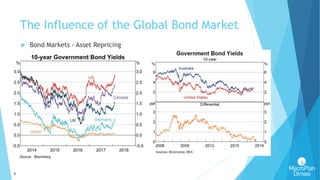
The Influence of the Global Bond Market
 Bond Markets - Asset Repricing
6
NATIONAL…
7
 High population growth – (1.6% or 388,000 + p.a.)
 Increasing household formation – (↑15 – 64 years)
 Retirement explosion - (65+ ↑ 42% 2006-2016)
 Employment churn (20%), then growth (1-2% p.a.)
 GDP at trend rate - (3% - 3.5% p.a.)
 Gearshift from resources → construction → services
 Fast growth in tourism, health, education
 Post GFC economy - ↑ wealth ↓ savings ↑ retail
 ↑ Asset repricing
National Economic Context
8
National Fundamentals
 The major impacts of the mining boom will finish by 2021/2022
 This means a return to fundamentals
 Market differentiation i.e. major geographic differences in demand
and supply, price having regard to global conditions
Demand Demographics
Jobs (Economic) Tradeable
Services
Supply Land (prices up)
Housing
9
National Transformation Factors
 Infrastructure spending boom
 Increase in jobs
 New geographies
 Technology driven restructure
 Amazon
 Growth in IT and Professional Services
 New Labour catchments
 Gig and share economies
10
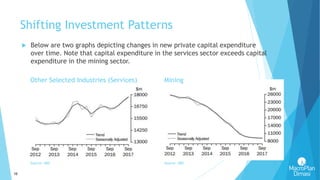
Shifting Investment Patterns
 Below are two graphs depicting changes in new private capital expenditure
over time. Note that capital expenditure in the services sector exceeds capital
expenditure in the mining sector.
Source: ABS Source: ABS
Other Selected Industries (Services) Mining
11
Jobs – The Key Macro Drivers
 Globalisation, international trade, technology, wealth and demographics are
turbo charging growth and change in the service sector:
 Job growth,
 Interest Rates, and
 Key growth sectors – tourism, health, professional, scientific and technical
services, media and information technology, freight and logistics.
 Demand for housing is emerging in very different ways.
 Income growth is currently weak, however as jobs growth continues and the
market tightens, income growth will pick up.
12
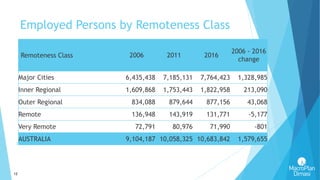
Employed Persons by Remoteness Class
Remoteness Class 2006 2011 2016
2006 - 2016
change
Major Cities 6,435,438 7,185,131 7,764,423 1,328,985
Inner Regional 1,609,868 1,753,443 1,822,958 213,090
Outer Regional 834,088 879,644 877,156 43,068
Remote 136,948 143,919 131,771 -5,177
Very Remote 72,791 80,976 71,990 -801
AUSTRALIA 9,104,187 10,058,325 10,683,842 1,579,655
Source: BITRE
13
SECTORS…
14
Retail
The Amazon effect
Sale of Westfield
Industrial property sales strong
Last mile supply chain industrial property
Strong Sydney office market
Strong Melbourne office market
Commercial Industrial
Sector Outlook
15
Economic Drivers: Sectors
 Tertiary Education
 Health and services expansion
 Tourism
 Freight and logistics: Exports
 Interest Rates Vs. International Bond Rates
 Property
 Household spending and lending
16
Property Supply: Medium Term Success
 Stock growth is currently outpacing demand.
 Given the previous and long period of demand outgrowing supply, a period
of supply outpacing demand can be sustained for some time.
 After a lag period, this situation will begin to put downward pressure on
prices and rents, which will be exacerbated if market activity remains
high.
 Little to no risk of ‘overbuild’ in the near future.
 Approvals and commencements of new dwellings will likely enter a
cyclical slow down but little risk of sharp fall.
17
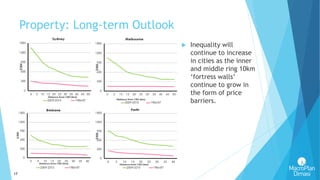
Property: Long-term Outlook
’
 Inequality will
continue to increase
in cities as the inner
and middle ring 10km
‘fortress walls’
continue to grow in
the form of price
barriers.
18
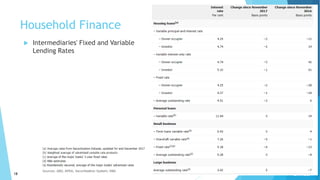
Household Finance
 Intermediaries' Fixed and Variable
Lending Rates
19
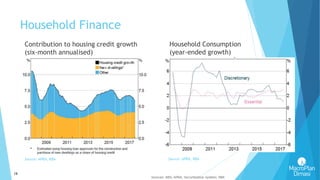
Household Finance
Source: APRA, RBA Source: APRA, RBA
Contribution to housing credit growth
(six-month annualised)
Household Consumption
(year-ended growth)
20
Property: Long-term Outlook
 These price barriers are driven by an increasing value being put on human
capital. Recent MacroPlan research, found that 50% of persons living in
Parramatta, commuting to Sydney CBD, would NOT take the same job if it was
available in Parramatta.
 Sydney CBD offers the professional networks, job densities, education and
potential for career enhancement, personal improvement and higher wages.
 Technology and the services economy are driving increasing centralisation in the
inner 10km and this trend is being supported by Federal and State infrastructure
plans.
 This centralisation drives high levels of productivity and high levels of inequality.
 Urban fringes and regional cities and towns are forced to rely primarily on low
paid population driven jobs (e.g. retail, health, education, police). This seriously
affects the economic and social sustainability of urban fringes and regional
cities.
21
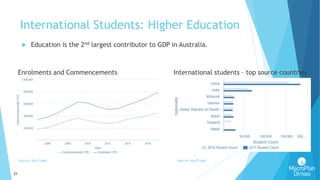
International Students: Higher Education
Source: AusTrade
 Education is the 2nd largest contributor to GDP in Australia.
Source: AusTrade
International students – top source countriesEnrolments and Commencements
22
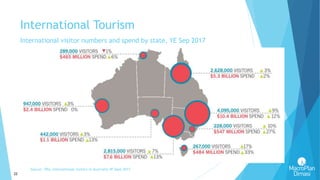
International Tourism
Source: TRA, International visitors in Australia YE Sept 2017
International visitor numbers and spend by state, YE Sep 2017
23
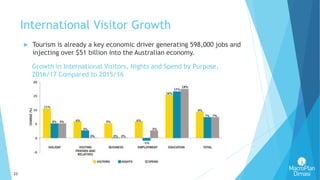
International Visitor Growth
 Tourism is already a key economic driver generating 598,000 jobs and
injecting over $51 billion into the Australian economy.
Growth in International Visitors, Nights and Spend by Purpose,
2016/17 Compared to 2015/16
24
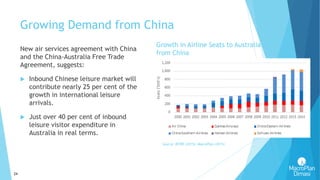
Growing Demand from China
Growth in Airline Seats to Australia
from China
Source: BITRE (2015); MacroPlan (2015)
New air services agreement with China
and the China-Australia Free Trade
Agreement, suggests:
 Inbound Chinese leisure market will
contribute nearly 25 per cent of the
growth in international leisure
arrivals.
 Just over 40 per cent of inbound
leisure visitor expenditure in
Australia in real terms.
25
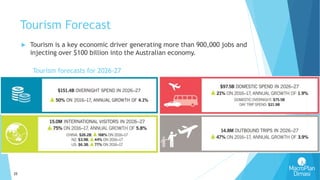
Tourism Forecast
 Tourism is a key economic driver generating more than 900,000 jobs and
injecting over $100 billion into the Australian economy.
Tourism forecasts for 2026-27
26
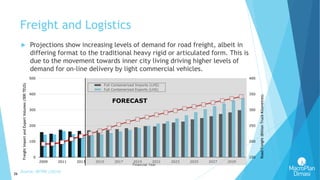
Freight and Logistics
150
200
250
300
350
400
0
100
200
300
400
500
2009 2011 2013 2015 2017 2019 2021 2023 2025 2027 2029
RoadFreight(BillionTruckKilometres)
FreightImportandExportVolumes('000TEUS)
Financial Year
Full Containerized Imports (LHS)
Full Containerized Exports (LHS)
FORECAST
Source: BITRE (2014)
 Projections show increasing levels of demand for road freight, albeit in
differing format to the traditional heavy rigid or articulated form. This is
due to the movement towards inner city living driving higher levels of
demand for on-line delivery by light commercial vehicles.
27
Challenges and Opportunities
27
 Australian cities and towns are on significantly different growth
trajectories and are at different stages of city-lifecycle.
 A significant increase in employment in the Business and Household
services sector is forecast. Future settlement planning for Australian cities
should focus on supporting Business and Household services exports.
 A significant increase in traffic congestion is forecast (Infrastructure
Australia Audit 2015) in all cities. This will cost over $50 billion annually.
28
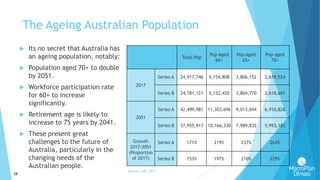
The Ageing Australian Population
 Its no secret that Australia has
an ageing population, notably:
 Population aged 70+ to double
by 2051.
 Workforce participation rate
for 60+ to increase
significantly.
 Retirement age is likely to
increase to 75 years by 2041.
 These present great
challenges to the future of
Australia, particularly in the
changing needs of the
Australian people.
Source: ABS 2014
Total Pop
Pop Aged
60+
Pop Aged
65+
Pop aged
70+
2017
Series A 24,917,746 5,154,808 3,806,152 2,619,524
Series B 24,781,121 5,152,420 3,804,770 2,618,691
2051
Series A 42,499,981 11,303,696 9,013,694 6,916,826
Series B 37,955,917 10,166,330 7,989,835 5,993,181
Growth
2017-2051
(Proportion
of 2017)
Series A 171% 219% 237% 264%
Series B 153% 197% 210% 229%
29
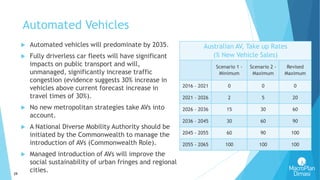
Automated Vehicles
 Automated vehicles will predominate by 2035.
 Fully driverless car fleets will have significant
impacts on public transport and will,
unmanaged, significantly increase traffic
congestion (evidence suggests 30% increase in
vehicles above current forecast increase in
travel times of 30%).
 No new metropolitan strategies take AVs into
account.
 A National Diverse Mobility Authority should be
initiated by the Commonwealth to manage the
introduction of AVs (Commonwealth Role).
 Managed introduction of AVs will improve the
social sustainability of urban fringes and regional
cities.
Australian AV, Take up Rates
(% New Vehicle Sales)
Scenario 1 -
Minimum
Scenario 2 -
Maximum
Revised
Maximum
2016 – 2021 0 0 0
2021 – 2026 2 5 20
2026 – 2036 15 30 60
2036 – 2045 30 60 90
2045 - 2055 60 90 100
2055 - 2065 100 100 100
30
The latest from Brian Haratsis…
www.macroplan.com.au | 02 9225 5211
31
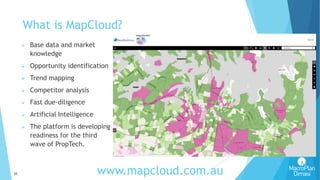
What is MapCloud?
 Base data and market
knowledge
 Opportunity identification
 Trend mapping
 Competitor analysis
 Fast due-diligence
 Artificial Intelligence
 The platform is developing
readiness for the third
wave of PropTech.
www.mapcloud.com.au
32
MapCloud free demonstration
 Go to www.mapcloud.com.au or download the ‘Mapcloud by MacroPlan’ app
 Go to ‘The Urban Developer Link’ located on the top right of the screen
 Follow the prompts
www.mapcloud.com.au
Password: urban2018

2018 Market Outlook

  • 1.
    2018 MARKET OUTLOOK FROMFAKE TO FUNDAMENTAL PROPERTY MARKETS BRIAN HARATSIS EXECUTIVE CHAIRMAN MACROPLAN
  • 2.
    2 Sector OutlookNational EconomicOutlookGlobal Economic Outlook Presentation Outline
  • 3.
  • 4.
    4 Global  Interest Ratesand Cheap Money  The rise in U.S. long term bond rates has caused a mild correction in world equity markets, this indicates that the U.S. Federal Reserve wants to cool markets.  No risk of global inflation impacting Australia  Jobs (Synchronised GDP Growth and China/Asia +/- Brexit (non- event))  Technology  Aussie $ as the X-factor
  • 5.
    5 The Influence ofthe Global Bond Market  Bond Markets - Asset Repricing
  • 6.
  • 7.
    7  High populationgrowth – (1.6% or 388,000 + p.a.)  Increasing household formation – (↑15 – 64 years)  Retirement explosion - (65+ ↑ 42% 2006-2016)  Employment churn (20%), then growth (1-2% p.a.)  GDP at trend rate - (3% - 3.5% p.a.)  Gearshift from resources → construction → services  Fast growth in tourism, health, education  Post GFC economy - ↑ wealth ↓ savings ↑ retail  ↑ Asset repricing National Economic Context
  • 8.
    8 National Fundamentals  Themajor impacts of the mining boom will finish by 2021/2022  This means a return to fundamentals  Market differentiation i.e. major geographic differences in demand and supply, price having regard to global conditions Demand Demographics Jobs (Economic) Tradeable Services Supply Land (prices up) Housing
  • 9.
    9 National Transformation Factors Infrastructure spending boom  Increase in jobs  New geographies  Technology driven restructure  Amazon  Growth in IT and Professional Services  New Labour catchments  Gig and share economies
  • 10.
    10 Shifting Investment Patterns Below are two graphs depicting changes in new private capital expenditure over time. Note that capital expenditure in the services sector exceeds capital expenditure in the mining sector. Source: ABS Source: ABS Other Selected Industries (Services) Mining
  • 11.
    11 Jobs – TheKey Macro Drivers  Globalisation, international trade, technology, wealth and demographics are turbo charging growth and change in the service sector:  Job growth,  Interest Rates, and  Key growth sectors – tourism, health, professional, scientific and technical services, media and information technology, freight and logistics.  Demand for housing is emerging in very different ways.  Income growth is currently weak, however as jobs growth continues and the market tightens, income growth will pick up.
  • 12.
    12 Employed Persons byRemoteness Class Remoteness Class 2006 2011 2016 2006 - 2016 change Major Cities 6,435,438 7,185,131 7,764,423 1,328,985 Inner Regional 1,609,868 1,753,443 1,822,958 213,090 Outer Regional 834,088 879,644 877,156 43,068 Remote 136,948 143,919 131,771 -5,177 Very Remote 72,791 80,976 71,990 -801 AUSTRALIA 9,104,187 10,058,325 10,683,842 1,579,655 Source: BITRE
  • 13.
  • 14.
    14 Retail The Amazon effect Saleof Westfield Industrial property sales strong Last mile supply chain industrial property Strong Sydney office market Strong Melbourne office market Commercial Industrial Sector Outlook
  • 15.
    15 Economic Drivers: Sectors Tertiary Education  Health and services expansion  Tourism  Freight and logistics: Exports  Interest Rates Vs. International Bond Rates  Property  Household spending and lending
  • 16.
    16 Property Supply: MediumTerm Success  Stock growth is currently outpacing demand.  Given the previous and long period of demand outgrowing supply, a period of supply outpacing demand can be sustained for some time.  After a lag period, this situation will begin to put downward pressure on prices and rents, which will be exacerbated if market activity remains high.  Little to no risk of ‘overbuild’ in the near future.  Approvals and commencements of new dwellings will likely enter a cyclical slow down but little risk of sharp fall.
  • 17.
    17 Property: Long-term Outlook ’ Inequality will continue to increase in cities as the inner and middle ring 10km ‘fortress walls’ continue to grow in the form of price barriers.
  • 18.
    18 Household Finance  Intermediaries'Fixed and Variable Lending Rates
  • 19.
    19 Household Finance Source: APRA,RBA Source: APRA, RBA Contribution to housing credit growth (six-month annualised) Household Consumption (year-ended growth)
  • 20.
    20 Property: Long-term Outlook These price barriers are driven by an increasing value being put on human capital. Recent MacroPlan research, found that 50% of persons living in Parramatta, commuting to Sydney CBD, would NOT take the same job if it was available in Parramatta.  Sydney CBD offers the professional networks, job densities, education and potential for career enhancement, personal improvement and higher wages.  Technology and the services economy are driving increasing centralisation in the inner 10km and this trend is being supported by Federal and State infrastructure plans.  This centralisation drives high levels of productivity and high levels of inequality.  Urban fringes and regional cities and towns are forced to rely primarily on low paid population driven jobs (e.g. retail, health, education, police). This seriously affects the economic and social sustainability of urban fringes and regional cities.
  • 21.
    21 International Students: HigherEducation Source: AusTrade  Education is the 2nd largest contributor to GDP in Australia. Source: AusTrade International students – top source countriesEnrolments and Commencements
  • 22.
    22 International Tourism Source: TRA,International visitors in Australia YE Sept 2017 International visitor numbers and spend by state, YE Sep 2017
  • 23.
    23 International Visitor Growth Tourism is already a key economic driver generating 598,000 jobs and injecting over $51 billion into the Australian economy. Growth in International Visitors, Nights and Spend by Purpose, 2016/17 Compared to 2015/16
  • 24.
    24 Growing Demand fromChina Growth in Airline Seats to Australia from China Source: BITRE (2015); MacroPlan (2015) New air services agreement with China and the China-Australia Free Trade Agreement, suggests:  Inbound Chinese leisure market will contribute nearly 25 per cent of the growth in international leisure arrivals.  Just over 40 per cent of inbound leisure visitor expenditure in Australia in real terms.
  • 25.
    25 Tourism Forecast  Tourismis a key economic driver generating more than 900,000 jobs and injecting over $100 billion into the Australian economy. Tourism forecasts for 2026-27
  • 26.
    26 Freight and Logistics 150 200 250 300 350 400 0 100 200 300 400 500 20092011 2013 2015 2017 2019 2021 2023 2025 2027 2029 RoadFreight(BillionTruckKilometres) FreightImportandExportVolumes('000TEUS) Financial Year Full Containerized Imports (LHS) Full Containerized Exports (LHS) FORECAST Source: BITRE (2014)  Projections show increasing levels of demand for road freight, albeit in differing format to the traditional heavy rigid or articulated form. This is due to the movement towards inner city living driving higher levels of demand for on-line delivery by light commercial vehicles.
  • 27.
    27 Challenges and Opportunities 27 Australian cities and towns are on significantly different growth trajectories and are at different stages of city-lifecycle.  A significant increase in employment in the Business and Household services sector is forecast. Future settlement planning for Australian cities should focus on supporting Business and Household services exports.  A significant increase in traffic congestion is forecast (Infrastructure Australia Audit 2015) in all cities. This will cost over $50 billion annually.
  • 28.
    28 The Ageing AustralianPopulation  Its no secret that Australia has an ageing population, notably:  Population aged 70+ to double by 2051.  Workforce participation rate for 60+ to increase significantly.  Retirement age is likely to increase to 75 years by 2041.  These present great challenges to the future of Australia, particularly in the changing needs of the Australian people. Source: ABS 2014 Total Pop Pop Aged 60+ Pop Aged 65+ Pop aged 70+ 2017 Series A 24,917,746 5,154,808 3,806,152 2,619,524 Series B 24,781,121 5,152,420 3,804,770 2,618,691 2051 Series A 42,499,981 11,303,696 9,013,694 6,916,826 Series B 37,955,917 10,166,330 7,989,835 5,993,181 Growth 2017-2051 (Proportion of 2017) Series A 171% 219% 237% 264% Series B 153% 197% 210% 229%
  • 29.
    29 Automated Vehicles  Automatedvehicles will predominate by 2035.  Fully driverless car fleets will have significant impacts on public transport and will, unmanaged, significantly increase traffic congestion (evidence suggests 30% increase in vehicles above current forecast increase in travel times of 30%).  No new metropolitan strategies take AVs into account.  A National Diverse Mobility Authority should be initiated by the Commonwealth to manage the introduction of AVs (Commonwealth Role).  Managed introduction of AVs will improve the social sustainability of urban fringes and regional cities. Australian AV, Take up Rates (% New Vehicle Sales) Scenario 1 - Minimum Scenario 2 - Maximum Revised Maximum 2016 – 2021 0 0 0 2021 – 2026 2 5 20 2026 – 2036 15 30 60 2036 – 2045 30 60 90 2045 - 2055 60 90 100 2055 - 2065 100 100 100
  • 30.
    30 The latest fromBrian Haratsis… www.macroplan.com.au | 02 9225 5211
  • 31.
    31 What is MapCloud? Base data and market knowledge  Opportunity identification  Trend mapping  Competitor analysis  Fast due-diligence  Artificial Intelligence  The platform is developing readiness for the third wave of PropTech. www.mapcloud.com.au
  • 32.
    32 MapCloud free demonstration Go to www.mapcloud.com.au or download the ‘Mapcloud by MacroPlan’ app  Go to ‘The Urban Developer Link’ located on the top right of the screen  Follow the prompts www.mapcloud.com.au Password: urban2018