What do we know about the productivity
slowdown?
Kevin J. Fox
OECD Global Forum on Productivity
Ottawa, 28-29 June 2018
UNSW Business School
Centre for Applied Economic Research
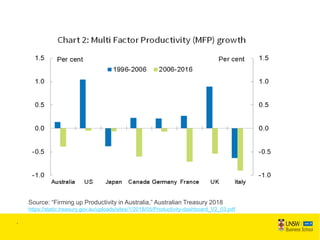
Source: “Firming up Productivity in Australia,” Australian Treasury 2018
https://static.treasury.gov.au/uploads/sites/1/2018/05/Productivity-dashboard_V2_03.pdf
.
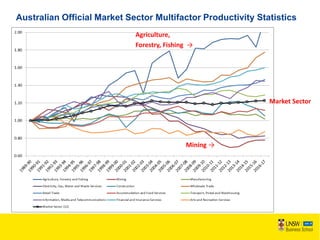
Australian Official Market Sector Multifactor Productivity Statistics
Agriculture,
Forestry, Fishing →
Market Sector
Mining →
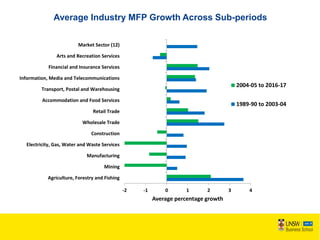
Average Industry MFP Growth Across Sub-periods
-2 -1 0 1 2 3 4
Agriculture, Forestry and Fishing
Mining
Manufacturing
Electricity, Gas, Water and Waste Services
Construction
Wholesale Trade
Retail Trade
Accommodation and Food Services
Transport, Postal and Warehousing
Information, Media and Telecommunications
Financial and Insurance Services
Arts and Recreation Services
Market Sector (12)
Average percentage growth
2004-05 to 2016-17
1989-90 to 2003-04
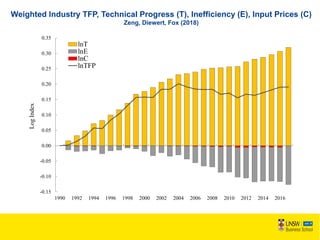
Weighted Industry TFP, Technical Progress (T), Inefficiency (E), Input Prices (C)
Zeng, Diewert, Fox (2018)
-0.15
-0.10
-0.05
0.00
0.05
0.10
0.15
0.20
0.25
0.30
0.35
1990 1992 1994 1996 1998 2000 2002 2004 2006 2008 2010 2012 2014 2016
LogIndex
lnT
lnE
lnC
lnTFP
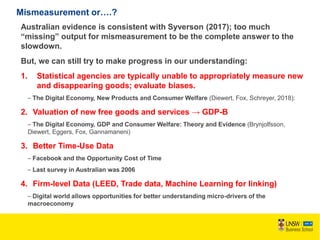
Mismeasurement or….?
Australian evidence is consistent with Syverson (2017); too much
“missing” output for mismeasurement to be the complete answer to the
slowdown.
But, we can still try to make progress in our understanding:
1. Statistical agencies are typically unable to appropriately measure new
and disappearing goods; evaluate biases.
– The Digital Economy, New Products and Consumer Welfare (Diewert, Fox, Schreyer, 2018):
2. Valuation of new free goods and services → GDP-B
– The Digital Economy, GDP and Consumer Welfare: Theory and Evidence (Brynjolfsson,
Diewert, Eggers, Fox, Gannamaneni)
3. Better Time-Use Data
– Facebook and the Opportunity Cost of Time
– Last survey in Australian was 2006
4. Firm-level Data (LEED, Trade data, Machine Learning for linking)
– Digital world allows opportunities for better understanding micro-drivers of the
macroeconomy

Kevin Fox

  • 1.
    What do weknow about the productivity slowdown? Kevin J. Fox OECD Global Forum on Productivity Ottawa, 28-29 June 2018 UNSW Business School Centre for Applied Economic Research
  • 2.
    Source: “Firming upProductivity in Australia,” Australian Treasury 2018 https://static.treasury.gov.au/uploads/sites/1/2018/05/Productivity-dashboard_V2_03.pdf .
  • 3.
    Australian Official MarketSector Multifactor Productivity Statistics Agriculture, Forestry, Fishing → Market Sector Mining →
  • 4.
    Average Industry MFPGrowth Across Sub-periods -2 -1 0 1 2 3 4 Agriculture, Forestry and Fishing Mining Manufacturing Electricity, Gas, Water and Waste Services Construction Wholesale Trade Retail Trade Accommodation and Food Services Transport, Postal and Warehousing Information, Media and Telecommunications Financial and Insurance Services Arts and Recreation Services Market Sector (12) Average percentage growth 2004-05 to 2016-17 1989-90 to 2003-04
  • 5.
    Weighted Industry TFP,Technical Progress (T), Inefficiency (E), Input Prices (C) Zeng, Diewert, Fox (2018) -0.15 -0.10 -0.05 0.00 0.05 0.10 0.15 0.20 0.25 0.30 0.35 1990 1992 1994 1996 1998 2000 2002 2004 2006 2008 2010 2012 2014 2016 LogIndex lnT lnE lnC lnTFP
  • 6.
    Mismeasurement or….? Australian evidenceis consistent with Syverson (2017); too much “missing” output for mismeasurement to be the complete answer to the slowdown. But, we can still try to make progress in our understanding: 1. Statistical agencies are typically unable to appropriately measure new and disappearing goods; evaluate biases. – The Digital Economy, New Products and Consumer Welfare (Diewert, Fox, Schreyer, 2018): 2. Valuation of new free goods and services → GDP-B – The Digital Economy, GDP and Consumer Welfare: Theory and Evidence (Brynjolfsson, Diewert, Eggers, Fox, Gannamaneni) 3. Better Time-Use Data – Facebook and the Opportunity Cost of Time – Last survey in Australian was 2006 4. Firm-level Data (LEED, Trade data, Machine Learning for linking) – Digital world allows opportunities for better understanding micro-drivers of the macroeconomy