Federal Budget 2014:
Key facts & tips
insight
The 2014 Federal Budget has been handed down and has
been met with mixed reactions of varying degrees of support
and criticism with winners and losers across all sectors where
businesses will be effected directly or indirectly.
The government has stated that this budget is geared towards
long term economic recovery based, in part, on the Australian
business sector’s ability to diversify, to compete globally, and
to generate greater revenue.
The 2014-15 Federal Budget
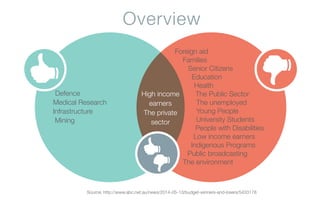
High income
earners
The private
sector
Overview
Foreign aid
Families
Senior Citizens
Education
Health
The Public Sector
The unemployed
Young People
University Students
People with Disabilities
Low income earners
Indigenous Programs
Public broadcasting
The environment
Source: http://www.abc.net.au/news/2014-05-13/budget-winners-and-losers/5433178
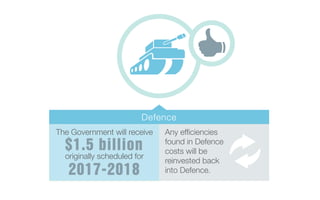
Defence
Medical Research
Infrastructure
Mining
Any efficiencies
found in Defence
costs will be
reinvested back
into Defence.
The Government will receive
originally scheduled for
$1.5 billion
Defence
2017-2018
Medical
Research
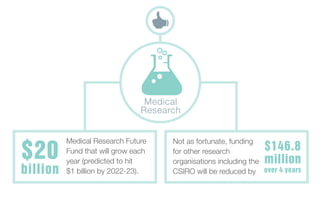
Medical Research Future
Fund that will grow each
year (predicted to hit
$1 billion by 2022-23).
$20
billion
Not as fortunate, funding
for other research
organisations including the
CSIRO will be reduced by
$146.8
million
over 4 years
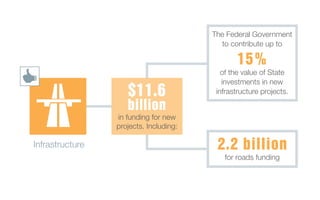
Infrastructure
for roads funding
15%
2.2 billion
The Federal Government
to contribute up to
of the value of State
investments in new
infrastructure projects.$11.6
billion
in funding for new
projects. Including:
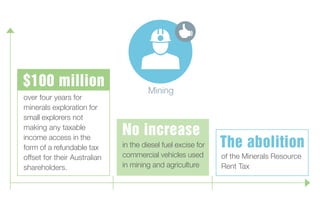
of the Minerals Resource
Rent Tax
Mining
No increase
The abolition
over four years for
minerals exploration for
small explorers not
making any taxable
income access in the
form of a refundable tax
offset for their Australian
shareholders.
in the diesel fuel excise for
commercial vehicles used
in mining and agriculture
$100 million
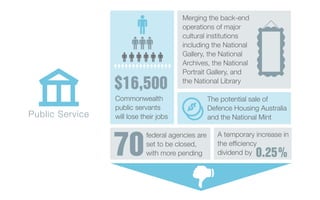
A temporary increase in
the efficiency
dividend by
Public Service
$16,500
70 0.25%
Commonwealth
public servants
will lose their jobs
federal agencies are
set to be closed,
with more pending
Merging the back-end
operations of major
cultural institutions
including the National
Gallery, the National
Archives, the National
Portrait Gallery, and
the National Library
The potential sale of
Defence Housing Australia
and the National Mint
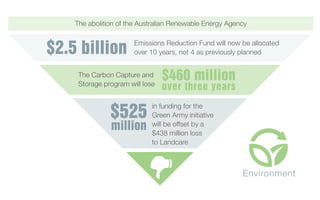
Environment
The abolition of the Australian Renewable Energy Agency
$2.5 billion
$460 million
over three years
$525
million
Emissions Reduction Fund will now be allocated
over 10 years, not 4 as previously planned
The Carbon Capture and
Storage program will lose
in funding for the
Green Army initiative
will be offset by a
$438 million loss
to Landcare
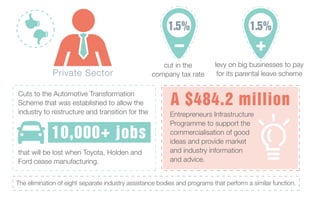
Private Sector
1.5%
cut in the
company tax rate
levy on big businesses to pay
for its parental leave scheme
A $484.2 million
Entrepreneurs Infrastructure
Programme to support the
commercialisation of good
ideas and provide market
and industry information
and advice.
Cuts to the Automotive Transformation
Scheme that was established to allow the
industry to restructure and transition for the
that will be lost when Toyota, Holden and
Ford cease manufacturing.
The elimination of eight separate industry assistance bodies and programs that perform a similar function.
1.5%
10,000+ jobs
+
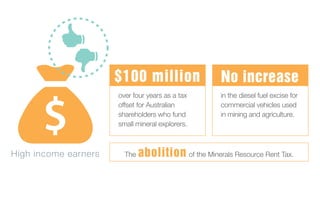
High income earners
over four years as a tax
offset for Australian
shareholders who fund
small mineral explorers.
in the diesel fuel excise for
commercial vehicles used
in mining and agriculture.
The abolition of the Minerals Resource Rent Tax.
No increase$100 million
Budget time is always a good time to review your
infrastructure and practices.
While the 2014 Budget has winners & losers, its a chance
to look for the opportunities for your organisation.
So what does it mean for you?
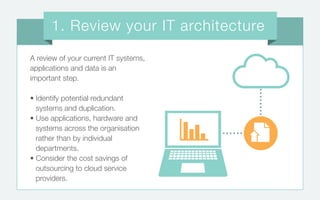
A review of your current IT systems,
applications and data is an
important step.
• Identify potential redundant
systems and duplication.
• Use applications, hardware and
systems across the organisation
rather than by individual
departments.
• Consider the cost savings of
outsourcing to cloud service
providers.
1. Review your IT architecture
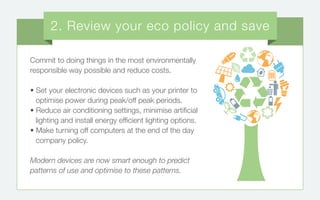
Commit to doing things in the most environmentally
responsible way possible and reduce costs.
• Set your electronic devices such as your printer to
optimise power during peak/off peak periods.
• Reduce air conditioning settings, minimise artificial
lighting and install energy efficient lighting options.
• Make turning off computers at the end of the day
company policy.
Modern devices are now smart enough to predict
patterns of use and optimise to these patterns.
2. Review your eco policy and save
Simple strategies can make a big difference
to business operational costs.
• Challenge your staff to find ways to do
things differently.
• Reducing the paper trail and establishing
an electronic workflow will improve
efficiencies, minimise risk of human error,
and save you money on paper.
• Offer incentives for employees who
suggest ideas that will help the company
save money and improve performance.
3. Work together to streamline processes
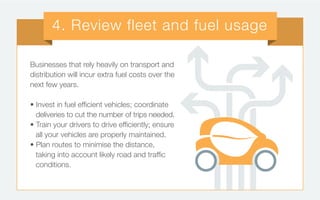
Businesses that rely heavily on transport and
distribution will incur extra fuel costs over the
next few years.
• Invest in fuel efficient vehicles; coordinate
deliveries to cut the number of trips needed.
• Train your drivers to drive efficiently; ensure
all your vehicles are properly maintained.
• Plan routes to minimise the distance,
taking into account likely road and traffic
conditions.
4. Review fleet and fuel usage
“The Federal Budget 2014 focused on the expenditure side of
the ledger for the longer term together with two revenue raising
measures to substantially reduce the forecasted budget deficits.
… In essence, the Government's strategy centres on
expenditure savings in the areas of health service contributions,
foreign aid, education loan programs, family and other welfare
benefits. Coupled with the reintroduction of fuel excise
indexation and a personal tax increase, the Budget savings
dramatically reduce the forecasted deficits. The Budget also
makes room for redirected expenditure priorities in infrastructure
and the establishment of a medical research future fund.”
KPMG's Federal Budget Brief 2014
A final word from the experts
Australian Industry Group
Chief Executive, Innes Willox
Institute of Chartered
Accountants Australia
“… many of the challenges
confronting us require
long-term solutions. We
need to remain competitive
globally into the future and
this year's federal budget
presents an opportunity to
rise to that challenge.”
“The Government's proposals to rein in
spending growth and to reintroduce fuel
tax indexation are difficult measures spread
across all sections of the community –
including businesses. In the face of the
undisputed longer-term pressures on
Australia's public finances the measures
will put the budget on a more secure
foundation and will make the Australian
economy more productive and resilient.”
Our Print & Document Management services and systems can free IT
teams and businesses from the struggle of managing a large printing
infrastructure and re-focus their energies on building their core business.
We can analyse both print environments and document-dependent
business processes in order to diagnose cost saving and productivity
enhancing opportunities.
For more information visit www.konicaminolta.com.au or
Free Call: 1800 789 389
Konica Minolta can help

Konica minolta2014budget slideshow_20140612

  • 1.
    Federal Budget 2014: Keyfacts & tips insight
  • 2.
    The 2014 FederalBudget has been handed down and has been met with mixed reactions of varying degrees of support and criticism with winners and losers across all sectors where businesses will be effected directly or indirectly. The government has stated that this budget is geared towards long term economic recovery based, in part, on the Australian business sector’s ability to diversify, to compete globally, and to generate greater revenue. The 2014-15 Federal Budget
  • 3.
    High income earners The private sector Overview Foreignaid Families Senior Citizens Education Health The Public Sector The unemployed Young People University Students People with Disabilities Low income earners Indigenous Programs Public broadcasting The environment Source: http://www.abc.net.au/news/2014-05-13/budget-winners-and-losers/5433178 Defence Medical Research Infrastructure Mining
  • 4.
    Any efficiencies found inDefence costs will be reinvested back into Defence. The Government will receive originally scheduled for $1.5 billion Defence 2017-2018
  • 5.
    Medical Research Medical Research Future Fundthat will grow each year (predicted to hit $1 billion by 2022-23). $20 billion Not as fortunate, funding for other research organisations including the CSIRO will be reduced by $146.8 million over 4 years
  • 6.
    Infrastructure for roads funding 15% 2.2billion The Federal Government to contribute up to of the value of State investments in new infrastructure projects.$11.6 billion in funding for new projects. Including:
  • 7.
    of the MineralsResource Rent Tax Mining No increase The abolition over four years for minerals exploration for small explorers not making any taxable income access in the form of a refundable tax offset for their Australian shareholders. in the diesel fuel excise for commercial vehicles used in mining and agriculture $100 million
  • 8.
    A temporary increasein the efficiency dividend by Public Service $16,500 70 0.25% Commonwealth public servants will lose their jobs federal agencies are set to be closed, with more pending Merging the back-end operations of major cultural institutions including the National Gallery, the National Archives, the National Portrait Gallery, and the National Library The potential sale of Defence Housing Australia and the National Mint
  • 9.
    Environment The abolition ofthe Australian Renewable Energy Agency $2.5 billion $460 million over three years $525 million Emissions Reduction Fund will now be allocated over 10 years, not 4 as previously planned The Carbon Capture and Storage program will lose in funding for the Green Army initiative will be offset by a $438 million loss to Landcare
  • 10.
    Private Sector 1.5% cut inthe company tax rate levy on big businesses to pay for its parental leave scheme A $484.2 million Entrepreneurs Infrastructure Programme to support the commercialisation of good ideas and provide market and industry information and advice. Cuts to the Automotive Transformation Scheme that was established to allow the industry to restructure and transition for the that will be lost when Toyota, Holden and Ford cease manufacturing. The elimination of eight separate industry assistance bodies and programs that perform a similar function. 1.5% 10,000+ jobs +
  • 11.
    High income earners overfour years as a tax offset for Australian shareholders who fund small mineral explorers. in the diesel fuel excise for commercial vehicles used in mining and agriculture. The abolition of the Minerals Resource Rent Tax. No increase$100 million
  • 12.
    Budget time isalways a good time to review your infrastructure and practices. While the 2014 Budget has winners & losers, its a chance to look for the opportunities for your organisation. So what does it mean for you?
  • 13.
    A review ofyour current IT systems, applications and data is an important step. • Identify potential redundant systems and duplication. • Use applications, hardware and systems across the organisation rather than by individual departments. • Consider the cost savings of outsourcing to cloud service providers. 1. Review your IT architecture
  • 14.
    Commit to doingthings in the most environmentally responsible way possible and reduce costs. • Set your electronic devices such as your printer to optimise power during peak/off peak periods. • Reduce air conditioning settings, minimise artificial lighting and install energy efficient lighting options. • Make turning off computers at the end of the day company policy. Modern devices are now smart enough to predict patterns of use and optimise to these patterns. 2. Review your eco policy and save
  • 15.
    Simple strategies canmake a big difference to business operational costs. • Challenge your staff to find ways to do things differently. • Reducing the paper trail and establishing an electronic workflow will improve efficiencies, minimise risk of human error, and save you money on paper. • Offer incentives for employees who suggest ideas that will help the company save money and improve performance. 3. Work together to streamline processes
  • 16.
    Businesses that relyheavily on transport and distribution will incur extra fuel costs over the next few years. • Invest in fuel efficient vehicles; coordinate deliveries to cut the number of trips needed. • Train your drivers to drive efficiently; ensure all your vehicles are properly maintained. • Plan routes to minimise the distance, taking into account likely road and traffic conditions. 4. Review fleet and fuel usage
  • 17.
    “The Federal Budget2014 focused on the expenditure side of the ledger for the longer term together with two revenue raising measures to substantially reduce the forecasted budget deficits. … In essence, the Government's strategy centres on expenditure savings in the areas of health service contributions, foreign aid, education loan programs, family and other welfare benefits. Coupled with the reintroduction of fuel excise indexation and a personal tax increase, the Budget savings dramatically reduce the forecasted deficits. The Budget also makes room for redirected expenditure priorities in infrastructure and the establishment of a medical research future fund.” KPMG's Federal Budget Brief 2014 A final word from the experts
  • 18.
    Australian Industry Group ChiefExecutive, Innes Willox Institute of Chartered Accountants Australia “… many of the challenges confronting us require long-term solutions. We need to remain competitive globally into the future and this year's federal budget presents an opportunity to rise to that challenge.” “The Government's proposals to rein in spending growth and to reintroduce fuel tax indexation are difficult measures spread across all sections of the community – including businesses. In the face of the undisputed longer-term pressures on Australia's public finances the measures will put the budget on a more secure foundation and will make the Australian economy more productive and resilient.”
  • 19.
    Our Print &Document Management services and systems can free IT teams and businesses from the struggle of managing a large printing infrastructure and re-focus their energies on building their core business. We can analyse both print environments and document-dependent business processes in order to diagnose cost saving and productivity enhancing opportunities. For more information visit www.konicaminolta.com.au or Free Call: 1800 789 389 Konica Minolta can help