Arnold Bregt
SDI from a technological
perspective: Standards
2
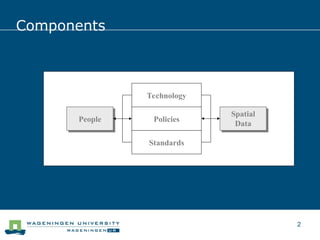
Components
People
Technology
Policies
Standards
Spatial
Data
3
Contents
 Why Standards?
 Classification of standards
 Standardization organizations
 Standards for SDI
4
Standards
 Can you mention a few standards in daily life?
5
Standards – make life easier
6
Why Standards?
 Efficiency
 Rules and threshold for society
 Increase connectivity
7
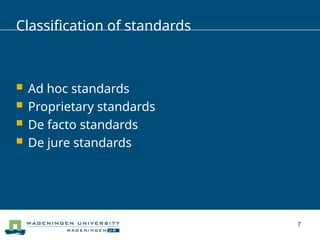
Classification of standards
 Ad hoc standards
 Proprietary standards
 De facto standards
 De jure standards
8
9
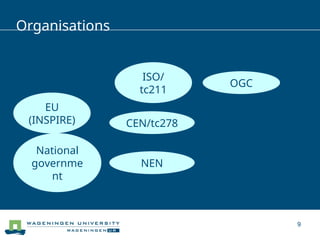
Organisations
ISO/
tc211
CEN/tc278
NEN
OGC
EU
(INSPIRE)
National
governme
nt
10
Standardization organizations
 ISO
 OGC
 CEN
11
ISO
 Founded 1926
 Non-governmental organization
 1994 ISO TC 211 Geographic
information/geomatics
 http://www.isotc211.org/
12
Organization - process
 ISO
 Technical committee (TC) for particular domain
• Working group (WG) for particular group of standards
– Project team (PT) for particular standard
 Stages
1. Proposal (NWIP = New Work Item Proposal) -> TC
2. Preparatory stage (WD = working draft) -> WG
3. Committee stage (CD = committee draft) -> TC
4. Enquiry stage (FDIS = (final) draft international standard)
5. Approval stage -> TC & all ISO member bodies: final Yes/No
6. Publication stage (IS = international standard)
13
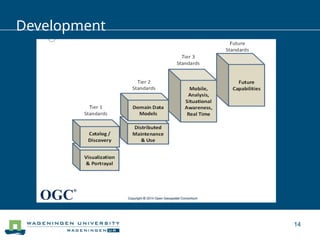
OGC
 Open Geospatial consortium
 Founded 1994
 Industry consortium
 Implementation specifications
 For instance: WMS, WFS, GML,
 http://www.opengeospatial.org/
 Testing of implemenations
Development
14
15
CEN (now dormant 2015)
 CEN organization 1961
 TC 287 (Geographic information)
 Founded 1991
 Revival in 2004
 Adoption of ISO standards
 http://www.centc287.eu/
16
Used specifications
 OGC web-site (nog
17
Standards for SDI (basis)
 Meta-data
 Spatial data reference models
 Services
18
Metadata
 ISO 19115 (formal description)
 ISO 19139 (technical implementation)
 Catalog service (CAT)
 Metadata about services (ISO 19119 )
19
Spatial data reference models
 ISO 19101 (reference model)
 ISO 19107 (Spatial schema)
 ISO 19108 (Temporal schema)
 ISO 19109 (Application schema)
 ISO 19111 (Spatial referencing by coordinates)
 ISO 19112 (Spatial referencing by geographic
identifiers)
20
Services
 Web map service (WMS)
 Web feature service (WFS)
 Web coverage service (WCS)
21
Mapping
service Sensor
service
Image
service
Geo
spatial
service
But we are in the geospatial business
Source
Cooperation ISO and OGC
22
23
INSPIRE- Implementing Rules (IR)
 IR for the creation and updating of metadata
 IR for monitoring and reporting
 IR for discovery and view services
 IR for download services
 IR for coordinates transformation service
 IR governing the access rights of use to spatial data sets
and services for Community institutions and bodies
 IRs for the interoperability and harmonization of spatial
data sets and services for Annex I spatial data themes
24
INSPIRE
 http://geostandards.geonovum.nl
 http://inspire.jrc.ec.europa.eu/
Summary
 There are a lot of GI standards
 Produced by ISO, OGC and CEN (Europe)
 Implemented in a variety of software
implementations
 Large part of it is used and relevant for SDI
25
Thank you for your attention!
Questions

SDI FROM A TECHNICAL PERSPECTIVE STANDARDS

Editor's Notes

  • #9 NEN, CEN, ISO = non-profit, national representatives, but of course national interests at stake related to national industry. ISO/tc211 = international standardisation organisation, tc211 geomatics CEN/tc278 = european standardisation organisation , tc278 geomatics NEN = netherlands standardisation organisation CEN adopts ISO. What does adopt mean? Varies from nothing much to developing profiles / application schemas and proposing new work items NEN adopts ISO. Not sure if this goes via CEN. Varies from nothing much to developing profiles / application schemas and proposing new work items. AND: here is where you buy a GI standard EU and national governments can decide that certain standards are mandatory. E.g. in EU INSPIRE is like a law. EU does what the E countries want, so lots of negotiation -> not whole standard compulsory but subset -> registered for publication as profile or application at CEN. Possibly at ISO. E countries obliged to adopt EU legislation. So, countries can decide certain standards to be compulsory. But may also be less stringent. E.g. govt. recommending use of specific standard. Govt. deciding that within the own organisation will be working with particular standards. OGC = profit = industry consortium. Tries to influence ISO/TC211. Out of company interests. If industry needs standard but ISO is not working on it or working on it too slowly. Industry consortium works faster because spending less time on consensus building. Risk: responding to interests of private companies, not society. Responding only to interests of companies who have resources for involvement in standardisation. Benefit: fast and possibly more in touch with users’ needs
  • #12 So people in the project team write the standard. In various stages they get comments which they have to process. They do that via e-mail and web correspondence and at occasional PT or WG meetings. Whole procedure can take up to 5 years! If not completed and still need for it, whole process starts over again. For this reason often completed just before deadline to avoid all efforts of being officially deleted.