Rotational Design:
Simulation Across the
Curriculum
Sara Fruechting, RN, MNSc, CCRN,CHSE
Jeffrey K. Carmack, DNP, MSN, RN,
CHSE
INACSL, 2015, Atlanta
ANCC Required Disclosures
Conflict of interest
• Jeffrey Carmack reports no conflict of interest
• Sara Fruechting reports no conflict of interest
Successful completion
• Attend 90% of session
• Complete online evaluation
Objectives
• The participants will
– identify appropriate situations for integration of
simulation based learning experiences across the
curriculum
– Understand limitation of the champion model
– explore the concierge model of simulation based
learning experiences
– examine the financial benefits of using a rotational
design for scheduling of students for simulation
based learning experiences.
Terminology… A common ground
• High-fidelity simulation: Irrespective of the
type of simulator
• Champion program: One or two faculty lead a
single content area
• Full-Faculty program: Every faculty member is
required to use the simulation space
• Concierge: Dedicated faculty delivering high-
fidelity simulation
High-fidelity Simulation
• Faculty has extensive training
• Most faculty have immersion training
• INACSL Standards of Best Practice:
SimulationSM is the guiding framework
• Faculty utilizes a reflective debriefing tool
Models of Staffing
• Champion
– Begin with champion's area of expertise
– Build up to further courses
• Pros
– Limited support needed
– Only one facilitator needs training
• Cons
– Limited support given
– Workload is often underestimated
– May not have training
– Simulation lacks “program” status
Models of Staffing
• Full-Faculty program
– Creates a more inclusive curriculum
• Pros
– Limited support needed
– Simulations occur during regular clinical hours
– May meet the definition of “program”
• Cons
– Workload is often underestimated
– Training costs are substantial
– Oversight is intensive if you meet a standard
– Equipment training for all faculty
» Manikin
» A/V system
» Debriefing system
Models of Staffing
• Concierge Model
– Creates a comprehensive and cohesive curriculum
• Pros
– Faculty are dedicated (Workload is known)
– Limited faculty training needed
» Manikin (in-house PM program)
» A/V system
» Debriefing system
– Simulation program
» Budget
– Training costs are limited to faculty facilitating simulations
• Cons
– Needs at least 1 FTE without a teaching load
– University policies
– Evaluation method may not exist for tenure track
High-fidelity Simulation
• Faculty has extensive training
• Most faculty have immersion training
• INACSL Standards of Best Practice:
SimulationSM is the guiding framework
• Faculty utilizes a reflective debriefing tool
Silo or Program?
AZ ADVISORY OPINION:
EDUCATION USE OF SIMULATION
• Simulation should be part of
SPE
• Calls for facilitators to be
immersion trained and for
ongoing evaluation
• Simulation cases based on
curriculum
NCSBN Simulation Guidelines
• Must have a supported
program
• Budget must include
ongoing training of
facilitators
• Calls for evaluation of
components including
learners and programs
methods
Program costs related to faculty
• Initial immersion training?
$1,000 - $5,000
• Biennial conference or other training?
$550
• Certification?
$350
• Travel? Hotel? Transportation?
$$$$
Budget Questions
• How many faculty will you train?
• What is your turnover rate for clinical faculty?
• Are your faculty tenured?
• Do you also need skills lab faculty?
Training and Certification for 1
3 year cost=
$6,900
Annual cost=
$2,300
Rotational Design at Work
• Increase size of all clinical groups to allow one
faculty member to teach simulation
• Send a small number of students from each
group to simulation each clinical week
• This gets all students through simulation over
the semester without hiring additional faculty
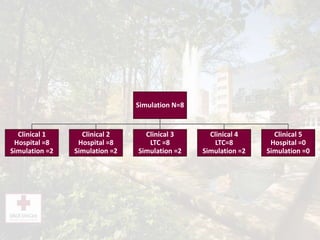
Simulation N=8
Clinical 1
Hospital =8
Simulation =2
Clinical 2
Hospital =8
Simulation =2
Clinical 3
LTC =8
Simulation =2
Clinical 4
LTC=8
Simulation =2
Clinical 5
Hospital =0
Simulation =0
N1505, Fundamentals
• Two faculty cover all simulation experiences
• Two hundred students enrolled
• Course divided into three rotations
– Simulation
– Long term care
– Acute care
• Simulation faculty have 70 students per week,
in groups of seven (five sessions per week)
N1505, Fundamentals
• One group of seven is in scenario with a
faculty running two mid-fidelity simulators
• Each simulator has an SP as a family member
• Twenty minutes in scenario and forty to
debrief
• The other seven students are working on skills
with the other faculty
• Both groups will be present for three hours,
once a week for four weeks.
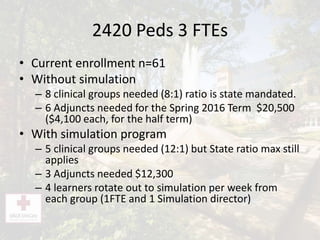
2420 Peds 3 FTEs
• Current enrollment n=61
• Without simulation
– 8 clinical groups needed (8:1) ratio is state mandated.
– 6 Adjuncts needed for the Spring 2016 Term $20,500
($4,100 each, for the half term)
• With simulation program
– 5 clinical groups needed (12:1) but State ratio max still
applies
– 3 Adjuncts needed $12,300
– 4 learners rotate out to simulation per week from
each group (1FTE and 1 Simulation director)
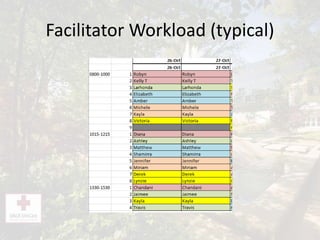
Facilitator Workload (typical)
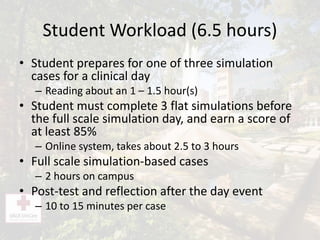
Student Workload (6.5 hours)
• Student prepares for one of three simulation
cases for a clinical day
– Reading about an 1 – 1.5 hour(s)
• Student must complete 3 flat simulations before
the full scale simulation day, and earn a score of
at least 85%
– Online system, takes about 2.5 to 3 hours
• Full scale simulation-based cases
– 2 hours on campus
• Post-test and reflection after the day event
– 10 to 15 minutes per case
Contact Information
• University of Arkansas at Little Rock
Department of Nursing
• Jeff Carmack 501.682.8620
jkcarmack@ualr.edu
• Sara Fruechting 501.371.7627
skfruechting@ualr.edu

2016 OADN Rotational Design Live

  • 1.
    Rotational Design: Simulation Acrossthe Curriculum Sara Fruechting, RN, MNSc, CCRN,CHSE Jeffrey K. Carmack, DNP, MSN, RN, CHSE INACSL, 2015, Atlanta
  • 2.
    ANCC Required Disclosures Conflictof interest • Jeffrey Carmack reports no conflict of interest • Sara Fruechting reports no conflict of interest Successful completion • Attend 90% of session • Complete online evaluation
  • 3.
    Objectives • The participantswill – identify appropriate situations for integration of simulation based learning experiences across the curriculum – Understand limitation of the champion model – explore the concierge model of simulation based learning experiences – examine the financial benefits of using a rotational design for scheduling of students for simulation based learning experiences.
  • 4.
    Terminology… A commonground • High-fidelity simulation: Irrespective of the type of simulator • Champion program: One or two faculty lead a single content area • Full-Faculty program: Every faculty member is required to use the simulation space • Concierge: Dedicated faculty delivering high- fidelity simulation
  • 5.
    High-fidelity Simulation • Facultyhas extensive training • Most faculty have immersion training • INACSL Standards of Best Practice: SimulationSM is the guiding framework • Faculty utilizes a reflective debriefing tool
  • 6.
    Models of Staffing •Champion – Begin with champion's area of expertise – Build up to further courses • Pros – Limited support needed – Only one facilitator needs training • Cons – Limited support given – Workload is often underestimated – May not have training – Simulation lacks “program” status
  • 7.
    Models of Staffing •Full-Faculty program – Creates a more inclusive curriculum • Pros – Limited support needed – Simulations occur during regular clinical hours – May meet the definition of “program” • Cons – Workload is often underestimated – Training costs are substantial – Oversight is intensive if you meet a standard – Equipment training for all faculty » Manikin » A/V system » Debriefing system
  • 8.
    Models of Staffing •Concierge Model – Creates a comprehensive and cohesive curriculum • Pros – Faculty are dedicated (Workload is known) – Limited faculty training needed » Manikin (in-house PM program) » A/V system » Debriefing system – Simulation program » Budget – Training costs are limited to faculty facilitating simulations • Cons – Needs at least 1 FTE without a teaching load – University policies – Evaluation method may not exist for tenure track
  • 9.
    High-fidelity Simulation • Facultyhas extensive training • Most faculty have immersion training • INACSL Standards of Best Practice: SimulationSM is the guiding framework • Faculty utilizes a reflective debriefing tool
  • 10.
    Silo or Program? AZADVISORY OPINION: EDUCATION USE OF SIMULATION • Simulation should be part of SPE • Calls for facilitators to be immersion trained and for ongoing evaluation • Simulation cases based on curriculum NCSBN Simulation Guidelines • Must have a supported program • Budget must include ongoing training of facilitators • Calls for evaluation of components including learners and programs methods
  • 11.
    Program costs relatedto faculty • Initial immersion training? $1,000 - $5,000 • Biennial conference or other training? $550 • Certification? $350 • Travel? Hotel? Transportation? $$$$
  • 12.
    Budget Questions • Howmany faculty will you train? • What is your turnover rate for clinical faculty? • Are your faculty tenured? • Do you also need skills lab faculty?
  • 13.
    Training and Certificationfor 1 3 year cost= $6,900 Annual cost= $2,300
  • 14.
    Rotational Design atWork • Increase size of all clinical groups to allow one faculty member to teach simulation • Send a small number of students from each group to simulation each clinical week • This gets all students through simulation over the semester without hiring additional faculty
  • 15.
    Simulation N=8 Clinical 1 Hospital=8 Simulation =2 Clinical 2 Hospital =8 Simulation =2 Clinical 3 LTC =8 Simulation =2 Clinical 4 LTC=8 Simulation =2 Clinical 5 Hospital =0 Simulation =0
  • 16.
    N1505, Fundamentals • Twofaculty cover all simulation experiences • Two hundred students enrolled • Course divided into three rotations – Simulation – Long term care – Acute care • Simulation faculty have 70 students per week, in groups of seven (five sessions per week)
  • 17.
    N1505, Fundamentals • Onegroup of seven is in scenario with a faculty running two mid-fidelity simulators • Each simulator has an SP as a family member • Twenty minutes in scenario and forty to debrief • The other seven students are working on skills with the other faculty • Both groups will be present for three hours, once a week for four weeks.
  • 18.
    2420 Peds 3FTEs • Current enrollment n=61 • Without simulation – 8 clinical groups needed (8:1) ratio is state mandated. – 6 Adjuncts needed for the Spring 2016 Term $20,500 ($4,100 each, for the half term) • With simulation program – 5 clinical groups needed (12:1) but State ratio max still applies – 3 Adjuncts needed $12,300 – 4 learners rotate out to simulation per week from each group (1FTE and 1 Simulation director)
  • 19.
  • 20.
    Student Workload (6.5hours) • Student prepares for one of three simulation cases for a clinical day – Reading about an 1 – 1.5 hour(s) • Student must complete 3 flat simulations before the full scale simulation day, and earn a score of at least 85% – Online system, takes about 2.5 to 3 hours • Full scale simulation-based cases – 2 hours on campus • Post-test and reflection after the day event – 10 to 15 minutes per case
  • 21.
    Contact Information • Universityof Arkansas at Little Rock Department of Nursing • Jeff Carmack 501.682.8620 jkcarmack@ualr.edu • Sara Fruechting 501.371.7627 skfruechting@ualr.edu

Editor's Notes

  • #7 Define Champion, Full Faculty and Concierge
  • #8 Define Champion, Full Faculty and Concierge
  • #9 Define Champion, Full Faculty and Concierge
  • #16 Model here? And Replace this one? Hypothetical
  • #18 The equivalent clinical time is six hours one day a week for four weeks.