Classroom-Level Success FactorsHigh Poverty Schools Making it Happen
Unit QuestionHow can you achieve success oflow socio economic students in your classroom?
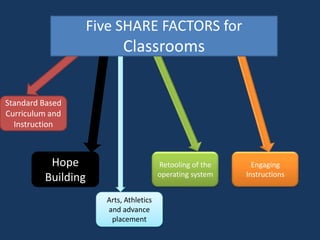
Five SHARE FACTORS for ClassroomsStandard Based Curriculum and InstructionHope BuildingRetooling of the operating systemEngaging InstructionsArts, Athletics and advance placement
Standards Based CurriculumEssential QuestionHow important is standard based test
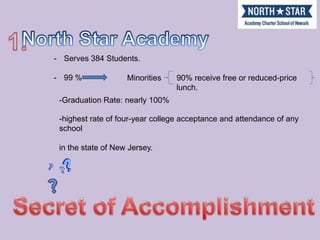
North Star Academy1.Serves 384 Students.
99 % Minorities90% receive free or reduced-price lunch.-Graduation Rate: nearly 100%-highest rate of four-year college acceptance and attendance of any schoolin the state of New Jersey.Secret of Accomplishment
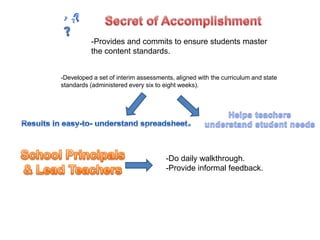
Secret of Accomplishment-Provides and commits to ensure students master the content standards.-Developed a set of interim assessments, aligned with the curriculum and state standards (administered every six to eight weeks).Helps teachers understand student needsResults in easy-to- understand spreadsheet.School Principals& Lead Teachers-Do daily walkthrough.-Provide informal feedback.
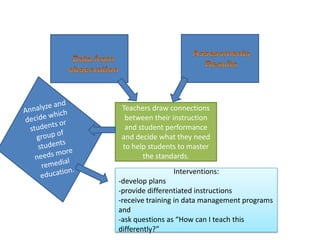
AssessmentsResultsData from observationAnnalyze and decide which students or group of students needs more remedial education.Teachers draw connections between their instruction and student performance and decide what they need to help students to master the standards. Interventions:-develop plans-provide differentiated instructions-receive training in data management programs and -ask questions as “How can I teach this differently?”
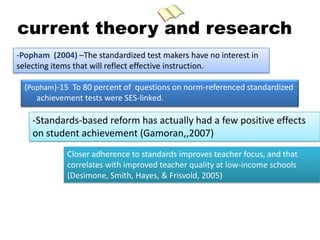
current theory and research-Popham  (2004) –The standardized test makers have no interest in selecting items that will reflect effective instruction.(Popham)-15  To 80 percent of  questions on norm-referenced standardized achievement tests were SES-linked.-Standards-based reform has actually had a few positive effects on student achievement (Gamoran,,2007)Closer adherence to standards improves teacher focus, and that correlates with improved teacher quality at low-income schools (Desimone, Smith, Hayes, & Frisvold, 2005)
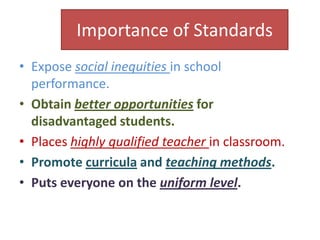
Importance of StandardsExpose social inequities in school performance.Obtain better opportunitiesfor disadvantaged students.Places highly qualified teacher in classroom.Promote curricula and teaching methods.Puts everyone on the uniform level.
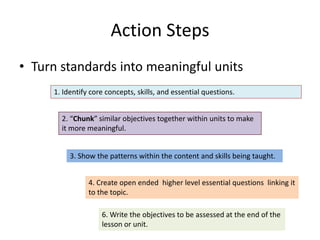
Action StepsTurn standards into meaningful units1. Identify core concepts, skills, and essential questions.2. “Chunk” similar objectives together within units to make it more meaningful.3. Show the patterns within the content and skills being taught.4. Create open ended  higher level essential questions  linking it to the topic.6. Write the objectives to be assessed at the end of the lesson or unit.
*Pre-assess to determine students’ background knowledge-Create pre-tests (combination of fill-in-the blanks, short-answer, and multiple-choice questions)-Questions should represent the key concepts and skills  from the upcoming units.-Questions should be sub divided based on each lesson objective. Include at least 6 questions. -Add “teaser” questions  (interests students) from the upcoming unit.Administer pretest --- At least one week before—to adjust the lesson
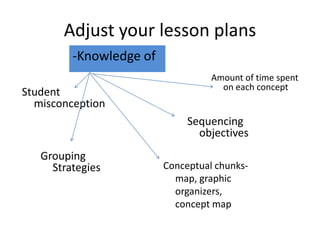
Adjust your lesson plans-Knowledge of Amount of time spent on each conceptStudent misconceptionSequencing objectivesGrouping StrategiesConceptual chunks- map, graphic organizers, concept map
RememberStandards alone are not enough, but they are animportant component in helping to turn around low-performing schools
Hope Building
Essential QuestionHow is hope a crucial factorIn improving students Performance
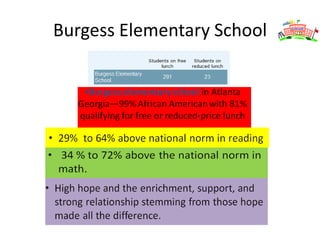
Burgess Elementary School
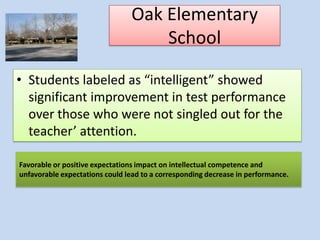
Oak Elementary SchoolStudents labeled as “intelligent” showed significant improvement in test performance over those who were not singled out for the teacher’ attention.Favorable or positive expectations impact on intellectual competence and unfavorable expectations could lead to a corresponding decrease in performance.
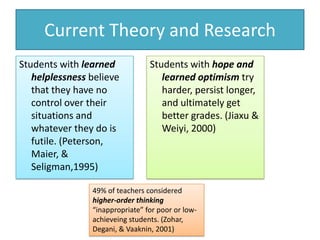
Current Theory and ResearchStudents with learned helplessness believe that they have no control over their situations and whatever they do is futile. (Peterson, Maier, & Seligman,1995)Students with hope and learned optimism try harder, persist longer, and ultimately get better grades. (Jiaxu & Weiyi, 2000)49% of teachers considered higher-order thinking “inappropriate” for poor or low-achieveing students. (Zohar, Degani, & Vaaknin, 2001)
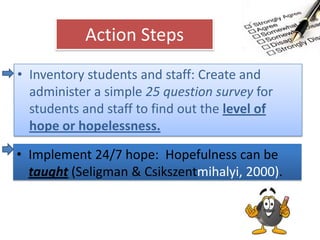
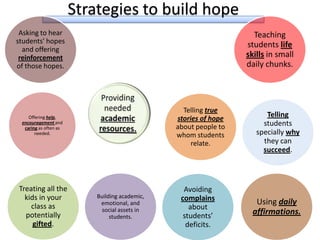
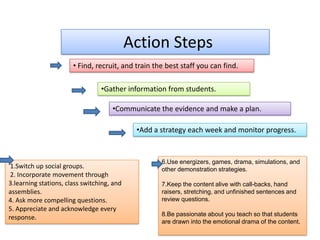
Action StepsInventory students and staff: Create and administer a simple 25 question survey for students and staff to find out the level of hope or hopelessness.Implement 24/7 hope:  Hopefulness can be taught (Seligman & Csikszentmihalyi, 2000). Strategies to build hope
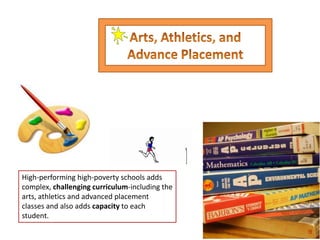
Arts, Athletics, and Advance PlacementHigh-performing high-poverty schools adds complex, challenging curriculum-including the arts, athletics and advanced placement classes and also adds capacity to each student.
Essential QuestionHow are arts, athletics and advancement placement curriculumessential for high poverty schools
Old-school way of thinkingKids  with less background knowledge need a slower-paced or dumbed-down curriculum.When students don’t immediately meet the new higher expectations, the teachers say, “See, I knew it. They just can’t do it.”
Chicago Arts Partnership in education ( CAPE)Developed innovative arts integrated curriculumResult- Inspiring turn around in student achievement at 14 high poverty schools in deeply troubled Chicago public school district.
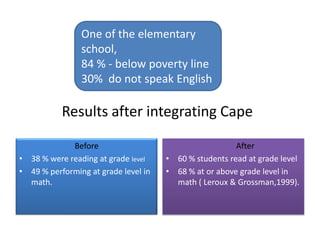
One of the elementary school, 84 % - below poverty line30%  do not speak EnglishResults after integrating CapeBefore 38 % were reading at grade level49 % performing at grade level in math.After60 % students read at grade level68 % at or above grade level in math ( Leroux & Grossman,1999).
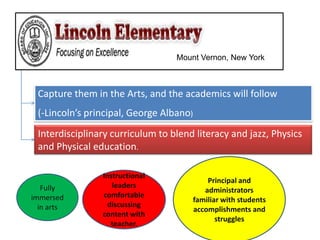
Mount Vernon, New YorkCapture them in the Arts, and the academics will follow (-Lincoln’s principal, George Albano)Interdisciplinary curriculum to blend literacy and jazz, Physics and Physical education.Principal and administrators familiar with students accomplishments and strugglesInstructional leaders comfortable discussing content with teacher.Fully immersed in arts
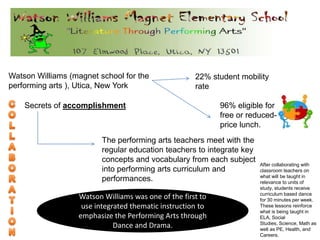
Watson Williams (magnet school for the performing arts ), Utica, New York22% student mobility rateCOLLABORATION96% eligible for free or reduced-price lunch.Secrets of accomplishmentThe performing arts teachers meet with the regular education teachers to integrate key concepts and vocabulary from each subject into performing arts curriculum and performances.After collaborating with classroom teachers on what will be taught in relevance to units of study, students receive curriculum based dance for 30 minutes per week. These lessons reinforce what is being taught in ELA, Social Studies, Science, Math as well as PE, Health, and Careers.Watson Williams was one of the first to use integrated thematic instruction to emphasize the Performing Arts through Dance and Drama.
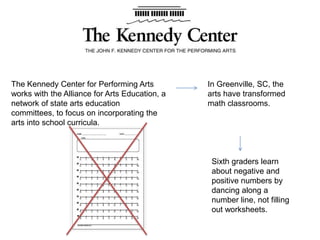
The Kennedy Center for Performing Arts  works with the Alliance for Arts Education, a network of state arts education committees, to focus on incorporating the arts into school curricula.In Greenville, SC, the arts have transformed math classrooms. Sixth graders learn about negative and positive numbers by dancing along a number line, not filling out worksheets.
Theory and ResearchTheory and ResearchOver view: Poor children are half as likely to be taken to museums, theaters, or the library and are less likely to go on other culturally enriching outings (Bradley & Corwyn, 2002). The arts and a challenging curriculum enhance essential learning skills and cognition, whereas sports, recess, and physical activity increase neurogenesis and reduce kids’ chances for depression..
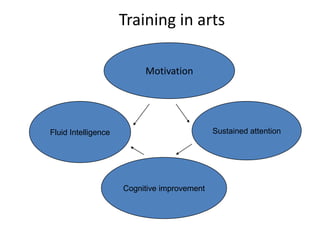
UCLA professor of education James Catterall (Catterall, Chapleau, & Iwanaga, 1999) analyzed data on more than 25,000 students from the National Educational Longitudinal SurveyHe found that students with high levels of arts participation outperform “arts-poor” students on virtually every measure and that high arts participation makes a more significant difference to low-income students than to high-income students. James Catterall documented the difference between low-SES students who took music lessons in grades 8–12 and comparable students who took no music lessons He found that the former not only significantly increased their math scores but also improved their reading, history, and geography scores by 40 percent. Training in the arts influences cognition because participants become motivated to practice their particular art with intentional, focused determination. This motivation typically leads to sustained attention, which leads to greater efficiency of the brain network involved in attention. That improved attention in turn leads to cognitive improvement in many areas, including math and science (Spelke, 2008), according to the results of a three-year collaboration between the Dana Consortium on Arts and Cognition and more than a dozen neuroscientists from five universities (Gazzaniga, 2008).
      Training in artsMotivationSustained attentionFluid IntelligenceCognitive improvement
Art developsAttentional Skills(Posner, (Rothbart, Sheese, & Kieras, 2008);
Processing Skills Ex: Manipulation of data (Jonides, 2008
Strengthen Memory Skills (Chan et al., 1998
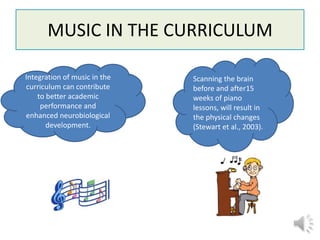
Transferable Skills- Reading. (Wandell, Dougherty, Ben-Shachar, & Deutsch, 2008). MUSIC IN THE CURRICULUMScanning the brain before and after15 weeks of piano lessons, will result in the physical changes (Stewart et al., 2003).Integration of music in the curriculum can contribute to better academic performance and enhanced neurobiological development.
Importance of ExerciseExercise enhances learning, mood, and memory (Fabel et al., 2003; van Praag, Kempermann,    & Gage, 1999). One study found that joggers consistently performed better than non-joggers on learning and memory tests that required the use of the prefrontal cortex (Harada et al., 2004). In addition, exercise leads to increased levels of calcium, which is transported to the brain and enhances dopamine synthesis, making the brain sharper for both cognitive problem solving and working memory (Sutoo & Akiyama, 2003).
        Athletics	      Athletics enhances:cognition (Sibley & Etnier,2003), 	academic outcomes(Pellegr Bohn,  2005), graduation rates, and
reduce behavioral problems (Newman, 2005)..  Athletics improves:                Students’ health,
cardiovascular capacity,
muscle strength,
body coordination,
speed,
reaction times, and
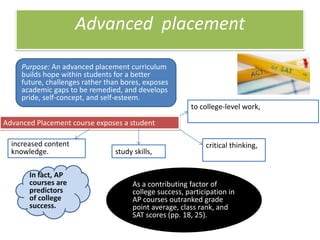
stress responses.Advanced  placementPurpose: An advanced placement curriculum builds hope within students for a better future, challenges rather than bores, exposes academic gaps to be remedied, and develops pride, self-concept, and self-esteem. to college-level work,Advanced Placement course exposes a student critical thinking, increased content knowledge. study skills,In fact, AP courses are predictors of college success.As a contributing factor of college success, participation in AP courses outranked grade point average, class rank, and SAT scores (pp. 18, 25).
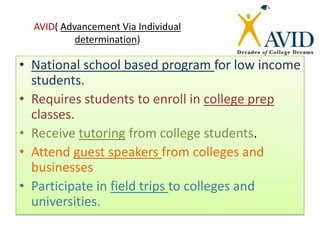
AVID( Advancement Via Individual determination)National school based program for low income students.Requires students to enroll in college prep classes.Receive tutoring from college students.Attend guest speakers from colleges and businessesParticipate in field trips to colleges and universities.
Result:AVID students enroll in college at a rate of two and one half times greater than the others.Longer students stay in AVID, the more successful they are.
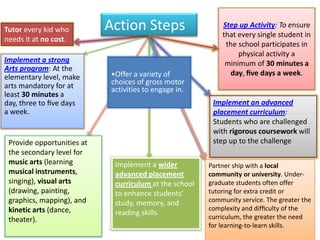
Step up Activity: To ensure that every single student in the school participates in physical activity a minimum of 30 minutes a day, five days a week. Action StepsTutor every kid who needs it at no cost.Implement a strong Arts program: At the elementary level, make arts mandatory for at least 30 minutes a day, three to five days a week. Offer a variety of choices of gross motor activities to engage in.Implement an advanced placement curriculum:  Students who are challenged with rigorous coursework will step up to the challenge Provide opportunities at the secondary level for music arts (learning musical instruments, singing), visual arts (drawing, painting, graphics, mapping), and kinetic arts (dance, theater).Implement a wider advanced placement curriculum at the school to enhance students’ study, memory, and reading skills. Partner ship with a local community or university. Under- graduate students often offer tutoring for extra credit or community service. The greater the complexity and difficulty of the curriculum, the greater the need for learning-to-learn skills.
Retooling of the Operating system
Essential QuestionWhat can be done- everyday to strengthen each part of the operating system?
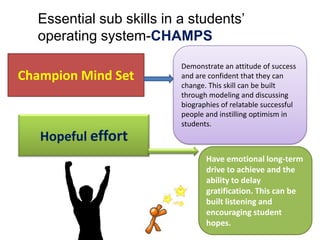
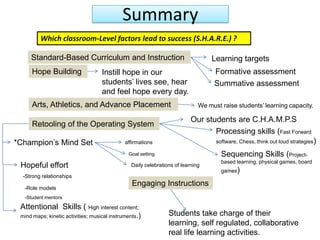
Essential sub skills in a students’ operating system-CHAMPSDemonstrate an attitude of success and are confident that they can change. This skill can be built through modeling and discussing biographies of relatable successful people and instilling optimism in students.Champion Mind SetHopeful effortHave emotional long-term drive to achieve and the ability to delay gratification. This can be built listening and encouraging student hopes.
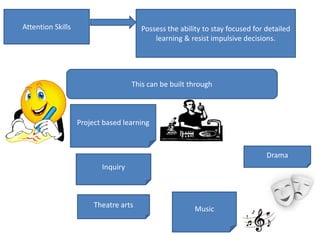
SAttention SkillsPossess the ability to stay focused for detailed learning & resist impulsive decisions. This can be built through Project based learningDramaInquiryMusicTheatre arts
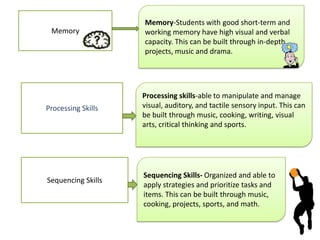
Memory-Students with good short-term and working memory have high visual and verbal capacity. This can be built through in-depth projects, music and drama.MemoryProcessing Skills Processing skills-able to manipulate and manage visual, auditory, and tactile sensory input. This can be built through music, cooking, writing, visual arts, critical thinking and sports.Sequencing SkillsSequencing Skills- Organized and able to apply strategies and prioritize tasks and items. This can be built through music, cooking, projects, sports, and math.
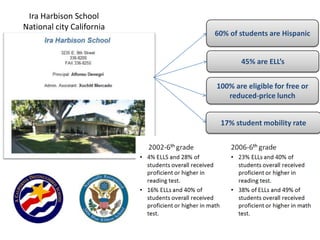
Ira Harbison SchoolNational city California60% of students are Hispanic45% are ELL’s100% are eligible for free or reduced-price lunch17% student mobility rate
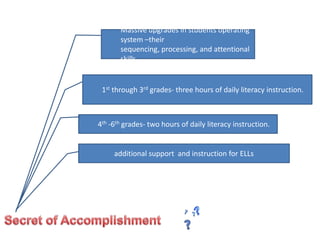
Massive upgrades in students operating system –their sequencing, processing, and attentional skills.1st through 3rd grades- three hours of daily literacy instruction.4th -6th grades- two hours of daily literacy instruction.additional support  and instruction for ELLsSecret of Accomplishment
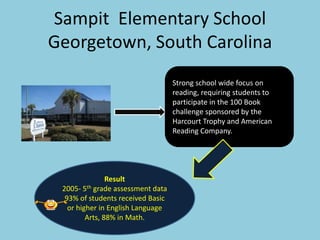
Sampit  Elementary SchoolGeorgetown, South CarolinaStrong school wide focus on reading, requiring students to participate in the 100 Book challenge sponsored by the Harcourt Trophy and American Reading Company.Result2005- 5th grade assessment data93% of students received Basic or higher in English Language Arts, 88% in Math.
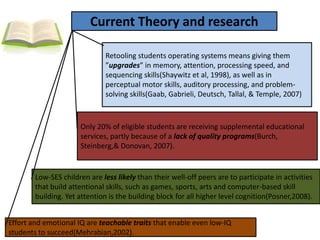
Current Theory and researchRetooling students operating systems means giving them ”upgrades” in memory, attention, processing speed, and sequencing skills(Shaywitz et al, 1998), as well as in perceptual motor skills, auditory processing, and problem-solving skills(Gaab, Gabrieli, Deutsch, Tallal, & Temple, 2007)Only 20% of eligible students are receiving supplemental educational services, partly because of a lack of quality programs(Burch, Steinberg,& Donovan, 2007).Low-SES children are less likely than their well-off peers are to participate in activities that build attentional skills, such as games, sports, arts and computer-based skill building. Yet attention is the building block for all higher level cognition(Posner,2008).Effort and emotional IQ are teachable traits that enable even low-IQ students to succeed(Mehrabian,2002).
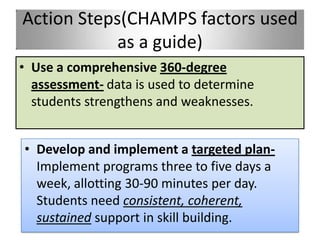
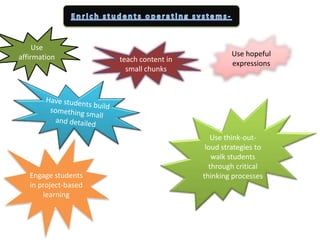
Action Steps(CHAMPS factors used as a guide)Use a comprehensive 360-degree assessment-data is used to determine students strengthens and weaknesses.Develop and implement a targeted plan- Implement programs three to five days a week, allotting 30-90 minutes per day. Students need consistent, coherent, sustained support in skill building. Enrich students operating systems- Use hopeful expressionsUse affirmationteach content in small chunksHave students build something small and detailedUse think-out-loud strategies to walk students through critical thinking processesEngage students in project-based learning
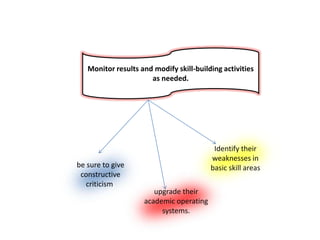
Monitor results and modify skill-building activities as needed.Identify their weaknesses in basic skill areas be sure to give constructive criticism. upgrade their academic operating systems.
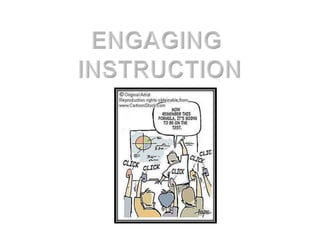
ENGAGING INSTRUCTION
Essential QuestionsHow students engagement improves the learning process in SES schools
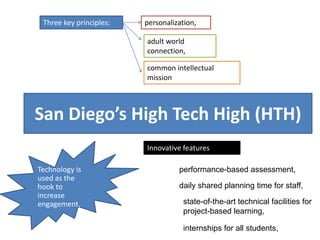
Three key principles:personalization,adult world connection,common intellectual missionSan Diego’s High Tech High (HTH) Technology is used as the hook to increase engagement. Innovative featuresperformance-based assessment,daily shared planning time for staff,state-of-the-art technical facilities for project-based learning,internships for all students,
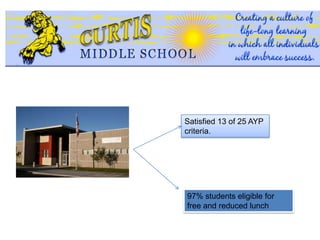
Satisfied 13 of 25 AYP criteria.97% students eligible for free and reduced lunch
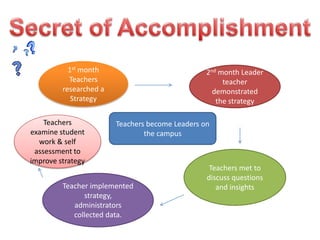
Secret of Accomplishment1st month Teachers researched a Strategy2nd month Leader teacher demonstrated the strategyTeachers become Leaders on the campusTeachers examine student work & self assessment to improve strategyTeachers met to discuss questions and insightsTeacher implemented strategy, administrators collected data.

Classroom level success factors

  • 1.
    Classroom-Level Success FactorsHighPoverty Schools Making it Happen
  • 2.
    Unit QuestionHow canyou achieve success oflow socio economic students in your classroom?
  • 3.
    Five SHARE FACTORSfor ClassroomsStandard Based Curriculum and InstructionHope BuildingRetooling of the operating systemEngaging InstructionsArts, Athletics and advance placement
  • 4.
    Standards Based CurriculumEssentialQuestionHow important is standard based test
  • 5.
  • 6.
    99 % Minorities90%receive free or reduced-price lunch.-Graduation Rate: nearly 100%-highest rate of four-year college acceptance and attendance of any schoolin the state of New Jersey.Secret of Accomplishment
  • 7.
    Secret of Accomplishment-Providesand commits to ensure students master the content standards.-Developed a set of interim assessments, aligned with the curriculum and state standards (administered every six to eight weeks).Helps teachers understand student needsResults in easy-to- understand spreadsheet.School Principals& Lead Teachers-Do daily walkthrough.-Provide informal feedback.
  • 8.
    AssessmentsResultsData from observationAnnalyzeand decide which students or group of students needs more remedial education.Teachers draw connections between their instruction and student performance and decide what they need to help students to master the standards. Interventions:-develop plans-provide differentiated instructions-receive training in data management programs and -ask questions as “How can I teach this differently?”
  • 9.
    current theory andresearch-Popham (2004) –The standardized test makers have no interest in selecting items that will reflect effective instruction.(Popham)-15 To 80 percent of questions on norm-referenced standardized achievement tests were SES-linked.-Standards-based reform has actually had a few positive effects on student achievement (Gamoran,,2007)Closer adherence to standards improves teacher focus, and that correlates with improved teacher quality at low-income schools (Desimone, Smith, Hayes, & Frisvold, 2005)
  • 10.
    Importance of StandardsExposesocial inequities in school performance.Obtain better opportunitiesfor disadvantaged students.Places highly qualified teacher in classroom.Promote curricula and teaching methods.Puts everyone on the uniform level.
  • 11.
    Action StepsTurn standardsinto meaningful units1. Identify core concepts, skills, and essential questions.2. “Chunk” similar objectives together within units to make it more meaningful.3. Show the patterns within the content and skills being taught.4. Create open ended higher level essential questions linking it to the topic.6. Write the objectives to be assessed at the end of the lesson or unit.
  • 12.
    *Pre-assess to determinestudents’ background knowledge-Create pre-tests (combination of fill-in-the blanks, short-answer, and multiple-choice questions)-Questions should represent the key concepts and skills from the upcoming units.-Questions should be sub divided based on each lesson objective. Include at least 6 questions. -Add “teaser” questions (interests students) from the upcoming unit.Administer pretest --- At least one week before—to adjust the lesson
  • 13.
    Adjust your lessonplans-Knowledge of Amount of time spent on each conceptStudent misconceptionSequencing objectivesGrouping StrategiesConceptual chunks- map, graphic organizers, concept map
  • 14.
    RememberStandards alone arenot enough, but they are animportant component in helping to turn around low-performing schools
  • 15.
  • 16.
    Essential QuestionHow ishope a crucial factorIn improving students Performance
  • 17.
  • 18.
    Oak Elementary SchoolStudentslabeled as “intelligent” showed significant improvement in test performance over those who were not singled out for the teacher’ attention.Favorable or positive expectations impact on intellectual competence and unfavorable expectations could lead to a corresponding decrease in performance.
  • 19.
    Current Theory andResearchStudents with learned helplessness believe that they have no control over their situations and whatever they do is futile. (Peterson, Maier, & Seligman,1995)Students with hope and learned optimism try harder, persist longer, and ultimately get better grades. (Jiaxu & Weiyi, 2000)49% of teachers considered higher-order thinking “inappropriate” for poor or low-achieveing students. (Zohar, Degani, & Vaaknin, 2001)
  • 20.
    Action StepsInventory studentsand staff: Create and administer a simple 25 question survey for students and staff to find out the level of hope or hopelessness.Implement 24/7 hope: Hopefulness can be taught (Seligman & Csikszentmihalyi, 2000). Strategies to build hope
  • 21.
    Arts, Athletics, andAdvance PlacementHigh-performing high-poverty schools adds complex, challenging curriculum-including the arts, athletics and advanced placement classes and also adds capacity to each student.
  • 22.
    Essential QuestionHow arearts, athletics and advancement placement curriculumessential for high poverty schools
  • 23.
    Old-school way ofthinkingKids with less background knowledge need a slower-paced or dumbed-down curriculum.When students don’t immediately meet the new higher expectations, the teachers say, “See, I knew it. They just can’t do it.”
  • 24.
    Chicago Arts Partnershipin education ( CAPE)Developed innovative arts integrated curriculumResult- Inspiring turn around in student achievement at 14 high poverty schools in deeply troubled Chicago public school district.
  • 25.
    One of theelementary school, 84 % - below poverty line30% do not speak EnglishResults after integrating CapeBefore 38 % were reading at grade level49 % performing at grade level in math.After60 % students read at grade level68 % at or above grade level in math ( Leroux & Grossman,1999).
  • 26.
    Mount Vernon, NewYorkCapture them in the Arts, and the academics will follow (-Lincoln’s principal, George Albano)Interdisciplinary curriculum to blend literacy and jazz, Physics and Physical education.Principal and administrators familiar with students accomplishments and strugglesInstructional leaders comfortable discussing content with teacher.Fully immersed in arts
  • 27.
    Watson Williams (magnetschool for the performing arts ), Utica, New York22% student mobility rateCOLLABORATION96% eligible for free or reduced-price lunch.Secrets of accomplishmentThe performing arts teachers meet with the regular education teachers to integrate key concepts and vocabulary from each subject into performing arts curriculum and performances.After collaborating with classroom teachers on what will be taught in relevance to units of study, students receive curriculum based dance for 30 minutes per week. These lessons reinforce what is being taught in ELA, Social Studies, Science, Math as well as PE, Health, and Careers.Watson Williams was one of the first to use integrated thematic instruction to emphasize the Performing Arts through Dance and Drama.
  • 28.
    The Kennedy Centerfor Performing Arts works with the Alliance for Arts Education, a network of state arts education committees, to focus on incorporating the arts into school curricula.In Greenville, SC, the arts have transformed math classrooms. Sixth graders learn about negative and positive numbers by dancing along a number line, not filling out worksheets.
  • 29.
    Theory and ResearchTheoryand ResearchOver view: Poor children are half as likely to be taken to museums, theaters, or the library and are less likely to go on other culturally enriching outings (Bradley & Corwyn, 2002). The arts and a challenging curriculum enhance essential learning skills and cognition, whereas sports, recess, and physical activity increase neurogenesis and reduce kids’ chances for depression..
  • 30.
    UCLA professor ofeducation James Catterall (Catterall, Chapleau, & Iwanaga, 1999) analyzed data on more than 25,000 students from the National Educational Longitudinal SurveyHe found that students with high levels of arts participation outperform “arts-poor” students on virtually every measure and that high arts participation makes a more significant difference to low-income students than to high-income students. James Catterall documented the difference between low-SES students who took music lessons in grades 8–12 and comparable students who took no music lessons He found that the former not only significantly increased their math scores but also improved their reading, history, and geography scores by 40 percent. Training in the arts influences cognition because participants become motivated to practice their particular art with intentional, focused determination. This motivation typically leads to sustained attention, which leads to greater efficiency of the brain network involved in attention. That improved attention in turn leads to cognitive improvement in many areas, including math and science (Spelke, 2008), according to the results of a three-year collaboration between the Dana Consortium on Arts and Cognition and more than a dozen neuroscientists from five universities (Gazzaniga, 2008).
  • 31.
    Training in artsMotivationSustained attentionFluid IntelligenceCognitive improvement
  • 32.
    Art developsAttentional Skills(Posner,(Rothbart, Sheese, & Kieras, 2008);
  • 33.
    Processing Skills Ex:Manipulation of data (Jonides, 2008
  • 34.
    Strengthen Memory Skills(Chan et al., 1998
  • 35.
    Transferable Skills- Reading.(Wandell, Dougherty, Ben-Shachar, & Deutsch, 2008). MUSIC IN THE CURRICULUMScanning the brain before and after15 weeks of piano lessons, will result in the physical changes (Stewart et al., 2003).Integration of music in the curriculum can contribute to better academic performance and enhanced neurobiological development.
  • 36.
    Importance of ExerciseExerciseenhances learning, mood, and memory (Fabel et al., 2003; van Praag, Kempermann, & Gage, 1999). One study found that joggers consistently performed better than non-joggers on learning and memory tests that required the use of the prefrontal cortex (Harada et al., 2004). In addition, exercise leads to increased levels of calcium, which is transported to the brain and enhances dopamine synthesis, making the brain sharper for both cognitive problem solving and working memory (Sutoo & Akiyama, 2003).
  • 37.
    Athletics Athletics enhances:cognition (Sibley & Etnier,2003), academic outcomes(Pellegr Bohn, 2005), graduation rates, and
  • 38.
    reduce behavioral problems(Newman, 2005).. Athletics improves: Students’ health,
  • 39.
  • 40.
  • 41.
  • 42.
  • 43.
  • 44.
    stress responses.Advanced placementPurpose: An advanced placement curriculum builds hope within students for a better future, challenges rather than bores, exposes academic gaps to be remedied, and develops pride, self-concept, and self-esteem. to college-level work,Advanced Placement course exposes a student critical thinking, increased content knowledge. study skills,In fact, AP courses are predictors of college success.As a contributing factor of college success, participation in AP courses outranked grade point average, class rank, and SAT scores (pp. 18, 25).
  • 46.
    AVID( Advancement ViaIndividual determination)National school based program for low income students.Requires students to enroll in college prep classes.Receive tutoring from college students.Attend guest speakers from colleges and businessesParticipate in field trips to colleges and universities.
  • 47.
    Result:AVID students enrollin college at a rate of two and one half times greater than the others.Longer students stay in AVID, the more successful they are.
  • 48.
    Step up Activity:To ensure that every single student in the school participates in physical activity a minimum of 30 minutes a day, five days a week. Action StepsTutor every kid who needs it at no cost.Implement a strong Arts program: At the elementary level, make arts mandatory for at least 30 minutes a day, three to five days a week. Offer a variety of choices of gross motor activities to engage in.Implement an advanced placement curriculum: Students who are challenged with rigorous coursework will step up to the challenge Provide opportunities at the secondary level for music arts (learning musical instruments, singing), visual arts (drawing, painting, graphics, mapping), and kinetic arts (dance, theater).Implement a wider advanced placement curriculum at the school to enhance students’ study, memory, and reading skills. Partner ship with a local community or university. Under- graduate students often offer tutoring for extra credit or community service. The greater the complexity and difficulty of the curriculum, the greater the need for learning-to-learn skills.
  • 49.
    Retooling of theOperating system
  • 50.
    Essential QuestionWhat canbe done- everyday to strengthen each part of the operating system?
  • 51.
    Essential sub skillsin a students’ operating system-CHAMPSDemonstrate an attitude of success and are confident that they can change. This skill can be built through modeling and discussing biographies of relatable successful people and instilling optimism in students.Champion Mind SetHopeful effortHave emotional long-term drive to achieve and the ability to delay gratification. This can be built listening and encouraging student hopes.
  • 52.
    SAttention SkillsPossess theability to stay focused for detailed learning & resist impulsive decisions. This can be built through Project based learningDramaInquiryMusicTheatre arts
  • 53.
    Memory-Students with goodshort-term and working memory have high visual and verbal capacity. This can be built through in-depth projects, music and drama.MemoryProcessing Skills Processing skills-able to manipulate and manage visual, auditory, and tactile sensory input. This can be built through music, cooking, writing, visual arts, critical thinking and sports.Sequencing SkillsSequencing Skills- Organized and able to apply strategies and prioritize tasks and items. This can be built through music, cooking, projects, sports, and math.
  • 54.
    Ira Harbison SchoolNationalcity California60% of students are Hispanic45% are ELL’s100% are eligible for free or reduced-price lunch17% student mobility rate
  • 55.
    Massive upgrades instudents operating system –their sequencing, processing, and attentional skills.1st through 3rd grades- three hours of daily literacy instruction.4th -6th grades- two hours of daily literacy instruction.additional support and instruction for ELLsSecret of Accomplishment
  • 56.
    Sampit ElementarySchoolGeorgetown, South CarolinaStrong school wide focus on reading, requiring students to participate in the 100 Book challenge sponsored by the Harcourt Trophy and American Reading Company.Result2005- 5th grade assessment data93% of students received Basic or higher in English Language Arts, 88% in Math.
  • 57.
    Current Theory andresearchRetooling students operating systems means giving them ”upgrades” in memory, attention, processing speed, and sequencing skills(Shaywitz et al, 1998), as well as in perceptual motor skills, auditory processing, and problem-solving skills(Gaab, Gabrieli, Deutsch, Tallal, & Temple, 2007)Only 20% of eligible students are receiving supplemental educational services, partly because of a lack of quality programs(Burch, Steinberg,& Donovan, 2007).Low-SES children are less likely than their well-off peers are to participate in activities that build attentional skills, such as games, sports, arts and computer-based skill building. Yet attention is the building block for all higher level cognition(Posner,2008).Effort and emotional IQ are teachable traits that enable even low-IQ students to succeed(Mehrabian,2002).
  • 58.
    Action Steps(CHAMPS factorsused as a guide)Use a comprehensive 360-degree assessment-data is used to determine students strengthens and weaknesses.Develop and implement a targeted plan- Implement programs three to five days a week, allotting 30-90 minutes per day. Students need consistent, coherent, sustained support in skill building. Enrich students operating systems- Use hopeful expressionsUse affirmationteach content in small chunksHave students build something small and detailedUse think-out-loud strategies to walk students through critical thinking processesEngage students in project-based learning
  • 59.
    Monitor results andmodify skill-building activities as needed.Identify their weaknesses in basic skill areas be sure to give constructive criticism. upgrade their academic operating systems.
  • 60.
  • 61.
    Essential QuestionsHow studentsengagement improves the learning process in SES schools
  • 62.
    Three key principles:personalization,adultworld connection,common intellectual missionSan Diego’s High Tech High (HTH) Technology is used as the hook to increase engagement. Innovative featuresperformance-based assessment,daily shared planning time for staff,state-of-the-art technical facilities for project-based learning,internships for all students,
  • 63.
    Satisfied 13 of25 AYP criteria.97% students eligible for free and reduced lunch
  • 64.
    Secret of Accomplishment1stmonth Teachers researched a Strategy2nd month Leader teacher demonstrated the strategyTeachers become Leaders on the campusTeachers examine student work & self assessment to improve strategyTeachers met to discuss questions and insightsTeacher implemented strategy, administrators collected data.