What Can Cloud Do
for Your Business?
Jacob Saunders
CTO, 10th Magnitude
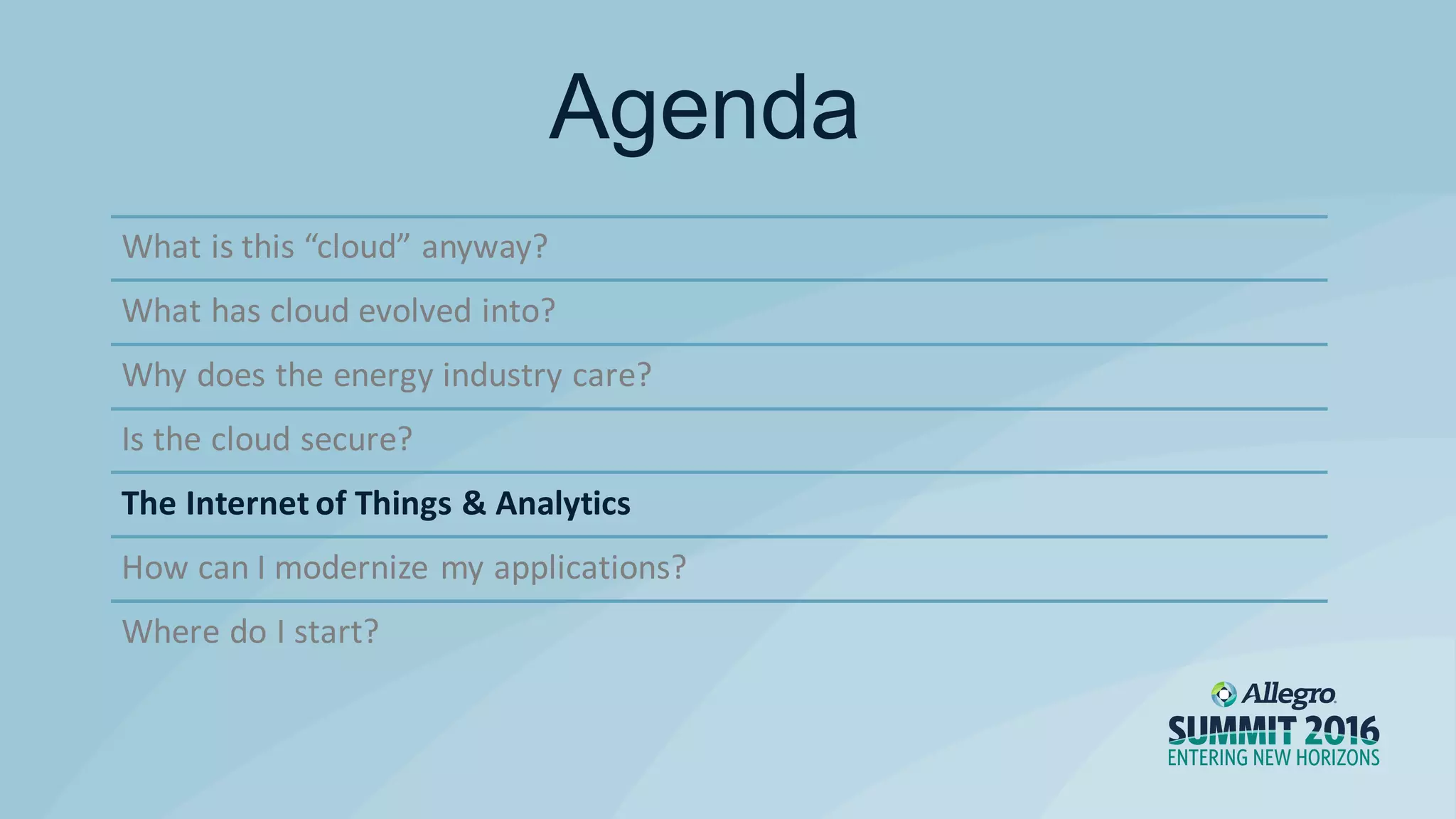
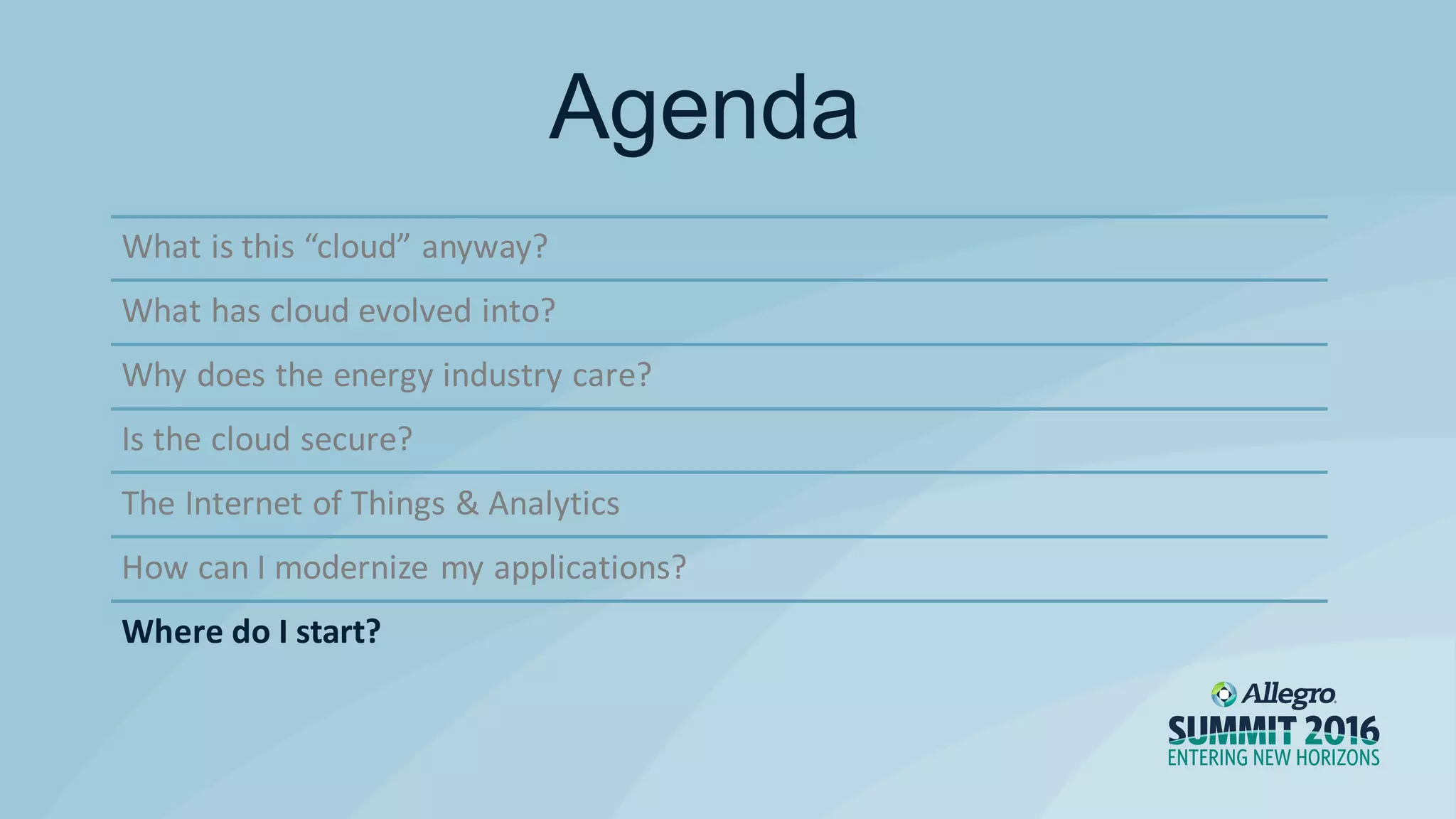
What is this “cloud” anyway?
What has cloud evolved into?
Why does the energy industry care?
Is the cloud secure?
The Internet of Things & Analytics
How can I modernize my applications?
Where do I start?
Agenda
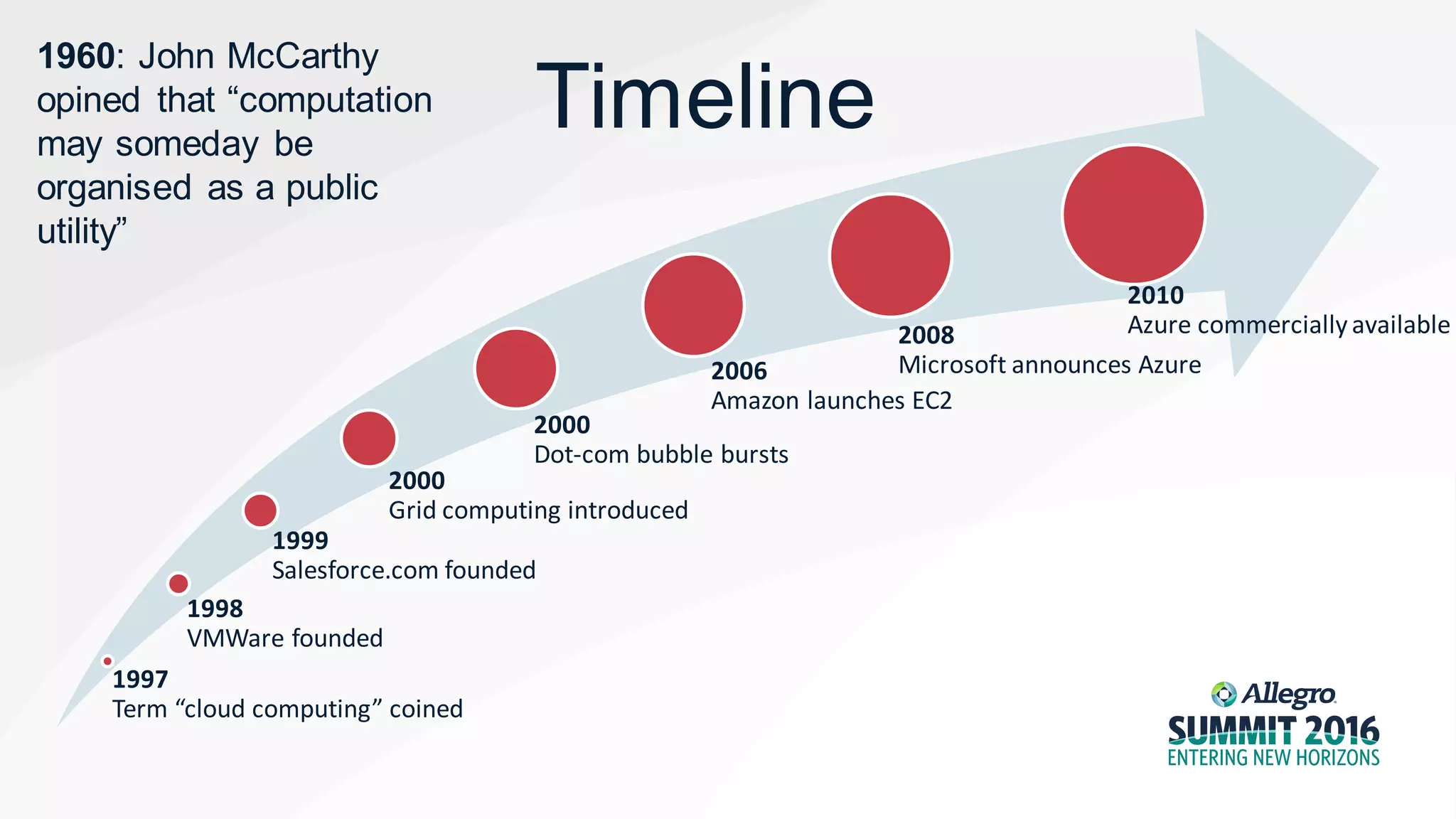
Timeline
1997
Term “cloud computing” coined
1999
Salesforce.com founded
2000
Grid computing introduced
2000
Dot-com bubble bursts
1998
VMWare founded
2006
Amazon launches EC2
2008
Microsoft announces Azure
2010
Azure commerciallyavailable
1960: John McCarthy
opined that “computation
may someday be
organised as a public
utility”
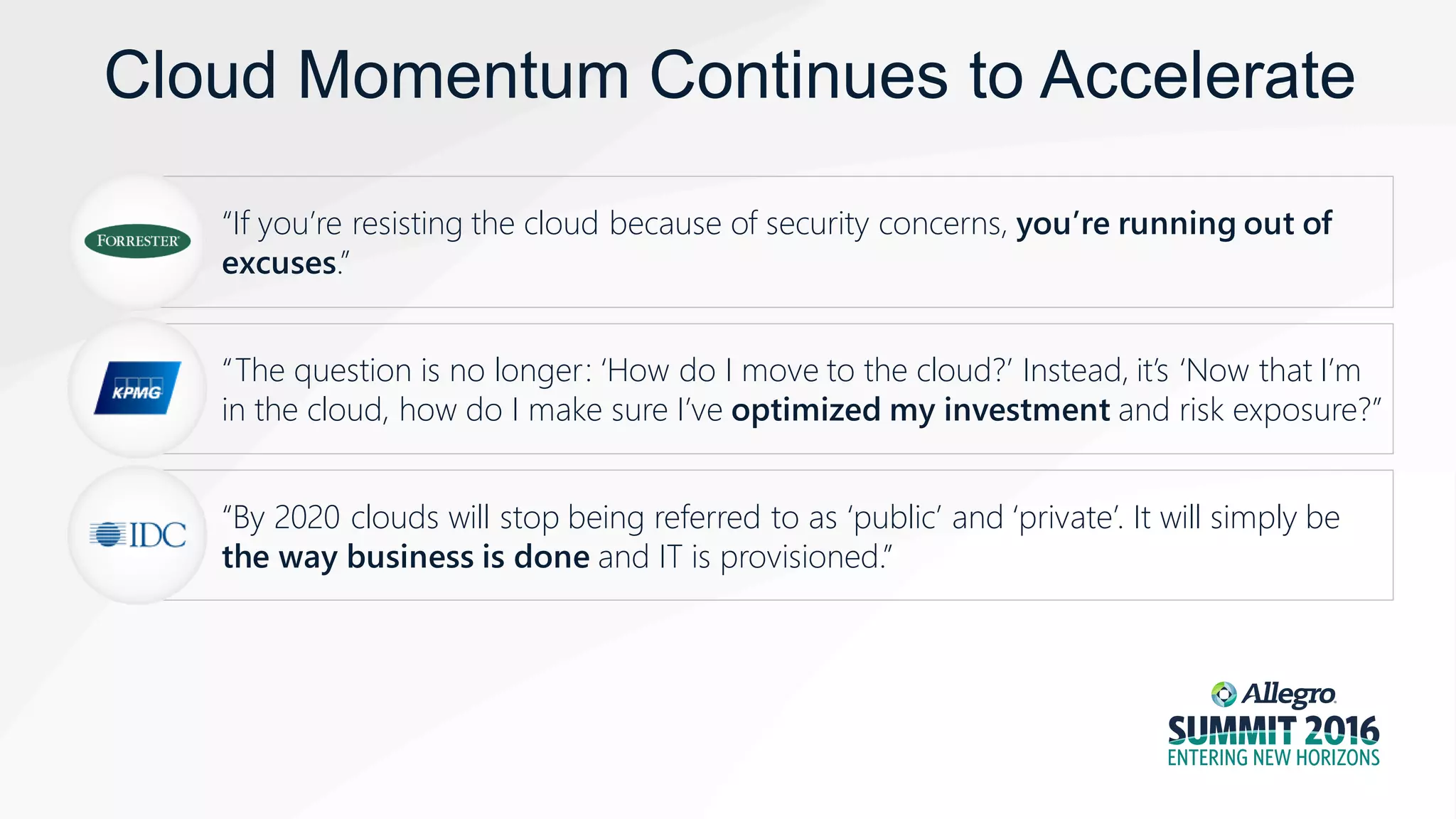
Cloud Momentum Continues to Accelerate
“If you’re resisting the cloud because of security concerns, you’re running out of
excuses.”
“The question is no longer: ‘How do I move to the cloud?’ Instead, it’s ‘Now that I’m
in the cloud, how do I make sure I’ve optimized my investment and risk exposure?”
“By 2020 clouds will stop being referred to as ‘public’ and ‘private’. It will simply be
the way business is done and IT is provisioned.”
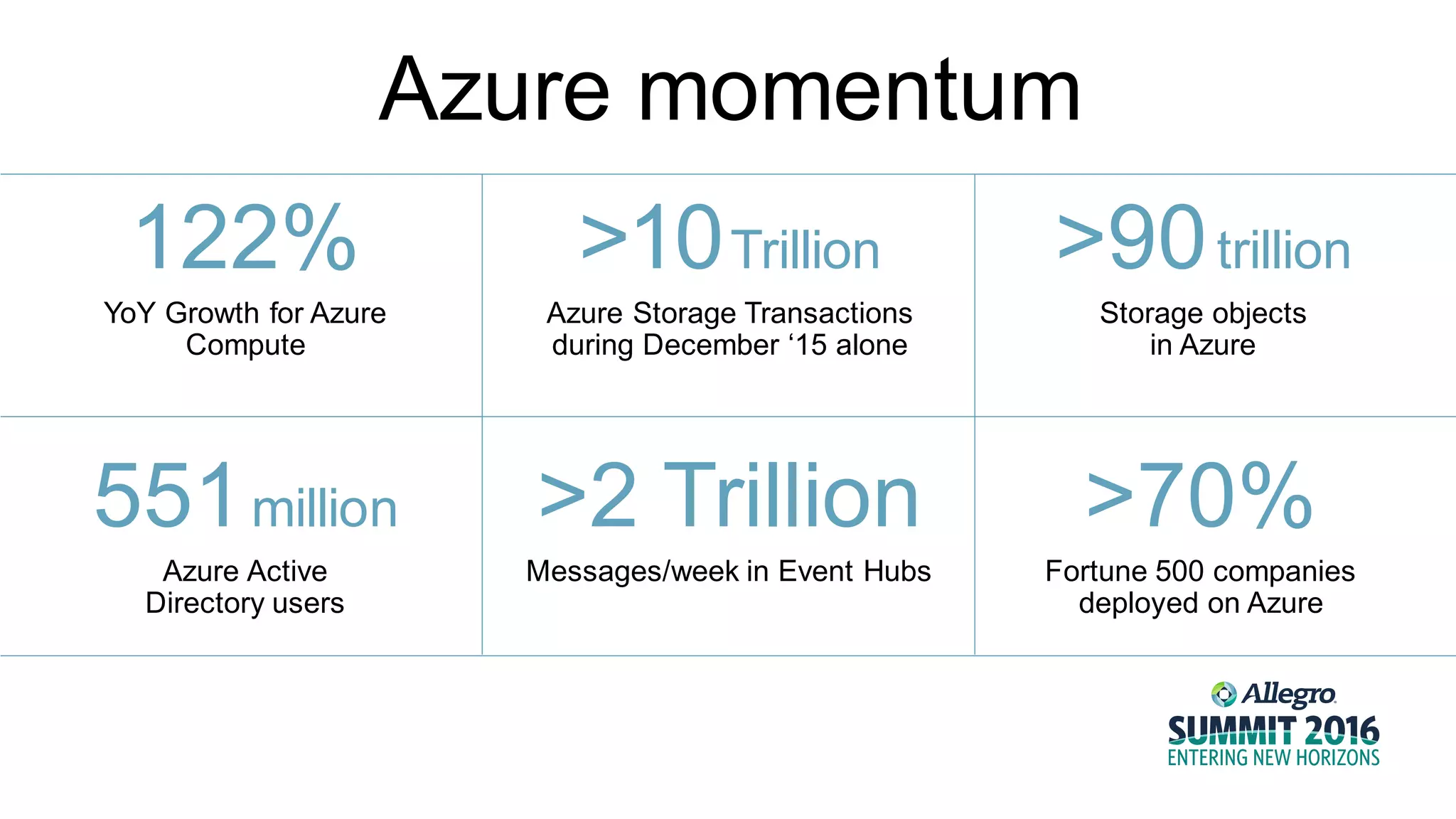
>70%
Fortune 500 companies
deployed on Azure
122%
YoY Growth for Azure
Compute
>10Trillion
Azure Storage Transactions
during December ‘15 alone
>90trillion
Storage objects
in Azure
>2 Trillion
Messages/week in Event Hubs
551million
Azure Active
Directory users
Azure momentum
Microsoft Confidential
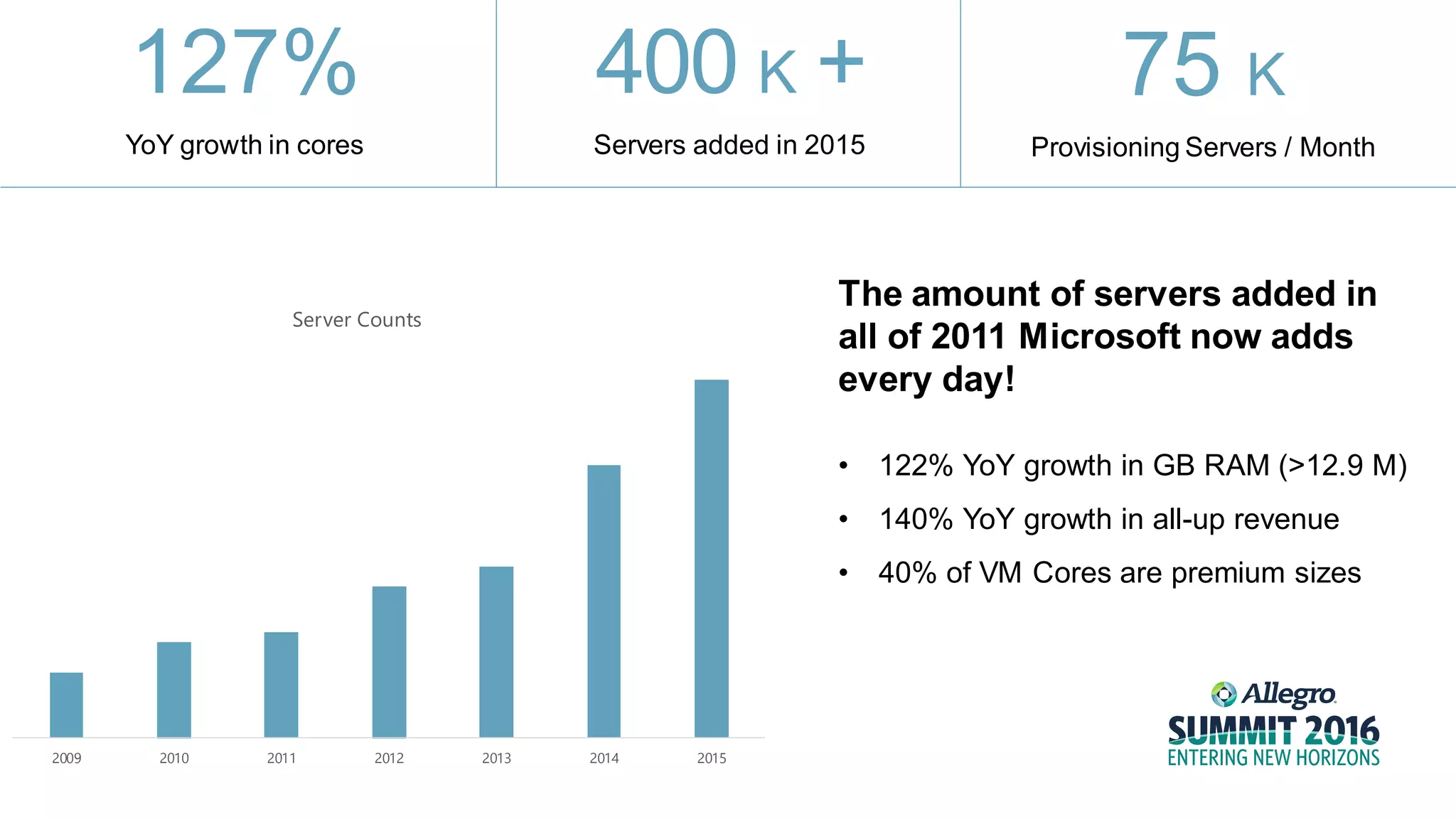
127%
YoY growth in cores
400 K +
Servers added in 2015
75 K
Provisioning Servers / Month
2009 2010 2011 2012 2013 2014 2015
Server Counts
The amount of servers added in
all of 2011 Microsoft now adds
every day!
• 122% YoY growth in GB RAM (>12.9 M)
• 140% YoY growth in all-up revenue
• 40% of VM Cores are premium sizes
What is this “cloud” anyway?
What has cloud evolved into?
Why does the energy industry care?
Is the cloud secure?
The Internet of Things & Analytics
How can I modernize my applications?
Where do I start?
Agenda
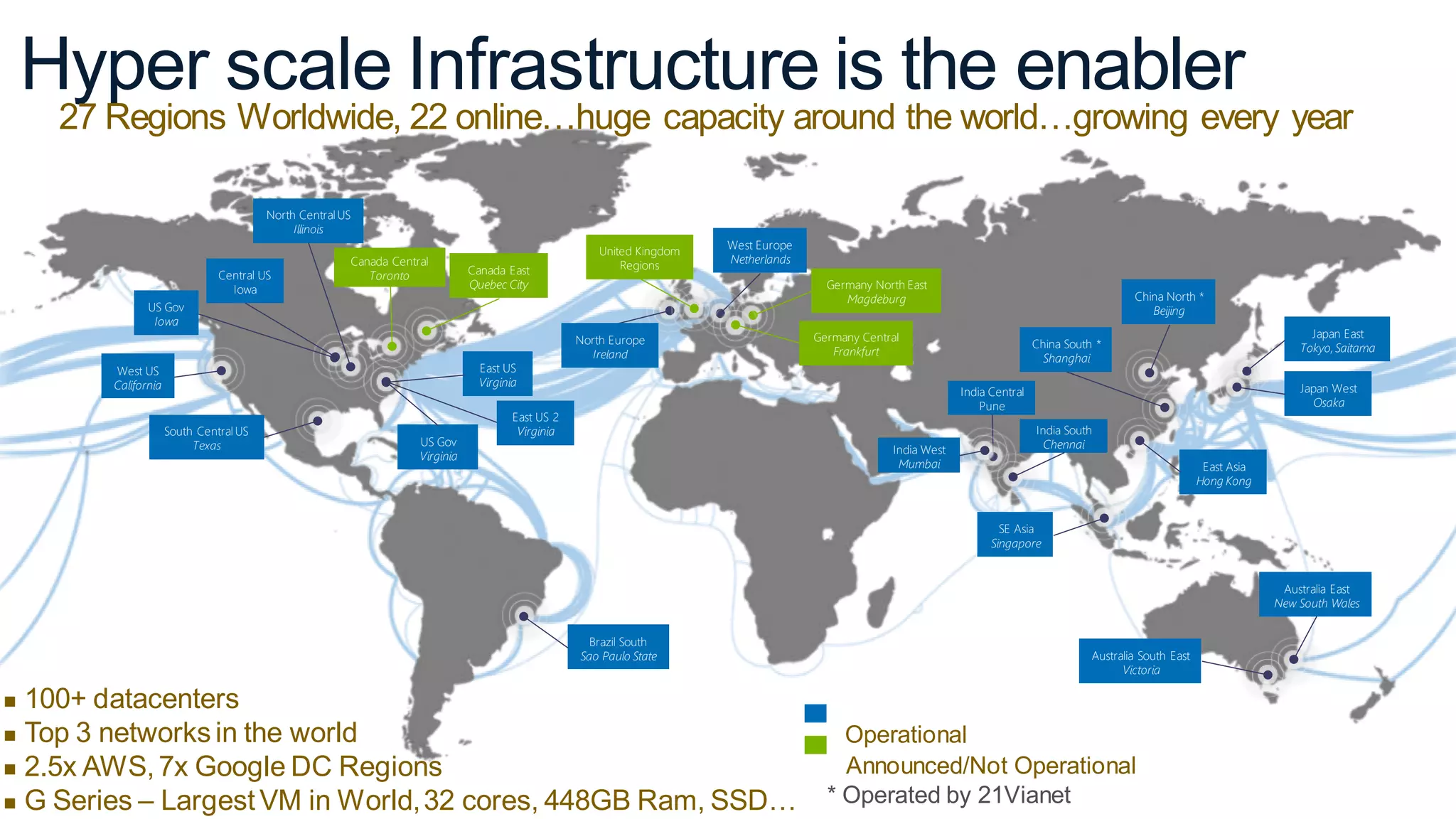
Hyper scale Infrastructure is the enabler
27 Regions Worldwide, 22 online…huge capacity around the world…growing every year
 100+ datacenters
 Top 3 networks in the world
 2.5x AWS,7x Google DC Regions
 G Series – LargestVM in World,32 cores, 448GB Ram, SSD…
Operational
Announced/Not Operational
Central US
Iowa
West US
California
East US
Virginia
US Gov
Virginia
North Central US
Illinois
US Gov
Iowa
South Central US
Texas
Brazil South
Sao Paulo State
West Europe
Netherlands
China North *
Beijing
China South *
Shanghai
Japan East
Tokyo,Saitama
Japan West
Osaka
India South
Chennai
East Asia
Hong Kong
SE Asia
Singapore
Australia South East
Victoria
Australia East
New South Wales
* Operated by 21Vianet
India Central
Pune
Canada East
Quebec City
Canada Central
Toronto
India West
Mumbai
Germany North East
Magdeburg
Germany Central
Frankfurt
United Kingdom
Regions
North Europe
Ireland
East US 2
Virginia
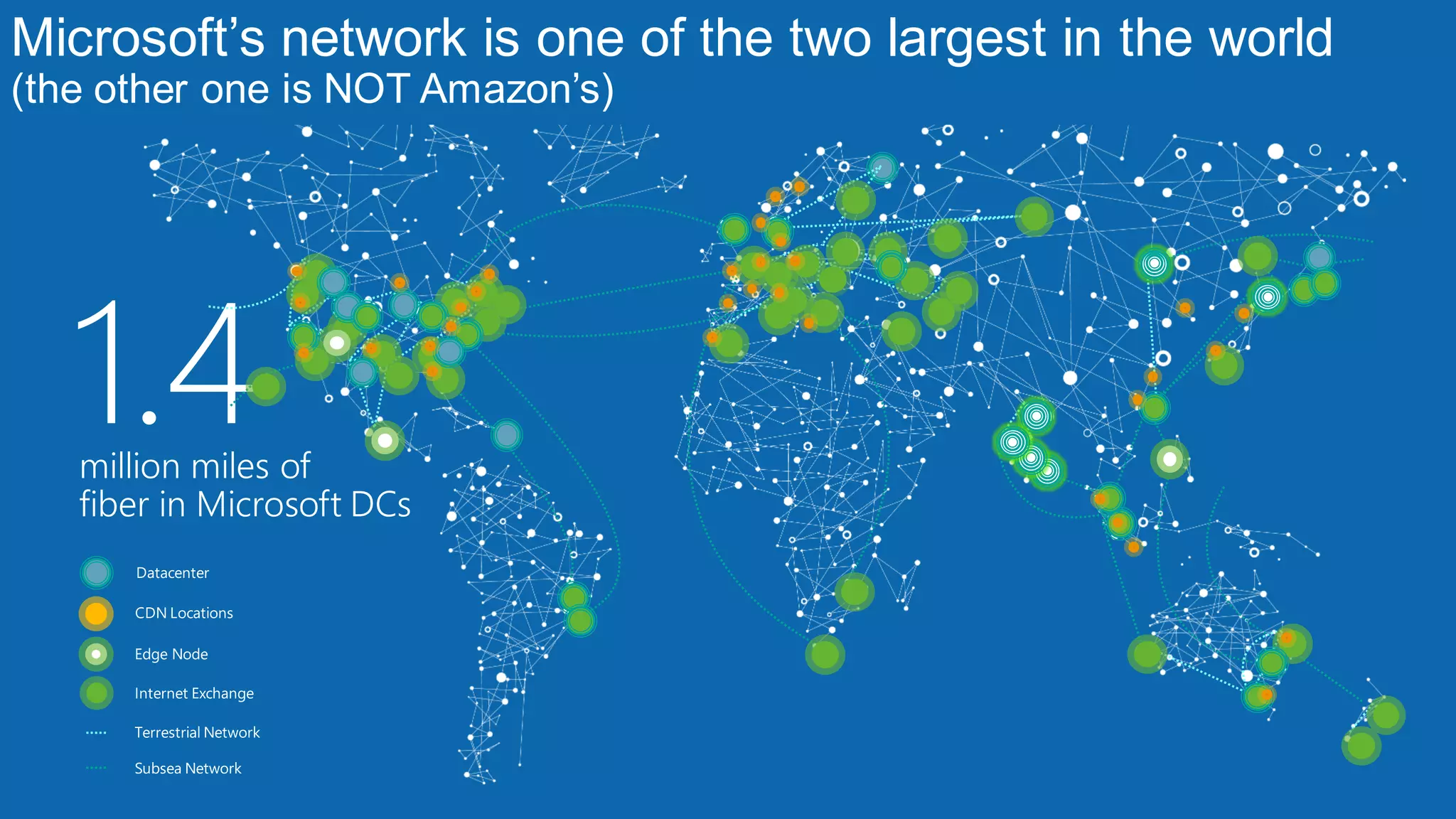
Microsoft’s network is one of the two largest in the world
(the other one is NOT Amazon’s)
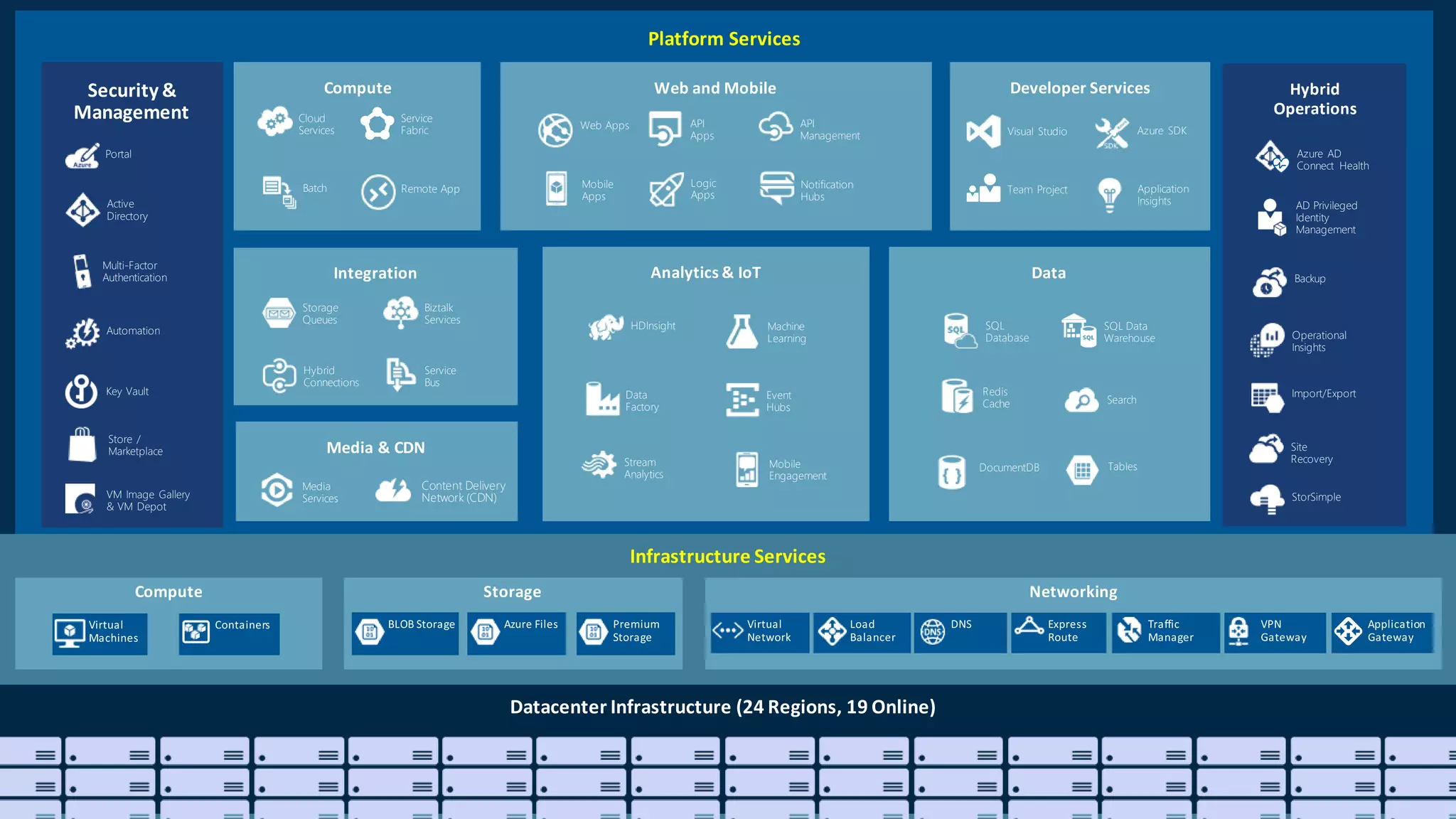
Platform Services
Security &
Management
Infrastructure Services
Web Apps
Mobile
Apps
API
Management
API
Apps
Logic
Apps
Notification
Hubs
Content Delivery
Network (CDN)
Media
Services
HDInsight Machine
Learning
Stream
Analytics
Data
Factory
Event
Hubs
Mobile
Engagement
Active
Directory
Multi-Factor
Authentication
Automation
Portal
Key Vault
Biztalk
Services
Hybrid
Connections
Service
Bus
Storage
Queues
Store /
Marketplace
Hybrid
Operations
Backup
StorSimple
Site
Recovery
Import/Export
SQL
Database
DocumentDB
Redis
Cache Search
Tables
SQL Data
Warehouse
Azure AD
Connect Health
AD Privileged
Identity
Management
Operational
Insights
Cloud
Services
Batch Remote App
Service
Fabric Visual Studio
Application
Insights
Azure SDK
Team Project
VM Image Gallery
& VM Depot
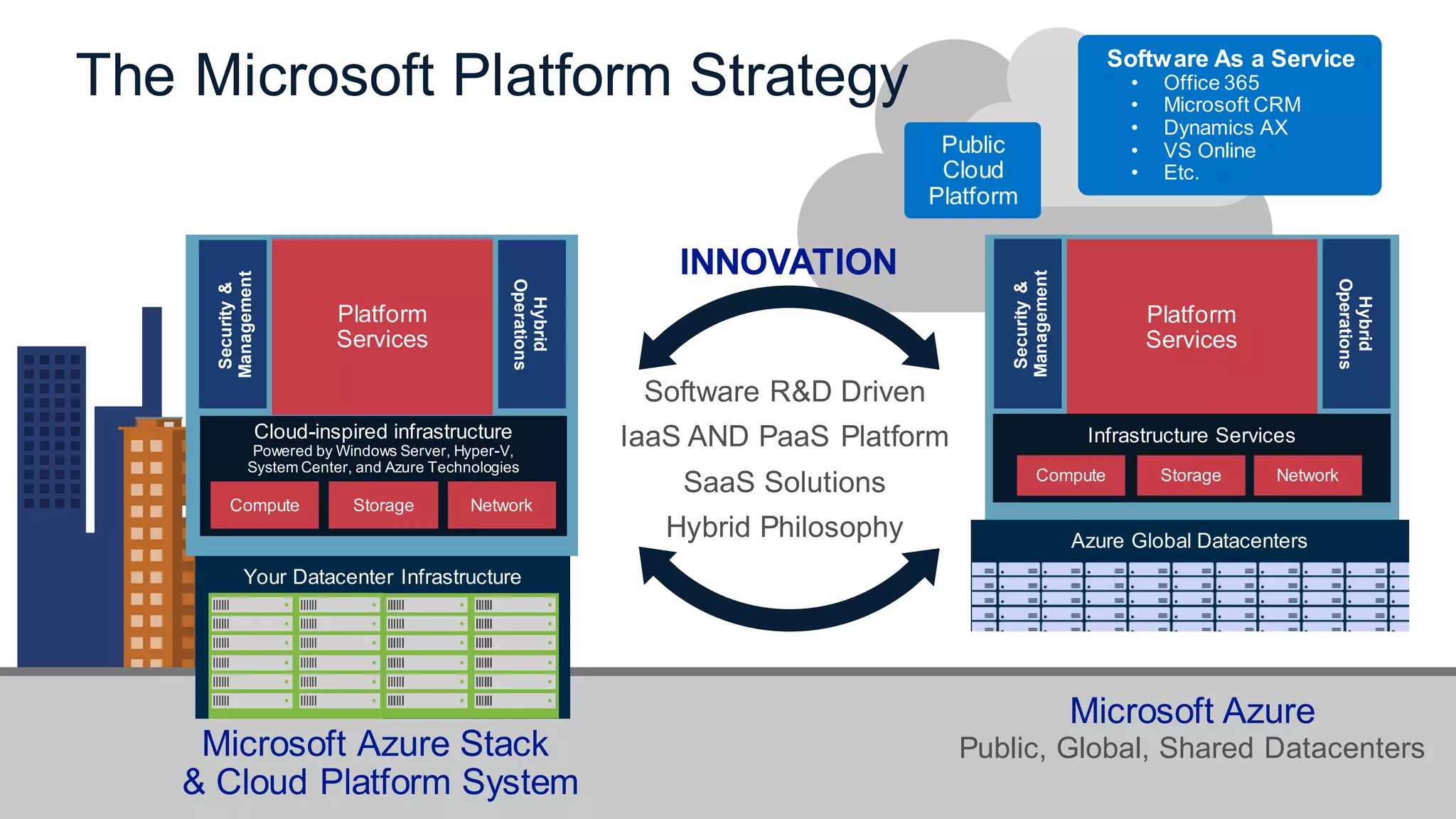
The Microsoft Platform Strategy
Public, Global, Shared DatacentersMicrosoft Azure Stack
& Cloud Platform System
Security&
Management
Public
Cloud
Platform
Hybrid
Operations
Security&
Management
Hybrid
Operations
Software As a Service
• Office 365
• Microsoft CRM
• Dynamics AX
• VS Online
• Etc.
What is this “cloud” anyway?
What has cloud evolved into?
Why does the energy industry care?
Is the cloud secure?
The Internet of Things & Analytics
How can I modernize my applications?
Where do I start?
Agenda
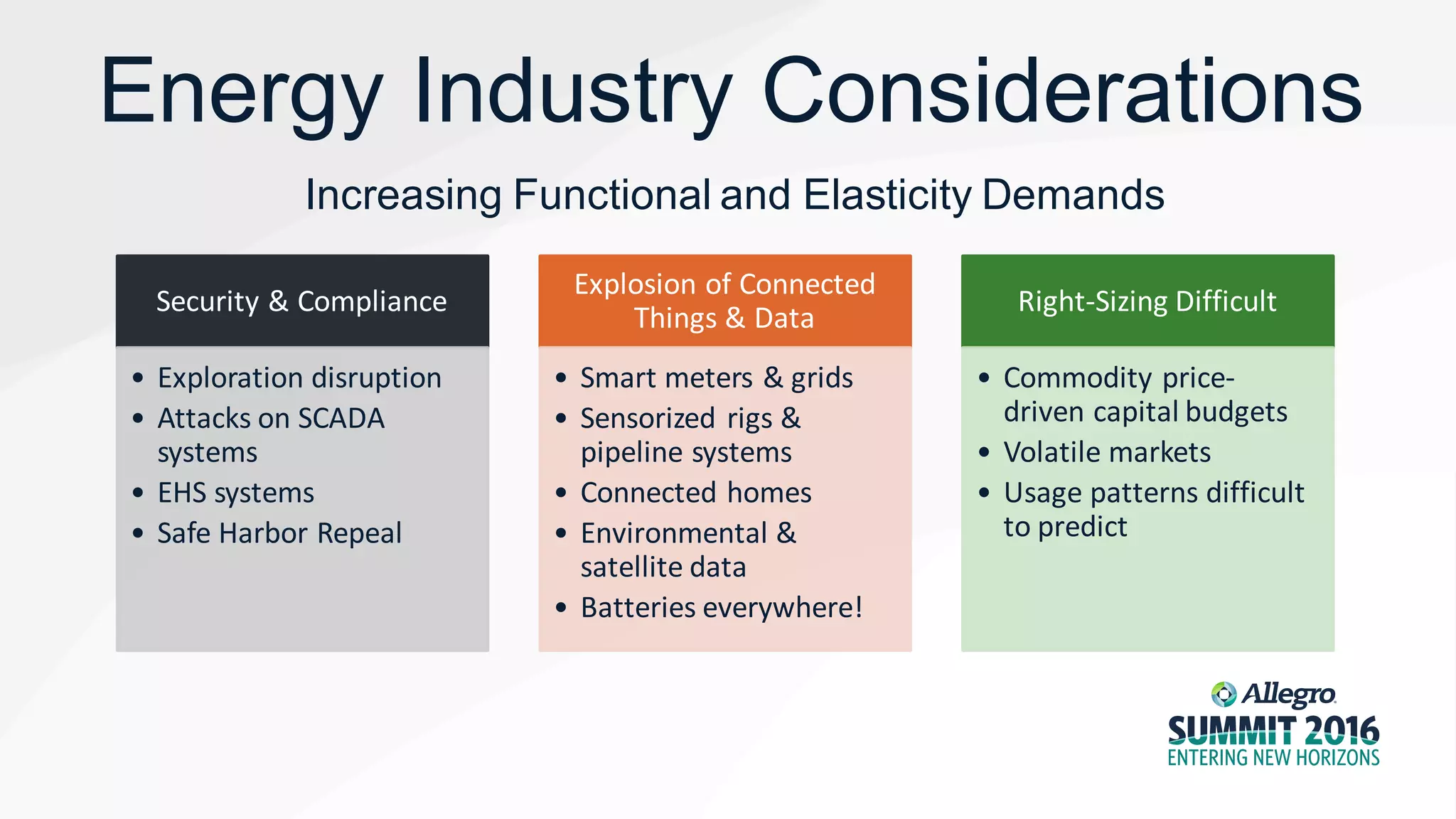
Explosion of Connected
Things & Data
• Smart meters & grids
• Sensorized rigs &
pipeline systems
• Connected homes
• Environmental &
satellite data
• Batteries everywhere!
Right-Sizing Difficult
• Commodity price-
driven capital budgets
• Volatile markets
• Usage patterns difficult
to predict
Security & Compliance
• Exploration disruption
• Attacks on SCADA
systems
• EHS systems
• Safe Harbor Repeal
Energy Industry Considerations
Increasing Functional and Elasticity Demands
What is this “cloud” anyway?
What has cloud evolved into?
Why does the energy industry care?
Is the cloud secure?
The Internet of Things & Analytics
How can I modernize my applications?
Where do I start?
Agenda
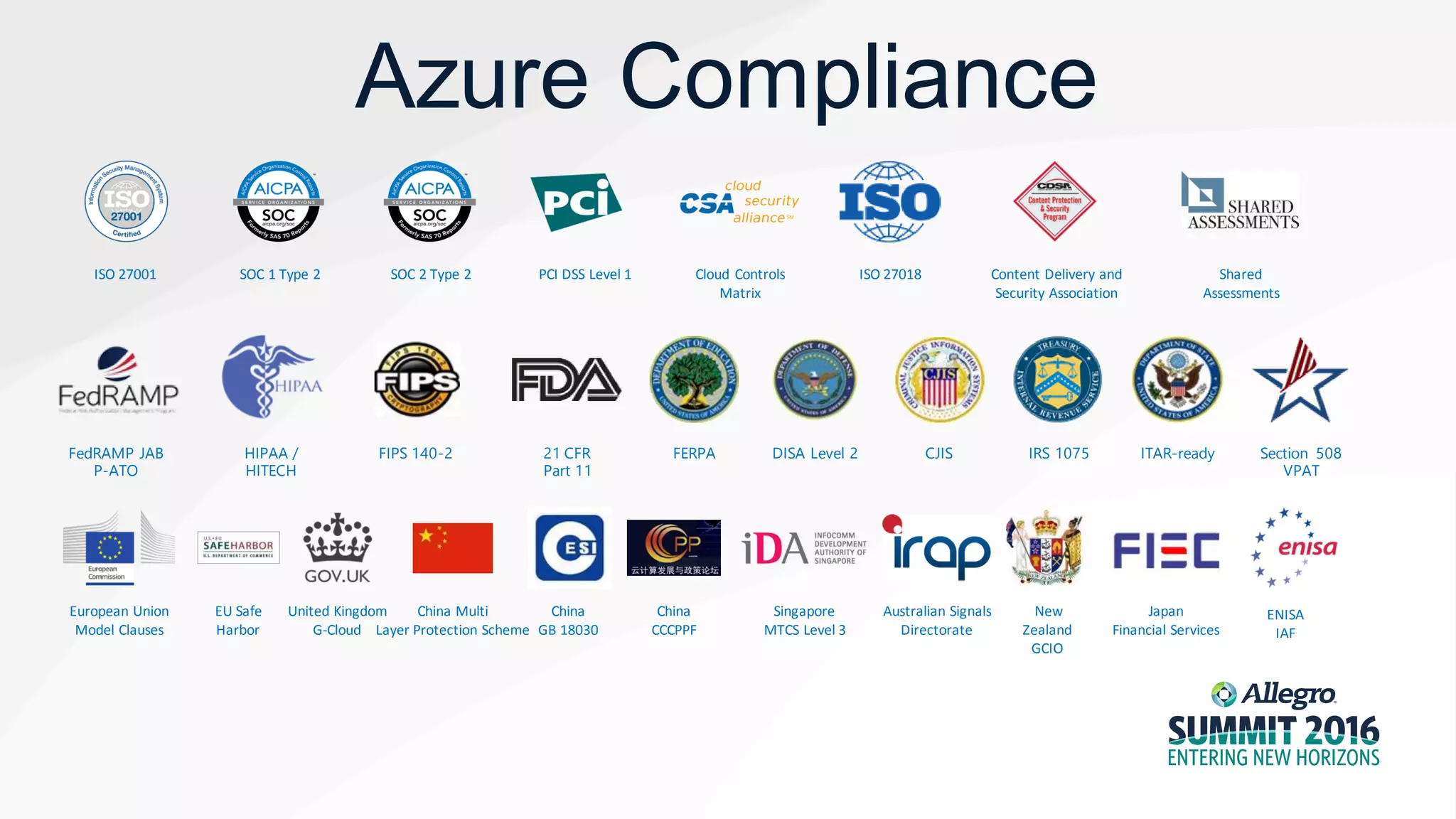
Azure Compliance
HIPAA /
HITECH
FedRAMP JAB
P-ATO
FIPS 140-2 FERPA DISA Level 2 ITAR-readyCJIS21 CFR
Part 11
IRS 1075 Section 508
VPAT
ISO 27001 PCI DSS Level 1SOC 1 Type 2 SOC 2 Type 2 ISO 27018Cloud Controls
Matrix
Content Delivery and
Security Association
Shared
Assessments
European Union
Model Clauses
United Kingdom
G-Cloud
Singapore
MTCS Level 3
Australian Signals
Directorate
Japan
Financial Services
China Multi
Layer Protection Scheme
China
CCCPPF
New
Zealand
GCIO
China
GB 18030
EU Safe
Harbor
ENISA
IAF
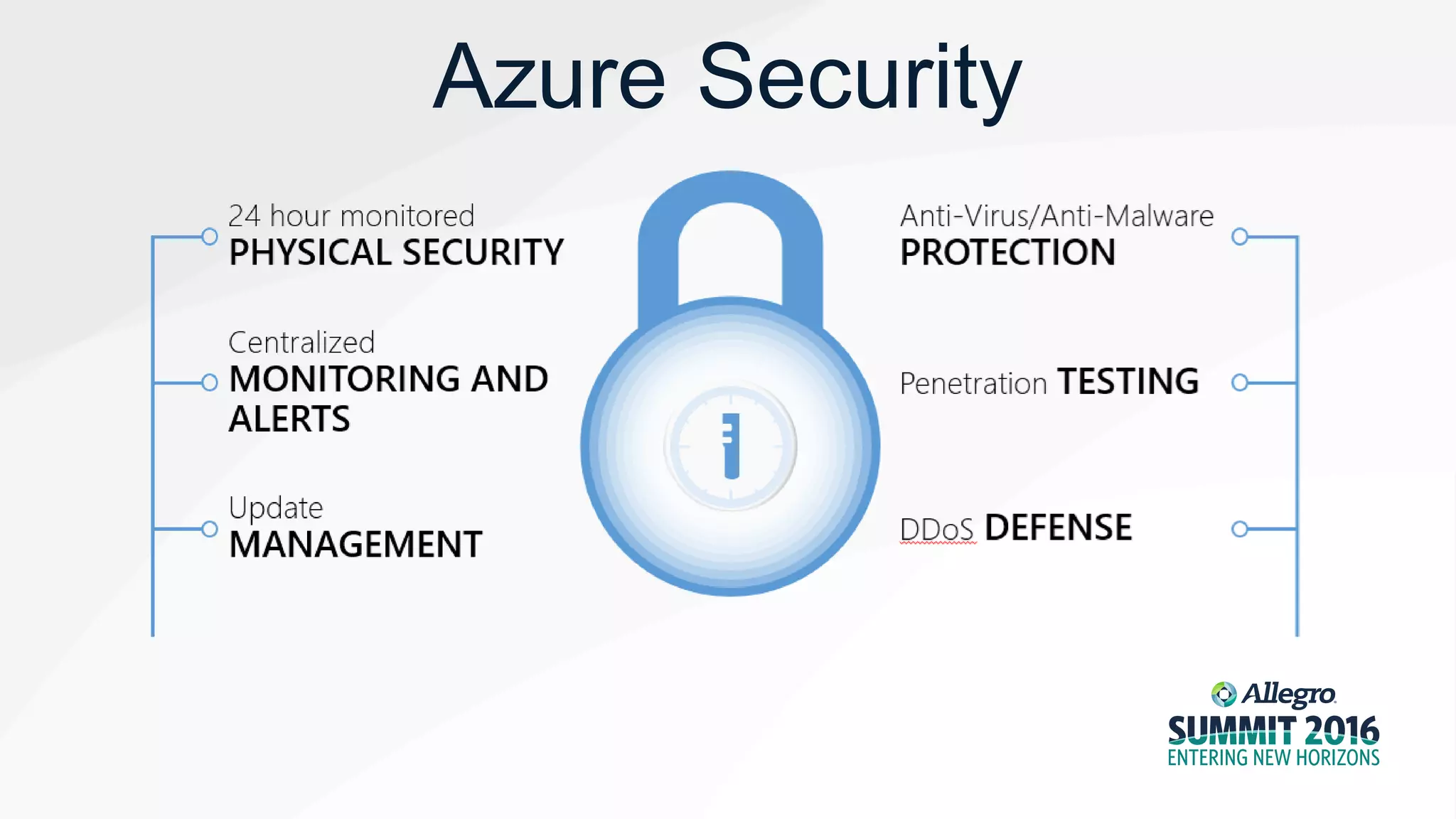
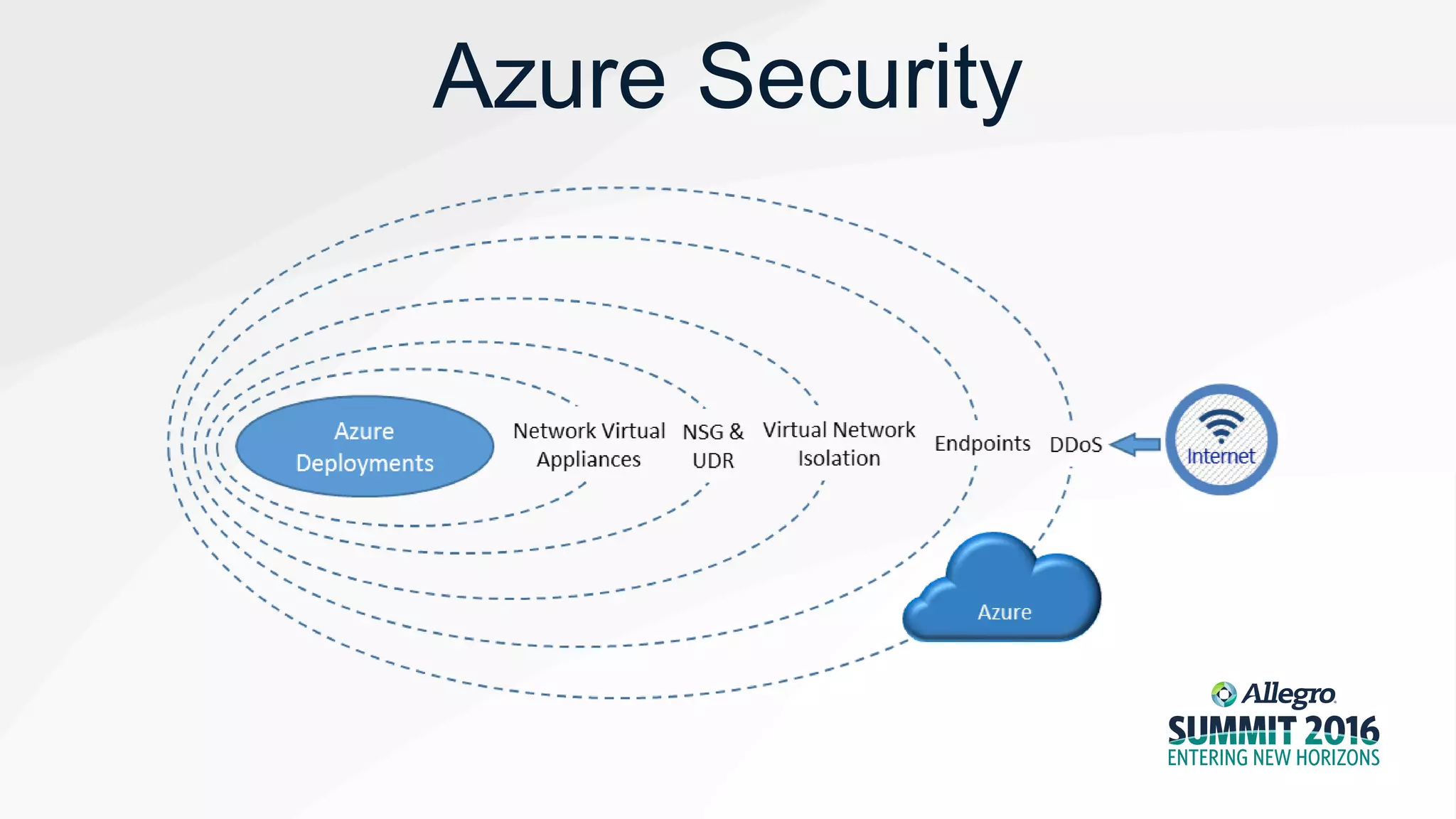
Azure Security
Azure Security
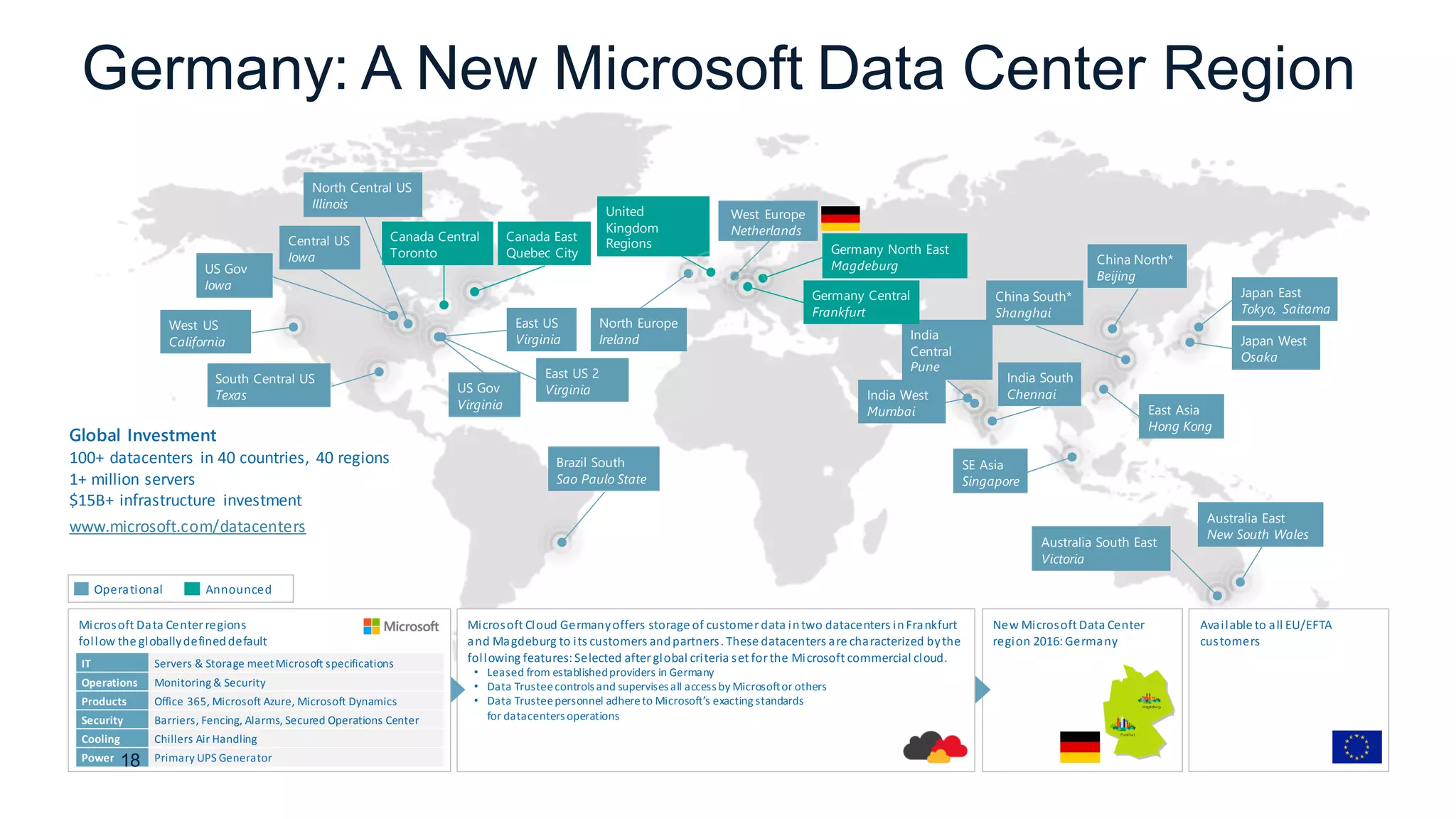
Germany: A New Microsoft Data Center Region
Central US
Iowa
West US
California
East US
Virginia
US Gov
Virginia
North Central US
Illinois
US Gov
Iowa
South Central US
Texas
Brazil South
Sao Paulo State
West Europe
Netherlands
China North*
Beijing
China South*
Shanghai
Japan East
Tokyo, Saitama
Japan West
Osaka
India South
Chennai
East Asia
Hong Kong
SE Asia
Singapore
Australia South East
Victoria
Australia East
New South Wales
India
Central
Pune
Canada East
Quebec City
Canada Central
Toronto
India West
Mumbai
Germany North East
Magdeburg
Germany Central
Frankfurt
United
Kingdom
Regions
North Europe
Ireland
East US 2
Virginia
Global Investment
100+ datacenters in 40 countries, 40 regions
1+ million servers
$15B+ infrastructure investment
www.microsoft.com/datacenters
New Microsoft Data Center
region 2016:Germany
Available to all EU/EFTA
customers
Microsoft Cloud Germanyoffers storage of customer data intwo datacenters inFrankfurt
and Magdeburg to its customers andpartners. These datacenters are characterized bythe
following features:Selected afterglobal criteria set forthe Microsoft commercial cloud.
• Leased from establishedproviders in Germany
• Data Trusteecontrols and supervises all access by Microsoftor others
• Data Trusteepersonnel adhereto Microsoft’s exacting standards
for datacenters operations
Microsoft Data Center regions
follow the globallydefineddefault
IT Servers & Storage meetMicrosoft specifications
Operations Monitoring & Security
Products Office 365, Microsoft Azure, Microsoft Dynamics
Security Barriers, Fencing, Alarms, Secured Operations Center
Cooling Chillers Air Handling
Power Primary UPS Generator
AnnouncedOperational
18
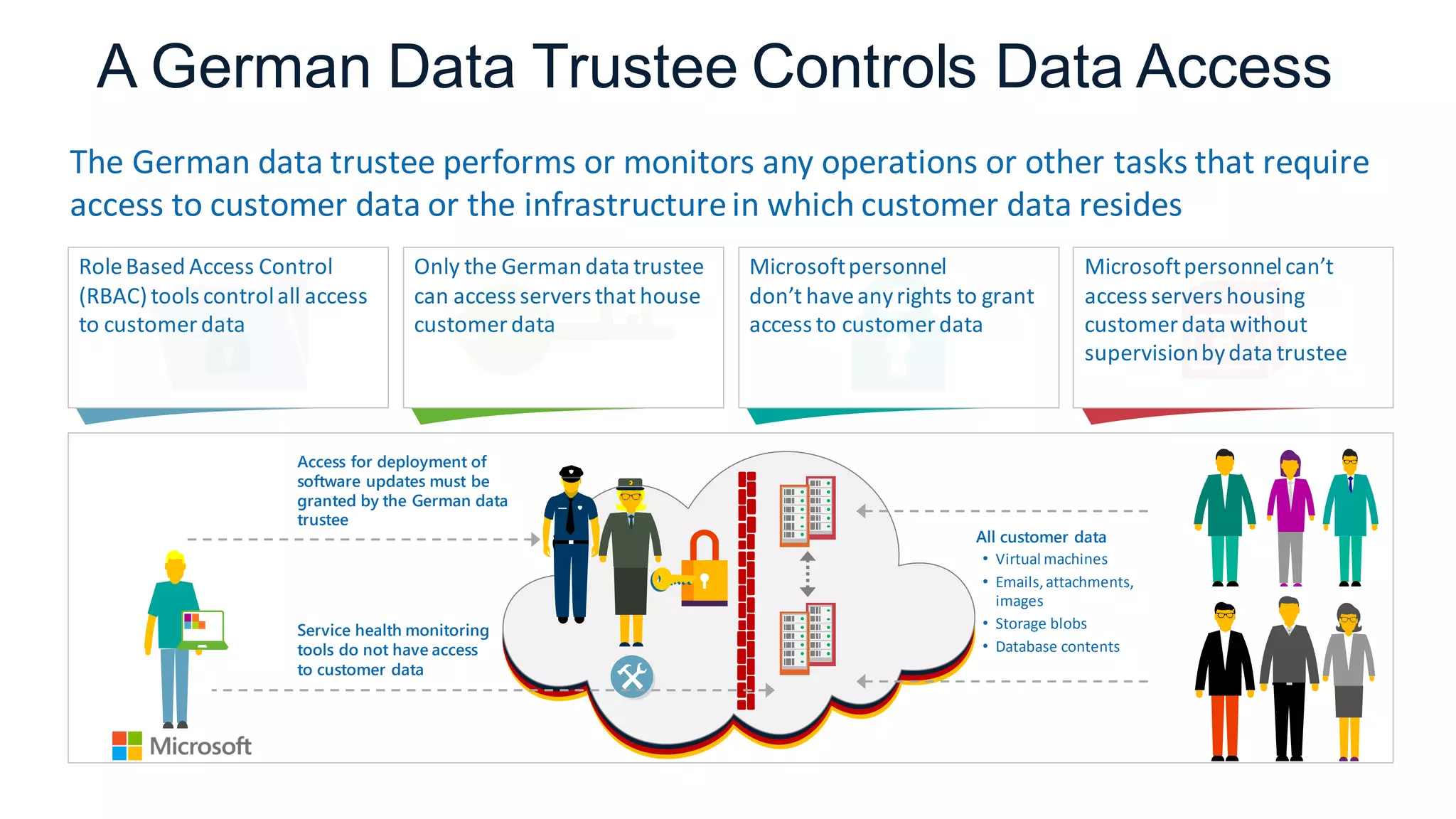
A German Data Trustee Controls Data Access
RoleBased Access Control
(RBAC)tools controlall access
to customerdata
Only the German data trustee
can access servers that house
customerdata
Microsoftpersonnel
don’t haveanyrights to grant
access to customer data
Microsoftpersonnelcan’t
access servers housing
customer data without
supervisionbydata trustee
The German data trustee performs or monitors any operations or other tasks that require
access to customer data or the infrastructurein which customer data resides
Access for deployment of
software updates must be
granted by the German data
trustee
Service health monitoring
tools do not have access
to customer data
All customer data
• Virtual machines
• Emails,attachments,
images
• Storage blobs
• Database contents
What is this “cloud” anyway?
What has cloud evolved into?
Why does the energy industry care?
Is the cloud secure?
The Internet of Things & Analytics
How can I modernize my applications?
Where do I start?
Agenda
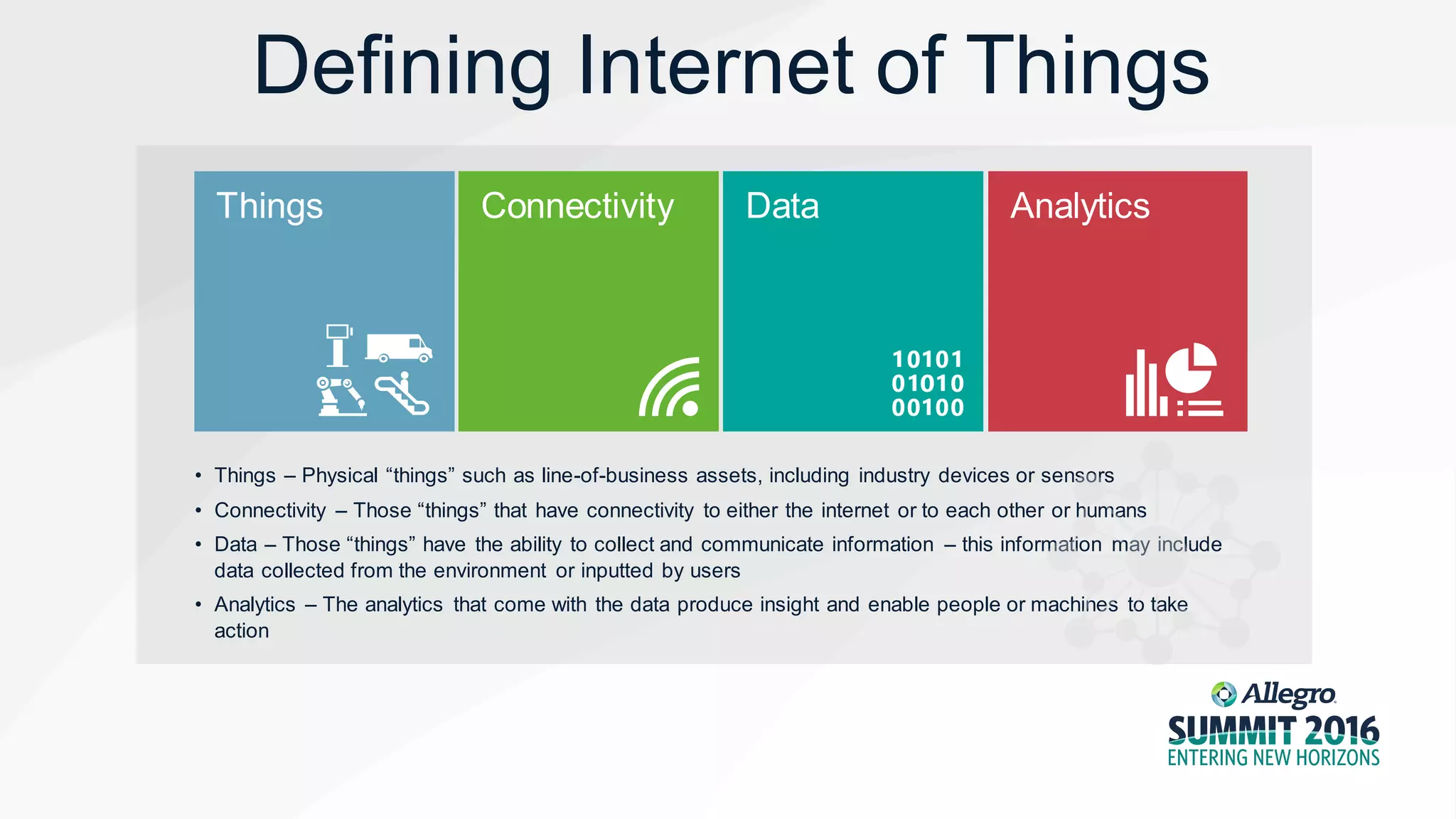
Data AnalyticsConnectivityThings
• Things – Physical “things” such as line-of-business assets, including industry devices or sensors
• Connectivity – Those “things” that have connectivity to either the internet or to each other or humans
• Data – Those “things” have the ability to collect and communicate information – this information may include
data collected from the environment or inputted by users
• Analytics – The analytics that come with the data produce insight and enable people or machines to take
action
Defining Internet of Things
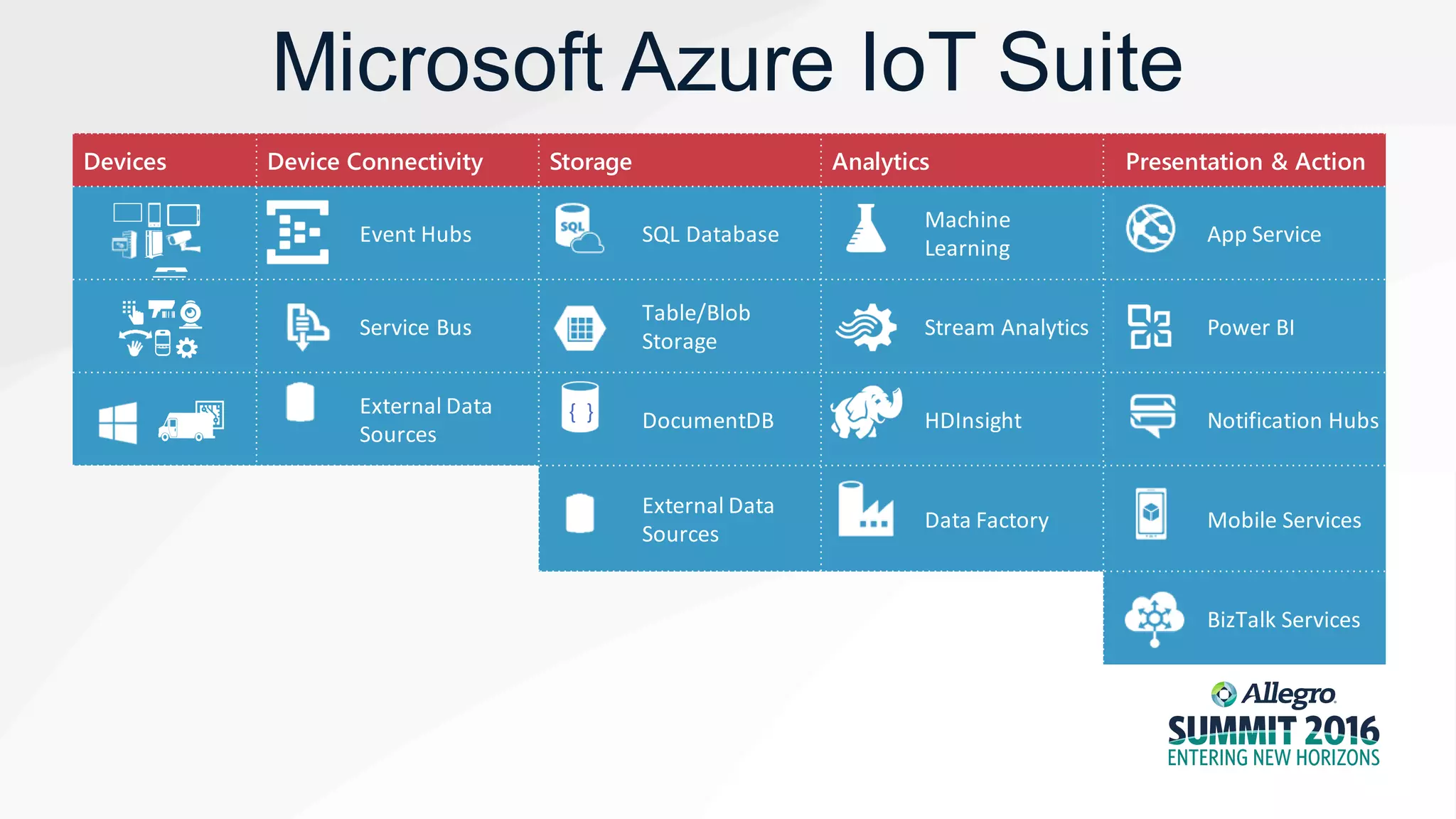
Microsoft Azure IoT Suite
Devices Device Connectivity Storage Analytics Presentation & Action
Event Hubs SQL Database
Machine
Learning
App Service
Service Bus
Table/Blob
Storage
Stream Analytics Power BI
External Data
Sources
DocumentDB HDInsight Notification Hubs
External Data
Sources
Data Factory Mobile Services
BizTalk Services
{ }
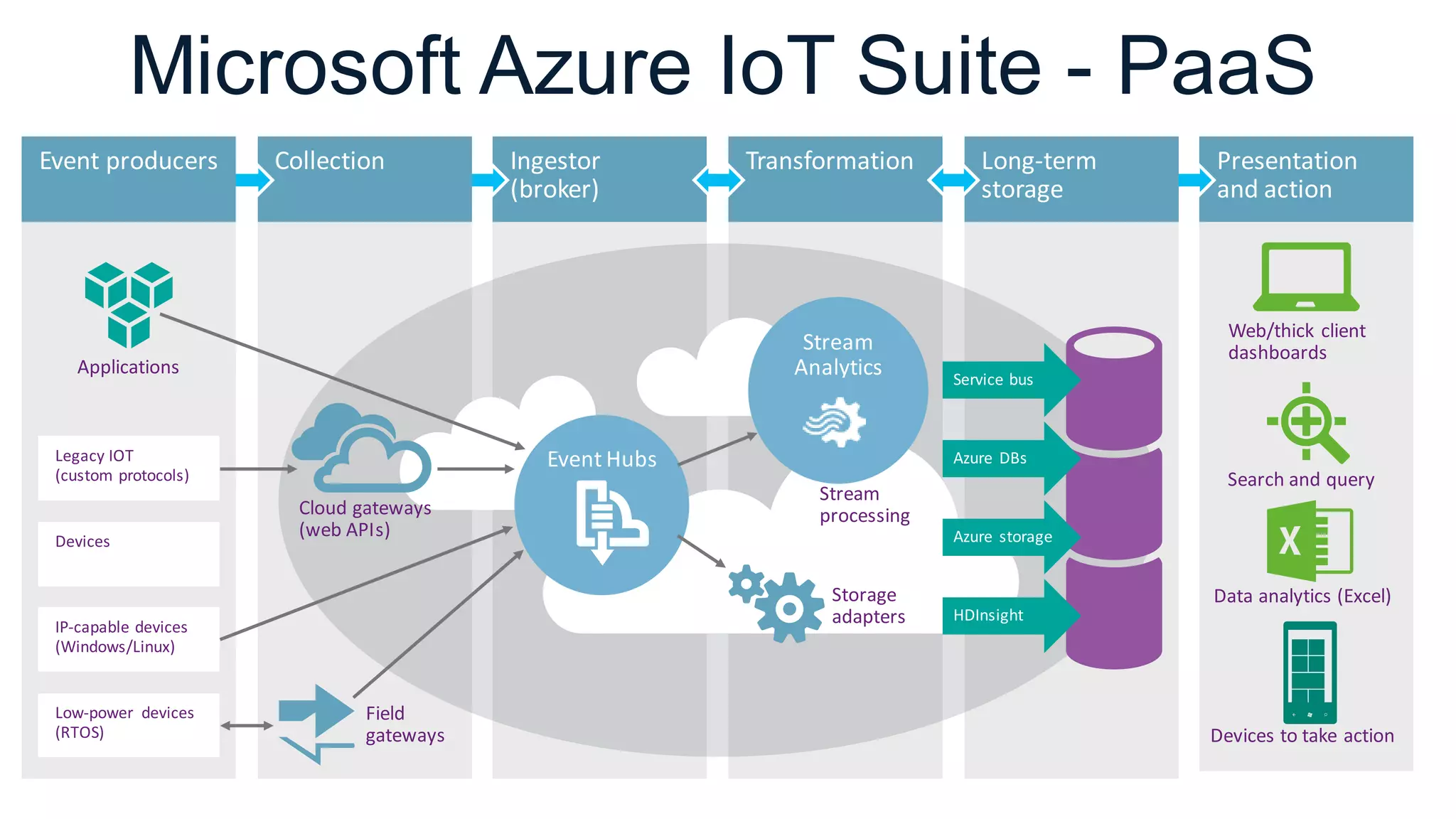
Microsoft Azure IoT Suite - PaaS
What is this “cloud” anyway?
What has cloud evolved into?
Why does the energy industry care?
Is the cloud secure?
The Internet of Things & Analytics
How can I modernize my applications?
Where do I start?
Agenda
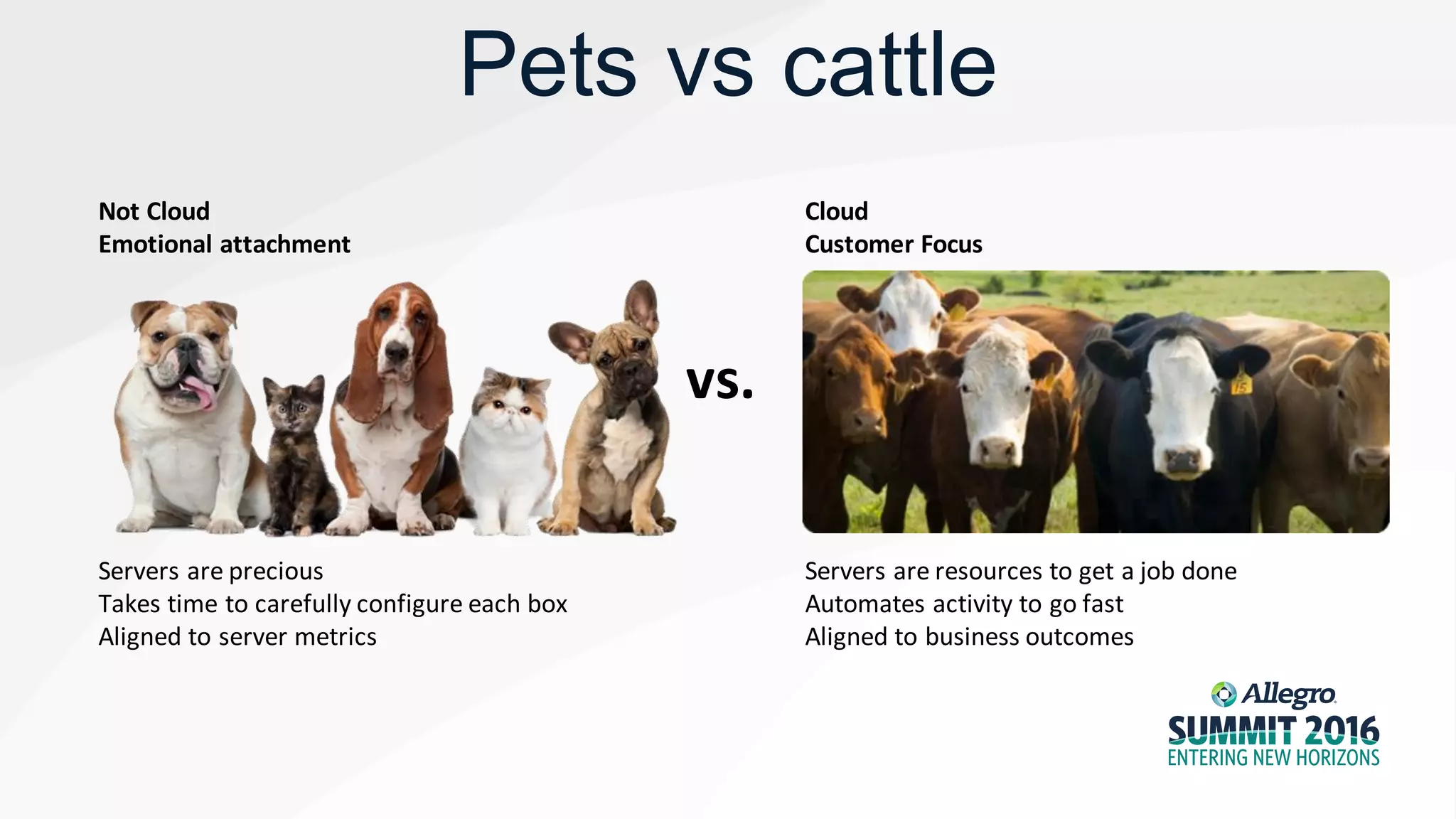
Pets vs cattle
Not Cloud
Emotional attachment
Cloud
Customer Focus
vs.
Servers are precious
Takes time to carefully configure each box
Aligned to server metrics
Servers are resources to get a job done
Automates activity to go fast
Aligned to business outcomes
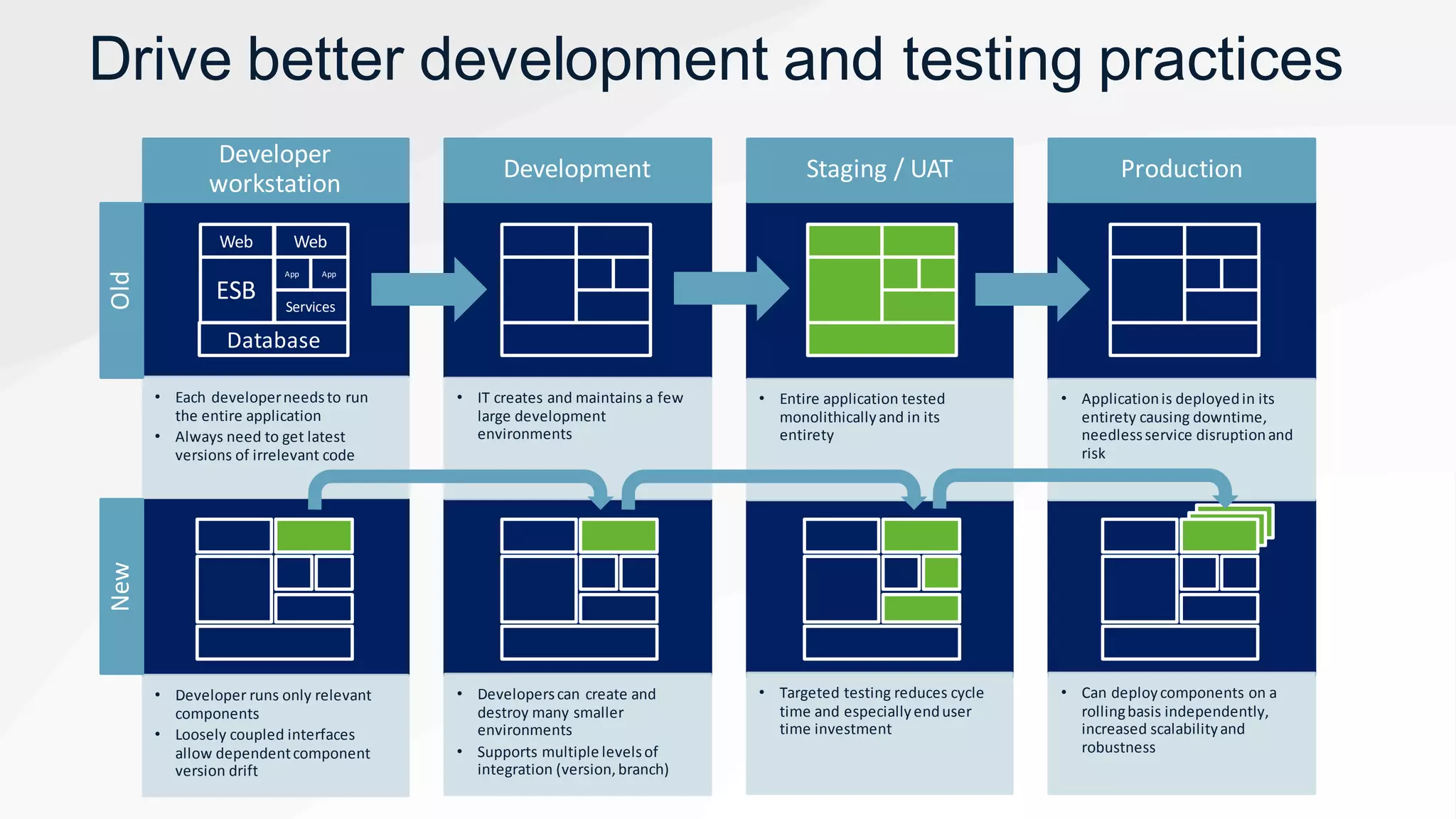
Developer
workstation
• Each developerneedsto run
the entire application
• Always need to get latest
versions of irrelevant code
Development
• IT creates and maintains a few
large development
environments
Staging / UAT
• Entire application tested
monolithicallyand in its
entirety
Production
• Applicationis deployedin its
entirety causing downtime,
needlessservice disruptionand
risk
• Developer runs only relevant
components
• Loosely coupled interfaces
allow dependentcomponent
version drift
• Developerscan create and
destroy many smaller
environments
• Supports multiple levelsof
integration (version,branch)
• Targeted testing reduces cycle
time and especiallyenduser
time investment
• Can deploycomponents on a
rollingbasis independently,
increased scalabilityand
robustness
OldNew
Web Web
AppApp
Services
ESB
Database
Drive better development and testing practices
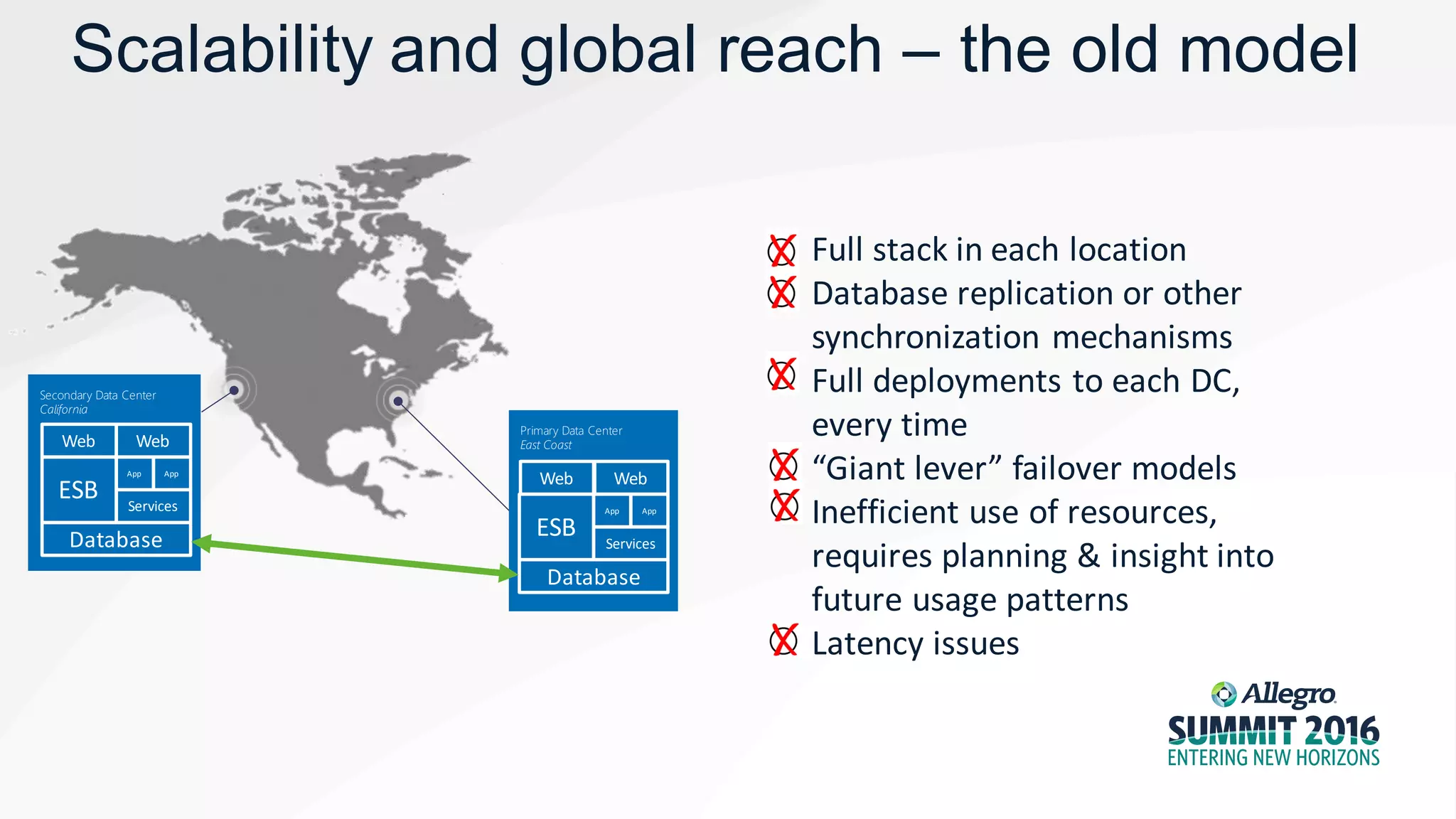
Secondary Data Center
California
Primary Data Center
East CoastWeb Web
AppApp
Services
ESB
Database
Web Web
AppApp
Services
ESB
Database
• Full stack in each location
• Database replication or other
synchronization mechanisms
• Full deployments to each DC,
every time
• “Giant lever” failover models
• Inefficient use of resources,
requires planning & insight into
future usage patterns
• Latency issues
Scalability and global reach – the old model
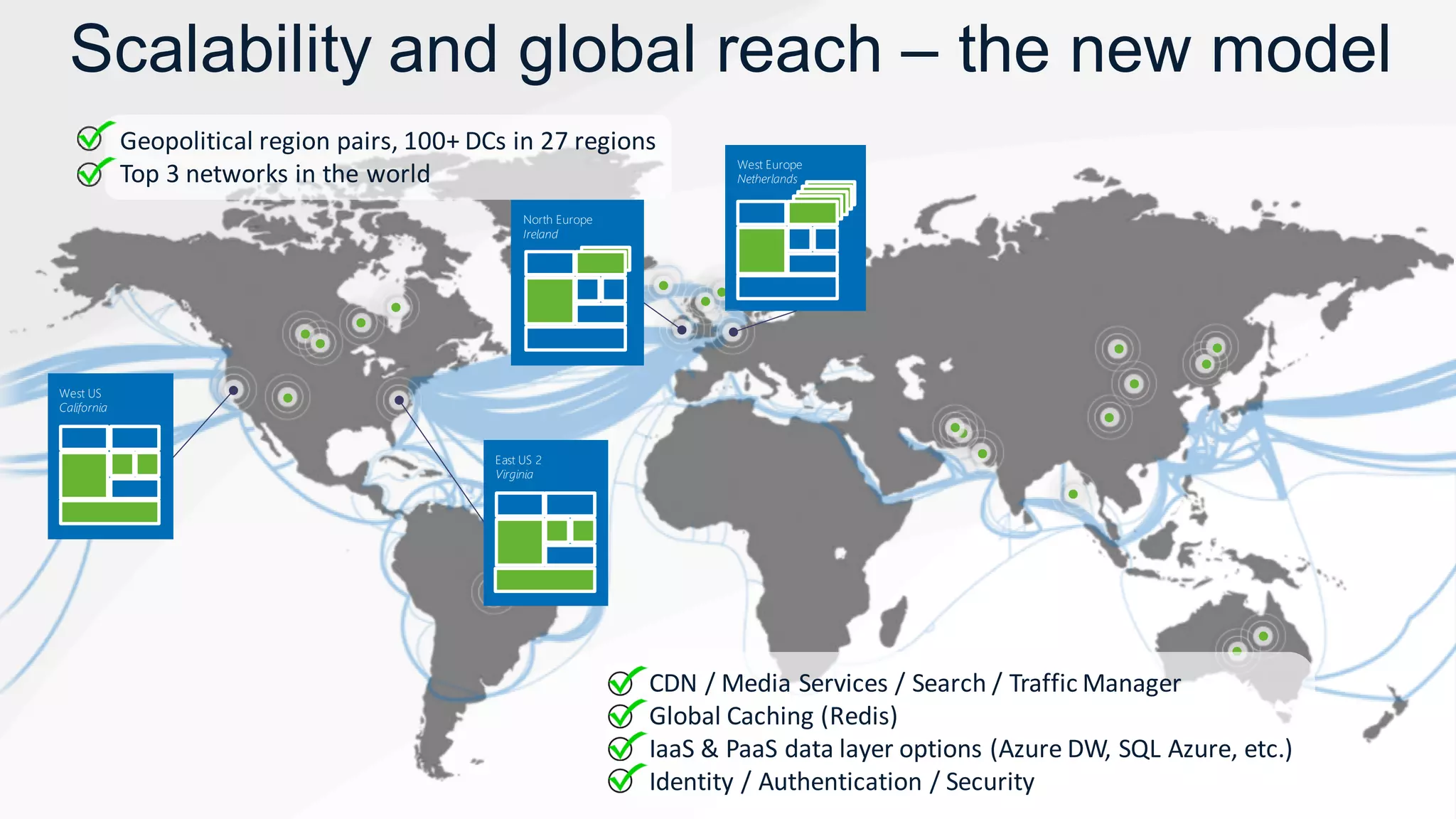
West US
California
West Europe
Netherlands
North Europe
Ireland
East US 2
Virginia
Scalability and global reach – the new model
Geopolitical region pairs, 100+ DCs in 27 regions
Top 3 networks in the world
CDN / Media Services / Search / Traffic Manager
Global Caching (Redis)
IaaS & PaaS data layer options (Azure DW, SQL Azure, etc.)
Identity / Authentication / Security
What is this “cloud” anyway?
What has cloud evolved into?
Why does the energy industry care?
Is the cloud secure?
The Internet of Things & Analytics
How can I modernize my applications?
Where do I start?
Agenda
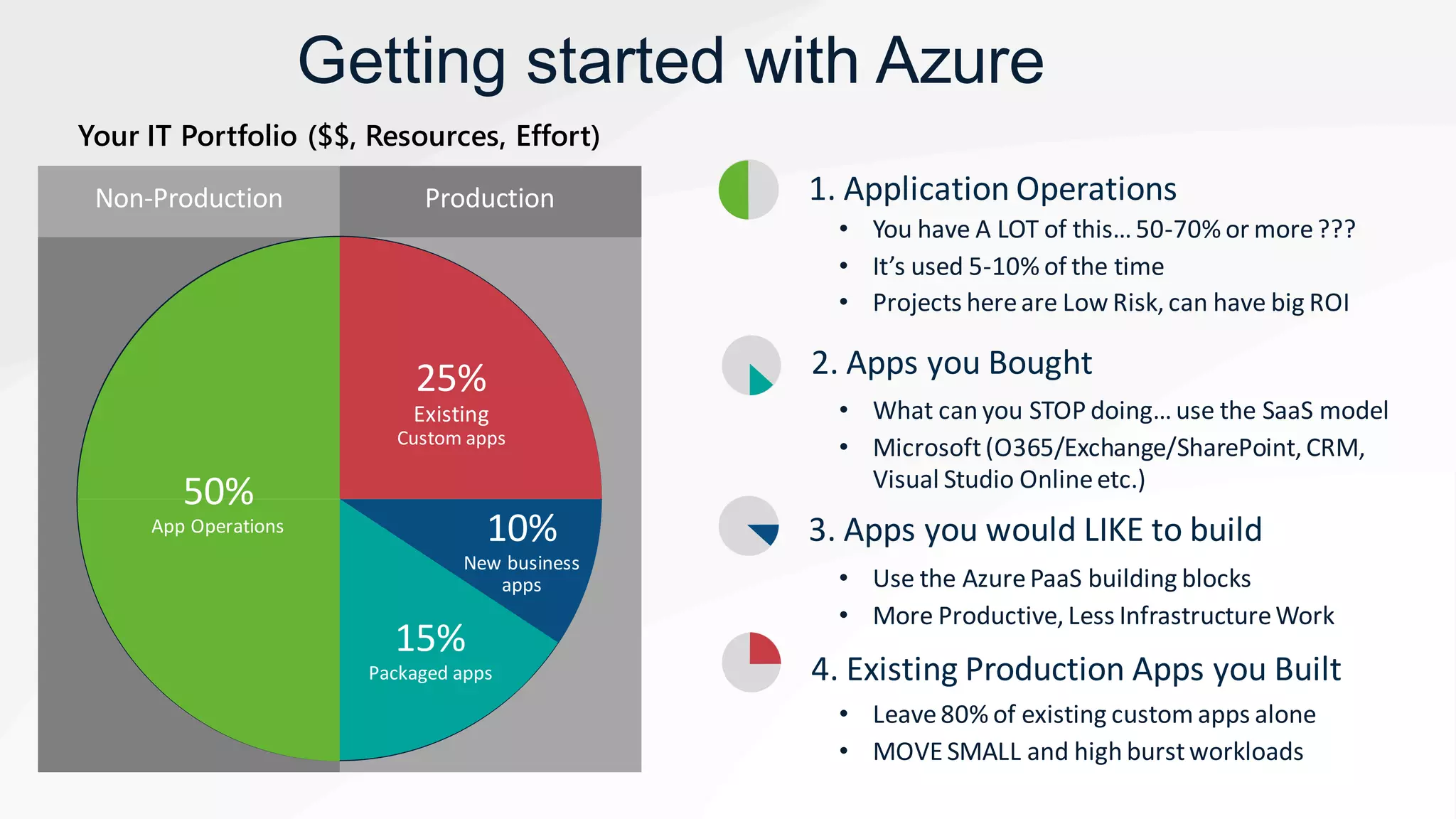
Non-Production Production
Getting started with Azure
Your IT Portfolio ($$, Resources, Effort)
50%
App Operations
25%
Existing
Custom apps
10%
New business
apps
15%
Packaged apps
1. Application Operations
• You have A LOT of this…50-70% or more???
• It’s used 5-10% of the time
• Projects hereare Low Risk,can have big ROI
4. Existing Production Apps you Built
• Leave80% of existing custom apps alone
• MOVE SMALL and high burstworkloads
3. Apps you would LIKE to build
• Use the AzurePaaS building blocks
• More Productive,Less InfrastructureWork
2. Apps you Bought
• What can you STOP doing…use the SaaS model
• Microsoft(O365/Exchange/SharePoint,CRM,
Visual Studio Onlineetc.)
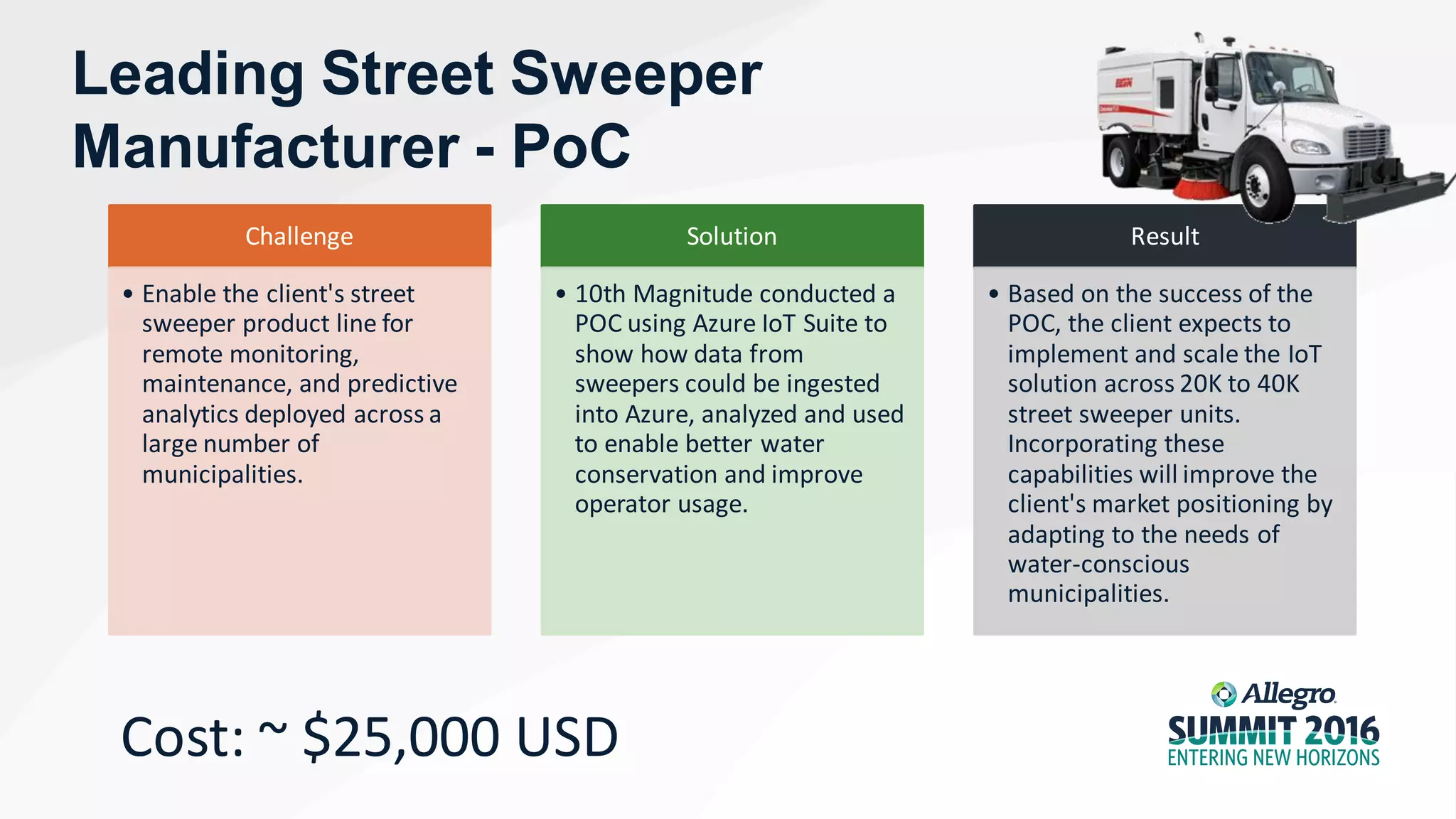
Leading Street Sweeper
Manufacturer - PoC
Challenge
• Enable the client's street
sweeper product line for
remote monitoring,
maintenance, and predictive
analytics deployed across a
large number of
municipalities.
Solution
• 10th Magnitude conducted a
POC using Azure IoT Suite to
show how data from
sweepers could be ingested
into Azure, analyzed and used
to enable better water
conservation and improve
operator usage.
Result
• Based on the success of the
POC, the client expects to
implement and scale the IoT
solution across 20K to 40K
street sweeper units.
Incorporating these
capabilities will improve the
client's market positioning by
adapting to the needs of
water-conscious
municipalities.
Cost: ~ $25,000 USD
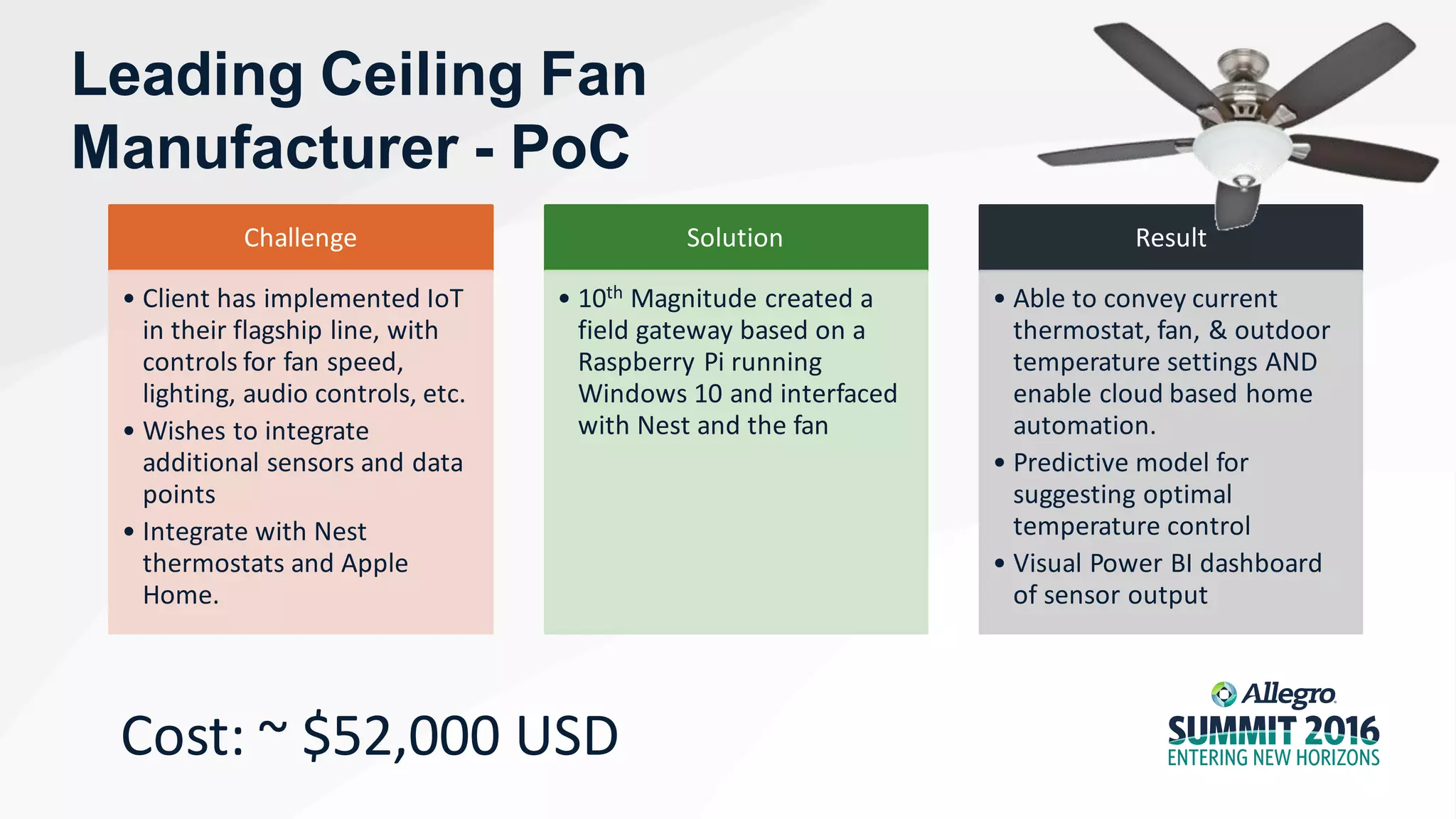
Leading Ceiling Fan
Manufacturer - PoC
Challenge
• Client has implemented IoT
in their flagship line, with
controls for fan speed,
lighting, audio controls, etc.
• Wishes to integrate
additional sensors and data
points
• Integrate with Nest
thermostats and Apple
Home.
Solution
• 10th Magnitude created a
field gateway based on a
Raspberry Pi running
Windows 10 and interfaced
with Nest and the fan
Result
• Able to convey current
thermostat, fan, & outdoor
temperature settings AND
enable cloud based home
automation.
• Predictive model for
suggesting optimal
temperature control
• Visual Power BI dashboard
of sensor output
Cost: ~ $52,000 USD
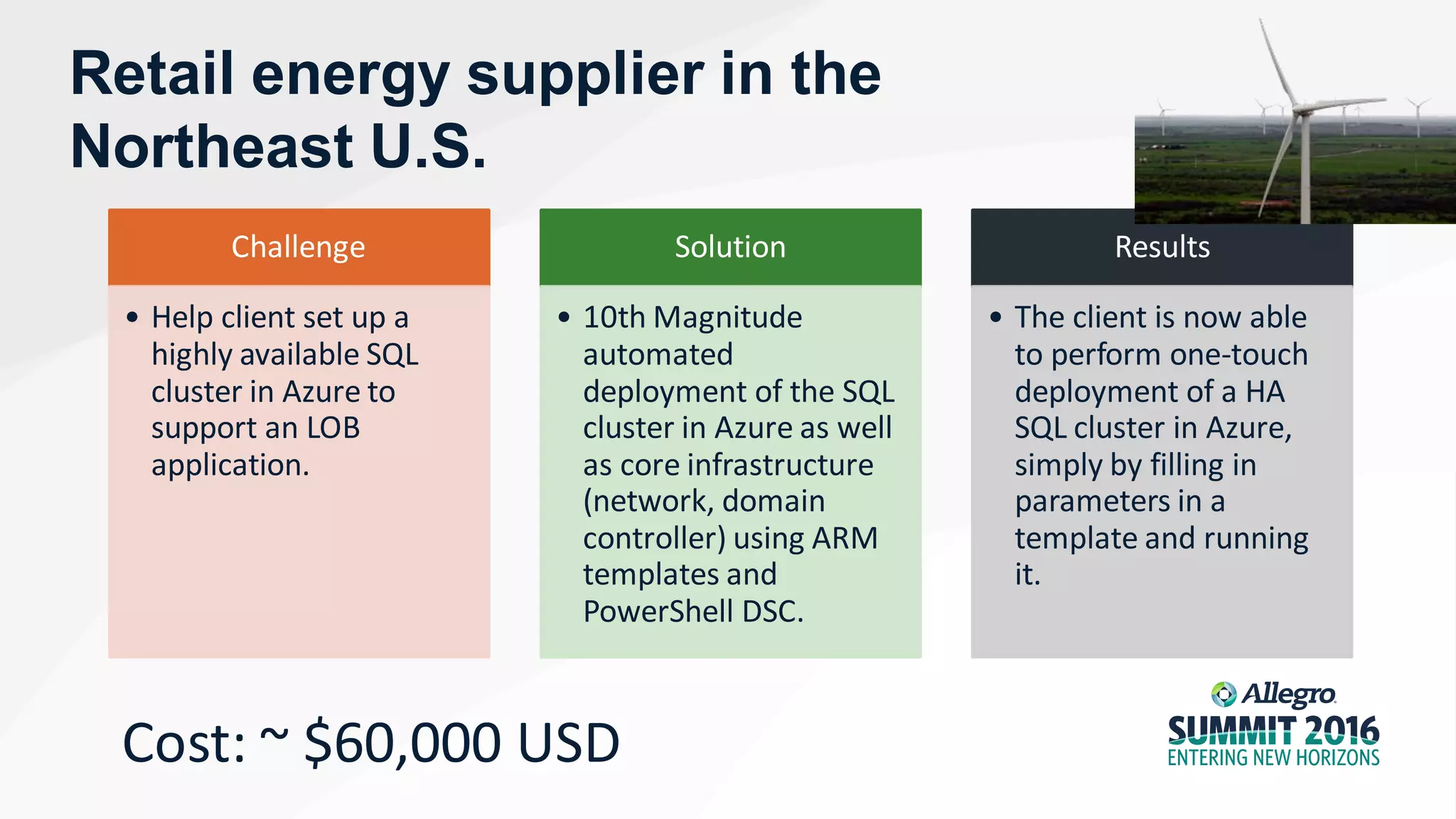
Retail energy supplier in the
Northeast U.S.
Challenge
• Help client set up a
highly available SQL
cluster in Azure to
support an LOB
application.
Solution
• 10th Magnitude
automated
deployment of the SQL
cluster in Azure as well
as core infrastructure
(network, domain
controller) using ARM
templates and
PowerShell DSC.
Results
• The client is now able
to perform one-touch
deployment of a HA
SQL cluster in Azure,
simply by filling in
parameters in a
template and running
it.
Cost: ~ $60,000 USD
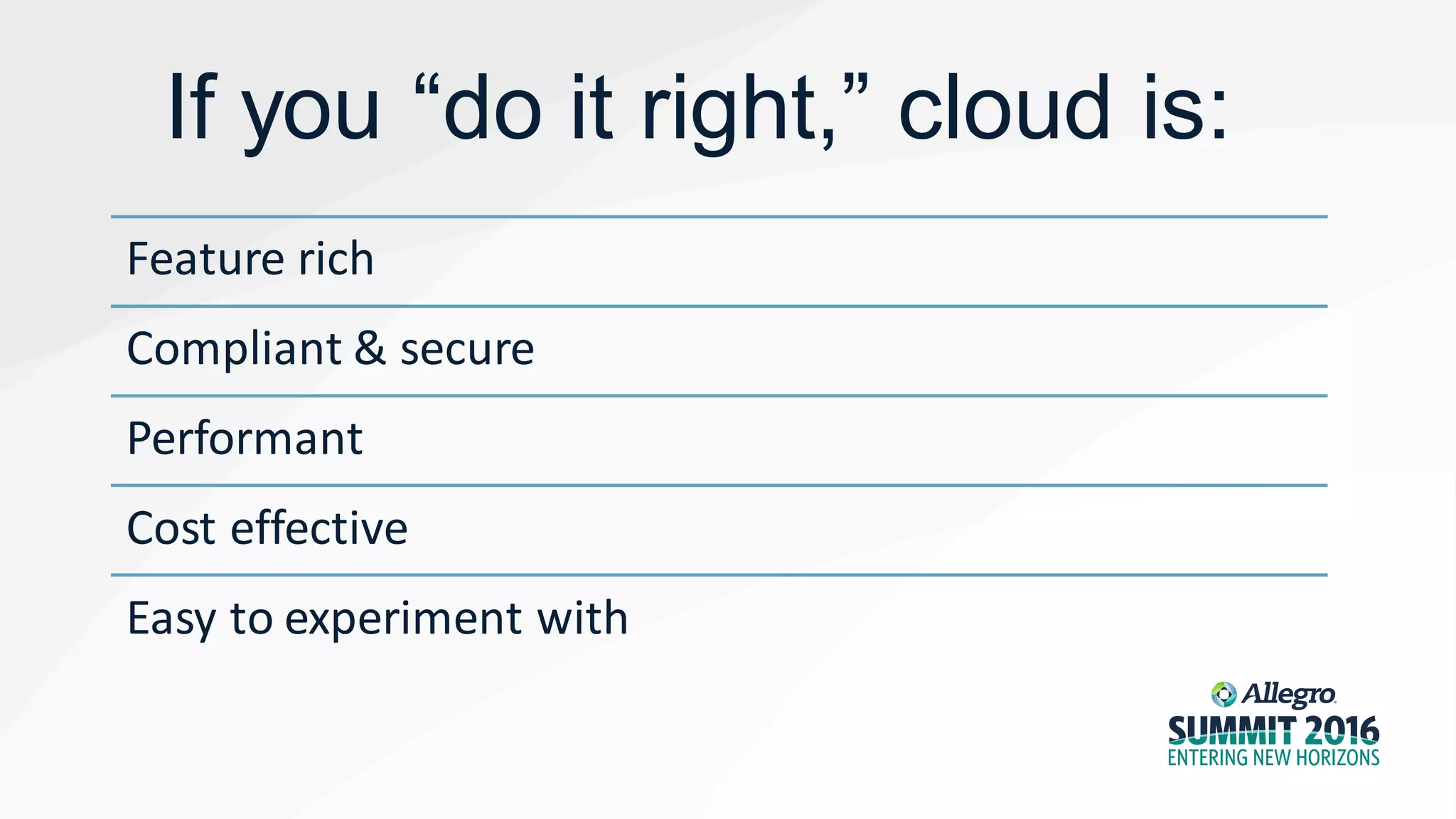
Feature rich
Compliant & secure
Performant
Cost effective
Easy to experiment with
If you “do it right,” cloud is:
Thank You!
jsaunders@10thmagnitude.com

2016 Allegro EMEA Customer Summit - Jacob Saunders

  • 1.
    What Can CloudDo for Your Business? Jacob Saunders CTO, 10th Magnitude
  • 2.
    What is this“cloud” anyway? What has cloud evolved into? Why does the energy industry care? Is the cloud secure? The Internet of Things & Analytics How can I modernize my applications? Where do I start? Agenda
  • 3.
    Timeline 1997 Term “cloud computing”coined 1999 Salesforce.com founded 2000 Grid computing introduced 2000 Dot-com bubble bursts 1998 VMWare founded 2006 Amazon launches EC2 2008 Microsoft announces Azure 2010 Azure commerciallyavailable 1960: John McCarthy opined that “computation may someday be organised as a public utility”
  • 4.
    Cloud Momentum Continuesto Accelerate “If you’re resisting the cloud because of security concerns, you’re running out of excuses.” “The question is no longer: ‘How do I move to the cloud?’ Instead, it’s ‘Now that I’m in the cloud, how do I make sure I’ve optimized my investment and risk exposure?” “By 2020 clouds will stop being referred to as ‘public’ and ‘private’. It will simply be the way business is done and IT is provisioned.”
  • 5.
    >70% Fortune 500 companies deployedon Azure 122% YoY Growth for Azure Compute >10Trillion Azure Storage Transactions during December ‘15 alone >90trillion Storage objects in Azure >2 Trillion Messages/week in Event Hubs 551million Azure Active Directory users Azure momentum Microsoft Confidential
  • 6.
    127% YoY growth incores 400 K + Servers added in 2015 75 K Provisioning Servers / Month 2009 2010 2011 2012 2013 2014 2015 Server Counts The amount of servers added in all of 2011 Microsoft now adds every day! • 122% YoY growth in GB RAM (>12.9 M) • 140% YoY growth in all-up revenue • 40% of VM Cores are premium sizes
  • 7.
    What is this“cloud” anyway? What has cloud evolved into? Why does the energy industry care? Is the cloud secure? The Internet of Things & Analytics How can I modernize my applications? Where do I start? Agenda
  • 8.
    Hyper scale Infrastructureis the enabler 27 Regions Worldwide, 22 online…huge capacity around the world…growing every year  100+ datacenters  Top 3 networks in the world  2.5x AWS,7x Google DC Regions  G Series – LargestVM in World,32 cores, 448GB Ram, SSD… Operational Announced/Not Operational Central US Iowa West US California East US Virginia US Gov Virginia North Central US Illinois US Gov Iowa South Central US Texas Brazil South Sao Paulo State West Europe Netherlands China North * Beijing China South * Shanghai Japan East Tokyo,Saitama Japan West Osaka India South Chennai East Asia Hong Kong SE Asia Singapore Australia South East Victoria Australia East New South Wales * Operated by 21Vianet India Central Pune Canada East Quebec City Canada Central Toronto India West Mumbai Germany North East Magdeburg Germany Central Frankfurt United Kingdom Regions North Europe Ireland East US 2 Virginia
  • 9.
    Microsoft’s network isone of the two largest in the world (the other one is NOT Amazon’s)
  • 10.
    Platform Services Security & Management InfrastructureServices Web Apps Mobile Apps API Management API Apps Logic Apps Notification Hubs Content Delivery Network (CDN) Media Services HDInsight Machine Learning Stream Analytics Data Factory Event Hubs Mobile Engagement Active Directory Multi-Factor Authentication Automation Portal Key Vault Biztalk Services Hybrid Connections Service Bus Storage Queues Store / Marketplace Hybrid Operations Backup StorSimple Site Recovery Import/Export SQL Database DocumentDB Redis Cache Search Tables SQL Data Warehouse Azure AD Connect Health AD Privileged Identity Management Operational Insights Cloud Services Batch Remote App Service Fabric Visual Studio Application Insights Azure SDK Team Project VM Image Gallery & VM Depot
  • 11.
    The Microsoft PlatformStrategy Public, Global, Shared DatacentersMicrosoft Azure Stack & Cloud Platform System Security& Management Public Cloud Platform Hybrid Operations Security& Management Hybrid Operations Software As a Service • Office 365 • Microsoft CRM • Dynamics AX • VS Online • Etc.
  • 12.
    What is this“cloud” anyway? What has cloud evolved into? Why does the energy industry care? Is the cloud secure? The Internet of Things & Analytics How can I modernize my applications? Where do I start? Agenda
  • 13.
    Explosion of Connected Things& Data • Smart meters & grids • Sensorized rigs & pipeline systems • Connected homes • Environmental & satellite data • Batteries everywhere! Right-Sizing Difficult • Commodity price- driven capital budgets • Volatile markets • Usage patterns difficult to predict Security & Compliance • Exploration disruption • Attacks on SCADA systems • EHS systems • Safe Harbor Repeal Energy Industry Considerations Increasing Functional and Elasticity Demands
  • 14.
    What is this“cloud” anyway? What has cloud evolved into? Why does the energy industry care? Is the cloud secure? The Internet of Things & Analytics How can I modernize my applications? Where do I start? Agenda
  • 15.
    Azure Compliance HIPAA / HITECH FedRAMPJAB P-ATO FIPS 140-2 FERPA DISA Level 2 ITAR-readyCJIS21 CFR Part 11 IRS 1075 Section 508 VPAT ISO 27001 PCI DSS Level 1SOC 1 Type 2 SOC 2 Type 2 ISO 27018Cloud Controls Matrix Content Delivery and Security Association Shared Assessments European Union Model Clauses United Kingdom G-Cloud Singapore MTCS Level 3 Australian Signals Directorate Japan Financial Services China Multi Layer Protection Scheme China CCCPPF New Zealand GCIO China GB 18030 EU Safe Harbor ENISA IAF
  • 16.
  • 17.
  • 18.
    Germany: A NewMicrosoft Data Center Region Central US Iowa West US California East US Virginia US Gov Virginia North Central US Illinois US Gov Iowa South Central US Texas Brazil South Sao Paulo State West Europe Netherlands China North* Beijing China South* Shanghai Japan East Tokyo, Saitama Japan West Osaka India South Chennai East Asia Hong Kong SE Asia Singapore Australia South East Victoria Australia East New South Wales India Central Pune Canada East Quebec City Canada Central Toronto India West Mumbai Germany North East Magdeburg Germany Central Frankfurt United Kingdom Regions North Europe Ireland East US 2 Virginia Global Investment 100+ datacenters in 40 countries, 40 regions 1+ million servers $15B+ infrastructure investment www.microsoft.com/datacenters New Microsoft Data Center region 2016:Germany Available to all EU/EFTA customers Microsoft Cloud Germanyoffers storage of customer data intwo datacenters inFrankfurt and Magdeburg to its customers andpartners. These datacenters are characterized bythe following features:Selected afterglobal criteria set forthe Microsoft commercial cloud. • Leased from establishedproviders in Germany • Data Trusteecontrols and supervises all access by Microsoftor others • Data Trusteepersonnel adhereto Microsoft’s exacting standards for datacenters operations Microsoft Data Center regions follow the globallydefineddefault IT Servers & Storage meetMicrosoft specifications Operations Monitoring & Security Products Office 365, Microsoft Azure, Microsoft Dynamics Security Barriers, Fencing, Alarms, Secured Operations Center Cooling Chillers Air Handling Power Primary UPS Generator AnnouncedOperational 18
  • 19.
    A German DataTrustee Controls Data Access RoleBased Access Control (RBAC)tools controlall access to customerdata Only the German data trustee can access servers that house customerdata Microsoftpersonnel don’t haveanyrights to grant access to customer data Microsoftpersonnelcan’t access servers housing customer data without supervisionbydata trustee The German data trustee performs or monitors any operations or other tasks that require access to customer data or the infrastructurein which customer data resides Access for deployment of software updates must be granted by the German data trustee Service health monitoring tools do not have access to customer data All customer data • Virtual machines • Emails,attachments, images • Storage blobs • Database contents
  • 20.
    What is this“cloud” anyway? What has cloud evolved into? Why does the energy industry care? Is the cloud secure? The Internet of Things & Analytics How can I modernize my applications? Where do I start? Agenda
  • 21.
    Data AnalyticsConnectivityThings • Things– Physical “things” such as line-of-business assets, including industry devices or sensors • Connectivity – Those “things” that have connectivity to either the internet or to each other or humans • Data – Those “things” have the ability to collect and communicate information – this information may include data collected from the environment or inputted by users • Analytics – The analytics that come with the data produce insight and enable people or machines to take action Defining Internet of Things
  • 22.
    Microsoft Azure IoTSuite Devices Device Connectivity Storage Analytics Presentation & Action Event Hubs SQL Database Machine Learning App Service Service Bus Table/Blob Storage Stream Analytics Power BI External Data Sources DocumentDB HDInsight Notification Hubs External Data Sources Data Factory Mobile Services BizTalk Services { }
  • 23.
    Microsoft Azure IoTSuite - PaaS
  • 24.
    What is this“cloud” anyway? What has cloud evolved into? Why does the energy industry care? Is the cloud secure? The Internet of Things & Analytics How can I modernize my applications? Where do I start? Agenda
  • 25.
    Pets vs cattle NotCloud Emotional attachment Cloud Customer Focus vs. Servers are precious Takes time to carefully configure each box Aligned to server metrics Servers are resources to get a job done Automates activity to go fast Aligned to business outcomes
  • 26.
    Developer workstation • Each developerneedstorun the entire application • Always need to get latest versions of irrelevant code Development • IT creates and maintains a few large development environments Staging / UAT • Entire application tested monolithicallyand in its entirety Production • Applicationis deployedin its entirety causing downtime, needlessservice disruptionand risk • Developer runs only relevant components • Loosely coupled interfaces allow dependentcomponent version drift • Developerscan create and destroy many smaller environments • Supports multiple levelsof integration (version,branch) • Targeted testing reduces cycle time and especiallyenduser time investment • Can deploycomponents on a rollingbasis independently, increased scalabilityand robustness OldNew Web Web AppApp Services ESB Database Drive better development and testing practices
  • 27.
    Secondary Data Center California PrimaryData Center East CoastWeb Web AppApp Services ESB Database Web Web AppApp Services ESB Database • Full stack in each location • Database replication or other synchronization mechanisms • Full deployments to each DC, every time • “Giant lever” failover models • Inefficient use of resources, requires planning & insight into future usage patterns • Latency issues Scalability and global reach – the old model
  • 28.
    West US California West Europe Netherlands NorthEurope Ireland East US 2 Virginia Scalability and global reach – the new model Geopolitical region pairs, 100+ DCs in 27 regions Top 3 networks in the world CDN / Media Services / Search / Traffic Manager Global Caching (Redis) IaaS & PaaS data layer options (Azure DW, SQL Azure, etc.) Identity / Authentication / Security
  • 29.
    What is this“cloud” anyway? What has cloud evolved into? Why does the energy industry care? Is the cloud secure? The Internet of Things & Analytics How can I modernize my applications? Where do I start? Agenda
  • 30.
    Non-Production Production Getting startedwith Azure Your IT Portfolio ($$, Resources, Effort) 50% App Operations 25% Existing Custom apps 10% New business apps 15% Packaged apps 1. Application Operations • You have A LOT of this…50-70% or more??? • It’s used 5-10% of the time • Projects hereare Low Risk,can have big ROI 4. Existing Production Apps you Built • Leave80% of existing custom apps alone • MOVE SMALL and high burstworkloads 3. Apps you would LIKE to build • Use the AzurePaaS building blocks • More Productive,Less InfrastructureWork 2. Apps you Bought • What can you STOP doing…use the SaaS model • Microsoft(O365/Exchange/SharePoint,CRM, Visual Studio Onlineetc.)
  • 31.
    Leading Street Sweeper Manufacturer- PoC Challenge • Enable the client's street sweeper product line for remote monitoring, maintenance, and predictive analytics deployed across a large number of municipalities. Solution • 10th Magnitude conducted a POC using Azure IoT Suite to show how data from sweepers could be ingested into Azure, analyzed and used to enable better water conservation and improve operator usage. Result • Based on the success of the POC, the client expects to implement and scale the IoT solution across 20K to 40K street sweeper units. Incorporating these capabilities will improve the client's market positioning by adapting to the needs of water-conscious municipalities. Cost: ~ $25,000 USD
  • 32.
    Leading Ceiling Fan Manufacturer- PoC Challenge • Client has implemented IoT in their flagship line, with controls for fan speed, lighting, audio controls, etc. • Wishes to integrate additional sensors and data points • Integrate with Nest thermostats and Apple Home. Solution • 10th Magnitude created a field gateway based on a Raspberry Pi running Windows 10 and interfaced with Nest and the fan Result • Able to convey current thermostat, fan, & outdoor temperature settings AND enable cloud based home automation. • Predictive model for suggesting optimal temperature control • Visual Power BI dashboard of sensor output Cost: ~ $52,000 USD
  • 33.
    Retail energy supplierin the Northeast U.S. Challenge • Help client set up a highly available SQL cluster in Azure to support an LOB application. Solution • 10th Magnitude automated deployment of the SQL cluster in Azure as well as core infrastructure (network, domain controller) using ARM templates and PowerShell DSC. Results • The client is now able to perform one-touch deployment of a HA SQL cluster in Azure, simply by filling in parameters in a template and running it. Cost: ~ $60,000 USD
  • 34.
    Feature rich Compliant &secure Performant Cost effective Easy to experiment with If you “do it right,” cloud is:
  • 35.