Vision in animals
Vani Jhaveri
V/11/175
Introduction
• Vision is that sense that enables
animals to see the world around
them.
• Animals require vision to survive,
find food, protect themselves from
predators, seek shelter, and so on..
The Eyes
• The main organ of vision is the eye!
• The eye, along with its multiple parts
and in coordination with the brain,
produces vision.
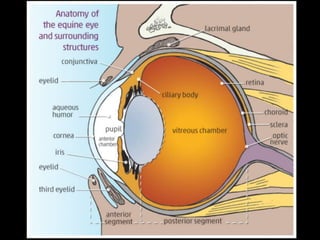
• Parts of the eye: (from outside to
inside)
Lens
Vitreous humor
Retina
Optic nerve
Sclera
Eyelashes and eyelids
Cornea
Aqueous humor
Iris
Pupil
Mechanism of vision
• Visual function involves a combination of
many factors, including:
 the field of view
 depth perception (ability to judge distances)
 acuity (focusing ability)
 perception of motion and
 colour differentiation.
• LIGHT from Object  Conjunctiva 
Cornea  Aqueous humor  Lens 
Vitreous humor  RETINA…
• NERVE IMPULSE  Rods and Cones on
retina Synapse  Bipolar nerve cells 
Ganglions  Optic nerves Occipital lobe
of BRAIN.
• Image formed on the retina is inverted but
Classification of Vision
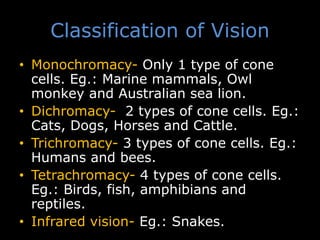
• Monochromacy- Only 1 type of cone
cells. Eg.: Marine mammals, Owl
monkey and Australian sea lion.
• Dichromacy- 2 types of cone cells. Eg.:
Cats, Dogs, Horses and Cattle.
• Trichromacy- 3 types of cone cells. Eg.:
Humans and bees.
• Tetrachromacy- 4 types of cone cells.
Eg.: Birds, fish, amphibians and
reptiles.
• Infrared vision- Eg.: Snakes.
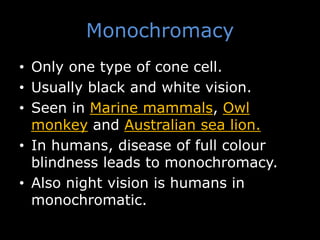
Monochromacy
• Only one type of cone cell.
• Usually black and white vision.
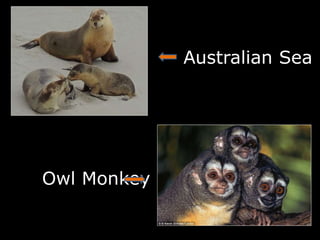
• Seen in Marine mammals, Owl
monkey and Australian sea lion.
• In humans, disease of full colour
blindness leads to monochromacy.
• Also night vision is humans in
monochromatic.
Australian Sea L
Owl Monkey
Dichromacy
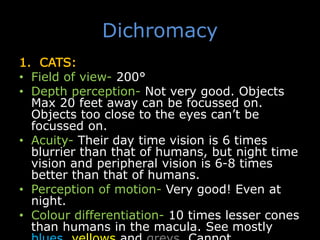
1. CATS:
• Field of view- 200°
• Depth perception- Not very good. Objects
Max 20 feet away can be focussed on.
Objects too close to the eyes can’t be
focussed on.
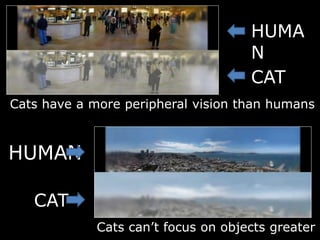
• Acuity- Their day time vision is 6 times
blurrier than that of humans, but night time
vision and peripheral vision is 6-8 times
better than that of humans.
• Perception of motion- Very good! Even at
night.
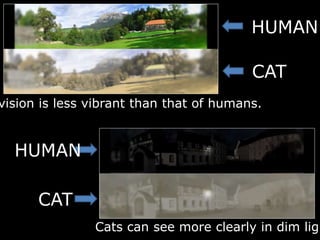
• Colour differentiation- 10 times lesser cones
than humans in the macula. See mostly
HUMA
N
CAT
Cats have a more peripheral vision than humans
HUMAN
CAT
Cats can’t focus on objects greater t
vision is less vibrant than that of humans.
Cats can see more clearly in dim ligh
HUMAN
CAT
HUMAN
CAT
Dichromacy
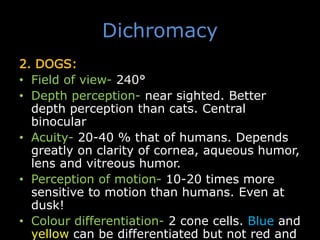
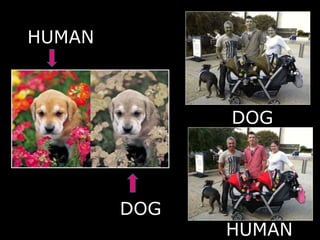
2. DOGS:
• Field of view- 240°
• Depth perception- near sighted. Better
depth perception than cats. Central
binocular field helps in depth perception.
• Acuity- 20-40 % that of humans. Depends
greatly on clarity of cornea, aqueous humor,
lens and vitreous humor.
• Perception of motion- 10-20 times more
sensitive to motion than humans. Even at
dusk!
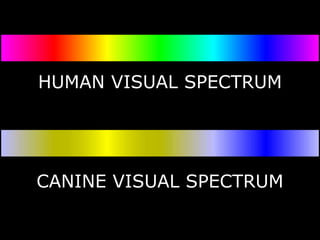
• Colour differentiation- 2 cone cells. Blue and
yellow can be differentiated but not red and
HUMAN
DOG
DOG
HUMAN
HUMAN VISUAL SPECTRUM
CANINE VISUAL SPECTRUM
Dichromacy
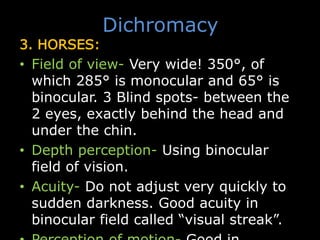
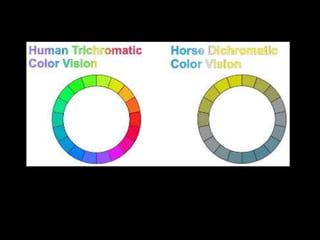
3. HORSES:
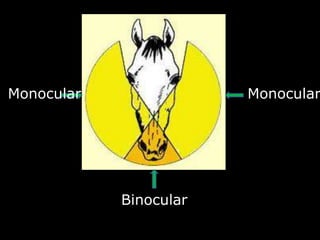
• Field of view- Very wide! 350°, of
which 285° is monocular and 65° is
binocular. 3 Blind spots- between the
2 eyes, exactly behind the head and
under the chin.
• Depth perception- Using binocular
field of vision.
• Acuity- Do not adjust very quickly to
sudden darkness. Good acuity in
binocular field called “visual streak”.
Monocular Monocular
Binocular
Dichromacy
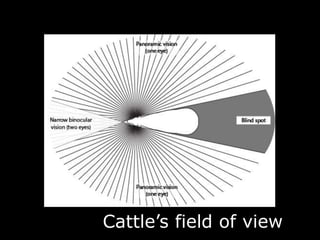
4. Cattle:
• Field of view- 340° , of which 310° is
panoramic and 25°-30° is binocular.
Blind spot is exactly behind the head.
• Depth perception- Very poor, specially
in dim light.
• Acuity-They have slit-shaped pupils and
weak eye muscles due to which they
cannot focus quickly on objects.
• Perception of motion- Average to good.
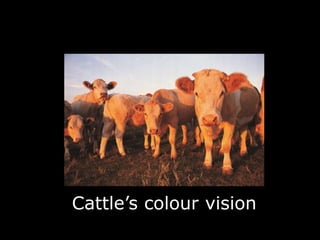
• Colour differentiation- Distinguish
Cattle’s field of view
Cattle’s colour vision
Dichromacy
• SUMMARY-
Most of our domestic mammals species
come under this class.
All those mentioned above have a
special set of cells on their retina which
enable them to see clearly at night.
This is called the “TAPETUM LUCIDIUM”.
It takes in the most minimal amount of
light available and reflects in back out
to make the animals be able to see the
object more clearly.
The tapetum lucidium is absent in
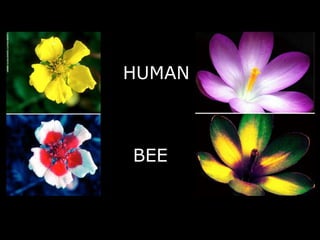
Trichromacy
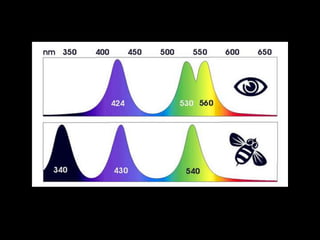
• 3 types of cone cells.
• HUMANS-
See red, green and blue.
Monochromatic vision at night.
• BEES-
see yellow, blue and ULTRAVIOLET.
Ultraviolet vision helps bees detect
colour patterns on petals that guide
them to nectar.
They have compound eyes, so each
lens produces 1 pixel.
Low resolution- blur vision.
HUMAN
BEE
Tetrachromacy
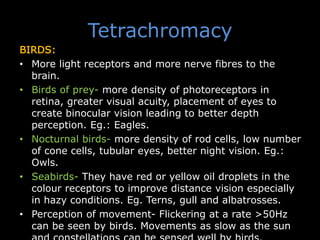
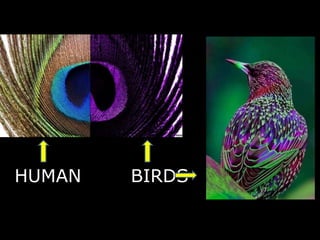
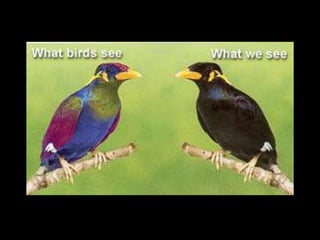
BIRDS:
• More light receptors and more nerve fibres to the
brain.
• Birds of prey- more density of photoreceptors in
retina, greater visual acuity, placement of eyes to
create binocular vision leading to better depth
perception. Eg.: Eagles.
• Nocturnal birds- more density of rod cells, low number
of cone cells, tubular eyes, better night vision. Eg.:
Owls.
• Seabirds- They have red or yellow oil droplets in the
colour receptors to improve distance vision especially
in hazy conditions. Eg. Terns, gull and albatrosses.
• Perception of movement- Flickering at a rate >50Hz
can be seen by birds. Movements as slow as the sun
BIRDSHUMAN
Tetrachromacy
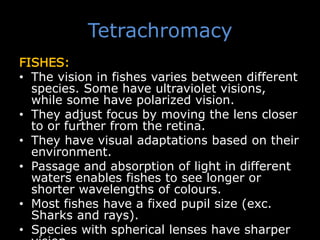
FISHES:
• The vision in fishes varies between different
species. Some have ultraviolet visions,
while some have polarized vision.
• They adjust focus by moving the lens closer
to or further from the retina.
• They have visual adaptations based on their
environment.
• Passage and absorption of light in different
waters enables fishes to see longer or
shorter wavelengths of colours.
• Most fishes have a fixed pupil size (exc.
Sharks and rays).
• Species with spherical lenses have sharper
Infrared vision
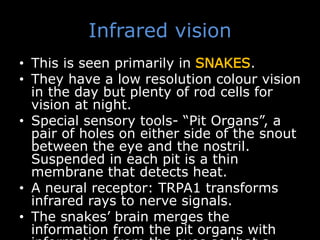
• This is seen primarily in SNAKES.
• They have a low resolution colour vision
in the day but plenty of rod cells for
vision at night.
• Special sensory tools- “Pit Organs”, a
pair of holes on either side of the snout
between the eye and the nostril.
Suspended in each pit is a thin
membrane that detects heat.
• A neural receptor: TRPA1 transforms
infrared rays to nerve signals.
• The snakes’ brain merges the
information from the pit organs with
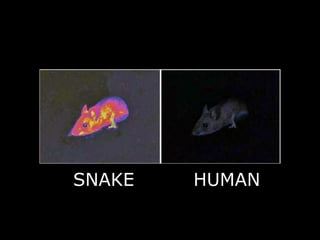
SNAKE HUMAN
Value In Ophthalmology..
• Aim of studying vision in animals: To
diagnose abnormalities causing vision
impairment.
• Reasons for impaired vision or
blindness-
Trauma
Increased or decreased intra-ocular
pressure
Diseases
Congenital
Tumors
Inflammation
Conclusion
Thus by having a better
understanding of vision in
different species, it
becomes easier for us to
prevent, diagnose and treat
any such conditions which
may interfere with normal
Thank You!!

Vision in animals

  • 1.
    Vision in animals VaniJhaveri V/11/175
  • 2.
    Introduction • Vision isthat sense that enables animals to see the world around them. • Animals require vision to survive, find food, protect themselves from predators, seek shelter, and so on..
  • 3.
    The Eyes • Themain organ of vision is the eye! • The eye, along with its multiple parts and in coordination with the brain, produces vision. • Parts of the eye: (from outside to inside) Lens Vitreous humor Retina Optic nerve Sclera Eyelashes and eyelids Cornea Aqueous humor Iris Pupil
  • 5.
    Mechanism of vision •Visual function involves a combination of many factors, including:  the field of view  depth perception (ability to judge distances)  acuity (focusing ability)  perception of motion and  colour differentiation. • LIGHT from Object  Conjunctiva  Cornea  Aqueous humor  Lens  Vitreous humor  RETINA… • NERVE IMPULSE  Rods and Cones on retina Synapse  Bipolar nerve cells  Ganglions  Optic nerves Occipital lobe of BRAIN. • Image formed on the retina is inverted but
  • 6.
    Classification of Vision •Monochromacy- Only 1 type of cone cells. Eg.: Marine mammals, Owl monkey and Australian sea lion. • Dichromacy- 2 types of cone cells. Eg.: Cats, Dogs, Horses and Cattle. • Trichromacy- 3 types of cone cells. Eg.: Humans and bees. • Tetrachromacy- 4 types of cone cells. Eg.: Birds, fish, amphibians and reptiles. • Infrared vision- Eg.: Snakes.
  • 7.
    Monochromacy • Only onetype of cone cell. • Usually black and white vision. • Seen in Marine mammals, Owl monkey and Australian sea lion. • In humans, disease of full colour blindness leads to monochromacy. • Also night vision is humans in monochromatic.
  • 8.
  • 9.
    Dichromacy 1. CATS: • Fieldof view- 200° • Depth perception- Not very good. Objects Max 20 feet away can be focussed on. Objects too close to the eyes can’t be focussed on. • Acuity- Their day time vision is 6 times blurrier than that of humans, but night time vision and peripheral vision is 6-8 times better than that of humans. • Perception of motion- Very good! Even at night. • Colour differentiation- 10 times lesser cones than humans in the macula. See mostly
  • 10.
    HUMA N CAT Cats have amore peripheral vision than humans HUMAN CAT Cats can’t focus on objects greater t
  • 11.
    vision is lessvibrant than that of humans. Cats can see more clearly in dim ligh HUMAN CAT HUMAN CAT
  • 12.
    Dichromacy 2. DOGS: • Fieldof view- 240° • Depth perception- near sighted. Better depth perception than cats. Central binocular field helps in depth perception. • Acuity- 20-40 % that of humans. Depends greatly on clarity of cornea, aqueous humor, lens and vitreous humor. • Perception of motion- 10-20 times more sensitive to motion than humans. Even at dusk! • Colour differentiation- 2 cone cells. Blue and yellow can be differentiated but not red and
  • 13.
  • 14.
  • 15.
    Dichromacy 3. HORSES: • Fieldof view- Very wide! 350°, of which 285° is monocular and 65° is binocular. 3 Blind spots- between the 2 eyes, exactly behind the head and under the chin. • Depth perception- Using binocular field of vision. • Acuity- Do not adjust very quickly to sudden darkness. Good acuity in binocular field called “visual streak”.
  • 16.
  • 18.
    Dichromacy 4. Cattle: • Fieldof view- 340° , of which 310° is panoramic and 25°-30° is binocular. Blind spot is exactly behind the head. • Depth perception- Very poor, specially in dim light. • Acuity-They have slit-shaped pupils and weak eye muscles due to which they cannot focus quickly on objects. • Perception of motion- Average to good. • Colour differentiation- Distinguish
  • 19.
  • 20.
  • 21.
    Dichromacy • SUMMARY- Most ofour domestic mammals species come under this class. All those mentioned above have a special set of cells on their retina which enable them to see clearly at night. This is called the “TAPETUM LUCIDIUM”. It takes in the most minimal amount of light available and reflects in back out to make the animals be able to see the object more clearly. The tapetum lucidium is absent in
  • 22.
    Trichromacy • 3 typesof cone cells. • HUMANS- See red, green and blue. Monochromatic vision at night. • BEES- see yellow, blue and ULTRAVIOLET. Ultraviolet vision helps bees detect colour patterns on petals that guide them to nectar. They have compound eyes, so each lens produces 1 pixel. Low resolution- blur vision.
  • 23.
  • 25.
    Tetrachromacy BIRDS: • More lightreceptors and more nerve fibres to the brain. • Birds of prey- more density of photoreceptors in retina, greater visual acuity, placement of eyes to create binocular vision leading to better depth perception. Eg.: Eagles. • Nocturnal birds- more density of rod cells, low number of cone cells, tubular eyes, better night vision. Eg.: Owls. • Seabirds- They have red or yellow oil droplets in the colour receptors to improve distance vision especially in hazy conditions. Eg. Terns, gull and albatrosses. • Perception of movement- Flickering at a rate >50Hz can be seen by birds. Movements as slow as the sun
  • 26.
  • 28.
    Tetrachromacy FISHES: • The visionin fishes varies between different species. Some have ultraviolet visions, while some have polarized vision. • They adjust focus by moving the lens closer to or further from the retina. • They have visual adaptations based on their environment. • Passage and absorption of light in different waters enables fishes to see longer or shorter wavelengths of colours. • Most fishes have a fixed pupil size (exc. Sharks and rays). • Species with spherical lenses have sharper
  • 29.
    Infrared vision • Thisis seen primarily in SNAKES. • They have a low resolution colour vision in the day but plenty of rod cells for vision at night. • Special sensory tools- “Pit Organs”, a pair of holes on either side of the snout between the eye and the nostril. Suspended in each pit is a thin membrane that detects heat. • A neural receptor: TRPA1 transforms infrared rays to nerve signals. • The snakes’ brain merges the information from the pit organs with
  • 30.
  • 31.
    Value In Ophthalmology.. •Aim of studying vision in animals: To diagnose abnormalities causing vision impairment. • Reasons for impaired vision or blindness- Trauma Increased or decreased intra-ocular pressure Diseases Congenital Tumors Inflammation
  • 32.
    Conclusion Thus by havinga better understanding of vision in different species, it becomes easier for us to prevent, diagnose and treat any such conditions which may interfere with normal
  • 33.