

Cloud Computing withDan Waters – Academic Developer Evangelistdan.waters@microsoft.comMithun Dhar – Developer Evangelistmithund@microsoft.com
http://blogs.msdn.com/mithundWhat the heck is a AcademicEvangelist??Dan.waters@microsoft.comTwitter: @danwaters
http://blogs.msdn.com/mithundWhat the heck is a 			Developer Evangelist??mithund@microsoft.comTwitter: @mithundBlog: http://blogs.msdn.com/MithunDFacebook: http://facebook.com/MithunD
As an MBA student…Be aware of trendsin your industry
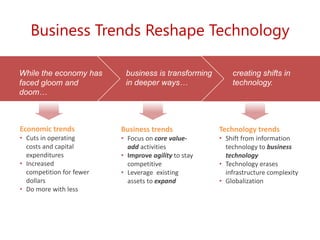
Business Trends Reshape Technologybusiness is transforming in deeper ways…While the economy has faced gloom and doom…creating shifts in technology.Economic trendsCuts in operating costs and capital expenditures
Increased competition for fewer dollars
Do more with lessBusiness trendsFocus on core value-add activities
Improve agility to stay competitive
Leverage  existing assets to expand Technology trendsShift from information technology to business technology
Technology erases infrastructure complexity
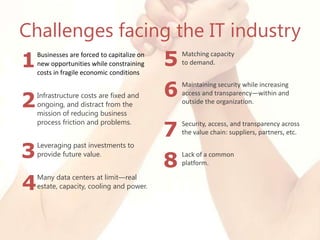
GlobalizationChallenges facing the IT industry51Matching capacity to demand.Maintaining security while increasing access and transparency—within and outside the organization.Security, access, and transparency across the value chain: suppliers, partners, etc.Lack of a common platform.Businesses are forced to capitalize on new opportunities while constraining costs in fragile economic conditionsInfrastructure costs are fixed and ongoing, and distract from the mission of reducing business process friction and problems.Leveraging past investments to provide future value.Many data centers at limit—real estate, capacity, cooling and power.627384
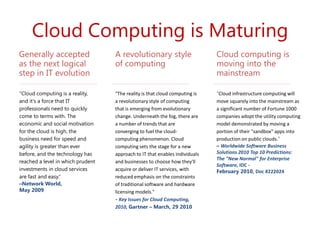
Cloud Computing is MaturingGenerally accepted as the next logical step in IT evolutionA revolutionary style of computingCloud computing is moving into the mainstream“Cloud computing is a reality, and it's a force that IT professionals need to quickly come to terms with. The economic and social motivation for the cloud is high, the business need for speed and agility is greater than ever before, and the technology has reached a level in which prudent investments in cloud services are fast and easy.”–Network World, May 2009"The reality is that cloud computing is a revolutionary style of computing that is emerging from evolutionary change. Underneath the fog, there are a number of trends that are converging to fuel the cloud-computing phenomenon. Cloud computing sets the stage for a new approach to IT that enables individuals and businesses to choose how they'll acquire or deliver IT services, with reduced emphasis on the constraints of traditional software and hardware licensing models."- Key Issues for Cloud Computing, 2010, Gartner – March, 29 2010“Cloud infrastructure computing will move squarely into the mainstream as a significant number of Fortune 1000 companies adopt the utility computing model demonstrated by moving a portion of their "sandbox" apps into production on public clouds.” – Worldwide Software Business Solutions 2010 Top 10 Predictions: The "New Normal" for Enterprise Software, IDC - February 2010, Doc #222024
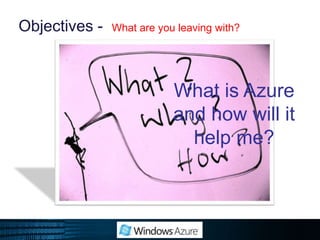
Objectives -  What are you leaving with?What is Azure and how will it help me?
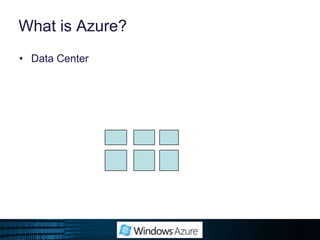
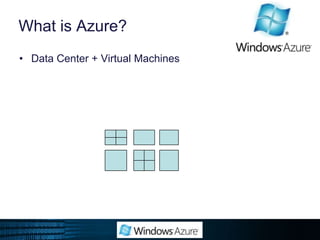
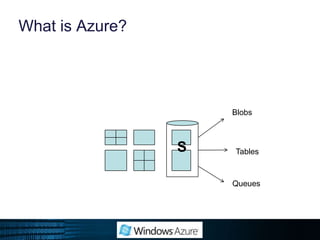
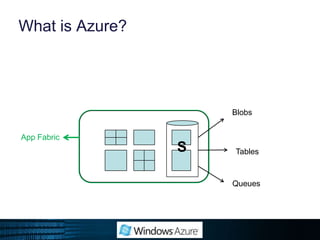
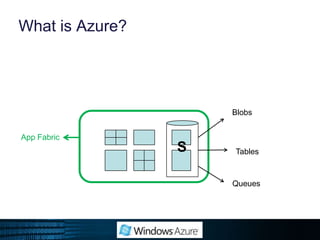
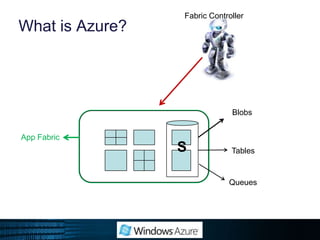
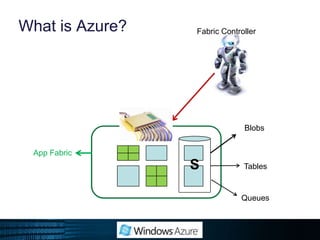
What is Azure?
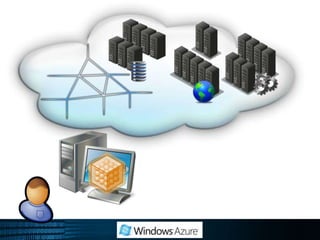
It’s an Operating System In the Could.Simple Answer?
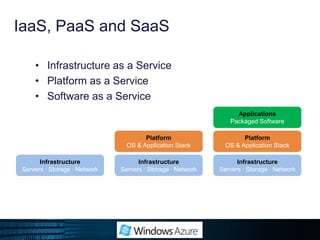
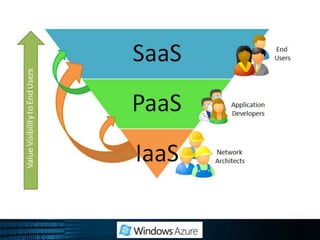
IaaS, PaaS and SaaSInfrastructure as a ServicePlatform as a ServiceSoftware as a ServiceSaaSApplicationsPackaged SoftwarePaaSPlatformOS & Application StackPlatformOS & Application StackIaaSInfrastructureServers · Storage · NetworkInfrastructureServers · Storage · NetworkInfrastructureServers · Storage · Network
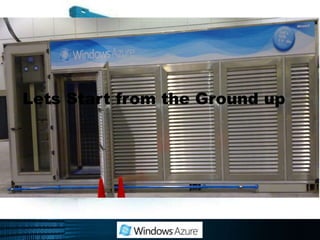
Lets Start from the Ground up
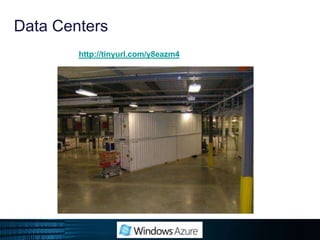
Data Centershttp://tinyurl.com/y8eazm4
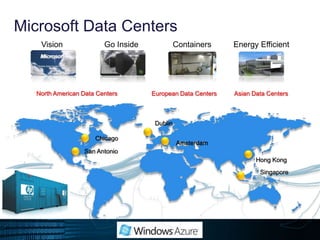
Microsoft Data CentersVisionGo InsideEnergy EfficientContainersNorth American Data CentersEuropean Data CentersAsian Data CentersDublinChicagoAmsterdamSan AntonioHong KongSingapore
Why Do I need this?
Driving ForcesISVs & SaaS ApplicationsMid-Market EnterpriseEnterprise Application MigrationStart-ups & Experimental InitiativesCloud Seen as a Fast Lane to Get to Market FasterSeasonal BusinessesUnder Pressure to Dramatically Reduce I.T. CostsCloud Seen as a Competitive Edge
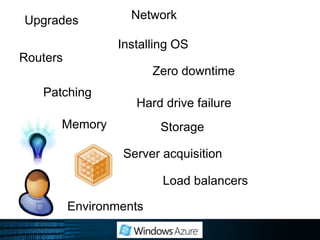
NetworkUpgradesInstalling OSRoutersZero downtimePatchingHard drive failureMemoryStorageServer acquisitionLoad balancersEnvironments
Great.. How do I do this?
Main Components
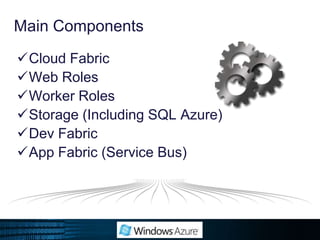
Main ComponentsCloud Fabric
Web Roles
Worker Roles
Storage (Including SQL Azure)
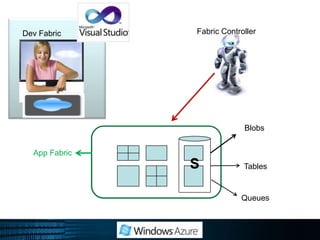
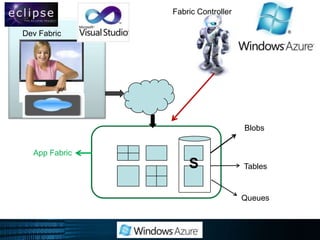
Dev Fabric
App Fabric (Service Bus)Windows Azure Roles
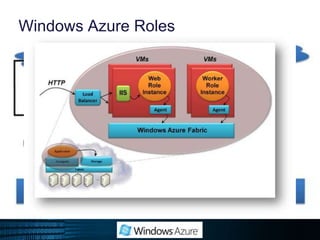
Windows Azure RolesWeb RoleA web role is used for web application programming in ASP.NET or PHPWorker RoleA worker role is used for performing work on behalf of the web role.In addition to .NET languages, Worker Roles may be written in Ruby or Java.Worker Roles are used to improve scalability by increasing parallelism and asynchronicityOften used for background work
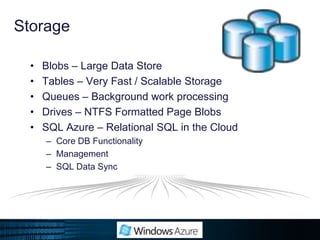
StorageBlobs – Large Data StoreTables – Very Fast / Scalable StorageQueues – Background work processingDrives – NTFS Formatted Page Blobs SQL Azure – Relational SQL in the CloudCore DB FunctionalityManagementSQL Data Sync
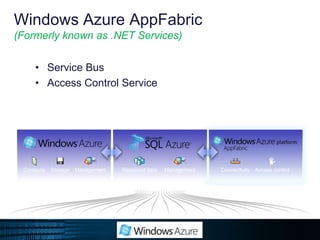
Windows Azure AppFabric(Formerly known as .NET Services)Service BusAccess Control ServiceComputeStorageManagementManagementRelational dataConnectivityAccess control
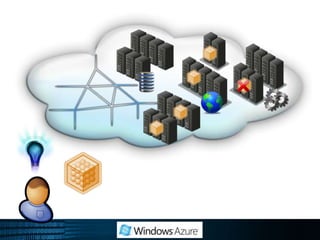
Windows Azure Cloud Fabric(Fabric Controller)Multiple virtual instancesEasy provision of applicationsDetect failuresSpin up new instances to replace the failed onesHow many instances and what role they will playLoad balances and DNSElasticity of the service… scaling up/down number of instances
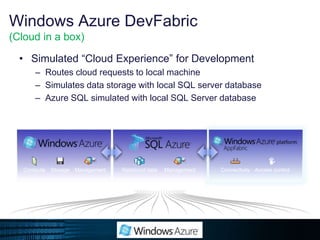
Windows Azure DevFabric(Cloud in a box)Simulated “Cloud Experience” for DevelopmentRoutes cloud requests to local machineSimulates data storage with local SQL server databaseAzure SQL simulated with local SQL Server databaseComputeStorageManagementManagementRelational dataConnectivityAccess control
DemoBuilding Our First Cloud ApplicationWith Microsoft Windows AzureThis demo uses the following technologies:.NET Framework 3.5 SP1
Visual Studio 2008 SP1 or Visual Web Developer 2008 SP1

SeattleUniv-IntroductionToCloudComputing-WinsowsAzure101

  • 1.
    Cloud Computing withDanWaters – Academic Developer Evangelistdan.waters@microsoft.comMithun Dhar – Developer Evangelistmithund@microsoft.com
  • 2.
    http://blogs.msdn.com/mithundWhat the heckis a AcademicEvangelist??Dan.waters@microsoft.comTwitter: @danwaters
  • 3.
    http://blogs.msdn.com/mithundWhat the heckis a Developer Evangelist??mithund@microsoft.comTwitter: @mithundBlog: http://blogs.msdn.com/MithunDFacebook: http://facebook.com/MithunD
  • 4.
    As an MBAstudent…Be aware of trendsin your industry
  • 5.
    Business Trends ReshapeTechnologybusiness is transforming in deeper ways…While the economy has faced gloom and doom…creating shifts in technology.Economic trendsCuts in operating costs and capital expenditures
  • 6.
  • 7.
    Do more withlessBusiness trendsFocus on core value-add activities
  • 8.
    Improve agility tostay competitive
  • 9.
    Leverage existingassets to expand Technology trendsShift from information technology to business technology
  • 10.
  • 11.
    GlobalizationChallenges facing theIT industry51Matching capacity to demand.Maintaining security while increasing access and transparency—within and outside the organization.Security, access, and transparency across the value chain: suppliers, partners, etc.Lack of a common platform.Businesses are forced to capitalize on new opportunities while constraining costs in fragile economic conditionsInfrastructure costs are fixed and ongoing, and distract from the mission of reducing business process friction and problems.Leveraging past investments to provide future value.Many data centers at limit—real estate, capacity, cooling and power.627384
  • 12.
    Cloud Computing isMaturingGenerally accepted as the next logical step in IT evolutionA revolutionary style of computingCloud computing is moving into the mainstream“Cloud computing is a reality, and it's a force that IT professionals need to quickly come to terms with. The economic and social motivation for the cloud is high, the business need for speed and agility is greater than ever before, and the technology has reached a level in which prudent investments in cloud services are fast and easy.”–Network World, May 2009"The reality is that cloud computing is a revolutionary style of computing that is emerging from evolutionary change. Underneath the fog, there are a number of trends that are converging to fuel the cloud-computing phenomenon. Cloud computing sets the stage for a new approach to IT that enables individuals and businesses to choose how they'll acquire or deliver IT services, with reduced emphasis on the constraints of traditional software and hardware licensing models."- Key Issues for Cloud Computing, 2010, Gartner – March, 29 2010“Cloud infrastructure computing will move squarely into the mainstream as a significant number of Fortune 1000 companies adopt the utility computing model demonstrated by moving a portion of their "sandbox" apps into production on public clouds.” – Worldwide Software Business Solutions 2010 Top 10 Predictions: The "New Normal" for Enterprise Software, IDC - February 2010, Doc #222024
  • 13.
    Objectives - What are you leaving with?What is Azure and how will it help me?
  • 14.
  • 15.
    It’s an OperatingSystem In the Could.Simple Answer?
  • 16.
    IaaS, PaaS andSaaSInfrastructure as a ServicePlatform as a ServiceSoftware as a ServiceSaaSApplicationsPackaged SoftwarePaaSPlatformOS & Application StackPlatformOS & Application StackIaaSInfrastructureServers · Storage · NetworkInfrastructureServers · Storage · NetworkInfrastructureServers · Storage · Network
  • 17.
    IaaS, PaaS andSaaSInfrastructure as a ServicePlatform as a ServiceSoftware as a ServiceSaaSApplicationsPackaged SoftwarePaaSPlatformOS & Application StackPlatformOS & Application StackIaaSInfrastructureServers · Storage · NetworkInfrastructureServers · Storage · NetworkInfrastructureServers · Storage · Network
  • 18.
    Lets Start fromthe Ground up
  • 20.
  • 21.
    Microsoft Data CentersVisionGoInsideEnergy EfficientContainersNorth American Data CentersEuropean Data CentersAsian Data CentersDublinChicagoAmsterdamSan AntonioHong KongSingapore
  • 22.
    Why Do Ineed this?
  • 23.
    Driving ForcesISVs &SaaS ApplicationsMid-Market EnterpriseEnterprise Application MigrationStart-ups & Experimental InitiativesCloud Seen as a Fast Lane to Get to Market FasterSeasonal BusinessesUnder Pressure to Dramatically Reduce I.T. CostsCloud Seen as a Competitive Edge
  • 24.
    NetworkUpgradesInstalling OSRoutersZero downtimePatchingHarddrive failureMemoryStorageServer acquisitionLoad balancersEnvironments
  • 28.
    Great.. How doI do this?
  • 29.
  • 30.
  • 31.
  • 32.
  • 33.
  • 34.
  • 35.
    App Fabric (ServiceBus)Windows Azure Roles
  • 36.
    Windows Azure RolesWebRoleA web role is used for web application programming in ASP.NET or PHPWorker RoleA worker role is used for performing work on behalf of the web role.In addition to .NET languages, Worker Roles may be written in Ruby or Java.Worker Roles are used to improve scalability by increasing parallelism and asynchronicityOften used for background work
  • 37.
    StorageBlobs – LargeData StoreTables – Very Fast / Scalable StorageQueues – Background work processingDrives – NTFS Formatted Page Blobs SQL Azure – Relational SQL in the CloudCore DB FunctionalityManagementSQL Data Sync
  • 38.
    Windows Azure AppFabric(Formerlyknown as .NET Services)Service BusAccess Control ServiceComputeStorageManagementManagementRelational dataConnectivityAccess control
  • 39.
    Windows Azure CloudFabric(Fabric Controller)Multiple virtual instancesEasy provision of applicationsDetect failuresSpin up new instances to replace the failed onesHow many instances and what role they will playLoad balances and DNSElasticity of the service… scaling up/down number of instances
  • 40.
    Windows Azure DevFabric(Cloudin a box)Simulated “Cloud Experience” for DevelopmentRoutes cloud requests to local machineSimulates data storage with local SQL server databaseAzure SQL simulated with local SQL Server databaseComputeStorageManagementManagementRelational dataConnectivityAccess control
  • 41.
    DemoBuilding Our FirstCloud ApplicationWith Microsoft Windows AzureThis demo uses the following technologies:.NET Framework 3.5 SP1
  • 42.
    Visual Studio 2008SP1 or Visual Web Developer 2008 SP1