FinanceEstonia Forum 2014 
Madis Müller 
19 November 2014
2 
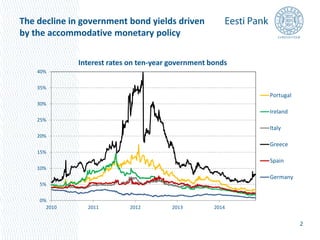
The decline in government bond yields driven 
by the accommodative monetary policy 
40% 
35% 
30% 
25% 
20% 
15% 
10% 
5% 
0% 
Interest rates on ten-year government bonds 
2010 2011 2012 2013 2014 
Portugal 
Ireland 
Italy 
Greece 
Spain 
Germany
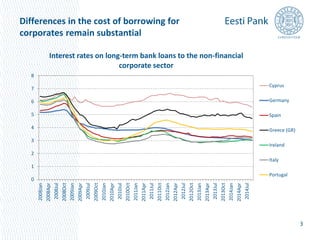
Differences in the cost of borrowing for 
corporates remain substantial 
3 
8 
7 
6 
5 
4 
3 
2 
1 
0 
Interest rates on long-term bank loans to the non-financial 
corporate sector 
2008Jan 
2008Apr 
2008Jul 
2008Oct 
2009Jan 
2009Apr 
2009Jul 
2009Oct 
2010Jan 
2010Apr 
2010Jul 
2010Oct 
2011Jan 
2011Apr 
2011Jul 
2011Oct 
2012Jan 
2012Apr 
2012Jul 
2012Oct 
2013Jan 
2013Apr 
2013Jul 
2013Oct 
2014Jan 
2014Apr 
2014Jul 
Cyprus 
Germany 
Spain 
Greece (GR) 
Ireland 
Italy 
Portugal
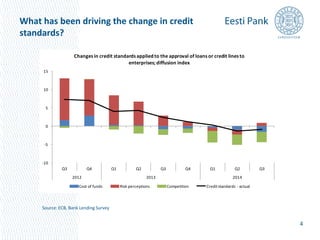
What has been driving the change in credit 
standards? 
4 
15 
10 
5 
0 
-5 
-10 
Changes in credit standards applied to the approval of loans or credit lines to 
enterprises; diffusion index 
Q3 Q4 Q1 Q2 Q3 Q4 Q1 Q2 Q3 
2012 2013 2014 
Cost of funds Risk perceptions Competition Credit standards - actual 
Source: ECB, Bank Lending Survey
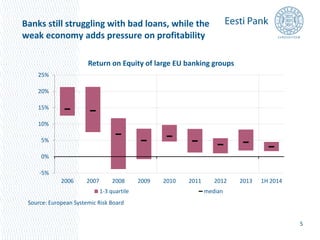
Banks still struggling with bad loans, while the 
weak economy adds pressure on profitability 
5 
25% 
20% 
15% 
10% 
5% 
0% 
-5% 
Return on Equity of large EU banking groups 
2006 2007 2008 2009 2010 2011 2012 2013 1H 2014 
1-3 quartile median 
Source: European Systemic Risk Board
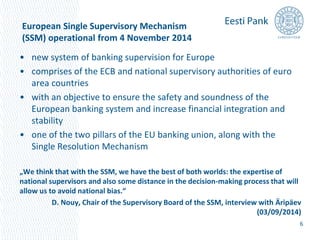
European Single Supervisory Mechanism 
(SSM) operational from 4 November 2014 
• new system of banking supervision for Europe 
• comprises of the ECB and national supervisory authorities of euro 
area countries 
• with an objective to ensure the safety and soundness of the 
European banking system and increase financial integration and 
stability 
• one of the two pillars of the EU banking union, along with the 
Single Resolution Mechanism 
„We think that with the SSM, we have the best of both worlds: the expertise of 
national supervisors and also some distance in the decision-making process that will 
allow us to avoid national bias.“ 
D. Nouy, Chair of the Supervisory Board of the SSM, interview with Äripäev 
(03/09/2014) 
6
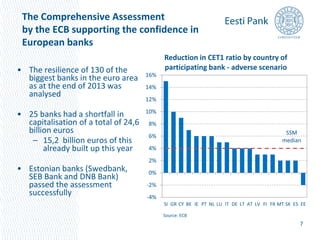
The Comprehensive Assessment 
by the ECB supporting the confidence in 
European banks 
• The resilience of 130 of the 
biggest banks in the euro area 
as at the end of 2013 was 
analysed 
• 25 banks had a shortfall in 
capitalisation of a total of 24,6 
billion euros 
– 15,2 billion euros of this 
already built up this year 
• Estonian banks (Swedbank, 
SEB Bank and DNB Bank) 
passed the assessment 
successfully 
Reduction in CET1 ratio by country of 
participating bank - adverse scenario 
SSM 
median 
7 
16% 
14% 
12% 
10% 
8% 
6% 
4% 
2% 
0% 
-2% 
-4% 
SI GR CY BE IE PT NL LU IT DE LT AT LV FI FR MT SK ES EE 
Source: ECB
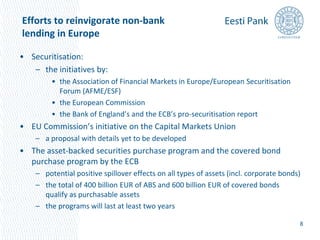
Efforts to reinvigorate non-bank 
lending in Europe 
• Securitisation: 
– the initiatives by: 
• the Association of Financial Markets in Europe/European Securitisation 
Forum (AFME/ESF) 
• the European Commission 
• the Bank of England’s and the ECB’s pro-securitisation report 
• EU Commission’s initiative on the Capital Markets Union 
– a proposal with details yet to be developed 
• The asset-backed securities purchase program and the covered bond 
purchase program by the ECB 
– potential positive spillover effects on all types of assets (incl. corporate bonds) 
– the total of 400 billion EUR of ABS and 600 billion EUR of covered bonds 
qualify as purchasable assets 
– the programs will last at least two years 
8
Efforts to reinvigorate non-bank 
lending in Europe (cont.-d) 
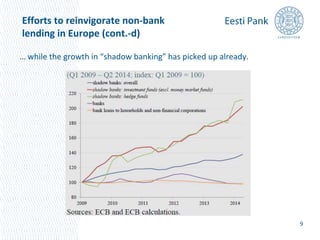
… while the growth in “shadow banking” has picked up already. 
9
Estonian banking sector strong in terms of 
capital and profitability 
10 
0% 10% 20% 30% 40% 
MT 
EE 
LU 
HR 
IE 
DK 
LT 
LV 
BE 
SK 
BG 
CZ 
RO 
FI 
DE 
HU 
UK 
PL 
EU 
euro area 
GR 
FR 
CY 
SI 
NL 
PT 
AT 
ES 
SE 
IT 
Source: ECB 
Banks' Tier1 ratio (2013) 
Banks' return on assets (2013) 
-3,4% 
-8,0% 
EE 
PL 
CZ 
LT 
SK 
LV 
MT 
BG 
SE 
LU 
FI 
BE 
ES 
FR 
NL 
DK 
EU 
UK 
RO 
euro area 
HR 
DE 
HU 
GR 
AT 
PT 
IT 
IE 
CY 
SI 
-1.0% -0.5% 0.0% 0.5% 1.0% 1.5% 2.0%
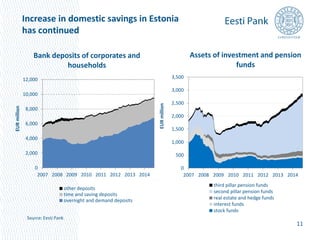
Increase in domestic savings in Estonia 
has continued 
11 
3,500 
3,000 
2,500 
2,000 
1,500 
1,000 
500 
0 
2007 2008 2009 2010 2011 2012 2013 2014 
EUR million 
Assets of investment and pension 
funds 
third pillar pension funds 
second pillar pension funds 
real estate and hedge funds 
interest funds 
stock funds 
12,000 
10,000 
8,000 
6,000 
4,000 
2,000 
0 
2007 2008 2009 2010 2011 2012 2013 2014 
EUR million 
Bank deposits of corporates and 
households 
other deposits 
time and saving deposits 
overnight and demand deposits 
Source: Eesti Pank
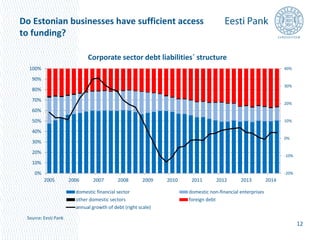
Do Estonian businesses have sufficient access 
to funding? 
12 
40% 
30% 
20% 
10% 
0% 
-10% 
-20% 
100% 
90% 
80% 
70% 
60% 
50% 
40% 
30% 
20% 
10% 
0% 
Corporate sector debt liabilities´ structure 
2005 2006 2007 2008 2009 2010 2011 2012 2013 2014 
domestic financial sector domestic non-financial enterprises 
other domestic sectors foreign debt 
annual growth of debt (right scale) 
Source: Eesti Pank
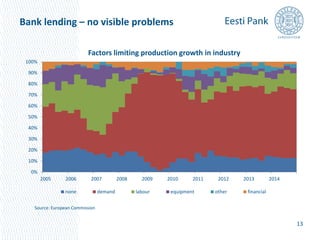
Bank lending – no visible problems 
13 
100% 
90% 
80% 
70% 
60% 
50% 
40% 
30% 
20% 
10% 
0% 
Factors limiting production growth in industry 
2005 2006 2007 2008 2009 2010 2011 2012 2013 2014 
none demand labour equipment other financial 
Source: European Commission
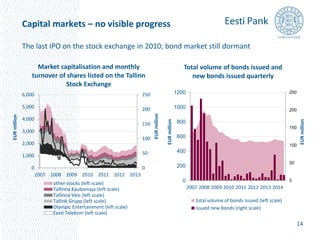
Capital markets – no visible progress 
The last IPO on the stock exchange in 2010; bond market still dormant 
14 
250 
200 
150 
100 
50 
0 
6,000 
5,000 
4,000 
3,000 
2,000 
1,000 
0 
2007 2008 2009 2010 2011 2012 2013 
EUR million 
EUR million 
Market capitalisation and monthly 
turnover of shares listed on the Tallinn 
Stock Exchange 
other stocks (left scale) 
Tallinna Kaubamaja (left scale) 
Tallinna Vesi (left scale) 
Tallink Grupp (left scale) 
Olympic Entertainment (left scale) 
Eesti Telekom (left scale) 
250 
200 
150 
100 
50 
0 
1200 
1000 
800 
600 
400 
200 
0 
2007 2008 2009 2010 2011 2012 2013 2014 
EUR million 
EUR million 
Total volume of bonds issued and 
new bonds issued quarterly 
total volume of bonds issued (left scale) 
issued new bonds (right scale)
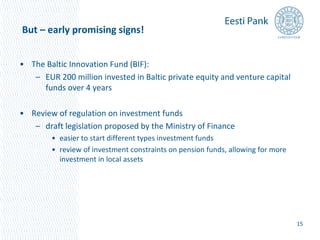
But – early promising signs! 
• The Baltic Innovation Fund (BIF): 
– EUR 200 million invested in Baltic private equity and venture capital 
funds over 4 years 
• Review of regulation on investment funds 
– draft legislation proposed by the Ministry of Finance 
• easier to start different types investment funds 
• review of investment constraints on pension funds, allowing for more 
investment in local assets 
15
• Do we need an active Estonian capital market or easy access to funding 
for Estonian companies? 
– room for more regional cooperation? 
• Do we know where is the demand for alternative sources of funding for 
businesses most pressing? 
– access to equity and mezzanine probably more constrained than 
straight debt? 
• Do we have local savings to meet that demand? 
– seems to be the case… 
• How to make the demand and supply meet? 
– necessary to educate both sides? 
• Role of the government 
– focus on the regulatory framework rather than outright funds 
16 
Questions we still need to discuss:

Madis Müller. Finance Estonia Forum 2014

  • 1.
    FinanceEstonia Forum 2014 Madis Müller 19 November 2014
  • 2.
    2 The declinein government bond yields driven by the accommodative monetary policy 40% 35% 30% 25% 20% 15% 10% 5% 0% Interest rates on ten-year government bonds 2010 2011 2012 2013 2014 Portugal Ireland Italy Greece Spain Germany
  • 3.
    Differences in thecost of borrowing for corporates remain substantial 3 8 7 6 5 4 3 2 1 0 Interest rates on long-term bank loans to the non-financial corporate sector 2008Jan 2008Apr 2008Jul 2008Oct 2009Jan 2009Apr 2009Jul 2009Oct 2010Jan 2010Apr 2010Jul 2010Oct 2011Jan 2011Apr 2011Jul 2011Oct 2012Jan 2012Apr 2012Jul 2012Oct 2013Jan 2013Apr 2013Jul 2013Oct 2014Jan 2014Apr 2014Jul Cyprus Germany Spain Greece (GR) Ireland Italy Portugal
  • 4.
    What has beendriving the change in credit standards? 4 15 10 5 0 -5 -10 Changes in credit standards applied to the approval of loans or credit lines to enterprises; diffusion index Q3 Q4 Q1 Q2 Q3 Q4 Q1 Q2 Q3 2012 2013 2014 Cost of funds Risk perceptions Competition Credit standards - actual Source: ECB, Bank Lending Survey
  • 5.
    Banks still strugglingwith bad loans, while the weak economy adds pressure on profitability 5 25% 20% 15% 10% 5% 0% -5% Return on Equity of large EU banking groups 2006 2007 2008 2009 2010 2011 2012 2013 1H 2014 1-3 quartile median Source: European Systemic Risk Board
  • 6.
    European Single SupervisoryMechanism (SSM) operational from 4 November 2014 • new system of banking supervision for Europe • comprises of the ECB and national supervisory authorities of euro area countries • with an objective to ensure the safety and soundness of the European banking system and increase financial integration and stability • one of the two pillars of the EU banking union, along with the Single Resolution Mechanism „We think that with the SSM, we have the best of both worlds: the expertise of national supervisors and also some distance in the decision-making process that will allow us to avoid national bias.“ D. Nouy, Chair of the Supervisory Board of the SSM, interview with Äripäev (03/09/2014) 6
  • 7.
    The Comprehensive Assessment by the ECB supporting the confidence in European banks • The resilience of 130 of the biggest banks in the euro area as at the end of 2013 was analysed • 25 banks had a shortfall in capitalisation of a total of 24,6 billion euros – 15,2 billion euros of this already built up this year • Estonian banks (Swedbank, SEB Bank and DNB Bank) passed the assessment successfully Reduction in CET1 ratio by country of participating bank - adverse scenario SSM median 7 16% 14% 12% 10% 8% 6% 4% 2% 0% -2% -4% SI GR CY BE IE PT NL LU IT DE LT AT LV FI FR MT SK ES EE Source: ECB
  • 8.
    Efforts to reinvigoratenon-bank lending in Europe • Securitisation: – the initiatives by: • the Association of Financial Markets in Europe/European Securitisation Forum (AFME/ESF) • the European Commission • the Bank of England’s and the ECB’s pro-securitisation report • EU Commission’s initiative on the Capital Markets Union – a proposal with details yet to be developed • The asset-backed securities purchase program and the covered bond purchase program by the ECB – potential positive spillover effects on all types of assets (incl. corporate bonds) – the total of 400 billion EUR of ABS and 600 billion EUR of covered bonds qualify as purchasable assets – the programs will last at least two years 8
  • 9.
    Efforts to reinvigoratenon-bank lending in Europe (cont.-d) … while the growth in “shadow banking” has picked up already. 9
  • 10.
    Estonian banking sectorstrong in terms of capital and profitability 10 0% 10% 20% 30% 40% MT EE LU HR IE DK LT LV BE SK BG CZ RO FI DE HU UK PL EU euro area GR FR CY SI NL PT AT ES SE IT Source: ECB Banks' Tier1 ratio (2013) Banks' return on assets (2013) -3,4% -8,0% EE PL CZ LT SK LV MT BG SE LU FI BE ES FR NL DK EU UK RO euro area HR DE HU GR AT PT IT IE CY SI -1.0% -0.5% 0.0% 0.5% 1.0% 1.5% 2.0%
  • 11.
    Increase in domesticsavings in Estonia has continued 11 3,500 3,000 2,500 2,000 1,500 1,000 500 0 2007 2008 2009 2010 2011 2012 2013 2014 EUR million Assets of investment and pension funds third pillar pension funds second pillar pension funds real estate and hedge funds interest funds stock funds 12,000 10,000 8,000 6,000 4,000 2,000 0 2007 2008 2009 2010 2011 2012 2013 2014 EUR million Bank deposits of corporates and households other deposits time and saving deposits overnight and demand deposits Source: Eesti Pank
  • 12.
    Do Estonian businesseshave sufficient access to funding? 12 40% 30% 20% 10% 0% -10% -20% 100% 90% 80% 70% 60% 50% 40% 30% 20% 10% 0% Corporate sector debt liabilities´ structure 2005 2006 2007 2008 2009 2010 2011 2012 2013 2014 domestic financial sector domestic non-financial enterprises other domestic sectors foreign debt annual growth of debt (right scale) Source: Eesti Pank
  • 13.
    Bank lending –no visible problems 13 100% 90% 80% 70% 60% 50% 40% 30% 20% 10% 0% Factors limiting production growth in industry 2005 2006 2007 2008 2009 2010 2011 2012 2013 2014 none demand labour equipment other financial Source: European Commission
  • 14.
    Capital markets –no visible progress The last IPO on the stock exchange in 2010; bond market still dormant 14 250 200 150 100 50 0 6,000 5,000 4,000 3,000 2,000 1,000 0 2007 2008 2009 2010 2011 2012 2013 EUR million EUR million Market capitalisation and monthly turnover of shares listed on the Tallinn Stock Exchange other stocks (left scale) Tallinna Kaubamaja (left scale) Tallinna Vesi (left scale) Tallink Grupp (left scale) Olympic Entertainment (left scale) Eesti Telekom (left scale) 250 200 150 100 50 0 1200 1000 800 600 400 200 0 2007 2008 2009 2010 2011 2012 2013 2014 EUR million EUR million Total volume of bonds issued and new bonds issued quarterly total volume of bonds issued (left scale) issued new bonds (right scale)
  • 15.
    But – earlypromising signs! • The Baltic Innovation Fund (BIF): – EUR 200 million invested in Baltic private equity and venture capital funds over 4 years • Review of regulation on investment funds – draft legislation proposed by the Ministry of Finance • easier to start different types investment funds • review of investment constraints on pension funds, allowing for more investment in local assets 15
  • 16.
    • Do weneed an active Estonian capital market or easy access to funding for Estonian companies? – room for more regional cooperation? • Do we know where is the demand for alternative sources of funding for businesses most pressing? – access to equity and mezzanine probably more constrained than straight debt? • Do we have local savings to meet that demand? – seems to be the case… • How to make the demand and supply meet? – necessary to educate both sides? • Role of the government – focus on the regulatory framework rather than outright funds 16 Questions we still need to discuss:

Editor's Notes