FINANCIAL STABILITY REVIEW
6 May 2020
The ability of companies and households to service their
loans is deteriorating
2
The depth of the recession will depend on how long
the restrictions last
• The measures taken to stop the spread of the coronavirus have a substantial impact
on economic activity
• this includes a drop in exports, supply problems and weaker consumer confidence
• Eesti Pank carried out scenario analysis to estimate the decline in the economy
• if restrictions last until August, the Estonian economy could shrink by 14%
• The longer the restrictions last, the more slowly the economy will recover
3
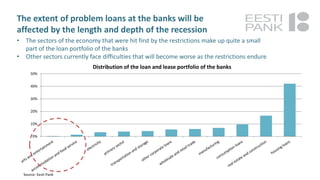
The extent of problem loans at the banks will be
affected by the length and depth of the recession
• The sectors of the economy that were hit first by the restrictions make up quite a small
part of the loan portfolio of the banks
• Other sectors currently face difficulties that will become worse as the restrictions endure
4
0%
10%
20%
30%
40%
50%
Distribution of the loan and lease portfolio of the banks
Source: Eesti Pank
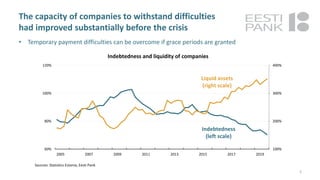
The capacity of companies to withstand difficulties
had improved substantially before the crisis
5
• Temporary payment difficulties can be overcome if grace periods are granted
100%
200%
300%
400%
60%
80%
100%
120%
2005 2007 2009 2011 2013 2015 2017 2019
Indebtedness and liquidity of companies
Sources: Statistics Estonia, Eesti Pank
Liquid assets
(right scale)
Indebtedness
(left scale)
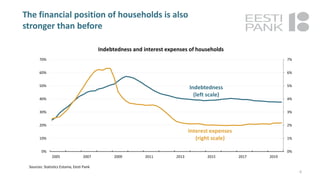
The financial position of households is also
stronger than before
6
0%
1%
2%
3%
4%
5%
6%
7%
0%
10%
20%
30%
40%
50%
60%
70%
2005 2007 2009 2011 2013 2015 2017 2019
Indebtedness and interest expenses of households
Sources: Statistics Estonia, Eesti Pank
Indebtedness
(left scale)
Interest expenses
(right scale)
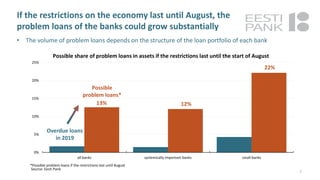
If the restrictions on the economy last until August, the
problem loans of the banks could grow substantially
7
0%
5%
10%
15%
20%
25%
all banks systemically important banks small banks
Possible share of problem loans in assets if the restrictions last until the start of August
Source: Eesti Pank
13%
Possible
problem loans*
Overdue loans
in 2019
12%
22%
*Possible problem loans if the restrictions last until August
• The volume of problem loans depends on the structure of the loan portfolio of each bank
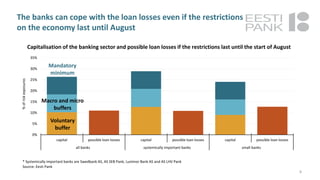
The banks can cope with the loan losses even if the restrictions
on the economy last until August
8
0%
5%
10%
15%
20%
25%
30%
35%
capital possible loan losses capital possible loan losses capital possible loan losses
all banks systemically important banks small banks
%ofriskexposures
Capitalisation of the banking sector and possible loan losses if the restrictions last until the start of August
Source: Eesti Pank
* Systemically important banks are Swedbank AS, AS SEB Pank, Luminor Bank AS and AS LHV Pank
Voluntary
buffer
Macro and micro
buffers
Mandatory
minimum
Actual loan losses will probably be smaller than in
the scenario of the restrictions lasting until August
• It is unlikely that the restrictions will remain at their current level until August
• It is not impossible that some of the restrictions will have to be brought back later on to stop the
spread of the virus
• The support measures from the state are helping companies and households to survive
the difficulties
• The European Central Bank has decided to take extraordinary measures to ease the impact
of the crisis
• The European Central Bank and supervisory authorities have allowed some degree of
flexibility in applying the framework for overdue loans
• Temporary payment moratoriums give loan clients time to manage the crisis
• They also give banks additional time to assess which clients will recover their capacity to pay
9
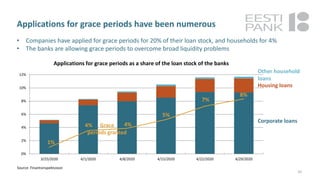
Applications for grace periods have been numerous
• Companies have applied for grace periods for 20% of their loan stock, and households for 4%
• The banks are allowing grace periods to overcome broad liquidity problems
10
0%
2%
4%
6%
8%
10%
12%
3/25/2020 4/1/2020 4/8/2020 4/15/2020 4/22/2020 4/29/2020
Applications for grace periods as a share of the loan stock of the banks
Source: Finantsinspektsioon
4% 4%
Corporate loans
Housing loans
Other household
loans
Grace
periods granted
1%
5%
7%
8%
The performance of the Estonian economy and financial
sector is affected by the extent of problems in
neighbouring countries
11
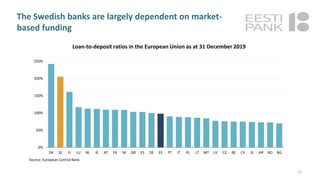
The Swedish banks are largely dependent on market-
based funding
12
0%
50%
100%
150%
200%
250%
DK SE FI LU NL IE AT FR SK GR ES DE EE PT IT PL LT MT LV CZ BE CY SI HR RO BG
Loan-to-deposit ratios in the European Union as at 31 December 2019
Source: European Central Bank
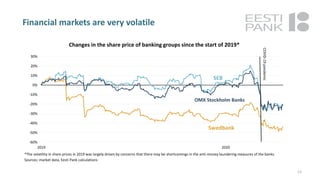
Financial markets are very volatile
13
-60%
-50%
-40%
-30%
-20%
-10%
0%
10%
20%
30%
2019 2020
Changes in the share price of banking groups since the start of 2019*
Sources: market data, Eesti Pank calculations
Swedbank
*The volatility in share prices in 2019 was largely driven by concerns that there may be shortcomings in the anti-money laundering measures of the banks
SEB
OMX Stockholm Banks
COVID-19pandemic
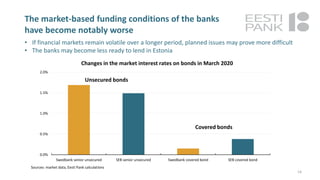
The market-based funding conditions of the banks
have become notably worse
14
0.0%
0.5%
1.0%
1.5%
2.0%
Swedbank senior unsecured SEB senior unsecured Swedbank covered bond SEB covered bond
Changes in the market interest rates on bonds in March 2020
Sources: market data, Eesti Pank calculations
Covered bonds
Unsecured bonds
• If financial markets remain volatile over a longer period, planned issues may prove more difficult
• The banks may become less ready to lend in Estonia
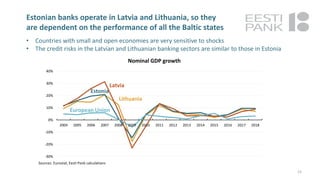
Estonian banks operate in Latvia and Lithuania, so they
are dependent on the performance of all the Baltic states
15
• Countries with small and open economies are very sensitive to shocks
• The credit risks in the Latvian and Lithuanian banking sectors are similar to those in Estonia
-30%
-20%
-10%
0%
10%
20%
30%
40%
2004 2005 2006 2007 2008 2009 2010 2011 2012 2013 2014 2015 2016 2017 2018
Nominal GDP growth
Sources: Eurostat, Eesti Pank calculations
Lithuania
Estonia
European Union
Latvia
Demand and supply in the real estate market
may move out of balance
16
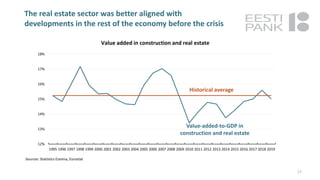
The real estate sector was better aligned with
developments in the rest of the economy before the crisis
17
12%
13%
14%
15%
16%
17%
18%
1995 1996 1997 1998 1999 2000 2001 2002 2003 2004 2005 2006 2007 2008 2009 2010 2011 2012 2013 2014 2015 2016 2017 2018 2019
Sources: Statistics Estonia, Eurostat
Value added in construction and real estate
Value-added-to-GDP in
construction and real estate
Historical average
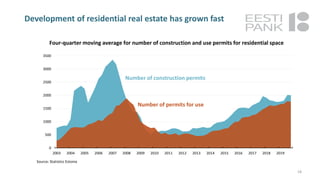
Development of residential real estate has grown fast
18
0
500
1000
1500
2000
2500
3000
3500
2003 2004 2005 2006 2007 2008 2009 2010 2011 2012 2013 2014 2015 2016 2017 2018 2019
Source: Statistics Estonia
Four-quarter moving average for number of construction and use permits for residential space
Number of construction permits
Number of permits for use
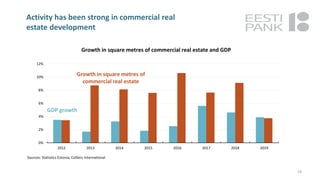
Activity has been strong in commercial real
estate development
19
0%
2%
4%
6%
8%
10%
12%
2012 2013 2014 2015 2016 2017 2018 2019
Sources: Statistics Estonia, Colliers International
Growth in square metres of commercial real estate and GDP
GDP growth
Growth in square metres of
commercial real estate
Summary of the risks to the financial sector
Macroprudential policy steps
The ability of companies and households to service
their loans is deteriorating
• The restrictions to stop the spread of the coronavirus have a major impact on
businesses and households
• The restrictions immediately impact companies focused on domestic demand and
the transport sector and exporting companies because of the contraction in export
markets
• If the restrictions on the economy last until August, problem loans could increase to
up to 13% of the loan portfolio of the banks
21
Problems in neighbouring countries could affect
financial intermediation in Estonia
• Swedish banking groups may support their Estonian subsidiaries during the crisis…
• … but if the groups become less able to access funding from international markets, it
could harm the loan supply from the Estonian banks
• The Estonian banks mainly fund themselves from local deposits, which has made
their supply of loans fairly independent
• The Estonian banking sector could be affected by risks coming from economic
developments in Latvia and Lithuania
• The credit risks in Latvia and Lithuania are similar to those in Estonia
22
Demand could fall a long way in the real estate
market
• Loans to construction and real estate make up a large part of the corporate loan
portfolio of the banks
• Demand will fall for some time at least for both residential and commercial real
estate
• A long recession could cause developers difficulties in completing projects and
owners problems in maintaining rental income
• The real estate market is in much better balance than it was before the financial
crisis of 2009
• The sector has not grown as quickly as a share of the total economy
• Companies are less leveraged
• Prices are better aligned with the rest of the economy
23
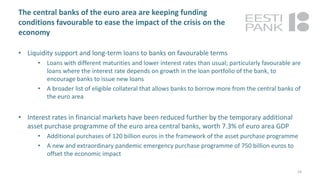
The central banks of the euro area are keeping funding
conditions favourable to ease the impact of the crisis on the
economy
• Liquidity support and long-term loans to banks on favourable terms
• Loans with different maturities and lower interest rates than usual; particularly favourable are
loans where the interest rate depends on growth in the loan portfolio of the bank, to
encourage banks to issue new loans
• A broader list of eligible collateral that allows banks to borrow more from the central banks of
the euro area
• Interest rates in financial markets have been reduced further by the temporary additional
asset purchase programme of the euro area central banks, worth 7.3% of euro area GDP
• Additional purchases of 120 billion euros in the framework of the asset purchase programme
• A new and extraordinary pandemic emergency purchase programme of 750 billion euros to
offset the economic impact
24
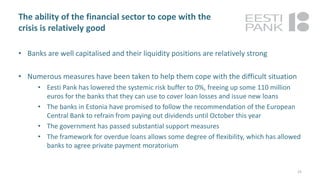
The ability of the financial sector to cope with the
crisis is relatively good
• Banks are well capitalised and their liquidity positions are relatively strong
• Numerous measures have been taken to help them cope with the difficult situation
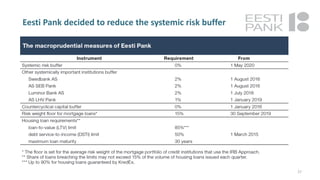
• Eesti Pank has lowered the systemic risk buffer to 0%, freeing up some 110 million
euros for the banks that they can use to cover loan losses and issue new loans
• The banks in Estonia have promised to follow the recommendation of the European
Central Bank to refrain from paying out dividends until October this year
• The government has passed substantial support measures
• The framework for overdue loans allows some degree of flexibility, which has allowed
banks to agree private payment moratorium
25
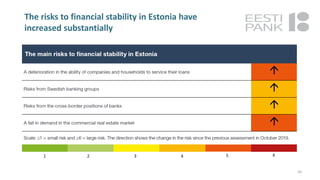
The risks to financial stability in Estonia have
increased substantially
26
1 2 3 4 5 6
Eesti Pank decided to reduce the systemic risk buffer
27

Financial Stability Review 1/2020

  • 1.
  • 2.
    The ability ofcompanies and households to service their loans is deteriorating 2
  • 3.
    The depth ofthe recession will depend on how long the restrictions last • The measures taken to stop the spread of the coronavirus have a substantial impact on economic activity • this includes a drop in exports, supply problems and weaker consumer confidence • Eesti Pank carried out scenario analysis to estimate the decline in the economy • if restrictions last until August, the Estonian economy could shrink by 14% • The longer the restrictions last, the more slowly the economy will recover 3
  • 4.
    The extent ofproblem loans at the banks will be affected by the length and depth of the recession • The sectors of the economy that were hit first by the restrictions make up quite a small part of the loan portfolio of the banks • Other sectors currently face difficulties that will become worse as the restrictions endure 4 0% 10% 20% 30% 40% 50% Distribution of the loan and lease portfolio of the banks Source: Eesti Pank
  • 5.
    The capacity ofcompanies to withstand difficulties had improved substantially before the crisis 5 • Temporary payment difficulties can be overcome if grace periods are granted 100% 200% 300% 400% 60% 80% 100% 120% 2005 2007 2009 2011 2013 2015 2017 2019 Indebtedness and liquidity of companies Sources: Statistics Estonia, Eesti Pank Liquid assets (right scale) Indebtedness (left scale)
  • 6.
    The financial positionof households is also stronger than before 6 0% 1% 2% 3% 4% 5% 6% 7% 0% 10% 20% 30% 40% 50% 60% 70% 2005 2007 2009 2011 2013 2015 2017 2019 Indebtedness and interest expenses of households Sources: Statistics Estonia, Eesti Pank Indebtedness (left scale) Interest expenses (right scale)
  • 7.
    If the restrictionson the economy last until August, the problem loans of the banks could grow substantially 7 0% 5% 10% 15% 20% 25% all banks systemically important banks small banks Possible share of problem loans in assets if the restrictions last until the start of August Source: Eesti Pank 13% Possible problem loans* Overdue loans in 2019 12% 22% *Possible problem loans if the restrictions last until August • The volume of problem loans depends on the structure of the loan portfolio of each bank
  • 8.
    The banks cancope with the loan losses even if the restrictions on the economy last until August 8 0% 5% 10% 15% 20% 25% 30% 35% capital possible loan losses capital possible loan losses capital possible loan losses all banks systemically important banks small banks %ofriskexposures Capitalisation of the banking sector and possible loan losses if the restrictions last until the start of August Source: Eesti Pank * Systemically important banks are Swedbank AS, AS SEB Pank, Luminor Bank AS and AS LHV Pank Voluntary buffer Macro and micro buffers Mandatory minimum
  • 9.
    Actual loan losseswill probably be smaller than in the scenario of the restrictions lasting until August • It is unlikely that the restrictions will remain at their current level until August • It is not impossible that some of the restrictions will have to be brought back later on to stop the spread of the virus • The support measures from the state are helping companies and households to survive the difficulties • The European Central Bank has decided to take extraordinary measures to ease the impact of the crisis • The European Central Bank and supervisory authorities have allowed some degree of flexibility in applying the framework for overdue loans • Temporary payment moratoriums give loan clients time to manage the crisis • They also give banks additional time to assess which clients will recover their capacity to pay 9
  • 10.
    Applications for graceperiods have been numerous • Companies have applied for grace periods for 20% of their loan stock, and households for 4% • The banks are allowing grace periods to overcome broad liquidity problems 10 0% 2% 4% 6% 8% 10% 12% 3/25/2020 4/1/2020 4/8/2020 4/15/2020 4/22/2020 4/29/2020 Applications for grace periods as a share of the loan stock of the banks Source: Finantsinspektsioon 4% 4% Corporate loans Housing loans Other household loans Grace periods granted 1% 5% 7% 8%
  • 11.
    The performance ofthe Estonian economy and financial sector is affected by the extent of problems in neighbouring countries 11
  • 12.
    The Swedish banksare largely dependent on market- based funding 12 0% 50% 100% 150% 200% 250% DK SE FI LU NL IE AT FR SK GR ES DE EE PT IT PL LT MT LV CZ BE CY SI HR RO BG Loan-to-deposit ratios in the European Union as at 31 December 2019 Source: European Central Bank
  • 13.
    Financial markets arevery volatile 13 -60% -50% -40% -30% -20% -10% 0% 10% 20% 30% 2019 2020 Changes in the share price of banking groups since the start of 2019* Sources: market data, Eesti Pank calculations Swedbank *The volatility in share prices in 2019 was largely driven by concerns that there may be shortcomings in the anti-money laundering measures of the banks SEB OMX Stockholm Banks COVID-19pandemic
  • 14.
    The market-based fundingconditions of the banks have become notably worse 14 0.0% 0.5% 1.0% 1.5% 2.0% Swedbank senior unsecured SEB senior unsecured Swedbank covered bond SEB covered bond Changes in the market interest rates on bonds in March 2020 Sources: market data, Eesti Pank calculations Covered bonds Unsecured bonds • If financial markets remain volatile over a longer period, planned issues may prove more difficult • The banks may become less ready to lend in Estonia
  • 15.
    Estonian banks operatein Latvia and Lithuania, so they are dependent on the performance of all the Baltic states 15 • Countries with small and open economies are very sensitive to shocks • The credit risks in the Latvian and Lithuanian banking sectors are similar to those in Estonia -30% -20% -10% 0% 10% 20% 30% 40% 2004 2005 2006 2007 2008 2009 2010 2011 2012 2013 2014 2015 2016 2017 2018 Nominal GDP growth Sources: Eurostat, Eesti Pank calculations Lithuania Estonia European Union Latvia
  • 16.
    Demand and supplyin the real estate market may move out of balance 16
  • 17.
    The real estatesector was better aligned with developments in the rest of the economy before the crisis 17 12% 13% 14% 15% 16% 17% 18% 1995 1996 1997 1998 1999 2000 2001 2002 2003 2004 2005 2006 2007 2008 2009 2010 2011 2012 2013 2014 2015 2016 2017 2018 2019 Sources: Statistics Estonia, Eurostat Value added in construction and real estate Value-added-to-GDP in construction and real estate Historical average
  • 18.
    Development of residentialreal estate has grown fast 18 0 500 1000 1500 2000 2500 3000 3500 2003 2004 2005 2006 2007 2008 2009 2010 2011 2012 2013 2014 2015 2016 2017 2018 2019 Source: Statistics Estonia Four-quarter moving average for number of construction and use permits for residential space Number of construction permits Number of permits for use
  • 19.
    Activity has beenstrong in commercial real estate development 19 0% 2% 4% 6% 8% 10% 12% 2012 2013 2014 2015 2016 2017 2018 2019 Sources: Statistics Estonia, Colliers International Growth in square metres of commercial real estate and GDP GDP growth Growth in square metres of commercial real estate
  • 20.
    Summary of therisks to the financial sector Macroprudential policy steps
  • 21.
    The ability ofcompanies and households to service their loans is deteriorating • The restrictions to stop the spread of the coronavirus have a major impact on businesses and households • The restrictions immediately impact companies focused on domestic demand and the transport sector and exporting companies because of the contraction in export markets • If the restrictions on the economy last until August, problem loans could increase to up to 13% of the loan portfolio of the banks 21
  • 22.
    Problems in neighbouringcountries could affect financial intermediation in Estonia • Swedish banking groups may support their Estonian subsidiaries during the crisis… • … but if the groups become less able to access funding from international markets, it could harm the loan supply from the Estonian banks • The Estonian banks mainly fund themselves from local deposits, which has made their supply of loans fairly independent • The Estonian banking sector could be affected by risks coming from economic developments in Latvia and Lithuania • The credit risks in Latvia and Lithuania are similar to those in Estonia 22
  • 23.
    Demand could falla long way in the real estate market • Loans to construction and real estate make up a large part of the corporate loan portfolio of the banks • Demand will fall for some time at least for both residential and commercial real estate • A long recession could cause developers difficulties in completing projects and owners problems in maintaining rental income • The real estate market is in much better balance than it was before the financial crisis of 2009 • The sector has not grown as quickly as a share of the total economy • Companies are less leveraged • Prices are better aligned with the rest of the economy 23
  • 24.
    The central banksof the euro area are keeping funding conditions favourable to ease the impact of the crisis on the economy • Liquidity support and long-term loans to banks on favourable terms • Loans with different maturities and lower interest rates than usual; particularly favourable are loans where the interest rate depends on growth in the loan portfolio of the bank, to encourage banks to issue new loans • A broader list of eligible collateral that allows banks to borrow more from the central banks of the euro area • Interest rates in financial markets have been reduced further by the temporary additional asset purchase programme of the euro area central banks, worth 7.3% of euro area GDP • Additional purchases of 120 billion euros in the framework of the asset purchase programme • A new and extraordinary pandemic emergency purchase programme of 750 billion euros to offset the economic impact 24
  • 25.
    The ability ofthe financial sector to cope with the crisis is relatively good • Banks are well capitalised and their liquidity positions are relatively strong • Numerous measures have been taken to help them cope with the difficult situation • Eesti Pank has lowered the systemic risk buffer to 0%, freeing up some 110 million euros for the banks that they can use to cover loan losses and issue new loans • The banks in Estonia have promised to follow the recommendation of the European Central Bank to refrain from paying out dividends until October this year • The government has passed substantial support measures • The framework for overdue loans allows some degree of flexibility, which has allowed banks to agree private payment moratorium 25
  • 26.
    The risks tofinancial stability in Estonia have increased substantially 26 1 2 3 4 5 6
  • 27.
    Eesti Pank decidedto reduce the systemic risk buffer 27