OECD INVESTMENT POLICY
REVIEW OF MYANMAR*
Dr. Stephen Thomsen
Head, Investment Policy Reviews, OECD
*Supported by the AANZFTA Economic Cooperation Support Program
2nd ASEAN-OECD Investment Policy Conference
10-11 December 2014, Jakarta
“The recommendations from the Review are candid,
impartial and highly practical.”
Aung Naing Oo, Director General,
Ministry of National Planning and Economic Development, Myanmar
Investment Policy Review of Myanmar:
Key themes and recommendations
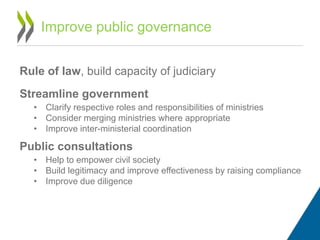
Rule of law, build capacity of judiciary
Streamline government
• Clarify respective roles and responsibilities of ministries
• Consider merging ministries where appropriate
• Improve inter-ministerial coordination
Public consultations
• Help to empower civil society
• Build legitimacy and improve effectiveness by raising compliance
• Improve due diligence
Improve public governance
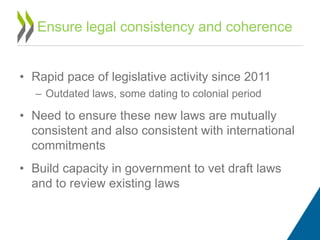
• Rapid pace of legislative activity since 2011
– Outdated laws, some dating to colonial period
• Need to ensure these new laws are mutually
consistent and also consistent with international
commitments
• Build capacity in government to vet draft laws
and to review existing laws
Ensure legal consistency and coherence
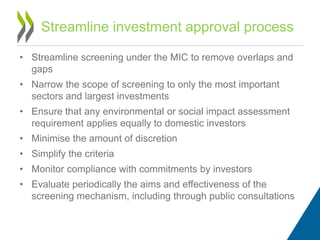
• Streamline screening under the MIC to remove overlaps and
gaps
• Narrow the scope of screening to only the most important
sectors and largest investments
• Ensure that any environmental or social impact assessment
requirement applies equally to domestic investors
• Minimise the amount of discretion
• Simplify the criteria
• Monitor compliance with commitments by investors
• Evaluate periodically the aims and effectiveness of the
screening mechanism, including through public consultations
Streamline investment approval process
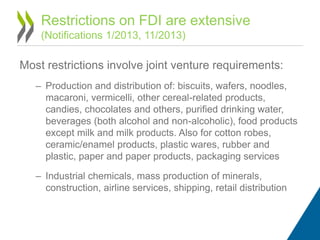
Most restrictions involve joint venture requirements:
– Production and distribution of: biscuits, wafers, noodles,
macaroni, vermicelli, other cereal-related products,
candies, chocolates and others, purified drinking water,
beverages (both alcohol and non-alcoholic), food products
except milk and milk products. Also for cotton robes,
ceramic/enamel products, plastic wares, rubber and
plastic, paper and paper products, packaging services
– Industrial chemicals, mass production of minerals,
construction, airline services, shipping, retail distribution
Restrictions on FDI are extensive
(Notifications 1/2013, 11/2013)
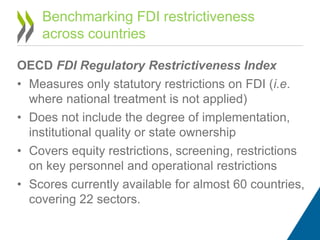
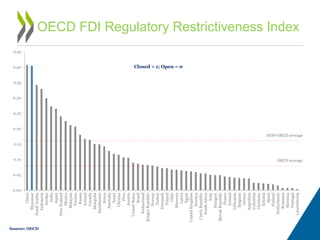
OECD FDI Regulatory Restrictiveness Index
• Measures only statutory restrictions on FDI (i.e.
where national treatment is not applied)
• Does not include the degree of implementation,
institutional quality or state ownership
• Covers equity restrictions, screening, restrictions
on key personnel and operational restrictions
• Scores currently available for almost 60 countries,
covering 22 sectors.
Benchmarking FDI restrictiveness
across countries
OECD FDI Regulatory Restrictiveness Index
OECD average
NON-OECD average
0.00
0.05
0.10
0.15
0.20
0.25
0.30
0.35
0.40
0.45
China
Myanmar
SaudiArabia
Indonesia
Jordan
India
Japan
NewZealand
Mexico
Malaysia
Tunisia
Russia
Iceland
Canada
Mongolia
Kazakhstan
Korea
Australia
Israel
Ukraine
Peru
Austria
UnitedStates
Brazil
Switzerland
KyrgyzRepublic
Norway
Turkey
Denmark
Poland
Chile
Morocco
Latvia
Egypt
UnitedKingdom
Sweden
CzechRepublic
SouthAfrica
Italy
Hungary
SlovakRepublic
France
Ireland
Lithuania
Belgium
Greece
Argentina
Colombia
Germany
Estonia
Spain
Finland
Netherlands
Romania
Slovenia
Portugal
Luxembourg
Source: OECD
Closed = 1; Open = 0
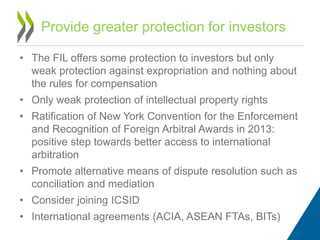
• The FIL offers some protection to investors but only
weak protection against expropriation and nothing about
the rules for compensation
• Only weak protection of intellectual property rights
• Ratification of New York Convention for the Enforcement
and Recognition of Foreign Arbitral Awards in 2013:
positive step towards better access to international
arbitration
• Promote alternative means of dispute resolution such as
conciliation and mediation
• Consider joining ICSID
• International agreements (ACIA, ASEAN FTAs, BITs)
Provide greater protection for investors
• Investment promotion is perhaps less important for
Myanmar at present than investment facilitation.
• Continue to streamline procedures (ease of doing
business)
• Ensure that one-stop shops include single-point
authority.
• DICA should take responsibility for addressing investor
grievances and serve as a policy advocate within
government for the private sector.
• Keeping existing investors happy is the best form of
promotion.
Investment promotion and facilitation
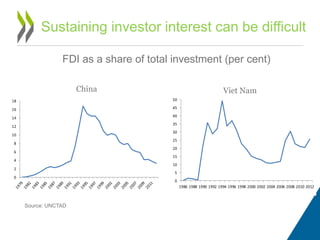
Sustaining investor interest can be difficult
0
5
10
15
20
25
30
35
40
45
50
1986 1988 1990 1992 1994 1996 1998 2000 2002 2004 2006 2008 2010 2012
0
2
4
6
8
10
12
14
16
18
FDI as a share of total investment (per cent)
China Viet Nam
Source: UNCTAD
• Incentives are commonplace worldwide.
• Little evidence that they are effective.
• Stability and predictability more important, together with
fair and efficient tax administration.
• With very low fiscal revenue as a share of GDP,
Myanmar would be better off taxing investment and
spending the revenue on education, health,
infrastructure, etc.
• Regional dimension
Incentives
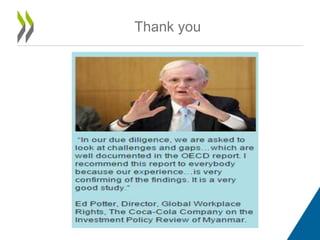
My government is taking steps to build investor confidence and promote responsible
investment in Myanmar.
President U Thein Sein
As sanctions are lifted, investment should be responsible and help the process of
democratisation.
Daw Aung San Suu Kyi
The EU…would welcome European companies exploring trade and investment opportunities
[in Myanmar]. This should be done [with] the highest standards of integrity and corporate
social responsibility.
Council of the European Union, April 2012
We say to American business: invest in Burma (Myanmar) and do it responsibly; be an agent
of positive change and be a good corporate citizen.
(Former) US Secretary of State Hillary Clinton, 2012
We welcome the commitment to responsible investment in Burma/Myanmar
G8 Foreign Ministers communiqué, 2013
A business considering investment in Myanmar should carefully examine the risks and
opportunities, as well as applicable international standards for RBC.
Business for Social Responsibility
Responsible business conduct
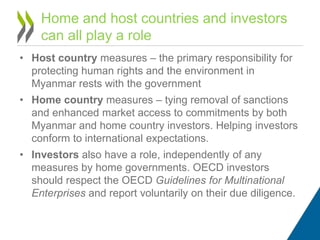
• Host country measures – the primary responsibility for
protecting human rights and the environment in
Myanmar rests with the government
• Home country measures – tying removal of sanctions
and enhanced market access to commitments by both
Myanmar and home country investors. Helping investors
conform to international expectations.
• Investors also have a role, independently of any
measures by home governments. OECD investors
should respect the OECD Guidelines for Multinational
Enterprises and report voluntarily on their due diligence.
Home and host countries and investors
can all play a role
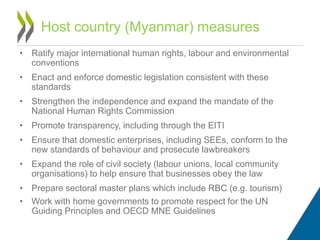
• Ratify major international human rights, labour and environmental
conventions
• Enact and enforce domestic legislation consistent with these
standards
• Strengthen the independence and expand the mandate of the
National Human Rights Commission
• Promote transparency, including through the EITI
• Ensure that domestic enterprises, including SEEs, conform to the
new standards of behaviour and prosecute lawbreakers
• Expand the role of civil society (labour unions, local community
organisations) to help ensure that businesses obey the law
• Prepare sectoral master plans which include RBC (e.g. tourism)
• Work with home governments to promote respect for the UN
Guiding Principles and OECD MNE Guidelines
Host country (Myanmar) measures
Thank you

Steven Thomsen, OECD, 2014 ASEAN-OECD Investment Policy Conference

  • 1.
    OECD INVESTMENT POLICY REVIEWOF MYANMAR* Dr. Stephen Thomsen Head, Investment Policy Reviews, OECD *Supported by the AANZFTA Economic Cooperation Support Program 2nd ASEAN-OECD Investment Policy Conference 10-11 December 2014, Jakarta
  • 2.
    “The recommendations fromthe Review are candid, impartial and highly practical.” Aung Naing Oo, Director General, Ministry of National Planning and Economic Development, Myanmar Investment Policy Review of Myanmar: Key themes and recommendations
  • 3.
    Rule of law,build capacity of judiciary Streamline government • Clarify respective roles and responsibilities of ministries • Consider merging ministries where appropriate • Improve inter-ministerial coordination Public consultations • Help to empower civil society • Build legitimacy and improve effectiveness by raising compliance • Improve due diligence Improve public governance
  • 4.
    • Rapid paceof legislative activity since 2011 – Outdated laws, some dating to colonial period • Need to ensure these new laws are mutually consistent and also consistent with international commitments • Build capacity in government to vet draft laws and to review existing laws Ensure legal consistency and coherence
  • 5.
    • Streamline screeningunder the MIC to remove overlaps and gaps • Narrow the scope of screening to only the most important sectors and largest investments • Ensure that any environmental or social impact assessment requirement applies equally to domestic investors • Minimise the amount of discretion • Simplify the criteria • Monitor compliance with commitments by investors • Evaluate periodically the aims and effectiveness of the screening mechanism, including through public consultations Streamline investment approval process
  • 6.
    Most restrictions involvejoint venture requirements: – Production and distribution of: biscuits, wafers, noodles, macaroni, vermicelli, other cereal-related products, candies, chocolates and others, purified drinking water, beverages (both alcohol and non-alcoholic), food products except milk and milk products. Also for cotton robes, ceramic/enamel products, plastic wares, rubber and plastic, paper and paper products, packaging services – Industrial chemicals, mass production of minerals, construction, airline services, shipping, retail distribution Restrictions on FDI are extensive (Notifications 1/2013, 11/2013)
  • 7.
    OECD FDI RegulatoryRestrictiveness Index • Measures only statutory restrictions on FDI (i.e. where national treatment is not applied) • Does not include the degree of implementation, institutional quality or state ownership • Covers equity restrictions, screening, restrictions on key personnel and operational restrictions • Scores currently available for almost 60 countries, covering 22 sectors. Benchmarking FDI restrictiveness across countries
  • 8.
    OECD FDI RegulatoryRestrictiveness Index OECD average NON-OECD average 0.00 0.05 0.10 0.15 0.20 0.25 0.30 0.35 0.40 0.45 China Myanmar SaudiArabia Indonesia Jordan India Japan NewZealand Mexico Malaysia Tunisia Russia Iceland Canada Mongolia Kazakhstan Korea Australia Israel Ukraine Peru Austria UnitedStates Brazil Switzerland KyrgyzRepublic Norway Turkey Denmark Poland Chile Morocco Latvia Egypt UnitedKingdom Sweden CzechRepublic SouthAfrica Italy Hungary SlovakRepublic France Ireland Lithuania Belgium Greece Argentina Colombia Germany Estonia Spain Finland Netherlands Romania Slovenia Portugal Luxembourg Source: OECD Closed = 1; Open = 0
  • 9.
    • The FILoffers some protection to investors but only weak protection against expropriation and nothing about the rules for compensation • Only weak protection of intellectual property rights • Ratification of New York Convention for the Enforcement and Recognition of Foreign Arbitral Awards in 2013: positive step towards better access to international arbitration • Promote alternative means of dispute resolution such as conciliation and mediation • Consider joining ICSID • International agreements (ACIA, ASEAN FTAs, BITs) Provide greater protection for investors
  • 10.
    • Investment promotionis perhaps less important for Myanmar at present than investment facilitation. • Continue to streamline procedures (ease of doing business) • Ensure that one-stop shops include single-point authority. • DICA should take responsibility for addressing investor grievances and serve as a policy advocate within government for the private sector. • Keeping existing investors happy is the best form of promotion. Investment promotion and facilitation
  • 11.
    Sustaining investor interestcan be difficult 0 5 10 15 20 25 30 35 40 45 50 1986 1988 1990 1992 1994 1996 1998 2000 2002 2004 2006 2008 2010 2012 0 2 4 6 8 10 12 14 16 18 FDI as a share of total investment (per cent) China Viet Nam Source: UNCTAD
  • 12.
    • Incentives arecommonplace worldwide. • Little evidence that they are effective. • Stability and predictability more important, together with fair and efficient tax administration. • With very low fiscal revenue as a share of GDP, Myanmar would be better off taxing investment and spending the revenue on education, health, infrastructure, etc. • Regional dimension Incentives
  • 13.
    My government istaking steps to build investor confidence and promote responsible investment in Myanmar. President U Thein Sein As sanctions are lifted, investment should be responsible and help the process of democratisation. Daw Aung San Suu Kyi The EU…would welcome European companies exploring trade and investment opportunities [in Myanmar]. This should be done [with] the highest standards of integrity and corporate social responsibility. Council of the European Union, April 2012 We say to American business: invest in Burma (Myanmar) and do it responsibly; be an agent of positive change and be a good corporate citizen. (Former) US Secretary of State Hillary Clinton, 2012 We welcome the commitment to responsible investment in Burma/Myanmar G8 Foreign Ministers communiqué, 2013 A business considering investment in Myanmar should carefully examine the risks and opportunities, as well as applicable international standards for RBC. Business for Social Responsibility Responsible business conduct
  • 14.
    • Host countrymeasures – the primary responsibility for protecting human rights and the environment in Myanmar rests with the government • Home country measures – tying removal of sanctions and enhanced market access to commitments by both Myanmar and home country investors. Helping investors conform to international expectations. • Investors also have a role, independently of any measures by home governments. OECD investors should respect the OECD Guidelines for Multinational Enterprises and report voluntarily on their due diligence. Home and host countries and investors can all play a role
  • 15.
    • Ratify majorinternational human rights, labour and environmental conventions • Enact and enforce domestic legislation consistent with these standards • Strengthen the independence and expand the mandate of the National Human Rights Commission • Promote transparency, including through the EITI • Ensure that domestic enterprises, including SEEs, conform to the new standards of behaviour and prosecute lawbreakers • Expand the role of civil society (labour unions, local community organisations) to help ensure that businesses obey the law • Prepare sectoral master plans which include RBC (e.g. tourism) • Work with home governments to promote respect for the UN Guiding Principles and OECD MNE Guidelines Host country (Myanmar) measures
  • 16.

Editor's Notes

  • #6 MIC, Central Working Body for SEZs, line ministries for joint ventures with SEEs not requiring incentives. Multiple approvals in some cases. Criteria for approval are complex and some might be beyond the likely capacity of MIC to evaluate: e.g. financial credibility, economic viability, appropriateness of the technology of proposed project Possible capacity constraints of current system in the event of rapid growth in foreign investment Possible capacity constraints of current system in the event of rapid growth in foreign investment
  • #14 Even the FIL lists as one of its aims: to allow the commencement of business enterprises and investments meeting international standards.