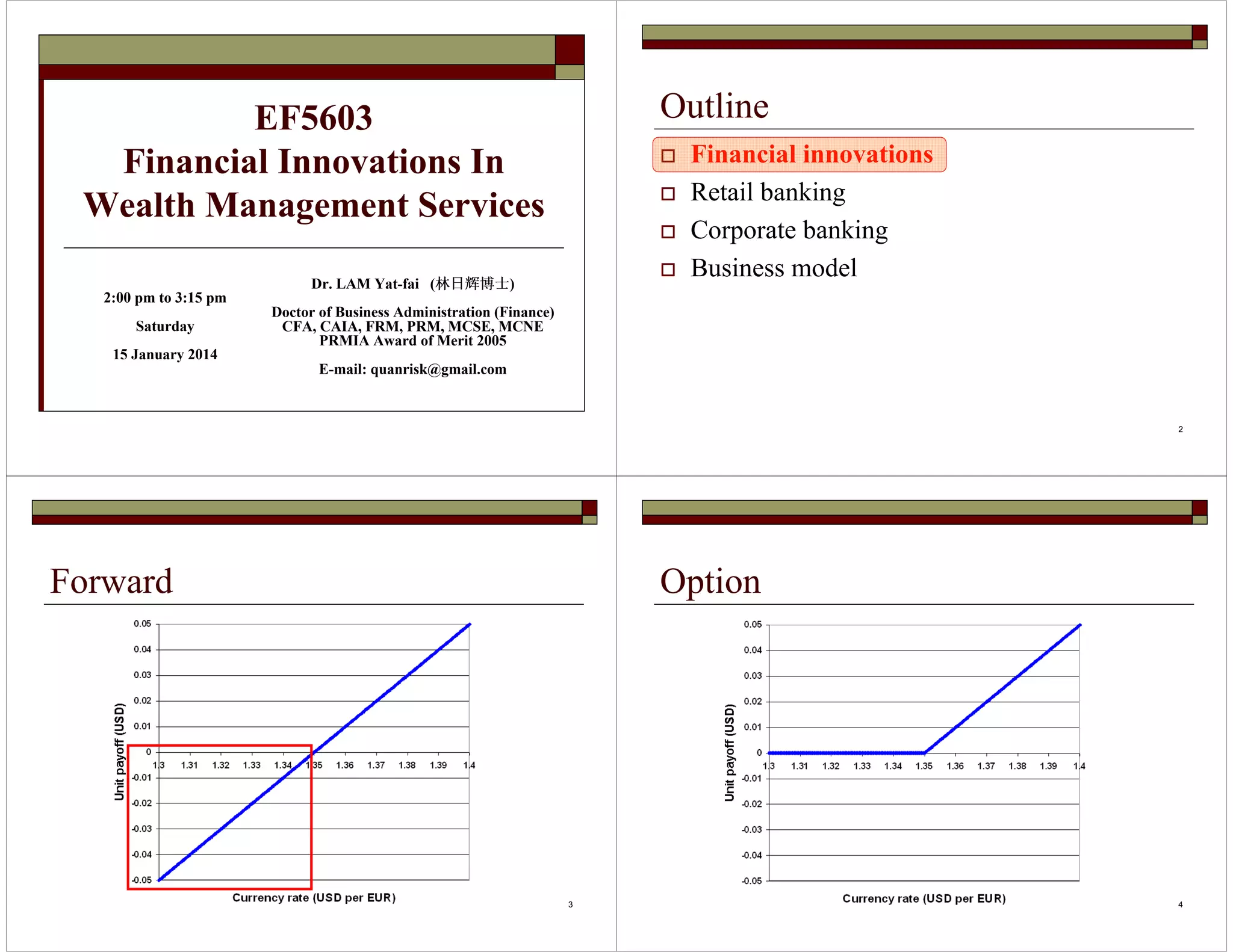
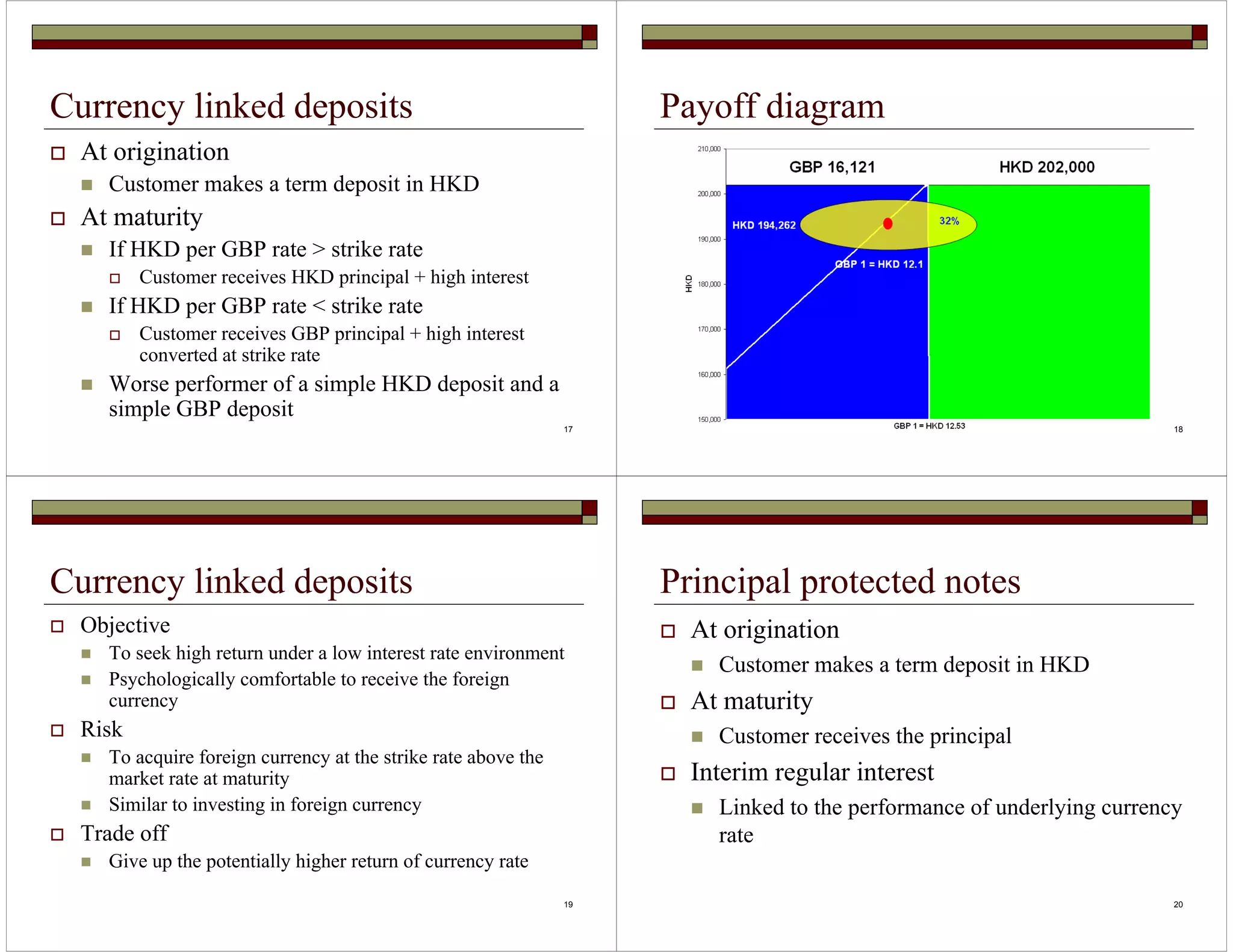
EF5603 
Financial Innovations In 
Wealth Management Services 
Dr. LAM Yat-fai (林日辉博士) 
Doctor of Business Administration (Finance) 
CFA, CAIA, FRM, PRM, MCSE, MCNE 
PRMIA Award of Merit 2005 
E-mail: quanrisk@gmail.com 
2:00 pm to 3:15 pm 
Saturday 
15 January 2014 
2 
Outline 
 Financial innovations 
 Retail banking 
 Corporate banking 
 Business model 
3 
Forward 
4 
Option
5 
Trading strategy 
6 
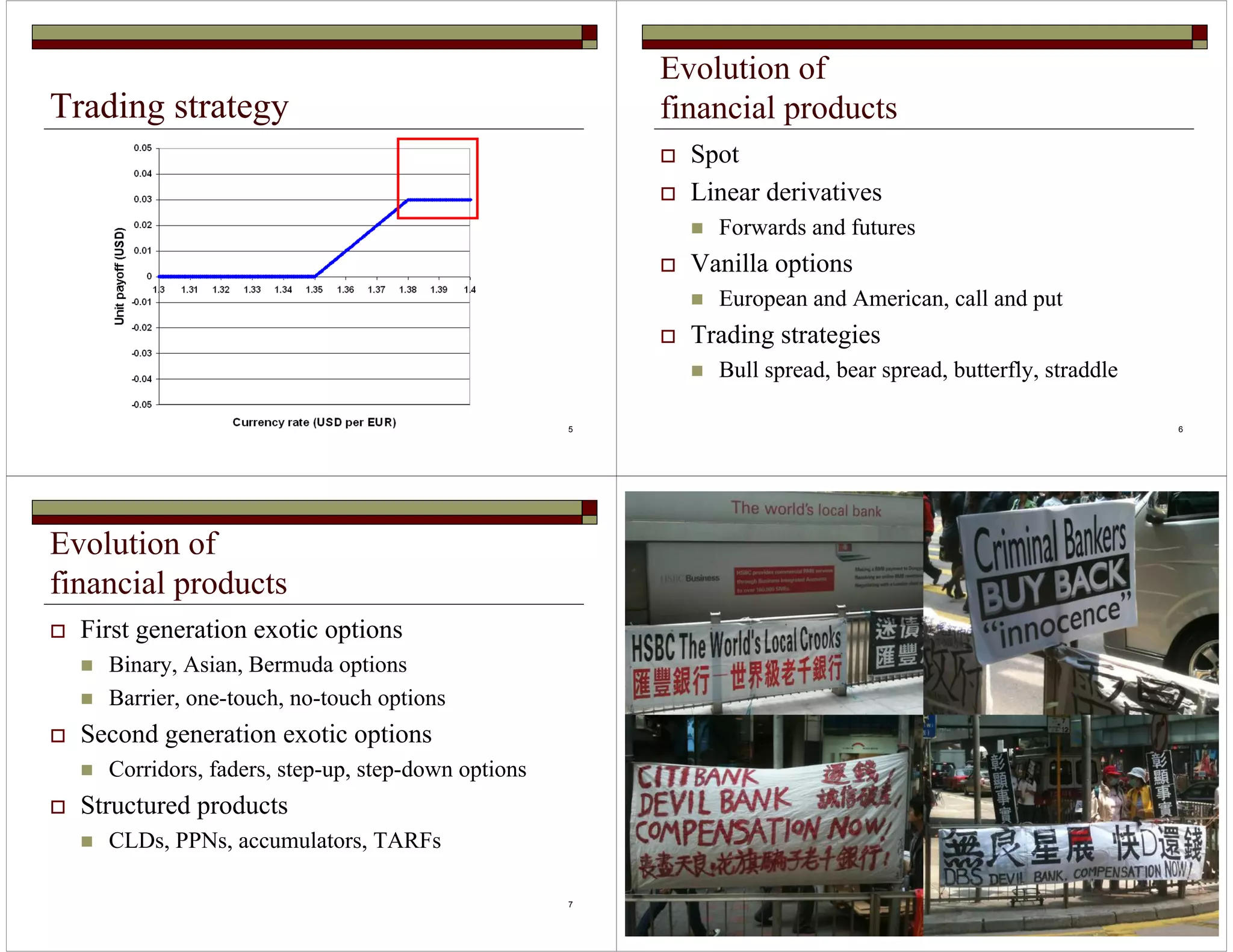
Evolution of 
financial products 
 Spot 
 Linear derivatives 
 Forwards and futures 
 Vanilla options 
 European and American, call and put 
 Trading strategies 
 Bull spread, bear spread, butterfly, straddle 
7 
Evolution of 
financial products 
 First generation exotic options 
 Binary, Asian, Bermuda options 
 Barrier, one-touch, no-touch options 
 Second generation exotic options 
 Corridors, faders, step-up, step-down options 
 Structured products 
 CLDs, PPNs, accumulators, TARFs 
8
9 
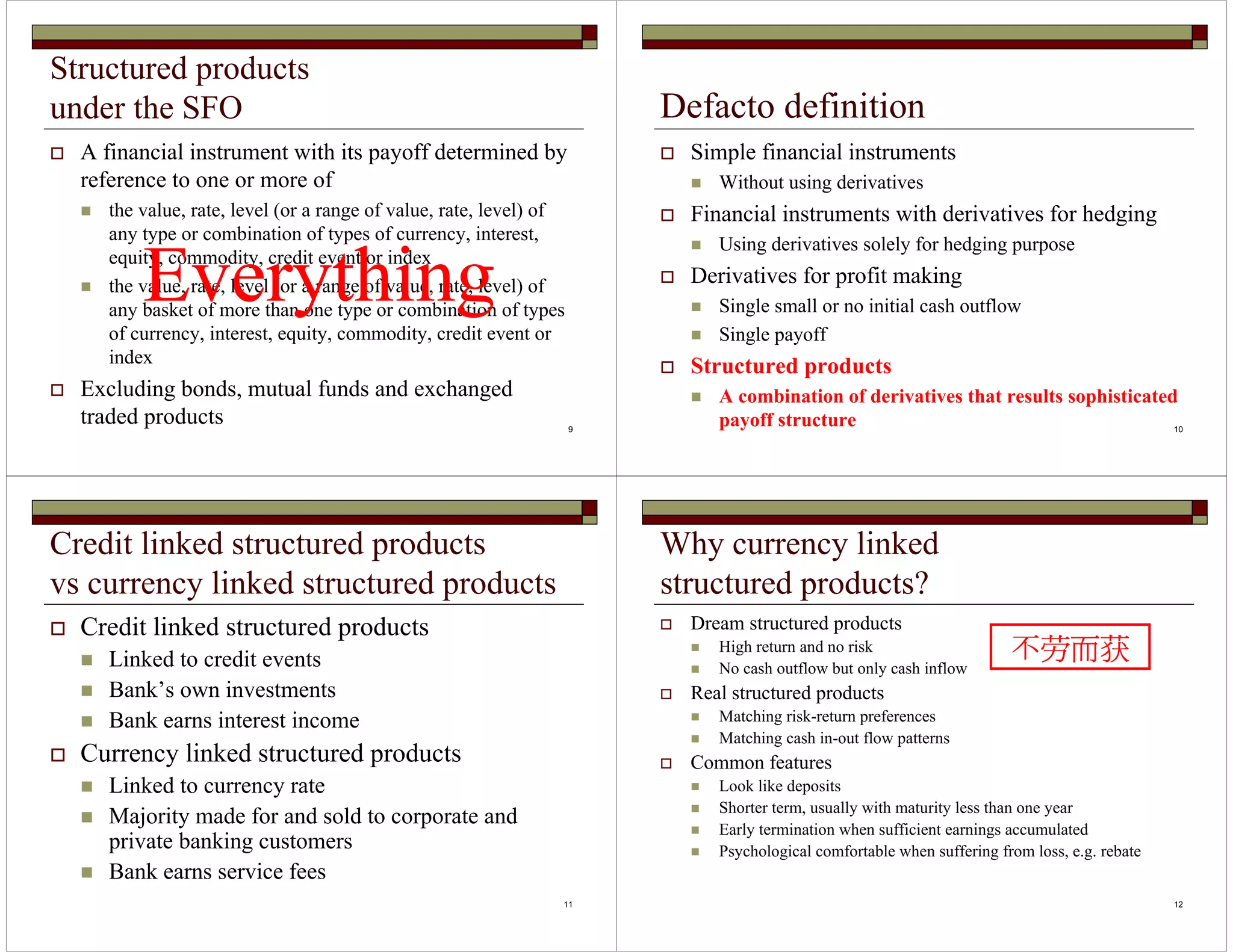
Structured products 
under the SFO 
 A financial instrument with its payoff determined by 
reference to one or more of 
 the value, rate, level (or a range of value, rate, level) of 
any type or combination of types of currency, interest, 
equity, commodity, credit event or index 
Everything 
 the value, rate, level (or a range of value, rate, level) of 
any basket of more than one type or combination of types 
of currency, interest, equity, commodity, credit event or 
index 
 Excluding bonds, mutual funds and exchanged 
traded products 
10 
Defacto definition 
 Simple financial instruments 
 Without using derivatives 
 Financial instruments with derivatives for hedging 
 Using derivatives solely for hedging purpose 
 Derivatives for profit making 
 Single small or no initial cash outflow 
 Single payoff 
 Structured products 
 A combination of derivatives that results sophisticated 
payoff structure 
11 
Credit linked structured products 
vs currency linked structured products 
 Credit linked structured products 
 Linked to credit events 
 Bank’s own investments 
 Bank earns interest income 
 Currency linked structured products 
 Linked to currency rate 
 Majority made for and sold to corporate and 
private banking customers 
 Bank earns service fees 
12 
Why currency linked 
structured products? 
 Dream structured products 
 High return and no risk 
 No cash outflow but only cash inflow 
 Real structured products 
 Matching risk-return preferences 
 Matching cash in-out flow patterns 
 Common features 
 Look like deposits 
不劳而获 
 Shorter term, usually with maturity less than one year 
 Early termination when sufficient earnings accumulated 
 Psychological comfortable when suffering from loss, e.g. rebate
13 
Currency linked structured products 
 Exempted from the SFO if sold by a bank 
under the supervision of the HKMA 
 The largest category of structured products in 
terms of transaction volume 
 To capture earning potential under the current 
environment of 
 extremely low interest rate 
 high currency rate volatility 
14 
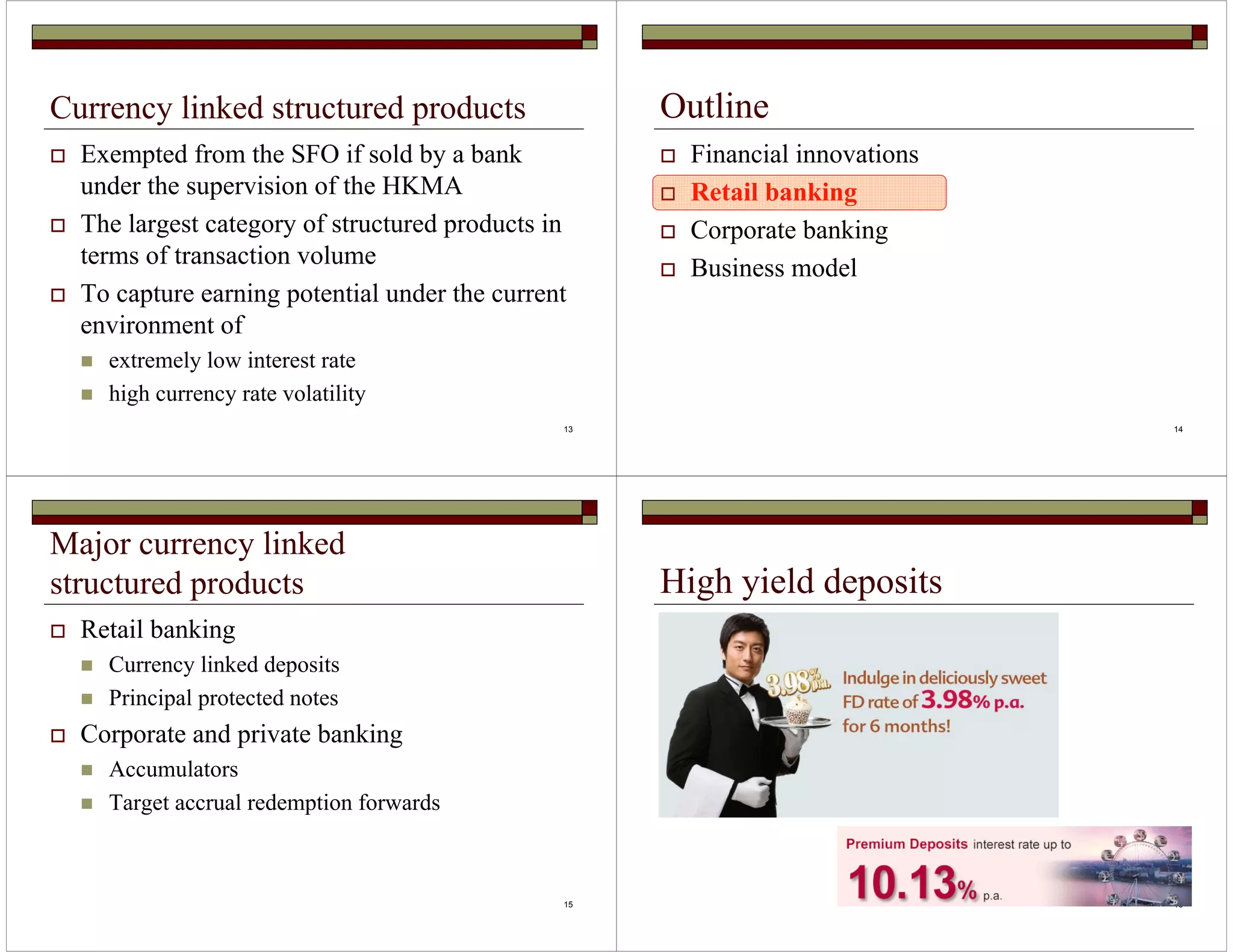
Outline 
 Financial innovations 
 Retail banking 
 Corporate banking 
 Business model 
15 
Major currency linked 
structured products 
 Retail banking 
 Currency linked deposits 
 Principal protected notes 
 Corporate and private banking 
 Accumulators 
 Target accrual redemption forwards 
16 
High yield deposits
17 
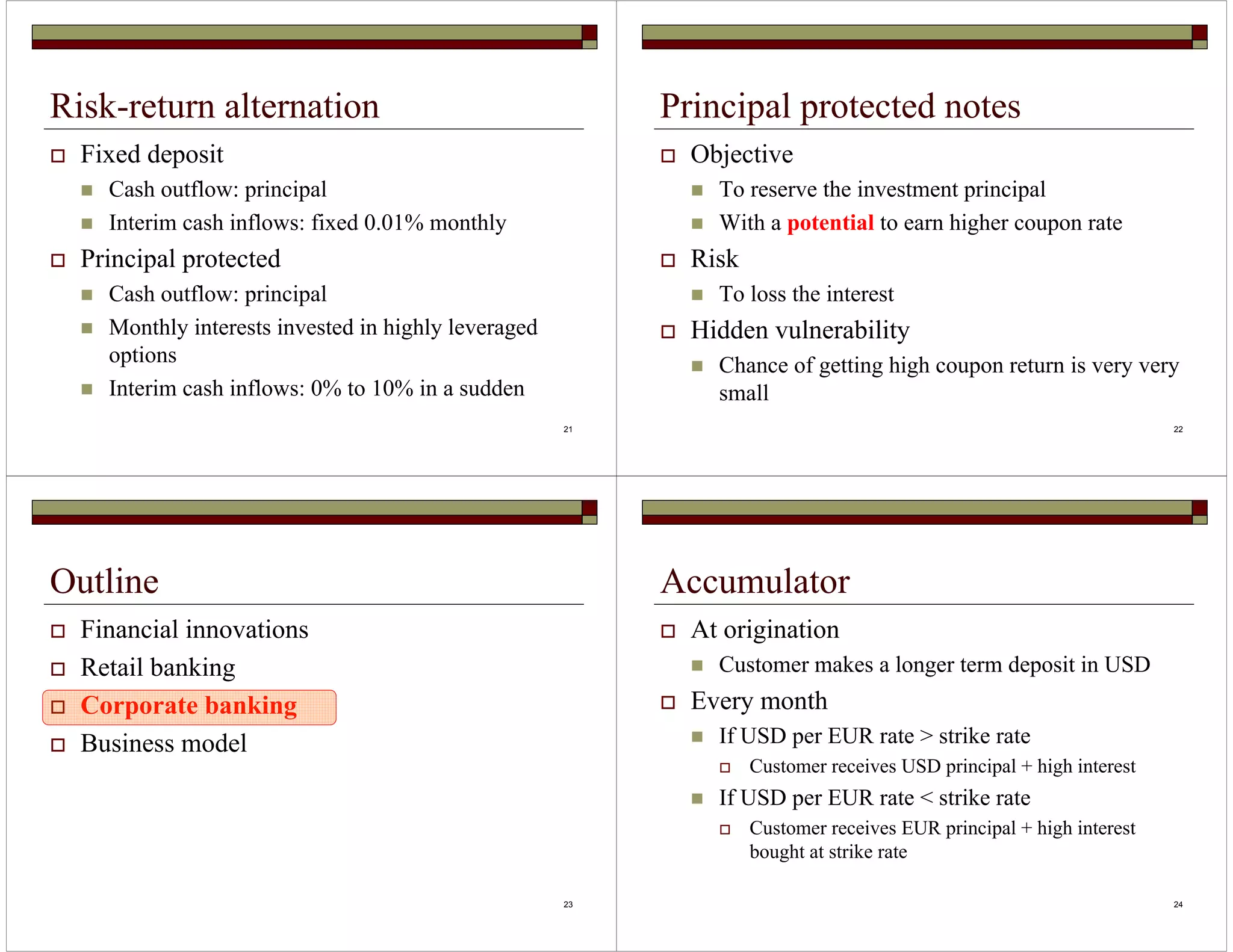
Currency linked deposits 
 At origination 
 Customer makes a term deposit in HKD 
 At maturity 
 If HKD per GBP rate  strike rate 
 Customer receives HKD principal + high interest 
 If HKD per GBP rate  strike rate 
 Customer receives GBP principal + high interest 
converted at strike rate 
 Worse performer of a simple HKD deposit and a 
simple GBP deposit 
18 
Payoff diagram 
19 
Currency linked deposits 
 Objective 
 To seek high return under a low interest rate environment 
 Psychologically comfortable to receive the foreign 
currency 
 Risk 
 To acquire foreign currency at the strike rate above the 
market rate at maturity 
 Similar to investing in foreign currency 
 Trade off 
 Give up the potentially higher return of currency rate 
20 
Principal protected notes 
 At origination 
 Customer makes a term deposit in HKD 
 At maturity 
 Customer receives the principal 
 Interim regular interest 
 Linked to the performance of underlying currency 
rate
21 
Risk-return alternation 
 Fixed deposit 
 Cash outflow: principal 
 Interim cash inflows: fixed 0.01% monthly 
 Principal protected 
 Cash outflow: principal 
 Monthly interests invested in highly leveraged 
options 
 Interim cash inflows: 0% to 10% in a sudden 
22 
Principal protected notes 
 Objective 
 To reserve the investment principal 
 With a potential to earn higher coupon rate 
 Risk 
 To loss the interest 
 Hidden vulnerability 
 Chance of getting high coupon return is very very 
small 
23 
Outline 
 Financial innovations 
 Retail banking 
 Corporate banking 
 Business model 
24 
Accumulator 
 At origination 
 Customer makes a longer term deposit in USD 
 Every month 
 If USD per EUR rate  strike rate 
 Customer receives USD principal + high interest 
 If USD per EUR rate  strike rate 
 Customer receives EUR principal + high interest 
bought at strike rate
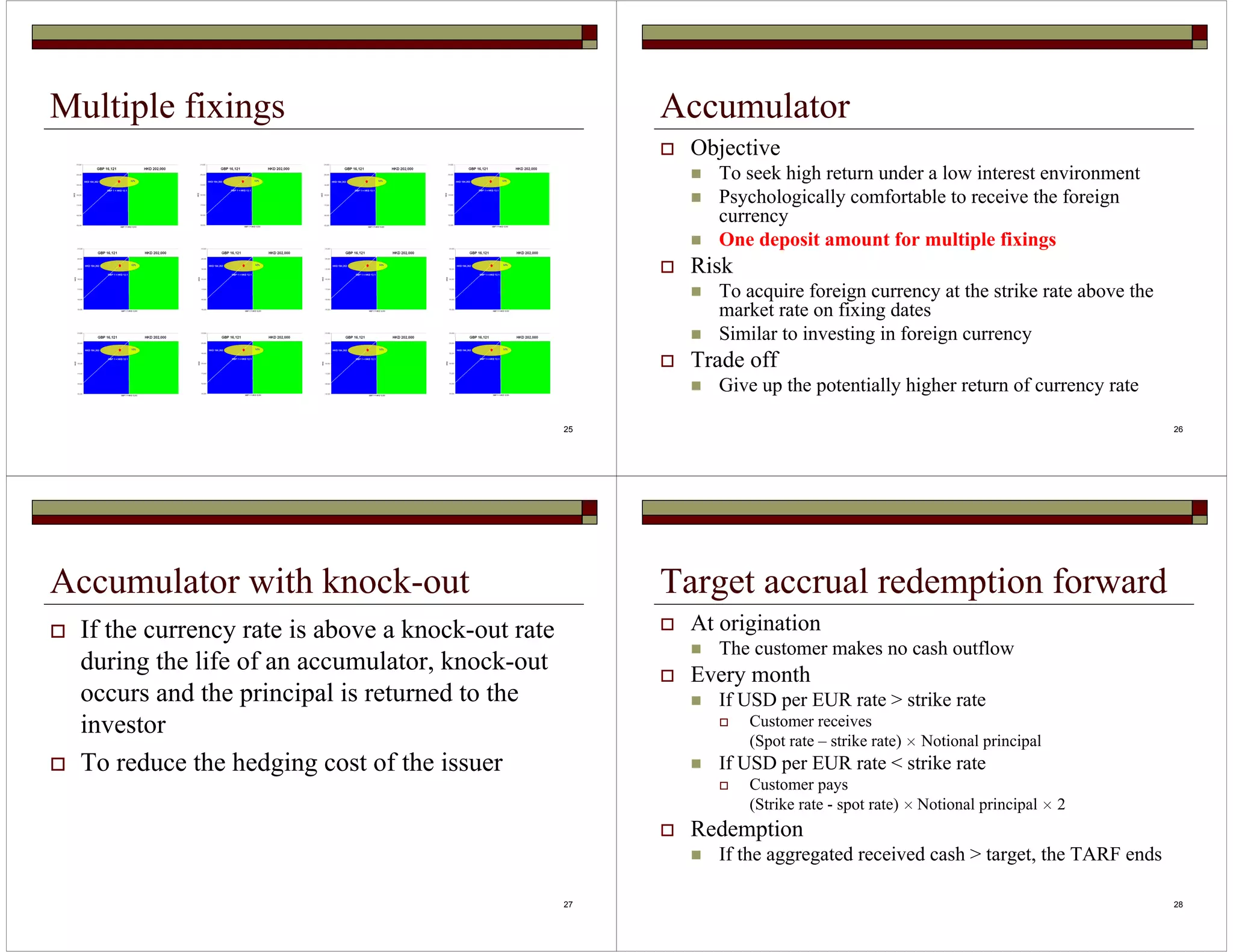
25 
Multiple fixings 
26 
Accumulator 
 Objective 
 To seek high return under a low interest environment 
 Psychologically comfortable to receive the foreign 
currency 
 One deposit amount for multiple fixings 
 Risk 
 To acquire foreign currency at the strike rate above the 
market rate on fixing dates 
 Similar to investing in foreign currency 
 Trade off 
 Give up the potentially higher return of currency rate 
27 
Accumulator with knock-out 
 If the currency rate is above a knock-out rate 
during the life of an accumulator, knock-out 
occurs and the principal is returned to the 
investor 
 To reduce the hedging cost of the issuer 
28 
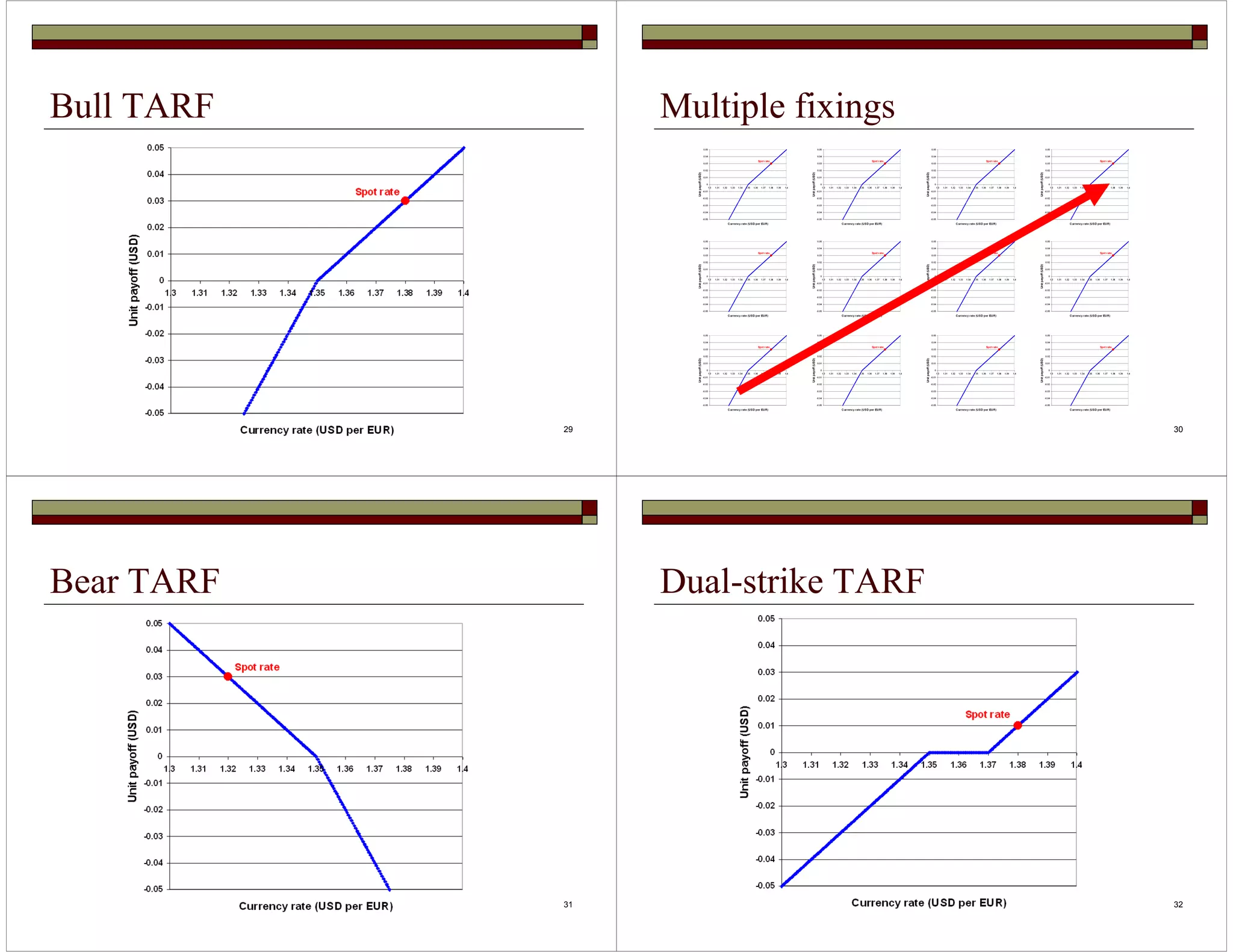
Target accrual redemption forward 
 At origination 
 The customer makes no cash outflow 
 Every month 
 If USD per EUR rate  strike rate 
 Customer receives 
(Spot rate – strike rate) × Notional principal 
 If USD per EUR rate  strike rate 
 Customer pays 
(Strike rate - spot rate) Ă—Notional principal Ă— 2 
 Redemption 
 If the aggregated received cash  target, the TARF ends
29 
Bull TARF 
30 
Multiple fixings 
31 
Bear TARF 
32 
Dual-strike TARF
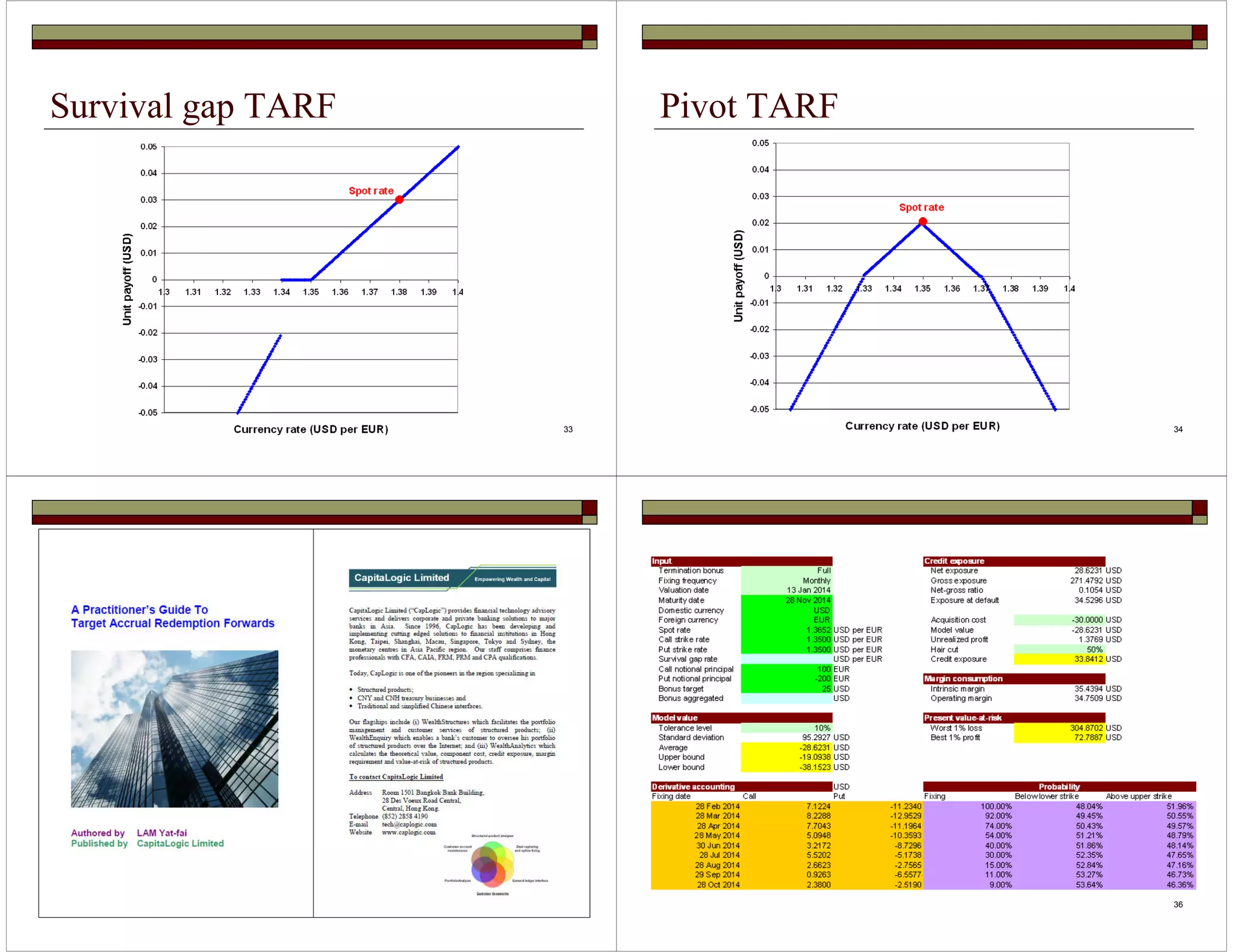
33 
Survival gap TARF 
34 
Pivot TARF 
35 36
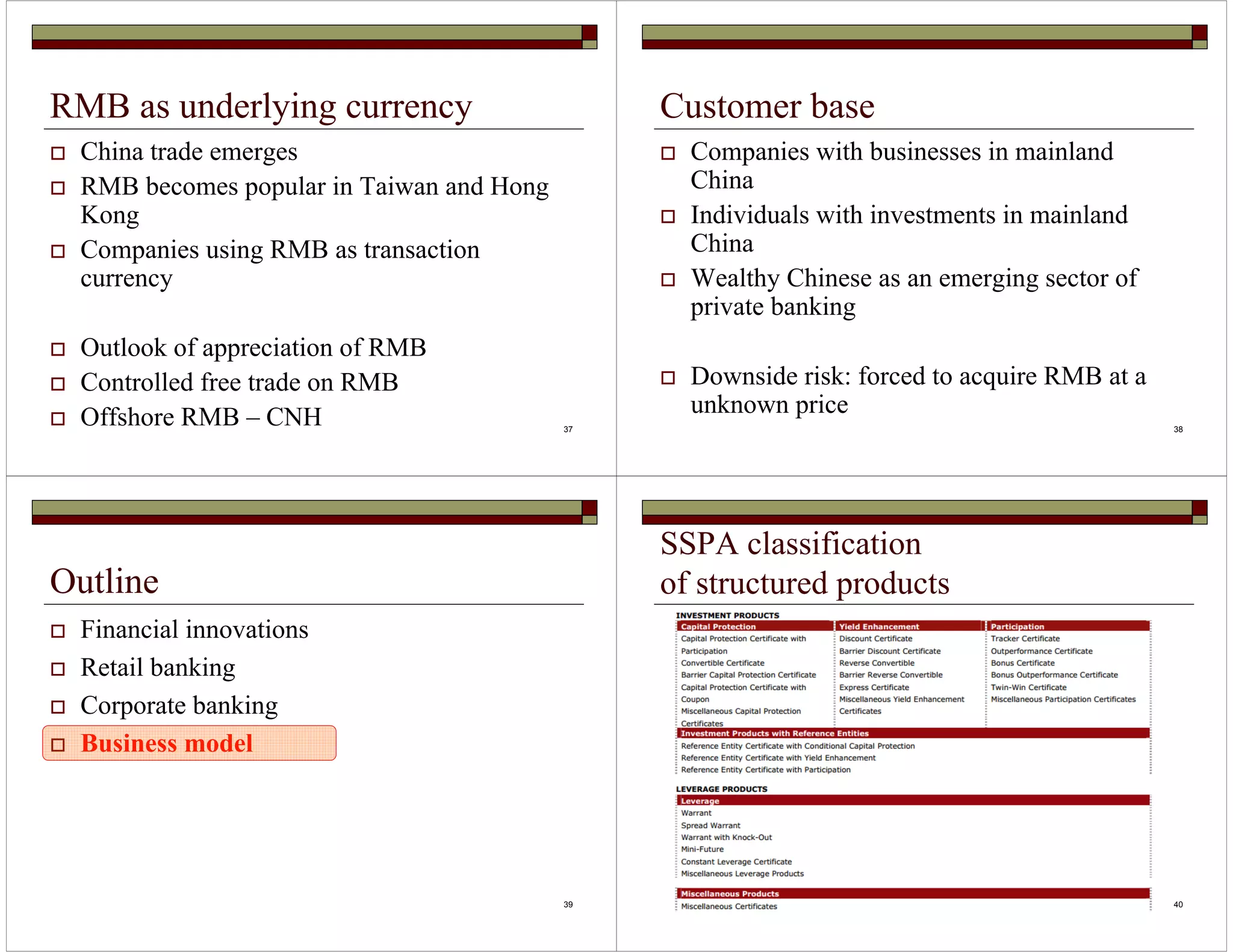
37 
RMB as underlying currency 
 China trade emerges 
 RMB becomes popular in Taiwan and Hong 
Kong 
 Companies using RMB as transaction 
currency 
 Outlook of appreciation of RMB 
 Controlled free trade on RMB 
Customer base 
 Companies with businesses in mainland 
China 
 Individuals with investments in mainland 
China 
 Wealthy Chinese as an emerging sector of 
private banking 
 Downside risk: forced to acquire RMB at a 
unknown price 
 Offshore RMB – CNH 38 
39 
Outline 
 Financial innovations 
 Retail banking 
 Corporate banking 
 Business model 
40 
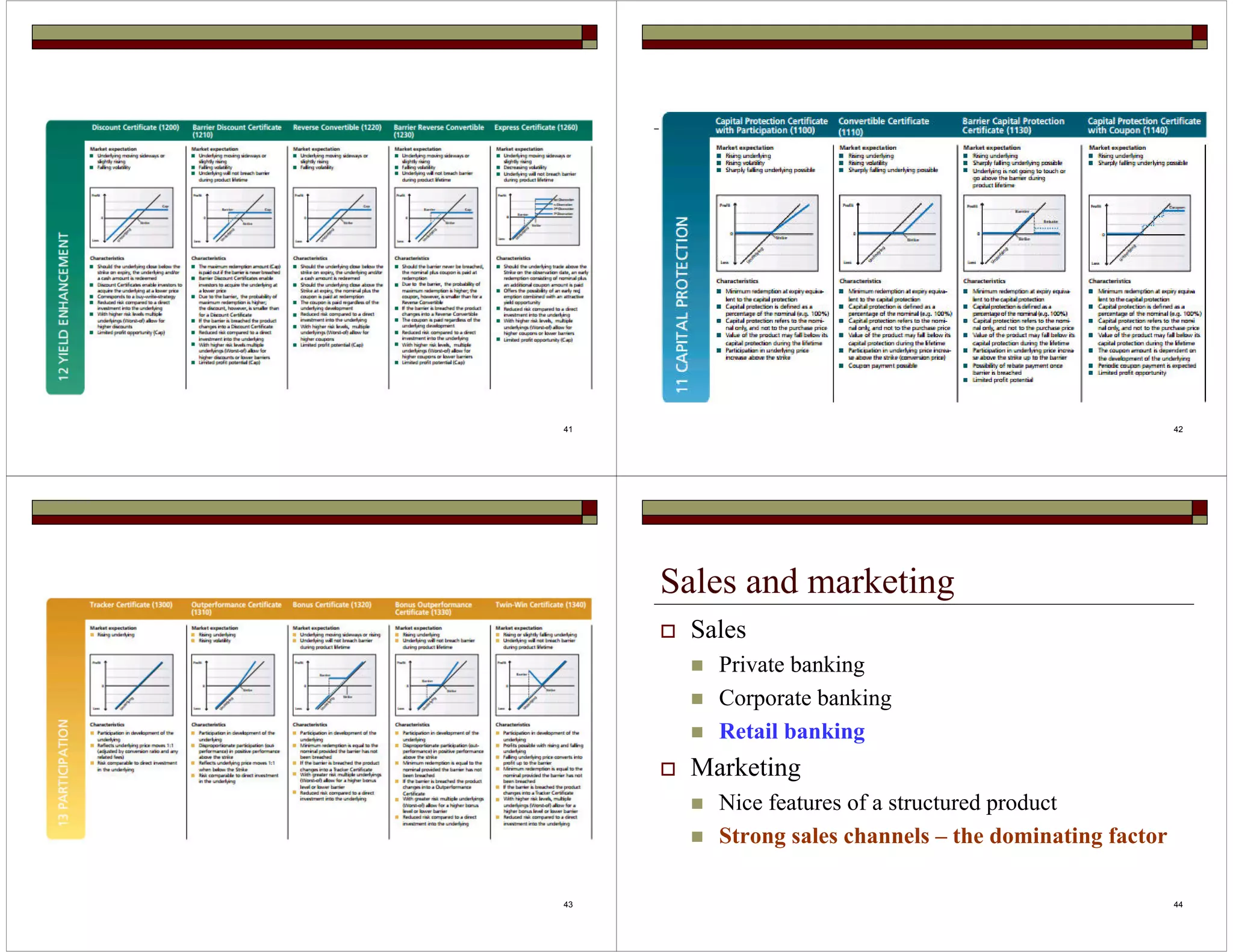
SSPA classification 
of structured products
41 42 
Sales and marketing 
 Sales 
 Private banking 
 Corporate banking 
 Retail banking 
 Marketing 
 Nice features of a structured product 
 Strong sales channels – the dominating factor 
43 44
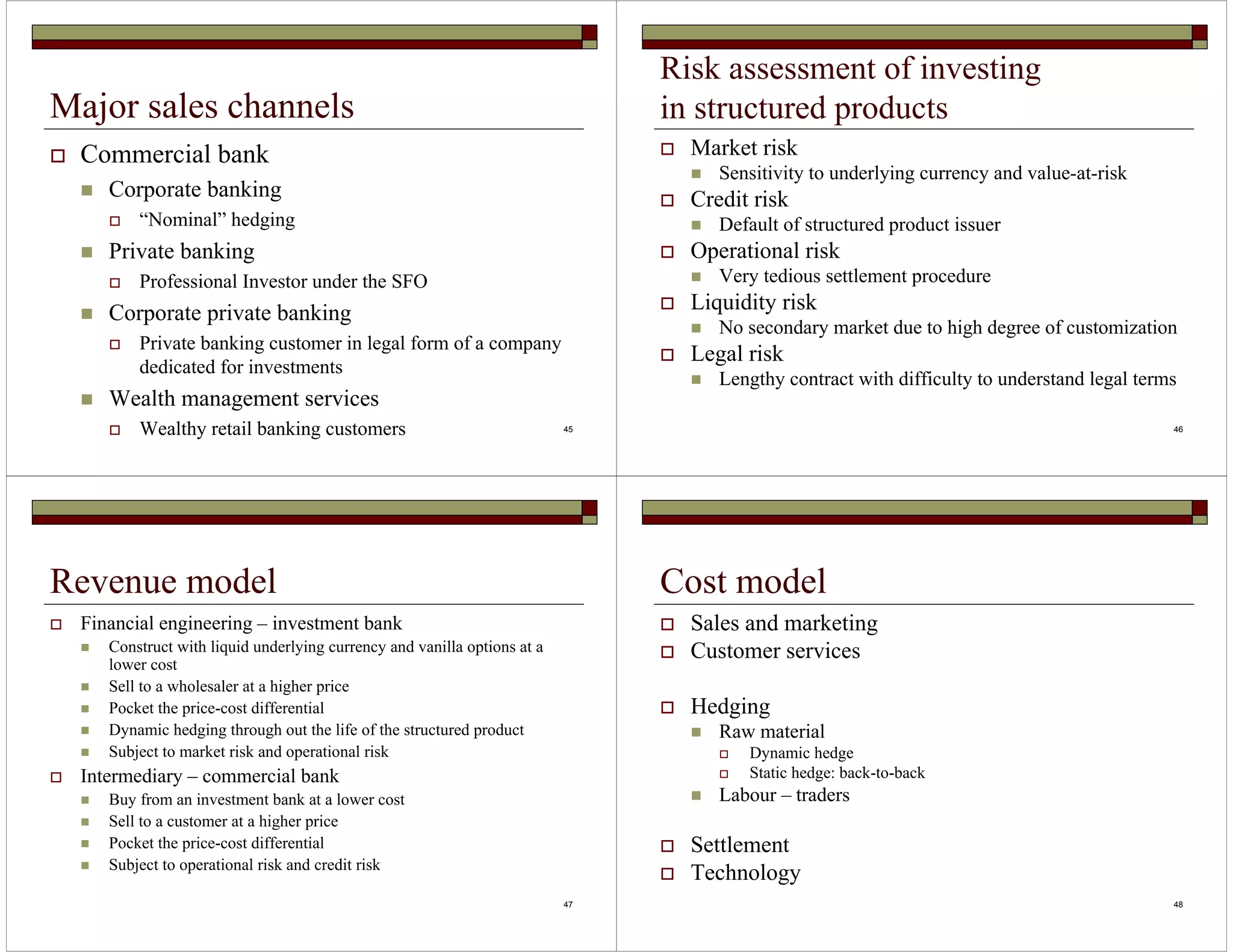
45 
Major sales channels 
 Commercial bank 
 Corporate banking 
 “Nominal” hedging 
 Private banking 
 Professional Investor under the SFO 
 Corporate private banking 
 Private banking customer in legal form of a company 
dedicated for investments 
 Wealth management services 
Risk assessment of investing 
in structured products 
 Market risk 
 Sensitivity to underlying currency and value-at-risk 
 Credit risk 
 Default of structured product issuer 
 Operational risk 
 Very tedious settlement procedure 
 Liquidity risk 
 No secondary market due to high degree of customization 
 Legal risk 
 Lengthy contract with difficulty to understand legal terms 
 Wealthy retail banking customers 46 
47 
Revenue model 
 Financial engineering – investment bank 
 Construct with liquid underlying currency and vanilla options at a 
lower cost 
 Sell to a wholesaler at a higher price 
 Pocket the price-cost differential 
 Dynamic hedging through out the life of the structured product 
 Subject to market risk and operational risk 
 Intermediary – commercial bank 
 Buy from an investment bank at a lower cost 
 Sell to a customer at a higher price 
 Pocket the price-cost differential 
 Subject to operational risk and credit risk 
48 
Cost model 
 Sales and marketing 
 Customer services 
 Hedging 
 Raw material 
 Dynamic hedge 
 Static hedge: back-to-back 
 Labour – traders 
 Settlement 
 Technology
49 
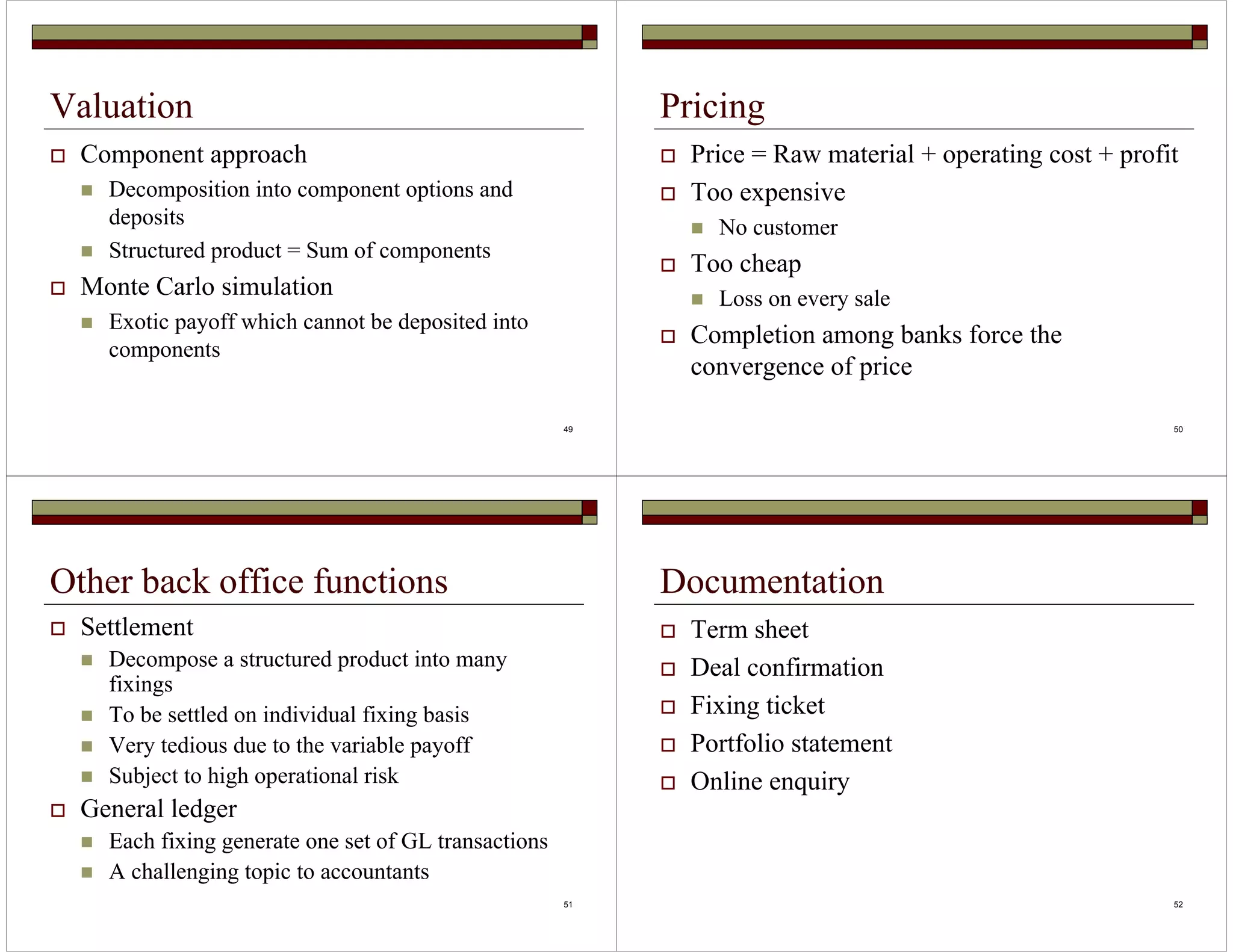
Valuation 
 Component approach 
 Decomposition into component options and 
deposits 
 Structured product = Sum of components 
 Monte Carlo simulation 
 Exotic payoff which cannot be deposited into 
components 
50 
Pricing 
 Price = Raw material + operating cost + profit 
 Too expensive 
 No customer 
 Too cheap 
 Loss on every sale 
 Completion among banks force the 
convergence of price 
51 
Other back office functions 
 Settlement 
 Decompose a structured product into many 
fixings 
 To be settled on individual fixing basis 
 Very tedious due to the variable payoff 
 Subject to high operational risk 
 General ledger 
 Each fixing generate one set of GL transactions 
 A challenging topic to accountants 
52 
Documentation 
 Term sheet 
 Deal confirmation 
 Fixing ticket 
 Portfolio statement 
 Online enquiry
Your opinions 
http://sites.google.com/site/quanrisk

2014 financial innovations in wealth management services

  • 1.
    EF5603 Financial InnovationsIn Wealth Management Services Dr. LAM Yat-fai (林日辉博士) Doctor of Business Administration (Finance) CFA, CAIA, FRM, PRM, MCSE, MCNE PRMIA Award of Merit 2005 E-mail: quanrisk@gmail.com 2:00 pm to 3:15 pm Saturday 15 January 2014 2 Outline Financial innovations Retail banking Corporate banking Business model 3 Forward 4 Option
  • 2.
    5 Trading strategy 6 Evolution of financial products Spot Linear derivatives Forwards and futures Vanilla options European and American, call and put Trading strategies Bull spread, bear spread, butterfly, straddle 7 Evolution of financial products First generation exotic options Binary, Asian, Bermuda options Barrier, one-touch, no-touch options Second generation exotic options Corridors, faders, step-up, step-down options Structured products CLDs, PPNs, accumulators, TARFs 8
  • 3.
    9 Structured products under the SFO A financial instrument with its payoff determined by reference to one or more of the value, rate, level (or a range of value, rate, level) of any type or combination of types of currency, interest, equity, commodity, credit event or index Everything the value, rate, level (or a range of value, rate, level) of any basket of more than one type or combination of types of currency, interest, equity, commodity, credit event or index Excluding bonds, mutual funds and exchanged traded products 10 Defacto definition Simple financial instruments Without using derivatives Financial instruments with derivatives for hedging Using derivatives solely for hedging purpose Derivatives for profit making Single small or no initial cash outflow Single payoff Structured products A combination of derivatives that results sophisticated payoff structure 11 Credit linked structured products vs currency linked structured products Credit linked structured products Linked to credit events Bank’s own investments Bank earns interest income Currency linked structured products Linked to currency rate Majority made for and sold to corporate and private banking customers Bank earns service fees 12 Why currency linked structured products? Dream structured products High return and no risk No cash outflow but only cash inflow Real structured products Matching risk-return preferences Matching cash in-out flow patterns Common features Look like deposits 不劳而获 Shorter term, usually with maturity less than one year Early termination when sufficient earnings accumulated Psychological comfortable when suffering from loss, e.g. rebate
  • 4.
    13 Currency linkedstructured products Exempted from the SFO if sold by a bank under the supervision of the HKMA The largest category of structured products in terms of transaction volume To capture earning potential under the current environment of extremely low interest rate high currency rate volatility 14 Outline Financial innovations Retail banking Corporate banking Business model 15 Major currency linked structured products Retail banking Currency linked deposits Principal protected notes Corporate and private banking Accumulators Target accrual redemption forwards 16 High yield deposits
  • 5.
    17 Currency linkeddeposits At origination Customer makes a term deposit in HKD At maturity If HKD per GBP rate strike rate Customer receives HKD principal + high interest If HKD per GBP rate strike rate Customer receives GBP principal + high interest converted at strike rate Worse performer of a simple HKD deposit and a simple GBP deposit 18 Payoff diagram 19 Currency linked deposits Objective To seek high return under a low interest rate environment Psychologically comfortable to receive the foreign currency Risk To acquire foreign currency at the strike rate above the market rate at maturity Similar to investing in foreign currency Trade off Give up the potentially higher return of currency rate 20 Principal protected notes At origination Customer makes a term deposit in HKD At maturity Customer receives the principal Interim regular interest Linked to the performance of underlying currency rate
  • 6.
    21 Risk-return alternation Fixed deposit Cash outflow: principal Interim cash inflows: fixed 0.01% monthly Principal protected Cash outflow: principal Monthly interests invested in highly leveraged options Interim cash inflows: 0% to 10% in a sudden 22 Principal protected notes Objective To reserve the investment principal With a potential to earn higher coupon rate Risk To loss the interest Hidden vulnerability Chance of getting high coupon return is very very small 23 Outline Financial innovations Retail banking Corporate banking Business model 24 Accumulator At origination Customer makes a longer term deposit in USD Every month If USD per EUR rate strike rate Customer receives USD principal + high interest If USD per EUR rate strike rate Customer receives EUR principal + high interest bought at strike rate
  • 7.
    25 Multiple fixings 26 Accumulator Objective To seek high return under a low interest environment Psychologically comfortable to receive the foreign currency One deposit amount for multiple fixings Risk To acquire foreign currency at the strike rate above the market rate on fixing dates Similar to investing in foreign currency Trade off Give up the potentially higher return of currency rate 27 Accumulator with knock-out If the currency rate is above a knock-out rate during the life of an accumulator, knock-out occurs and the principal is returned to the investor To reduce the hedging cost of the issuer 28 Target accrual redemption forward At origination The customer makes no cash outflow Every month If USD per EUR rate strike rate Customer receives (Spot rate – strike rate) × Notional principal If USD per EUR rate strike rate Customer pays (Strike rate - spot rate) ×Notional principal × 2 Redemption If the aggregated received cash target, the TARF ends
  • 8.
    29 Bull TARF 30 Multiple fixings 31 Bear TARF 32 Dual-strike TARF
  • 9.
    33 Survival gapTARF 34 Pivot TARF 35 36
  • 10.
    37 RMB asunderlying currency China trade emerges RMB becomes popular in Taiwan and Hong Kong Companies using RMB as transaction currency Outlook of appreciation of RMB Controlled free trade on RMB Customer base Companies with businesses in mainland China Individuals with investments in mainland China Wealthy Chinese as an emerging sector of private banking Downside risk: forced to acquire RMB at a unknown price Offshore RMB – CNH 38 39 Outline Financial innovations Retail banking Corporate banking Business model 40 SSPA classification of structured products
  • 11.
    41 42 Salesand marketing Sales Private banking Corporate banking Retail banking Marketing Nice features of a structured product Strong sales channels – the dominating factor 43 44
  • 12.
    45 Major saleschannels Commercial bank Corporate banking “Nominal” hedging Private banking Professional Investor under the SFO Corporate private banking Private banking customer in legal form of a company dedicated for investments Wealth management services Risk assessment of investing in structured products Market risk Sensitivity to underlying currency and value-at-risk Credit risk Default of structured product issuer Operational risk Very tedious settlement procedure Liquidity risk No secondary market due to high degree of customization Legal risk Lengthy contract with difficulty to understand legal terms Wealthy retail banking customers 46 47 Revenue model Financial engineering – investment bank Construct with liquid underlying currency and vanilla options at a lower cost Sell to a wholesaler at a higher price Pocket the price-cost differential Dynamic hedging through out the life of the structured product Subject to market risk and operational risk Intermediary – commercial bank Buy from an investment bank at a lower cost Sell to a customer at a higher price Pocket the price-cost differential Subject to operational risk and credit risk 48 Cost model Sales and marketing Customer services Hedging Raw material Dynamic hedge Static hedge: back-to-back Labour – traders Settlement Technology
  • 13.
    49 Valuation Component approach Decomposition into component options and deposits Structured product = Sum of components Monte Carlo simulation Exotic payoff which cannot be deposited into components 50 Pricing Price = Raw material + operating cost + profit Too expensive No customer Too cheap Loss on every sale Completion among banks force the convergence of price 51 Other back office functions Settlement Decompose a structured product into many fixings To be settled on individual fixing basis Very tedious due to the variable payoff Subject to high operational risk General ledger Each fixing generate one set of GL transactions A challenging topic to accountants 52 Documentation Term sheet Deal confirmation Fixing ticket Portfolio statement Online enquiry
  • 14.