Copyright © 2018 CapitaLogic Limited
Chapter 6
Credit Risk Controls
This presentation file is prepared in accordance with
Chapter 6 of the text book
“Managing Credit Risk Under The Basel III Framework, 3rd ed”
Website : https://sites.google.com/site/crmbasel
E-mail : crmbasel@gmail.com
Copyright © 2018 CapitaLogic Limited 2
Declaration
 Copyright © 2018 CapitaLogic Limited.
 All rights reserved. No part of this presentation file may be
reproduced, in any form or by any means, without written
permission from CapitaLogic Limited.
 Authored by Dr. LAM Yat-fai (林日辉),
Director, CapitaLogic Limited,
Adjunct Professor of Finance, City University of Hong Kong,
Doctor of Business Administration,
CFA, CAIA, CAMS, FRM, PRM.
Copyright © 2018 CapitaLogic Limited 3
Outline
 Why mitigating credit risk
 Risk controls for single debts
 Risk controls for debt portfolios
 Appendix
Copyright © 2018 CapitaLogic Limited 4
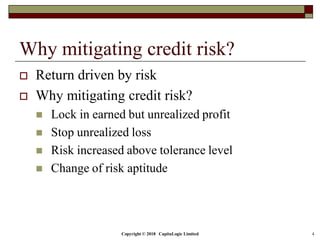
Why mitigating credit risk?
 Return driven by risk
 Why mitigating credit risk?
 Lock in earned but unrealized profit
 Stop unrealized loss
 Risk increased above tolerance level
 Change of risk aptitude
Copyright © 2018 CapitaLogic Limited 5
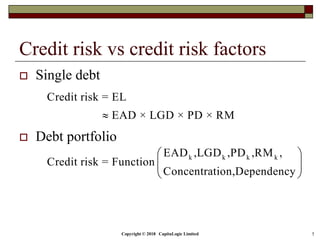
Credit risk vs credit risk factors
 Single debt
 Debt portfolio
k k k k
Credit risk = EL
EAD × LGD × PD × RM
EAD ,LGD ,PD ,RM ,
Credit risk = Function
Concentration,Dependency

 
 
 
Copyright © 2018 CapitaLogic Limited 6
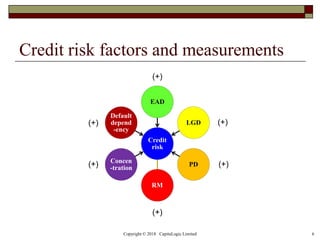
Credit risk factors and measurements
Credit
risk
EAD
LGD
PD
RM
Concen
-tration
Default
depend
-ency
(+)
(+) (+)
(+)
(+)
(+)
Copyright © 2018 CapitaLogic Limited 7
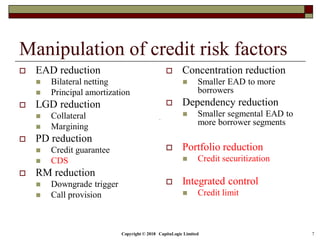
Manipulation of credit risk factors
 EAD reduction
 Bilateral netting
 Principal amortization
 LGD reduction
 Collateral
 Margining
 PD reduction
 Credit guarantee
 CDS
 RM reduction
 Downgrade trigger
 Call provision
 Concentration reduction
 Smaller EAD to more
borrowers
 Dependency reduction
 Smaller segmental EAD to
more borrower segments
 Portfolio reduction
 Credit securitization
 Integrated control
 Credit limit

Copyright © 2018 CapitaLogic Limited 8
Outline
 Why mitigating credit risk
 Risk controls for single debts
 Risk controls for debt portfolios
 Appendix
Copyright © 2018 CapitaLogic Limited 9
Bilateral netting
 Two banks own each other monies
 When one bank defaults
 Without bilateral netting agreement
 Survival bank must surrender the borrowing EAD
immediately to liquidator
 Survival bank then collects the lending EAD from
liquidator
 EAD = Principal + Accrued interest
 With bilateral netting agreement
 Net EAD = Max[Lending EAD - Borrowing EAD, 0]
Example 6.1
Copyright © 2018 CapitaLogic Limited 10
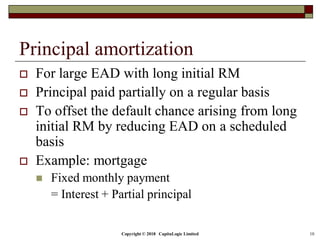
Principal amortization
 For large EAD with long initial RM
 Principal paid partially on a regular basis
 To offset the default chance arising from long
initial RM by reducing EAD on a scheduled
basis
 Example: mortgage
 Fixed monthly payment
= Interest + Partial principal
Copyright © 2018 CapitaLogic Limited 11
Collateral
 Borrower surrenders the legal ownership of his
assets to lender
 Lender sells assets to compensate part of the EAD in
case the borrower defaults
 Debt collection continues if assets are sold below the
EAD
 Common collaterals
 Property, land, equity, car, equipment … red wine
 Preferred collaterals
 Low mobility – land and property
 High liquidity – financial instruments
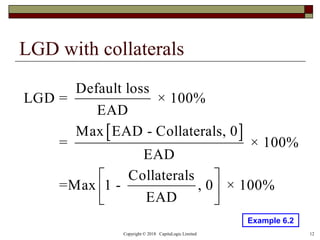
LGD with collaterals
Copyright © 2018 CapitaLogic Limited 12
 
Default loss
LGD = × 100%
EAD
Max EAD - Collaterals, 0
= × 100%
EAD
Collaterals
=Max 1 - , 0 × 100%
EAD
 
 
 
Example 6.2
Copyright © 2018 CapitaLogic Limited 13
Margining
 To top up collaterals with additional cash up
to a certain threshold
 e.g. lending amount + potential maximum
decrease of collateral value in a short period
 Higher collateral volatility => more margin
 Margin lending for foreign currency contract
 5% initial margin
 3% maintenance margin
 1% liquidation margin
Example 6.3
Copyright © 2018 CapitaLogic Limited 14
Credit guarantee
 Default insurance of a debt
 Guarantor sourced by the borrower at
origination of a debt
 Credit guarantor has
 a credit quality higher than that of the borrower
 a positive view on the credit quality of the
borrower
Copyright © 2018 CapitaLogic Limited 15
Credit default swap
 Default insurance of a debt
 Insurer sourced by lender at any time during
the lending period
 Lender pays insurer an insurance premium
 A bet between lender and insurer
Copyright © 2018 CapitaLogic Limited 16
Downgrade trigger
 Borrower has to return the EAD to the lender
 When the borrower is downgraded materially by
major credit rating agencies
 Lender to
 Take debt collection actions before default
 Accelerate the default of borrower
Copyright © 2018 CapitaLogic Limited 17
Call provision
 Borrower has to return the EAD to the lender when
failing to meet any positive provisions, e.g.
 Maintain its credit rating at investment grade by major
global credit rating agencies
 Deposit sufficient collaterals to the lender
 Meet certain sales and/or profit targets every quarter
 Complete a project following a scheduled timeline
 Demonstrate a sufficient improvement in financial
condition within a certain period of time
Copyright © 2018 CapitaLogic Limited 18
Outline
 Why mitigating credit risk
 Risk controls for individual debts
 Risk controls for debt portfolios
 Appendix
Copyright © 2018 CapitaLogic Limited 19
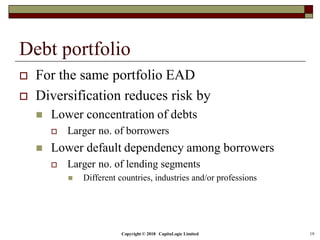
Debt portfolio
 For the same portfolio EAD
 Diversification reduces risk by
 Lower concentration of debts
 Larger no. of borrowers
 Lower default dependency among borrowers
 Larger no. of lending segments
 Different countries, industries and/or professions
Copyright © 2018 CapitaLogic Limited 20
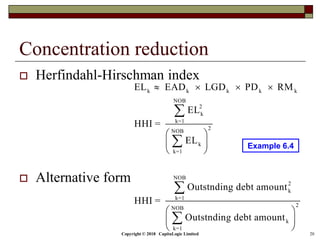
Concentration reduction
 Herfindahl-Hirschman index
 Alternative form
k k k k k
NOB
2
k
k=1
2
NOB
k
k=1
NOB
2
k
k=1
2
NOB
k
k=1
EL EAD LGD PD RM
EL
HHI =
EL
Outstnding debt amount
HHI =
Outstnding debt amount
   
 
 
 
 
 
 




Example 6.4
Copyright © 2018 CapitaLogic Limited 21
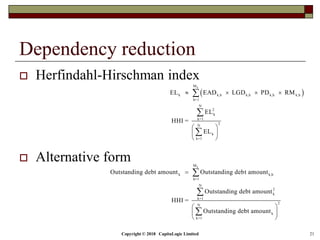
Dependency reduction
 Herfindahl-Hirschman index
 Alternative form
 
k
k
M
k k,h k,h k,h k,h
h=1
N
2
k
k=1
2
N
k
k=1
M
k k,h
h=1
N
2
k
k=1
N
k
k=1
EL EAD LGD PD RM
EL
HHI =
EL
Outstanding debt amount Outstanding debt amount
Outstanding debt amount
HHI =
Outstanding debt amount
   
 
 
 










2



Copyright © 2018 CapitaLogic Limited 22
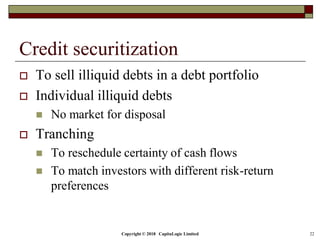
Credit securitization
 To sell illiquid debts in a debt portfolio
 Individual illiquid debts
 No market for disposal
 Tranching
 To reschedule certainty of cash flows
 To match investors with different risk-return
preferences
Copyright © 2018 CapitaLogic Limited 23
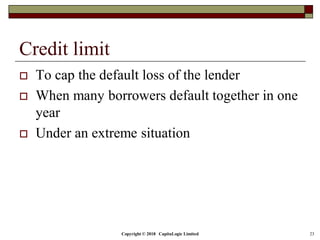
Credit limit
 To cap the default loss of the lender
 When many borrowers default together in one
year
 Under an extreme situation
Copyright © 2018 CapitaLogic Limited 24
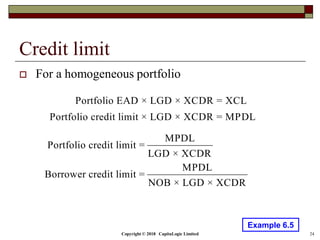
Credit limit
 For a homogeneous portfolio
Portfolio EAD × LGD × XCDR = XCL
Portfolio credit limit × LGD × XCDR = MPDL
Example 6.5
MPDL
Portfolio credit limit =
LGD × XCDR
MPDL
Borrower credit limit =
NOB × LGD × XCDR
Copyright © 2018 CapitaLogic Limited 25
Credit limit
 For a heterogeneous portfolio
k
k k
MPDL
Borrower credit limit =
NOB × LGD × XCDR
Copyright © 2018 CapitaLogic Limited 26
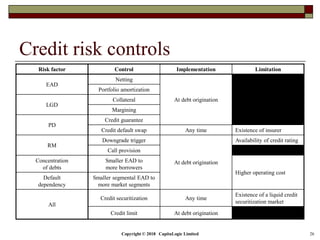
Credit risk controls
Risk factor Control Implementation Limitation
EAD
Netting
At debt origination
Portfolio amortization
LGD
Collateral
Margining
PD
Credit guarantee
Credit default swap Any time Existence of insurer
RM
Downgrade trigger
At debt origination
Availability of credit rating
Call provision
Concentration
of debts
Smaller EAD to
more borrowers
Higher operating cost
Default
dependency
Smaller segmental EAD to
more market segments
All
Credit securitization Any time
Existence of a liquid credit
securitization market
Credit limit At debt origination
Copyright © 2018 CapitaLogic Limited 27
Outline
 Why mitigating credit risk
 Risk controls for individual debts
 Risk controls for debt portfolios
 Appendix
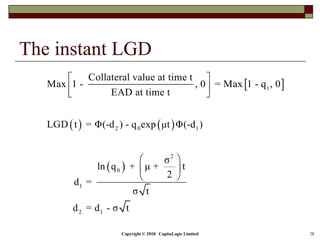
The instant LGD
Copyright © 2018 CapitaLogic Limited 28
   
 
2 0 1
2
0
1
2 1
LGD t = Φ(-d ) - q exp μt Φ(-d )
σ
ln q + μ + t
2
d =
σ t
d = d - σ t
 
 
 
 t
Collateral value at time t
Max 1 - , 0 = Max 1 - q , 0
EAD at time t
 
 
 
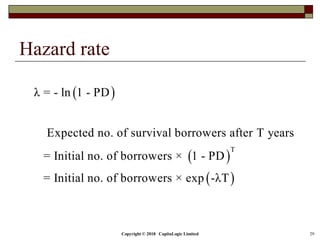
Hazard rate
Copyright © 2018 CapitaLogic Limited 29
 
 
 
T
λ = - ln 1 - PD
Expected no. of survival borrowers after T years
= Initial no. of borrowers × 1 - PD
= Initial no. of borrowers × exp -λT
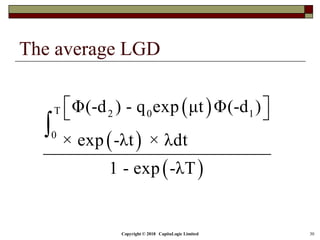
The average LGD
Copyright © 2018 CapitaLogic Limited 30
 
 
 
T 2 0 1
0
Φ(-d ) - q exp μt Φ(-d )
× exp -λt × λdt
1 - exp -λT
  


06.2 credit risk controls

  • 1.
    Copyright © 2018CapitaLogic Limited Chapter 6 Credit Risk Controls This presentation file is prepared in accordance with Chapter 6 of the text book “Managing Credit Risk Under The Basel III Framework, 3rd ed” Website : https://sites.google.com/site/crmbasel E-mail : crmbasel@gmail.com
  • 2.
    Copyright © 2018CapitaLogic Limited 2 Declaration  Copyright © 2018 CapitaLogic Limited.  All rights reserved. No part of this presentation file may be reproduced, in any form or by any means, without written permission from CapitaLogic Limited.  Authored by Dr. LAM Yat-fai (林日辉), Director, CapitaLogic Limited, Adjunct Professor of Finance, City University of Hong Kong, Doctor of Business Administration, CFA, CAIA, CAMS, FRM, PRM.
  • 3.
    Copyright © 2018CapitaLogic Limited 3 Outline  Why mitigating credit risk  Risk controls for single debts  Risk controls for debt portfolios  Appendix
  • 4.
    Copyright © 2018CapitaLogic Limited 4 Why mitigating credit risk?  Return driven by risk  Why mitigating credit risk?  Lock in earned but unrealized profit  Stop unrealized loss  Risk increased above tolerance level  Change of risk aptitude
  • 5.
    Copyright © 2018CapitaLogic Limited 5 Credit risk vs credit risk factors  Single debt  Debt portfolio k k k k Credit risk = EL EAD × LGD × PD × RM EAD ,LGD ,PD ,RM , Credit risk = Function Concentration,Dependency       
  • 6.
    Copyright © 2018CapitaLogic Limited 6 Credit risk factors and measurements Credit risk EAD LGD PD RM Concen -tration Default depend -ency (+) (+) (+) (+) (+) (+)
  • 7.
    Copyright © 2018CapitaLogic Limited 7 Manipulation of credit risk factors  EAD reduction  Bilateral netting  Principal amortization  LGD reduction  Collateral  Margining  PD reduction  Credit guarantee  CDS  RM reduction  Downgrade trigger  Call provision  Concentration reduction  Smaller EAD to more borrowers  Dependency reduction  Smaller segmental EAD to more borrower segments  Portfolio reduction  Credit securitization  Integrated control  Credit limit 
  • 8.
    Copyright © 2018CapitaLogic Limited 8 Outline  Why mitigating credit risk  Risk controls for single debts  Risk controls for debt portfolios  Appendix
  • 9.
    Copyright © 2018CapitaLogic Limited 9 Bilateral netting  Two banks own each other monies  When one bank defaults  Without bilateral netting agreement  Survival bank must surrender the borrowing EAD immediately to liquidator  Survival bank then collects the lending EAD from liquidator  EAD = Principal + Accrued interest  With bilateral netting agreement  Net EAD = Max[Lending EAD - Borrowing EAD, 0] Example 6.1
  • 10.
    Copyright © 2018CapitaLogic Limited 10 Principal amortization  For large EAD with long initial RM  Principal paid partially on a regular basis  To offset the default chance arising from long initial RM by reducing EAD on a scheduled basis  Example: mortgage  Fixed monthly payment = Interest + Partial principal
  • 11.
    Copyright © 2018CapitaLogic Limited 11 Collateral  Borrower surrenders the legal ownership of his assets to lender  Lender sells assets to compensate part of the EAD in case the borrower defaults  Debt collection continues if assets are sold below the EAD  Common collaterals  Property, land, equity, car, equipment … red wine  Preferred collaterals  Low mobility – land and property  High liquidity – financial instruments
  • 12.
    LGD with collaterals Copyright© 2018 CapitaLogic Limited 12   Default loss LGD = × 100% EAD Max EAD - Collaterals, 0 = × 100% EAD Collaterals =Max 1 - , 0 × 100% EAD       Example 6.2
  • 13.
    Copyright © 2018CapitaLogic Limited 13 Margining  To top up collaterals with additional cash up to a certain threshold  e.g. lending amount + potential maximum decrease of collateral value in a short period  Higher collateral volatility => more margin  Margin lending for foreign currency contract  5% initial margin  3% maintenance margin  1% liquidation margin Example 6.3
  • 14.
    Copyright © 2018CapitaLogic Limited 14 Credit guarantee  Default insurance of a debt  Guarantor sourced by the borrower at origination of a debt  Credit guarantor has  a credit quality higher than that of the borrower  a positive view on the credit quality of the borrower
  • 15.
    Copyright © 2018CapitaLogic Limited 15 Credit default swap  Default insurance of a debt  Insurer sourced by lender at any time during the lending period  Lender pays insurer an insurance premium  A bet between lender and insurer
  • 16.
    Copyright © 2018CapitaLogic Limited 16 Downgrade trigger  Borrower has to return the EAD to the lender  When the borrower is downgraded materially by major credit rating agencies  Lender to  Take debt collection actions before default  Accelerate the default of borrower
  • 17.
    Copyright © 2018CapitaLogic Limited 17 Call provision  Borrower has to return the EAD to the lender when failing to meet any positive provisions, e.g.  Maintain its credit rating at investment grade by major global credit rating agencies  Deposit sufficient collaterals to the lender  Meet certain sales and/or profit targets every quarter  Complete a project following a scheduled timeline  Demonstrate a sufficient improvement in financial condition within a certain period of time
  • 18.
    Copyright © 2018CapitaLogic Limited 18 Outline  Why mitigating credit risk  Risk controls for individual debts  Risk controls for debt portfolios  Appendix
  • 19.
    Copyright © 2018CapitaLogic Limited 19 Debt portfolio  For the same portfolio EAD  Diversification reduces risk by  Lower concentration of debts  Larger no. of borrowers  Lower default dependency among borrowers  Larger no. of lending segments  Different countries, industries and/or professions
  • 20.
    Copyright © 2018CapitaLogic Limited 20 Concentration reduction  Herfindahl-Hirschman index  Alternative form k k k k k NOB 2 k k=1 2 NOB k k=1 NOB 2 k k=1 2 NOB k k=1 EL EAD LGD PD RM EL HHI = EL Outstnding debt amount HHI = Outstnding debt amount                     Example 6.4
  • 21.
    Copyright © 2018CapitaLogic Limited 21 Dependency reduction  Herfindahl-Hirschman index  Alternative form   k k M k k,h k,h k,h k,h h=1 N 2 k k=1 2 N k k=1 M k k,h h=1 N 2 k k=1 N k k=1 EL EAD LGD PD RM EL HHI = EL Outstanding debt amount Outstanding debt amount Outstanding debt amount HHI = Outstanding debt amount                     2   
  • 22.
    Copyright © 2018CapitaLogic Limited 22 Credit securitization  To sell illiquid debts in a debt portfolio  Individual illiquid debts  No market for disposal  Tranching  To reschedule certainty of cash flows  To match investors with different risk-return preferences
  • 23.
    Copyright © 2018CapitaLogic Limited 23 Credit limit  To cap the default loss of the lender  When many borrowers default together in one year  Under an extreme situation
  • 24.
    Copyright © 2018CapitaLogic Limited 24 Credit limit  For a homogeneous portfolio Portfolio EAD × LGD × XCDR = XCL Portfolio credit limit × LGD × XCDR = MPDL Example 6.5 MPDL Portfolio credit limit = LGD × XCDR MPDL Borrower credit limit = NOB × LGD × XCDR
  • 25.
    Copyright © 2018CapitaLogic Limited 25 Credit limit  For a heterogeneous portfolio k k k MPDL Borrower credit limit = NOB × LGD × XCDR
  • 26.
    Copyright © 2018CapitaLogic Limited 26 Credit risk controls Risk factor Control Implementation Limitation EAD Netting At debt origination Portfolio amortization LGD Collateral Margining PD Credit guarantee Credit default swap Any time Existence of insurer RM Downgrade trigger At debt origination Availability of credit rating Call provision Concentration of debts Smaller EAD to more borrowers Higher operating cost Default dependency Smaller segmental EAD to more market segments All Credit securitization Any time Existence of a liquid credit securitization market Credit limit At debt origination
  • 27.
    Copyright © 2018CapitaLogic Limited 27 Outline  Why mitigating credit risk  Risk controls for individual debts  Risk controls for debt portfolios  Appendix
  • 28.
    The instant LGD Copyright© 2018 CapitaLogic Limited 28       2 0 1 2 0 1 2 1 LGD t = Φ(-d ) - q exp μt Φ(-d ) σ ln q + μ + t 2 d = σ t d = d - σ t        t Collateral value at time t Max 1 - , 0 = Max 1 - q , 0 EAD at time t      
  • 29.
    Hazard rate Copyright ©2018 CapitaLogic Limited 29       T λ = - ln 1 - PD Expected no. of survival borrowers after T years = Initial no. of borrowers × 1 - PD = Initial no. of borrowers × exp -λT
  • 30.
    The average LGD Copyright© 2018 CapitaLogic Limited 30       T 2 0 1 0 Φ(-d ) - q exp μt Φ(-d ) × exp -λt × λdt 1 - exp -λT    