Credit Neural Network
with Neural Designer
This presentation file is prepared in accordance with
the text book
“Credit Neural Network with Neural Designer”
Website : https://sites.google.com/site/quanrisk
E-mail : quanrisk@gmail.com
Copyright © 2019 CapitaLogic Limited
Declaration
 Copyright © 2019 CapitaLogic Limited.
 All rights reserved. No part of this presentation file may be
reproduced, in any form or by any means, without written
permission from CapitaLogic Limited.
 Authored by Dr. LAM Yat-fai (林日辉),
Director, CapitaLogic Limited,
Adjunct Professor of Finance, City University of Hong Kong,
Doctor of Business Administration,
CFA, CAIA, CAMS, FRM, PRM.
2Copyright © 2019 CapitaLogic Limited
Outline
 Data preparation
 Classical regressions
 Monotonic neural network
 Continuous response network
 Credit neural network
 Shadow credit rating
 LGD of residential mortgages
3Copyright © 2019 CapitaLogic Limited
What is research?
 There is a result
 Theory
 Which factors cause this result?
 How increases and/or decreases in these factors
impact the result?
 Testing
 Does the theory work in real life scenarios?
4Copyright © 2019 CapitaLogic Limited
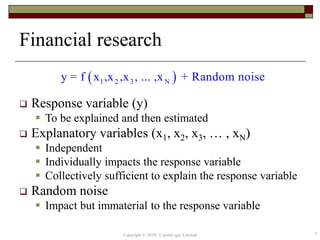
Financial research
 Response variable (y)
 To be explained and then estimated
 Explanatory variables (x1, x2, x3, … , xN)
 Independent
 Individually impacts the response variable
 Collectively sufficient to explain the response variable
 Random noise
 Impact but immaterial to the response variable
 1 2 3 Ny = f x ,x ,x , ... ,x + Random noise
5Copyright © 2019 CapitaLogic Limited
Data preparation
 Outliers
 Relevancy
 Inter-dependency
 Randomization
 Consistency
 Sampling
Copyright © 2019 CapitaLogic Limited 6
Example 1.1
Outliers
 Smallest 1% value of the variables
 Largest 1% value of the variables
 To exclude outliers
Copyright © 2019 CapitaLogic Limited 7
Example 1.2
Relevancy
 Between the response variable and an
explanatory
 Quantified by the Spearman’s ρ
 Smaller t-statistic and larger p-value suggest
weaker relevancy
 To exclude irrelevant explanatory variables
Copyright © 2019 CapitaLogic Limited 8
Example 1.3
Inter-dependency
 Between any two explanatory variables
 Quantified by the Spearman’s ρ
 Larger Spearman’s ρ suggests stronger inter-
dependency between two explanatory variables
 To drop one of the inter-dependent
explanatory variables
Copyright © 2019 CapitaLogic Limited 9
Example 1.4
Randomization
 For a continuous response variable, order the
records randomly
 For a categorical response variable, order the
records randomly for each category of the
response variable
Copyright © 2019 CapitaLogic Limited 10
Example 1.5
Consistency
 Consistent variables
 Cover a similar range
 Increase in an explanatory variable
=> Increase in the response variable
while holding other explanatory variables fixed
 More effective and efficient for computer
implementation
11Copyright © 2019 CapitaLogic Limited
Example 1.6
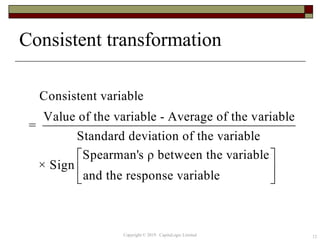
Consistent transformation
12
Consistent variable
Value of the variable - Average of the variable
=
Standard deviation of the variable
Spearman's ρ between the variable
× Sign
and the response variable
 
 
 
Copyright © 2019 CapitaLogic Limited
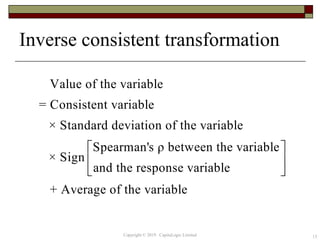
Inverse consistent transformation
13
Value of the variable
= Consistent variable
× Standard deviation of the variable
Spearman's ρ between the variable
× Sign
and the response variable
+ Average of the variable
 
 
 
Copyright © 2019 CapitaLogic Limited
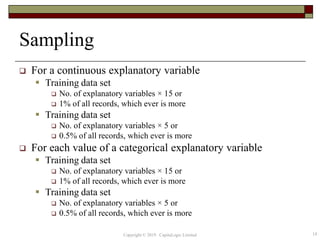
Sampling
 For a continuous explanatory variable
 Training data set
 No. of explanatory variables × 15 or
 1% of all records, which ever is more
 Training data set
 No. of explanatory variables × 5 or
 0.5% of all records, which ever is more
 For each value of a categorical explanatory variable
 Training data set
 No. of explanatory variables × 15 or
 1% of all records, which ever is more
 Training data set
 No. of explanatory variables × 5 or
 0.5% of all records, which ever is more
Copyright © 2019 CapitaLogic Limited 14
Outline
 Data preparation
 Classical regressions
 Monotonic neural network
 Continuous response network
 Credit neural network
 Shadow credit rating
 LGD of residential mortgages
15Copyright © 2019 CapitaLogic Limited
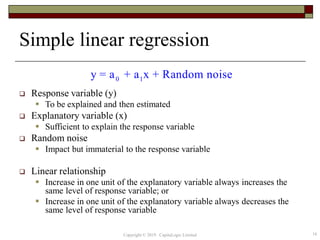
Simple linear regression
 Response variable (y)
 To be explained and then estimated
 Explanatory variable (x)
 Sufficient to explain the response variable
 Random noise
 Impact but immaterial to the response variable
 Linear relationship
 Increase in one unit of the explanatory variable always increases the
same level of response variable; or
 Increase in one unit of the explanatory variable always decreases the
same level of response variable
0 1y = a + a x + Random noise
16Copyright © 2019 CapitaLogic Limited
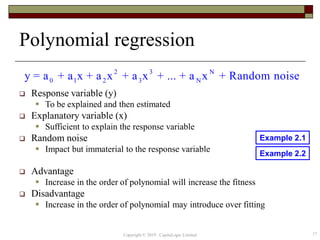
Polynomial regression
 Response variable (y)
 To be explained and then estimated
 Explanatory variable (x)
 Sufficient to explain the response variable
 Random noise
 Impact but immaterial to the response variable
 Advantage
 Increase in the order of polynomial will increase the fitness
 Disadvantage
 Increase in the order of polynomial may introduce over fitting
2 3 N
0 1 2 3 Ny = a + a x + a x + a x + ... + a x + Random noise
17Copyright © 2019 CapitaLogic Limited
Example 2.1
Example 2.2
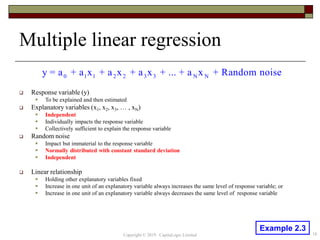
Multiple linear regression
 Response variable (y)
 To be explained and then estimated
 Explanatory variables (x1, x2, x3, … , xN)
 Independent
 Individually impacts the response variable
 Collectively sufficient to explain the response variable
 Random noise
 Impact but immaterial to the response variable
 Normally distributed with constant standard deviation
 Independent
 Linear relationship
 Holding other explanatory variables fixed
 Increase in one unit of an explanatory variable always increases the same level of response variable; or
 Increase in one unit of an explanatory variable always decreases the same level of response variable
0 1 1 2 2 3 3 N Ny = a + a x + a x + a x + ... + a x + Random noise
18Copyright © 2019 CapitaLogic Limited
Example 2.3
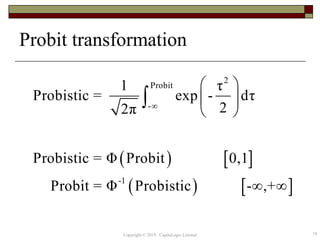
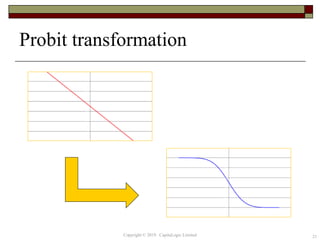
Probit transformation
19
   
   
2
Probit
-
-1
1 τ
Probistic = exp - dτ
22π
Probistic = Φ Probit 0,1
Probit = Φ Probistic - ,+

 
 
 
 

Copyright © 2019 CapitaLogic Limited
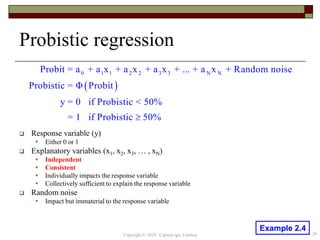
Probistic regression
 Response variable (y)
 Either 0 or 1
 Explanatory variables (x1, x2, x3, … , xN)
 Independent
 Consistent
 Individually impacts the response variable
 Collectively sufficient to explain the response variable
 Random noise
 Impact but immaterial to the response variable
 
0 1 1 2 2 3 3 N NProbit = a + a x + a x + a x + ... + a x + Random noise
Probistic = Φ Probit
y = 0 if Probistic < 50%
= 1 if Probistic 50%
20Copyright © 2019 CapitaLogic Limited
Example 2.4
Probit transformation
21Copyright © 2019 CapitaLogic Limited
22
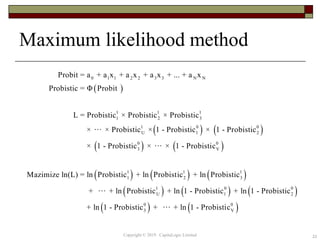
Maximum likelihood method
 
   
 
0 1 1 2 2 3 3 N N
1 1 1
1 2 3
1 0 0
U 1 2
0
3
Probit = a + a x + a x + a x + ... + a x
Probistic = Φ Probit
L = Probistic × Probistic × Probistic
× × Probistic × 1 - Probistic × 1 - Probistic
× 1 - Probistic × × 1 - Probisti 
     
     
   
0
V
1 1 1
1 2 3
1 0 0
U 1 2
0 0
3 V
c
Mazimize ln(L) = ln Probistic + ln Probistic + ln Probistic
+ + ln Probistic + ln 1 - Probistic + ln 1 - Probistic
+ ln 1 - Probistic + + ln 1 - Probistic
Copyright © 2019 CapitaLogic Limited
Outline
 Data preparation
 Classical regressions
 Monotonic neural network
 Continuous response network
 Credit neural network
 Shadow credit rating
 LGD of residential mortgages
23Copyright © 2019 CapitaLogic Limited
Monotonic neural network
 To release the limitations of multiple linear
regression
WITHOUT
 Introducing complex mathematics
 An extremely simplified version of neural
network
 The entry level of artificial intelligence, machine
learning and deep learning
24Copyright © 2019 CapitaLogic Limited
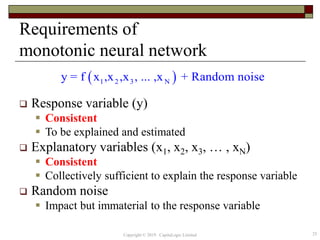
Requirements of
monotonic neural network
 Response variable (y)
 Consistent
 To be explained and estimated
 Explanatory variables (x1, x2, x3, … , xN)
 Consistent
 Collectively sufficient to explain the response variable
 Random noise
 Impact but immaterial to the response variable
 1 2 3 Ny = f x ,x ,x , ... ,x + Random noise
25Copyright © 2019 CapitaLogic Limited
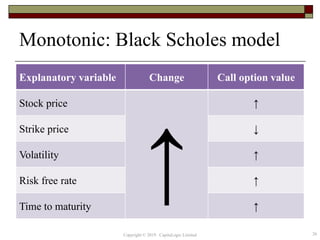
Monotonic: Black Scholes model
Explanatory variable Change Call option value
Stock price
↑
↑
Strike price ↓
Volatility ↑
Risk free rate ↑
Time to maturity ↑
26Copyright © 2019 CapitaLogic Limited
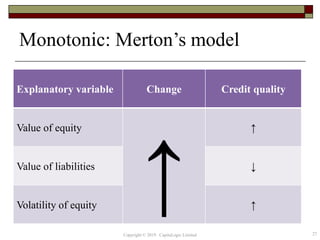
Monotonic: Merton’s model
Explanatory variable Change Credit quality
Value of equity
↑
↑
Value of liabilities ↓
Volatility of equity ↑
27Copyright © 2019 CapitaLogic Limited
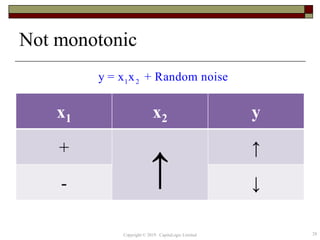
Not monotonic
x1 x2 y
+
↑
↑
- ↓
1 2y = x x + Random noise
28Copyright © 2019 CapitaLogic Limited
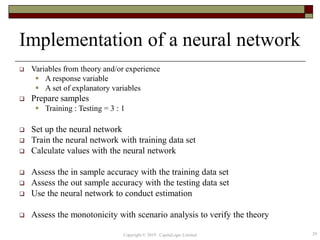
Implementation of a neural network
 Variables from theory and/or experience
 A response variable
 A set of explanatory variables
 Prepare samples
 Training : Testing = 3 : 1
 Set up the neural network
 Train the neural network with training data set
 Calculate values with the neural network
 Assess the in sample accuracy with the training data set
 Assess the out sample accuracy with the testing data set
 Use the neural network to conduct estimation
 Assess the monotonicity with scenario analysis to verify the theory
29Copyright © 2019 CapitaLogic Limited
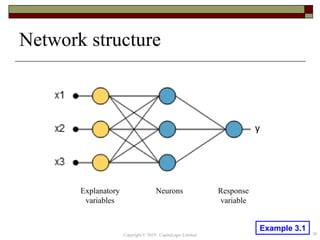
Network structure
Explanatory
variables
Response
variable
Neurons
30
y
Copyright © 2019 CapitaLogic Limited
Example 3.1
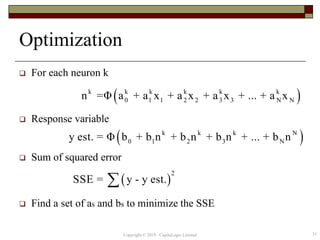
Optimization
 For each neuron k
 Response variable
 Sum of squared error
 Find a set of as and bs to minimize the SSE
31
 
 
 
k k k k k k
0 1 1 2 2 3 3 N N
k k k N
0 1 2 3 N
2
n =Φ a + a x + a x + a x + ... + a x
y est. = Φ b + b n + b n + b n + ... + b n
SSE = y - y est.
Copyright © 2019 CapitaLogic Limited
No. of as and bs
 No. of nodes
 N explanatory variables
 N neurons
 One response variables
 Each neuron
 N + 1 as
 Response variable
 N + 1 bs
 Total number
 (N + 1)2
 Including irrelevant or dependent explanatory variable will
waste a lot of computing power
32Copyright © 2019 CapitaLogic Limited
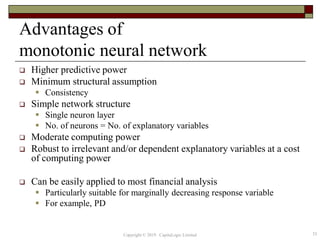
Advantages of
monotonic neural network
 Higher predictive power
 Minimum structural assumption
 Consistency
 Simple network structure
 Single neuron layer
 No. of neurons = No. of explanatory variables
 Moderate computing power
 Robust to irrelevant and/or dependent explanatory variables at a cost
of computing power
 Can be easily applied to most financial analysis
 Particularly suitable for marginally decreasing response variable
 For example, PD
33Copyright © 2019 CapitaLogic Limited
Disadvantages of
monotonic neural network
 Rely on theory and/or experience to identify
explanatory variables
 May incorporate the effect of random noise
during training
 No straight forward mathematical formulation
 More samples
34Copyright © 2019 CapitaLogic Limited
Outline
 Data preparation
 Classical regressions
 Monotonic neural network
 Continuous response network
 Credit neural network
 Shadow credit rating
 LGD of residential mortgages
35Copyright © 2019 CapitaLogic Limited
Variables and samples
 Response variable
 y
 Explanatory variables
 x1, x2, x3
 Sufficient no. of samples
36Copyright © 2019 CapitaLogic Limited
Example 4.1
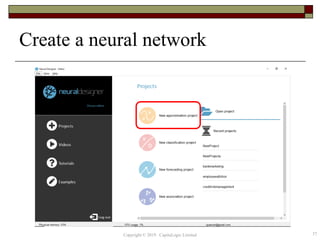
Create a neural network
37Copyright © 2019 CapitaLogic Limited
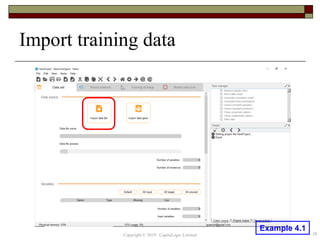
Import training data
38Copyright © 2019 CapitaLogic Limited
Example 4.1
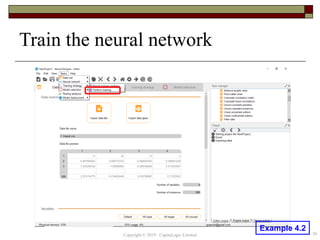
Train the neural network
39Copyright © 2019 CapitaLogic Limited
Example 4.2
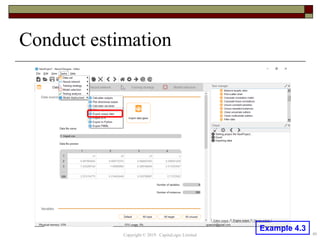
Conduct estimation
40Copyright © 2019 CapitaLogic Limited
Example 4.3
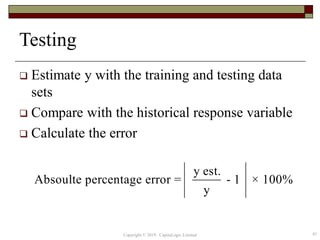
Testing
 Estimate y with the training and testing data
sets
 Compare with the historical response variable
 Calculate the error
41
y est.
Absoulte percentage error = - 1 × 100%
y
Copyright © 2019 CapitaLogic Limited
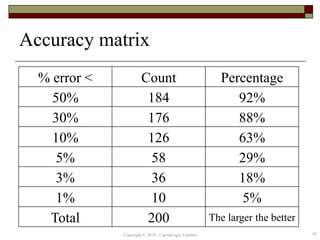
Accuracy matrix
42
% error < Count Percentage
50% 184 92%
30% 176 88%
10% 126 63%
5% 58 29%
3% 36 18%
1% 10 5%
Total 200 The larger the better
Copyright © 2019 CapitaLogic Limited
Estimation
 Given a set of explanatory variables without
response variable
 Use the neural network to estimate the ys
43Copyright © 2019 CapitaLogic Limited
Example 4.4
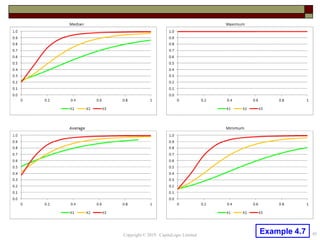
Monotonicity analysis
 Baseline scenarios
 All explanatory variables set to
 The medians
 The averages
 The maximums
 The minimums
 While fixing other explanatory variables
 Vary one explanatory variable from the minimum to the
maximum
 Conduct estimation
 Plot response variable vs explanatory variable
 Repeat for other explanatory variables
44Copyright © 2019 CapitaLogic Limited
Example 4.6
45Copyright © 2019 CapitaLogic Limited
Example 4.7
Exception
 Violation of monotonicity
 The theory and/or experience need to be reviewed
 Inter-dependency among explanatory variables
 Too much random noise
 Response variable insensitive to an
explanatory variable
 The explanatory variable may be irrelevant
 Remove the explanatory and re-build the neural
network
46Copyright © 2019 CapitaLogic Limited
Outline
 Data preparation
 Classical regressions
 Monotonic neural network
 Continuous response network
 Credit neural network
 Shadow credit rating
 LGD of residential mortgages
47Copyright © 2019 CapitaLogic Limited
Merton’s corporate default model
 Market’s view of credit quality can be derived
from observable
 x1 = Market value of equity
 x2 = Book value of liabilities
 x3 = Volatility of equity
48Copyright © 2019 CapitaLogic Limited
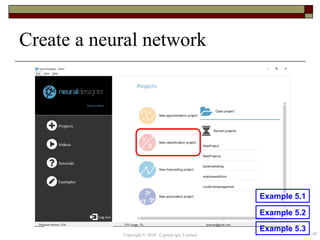
Create a neural network
49Copyright © 2019 CapitaLogic Limited
Example 5.1
Example 5.2
Example 5.3
Variables and samples
 Response variable
 Coded PD of the listed companies
 0 for survival and 1 for default
 Explanatory variables
 x1, x2, x3
 Sufficient no. of samples
50Copyright © 2019 CapitaLogic Limited
Testing
 Conduct estimation with the training and
testing data sets on the coded PD
 Use the neural network to estimate a PD
 If PD < 50%, then a bad borrower
 If PD > 50%, then a good borrower
 Compare with the historical response variable
51Copyright © 2019 CapitaLogic Limited
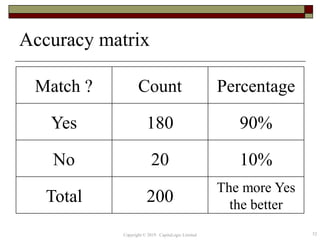
Accuracy matrix
52
Match ? Count Percentage
Yes 180 90%
No 20 10%
Total 200
The more Yes
the better
Copyright © 2019 CapitaLogic Limited
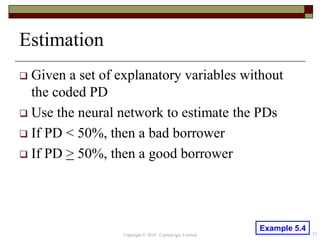
Estimation
 Given a set of explanatory variables without
the coded PD
 Use the neural network to estimate the PDs
 If PD < 50%, then a bad borrower
 If PD > 50%, then a good borrower
53Copyright © 2019 CapitaLogic Limited
Example 5.4
Outline
 Data preparation
 Classical regressions
 Monotonic neural network
 Continuous response network
 Credit neural network
 Shadow credit rating
 LGD of residential mortgages
54Copyright © 2019 CapitaLogic Limited
Merton’s corporate default model
 Market’s view of credit quality can be derived
from observable
 x1 = Market value of equity
 x2 = Book value of liabilities
 x3 = Volatility of equity
55Copyright © 2019 CapitaLogic Limited
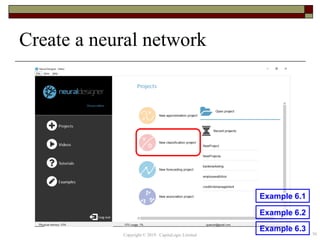
Create a neural network
56Copyright © 2019 CapitaLogic Limited
Example 6.1
Example 6.2
Example 6.3
Shadow credit rating
 The idea of using credit ratings from major
credit agencies to derive a relationship
between credit rating and explanatory
variables
 Assume that the credit ratings are largely
accurate
57Copyright © 2019 CapitaLogic Limited
Variables and samples
 Response variable
 Credit rating
 Explanatory variables
 x1, x2, x3
 Sufficient no. of samples
58Copyright © 2019 CapitaLogic Limited
Testing
 Estimate the probabilities of credit ratings with
the training and testing data sets
 Select the credit rating with the highest
probability
 Map the credit rating to the rank
 Compare with the historical response variable
59Copyright © 2019 CapitaLogic Limited
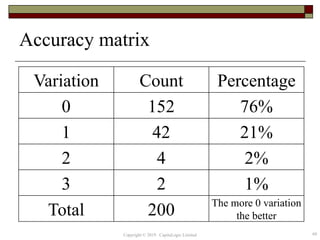
Accuracy matrix
60
Variation Count Percentage
0 152 76%
1 42 21%
2 4 2%
3 2 1%
Total 200
The more 0 variation
the better
Copyright © 2019 CapitaLogic Limited
Estimation
 Given a set of explanatory variables without
credit rating
 Use the neural network to estimate the
probabilities of credit ratings
 Select the credit rating with the highest
probability
61Copyright © 2019 CapitaLogic Limited
Example 6.4
Outline
 Data preparation
 Classical regressions
 Monotonic neural network
 Continuous response network
 Credit neural network
 Shadow credit rating
 LGD of residential mortgages
62Copyright © 2019 CapitaLogic Limited
LGD of collateralized lending
 Factor impacting the LGD
 Outstanding loan amount
 Current value of collateral
 Drift of collateral value
 Volatility of collateral value
 Explanatory variables
 x1 = Loan to value ratio
 x2 = Drift of collateral value
 x3 = Volatility of collateral value
63Copyright © 2019 CapitaLogic Limited
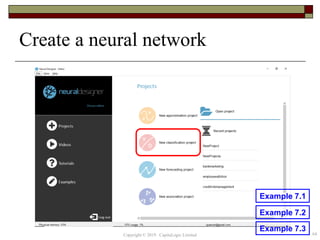
Create a neural network
64Copyright © 2019 CapitaLogic Limited
Example 7.1
Example 7.2
Example 7.3
Variables and samples
 Response variable
 Credit rating
 Explanatory variables
 x1, x2, x3
 Sufficient no. of samples
65Copyright © 2019 CapitaLogic Limited
Testing
 Estimate the LGD with the training and testing
data sets
 Compare with the historical response variable
66Copyright © 2019 CapitaLogic Limited
Estimation
 Given a set of explanatory variables without
LGD
 Use the neural network to estimate the LGDs
67Copyright © 2019 CapitaLogic Limited
Example 7.4
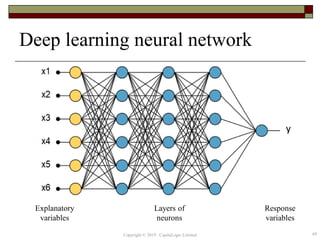
Deep learning
 Many explanatory variables
 Many layers of neurons
 Several response variables
 Can handle very complex relationships
 Non-monotonic relationships
 Periodic relationships
 Require huge computing power
68Copyright © 2019 CapitaLogic Limited
Deep learning neural network
Explanatory
variables
Response
variables
Layers of
neurons
69
y
Copyright © 2019 CapitaLogic Limited

Chapter 0 credit neural network

  • 1.
    Credit Neural Network withNeural Designer This presentation file is prepared in accordance with the text book “Credit Neural Network with Neural Designer” Website : https://sites.google.com/site/quanrisk E-mail : quanrisk@gmail.com Copyright © 2019 CapitaLogic Limited
  • 2.
    Declaration  Copyright ©2019 CapitaLogic Limited.  All rights reserved. No part of this presentation file may be reproduced, in any form or by any means, without written permission from CapitaLogic Limited.  Authored by Dr. LAM Yat-fai (林日辉), Director, CapitaLogic Limited, Adjunct Professor of Finance, City University of Hong Kong, Doctor of Business Administration, CFA, CAIA, CAMS, FRM, PRM. 2Copyright © 2019 CapitaLogic Limited
  • 3.
    Outline  Data preparation Classical regressions  Monotonic neural network  Continuous response network  Credit neural network  Shadow credit rating  LGD of residential mortgages 3Copyright © 2019 CapitaLogic Limited
  • 4.
    What is research? There is a result  Theory  Which factors cause this result?  How increases and/or decreases in these factors impact the result?  Testing  Does the theory work in real life scenarios? 4Copyright © 2019 CapitaLogic Limited
  • 5.
    Financial research  Responsevariable (y)  To be explained and then estimated  Explanatory variables (x1, x2, x3, … , xN)  Independent  Individually impacts the response variable  Collectively sufficient to explain the response variable  Random noise  Impact but immaterial to the response variable  1 2 3 Ny = f x ,x ,x , ... ,x + Random noise 5Copyright © 2019 CapitaLogic Limited
  • 6.
    Data preparation  Outliers Relevancy  Inter-dependency  Randomization  Consistency  Sampling Copyright © 2019 CapitaLogic Limited 6 Example 1.1
  • 7.
    Outliers  Smallest 1%value of the variables  Largest 1% value of the variables  To exclude outliers Copyright © 2019 CapitaLogic Limited 7 Example 1.2
  • 8.
    Relevancy  Between theresponse variable and an explanatory  Quantified by the Spearman’s ρ  Smaller t-statistic and larger p-value suggest weaker relevancy  To exclude irrelevant explanatory variables Copyright © 2019 CapitaLogic Limited 8 Example 1.3
  • 9.
    Inter-dependency  Between anytwo explanatory variables  Quantified by the Spearman’s ρ  Larger Spearman’s ρ suggests stronger inter- dependency between two explanatory variables  To drop one of the inter-dependent explanatory variables Copyright © 2019 CapitaLogic Limited 9 Example 1.4
  • 10.
    Randomization  For acontinuous response variable, order the records randomly  For a categorical response variable, order the records randomly for each category of the response variable Copyright © 2019 CapitaLogic Limited 10 Example 1.5
  • 11.
    Consistency  Consistent variables Cover a similar range  Increase in an explanatory variable => Increase in the response variable while holding other explanatory variables fixed  More effective and efficient for computer implementation 11Copyright © 2019 CapitaLogic Limited Example 1.6
  • 12.
    Consistent transformation 12 Consistent variable Valueof the variable - Average of the variable = Standard deviation of the variable Spearman's ρ between the variable × Sign and the response variable       Copyright © 2019 CapitaLogic Limited
  • 13.
    Inverse consistent transformation 13 Valueof the variable = Consistent variable × Standard deviation of the variable Spearman's ρ between the variable × Sign and the response variable + Average of the variable       Copyright © 2019 CapitaLogic Limited
  • 14.
    Sampling  For acontinuous explanatory variable  Training data set  No. of explanatory variables × 15 or  1% of all records, which ever is more  Training data set  No. of explanatory variables × 5 or  0.5% of all records, which ever is more  For each value of a categorical explanatory variable  Training data set  No. of explanatory variables × 15 or  1% of all records, which ever is more  Training data set  No. of explanatory variables × 5 or  0.5% of all records, which ever is more Copyright © 2019 CapitaLogic Limited 14
  • 15.
    Outline  Data preparation Classical regressions  Monotonic neural network  Continuous response network  Credit neural network  Shadow credit rating  LGD of residential mortgages 15Copyright © 2019 CapitaLogic Limited
  • 16.
    Simple linear regression Response variable (y)  To be explained and then estimated  Explanatory variable (x)  Sufficient to explain the response variable  Random noise  Impact but immaterial to the response variable  Linear relationship  Increase in one unit of the explanatory variable always increases the same level of response variable; or  Increase in one unit of the explanatory variable always decreases the same level of response variable 0 1y = a + a x + Random noise 16Copyright © 2019 CapitaLogic Limited
  • 17.
    Polynomial regression  Responsevariable (y)  To be explained and then estimated  Explanatory variable (x)  Sufficient to explain the response variable  Random noise  Impact but immaterial to the response variable  Advantage  Increase in the order of polynomial will increase the fitness  Disadvantage  Increase in the order of polynomial may introduce over fitting 2 3 N 0 1 2 3 Ny = a + a x + a x + a x + ... + a x + Random noise 17Copyright © 2019 CapitaLogic Limited Example 2.1 Example 2.2
  • 18.
    Multiple linear regression Response variable (y)  To be explained and then estimated  Explanatory variables (x1, x2, x3, … , xN)  Independent  Individually impacts the response variable  Collectively sufficient to explain the response variable  Random noise  Impact but immaterial to the response variable  Normally distributed with constant standard deviation  Independent  Linear relationship  Holding other explanatory variables fixed  Increase in one unit of an explanatory variable always increases the same level of response variable; or  Increase in one unit of an explanatory variable always decreases the same level of response variable 0 1 1 2 2 3 3 N Ny = a + a x + a x + a x + ... + a x + Random noise 18Copyright © 2019 CapitaLogic Limited Example 2.3
  • 19.
    Probit transformation 19        2 Probit - -1 1 τ Probistic = exp - dτ 22π Probistic = Φ Probit 0,1 Probit = Φ Probistic - ,+           Copyright © 2019 CapitaLogic Limited
  • 20.
    Probistic regression  Responsevariable (y)  Either 0 or 1  Explanatory variables (x1, x2, x3, … , xN)  Independent  Consistent  Individually impacts the response variable  Collectively sufficient to explain the response variable  Random noise  Impact but immaterial to the response variable   0 1 1 2 2 3 3 N NProbit = a + a x + a x + a x + ... + a x + Random noise Probistic = Φ Probit y = 0 if Probistic < 50% = 1 if Probistic 50% 20Copyright © 2019 CapitaLogic Limited Example 2.4
  • 21.
    Probit transformation 21Copyright ©2019 CapitaLogic Limited
  • 22.
    22 Maximum likelihood method        0 1 1 2 2 3 3 N N 1 1 1 1 2 3 1 0 0 U 1 2 0 3 Probit = a + a x + a x + a x + ... + a x Probistic = Φ Probit L = Probistic × Probistic × Probistic × × Probistic × 1 - Probistic × 1 - Probistic × 1 - Probistic × × 1 - Probisti                  0 V 1 1 1 1 2 3 1 0 0 U 1 2 0 0 3 V c Mazimize ln(L) = ln Probistic + ln Probistic + ln Probistic + + ln Probistic + ln 1 - Probistic + ln 1 - Probistic + ln 1 - Probistic + + ln 1 - Probistic Copyright © 2019 CapitaLogic Limited
  • 23.
    Outline  Data preparation Classical regressions  Monotonic neural network  Continuous response network  Credit neural network  Shadow credit rating  LGD of residential mortgages 23Copyright © 2019 CapitaLogic Limited
  • 24.
    Monotonic neural network To release the limitations of multiple linear regression WITHOUT  Introducing complex mathematics  An extremely simplified version of neural network  The entry level of artificial intelligence, machine learning and deep learning 24Copyright © 2019 CapitaLogic Limited
  • 25.
    Requirements of monotonic neuralnetwork  Response variable (y)  Consistent  To be explained and estimated  Explanatory variables (x1, x2, x3, … , xN)  Consistent  Collectively sufficient to explain the response variable  Random noise  Impact but immaterial to the response variable  1 2 3 Ny = f x ,x ,x , ... ,x + Random noise 25Copyright © 2019 CapitaLogic Limited
  • 26.
    Monotonic: Black Scholesmodel Explanatory variable Change Call option value Stock price ↑ ↑ Strike price ↓ Volatility ↑ Risk free rate ↑ Time to maturity ↑ 26Copyright © 2019 CapitaLogic Limited
  • 27.
    Monotonic: Merton’s model Explanatoryvariable Change Credit quality Value of equity ↑ ↑ Value of liabilities ↓ Volatility of equity ↑ 27Copyright © 2019 CapitaLogic Limited
  • 28.
    Not monotonic x1 x2y + ↑ ↑ - ↓ 1 2y = x x + Random noise 28Copyright © 2019 CapitaLogic Limited
  • 29.
    Implementation of aneural network  Variables from theory and/or experience  A response variable  A set of explanatory variables  Prepare samples  Training : Testing = 3 : 1  Set up the neural network  Train the neural network with training data set  Calculate values with the neural network  Assess the in sample accuracy with the training data set  Assess the out sample accuracy with the testing data set  Use the neural network to conduct estimation  Assess the monotonicity with scenario analysis to verify the theory 29Copyright © 2019 CapitaLogic Limited
  • 30.
  • 31.
    Optimization  For eachneuron k  Response variable  Sum of squared error  Find a set of as and bs to minimize the SSE 31       k k k k k k 0 1 1 2 2 3 3 N N k k k N 0 1 2 3 N 2 n =Φ a + a x + a x + a x + ... + a x y est. = Φ b + b n + b n + b n + ... + b n SSE = y - y est. Copyright © 2019 CapitaLogic Limited
  • 32.
    No. of asand bs  No. of nodes  N explanatory variables  N neurons  One response variables  Each neuron  N + 1 as  Response variable  N + 1 bs  Total number  (N + 1)2  Including irrelevant or dependent explanatory variable will waste a lot of computing power 32Copyright © 2019 CapitaLogic Limited
  • 33.
    Advantages of monotonic neuralnetwork  Higher predictive power  Minimum structural assumption  Consistency  Simple network structure  Single neuron layer  No. of neurons = No. of explanatory variables  Moderate computing power  Robust to irrelevant and/or dependent explanatory variables at a cost of computing power  Can be easily applied to most financial analysis  Particularly suitable for marginally decreasing response variable  For example, PD 33Copyright © 2019 CapitaLogic Limited
  • 34.
    Disadvantages of monotonic neuralnetwork  Rely on theory and/or experience to identify explanatory variables  May incorporate the effect of random noise during training  No straight forward mathematical formulation  More samples 34Copyright © 2019 CapitaLogic Limited
  • 35.
    Outline  Data preparation Classical regressions  Monotonic neural network  Continuous response network  Credit neural network  Shadow credit rating  LGD of residential mortgages 35Copyright © 2019 CapitaLogic Limited
  • 36.
    Variables and samples Response variable  y  Explanatory variables  x1, x2, x3  Sufficient no. of samples 36Copyright © 2019 CapitaLogic Limited Example 4.1
  • 37.
    Create a neuralnetwork 37Copyright © 2019 CapitaLogic Limited
  • 38.
    Import training data 38Copyright© 2019 CapitaLogic Limited Example 4.1
  • 39.
    Train the neuralnetwork 39Copyright © 2019 CapitaLogic Limited Example 4.2
  • 40.
    Conduct estimation 40Copyright ©2019 CapitaLogic Limited Example 4.3
  • 41.
    Testing  Estimate ywith the training and testing data sets  Compare with the historical response variable  Calculate the error 41 y est. Absoulte percentage error = - 1 × 100% y Copyright © 2019 CapitaLogic Limited
  • 42.
    Accuracy matrix 42 % error< Count Percentage 50% 184 92% 30% 176 88% 10% 126 63% 5% 58 29% 3% 36 18% 1% 10 5% Total 200 The larger the better Copyright © 2019 CapitaLogic Limited
  • 43.
    Estimation  Given aset of explanatory variables without response variable  Use the neural network to estimate the ys 43Copyright © 2019 CapitaLogic Limited Example 4.4
  • 44.
    Monotonicity analysis  Baselinescenarios  All explanatory variables set to  The medians  The averages  The maximums  The minimums  While fixing other explanatory variables  Vary one explanatory variable from the minimum to the maximum  Conduct estimation  Plot response variable vs explanatory variable  Repeat for other explanatory variables 44Copyright © 2019 CapitaLogic Limited Example 4.6
  • 45.
    45Copyright © 2019CapitaLogic Limited Example 4.7
  • 46.
    Exception  Violation ofmonotonicity  The theory and/or experience need to be reviewed  Inter-dependency among explanatory variables  Too much random noise  Response variable insensitive to an explanatory variable  The explanatory variable may be irrelevant  Remove the explanatory and re-build the neural network 46Copyright © 2019 CapitaLogic Limited
  • 47.
    Outline  Data preparation Classical regressions  Monotonic neural network  Continuous response network  Credit neural network  Shadow credit rating  LGD of residential mortgages 47Copyright © 2019 CapitaLogic Limited
  • 48.
    Merton’s corporate defaultmodel  Market’s view of credit quality can be derived from observable  x1 = Market value of equity  x2 = Book value of liabilities  x3 = Volatility of equity 48Copyright © 2019 CapitaLogic Limited
  • 49.
    Create a neuralnetwork 49Copyright © 2019 CapitaLogic Limited Example 5.1 Example 5.2 Example 5.3
  • 50.
    Variables and samples Response variable  Coded PD of the listed companies  0 for survival and 1 for default  Explanatory variables  x1, x2, x3  Sufficient no. of samples 50Copyright © 2019 CapitaLogic Limited
  • 51.
    Testing  Conduct estimationwith the training and testing data sets on the coded PD  Use the neural network to estimate a PD  If PD < 50%, then a bad borrower  If PD > 50%, then a good borrower  Compare with the historical response variable 51Copyright © 2019 CapitaLogic Limited
  • 52.
    Accuracy matrix 52 Match ?Count Percentage Yes 180 90% No 20 10% Total 200 The more Yes the better Copyright © 2019 CapitaLogic Limited
  • 53.
    Estimation  Given aset of explanatory variables without the coded PD  Use the neural network to estimate the PDs  If PD < 50%, then a bad borrower  If PD > 50%, then a good borrower 53Copyright © 2019 CapitaLogic Limited Example 5.4
  • 54.
    Outline  Data preparation Classical regressions  Monotonic neural network  Continuous response network  Credit neural network  Shadow credit rating  LGD of residential mortgages 54Copyright © 2019 CapitaLogic Limited
  • 55.
    Merton’s corporate defaultmodel  Market’s view of credit quality can be derived from observable  x1 = Market value of equity  x2 = Book value of liabilities  x3 = Volatility of equity 55Copyright © 2019 CapitaLogic Limited
  • 56.
    Create a neuralnetwork 56Copyright © 2019 CapitaLogic Limited Example 6.1 Example 6.2 Example 6.3
  • 57.
    Shadow credit rating The idea of using credit ratings from major credit agencies to derive a relationship between credit rating and explanatory variables  Assume that the credit ratings are largely accurate 57Copyright © 2019 CapitaLogic Limited
  • 58.
    Variables and samples Response variable  Credit rating  Explanatory variables  x1, x2, x3  Sufficient no. of samples 58Copyright © 2019 CapitaLogic Limited
  • 59.
    Testing  Estimate theprobabilities of credit ratings with the training and testing data sets  Select the credit rating with the highest probability  Map the credit rating to the rank  Compare with the historical response variable 59Copyright © 2019 CapitaLogic Limited
  • 60.
    Accuracy matrix 60 Variation CountPercentage 0 152 76% 1 42 21% 2 4 2% 3 2 1% Total 200 The more 0 variation the better Copyright © 2019 CapitaLogic Limited
  • 61.
    Estimation  Given aset of explanatory variables without credit rating  Use the neural network to estimate the probabilities of credit ratings  Select the credit rating with the highest probability 61Copyright © 2019 CapitaLogic Limited Example 6.4
  • 62.
    Outline  Data preparation Classical regressions  Monotonic neural network  Continuous response network  Credit neural network  Shadow credit rating  LGD of residential mortgages 62Copyright © 2019 CapitaLogic Limited
  • 63.
    LGD of collateralizedlending  Factor impacting the LGD  Outstanding loan amount  Current value of collateral  Drift of collateral value  Volatility of collateral value  Explanatory variables  x1 = Loan to value ratio  x2 = Drift of collateral value  x3 = Volatility of collateral value 63Copyright © 2019 CapitaLogic Limited
  • 64.
    Create a neuralnetwork 64Copyright © 2019 CapitaLogic Limited Example 7.1 Example 7.2 Example 7.3
  • 65.
    Variables and samples Response variable  Credit rating  Explanatory variables  x1, x2, x3  Sufficient no. of samples 65Copyright © 2019 CapitaLogic Limited
  • 66.
    Testing  Estimate theLGD with the training and testing data sets  Compare with the historical response variable 66Copyright © 2019 CapitaLogic Limited
  • 67.
    Estimation  Given aset of explanatory variables without LGD  Use the neural network to estimate the LGDs 67Copyright © 2019 CapitaLogic Limited Example 7.4
  • 68.
    Deep learning  Manyexplanatory variables  Many layers of neurons  Several response variables  Can handle very complex relationships  Non-monotonic relationships  Periodic relationships  Require huge computing power 68Copyright © 2019 CapitaLogic Limited
  • 69.
    Deep learning neuralnetwork Explanatory variables Response variables Layers of neurons 69 y Copyright © 2019 CapitaLogic Limited