Hedge Funds
 What is Alternative Investments
Alternative investments are investment products
outside traditional investments like stocks, bonds, cash
or property. The alternative investment industry
includes hedge funds, funds of funds, managed futures
funds and other non-traditional asset classes.
Alternative investment managers are distinguished by
their objective to deliver absolute returns, regardless of
market conditions. Using strategy-driven and research
backed investment methodologies, alternative
managers aim to provide broad asset diversification
benefits such as lowered volatility (risk) and the
potential for improved performance.
2
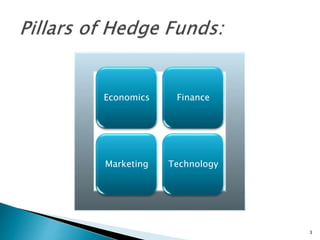
Economics Finance
Marketing Technology
3
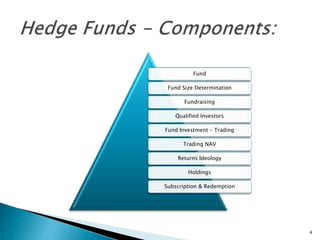
Fund
Fund Size Determination
Fundraising
Qualified Investors
Fund Investment – Trading
Trading NAV
Returns Ideology
Holdings
Subscription & Redemption
4
Investment across
Asset Classes
Structured as Private
Partnerships and
open to only Limited
Number of Investors
Lock up & Notice
Period - Alternatives
Less Regulated and
Publicly Traded
Fee Structure
Fund of Funds
Investment
5
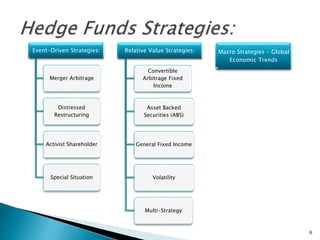
Event-Driven Strategies:
Merger Arbitrage
Distressed
Restructuring
Activist Shareholder
Special Situation
Relative Value Strategies:
Convertible
Arbitrage Fixed
Income
Asset Backed
Securities (ABS)
General Fixed Income
Volatility
Multi-Strategy
Macro Strategies – Global
Economic Trends
6
7
Institutional Investors
• Insurance Companies
• Pension Funds
• University Endowments
• Other Institutional Investors
High Net-worth Individuals
Family Offices
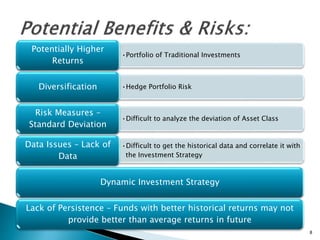
•Portfolio of Traditional Investments
Potentially Higher
Returns
•Hedge Portfolio RiskDiversification
•Difficult to analyze the deviation of Asset Class
Risk Measures –
Standard Deviation
•Difficult to get the historical data and correlate it with
the Investment Strategy
Data Issues – Lack of
Data
Dynamic Investment Strategy
Lack of Persistence – Funds with better historical returns may not
provide better than average returns in future
8
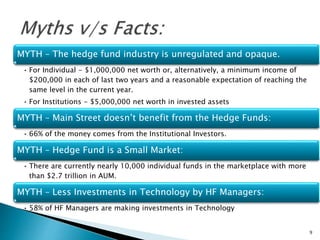
MYTH – The hedge fund industry is unregulated and opaque.
• For Individual - $1,000,000 net worth or, alternatively, a minimum income of
$200,000 in each of last two years and a reasonable expectation of reaching the
same level in the current year.
• For Institutions - $5,000,000 net worth in invested assets
MYTH – Main Street doesn’t benefit from the Hedge Funds:
• 66% of the money comes from the Institutional Investors.
MYTH – Hedge Fund is a Small Market:
• There are currently nearly 10,000 individual funds in the marketplace with more
than $2.7 trillion in AUM.
MYTH – Less Investments in Technology by HF Managers:
• 58% of HF Managers are making investments in Technology
9
 Trading NAV:
◦ Calculated on the Daily Basis
◦ It helps in determining at the end of the trading day
whether to buy or sell a particular share.
◦ NAV = Total Investments / Holding
◦ $50 = $50,000,000 / 1,000,000
10
• Management Fees (Typically 1% of AUM)
Management
Fees
• High Watermark Provisions – Incentive Fees (%
of the returns achieved above benchmark)
• Hurdle Rate – Minimum rate that must be
earned before Incentive fee
Incentive
Based Fees
11
 Registration of a Hedge Fund is required when the AUM of the
fund is more than $150 million.
◦ Portfolio management processes, including allocation of
investment opportunities among clients, consistency with
client objectives and applicable regulatory restrictions.
◦ Trading practices, including procedures by which you
satisfy your best execution obligation, use client brokerage
to obtain research and other services (i.e., soft dollar
arrangements) and allocate aggregated trades among
clients
◦ Proprietary trading and personal trading activities of
supervised persons in a manner reasonably designed to
prevent the misuse of material nonpublic information
12
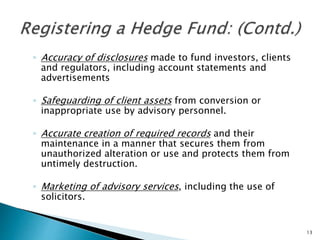
◦ Accuracy of disclosures made to fund investors, clients
and regulators, including account statements and
advertisements
◦ Safeguarding of client assets from conversion or
inappropriate use by advisory personnel.
◦ Accurate creation of required records and their
maintenance in a manner that secures them from
unauthorized alteration or use and protects them from
untimely destruction.
◦ Marketing of advisory services, including the use of
solicitors.
13
◦ Processes to value client holdings and assess fees
based on those valuations, including ensuring that
these processes are appropriate in view of the fact
that you receive compensation based on those
valuations.
◦ Business continuity plans, including plans to
address disaster recover and, for smaller firms,
deaths of owners and/or key personnel.
14
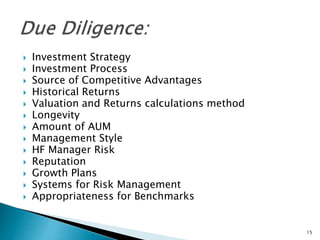
 Investment Strategy
 Investment Process
 Source of Competitive Advantages
 Historical Returns
 Valuation and Returns calculations method
 Longevity
 Amount of AUM
 Management Style
 HF Manager Risk
 Reputation
 Growth Plans
 Systems for Risk Management
 Appropriateness for Benchmarks
15
Q&A
Thank You,
Samarth Dang
Navatar Group
16

Hedge Funds - Domain Knowledge

  • 1.
  • 2.
     What isAlternative Investments Alternative investments are investment products outside traditional investments like stocks, bonds, cash or property. The alternative investment industry includes hedge funds, funds of funds, managed futures funds and other non-traditional asset classes. Alternative investment managers are distinguished by their objective to deliver absolute returns, regardless of market conditions. Using strategy-driven and research backed investment methodologies, alternative managers aim to provide broad asset diversification benefits such as lowered volatility (risk) and the potential for improved performance. 2
  • 3.
  • 4.
    Fund Fund Size Determination Fundraising QualifiedInvestors Fund Investment – Trading Trading NAV Returns Ideology Holdings Subscription & Redemption 4
  • 5.
    Investment across Asset Classes Structuredas Private Partnerships and open to only Limited Number of Investors Lock up & Notice Period - Alternatives Less Regulated and Publicly Traded Fee Structure Fund of Funds Investment 5
  • 6.
    Event-Driven Strategies: Merger Arbitrage Distressed Restructuring ActivistShareholder Special Situation Relative Value Strategies: Convertible Arbitrage Fixed Income Asset Backed Securities (ABS) General Fixed Income Volatility Multi-Strategy Macro Strategies – Global Economic Trends 6
  • 7.
    7 Institutional Investors • InsuranceCompanies • Pension Funds • University Endowments • Other Institutional Investors High Net-worth Individuals Family Offices
  • 8.
    •Portfolio of TraditionalInvestments Potentially Higher Returns •Hedge Portfolio RiskDiversification •Difficult to analyze the deviation of Asset Class Risk Measures – Standard Deviation •Difficult to get the historical data and correlate it with the Investment Strategy Data Issues – Lack of Data Dynamic Investment Strategy Lack of Persistence – Funds with better historical returns may not provide better than average returns in future 8
  • 9.
    MYTH – Thehedge fund industry is unregulated and opaque. • For Individual - $1,000,000 net worth or, alternatively, a minimum income of $200,000 in each of last two years and a reasonable expectation of reaching the same level in the current year. • For Institutions - $5,000,000 net worth in invested assets MYTH – Main Street doesn’t benefit from the Hedge Funds: • 66% of the money comes from the Institutional Investors. MYTH – Hedge Fund is a Small Market: • There are currently nearly 10,000 individual funds in the marketplace with more than $2.7 trillion in AUM. MYTH – Less Investments in Technology by HF Managers: • 58% of HF Managers are making investments in Technology 9
  • 10.
     Trading NAV: ◦Calculated on the Daily Basis ◦ It helps in determining at the end of the trading day whether to buy or sell a particular share. ◦ NAV = Total Investments / Holding ◦ $50 = $50,000,000 / 1,000,000 10
  • 11.
    • Management Fees(Typically 1% of AUM) Management Fees • High Watermark Provisions – Incentive Fees (% of the returns achieved above benchmark) • Hurdle Rate – Minimum rate that must be earned before Incentive fee Incentive Based Fees 11
  • 12.
     Registration ofa Hedge Fund is required when the AUM of the fund is more than $150 million. ◦ Portfolio management processes, including allocation of investment opportunities among clients, consistency with client objectives and applicable regulatory restrictions. ◦ Trading practices, including procedures by which you satisfy your best execution obligation, use client brokerage to obtain research and other services (i.e., soft dollar arrangements) and allocate aggregated trades among clients ◦ Proprietary trading and personal trading activities of supervised persons in a manner reasonably designed to prevent the misuse of material nonpublic information 12
  • 13.
    ◦ Accuracy ofdisclosures made to fund investors, clients and regulators, including account statements and advertisements ◦ Safeguarding of client assets from conversion or inappropriate use by advisory personnel. ◦ Accurate creation of required records and their maintenance in a manner that secures them from unauthorized alteration or use and protects them from untimely destruction. ◦ Marketing of advisory services, including the use of solicitors. 13
  • 14.
    ◦ Processes tovalue client holdings and assess fees based on those valuations, including ensuring that these processes are appropriate in view of the fact that you receive compensation based on those valuations. ◦ Business continuity plans, including plans to address disaster recover and, for smaller firms, deaths of owners and/or key personnel. 14
  • 15.
     Investment Strategy Investment Process  Source of Competitive Advantages  Historical Returns  Valuation and Returns calculations method  Longevity  Amount of AUM  Management Style  HF Manager Risk  Reputation  Growth Plans  Systems for Risk Management  Appropriateness for Benchmarks 15
  • 16.