




The ICD-10 Change-Over: Looking Ahead Adele Allison National Director of Government Affairs, SuccessEHS
ICD-10 Planning
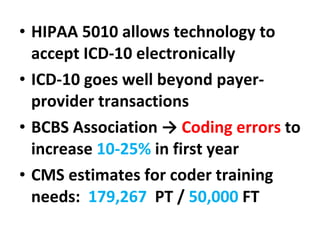
HIPAA 5010 allows technology to accept ICD-10 electronically ICD-10 goes well beyond payer-provider transactions BCBS Association ->  Coding errors  to increase  10-25%  in first year CMS estimates for coder training needs:  179,267   PT /  50,000  FT
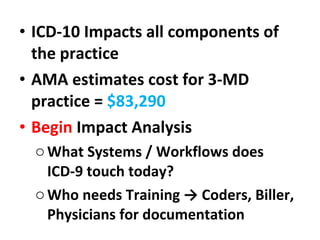
ICD-10 Impacts all components of the practice AMA estimates cost for 3-MD practice =  $83,290 Begin  Impact Analysis What Systems / Workflows does ICD-9 touch today? Who needs Training -> Coders, Biller, Physicians for documentation
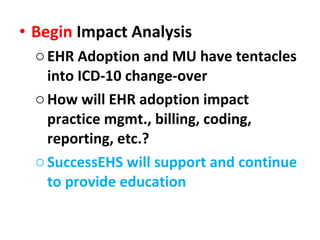
Begin  Impact Analysis EHR Adoption and MU have tentacles into ICD-10 change-over How will EHR adoption impact practice mgmt., billing, coding, reporting, etc.? SuccessEHS will support and continue to provide education
Provider Documentation Training
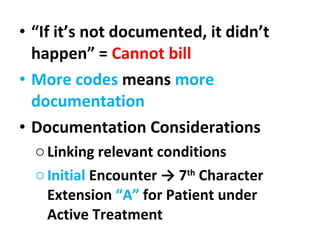
“ If it’s not documented, it didn’t happen” =  Cannot bill More codes  means  more documentation  Documentation Considerations Linking relevant conditions  Initial  Encounter -> 7 th  Character Extension  “A”  for Patient under Active Treatment
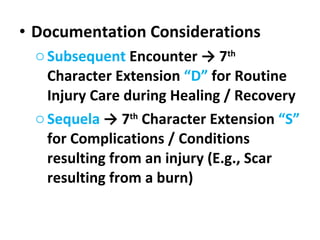
Documentation Considerations Subsequent  Encounter -> 7 th  Character Extension  “D”  for Routine Injury Care during Healing / Recovery Sequela  -> 7 th  Character Extension  “S”  for Complications / Conditions resulting from an injury (E.g., Scar resulting from a burn)
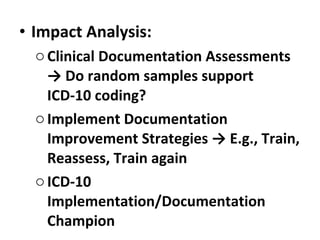
Impact Analysis: Clinical Documentation Assessments  ->  Do random samples support ICD-10 coding? Implement Documentation Improvement Strategies  ->  E.g., Train, Reassess, Train again ICD-10 Implementation/Documentation Champion
Provider Documentation Training
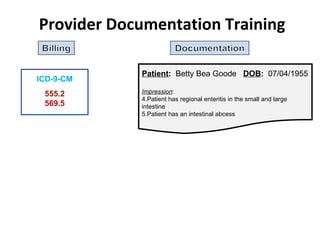
Provider Documentation Training  ICD-9-CM 555.2 569.5 Patient :   Betty Bea Goode  DOB :   07/04/1955 Impression :  Patient has regional enteritis in the small and large intestine Patient has an intestinal abcess
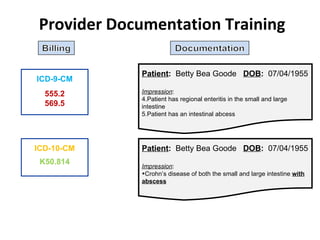
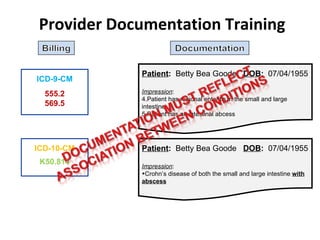
Provider Documentation Training  ICD-9-CM 555.2 569.5 Patient :   Betty Bea Goode  DOB :   07/04/1955 Impression :  Patient has regional enteritis in the small and large intestine Patient has an intestinal abcess ICD-10-CM K50.814 Patient :   Betty Bea Goode  DOB :   07/04/1955 Impression :  Crohn’s disease of both the small and large intestine  with abscess
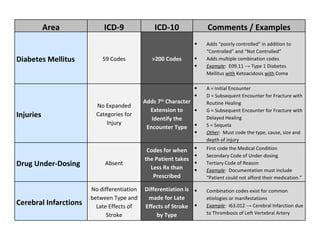
Area ICD-9 ICD-10 Comments / Examples Diabetes Mellitus 59 Codes >200 Codes Adds “poorly controlled” in addition to “Controlled” and “Not Controlled” Adds multiple combination codes Example :  E09.11  ->  Type 1 Diabetes Mellitus  with  Ketoacidosis  with  Coma Injuries No Expanded Categories for Injury Adds 7 th  Character Extension to Identify the Encounter Type A = Initial Encounter D = Subsequent Encounter for Fracture with Routine Healing G = Subsequent Encounter for Fracture with Delayed Healing S = Sequela Other :  Must code the type, cause, size and depth of injury Drug Under-Dosing Absent Codes for when the Patient takes Less Rx than Prescribed First code the Medical Condition Secondary Code of Under-dosing Tertiary Code of Reason Example :   Documentation must include “Patient could not afford their medication.” Cerebral Infarctions No differentiation between Type and Late Effects of Stroke Differentiation is made for Late Effects of Stroke by Type Combination codes exist for common etiologies or manifestations Example :   I63.012  ->  Cerebral Infarction due to Thrombosis of Left Vertebral Artery
Area ICD-9 ICD-10 Comments / Examples Acute Myocardial Infarction Age definition is 8 weeks Age definition is 4 weeks New categories for subsequent AMI and for complications within 4 weeks (28 days) of event Difference in terminology Laterality is included Example :   I21.02  ->  ST Segment Elevation Myocardial Infarction involving the Left Anterior Descending Coronary Artery Musculoskeletal  Limited Diagnosis Codes Expanded Diagnosis Codes Example :   There are 8 codes for pathologic fracture in ICD-9; 150 codes in ICD-10 Pregnancy Trimester Not Required, uses episodes of care Documentation of Trimester Required Counted from 1 st  day of last period Must document number of weeks Episodes of care deleted Obstructed Labor incorporates reason Code extensions use to ID baby (1-5) affected by OB condition Example :   (Trimester) O15.03  ->  Eclampsia in   Pregnancy in the 3 rd  Trimester Example :  (Obstruction/Baby ID) O64.1xx2  ->  Obstructed Labor due to Breech Presentation, Fetus 2
What about dentists?
Fact:  Dental Office Systems should be compatible with Medical Office Systems ADA Codes on Dental Procedures and Nomenclature used today All electronic dental claims  MUST be 5010 compliant
No coding change  for the ADA Codes due to ICD-10 Exception  ->  Dentists perform a  medically  warranted procedure billed on a medical claim
How do you embrace change management?
Pragmatist 60% aim for minimum Only core processes for administration/revenue cycle management Aiming for Average = Potential Risk
Collaborator 20-25% aim for opportunity Improve processes Advanced analytics, internal reporting Aiming for Improvement = Potential Value for Costs
Innovator 15-20% aim for transformation Change agent Contracting, training, outcomes management Aiming for Excellence = Competitive Advantage & Strategic Positioning
Structural differences in  ICD-9 and ICD-10
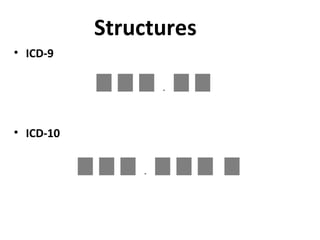
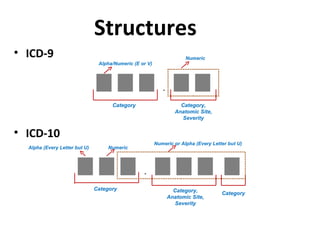
Structures ICD-9 ICD-10
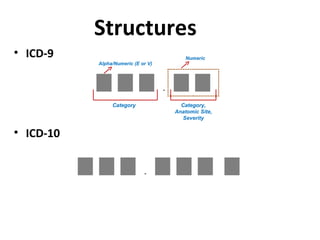
Structures ICD-9 ICD-10 Category Category, Anatomic Site, Severity Alpha/Numeric (E or V) Numeric
Structures ICD-9 ICD-10 Category Category, Anatomic Site, Severity Alpha/Numeric (E or V) Numeric  Category Category, Anatomic Site, Severity Category Numeric  Alpha (Every Letter but U) Numeric or Alpha (Every Letter but U)
Mapping differences in  ICD-9 and ICD-10
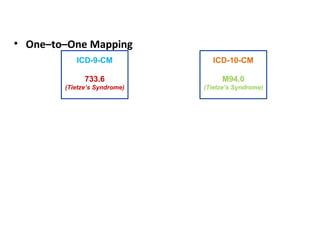
One–to–One Mapping ICD-9-CM ICD-10-CM 733.6 (Tietze’s Syndrome) M94.0 (Tietze’s Syndrome)
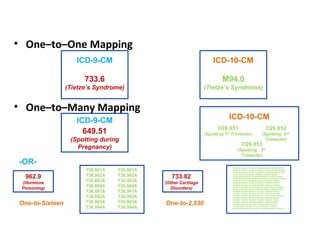
One–to–One Mapping One–to–Many Mapping ICD-9-CM ICD-10-CM 733.6 (Tietze’s Syndrome) M94.0 (Tietze’s Syndrome) ICD-9-CM 649.51 (Spotting during Pregnancy) ICD-10-CM O26.851 (Spotting 1 st  Trimester) O26.852 (Spotting  2 nd   Trimester) O26.853 (Spotting  3 rd   Trimester) -OR- 962.9 (Hormone Poisoning) T38.801A T38.901A T38.802A T38.902A T28.803A T38.903A T38.804A T38.904A T38.891A T38.991A T38.892A T38.992A T38.893A T38.993A T38.894A T38.994A 733.82 (Other Cartilage Disorders) T38.801AT38.901A T38.901AT38.901A38.901AT38.801AT38.901A T38.901AT38.901A T38.901AT38.802AT38.902A28.803AT38.903A T38.804AT38.904A T38.891A T38.991A 38.992A38.893AT38.993A T38.901T38.901AT38.892A T38.992A T38.893AT38.993A T38.90T38.90T38.901A T38.894A T38.992A T38.893AT38.993A T38.90T38.90T38.901AT38.994T38.901A38.901AT38.801AT38.901A T38.901AT38.901AT38.90102AT38.902AT28.803AT38.903A T38.804AT38.904A T38.891A T38.991A T38.901AT38.901A T38.892A T38.992A T38.893AT38.993A T38.901A T38.894A T38.901A T38.994A T38.901A38.901A T38.89 T38.801AT38.901A T38.901AT38.901A T38.901A 802AT38.902AT28.803AT38.903A T38.804AT38.904A T38.891A T38.991A T38.901AT38.901A T38.892A T38.992A T38.893AT38.993A T38.901A T38.894A T38.901A T38.994A T38.901A38.901A T38.89 T38.802AT38.902A T28.803AT38.903A T38.804A T38.992A T38.893AT38.993A  T38.904A T38.891A T38.991A T38.901A T38.901A T38.90 T38.892A T38.992A T38.893AT38.993A T38.901AT38.90 T38.894A T38.901A T38.994A T38.901A38.901A T38.90 T38.90T38.801AT38.901A T38.901AT38.901A T38.901A 802AT38.902AT28.803AT38.903A T38.804AT38.904A T38.891A T One-to-Sixteen One-to-2,530
Which of the following statements apply to implementation of ICD-10?
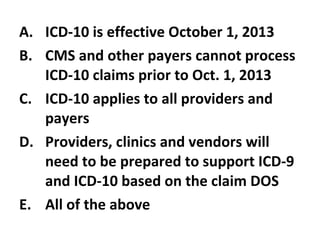
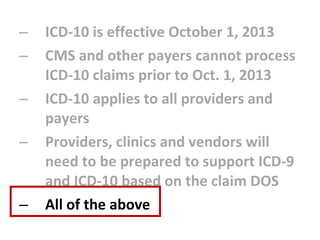
ICD-10 is effective October 1, 2013 CMS and other payers cannot process ICD-10 claims prior to Oct. 1, 2013 ICD-10 applies to all providers and payers Providers, clinics and vendors will need to be prepared to support ICD-9 and ICD-10 based on the claim DOS All of the above
Provider documentation will be a significant factor in succeeding with ICD-10 because:
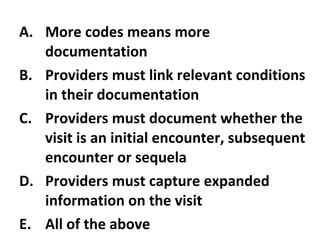
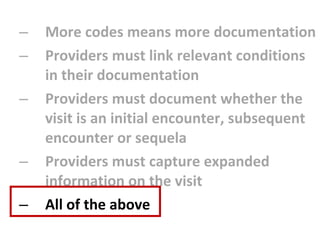
More codes means more documentation Providers must link relevant conditions in their documentation Providers must document whether the visit is an initial encounter, subsequent encounter or sequela Providers must capture expanded information on the visit All of the above
For more information about  industry trends, visit  www.successehs.com  for white papers, articles, blog posts and more! Click  here  for our industry blog

The ICD-10 Change-Over: Looking Ahead

  • 1.
    The ICD-10 Change-Over:Looking Ahead Adele Allison National Director of Government Affairs, SuccessEHS
  • 2.
  • 3.
    HIPAA 5010 allowstechnology to accept ICD-10 electronically ICD-10 goes well beyond payer-provider transactions BCBS Association -> Coding errors to increase 10-25% in first year CMS estimates for coder training needs: 179,267 PT / 50,000 FT
  • 4.
    ICD-10 Impacts allcomponents of the practice AMA estimates cost for 3-MD practice = $83,290 Begin Impact Analysis What Systems / Workflows does ICD-9 touch today? Who needs Training -> Coders, Biller, Physicians for documentation
  • 5.
    Begin ImpactAnalysis EHR Adoption and MU have tentacles into ICD-10 change-over How will EHR adoption impact practice mgmt., billing, coding, reporting, etc.? SuccessEHS will support and continue to provide education
  • 6.
  • 7.
    “ If it’snot documented, it didn’t happen” = Cannot bill More codes means more documentation Documentation Considerations Linking relevant conditions Initial Encounter -> 7 th Character Extension “A” for Patient under Active Treatment
  • 8.
    Documentation Considerations Subsequent Encounter -> 7 th Character Extension “D” for Routine Injury Care during Healing / Recovery Sequela -> 7 th Character Extension “S” for Complications / Conditions resulting from an injury (E.g., Scar resulting from a burn)
  • 9.
    Impact Analysis: ClinicalDocumentation Assessments -> Do random samples support ICD-10 coding? Implement Documentation Improvement Strategies -> E.g., Train, Reassess, Train again ICD-10 Implementation/Documentation Champion
  • 10.
  • 11.
    Provider Documentation Training ICD-9-CM 555.2 569.5 Patient : Betty Bea Goode DOB : 07/04/1955 Impression : Patient has regional enteritis in the small and large intestine Patient has an intestinal abcess
  • 12.
    Provider Documentation Training ICD-9-CM 555.2 569.5 Patient : Betty Bea Goode DOB : 07/04/1955 Impression : Patient has regional enteritis in the small and large intestine Patient has an intestinal abcess ICD-10-CM K50.814 Patient : Betty Bea Goode DOB : 07/04/1955 Impression : Crohn’s disease of both the small and large intestine with abscess
  • 13.
    Provider Documentation Training ICD-9-CM 555.2 569.5 Patient : Betty Bea Goode DOB : 07/04/1955 Impression : Patient has regional enteritis in the small and large intestine Patient has an intestinal abcess ICD-10-CM K50.814 Patient : Betty Bea Goode DOB : 07/04/1955 Impression : Crohn’s disease of both the small and large intestine with abscess
  • 14.
    Area ICD-9 ICD-10Comments / Examples Diabetes Mellitus 59 Codes >200 Codes Adds “poorly controlled” in addition to “Controlled” and “Not Controlled” Adds multiple combination codes Example : E09.11 -> Type 1 Diabetes Mellitus with Ketoacidosis with Coma Injuries No Expanded Categories for Injury Adds 7 th Character Extension to Identify the Encounter Type A = Initial Encounter D = Subsequent Encounter for Fracture with Routine Healing G = Subsequent Encounter for Fracture with Delayed Healing S = Sequela Other : Must code the type, cause, size and depth of injury Drug Under-Dosing Absent Codes for when the Patient takes Less Rx than Prescribed First code the Medical Condition Secondary Code of Under-dosing Tertiary Code of Reason Example : Documentation must include “Patient could not afford their medication.” Cerebral Infarctions No differentiation between Type and Late Effects of Stroke Differentiation is made for Late Effects of Stroke by Type Combination codes exist for common etiologies or manifestations Example : I63.012 -> Cerebral Infarction due to Thrombosis of Left Vertebral Artery
  • 15.
    Area ICD-9 ICD-10Comments / Examples Acute Myocardial Infarction Age definition is 8 weeks Age definition is 4 weeks New categories for subsequent AMI and for complications within 4 weeks (28 days) of event Difference in terminology Laterality is included Example : I21.02 -> ST Segment Elevation Myocardial Infarction involving the Left Anterior Descending Coronary Artery Musculoskeletal Limited Diagnosis Codes Expanded Diagnosis Codes Example : There are 8 codes for pathologic fracture in ICD-9; 150 codes in ICD-10 Pregnancy Trimester Not Required, uses episodes of care Documentation of Trimester Required Counted from 1 st day of last period Must document number of weeks Episodes of care deleted Obstructed Labor incorporates reason Code extensions use to ID baby (1-5) affected by OB condition Example : (Trimester) O15.03 -> Eclampsia in Pregnancy in the 3 rd Trimester Example : (Obstruction/Baby ID) O64.1xx2 -> Obstructed Labor due to Breech Presentation, Fetus 2
  • 16.
  • 17.
    Fact: DentalOffice Systems should be compatible with Medical Office Systems ADA Codes on Dental Procedures and Nomenclature used today All electronic dental claims MUST be 5010 compliant
  • 18.
    No coding change for the ADA Codes due to ICD-10 Exception -> Dentists perform a medically warranted procedure billed on a medical claim
  • 19.
    How do youembrace change management?
  • 20.
    Pragmatist 60% aimfor minimum Only core processes for administration/revenue cycle management Aiming for Average = Potential Risk
  • 21.
    Collaborator 20-25% aimfor opportunity Improve processes Advanced analytics, internal reporting Aiming for Improvement = Potential Value for Costs
  • 22.
    Innovator 15-20% aimfor transformation Change agent Contracting, training, outcomes management Aiming for Excellence = Competitive Advantage & Strategic Positioning
  • 23.
    Structural differences in ICD-9 and ICD-10
  • 24.
  • 25.
    Structures ICD-9 ICD-10Category Category, Anatomic Site, Severity Alpha/Numeric (E or V) Numeric
  • 26.
    Structures ICD-9 ICD-10Category Category, Anatomic Site, Severity Alpha/Numeric (E or V) Numeric Category Category, Anatomic Site, Severity Category Numeric Alpha (Every Letter but U) Numeric or Alpha (Every Letter but U)
  • 27.
    Mapping differences in ICD-9 and ICD-10
  • 28.
    One–to–One Mapping ICD-9-CMICD-10-CM 733.6 (Tietze’s Syndrome) M94.0 (Tietze’s Syndrome)
  • 29.
    One–to–One Mapping One–to–ManyMapping ICD-9-CM ICD-10-CM 733.6 (Tietze’s Syndrome) M94.0 (Tietze’s Syndrome) ICD-9-CM 649.51 (Spotting during Pregnancy) ICD-10-CM O26.851 (Spotting 1 st Trimester) O26.852 (Spotting 2 nd Trimester) O26.853 (Spotting 3 rd Trimester) -OR- 962.9 (Hormone Poisoning) T38.801A T38.901A T38.802A T38.902A T28.803A T38.903A T38.804A T38.904A T38.891A T38.991A T38.892A T38.992A T38.893A T38.993A T38.894A T38.994A 733.82 (Other Cartilage Disorders) T38.801AT38.901A T38.901AT38.901A38.901AT38.801AT38.901A T38.901AT38.901A T38.901AT38.802AT38.902A28.803AT38.903A T38.804AT38.904A T38.891A T38.991A 38.992A38.893AT38.993A T38.901T38.901AT38.892A T38.992A T38.893AT38.993A T38.90T38.90T38.901A T38.894A T38.992A T38.893AT38.993A T38.90T38.90T38.901AT38.994T38.901A38.901AT38.801AT38.901A T38.901AT38.901AT38.90102AT38.902AT28.803AT38.903A T38.804AT38.904A T38.891A T38.991A T38.901AT38.901A T38.892A T38.992A T38.893AT38.993A T38.901A T38.894A T38.901A T38.994A T38.901A38.901A T38.89 T38.801AT38.901A T38.901AT38.901A T38.901A 802AT38.902AT28.803AT38.903A T38.804AT38.904A T38.891A T38.991A T38.901AT38.901A T38.892A T38.992A T38.893AT38.993A T38.901A T38.894A T38.901A T38.994A T38.901A38.901A T38.89 T38.802AT38.902A T28.803AT38.903A T38.804A T38.992A T38.893AT38.993A T38.904A T38.891A T38.991A T38.901A T38.901A T38.90 T38.892A T38.992A T38.893AT38.993A T38.901AT38.90 T38.894A T38.901A T38.994A T38.901A38.901A T38.90 T38.90T38.801AT38.901A T38.901AT38.901A T38.901A 802AT38.902AT28.803AT38.903A T38.804AT38.904A T38.891A T One-to-Sixteen One-to-2,530
  • 30.
    Which of thefollowing statements apply to implementation of ICD-10?
  • 31.
    ICD-10 is effectiveOctober 1, 2013 CMS and other payers cannot process ICD-10 claims prior to Oct. 1, 2013 ICD-10 applies to all providers and payers Providers, clinics and vendors will need to be prepared to support ICD-9 and ICD-10 based on the claim DOS All of the above
  • 32.
    ICD-10 is effectiveOctober 1, 2013 CMS and other payers cannot process ICD-10 claims prior to Oct. 1, 2013 ICD-10 applies to all providers and payers Providers, clinics and vendors will need to be prepared to support ICD-9 and ICD-10 based on the claim DOS All of the above
  • 33.
    Provider documentation willbe a significant factor in succeeding with ICD-10 because:
  • 34.
    More codes meansmore documentation Providers must link relevant conditions in their documentation Providers must document whether the visit is an initial encounter, subsequent encounter or sequela Providers must capture expanded information on the visit All of the above
  • 35.
    More codes meansmore documentation Providers must link relevant conditions in their documentation Providers must document whether the visit is an initial encounter, subsequent encounter or sequela Providers must capture expanded information on the visit All of the above
  • 36.
    For more informationabout industry trends, visit www.successehs.com for white papers, articles, blog posts and more! Click here for our industry blog