Copyright © 2014, 2013, 2012 by Saunders, an imprint of Elsevier Inc. All rights reserved.
Chapter 2
The Health Record as the Foundation
of Coding
2Copyright © 2014, 2013, 2012 by Saunders, an imprint of Elsevier Inc. All rights reserved.
Lesson 2.1: The Health Record
 Explain the purpose of the various forms or
reports found in a health record.
3Copyright © 2014, 2013, 2012 by Saunders, an imprint of Elsevier Inc. All rights reserved.
The Health Record
 One for each patient
 Documents health history
 Timely
 Documentation in record should:
 Identify patient
 Support diagnosis or reason for encounter
 Justify treatment
 Document results
4Copyright © 2014, 2013, 2012 by Saunders, an imprint of Elsevier Inc. All rights reserved.
The Health Record
 Describes the patient’s health history
 Serves as a method for clinicians to
communicate
 Serves as a legal document of care and
services provided
 Serves as a source of data
 Serves as a resource for healthcare
practitioner education
5Copyright © 2014, 2013, 2012 by Saunders, an imprint of Elsevier Inc. All rights reserved.
The Health Record
 Current format of health records
 Electronic
 Paper (traditional)
 Electronic and paper “hybrids”
6Copyright © 2014, 2013, 2012 by Saunders, an imprint of Elsevier Inc. All rights reserved.
The Health Record
 General Principles of Medical Record
Documentation
 Medical records should be complete and legible
 The documentation of each patient encounter
should include:
• Reason for encounter and relevant history
• Physical examination findings and prior diagnostic test
results
• Assessment, clinical impression, and diagnosis
• Plan for care
• Date and legible identity of the observer
7Copyright © 2014, 2013, 2012 by Saunders, an imprint of Elsevier Inc. All rights reserved.
The Health Record
 General Principles of Medical Record
Documentation
 The rationale for ordering diagnostic and ancillary
services
• If not documented, they should be easily inferred
 Past and present diagnoses should be accessible
for treating and/or consulting physician
 Appropriate health risk factors should be identified
 Patient’s progress, response to changes in
treatment, and revision of diagnosis should be
documented
8Copyright © 2014, 2013, 2012 by Saunders, an imprint of Elsevier Inc. All rights reserved.
The Health Record
 General Principles of Medical Record
Documentation
 International Classification of Diseases, 10th
Revision, Clinical Modification (ICD-10-CM & ICD-
10-PCS) codes should be supported by
documentation
9Copyright © 2014, 2013, 2012 by Saunders, an imprint of Elsevier Inc. All rights reserved.
Sections of the Health Record
 Administrative Data
 Demographic
 Personal
 Consents
10Copyright © 2014, 2013, 2012 by Saunders, an imprint of Elsevier Inc. All rights reserved.
Sections of the Health Record
 Clinical Data
 Emergency room documentation
 Admission history and physical (H&P)
 Physician orders
 Progress notes by healthcare providers
 Anesthesia forms
 Operative notes
11Copyright © 2014, 2013, 2012 by Saunders, an imprint of Elsevier Inc. All rights reserved.
Sections of the Health Record
 Clinical Data
 Recovery room notes
 Consultations
 Laboratory test results
 Radiology test results
 Miscellaneous ancillary reports
 Discharge summary
12Copyright © 2014, 2013, 2012 by Saunders, an imprint of Elsevier Inc. All rights reserved.
Sections of the Health Record
 Clinical Data
 Requirements for data mandated by:
• Joint Commission
• Medical Staff Bylaws
• Federal Government Guides
• UHDDS Discharge Data Set
 DOB
 NPI
13Copyright © 2014, 2013, 2012 by Saunders, an imprint of Elsevier Inc. All rights reserved.
Sections of the Health Record
 Emergency Record
 Mini medical record
• Chief complaint
• Other medical services during visit
• Working diagnosis
• Discharge or transfer disposition
14Copyright © 2014, 2013, 2012 by Saunders, an imprint of Elsevier Inc. All rights reserved.
Sections of the Health Record
 Admission History and Physical (H&P)
 Chief complaint
 History of present illness
 Past medical history
 Family medical history
 Social history
 Review of systems
 Physical exam
 Impressions and plans
15Copyright © 2014, 2013, 2012 by Saunders, an imprint of Elsevier Inc. All rights reserved.
Sections of the Health Record
 Physician Orders
 Attending physician
 Consultants
 Written or verbal
16Copyright © 2014, 2013, 2012 by Saunders, an imprint of Elsevier Inc. All rights reserved.
Sections of the Health Record
 Progress notes: Usually in SOAP format
 Subjective: Chief complaint
 Objective: History, physical exam, and diagnostic
tests
 Assessment: Conclusion of subjective and
objective
 Plan: Steps to solve the patient’s problem
17Copyright © 2014, 2013, 2012 by Saunders, an imprint of Elsevier Inc. All rights reserved.
Sections of the Health Record
 Nursing notes
 Integrated or separate
 Include:
• Admission note
• Graphic charts
• Medications/treatments
• TPR sheets
18Copyright © 2014, 2013, 2012 by Saunders, an imprint of Elsevier Inc. All rights reserved.
Sections of the Health Record
 Anesthesia forms
 Pre-anesthesia
 Post-anesthesia
 Anesthetic agent used
 Amount
 Administration
 Duration
 Blood loss
 Fluids
19Copyright © 2014, 2013, 2012 by Saunders, an imprint of Elsevier Inc. All rights reserved.
Sections of the Health Record
 Operative Report
 Pre-op diagnosis
 Post-op diagnosis
 Dates
 Surgeons
 Findings
 Procedures performed
 Condition of patient at completion of procedure
 Dictated or written within 24 hours
20Copyright © 2014, 2013, 2012 by Saunders, an imprint of Elsevier Inc. All rights reserved.
Sections of the Health Record
 Consultations
 Requested by attending physician
 May be used to assess surgical risk
• Surgical clearance
 Within progress note or separate form
21Copyright © 2014, 2013, 2012 by Saunders, an imprint of Elsevier Inc. All rights reserved.
Sections of the Health Record
 Laboratory, radiology, and pathology reports
 Electronic or paper
 CBC
 UA
 Metabolic levels
22Copyright © 2014, 2013, 2012 by Saunders, an imprint of Elsevier Inc. All rights reserved.
Sections of the Health Record
 Discharge summary
 History of present illness
 Past medical history
 Findings
 Lab data
 Other treatments or procedures performed
 Final diagnosis
 Discharge information
23Copyright © 2014, 2013, 2012 by Saunders, an imprint of Elsevier Inc. All rights reserved.
Lesson 2.2: Reporting Diagnoses
and Procedures
 Define “principal diagnosis.”
 Define “principal procedure.”
 Identify reasons for assigning codes for other
diagnoses.
 List the basic guidelines for reporting
diagnoses and procedures.
 Identify which types of documentation are
acceptable to use when assigning codes.
 Explain the query process.
24Copyright © 2014, 2013, 2012 by Saunders, an imprint of Elsevier Inc. All rights reserved.
UHDDS Reporting Standards for
Diagnosis and Procedures
 Information extraction
 Principal diagnosis
• Other, secondary diagnoses
 Principal procedure
25Copyright © 2014, 2013, 2012 by Saunders, an imprint of Elsevier Inc. All rights reserved.
UHDDS Reporting Standards for
Diagnosis and Procedures
 Principal diagnosis
 The condition established after study to be chiefly
responsible for occasioning the admission of the
patient to the hospital for care
 Key to appropriate MS-DRG reimbursement
26Copyright © 2014, 2013, 2012 by Saunders, an imprint of Elsevier Inc. All rights reserved.
 Principal procedure
 The procedure that is performed for definitive
treatment rather than for diagnostic or exploratory
purposes, or a procedure that is necessary to take
care of a complication
 If two procedures meet the definition of principal,
then the one most closely related to the principal
diagnosis is designated as the principal procedure
UHDDS Reporting Standards for
Diagnosis and Procedures
27Copyright © 2014, 2013, 2012 by Saunders, an imprint of Elsevier Inc. All rights reserved.
 Other diagnoses
 Conditions that coexist at the time of admission
 Conditions that develop after admission
 Conditions that affect the treatment
 Conditions that affect the length of stay
UHDDS Reporting Standards for
Diagnosis and Procedures
28Copyright © 2014, 2013, 2012 by Saunders, an imprint of Elsevier Inc. All rights reserved.
 Other reportable diagnoses are defined as
additional conditions that affect patient care
because they require:
 Clinical evaluation
• Testing
• Consultations
• Observation of status
UHDDS Reporting Standards for
Diagnosis and Procedures
29Copyright © 2014, 2013, 2012 by Saunders, an imprint of Elsevier Inc. All rights reserved.
 Other reportable diagnoses are defined as
additional conditions that affect patient care
because they require:
 Therapeutic treatment
• Medications
• Therapies
• Surgery
UHDDS Reporting Standards for
Diagnosis and Procedures
30Copyright © 2014, 2013, 2012 by Saunders, an imprint of Elsevier Inc. All rights reserved.
 Other reportable diagnoses are defined as
additional conditions that affect patient care
because they require:
 Diagnostic procedures
• To determine underlying causes
UHDDS Reporting Standards for
Diagnosis and Procedures
31Copyright © 2014, 2013, 2012 by Saunders, an imprint of Elsevier Inc. All rights reserved.
 Other reportable diagnoses are defined as
additional conditions that affect patient care
because they require:
 Extended length of hospital stay
• Conditions that require:
 Investigation
 Monitoring
 Watchful waiting
UHDDS Reporting Standards for
Diagnosis and Procedures
32Copyright © 2014, 2013, 2012 by Saunders, an imprint of Elsevier Inc. All rights reserved.
 Other reportable diagnoses are defined as
additional conditions that affect patient care
because they require either:
 Increased nursing care and/or other monitoring
• May not need physician treatment
• Conditions may need monitoring
UHDDS Reporting Standards for
Diagnosis and Procedures
33Copyright © 2014, 2013, 2012 by Saunders, an imprint of Elsevier Inc. All rights reserved.
 Guidelines for reporting additional diagnoses
for inpatient, short-term, acute care hospital
records
 Previous conditions
• Sometimes part of discharge summary or H&P
• May not be applicable to current stay
• May be coded by hospital policy
• V codes may be appropriate
UHDDS Reporting Standards for
Diagnosis and Procedures
34Copyright © 2014, 2013, 2012 by Saunders, an imprint of Elsevier Inc. All rights reserved.
 Guidelines for reporting additional diagnoses
for inpatient, short-term, acute care hospital
records
 Reporting of coexisting chronic conditions
• Conditions being evaluated or monitored
UHDDS Reporting Standards for
Diagnosis and Procedures
35Copyright © 2014, 2013, 2012 by Saunders, an imprint of Elsevier Inc. All rights reserved.
 Guidelines for reporting additional diagnoses
for inpatient, short-term, acute care hospital
records
 Integral vs. nonintegral conditions
• Conditions that are integral to the disease process are
not assigned codes
• Is the condition a sign or symptom?
 Do not code
• Not associated with a disease process?
 DO CODE
UHDDS Reporting Standards for
Diagnosis and Procedures
36Copyright © 2014, 2013, 2012 by Saunders, an imprint of Elsevier Inc. All rights reserved.
 Guidelines for reporting additional diagnoses
for inpatient, short-term, acute care hospital
records
 Abnormal findings
• Do not code unless clinically significant
• Look for normal range indications
• Look for further testing
• In doubt? Query the physician
UHDDS Reporting Standards for
Diagnosis and Procedures
37Copyright © 2014, 2013, 2012 by Saunders, an imprint of Elsevier Inc. All rights reserved.
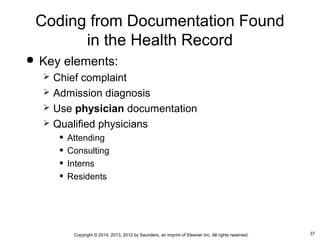
Coding from Documentation Found
in the Health Record
 Key elements:
 Chief complaint
 Admission diagnosis
 Use physician documentation
 Qualified physicians
• Attending
• Consulting
• Interns
• Residents
38Copyright © 2014, 2013, 2012 by Saunders, an imprint of Elsevier Inc. All rights reserved.
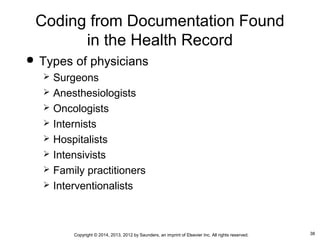
Coding from Documentation Found
in the Health Record
 Types of physicians
 Surgeons
 Anesthesiologists
 Oncologists
 Internists
 Hospitalists
 Intensivists
 Family practitioners
 Interventionalists
39Copyright © 2014, 2013, 2012 by Saunders, an imprint of Elsevier Inc. All rights reserved.
Coding from Documentation Found
in the Health Record
 Radiology or pathology reports
 What to code
• Confirmed conditions from attending
 What not to code
• Conditions not referenced
40Copyright © 2014, 2013, 2012 by Saunders, an imprint of Elsevier Inc. All rights reserved.
Coding from Documentation Found
in the Health Record
 The use of queries in the coding process
 The goal of queries
• Improve physician documentation
• Improve coding professionals’ understanding of the
clinical situation
• Not solely to improve the reimbursement
• Ensure data integrity
41Copyright © 2014, 2013, 2012 by Saunders, an imprint of Elsevier Inc. All rights reserved.
Coding from Documentation Found
in the Health Record
 When to Query
 Documentation describes or is associated with
clinical indicators without a definitive relationship
to an underlying diagnosis.
 Documentation includes clinical indicators,
diagnostic evaluation, and or/treatment not related
to a specific condition or procedure.
 Documentation provides a diagnosis without
underlying clinical validation.
 Documentation is unclear for present on
admission
42Copyright © 2014, 2013, 2012 by Saunders, an imprint of Elsevier Inc. All rights reserved.
Coding from Documentation Found
in the Health Record
 How to Query
 Verbal or written
 Always document the query
 No leading queries
 Do not use the word “possible”
43Copyright © 2014, 2013, 2012 by Saunders, an imprint of Elsevier Inc. All rights reserved.
Coding from Documentation Found
in the Health Record
 Query Format
 Open-ended
 Multiple choice
• Can provide a new diagnosis as an option
 Yes/No
• Determine present on admission (POA)
• Further specify a diagnosis that is already documented
• Establish a cause/effect relationship between
documented conditions
• Resolve conflicting documentation from multiple
providers
44Copyright © 2014, 2013, 2012 by Saunders, an imprint of Elsevier Inc. All rights reserved.
Coding from Documentation Found
in the Health Record
 Query Retention Policy
 Each facility should have a retention policy
 Practitioner response should be:
• Kept in the health record as an addendum
• Written in a timely manner
• Current date and time
• Reason for additional documentation
45Copyright © 2014, 2013, 2012 by Saunders, an imprint of Elsevier Inc. All rights reserved.
Coding from Documentation Found
in the Health Record
 Leading Query
 Not supported by clinical indicators found in the
record or directs provider to document a particular
diagnosis or procedure
 Query should only present clinical facts and allow
provider to make a clinical determination
46Copyright © 2014, 2013, 2012 by Saunders, an imprint of Elsevier Inc. All rights reserved.
Coding from Documentation Found
in the Health Record
 Who to query
 Query the provider who supplied the
documentation in question
• Consultant
• Anesthesiologist
• Surgeon
• Attending physician
47Copyright © 2014, 2013, 2012 by Saunders, an imprint of Elsevier Inc. All rights reserved.
Coding from Documentation Found
in the Health Record
 Elements of a query form
 Date of query
 Patient name
 Medical record number
 Account number
 Admission date/date of service
 Question needing clarification with clinical indicators
 Identification of coder
 Contact information of the coder
 Area for provider response
 Place for provider signature and date of response
 Instruction, correction, or addendum
48Copyright © 2014, 2013, 2012 by Saunders, an imprint of Elsevier Inc. All rights reserved.
Coding from Documentation Found
in the Health Record
 Ways to transmit queries to provider
 Fax
 Electronic via secure email or IT messaging
 Queries become part of the official health record
 Do not use sticky notes, scratch paper, or
anything that can be removed or discarded
49Copyright © 2014, 2013, 2012 by Saunders, an imprint of Elsevier Inc. All rights reserved.
QUESTIONS

MO230 Chapter 002

  • 1.
    Copyright © 2014,2013, 2012 by Saunders, an imprint of Elsevier Inc. All rights reserved. Chapter 2 The Health Record as the Foundation of Coding
  • 2.
    2Copyright © 2014,2013, 2012 by Saunders, an imprint of Elsevier Inc. All rights reserved. Lesson 2.1: The Health Record  Explain the purpose of the various forms or reports found in a health record.
  • 3.
    3Copyright © 2014,2013, 2012 by Saunders, an imprint of Elsevier Inc. All rights reserved. The Health Record  One for each patient  Documents health history  Timely  Documentation in record should:  Identify patient  Support diagnosis or reason for encounter  Justify treatment  Document results
  • 4.
    4Copyright © 2014,2013, 2012 by Saunders, an imprint of Elsevier Inc. All rights reserved. The Health Record  Describes the patient’s health history  Serves as a method for clinicians to communicate  Serves as a legal document of care and services provided  Serves as a source of data  Serves as a resource for healthcare practitioner education
  • 5.
    5Copyright © 2014,2013, 2012 by Saunders, an imprint of Elsevier Inc. All rights reserved. The Health Record  Current format of health records  Electronic  Paper (traditional)  Electronic and paper “hybrids”
  • 6.
    6Copyright © 2014,2013, 2012 by Saunders, an imprint of Elsevier Inc. All rights reserved. The Health Record  General Principles of Medical Record Documentation  Medical records should be complete and legible  The documentation of each patient encounter should include: • Reason for encounter and relevant history • Physical examination findings and prior diagnostic test results • Assessment, clinical impression, and diagnosis • Plan for care • Date and legible identity of the observer
  • 7.
    7Copyright © 2014,2013, 2012 by Saunders, an imprint of Elsevier Inc. All rights reserved. The Health Record  General Principles of Medical Record Documentation  The rationale for ordering diagnostic and ancillary services • If not documented, they should be easily inferred  Past and present diagnoses should be accessible for treating and/or consulting physician  Appropriate health risk factors should be identified  Patient’s progress, response to changes in treatment, and revision of diagnosis should be documented
  • 8.
    8Copyright © 2014,2013, 2012 by Saunders, an imprint of Elsevier Inc. All rights reserved. The Health Record  General Principles of Medical Record Documentation  International Classification of Diseases, 10th Revision, Clinical Modification (ICD-10-CM & ICD- 10-PCS) codes should be supported by documentation
  • 9.
    9Copyright © 2014,2013, 2012 by Saunders, an imprint of Elsevier Inc. All rights reserved. Sections of the Health Record  Administrative Data  Demographic  Personal  Consents
  • 10.
    10Copyright © 2014,2013, 2012 by Saunders, an imprint of Elsevier Inc. All rights reserved. Sections of the Health Record  Clinical Data  Emergency room documentation  Admission history and physical (H&P)  Physician orders  Progress notes by healthcare providers  Anesthesia forms  Operative notes
  • 11.
    11Copyright © 2014,2013, 2012 by Saunders, an imprint of Elsevier Inc. All rights reserved. Sections of the Health Record  Clinical Data  Recovery room notes  Consultations  Laboratory test results  Radiology test results  Miscellaneous ancillary reports  Discharge summary
  • 12.
    12Copyright © 2014,2013, 2012 by Saunders, an imprint of Elsevier Inc. All rights reserved. Sections of the Health Record  Clinical Data  Requirements for data mandated by: • Joint Commission • Medical Staff Bylaws • Federal Government Guides • UHDDS Discharge Data Set  DOB  NPI
  • 13.
    13Copyright © 2014,2013, 2012 by Saunders, an imprint of Elsevier Inc. All rights reserved. Sections of the Health Record  Emergency Record  Mini medical record • Chief complaint • Other medical services during visit • Working diagnosis • Discharge or transfer disposition
  • 14.
    14Copyright © 2014,2013, 2012 by Saunders, an imprint of Elsevier Inc. All rights reserved. Sections of the Health Record  Admission History and Physical (H&P)  Chief complaint  History of present illness  Past medical history  Family medical history  Social history  Review of systems  Physical exam  Impressions and plans
  • 15.
    15Copyright © 2014,2013, 2012 by Saunders, an imprint of Elsevier Inc. All rights reserved. Sections of the Health Record  Physician Orders  Attending physician  Consultants  Written or verbal
  • 16.
    16Copyright © 2014,2013, 2012 by Saunders, an imprint of Elsevier Inc. All rights reserved. Sections of the Health Record  Progress notes: Usually in SOAP format  Subjective: Chief complaint  Objective: History, physical exam, and diagnostic tests  Assessment: Conclusion of subjective and objective  Plan: Steps to solve the patient’s problem
  • 17.
    17Copyright © 2014,2013, 2012 by Saunders, an imprint of Elsevier Inc. All rights reserved. Sections of the Health Record  Nursing notes  Integrated or separate  Include: • Admission note • Graphic charts • Medications/treatments • TPR sheets
  • 18.
    18Copyright © 2014,2013, 2012 by Saunders, an imprint of Elsevier Inc. All rights reserved. Sections of the Health Record  Anesthesia forms  Pre-anesthesia  Post-anesthesia  Anesthetic agent used  Amount  Administration  Duration  Blood loss  Fluids
  • 19.
    19Copyright © 2014,2013, 2012 by Saunders, an imprint of Elsevier Inc. All rights reserved. Sections of the Health Record  Operative Report  Pre-op diagnosis  Post-op diagnosis  Dates  Surgeons  Findings  Procedures performed  Condition of patient at completion of procedure  Dictated or written within 24 hours
  • 20.
    20Copyright © 2014,2013, 2012 by Saunders, an imprint of Elsevier Inc. All rights reserved. Sections of the Health Record  Consultations  Requested by attending physician  May be used to assess surgical risk • Surgical clearance  Within progress note or separate form
  • 21.
    21Copyright © 2014,2013, 2012 by Saunders, an imprint of Elsevier Inc. All rights reserved. Sections of the Health Record  Laboratory, radiology, and pathology reports  Electronic or paper  CBC  UA  Metabolic levels
  • 22.
    22Copyright © 2014,2013, 2012 by Saunders, an imprint of Elsevier Inc. All rights reserved. Sections of the Health Record  Discharge summary  History of present illness  Past medical history  Findings  Lab data  Other treatments or procedures performed  Final diagnosis  Discharge information
  • 23.
    23Copyright © 2014,2013, 2012 by Saunders, an imprint of Elsevier Inc. All rights reserved. Lesson 2.2: Reporting Diagnoses and Procedures  Define “principal diagnosis.”  Define “principal procedure.”  Identify reasons for assigning codes for other diagnoses.  List the basic guidelines for reporting diagnoses and procedures.  Identify which types of documentation are acceptable to use when assigning codes.  Explain the query process.
  • 24.
    24Copyright © 2014,2013, 2012 by Saunders, an imprint of Elsevier Inc. All rights reserved. UHDDS Reporting Standards for Diagnosis and Procedures  Information extraction  Principal diagnosis • Other, secondary diagnoses  Principal procedure
  • 25.
    25Copyright © 2014,2013, 2012 by Saunders, an imprint of Elsevier Inc. All rights reserved. UHDDS Reporting Standards for Diagnosis and Procedures  Principal diagnosis  The condition established after study to be chiefly responsible for occasioning the admission of the patient to the hospital for care  Key to appropriate MS-DRG reimbursement
  • 26.
    26Copyright © 2014,2013, 2012 by Saunders, an imprint of Elsevier Inc. All rights reserved.  Principal procedure  The procedure that is performed for definitive treatment rather than for diagnostic or exploratory purposes, or a procedure that is necessary to take care of a complication  If two procedures meet the definition of principal, then the one most closely related to the principal diagnosis is designated as the principal procedure UHDDS Reporting Standards for Diagnosis and Procedures
  • 27.
    27Copyright © 2014,2013, 2012 by Saunders, an imprint of Elsevier Inc. All rights reserved.  Other diagnoses  Conditions that coexist at the time of admission  Conditions that develop after admission  Conditions that affect the treatment  Conditions that affect the length of stay UHDDS Reporting Standards for Diagnosis and Procedures
  • 28.
    28Copyright © 2014,2013, 2012 by Saunders, an imprint of Elsevier Inc. All rights reserved.  Other reportable diagnoses are defined as additional conditions that affect patient care because they require:  Clinical evaluation • Testing • Consultations • Observation of status UHDDS Reporting Standards for Diagnosis and Procedures
  • 29.
    29Copyright © 2014,2013, 2012 by Saunders, an imprint of Elsevier Inc. All rights reserved.  Other reportable diagnoses are defined as additional conditions that affect patient care because they require:  Therapeutic treatment • Medications • Therapies • Surgery UHDDS Reporting Standards for Diagnosis and Procedures
  • 30.
    30Copyright © 2014,2013, 2012 by Saunders, an imprint of Elsevier Inc. All rights reserved.  Other reportable diagnoses are defined as additional conditions that affect patient care because they require:  Diagnostic procedures • To determine underlying causes UHDDS Reporting Standards for Diagnosis and Procedures
  • 31.
    31Copyright © 2014,2013, 2012 by Saunders, an imprint of Elsevier Inc. All rights reserved.  Other reportable diagnoses are defined as additional conditions that affect patient care because they require:  Extended length of hospital stay • Conditions that require:  Investigation  Monitoring  Watchful waiting UHDDS Reporting Standards for Diagnosis and Procedures
  • 32.
    32Copyright © 2014,2013, 2012 by Saunders, an imprint of Elsevier Inc. All rights reserved.  Other reportable diagnoses are defined as additional conditions that affect patient care because they require either:  Increased nursing care and/or other monitoring • May not need physician treatment • Conditions may need monitoring UHDDS Reporting Standards for Diagnosis and Procedures
  • 33.
    33Copyright © 2014,2013, 2012 by Saunders, an imprint of Elsevier Inc. All rights reserved.  Guidelines for reporting additional diagnoses for inpatient, short-term, acute care hospital records  Previous conditions • Sometimes part of discharge summary or H&P • May not be applicable to current stay • May be coded by hospital policy • V codes may be appropriate UHDDS Reporting Standards for Diagnosis and Procedures
  • 34.
    34Copyright © 2014,2013, 2012 by Saunders, an imprint of Elsevier Inc. All rights reserved.  Guidelines for reporting additional diagnoses for inpatient, short-term, acute care hospital records  Reporting of coexisting chronic conditions • Conditions being evaluated or monitored UHDDS Reporting Standards for Diagnosis and Procedures
  • 35.
    35Copyright © 2014,2013, 2012 by Saunders, an imprint of Elsevier Inc. All rights reserved.  Guidelines for reporting additional diagnoses for inpatient, short-term, acute care hospital records  Integral vs. nonintegral conditions • Conditions that are integral to the disease process are not assigned codes • Is the condition a sign or symptom?  Do not code • Not associated with a disease process?  DO CODE UHDDS Reporting Standards for Diagnosis and Procedures
  • 36.
    36Copyright © 2014,2013, 2012 by Saunders, an imprint of Elsevier Inc. All rights reserved.  Guidelines for reporting additional diagnoses for inpatient, short-term, acute care hospital records  Abnormal findings • Do not code unless clinically significant • Look for normal range indications • Look for further testing • In doubt? Query the physician UHDDS Reporting Standards for Diagnosis and Procedures
  • 37.
    37Copyright © 2014,2013, 2012 by Saunders, an imprint of Elsevier Inc. All rights reserved. Coding from Documentation Found in the Health Record  Key elements:  Chief complaint  Admission diagnosis  Use physician documentation  Qualified physicians • Attending • Consulting • Interns • Residents
  • 38.
    38Copyright © 2014,2013, 2012 by Saunders, an imprint of Elsevier Inc. All rights reserved. Coding from Documentation Found in the Health Record  Types of physicians  Surgeons  Anesthesiologists  Oncologists  Internists  Hospitalists  Intensivists  Family practitioners  Interventionalists
  • 39.
    39Copyright © 2014,2013, 2012 by Saunders, an imprint of Elsevier Inc. All rights reserved. Coding from Documentation Found in the Health Record  Radiology or pathology reports  What to code • Confirmed conditions from attending  What not to code • Conditions not referenced
  • 40.
    40Copyright © 2014,2013, 2012 by Saunders, an imprint of Elsevier Inc. All rights reserved. Coding from Documentation Found in the Health Record  The use of queries in the coding process  The goal of queries • Improve physician documentation • Improve coding professionals’ understanding of the clinical situation • Not solely to improve the reimbursement • Ensure data integrity
  • 41.
    41Copyright © 2014,2013, 2012 by Saunders, an imprint of Elsevier Inc. All rights reserved. Coding from Documentation Found in the Health Record  When to Query  Documentation describes or is associated with clinical indicators without a definitive relationship to an underlying diagnosis.  Documentation includes clinical indicators, diagnostic evaluation, and or/treatment not related to a specific condition or procedure.  Documentation provides a diagnosis without underlying clinical validation.  Documentation is unclear for present on admission
  • 42.
    42Copyright © 2014,2013, 2012 by Saunders, an imprint of Elsevier Inc. All rights reserved. Coding from Documentation Found in the Health Record  How to Query  Verbal or written  Always document the query  No leading queries  Do not use the word “possible”
  • 43.
    43Copyright © 2014,2013, 2012 by Saunders, an imprint of Elsevier Inc. All rights reserved. Coding from Documentation Found in the Health Record  Query Format  Open-ended  Multiple choice • Can provide a new diagnosis as an option  Yes/No • Determine present on admission (POA) • Further specify a diagnosis that is already documented • Establish a cause/effect relationship between documented conditions • Resolve conflicting documentation from multiple providers
  • 44.
    44Copyright © 2014,2013, 2012 by Saunders, an imprint of Elsevier Inc. All rights reserved. Coding from Documentation Found in the Health Record  Query Retention Policy  Each facility should have a retention policy  Practitioner response should be: • Kept in the health record as an addendum • Written in a timely manner • Current date and time • Reason for additional documentation
  • 45.
    45Copyright © 2014,2013, 2012 by Saunders, an imprint of Elsevier Inc. All rights reserved. Coding from Documentation Found in the Health Record  Leading Query  Not supported by clinical indicators found in the record or directs provider to document a particular diagnosis or procedure  Query should only present clinical facts and allow provider to make a clinical determination
  • 46.
    46Copyright © 2014,2013, 2012 by Saunders, an imprint of Elsevier Inc. All rights reserved. Coding from Documentation Found in the Health Record  Who to query  Query the provider who supplied the documentation in question • Consultant • Anesthesiologist • Surgeon • Attending physician
  • 47.
    47Copyright © 2014,2013, 2012 by Saunders, an imprint of Elsevier Inc. All rights reserved. Coding from Documentation Found in the Health Record  Elements of a query form  Date of query  Patient name  Medical record number  Account number  Admission date/date of service  Question needing clarification with clinical indicators  Identification of coder  Contact information of the coder  Area for provider response  Place for provider signature and date of response  Instruction, correction, or addendum
  • 48.
    48Copyright © 2014,2013, 2012 by Saunders, an imprint of Elsevier Inc. All rights reserved. Coding from Documentation Found in the Health Record  Ways to transmit queries to provider  Fax  Electronic via secure email or IT messaging  Queries become part of the official health record  Do not use sticky notes, scratch paper, or anything that can be removed or discarded
  • 49.
    49Copyright © 2014,2013, 2012 by Saunders, an imprint of Elsevier Inc. All rights reserved. QUESTIONS

Editor's Notes

  • #4 QUESTION: What is the purpose of having a health record? (To provide diagnosis and treatment records for every individual assessed or treated) The health record should: Document a patient ’ s life and health history. Include past and present illnesses and treatments. Review events during the current episode of care. Be compiled in a timely manner. Contain sufficient data to identify the patient. Support the diagnosis or reason for healthcare encounter. Justify the current treatment and accurately document the results. TRANSITION: According to Abdelhak ’ s Heath Information: Management of a Strategic Resource, the medical record serves 5 purposes.
  • #5 A patient ’ s health history can provide context for the current illness and alert the physician to medical contraindications Allows clinicians to communicate the plan of care for the patient with others involved in the patient ’ s care Is a legal document of care and services provided Is a source of data Is a resource for healthcare practitioner education
  • #6 The patient ’ s record may come in several formats or hybrids. As electronic formats advance, paper notes become obsolete. The traditional medical record is paper. Most hospital medical records are in a state of transition going from paper to electronic. Advantage of electronic records: many users are able to access the record at the same time. Documentation serves as the basis of a health record.
  • #7 The Centers for Medicare and Medicaid Services (CMS) have provided physicians with General Principles of Medical Record Documentation.
  • #8 General principles of Medical Record Documentation: The rationale for ordering diagnostic and ancillary services (If not documented, they should be easily inferred) Past and present diagnoses should be accessible to all providers Appropriate health risk factors should be identified Patient ’s progress, response to changes in treatment, and revision of diagnosis should be documented
  • #10 Some of the UHDDS data elements included are personal identification, date of birth, sex, race, residence, admit date, and discharge date.
  • #11 Records may be organized in a reverse chronological order. QUESTION: Why would the clinical records be organized in reverse order? (More definitive diagnostic statements can perhaps be made toward the end of the patient stay.) The discharge summary may begin the record.
  • #13 QUESTION: Name some other elements that are required by UHDDS. (Sex, Race and ethnicity, Residence, Hospital ID number, Admission date, Type of admission, Discharge date, Diagnoses, Procedures and dates, External cause of injury code, Birth weight of neonate, Disposition of the patient, Patient ’ s expected source of payment, Total charges) TRANSITION: Now we will discuss the clinical data elements in more detail.
  • #14 Chief complaint (CC): Reason in the patient ’ s own words for the visit Other elements: History, physical exam, possible labs and/or radiology reports, plan of care, physician orders, procedures performed, working diagnoses, disposition of the patient
  • #15 The Joint Commission requires that the H&P be completed within 24 hours DISCUSSION QUESTION : Why do you think it is important for the History and Physical to be on the medical records within 24 hours? ( So that the clinical staff and consulting have the information to treat the patient. )
  • #16 QUESTION: Who puts information in the physician orders? (Attending physician or physician consultants) Gives directions to other physicians and nursing and ancillary services May be written or verbal and part of written or electronic records. Verbal orders guided by medical staff regulations Verbal and telephone orders must be signed by the physician giving the order within 48 hours after giving the order QUESTION: List some required elements of a physician order. (Dated, timed, and signed)
  • #17 Records the course of the patient ’ s hospital care Normally written by the attending physician Other clinicians will also be using the record: Academic medical centers: Medical students, interns, residents Integrated progress notes: Several disciplines write in the same area of the record (physical therapists, respiratory therapists, and sometimes nursing) Records may be scribed by someone other than the physician EHR notes may be dictated and transcribed or typed by the physician Recorded on a daily basis. Frequency of notes governed by medical staff regulations.
  • #20 There must be an operative report if patient is having a surgical procedure Must be on record within 24 hours of time after procedure was performed
  • #23 Summary of the patient ’ s stay in the hospital TRANSITION: Now that we have looked at the sections of the health record, we will discuss the standards for reporting the content.
  • #25 Extract the diagnoses and procedures The extracting of data from the health record may also be referred to as abstracting
  • #26 The most important concept to understand and to apply: Principal diagnosis and principal procedure create the Medicare severity diagnosis-related group MS-DRGs determine reimbursement A coder ’ s main role is to select the correct diagnosis upon record review Sometimes the principal diagnosis is not easily identifiable Some diagnoses may utilize more resources during a patient stay but will not be the principal diagnosis
  • #28 Must have significance for the specific hospital encounter Other diagnoses: “ Conditions that coexist at the time of admission, or develop subsequently or affect the treatment received and/or the length of stay ” Do not use diagnoses which relate to an earlier episode which have no bearing on the current stay “ Other diagnoses ” affect patient care in terms of requiring: Clinical evaluation; or Therapeutic treatment; or Diagnostic Procedures; or Extended length of hospital stay; or Increased nursing care or monitoring Other diagnoses may become complications and/or comorbidities Important in the MS-DRG system of reimbursement
  • #29 The coder would expect to see some testing, clinical observations or perhaps a consultation
  • #30 Treatment by medications, physical therapy, and surgery are forms of therapeutic treatment. Physicians often list conditions in the patient ’ s past medical history that are currently being treated The coders should be familiar with medications and the disorders they treat
  • #31 Used to determine the cause of a sign, symptom, or patient complaint, and to determine the underlying cause. QUESTION: Name some possible diagnostic procedures : EKG or ECG (electrocardiogram); EEG (electroencephalogram); EGD (esophagogastroduodenoscopy); Colonoscopy; Echocardiogram; Nuclear medicine studies; MRI (magnetic resonance imaging); MRA (magnetic resonance angiography); X-rays
  • #32 Patient is ready to be discharged but develops a condition requiring either more investigation, monitoring, or watchful waiting Needs an additional night ’ s stay Examples of conditions: fever, cough, or pain
  • #33 Appropriate for conditions that are not significant enough to require physician treatment Physician may order additional care or labs to monitor the condition If there is no physician diagnosis for which care is being rendered, query the physician
  • #34 The discharge summary or history and physical will list diagnoses from previous admissions that are NOT applicable to the current hospital stay These are NOT reported and are coded only if required by hospital policy “ History of ” codes may be used if this historical condition has an impact on current care or influences treatment
  • #35 Patients may have multiple chronic conditions when they are admitted May not be specifically treated with medications or procedures Report them because they may be evaluated and/or monitored, or affect the way a patient is treated. Long-term use of medications such as anticoagulants are a clue. QUESTION: Name some chronic conditions that may be used as additional diagnoses . (Such as, but not limited to, hypertension, congestive heart failure, asthma, emphysema, COPD, Parkinson ’ s disease, and diabetes mellitus)
  • #36 Conditions that are an integral part of the disease process are not coded Conditions that are NOT an integral part of the disease process may be coded
  • #37 “ Abnormal findings ” (laboratory, x-ray, pathologic, and other diagnostic results) are not coded and reported unless the physician indicates their clinical significance If findings are outside the normal and if the physician has ordered other tests to evaluate the condition or treatment, query the physician to ask whether the abnormal finding should be used
  • #38 Advice given to a new coder is to begin to code a record by reading the discharge summary The discharge summary equals the synopsis of a book You should be able to determine the principal diagnosis ; however, documenting physicians may list a diagnosis that does not meet the requirements because they are not aware of the requirements Other places to look: Start at the beginning. The ER record will give you the patient ’ s chief complaint and will generally give the coder the admission diagnosis. The admitting diagnosis may be a symptom After exam there may be a working diagnosis The ER physician should have a working diagnosis or a sign/symptom for more workup to admit If not clear from the ER record, try admission orders for the reason for admission If no ER record, or it does not help, move on to the Admission History and Physical (H&P) Next, check progress notes, Op reports, labs, radiology, consults, and orders
  • #39 Code from any documentation by a physician Physician = an individual qualified by education and legally authorized to practice medicine Other terms: attending, consulting, interns, and residents Check your medical staff bylaws: documentation by other healthcare providers (nurse practitioners or physician assistants) may be valid Medical students are not physicians
  • #40 Confusion as to what exactly may be coded from a radiology or pathology report, as the authors of these reports are physicians: The coder cannot take information from these reports without attending confirmation. Additional details such as area of fracture, or location of mass, relating to confirmed diagnoses may be taken from x-ray or pathology reports. EXAMPLE: If the physician has already documented an ulnar fracture, the coder may pick up additional detail on the site of the fracture from this report. HOWEVER, if the physician has not documented the femur fracture, the coder could not use the information from the radiology report.
  • #41 Each facility should have its own policies and procedures in regards to the query process Coding queries are an approved part of the official medical record Query forms should only seek clarification of information that is already present in the record Facilities have developed standardized query forms for repeated documentation issues Query forms should contain data elements to identify the patient Must have a place for physician to sign and date response Wording is important AHIMA suggests that the query: Be clearly and concisely written; Contain precise language; Present the facts from the medical record and identify why clarification is needed; Present the scenario and state a question that asks the physician to make a clinical interpretation of a given diagnosis or condition based on treatment, evaluation, monitoring and services provided; Be phrased such that the physician is allowed to specify the correct diagnosis. For more information: American Health Quality Association (AHQA)
  • #42 Why query? Unclear or questionable diagnoses; Evidence of treatment but no diagnosis; Medication is being administered but there is no diagnosis documented to correspond with this treatment
  • #43 Verbal queries should be documented at the time of discussion or immediately after and they should contain the same format as written queries and contain the same clinical indicators that would be in a written query. If the query is not maintained in the medical record, it should become part of the permanent health record. Guidelines allow assigning codes to most possible conditions the term is too broad to be used in the query format
  • #44 All queries must be supported by pertinent clinical indicators. For multiple choice and yes/no queries, additional options such as “clinically undetermined” or “not clinically significant” are suggested.
  • #45 These suggestions are considered “best practices.” Coders should always follow the facility policy.
  • #46 It is unacceptable to lead a provider to document a particular response. AHIMA in the Practice Brief Guidelines for Achieving a Compliant Query Practice has provided examples of compliant/non-compliant queries. These can be found at http://journal.ahima.org/2013/02/01/physician-query-examples/
  • #49 Facility policy will control where queries are maintained
  • #50 CHAPTER HIGHLIGHTS: Go around the room and ask students to give examples of the topics covered: If no interest – ask the following: QUESTION: What are the various sections of a medical record? (Administrative, clinical, demographic, admission H&P, physician orders, progress notes, nursing notes, anesthesia forms, operative reports, consultations, labs, radiology, path, discharge summary) QUESTION: Why would the discharge summary be the first thing in the record? (Because it should list a summary of patient diagnosis and treatment and possibly the principal diagnosis and procedure) QUESTION: Define principal diagnosis. (The condition after study to be chiefly responsible for occasioning the admission of the patient to the hospital for care) QUESTION: Yes or no: Each facility should have its own policies and procedures with regard to the query process. (Yes) QUESTION: Yes or no: Coding queries are not an approved part of the official medical record. (No, they are part of the approved medical record)