Software Engineering for Business Information Systems (sebis)
Department of Informatics
Technische Universität München, Germany
wwwmatthes.in.tum.de
Agile Enterprise Architecture Management
Prof. Florian Matthes, DEDM 2014, Paris
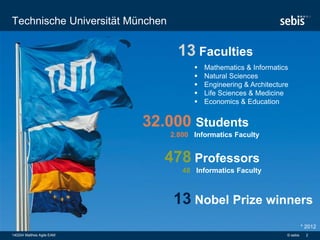
Technische Universität München
© sebis140204 Matthes Agile EAM 2
13 Faculties
 Mathematics & Informatics
 Natural Sciences
 Engineering & Architecture
 Life Sciences & Medicine
 Economics & Education
32.000 Students
2.800 Informatics Faculty
478 Professors
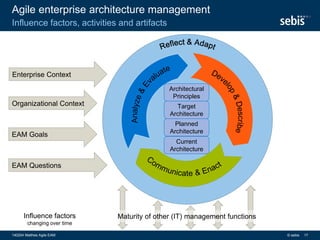
48 Informatics Faculty
13 Nobel Prize winners
* 2012
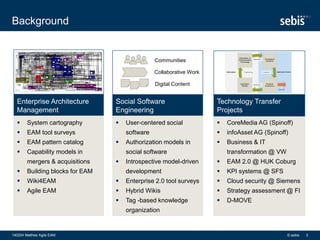
Background
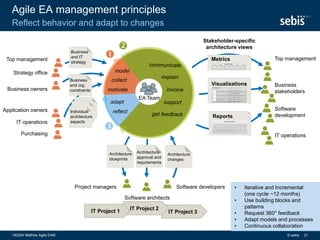
© sebis140204 Matthes Agile EAM 3
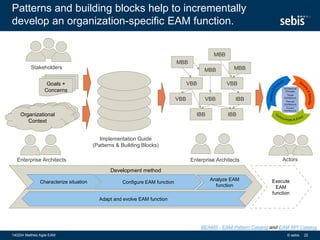
Enterprise Architecture
Management
Social Software
Engineering
 System cartography
 EAM tool surveys
 EAM pattern catalog
 Capability models in
mergers & acquisitions
 Building blocks for EAM
 Wiki4EAM
 Agile EAM
 User-centered social
software
 Authorization models in
social software
 Introspective model-driven
development
 Enterprise 2.0 tool surveys
 Hybrid Wikis
 Tag -based knowledge
organization
Communities
Collaborative Work
Digital Content
 CoreMedia AG (Spinoff)
 infoAsset AG (Spinoff)
 Business & IT
transformation @ VW
 EAM 2.0 @ HUK Coburg
 KPI systems @ SFS
 Cloud security @ Siemens
 Strategy assessment @ FI
 D-MOVE
Technology Transfer
Projects
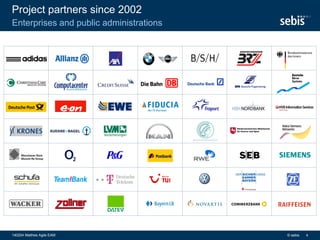
Project partners since 2002
© sebis140204 Matthes Agile EAM 4
Enterprises and public administrations
Deutsche
Börse
Systems
Project Partners since 2002
© sebis140204 Matthes Agile EAM 5
Consultants and Software Vendors
1. Turbulent Times
Accelerating growth, heterogeneity, connectedness and change
2. Enterprise Architecture & Enterprise Architecture Management
Clarity, coherence and agility despite complexity
3. Agile Architecture Management
Principles and implementation using patterns and building blocks
Overview
© sebis140204 Matthes Agile EAM 6
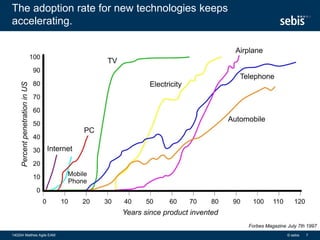
The adoption rate for new technologies keeps
accelerating.
© sebis140204 Matthes Agile EAM 7
Forbes Magazine July 7th 1997
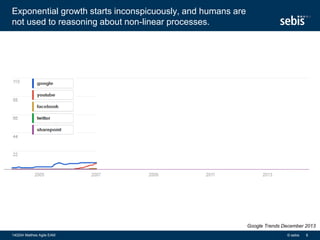
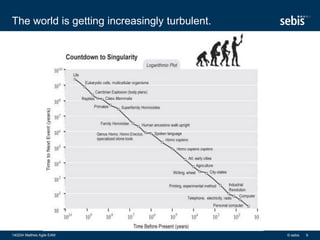
Exponential growth starts inconspicuously, and humans are
not used to reasoning about non-linear processes.
140204 Matthes Agile EAM 8© sebis
Google Trends December 2013
The world is getting increasingly turbulent.
140204 Matthes Agile EAM 9© sebis
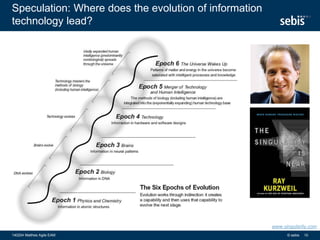
Speculation: Where does the evolution of information
technology lead?
140204 Matthes Agile EAM 10© sebis
www.singularity.com
1. Turbulent Times
Accelerating growth, heterogeneity, connectedness and change
2. Enterprise Architecture & Enterprise Architecture Management
Clarity, coherence and agility despite complexity
3. Agile Architecture Management
Principles and implementation using patterns and building blocks
Overview
© sebis140204 Matthes Agile EAM 11
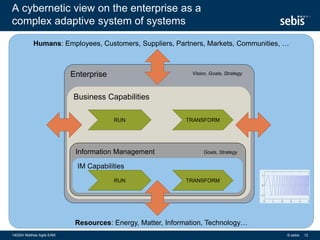
Humans: Employees, Customers, Suppliers, Partners, Markets, Communities, …
Resources: Energy, Matter, Information, Technology…
Enterprise
A cybernetic view on the enterprise as a
complex adaptive system of systems
© sebis140204 Matthes Agile EAM 12
Business Capabilities
Information Management
RUN TRANSFORM
IM Capabilities
RUN TRANSFORM
Goals, Strategy
Vision, Goals, Strategy
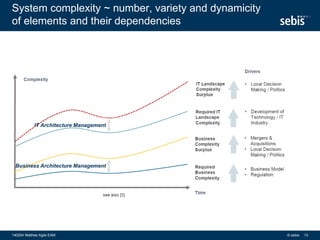
System complexity ~ number, variety and dynamicity
of elements and their dependencies
140204 Matthes Agile EAM 13
Business Architecture Management
IT Architecture Management
© sebis
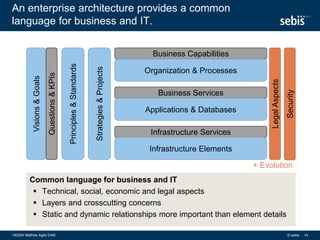
An enterprise architecture provides a common
language for business and IT.
Common language for business and IT
 Technical, social, economic and legal aspects
 Layers and crosscutting concerns
 Static and dynamic relationships more important than element details
140204 Matthes Agile EAM
Strategies&Projects
Principles&Standards
Business Capabilities
Organization & Processes
Business Services
Applications & Databases
Infrastructure Services
Infrastructure Elements
Visions&Goals
Questions&KPIs
14
LegalAspects
Security
© sebis
+ Evolution
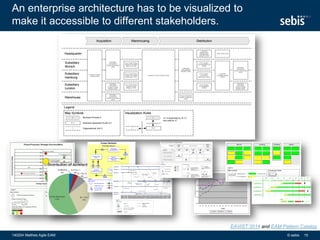
An enterprise architecture has to be visualized to
make it accessible to different stakeholders.
140204 Matthes Agile EAM 15© sebis
EAVIST 2014 and EAM Pattern Catalog
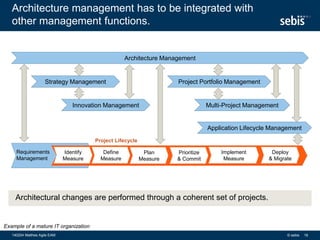
Architecture management has to be integrated with
other management functions.
Architectural changes are performed through a coherent set of projects.
140204 Matthes Agile EAM 16
Architecture Management
Multi-Project Management
Project Portfolio ManagementStrategy Management
Project Lifecycle
Define
Measure
Plan
Measure
Prioritize
& Commit
Implement
Measure
Deploy
& Migrate
Requirements
Management
Identify
Measure
Application Lifecycle Management
Innovation Management
Example of a mature IT organization
© sebis
Agile enterprise architecture management
© sebis140204 Matthes Agile EAM 17
Influence factors, activities and artifacts
EAM Questions
Organizational Context
EAM Goals
Maturity of other (IT) management functions
Architectural
Principles
Target
Architecture
Planned
Architecture
Current
Architecture
Enterprise Context
Influence factors
changing over time
1. Turbulent Times
Accelerating growth, heterogeneity, connectedness and change
2. Enterprise Architecture & Enterprise Architecture Management
Clarity, coherence and agility despite complexity
3. Agile Architecture Management
Principles and implementation using patterns and building blocks
Overview
© sebis140204 Matthes Agile EAM 18
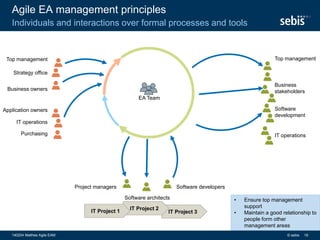
Agile EA management principles
140204 Matthes Agile EAM 19
Individuals and interactions over formal processes and tools
IT Project 3
IT Project 2IT Project 1
Top management
Business
stakeholders
Software
development
IT operations
Project managers
Software architects
Software developers
Top management
Strategy office
Business owners
Application owners
IT operations
Purchasing
EA Team
• Ensure top management
support
• Maintain a good relationship to
people form other
management areas
© sebis
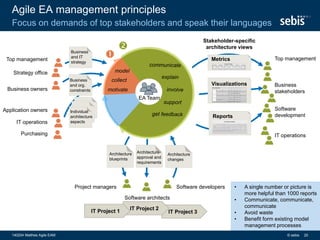
Agile EA management principles
140204 Matthes Agile EAM 20
Focus on demands of top stakeholders and speak their languages
IT Project 3
IT Project 2IT Project 1
Architecture
blueprints
Top management
Business
stakeholders
Software
development
IT operations
Project managers
Software architects
Software developers


Top management
Strategy office
Visualizations
Business owners
Application owners
IT operations
Purchasing
EA Team
Stakeholder-specific
architecture views
Metrics
Reports
Architecture-
approval and
requirements
Architecture
changes
model
collect
motivate
Business
and IT
strategy
Individual
architecture
aspects
Business
and org.
constraints
• A single number or picture is
more helpful than 1000 reports
• Communicate, communicate,
communicate
• Avoid waste
• Benefit form existing model
management processes
© sebis
Agile EA management principles
140204 Matthes Agile EAM 21
Reflect behavior and adapt to changes
IT Project 3
IT Project 2IT Project 1
Architecture
blueprints
Top management
Business
stakeholders
Software
development
IT operations
Project managers
Software architects
Software developers

reflect
adapt


Top management
Strategy office
Visualizations
Business owners
Application owners
IT operations
Purchasing
EA Team
Stakeholder-specific
architecture views
Metrics
Reports
Architecture-
approval and
requirements
Architecture
changes
model
collect
motivate
Business
and IT
strategy
Individual
architecture
aspects
Business
and org.
constraints
• Iterative and Incremental
(one cycle ~12 months)
• Use building blocks and
patterns
• Request 360° feedback
• Adapt models and processes
• Continuous collaboration
© sebis
Patterns and building blocks help to incrementally
develop an organization-specific EAM function.
© sebis140204 Matthes Agile EAM 22
Stakeholders
Goals +
Concerns
Organizational
context
Organizational
context
Organizational
Context
ActorsEnterprise Architects
MBB
VBB
VBB
MBB
VBB
MBB
VBB
IBB
MBB
IBB
IBB
Enterprise Architects
Development method
Characterize situation Configure EAM function
Analyze EAM
function
Adapt and evolve EAM function
Execute
EAM
function
Implementation Guide
(Patterns & Building Blocks)
BEAMS , EAM Pattern Catalog and EAM KPI Catalog
Adoption of EA management principles
26
29
31
33
38
39
39
43
43
48
49
51
52
54
55
60
60
62
64
65
65
66
67
67
68
72
72
73
76
77
81
89
95
28
28
16
14
27
23
27
29
26
26
19
21
19
28
18
18
8
25
16
21
17
19
11
15
18
13
8
12
13
11
13
4
2
40
38
52
51
28
30
30
26
22
21
29
23
28
14
26
20
23
12
15
10
15
14
20
17
4
4
11
11
8
7
4
6
3
8
7
3
4
9
10
6
4
11
7
5
7
3
6
3
4
11
3
7
6
5
3
4
3
12
13
11
6
5
7
4
3
2
0 20 40 60 80 100
Valuation of time over quality
Exactly respond to the stakeholders' demands
Adherence to the one-piece flow
Application of the pull-principle
Advancement with a indefinite & constant pace
Agreed level of done
Actually used by stakeholders
Embracement of changes
Valuation of time over completness
Satisfied with its work
Clear definition of roles & responsibilities
Focus on requirements
Stakeholders provide feedback to EAM team
Satisfy stakeholders
Focus on high-quality
Characterized by defined roles & responsibilities
Accomplishes EAM tasks in small subteams
Diplomacy and negotiation skills
Members know their colleagues' duties
Early delivery
Foster learning by experiments
Common language
Usable for stakeholders
As simple and accessible as possible
Leader fosters team's self-organization
Leader acts as servant for the team
EAM team incorporates feedback
Incorporation of reflections & retrospectives
Specialized to perform various tasks
Performs tasks in self-organized manner
Iterative
Incremental
Operates cross-functional
Agree Neither Disagree No response
Survey among European enterprise architects (Q4 2013, n=105)
Agile Enterprise Architecture management: Empirical analysis on the application of agile principles [to appear 2014]
© sebis140204 Matthes Agile EAM 23
Technische Universität München
Department of Informatics
Chair of Software Engineering for
Business Information Systems
Boltzmannstraße 3
85748 Garching bei München
Tel +49.89.289.
Fax +49.89.289.17136
wwwmatthes.in.tum.de
Florian Matthes
Prof.Dr.rer.nat.
17132
matthes@in.tum.de
Thank you for your attention. Questions?
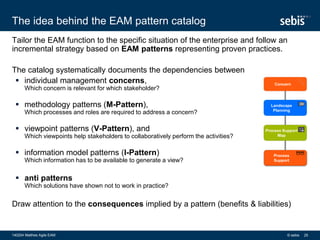
The idea behind the EAM pattern catalog
Tailor the EAM function to the specific situation of the enterprise and follow an
incremental strategy based on EAM patterns representing proven practices.
The catalog systematically documents the dependencies between
 individual management concerns,
Which concern is relevant for which stakeholder?
 methodology patterns (M-Pattern),
Which processes and roles are required to address a concern?
 viewpoint patterns (V-Pattern), and
Which viewpoints help stakeholders to collaboratively perform the activities?
 information model patterns (I-Pattern)
Which information has to be available to generate a view?
 anti patterns
Which solutions have shown not to work in practice?
Draw attention to the consequences implied by a pattern (benefits & liabilities)
© sebis140204 Matthes Agile EAM 25
Process
Support
Process Support
Map
Landscape
Planning
Concern
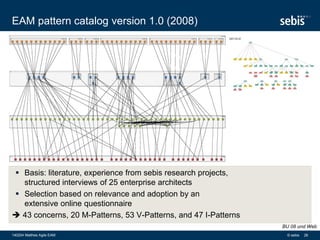
EAM pattern catalog version 1.0 (2008)
 Basis: literature, experience from sebis research projects,
structured interviews of 25 enterprise architects
 Selection based on relevance and adoption by an
extensive online questionnaire
 43 concerns, 20 M-Patterns, 53 V-Patterns, and 47 I-Patterns
140204 Matthes Agile EAM 26© sebis
BU 08 und Web
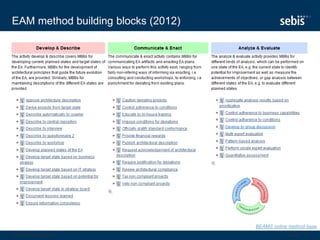
EAM method building blocks (2012)
© sebis140204 Matthes Agile EAM 27
BEAMS online method base

2014 02 florian-matthes-agile-enterprise-architecture-management

  • 1.
    Software Engineering forBusiness Information Systems (sebis) Department of Informatics Technische Universität München, Germany wwwmatthes.in.tum.de Agile Enterprise Architecture Management Prof. Florian Matthes, DEDM 2014, Paris
  • 2.
    Technische Universität München ©sebis140204 Matthes Agile EAM 2 13 Faculties  Mathematics & Informatics  Natural Sciences  Engineering & Architecture  Life Sciences & Medicine  Economics & Education 32.000 Students 2.800 Informatics Faculty 478 Professors 48 Informatics Faculty 13 Nobel Prize winners * 2012
  • 3.
    Background © sebis140204 MatthesAgile EAM 3 Enterprise Architecture Management Social Software Engineering  System cartography  EAM tool surveys  EAM pattern catalog  Capability models in mergers & acquisitions  Building blocks for EAM  Wiki4EAM  Agile EAM  User-centered social software  Authorization models in social software  Introspective model-driven development  Enterprise 2.0 tool surveys  Hybrid Wikis  Tag -based knowledge organization Communities Collaborative Work Digital Content  CoreMedia AG (Spinoff)  infoAsset AG (Spinoff)  Business & IT transformation @ VW  EAM 2.0 @ HUK Coburg  KPI systems @ SFS  Cloud security @ Siemens  Strategy assessment @ FI  D-MOVE Technology Transfer Projects
  • 4.
    Project partners since2002 © sebis140204 Matthes Agile EAM 4 Enterprises and public administrations Deutsche Börse Systems
  • 5.
    Project Partners since2002 © sebis140204 Matthes Agile EAM 5 Consultants and Software Vendors
  • 6.
    1. Turbulent Times Acceleratinggrowth, heterogeneity, connectedness and change 2. Enterprise Architecture & Enterprise Architecture Management Clarity, coherence and agility despite complexity 3. Agile Architecture Management Principles and implementation using patterns and building blocks Overview © sebis140204 Matthes Agile EAM 6
  • 7.
    The adoption ratefor new technologies keeps accelerating. © sebis140204 Matthes Agile EAM 7 Forbes Magazine July 7th 1997
  • 8.
    Exponential growth startsinconspicuously, and humans are not used to reasoning about non-linear processes. 140204 Matthes Agile EAM 8© sebis Google Trends December 2013
  • 9.
    The world isgetting increasingly turbulent. 140204 Matthes Agile EAM 9© sebis
  • 10.
    Speculation: Where doesthe evolution of information technology lead? 140204 Matthes Agile EAM 10© sebis www.singularity.com
  • 11.
    1. Turbulent Times Acceleratinggrowth, heterogeneity, connectedness and change 2. Enterprise Architecture & Enterprise Architecture Management Clarity, coherence and agility despite complexity 3. Agile Architecture Management Principles and implementation using patterns and building blocks Overview © sebis140204 Matthes Agile EAM 11
  • 12.
    Humans: Employees, Customers,Suppliers, Partners, Markets, Communities, … Resources: Energy, Matter, Information, Technology… Enterprise A cybernetic view on the enterprise as a complex adaptive system of systems © sebis140204 Matthes Agile EAM 12 Business Capabilities Information Management RUN TRANSFORM IM Capabilities RUN TRANSFORM Goals, Strategy Vision, Goals, Strategy
  • 13.
    System complexity ~number, variety and dynamicity of elements and their dependencies 140204 Matthes Agile EAM 13 Business Architecture Management IT Architecture Management © sebis
  • 14.
    An enterprise architectureprovides a common language for business and IT. Common language for business and IT  Technical, social, economic and legal aspects  Layers and crosscutting concerns  Static and dynamic relationships more important than element details 140204 Matthes Agile EAM Strategies&Projects Principles&Standards Business Capabilities Organization & Processes Business Services Applications & Databases Infrastructure Services Infrastructure Elements Visions&Goals Questions&KPIs 14 LegalAspects Security © sebis + Evolution
  • 15.
    An enterprise architecturehas to be visualized to make it accessible to different stakeholders. 140204 Matthes Agile EAM 15© sebis EAVIST 2014 and EAM Pattern Catalog
  • 16.
    Architecture management hasto be integrated with other management functions. Architectural changes are performed through a coherent set of projects. 140204 Matthes Agile EAM 16 Architecture Management Multi-Project Management Project Portfolio ManagementStrategy Management Project Lifecycle Define Measure Plan Measure Prioritize & Commit Implement Measure Deploy & Migrate Requirements Management Identify Measure Application Lifecycle Management Innovation Management Example of a mature IT organization © sebis
  • 17.
    Agile enterprise architecturemanagement © sebis140204 Matthes Agile EAM 17 Influence factors, activities and artifacts EAM Questions Organizational Context EAM Goals Maturity of other (IT) management functions Architectural Principles Target Architecture Planned Architecture Current Architecture Enterprise Context Influence factors changing over time
  • 18.
    1. Turbulent Times Acceleratinggrowth, heterogeneity, connectedness and change 2. Enterprise Architecture & Enterprise Architecture Management Clarity, coherence and agility despite complexity 3. Agile Architecture Management Principles and implementation using patterns and building blocks Overview © sebis140204 Matthes Agile EAM 18
  • 19.
    Agile EA managementprinciples 140204 Matthes Agile EAM 19 Individuals and interactions over formal processes and tools IT Project 3 IT Project 2IT Project 1 Top management Business stakeholders Software development IT operations Project managers Software architects Software developers Top management Strategy office Business owners Application owners IT operations Purchasing EA Team • Ensure top management support • Maintain a good relationship to people form other management areas © sebis
  • 20.
    Agile EA managementprinciples 140204 Matthes Agile EAM 20 Focus on demands of top stakeholders and speak their languages IT Project 3 IT Project 2IT Project 1 Architecture blueprints Top management Business stakeholders Software development IT operations Project managers Software architects Software developers   Top management Strategy office Visualizations Business owners Application owners IT operations Purchasing EA Team Stakeholder-specific architecture views Metrics Reports Architecture- approval and requirements Architecture changes model collect motivate Business and IT strategy Individual architecture aspects Business and org. constraints • A single number or picture is more helpful than 1000 reports • Communicate, communicate, communicate • Avoid waste • Benefit form existing model management processes © sebis
  • 21.
    Agile EA managementprinciples 140204 Matthes Agile EAM 21 Reflect behavior and adapt to changes IT Project 3 IT Project 2IT Project 1 Architecture blueprints Top management Business stakeholders Software development IT operations Project managers Software architects Software developers  reflect adapt   Top management Strategy office Visualizations Business owners Application owners IT operations Purchasing EA Team Stakeholder-specific architecture views Metrics Reports Architecture- approval and requirements Architecture changes model collect motivate Business and IT strategy Individual architecture aspects Business and org. constraints • Iterative and Incremental (one cycle ~12 months) • Use building blocks and patterns • Request 360° feedback • Adapt models and processes • Continuous collaboration © sebis
  • 22.
    Patterns and buildingblocks help to incrementally develop an organization-specific EAM function. © sebis140204 Matthes Agile EAM 22 Stakeholders Goals + Concerns Organizational context Organizational context Organizational Context ActorsEnterprise Architects MBB VBB VBB MBB VBB MBB VBB IBB MBB IBB IBB Enterprise Architects Development method Characterize situation Configure EAM function Analyze EAM function Adapt and evolve EAM function Execute EAM function Implementation Guide (Patterns & Building Blocks) BEAMS , EAM Pattern Catalog and EAM KPI Catalog
  • 23.
    Adoption of EAmanagement principles 26 29 31 33 38 39 39 43 43 48 49 51 52 54 55 60 60 62 64 65 65 66 67 67 68 72 72 73 76 77 81 89 95 28 28 16 14 27 23 27 29 26 26 19 21 19 28 18 18 8 25 16 21 17 19 11 15 18 13 8 12 13 11 13 4 2 40 38 52 51 28 30 30 26 22 21 29 23 28 14 26 20 23 12 15 10 15 14 20 17 4 4 11 11 8 7 4 6 3 8 7 3 4 9 10 6 4 11 7 5 7 3 6 3 4 11 3 7 6 5 3 4 3 12 13 11 6 5 7 4 3 2 0 20 40 60 80 100 Valuation of time over quality Exactly respond to the stakeholders' demands Adherence to the one-piece flow Application of the pull-principle Advancement with a indefinite & constant pace Agreed level of done Actually used by stakeholders Embracement of changes Valuation of time over completness Satisfied with its work Clear definition of roles & responsibilities Focus on requirements Stakeholders provide feedback to EAM team Satisfy stakeholders Focus on high-quality Characterized by defined roles & responsibilities Accomplishes EAM tasks in small subteams Diplomacy and negotiation skills Members know their colleagues' duties Early delivery Foster learning by experiments Common language Usable for stakeholders As simple and accessible as possible Leader fosters team's self-organization Leader acts as servant for the team EAM team incorporates feedback Incorporation of reflections & retrospectives Specialized to perform various tasks Performs tasks in self-organized manner Iterative Incremental Operates cross-functional Agree Neither Disagree No response Survey among European enterprise architects (Q4 2013, n=105) Agile Enterprise Architecture management: Empirical analysis on the application of agile principles [to appear 2014] © sebis140204 Matthes Agile EAM 23
  • 24.
    Technische Universität München Departmentof Informatics Chair of Software Engineering for Business Information Systems Boltzmannstraße 3 85748 Garching bei München Tel +49.89.289. Fax +49.89.289.17136 wwwmatthes.in.tum.de Florian Matthes Prof.Dr.rer.nat. 17132 matthes@in.tum.de Thank you for your attention. Questions?
  • 25.
    The idea behindthe EAM pattern catalog Tailor the EAM function to the specific situation of the enterprise and follow an incremental strategy based on EAM patterns representing proven practices. The catalog systematically documents the dependencies between  individual management concerns, Which concern is relevant for which stakeholder?  methodology patterns (M-Pattern), Which processes and roles are required to address a concern?  viewpoint patterns (V-Pattern), and Which viewpoints help stakeholders to collaboratively perform the activities?  information model patterns (I-Pattern) Which information has to be available to generate a view?  anti patterns Which solutions have shown not to work in practice? Draw attention to the consequences implied by a pattern (benefits & liabilities) © sebis140204 Matthes Agile EAM 25 Process Support Process Support Map Landscape Planning Concern
  • 26.
    EAM pattern catalogversion 1.0 (2008)  Basis: literature, experience from sebis research projects, structured interviews of 25 enterprise architects  Selection based on relevance and adoption by an extensive online questionnaire  43 concerns, 20 M-Patterns, 53 V-Patterns, and 47 I-Patterns 140204 Matthes Agile EAM 26© sebis BU 08 und Web
  • 27.
    EAM method buildingblocks (2012) © sebis140204 Matthes Agile EAM 27 BEAMS online method base