Weighing Ice Sheets from Space

Pavel Ditmar
Department of Geoscience and Remote Sensing
Delft University of Technology

Challenge the future

1
How to weigh up an
ice sheet?

Challenge the future

3
Measurement principle of satellite
gravimetry

M
Newton's law of universal
gravitation:

F

Newton's 2nd law:

a

Equation of motion:

x
Challenge the future

4
GRACE Satellite
Mission

• Launch date: March 17, 2002
• Altitude: 450 – 500 km

(C) http://www.csr.utexas.edu

• Expected operation period: until 2017
• Satellite-to-satellite distance: ≈ 200 km
• Primary sensor: K-Band Ranging (KBR) system
• Inter-satellite ranging accuracy: ≈ 10-6 m
Challenge the future

5
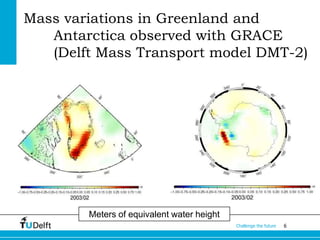
Mass variations in Greenland and
Antarctica observed with GRACE
(Delft Mass Transport model DMT-2)

Meters of equivalent water height
Challenge the future

6
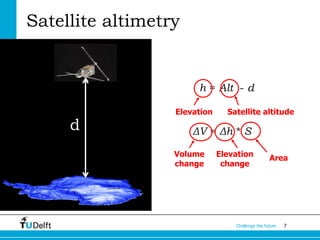
Satellite altimetry

h = Alt - d

d

Elevation

Satellite altitude

ΔV = Δh * S
Volume
change

Elevation
change

Area

Challenge the future

7
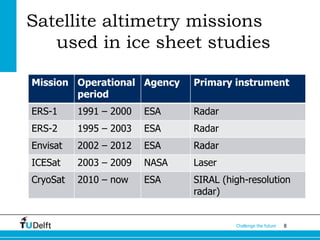
Satellite altimetry missions
used in ice sheet studies
Mission Operational Agency
period

Primary instrument

ERS-1

1991 – 2000

ESA

Radar

ERS-2

1995 – 2003

ESA

Radar

Envisat

2002 – 2012

ESA

Radar

ICESat

2003 – 2009

NASA

Laser

CryoSat

2010 – now

ESA

SIRAL (high-resolution
radar)

Challenge the future

8
Mass balance estimates: intercomparison of different methods and
final numbers
Mass balance in 2003 – 2008

Challenge the future
9
Shepherd et al, Science, 2012
Temporal variability of mass changes

(Gravimetry and
radar altimetry
time-series are
smoothed with
a 13-month
moving average)
Challenge the future 10
Shepherd et al, Science, 2012
Features and limitations of
satellite altimetry
Conventional
radar

SIRAL

Laser

Spatial resolution

~ 10 km

~ 10 km cross-track
~ 0.3 km along-track

~ 0.1 km

Senses fresh snow

No

No

Yes

Number of suitable
satellite missions

at least, 3

1

1

Temporal coverage

1991-2012

2010-now

2003-2009

Temporal resolution

~ 1 month

~ 1 month

~ 1 year

Operates in the presence of cloud cover

Yes

Yes

No

Senses mass
changes directly

No

No

No

Challenge the future

11
Features and limitations of satellite gravimetry:
Sensitivity to Glacial Isostatic Adjustment (GIA)

Figure from http://www.physicalgeography.net/
Challenge the future

12
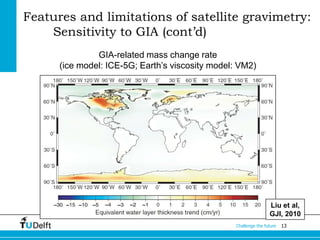
Features and limitations of satellite gravimetry:
Sensitivity to GIA (cont’d)
GIA-related mass change rate
(ice model: ICE-5G; Earth’s viscosity model: VM2)

Liu et al,
GJI, 2010
Challenge the future

13
Mass change rates in Antarctica from
GRACE and ICESat data (2003 – 2009)
observed

M
M
VV

Total mass
change (GRACE)

EWH (cm/yr)
(CSR RL04 DDK3)

iceice

VV

iceice

snow
snow
GIA

VV

GIA
ice
snow
V ice V V snow
V

Total height
change (ICESat)

(cm/yr)

snow
snow
GIA

pre-defined

GIA mass change

EWH (mm/yr)

Ice mass change

EWH (mm/yr)
Didova et al, 2013
Challenge the future

14
Further limitation of GRACE:
anisotropic sensitivity
GRACE Ground-tracks
(a day in July 2006)
GRACE-1
GRACE-2
(not to scale)

Let

f =: f(y) =>

Challenge the future

=0

15
Mitigation of GRACE limitations:
application of “intelligent” constraints
Unconstrained
GRACE solution

GRACE solution
constrained over the ocean

Challenge the future

16
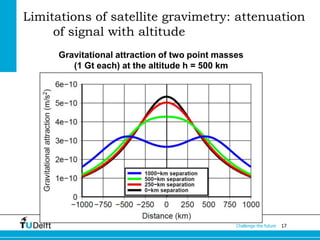
Limitations of satellite gravimetry: attenuation
of signal with altitude
Gravitational attraction of two point masses
(1 Gt each) at the altitude h = 500 km

Challenge the future

17
Future of satellite gravimetry
• Better geometry of satellite formations, usage of
several satellite pairs simultaneously
• Lower satellite altitude (250-300 km)
• Usage of more accurate onboard instruments

Challenge the future

18
Impact of noise in satellite attitudes onto
the quality of mass transport solutions

Unconstrained GRACE solution,
total noise

RMS = 20 m

Unconstrained GRACE solution,
noise in satellite attitudes only

RMS = 5 m

Challenge the future

19
More distant future of “gravimetric
remote sensing”
Questions to be
answered: how to
ensure a suitable
•

•
•

•

... accuracy of
gravimetric
measurements?
... accuracy of
positioning?
... spatial coverage and
observation repeat
period?
...

Airships?

“Conventional” airplanes?

HALE (High Attitude Long
Endurance) Unmanned Vehicles ?
Challenge the future

20
Conclusions
• Current technology level allows the rate of total ice mass loss
in Greenland and Antarctic to be reliably estimated. Ice
sheets in Greenland and Antarctic steadily loose mass in the
last 20 year: the average rate of mass loss is 142 Gt/yr and
71 Gt/yr, respectively (Shepherd et al, 2012).
• Further improvements in data processing and observational
concepts are needed to monitor ice sheet changes with a
high temporal and spatial resolution.
• Gravimetry is the only observational concept that can sense
total mass changes. Further development of this technique
will have a large impact on ice sheet studies.

Challenge the future

21
Acknowledgements
The author thanks colleagues from the Dept. GRS of
TU Delft for providing contributions to the presentation:
•
•
•
•
•
•

Sun Yu
Jiangjun Ran
Olga Didova
Pedro Inacio
Hassan Hashemi Farahani
Riccardo Riva

Challenge the future

22

2013.10.17 ice sheet-symposium_ditmar

  • 1.
    Weighing Ice Sheetsfrom Space Pavel Ditmar Department of Geoscience and Remote Sensing Delft University of Technology Challenge the future 1
  • 2.
    How to weighup an ice sheet? Challenge the future 3
  • 3.
    Measurement principle ofsatellite gravimetry M Newton's law of universal gravitation: F Newton's 2nd law: a Equation of motion: x Challenge the future 4
  • 4.
    GRACE Satellite Mission • Launchdate: March 17, 2002 • Altitude: 450 – 500 km (C) http://www.csr.utexas.edu • Expected operation period: until 2017 • Satellite-to-satellite distance: ≈ 200 km • Primary sensor: K-Band Ranging (KBR) system • Inter-satellite ranging accuracy: ≈ 10-6 m Challenge the future 5
  • 5.
    Mass variations inGreenland and Antarctica observed with GRACE (Delft Mass Transport model DMT-2) Meters of equivalent water height Challenge the future 6
  • 6.
    Satellite altimetry h =Alt - d d Elevation Satellite altitude ΔV = Δh * S Volume change Elevation change Area Challenge the future 7
  • 7.
    Satellite altimetry missions usedin ice sheet studies Mission Operational Agency period Primary instrument ERS-1 1991 – 2000 ESA Radar ERS-2 1995 – 2003 ESA Radar Envisat 2002 – 2012 ESA Radar ICESat 2003 – 2009 NASA Laser CryoSat 2010 – now ESA SIRAL (high-resolution radar) Challenge the future 8
  • 8.
    Mass balance estimates:intercomparison of different methods and final numbers Mass balance in 2003 – 2008 Challenge the future 9 Shepherd et al, Science, 2012
  • 9.
    Temporal variability ofmass changes (Gravimetry and radar altimetry time-series are smoothed with a 13-month moving average) Challenge the future 10 Shepherd et al, Science, 2012
  • 10.
    Features and limitationsof satellite altimetry Conventional radar SIRAL Laser Spatial resolution ~ 10 km ~ 10 km cross-track ~ 0.3 km along-track ~ 0.1 km Senses fresh snow No No Yes Number of suitable satellite missions at least, 3 1 1 Temporal coverage 1991-2012 2010-now 2003-2009 Temporal resolution ~ 1 month ~ 1 month ~ 1 year Operates in the presence of cloud cover Yes Yes No Senses mass changes directly No No No Challenge the future 11
  • 11.
    Features and limitationsof satellite gravimetry: Sensitivity to Glacial Isostatic Adjustment (GIA) Figure from http://www.physicalgeography.net/ Challenge the future 12
  • 12.
    Features and limitationsof satellite gravimetry: Sensitivity to GIA (cont’d) GIA-related mass change rate (ice model: ICE-5G; Earth’s viscosity model: VM2) Liu et al, GJI, 2010 Challenge the future 13
  • 13.
    Mass change ratesin Antarctica from GRACE and ICESat data (2003 – 2009) observed M M VV Total mass change (GRACE) EWH (cm/yr) (CSR RL04 DDK3) iceice VV iceice snow snow GIA VV GIA ice snow V ice V V snow V Total height change (ICESat) (cm/yr) snow snow GIA pre-defined GIA mass change EWH (mm/yr) Ice mass change EWH (mm/yr) Didova et al, 2013 Challenge the future 14
  • 14.
    Further limitation ofGRACE: anisotropic sensitivity GRACE Ground-tracks (a day in July 2006) GRACE-1 GRACE-2 (not to scale) Let f =: f(y) => Challenge the future =0 15
  • 15.
    Mitigation of GRACElimitations: application of “intelligent” constraints Unconstrained GRACE solution GRACE solution constrained over the ocean Challenge the future 16
  • 16.
    Limitations of satellitegravimetry: attenuation of signal with altitude Gravitational attraction of two point masses (1 Gt each) at the altitude h = 500 km Challenge the future 17
  • 17.
    Future of satellitegravimetry • Better geometry of satellite formations, usage of several satellite pairs simultaneously • Lower satellite altitude (250-300 km) • Usage of more accurate onboard instruments Challenge the future 18
  • 18.
    Impact of noisein satellite attitudes onto the quality of mass transport solutions Unconstrained GRACE solution, total noise RMS = 20 m Unconstrained GRACE solution, noise in satellite attitudes only RMS = 5 m Challenge the future 19
  • 19.
    More distant futureof “gravimetric remote sensing” Questions to be answered: how to ensure a suitable • • • • ... accuracy of gravimetric measurements? ... accuracy of positioning? ... spatial coverage and observation repeat period? ... Airships? “Conventional” airplanes? HALE (High Attitude Long Endurance) Unmanned Vehicles ? Challenge the future 20
  • 20.
    Conclusions • Current technologylevel allows the rate of total ice mass loss in Greenland and Antarctic to be reliably estimated. Ice sheets in Greenland and Antarctic steadily loose mass in the last 20 year: the average rate of mass loss is 142 Gt/yr and 71 Gt/yr, respectively (Shepherd et al, 2012). • Further improvements in data processing and observational concepts are needed to monitor ice sheet changes with a high temporal and spatial resolution. • Gravimetry is the only observational concept that can sense total mass changes. Further development of this technique will have a large impact on ice sheet studies. Challenge the future 21
  • 21.
    Acknowledgements The author thankscolleagues from the Dept. GRS of TU Delft for providing contributions to the presentation: • • • • • • Sun Yu Jiangjun Ran Olga Didova Pedro Inacio Hassan Hashemi Farahani Riccardo Riva Challenge the future 22

Editor's Notes

  • #15 Add how many Gt/yr!!! And equivalent sea level rise!!!The figures show the result of the GRACE-ICESat combination for the period 03-2003 till 03-2007. The first two plots show trends from 1) mass change measured by GRACE, 2) surface elevation change measured by ICESat. The combination of the two data sets allows the isolation of trends of surface elevation changes due to GIA and ice mass changes. Figure c) shows for the first time ever the result of the first direct observation of the Antarctic GIA over the whole continent. Noteworthy, the result of this direct observation shows some common features with IJ05 model results. The presence of significant differences over the two main ice shelves and the Antarctic Peninsula, however,, suggest the potential of those results to considerably improve existing models of Antarctic glacial history.Compared with other techniques for mass balance estimation (e.g. budget method), the combination approach has the advantage to allow an accurate localization of the areas of mass change. This is important for ice streams discharging into the Amundsen Sea Embayment (between 230-270 deg longtiude), which appear to be currently out of blaance and are therefore raising concerns about the stability of the WAIS.