Towards the Discovery
of Person-Level Data
International Workshop on Semantic Statistics
22 October 2013, Sydney, Australia

Thomas Bosch1, Benjamin Zapilko1, Joachim Wackerow1, Arofan Gregory2
1GESIS

– Leibniz Institute for the Social Sciences, Germany
{first name.last name}@gesis.org
2Open

Data Foundation, USA

agregory@opendatafoundation.org
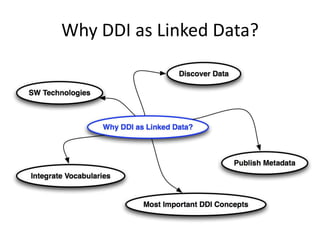
Why DDI as Linked Data?
Overview
class overview
question

0..*

0..*

Question
0..*

0..*
Variable

analysisUnit

variable

0..1

1..*

0..*
0..*

skos:Concept
AnalysisUnit

question
0..*

containsVariable

0..1

Instrument
Questionnaire

1..* 1..*

product

Study
universe

0..*

analysisUnit

inGroup
0..1

0..*

universe
0..*

«union»

StudyGroup

0..*
1

1..*

skos:Concept
Universe

1

universe
universe

1

0..*

1..*

dcat:Dataset
LogicalDataSet

0..*
Use Cases
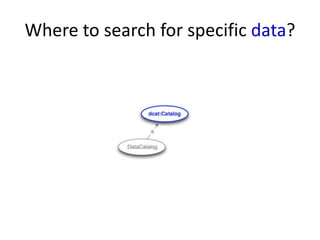
Where to search for specific data?
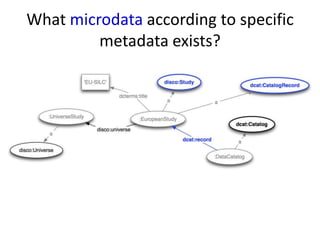
What microdata according to specific
metadata exists?
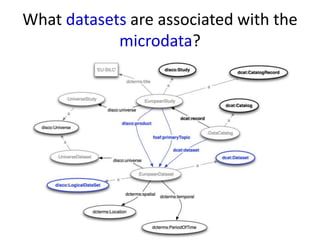
What datasets are associated with the
microdata?
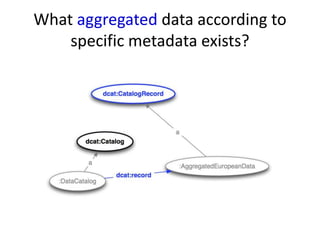
What aggregated data according to
specific metadata exists?
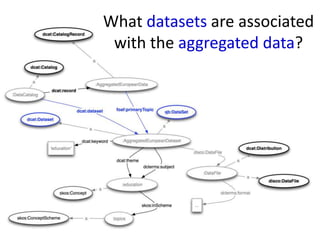
What datasets are associated
with the aggregated data?
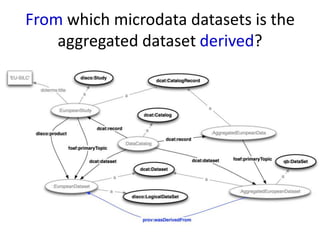
From which microdata datasets is the
aggregated dataset derived?
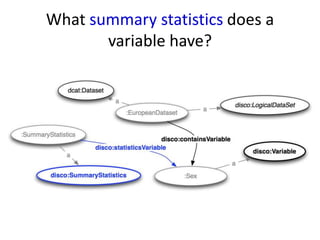
What summary statistics does a
variable have?
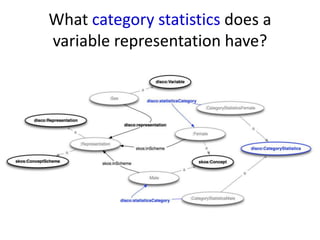
What category statistics does a
variable representation have?
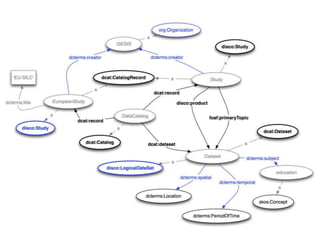
What microdata datasets are created
by the research institute 'GESIS'
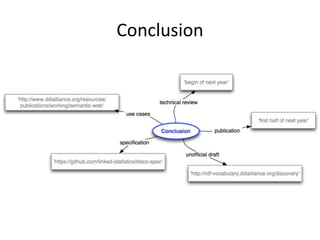
Conclusion
Thank you for your attention…
Backup Slides
Why DDI as Linked Data?
• Users discover data in the Linked Open Data Cloud
using DDI metadata
• Users can search for data
• Data providers publish searchable / accessable
metadata
• The Discovery specification contains the most
important DDI concepts for the discovery purpose
• We integrated well elaborated vocabularies
• We use SW technologies
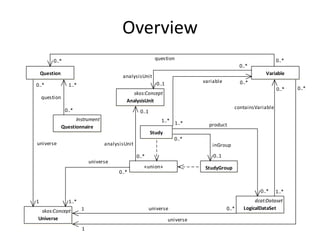
Overview
• Study
• LogicalDataSet: the dataset where we save the actual data
• Universe: for whom is the study applied to? (e.g. all women
in Germany)
• Analysis Unit (e.g. persons or households)
• Instrument: How do we want to measure? (e.g. 'What is
your sex?')
• Concept: What do we want to measure?
• Variable: Where do we save what we measured? (e.g. sex)
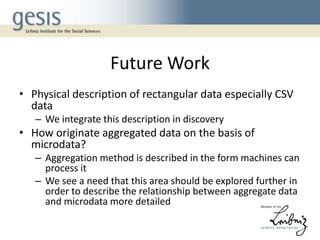
Future Work
• Physical description of rectangular data especially CSV
data
– We integrate this description in discovery

• How originate aggregated data on the basis of
microdata?
– Aggregation method is described in the form machines can
process it
– We see a need that this area should be explored further in
order to describe the relationship between aggregate data
and microdata more detailed
Acknowledgements
26 experts from the statistical community and the Linked Data community coming
from 12 different countries contributed to this work. They were participating in
the events mentioned below.
• 1st workshop on 'Semantic Statistics for Social, Behavioural, and Economic
Sciences: Leveraging the DDI Model for the Linked Data Web' at Schloss
Dagstuhl - Leibniz Center for Informatics, Germany in September 2011
• Working meeting in the course of the 3rd Annual European DDI Users Group
Meeting (EDDI11) in Gothenburg, Sweden in December 2011
• 2nd workshop on 'Semantic Statistics for Social, Behavioural, and Economic
Sciences: Leveraging the DDI Model for the Linked Data Web' at Schloss
Dagstuhl - Leibniz Center for Informatics, Germany in October 2012
• Working meeting at GESIS - Leibniz Institute for the Social Sciences in
Mannheim, Germany in February 2013

Towards the Discovery of Person-Level Data (SemStats, ISWC 2013) [2013.10]