A centre of expertise in digital information management
www.ukoln.ac.uk
UKOLN is supported by:
Roadmaps, Roles & Re-engineering:
Developing Data Informatics
Capability in Libraries
Dr Liz Lyon,
Associate Director, UK Digital Curation Centre,
Director, UKOLN, University of Bath, UK
LIBER Conference Munich, June 2013
This work is licensed under a Creative Commons Licence
Attribution-ShareAlike 2.0
Photocredits: Flickr Teamstaufrenberger
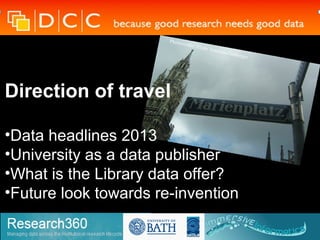
Direction of travel
•Data headlines 2013
•University as a data publisher
•What is the Library data offer?
•Future look towards re-invention
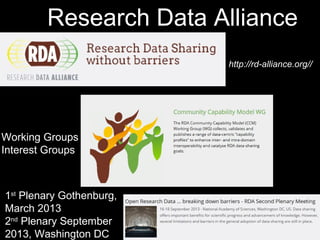
Research Data Alliance
1st
Plenary Gothenburg,
March 2013
2nd
Plenary September
2013, Washington DC
http://rd-alliance.org//
Working Groups
Interest Groups
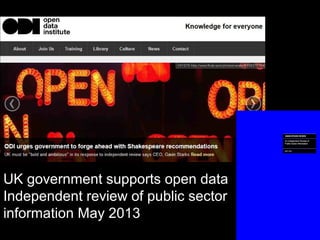
UK government supports open data
Independent review of public sector
information May 2013
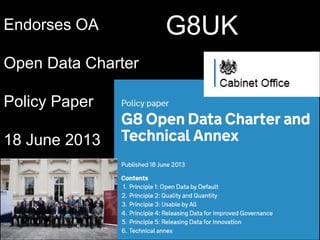
Endorses OA
Open Data Charter
Policy Paper
18 June 2013
G8UK
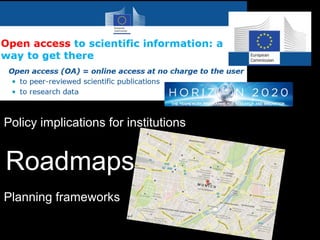
Policy implications for institutions
Planning frameworks
Roadmaps
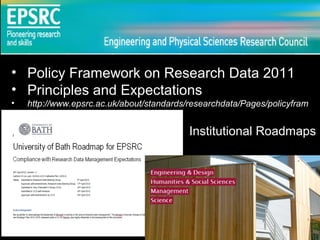
• Policy Framework on Research Data 2011
• Principles and Expectations
• http://www.epsrc.ac.uk/about/standards/researchdata/Pages/policyfram
ework.aspx
Institutional Roadmaps
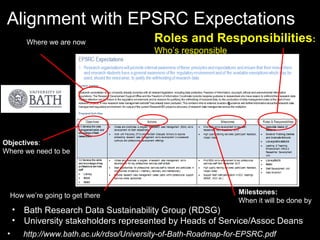
Alignment with EPSRC Expectations
sition:Where we are now
Objectives:
Where we need to be
Actions:
How we’re going to get there Milestones:
When it will be done by
Roles and Responsibilities:
Who’s responsible
• Bath Research Data Sustainability Group (RDSG)
• University stakeholders represented by Heads of Service/Assoc Deans
• http://www.bath.ac.uk/rdso/University-of-Bath-Roadmap-for-EPSRC.pdf
Photo credits: http://www.hdwallpapers.in/man_of_steel-wallpapers.html
Roles
New Library data roles too 
Transition from pilot RDM projects to sustainable
and integrated data services
Articulate business case for RDM investment…..
but first….
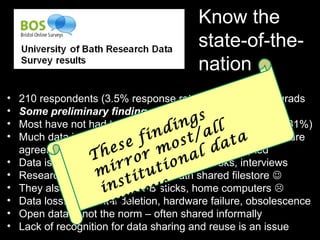
• 210 respondents (3.5% response rate) : PIs, ROs, postgrads
• Some preliminary findings:
• Most have not had to produce a data management plan (81%)
• Much data is confidential, anonymised, under non-disclosure
agreements, commercially sensitive, DPA, encrypted
• Data is also in non-digital form: lab notebooks, interviews
• Researchers store data on Univ Bath shared filestore 
• They also use Dropbox, USB sticks, home computers 
• Data loss: accidental deletion, hardware failure, obsolescence
• Open data is not the norm – often shared informally
• Lack of recognition for data sharing and reuse is an issue
Know the
state-of-the-
nation
These findings
mirror most/all
institutional data
surveys…
Understand
the costs
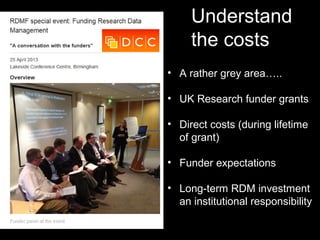
• A rather grey area…..
• UK Research funder grants
• Direct costs (during lifetime
of grant)
• Funder expectations
• Long-term RDM investment
an institutional responsibility
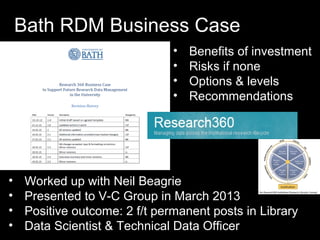
Bath RDM Business Case
• Worked up with Neil Beagrie
• Presented to V-C Group in March 2013
• Positive outcome: 2 f/t permanent posts in Library
• Data Scientist & Technical Data Officer
• Benefits of investment
• Risks if none
• Options & levels
• Recommendations
From 300 year old print-based
traditions….
….to data informatics services &
….data-savvy staff
Re-engineering…
Photo Credits: Flickr Chris Walker
http://www.bmwblog.com/2013/06/17/rumor-bmw-8-series-coupe-in-works/
Positioning the university
as a data publisher
• Takes responsibility
for its data products
• HEI stakeholders
described in 2012
(Informatics Transform)
• Advocacy gap
• Infrastructure gap
• Reputation?
• Risk?
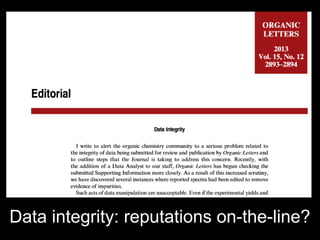
Data integrity: reputations on-the-line?
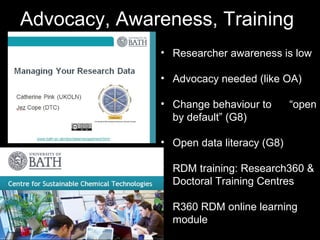
Advocacy, Awareness, Training
• Researcher awareness is low
• Advocacy needed (like OA)
• Change behaviour to “open
by default” (G8)
• Open data literacy (G8)
• RDM training: Research360 &
• Doctoral Training Centres
• R360 RDM online learning
module
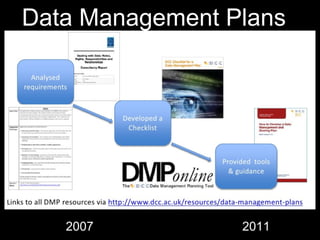
Data Management Plans
2007 2011
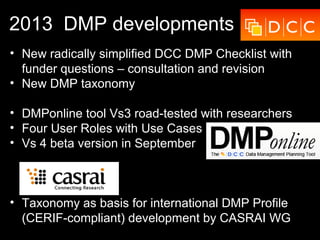
2013 DMP developments
• New radically simplified DCC DMP Checklist with
funder questions – consultation and revision
• New DMP taxonomy
• DMPonline tool Vs3 road-tested with researchers
• Four User Roles with Use Cases
• Vs 4 beta version in September
• Taxonomy as basis for international DMP Profile
(CERIF-compliant) development by CASRAI WG
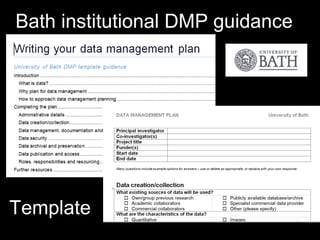
Bath institutional DMP guidance
Template
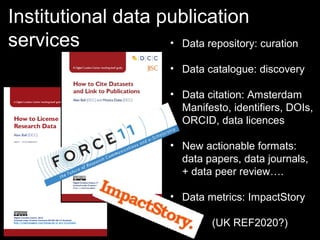
Institutional data publication
services • Data repository: curation
• Data catalogue: discovery
• Data citation: Amsterdam
Manifesto, identifiers, DOIs,
ORCID, data licences
• New actionable formats:
data papers, data journals,
+ data peer review….
• Data metrics: ImpactStory
• (UK REF2020?)
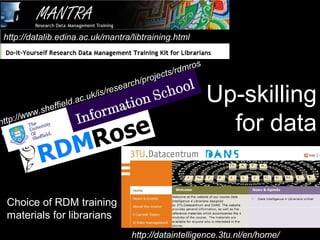
http://dataintelligence.3tu.nl/en/home/
http://www.sheffield.ac.uk/is/research/projects/rdmros
e
Choice of RDM training
materials for librarians
Up-skilling
for data
http://datalib.edina.ac.uk/mantra/libtraining.html
Developing data capability in
professional services
http://immersiveinformatics.org/
ImmersiveInformatics pilot at University of Bath
Co-developed with University of Melbourne
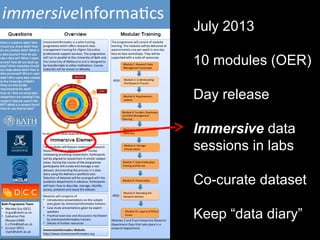
July 2013
10 modules (OER)
Day release
Immersive data
sessions in labs
Co-curate dataset
Keep “data diary”
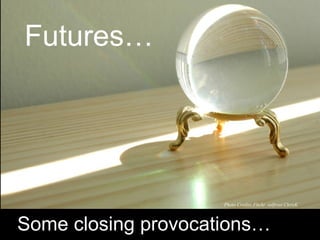
Futures…
Photo Credits:Flickr solfrost ChrisK
Some closing provocations…
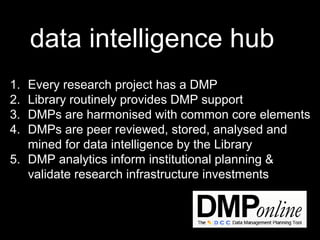
data intelligence hub
1. Every research project has a DMP
2. Library routinely provides DMP support
3. DMPs are harmonised with common core elements
4. DMPs are peer reviewed, stored, analysed and
mined for data intelligence by the Library
5. DMP analytics inform institutional planning &
validate research infrastructure investments
Data is
mission-critical
for Libraries
1. Library delivers core RDM services
2. Regional partnerships with collaborative and
shared data infrastructure services
3. Demonstrate cost-benefits and efficiency savings
4. Data scientist, data librarian, data analyst teams
5. Transformational data service delivery modes
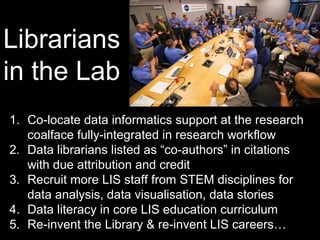
Librarians
in the Lab
1. Co-locate data informatics support at the research
coalface fully-integrated in research workflow
2. Data librarians listed as “co-authors” in citations
with due attribution and credit
3. Recruit more LIS staff from STEM disciplines for
data analysis, data visualisation, data stories
4. Data literacy in core LIS education curriculum
5. Re-invent the Library & re-invent LIS careers…
Photo Credits:Flickr NASA HQ
Thank you !
DCC Resources
http://www.dcc.ac.uk
ImmersiveInformatics
http://immersiveinformatics.org
Research360 Project at University of Bath
http://blogs.bath.ac.uk/research360/
Informatics Transform article
http://www.ijdc.net/index.php/ijdc/article/view/210

Roadmaps, Roles and Re-engineering: Developing Data Informatics Capability in Libraries

  • 1.
    A centre ofexpertise in digital information management www.ukoln.ac.uk UKOLN is supported by: Roadmaps, Roles & Re-engineering: Developing Data Informatics Capability in Libraries Dr Liz Lyon, Associate Director, UK Digital Curation Centre, Director, UKOLN, University of Bath, UK LIBER Conference Munich, June 2013 This work is licensed under a Creative Commons Licence Attribution-ShareAlike 2.0
  • 2.
    Photocredits: Flickr Teamstaufrenberger Directionof travel •Data headlines 2013 •University as a data publisher •What is the Library data offer? •Future look towards re-invention
  • 3.
    Research Data Alliance 1st PlenaryGothenburg, March 2013 2nd Plenary September 2013, Washington DC http://rd-alliance.org// Working Groups Interest Groups
  • 4.
    UK government supportsopen data Independent review of public sector information May 2013
  • 5.
    Endorses OA Open DataCharter Policy Paper 18 June 2013 G8UK
  • 6.
    Policy implications forinstitutions Planning frameworks Roadmaps
  • 7.
    • Policy Frameworkon Research Data 2011 • Principles and Expectations • http://www.epsrc.ac.uk/about/standards/researchdata/Pages/policyfram ework.aspx Institutional Roadmaps
  • 8.
    Alignment with EPSRCExpectations sition:Where we are now Objectives: Where we need to be Actions: How we’re going to get there Milestones: When it will be done by Roles and Responsibilities: Who’s responsible • Bath Research Data Sustainability Group (RDSG) • University stakeholders represented by Heads of Service/Assoc Deans • http://www.bath.ac.uk/rdso/University-of-Bath-Roadmap-for-EPSRC.pdf
  • 9.
    Photo credits: http://www.hdwallpapers.in/man_of_steel-wallpapers.html Roles NewLibrary data roles too  Transition from pilot RDM projects to sustainable and integrated data services Articulate business case for RDM investment….. but first….
  • 10.
    • 210 respondents(3.5% response rate) : PIs, ROs, postgrads • Some preliminary findings: • Most have not had to produce a data management plan (81%) • Much data is confidential, anonymised, under non-disclosure agreements, commercially sensitive, DPA, encrypted • Data is also in non-digital form: lab notebooks, interviews • Researchers store data on Univ Bath shared filestore  • They also use Dropbox, USB sticks, home computers  • Data loss: accidental deletion, hardware failure, obsolescence • Open data is not the norm – often shared informally • Lack of recognition for data sharing and reuse is an issue Know the state-of-the- nation These findings mirror most/all institutional data surveys…
  • 11.
    Understand the costs • Arather grey area….. • UK Research funder grants • Direct costs (during lifetime of grant) • Funder expectations • Long-term RDM investment an institutional responsibility
  • 12.
    Bath RDM BusinessCase • Worked up with Neil Beagrie • Presented to V-C Group in March 2013 • Positive outcome: 2 f/t permanent posts in Library • Data Scientist & Technical Data Officer • Benefits of investment • Risks if none • Options & levels • Recommendations
  • 13.
    From 300 yearold print-based traditions…. ….to data informatics services & ….data-savvy staff Re-engineering… Photo Credits: Flickr Chris Walker http://www.bmwblog.com/2013/06/17/rumor-bmw-8-series-coupe-in-works/
  • 14.
    Positioning the university asa data publisher • Takes responsibility for its data products • HEI stakeholders described in 2012 (Informatics Transform) • Advocacy gap • Infrastructure gap • Reputation? • Risk?
  • 15.
  • 16.
    Advocacy, Awareness, Training •Researcher awareness is low • Advocacy needed (like OA) • Change behaviour to “open by default” (G8) • Open data literacy (G8) • RDM training: Research360 & • Doctoral Training Centres • R360 RDM online learning module
  • 17.
  • 18.
    2013 DMP developments •New radically simplified DCC DMP Checklist with funder questions – consultation and revision • New DMP taxonomy • DMPonline tool Vs3 road-tested with researchers • Four User Roles with Use Cases • Vs 4 beta version in September • Taxonomy as basis for international DMP Profile (CERIF-compliant) development by CASRAI WG
  • 19.
    Bath institutional DMPguidance Template
  • 20.
    Institutional data publication services• Data repository: curation • Data catalogue: discovery • Data citation: Amsterdam Manifesto, identifiers, DOIs, ORCID, data licences • New actionable formats: data papers, data journals, + data peer review…. • Data metrics: ImpactStory • (UK REF2020?)
  • 21.
    http://dataintelligence.3tu.nl/en/home/ http://www.sheffield.ac.uk/is/research/projects/rdmros e Choice of RDMtraining materials for librarians Up-skilling for data http://datalib.edina.ac.uk/mantra/libtraining.html
  • 22.
    Developing data capabilityin professional services http://immersiveinformatics.org/ ImmersiveInformatics pilot at University of Bath Co-developed with University of Melbourne
  • 23.
    July 2013 10 modules(OER) Day release Immersive data sessions in labs Co-curate dataset Keep “data diary”
  • 24.
    Futures… Photo Credits:Flickr solfrostChrisK Some closing provocations…
  • 25.
    data intelligence hub 1.Every research project has a DMP 2. Library routinely provides DMP support 3. DMPs are harmonised with common core elements 4. DMPs are peer reviewed, stored, analysed and mined for data intelligence by the Library 5. DMP analytics inform institutional planning & validate research infrastructure investments
  • 26.
    Data is mission-critical for Libraries 1.Library delivers core RDM services 2. Regional partnerships with collaborative and shared data infrastructure services 3. Demonstrate cost-benefits and efficiency savings 4. Data scientist, data librarian, data analyst teams 5. Transformational data service delivery modes
  • 27.
    Librarians in the Lab 1.Co-locate data informatics support at the research coalface fully-integrated in research workflow 2. Data librarians listed as “co-authors” in citations with due attribution and credit 3. Recruit more LIS staff from STEM disciplines for data analysis, data visualisation, data stories 4. Data literacy in core LIS education curriculum 5. Re-invent the Library & re-invent LIS careers… Photo Credits:Flickr NASA HQ
  • 28.
    Thank you ! DCCResources http://www.dcc.ac.uk ImmersiveInformatics http://immersiveinformatics.org Research360 Project at University of Bath http://blogs.bath.ac.uk/research360/ Informatics Transform article http://www.ijdc.net/index.php/ijdc/article/view/210

Editor's Notes

  • #9 Current position: Where we are This was determined from our 2011 DAF survey and from the k nowledge/experience of Research Data Steering Group Needed to be honest about what we were doing and where the gaps were. Difficult to do on the timescales required as we’d not rolled out our requirements survey. Objectives: Where we need to be These were re-ordered from the adapted Monash strategy and aligned with the EPSRC expectations Not all of the objects that met the Institutional needs were included in the EPSRC Roadmap Actions: How we’re going to get there These were specific with more detail Milestones: when it will be done by Requirement is to be compliant by 2015 – timescales needed to be realistic and achievable Roles and Responsibilities Responsibility spread across a number of key professional support services For each objective, operational leads were identified Everyone with an identified role was informed of this prior to the report being published As a result, a gap in the Research Data Steering Group was identified and an additional member invited to join the group How to get there Specific activities with assigned responsibilities, leads and timetables for delievery