General concepts: DDI
Irena Vipavc Brvar, ADP
SEEDS Kick-off meeting, Lausanne, 4. - 6. May 2015
What we learned so far:
If we want to use data at some point in the future, data need to be
properly documented, saved in trusted place. Users need to be able
to find and access it.
How do we achieve that. - > by using a standard
We would like surveys in our institutions to be describe in the same
way. So every new colleague would know how to do it.
And possibly we would like to use such a standard that is used in
similar organizations – interoperability between DA.
DDI stands for Data Documentation initiative. - > to establish a
standard for technical documentation describing social science data.
How to describe our survey
Idea was to produce metadata specification for the description of social
science data resources.
- Initiated in 1994 (ICPSR) / XML DTD already in 1997
Contributors to the efforts of the DDI come from social science data
archives and libraries in USA, Canada and EU and from major producers
of statistical data (like the US Bureau of the Census, the US Bureau of
Labour statistics, Statistics Canada and Health Canada)
- to replace the existing and widely used OSIRIS Codebook/data
dictionary standard with a more modern and Web-aware specification.
- The first official version of the DDI specification (version 1.0) was
published in March 2000.
- 2002 V2.0
- 2008 V3.0
(Ryssevik, 2001)
Hstory
DDI-Codebook
DDI-Codebook is a more light-weight version of the
standard, intended primarily to document simple survey
data. Originally DTD-based, DDI-C is now available as an
XML Schema. The current version of DDI-C is 2.5.
DDI-Lifecycle
Encompassing all of the DDI-Codebook specification and
extending it, DDI-Lifecycle is designed to document and
manage data across the entire life cycle, from
conceptualization to data publication and analysis
and beyond. Based on XML Schemas, DDI-Lifecycle is
modular and extensible. Current DDI-L 3.2.
2 development lines
- Section 1.0 ‐ Document Description consists of
bibliographic information that can be considered as the
header whose elements uniquely describe the full contents
of the compliant DDI file.
- Section 2.0 ‐ Study Description consists of information
about the data collection. This section includes information
about who collected and who distributes the data, about
the scope and coverage, sampling (if relevant), data
collection methods and processing, citation requirements,
etc.
BASIC STRUCTURE OF DDI 2.*
- Section 3.0 ‐ Data Files Description provides
information about the Data file(s).
- Section 4.0 ‐ Variable Description provides a detailed
description of variables, including (when relevant) the
variable type, variable and value labels, literal questions,
computation or imputation methods, instructions to
interviewers, universe, descriptive statistics, etc.
- Section 5.0 ‐ Other Study Related Materials allows for
the inclusion of other materials related to the study such as
questionnaires, user manuals, computer programs,
interviewer manuals, maps, coding
information, etc.
BASIC STRUCTURE OF DDI 2.*
Controled vocabularity (CESSDA topic classification,
ELSST, DDI vocabulary)
Multilingual support
- > CESSDA Catalogue
Approximate number of elements in each specification
DDI 3.1 - 900
DDI 3.2 - 1150
DDI 2.1 - 400
DDI 2 Lite - 80
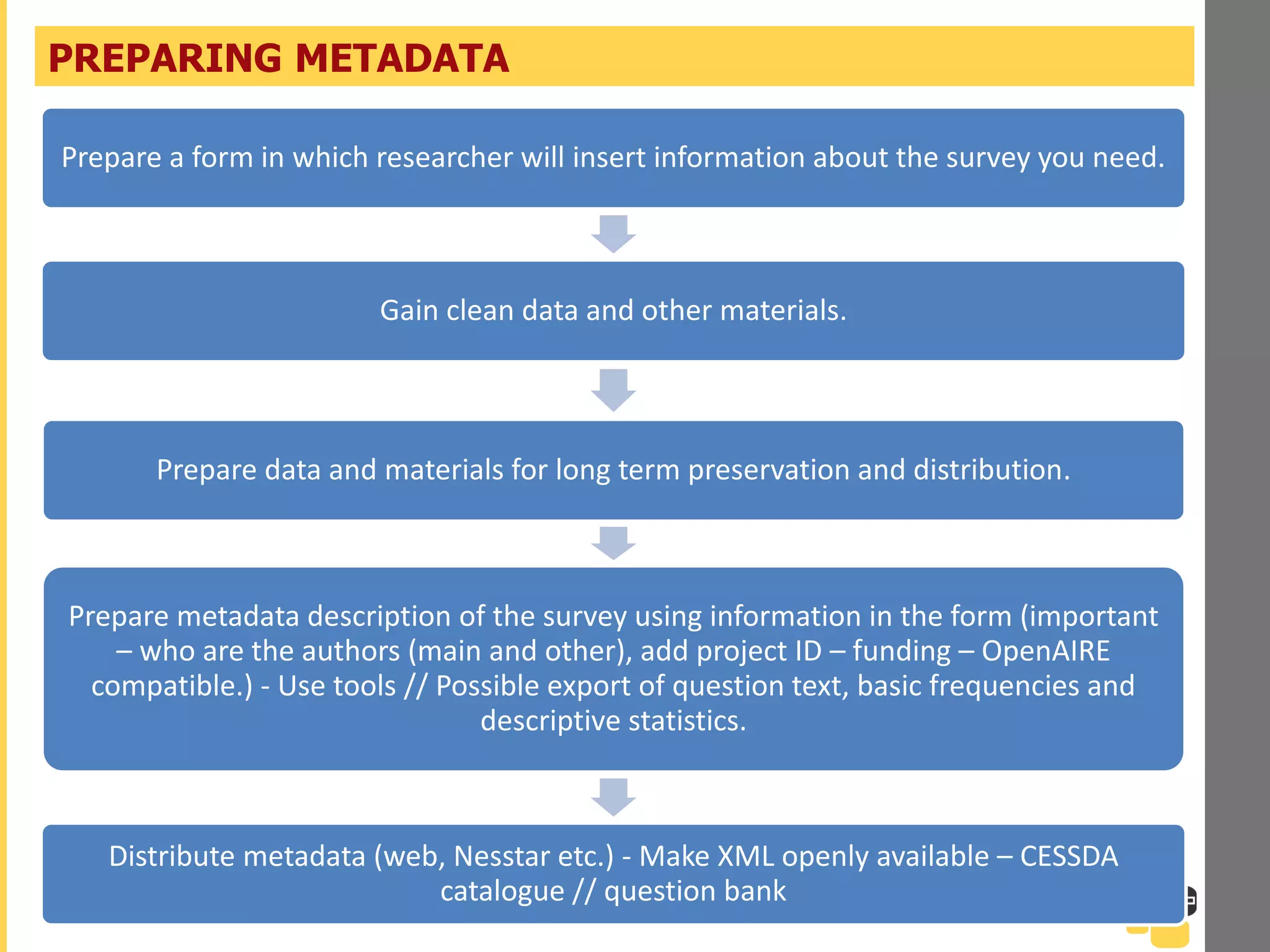
PREPARING METADATA
Prepare a form in which researcher will insert information about the survey you need.
Gain clean data and other materials.
Prepare data and materials for long term preservation and distribution.
Prepare metadata description of the survey using information in the form (important
– who are the authors (main and other), add project ID – funding – OpenAIRE
compatible.) - Use tools // Possible export of question text, basic frequencies and
descriptive statistics.
Distribute metadata (web, Nesstar etc.) - Make XML openly available – CESSDA
catalogue // question bank
Some data about Nesstar usage
Nesstar is currently run by most archives in Europe, and a reasonable
number of data libraries in US/Canada.
Nesstar was originally developed by and for archives, and is designed
to fit many important documentation and dissemination use-cases for
data archives. Nesstar was also the first tool to support DDI, which is
still a highly relevant standard for data documentation.
There are currently > 130 instances of Nesstar Server worldwide,
from Vancouver to Taiwan and from South-Africa to Iceland.
In volume, the International Household Survey Network
(http://ihsn.org/home/) is the most important Nesstar user. IHSN do not
use Nesstar Server, but they use Nesstar Publisher as a documentation
tool for statistical agencies in a large number of (developing)
countries on all continents.
11
Nesstar also fully supports multilingual metadata, which makes it
possible to document data in more than one language (without
duplicating data).
Nesstar Server comes with a set of APIs that allow for third-party
integration with data, metadata and functionality (e.g. tabulation and
download operations) on the server.
Because of the APIs and the DDI support, the Nesstar platform is also
very easy to repurpose for other services, e.g. the CESSDA Portal and
the DwB Data Discovery portal.
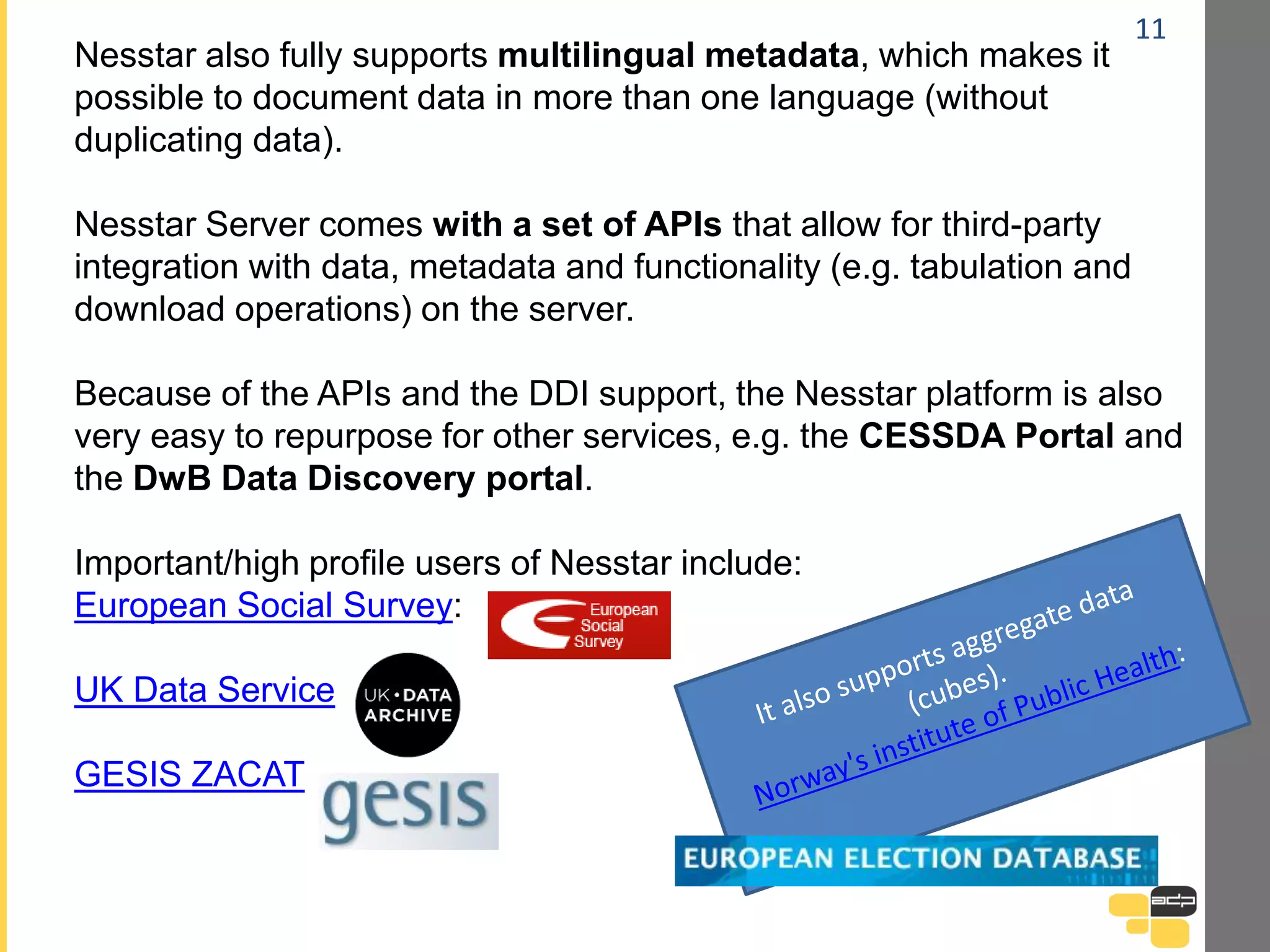
Important/high profile users of Nesstar include:
European Social Survey:
UK Data Service
GESIS ZACAT
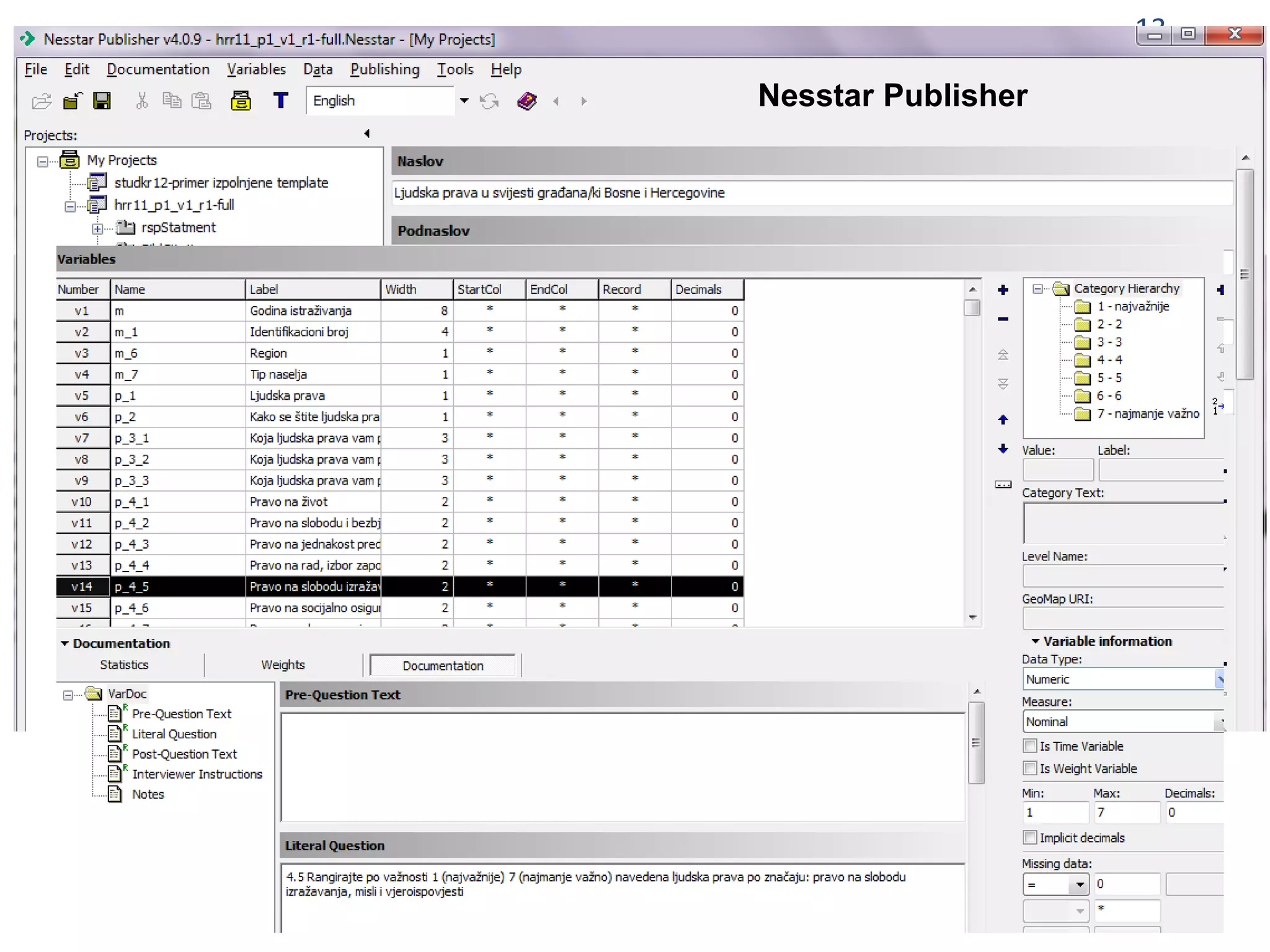
Nesstar Publisher (Located on desktop)
12
Nesstar Publisher – a sophisticated authoring environment that can
publish data from a variety of sources (including SPSS, SAS, Excel
etc.). The tool includes a specialised metadata editor, data and
metadata validation routines and metadata templates that provide
standardisation and control.
Easy editing/creation and export
of DDI documented datasets with
XML experience needed.
Tools to compute/recode/label
new, or existing, variables to be
added to a dataset before
publishing.
Tools to validate metadata and
variables.
The ability to import and export
data to the most common statistical
formats, including delimited files.
The ability to include automatically
generated frequency and summary
statistics for each variable.
Multilingual - Arabic, Chinese,
English, French, Portuguese,
Russian and Spanish and more.
13
Nesstar Publisher
Nesstar Server (Located on server)
14
Nesstar Server - includes an SQL-based metadata management
system, a data storage system, a powerful statistical engine as well as
a flexible access control system.
Nesstar WebView – totally customisable and configurable layer that
presents the search, browse, display, analysis and retrieval options to
the user. Able to seamlessly handle survey data, cubes and other
resources.
Multiple
crosstabulation and
recoding
Regression and
correlation analysis
Nesstar web view
15
The CESSDA portal is an example of integration of data
in heterogeneous, autonomous resources (data archives)
by using harmonised descriptive metadata represented in a
common metadata standard, and using controlled
vocabularies and code schemes.
Harmonisation of metadata is done by the DAs, and the
harmonised metadata are made available in local servers
for harvesting, and for presenting in the CESSDA portal.
<- Retaining the autonomy of the resources/DAs.
More in Deliverable 7.1 and 7.2-3
of DwB project
Using Common Metadata for Harmonisation for Data
Integration
- EDDI – yearly conference (since 2009) / aslo in the US
- DDI workshops in Castle Dagstuhl (since 2007)
- Presentations that are related to DDI at IASSIST
conferences
- Trainings organized by CESSDA archives / CESSDA
expert seminars
Events
DDI Alliance [http://www.ddialliance.org/, 2. 5. 2015]
IHSN: Metadata Editor (Nesstar Publisher 4.0.9)
[http://www.ihsn.org/home/software/ddi-metadata-editor, 2.5.2015]
IHNS (2007): Quick Reference Guide for Data Archivists
[http://www.ihsn.org/home/sites/default/files/resources/DDI_IHSN_Ch
ecklist_OD_06152007.pdf, 2.5.2015]
Ryssevik, J. (2001). The Data Documentation Initiative (DDI) metadata
specification. Paper prepared for MetaNet 2001, Voorburg, Netherlands.
[http://www.ddialliance.org/sites/default/files/ryssevik_0.pdf, 2. 5.
2015]
Martinez, L. (2008): The Data Documentation Initiative (DDI) and
Institutional Repositories
[http://www.disc-uk.org/docs/DDI_and_IRs.pdf, 2.5.2015]

General concepts: DDI

  • 1.
    General concepts: DDI IrenaVipavc Brvar, ADP SEEDS Kick-off meeting, Lausanne, 4. - 6. May 2015
  • 3.
    What we learnedso far: If we want to use data at some point in the future, data need to be properly documented, saved in trusted place. Users need to be able to find and access it. How do we achieve that. - > by using a standard We would like surveys in our institutions to be describe in the same way. So every new colleague would know how to do it. And possibly we would like to use such a standard that is used in similar organizations – interoperability between DA. DDI stands for Data Documentation initiative. - > to establish a standard for technical documentation describing social science data. How to describe our survey
  • 4.
    Idea was toproduce metadata specification for the description of social science data resources. - Initiated in 1994 (ICPSR) / XML DTD already in 1997 Contributors to the efforts of the DDI come from social science data archives and libraries in USA, Canada and EU and from major producers of statistical data (like the US Bureau of the Census, the US Bureau of Labour statistics, Statistics Canada and Health Canada) - to replace the existing and widely used OSIRIS Codebook/data dictionary standard with a more modern and Web-aware specification. - The first official version of the DDI specification (version 1.0) was published in March 2000. - 2002 V2.0 - 2008 V3.0 (Ryssevik, 2001) Hstory
  • 5.
    DDI-Codebook DDI-Codebook is amore light-weight version of the standard, intended primarily to document simple survey data. Originally DTD-based, DDI-C is now available as an XML Schema. The current version of DDI-C is 2.5. DDI-Lifecycle Encompassing all of the DDI-Codebook specification and extending it, DDI-Lifecycle is designed to document and manage data across the entire life cycle, from conceptualization to data publication and analysis and beyond. Based on XML Schemas, DDI-Lifecycle is modular and extensible. Current DDI-L 3.2. 2 development lines
  • 6.
    - Section 1.0‐ Document Description consists of bibliographic information that can be considered as the header whose elements uniquely describe the full contents of the compliant DDI file. - Section 2.0 ‐ Study Description consists of information about the data collection. This section includes information about who collected and who distributes the data, about the scope and coverage, sampling (if relevant), data collection methods and processing, citation requirements, etc. BASIC STRUCTURE OF DDI 2.*
  • 7.
    - Section 3.0‐ Data Files Description provides information about the Data file(s). - Section 4.0 ‐ Variable Description provides a detailed description of variables, including (when relevant) the variable type, variable and value labels, literal questions, computation or imputation methods, instructions to interviewers, universe, descriptive statistics, etc. - Section 5.0 ‐ Other Study Related Materials allows for the inclusion of other materials related to the study such as questionnaires, user manuals, computer programs, interviewer manuals, maps, coding information, etc. BASIC STRUCTURE OF DDI 2.*
  • 8.
    Controled vocabularity (CESSDAtopic classification, ELSST, DDI vocabulary) Multilingual support - > CESSDA Catalogue Approximate number of elements in each specification DDI 3.1 - 900 DDI 3.2 - 1150 DDI 2.1 - 400 DDI 2 Lite - 80
  • 9.
    PREPARING METADATA Prepare aform in which researcher will insert information about the survey you need. Gain clean data and other materials. Prepare data and materials for long term preservation and distribution. Prepare metadata description of the survey using information in the form (important – who are the authors (main and other), add project ID – funding – OpenAIRE compatible.) - Use tools // Possible export of question text, basic frequencies and descriptive statistics. Distribute metadata (web, Nesstar etc.) - Make XML openly available – CESSDA catalogue // question bank
  • 10.
    Some data aboutNesstar usage Nesstar is currently run by most archives in Europe, and a reasonable number of data libraries in US/Canada. Nesstar was originally developed by and for archives, and is designed to fit many important documentation and dissemination use-cases for data archives. Nesstar was also the first tool to support DDI, which is still a highly relevant standard for data documentation. There are currently > 130 instances of Nesstar Server worldwide, from Vancouver to Taiwan and from South-Africa to Iceland. In volume, the International Household Survey Network (http://ihsn.org/home/) is the most important Nesstar user. IHSN do not use Nesstar Server, but they use Nesstar Publisher as a documentation tool for statistical agencies in a large number of (developing) countries on all continents.
  • 11.
    11 Nesstar also fullysupports multilingual metadata, which makes it possible to document data in more than one language (without duplicating data). Nesstar Server comes with a set of APIs that allow for third-party integration with data, metadata and functionality (e.g. tabulation and download operations) on the server. Because of the APIs and the DDI support, the Nesstar platform is also very easy to repurpose for other services, e.g. the CESSDA Portal and the DwB Data Discovery portal. Important/high profile users of Nesstar include: European Social Survey: UK Data Service GESIS ZACAT
  • 12.
    Nesstar Publisher (Locatedon desktop) 12 Nesstar Publisher – a sophisticated authoring environment that can publish data from a variety of sources (including SPSS, SAS, Excel etc.). The tool includes a specialised metadata editor, data and metadata validation routines and metadata templates that provide standardisation and control. Easy editing/creation and export of DDI documented datasets with XML experience needed. Tools to compute/recode/label new, or existing, variables to be added to a dataset before publishing. Tools to validate metadata and variables. The ability to import and export data to the most common statistical formats, including delimited files. The ability to include automatically generated frequency and summary statistics for each variable. Multilingual - Arabic, Chinese, English, French, Portuguese, Russian and Spanish and more.
  • 13.
  • 14.
    Nesstar Server (Locatedon server) 14 Nesstar Server - includes an SQL-based metadata management system, a data storage system, a powerful statistical engine as well as a flexible access control system. Nesstar WebView – totally customisable and configurable layer that presents the search, browse, display, analysis and retrieval options to the user. Able to seamlessly handle survey data, cubes and other resources. Multiple crosstabulation and recoding Regression and correlation analysis
  • 15.
  • 16.
    The CESSDA portalis an example of integration of data in heterogeneous, autonomous resources (data archives) by using harmonised descriptive metadata represented in a common metadata standard, and using controlled vocabularies and code schemes. Harmonisation of metadata is done by the DAs, and the harmonised metadata are made available in local servers for harvesting, and for presenting in the CESSDA portal. <- Retaining the autonomy of the resources/DAs. More in Deliverable 7.1 and 7.2-3 of DwB project Using Common Metadata for Harmonisation for Data Integration
  • 17.
    - EDDI –yearly conference (since 2009) / aslo in the US - DDI workshops in Castle Dagstuhl (since 2007) - Presentations that are related to DDI at IASSIST conferences - Trainings organized by CESSDA archives / CESSDA expert seminars Events
  • 18.
    DDI Alliance [http://www.ddialliance.org/,2. 5. 2015] IHSN: Metadata Editor (Nesstar Publisher 4.0.9) [http://www.ihsn.org/home/software/ddi-metadata-editor, 2.5.2015] IHNS (2007): Quick Reference Guide for Data Archivists [http://www.ihsn.org/home/sites/default/files/resources/DDI_IHSN_Ch ecklist_OD_06152007.pdf, 2.5.2015] Ryssevik, J. (2001). The Data Documentation Initiative (DDI) metadata specification. Paper prepared for MetaNet 2001, Voorburg, Netherlands. [http://www.ddialliance.org/sites/default/files/ryssevik_0.pdf, 2. 5. 2015] Martinez, L. (2008): The Data Documentation Initiative (DDI) and Institutional Repositories [http://www.disc-uk.org/docs/DDI_and_IRs.pdf, 2.5.2015]