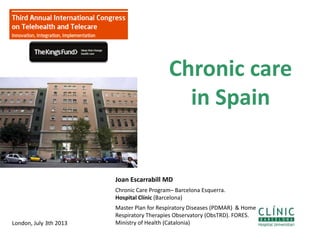
Chronic care
in Spain
1
Joan Escarrabill MD
Chronic Care Program– Barcelona Esquerra.
Hospital Clínic (Barcelona)
Master Plan for Respiratory Diseases (PDMAR) & Home
Respiratory Therapies Observatory (ObsTRD). FORES.
Ministry of Health (Catalonia)London, July 3th 2013
Agenda
2
CountryRegionArea
Three different perspectives of chronic care1
Controversial issues2
Conclusions3
Spain: Socio-demographic characteristics
(1) Municipal Registre 01/01/2009 INE / INS
National Instite of Statistis
(2-6) Eurostat (UE 27=100)
17 Autonomous Communities
Area 504,750 km²
Population (2011)1 47,213,000
Life expectancy (2011)2 82,035 years
Birth rate (2011)3 10.15/1000
Gross Mortality rate (2011)4 8.25/1000
Infant mortality (2011)5 3.0 / 1000 Live Births
GDP Per capita
6
$29,289
Source: Catalan Ministry of Health
Health Care in Spain
4
Work
Injury Act
1900
Social
Security
Model
1945
National
Health
Service
1986
GENERAL HEALTHCARE ACT: 1986
• Universal coverage / Free access
• Funded by taxes
• Decentralized to regional autonomies
• Very wide range of publicly covered services
• Co-payment in pharmaceutical products
• Strategic direction through “Interterritorial
board”
Source: Catalan Ministry of Health
Health System Decentralization
Central
Government
• Basic legislation and coordination.
• Financing.
• Minimum package funded through NHS.
• Pharmaceutical policy.
• International health policy.
• Educational requirements
Autonomous
Government
• Subsidiary legislation.
• Public health.
• System’s organizational structure.
• Accreditation and planning.
• Purchasing and service provision
Source: Catalan Ministry of Health
Law without
budget
Care delivery
responsibilities
without law
Devolution process to AA CC
1984
1987
1987
19901990
1994
2001
2001
2001
2001
2001
2001
2001
20012001
2001
Catalonia
1981
Source: Catalan Ministry of Health
7
Chronic care
CountryRegionArea
Int J Healthcare Management 2012;5:208-215
 Predicitve modeling for population health management
 Integrated home care
 Case management
 Hospital at home
 Expert patient and “Schools of patients”
Strategies
8
Disease
Groups of diseases
Chronic care
9
20122009
Chest Physicians
General Practitioners
Internal Medicine
Nurses
Patients
General Practitioners
Int Medicine & Geriatricians
Nurses
Patients
Without any specialist
No direct relationship with budget or
health service delivery
Palliative (2007)
Icuts (2008)
Cancer (2009)
Coronary heart
disease (2009)
Diabetes (2012)
Ambulatory care sensitive conditions
10
COPD Admissions
www.atlasvpm.org/
11
Chronic care
CountryRegionArea
Master Plans for specific
groups of diseases
2000
2010
Valcronic
2012
12
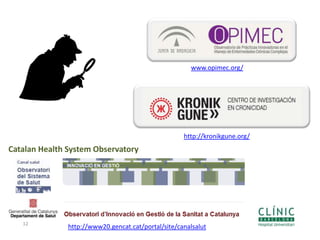
www.opimec.org/
http://kronikgune.org/
http://www20.gencat.cat/portal/site/canalsalut
Catalan Health System Observatory
13
Health Policy 2013;111:1–13
Thirty-one telehealthcare initiatives across
eight countries involving over 20,000 patients
 Heterogenity
 Citizen’s ICT skills
 Professional’s reluctance
 Fave-to-face vs tele-health
• Small pilot studies (< 100 pts except WSD)
• The challange of interoperability
• Problems in the deployment.
• No clear consensus on how to measure the impact
• General perception that evidence was lacking

Tele-Health
14
<<<<<<<<<<<<<<<<<<<<<<<<<<<
<<<<<<<<<<<<<<<<<<<<<<
<<<<<<<<<<
Galicia
Basc Country
Catalonia
An example: Catalonia
15
Catalonia
Area 32.106 km²
Population (2011) 7,570,908 (16% of Spain)
GDP €170.450 milions (18.8% of Spain)
Health Services: Primary Care
77.6
3.3 19.1
Catalan Health Institute
Medical Groups
Other providers
367 Primary Care Teams
Public Hospitals
(% beds)
70%
30%
Non-profit
Former Social Security
16
H Sta Creu i
St Pau.
BARCELONA
1401
H Sta Creu.
VIC.
1348
H Sta Maria. LLEIDA
1519
Hospitals from “Social
Secutiry Model”
1942
7 hospitals
Religious Orders
H S J de Deu
1867
Friendly societies
1900
56 hospitals
Experiences in Catalonia
Hospice
Home support
teams
Geriatrics Palliative Respiratory
Chronic respiratory failure
Escarrabill et al
Lancet 1985;ii:779
ATDOM
Home care
Primary care
Palliative care
X. Gómez-Batiste et al
J Pain Symptom Manage. 2012;43:783-94
Hernández et al ERJ 2003; 21: 58–67
Hospital at home
Casas et al ERJ 2006;28:123-30
Integrated care Chronic Heart Failure
Rev Esp Cardiol. 2011;64(4):277–285
Escarrabill. The Lancet 1985:ii:779
Long-term oxygen therapy
Legislation changes
1990
0
50
100
1988 1991 1993 2000 2012
5.5
14
34.1
74 73
Sources of oxygen (%)
Cylinder Concentrator Liquid O2 Portable concentrator
19
Int J Clin Pract, March 2012;66;289–298
Health Plan 2011 – 2015:Priorities and Projects
9 priority areas and 31 projects
 Objectives and Health Programmes

Chronic
Care
Orientation

Performance
improvement
at primary care
level

Improvement
of quality at
high
specialization
level
 Focus to patients and their families and carers
 New purchasing and commissioning of health services
 Clinical and professional knowledge at the front line
 Governance improvement and professional and citizen’s participation
 Strengthening the information system, transparency and evaluation
3
2
1
Health Plan 2011 – 2015:Priorities and Projects
9 priority areas and 31 projects
 Objectives and Health Programmes

Chronic
Care
Orientation

Performance
improvement
at primary care
level

Improvement
of quality at
high
specialization
level
 Focus to patients and their families and carers
 New purchasing and commissioning of health services
 Clinical and professional knowledge at the front line
 Governance improvement and professional and citizen’s participation
 Strengthening the information system, transparency and evaluation
3
2
1
Chronic care program
22
Incentives through
the funding system
Specific approach to
complexity
Clinical Pathways
Stratitification
• Complex patients
• End-of-life
•COPD
•CF
•Diabetes
•Depression
Improve
integrated care
Increasing the
capacity of
resolution of
Primary Care
Results
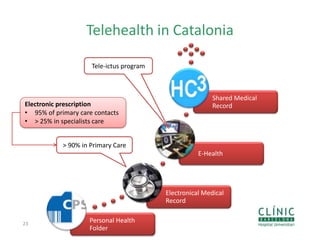
Telehealth in Catalonia
23
Personal Health
Folder
Electronical Medical
Record
E-Health
Shared Medical
Record
> 90% in Primary Care
Tele-ictus program
Electronic prescription
• 95% of primary care contacts
• > 25% in specialists care
24
How to improve
care after COPD
acute exacerbation?
Some thoughts from a regional perspective
25
The funding system
is a necessary
lever, but not
sufficient
The challenge is the large
metropolitan areas and
the transformation of big
teaching hospitals
The changes should affect the
entire system, not just hospitals
It is imperative to focus on
results, not process.
1
2
3
4
26
Chronic care
CountryRegionArea
How a teaching hospital faces
the problem of chronic care?
2002-2012
10 of the 50 most cited Spanish
documents are from the HC
Blur the boundaries
between the HC
and Primary Care
Improve
communication
through ICT
The process is
always developed
from clinical criteria
Population
27
534.955 inhabitants
21% > 65 years
19 Primary Care Teams
4 hospitals
Barcelona
Esquerra
Current situation regarding chronic care
28
Diabetes
Debut
Age + HbA1c
Insulinization
Post
discharge
CF
COPD
Integrated
care
Frail
LTOT evaluation
Cognitive
disorders
HIV
…
Indicators
Drug prescription: Joint Formulary
ICT
3 share policies between Hospital & Primary Care
Shared policies
29
2003 2012
Policies
Education, information &
decision support
Geriatric
care
Transitional
care
Confusional syndrome
Polimedication
Multimorbidities
Therapeutic education
Decision support & uncertainty
Patient’s experience
Transitions “in hosp”
Discharge planning
Start new therapies
NEJM 2013;368:201-3
Shared policies
30
2003 2012
Policies
Education, information &
decision support
Geriatric
care
Transitional
care
25% admissions
> 75 years
Bray-Hall ST. Ann Intern Med. 2012;157:448-9
Agenda
31
CountryRegionArea
Three different perspectives of chronic care1
Controversial issues2
Conclusions3
Stratification focused interventions
in more serious ill.
32
BMJ 2012;345:e6017
Where we should make
the maximum effort?
More severe
patients ???
Stop the
progression of
the disease ???
The chaos of multimorbidity
33
BMJ 2012;345:e5915 doi: 10.1136/bmj.e5915
Continuity & Information
Organization > Evidences ?
…but organ failure “exists”
The mirage of ICT
34
Convergence of all six of the
major tecnological advances
The hospital is guilty…
3535
Increased resolution
capability of primary
care.
Reduction of hospital
admissions of patients
with chronic diseases.
Close
beds
BMJ 2013;346:f3186
…but Primary Care must also change.
36
Primary care is first-
contact, continuous, comprehensive, and
coordinated care provided to populations
undifferentiated by gender, disease, or organ
system.
 Accessibility = possible use 24/7/365
 Finding answers to new problems
 Always located in a territory and can learn about available resources around them.
 Use over time regardless of the type of problem
 Broad service portfolio (without great additional costs)
 Recognition of the needs when they occur (alarm)
 Ensuring continuity
 Recognize problems requiring follow-up
Reading these features, my daughter said:
37
Dad, this is a
definition of
smartphone, right?
 Accessibility = possible use 24/7/365
 Finding answers to new problems
 Always located in a territory and can learn about available
resources around them.
 Use over time regardless of the type of problem
 Broad service portfolio (without great additional costs)
 Recognition of the needs when they occur (alarm)
 Ensuring continuity
 Recognize problems requiring follow-up
Agenda
38
CountryRegionArea
Three different perspectives of chronic care1
Controversial issues2
Conclusions3
Chronic care = “wicked problem”
39
2007
• Solutions to wicked problems are not right
or wrong.
• Every wicked problem can be considered to
be a symptom of another problem.
• Every solution to a wicked problem is a 'one
shot operation.'
• Wicked problems have no stopping rule.
• There is no template to follow when
tackling a wicked problem.
This demands interdisciplinary
collaboration, and most
importantly, perseverance.
www.wickedproblems.com/
The role of the "specialist" radically changes
Conclusions regading
“Chronic care in Spain”
40
There is no specific model
for chronic care in Spain.
Still, there were no significant
changes in the organization of
the health system.
Multiple pilot studies with good
results but with little impact on
the overall system.
There is no systematic
use of ICT.
1
2
3
4
41
Simple
Authomatic
Good enough
Thank you very much !
42
ESCARRABILL@clinic.ub.es

20130703 kings fund final

  • 1.
    Chronic care in Spain 1 JoanEscarrabill MD Chronic Care Program– Barcelona Esquerra. Hospital Clínic (Barcelona) Master Plan for Respiratory Diseases (PDMAR) & Home Respiratory Therapies Observatory (ObsTRD). FORES. Ministry of Health (Catalonia)London, July 3th 2013
  • 2.
    Agenda 2 CountryRegionArea Three different perspectivesof chronic care1 Controversial issues2 Conclusions3
  • 3.
    Spain: Socio-demographic characteristics (1)Municipal Registre 01/01/2009 INE / INS National Instite of Statistis (2-6) Eurostat (UE 27=100) 17 Autonomous Communities Area 504,750 km² Population (2011)1 47,213,000 Life expectancy (2011)2 82,035 years Birth rate (2011)3 10.15/1000 Gross Mortality rate (2011)4 8.25/1000 Infant mortality (2011)5 3.0 / 1000 Live Births GDP Per capita 6 $29,289 Source: Catalan Ministry of Health
  • 4.
    Health Care inSpain 4 Work Injury Act 1900 Social Security Model 1945 National Health Service 1986 GENERAL HEALTHCARE ACT: 1986 • Universal coverage / Free access • Funded by taxes • Decentralized to regional autonomies • Very wide range of publicly covered services • Co-payment in pharmaceutical products • Strategic direction through “Interterritorial board” Source: Catalan Ministry of Health
  • 5.
    Health System Decentralization Central Government •Basic legislation and coordination. • Financing. • Minimum package funded through NHS. • Pharmaceutical policy. • International health policy. • Educational requirements Autonomous Government • Subsidiary legislation. • Public health. • System’s organizational structure. • Accreditation and planning. • Purchasing and service provision Source: Catalan Ministry of Health Law without budget Care delivery responsibilities without law
  • 6.
    Devolution process toAA CC 1984 1987 1987 19901990 1994 2001 2001 2001 2001 2001 2001 2001 20012001 2001 Catalonia 1981 Source: Catalan Ministry of Health
  • 7.
    7 Chronic care CountryRegionArea Int JHealthcare Management 2012;5:208-215  Predicitve modeling for population health management  Integrated home care  Case management  Hospital at home  Expert patient and “Schools of patients”
  • 8.
  • 9.
    9 20122009 Chest Physicians General Practitioners InternalMedicine Nurses Patients General Practitioners Int Medicine & Geriatricians Nurses Patients Without any specialist No direct relationship with budget or health service delivery Palliative (2007) Icuts (2008) Cancer (2009) Coronary heart disease (2009) Diabetes (2012)
  • 10.
    Ambulatory care sensitiveconditions 10 COPD Admissions www.atlasvpm.org/
  • 11.
    11 Chronic care CountryRegionArea Master Plansfor specific groups of diseases 2000 2010 Valcronic 2012
  • 12.
  • 13.
    13 Health Policy 2013;111:1–13 Thirty-onetelehealthcare initiatives across eight countries involving over 20,000 patients  Heterogenity  Citizen’s ICT skills  Professional’s reluctance  Fave-to-face vs tele-health • Small pilot studies (< 100 pts except WSD) • The challange of interoperability • Problems in the deployment. • No clear consensus on how to measure the impact • General perception that evidence was lacking 
  • 14.
  • 15.
    An example: Catalonia 15 Catalonia Area32.106 km² Population (2011) 7,570,908 (16% of Spain) GDP €170.450 milions (18.8% of Spain) Health Services: Primary Care 77.6 3.3 19.1 Catalan Health Institute Medical Groups Other providers 367 Primary Care Teams
  • 16.
    Public Hospitals (% beds) 70% 30% Non-profit FormerSocial Security 16 H Sta Creu i St Pau. BARCELONA 1401 H Sta Creu. VIC. 1348 H Sta Maria. LLEIDA 1519 Hospitals from “Social Secutiry Model” 1942 7 hospitals Religious Orders H S J de Deu 1867 Friendly societies 1900 56 hospitals
  • 17.
    Experiences in Catalonia Hospice Homesupport teams Geriatrics Palliative Respiratory Chronic respiratory failure Escarrabill et al Lancet 1985;ii:779 ATDOM Home care Primary care Palliative care X. Gómez-Batiste et al J Pain Symptom Manage. 2012;43:783-94 Hernández et al ERJ 2003; 21: 58–67 Hospital at home Casas et al ERJ 2006;28:123-30 Integrated care Chronic Heart Failure Rev Esp Cardiol. 2011;64(4):277–285
  • 18.
    Escarrabill. The Lancet1985:ii:779 Long-term oxygen therapy Legislation changes 1990 0 50 100 1988 1991 1993 2000 2012 5.5 14 34.1 74 73 Sources of oxygen (%) Cylinder Concentrator Liquid O2 Portable concentrator
  • 19.
    19 Int J ClinPract, March 2012;66;289–298
  • 20.
    Health Plan 2011– 2015:Priorities and Projects 9 priority areas and 31 projects  Objectives and Health Programmes  Chronic Care Orientation  Performance improvement at primary care level  Improvement of quality at high specialization level  Focus to patients and their families and carers  New purchasing and commissioning of health services  Clinical and professional knowledge at the front line  Governance improvement and professional and citizen’s participation  Strengthening the information system, transparency and evaluation 3 2 1
  • 21.
    Health Plan 2011– 2015:Priorities and Projects 9 priority areas and 31 projects  Objectives and Health Programmes  Chronic Care Orientation  Performance improvement at primary care level  Improvement of quality at high specialization level  Focus to patients and their families and carers  New purchasing and commissioning of health services  Clinical and professional knowledge at the front line  Governance improvement and professional and citizen’s participation  Strengthening the information system, transparency and evaluation 3 2 1
  • 22.
    Chronic care program 22 Incentivesthrough the funding system Specific approach to complexity Clinical Pathways Stratitification • Complex patients • End-of-life •COPD •CF •Diabetes •Depression Improve integrated care Increasing the capacity of resolution of Primary Care Results
  • 23.
    Telehealth in Catalonia 23 PersonalHealth Folder Electronical Medical Record E-Health Shared Medical Record > 90% in Primary Care Tele-ictus program Electronic prescription • 95% of primary care contacts • > 25% in specialists care
  • 24.
    24 How to improve careafter COPD acute exacerbation?
  • 25.
    Some thoughts froma regional perspective 25 The funding system is a necessary lever, but not sufficient The challenge is the large metropolitan areas and the transformation of big teaching hospitals The changes should affect the entire system, not just hospitals It is imperative to focus on results, not process. 1 2 3 4
  • 26.
    26 Chronic care CountryRegionArea How ateaching hospital faces the problem of chronic care? 2002-2012 10 of the 50 most cited Spanish documents are from the HC Blur the boundaries between the HC and Primary Care Improve communication through ICT The process is always developed from clinical criteria
  • 27.
    Population 27 534.955 inhabitants 21% >65 years 19 Primary Care Teams 4 hospitals Barcelona Esquerra
  • 28.
    Current situation regardingchronic care 28 Diabetes Debut Age + HbA1c Insulinization Post discharge CF COPD Integrated care Frail LTOT evaluation Cognitive disorders HIV … Indicators Drug prescription: Joint Formulary ICT 3 share policies between Hospital & Primary Care
  • 29.
    Shared policies 29 2003 2012 Policies Education,information & decision support Geriatric care Transitional care Confusional syndrome Polimedication Multimorbidities Therapeutic education Decision support & uncertainty Patient’s experience Transitions “in hosp” Discharge planning Start new therapies
  • 30.
    NEJM 2013;368:201-3 Shared policies 30 20032012 Policies Education, information & decision support Geriatric care Transitional care 25% admissions > 75 years Bray-Hall ST. Ann Intern Med. 2012;157:448-9
  • 31.
    Agenda 31 CountryRegionArea Three different perspectivesof chronic care1 Controversial issues2 Conclusions3
  • 32.
    Stratification focused interventions inmore serious ill. 32 BMJ 2012;345:e6017 Where we should make the maximum effort? More severe patients ??? Stop the progression of the disease ???
  • 33.
    The chaos ofmultimorbidity 33 BMJ 2012;345:e5915 doi: 10.1136/bmj.e5915 Continuity & Information Organization > Evidences ? …but organ failure “exists”
  • 34.
    The mirage ofICT 34 Convergence of all six of the major tecnological advances
  • 35.
    The hospital isguilty… 3535 Increased resolution capability of primary care. Reduction of hospital admissions of patients with chronic diseases. Close beds BMJ 2013;346:f3186
  • 36.
    …but Primary Caremust also change. 36 Primary care is first- contact, continuous, comprehensive, and coordinated care provided to populations undifferentiated by gender, disease, or organ system.  Accessibility = possible use 24/7/365  Finding answers to new problems  Always located in a territory and can learn about available resources around them.  Use over time regardless of the type of problem  Broad service portfolio (without great additional costs)  Recognition of the needs when they occur (alarm)  Ensuring continuity  Recognize problems requiring follow-up
  • 37.
    Reading these features,my daughter said: 37 Dad, this is a definition of smartphone, right?  Accessibility = possible use 24/7/365  Finding answers to new problems  Always located in a territory and can learn about available resources around them.  Use over time regardless of the type of problem  Broad service portfolio (without great additional costs)  Recognition of the needs when they occur (alarm)  Ensuring continuity  Recognize problems requiring follow-up
  • 38.
    Agenda 38 CountryRegionArea Three different perspectivesof chronic care1 Controversial issues2 Conclusions3
  • 39.
    Chronic care =“wicked problem” 39 2007 • Solutions to wicked problems are not right or wrong. • Every wicked problem can be considered to be a symptom of another problem. • Every solution to a wicked problem is a 'one shot operation.' • Wicked problems have no stopping rule. • There is no template to follow when tackling a wicked problem. This demands interdisciplinary collaboration, and most importantly, perseverance. www.wickedproblems.com/ The role of the "specialist" radically changes
  • 40.
    Conclusions regading “Chronic carein Spain” 40 There is no specific model for chronic care in Spain. Still, there were no significant changes in the organization of the health system. Multiple pilot studies with good results but with little impact on the overall system. There is no systematic use of ICT. 1 2 3 4
  • 41.
  • 42.
    Thank you verymuch ! 42 ESCARRABILL@clinic.ub.es