PRoF Award 2016
Chair Ghent University
prof. dr. R. Peleman
© 2011 Universitair Ziekenhuis Gent© 2016 Universitair Ziekenhuis Gent
Healthcare 2016
Renaat Peleman
Chief Medical Officer
Ghent University Hospital
Chairholder PRoF Chair Ghent University
3© 2016 Universitair Ziekenhuis Gent
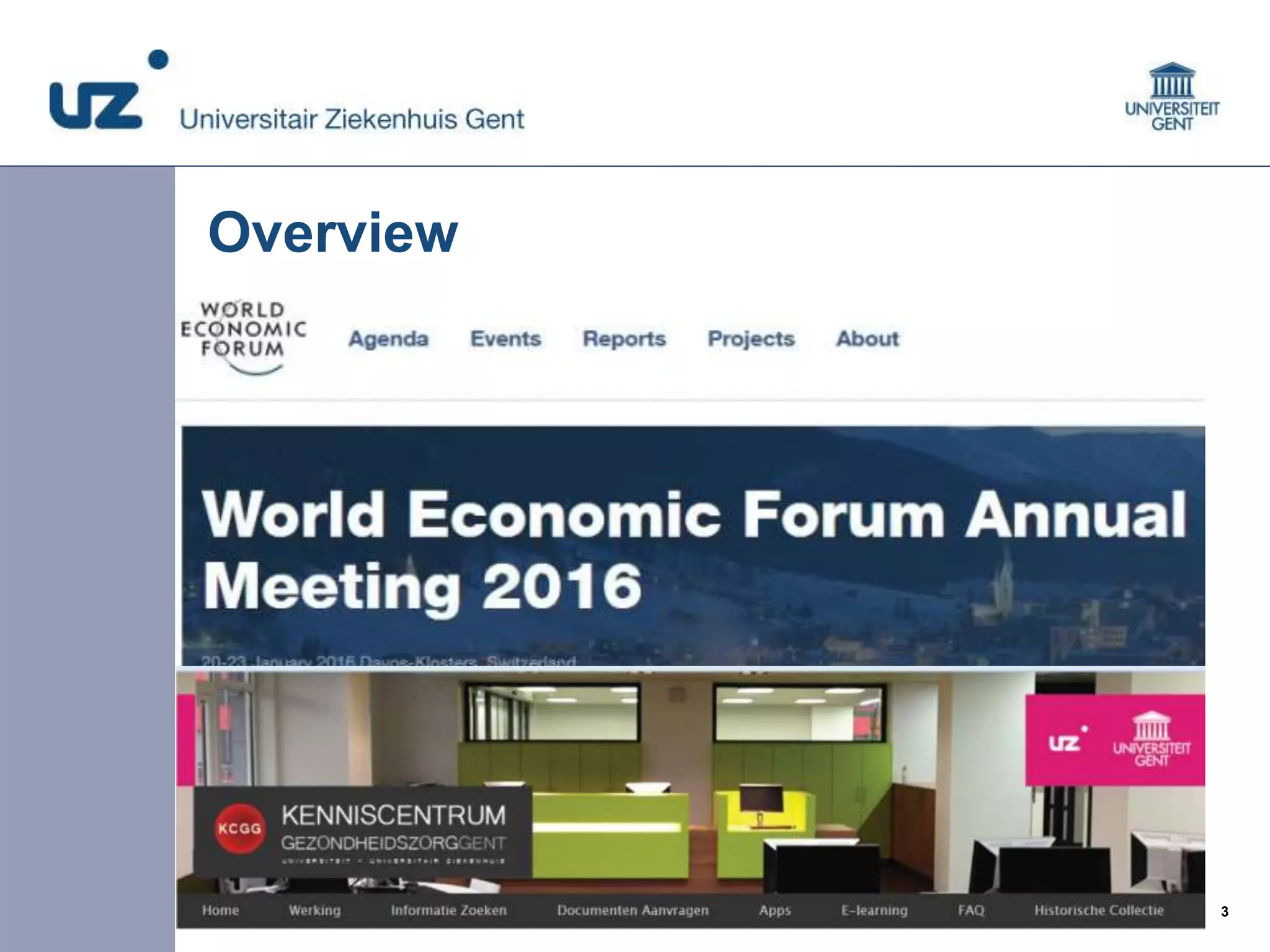
Overview
4© 2016 Universitair Ziekenhuis Gent
The global healthcare system
and it’s challenges
• capital-intensive and hospital-centric systems
• prohibitive costs of care; lack of human resources and
infrastructure, particularly in emerging economies
• increased exposure to risks such as tobacco, physical
inactivity and unhealthy dietary patterns
• vulnerability and inefficient responses to pandemics
• inadequate governance structures to leverage technology
and big data for improving health
• to keep individuals and populations healthy, solutions need
to come from outside of the traditional healthcare space.
5© 2016 Universitair Ziekenhuis Gent
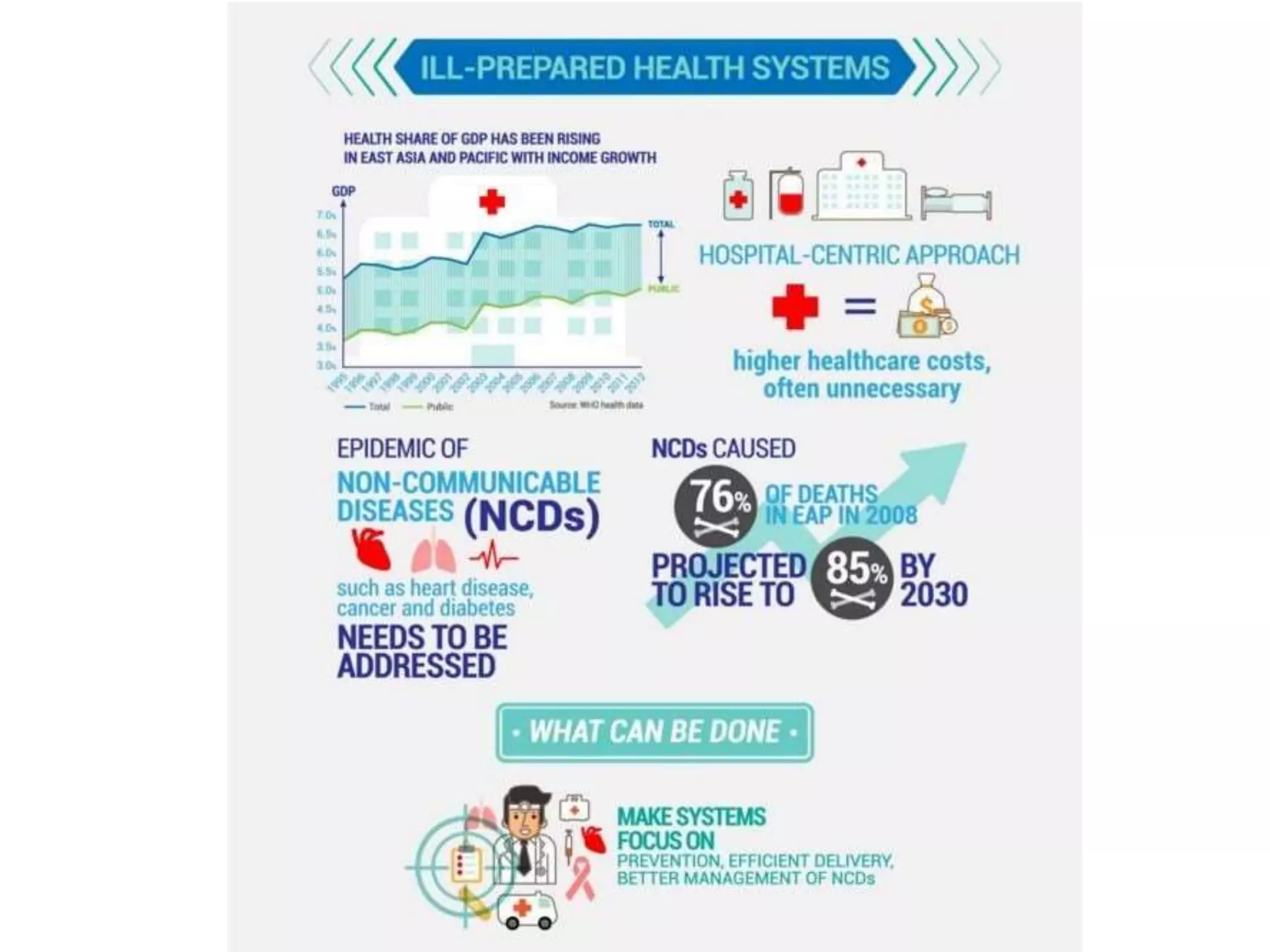
The hospital-centric model
• current hospital-centric system already proving unsustainable
and ineffective.
• World Bank report on the impacts of ageing in East Asia
highlights the urgency of shifting to a new model:
• primary care plays a bigger role
• treatment of older patients with chronic conditions is managed
affordably at the right levels of the system.
• financing model for healthcare will need to rely more on
budget financing to achieve universal health coverage as the
needs of ageing populations grow.
• ageing is also creating a rapidly growing demand and market
for long-term care as traditional family networks become
increasingly stretched.
7© 2016 Universitair Ziekenhuis Gent
• Prohibitive costs of care and a lack of human resources
and infrastructure particularly in emerging economies
are proving a major obstacle.
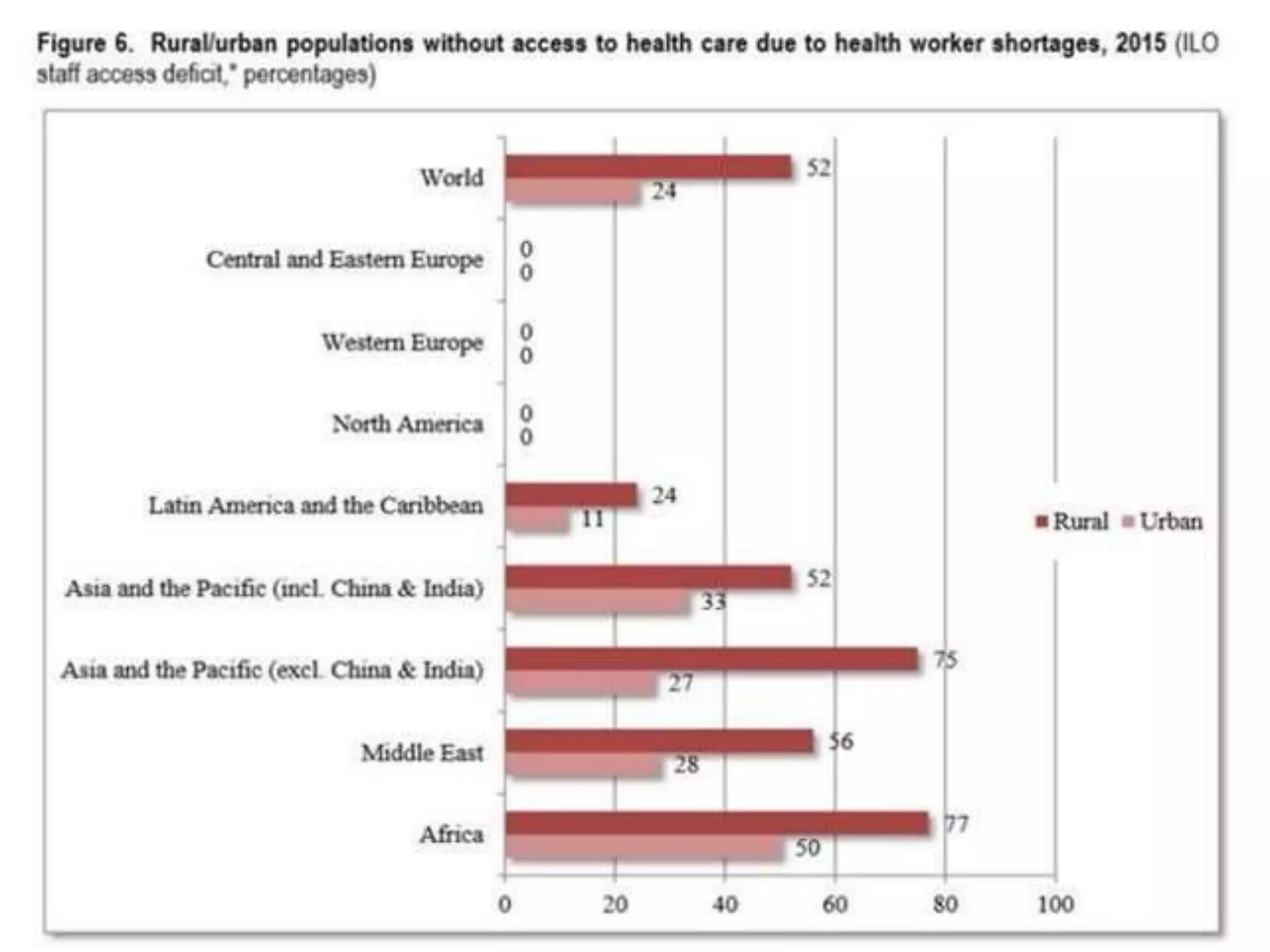
• The UN International Labour Organization found that
56% of the world’s rural population and 83% of Africa’s
rural population live without critical healthcare access.
• This amounts to a deficit of roughly 7 million
healthworkers in rural areas.
Healthcare costs, human
resources and infrastructure
8© 2016 Universitair Ziekenhuis Gent
9© 2016 Universitair Ziekenhuis Gent
Noncommunicable
diseases
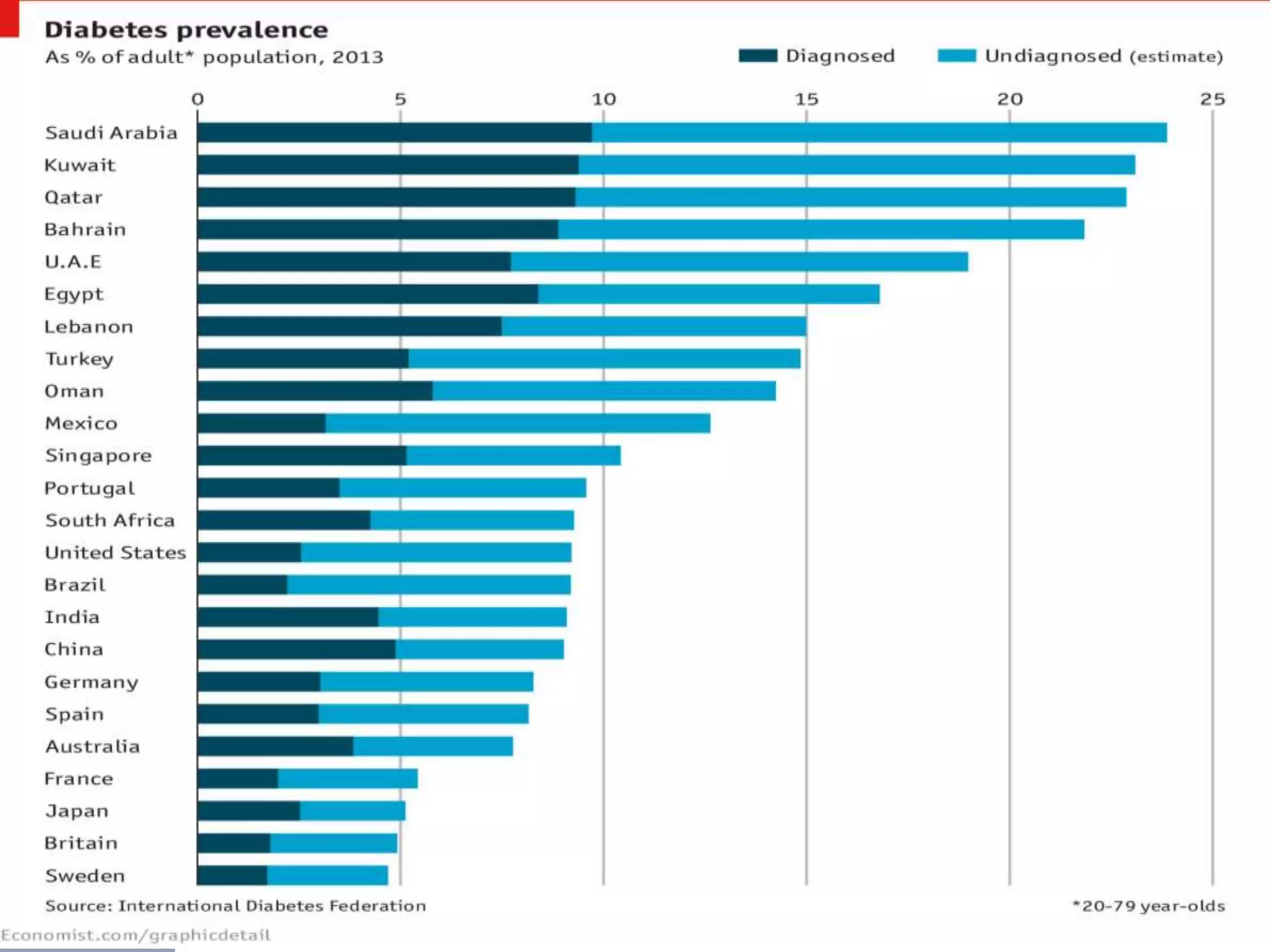
• Increased exposure to risks such as tobacco, physical
inactivity and unhealthy dietary patterns are making
noncommunicable diseases (NCDs) such as cancer
and diabetes the number one killer globally.
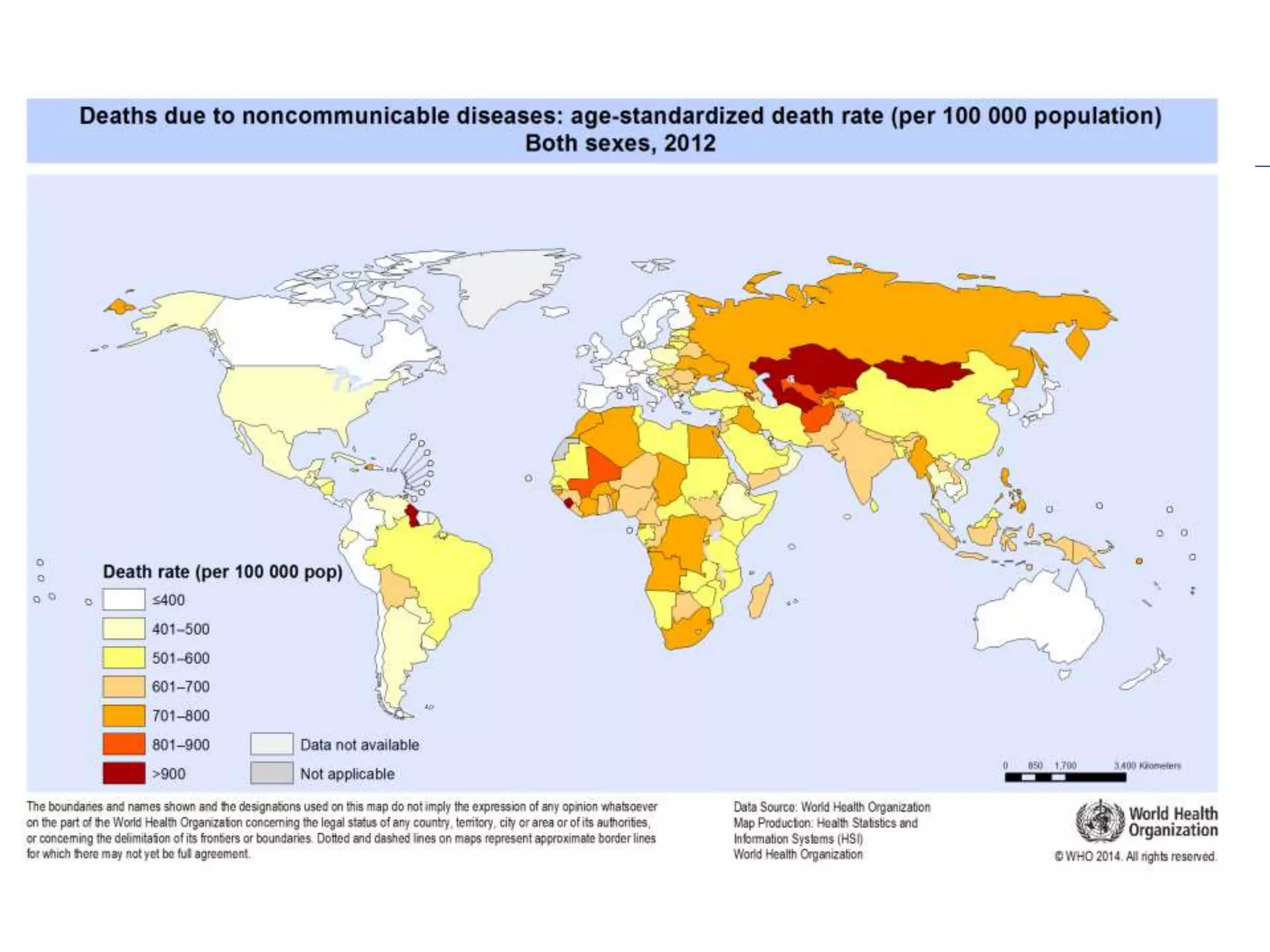
• As the world’s population ages, deaths from NCDs are
projected to rise from 38 million in 2012 to 52 million
annually by 2030.
10© 2016 Universitair Ziekenhuis Gent
11© 2016 Universitair Ziekenhuis Gent
12© 2016 Universitair Ziekenhuis Gent
Vulnerability to
pandemics
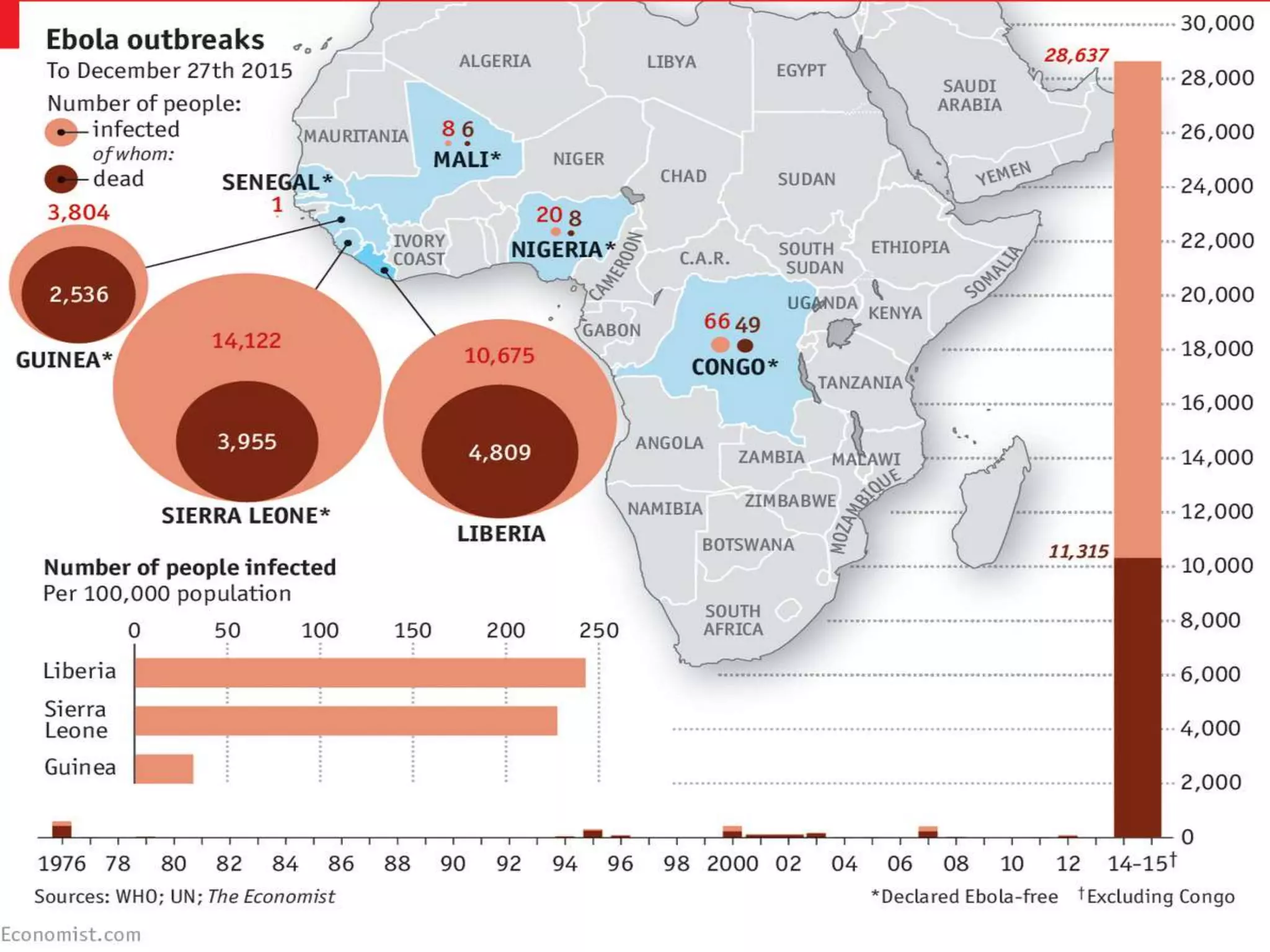
• The potential costs of a global outbreak of the flu or another
highly contagious disease could be huge.
• The Ebola outbreak in West Africa provided a wake-up call
for how health emergencies, in an increasingly connected
world, can quickly become global challenges.
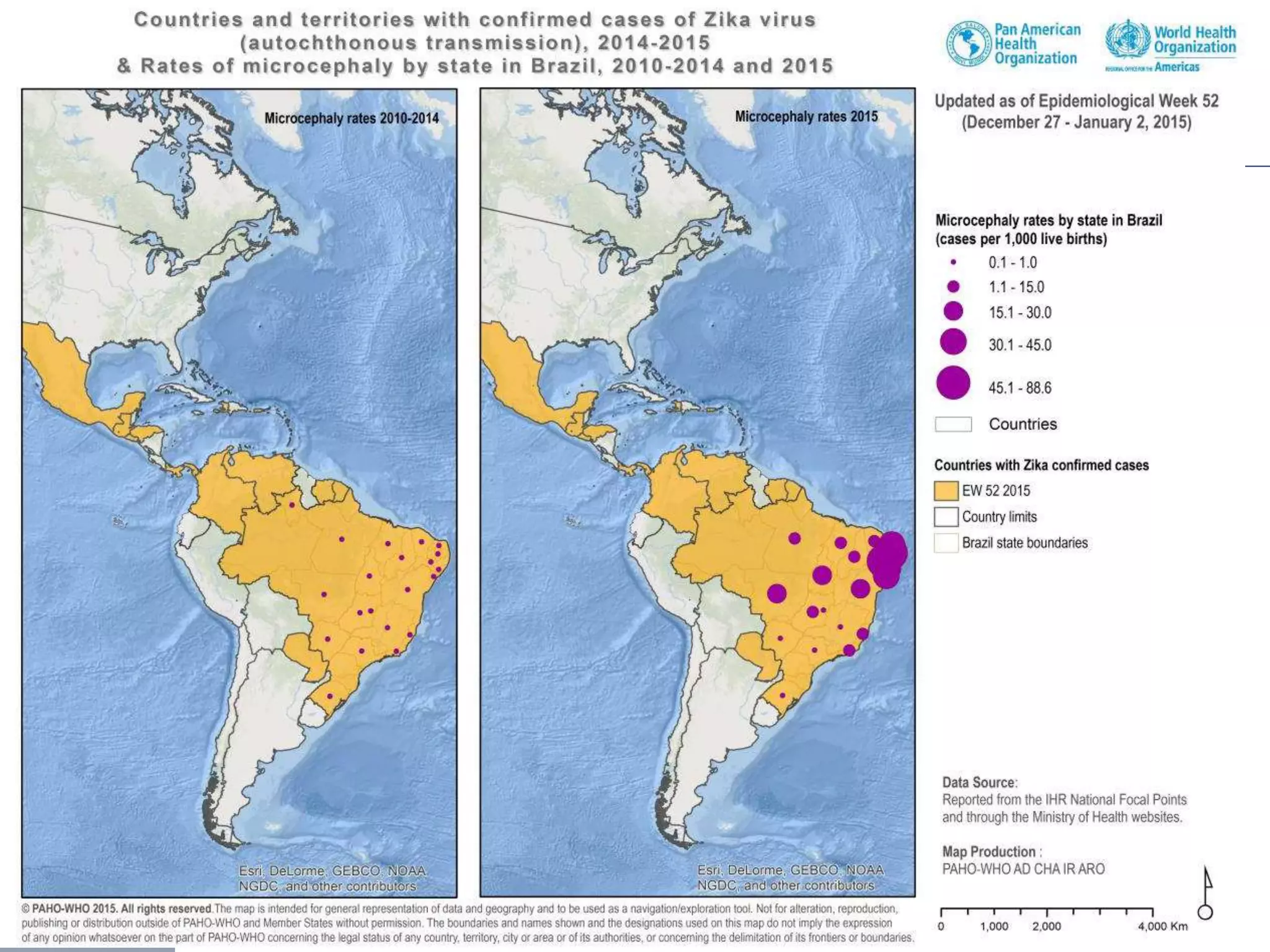
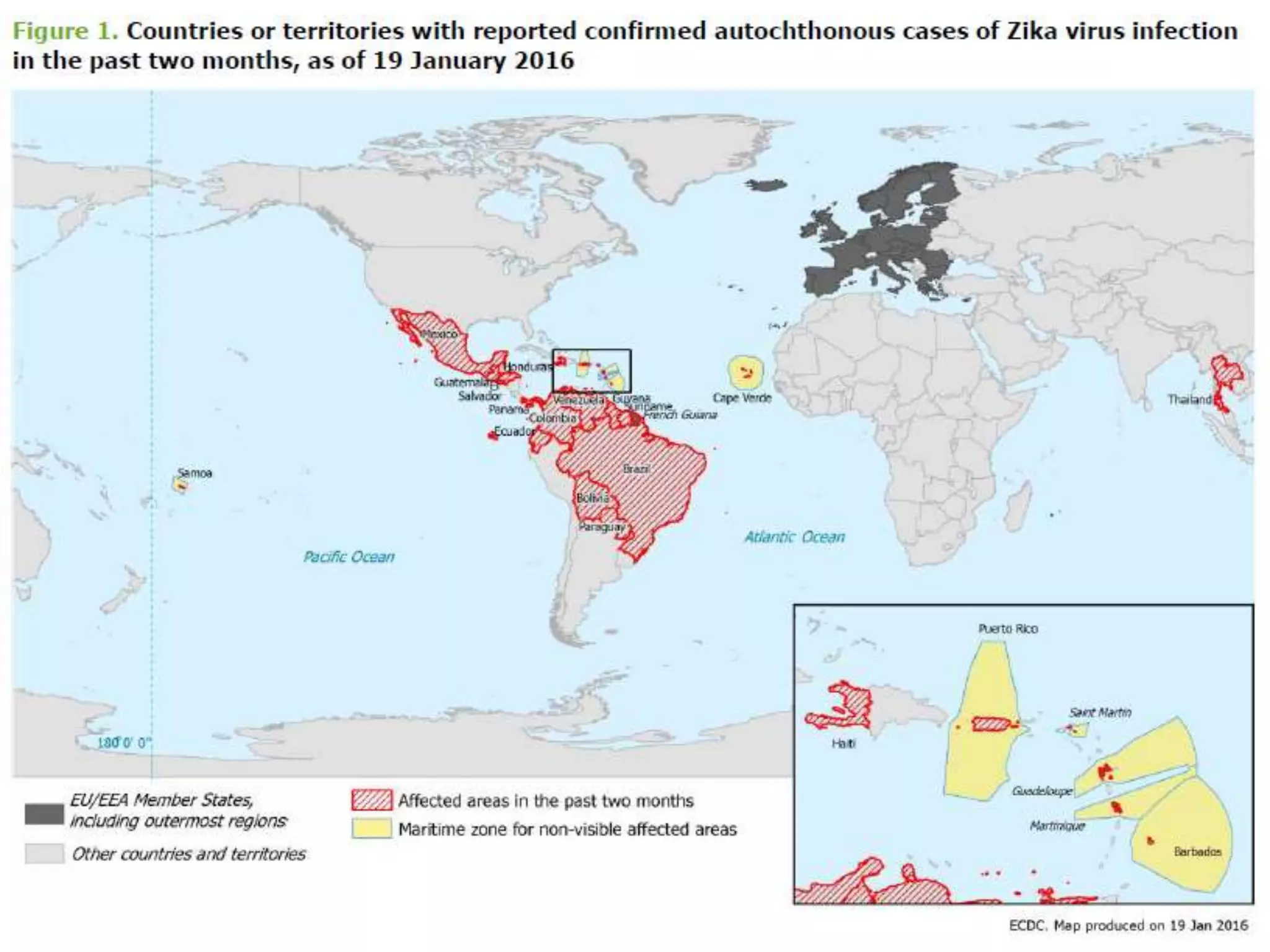
• We are presently facing ZIKA
13© 2016 Universitair Ziekenhuis Gent
14© 2016 Universitair Ziekenhuis Gent
15© 2016 Universitair Ziekenhuis Gent
17© 2016 Universitair Ziekenhuis Gent
• Breakthroughs in technology and the use of big data have
the potential to transform medicine and create connected,
more efficient healthcare.
• Yet health systems are struggling to benefit from these
innovations.
Health technology
and big data
18
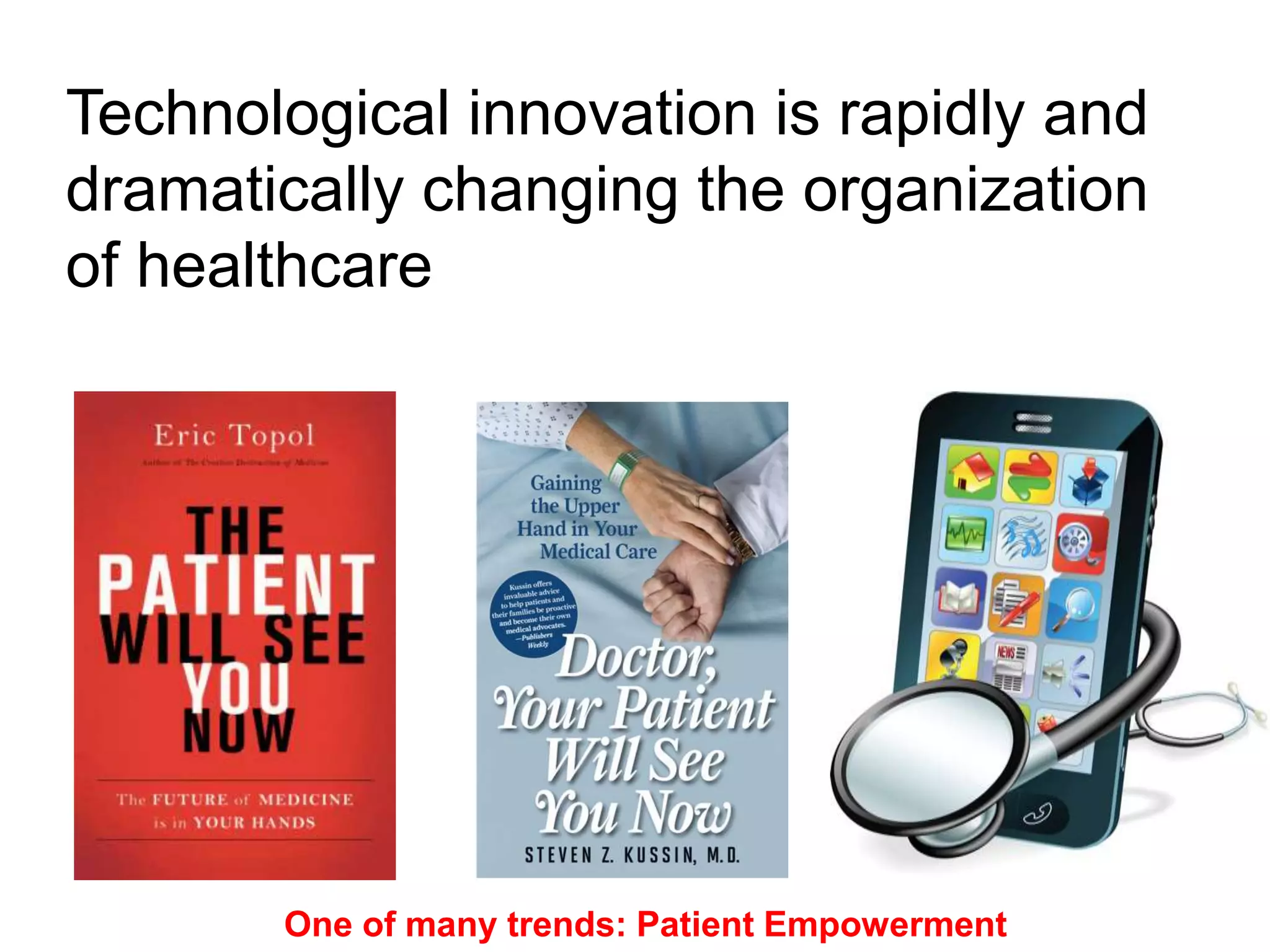
Technological innovation is rapidly and
dramatically changing the organization
of healthcare
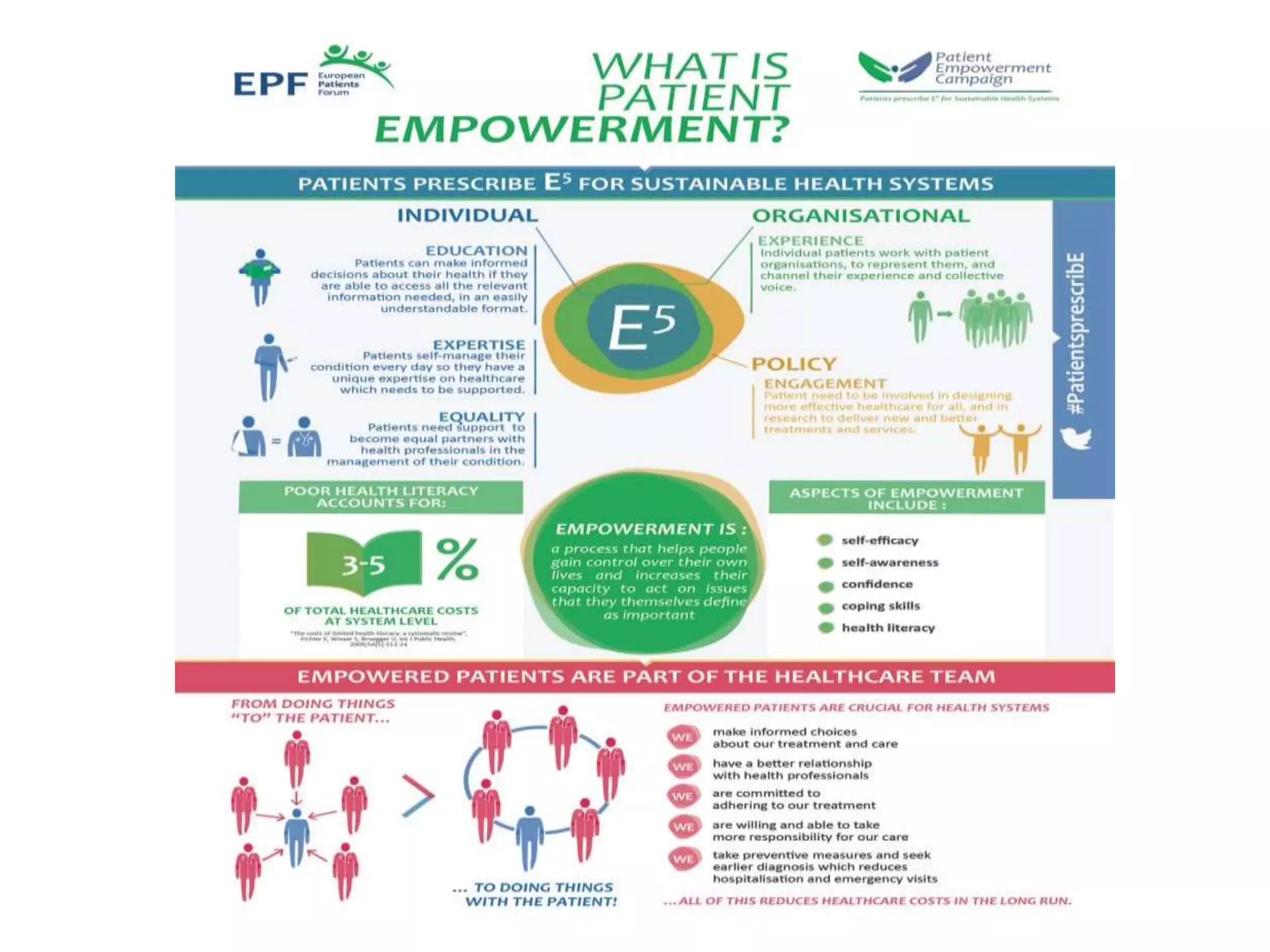
One of many trends: Patient Empowerment
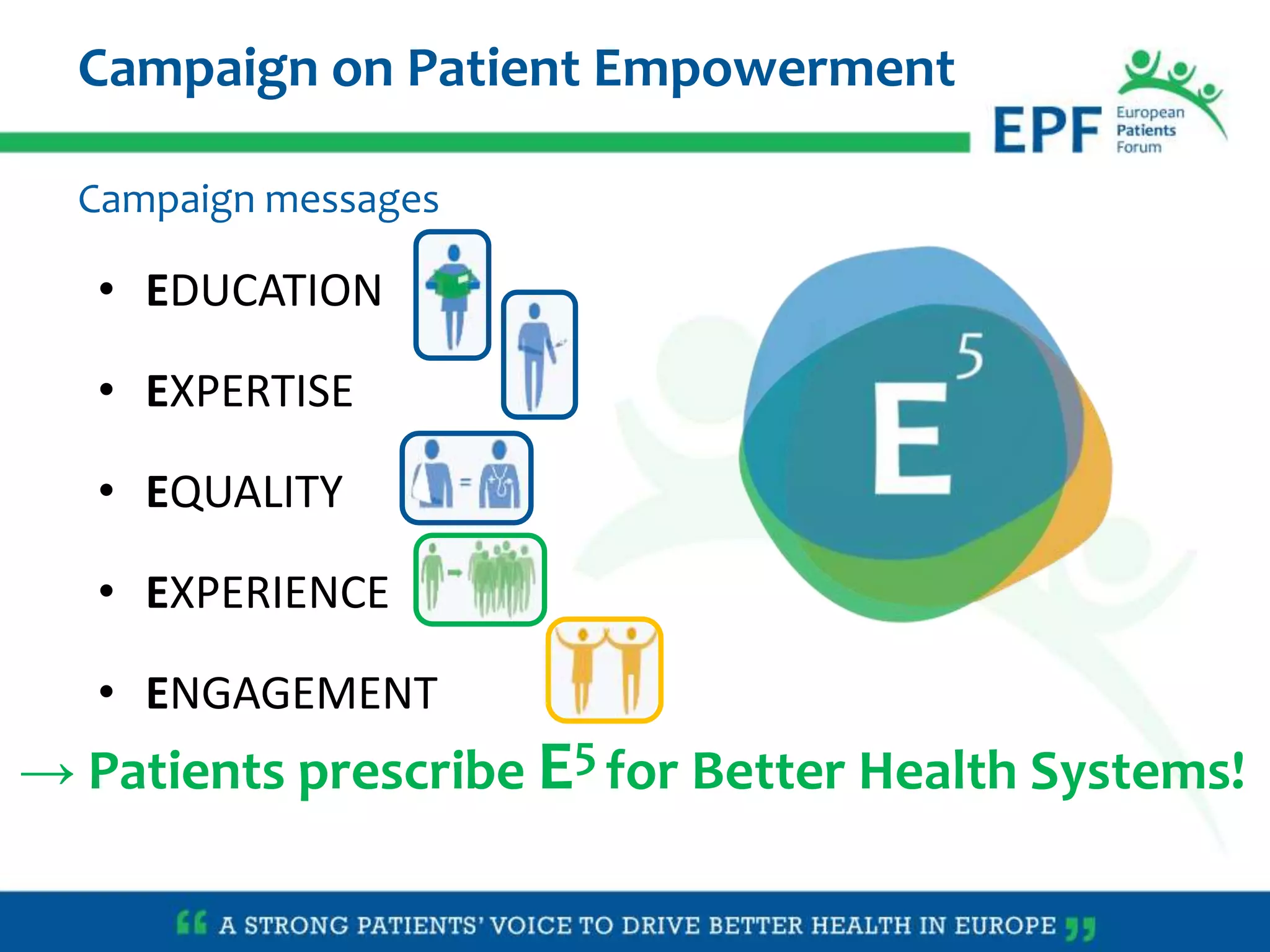
Campaign on Patient Empowerment
→ Patients prescribe E5 for Better Health Systems!
• EDUCATION
• EXPERTISE
• EQUALITY
• EXPERIENCE
• ENGAGEMENT
Campaign messages
21© 2016 Universitair Ziekenhuis Gent
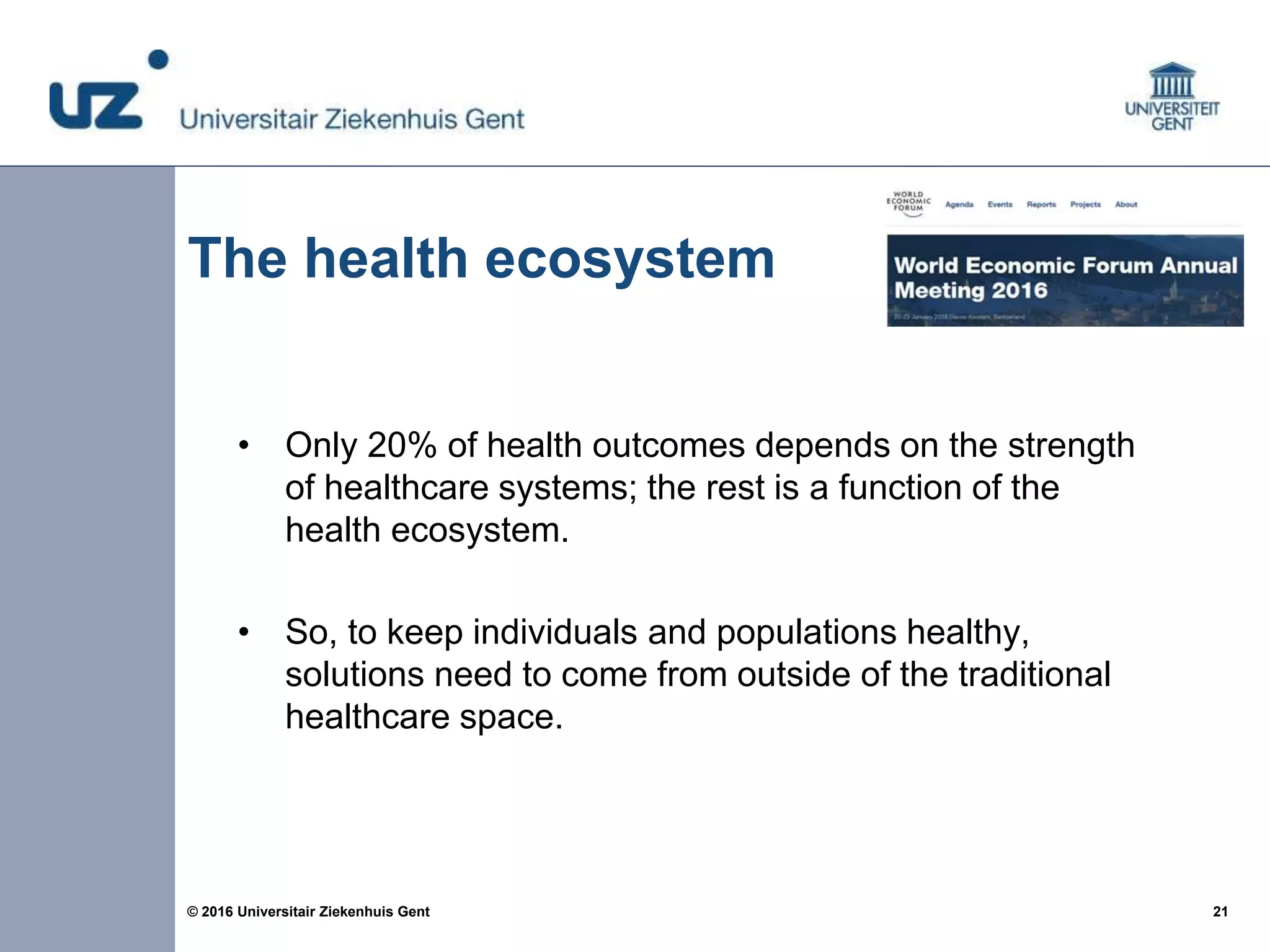
The health ecosystem
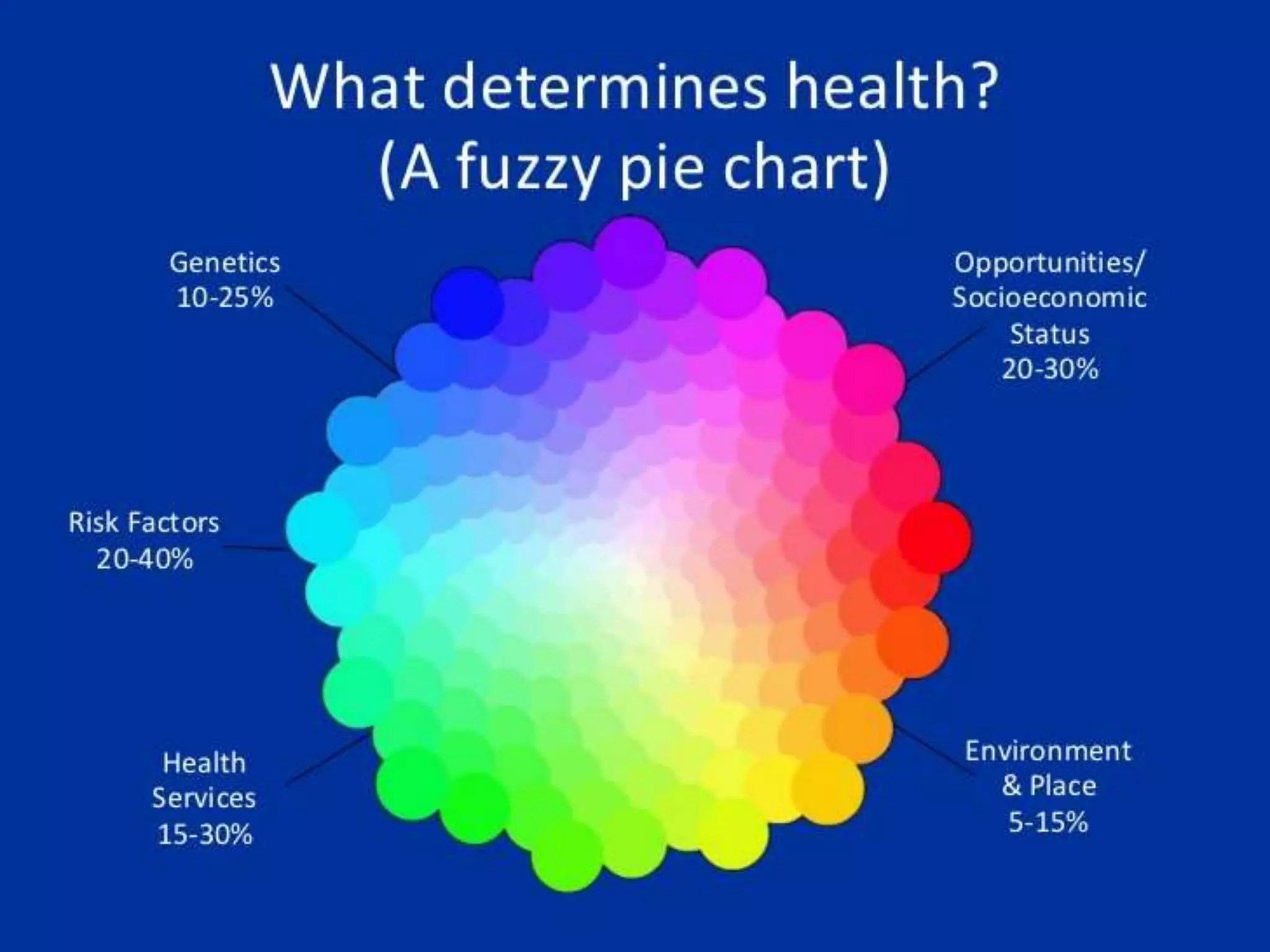
• Only 20% of health outcomes depends on the strength
of healthcare systems; the rest is a function of the
health ecosystem.
• So, to keep individuals and populations healthy,
solutions need to come from outside of the traditional
healthcare space.
22© 2016 Universitair Ziekenhuis Gent
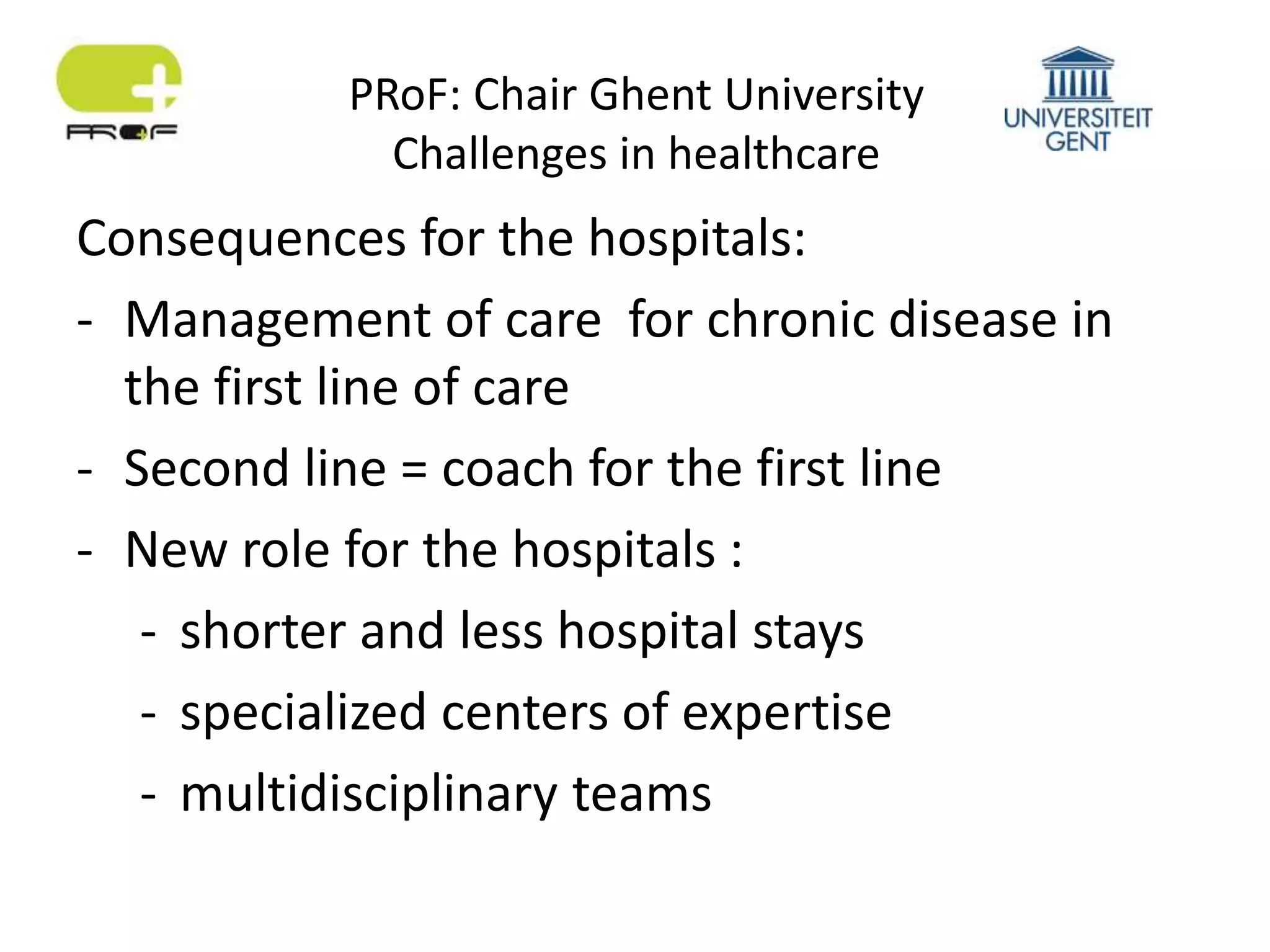
PRoF: Chair Ghent University
Challenges in healthcare
Consequences for the hospitals:
- Management of care for chronic disease in
the first line of care
- Second line = coach for the first line
- New role for the hospitals :
- shorter and less hospital stays
- specialized centers of expertise
- multidisciplinary teams
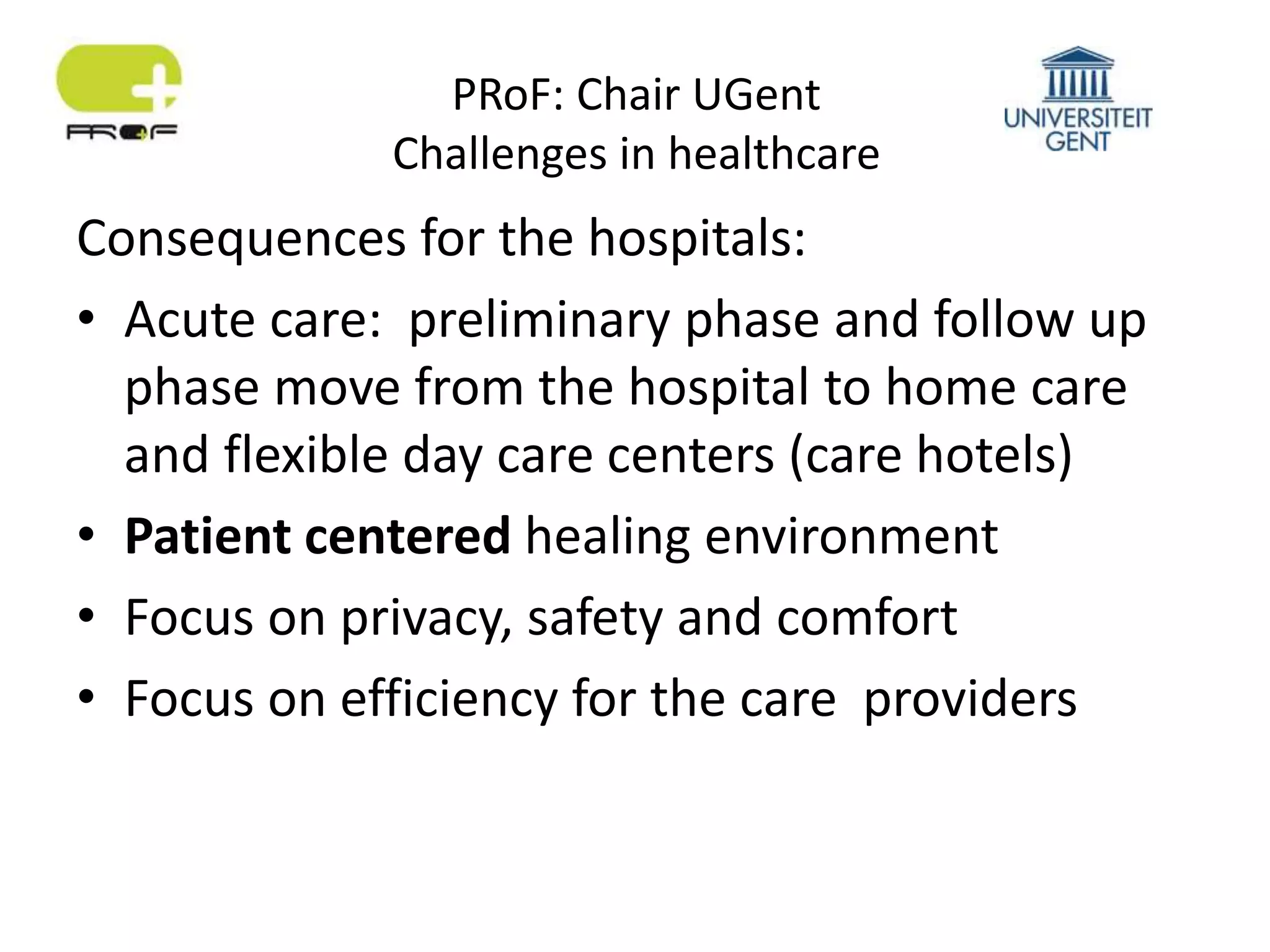
PRoF: Chair UGent
Challenges in healthcare
Consequences for the hospitals:
• Acute care: preliminary phase and follow up
phase move from the hospital to home care
and flexible day care centers (care hotels)
• Patient centered healing environment
• Focus on privacy, safety and comfort
• Focus on efficiency for the care providers
PRoF: Chair UGent
Challenges in healthcare
Consequences for the financing of the care
• No longer based on volume nor activities
• Based on the level of care, quality and efficiency
• Scarce resources must be used optimally
Vision for the future:
• Hospitals and care centers for basic care
• Centers of expertise for advanced care
• Need for innovation and scientific research
 Urgently needed: a new model for financing our healthcare!
ProF-Chair at UGent
• Think tank PRoF : stimulating innovation and quality improvement of care
• Yearly award for innovation
• Knowledge exchange between different research groups and faculties
PRoF: international open innovation consortium
• Start in 2009
• > 350 care professionals from multiple disciplines and
organizations
• Creating visions about the future evolution of care systems
• Interdisciplinary approach:
– care organizations
– research centers, universities
– companies
• Each vision has been realized as a concept room
• PRoF location in Poperinge – Belgium.
The PRoF consortium
• 2011: PRoF 1.0 - Patient Room of the Future
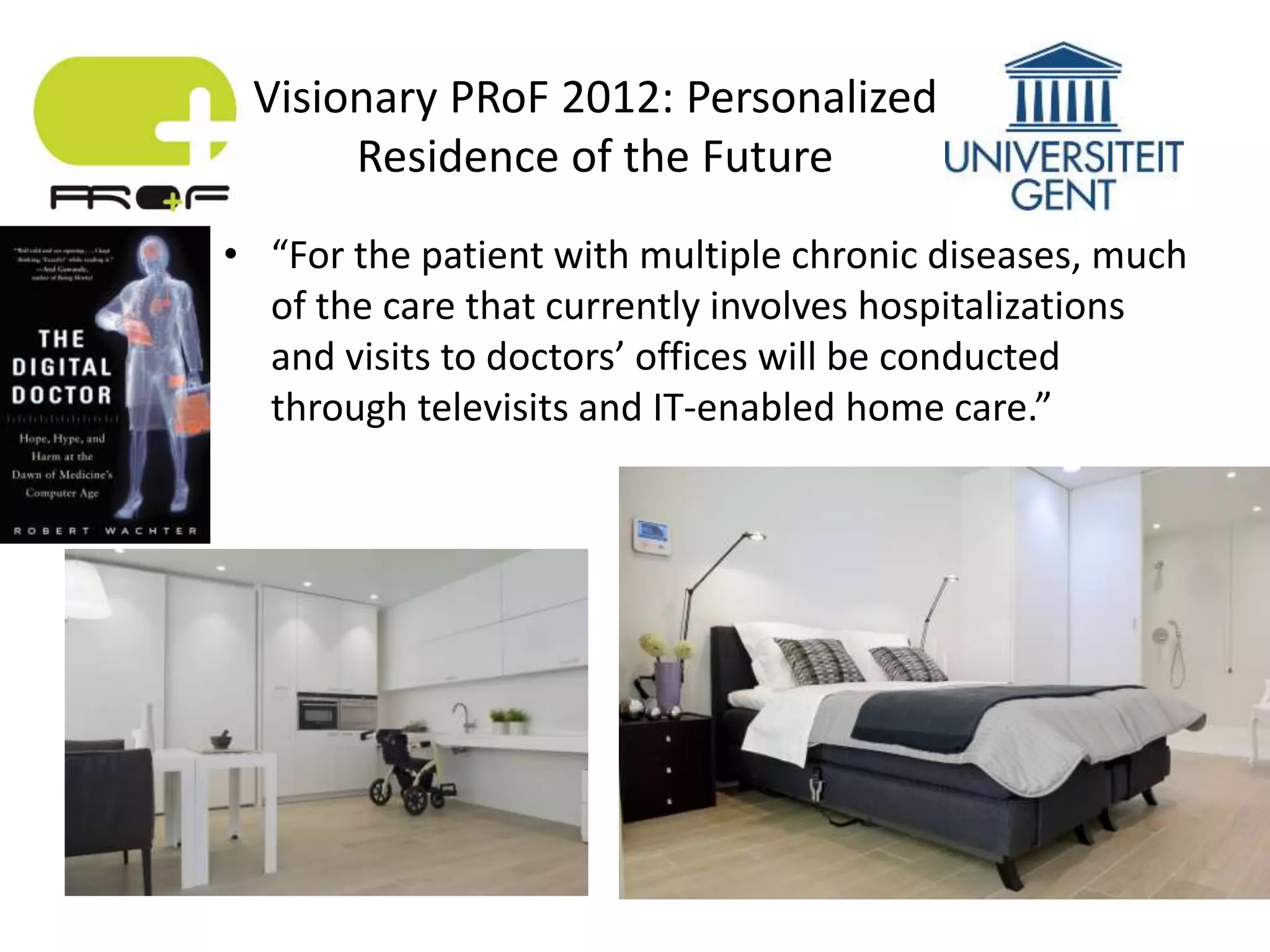
• 2012: PRoF 2.0 - Personalized Residence of the Future
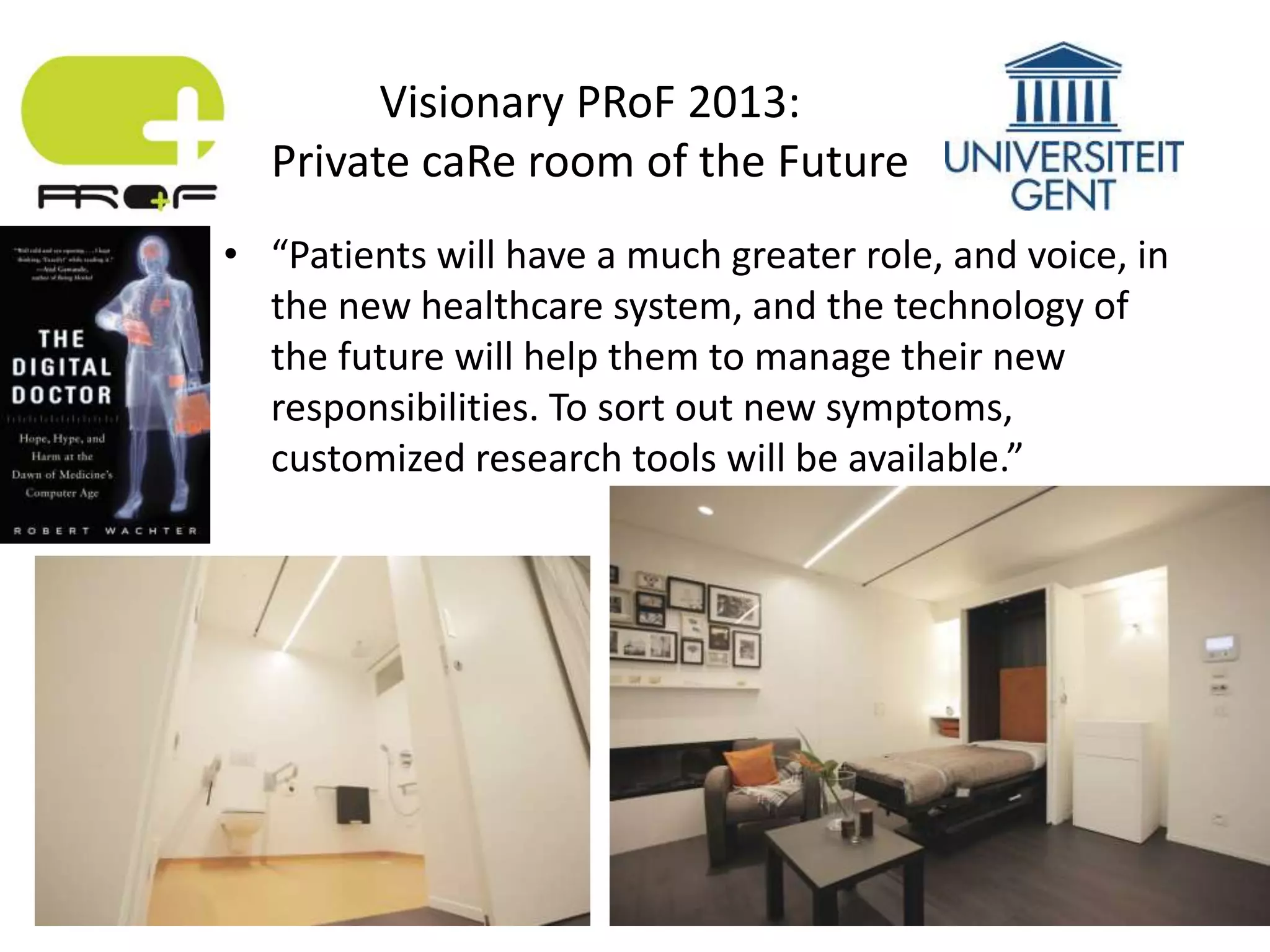
• 2013: PRoF 3.0 - Private caRe room of the Future
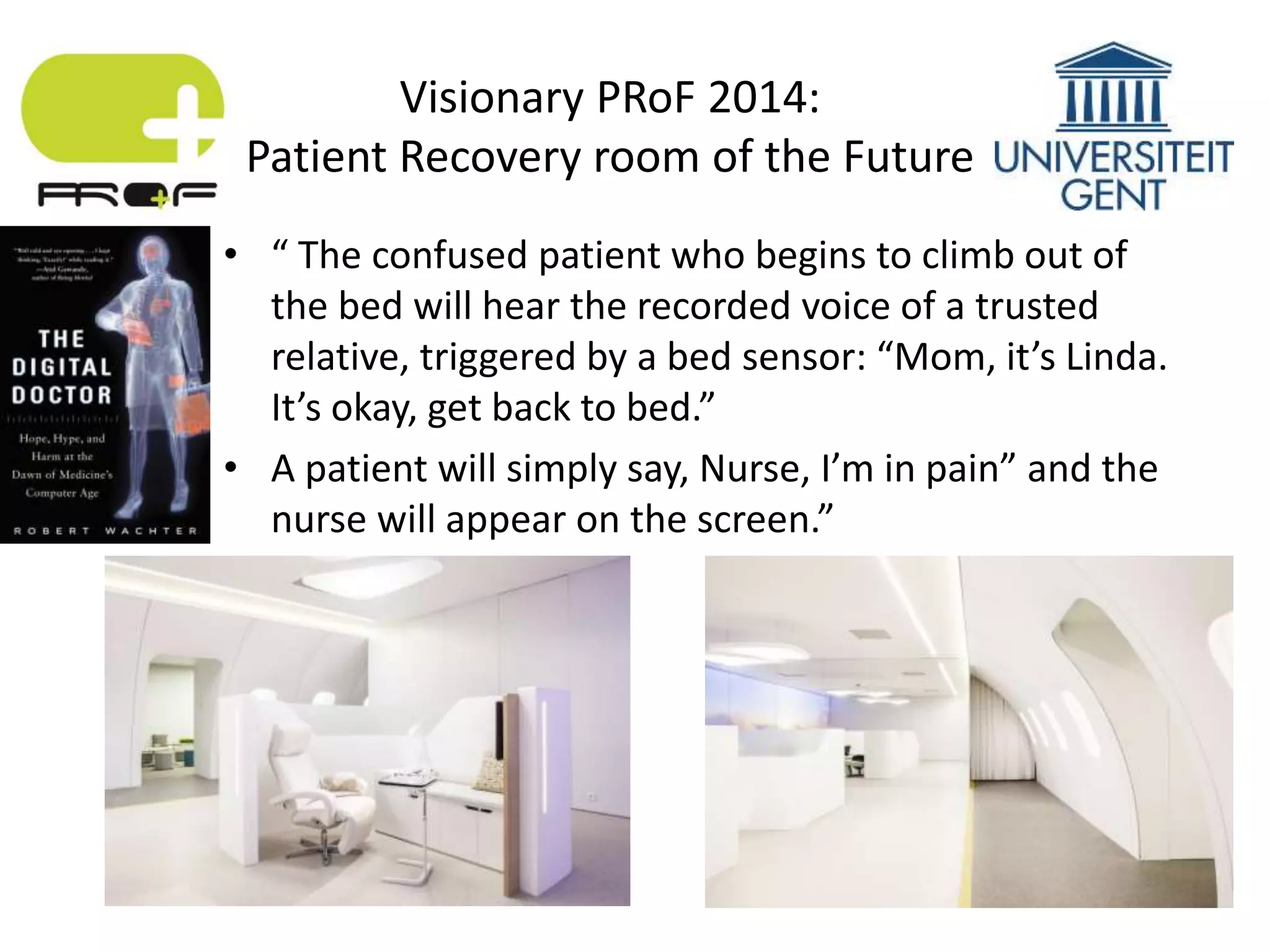
• 2014: PRoF 4.0 - Patient Recovery room of the Future
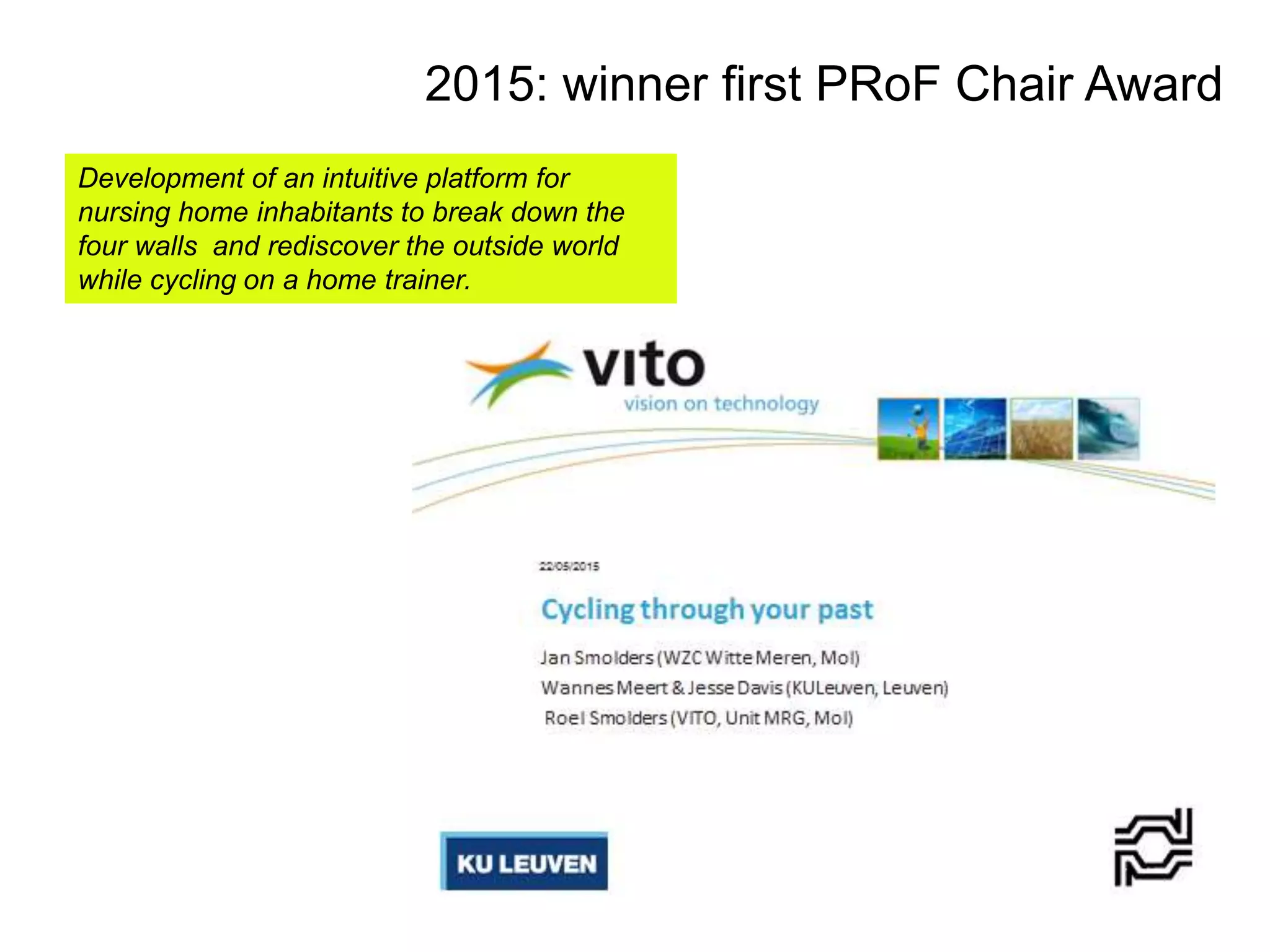
• 2015: Award PRoF Chair Ghent University
PRoF : the history
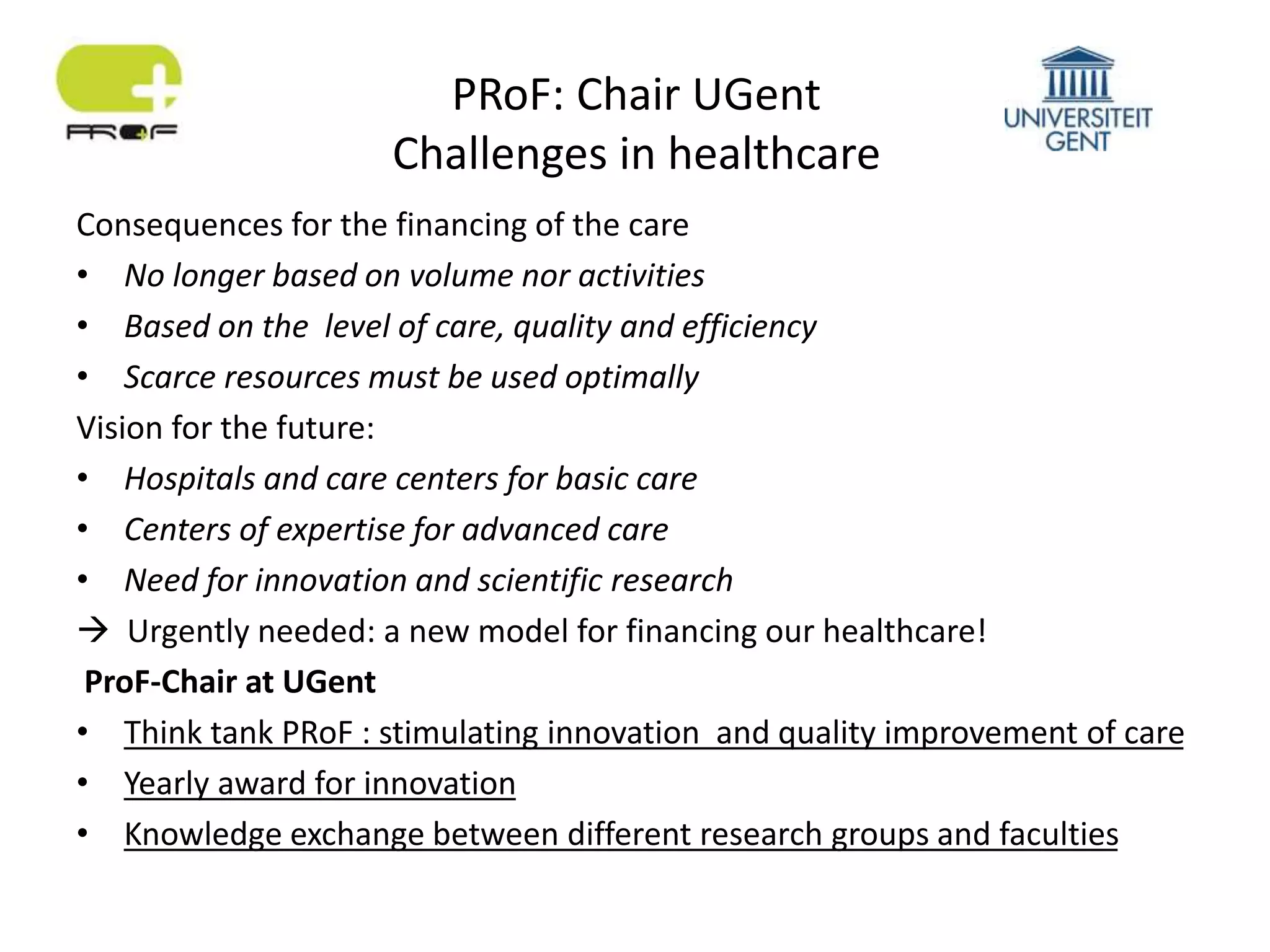
• “Patients will be in single rooms designed for safety
and infection prevention. Outfitted with wall-sized
video screens as well as cameras capable of extreme
close-ups and wide angels.”
Visionary PRoF 2011:
Patient Room of the Future
• “For the patient with multiple chronic diseases, much
of the care that currently involves hospitalizations
and visits to doctors’ offices will be conducted
through televisits and IT-enabled home care.”
Visionary PRoF 2012: Personalized
Residence of the Future
• “Patients will have a much greater role, and voice, in
the new healthcare system, and the technology of
the future will help them to manage their new
responsibilities. To sort out new symptoms,
customized research tools will be available.”
Visionary PRoF 2013:
Private caRe room of the Future
• “ The confused patient who begins to climb out of
the bed will hear the recorded voice of a trusted
relative, triggered by a bed sensor: “Mom, it’s Linda.
It’s okay, get back to bed.”
• A patient will simply say, Nurse, I’m in pain” and the
nurse will appear on the screen.”
Visionary PRoF 2014:
Patient Recovery room of the Future
Development of an intuitive platform for
nursing home inhabitants to break down the
four walls and rediscover the outside world
while cycling on a home trainer.
2015: winner first PRoF Chair Award
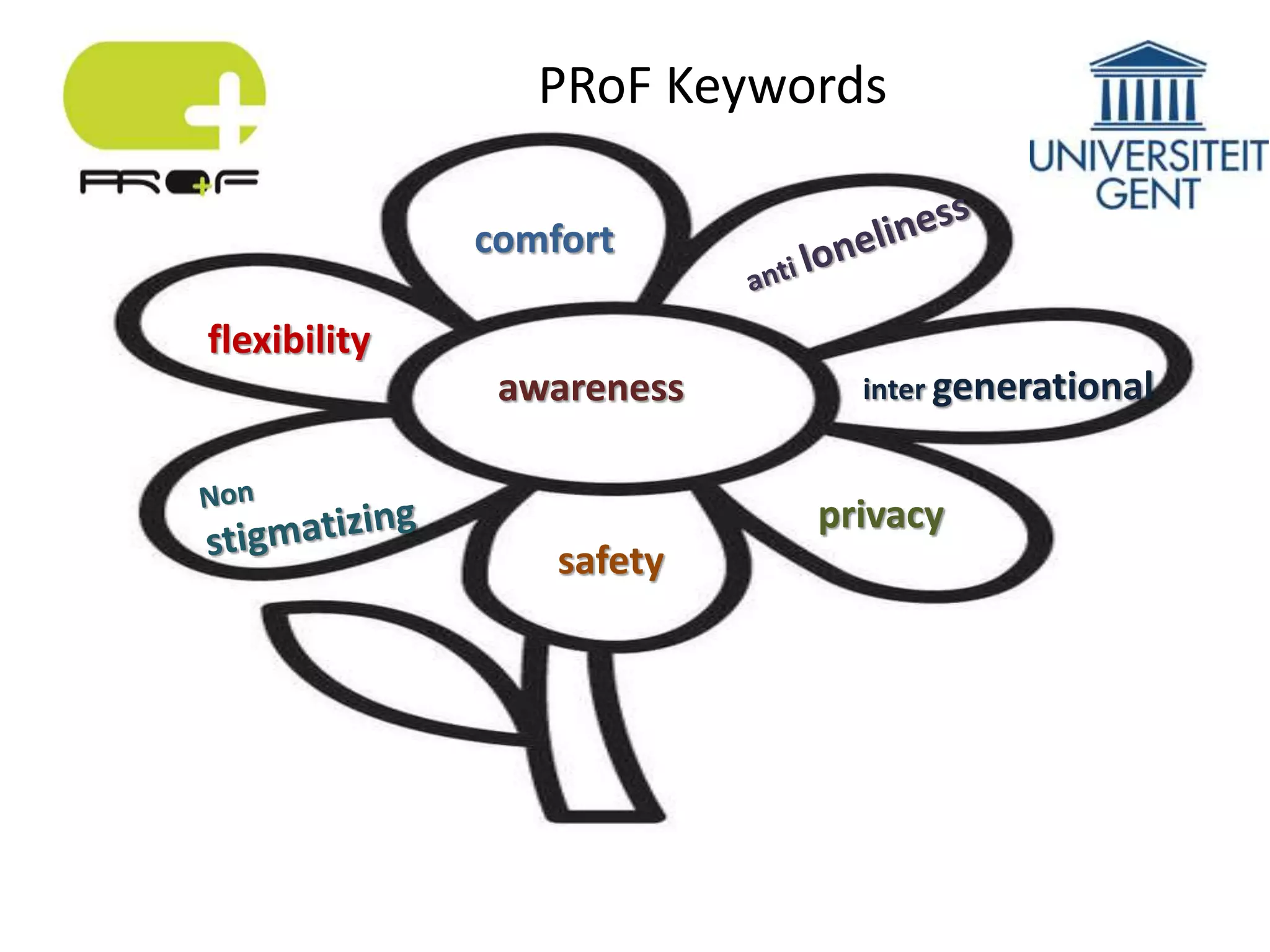
awareness
comfort
safety
privacy
inter generational
flexibility
PRoF Keywords
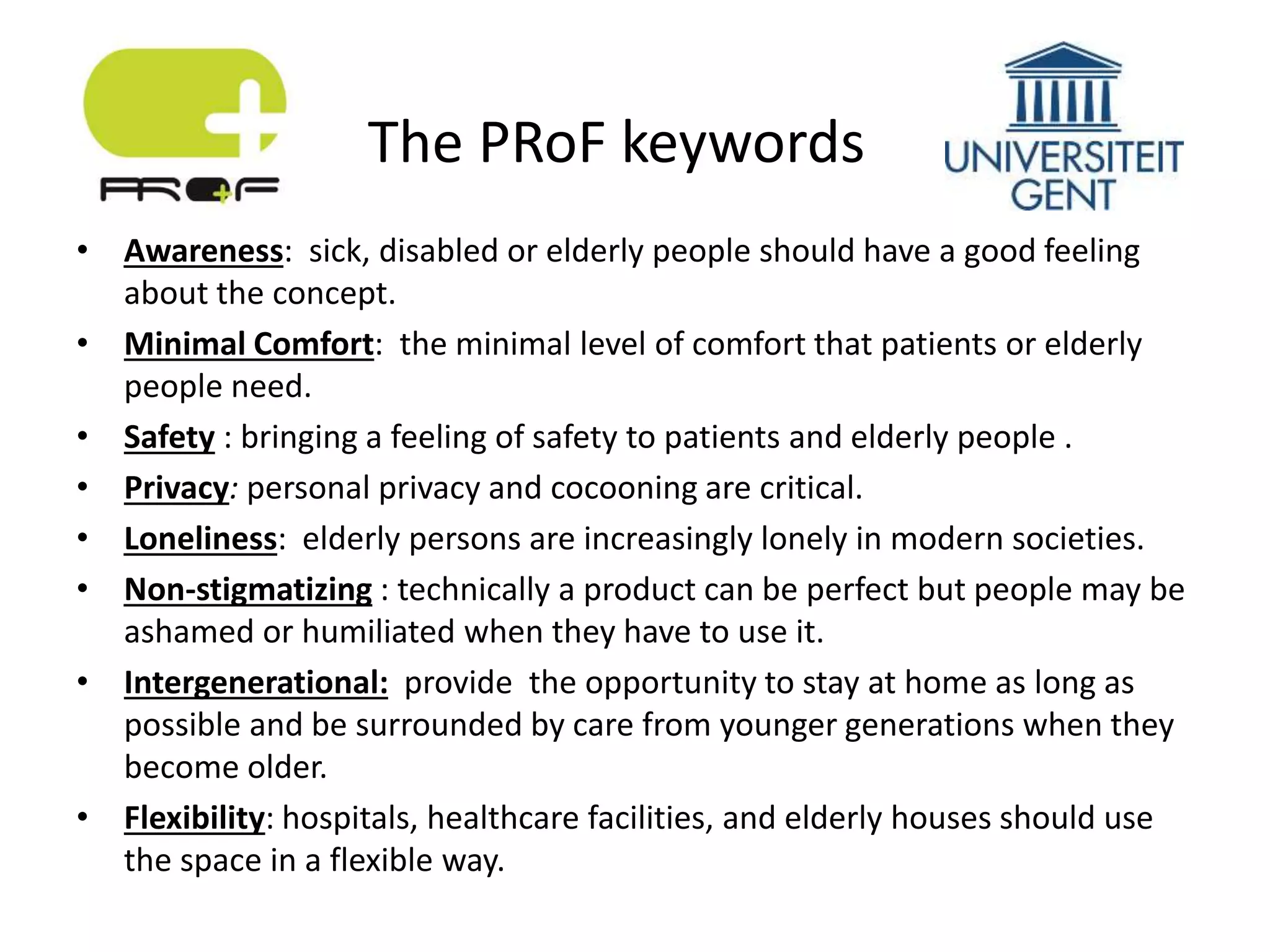
• Awareness: sick, disabled or elderly people should have a good feeling
about the concept.
• Minimal Comfort: the minimal level of comfort that patients or elderly
people need.
• Safety : bringing a feeling of safety to patients and elderly people .
• Privacy: personal privacy and cocooning are critical.
• Loneliness: elderly persons are increasingly lonely in modern societies.
• Non-stigmatizing : technically a product can be perfect but people may be
ashamed or humiliated when they have to use it.
• Intergenerational: provide the opportunity to stay at home as long as
possible and be surrounded by care from younger generations when they
become older.
• Flexibility: hospitals, healthcare facilities, and elderly houses should use
the space in a flexible way.
The PRoF keywords
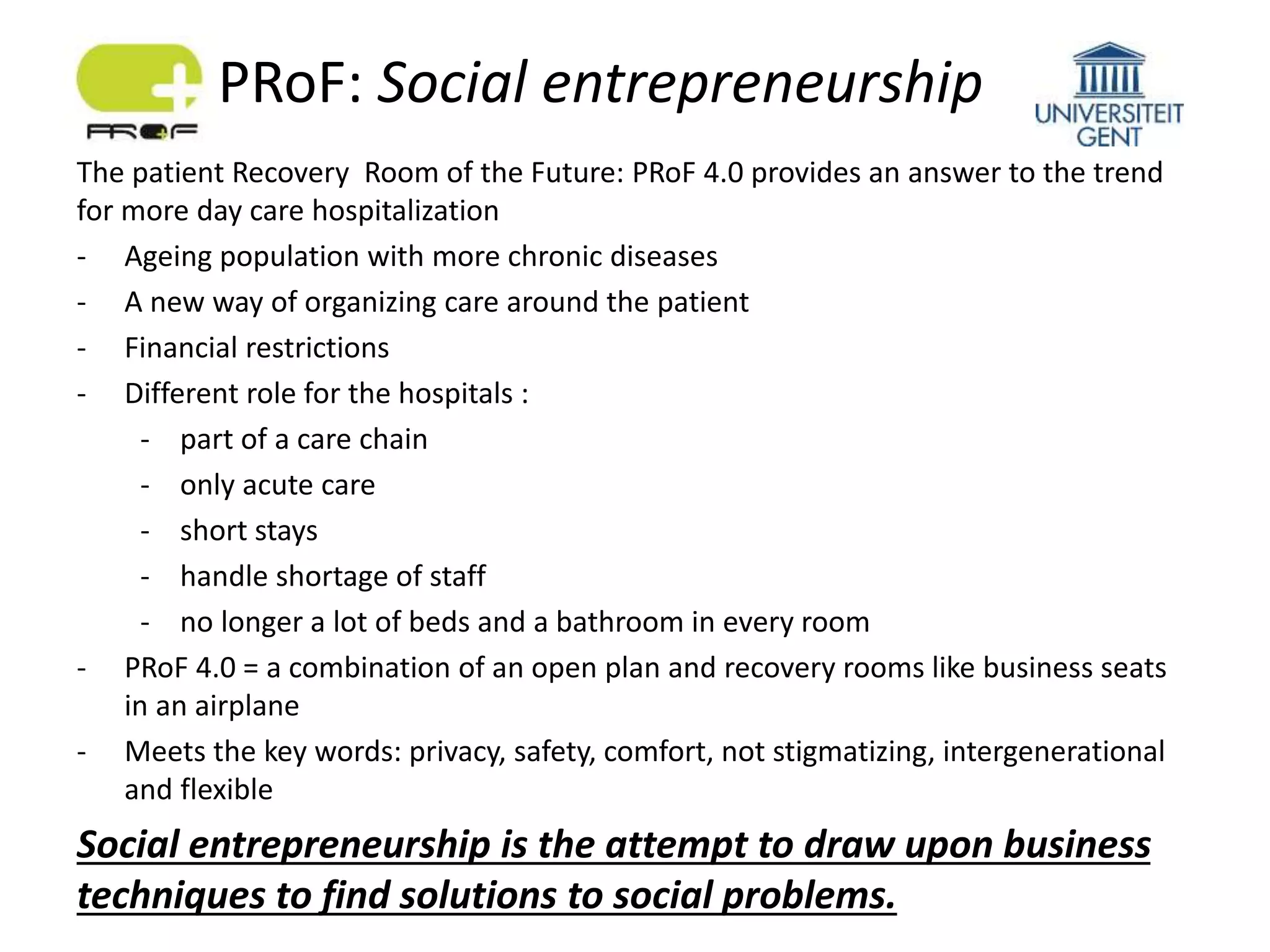
The patient Recovery Room of the Future: PRoF 4.0 provides an answer to the trend
for more day care hospitalization
- Ageing population with more chronic diseases
- A new way of organizing care around the patient
- Financial restrictions
- Different role for the hospitals :
- part of a care chain
- only acute care
- short stays
- handle shortage of staff
- no longer a lot of beds and a bathroom in every room
- PRoF 4.0 = a combination of an open plan and recovery rooms like business seats
in an airplane
- Meets the key words: privacy, safety, comfort, not stigmatizing, intergenerational
and flexible
Social entrepreneurship is the attempt to draw upon business
techniques to find solutions to social problems.
PRoF: Social entrepreneurship
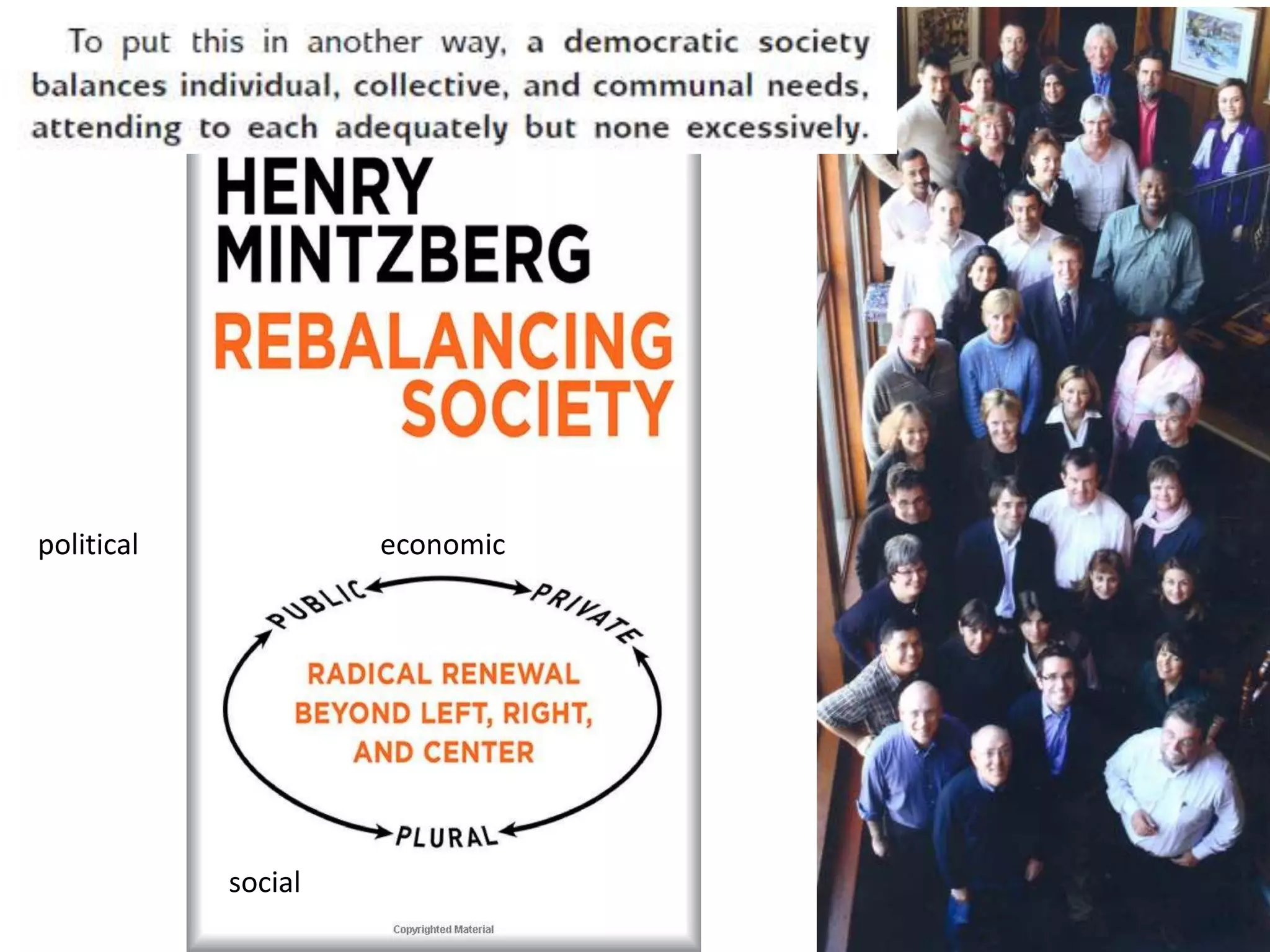
economicpolitical
social
KCGG
• Collaboration University – University Hospital
• Focused on “care” and “healthcare system”
– Horizontal integration of care systems
– Develop models for “care”
– Macro-, meso-,micro-level
– Networks
• Ghent University Hospital – Ghent University
• Stakeholders
• Goal: integrated knowledge center with other
universities
KCGG
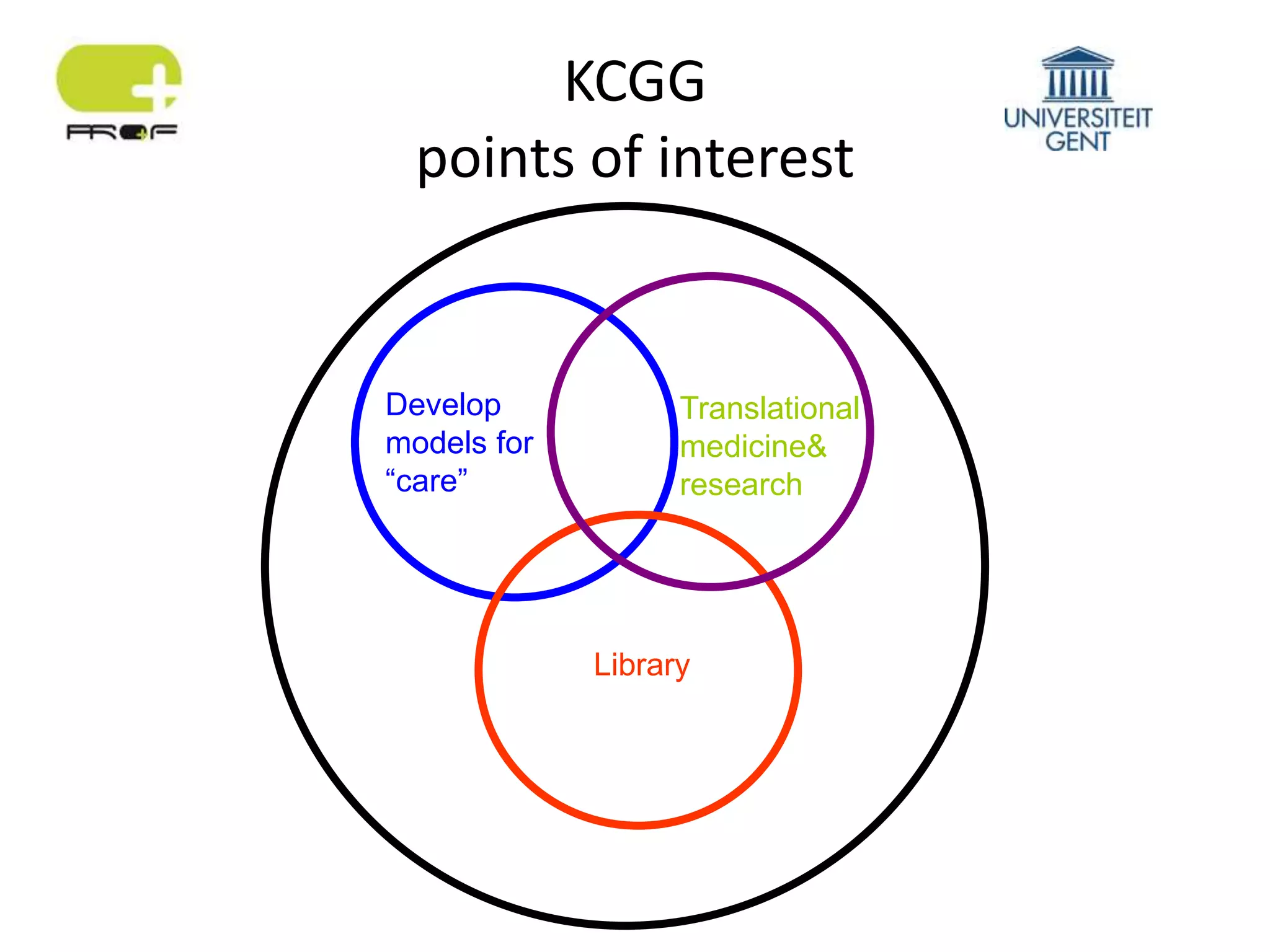
points of interest
Library
Translational
medicine&
research
Develop
models for
“care”
KCGG
work in progress
• Datawarehouse
– Structured data
– Knowledge repository (paper, multimedia) with search robots
– Knowledge repository for ‘tacit knowledge’
• Biomedical library
• Basic and clinical research
• Development of competence in ‘knowledge
management’
• In a network with other universities
What is Knowledge Management?
• Defined in a variety of ways.
• KM in education: a strategy to enable people to develop a
set of practices to create, capture, share & use
knowledge to advance.
• KM focuses on:
– people who create and use knowledge.
– processes and technologies by which knowledge is
created, maintained and accessed.
– artifacts in which knowledge is stored (manuals,
databases, intranets, books, ….).
Call for candidates for the competition via Ghent University:
• Innovative projects in the broad domain of healthcare applications
• Criteria:
– new concepts or theories in healthcare models (medical, care, ageing society)
– new insights regarding healthcare infrastructure (architecture and/or
equipment)
– innovating healthcare processes and/or procedures
– innovating healthcare products and/or services
– at least at research proof-of-concept stage or early market phase (pilot phase,
first market introduction)
– effect on the future healthcare system and the relevant stakeholders
– innovation matches with the values of the PRoF consortium
• Top 3 innovating projects selected by the jury for presenting their projects
• Selection of the winner at the Symposium: PRoF award (10.000 €).
The 2016 PRoF Award
• 16 applications
• From Belgium, Croatia, Greece, Italy and India
• Topics:
– new medical techniques
– care for the elderly
– care for the handicapped
– echography at home
– new care models
– monitoring and screening methodologies
– rehabilitation programs
– care for dementia
– innovating healthcare products
– services and quality control
The 2016 PRoF Award
The 2016 PRoF Award nominees
Ghent Toolkit Upper extremity Prosthesis (GTUP):
Developing a toolkit for upper limb prosthesis by using digital manufacturing techniques.
• Occupational therapy – Rehabilitation, Ghent University Hospital
• Ghent University
• Howest, Kortrijk
Inga Wellbeing:
Attractive, comfortable and functional clothing that enables patients to look and feel ‘normal’,
keep their dignity, and dress themselves even when hooked up to IV lines, drains and monitors.
• Inga Wellbeing
• Alsico NV
Automated Incontinence Monitoring for Elderly
A diaper-based sensor platform for optimizing and personalize incontinence related care as well
as to enable objective and accurate measurements necessary for diagnostics of urinary
incontinence in any home setting
• Ghent University Hospital
• Ghent University
• Imec
• p2-solutions
PRoF Award 2016
Chair UGent
www.prof-projects.com #profchair

2 PRoF 2016 prof Peleman introduction

  • 1.
    PRoF Award 2016 ChairGhent University prof. dr. R. Peleman
  • 2.
    © 2011 UniversitairZiekenhuis Gent© 2016 Universitair Ziekenhuis Gent Healthcare 2016 Renaat Peleman Chief Medical Officer Ghent University Hospital Chairholder PRoF Chair Ghent University
  • 3.
    3© 2016 UniversitairZiekenhuis Gent Overview
  • 4.
    4© 2016 UniversitairZiekenhuis Gent The global healthcare system and it’s challenges • capital-intensive and hospital-centric systems • prohibitive costs of care; lack of human resources and infrastructure, particularly in emerging economies • increased exposure to risks such as tobacco, physical inactivity and unhealthy dietary patterns • vulnerability and inefficient responses to pandemics • inadequate governance structures to leverage technology and big data for improving health • to keep individuals and populations healthy, solutions need to come from outside of the traditional healthcare space.
  • 5.
    5© 2016 UniversitairZiekenhuis Gent The hospital-centric model • current hospital-centric system already proving unsustainable and ineffective. • World Bank report on the impacts of ageing in East Asia highlights the urgency of shifting to a new model: • primary care plays a bigger role • treatment of older patients with chronic conditions is managed affordably at the right levels of the system. • financing model for healthcare will need to rely more on budget financing to achieve universal health coverage as the needs of ageing populations grow. • ageing is also creating a rapidly growing demand and market for long-term care as traditional family networks become increasingly stretched.
  • 7.
    7© 2016 UniversitairZiekenhuis Gent • Prohibitive costs of care and a lack of human resources and infrastructure particularly in emerging economies are proving a major obstacle. • The UN International Labour Organization found that 56% of the world’s rural population and 83% of Africa’s rural population live without critical healthcare access. • This amounts to a deficit of roughly 7 million healthworkers in rural areas. Healthcare costs, human resources and infrastructure
  • 8.
    8© 2016 UniversitairZiekenhuis Gent
  • 9.
    9© 2016 UniversitairZiekenhuis Gent Noncommunicable diseases • Increased exposure to risks such as tobacco, physical inactivity and unhealthy dietary patterns are making noncommunicable diseases (NCDs) such as cancer and diabetes the number one killer globally. • As the world’s population ages, deaths from NCDs are projected to rise from 38 million in 2012 to 52 million annually by 2030.
  • 10.
    10© 2016 UniversitairZiekenhuis Gent
  • 11.
    11© 2016 UniversitairZiekenhuis Gent
  • 12.
    12© 2016 UniversitairZiekenhuis Gent Vulnerability to pandemics • The potential costs of a global outbreak of the flu or another highly contagious disease could be huge. • The Ebola outbreak in West Africa provided a wake-up call for how health emergencies, in an increasingly connected world, can quickly become global challenges. • We are presently facing ZIKA
  • 13.
    13© 2016 UniversitairZiekenhuis Gent
  • 14.
    14© 2016 UniversitairZiekenhuis Gent
  • 15.
    15© 2016 UniversitairZiekenhuis Gent
  • 17.
    17© 2016 UniversitairZiekenhuis Gent • Breakthroughs in technology and the use of big data have the potential to transform medicine and create connected, more efficient healthcare. • Yet health systems are struggling to benefit from these innovations. Health technology and big data
  • 18.
    18 Technological innovation israpidly and dramatically changing the organization of healthcare One of many trends: Patient Empowerment
  • 20.
    Campaign on PatientEmpowerment → Patients prescribe E5 for Better Health Systems! • EDUCATION • EXPERTISE • EQUALITY • EXPERIENCE • ENGAGEMENT Campaign messages
  • 21.
    21© 2016 UniversitairZiekenhuis Gent The health ecosystem • Only 20% of health outcomes depends on the strength of healthcare systems; the rest is a function of the health ecosystem. • So, to keep individuals and populations healthy, solutions need to come from outside of the traditional healthcare space.
  • 22.
    22© 2016 UniversitairZiekenhuis Gent
  • 23.
    PRoF: Chair GhentUniversity Challenges in healthcare Consequences for the hospitals: - Management of care for chronic disease in the first line of care - Second line = coach for the first line - New role for the hospitals : - shorter and less hospital stays - specialized centers of expertise - multidisciplinary teams
  • 24.
    PRoF: Chair UGent Challengesin healthcare Consequences for the hospitals: • Acute care: preliminary phase and follow up phase move from the hospital to home care and flexible day care centers (care hotels) • Patient centered healing environment • Focus on privacy, safety and comfort • Focus on efficiency for the care providers
  • 25.
    PRoF: Chair UGent Challengesin healthcare Consequences for the financing of the care • No longer based on volume nor activities • Based on the level of care, quality and efficiency • Scarce resources must be used optimally Vision for the future: • Hospitals and care centers for basic care • Centers of expertise for advanced care • Need for innovation and scientific research  Urgently needed: a new model for financing our healthcare! ProF-Chair at UGent • Think tank PRoF : stimulating innovation and quality improvement of care • Yearly award for innovation • Knowledge exchange between different research groups and faculties
  • 26.
    PRoF: international openinnovation consortium • Start in 2009 • > 350 care professionals from multiple disciplines and organizations • Creating visions about the future evolution of care systems • Interdisciplinary approach: – care organizations – research centers, universities – companies • Each vision has been realized as a concept room • PRoF location in Poperinge – Belgium. The PRoF consortium
  • 27.
    • 2011: PRoF1.0 - Patient Room of the Future • 2012: PRoF 2.0 - Personalized Residence of the Future • 2013: PRoF 3.0 - Private caRe room of the Future • 2014: PRoF 4.0 - Patient Recovery room of the Future • 2015: Award PRoF Chair Ghent University PRoF : the history
  • 28.
    • “Patients willbe in single rooms designed for safety and infection prevention. Outfitted with wall-sized video screens as well as cameras capable of extreme close-ups and wide angels.” Visionary PRoF 2011: Patient Room of the Future
  • 29.
    • “For thepatient with multiple chronic diseases, much of the care that currently involves hospitalizations and visits to doctors’ offices will be conducted through televisits and IT-enabled home care.” Visionary PRoF 2012: Personalized Residence of the Future
  • 30.
    • “Patients willhave a much greater role, and voice, in the new healthcare system, and the technology of the future will help them to manage their new responsibilities. To sort out new symptoms, customized research tools will be available.” Visionary PRoF 2013: Private caRe room of the Future
  • 31.
    • “ Theconfused patient who begins to climb out of the bed will hear the recorded voice of a trusted relative, triggered by a bed sensor: “Mom, it’s Linda. It’s okay, get back to bed.” • A patient will simply say, Nurse, I’m in pain” and the nurse will appear on the screen.” Visionary PRoF 2014: Patient Recovery room of the Future
  • 32.
    Development of anintuitive platform for nursing home inhabitants to break down the four walls and rediscover the outside world while cycling on a home trainer. 2015: winner first PRoF Chair Award
  • 33.
  • 34.
    • Awareness: sick,disabled or elderly people should have a good feeling about the concept. • Minimal Comfort: the minimal level of comfort that patients or elderly people need. • Safety : bringing a feeling of safety to patients and elderly people . • Privacy: personal privacy and cocooning are critical. • Loneliness: elderly persons are increasingly lonely in modern societies. • Non-stigmatizing : technically a product can be perfect but people may be ashamed or humiliated when they have to use it. • Intergenerational: provide the opportunity to stay at home as long as possible and be surrounded by care from younger generations when they become older. • Flexibility: hospitals, healthcare facilities, and elderly houses should use the space in a flexible way. The PRoF keywords
  • 35.
    The patient RecoveryRoom of the Future: PRoF 4.0 provides an answer to the trend for more day care hospitalization - Ageing population with more chronic diseases - A new way of organizing care around the patient - Financial restrictions - Different role for the hospitals : - part of a care chain - only acute care - short stays - handle shortage of staff - no longer a lot of beds and a bathroom in every room - PRoF 4.0 = a combination of an open plan and recovery rooms like business seats in an airplane - Meets the key words: privacy, safety, comfort, not stigmatizing, intergenerational and flexible Social entrepreneurship is the attempt to draw upon business techniques to find solutions to social problems. PRoF: Social entrepreneurship
  • 36.
  • 37.
    KCGG • Collaboration University– University Hospital • Focused on “care” and “healthcare system” – Horizontal integration of care systems – Develop models for “care” – Macro-, meso-,micro-level – Networks • Ghent University Hospital – Ghent University • Stakeholders • Goal: integrated knowledge center with other universities
  • 38.
  • 39.
    KCGG work in progress •Datawarehouse – Structured data – Knowledge repository (paper, multimedia) with search robots – Knowledge repository for ‘tacit knowledge’ • Biomedical library • Basic and clinical research • Development of competence in ‘knowledge management’ • In a network with other universities
  • 40.
    What is KnowledgeManagement? • Defined in a variety of ways. • KM in education: a strategy to enable people to develop a set of practices to create, capture, share & use knowledge to advance. • KM focuses on: – people who create and use knowledge. – processes and technologies by which knowledge is created, maintained and accessed. – artifacts in which knowledge is stored (manuals, databases, intranets, books, ….).
  • 41.
    Call for candidatesfor the competition via Ghent University: • Innovative projects in the broad domain of healthcare applications • Criteria: – new concepts or theories in healthcare models (medical, care, ageing society) – new insights regarding healthcare infrastructure (architecture and/or equipment) – innovating healthcare processes and/or procedures – innovating healthcare products and/or services – at least at research proof-of-concept stage or early market phase (pilot phase, first market introduction) – effect on the future healthcare system and the relevant stakeholders – innovation matches with the values of the PRoF consortium • Top 3 innovating projects selected by the jury for presenting their projects • Selection of the winner at the Symposium: PRoF award (10.000 €). The 2016 PRoF Award
  • 42.
    • 16 applications •From Belgium, Croatia, Greece, Italy and India • Topics: – new medical techniques – care for the elderly – care for the handicapped – echography at home – new care models – monitoring and screening methodologies – rehabilitation programs – care for dementia – innovating healthcare products – services and quality control The 2016 PRoF Award
  • 43.
    The 2016 PRoFAward nominees Ghent Toolkit Upper extremity Prosthesis (GTUP): Developing a toolkit for upper limb prosthesis by using digital manufacturing techniques. • Occupational therapy – Rehabilitation, Ghent University Hospital • Ghent University • Howest, Kortrijk Inga Wellbeing: Attractive, comfortable and functional clothing that enables patients to look and feel ‘normal’, keep their dignity, and dress themselves even when hooked up to IV lines, drains and monitors. • Inga Wellbeing • Alsico NV Automated Incontinence Monitoring for Elderly A diaper-based sensor platform for optimizing and personalize incontinence related care as well as to enable objective and accurate measurements necessary for diagnostics of urinary incontinence in any home setting • Ghent University Hospital • Ghent University • Imec • p2-solutions
  • 44.
    PRoF Award 2016 ChairUGent www.prof-projects.com #profchair