Interactive Mobile Learning Systems
Diseño y Evaluación de Productos Interactivos
Interactive Mobile Learning Systems
for learning
Mar Pérez-Sanagustín,
GAST, Gradient Laboratory,Universidad Carlos III de Madrid
Diseño y Evaluación de Productos Interactivos
21st May 2013
#depimlearning
Interactive Mobile Learning Systems
Diseño y Evaluación de Productos Interactivos
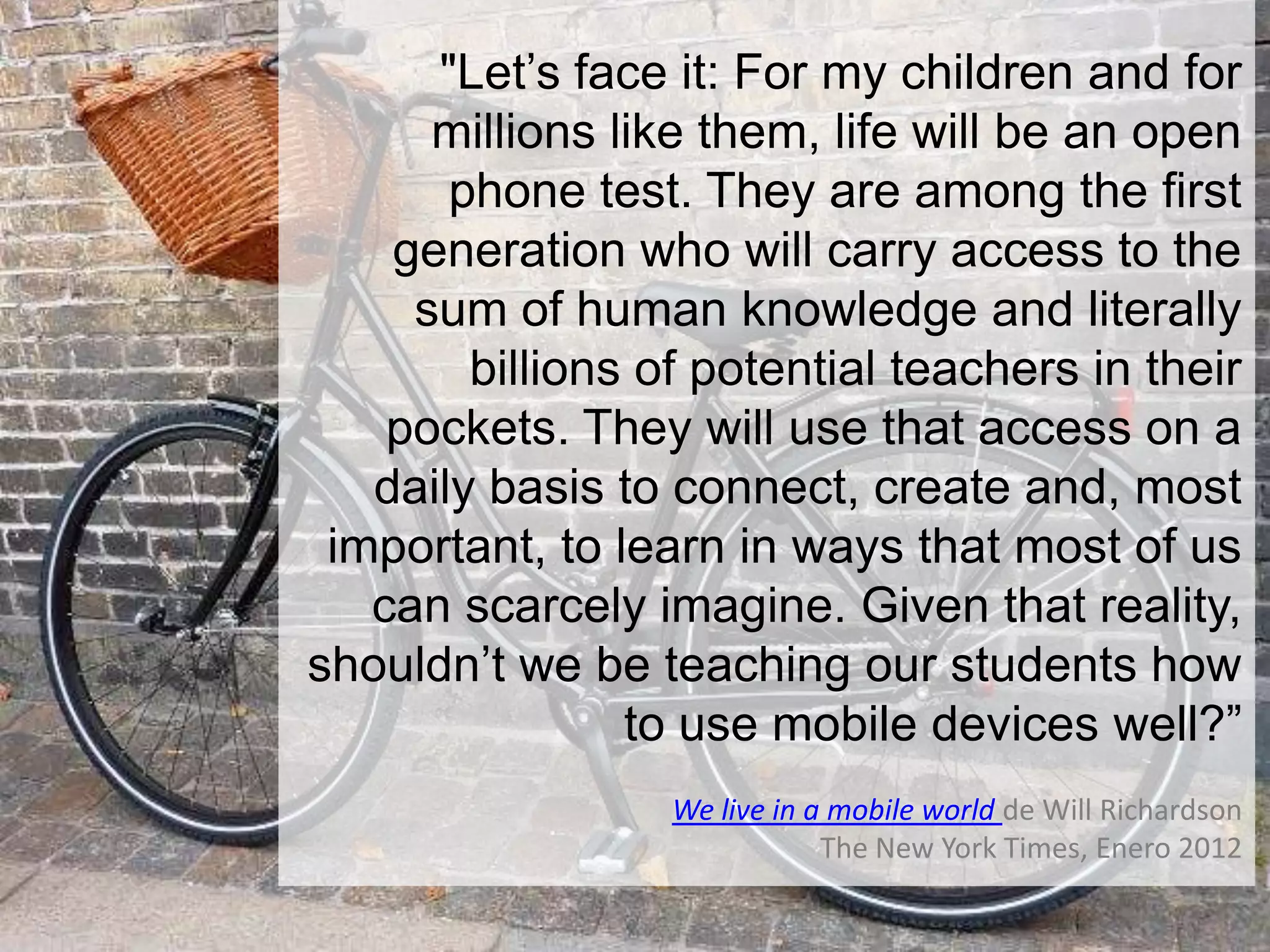
"Let’s face it: For my children and for
millions like them, life will be an open
phone test. They are among the first
generation who will carry access to the
sum of human knowledge and literally
billions of potential teachers in their
pockets. They will use that access on a
daily basis to connect, create and, most
important, to learn in ways that most of us
can scarcely imagine. Given that reality,
shouldn’t we be teaching our students how
to use mobile devices well?”
We live in a mobile world de Will Richardson
The New York Times, Enero 2012
Interactive Mobile Learning Systems
Diseño y Evaluación de Productos Interactivos
1. Mobile Learning
1.1. Definitions
1.2. Theory of mobile learning
2. Mobile learning applications and scenarios
2.1. Indoors & Outdoors Applications
2.2. Designing situated learning scenarios
2.3. Indoors & Outdoors Scenarios: Case studies
2.4. Activity (30 mins)
3. Mobile learning in the smart city: Future challenges
3.1. Smart city Horizon 2020
3.2. Smart City Learning
4. Conclusions
Interactive Mobile Learning Systems
Diseño y Evaluación de Productos Interactivos
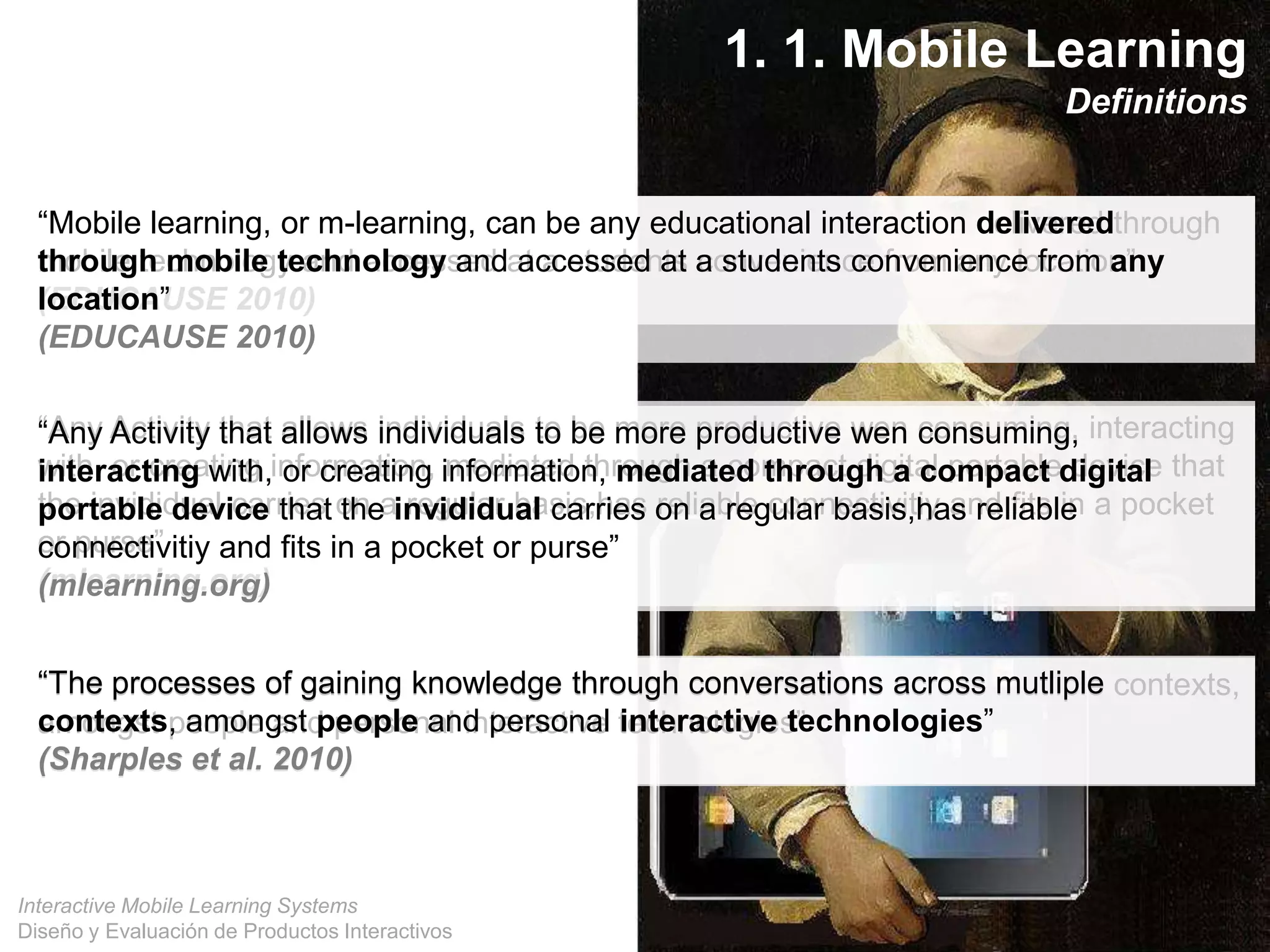
“Mobile learning, or m-learning, can be any educational interaction delivered through
mobile technology and accessed at a students convenience from any location”
(EDUCAUSE 2010)
“Any Activity that allows individuals to be more productive wen consuming, interacting
with, or creating information, mediated through a compact digital portable device that
the invididual carries on a regular basis,has reliable connectivitiy and fits in a pocket
or purse”
(mlearning.org)
“The processes of gaining knowledge through conversations across mutliple contexts,
amongst people and personal interactive technologies”
(Sharples et al. 2010)
“Mobile learning, or m-learning, can be any educational interaction delivered
through mobile technology and accessed at a students convenience from any
location”
(EDUCAUSE 2010)
“Any Activity that allows individuals to be more productive wen consuming,
interacting with, or creating information, mediated through a compact digital
portable device that the invididual carries on a regular basis,has reliable
connectivitiy and fits in a pocket or purse”
(mlearning.org)
“The processes of gaining knowledge through conversations across mutliple
contexts, amongst people and personal interactive technologies”
(Sharples et al. 2010)
1. 1. Mobile Learning
Definitions
Interactive Mobile Learning Systems
Diseño y Evaluación de Productos Interactivos
1. 1. Mobile Learning
Definitions
Interactive Mobile Learning Systems
Diseño y Evaluación de Productos Interactivos
1. 2. Mobile Learning
Theories
What makes mobile
learning different
form other learning
theories?
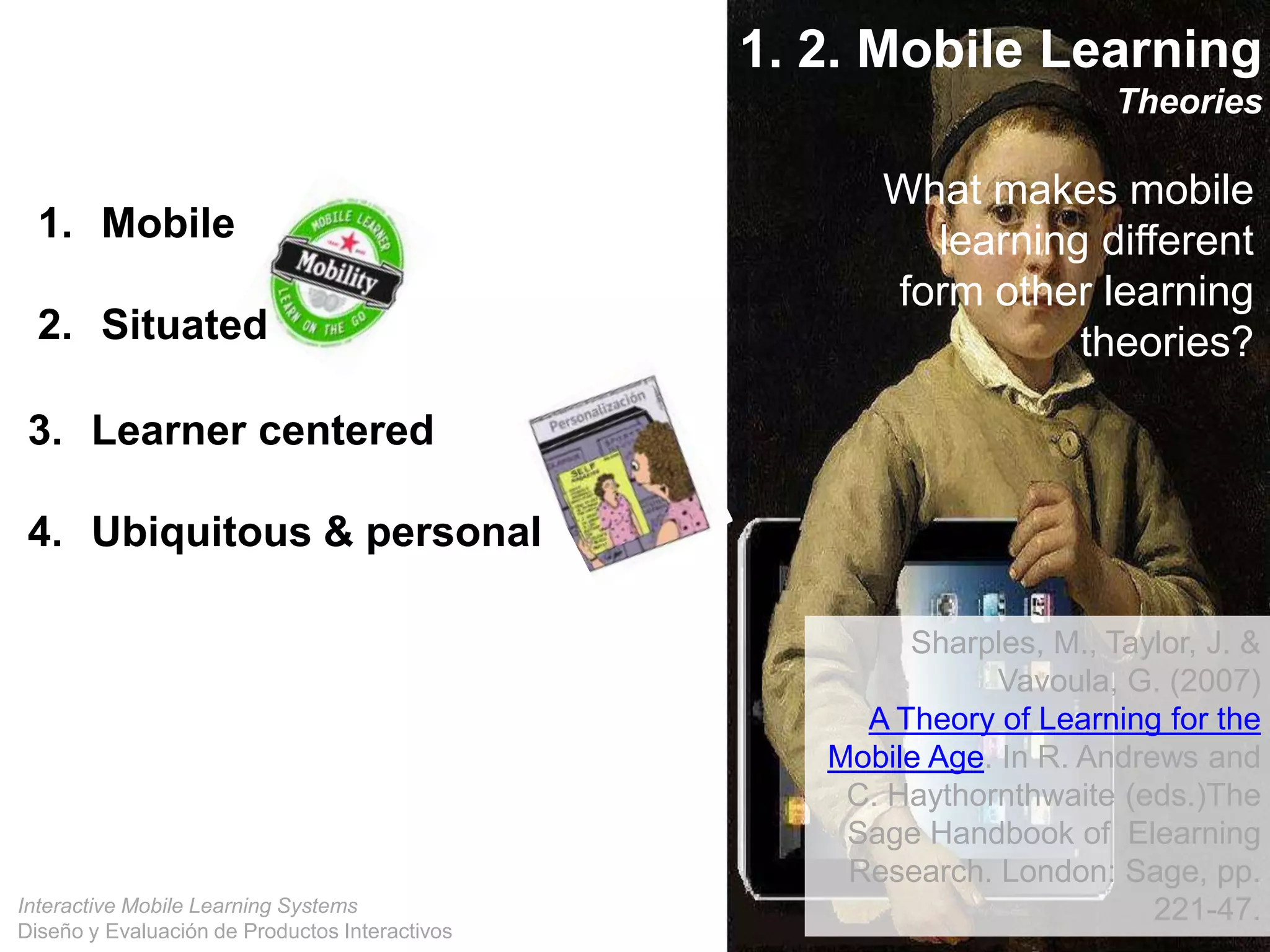
1. Mobile
2. Situated
3. Learner centered
4. Ubiquitous & personal
Sharples, M., Taylor, J. &
Vavoula, G. (2007)
A Theory of Learning for the
Mobile Age. In R. Andrews and
C. Haythornthwaite (eds.)The
Sage Handbook of Elearning
Research. London: Sage, pp.
221-47.
Interactive Mobile Learning Systems
Diseño y Evaluación de Productos Interactivos
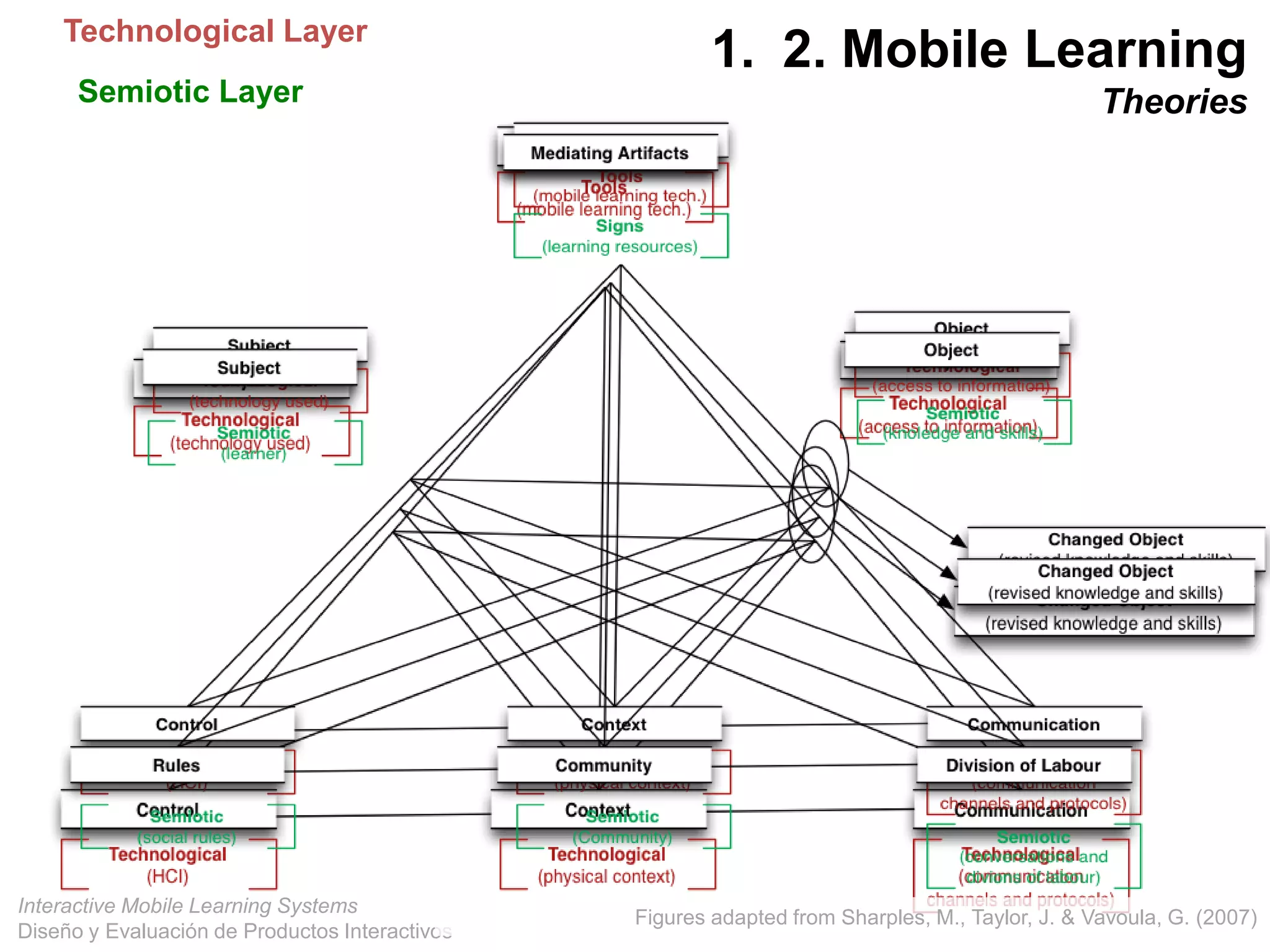
Technological Layer
Semiotic Layer
Figures adapted from Sharples, M., Taylor, J. & Vavoula, G. (2007)
1. 2. Mobile Learning
Theories
Interactive Mobile Learning Systems
Diseño y Evaluación de Productos Interactivos
1. 2. Mobile Learning
Theories
Theory for Mobile Learning
Pedagogically-oriented
frameworks for
designing Mobile
Learning Activities
Interactive Mobile Learning Systems
Diseño y Evaluación de Productos Interactivos
1. 2. Mobile Learning
Theories
Uden (2009)
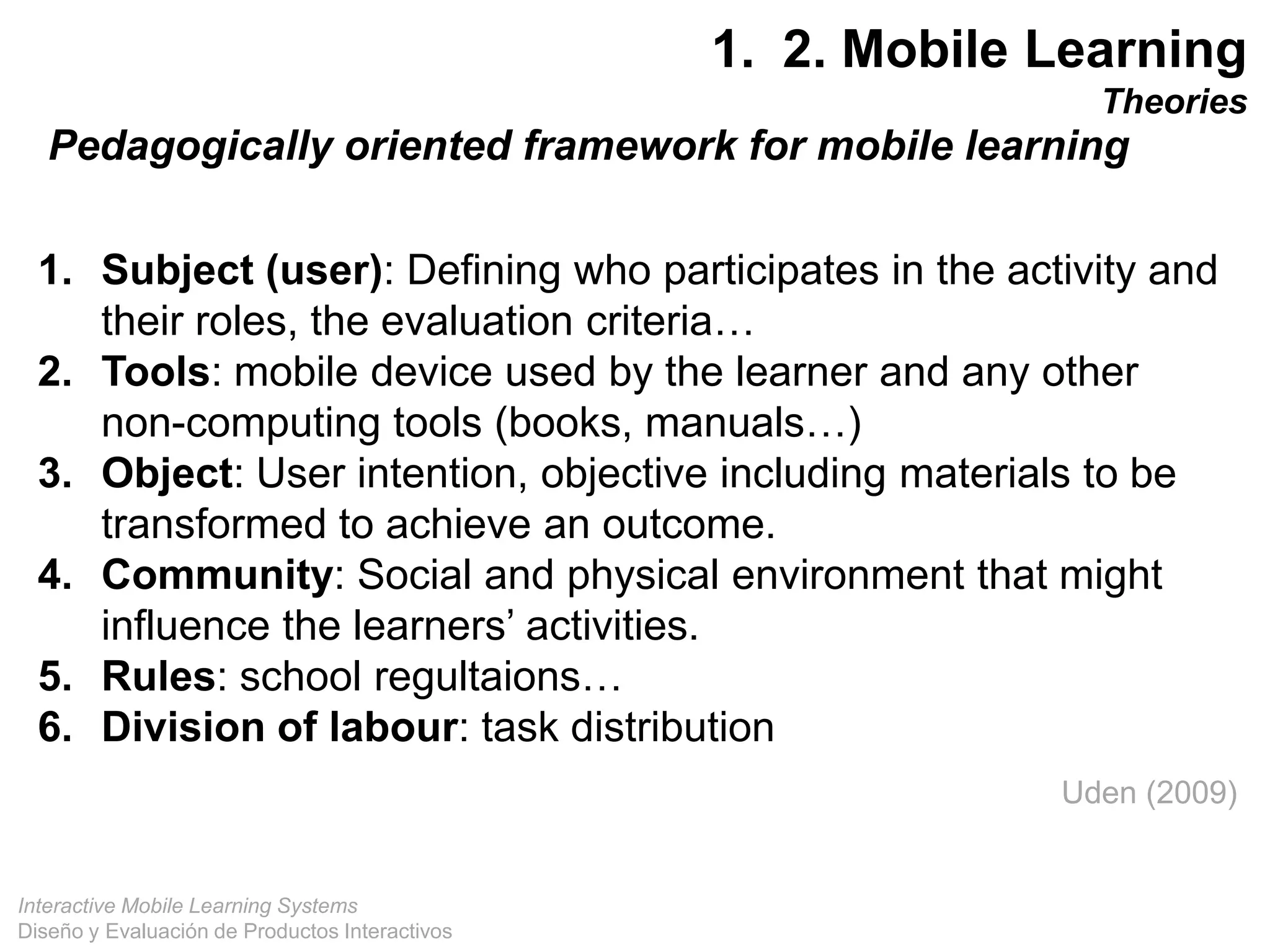
1. Subject (user): Defining who participates in the activity and
their roles, the evaluation criteria…
2. Tools: mobile device used by the learner and any other
non-computing tools (books, manuals…)
3. Object: User intention, objective including materials to be
transformed to achieve an outcome.
4. Community: Social and physical environment that might
influence the learners’ activities.
5. Rules: school regultaions…
6. Division of labour: task distribution
Pedagogically oriented framework for mobile learning
Interactive Mobile Learning Systems
Diseño y Evaluación de Productos Interactivos
1. 2. Mobile Learning
Theories
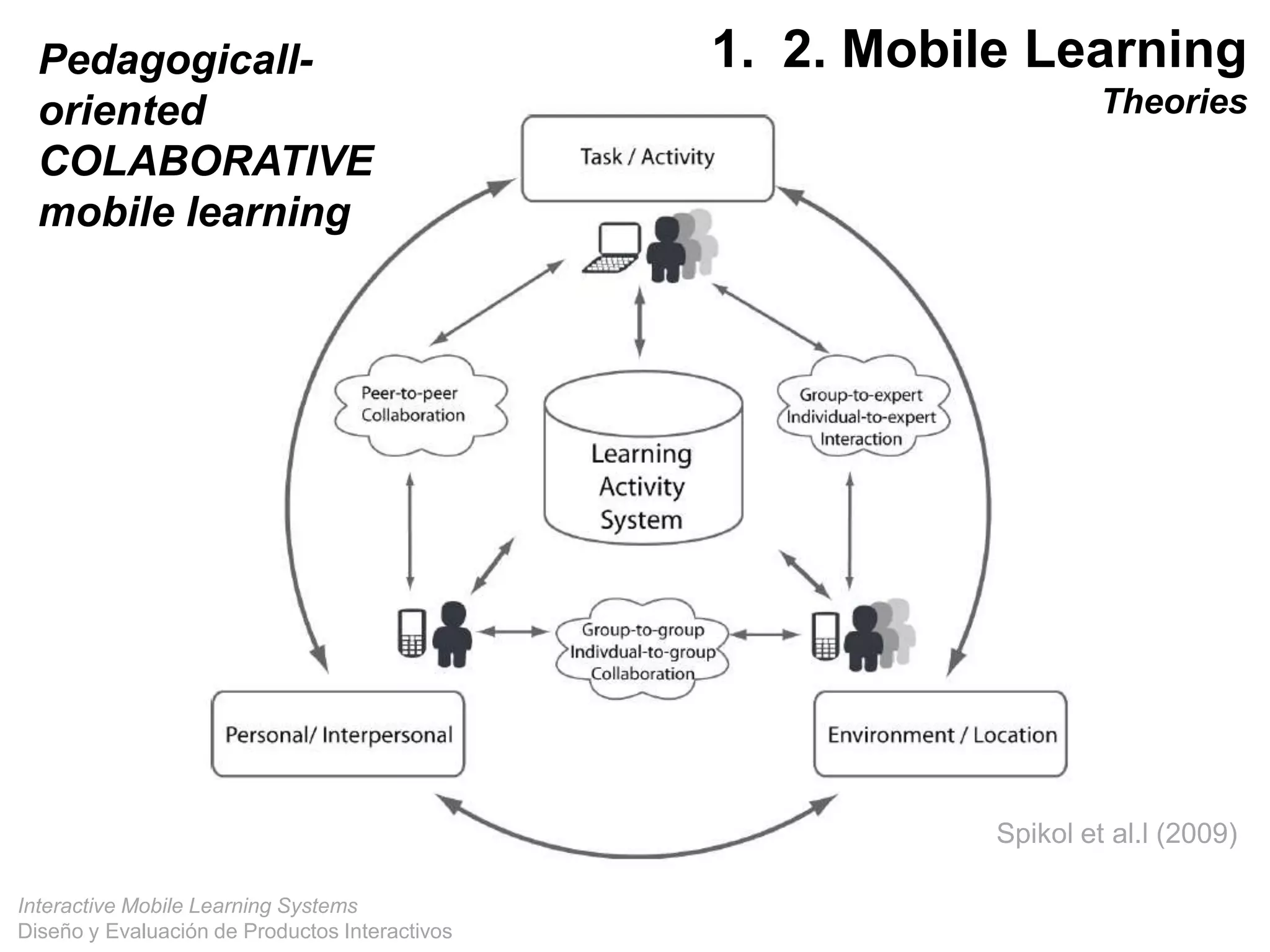
Spikol et al.l (2009)
Pedagogicall-
oriented
COLABORATIVE
mobile learning
Interactive Mobile Learning Systems
Diseño y Evaluación de Productos Interactivos
1. 2. Mobile Learning
Theories
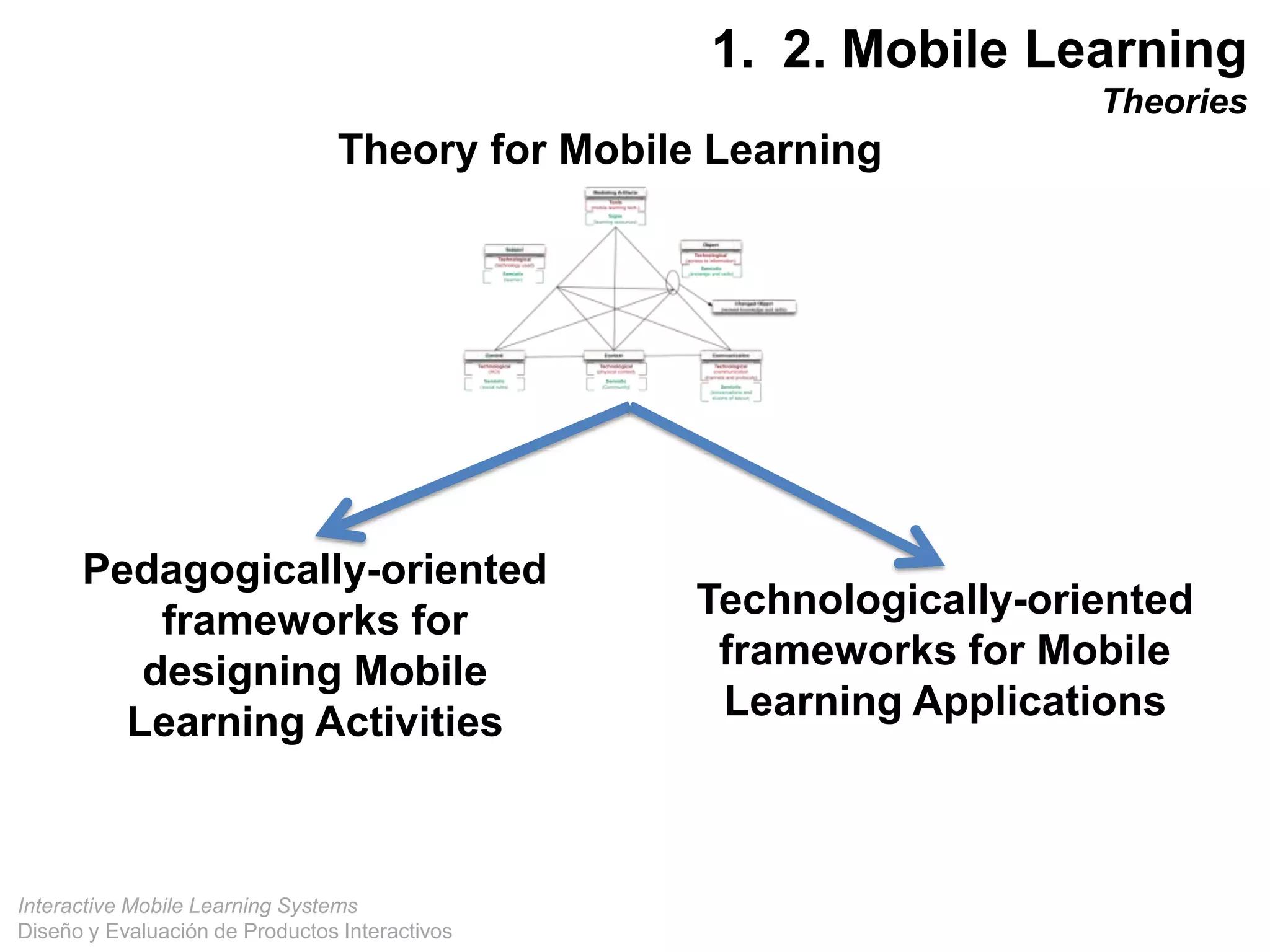
Theory for Mobile Learning
Pedagogically-oriented
frameworks for
designing Mobile
Learning Activities
Technologically-oriented
frameworks for Mobile
Learning Applications
Interactive Mobile Learning Systems
Diseño y Evaluación de Productos Interactivos
1. 2. Mobile Learning
Theories
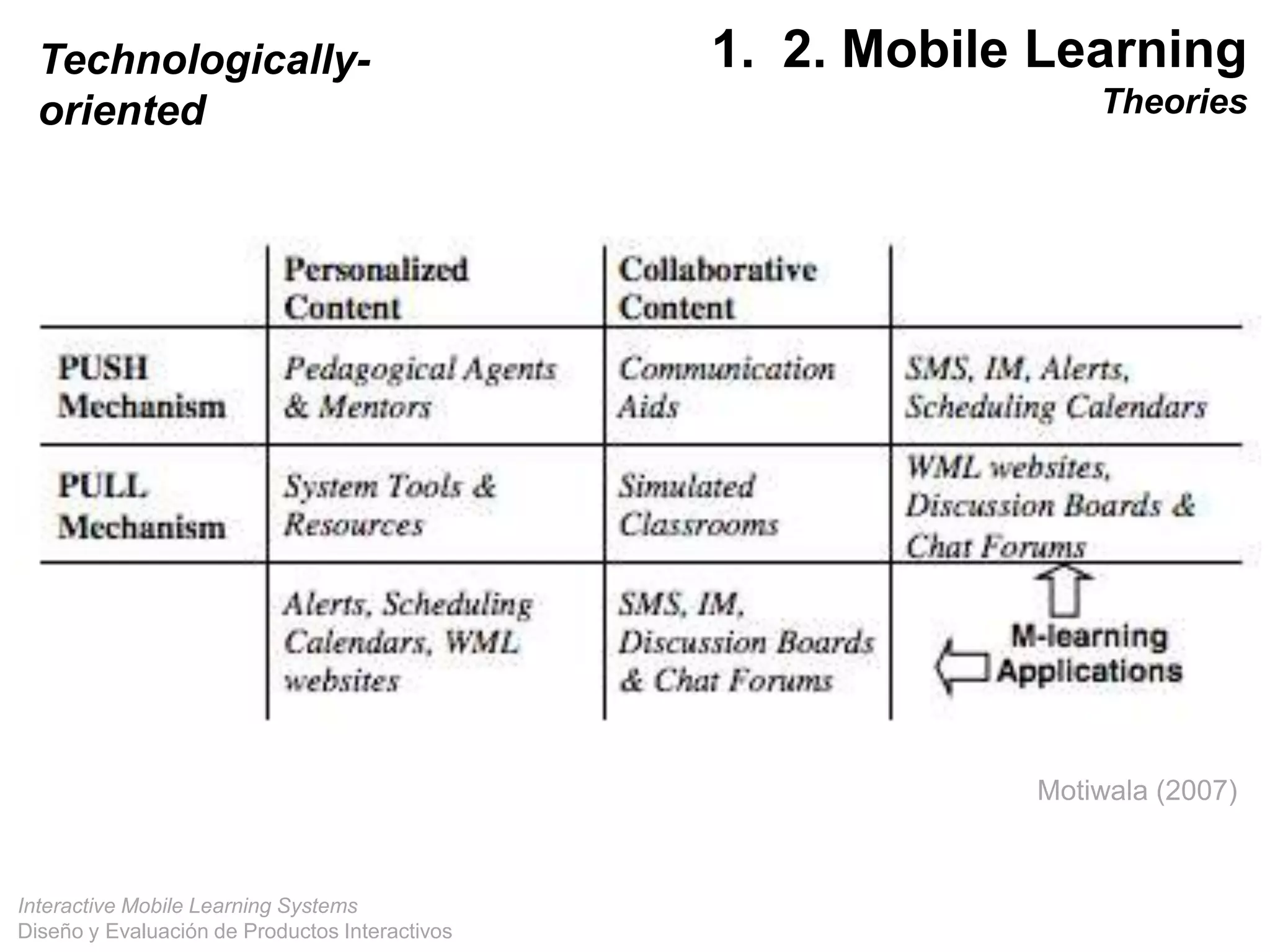
Motiwala (2007)
Technologically-
oriented
Interactive Mobile Learning Systems
Diseño y Evaluación de Productos Interactivos
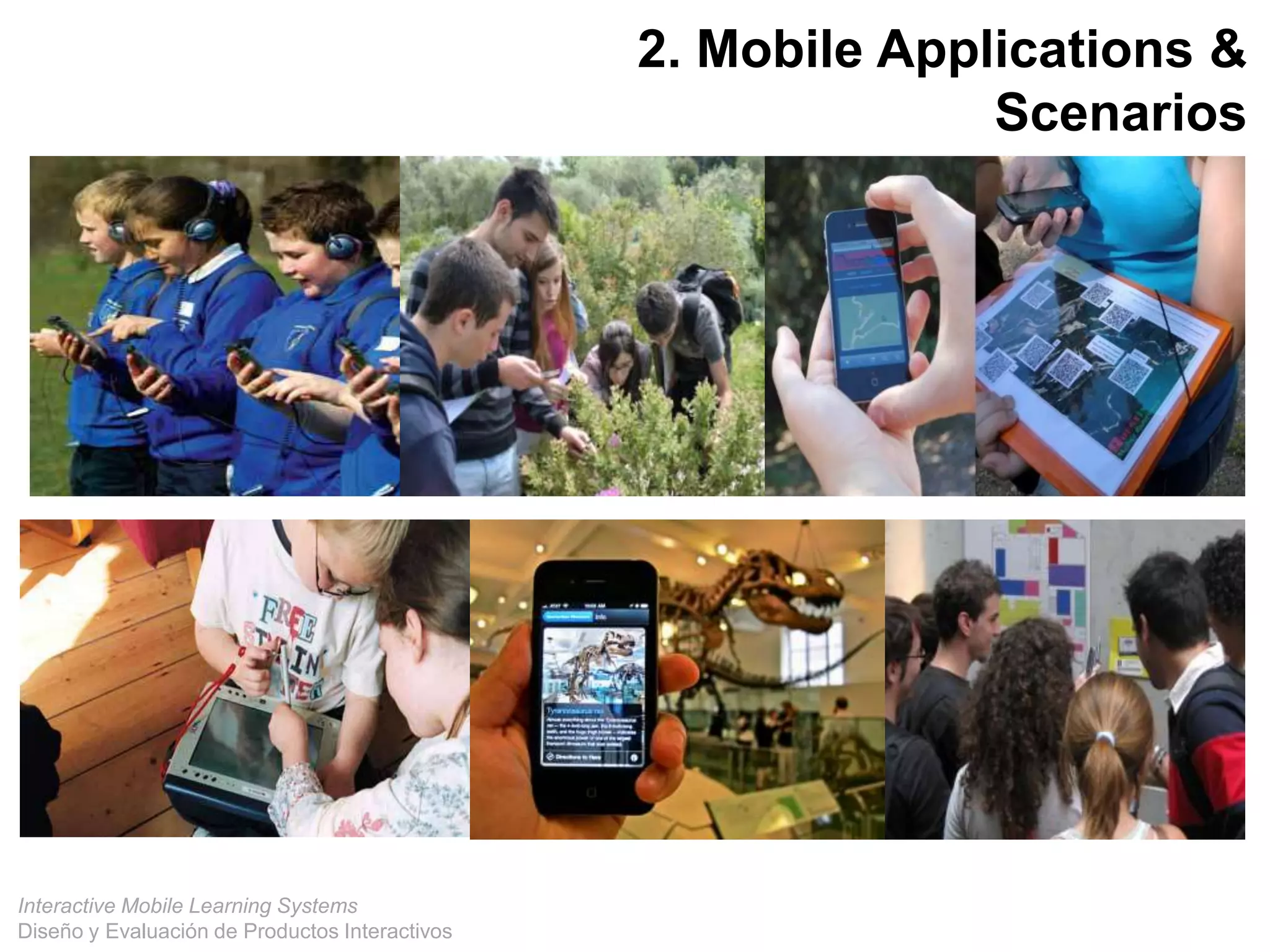
2. Mobile Applications &
Scenarios
Interactive Mobile Learning Systems
Diseño y Evaluación de Productos Interactivos
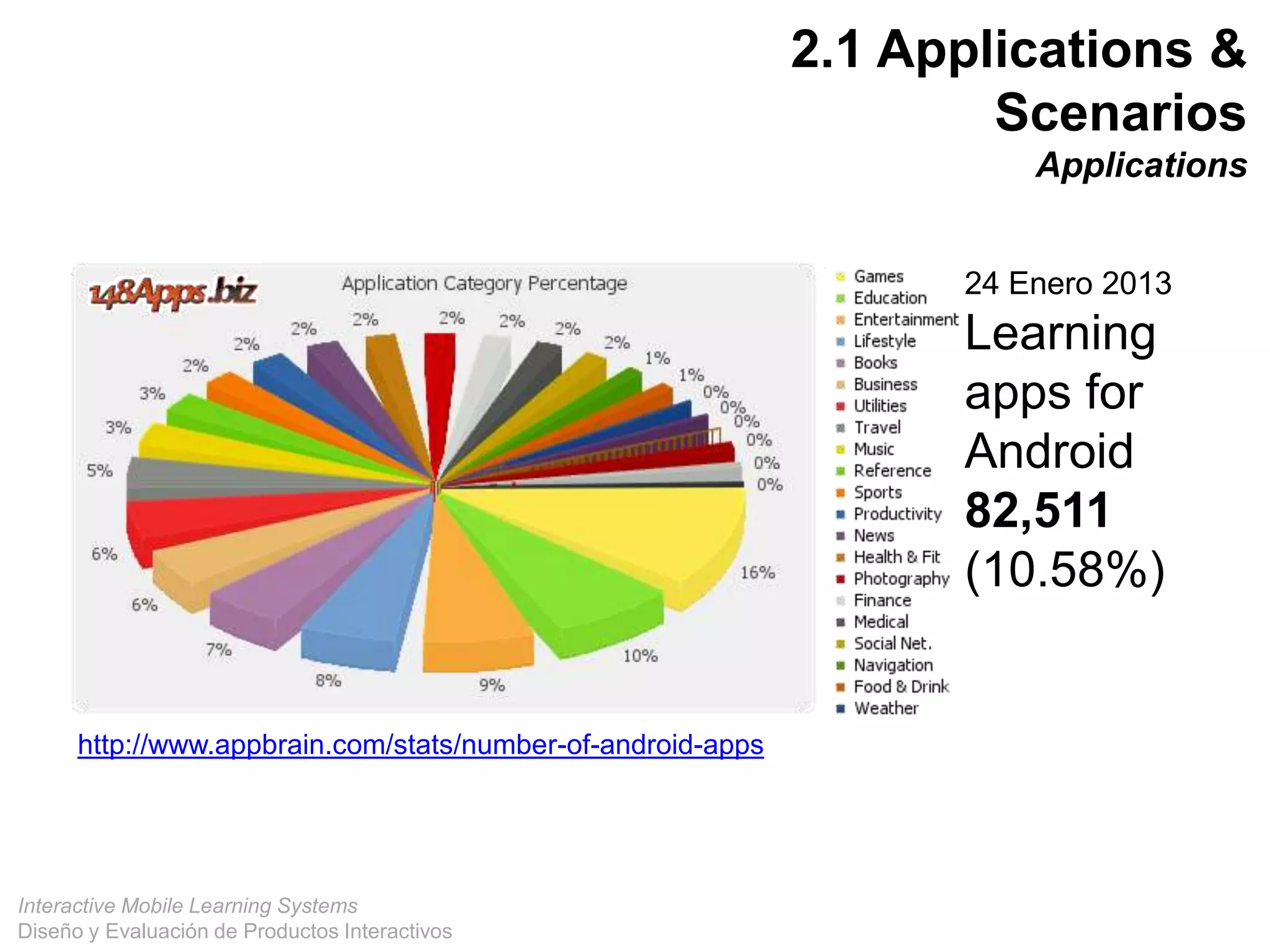
2.1 Applications &
Scenarios
Applications
24 Enero 2013
Learning
apps for
Android
82,511
(10.58%)
http://www.appbrain.com/stats/number-of-android-apps
Interactive Mobile Learning Systems
Diseño y Evaluación de Productos Interactivos
Interactive Mobile Learning Systems
Diseño y Evaluación de Productos Interactivos
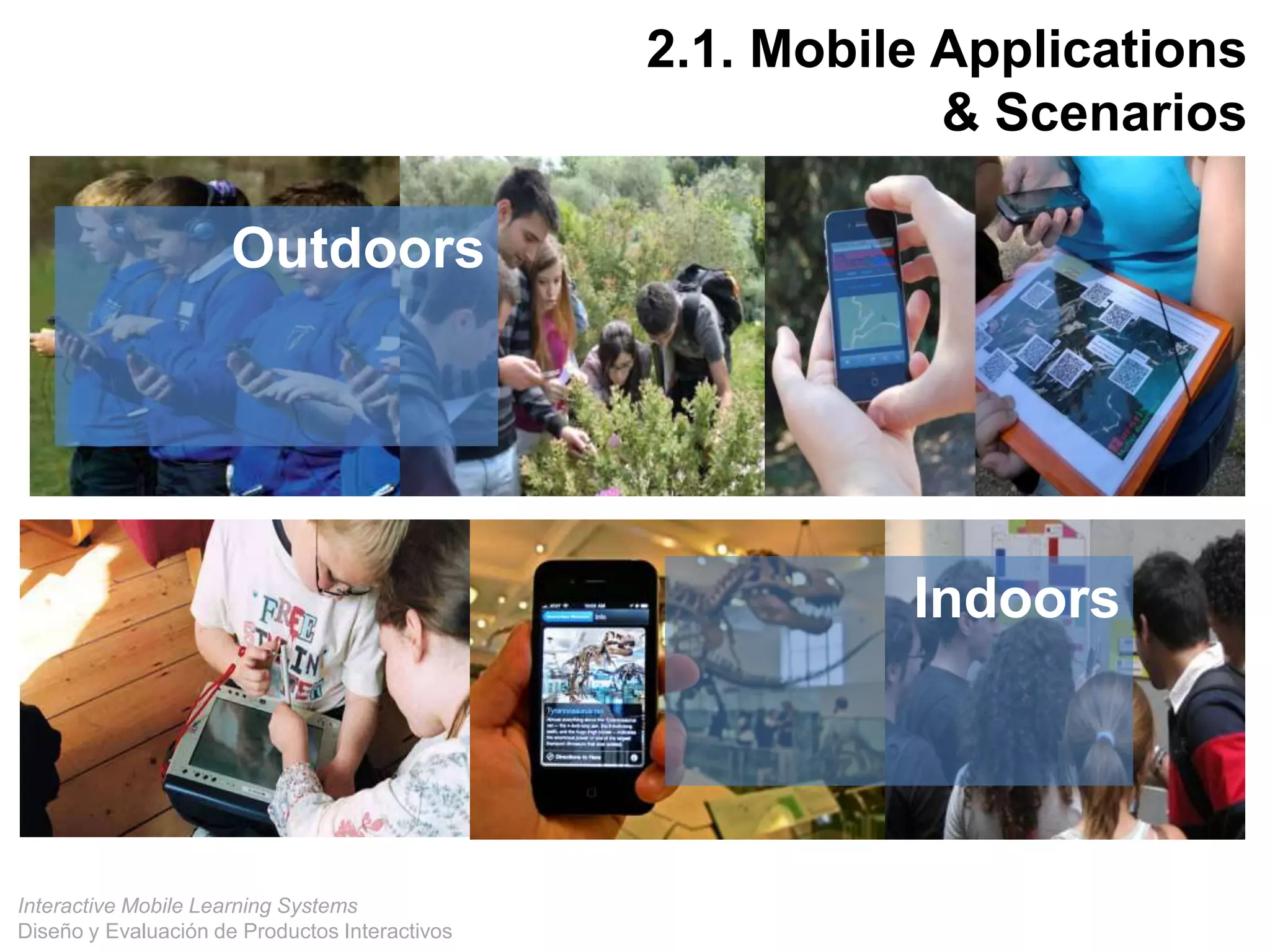
2.1. Mobile Applications
& Scenarios
Outdoors
Indoors
Interactive Mobile Learning Systems
Diseño y Evaluación de Productos Interactivos
17
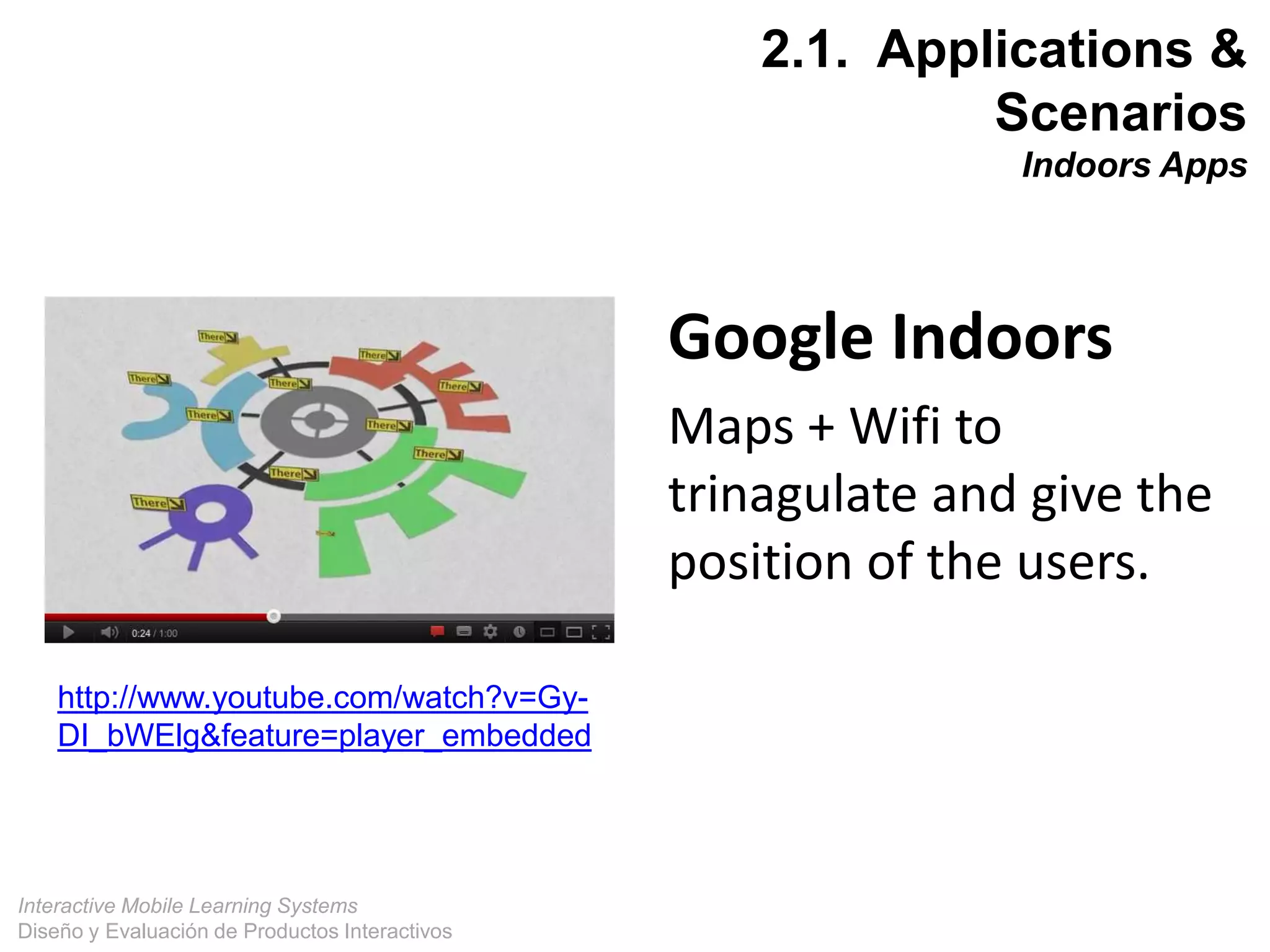
http://www.youtube.com/watch?v=Gy-
DI_bWElg&feature=player_embedded
Google Indoors
Maps + Wifi to
trinagulate and give the
position of the users.
2.1. Applications &
Scenarios
Indoors Apps
Interactive Mobile Learning Systems
Diseño y Evaluación de Productos Interactivos
18
http://www.youtube.com/watch?feature=pl
ayer_embedded&v=PkehW3fkpLQ
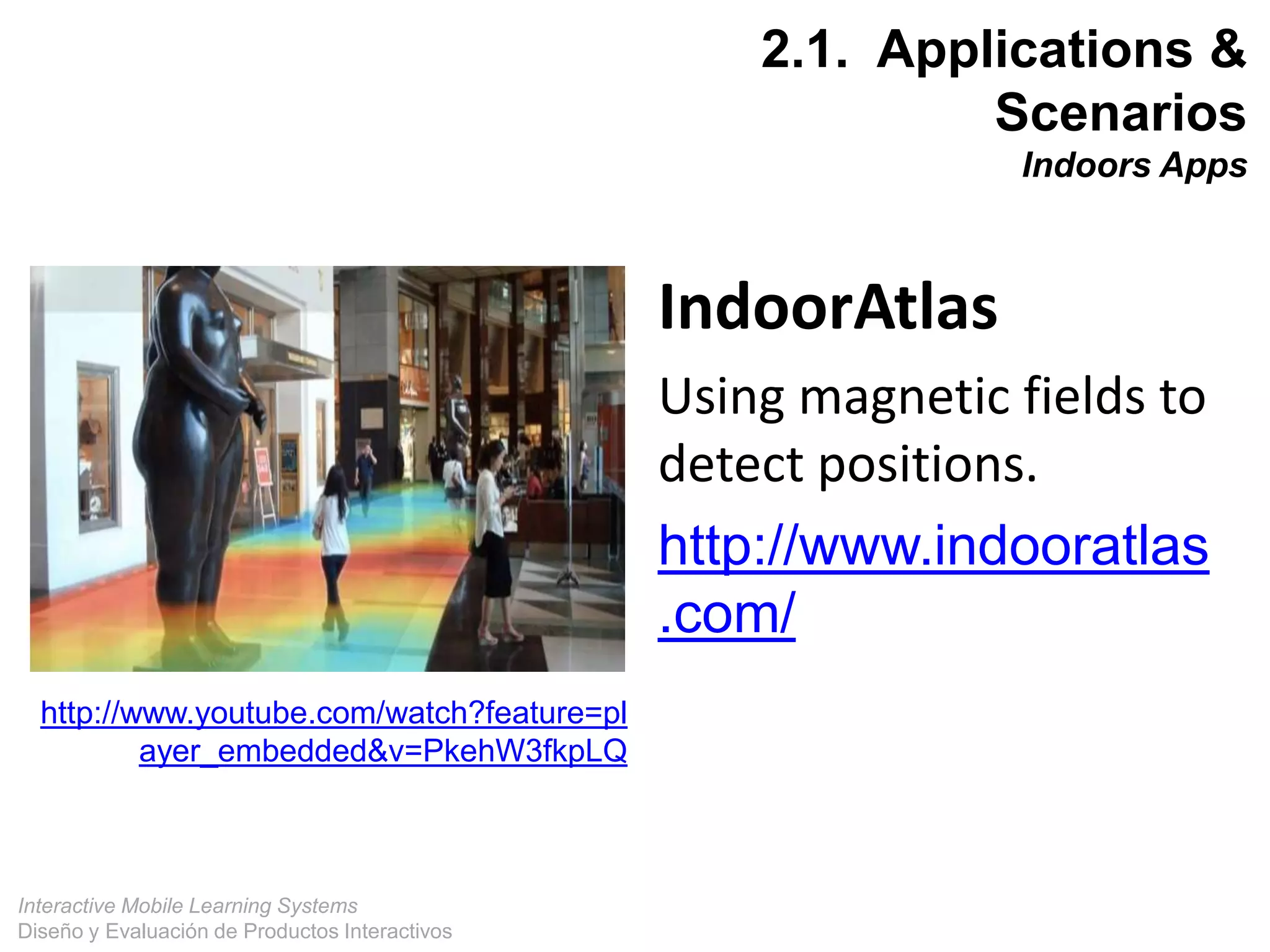
IndoorAtlas
Using magnetic fields to
detect positions.
http://www.indooratlas
.com/
2.1. Applications &
Scenarios
Indoors Apps
Interactive Mobile Learning Systems
Diseño y Evaluación de Productos Interactivos
19
Pizarra
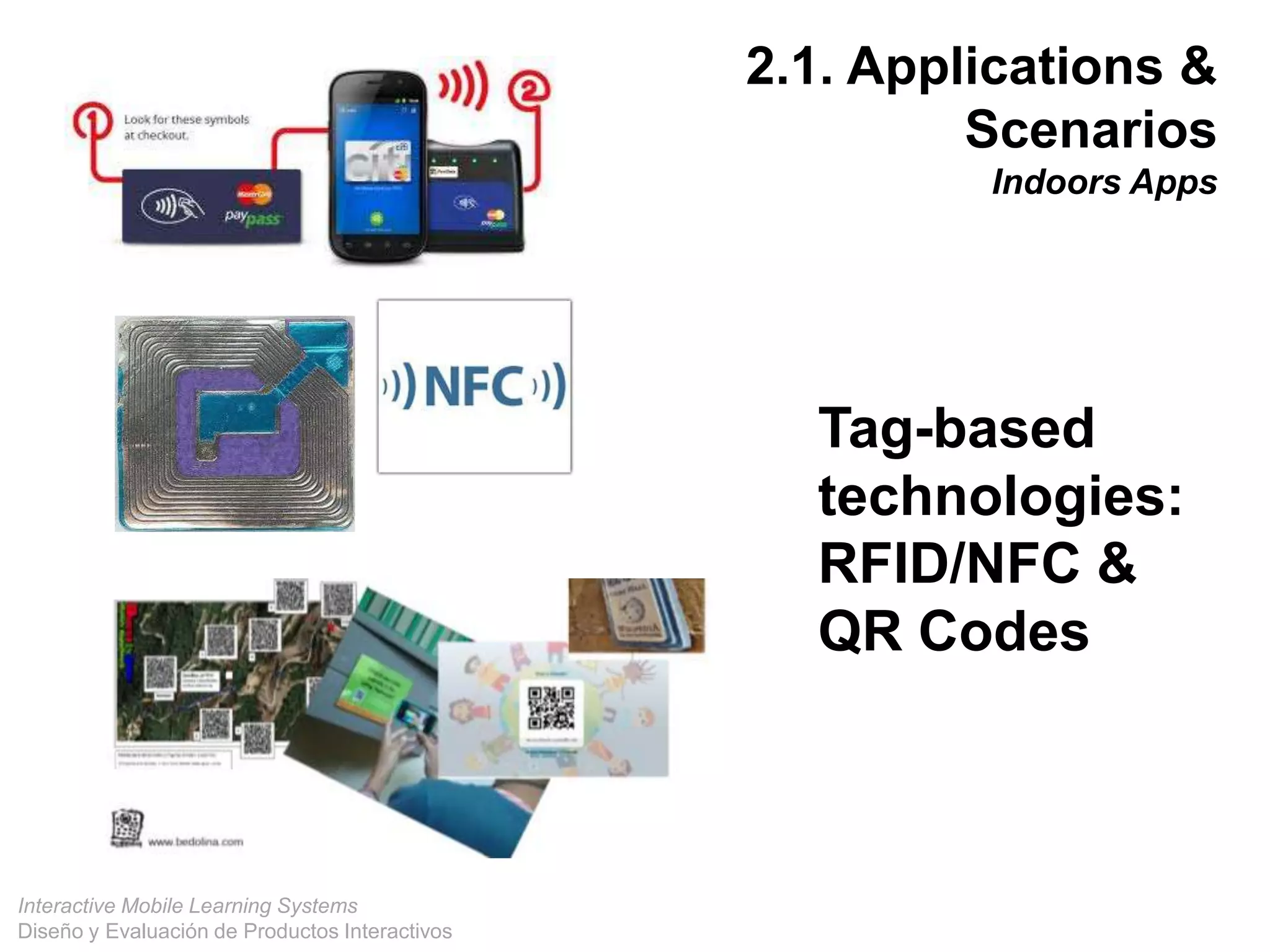
Tag-based
technologies:
RFID/NFC &
QR Codes
2.1. Applications &
Scenarios
Indoors Apps
Interactive Mobile Learning Systems
Diseño y Evaluación de Productos Interactivos
20
Positioning outdoors
“Technologies (using GPS…)
that allow designing
applications that detect the
location of the user and
modify interfaces and
functionalities according to
this position”
V. Zeimpekis, et al., A taxonomy of Indoor
and Outdoor Positioning Techniques for
Mobile Location Services, ACM, 2003, p. 19-
27
2.1 Applications & Scenarios
Applications
Interactive Mobile Learning Systems
Diseño y Evaluación de Productos Interactivos
21
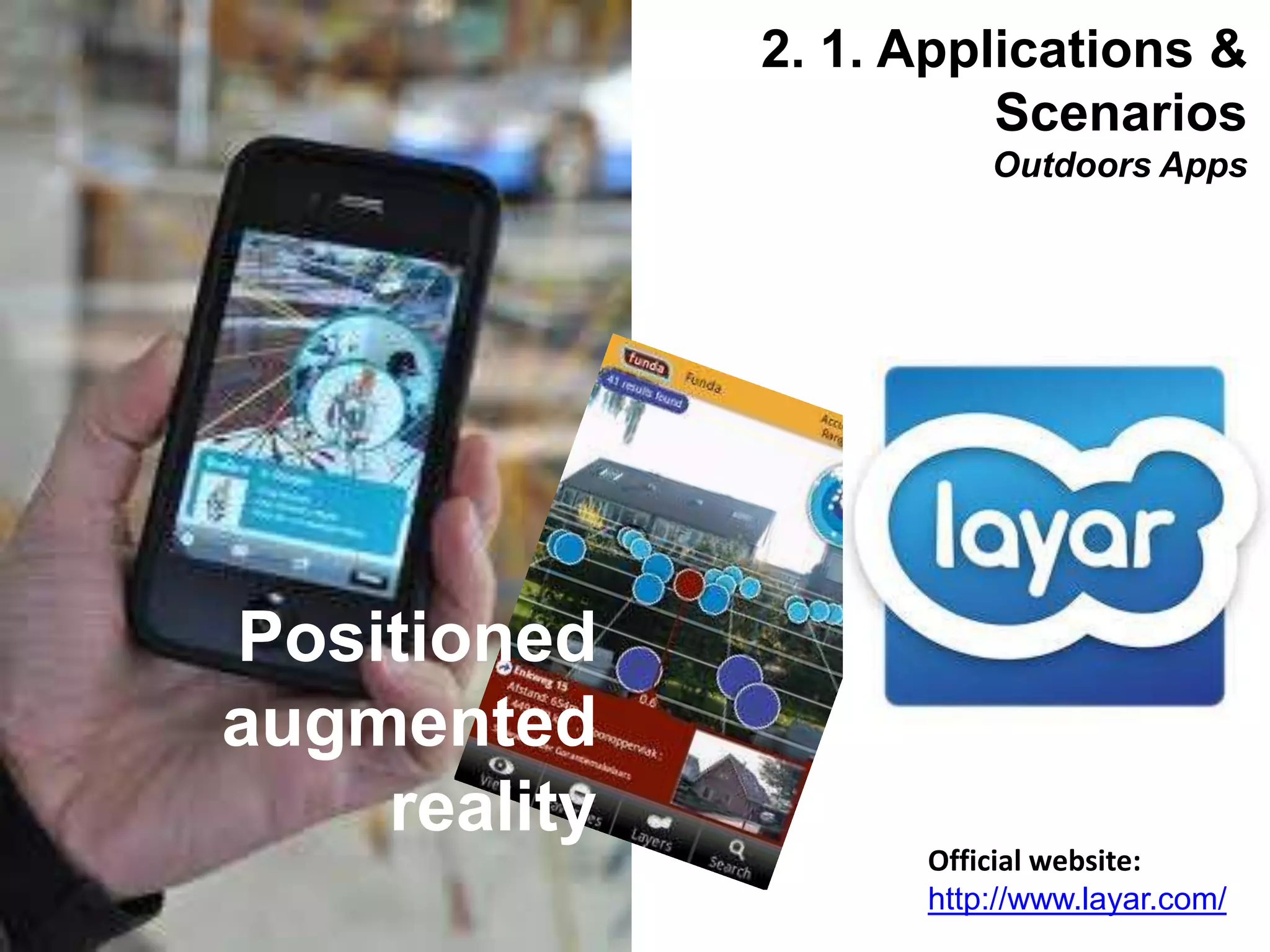
Positioned
augmented
reality
Official website:
http://www.layar.com/
2. 1. Applications &
Scenarios
Outdoors Apps
Interactive Mobile Learning Systems
Diseño y Evaluación de Productos Interactivos
22
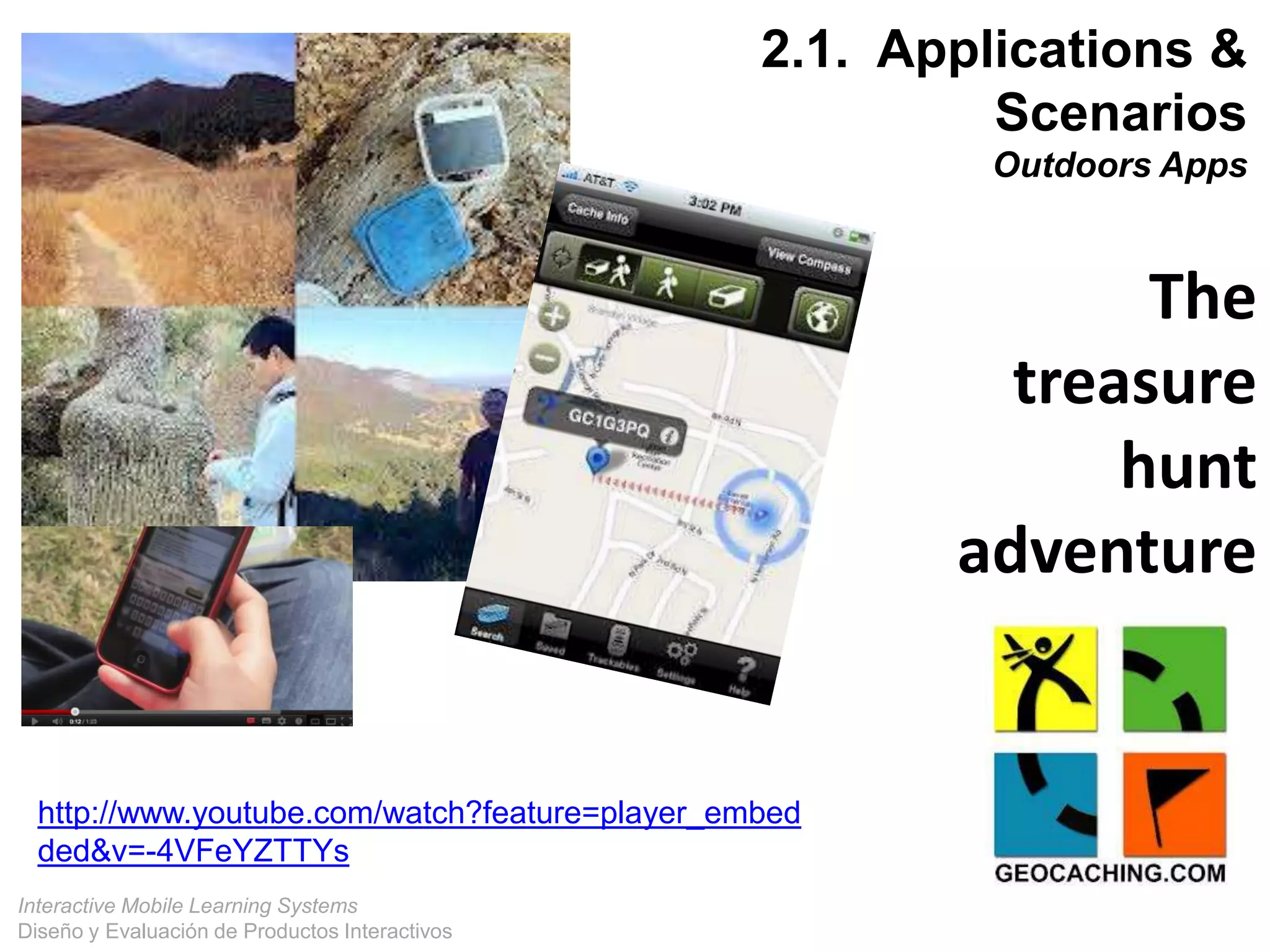
http://www.youtube.com/watch?feature=player_embed
ded&v=-4VFeYZTTYs
The
treasure
hunt
adventure
2.1. Applications &
Scenarios
Outdoors Apps
Interactive Mobile Learning Systems
Diseño y Evaluación de Productos Interactivos
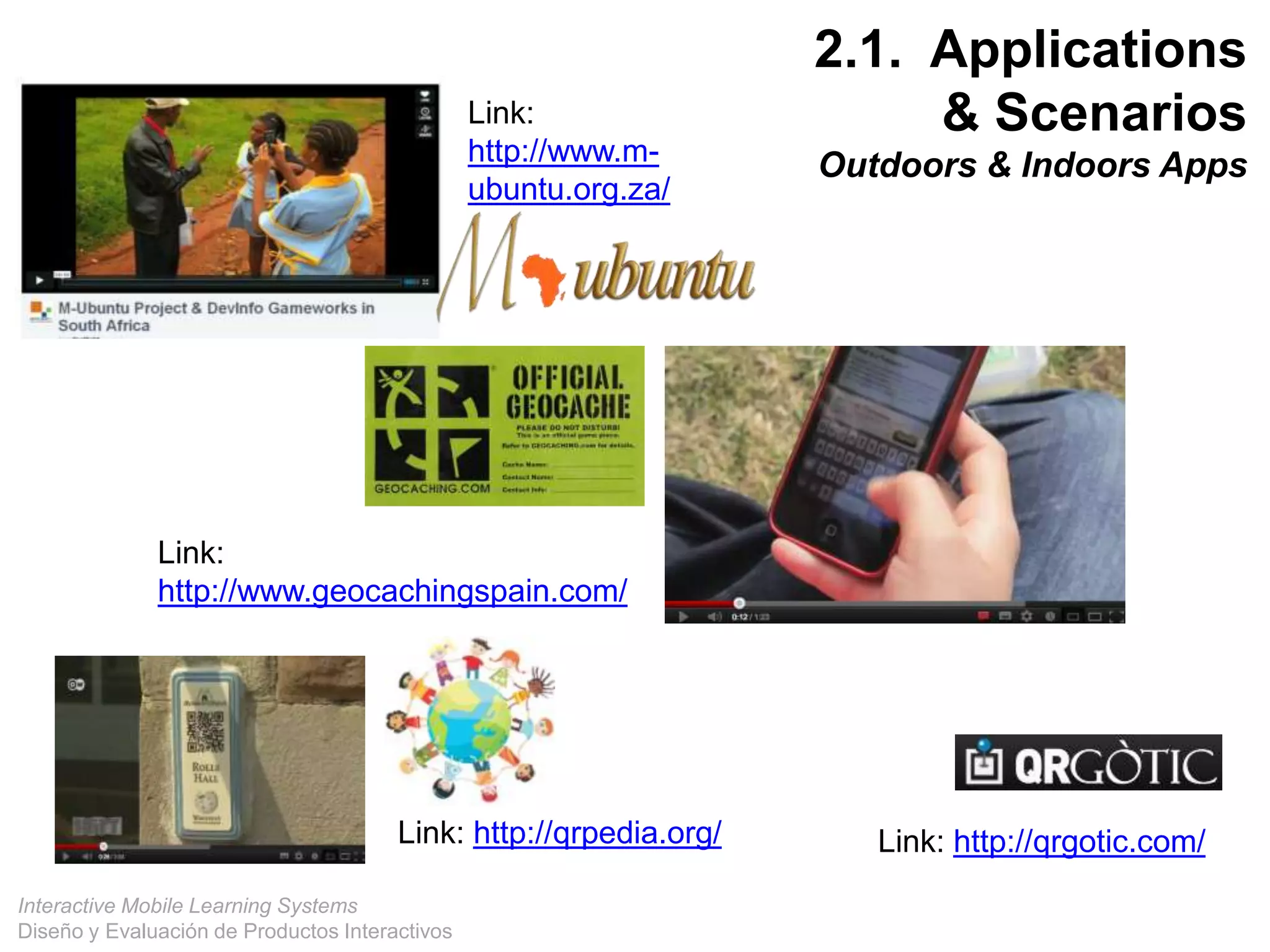
Link:
http://www.m-
ubuntu.org.za/
Link:
http://www.geocachingspain.com/
Link: http://qrpedia.org/ Link: http://qrgotic.com/
2.1. Applications
& Scenarios
Outdoors & Indoors Apps
Interactive Mobile Learning Systems
Diseño y Evaluación de Productos Interactivos
24
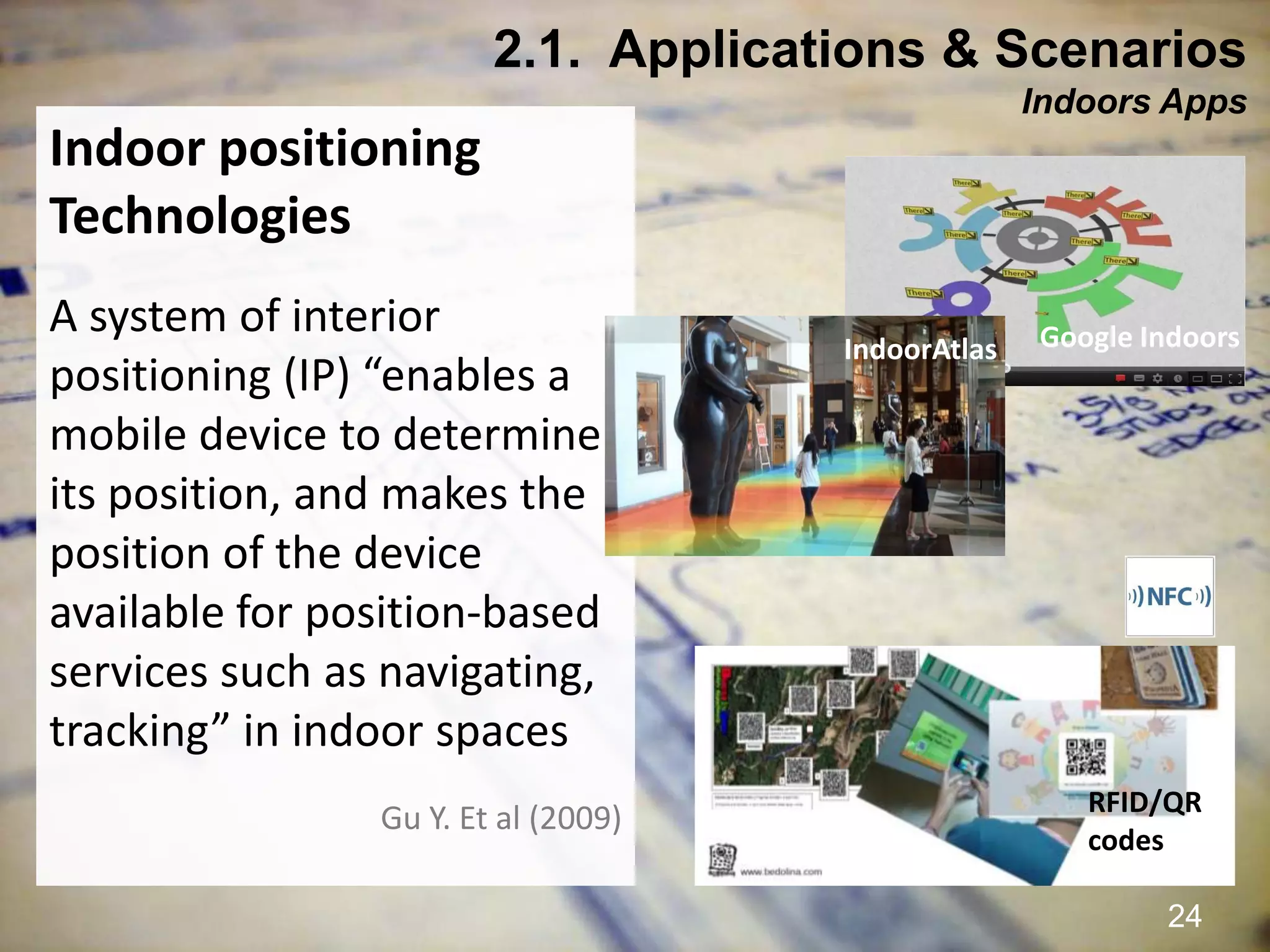
Indoor positioning
Technologies
A system of interior
positioning (IP) “enables a
mobile device to determine
its position, and makes the
position of the device
available for position-based
services such as navigating,
tracking” in indoor spaces
Gu Y. Et al (2009)
2.1. Applications & Scenarios
Indoors Apps
Google IndoorsIndoorAtlas
RFID/QR
codes
Interactive Mobile Learning Systems
Diseño y Evaluación de Productos Interactivos
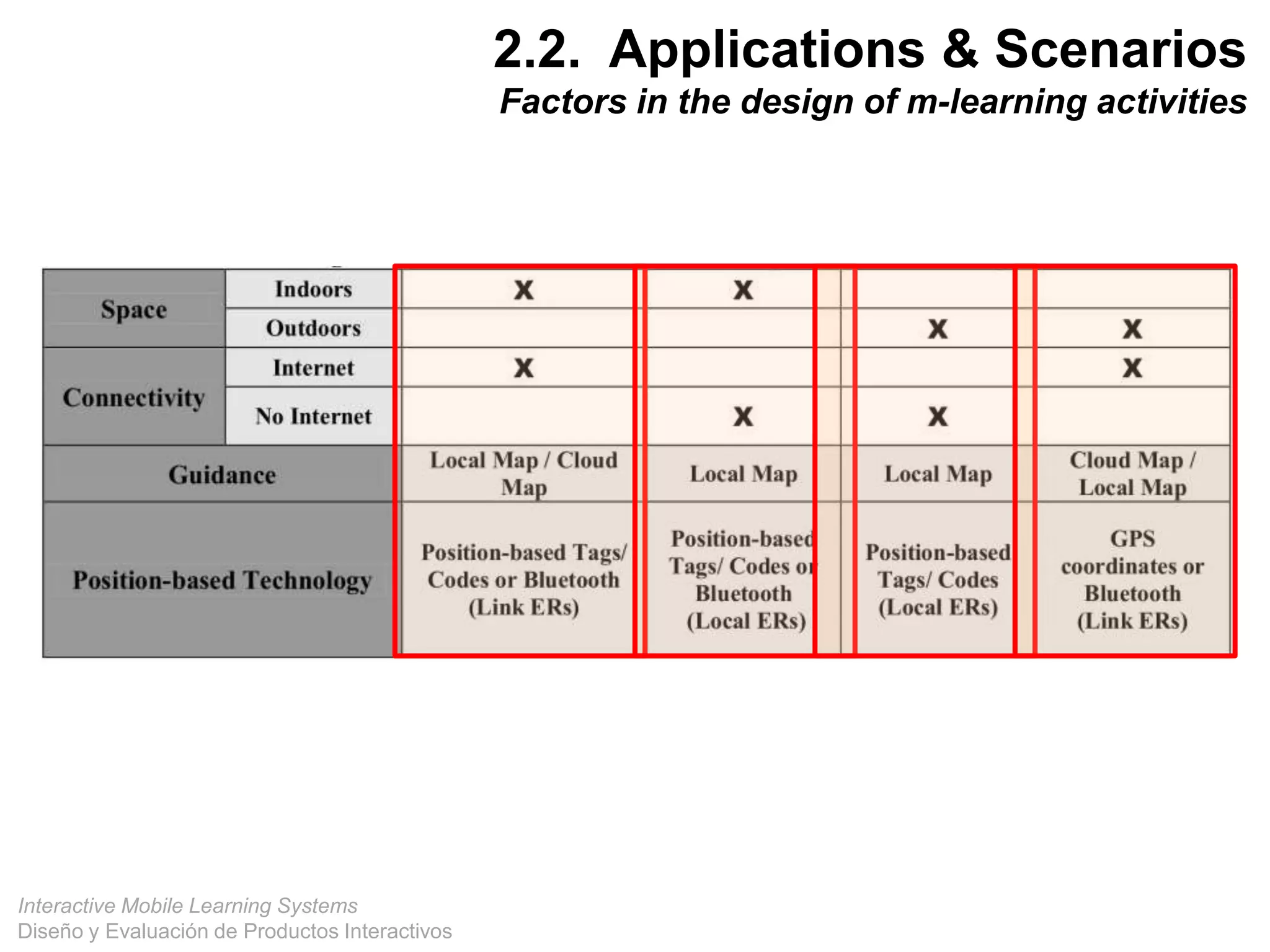
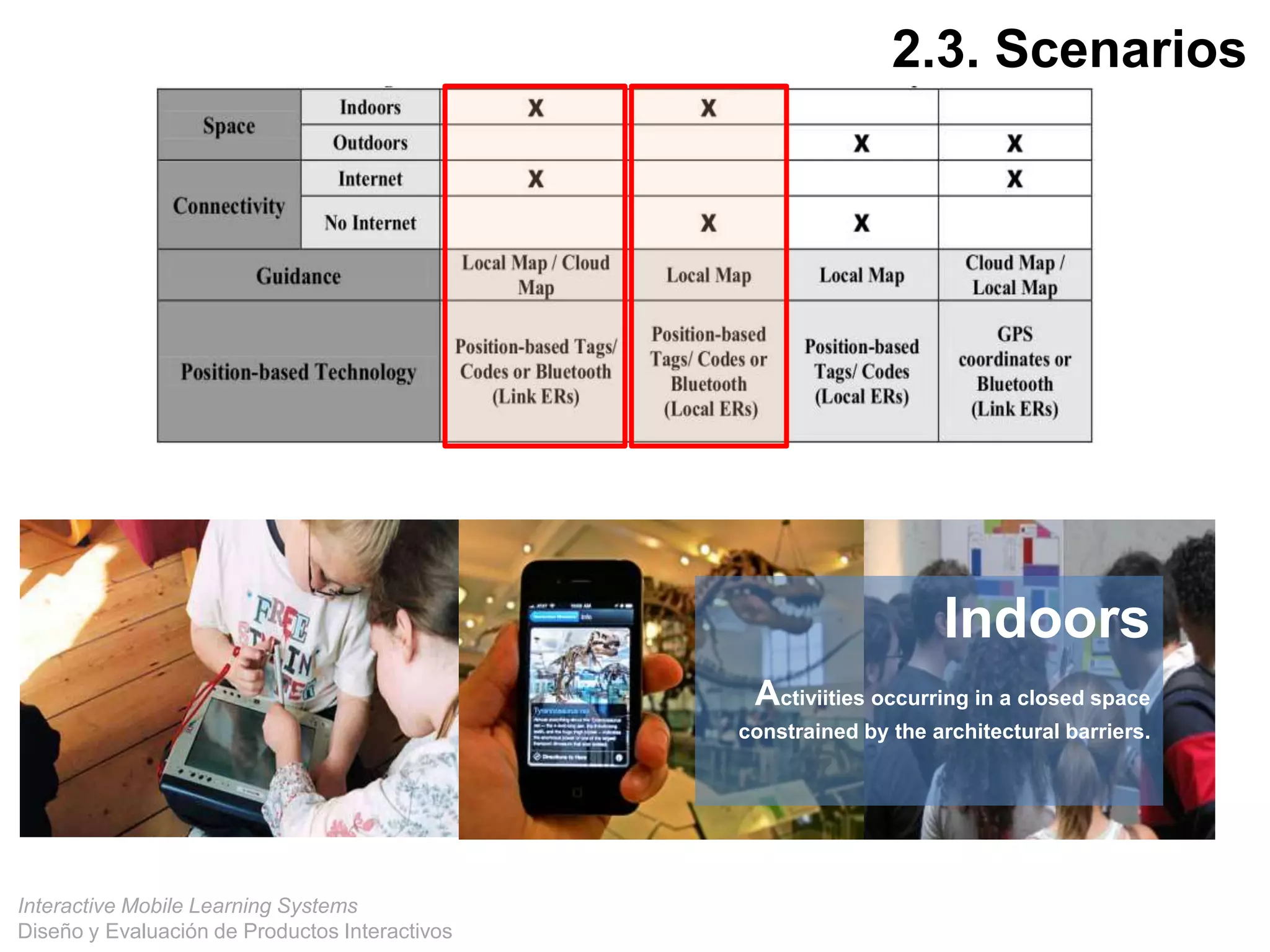
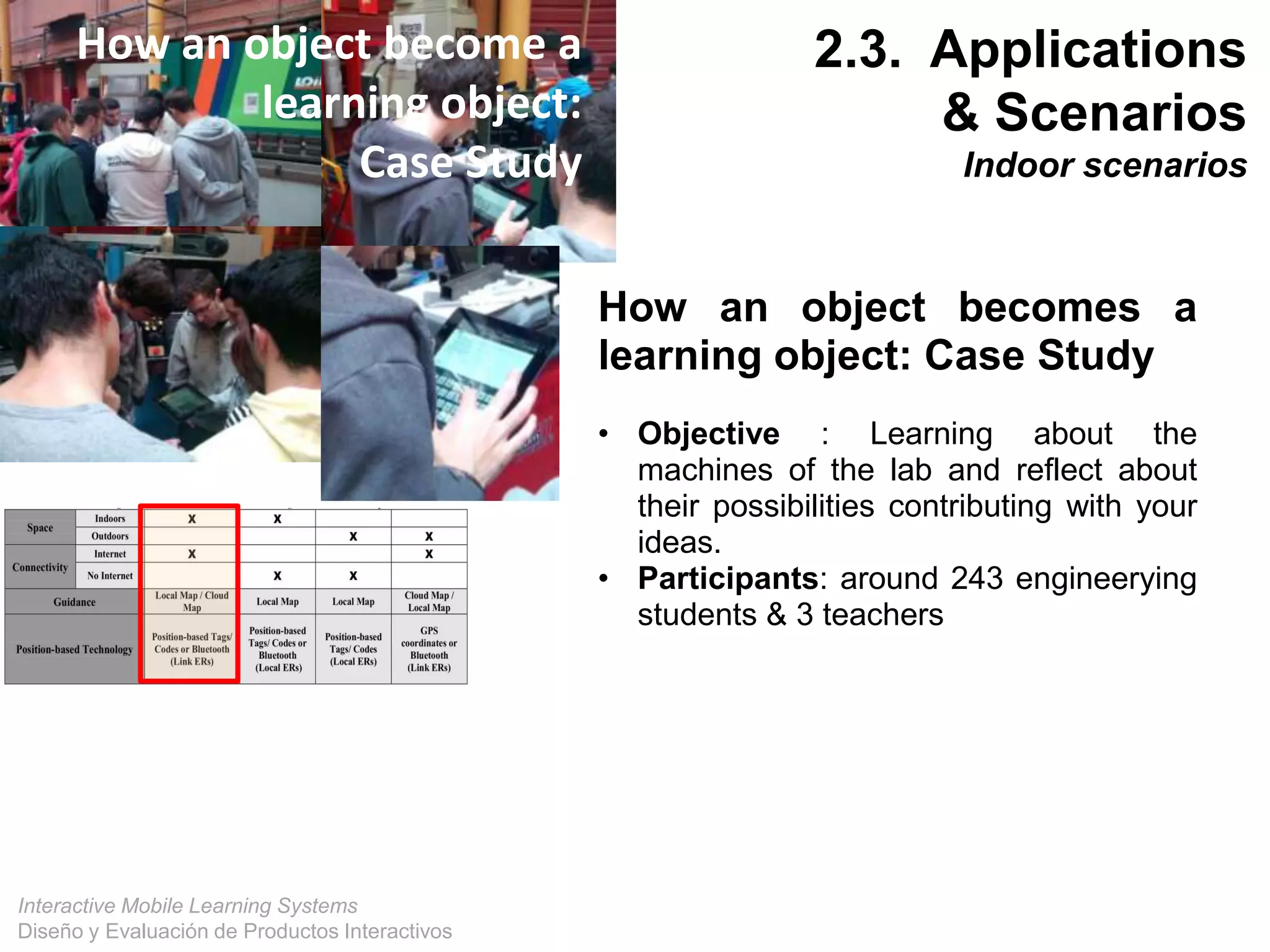
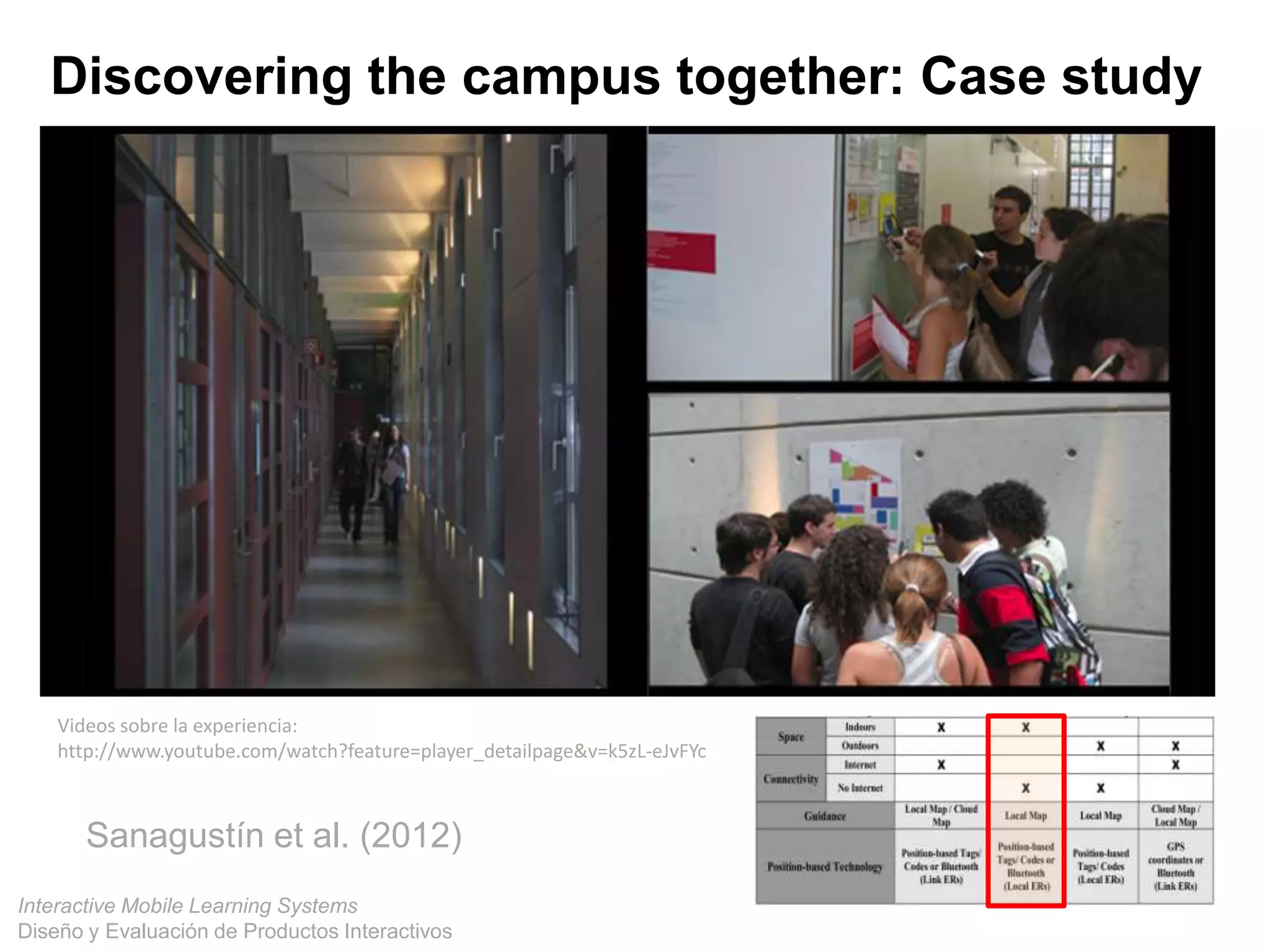
 Space
 Connectivity
 Guidance
 Position-based technology
2.2. Applications
& Scenarios
Designing m-Learning
scenarios
Design Factors
Interactive Mobile Learning Systems
Diseño y Evaluación de Productos Interactivos
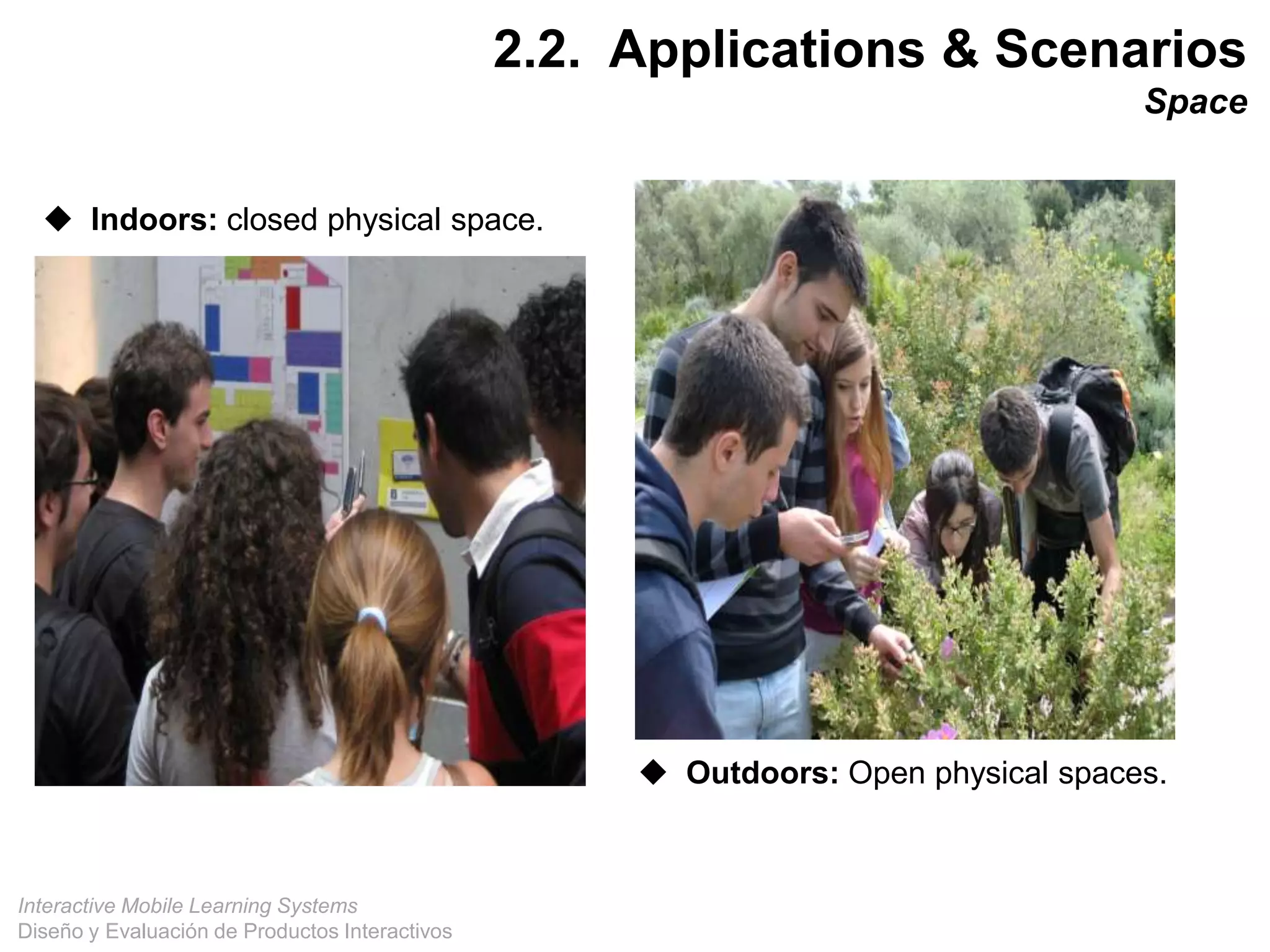
 Indoors: closed physical space.
 Outdoors: Open physical spaces.
26
2.2. Applications & Scenarios
Space
Interactive Mobile Learning Systems
Diseño y Evaluación de Productos Interactivos
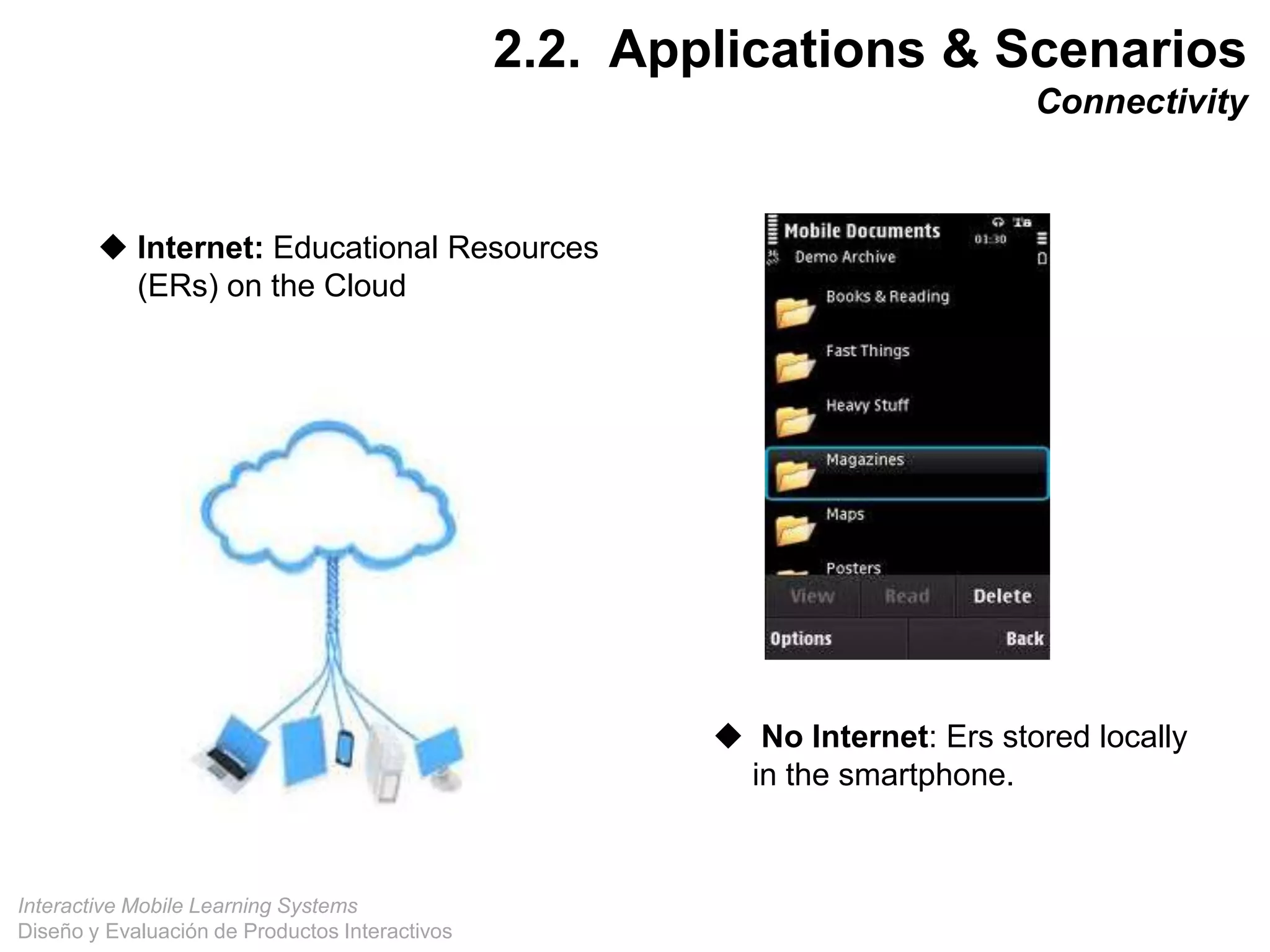
 Internet: Educational Resources
(ERs) on the Cloud
 No Internet: Ers stored locally
in the smartphone.
27
2.2. Applications & Scenarios
Connectivity
Interactive Mobile Learning Systems
Diseño y Evaluación de Productos Interactivos
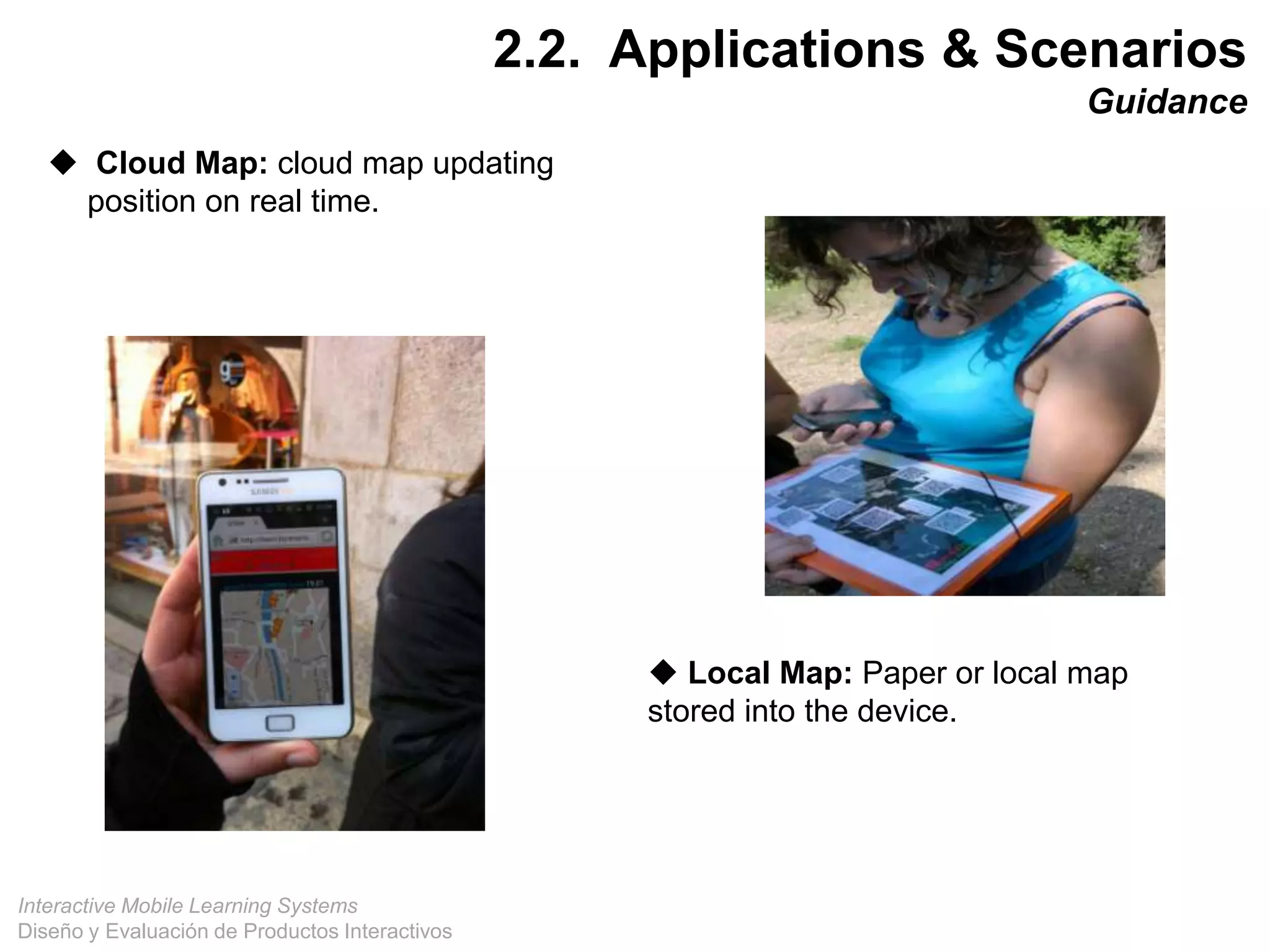
 Cloud Map: cloud map updating
position on real time.
 Local Map: Paper or local map
stored into the device.
28
2.2. Applications & Scenarios
Guidance
Interactive Mobile Learning Systems
Diseño y Evaluación de Productos Interactivos
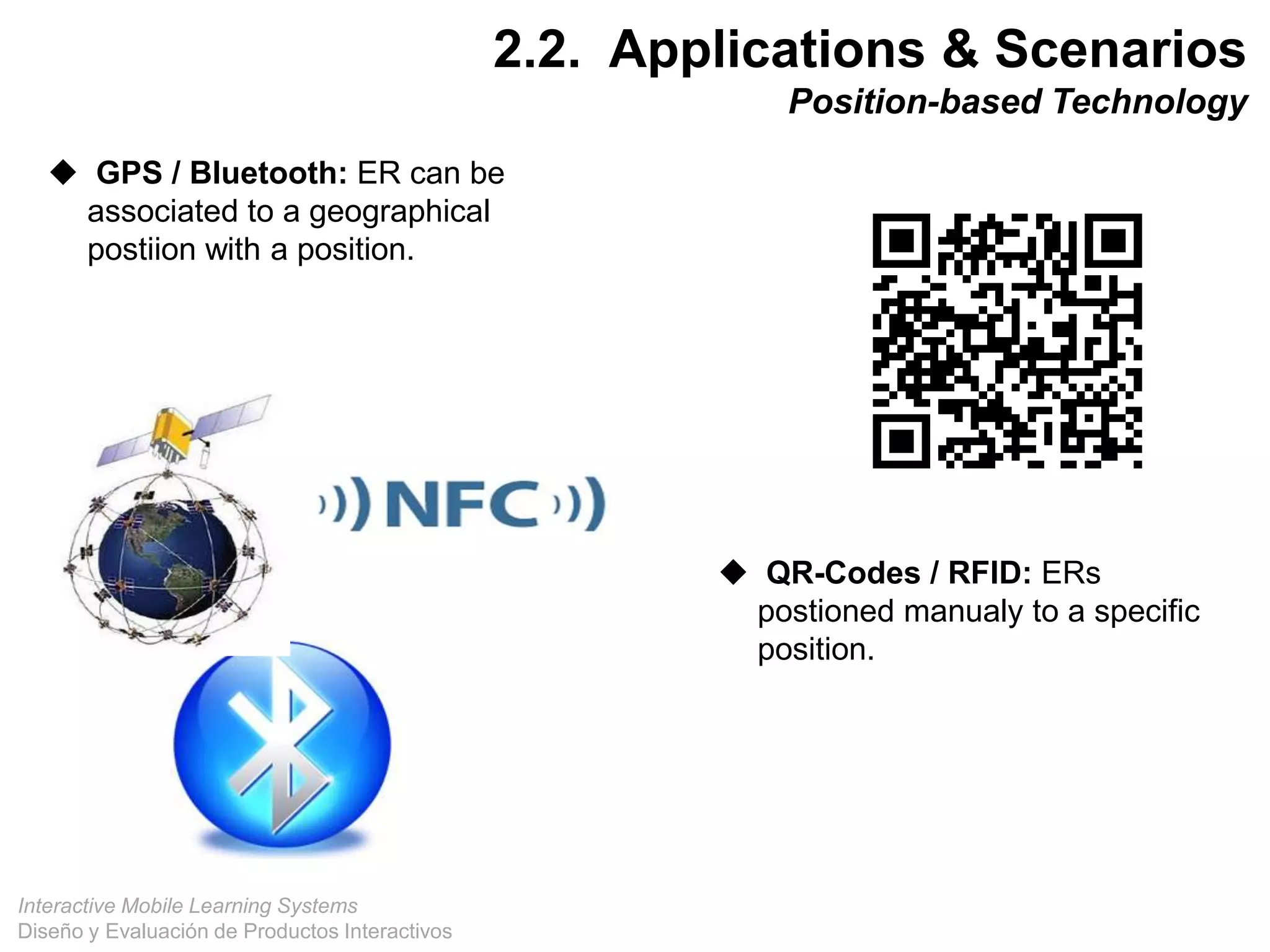
 GPS / Bluetooth: ER can be
associated to a geographical
postiion with a position.
 QR-Codes / RFID: ERs
postioned manualy to a specific
position.
29
2.2. Applications & Scenarios
Position-based Technology
Interactive Mobile Learning Systems
Diseño y Evaluación de Productos Interactivos
2.2. Applications & Scenarios
Factors in the design of m-learning activities
Interactive Mobile Learning Systems
Diseño y Evaluación de Productos Interactivos
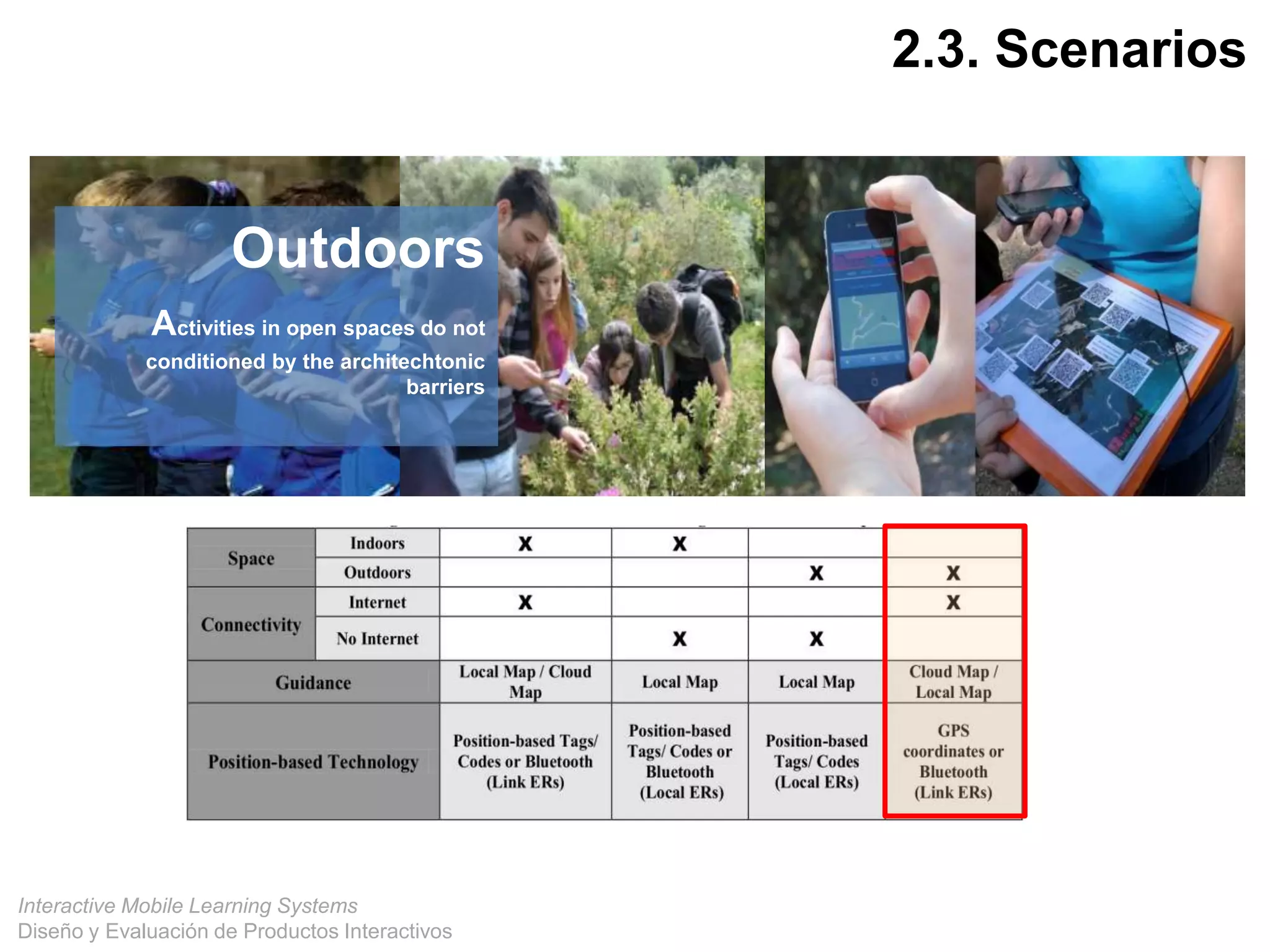
2.3. Scenarios
Outdoors
Activities in open spaces do not
conditioned by the architechtonic
barriers
Interactive Mobile Learning Systems
Diseño y Evaluación de Productos Interactivos
32
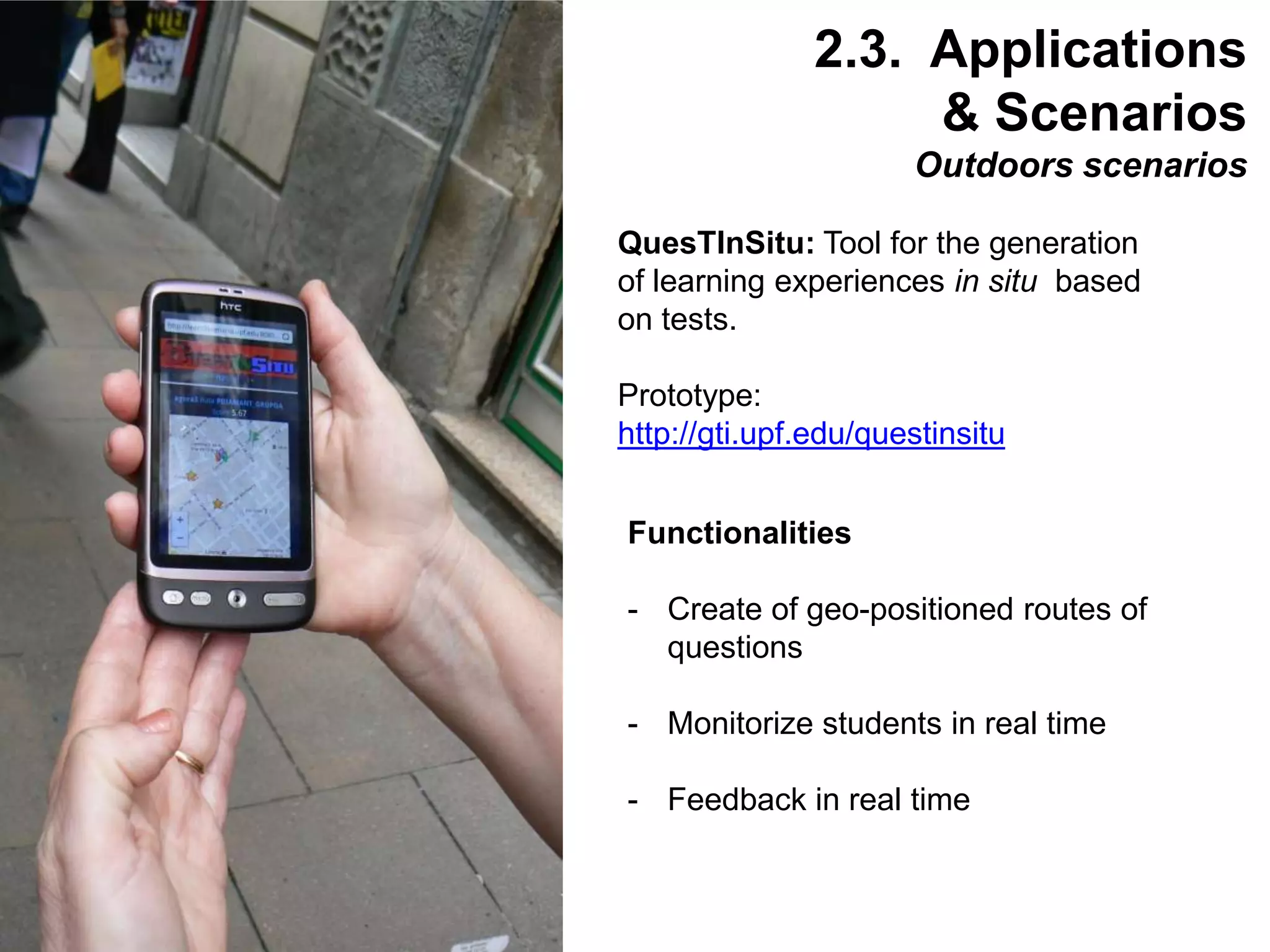
QuesTInSitu: Tool for the generation
of learning experiences in situ based
on tests.
Prototype:
http://gti.upf.edu/questinsitu
Functionalities
- Create of geo-positioned routes of
questions
- Monitorize students in real time
- Feedback in real time
2.3. Applications
& Scenarios
Outdoors scenarios
Interactive Mobile Learning Systems
Diseño y Evaluación de Productos Interactivos
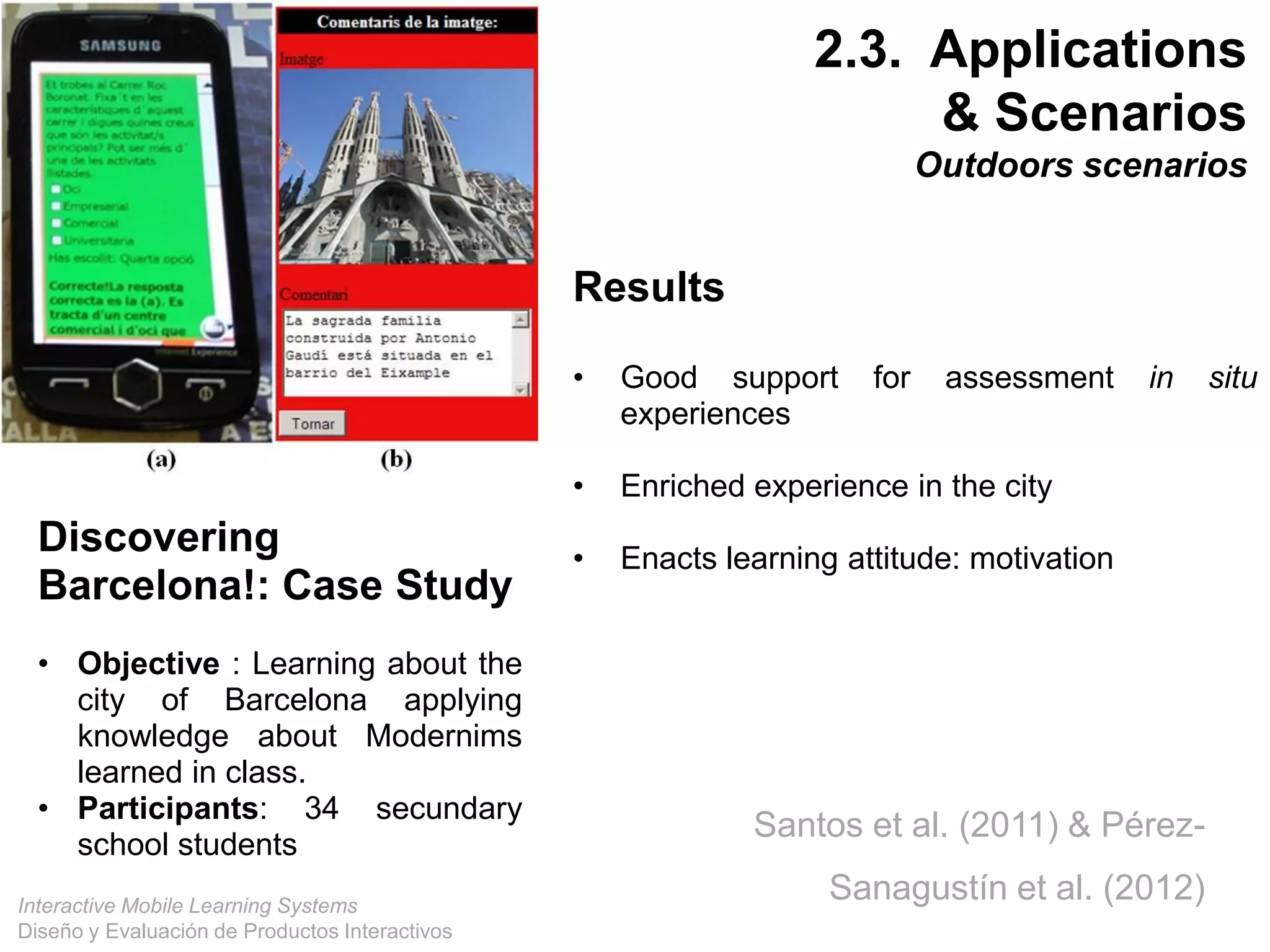
Discovering
Barcelona!: Case Study
• Objective : Learning about the
city of Barcelona applying
knowledge about Modernims
learned in class.
• Participants: 34 secundary
school students
Results
• Good support for assessment in situ
experiences
• Enriched experience in the city
• Enacts learning attitude: motivation
Santos et al. (2011) & Pérez-
Sanagustín et al. (2012)
2.3. Applications
& Scenarios
Outdoors scenarios
Interactive Mobile Learning Systems
Diseño y Evaluación de Productos Interactivos
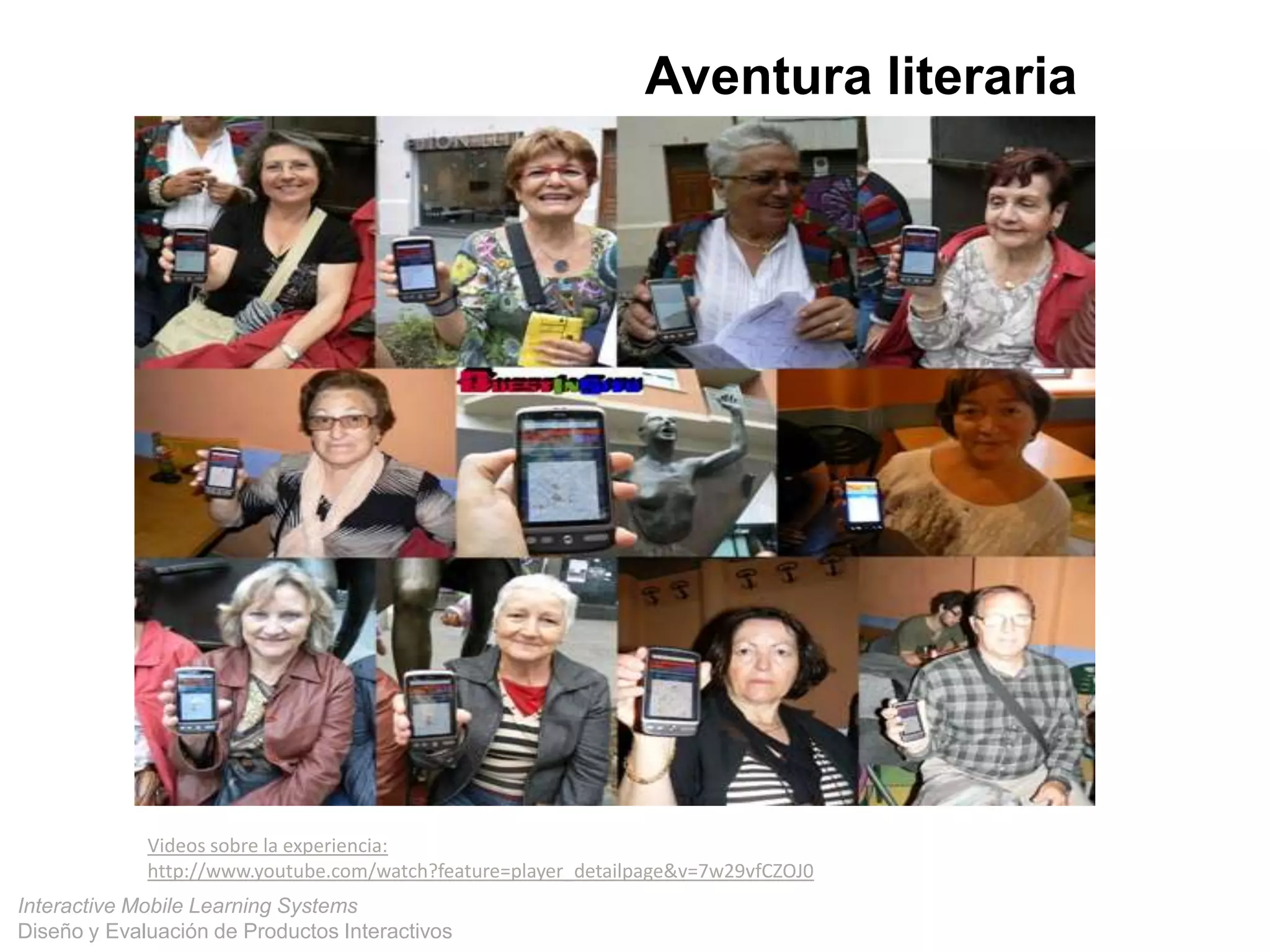
Videos sobre la experiencia:
http://www.youtube.com/watch?feature=player_detailpage&v=7w29vfCZOJ0
Aventura literaria
Interactive Mobile Learning Systems
Diseño y Evaluación de Productos Interactivos
Indoors
Activiities occurring in a closed space
constrained by the architectural barriers.
2.3. Scenarios
Interactive Mobile Learning Systems
Diseño y Evaluación de Productos Interactivos
36
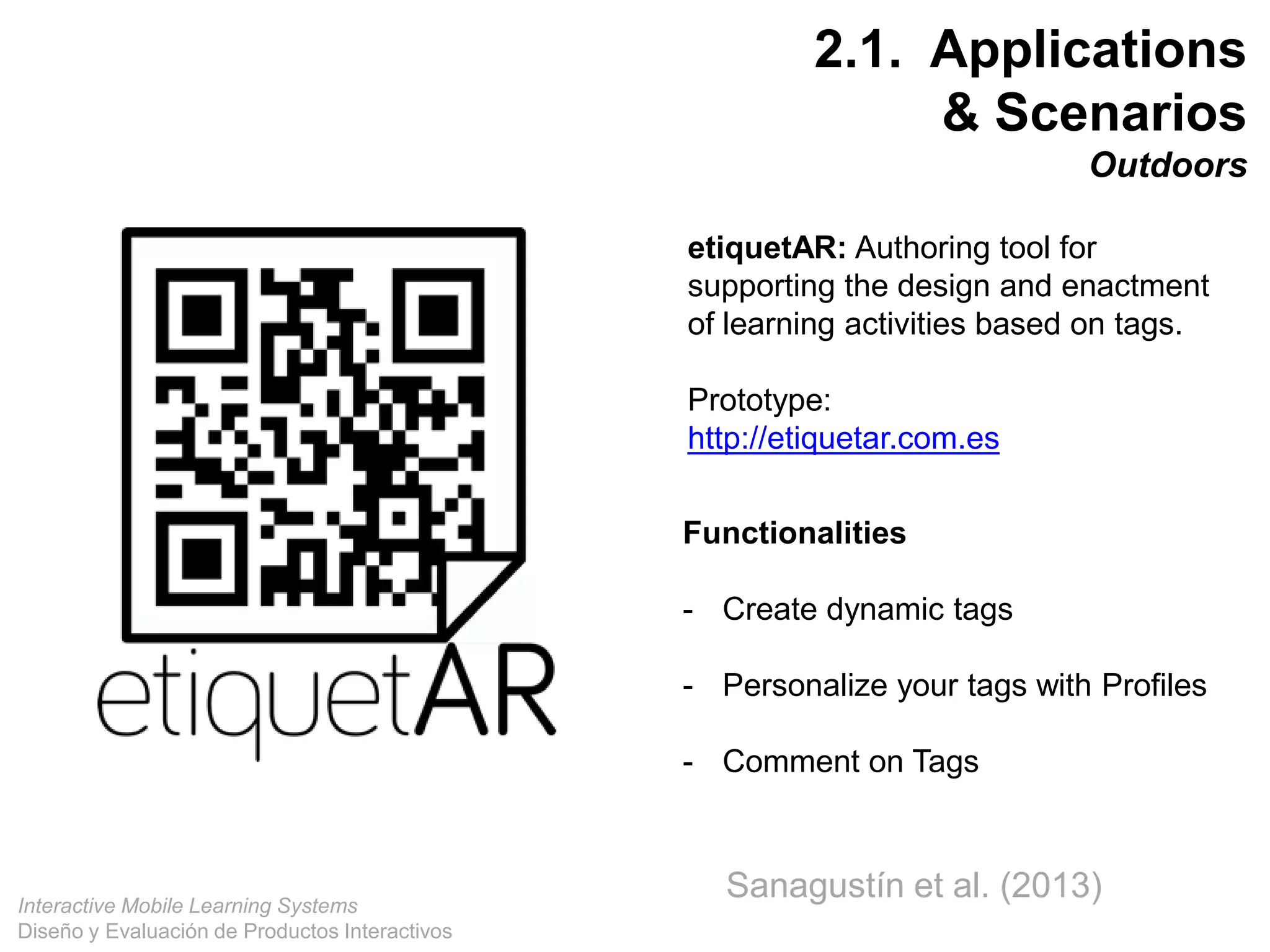
etiquetAR: Authoring tool for
supporting the design and enactment
of learning activities based on tags.
Prototype:
http://etiquetar.com.es
Functionalities
- Create dynamic tags
- Personalize your tags with Profiles
- Comment on Tags
2.1. Applications
& Scenarios
Outdoors
Sanagustín et al. (2013)
Interactive Mobile Learning Systems
Diseño y Evaluación de Productos Interactivos
2.3. Applications
& Scenarios
Indoor scenarios
How an object become a
learning object:
Case Study
How an object becomes a
learning object: Case Study
• Objective : Learning about the
machines of the lab and reflect about
their possibilities contributing with your
ideas.
• Participants: around 243 engineerying
students & 3 teachers
Interactive Mobile Learning Systems
Diseño y Evaluación de Productos Interactivos
Videos sobre la experiencia:
http://www.youtube.com/watch?feature=player_detailpage&v=k5zL-eJvFYc
Discovering the campus together: Case study
Sanagustín et al. (2012)
Interactive Mobile Learning Systems
Diseño y Evaluación de Productos Interactivos
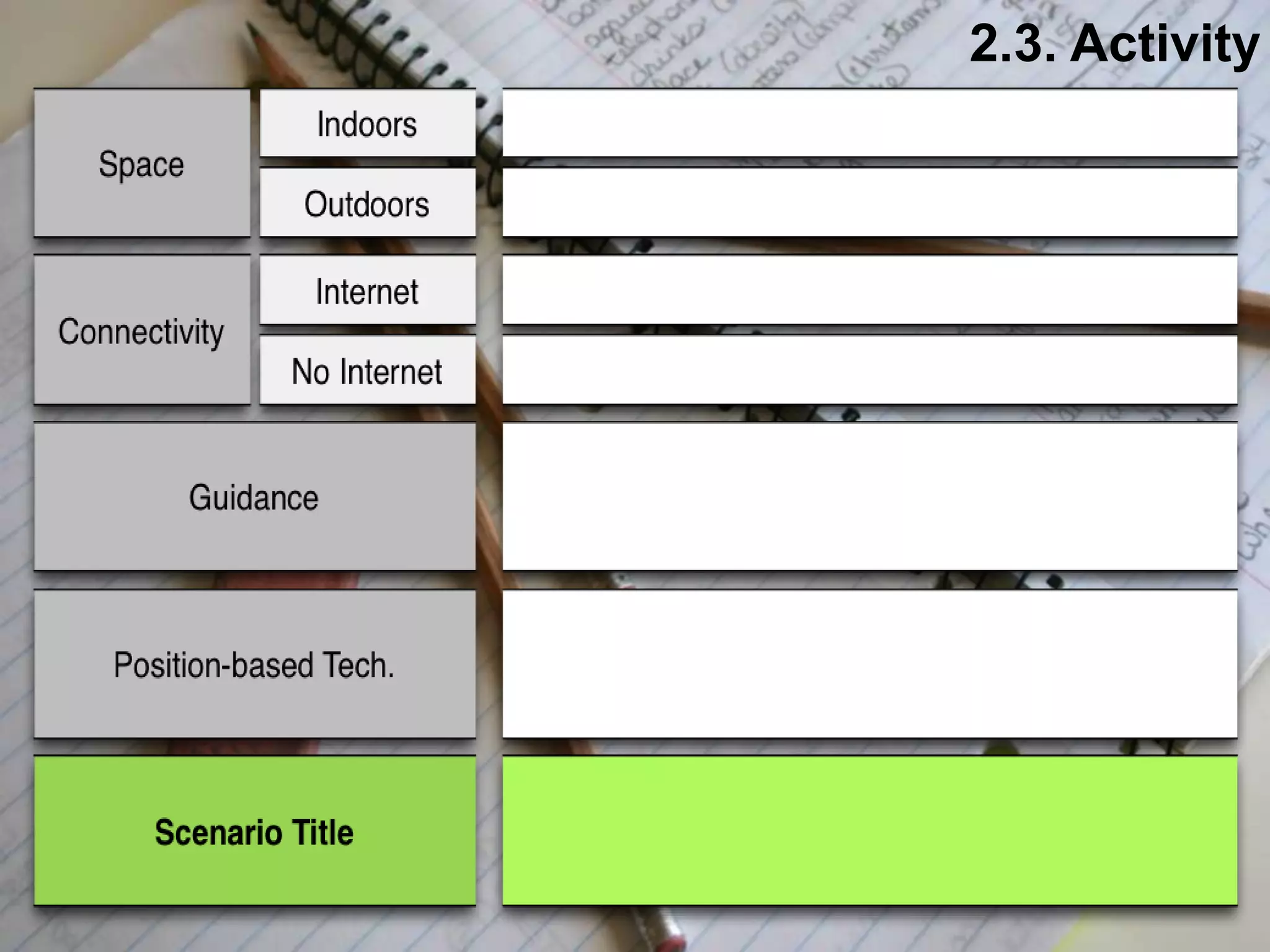
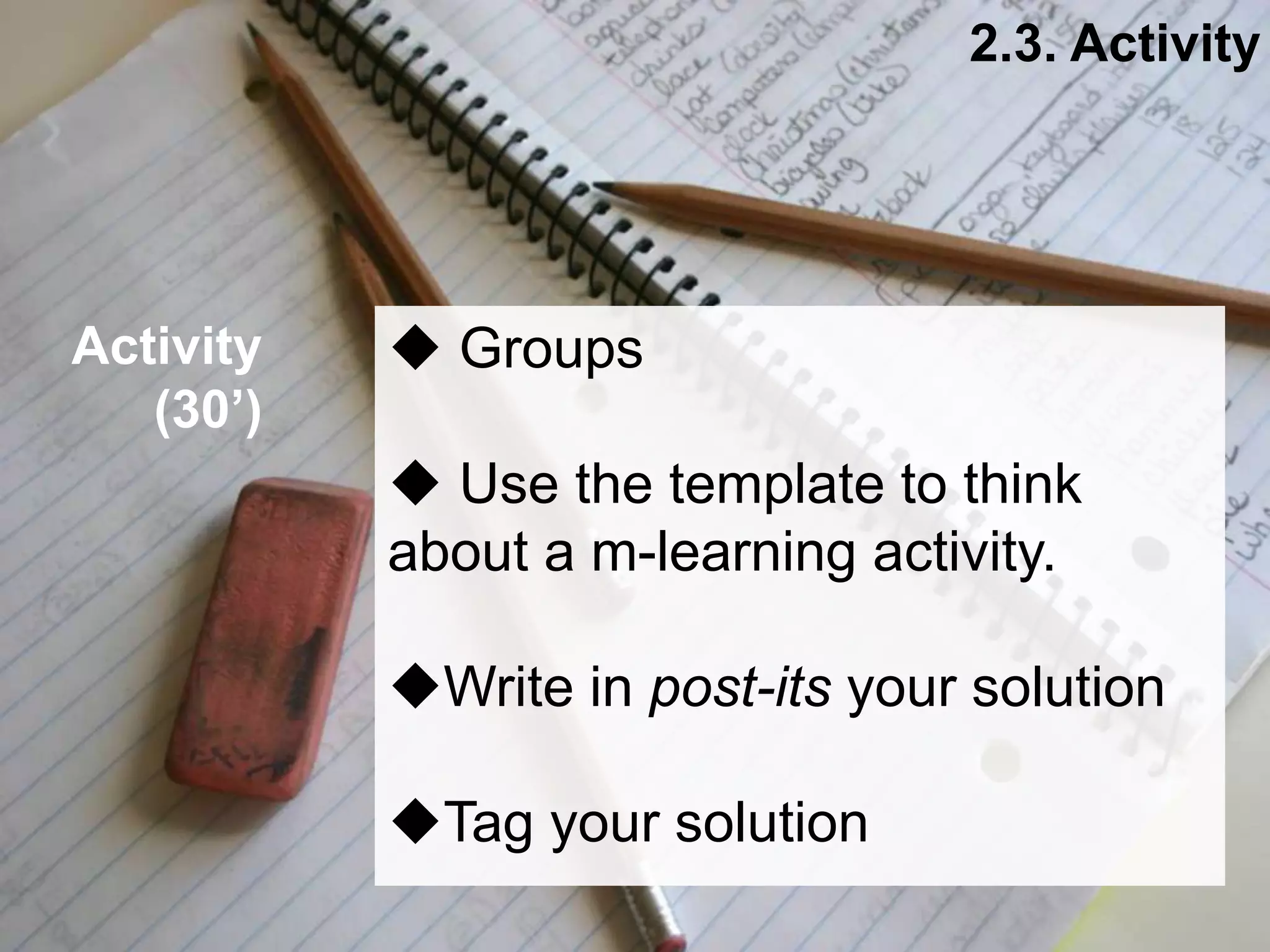
 Groups
 Use the template to think
about a m-learning activity.
Write in post-its your solution
Tag your solution
2.3. Activity
Activity
(30’)
Interactive Mobile Learning Systems
Diseño y Evaluación de Productos Interactivos
2.3. Activity
Interactive Mobile Learning Systems
Diseño y Evaluación de Productos Interactivos
3. Mobile Learning in the Smart City
Future challenges
Interactive Mobile Learning Systems
Diseño y Evaluación de Productos Interactivos
• Marie Skłodowska-Curie actions on skills, training and career development
• Research infrastructures (including e-Infrastructures)
• Leadership in enabling and industrial technologies within the following areas:
• Information and Communication Technologies (ICT)*
• Access to risk finance (debt or equity financing)
• Innovation in small and medium-sized enterprises (SMEs)
• Health, demographic change and wellbeing
• Food security, sustainable agriculture, marine and maritime research &
• the bio-economy
• Secure, clean and efficient energy (including nuclear energy)
• Smart, green and integrated transport
• Climate action, resource efficiency and raw materials
• Inclusive, innovative and secure societies
http://ec.europa.eu/research/horizon2020/index_en.cfm?pg=h2020-experts
3.1. mLearning in the Smart
City
Horizon 2020
Interactive Mobile Learning Systems
Diseño y Evaluación de Productos Interactivos
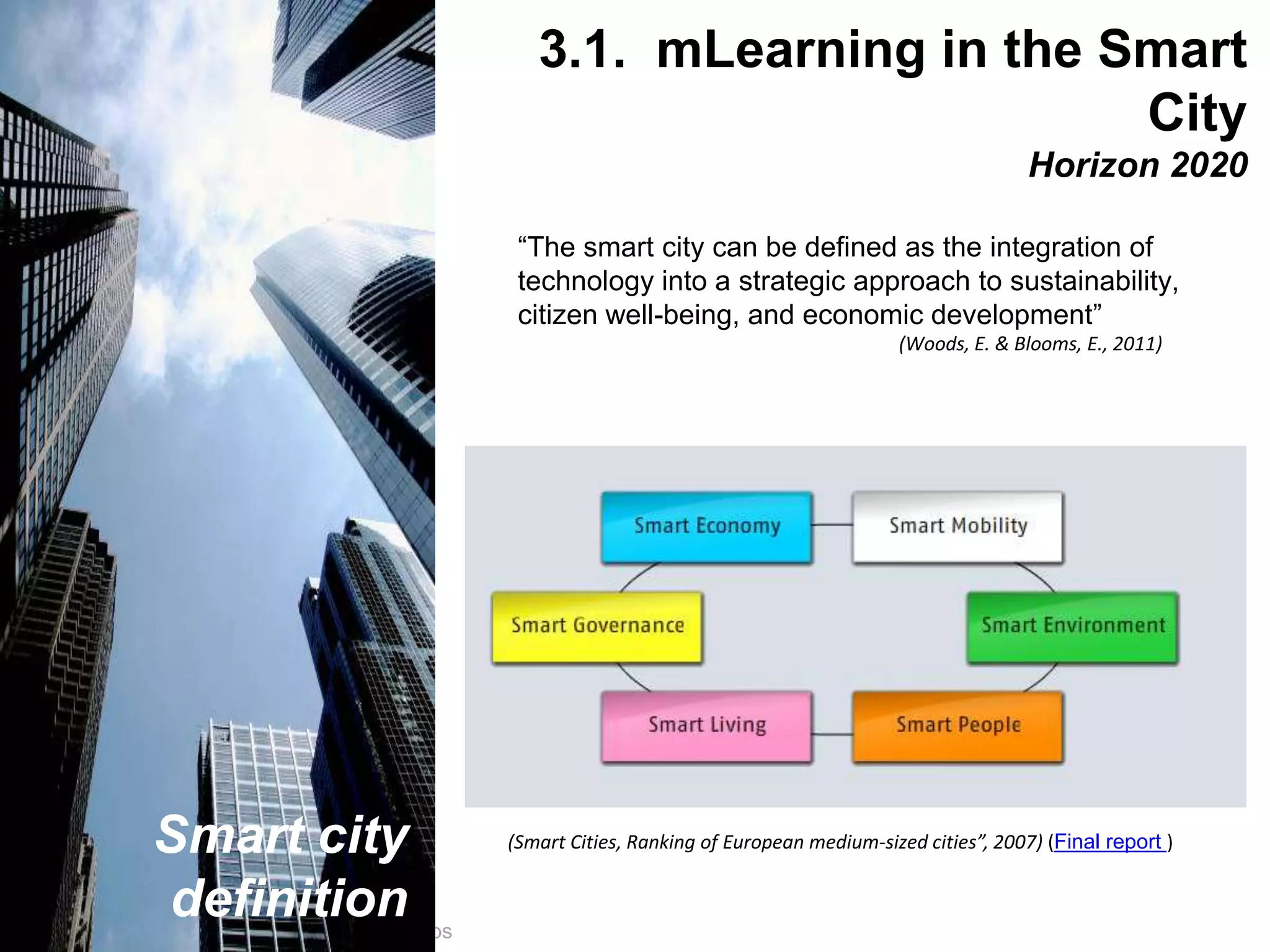
“The smart city can be defined as the integration of
technology into a strategic approach to sustainability,
citizen well-being, and economic development”
(Woods, E. & Blooms, E., 2011)
(Smart Cities, Ranking of European medium-sized cities”, 2007) (Final report )Smart city
definition
3.1. mLearning in the Smart
City
Horizon 2020
Interactive Mobile Learning Systems
Diseño y Evaluación de Productos Interactivos
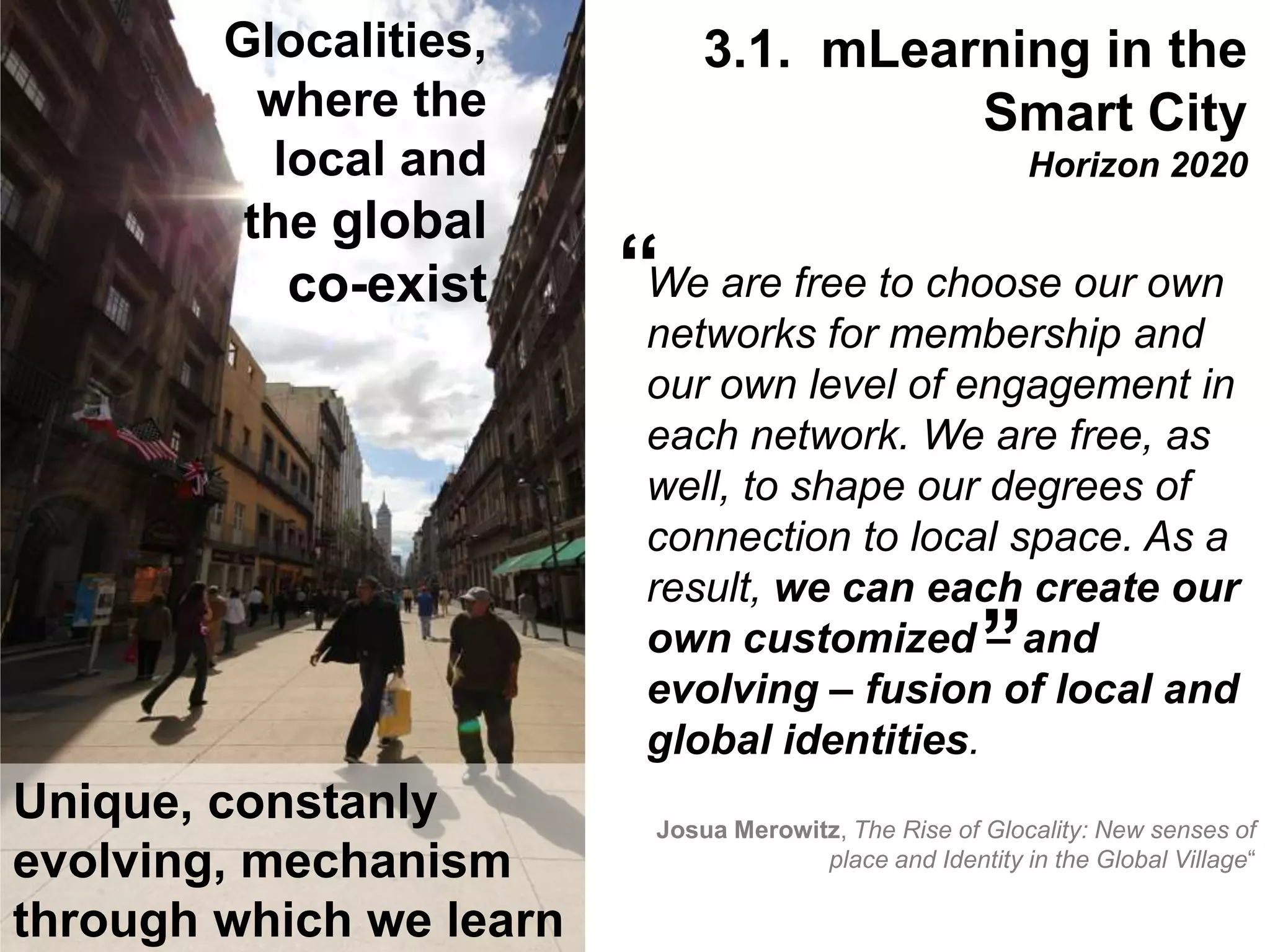
We are free to choose our own
networks for membership and
our own level of engagement in
each network. We are free, as
well, to shape our degrees of
connection to local space. As a
result, we can each create our
own customized – and
evolving – fusion of local and
global identities.
Josua Merowitz, The Rise of Glocality: New senses of
place and Identity in the Global Village“
“
“
Glocalities,
where the
local and
the global
co-exist
Unique, constanly
evolving, mechanism
through which we learn
3.1. mLearning in the
Smart City
Horizon 2020
Interactive Mobile Learning Systems
Diseño y Evaluación de Productos Interactivos
Introduction
Learning through glocalities
• Glocalities are unique and
constantly evolving
• Citizens are lifelong learners
permanently learning with and
within the city
• Citizens build up their learning
ecosystems to be constantly
evolving
3.1. mLearning in
the Smart City
Horizon 2020
Interactive Mobile Learning Systems
Diseño y Evaluación de Productos Interactivos
"The theme of the transformation of the
learning modalities that may be induced
by the transformation of living places in
smart territories, cities and villages is a new
theme whose relevance will grow more
and more in the near future."
WS Webpage: http://www.mifav.uniroma2.it/inevent/events/scl13/index.php?s=156
January, 28- February, 1st 2013
3.2. mLearning in the Smart City
Smart Cities Learning
Interactive Mobile Learning Systems
Diseño y Evaluación de Productos Interactivos
1. Technological Ecosystems supporting learning within and
from the 'smart cities’
2. Smart city learning scenarios (contexts and methods for the
citizens of the future)
3. Ecological monitoring and visualization of flows, behaviors,
experience's styles and 'smart cities' learning (analytics and
visualization)
4. The impact of contextualization, glocalities, identities
(cultural effect and inclusion)
3.2. mLearning in the Smart City
Smart Cities Learning
Interactive Mobile Learning Systems
Diseño y Evaluación de Productos Interactivos
4. Conclusions
• Mobile learning: Learning theory based on learning across
contexts and people through the use of mobiles. A New Era for
education
• Apps for supporting m-learning scenarios: Learning
beyond the classroom.
• Factors in the design of m-Learning scenarios: Space,
Connectivity, Guidance & Position based Technologies
• Future challenges: the smart city learning
Interactive Mobile Learning Systems
Diseño y Evaluación de Productos Interactivos
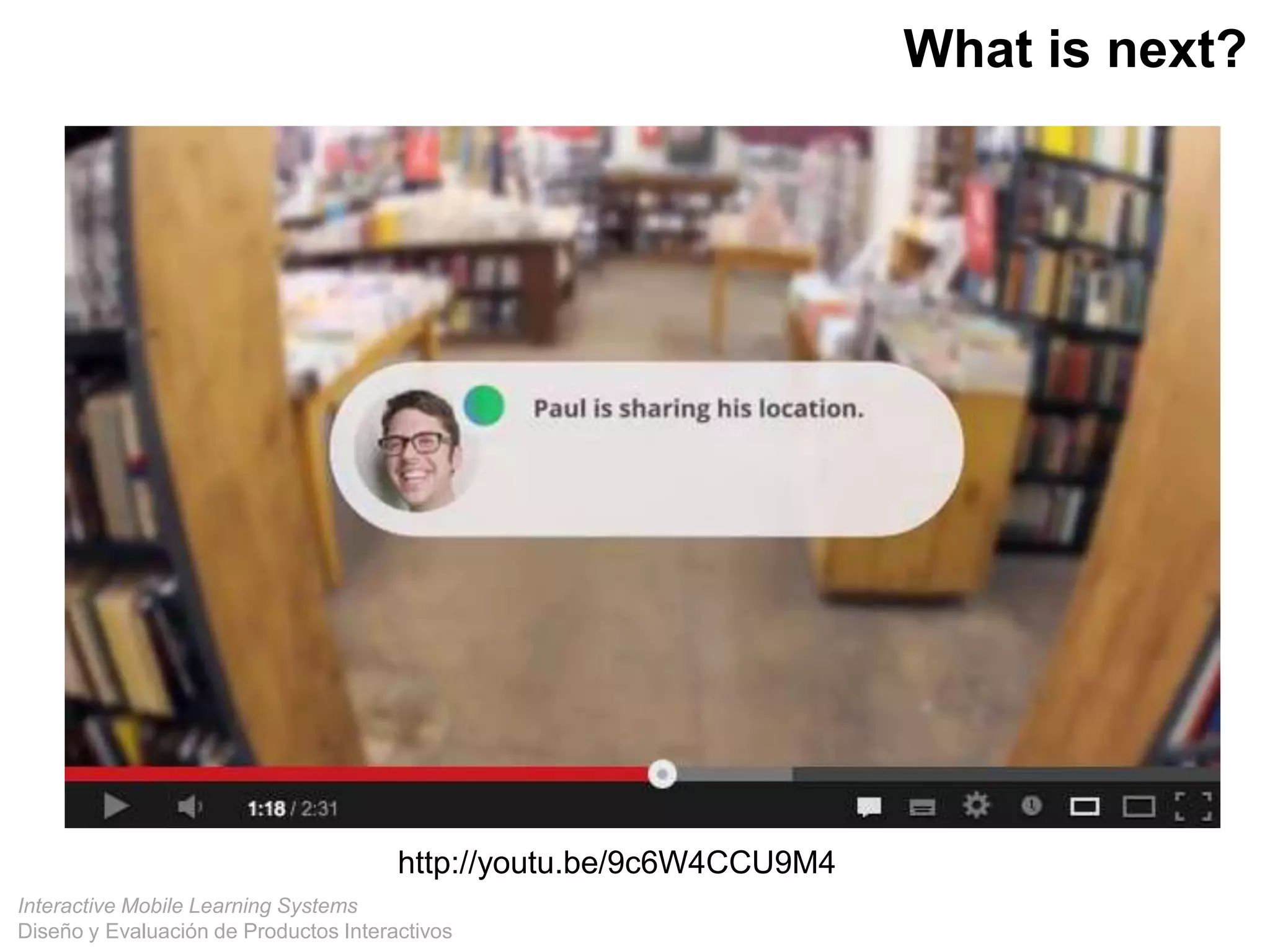
What is next?
http://youtu.be/9c6W4CCU9M4
Interactive Mobile Learning Systems
Diseño y Evaluación de Productos Interactivos
Bibliography
• Gu, Y., Lo, A. (2009) A Survey of Indoor Positioning Systems for Wireless
Personal Networks, IEEE Communications Surveys and Tutorials, 11(1), pp.
13-32.
• Motiwala, L. F. (2007) Mobile Learning: A Framework and evaluation,
Computers & Education, 49, pp. 581-596.
• Pérez-Sanagustín,M., Santos, P., Hernández-Leo, D. & Blat, J. (2012)
4SPPIces: A case study of factors in a scripted collaborative-learning blended
course across spatial locations (2012) In International Journal of Computer-
Supported Collaborative Learning, 7(3), pp. 443-465.
• Pérez-Sanagustín, M., Ramírez-Gonzalez, G., Hernández-Leo, D., Muñoz-
Organero, M., Santos, P., Blat, J. & Delgado Kloos, C. (2012) Discovering the
Campus Together: a mobile and computer-based learning experience. Journal
of Network and Computer Applications, 35(1), pp. 176-188
• Santos, P., Pérez-Sanagustín, M., Hernández-Leo, D. & Blat, J. (2011)
QuesTInSitu: From tests to routes for assessment in situ activities. Computers
& Education, 57(4): 2517-2534.
• Santos, P., Pérez-Sanagustín, M., Hernández-Leo, D. & Blat, J. (2012)
Space-aware Design Factors for Located Learning Activities Supported with
Smart Phones, Proceedings of the 6th Multimedia and Ubiquitous
Engineering. Leganés, pp. 792-798
Interactive Mobile Learning Systems
Diseño y Evaluación de Productos Interactivos
Bibliography
• Sharples, M., Taylor, J. & Vavoula, G. (2007)A Theory of Learning for the
Mobile Age. In R. Andrews and C. Haythornthwaite (eds.)The Sage Handbook
of Elearning Research. London: Sage, pp. 221-47.
• Spikol, D & Milrad, M. Combining physical activities and mobiel games to
promote novel learning practices. (2008) 5th IEEE Interantaional Conference
on Wireless, Mobile and Ubitquitous Tecnology in Education, pp. 31-38,
Beijing, China.
• Uden, L., (2007) Activity Theory for designing mobile learning, Int. J. Mobile
Learning and Organization, 1(1), pp. 81- 102.
• Zeimpekis, V., et al. (2003) A taxonomy of Indoor and Outdoor Positioning
Techniques for Mobile Location Services, ACM, pp. 19-27
Interactive Mobile Learning Systems
Diseño y Evaluación de Productos Interactivos
Thank you
Mar Pérez-Sanagustín:
marimar.ps
http://mperezsanagustin.wordpress.com/
mmpsanag@it.uc3m.es

20130521 interactive mobilesystems-uploaded

  • 1.
    Interactive Mobile LearningSystems Diseño y Evaluación de Productos Interactivos Interactive Mobile Learning Systems for learning Mar Pérez-Sanagustín, GAST, Gradient Laboratory,Universidad Carlos III de Madrid Diseño y Evaluación de Productos Interactivos 21st May 2013 #depimlearning
  • 2.
    Interactive Mobile LearningSystems Diseño y Evaluación de Productos Interactivos "Let’s face it: For my children and for millions like them, life will be an open phone test. They are among the first generation who will carry access to the sum of human knowledge and literally billions of potential teachers in their pockets. They will use that access on a daily basis to connect, create and, most important, to learn in ways that most of us can scarcely imagine. Given that reality, shouldn’t we be teaching our students how to use mobile devices well?” We live in a mobile world de Will Richardson The New York Times, Enero 2012
  • 3.
    Interactive Mobile LearningSystems Diseño y Evaluación de Productos Interactivos 1. Mobile Learning 1.1. Definitions 1.2. Theory of mobile learning 2. Mobile learning applications and scenarios 2.1. Indoors & Outdoors Applications 2.2. Designing situated learning scenarios 2.3. Indoors & Outdoors Scenarios: Case studies 2.4. Activity (30 mins) 3. Mobile learning in the smart city: Future challenges 3.1. Smart city Horizon 2020 3.2. Smart City Learning 4. Conclusions
  • 4.
    Interactive Mobile LearningSystems Diseño y Evaluación de Productos Interactivos “Mobile learning, or m-learning, can be any educational interaction delivered through mobile technology and accessed at a students convenience from any location” (EDUCAUSE 2010) “Any Activity that allows individuals to be more productive wen consuming, interacting with, or creating information, mediated through a compact digital portable device that the invididual carries on a regular basis,has reliable connectivitiy and fits in a pocket or purse” (mlearning.org) “The processes of gaining knowledge through conversations across mutliple contexts, amongst people and personal interactive technologies” (Sharples et al. 2010) “Mobile learning, or m-learning, can be any educational interaction delivered through mobile technology and accessed at a students convenience from any location” (EDUCAUSE 2010) “Any Activity that allows individuals to be more productive wen consuming, interacting with, or creating information, mediated through a compact digital portable device that the invididual carries on a regular basis,has reliable connectivitiy and fits in a pocket or purse” (mlearning.org) “The processes of gaining knowledge through conversations across mutliple contexts, amongst people and personal interactive technologies” (Sharples et al. 2010) 1. 1. Mobile Learning Definitions
  • 5.
    Interactive Mobile LearningSystems Diseño y Evaluación de Productos Interactivos 1. 1. Mobile Learning Definitions
  • 6.
    Interactive Mobile LearningSystems Diseño y Evaluación de Productos Interactivos 1. 2. Mobile Learning Theories What makes mobile learning different form other learning theories? 1. Mobile 2. Situated 3. Learner centered 4. Ubiquitous & personal Sharples, M., Taylor, J. & Vavoula, G. (2007) A Theory of Learning for the Mobile Age. In R. Andrews and C. Haythornthwaite (eds.)The Sage Handbook of Elearning Research. London: Sage, pp. 221-47.
  • 7.
    Interactive Mobile LearningSystems Diseño y Evaluación de Productos Interactivos Technological Layer Semiotic Layer Figures adapted from Sharples, M., Taylor, J. & Vavoula, G. (2007) 1. 2. Mobile Learning Theories
  • 8.
    Interactive Mobile LearningSystems Diseño y Evaluación de Productos Interactivos 1. 2. Mobile Learning Theories Theory for Mobile Learning Pedagogically-oriented frameworks for designing Mobile Learning Activities
  • 9.
    Interactive Mobile LearningSystems Diseño y Evaluación de Productos Interactivos 1. 2. Mobile Learning Theories Uden (2009) 1. Subject (user): Defining who participates in the activity and their roles, the evaluation criteria… 2. Tools: mobile device used by the learner and any other non-computing tools (books, manuals…) 3. Object: User intention, objective including materials to be transformed to achieve an outcome. 4. Community: Social and physical environment that might influence the learners’ activities. 5. Rules: school regultaions… 6. Division of labour: task distribution Pedagogically oriented framework for mobile learning
  • 10.
    Interactive Mobile LearningSystems Diseño y Evaluación de Productos Interactivos 1. 2. Mobile Learning Theories Spikol et al.l (2009) Pedagogicall- oriented COLABORATIVE mobile learning
  • 11.
    Interactive Mobile LearningSystems Diseño y Evaluación de Productos Interactivos 1. 2. Mobile Learning Theories Theory for Mobile Learning Pedagogically-oriented frameworks for designing Mobile Learning Activities Technologically-oriented frameworks for Mobile Learning Applications
  • 12.
    Interactive Mobile LearningSystems Diseño y Evaluación de Productos Interactivos 1. 2. Mobile Learning Theories Motiwala (2007) Technologically- oriented
  • 13.
    Interactive Mobile LearningSystems Diseño y Evaluación de Productos Interactivos 2. Mobile Applications & Scenarios
  • 14.
    Interactive Mobile LearningSystems Diseño y Evaluación de Productos Interactivos 2.1 Applications & Scenarios Applications 24 Enero 2013 Learning apps for Android 82,511 (10.58%) http://www.appbrain.com/stats/number-of-android-apps
  • 15.
    Interactive Mobile LearningSystems Diseño y Evaluación de Productos Interactivos
  • 16.
    Interactive Mobile LearningSystems Diseño y Evaluación de Productos Interactivos 2.1. Mobile Applications & Scenarios Outdoors Indoors
  • 17.
    Interactive Mobile LearningSystems Diseño y Evaluación de Productos Interactivos 17 http://www.youtube.com/watch?v=Gy- DI_bWElg&feature=player_embedded Google Indoors Maps + Wifi to trinagulate and give the position of the users. 2.1. Applications & Scenarios Indoors Apps
  • 18.
    Interactive Mobile LearningSystems Diseño y Evaluación de Productos Interactivos 18 http://www.youtube.com/watch?feature=pl ayer_embedded&v=PkehW3fkpLQ IndoorAtlas Using magnetic fields to detect positions. http://www.indooratlas .com/ 2.1. Applications & Scenarios Indoors Apps
  • 19.
    Interactive Mobile LearningSystems Diseño y Evaluación de Productos Interactivos 19 Pizarra Tag-based technologies: RFID/NFC & QR Codes 2.1. Applications & Scenarios Indoors Apps
  • 20.
    Interactive Mobile LearningSystems Diseño y Evaluación de Productos Interactivos 20 Positioning outdoors “Technologies (using GPS…) that allow designing applications that detect the location of the user and modify interfaces and functionalities according to this position” V. Zeimpekis, et al., A taxonomy of Indoor and Outdoor Positioning Techniques for Mobile Location Services, ACM, 2003, p. 19- 27 2.1 Applications & Scenarios Applications
  • 21.
    Interactive Mobile LearningSystems Diseño y Evaluación de Productos Interactivos 21 Positioned augmented reality Official website: http://www.layar.com/ 2. 1. Applications & Scenarios Outdoors Apps
  • 22.
    Interactive Mobile LearningSystems Diseño y Evaluación de Productos Interactivos 22 http://www.youtube.com/watch?feature=player_embed ded&v=-4VFeYZTTYs The treasure hunt adventure 2.1. Applications & Scenarios Outdoors Apps
  • 23.
    Interactive Mobile LearningSystems Diseño y Evaluación de Productos Interactivos Link: http://www.m- ubuntu.org.za/ Link: http://www.geocachingspain.com/ Link: http://qrpedia.org/ Link: http://qrgotic.com/ 2.1. Applications & Scenarios Outdoors & Indoors Apps
  • 24.
    Interactive Mobile LearningSystems Diseño y Evaluación de Productos Interactivos 24 Indoor positioning Technologies A system of interior positioning (IP) “enables a mobile device to determine its position, and makes the position of the device available for position-based services such as navigating, tracking” in indoor spaces Gu Y. Et al (2009) 2.1. Applications & Scenarios Indoors Apps Google IndoorsIndoorAtlas RFID/QR codes
  • 25.
    Interactive Mobile LearningSystems Diseño y Evaluación de Productos Interactivos  Space  Connectivity  Guidance  Position-based technology 2.2. Applications & Scenarios Designing m-Learning scenarios Design Factors
  • 26.
    Interactive Mobile LearningSystems Diseño y Evaluación de Productos Interactivos  Indoors: closed physical space.  Outdoors: Open physical spaces. 26 2.2. Applications & Scenarios Space
  • 27.
    Interactive Mobile LearningSystems Diseño y Evaluación de Productos Interactivos  Internet: Educational Resources (ERs) on the Cloud  No Internet: Ers stored locally in the smartphone. 27 2.2. Applications & Scenarios Connectivity
  • 28.
    Interactive Mobile LearningSystems Diseño y Evaluación de Productos Interactivos  Cloud Map: cloud map updating position on real time.  Local Map: Paper or local map stored into the device. 28 2.2. Applications & Scenarios Guidance
  • 29.
    Interactive Mobile LearningSystems Diseño y Evaluación de Productos Interactivos  GPS / Bluetooth: ER can be associated to a geographical postiion with a position.  QR-Codes / RFID: ERs postioned manualy to a specific position. 29 2.2. Applications & Scenarios Position-based Technology
  • 30.
    Interactive Mobile LearningSystems Diseño y Evaluación de Productos Interactivos 2.2. Applications & Scenarios Factors in the design of m-learning activities
  • 31.
    Interactive Mobile LearningSystems Diseño y Evaluación de Productos Interactivos 2.3. Scenarios Outdoors Activities in open spaces do not conditioned by the architechtonic barriers
  • 32.
    Interactive Mobile LearningSystems Diseño y Evaluación de Productos Interactivos 32 QuesTInSitu: Tool for the generation of learning experiences in situ based on tests. Prototype: http://gti.upf.edu/questinsitu Functionalities - Create of geo-positioned routes of questions - Monitorize students in real time - Feedback in real time 2.3. Applications & Scenarios Outdoors scenarios
  • 33.
    Interactive Mobile LearningSystems Diseño y Evaluación de Productos Interactivos Discovering Barcelona!: Case Study • Objective : Learning about the city of Barcelona applying knowledge about Modernims learned in class. • Participants: 34 secundary school students Results • Good support for assessment in situ experiences • Enriched experience in the city • Enacts learning attitude: motivation Santos et al. (2011) & Pérez- Sanagustín et al. (2012) 2.3. Applications & Scenarios Outdoors scenarios
  • 34.
    Interactive Mobile LearningSystems Diseño y Evaluación de Productos Interactivos Videos sobre la experiencia: http://www.youtube.com/watch?feature=player_detailpage&v=7w29vfCZOJ0 Aventura literaria
  • 35.
    Interactive Mobile LearningSystems Diseño y Evaluación de Productos Interactivos Indoors Activiities occurring in a closed space constrained by the architectural barriers. 2.3. Scenarios
  • 36.
    Interactive Mobile LearningSystems Diseño y Evaluación de Productos Interactivos 36 etiquetAR: Authoring tool for supporting the design and enactment of learning activities based on tags. Prototype: http://etiquetar.com.es Functionalities - Create dynamic tags - Personalize your tags with Profiles - Comment on Tags 2.1. Applications & Scenarios Outdoors Sanagustín et al. (2013)
  • 37.
    Interactive Mobile LearningSystems Diseño y Evaluación de Productos Interactivos 2.3. Applications & Scenarios Indoor scenarios How an object become a learning object: Case Study How an object becomes a learning object: Case Study • Objective : Learning about the machines of the lab and reflect about their possibilities contributing with your ideas. • Participants: around 243 engineerying students & 3 teachers
  • 38.
    Interactive Mobile LearningSystems Diseño y Evaluación de Productos Interactivos Videos sobre la experiencia: http://www.youtube.com/watch?feature=player_detailpage&v=k5zL-eJvFYc Discovering the campus together: Case study Sanagustín et al. (2012)
  • 39.
    Interactive Mobile LearningSystems Diseño y Evaluación de Productos Interactivos  Groups  Use the template to think about a m-learning activity. Write in post-its your solution Tag your solution 2.3. Activity Activity (30’)
  • 40.
    Interactive Mobile LearningSystems Diseño y Evaluación de Productos Interactivos 2.3. Activity
  • 41.
    Interactive Mobile LearningSystems Diseño y Evaluación de Productos Interactivos 3. Mobile Learning in the Smart City Future challenges
  • 42.
    Interactive Mobile LearningSystems Diseño y Evaluación de Productos Interactivos • Marie Skłodowska-Curie actions on skills, training and career development • Research infrastructures (including e-Infrastructures) • Leadership in enabling and industrial technologies within the following areas: • Information and Communication Technologies (ICT)* • Access to risk finance (debt or equity financing) • Innovation in small and medium-sized enterprises (SMEs) • Health, demographic change and wellbeing • Food security, sustainable agriculture, marine and maritime research & • the bio-economy • Secure, clean and efficient energy (including nuclear energy) • Smart, green and integrated transport • Climate action, resource efficiency and raw materials • Inclusive, innovative and secure societies http://ec.europa.eu/research/horizon2020/index_en.cfm?pg=h2020-experts 3.1. mLearning in the Smart City Horizon 2020
  • 43.
    Interactive Mobile LearningSystems Diseño y Evaluación de Productos Interactivos “The smart city can be defined as the integration of technology into a strategic approach to sustainability, citizen well-being, and economic development” (Woods, E. & Blooms, E., 2011) (Smart Cities, Ranking of European medium-sized cities”, 2007) (Final report )Smart city definition 3.1. mLearning in the Smart City Horizon 2020
  • 44.
    Interactive Mobile LearningSystems Diseño y Evaluación de Productos Interactivos We are free to choose our own networks for membership and our own level of engagement in each network. We are free, as well, to shape our degrees of connection to local space. As a result, we can each create our own customized – and evolving – fusion of local and global identities. Josua Merowitz, The Rise of Glocality: New senses of place and Identity in the Global Village“ “ “ Glocalities, where the local and the global co-exist Unique, constanly evolving, mechanism through which we learn 3.1. mLearning in the Smart City Horizon 2020
  • 45.
    Interactive Mobile LearningSystems Diseño y Evaluación de Productos Interactivos Introduction Learning through glocalities • Glocalities are unique and constantly evolving • Citizens are lifelong learners permanently learning with and within the city • Citizens build up their learning ecosystems to be constantly evolving 3.1. mLearning in the Smart City Horizon 2020
  • 46.
    Interactive Mobile LearningSystems Diseño y Evaluación de Productos Interactivos "The theme of the transformation of the learning modalities that may be induced by the transformation of living places in smart territories, cities and villages is a new theme whose relevance will grow more and more in the near future." WS Webpage: http://www.mifav.uniroma2.it/inevent/events/scl13/index.php?s=156 January, 28- February, 1st 2013 3.2. mLearning in the Smart City Smart Cities Learning
  • 47.
    Interactive Mobile LearningSystems Diseño y Evaluación de Productos Interactivos 1. Technological Ecosystems supporting learning within and from the 'smart cities’ 2. Smart city learning scenarios (contexts and methods for the citizens of the future) 3. Ecological monitoring and visualization of flows, behaviors, experience's styles and 'smart cities' learning (analytics and visualization) 4. The impact of contextualization, glocalities, identities (cultural effect and inclusion) 3.2. mLearning in the Smart City Smart Cities Learning
  • 48.
    Interactive Mobile LearningSystems Diseño y Evaluación de Productos Interactivos 4. Conclusions • Mobile learning: Learning theory based on learning across contexts and people through the use of mobiles. A New Era for education • Apps for supporting m-learning scenarios: Learning beyond the classroom. • Factors in the design of m-Learning scenarios: Space, Connectivity, Guidance & Position based Technologies • Future challenges: the smart city learning
  • 49.
    Interactive Mobile LearningSystems Diseño y Evaluación de Productos Interactivos What is next? http://youtu.be/9c6W4CCU9M4
  • 50.
    Interactive Mobile LearningSystems Diseño y Evaluación de Productos Interactivos Bibliography • Gu, Y., Lo, A. (2009) A Survey of Indoor Positioning Systems for Wireless Personal Networks, IEEE Communications Surveys and Tutorials, 11(1), pp. 13-32. • Motiwala, L. F. (2007) Mobile Learning: A Framework and evaluation, Computers & Education, 49, pp. 581-596. • Pérez-Sanagustín,M., Santos, P., Hernández-Leo, D. & Blat, J. (2012) 4SPPIces: A case study of factors in a scripted collaborative-learning blended course across spatial locations (2012) In International Journal of Computer- Supported Collaborative Learning, 7(3), pp. 443-465. • Pérez-Sanagustín, M., Ramírez-Gonzalez, G., Hernández-Leo, D., Muñoz- Organero, M., Santos, P., Blat, J. & Delgado Kloos, C. (2012) Discovering the Campus Together: a mobile and computer-based learning experience. Journal of Network and Computer Applications, 35(1), pp. 176-188 • Santos, P., Pérez-Sanagustín, M., Hernández-Leo, D. & Blat, J. (2011) QuesTInSitu: From tests to routes for assessment in situ activities. Computers & Education, 57(4): 2517-2534. • Santos, P., Pérez-Sanagustín, M., Hernández-Leo, D. & Blat, J. (2012) Space-aware Design Factors for Located Learning Activities Supported with Smart Phones, Proceedings of the 6th Multimedia and Ubiquitous Engineering. Leganés, pp. 792-798
  • 51.
    Interactive Mobile LearningSystems Diseño y Evaluación de Productos Interactivos Bibliography • Sharples, M., Taylor, J. & Vavoula, G. (2007)A Theory of Learning for the Mobile Age. In R. Andrews and C. Haythornthwaite (eds.)The Sage Handbook of Elearning Research. London: Sage, pp. 221-47. • Spikol, D & Milrad, M. Combining physical activities and mobiel games to promote novel learning practices. (2008) 5th IEEE Interantaional Conference on Wireless, Mobile and Ubitquitous Tecnology in Education, pp. 31-38, Beijing, China. • Uden, L., (2007) Activity Theory for designing mobile learning, Int. J. Mobile Learning and Organization, 1(1), pp. 81- 102. • Zeimpekis, V., et al. (2003) A taxonomy of Indoor and Outdoor Positioning Techniques for Mobile Location Services, ACM, pp. 19-27
  • 52.
    Interactive Mobile LearningSystems Diseño y Evaluación de Productos Interactivos Thank you Mar Pérez-Sanagustín: marimar.ps http://mperezsanagustin.wordpress.com/ mmpsanag@it.uc3m.es