Operationalization of collaborative blended learning scripts: a model, computational mechanisms and experimentsAuthor: Mar Pérez-SanagustínAdvisors: Davinia Hernández-Leo & Josep BlatPhD Thesis PresentationPhD Presentation, 1st July 2011
OutlineIntroductionFactors in the design of CSCBL scriptsOperationalization of CSCBL scriptsTwo multicase studiesSummary of contributions and future work 2PhD Presentation, 1st July 2011
OutlineIntroductionFactors in the design of CSCBL scriptsOperationalization of CSCBL scriptsTwo multicase studiesSummary of contributions and future work 3PhD Presentation, 1st July 2011
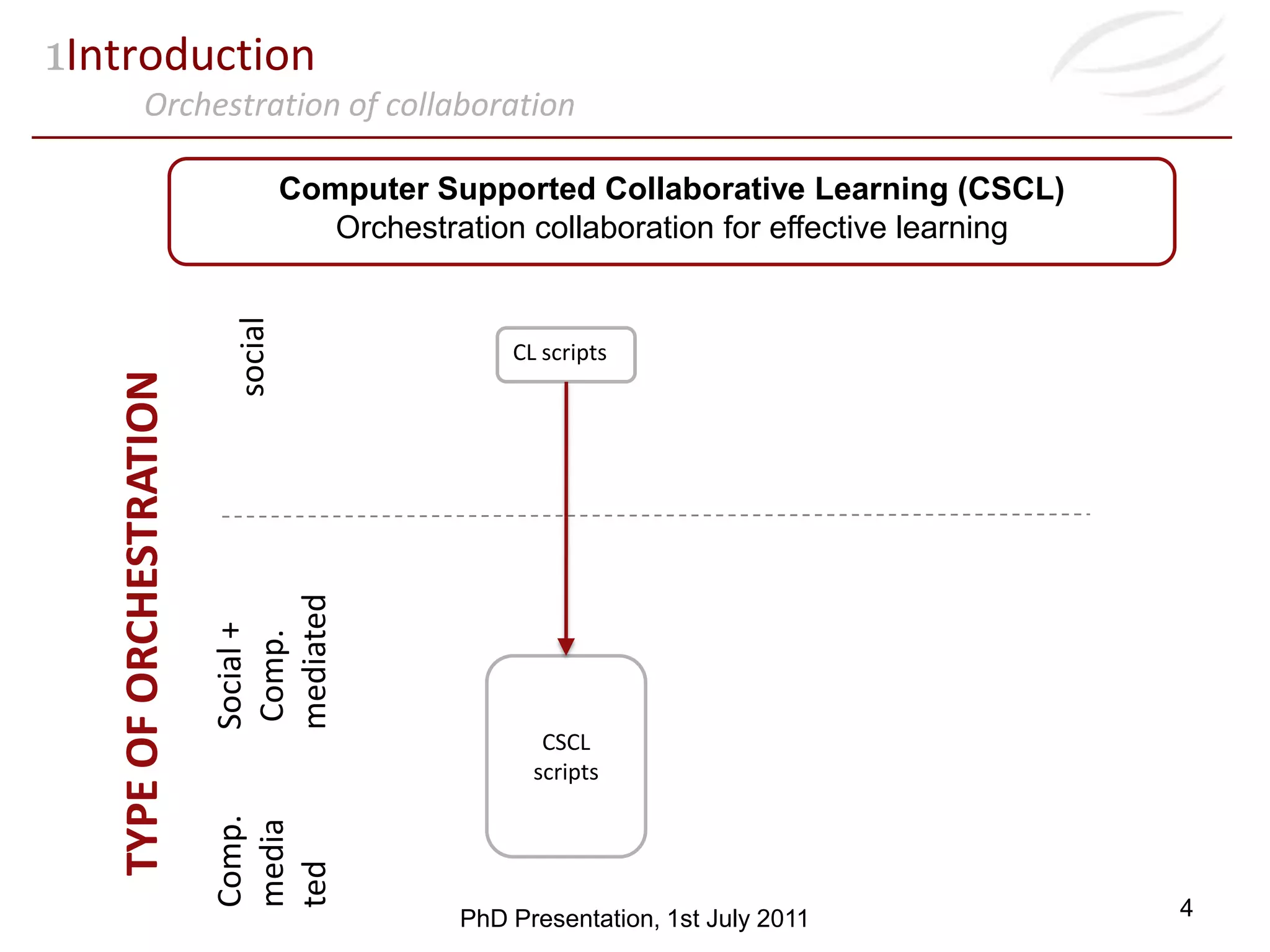
1IntroductionOrchestration of collaborationComputer Supported Collaborative Learning (CSCL)Orchestration collaboration for effective learningCL scriptssocialSocial + Comp. mediatedTYPE OF ORCHESTRATIONCSCL scriptsComp. mediated4PhD Presentation, 1st July 2011
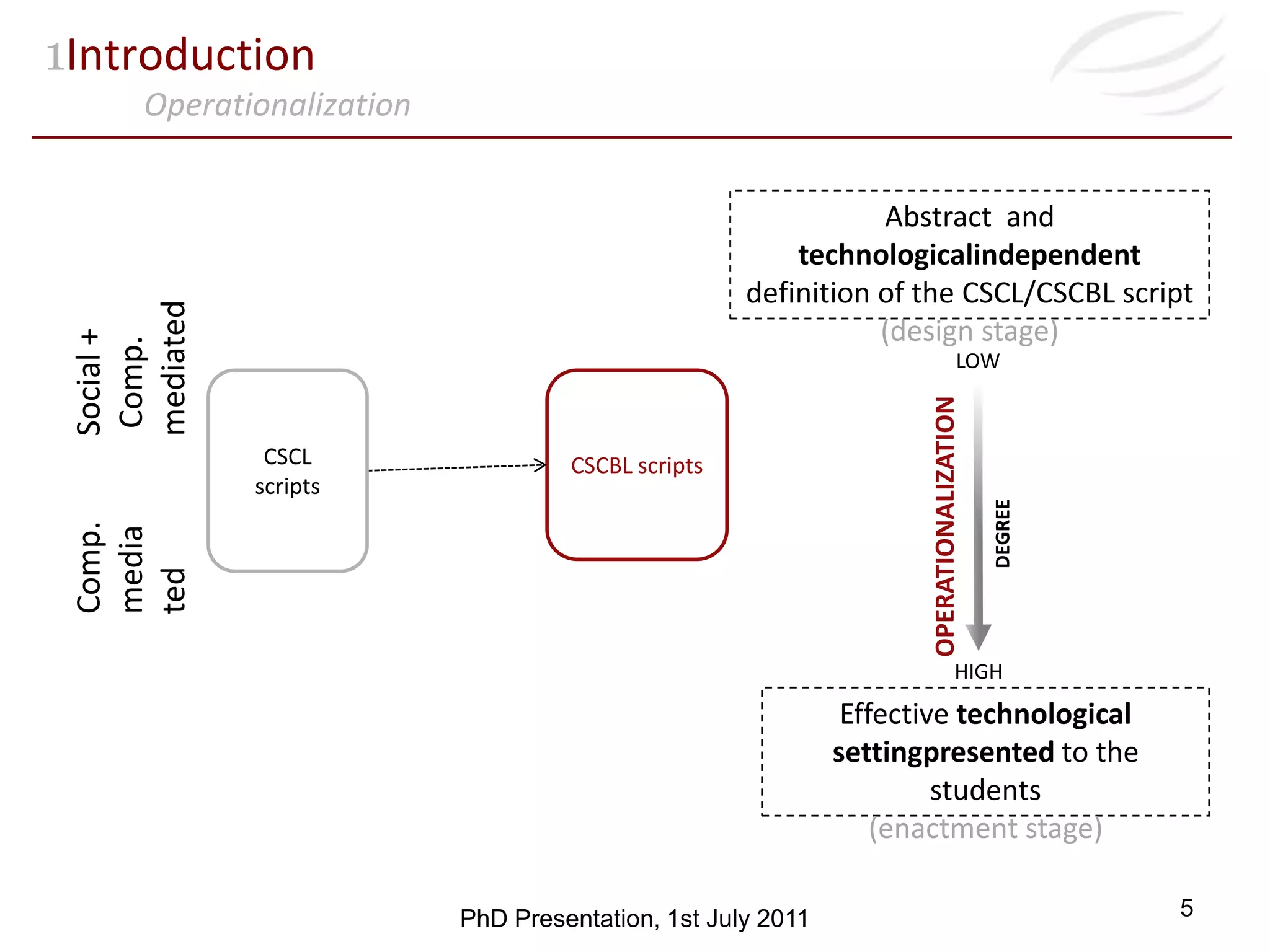
1IntroductionOperationalizationAbstract  and technologicalindependent definition of the CSCL/CSCBL script (design stage)Social + Comp. mediatedCSCL scriptsOPERATIONALIZATIONComp. mediatedLOWCSCBL scriptsEffective technological settingpresented to the students(enactment stage)DEGREEHIGH5PhD Presentation, 1st July 2011
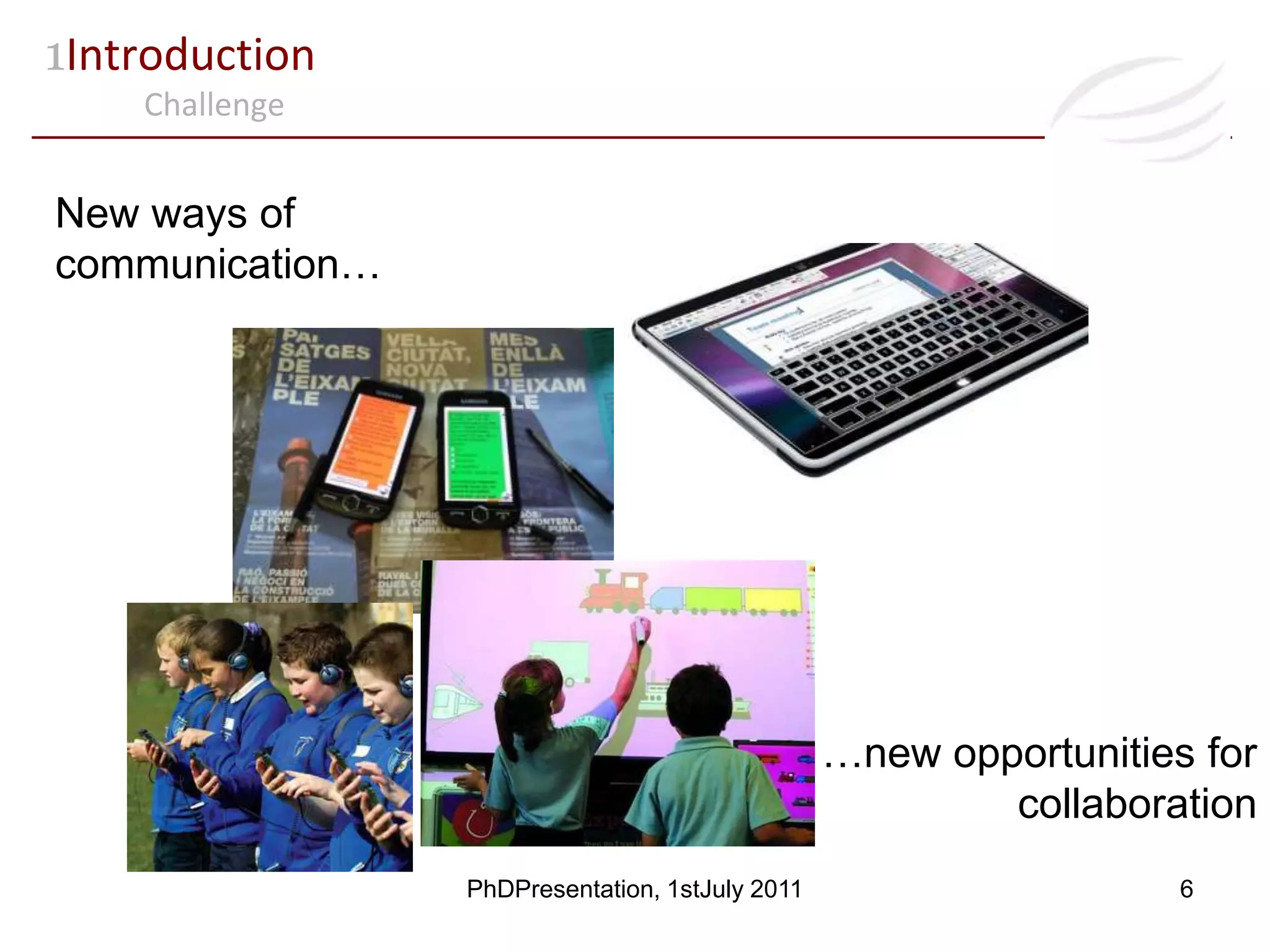
1IntroductionChallengeNew ways of communication……new opportunities for collaboration6PhDPresentation, 1stJuly 2011
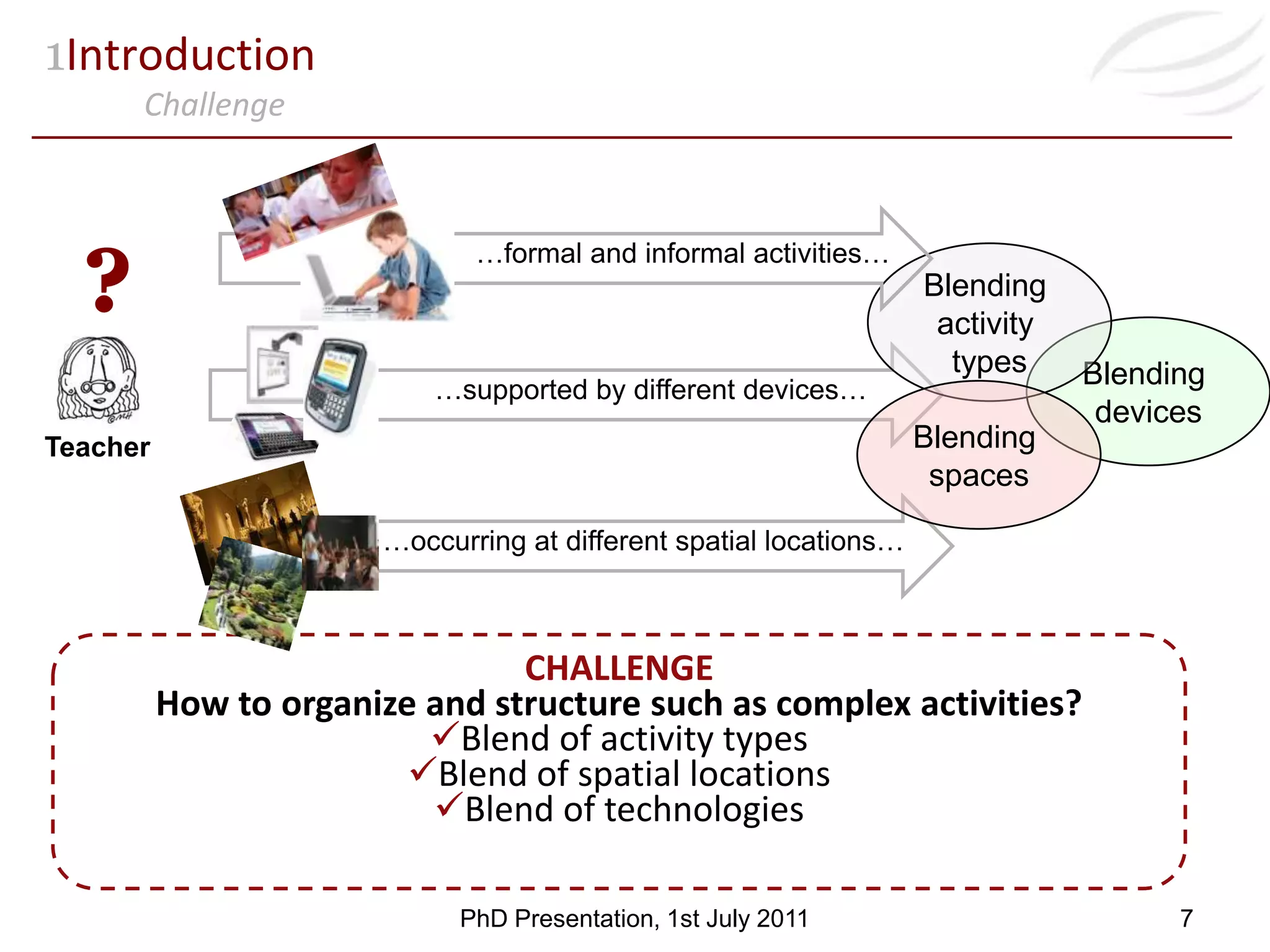
Teacher1IntroductionChallenge…formal and informal activities…?Blending activity typesBlending devicesBlending spaces…supported by different devices……occurring at different spatial locations…CHALLENGEHow to organize and structure such as complex activities?Blend of activity types
Blend of spatial locations
Blend of technologies7PhD Presentation, 1st July 2011
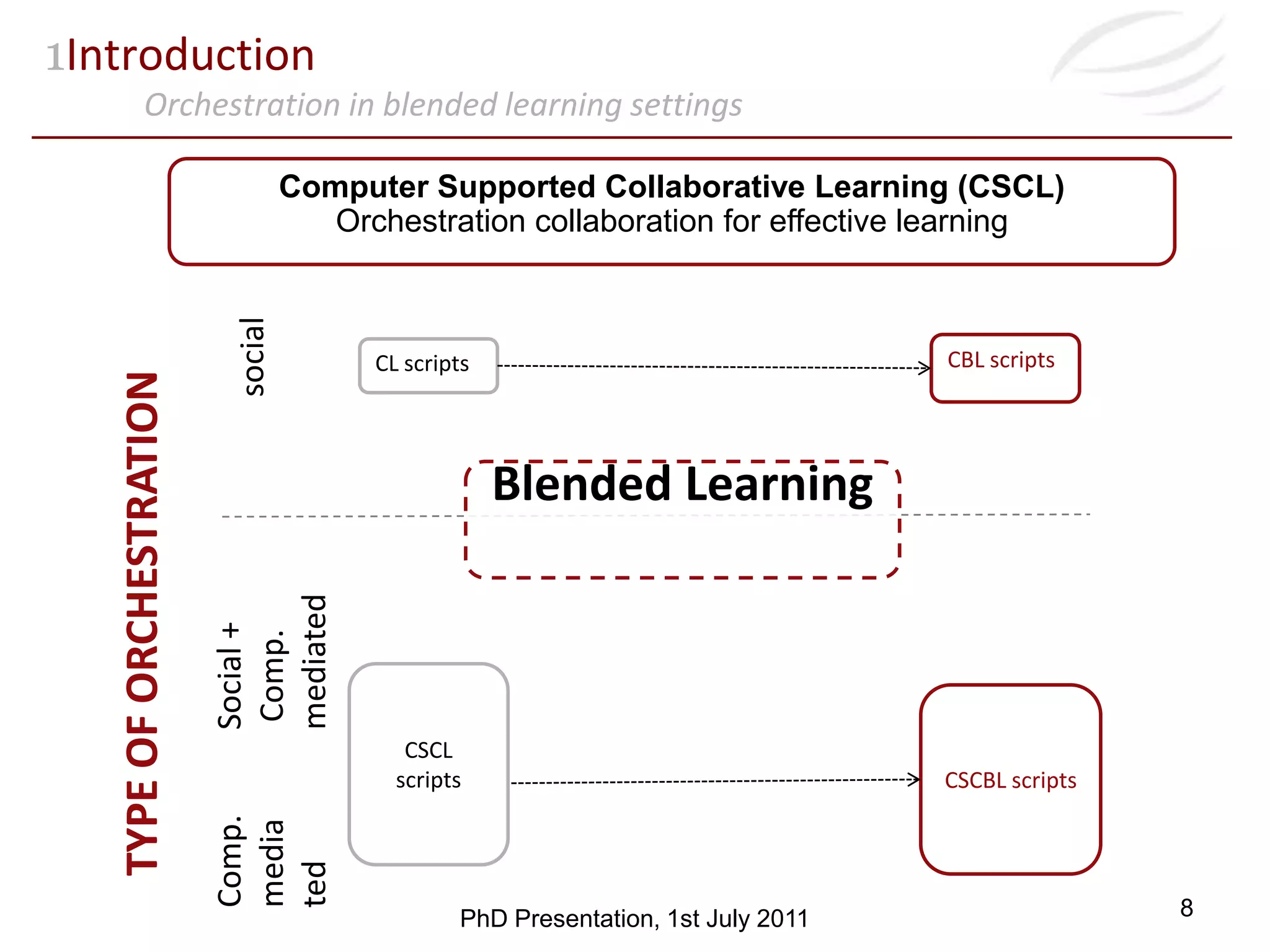
1IntroductionOrchestration in blended learning settingsComputer Supported Collaborative Learning (CSCL)Orchestration collaboration for effective learningCBL scriptssocialCL scriptsBlended LearningSocial + Comp. mediatedTYPE OF ORCHESTRATIONCSCBL scriptsCSCL scriptsComp. mediated8PhD Presentation, 1st July 2011
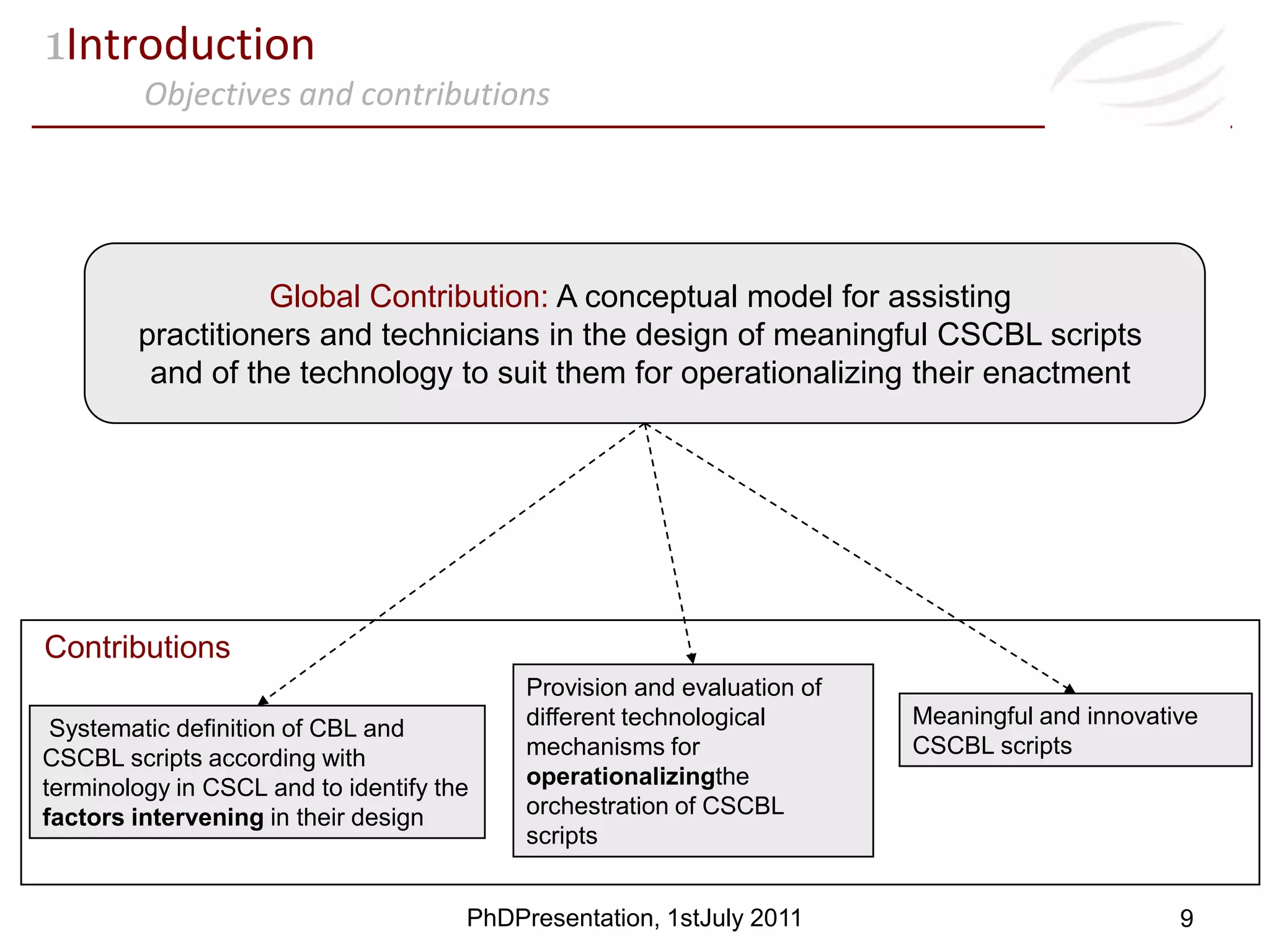
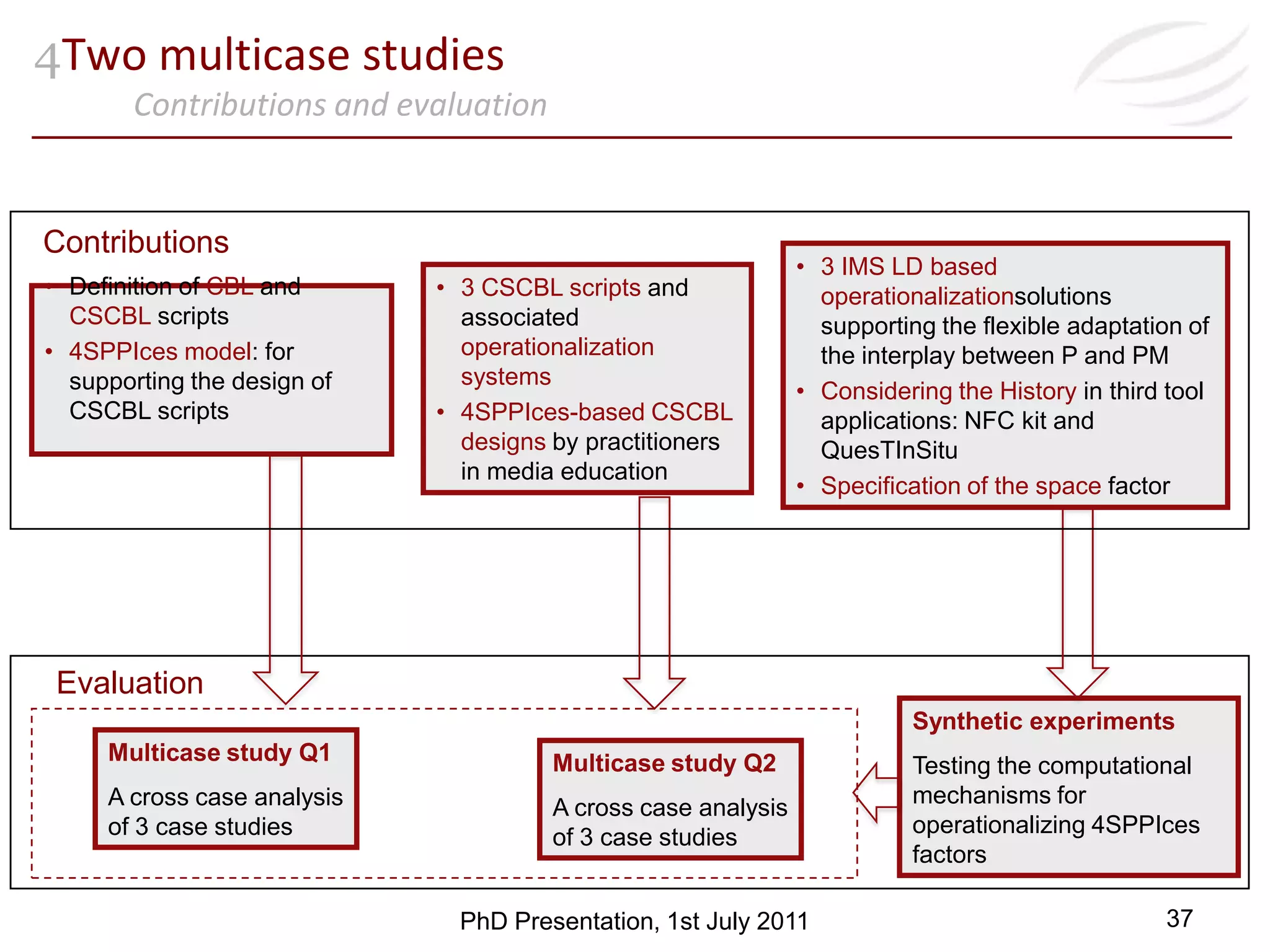
Contributions1IntroductionObjectives and contributionsGlobal Contribution: A conceptual model for assisting practitioners and technicians in the design of meaningful CSCBL scripts and of the technology to suit them for operationalizing their enactment Provision and evaluation of different technological mechanisms for operationalizingthe orchestration of CSCBL scriptsMeaningful and innovative CSCBL scripts Systematic definition of CBL and CSCBL scripts according with terminology in CSCL and to identify the factors intervening in their designPhDPresentation, 1stJuly 20119
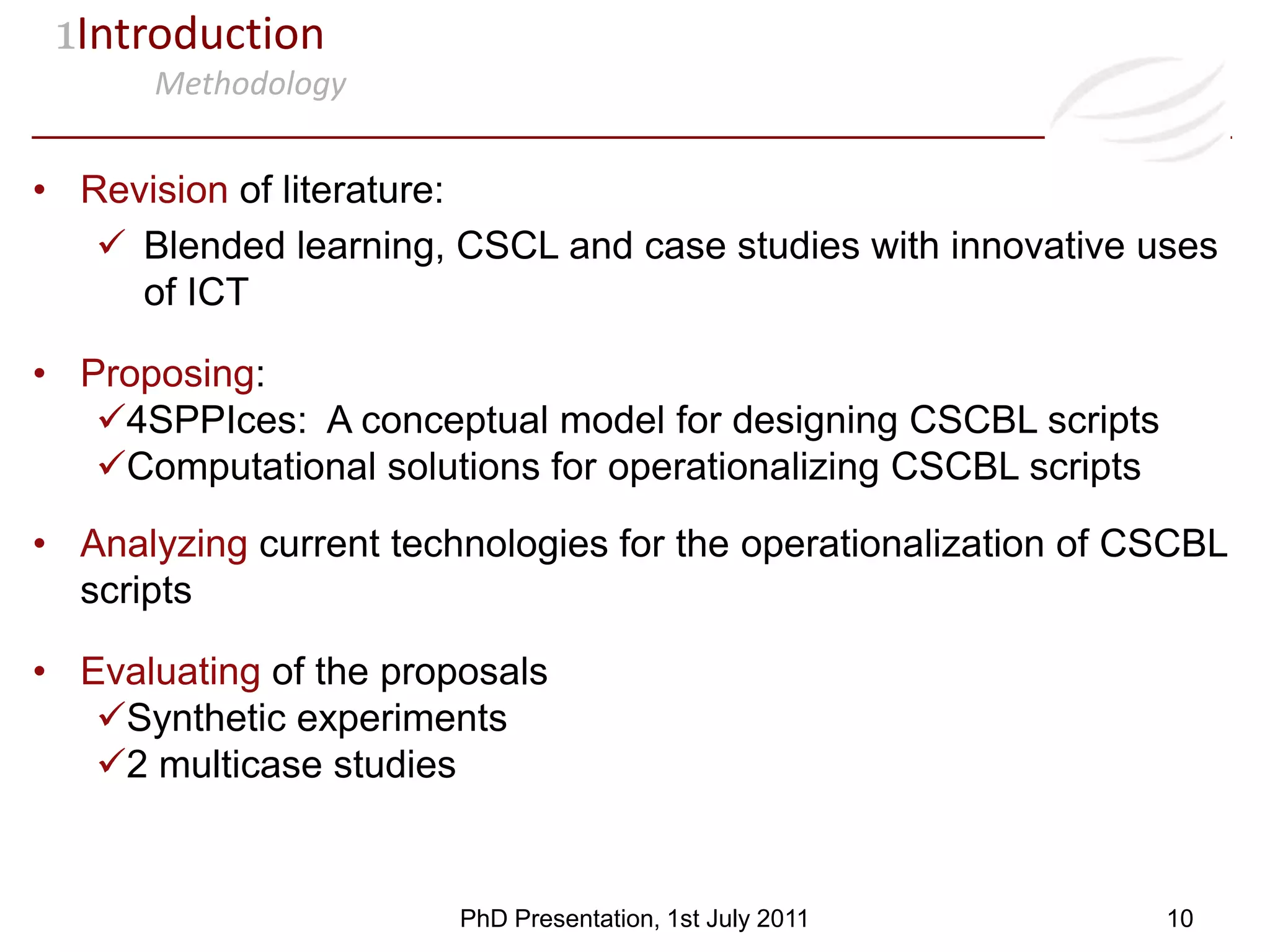
1IntroductionMethodologyRevision of literature:
Blended learning, CSCL and case studies with innovative uses of ICT
Proposing:
4SPPIces:  A conceptual model for designing CSCBL scripts
Computational solutions for operationalizing CSCBL scripts
Analyzing current technologies for the operationalization of CSCBL scripts
Evaluating of the proposals
Synthetic experiments
2 multicase studies10PhD Presentation, 1st July 2011
OutlineIntroductionFactors in the design of CSCBL scriptsOperationalization of CSCBL scriptsTwo multicase studiesSummary of contributions and future work 11PhD Presentation, 1st July 2011
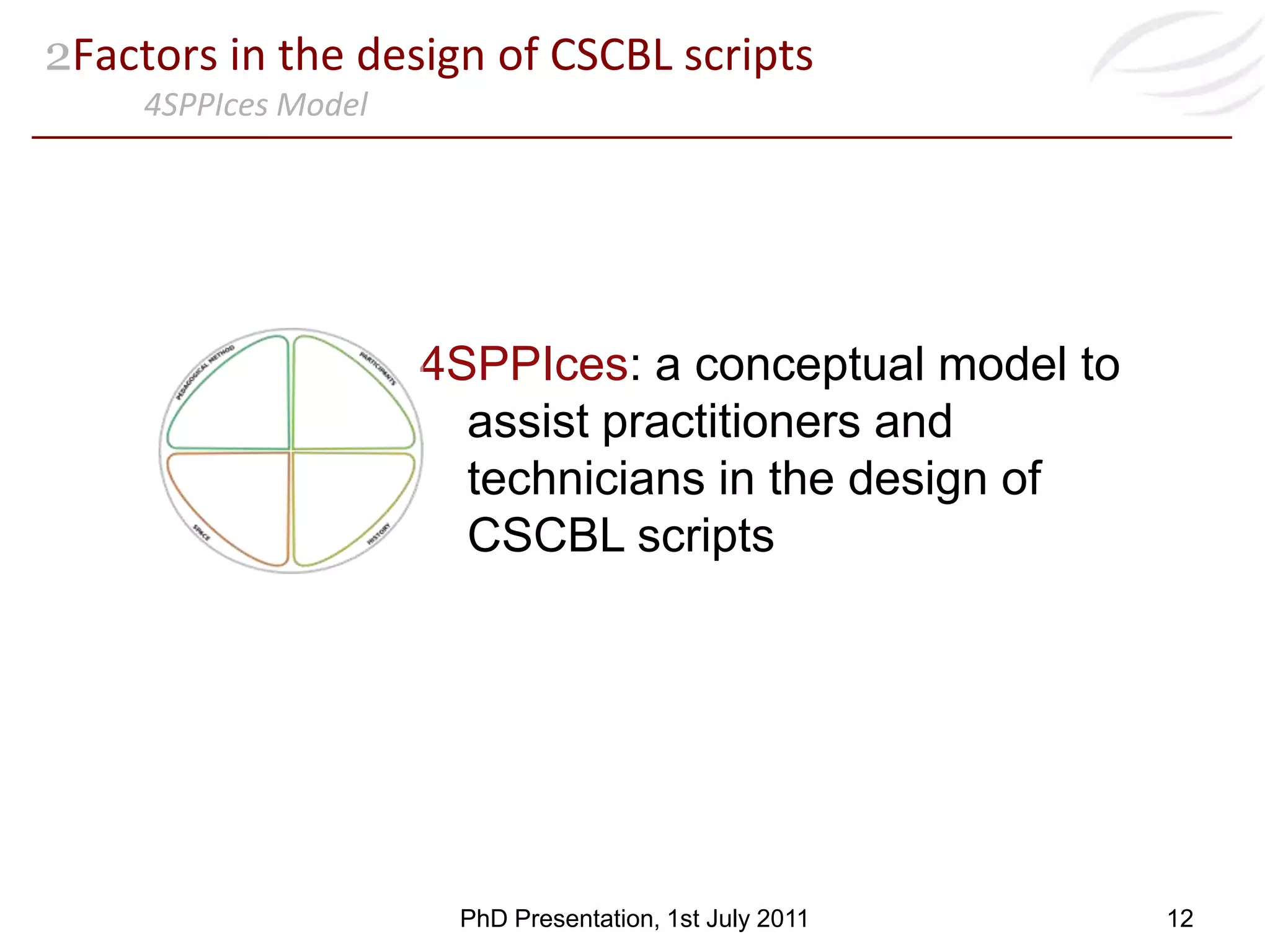
2Factors in the design of CSCBL scripts4SPPIces Model 4SPPIces: a conceptual model to assist practitioners and technicians in the design of CSCBL scriptsPhD Presentation, 1st July 201112
2Factors in the design of CSCBL scripts4SPPIces Model SPACEAgent able to activate or inhibit learning by shaping users interactions Learning flowActivityGroup characteristicsData flowNumber ParticipantsProfile LocationHISTORYFlexibility
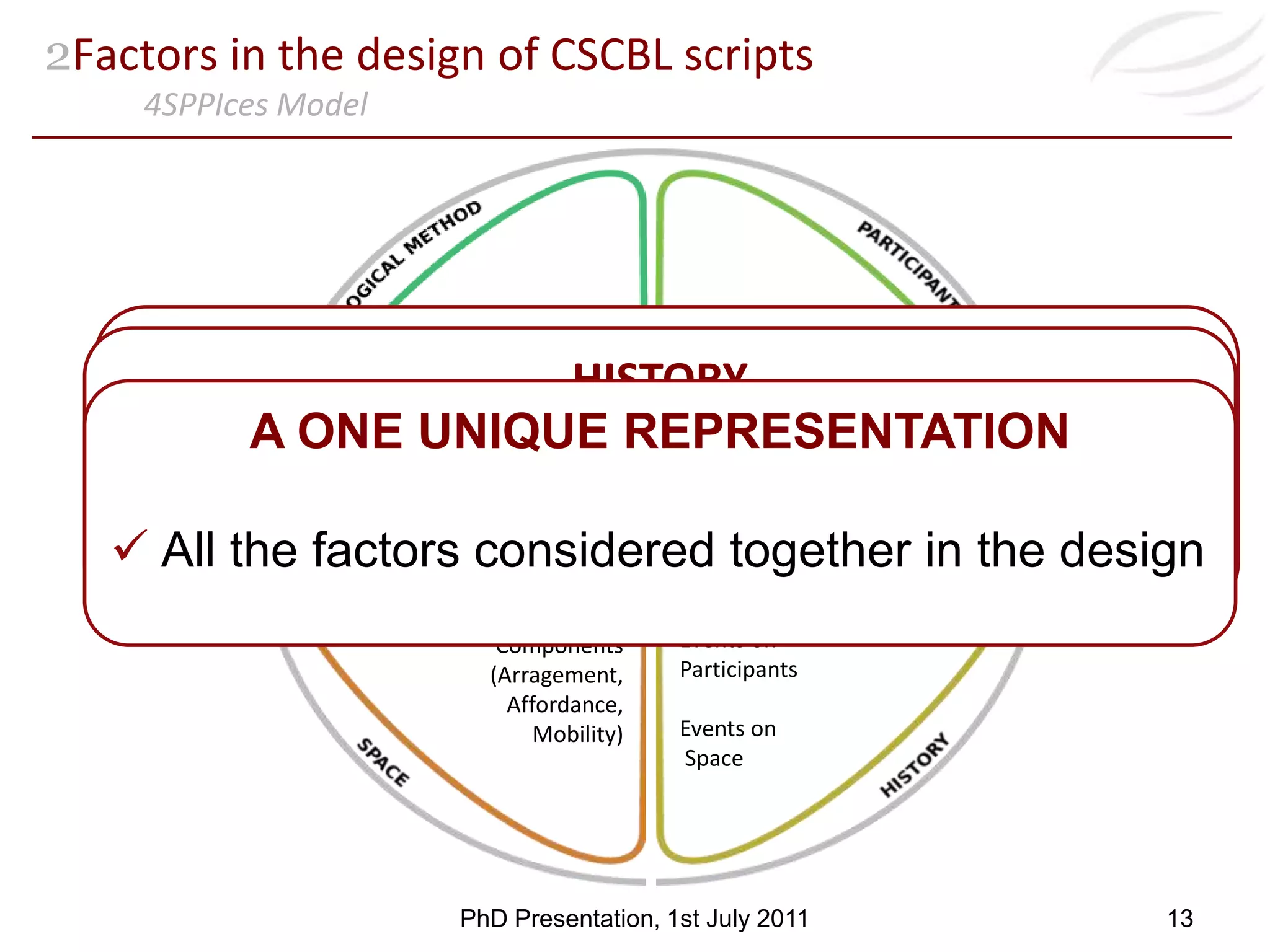
Relationships between factorsA ONE UNIQUE REPRESENTATIONAll the factors considered together in the designVirtual & physical spacesAreasComponents (Arragement,Affordance, Mobility)Events on Pedagogical MethodEvents on ParticipantsEvents on Space13PhD Presentation, 1st July 2011
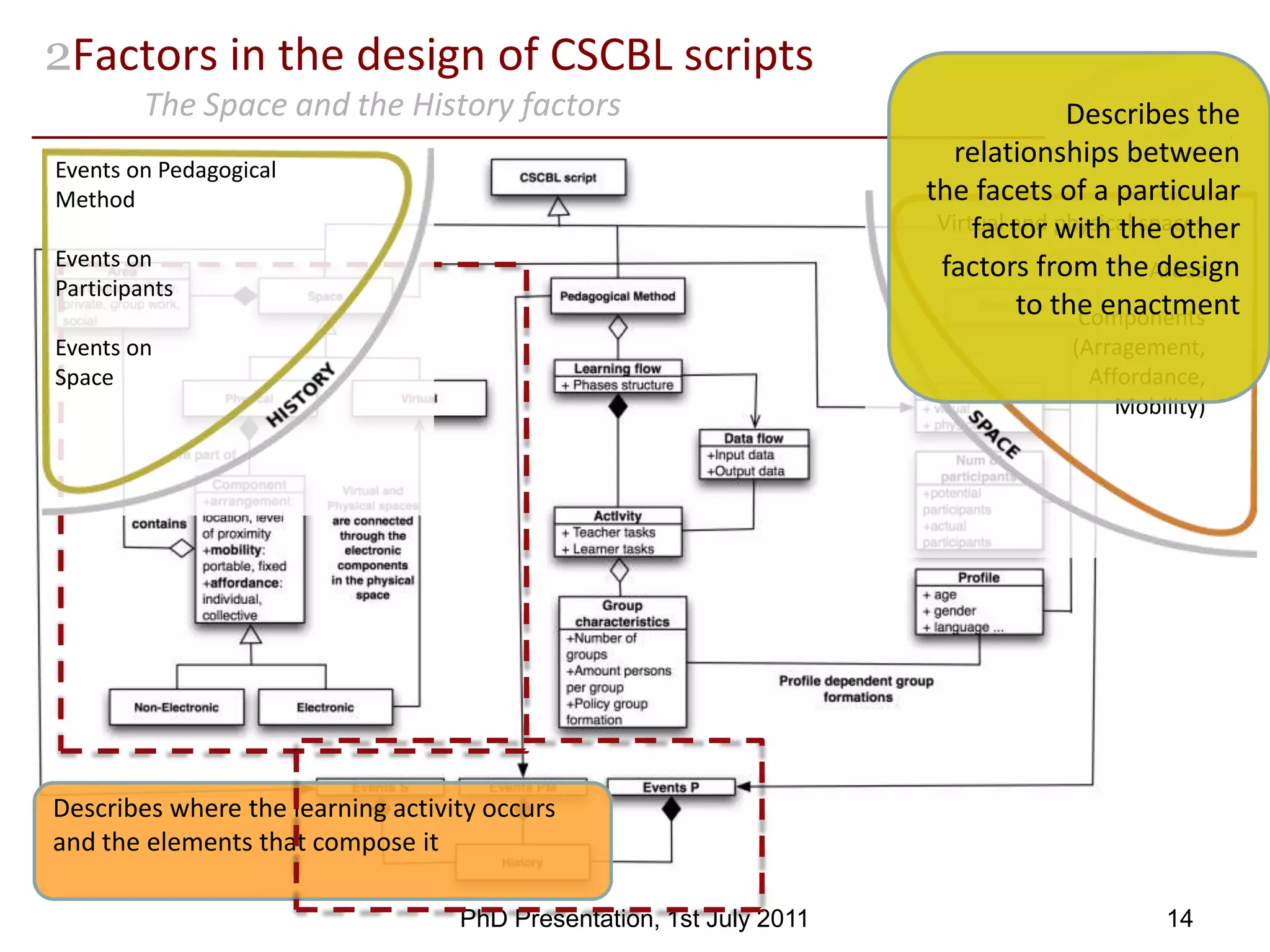
2Factors in the design of CSCBL scriptsThe Space and the History factorsDescribes the relationships between the facets of a particular factor with the other factors from the design to the enactmentEvents on Pedagogical MethodEvents onParticipantsEvents onSpaceVirtual and physical spacesAreasComponents (Arragement,Affordance, Mobility)Describes where the learning activity occurs and the elements that compose it14PhD Presentation, 1st July 2011
OutlineIntroductionFactors in the design of CSCBL scriptsOperationalization of CSCBL scriptsTwo multicase studiesSummary of contributions and future work PhDPresentation, 1stJuly 201115
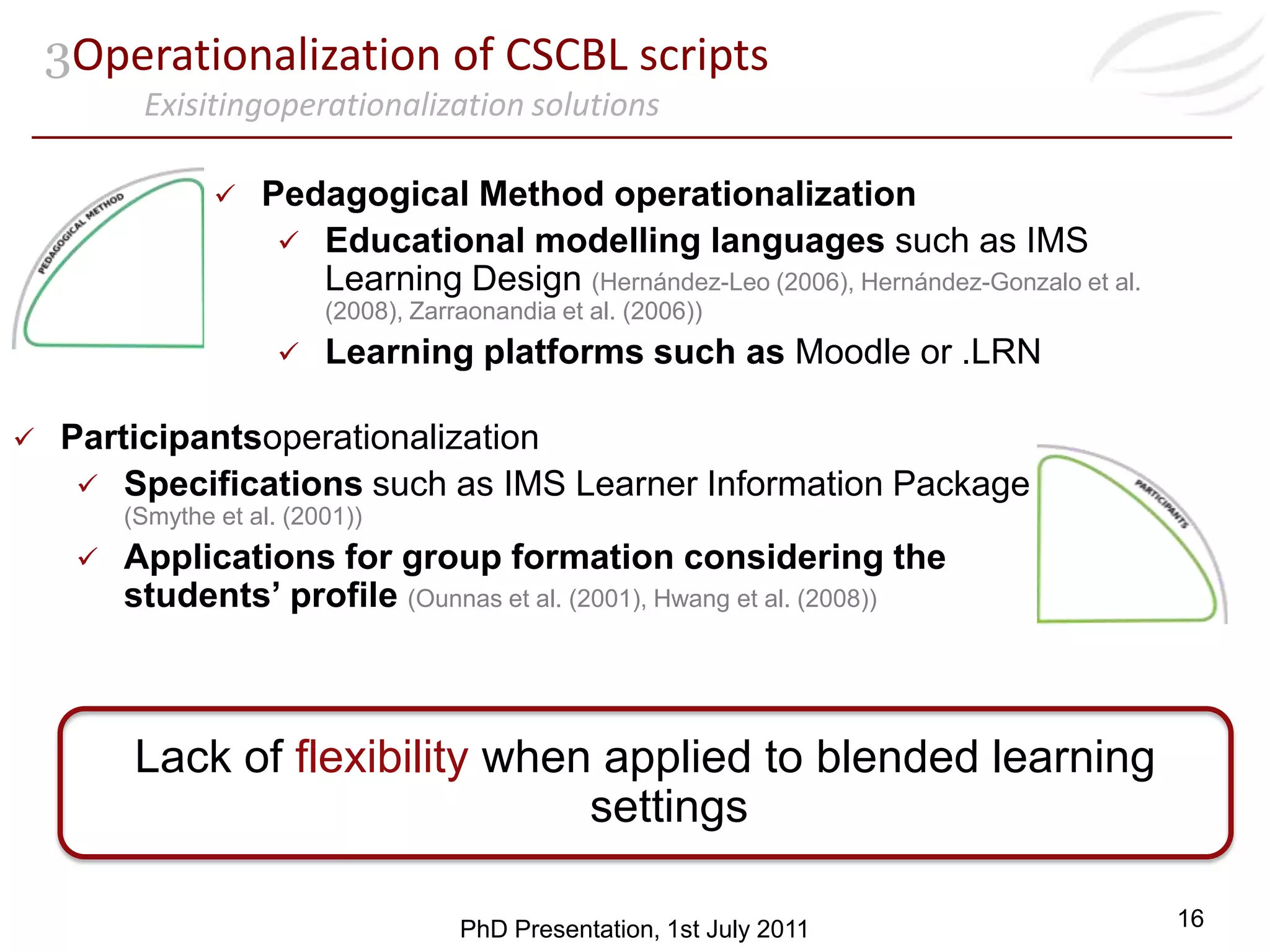
3Operationalization of CSCBL scriptsExisitingoperationalization solutionsPedagogical Method operationalization
Educational modelling languages such as IMS Learning Design (Hernández-Leo (2006), Hernández-Gonzalo et al. (2008), Zarraonandia et al. (2006))
Learning platforms such as Moodle or .LRN
Participantsoperationalization
Specifications such as IMS Learner Information Package (Smythe et al. (2001))
Applications for group formation considering the students’ profile (Ounnas et al. (2001), Hwang et al. (2008))Lack of flexibility when applied to blended learning settings16PhD Presentation, 1st July 2011
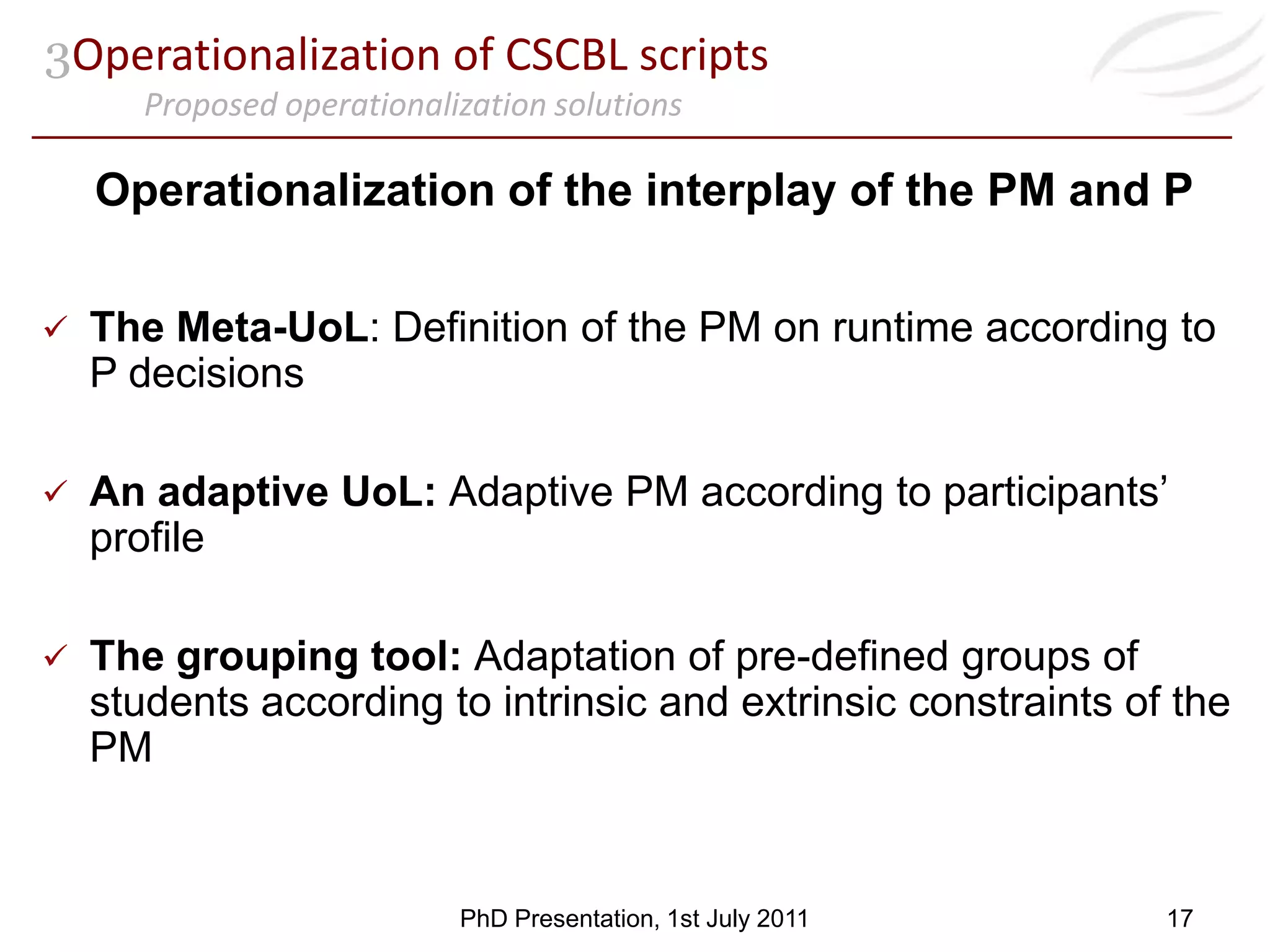
3Operationalization of CSCBL scriptsProposed operationalization solutionsOperationalization of the interplay of the PM and PThe Meta-UoL: Definition of the PM on runtime according to P decisions
An adaptive UoL: Adaptive PM according to participants’ profile
The grouping tool: Adaptation of pre-defined groups of students according to intrinsic and extrinsic constraints of the PMPhD Presentation, 1st July 201117
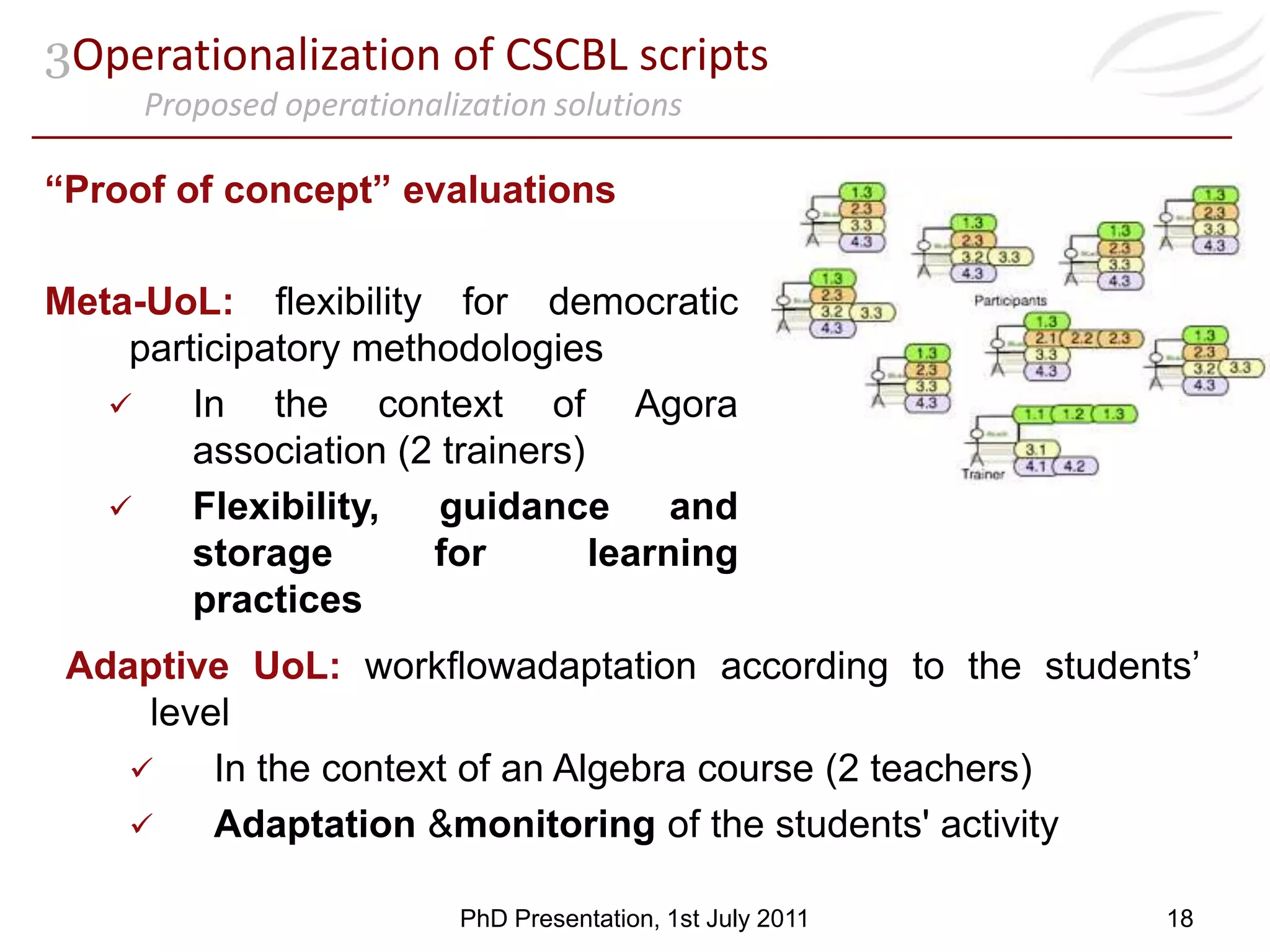
3Operationalization of CSCBL scriptsProposed operationalization solutions“Proof of concept” evaluationsMeta-UoL: flexibility for democratic participatory methodologiesIn the context of Agora association (2 trainers)
Flexibility, guidance and storage for learning practicesAdaptive UoL: workflowadaptation according to the students’ levelIn the context of an Algebra course (2 teachers)
Adaptation & monitoring of the students' activityPhD Presentation, 1st July 201118
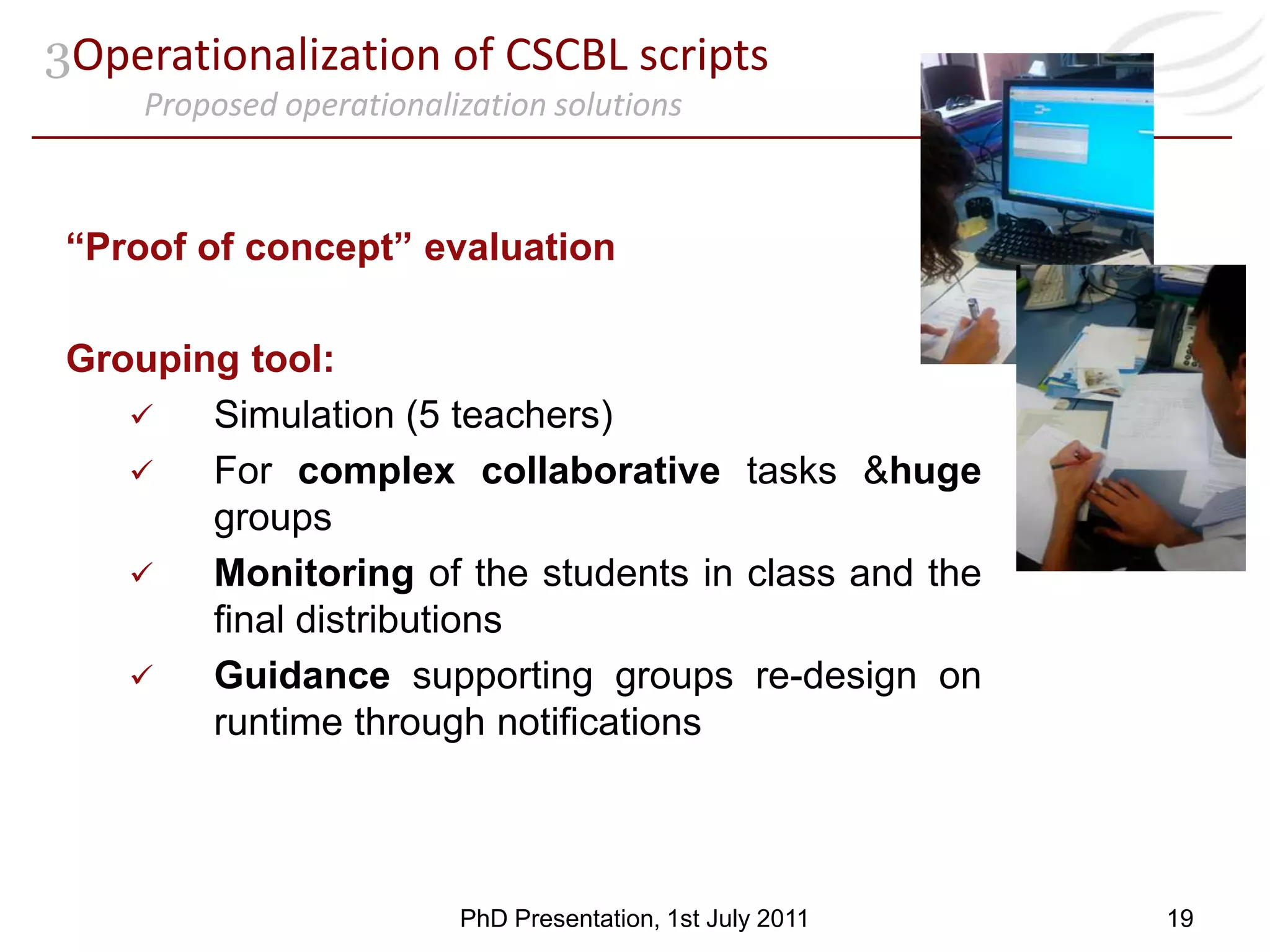
3Operationalization of CSCBL scriptsProposed operationalization solutions“Proof of concept” evaluationGrouping tool:Simulation (5 teachers)
For complex collaborative tasks & huge groups
Monitoring of the students in class and the final distributions
Guidance supporting groups re-design on runtime through notifications   PhD Presentation, 1st July 201119
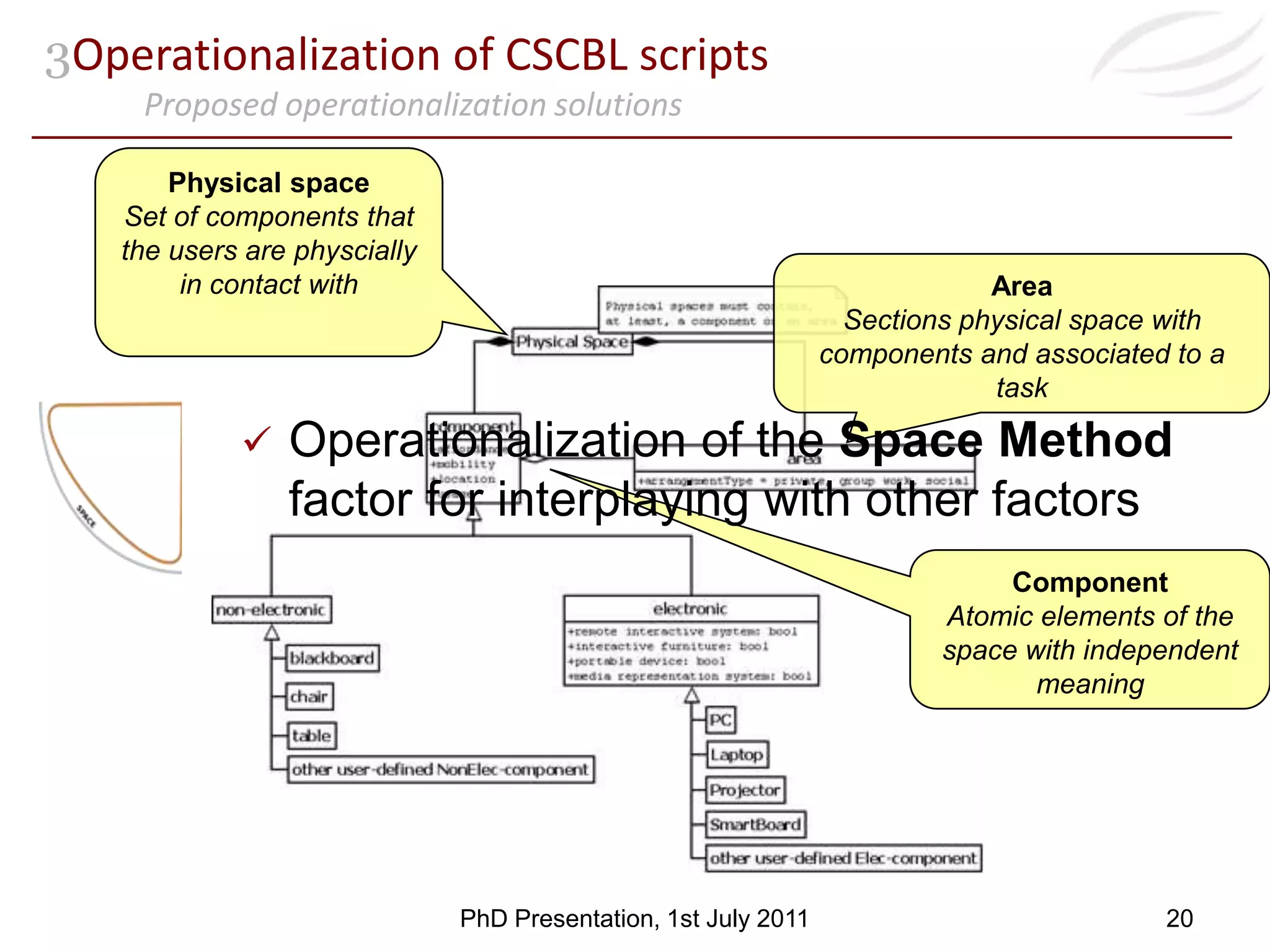
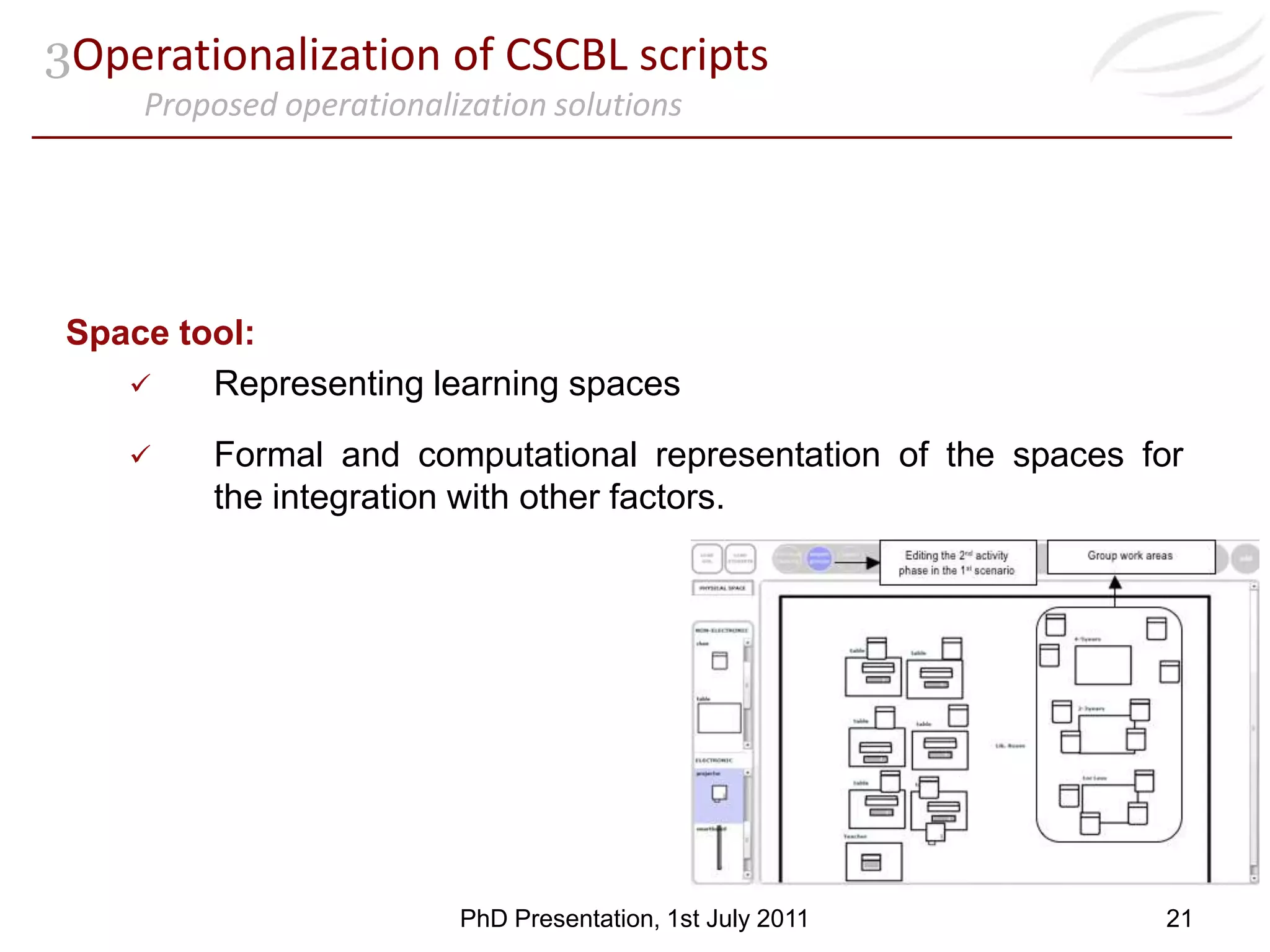
3Operationalization of CSCBL scriptsProposed operationalization solutionsPhysical spaceSet of components that the users are physcially in contact withOperationalization of the Space Method factor for interplaying with other factorsAreaSections physical space with components and associated to a taskComponentAtomic elements of the space with independent meaningPhD Presentation, 1st July 201120
3Operationalization of CSCBL scriptsProposed operationalization solutionsSpace tool:Representing learning spaces

PhD Thesis: Operationalization of Collaborative Blended Learning Scripts

  • 1.
    Operationalization of collaborativeblended learning scripts: a model, computational mechanisms and experimentsAuthor: Mar Pérez-SanagustínAdvisors: Davinia Hernández-Leo & Josep BlatPhD Thesis PresentationPhD Presentation, 1st July 2011
  • 2.
    OutlineIntroductionFactors in thedesign of CSCBL scriptsOperationalization of CSCBL scriptsTwo multicase studiesSummary of contributions and future work 2PhD Presentation, 1st July 2011
  • 3.
    OutlineIntroductionFactors in thedesign of CSCBL scriptsOperationalization of CSCBL scriptsTwo multicase studiesSummary of contributions and future work 3PhD Presentation, 1st July 2011
  • 4.
    1IntroductionOrchestration of collaborationComputerSupported Collaborative Learning (CSCL)Orchestration collaboration for effective learningCL scriptssocialSocial + Comp. mediatedTYPE OF ORCHESTRATIONCSCL scriptsComp. mediated4PhD Presentation, 1st July 2011
  • 5.
    1IntroductionOperationalizationAbstract andtechnologicalindependent definition of the CSCL/CSCBL script (design stage)Social + Comp. mediatedCSCL scriptsOPERATIONALIZATIONComp. mediatedLOWCSCBL scriptsEffective technological settingpresented to the students(enactment stage)DEGREEHIGH5PhD Presentation, 1st July 2011
  • 6.
    1IntroductionChallengeNew ways ofcommunication……new opportunities for collaboration6PhDPresentation, 1stJuly 2011
  • 7.
    Teacher1IntroductionChallenge…formal and informalactivities…?Blending activity typesBlending devicesBlending spaces…supported by different devices……occurring at different spatial locations…CHALLENGEHow to organize and structure such as complex activities?Blend of activity types
  • 8.
  • 9.
    Blend of technologies7PhDPresentation, 1st July 2011
  • 10.
    1IntroductionOrchestration in blendedlearning settingsComputer Supported Collaborative Learning (CSCL)Orchestration collaboration for effective learningCBL scriptssocialCL scriptsBlended LearningSocial + Comp. mediatedTYPE OF ORCHESTRATIONCSCBL scriptsCSCL scriptsComp. mediated8PhD Presentation, 1st July 2011
  • 11.
    Contributions1IntroductionObjectives and contributionsGlobalContribution: A conceptual model for assisting practitioners and technicians in the design of meaningful CSCBL scripts and of the technology to suit them for operationalizing their enactment Provision and evaluation of different technological mechanisms for operationalizingthe orchestration of CSCBL scriptsMeaningful and innovative CSCBL scripts Systematic definition of CBL and CSCBL scripts according with terminology in CSCL and to identify the factors intervening in their designPhDPresentation, 1stJuly 20119
  • 12.
  • 13.
    Blended learning, CSCLand case studies with innovative uses of ICT
  • 14.
  • 15.
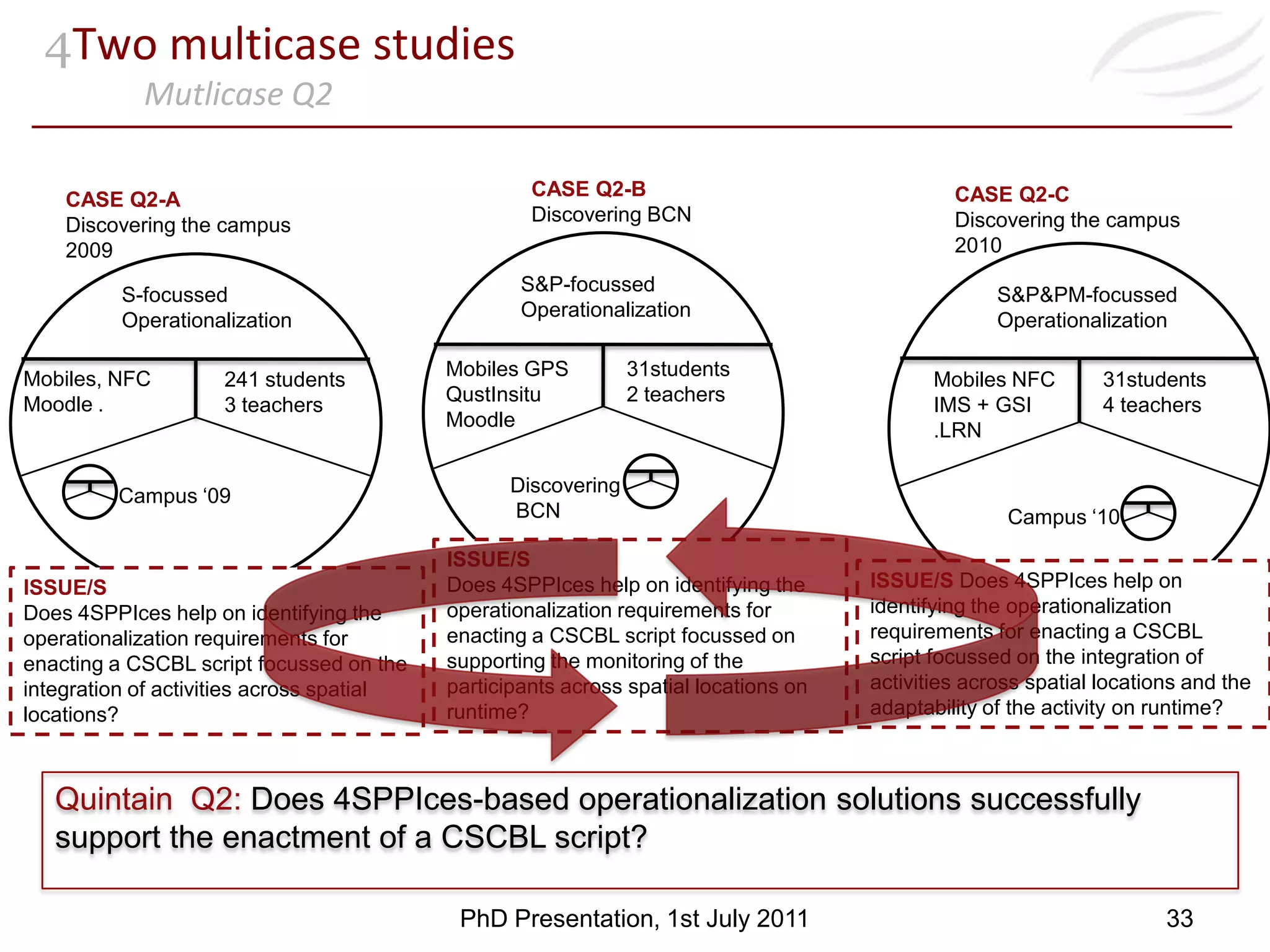
    4SPPIces: Aconceptual model for designing CSCBL scripts
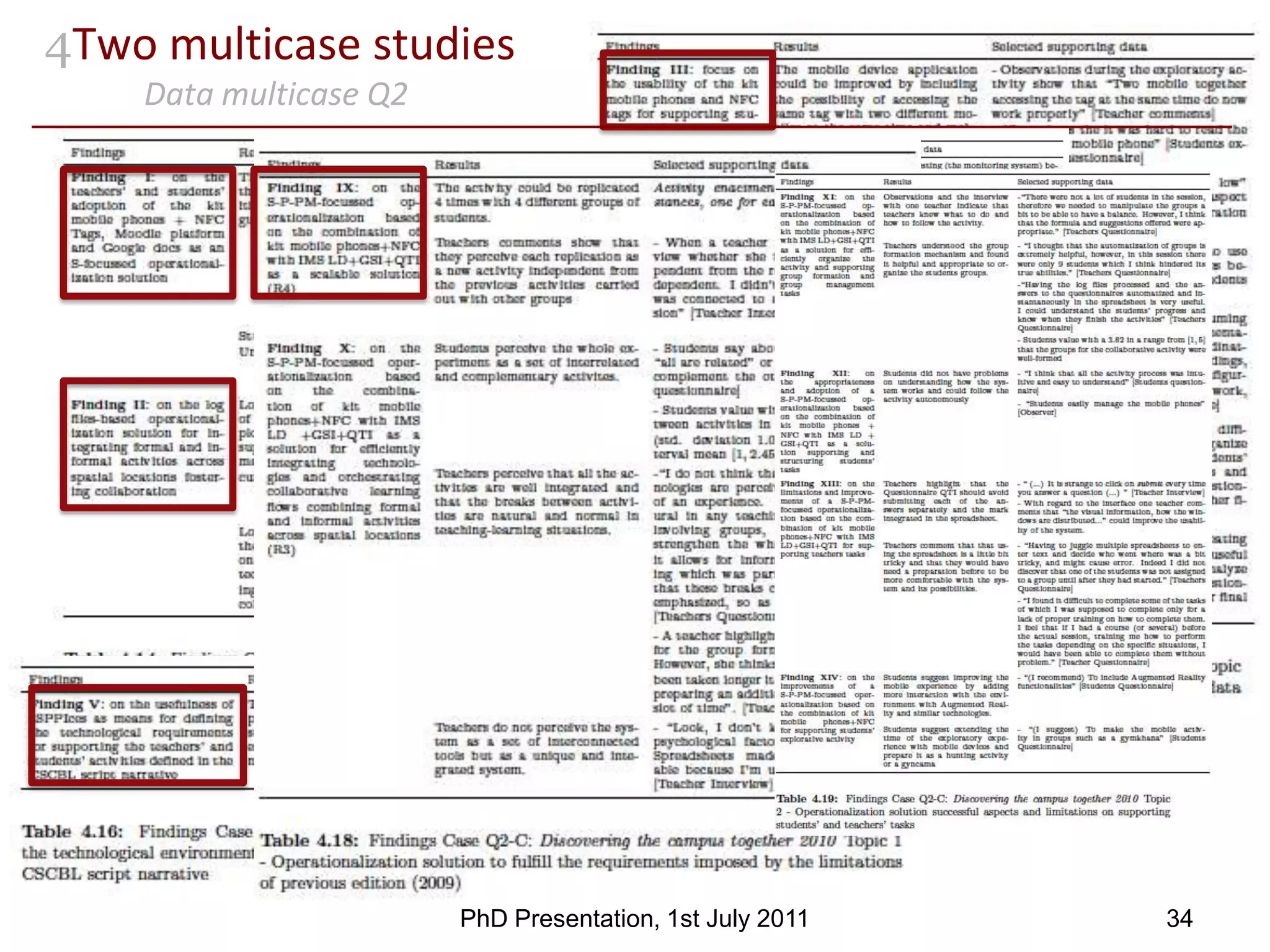
  • 16.
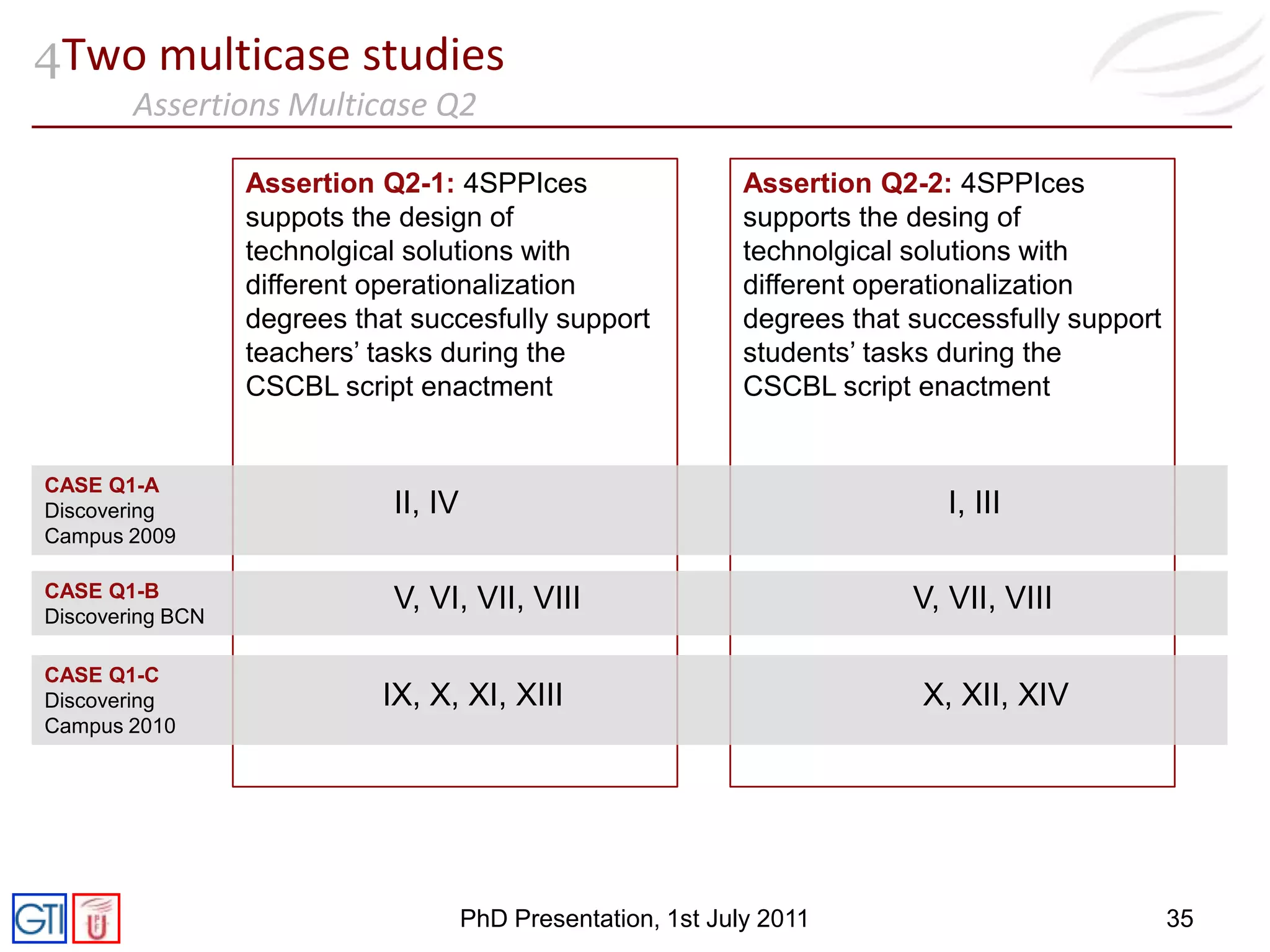
    Computational solutions foroperationalizing CSCBL scripts
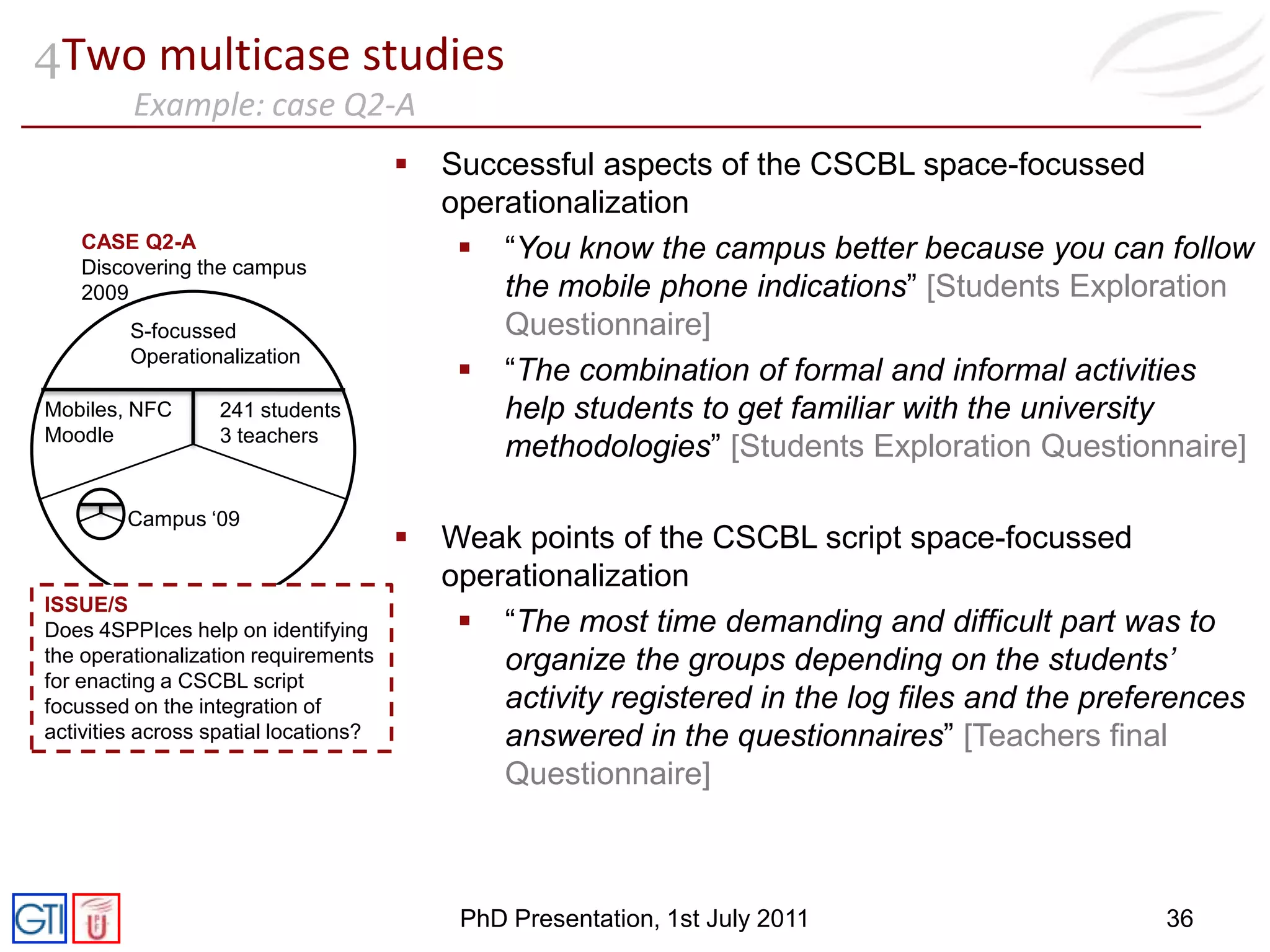
  • 17.
    Analyzing current technologiesfor the operationalization of CSCBL scripts
  • 18.
  • 19.
  • 20.
    2 multicase studies10PhDPresentation, 1st July 2011
  • 21.
    OutlineIntroductionFactors in thedesign of CSCBL scriptsOperationalization of CSCBL scriptsTwo multicase studiesSummary of contributions and future work 11PhD Presentation, 1st July 2011
  • 22.
    2Factors in thedesign of CSCBL scripts4SPPIces Model 4SPPIces: a conceptual model to assist practitioners and technicians in the design of CSCBL scriptsPhD Presentation, 1st July 201112
  • 23.
    2Factors in thedesign of CSCBL scripts4SPPIces Model SPACEAgent able to activate or inhibit learning by shaping users interactions Learning flowActivityGroup characteristicsData flowNumber ParticipantsProfile LocationHISTORYFlexibility
  • 24.
    Relationships between factorsAONE UNIQUE REPRESENTATIONAll the factors considered together in the designVirtual & physical spacesAreasComponents (Arragement,Affordance, Mobility)Events on Pedagogical MethodEvents on ParticipantsEvents on Space13PhD Presentation, 1st July 2011
  • 25.
    2Factors in thedesign of CSCBL scriptsThe Space and the History factorsDescribes the relationships between the facets of a particular factor with the other factors from the design to the enactmentEvents on Pedagogical MethodEvents onParticipantsEvents onSpaceVirtual and physical spacesAreasComponents (Arragement,Affordance, Mobility)Describes where the learning activity occurs and the elements that compose it14PhD Presentation, 1st July 2011
  • 26.
    OutlineIntroductionFactors in thedesign of CSCBL scriptsOperationalization of CSCBL scriptsTwo multicase studiesSummary of contributions and future work PhDPresentation, 1stJuly 201115
  • 27.
    3Operationalization of CSCBLscriptsExisitingoperationalization solutionsPedagogical Method operationalization
  • 28.
    Educational modelling languagessuch as IMS Learning Design (Hernández-Leo (2006), Hernández-Gonzalo et al. (2008), Zarraonandia et al. (2006))
  • 29.
    Learning platforms suchas Moodle or .LRN
  • 30.
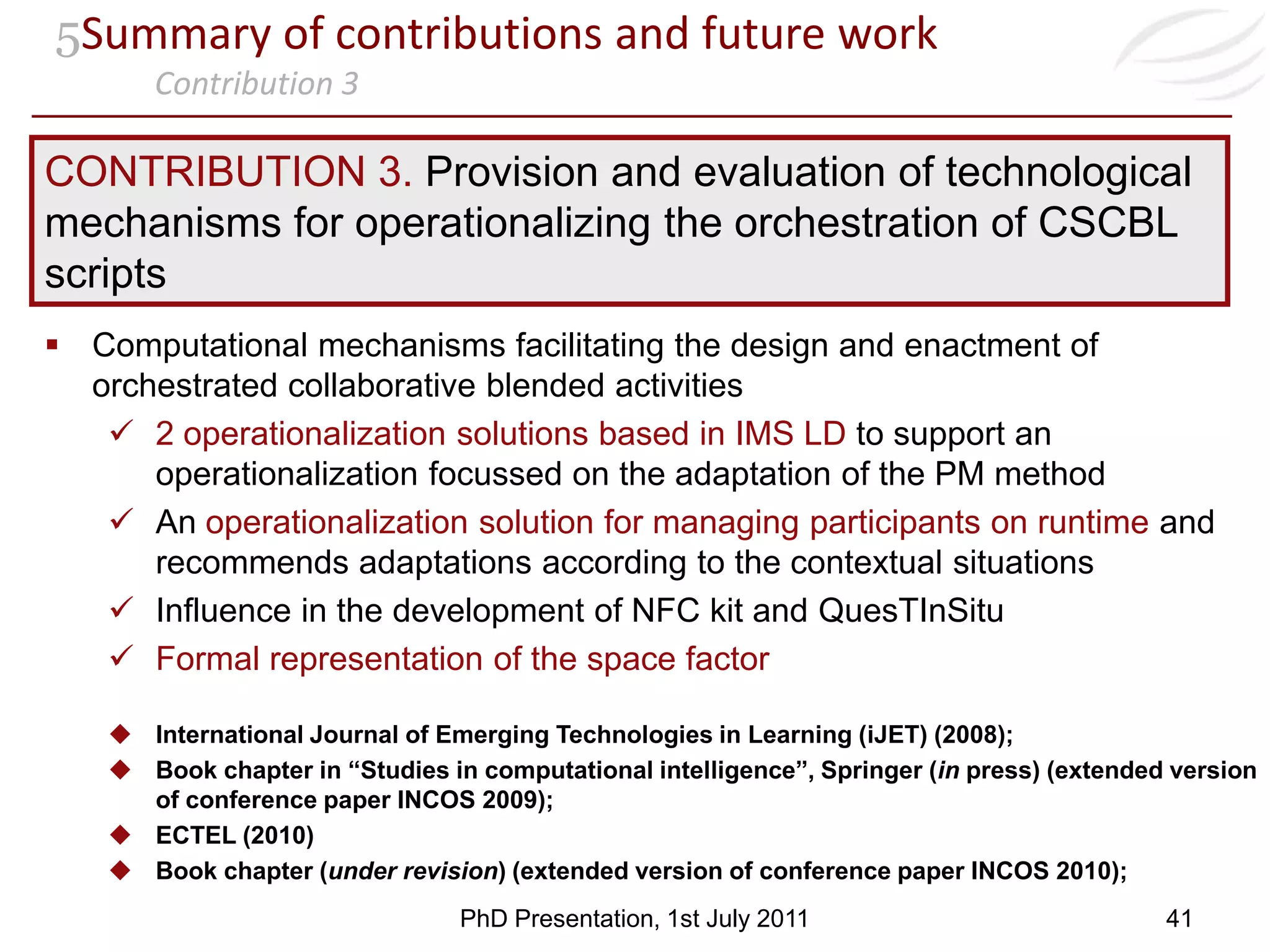
  • 31.
    Specifications such asIMS Learner Information Package (Smythe et al. (2001))
  • 32.
    Applications for groupformation considering the students’ profile (Ounnas et al. (2001), Hwang et al. (2008))Lack of flexibility when applied to blended learning settings16PhD Presentation, 1st July 2011
  • 33.
    3Operationalization of CSCBLscriptsProposed operationalization solutionsOperationalization of the interplay of the PM and PThe Meta-UoL: Definition of the PM on runtime according to P decisions
  • 34.
    An adaptive UoL:Adaptive PM according to participants’ profile
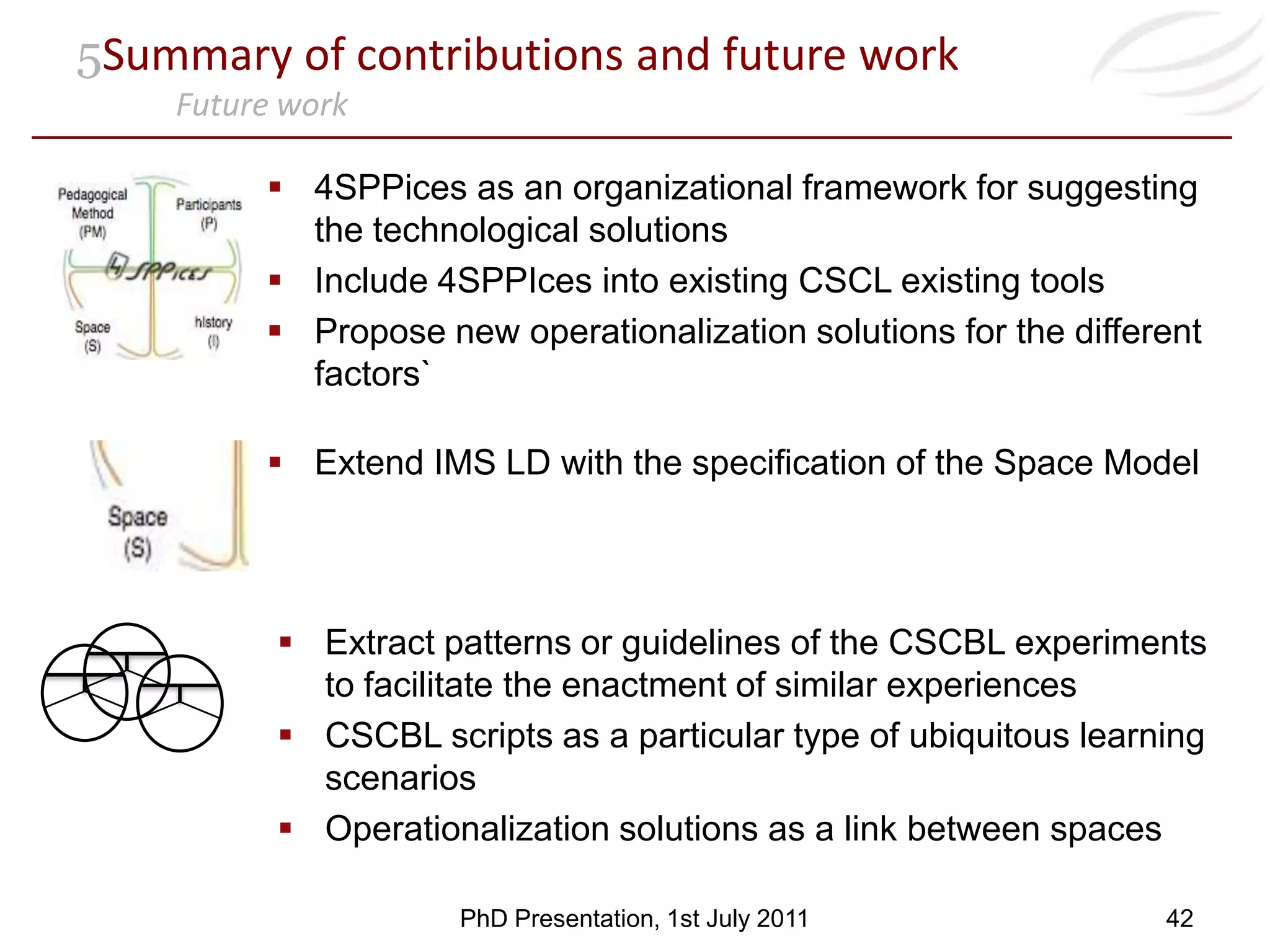
  • 35.
    The grouping tool:Adaptation of pre-defined groups of students according to intrinsic and extrinsic constraints of the PMPhD Presentation, 1st July 201117
  • 36.
    3Operationalization of CSCBLscriptsProposed operationalization solutions“Proof of concept” evaluationsMeta-UoL: flexibility for democratic participatory methodologiesIn the context of Agora association (2 trainers)
  • 37.
    Flexibility, guidance andstorage for learning practicesAdaptive UoL: workflowadaptation according to the students’ levelIn the context of an Algebra course (2 teachers)
  • 38.
    Adaptation & monitoringof the students' activityPhD Presentation, 1st July 201118
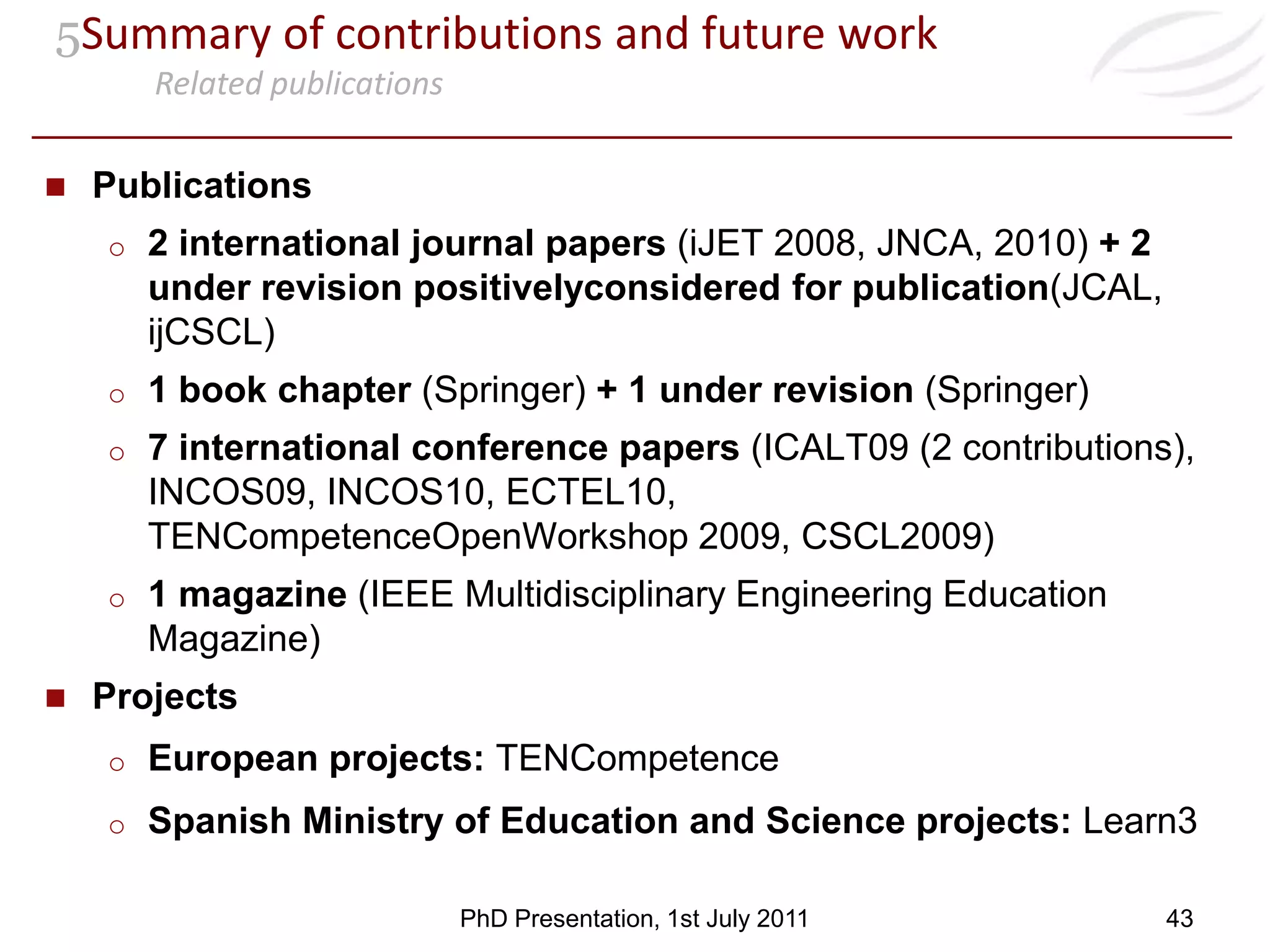
  • 39.
    3Operationalization of CSCBLscriptsProposed operationalization solutions“Proof of concept” evaluationGrouping tool:Simulation (5 teachers)
  • 40.
    For complex collaborativetasks & huge groups
  • 41.
    Monitoring of thestudents in class and the final distributions
  • 42.
    Guidance supporting groupsre-design on runtime through notifications PhD Presentation, 1st July 201119
  • 43.
    3Operationalization of CSCBLscriptsProposed operationalization solutionsPhysical spaceSet of components that the users are physcially in contact withOperationalization of the Space Method factor for interplaying with other factorsAreaSections physical space with components and associated to a taskComponentAtomic elements of the space with independent meaningPhD Presentation, 1st July 201120
  • 44.
    3Operationalization of CSCBLscriptsProposed operationalization solutionsSpace tool:Representing learning spaces
  • 45.
    Formal and computationalrepresentation of the spaces for the integration with other factors.21PhD Presentation, 1st July 2011
  • 46.
    3Operationalization of CSCBLscriptsProposed operationalization solutions“Proof of concept” evaluationSpace tool: testing the descriptive potential of the modelRepresentation of the same learning practice occurring at two different spaces with real participants
  • 47.
    The final groupactivity of the learning flow was different and adapted to the particular characteristics of the space22PhD Presentation, 1st July 2011
  • 48.
    3Operationalization of CSCBLscriptsProposed operationalization solutionsOperationalization of the History factor: modelling the relationships between the P the PM and the S23PhD Presentation, 1st July 2011
  • 49.
    3Operationalization of CSCBLscriptsProposed operationalization solutionsNFC tags + Mobile phones (Ramírez et al., 2008)+ LOG FILES:Capturing the actions of the students
  • 50.
    Adapting the learningflow according students’ actions
  • 51.
    (Santos et al.,2010) + MONITORING FUNCTIONALITYLearning flows in parallel
  • 52.
    Students actions onruntime24PhD Presentation, 1st July 2011
  • 53.
    OutlineIntroductionFactors in thedesign of CSCBL scriptsOperationalization of CSCBL scriptsTwo multicase studiesSummary of contributions and future work 25PhD Presentation, 1st July 2011
  • 54.
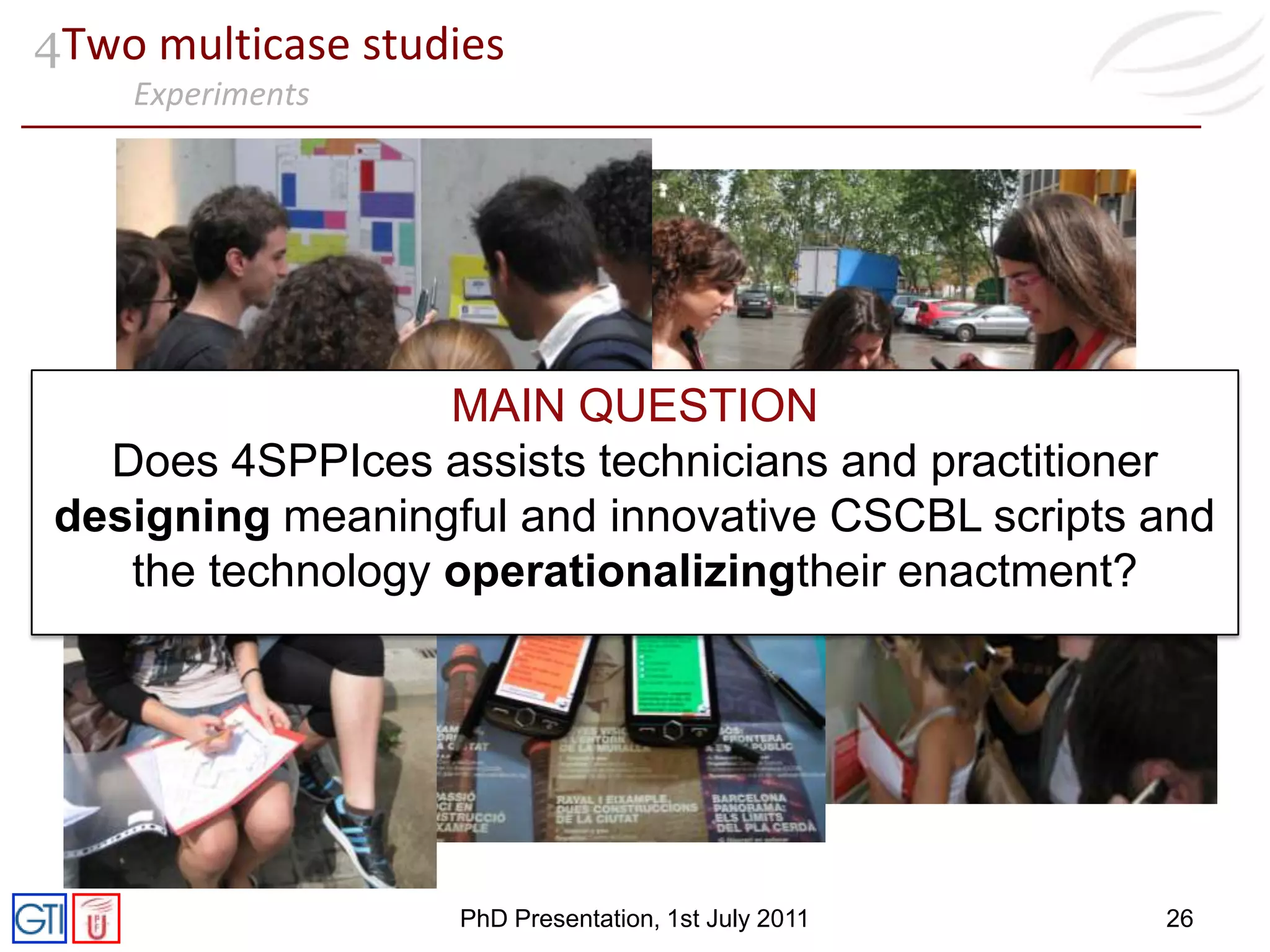
    4Two multicase studiesExperimentsMAINQUESTIONDoes 4SPPIces assists technicians and practitioner designing meaningful and innovative CSCBL scripts and the technology operationalizingtheir enactment?PhD Presentation, 1st July 201126
  • 55.
    4Two multicase studiesMethodologyMulticaseStudy (Stake, 2005) cross-case analysis
  • 56.
    Multicase study Q1:Design perspective
  • 57.
    Multicase study Q2:Operationalization perspective
  • 58.
    Mixed Method datagathering techniques (Martínez et al. 2003)
  • 59.
    Data analysis throughtriangulation: comparative analysis of evidences from different resourcesPhD Presentation, 1st July 201127
  • 60.
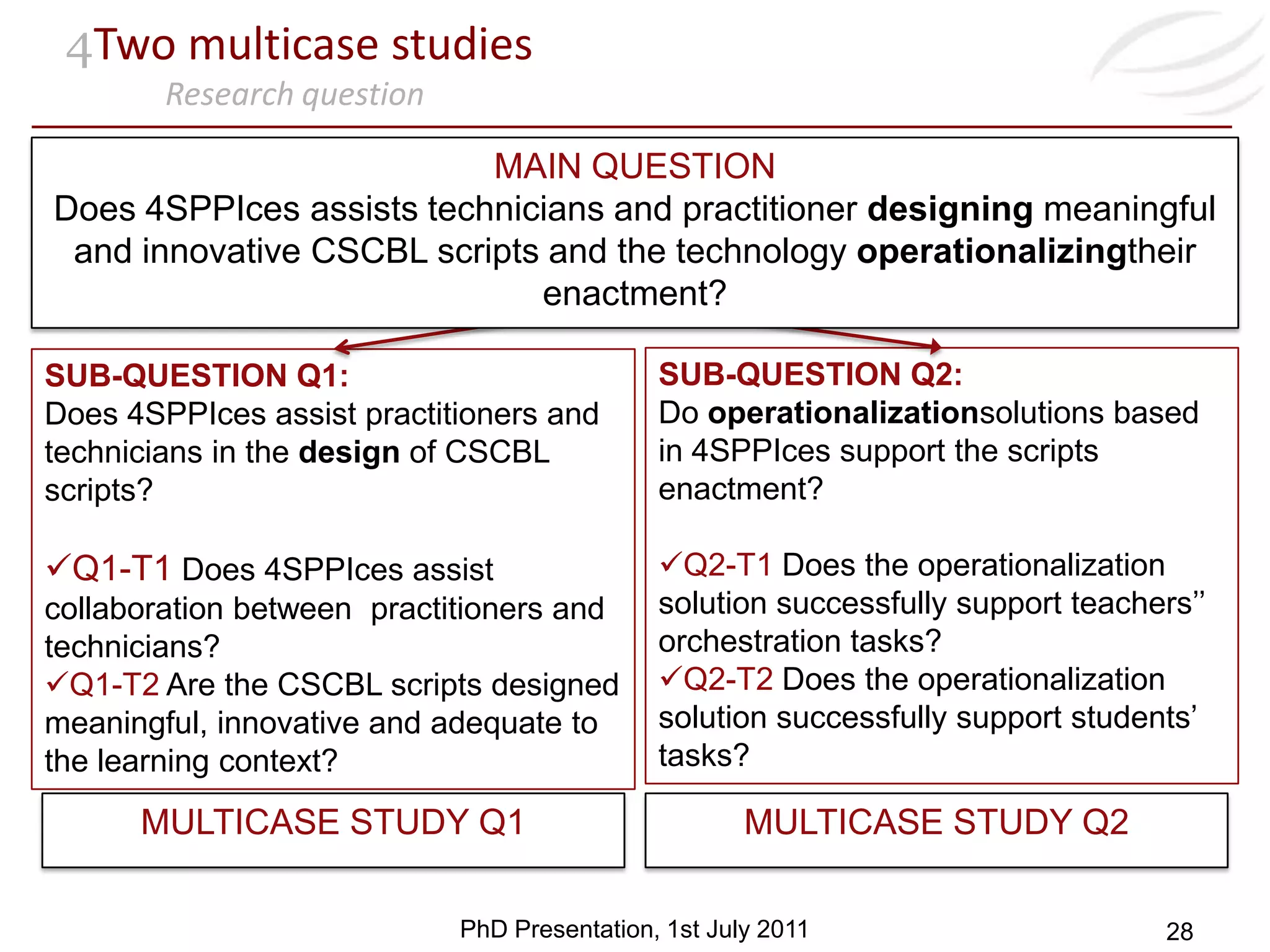
    4Two multicase studiesResearchquestionMAIN QUESTIONDoes 4SPPIces assists technicians and practitioner designing meaningful and innovative CSCBL scripts and the technology operationalizingtheir enactment?SUB-QUESTION Q1: Does 4SPPIces assist practitioners and technicians in the design of CSCBL scripts?Q1-T1 Does 4SPPIces assist collaboration between practitioners and technicians?
  • 61.
    Q1-T2 Are theCSCBL scripts designed meaningful, innovative and adequate to the learning context? SUB-QUESTION Q2:Do operationalizationsolutions based in 4SPPIces support the scripts enactment?Q2-T1 Does the operationalization solution successfully support teachers’’ orchestration tasks?
  • 62.
    Q2-T2 Does theoperationalization solution successfully support students’ tasks?MULTICASE STUDY Q1MULTICASE STUDY Q2PhD Presentation, 1st July 201128
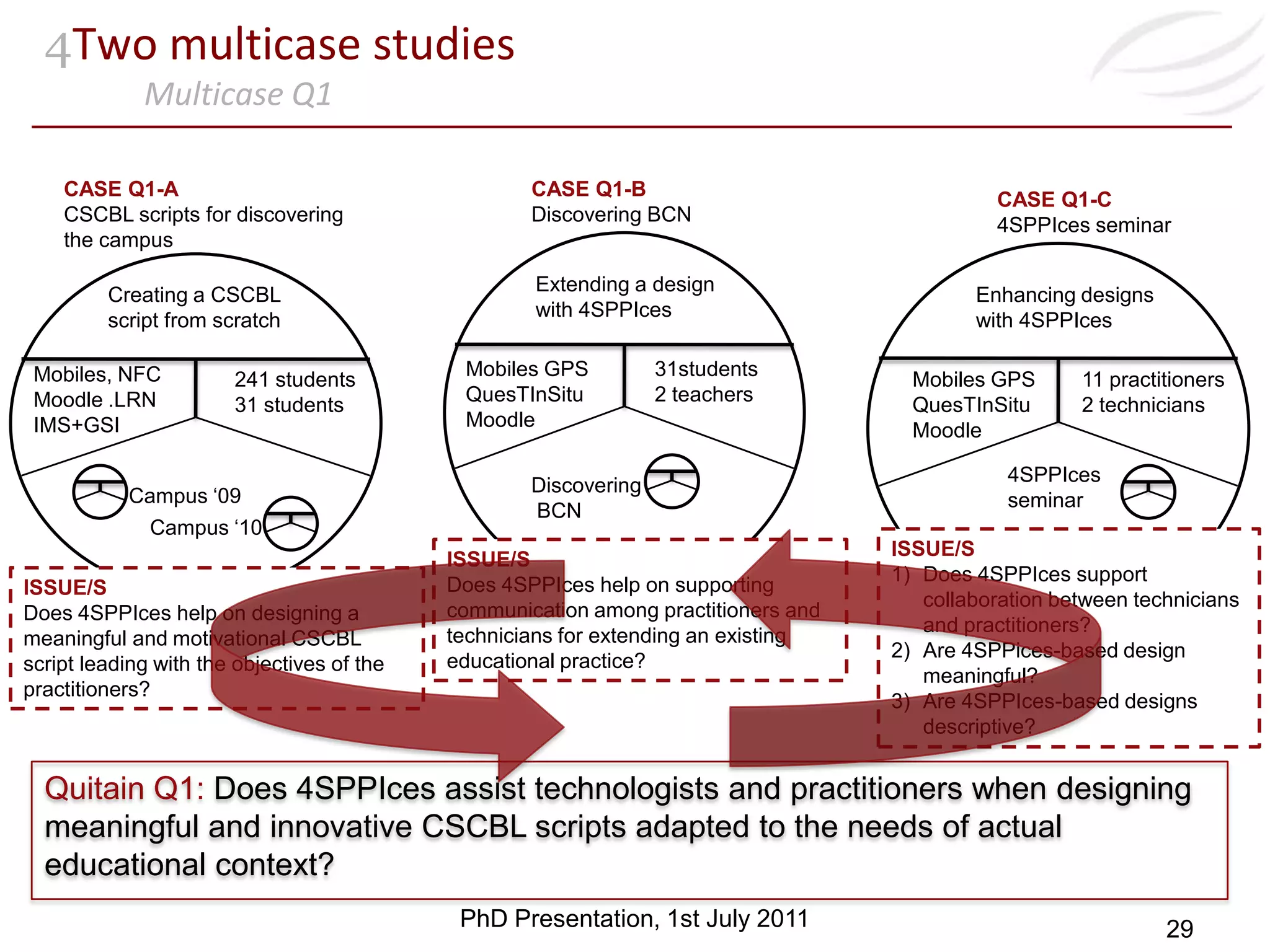
  • 63.
    4Two multicase studiesMulticaseQ1 CASE Q1-ACSCBL scripts for discoveringthe campusCASE Q1-BDiscovering BCNCASE Q1-C4SPPIces seminarExtending a design with 4SPPIcesCreating a CSCBLscript from scratchEnhancing designswith 4SPPIces31students2 teachersMobiles GPSQuesTInSituMoodleMobiles, NFCMoodle .LRNIMS+GSI241 students31 students11 practitioners2 techniciansMobiles GPSQuesTInSituMoodleCampus ‘094SPPIces seminarCampus ‘10Discovering BCNISSUE/SDoes 4SPPIces support collaboration between technicians and practitioners?Are 4SPPices-based design meaningful?Are 4SPPIces-based designs descriptive?ISSUE/SDoes 4SPPIces help on supporting communication among practitioners and technicians for extending an existing educational practice?ISSUE/SDoes 4SPPIces help on designing a meaningful and motivational CSCBL script leading with the objectives of the practitioners?Quitain Q1: Does 4SPPIces assist technologists and practitioners when designing meaningful and innovative CSCBL scripts adapted to the needs of actual educational context?PhD Presentation, 1st July 201129
  • 64.
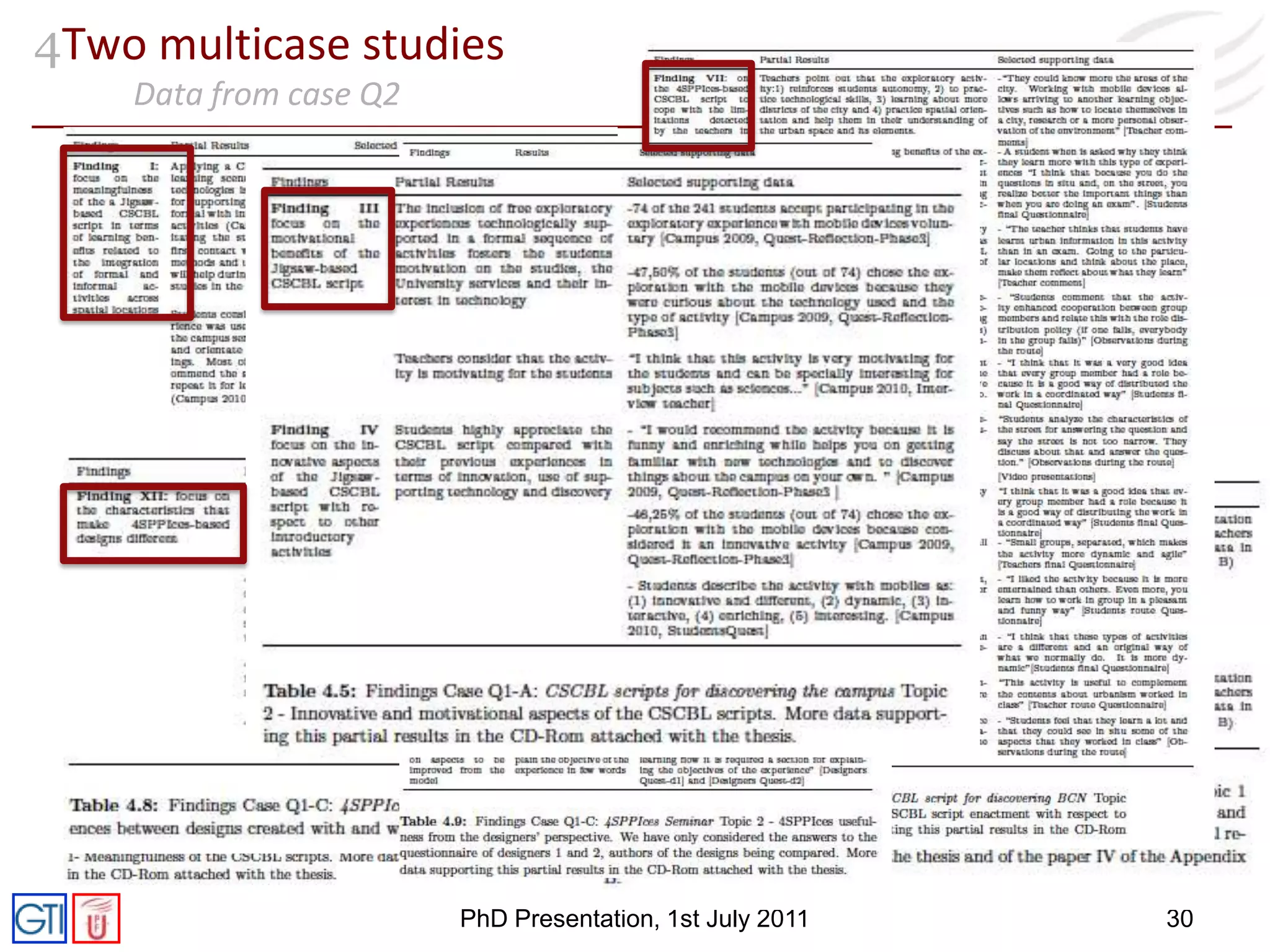
    4Two multicase studiesDatafrom case Q2PhD Presentation, 1st July 201130
  • 65.
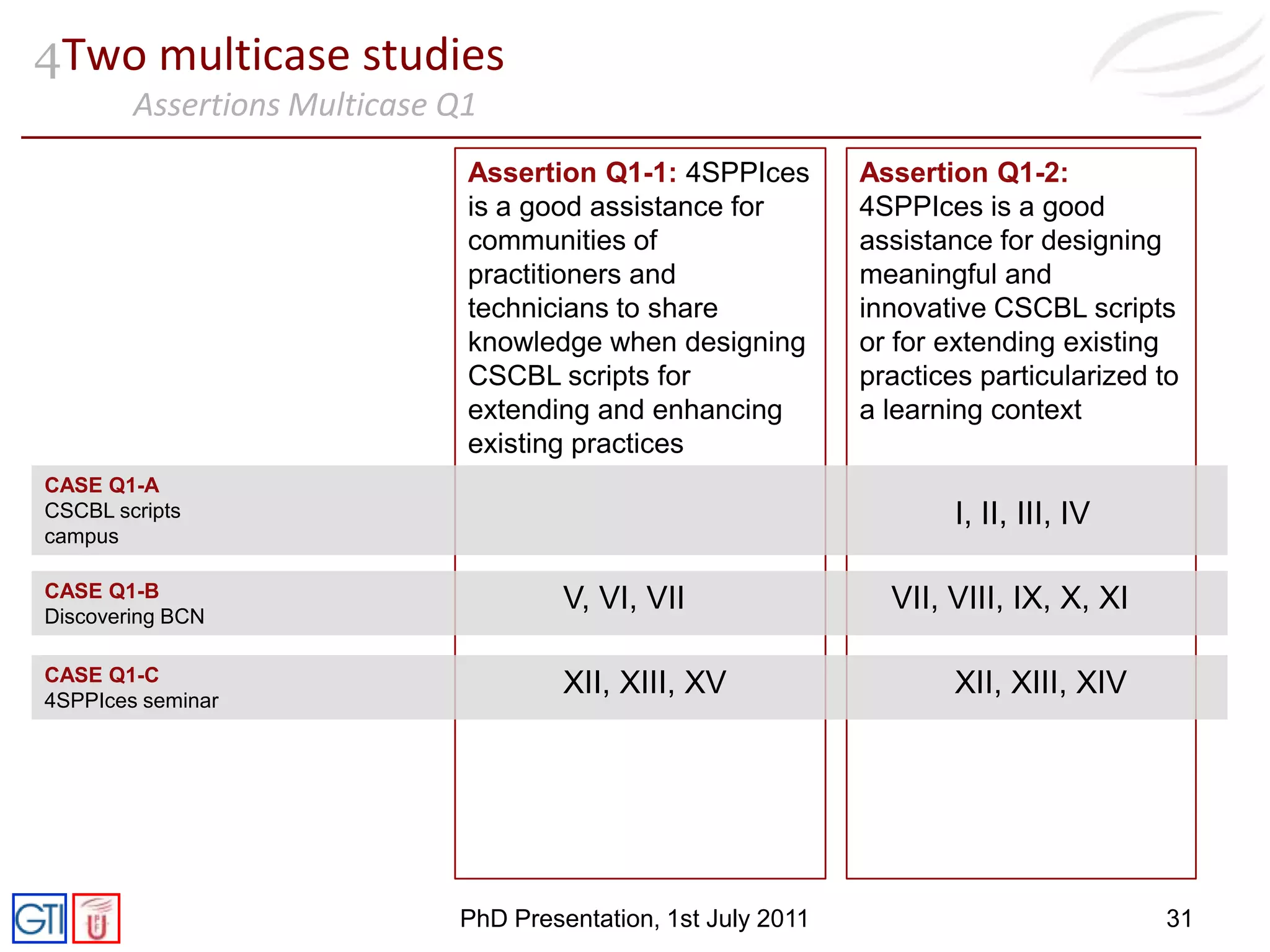
    4Two multicase studiesAssertionsMulticase Q1Assertion Q1-2: 4SPPIces is a good assistance for designing meaningful and innovative CSCBL scripts or for extending existing practices particularized to a learning context Assertion Q1-1: 4SPPIces is a good assistance for communities of practitioners and technicians to share knowledge when designing CSCBL scripts for extending and enhancing existing practicesCASE Q1-ACSCBL scripts campusI, II, III, IVCASE Q1-BDiscovering BCNV, VI, VIIVII, VIII, IX, X, XICASE Q1-C4SPPIces seminarXII, XIII, XVXII, XIII, XIVPhD Presentation, 1st July 201131
  • 66.
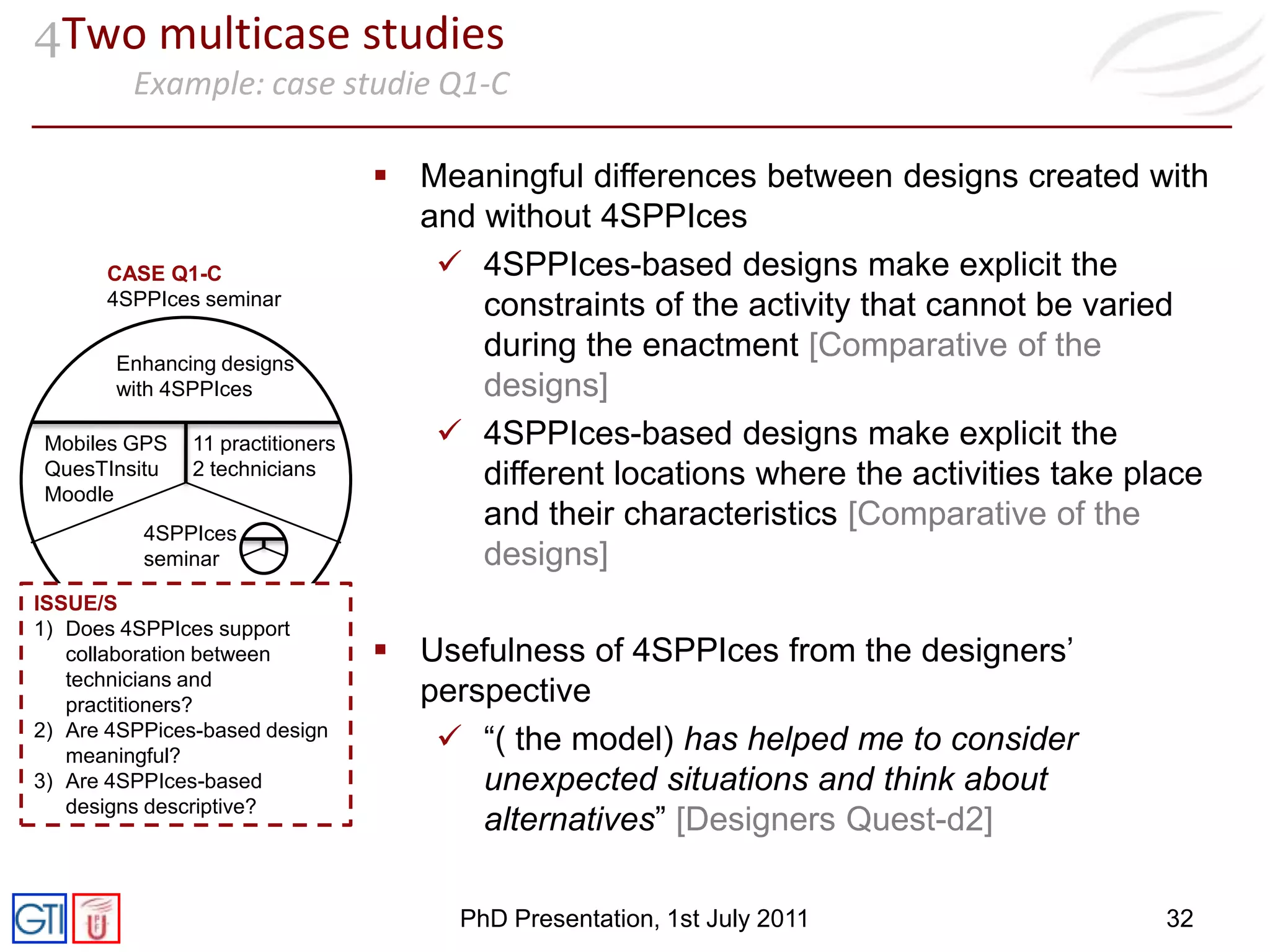
    4Two multicase studiesExample:case studie Q1-CMeaningful differences between designs created with and without 4SPPIces
  • 67.
    4SPPIces-based designs makeexplicit the constraints of the activity that cannot be varied during the enactment [Comparative of the designs]
  • 68.
    4SPPIces-based designs makeexplicit the different locations where the activities take place and their characteristics [Comparative of the designs]
  • 69.
    Usefulness of 4SPPIcesfrom the designers’ perspective
  • 70.
    “( the model)has helped me to consider unexpected situations and think about alternatives” [Designers Quest-d2]CASE Q1-C4SPPIces seminarEnhancing designswith 4SPPIces11 practitioners2 techniciansMobiles GPSQuesTInsituMoodle4SPPIces seminarISSUE/SDoes 4SPPIces support collaboration between technicians and practitioners?Are 4SPPices-based design meaningful?Are 4SPPIces-based designs descriptive?PhD Presentation, 1st July 201132
  • 71.
    4Two multicase studiesMutlicaseQ2CASE Q2-BDiscovering BCNCASE Q2-CDiscovering the campus 2010CASE Q2-ADiscovering the campus 2009S&P-focussedOperationalizationS-focussedOperationalizationS&P&PM-focussedOperationalization31students2 teachersMobiles GPSQustInsituMoodleMobiles, NFCMoodle .241 students3 teachersMobiles NFCIMS + GSI.LRN31students4 teachersCampus ‘09Discovering BCNCampus ‘10ISSUE/SDoes 4SPPIces help on identifying the operationalization requirements for enacting a CSCBL script focussed on supporting the monitoring of the participants across spatial locations on runtime?ISSUE/S Does 4SPPIces help on identifying the operationalization requirements for enacting a CSCBL script focussed on the integration of activities across spatial locations and the adaptability of the activity on runtime?ISSUE/SDoes 4SPPIces help on identifying the operationalization requirements for enacting a CSCBL script focussed on the integration of activities across spatial locations?Quintain Q2: Does 4SPPIces-based operationalization solutions successfully support the enactment of a CSCBL script?33PhD Presentation, 1st July 2011
  • 72.
    4Two multicase studiesDatamulticase Q2PhD Presentation, 1st July 201134
  • 73.
    4Two multicase studiesAssertionsMulticase Q2Assertion Q2-2: 4SPPIces supports the desing of technolgical solutions with different operationalization degrees that successfully support students’ tasks during the CSCBL script enactmentAssertion Q2-1: 4SPPIces suppots the design of technolgical solutions with different operationalization degrees that succesfully support teachers’ tasks during the CSCBL script enactmentCASE Q1-ADiscoveringCampus 2009I, IIIII, IVCASE Q1-BDiscovering BCNV, VI, VII, VIIIV, VII, VIIICASE Q1-CDiscovering Campus 2010IX, X, XI, XIIIX, XII, XIVPhD Presentation, 1st July 201135
  • 74.
    4Two multicase studiesExample:case Q2-ASuccessful aspects of the CSCBL space-focussed operationalization
  • 75.
    “You know thecampus better because you can follow the mobile phone indications” [Students Exploration Questionnaire]
  • 76.
    “The combination offormal and informal activities help students to get familiar with the university methodologies” [Students Exploration Questionnaire]
  • 77.
    Weak points ofthe CSCBL script space-focussed operationalization
  • 78.
    “The most timedemanding and difficult part was to organize the groups depending on the students’ activity registered in the log files and the preferences answered in the questionnaires” [Teachers final Questionnaire]CASE Q2-ADiscovering the campus 2009S-focussedOperationalizationMobiles, NFCMoodle241 students3 teachersCampus ‘09ISSUE/SDoes 4SPPIces help on identifying the operationalization requirements for enacting a CSCBL script focussed on the integration of activities across spatial locations?PhD Presentation, 1st July 201136
  • 79.
  • 80.
    4SPPIces model: forsupporting the design of CSCBL scripts4Two multicase studiesContributions and evaluation3 IMS LD based operationalizationsolutions supporting the flexible adaptation of the interplay between P and PM
  • 81.
    Considering the Historyin third tool applications: NFC kit and QuesTInSitu
  • 82.
  • 83.
    3 CSCBL scriptsand associated operationalization systems
  • 84.
    4SPPIces-based CSCBL designsby practitioners in media educationSynthetic experimentsTesting the computational mechanisms for operationalizing 4SPPIces factorsMulticase study Q1A cross case analysis of 3 case studiesMulticase study Q2A cross case analysis of 3 case studies37PhD Presentation, 1st July 2011
  • 85.
    OutlineIntroductionFactors in thedesign of CSCBL scriptsOperationalization of CSCBL scriptsTwo multicase studiesSummary of contributions and future work38PhD Presentation, 1st July 2011
  • 86.
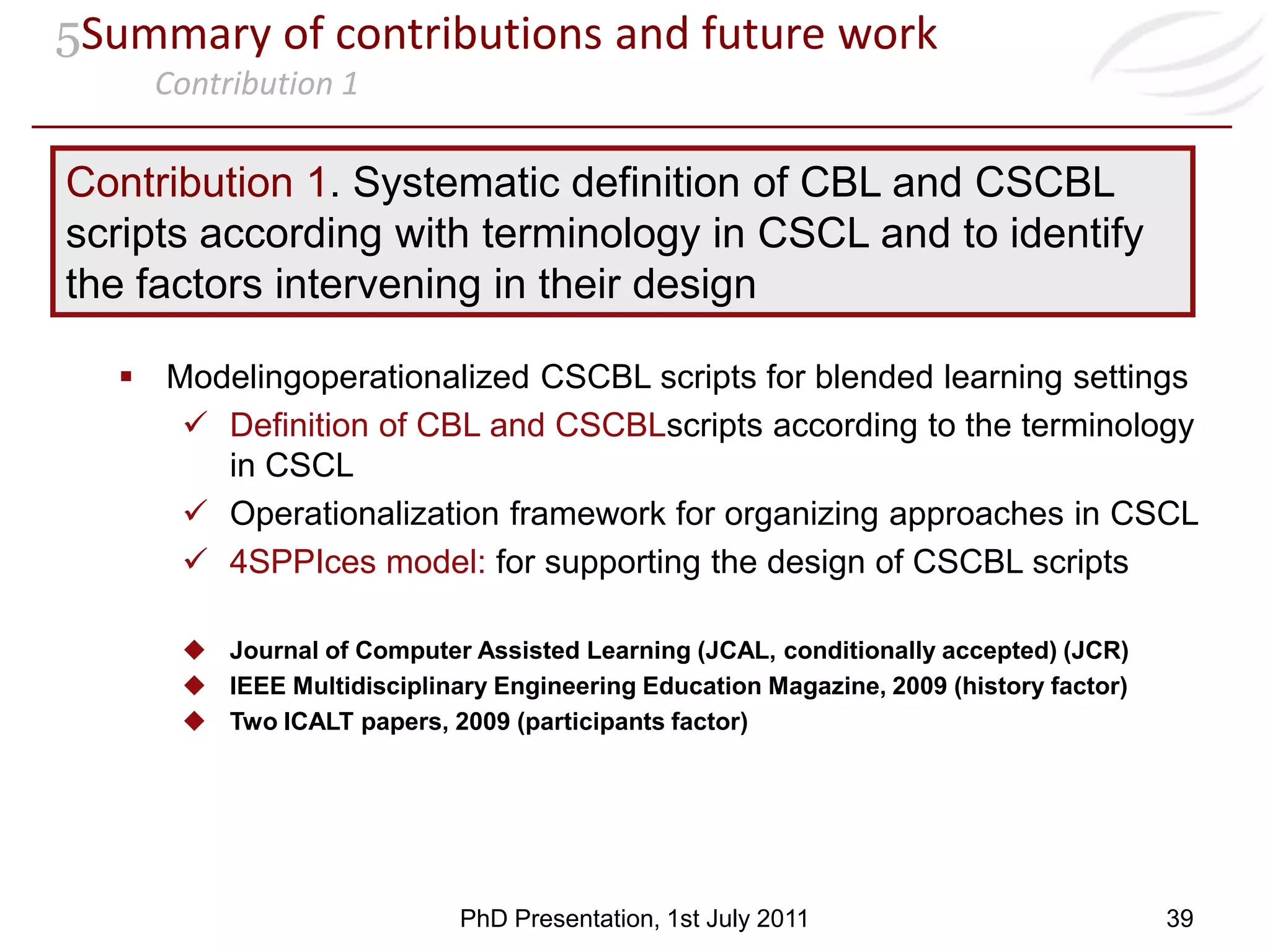
    5Summary of contributionsand future workContribution 1Contribution 1. Systematic definition of CBL and CSCBL scripts according with terminology in CSCL and to identify the factors intervening in their designModelingoperationalized CSCBL scripts for blended learning settings
  • 87.
    Definition of CBLand CSCBLscripts according to the terminology in CSCL
  • 88.
    Operationalization framework fororganizing approaches in CSCL
  • 89.
    4SPPIces model: forsupporting the design of CSCBL scripts
  • 90.
    Journal of ComputerAssisted Learning (JCAL, conditionally accepted) (JCR)
  • 91.
    IEEE Multidisciplinary EngineeringEducation Magazine, 2009 (history factor)
  • 92.
    Two ICALT papers,2009 (participants factor)PhD Presentation, 1st July 201139
  • 93.
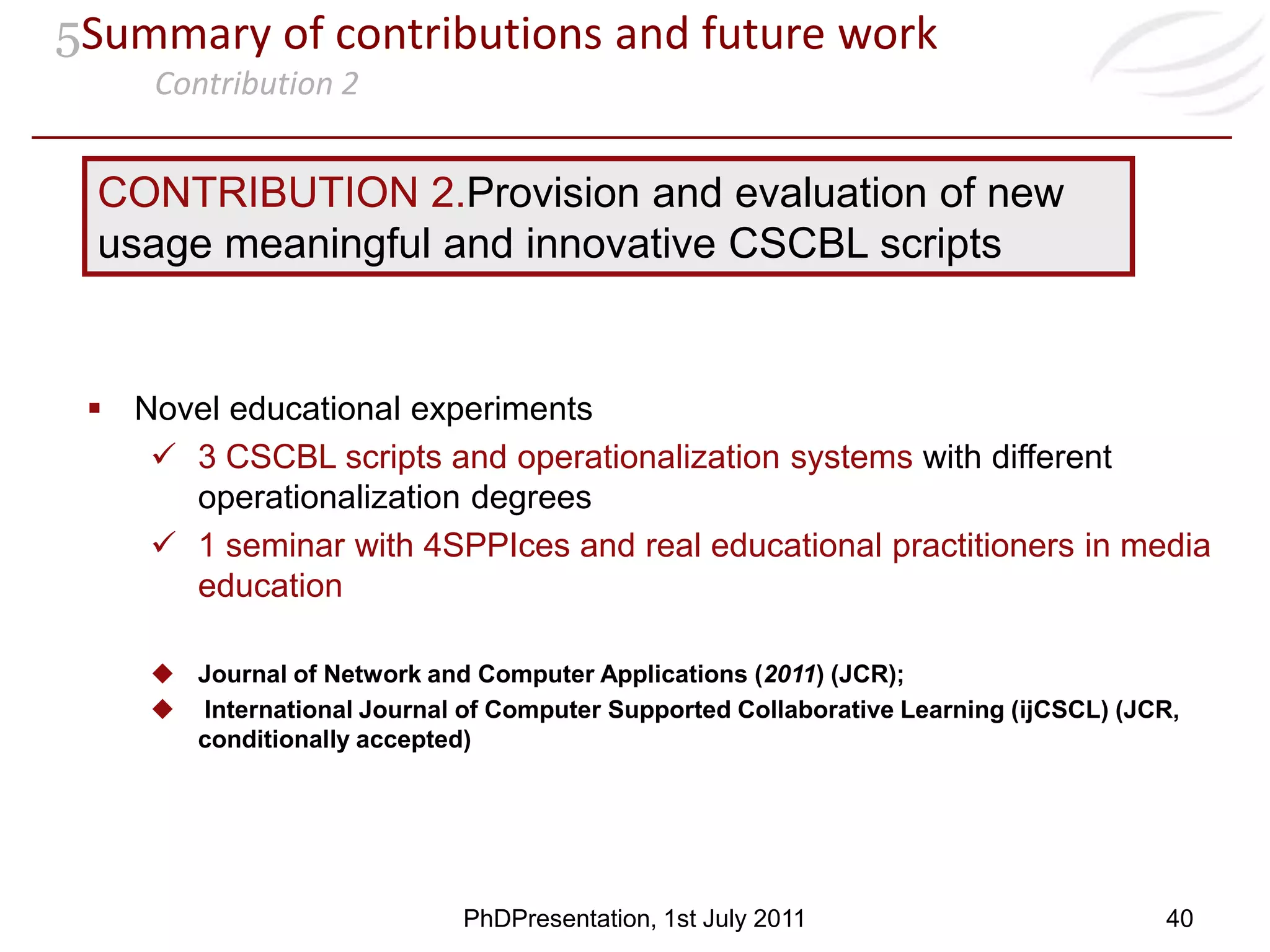
    5Summary of contributionsand future workContribution 2CONTRIBUTION 2.Provision and evaluation of new usage meaningful and innovative CSCBL scriptsNovel educational experiments
  • 94.
    3 CSCBL scriptsand operationalization systems with different operationalization degrees
  • 95.
    1 seminar with4SPPIces and real educational practitioners in media education
  • 96.
    Journal of Networkand Computer Applications (2011) (JCR);
  • 97.
    International Journalof Computer Supported Collaborative Learning (ijCSCL) (JCR, conditionally accepted)PhDPresentation, 1st July 201140
  • 98.
    5Summary of contributionsand future workContribution 3CONTRIBUTION 3. Provision and evaluation of technological mechanisms for operationalizing the orchestration of CSCBL scriptsComputational mechanisms facilitating the design and enactment of orchestrated collaborative blended activities
  • 99.
    2 operationalization solutionsbased in IMS LD to support an operationalization focussed on the adaptation of the PM method
  • 100.
    An operationalization solutionfor managing participants on runtime and recommends adaptations according to the contextual situations
  • 101.
    Influence in thedevelopment of NFC kit and QuesTInSitu
  • 102.
    Formal representation ofthe space factor
  • 103.
    International Journal ofEmerging Technologies in Learning (iJET) (2008);
  • 104.
    Book chapter in“Studies in computational intelligence”, Springer (in press) (extended version of conference paper INCOS 2009);
  • 105.
  • 106.
    Book chapter (underrevision) (extended version of conference paper INCOS 2010);PhD Presentation, 1st July 201141
  • 107.
    5Summary of contributionsand future workFuture work4SPPices as an organizational framework for suggesting the technological solutions
  • 108.
    Include 4SPPIces intoexisting CSCL existing tools
  • 109.
    Propose new operationalizationsolutions for the different factors`
  • 110.
    Extend IMS LDwith the specification of the Space Model
  • 111.
    Extract patterns orguidelines of the CSCBL experiments to facilitate the enactment of similar experiences
  • 112.
    CSCBL scripts asa particular type of ubiquitous learning scenarios
  • 113.
    Operationalization solutions asa link between spacesPhD Presentation, 1st July 201142
  • 114.
    5Summary of contributionsand future workRelated publicationsPublications
  • 115.
    2 international journalpapers (iJET 2008, JNCA, 2010) + 2 under revision positivelyconsidered for publication(JCAL, ijCSCL)
  • 116.
    1 book chapter(Springer) + 1 under revision (Springer)
  • 117.
    7 international conferencepapers (ICALT09 (2 contributions), INCOS09, INCOS10, ECTEL10, TENCompetenceOpenWorkshop 2009, CSCL2009)
  • 118.
    1 magazine (IEEEMultidisciplinary Engineering Education Magazine)
  • 119.
  • 120.
  • 121.
    Spanish Ministry ofEducation and Science projects: Learn3PhD Presentation, 1st July 201143
  • 122.