Open Access:
  Introduction
            Gwen Franck
      Ghent University Library
OpenAIRE project | Open Access Belgium
info@openaccess.be www.openaccess.be
                                       2
          @openaccess_be
• Research              articles

                                                      datasets

• Free for the end user

• Digital
                         OA journals


                                    OA repository

               info@openaccess.be www.openaccess.be
                                                                 3
                         @openaccess_be
info@openaccess.be www.openaccess.be
                                       4
          @openaccess_be
Why should I care?


info@openaccess.be www.openaccess.be
                                       5
          @openaccess_be
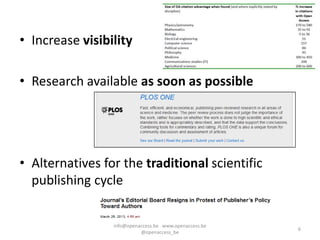
• Increase visibility

• Research available as soon as possible


• Alternatives for the traditional scientific
  publishing cycle


                 info@openaccess.be www.openaccess.be
                                                        6
                           @openaccess_be
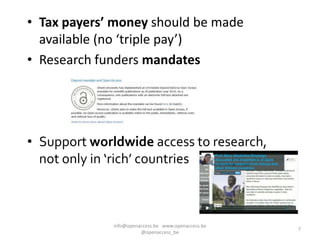
• Tax payers’ money should be made
  available (no ‘triple pay’)
• Research funders mandates


• Support worldwide access to research,
  not only in ‘rich’ countries


              info@openaccess.be www.openaccess.be
                                                     7
                        @openaccess_be
How
• Archive an open access version of your work in
  a repository
  OR
• Publish directly in an open access/hybrid
  journal


                info@openaccess.be www.openaccess.be
                                                       8
                          @openaccess_be
Open Access publishing
• Submit your work to OA Journals
• ‘Born OA’ or converted journals
• With or without Article Processing Charges/
  Author Fees
• Level of openness = no indication of quality!
• Directory of OA Journals: www.doaj.org
  – ALL quality OA journals are in DOAJ.


                 info@openaccess.be www.openaccess.be
                                                        9
                           @openaccess_be
OA publishing in quality journals                      ≠ (high) article
processing charges/author fees


 (by the way: a lot of Open Access journals have a discount or even waiver policy for
 author fees. So, if you can’t afford it, these are often negotiable! )


                            info@openaccess.be www.openaccess.be
                                                                                        10
                                      @openaccess_be
‘Hybrid’ OA


• After paying a fee/charge individual article
  becomes immediately OA
• End result =
  – Good because article becomes open but …
  – Bad because expensive subscriptions for the
    whole journal remain necessary
• Fastest growing component of OA publishing
                 info@openaccess.be www.openaccess.be
                                                        11
                           @openaccess_be
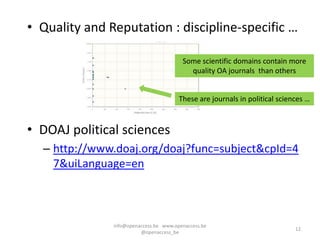
• Quality and Reputation : discipline-specific …

                                         Some scientific domains contain more
                                           quality OA journals than others


                                        These are journals in political sciences …


• DOAJ political sciences
  – http://www.doaj.org/doaj?func=subject&cpId=4
    7&uiLanguage=en


               info@openaccess.be www.openaccess.be
                                                                             12
                         @openaccess_be
Self-archiving
• Deposit/Archive research in a repository
  – Institutional


  – Subject/discipline specific


• Better than personal, departmental or project
  website!
                    info@openaccess.be www.openaccess.be
                                                           13
                              @openaccess_be
Self-archiving
• Advantage:
  – Publish in any journal you want! (also the non-OA
    ones)
  – A majority of publishers (>75%) allow you to make
    (a version) of your work OA through self-archiving
  – Check publisher’s policies on
    http://www.sherpa.ac.uk/romeo/
  – If not allowed: negotiate!


                 info@openaccess.be www.openaccess.be
                                                        14
                           @openaccess_be
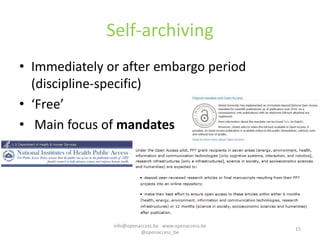
Self-archiving
• Immediately or after embargo period
  (discipline-specific)
• ‘Free’
• Main focus of mandates


               info@openaccess.be www.openaccess.be
                                                      15
                         @openaccess_be
What OA is not/should not be
• Extra burden for researchers
• Be a hindrance for your career
• Taking big chunks out of your research budget
• Limiting your choice of journals/prohibiting
  you from publishing in the journal you want
• Going against the law/publisher’s policies


                info@openaccess.be www.openaccess.be
                                                       16
                          @openaccess_be
It’s not over …
• Mainstreaming
  – OA is becoming big business (> 20 % of all research
    articles)
  – More attention/ the stakes are raised!
  – More discussion and debate. Internal differences
    become outspoken
  – From vibrant online only community to mainstream
    press
  – More risk of scams: author fees are tempting for frauds


                   info@openaccess.be www.openaccess.be
                                                              17
                             @openaccess_be
It’s not over …
• Experimenting
  – New types of journals (PeerJ, …)
  – Financing methods
  – Altmetrics
• Text and data mining
• Licensing and copyright issues
• Open Access to research data?

                 info@openaccess.be www.openaccess.be
                                                        18
                           @openaccess_be
info@openaccess.be www.openaccess.be
                                       19
          @openaccess_be
What do you think?
• Are you making your research OA already?
  Why (not)?
• What can be done on university/government
  level as an incentive?
• Would you consider taking part of OA
  initiatives such as new journals, training
  sessions, …
• How about your research data?
• …
               info@openaccess.be www.openaccess.be
                                                      20
                         @openaccess_be
•   www.openaccess.be
•   info@openaccess.be/
•   gwen.franck@ugent.be
•   www.openaire.eu
•   Twitter @openaccess_be
•   Facebook ‘Open Access Belgium’
•    0032 9 264 94 72


                  info@openaccess.be www.openaccess.be
                                                         21
                            @openaccess_be
References
•   2: Open Access cartoon by Patrick Hochstenbach (@hochstenbach)
•   4: ‘Open Access Explained!’ PHD Comics by Jorge Cham, Nick Shockey and
    Jonathan Eisen
•   6:
     – Swan Alma, The Open Access citation advantage
       http://eprints.soton.ac.uk/268516/2/Citation_advantage_paper.pdf
     – ‘Journal board resigns’ http://chronicle.com/blogs/wiredcampus/journals-editorial-
       board-resigns-in-protest-of-publishers-policy-toward-authors/43149
•   7:
    http://www.openoasis.org/index.php?option=com_content&view=article&catid=78:articles&
    id=28:developing-countries&Itemid=253
•   9 & 11: ‘APC graphic. Corbyn, Zoe. Price doesn't always buy prestige in open
    access, Nature 22.01.2013 doi:10.1038/nature.2013.12259
•   16: ‘Nature vs. Science vs. Open Access’ PHD Comics by Jorge Cham


                              info@openaccess.be www.openaccess.be
                                                                                       22
                                        @openaccess_be

20130418 open access

  • 1.
    Open Access: Introduction Gwen Franck Ghent University Library OpenAIRE project | Open Access Belgium
  • 2.
  • 3.
    • Research articles datasets • Free for the end user • Digital OA journals OA repository info@openaccess.be www.openaccess.be 3 @openaccess_be
  • 4.
  • 5.
    Why should Icare? info@openaccess.be www.openaccess.be 5 @openaccess_be
  • 6.
    • Increase visibility •Research available as soon as possible • Alternatives for the traditional scientific publishing cycle info@openaccess.be www.openaccess.be 6 @openaccess_be
  • 7.
    • Tax payers’money should be made available (no ‘triple pay’) • Research funders mandates • Support worldwide access to research, not only in ‘rich’ countries info@openaccess.be www.openaccess.be 7 @openaccess_be
  • 8.
    How • Archive anopen access version of your work in a repository OR • Publish directly in an open access/hybrid journal info@openaccess.be www.openaccess.be 8 @openaccess_be
  • 9.
    Open Access publishing •Submit your work to OA Journals • ‘Born OA’ or converted journals • With or without Article Processing Charges/ Author Fees • Level of openness = no indication of quality! • Directory of OA Journals: www.doaj.org – ALL quality OA journals are in DOAJ. info@openaccess.be www.openaccess.be 9 @openaccess_be
  • 10.
    OA publishing inquality journals ≠ (high) article processing charges/author fees (by the way: a lot of Open Access journals have a discount or even waiver policy for author fees. So, if you can’t afford it, these are often negotiable! ) info@openaccess.be www.openaccess.be 10 @openaccess_be
  • 11.
    ‘Hybrid’ OA • Afterpaying a fee/charge individual article becomes immediately OA • End result = – Good because article becomes open but … – Bad because expensive subscriptions for the whole journal remain necessary • Fastest growing component of OA publishing info@openaccess.be www.openaccess.be 11 @openaccess_be
  • 12.
    • Quality andReputation : discipline-specific … Some scientific domains contain more quality OA journals than others These are journals in political sciences … • DOAJ political sciences – http://www.doaj.org/doaj?func=subject&cpId=4 7&uiLanguage=en info@openaccess.be www.openaccess.be 12 @openaccess_be
  • 13.
    Self-archiving • Deposit/Archive researchin a repository – Institutional – Subject/discipline specific • Better than personal, departmental or project website! info@openaccess.be www.openaccess.be 13 @openaccess_be
  • 14.
    Self-archiving • Advantage: – Publish in any journal you want! (also the non-OA ones) – A majority of publishers (>75%) allow you to make (a version) of your work OA through self-archiving – Check publisher’s policies on http://www.sherpa.ac.uk/romeo/ – If not allowed: negotiate! info@openaccess.be www.openaccess.be 14 @openaccess_be
  • 15.
    Self-archiving • Immediately orafter embargo period (discipline-specific) • ‘Free’ • Main focus of mandates info@openaccess.be www.openaccess.be 15 @openaccess_be
  • 16.
    What OA isnot/should not be • Extra burden for researchers • Be a hindrance for your career • Taking big chunks out of your research budget • Limiting your choice of journals/prohibiting you from publishing in the journal you want • Going against the law/publisher’s policies info@openaccess.be www.openaccess.be 16 @openaccess_be
  • 17.
    It’s not over… • Mainstreaming – OA is becoming big business (> 20 % of all research articles) – More attention/ the stakes are raised! – More discussion and debate. Internal differences become outspoken – From vibrant online only community to mainstream press – More risk of scams: author fees are tempting for frauds info@openaccess.be www.openaccess.be 17 @openaccess_be
  • 18.
    It’s not over… • Experimenting – New types of journals (PeerJ, …) – Financing methods – Altmetrics • Text and data mining • Licensing and copyright issues • Open Access to research data? info@openaccess.be www.openaccess.be 18 @openaccess_be
  • 19.
  • 20.
    What do youthink? • Are you making your research OA already? Why (not)? • What can be done on university/government level as an incentive? • Would you consider taking part of OA initiatives such as new journals, training sessions, … • How about your research data? • … info@openaccess.be www.openaccess.be 20 @openaccess_be
  • 21.
    www.openaccess.be • info@openaccess.be/ • gwen.franck@ugent.be • www.openaire.eu • Twitter @openaccess_be • Facebook ‘Open Access Belgium’ •  0032 9 264 94 72 info@openaccess.be www.openaccess.be 21 @openaccess_be
  • 22.
    References • 2: Open Access cartoon by Patrick Hochstenbach (@hochstenbach) • 4: ‘Open Access Explained!’ PHD Comics by Jorge Cham, Nick Shockey and Jonathan Eisen • 6: – Swan Alma, The Open Access citation advantage http://eprints.soton.ac.uk/268516/2/Citation_advantage_paper.pdf – ‘Journal board resigns’ http://chronicle.com/blogs/wiredcampus/journals-editorial- board-resigns-in-protest-of-publishers-policy-toward-authors/43149 • 7: http://www.openoasis.org/index.php?option=com_content&view=article&catid=78:articles& id=28:developing-countries&Itemid=253 • 9 & 11: ‘APC graphic. Corbyn, Zoe. Price doesn't always buy prestige in open access, Nature 22.01.2013 doi:10.1038/nature.2013.12259 • 16: ‘Nature vs. Science vs. Open Access’ PHD Comics by Jorge Cham info@openaccess.be www.openaccess.be 22 @openaccess_be