Common Core in the Cloud
#ccssconf2013
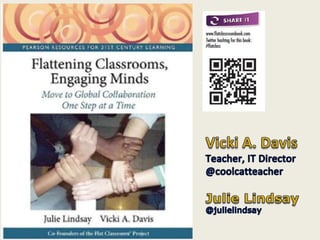
Vicki A. Davis
Teacher, IT Director
@coolcatteacher
Co-founder, Flat Classroom™ Projects
Author, Flattening Classrooms, Engaging Minds
Reinventing Writing
Eye on Education
December 2013
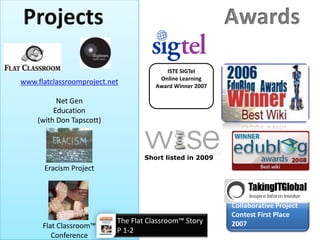
Collaborative Project
Contest First Place
2007
ISTE SIGTel
Online Learning
Award Winner 2007
www.flatclassroomproject.net
Net Gen
Education
(with Don Tapscott)
Eracism Project
Flat Classroom™
Conference
The Flat Classroom™ Story
P 1-2
Short listed in 2009
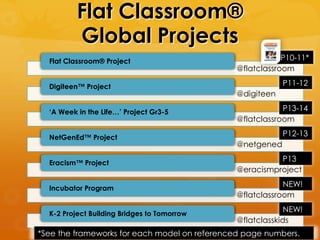
Flat Classroom®
Global Projects
Flat Classroom® Project
Digiteen™ Project
‘A Week in the Life…’ Project Gr3-5
NetGenEd™ Project
Eracism™ Project
Incubator Program
K-2 Project Building Bridges to Tomorrow
@flatclassroom
@digiteen
@netgened
@eracismproject
@flatclassroom
@flatclasskids
P10-11*
P11-12
P13-14
P12-13
P13
NEW!
NEW!
@flatclassroom
*See the frameworks for each model on referenced page numbers.
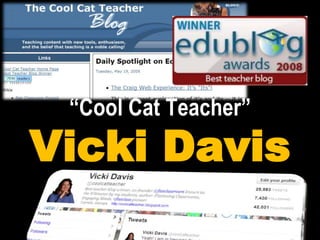
“Cool Cat Teacher”
Vicki Davis
B
e
s
t
P
r
a
c
t
i
c
e
Flat Classroom
http://flatclassroomproject.wikispaces.com
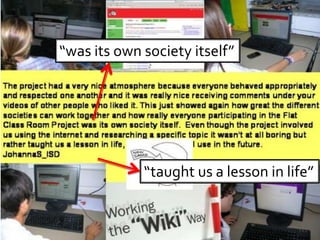
“was its own society itself”
“taught us a lesson in life”
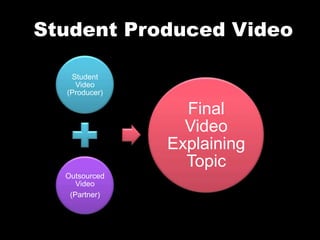
Student Produced Video
Student
Video
(Producer)
Outsourced
Video
(Partner)
Final
Video
Explaining
Topic
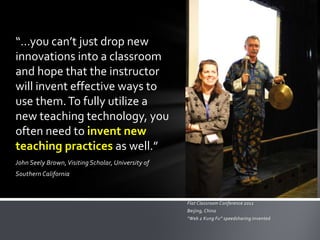
John Seely Brown,Visiting Scholar, University of
Southern California
“…you can’t just drop new
innovations into a classroom
and hope that the instructor
will invent effective ways to
use them.To fully utilize a
new teaching technology, you
often need to invent new
teaching practices as well.”
Flat Classroom Conference 2011
Beijing, China
“Web 2 Kung Fu” speedsharing invented
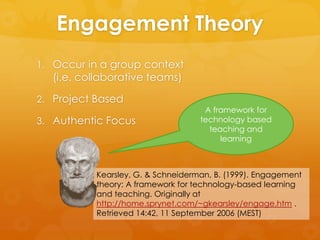
Engagement Theory
1. Occur in a group context
(i.e. collaborative teams)
2. Project Based
3. Authentic Focus
Kearsley, G. & Schneiderman, B. (1999). Engagement
theory: A framework for technology-based learning
and teaching. Originally at
http://home.sprynet.com/~gkearsley/engage.htm .
Retrieved 14:42, 11 September 2006 (MEST)
A framework for
technology based
teaching and
learning
Isn’t the way we’ve always taught
good
enough?
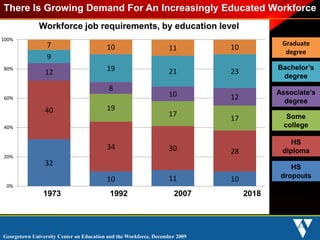
Facts for your future
Caucasian white people will be the minority in the US by 2042.
Georgetown University Center on Education and the Workforce, December 2009
32
10 11 10
40
34 30 28
19
17
17
12
8
10 12
9
19 21 23
7 10 11 10
0%
20%
40%
60%
80%
100%
There Is Growing Demand For An Increasingly Educated Workforce
Workforce job requirements, by education level
1973 1992 2007 2018
Graduate
degree
Some
college
HS
diploma
HS
dropouts
Associate’s
degree
Bachelor’s
degree
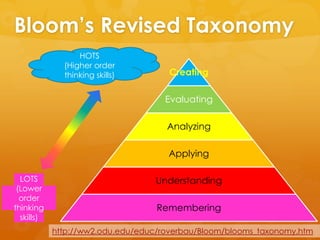
Bloom’s Revised Taxonomy
Creating
Evaluating
Analyzing
Applying
Understanding
Remembering
http://ww2.odu.edu/educ/roverbau/Bloom/blooms_taxonomy.htm
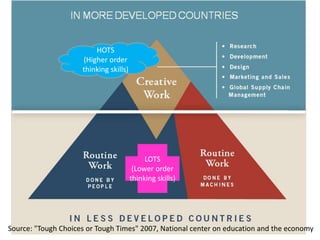
HOTS
(Higher order
thinking skills)
LOTS
(Lower
order
thinking
skills)
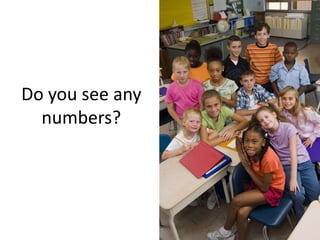
Do you see any
numbers?
Source: "Tough Choices or Tough Times" 2007, National center on education and the economy
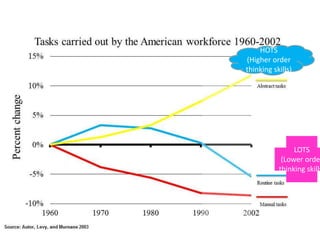
LOTS
(Lower order
thinking skills)
HOTS
(Higher order
thinking skills)
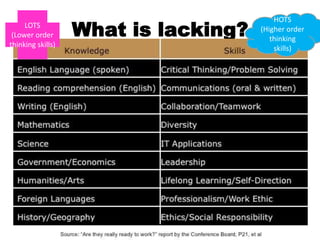
What is lacking?
HOTS
(Higher order
thinking
skills)
LOTS
(Lower order
thinking skills)
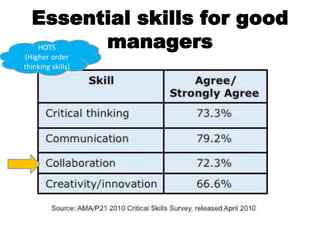
Essential skills for good
managersHOTS
(Higher order
thinking skills)
HOTS
(Higher order
thinking skills)
LOTS
(Lower orde
thinking skills
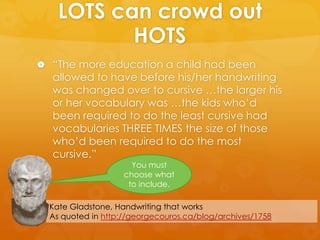
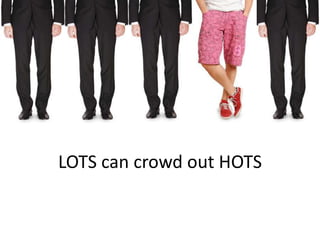
LOTS can crowd out
HOTS
 “The more education a child had been
allowed to have before his/her handwriting
was changed over to cursive …the larger his
or her vocabulary was …the kids who’d
been required to do the least cursive had
vocabularies THREE TIMES the size of those
who’d been required to do the most
cursive.”
Kate Gladstone, Handwriting that works
As quoted in http://georgecouros.ca/blog/archives/1758
You must
choose what
to include.
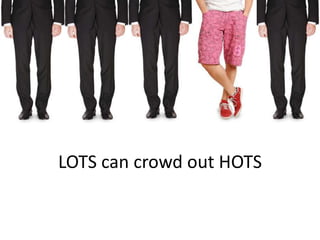
LOTS can crowd out HOTS
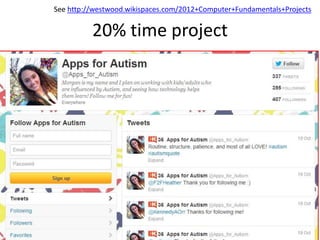
20% time project
See http://westwood.wikispaces.com/2012+Computer+Fundamentals+Projects
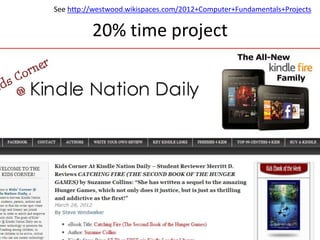
20% time project
See http://westwood.wikispaces.com/2012+Computer+Fundamentals+Projects
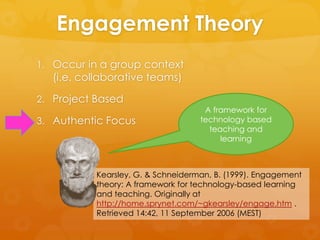
Engagement Theory
1. Occur in a group context
(i.e. collaborative teams)
2. Project Based
3. Authentic Focus
Kearsley, G. & Schneiderman, B. (1999). Engagement
theory: A framework for technology-based learning
and teaching. Originally at
http://home.sprynet.com/~gkearsley/engage.htm .
Retrieved 14:42, 11 September 2006 (MEST)
A framework for
technology based
teaching and
learning
Authentic Focus
Passion (PQ)
Curiosity (CQ)
Man from Bangladesh on
my plane
“This is your last generation
of prosperity because none
of you want to work. My
friends and I are coming
here and taking all your
jobs. Enjoy your life.”
Man from Bangladesh on
my plane
“This is your last generation
of prosperity because none
of you want to work. My
friends and I are coming
here and taking all your
jobs. Enjoy your life.”
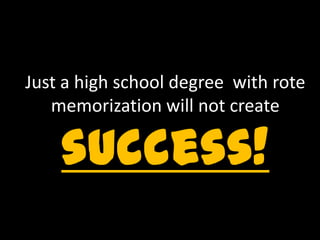
Just a high school degree with rote
memorization will not create
success!
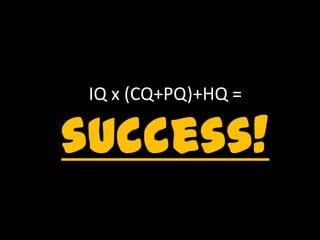
IQ x (CQ+PQ)+HQ =
success!
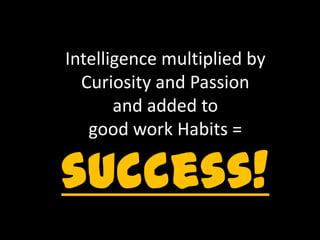
Intelligence multiplied by
Curiosity and Passion
and added to
good work Habits =
success!
We need
LOTS
and
HOTS
We need
Common Core
Standards
and
College &
Career
Readiness
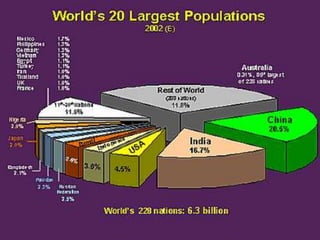
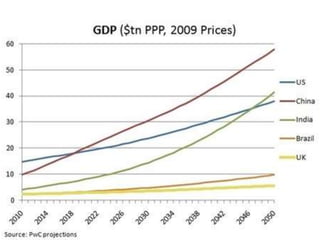
Why do we even care about
flattening
Our classrooms?
The FACTS of 21st century life.
Successful people will have to
work with and market to
China, India, and
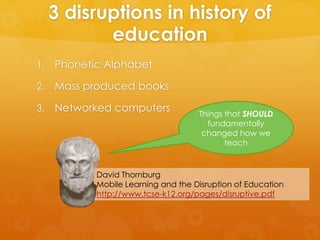
3 disruptions in history of
education
1. Phonetic Alphabet
2. Mass produced books
3. Networked computers
David Thornburg
Mobile Learning and the Disruption of Education
http://www.tcse-k12.org/pages/disruptive.pdf
Things that SHOULD
fundamentally
changed how we
teach
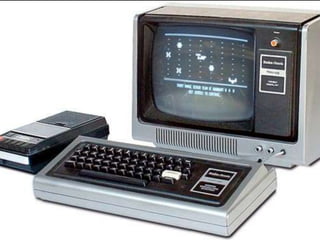
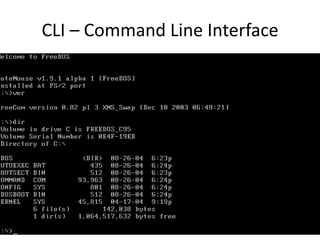
CLI – Command Line Interface
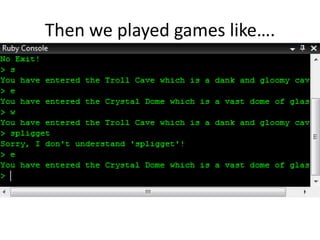
Then we played games like….
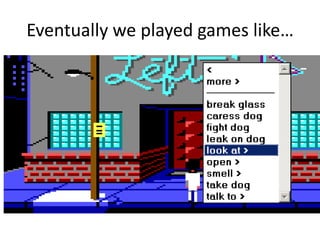
Eventually we played games like…
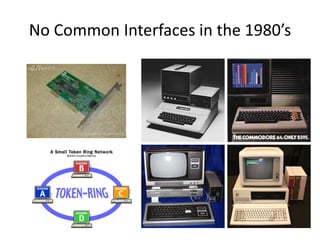
No Common Interfaces in the 1980’s
COMMAND STUDENT INTERFACE
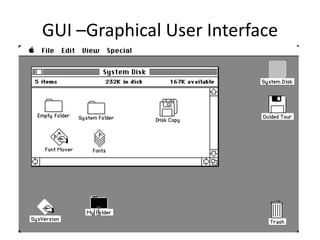
GUI –Graphical User Interface
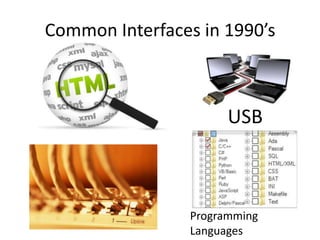
Common Interfaces in 1990’s
USB
Programming
Languages
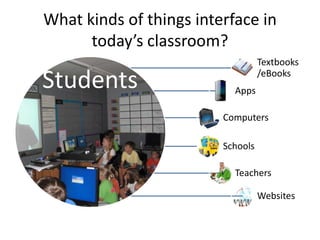
What kinds of things interface in
today’s classroom?
Students
Textbooks
/eBooks
Apps
Computers
Schools
Teachers
Websites
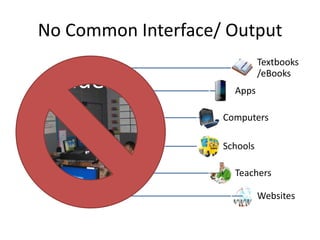
No Common Interface/ Output
Students
Textbooks
/eBooks
Apps
Computers
Schools
Teachers
Websites
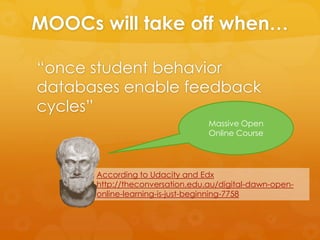
MOOCs will take off when…
“once student behavior
databases enable feedback
cycles”
According to Udacity and Edx
http://theconversation.edu.au/digital-dawn-open-
online-learning-is-just-beginning-7758
Massive Open
Online Course
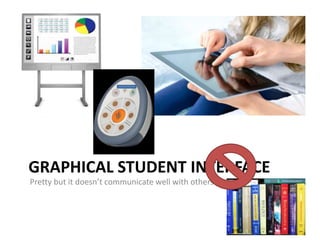
GRAPHICAL STUDENT INTERFACE
Pretty but it doesn’t communicate well with others.
How will we allow all of these
beautiful graphical tools to interact?
How will all of the tools in education
interface?
Strengths
Allow you to program
common INTERFACES
Allow communication &
SYNERGY between different
tools and teachers
If you don’t know where
you’re going how will you
know when you’re there?
UNFAIR to hand
students TESTS that
are a surprise.
Weaknesses
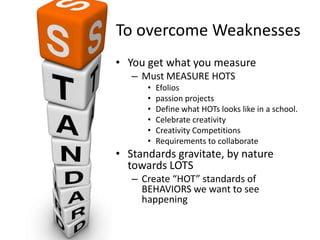
• You get what you measure
"Perhaps what you measure is what you
get. More likely, what you measure is all
you’ll get. What you don’t (or can’t)
measure is lost" –
H. Thomas Johnson
"the most important figures that one
needs for management are unknown or
unknowable,
but successful management must
nevertheless take account of them."
W. Edwards Deming
(from Out of the Crisis, p121)
Weaknesses
• Standards, by nature
gravitate towards Lower
Order Thinking Skills
LOTS can crowd out HOTS
Classrooms have
microclimates too!
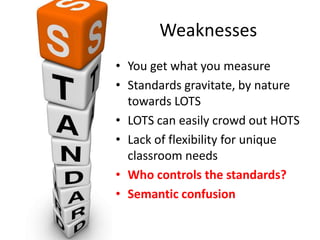
Weaknesses
• You get what you measure
• Standards gravitate, by nature
towards LOTS
• LOTS can easily crowd out HOTS
• Lack of flexibility for unique
classroom needs
• Who controls the standards?
• Semantic confusion
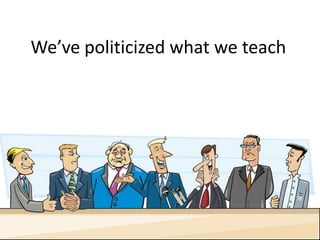
We’ve politicized what we teach
Where did
humans
originate?
Panspermia
Electric Spark
Deep Sea Vents
RNA World
Community
Clay
A Creator
T H E O R I E S
Panspermia
Electric Spark
Deep Sea Vents
RNA World
Community
Clay
A Creator
L A W S
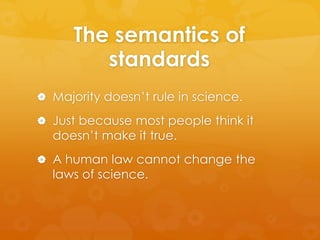
The semantics of
standards
 Majority doesn’t rule in science.
 Just because most people think it
doesn’t make it true.
 A human law cannot change the
laws of science.
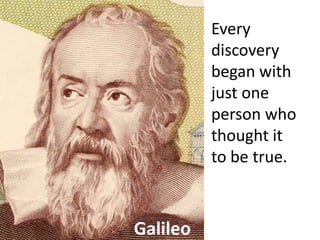
Galileo
Every
discovery
began with
just one
person who
thought it
to be true.
To overcome Weaknesses
• You get what you measure
– Must MEASURE HOTS
• Efolios
• passion projects
• Define what HOTs looks like in a school.
• Celebrate creativity
• Creativity Competitions
• Requirements to collaborate
• Standards gravitate, by nature
towards LOTS
– Create “HOT” standards of
BEHAVIORS we want to see
happening
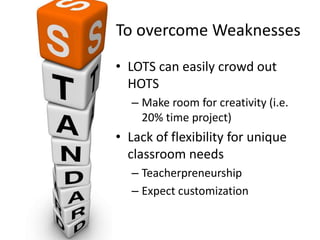
To overcome Weaknesses
• LOTS can easily crowd out
HOTS
– Make room for creativity (i.e.
20% time project)
• Lack of flexibility for unique
classroom needs
– Teacherpreneurship
– Expect customization
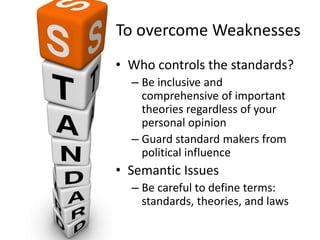
To overcome Weaknesses
• Who controls the standards?
– Be inclusive and
comprehensive of important
theories regardless of your
personal opinion
– Guard standard makers from
political influence
• Semantic Issues
– Be careful to define terms:
standards, theories, and laws
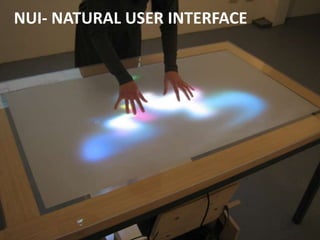
NUI- NATURAL USER INTERFACE
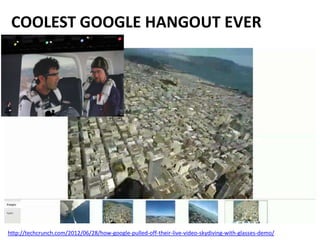
GOOGLE’S
PROJECT GLASS
http://techcrunch.com/2012/06/28/how-google-pulled-off-their-live-video-skydiving-with-glasses-demo/
COOLEST GOOGLE HANGOUT EVER
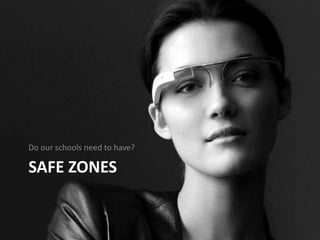
SAFE ZONES
Do our schools need to have?
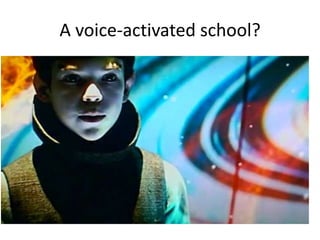
A voice-activated school?
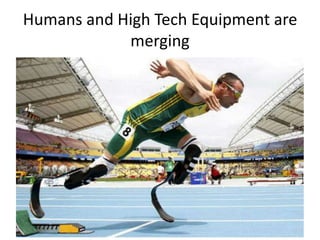
Humans and High Tech Equipment are
merging
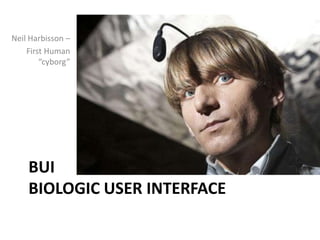
BUI
BIOLOGIC USER INTERFACE
Neil Harbisson –
First Human
“cyborg”
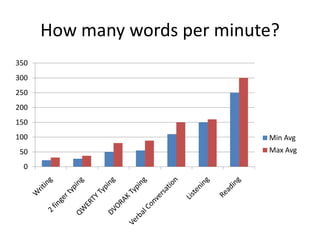
How many words per minute?
0
50
100
150
200
250
300
350
Min Avg
Max Avg
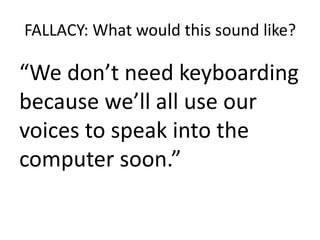
FALLACY: What would this sound like?
“We don’t need keyboarding
because we’ll all use our
voices to speak into the
computer soon.”
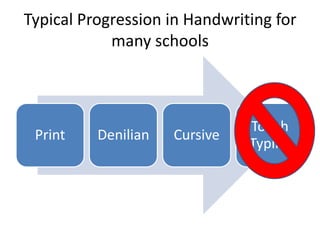
Typical Progression in Handwriting for
many schools
Print Denilian Cursive
Touch
Typing
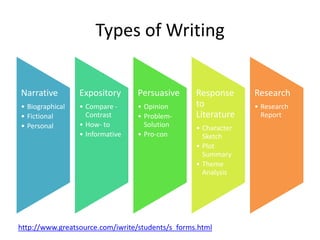
Types of Writing
Narrative
• Biographical
• Fictional
• Personal
Expository
• Compare -
Contrast
• How- to
• Informative
Persuasive
• Opinion
• Problem-
Solution
• Pro-con
Response
to
Literature
• Character
Sketch
• Plot
Summary
• Theme
Analysis
Research
• Research
Report
http://www.greatsource.com/iwrite/students/s_forms.html
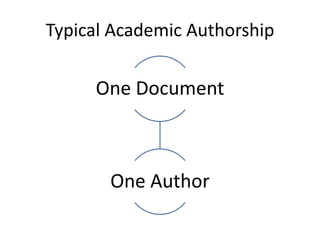
Typical Academic Authorship
One Document
One Author
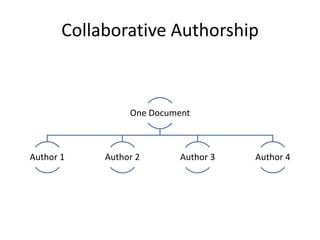
Collaborative Authorship
One Document
Author 1 Author 2 Author 3 Author 4
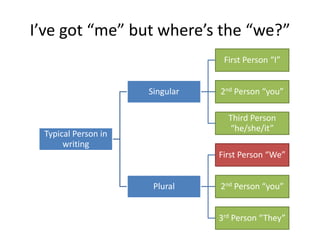
I’ve got “me” but where’s the “we?”
Typical Person in
writing
Singular
First Person “I”
2nd Person “you”
Third Person
“he/she/it”
Plural
First Person “We”
2nd Person “you”
3rd Person “They”
WHAT IS COLLABORATIVE WRITING?
WHAT IS “THE CLOUD?”
The process of writing, editing, and producing with a group of people.
Dr. Justin Reich @bjfr
• “Only 11% of wikis have any form of student
collaboration and only 2-3% of wikis could be
called ‘highly collaborative.’”
• “Giving students access to collaborative
platforms doesn’t mean they will collaborate.”
http://blogs.edweek.org/edweek/edtechresearcher
Types of writing on typical wikis
via Dr. Justin Reich
1. Concatenation
– discrete content
– Students don’t touch each other’s work
2. Copy Editing
– Edit grammar, punctuation, syntax or spelling
3. Co construction
– Substantively edit text of another student
through addition, deletion replacement
As quoted in
Chapter 1: Reinventing Writing
By Vicki Davis @eyeoneducation
Fall 2013
Types of writing on typical wikis
via Dr. Justin Reich
4. Commenting
– Conversational move
– Doesn’t contribute to wiki content
5. Discussion
– Comment back and forth on a topic with at least
four conversational turns.
As quoted in
Chapter 1: Reinventing Writing
By Vicki Davis @eyeoneducation
Fall 2013
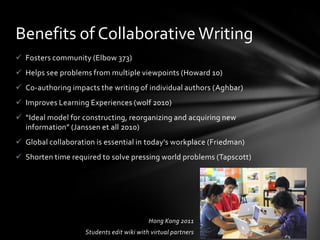
 Fosters community (Elbow 373)
 Helps see problems from multiple viewpoints (Howard 10)
 Co-authoring impacts the writing of individual authors (Aghbar)
 Improves Learning Experiences (wolf 2010)
 “Ideal model for constructing, reorganizing and acquiring new
information” (Janssen et all 2010)
 Global collaboration is essential in today’s workplace (Friedman)
 Shorten time required to solve pressing world problems (Tapscott)
Benefits of Collaborative Writing
Hong Kong 2011
Students edit wiki with virtual partners
People = Problems
(Trouble)
Troubleshooting
is HOT
PERFECTION
is not
WHAT IS COLLABORATIVE
WRITING?
The process of
writing, editing, an
d producing with a
group of people.
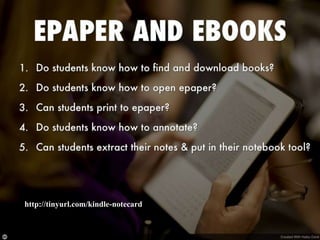
http://tinyurl.com/kindle-notecard
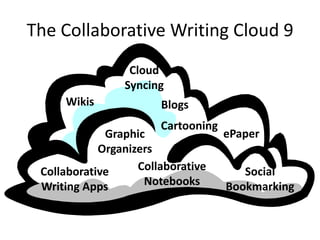
The Collaborative Writing Cloud 9
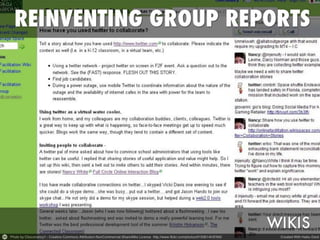
Wikis
Collaborative
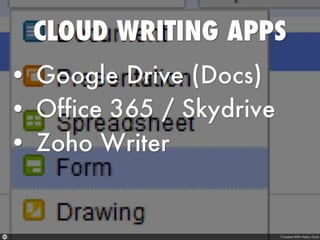
Writing Apps
Blogs
Social
Bookmarking
Graphic
Organizers
Collaborative
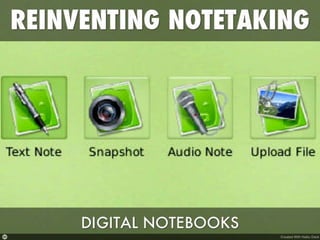
Notebooks
ePaper
Cartooning
Cloud
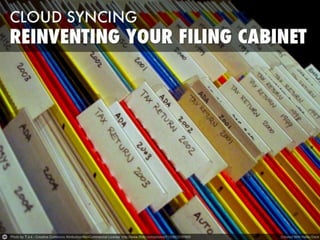
Syncing
Community of Practice
• “communities of practice are formed by
people who engage in a process of collective
learning in a shared domain of human
endeavor.” (Lave and Wegner)
Community of Practice
• “communities of practice are formed by
people who engage in a process of collective
learning in a shared domain of human
endeavor.” (Lave and Wegner)
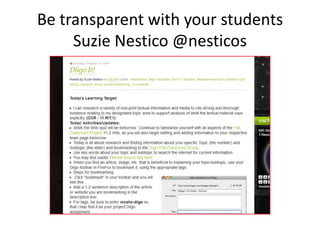
Be transparent with your students
Suzie Nestico @nesticos
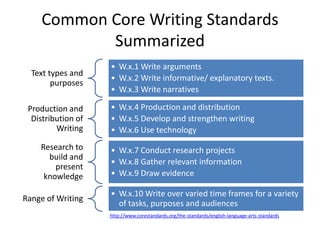
Common Core Writing Standards
Summarized
Text types and
purposes
• W.x.1 Write arguments
• W.x.2 Write informative/ explanatory texts.
• W.x.3 Write narratives
Production and
Distribution of
Writing
• W.x.4 Production and distribution
• W.x.5 Develop and strengthen writing
• W.x.6 Use technology
Research to
build and
present
knowledge
• W.x.7 Conduct research projects
• W.x.8 Gather relevant information
• W.x.9 Draw evidence
Range of Writing
• W.x.10 Write over varied time frames for a variety
of tasks, purposes and audiences
http://www.corestandards.org/the-standards/english-language-arts-standards
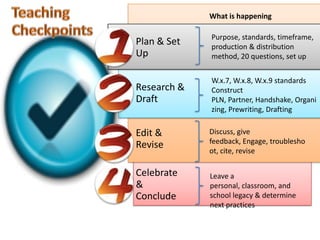
Plan & Set
Up
Research &
Draft
Edit &
Revise
Celebrate
&
Conclude
Purpose, standards, timeframe,
production & distribution
method, 20 questions, set up
What is happening
W.x.7, W.x.8, W.x.9 standards
Construct
PLN, Partner, Handshake, Organi
zing, Prewriting, Drafting
Leave a
personal, classroom, and
school legacy & determine
next practices
Discuss, give
feedback, Engage, troublesho
ot, cite, revise
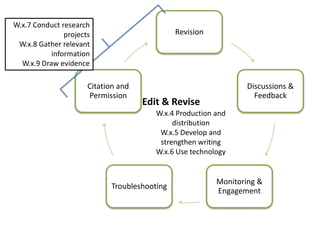
Revision
Discussions &
Feedback
Monitoring &
Engagement
Troubleshooting
Citation and
Permission
Edit & Revise
W.x.4 Production and
distribution
W.x.5 Develop and
strengthen writing
W.x.6 Use technology
W.x.7 Conduct research
projects
W.x.8 Gather relevant
information
W.x.9 Draw evidence
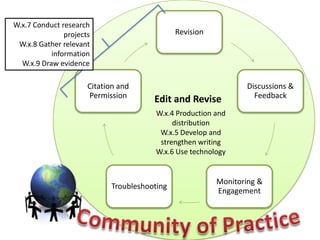
Revision
Discussions &
Feedback
Monitoring &
Engagement
Troubleshooting
Citation and
Permission
Edit and Revise
W.x.4 Production and
distribution
W.x.5 Develop and
strengthen writing
W.x.6 Use technology
W.x.7 Conduct research
projects
W.x.8 Gather relevant
information
W.x.9 Draw evidence
You can integrate
Common Core
 Plan ahead
 Write over extended
periods
 Customize the classroom
 FLIP and FLATTEN
 Go paperless
So…
What will we do
with
standards?
Don’t…
Let the
Common Core
become the
common
bore!
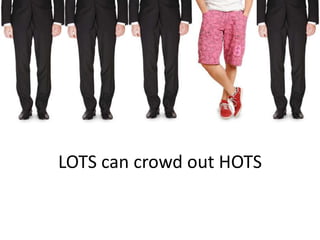
LOTS can crowd out HOTS
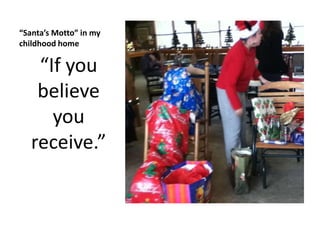
“Santa’s Motto” in my
childhood home
“If you
believe
you
receive.”
Study of Expectations
• 20% of students in the student were said to
have “unusual potential for intellectual
growth”
• Three teachers selected were told they were
selected because they were the best in the
school
Rosenthal, R., and Jacobson, L. (1968). Pygmalion in the classroom: Teacher
expectation and pupils' intellectual development'. New York: Rinehart and
Winston.
At the end of the school year
• Led the school and district in standardized test
scores
• Jumped 20-30% in academic achievement
over previous year.
Rosenthal, R., and Jacobson, L. (1968). Pygmalion in the
classroom: Teacher expectation and pupils' intellectual
development'. New York: Rinehart and Winston.
Guess what?
• The selections were RANDOM.
– Students were a mix of good/bad/ medium.
– So were teachers!
Rosenthal, R., and Jacobson, L. (1968). Pygmalion in the classroom: Teacher
expectation and pupils' intellectual development'. New York: Rinehart and
Winston.
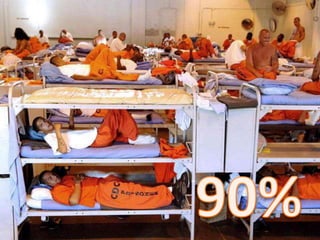
You Believe, You Receive!
“In experiment after experiment, it has been
demonstrated that when teachers EXPECT their
students to perform well, the students work
hard and live up to their teacher’s expectations.”
Brian Tracy, Maximum Achievement
The most important “A”
in your classroom
Att-I-tude
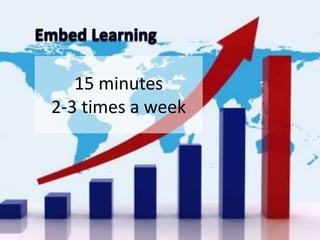
15 minutes
2-3 times a week
Eat a
watermelon
Not
whole!
Small
bites!
The power of Three!
Pick three
Thomas Carlyle
“Our job is not to see
what lies dimly at a
distance, but to do
what lies clearly at
hand.”
CAN
CAN
Who am I?
TEACHER
Common Core in the Cloud
#ccssconf13
Vicki A. Davis
Teacher, IT Director
@coolcatteacher
Co-founder, Flat Classroom™ Projects
Author, Flattening Classrooms, Engaging Minds
The Essential Collaborative Writing GuideBook
Eye on Education
December 2012

2013 june-ccssconf2013-keynote-common core in the cloud

  • 1.
    Common Core inthe Cloud #ccssconf2013 Vicki A. Davis Teacher, IT Director @coolcatteacher Co-founder, Flat Classroom™ Projects Author, Flattening Classrooms, Engaging Minds Reinventing Writing Eye on Education December 2013
  • 2.
    Collaborative Project Contest FirstPlace 2007 ISTE SIGTel Online Learning Award Winner 2007 www.flatclassroomproject.net Net Gen Education (with Don Tapscott) Eracism Project Flat Classroom™ Conference The Flat Classroom™ Story P 1-2 Short listed in 2009

  • 3.
    Flat Classroom® Global Projects FlatClassroom® Project Digiteen™ Project ‘A Week in the Life…’ Project Gr3-5 NetGenEd™ Project Eracism™ Project Incubator Program K-2 Project Building Bridges to Tomorrow @flatclassroom @digiteen @netgened @eracismproject @flatclassroom @flatclasskids P10-11* P11-12 P13-14 P12-13 P13 NEW! NEW! @flatclassroom *See the frameworks for each model on referenced page numbers.
  • 4.
  • 6.
  • 10.
  • 12.
    “was its ownsociety itself” “taught us a lesson in life”
  • 13.
  • 14.
    John Seely Brown,VisitingScholar, University of Southern California “…you can’t just drop new innovations into a classroom and hope that the instructor will invent effective ways to use them.To fully utilize a new teaching technology, you often need to invent new teaching practices as well.” Flat Classroom Conference 2011 Beijing, China “Web 2 Kung Fu” speedsharing invented
  • 15.
    Engagement Theory 1. Occurin a group context (i.e. collaborative teams) 2. Project Based 3. Authentic Focus Kearsley, G. & Schneiderman, B. (1999). Engagement theory: A framework for technology-based learning and teaching. Originally at http://home.sprynet.com/~gkearsley/engage.htm . Retrieved 14:42, 11 September 2006 (MEST) A framework for technology based teaching and learning
  • 17.
    Isn’t the waywe’ve always taught good enough?
  • 18.
    Facts for yourfuture Caucasian white people will be the minority in the US by 2042. Georgetown University Center on Education and the Workforce, December 2009 32 10 11 10 40 34 30 28 19 17 17 12 8 10 12 9 19 21 23 7 10 11 10 0% 20% 40% 60% 80% 100% There Is Growing Demand For An Increasingly Educated Workforce Workforce job requirements, by education level 1973 1992 2007 2018 Graduate degree Some college HS diploma HS dropouts Associate’s degree Bachelor’s degree
  • 20.
  • 23.
    Do you seeany numbers?
  • 24.
    Source: "Tough Choicesor Tough Times" 2007, National center on education and the economy LOTS (Lower order thinking skills) HOTS (Higher order thinking skills)
  • 25.
    What is lacking? HOTS (Higherorder thinking skills) LOTS (Lower order thinking skills)
  • 26.
    Essential skills forgood managersHOTS (Higher order thinking skills)
  • 27.
  • 28.
    LOTS can crowdout HOTS  “The more education a child had been allowed to have before his/her handwriting was changed over to cursive …the larger his or her vocabulary was …the kids who’d been required to do the least cursive had vocabularies THREE TIMES the size of those who’d been required to do the most cursive.” Kate Gladstone, Handwriting that works As quoted in http://georgecouros.ca/blog/archives/1758 You must choose what to include.
  • 29.
  • 30.
    20% time project Seehttp://westwood.wikispaces.com/2012+Computer+Fundamentals+Projects
  • 31.
    20% time project Seehttp://westwood.wikispaces.com/2012+Computer+Fundamentals+Projects
  • 32.
    Engagement Theory 1. Occurin a group context (i.e. collaborative teams) 2. Project Based 3. Authentic Focus Kearsley, G. & Schneiderman, B. (1999). Engagement theory: A framework for technology-based learning and teaching. Originally at http://home.sprynet.com/~gkearsley/engage.htm . Retrieved 14:42, 11 September 2006 (MEST) A framework for technology based teaching and learning
  • 33.
  • 34.
    Man from Bangladeshon my plane “This is your last generation of prosperity because none of you want to work. My friends and I are coming here and taking all your jobs. Enjoy your life.”
  • 35.
    Man from Bangladeshon my plane “This is your last generation of prosperity because none of you want to work. My friends and I are coming here and taking all your jobs. Enjoy your life.”
  • 36.
    Just a highschool degree with rote memorization will not create success!
  • 37.
    IQ x (CQ+PQ)+HQ= success!
  • 38.
    Intelligence multiplied by Curiosityand Passion and added to good work Habits = success!
  • 39.
  • 40.
  • 41.
    Why do weeven care about flattening Our classrooms?
  • 44.
    The FACTS of21st century life. Successful people will have to work with and market to China, India, and
  • 45.
    3 disruptions inhistory of education 1. Phonetic Alphabet 2. Mass produced books 3. Networked computers David Thornburg Mobile Learning and the Disruption of Education http://www.tcse-k12.org/pages/disruptive.pdf Things that SHOULD fundamentally changed how we teach
  • 48.
    CLI – CommandLine Interface
  • 49.
    Then we playedgames like….
  • 50.
    Eventually we playedgames like…
  • 52.
    No Common Interfacesin the 1980’s
  • 53.
  • 55.
  • 58.
    Common Interfaces in1990’s USB Programming Languages
  • 59.
    What kinds ofthings interface in today’s classroom? Students Textbooks /eBooks Apps Computers Schools Teachers Websites
  • 60.
    No Common Interface/Output Students Textbooks /eBooks Apps Computers Schools Teachers Websites
  • 61.
    MOOCs will takeoff when… “once student behavior databases enable feedback cycles” According to Udacity and Edx http://theconversation.edu.au/digital-dawn-open- online-learning-is-just-beginning-7758 Massive Open Online Course
  • 62.
    GRAPHICAL STUDENT INTERFACE Prettybut it doesn’t communicate well with others.
  • 63.
    How will weallow all of these beautiful graphical tools to interact?
  • 64.
    How will allof the tools in education interface?
  • 66.
    Strengths Allow you toprogram common INTERFACES Allow communication & SYNERGY between different tools and teachers If you don’t know where you’re going how will you know when you’re there?
  • 67.
    UNFAIR to hand studentsTESTS that are a surprise.
  • 68.
    Weaknesses • You getwhat you measure "Perhaps what you measure is what you get. More likely, what you measure is all you’ll get. What you don’t (or can’t) measure is lost" – H. Thomas Johnson "the most important figures that one needs for management are unknown or unknowable, but successful management must nevertheless take account of them." W. Edwards Deming (from Out of the Crisis, p121)
  • 69.
    Weaknesses • Standards, bynature gravitate towards Lower Order Thinking Skills
  • 70.
  • 71.
  • 72.
    Weaknesses • You getwhat you measure • Standards gravitate, by nature towards LOTS • LOTS can easily crowd out HOTS • Lack of flexibility for unique classroom needs • Who controls the standards? • Semantic confusion
  • 73.
  • 74.
  • 75.
    Panspermia Electric Spark Deep SeaVents RNA World Community Clay A Creator T H E O R I E S
  • 76.
    Panspermia Electric Spark Deep SeaVents RNA World Community Clay A Creator L A W S
  • 77.
    The semantics of standards Majority doesn’t rule in science.  Just because most people think it doesn’t make it true.  A human law cannot change the laws of science.
  • 78.
  • 82.
    To overcome Weaknesses •You get what you measure – Must MEASURE HOTS • Efolios • passion projects • Define what HOTs looks like in a school. • Celebrate creativity • Creativity Competitions • Requirements to collaborate • Standards gravitate, by nature towards LOTS – Create “HOT” standards of BEHAVIORS we want to see happening
  • 83.
    To overcome Weaknesses •LOTS can easily crowd out HOTS – Make room for creativity (i.e. 20% time project) • Lack of flexibility for unique classroom needs – Teacherpreneurship – Expect customization
  • 84.
    To overcome Weaknesses •Who controls the standards? – Be inclusive and comprehensive of important theories regardless of your personal opinion – Guard standard makers from political influence • Semantic Issues – Be careful to define terms: standards, theories, and laws
  • 86.
  • 88.
  • 89.
  • 90.
    SAFE ZONES Do ourschools need to have?
  • 91.
  • 92.
    Humans and HighTech Equipment are merging
  • 93.
    BUI BIOLOGIC USER INTERFACE NeilHarbisson – First Human “cyborg”
  • 96.
    How many wordsper minute? 0 50 100 150 200 250 300 350 Min Avg Max Avg
  • 97.
    FALLACY: What wouldthis sound like? “We don’t need keyboarding because we’ll all use our voices to speak into the computer soon.”
  • 98.
    Typical Progression inHandwriting for many schools Print Denilian Cursive Touch Typing
  • 99.
    Types of Writing Narrative •Biographical • Fictional • Personal Expository • Compare - Contrast • How- to • Informative Persuasive • Opinion • Problem- Solution • Pro-con Response to Literature • Character Sketch • Plot Summary • Theme Analysis Research • Research Report http://www.greatsource.com/iwrite/students/s_forms.html
  • 100.
  • 101.
  • 102.
    I’ve got “me”but where’s the “we?” Typical Person in writing Singular First Person “I” 2nd Person “you” Third Person “he/she/it” Plural First Person “We” 2nd Person “you” 3rd Person “They”
  • 103.
    WHAT IS COLLABORATIVEWRITING? WHAT IS “THE CLOUD?” The process of writing, editing, and producing with a group of people.
  • 104.
    Dr. Justin Reich@bjfr • “Only 11% of wikis have any form of student collaboration and only 2-3% of wikis could be called ‘highly collaborative.’” • “Giving students access to collaborative platforms doesn’t mean they will collaborate.” http://blogs.edweek.org/edweek/edtechresearcher
  • 105.
    Types of writingon typical wikis via Dr. Justin Reich 1. Concatenation – discrete content – Students don’t touch each other’s work 2. Copy Editing – Edit grammar, punctuation, syntax or spelling 3. Co construction – Substantively edit text of another student through addition, deletion replacement As quoted in Chapter 1: Reinventing Writing By Vicki Davis @eyeoneducation Fall 2013
  • 106.
    Types of writingon typical wikis via Dr. Justin Reich 4. Commenting – Conversational move – Doesn’t contribute to wiki content 5. Discussion – Comment back and forth on a topic with at least four conversational turns. As quoted in Chapter 1: Reinventing Writing By Vicki Davis @eyeoneducation Fall 2013
  • 107.
     Fosters community(Elbow 373)  Helps see problems from multiple viewpoints (Howard 10)  Co-authoring impacts the writing of individual authors (Aghbar)  Improves Learning Experiences (wolf 2010)  “Ideal model for constructing, reorganizing and acquiring new information” (Janssen et all 2010)  Global collaboration is essential in today’s workplace (Friedman)  Shorten time required to solve pressing world problems (Tapscott) Benefits of Collaborative Writing Hong Kong 2011 Students edit wiki with virtual partners
  • 108.
  • 109.
  • 110.
  • 111.
    WHAT IS COLLABORATIVE WRITING? Theprocess of writing, editing, an d producing with a group of people.
  • 114.
  • 134.
    The Collaborative WritingCloud 9 Wikis Collaborative Writing Apps Blogs Social Bookmarking Graphic Organizers Collaborative Notebooks ePaper Cartooning Cloud Syncing
  • 135.
    Community of Practice •“communities of practice are formed by people who engage in a process of collective learning in a shared domain of human endeavor.” (Lave and Wegner)
  • 136.
    Community of Practice •“communities of practice are formed by people who engage in a process of collective learning in a shared domain of human endeavor.” (Lave and Wegner)
  • 137.
    Be transparent withyour students Suzie Nestico @nesticos
  • 138.
    Common Core WritingStandards Summarized Text types and purposes • W.x.1 Write arguments • W.x.2 Write informative/ explanatory texts. • W.x.3 Write narratives Production and Distribution of Writing • W.x.4 Production and distribution • W.x.5 Develop and strengthen writing • W.x.6 Use technology Research to build and present knowledge • W.x.7 Conduct research projects • W.x.8 Gather relevant information • W.x.9 Draw evidence Range of Writing • W.x.10 Write over varied time frames for a variety of tasks, purposes and audiences http://www.corestandards.org/the-standards/english-language-arts-standards
  • 139.
    Plan & Set Up Research& Draft Edit & Revise Celebrate & Conclude Purpose, standards, timeframe, production & distribution method, 20 questions, set up What is happening W.x.7, W.x.8, W.x.9 standards Construct PLN, Partner, Handshake, Organi zing, Prewriting, Drafting Leave a personal, classroom, and school legacy & determine next practices Discuss, give feedback, Engage, troublesho ot, cite, revise
  • 140.
    Revision Discussions & Feedback Monitoring & Engagement Troubleshooting Citationand Permission Edit & Revise W.x.4 Production and distribution W.x.5 Develop and strengthen writing W.x.6 Use technology W.x.7 Conduct research projects W.x.8 Gather relevant information W.x.9 Draw evidence
  • 141.
    Revision Discussions & Feedback Monitoring & Engagement Troubleshooting Citationand Permission Edit and Revise W.x.4 Production and distribution W.x.5 Develop and strengthen writing W.x.6 Use technology W.x.7 Conduct research projects W.x.8 Gather relevant information W.x.9 Draw evidence
  • 142.
    You can integrate CommonCore  Plan ahead  Write over extended periods  Customize the classroom  FLIP and FLATTEN  Go paperless
  • 143.
    So… What will wedo with standards?
  • 144.
  • 145.
  • 146.
    “Santa’s Motto” inmy childhood home “If you believe you receive.”
  • 147.
    Study of Expectations •20% of students in the student were said to have “unusual potential for intellectual growth” • Three teachers selected were told they were selected because they were the best in the school Rosenthal, R., and Jacobson, L. (1968). Pygmalion in the classroom: Teacher expectation and pupils' intellectual development'. New York: Rinehart and Winston.
  • 148.
    At the endof the school year • Led the school and district in standardized test scores • Jumped 20-30% in academic achievement over previous year. Rosenthal, R., and Jacobson, L. (1968). Pygmalion in the classroom: Teacher expectation and pupils' intellectual development'. New York: Rinehart and Winston.
  • 149.
    Guess what? • Theselections were RANDOM. – Students were a mix of good/bad/ medium. – So were teachers! Rosenthal, R., and Jacobson, L. (1968). Pygmalion in the classroom: Teacher expectation and pupils' intellectual development'. New York: Rinehart and Winston.
  • 150.
    You Believe, YouReceive! “In experiment after experiment, it has been demonstrated that when teachers EXPECT their students to perform well, the students work hard and live up to their teacher’s expectations.” Brian Tracy, Maximum Achievement
  • 152.
    The most important“A” in your classroom Att-I-tude
  • 154.
  • 155.
  • 156.
  • 157.
  • 158.
    The power ofThree! Pick three
  • 161.
    Thomas Carlyle “Our jobis not to see what lies dimly at a distance, but to do what lies clearly at hand.”
  • 162.
  • 163.
  • 165.
  • 167.
    Common Core inthe Cloud #ccssconf13 Vicki A. Davis Teacher, IT Director @coolcatteacher Co-founder, Flat Classroom™ Projects Author, Flattening Classrooms, Engaging Minds The Essential Collaborative Writing GuideBook Eye on Education December 2012

Editor's Notes

  • #3 Julie: Flat classroom projects have been acknowledged over the past 5 years with awards and listed as exemplary
  • #4 Julie: Our aim is to create projects and opportunities across all levels of education. Right now we have FCP and NetGenEd for high school, Digiteen for upper ES, MS and HS, AWL for upper ES, Eracism for MS HS and our new pilot this semester is Building Bridges to Tomorrow for K-2 level – over 40 classrooms from about more than 10 countries
  • #5 During that time, in December 2005, I began blogging at the Cool Cat Teacher blog and used my experience from the business world as a general manager as well as my teaching, professional development teaching I’ve done for adults in technology at the college level, and my experience as IT director for my school to this blog. But you see, I still view myself as the
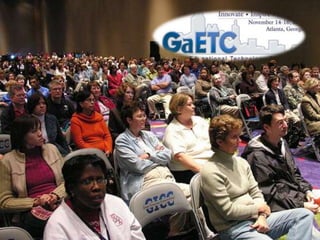
  • #6 Georgia Educators Technology Conference in Atlanta with a commission from my curriculum director to bring technologies back to my classroom that would enable me to better facilitiate
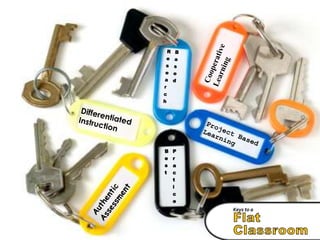
  • #7 Understand that flat classrooms are based upon things you already understand – Research Based Best Practices such as differentiated instruction, authentic assessment, cooperative learning, and project based learning. The only difference is that your classroom is merged with other classrooms and your student’s partners are in other time zones and locations.
  • #8 This is how I felt!
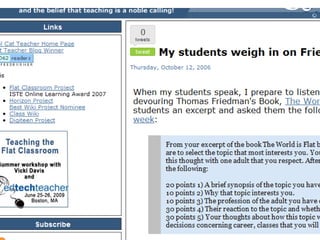
  • #9 event for my classroom and I when I wrote a blog post in October 2006 called “My students weigh in on Friedman’s Flat World.”
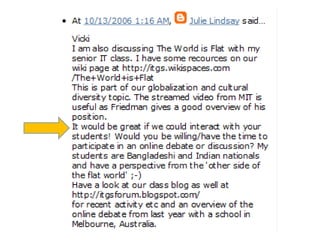
  • #10 Julie Lindsay, “It would be great if we could interact with your students! Would you be willing/ have the time to participate in an online debate or discussion? My students are Bangladeshi and Indian nationals and have a perspective from the ‘other side of the flat world.’”
  • #11 She was at the International School Dhaka, Bangladesh. Her students were primarily Indian and Bangladeshi nationals who practiced the Muslim, mine, primarily Anglo Christian background.
  • #14 In addition to the wiki, the students also created videos about their topic where that to outsource, or receive video from their partner on the other side of the world and this is the type of video that emerged.
  • #15 “…you can’t just drop new innovations into a classroom and hope that the instructor will invent effective ways to use them. To fully utilize a new teaching technology, you often need to invent new teaching practices as well.” John Seely Brown
  • #22 We’re not making copies in schools, we’re making originals.
  • #42 We are working to determine the vital behaviors that will move us towards effective twenty first century classrooms. We’ll call this Flat Classroom. But I want you to remember as we look as the vital behaviors that there is one thing you can completely influence. What is the one thing you have complete and total control over in your district?
  • #47 We’re going to talk about the cloud, but sometimes to see where we’re going, we need to see the bigger picture of where we’ve been.
  • #48 My technology journey began somewhere around the age of 10 with the TRS-80 computer
  • #49 These were the days of the Command Line Interface or CLI
  • #50 We played games like this text adventure game
  • #51 And eventually played games like this that became a little bit more graphical and really thought we had it made when we
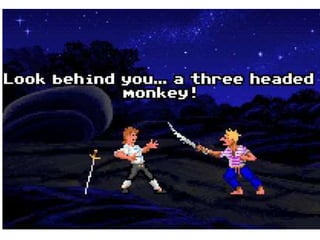
  • #52 Were able to play games like Monkey island
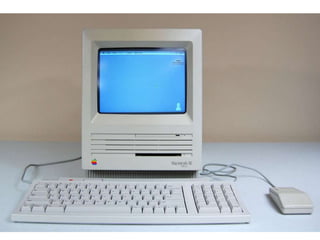
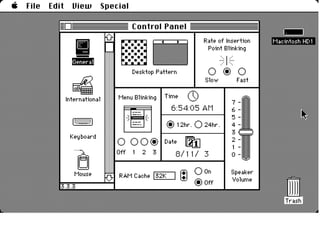
  • #55 Then, the Graphical User Interface was invented at Xerox PARC and we began having devices like the computer I took to Georgia Tech in 1987 – the Macintosh SE
  • #56 We had the graphical user interface
  • #57 With a lovely little control panel like this
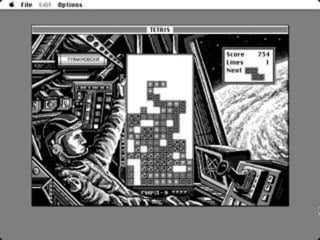
  • #58 And eventually when color came along we were starting to play games like this.
  • #75 For example, let’s take one question: where did humans originate?
  • #76 For example, let’s take one question: where did humans originate?
  • #77 For example, let’s take one question: where did humans originate?
  • #93 Oscar Pistorius Olympics
  • #94 The story of the first 'cyborg' flesh and bloodNeil Harbisson, the first human to be officially recognized as a man / machine.Due to his illness in xonsiste that fails to recognize the colors alone, he walks with a device that turns colors into sounds for him so he can know what color things, objects with which it intersects on a daily basis.He began walking with a backpack which contained a computer and now behind only one chip in the head, which transposed into everywhere, for that utlidade.http://www.luuux.com/node/3560531
  • #96 We’re going to talk about the cloud, but sometimes to see where we’re going, we need to see the bigger picture of where we’ve been.
  • #97 These numbers are pulled from a variety of sources including Ahmed SabbirArif, Wolfgang Stuerzlinger Analysis of Text Entry Performance Metrics Dept. of Computer Science & Engineering York University^ Karat, C.M., Halverson, C., Horn, D. and Karat, J. (1999), Patterns of entry and correction in large vocabulary continuous speech recognition systems, CHI 99 Conference Proceedings, 568-575.^ a b c Brown, C. M. (1988). Human-computer interface design guidelines. Norwood, NJ: Ablex Publishing.^ Ayres, Robert U; Martinás, Katalin (2005), "120 wpm for very skilled typist", On the Reappraisal of Microeconomics: Economic Growth and Change in a Material World, Cheltenham, UK & Northampton, Massachusetts: Edward Elgar Publishing, p. 41, ISBN 1-84542-272-4, retrieved 22 November 2010^ Typing Speed: How Fast is Average, 1997^ http://www.bigsiteofamazingfacts.com/history-of-typewriters^ http://www.owled.com/typing.htmlZiefle, M. (1998), Effects of display resolution on visual performance, Human Factors, 40(4), 555–568.^ Williams, J. R. (1998). Guidelines for the use of multimedia in instruction, Proceedings of the Human Factors and Ergonomics Society 42nd Annual Meeting, 1447–1451^ http://www.brainyhistory.com/events/1988/may_24_1988_161209.html^ http://www.youtube.com/watch?v=c4-CRv0ih28http://www.lisabmarshall.com/uncategorized/how-fast-do-i-speak/On the 2006 SAT, a United States post-secondary education entrance exam, only 15 percent of the students wrote their essay answers in cursive.[7]http://www.eric.ed.gov/ERICWebPortal/search/detailmini.jsp?_nfpb=true&_&ERICExtSearch_SearchValue_0=ED056015&ERICExtSearch_SearchType_0=no&accno=ED056015 – Manuscript / cursive speeds
  • #104 One drop is a drop of water. Many drops of water together make rain. Rain makes the grass grow. One person writing is one workbut multiple people make change. Change can improve our world.
  • #112 One drop is a drop of water. Many drops of water together make rain. Rain makes the grass grow. One person writing is one workbut multiple people make change. Change can improve our world.
  • #150 In his book Pymalion in the classroom, Dr. Robert Rosenthal of Harvard University shared his experiment from the late 1960s. Beginning of school year three teachers were called into the office and told that “because of their teaching styles you are the three best teachers in the school as a special reward we are going to give each of you one classroom of the brightest childre in the school selected based on IQ tests – we expect them to jump 20-30% in academic achievement. Keep this confidential, we don’t want anyone to know.”Teachers were psyched. They were enthusiastic. At the end of the year.
  • #151 In his book Pymalion in the classroom, Dr. Robert Rosenthal of Harvard University shared his experiment from the late 1960s. Beginning of school year three teachers were called into the office and told that “because of their teaching styles you are the three best teachers in the school as a special reward we are going to give each of you one classroom of the brightest childre in the school selected based on IQ tests – we expect them to jump 20-30% in academic achievement. Keep this confidential, we don’t want anyone to know.”Teachers were psyched. They were enthusiastic. At the end of the year.
  • #156 We’re too busy having a pity party to exert the influence to have a victory party.
  • #157 So, I embed my learning and take 15 minutes 2-3 times a week to learn and explore new technologies and this, has been the thing that has led to the complete transformation of my classroom! But you don’t have time – you say.
  • #158 How do you eat a watermelon?
  • #159 If you eat it whole, you’ll choke.
  • #160 No, the way you eat a watermelon is one bit at a time.
  • #161 And that is what I suggest for you to do today. Your assignment for this webinar today is to come up with your “Big Three” at the end of the webinar. Pick three things – start there!
  • #162 Me but we have to change me into
  • #163 And you’ll be surprised at how quickly me turns into We!
  • #164 Do the things that sit at hand like Thomas Carlyle said. “Our job is not to see what lies dimly at a distance, but to do what lies clearly at hand.” Investigate your next three things.
  • #165 I can do something. I
  • #166 Can. I can.
  • #167 I CAN. So, angela, what can we do in our schools and classrooms today that will make a difference?