




Beyond Mobile, Beyond Web
The Internet of things needs our help

IA Summit 5 April 2013


     @scottjenson

     jenson.org
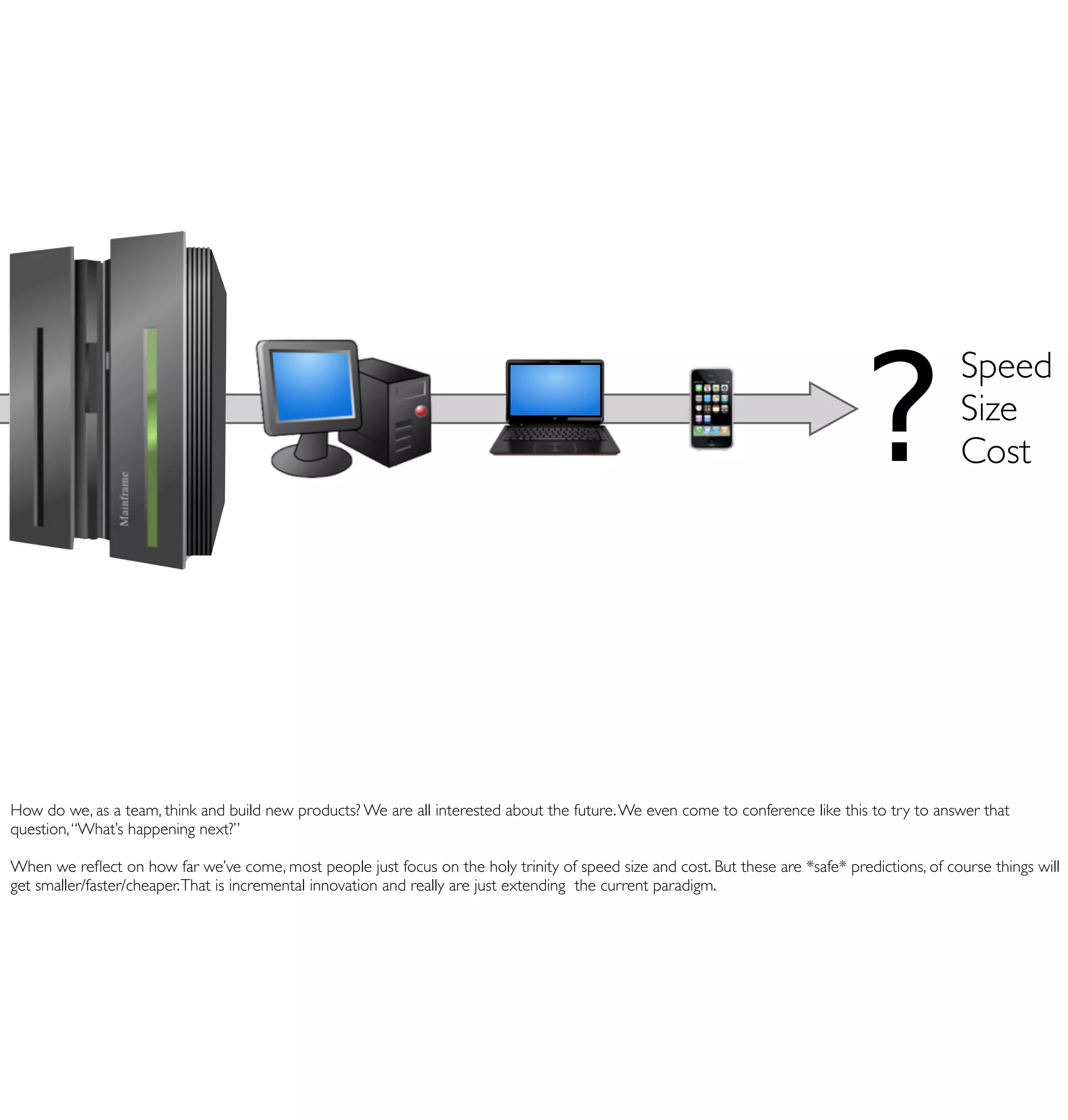
?
                                                                                                                                                Speed
                                                                                                                                                Size
                                                                                                                                                Cost


How do we, as a team, think and build new products? We are all interested about the future. We even come to conference like this to try to answer that
question, “What’s happening next?”

When we reflect on how far we’ve come, most people just focus on the holy trinity of speed size and cost. But these are *safe* predictions, of course things will
get smaller/faster/cheaper. That is incremental innovation and really are just extending the current paradigm.
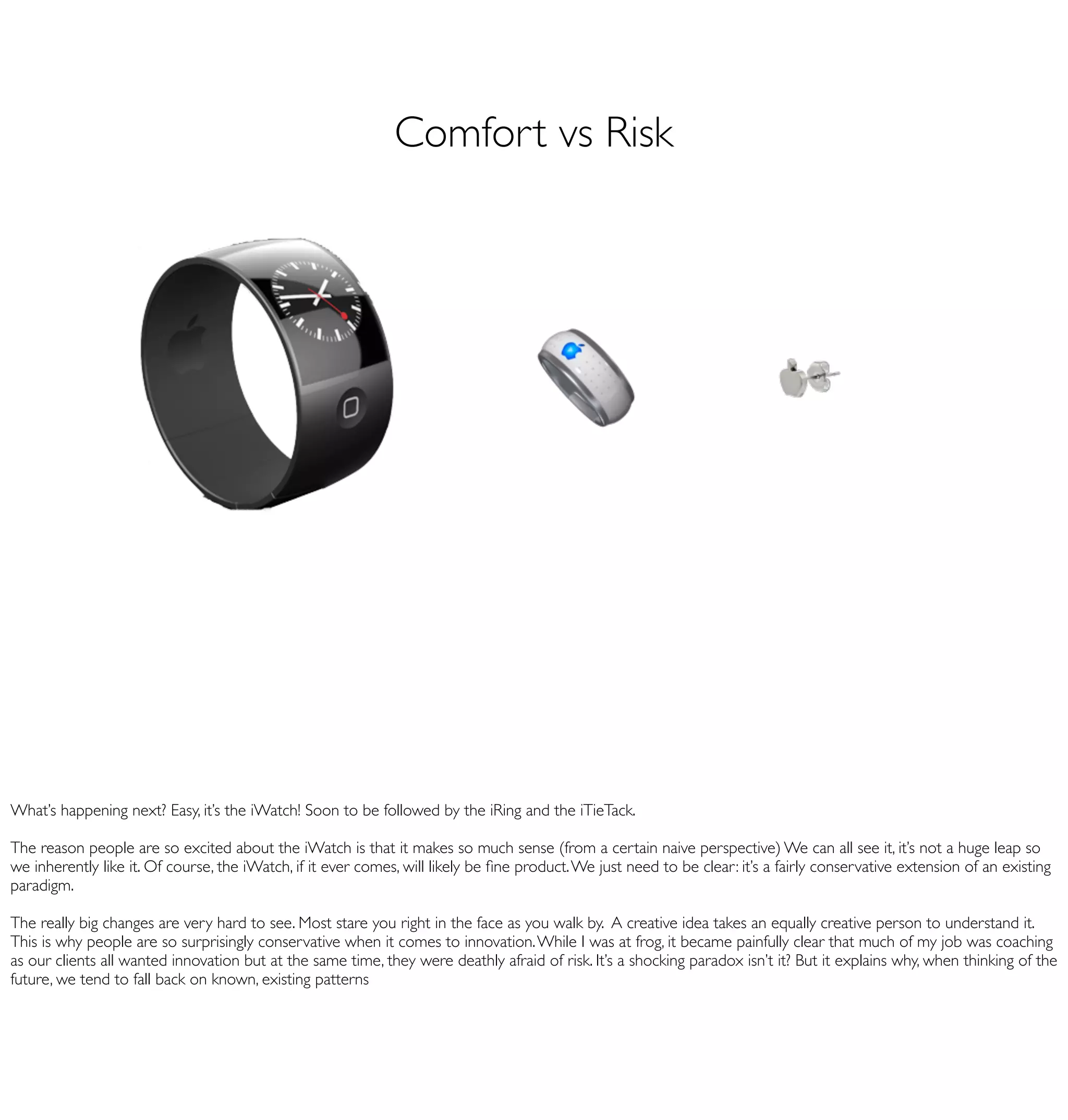
Comfort vs Risk


What’s happening next? Easy, it’s the iWatch! Soon to be followed by the iRing and the iTieTack.

The reason people are so excited about the iWatch is that it makes so much sense (from a certain naive perspective) We can all see it, it’s not a huge leap so
we inherently like it. Of course, the iWatch, if it ever comes, will likely be fine product. We just need to be clear: it’s a fairly conservative extension of an existing
paradigm.

The really big changes are very hard to see. Most stare you right in the face as you walk by. A creative idea takes an equally creative person to understand it.
This is why people are so surprisingly conservative when it comes to innovation. While I was at frog, it became painfully clear that much of my job was coaching
as our clients all wanted innovation but at the same time, they were deathly afraid of risk. It’s a shocking paradox isn’t it? But it explains why, when thinking of the
future, we tend to fall back on known, existing patterns
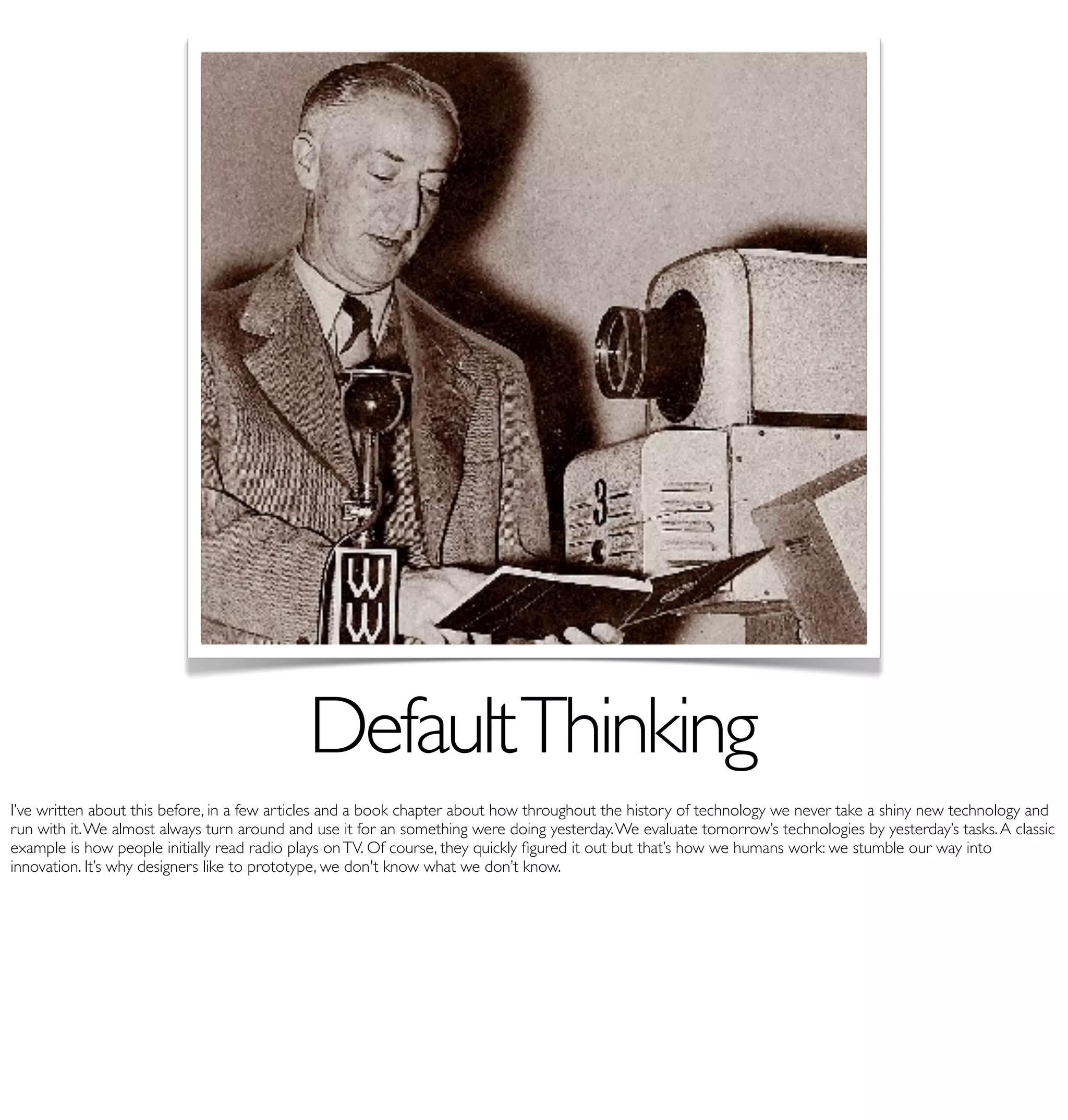
Default Thinking
I’ve written about this before, in a few articles and a book chapter about how throughout the history of technology we never take a shiny new technology and
run with it. We almost always turn around and use it for an something were doing yesterday. We evaluate tomorrow’s technologies by yesterday’s tasks. A classic
example is how people initially read radio plays on TV. Of course, they quickly figured it out but that’s how we humans work: we stumble our way into
innovation. It’s why designers like to prototype, we don't know what we don’t know.
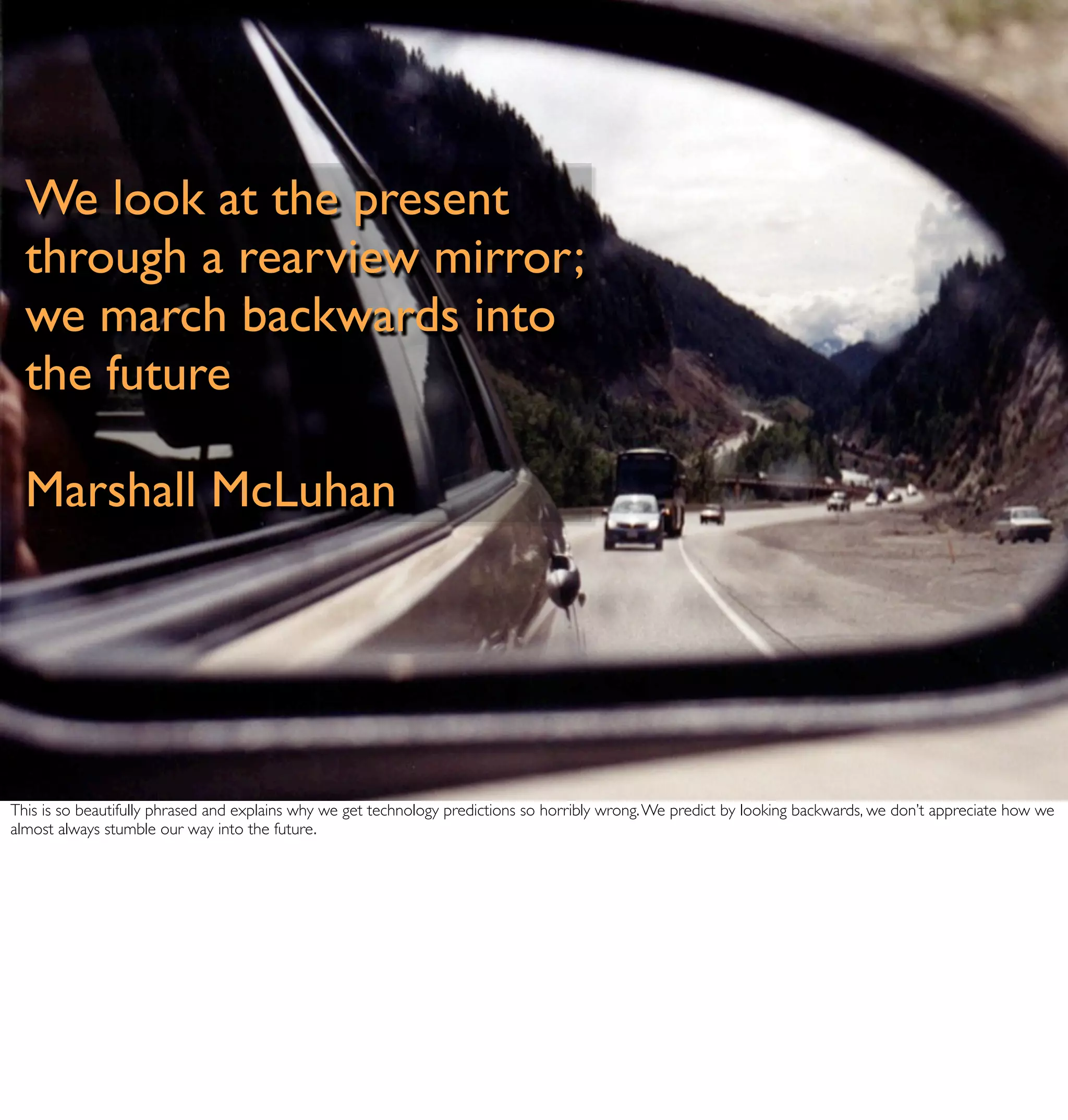
We look at the present
  through a rearview mirror;
  we march backwards into
  the future

  Marshall McLuhan


This is so beautifully phrased and explains why we get technology predictions so horribly wrong. We predict by looking backwards, we don’t appreciate how we
almost always stumble our way into the future.
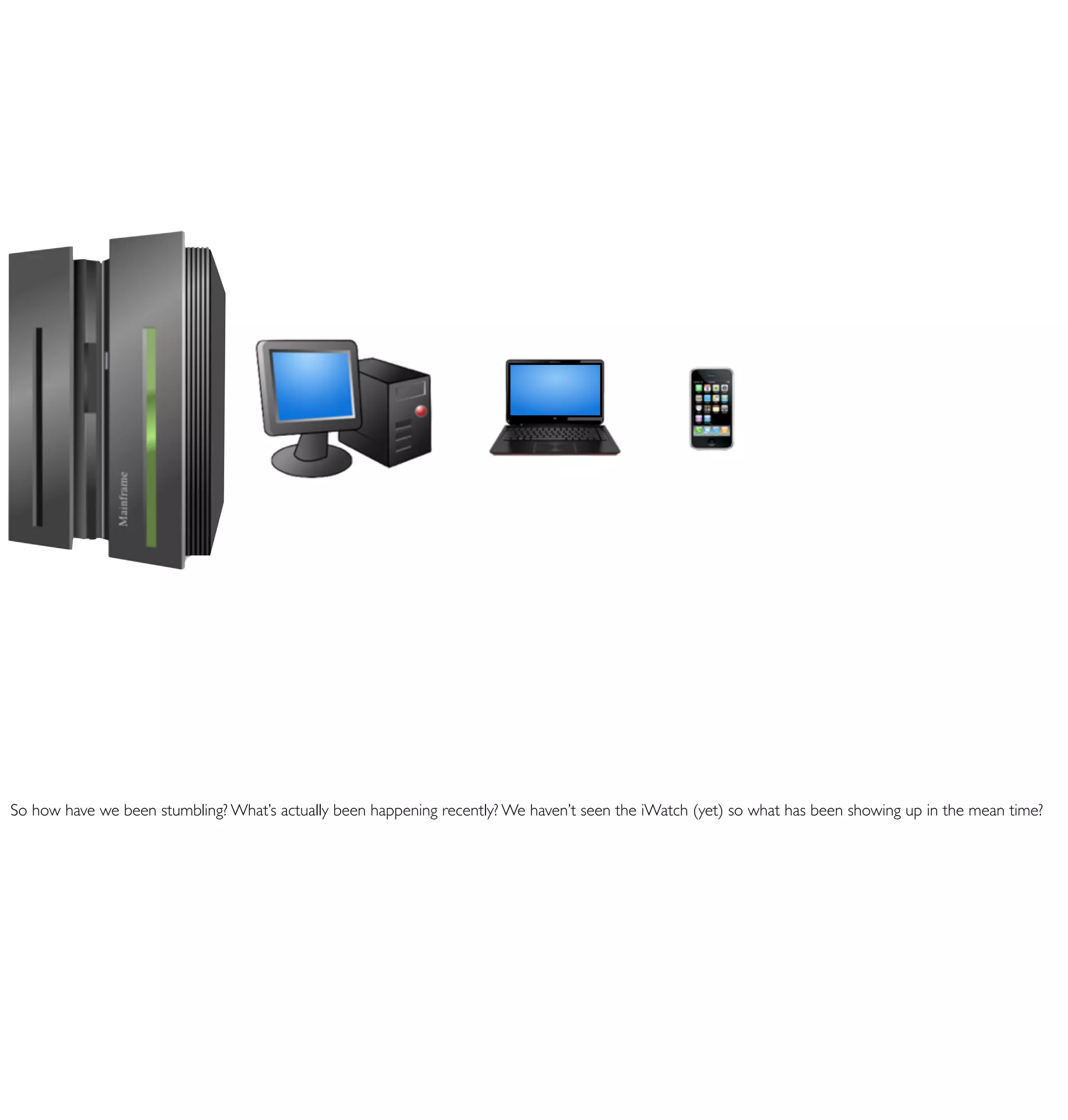
So how have we been stumbling? What’s actually been happening recently? We haven’t seen the iWatch (yet) so what has been showing up in the mean time?
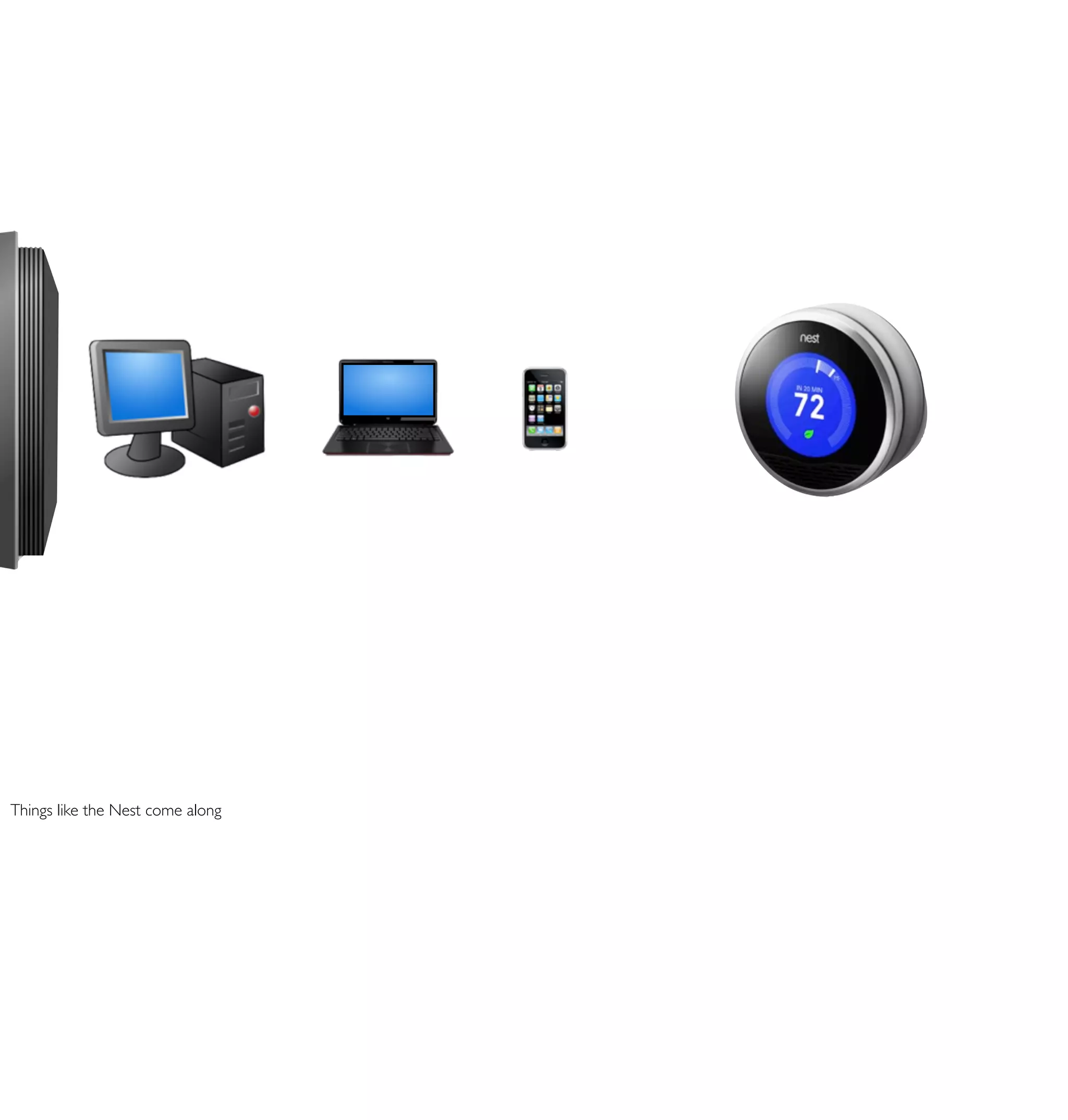
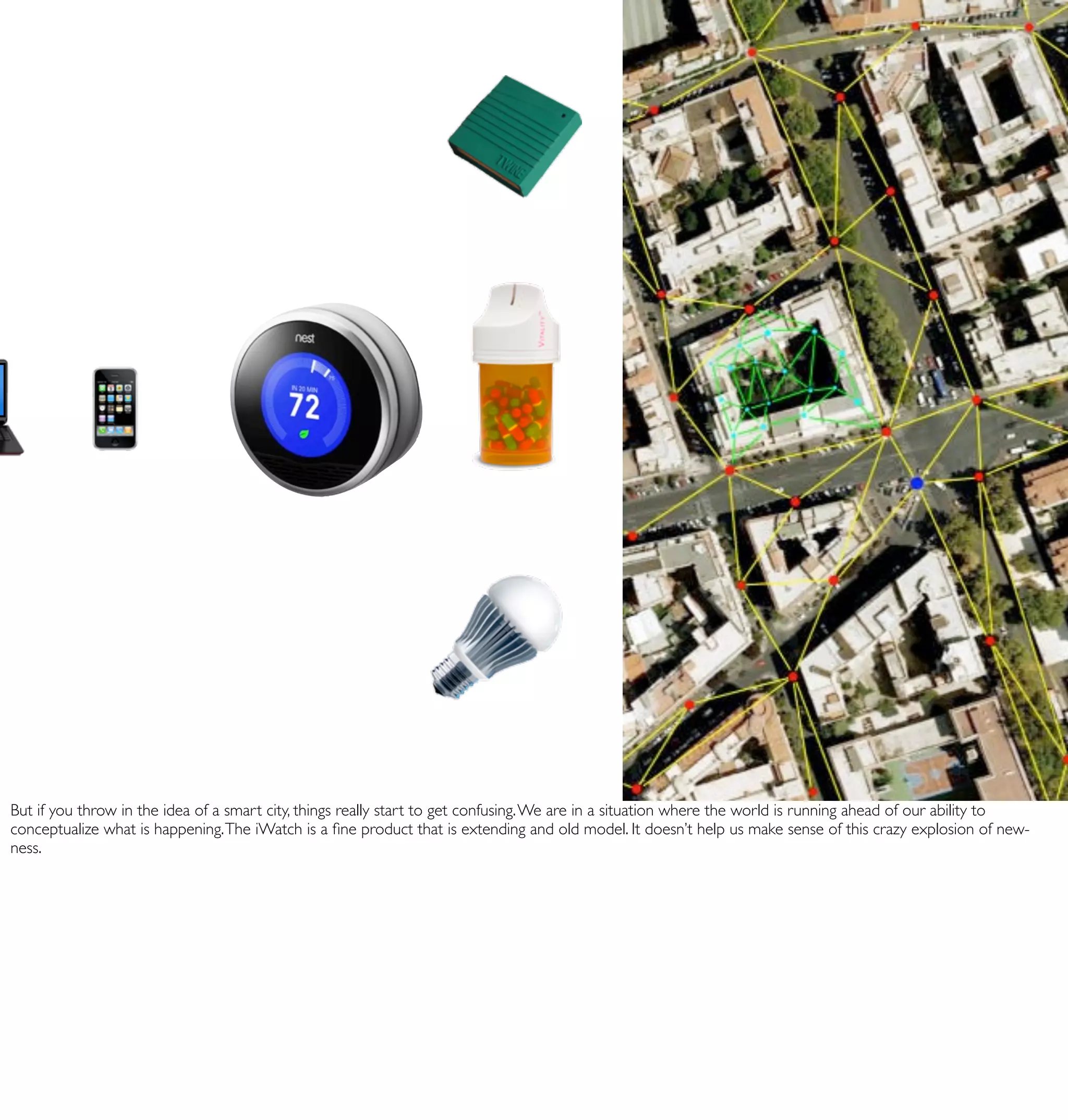
Things like the Nest come along
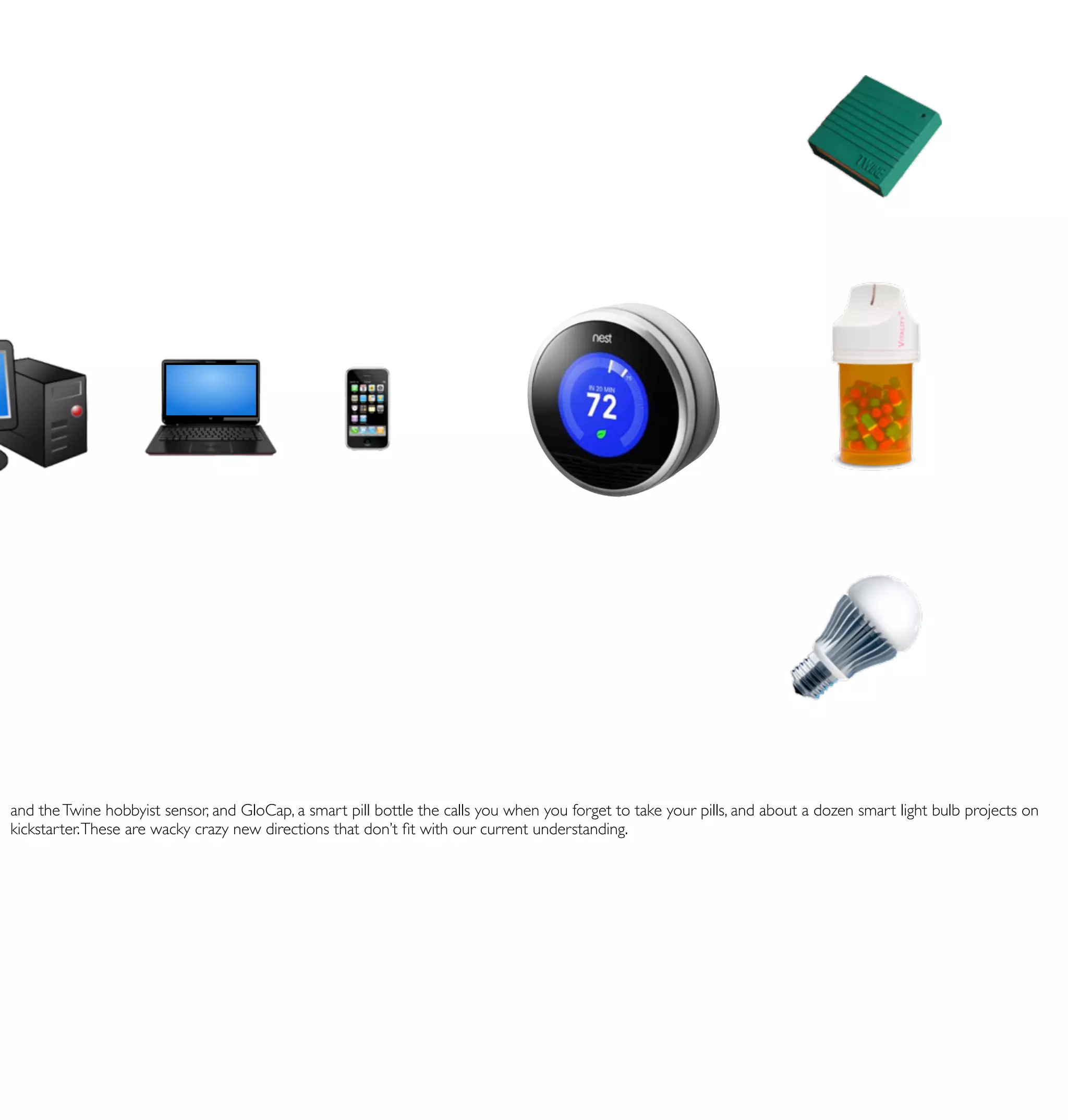
and the Twine hobbyist sensor, and GloCap, a smart pill bottle the calls you when you forget to take your pills, and about a dozen smart light bulb projects on
kickstarter. These are wacky crazy new directions that don’t fit with our current understanding.
But if you throw in the idea of a smart city, things really start to get confusing. We are in a situation where the world is running ahead of our ability to
conceptualize what is happening. The iWatch is a fine product that is extending and old model. It doesn’t help us make sense of this crazy explosion of new-
ness.
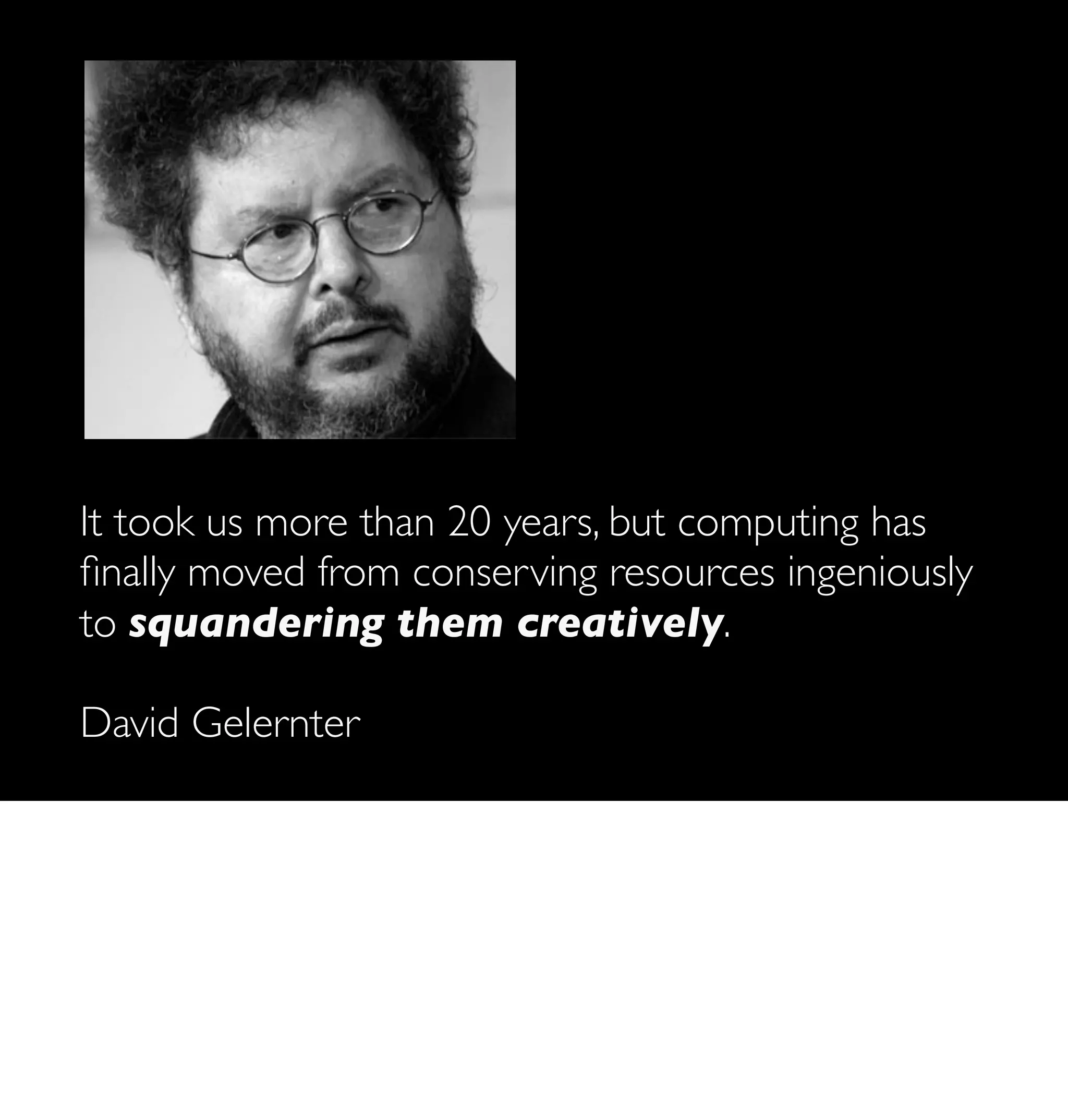
It took us more than 20 years, but computing has
finally moved from conserving resources ingeniously
to squandering them creatively.

David Gelernter
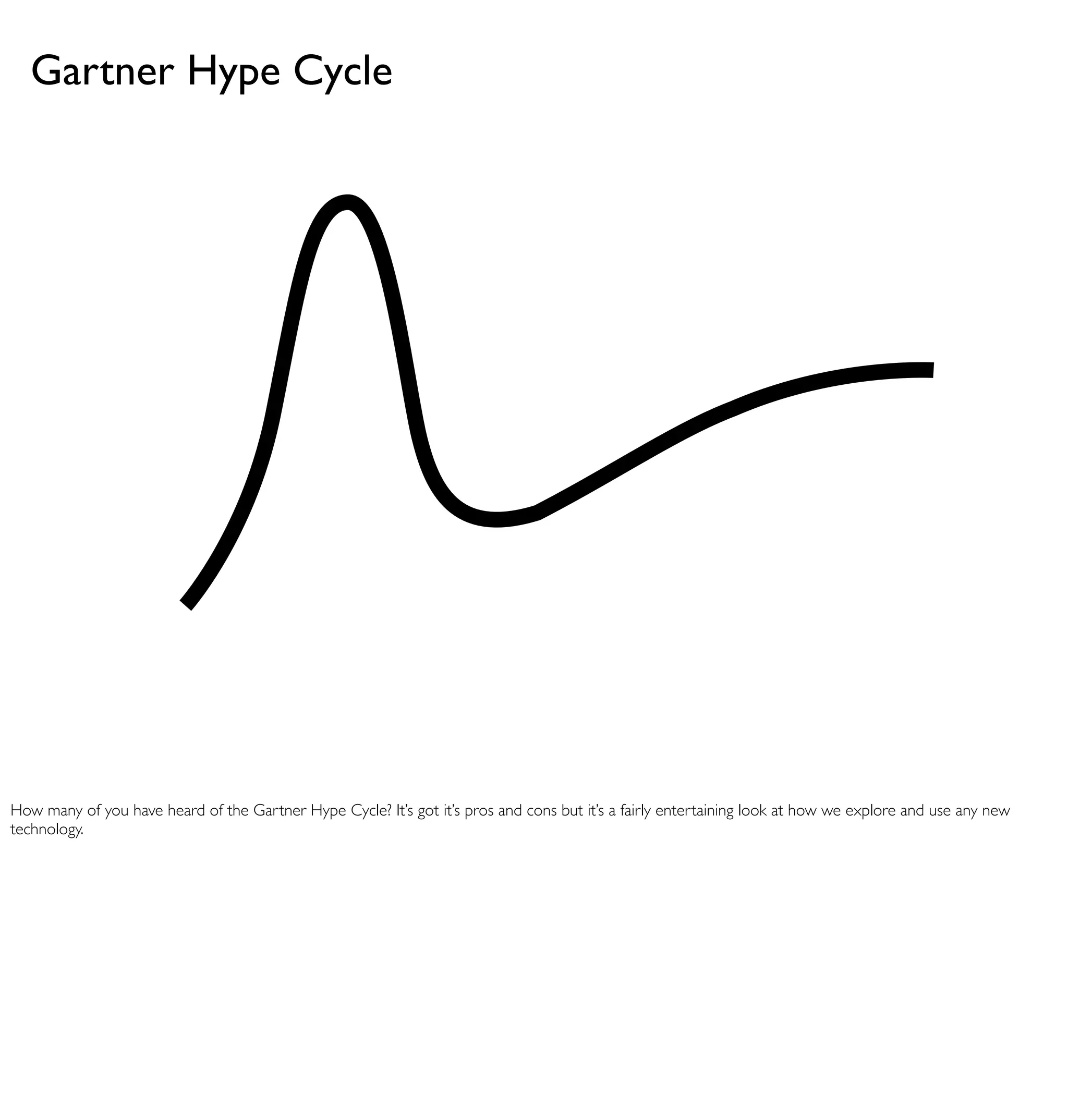
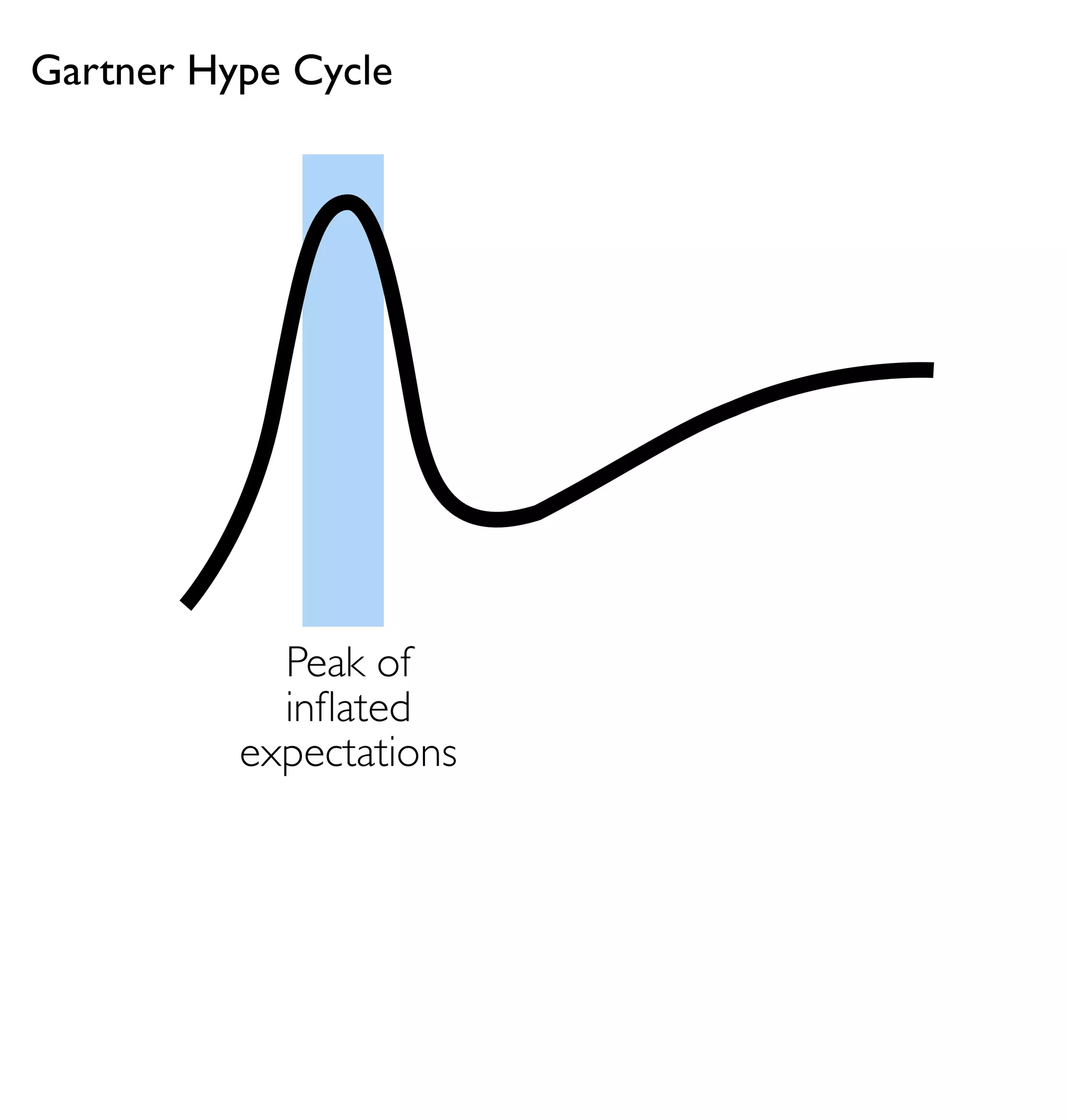
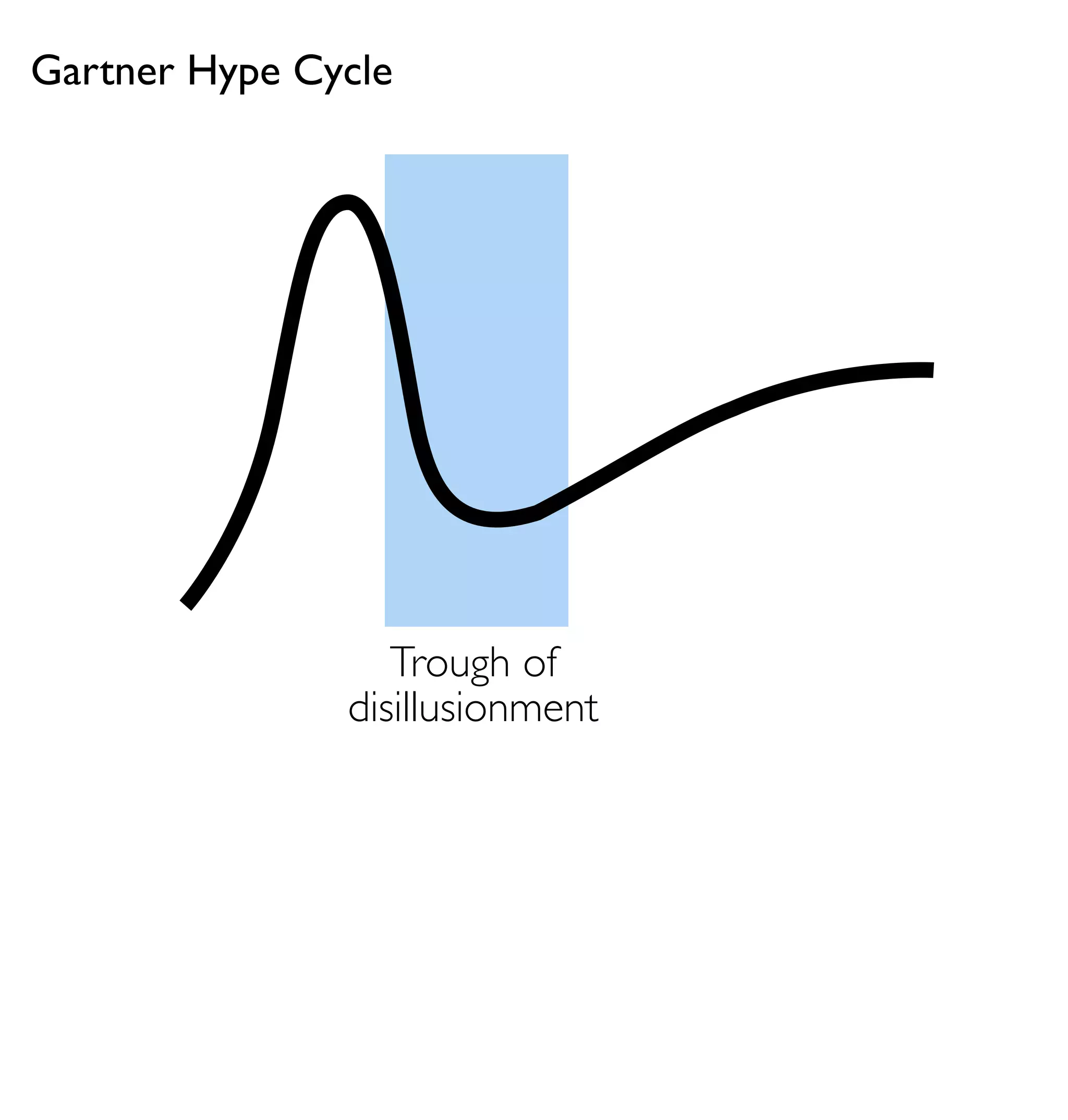
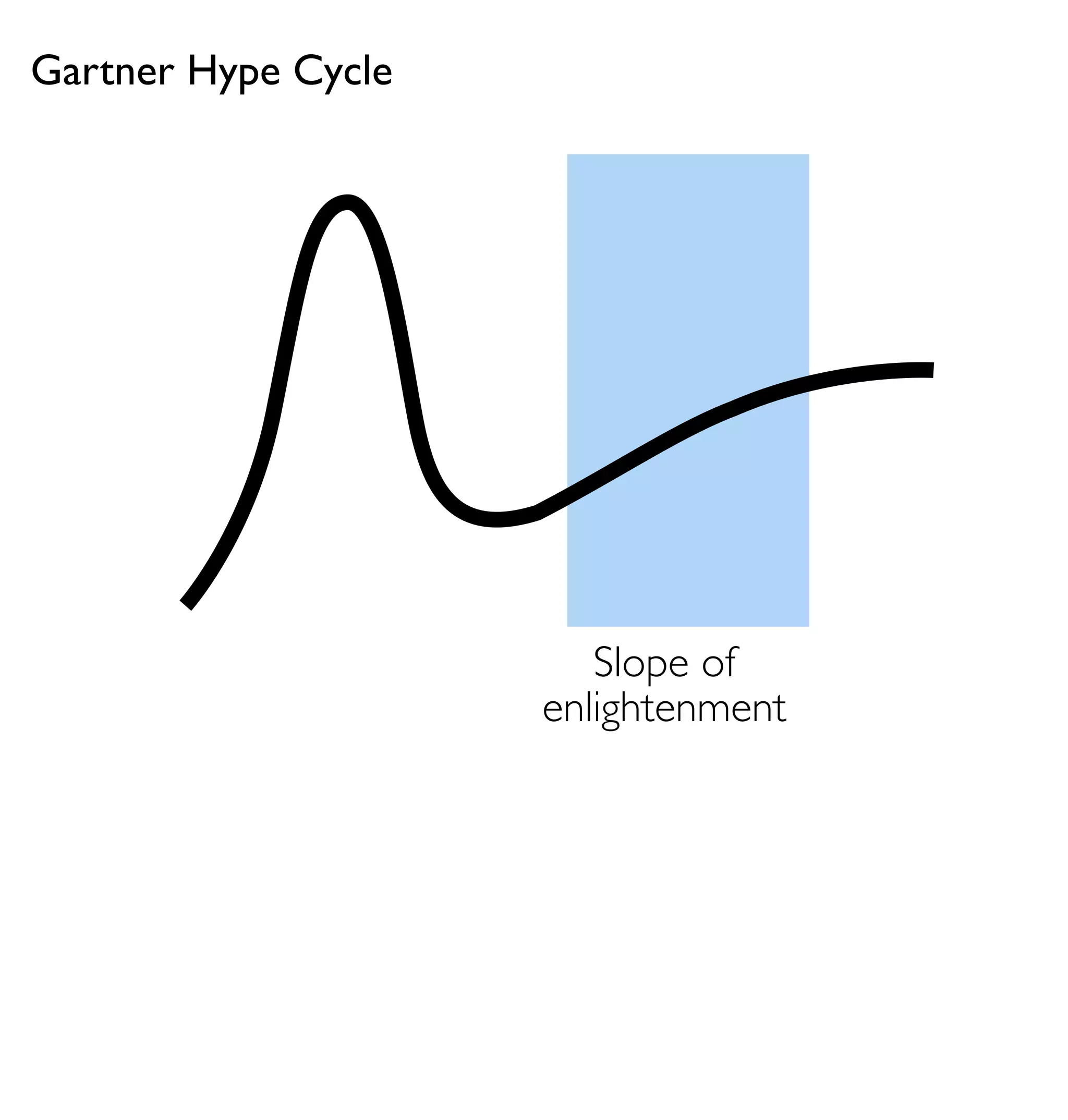
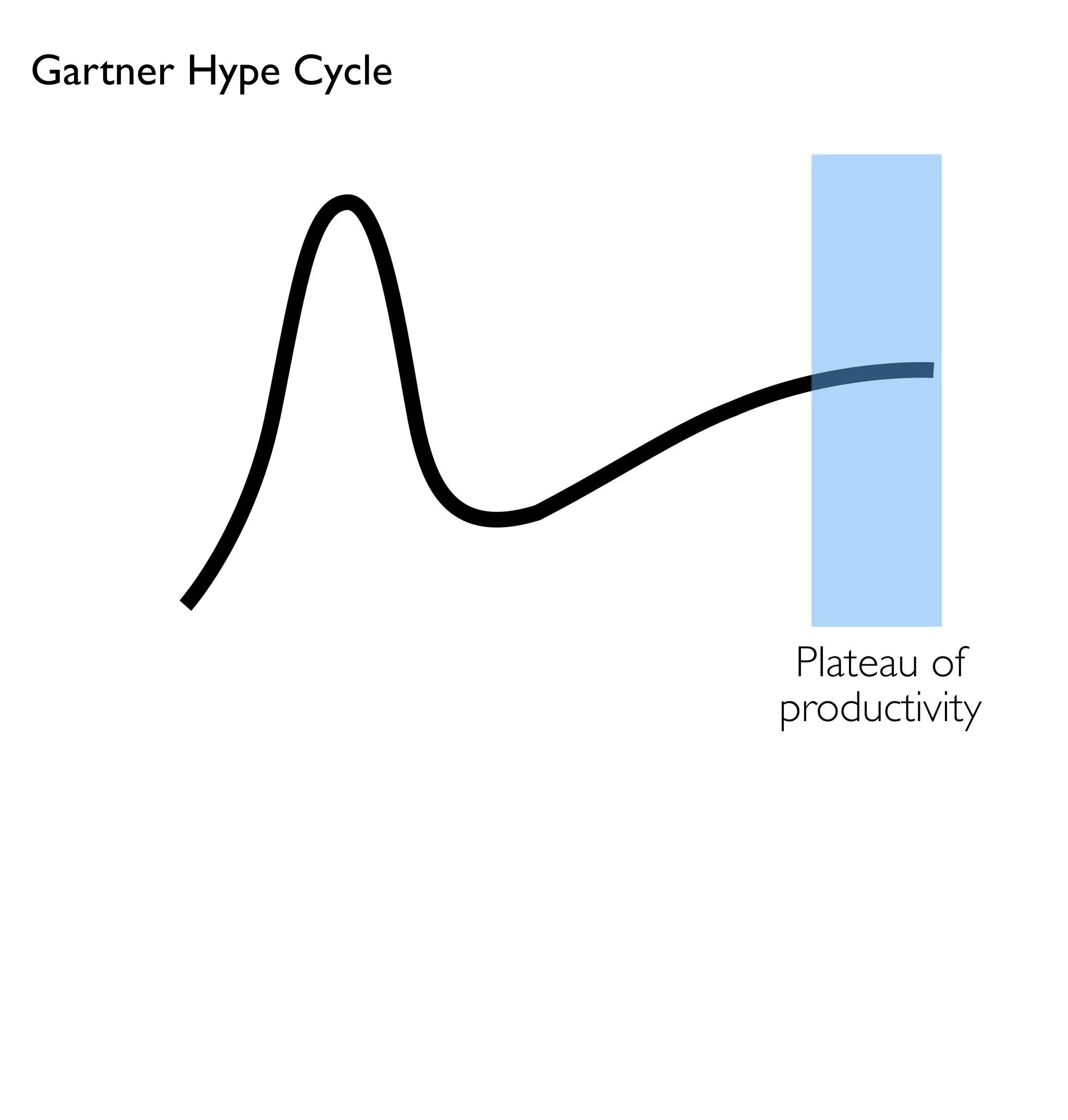
Gartner Hype Cycle


How many of you have heard of the Gartner Hype Cycle? It’s got it’s pros and cons but it’s a fairly entertaining look at how we explore and use any new
technology.
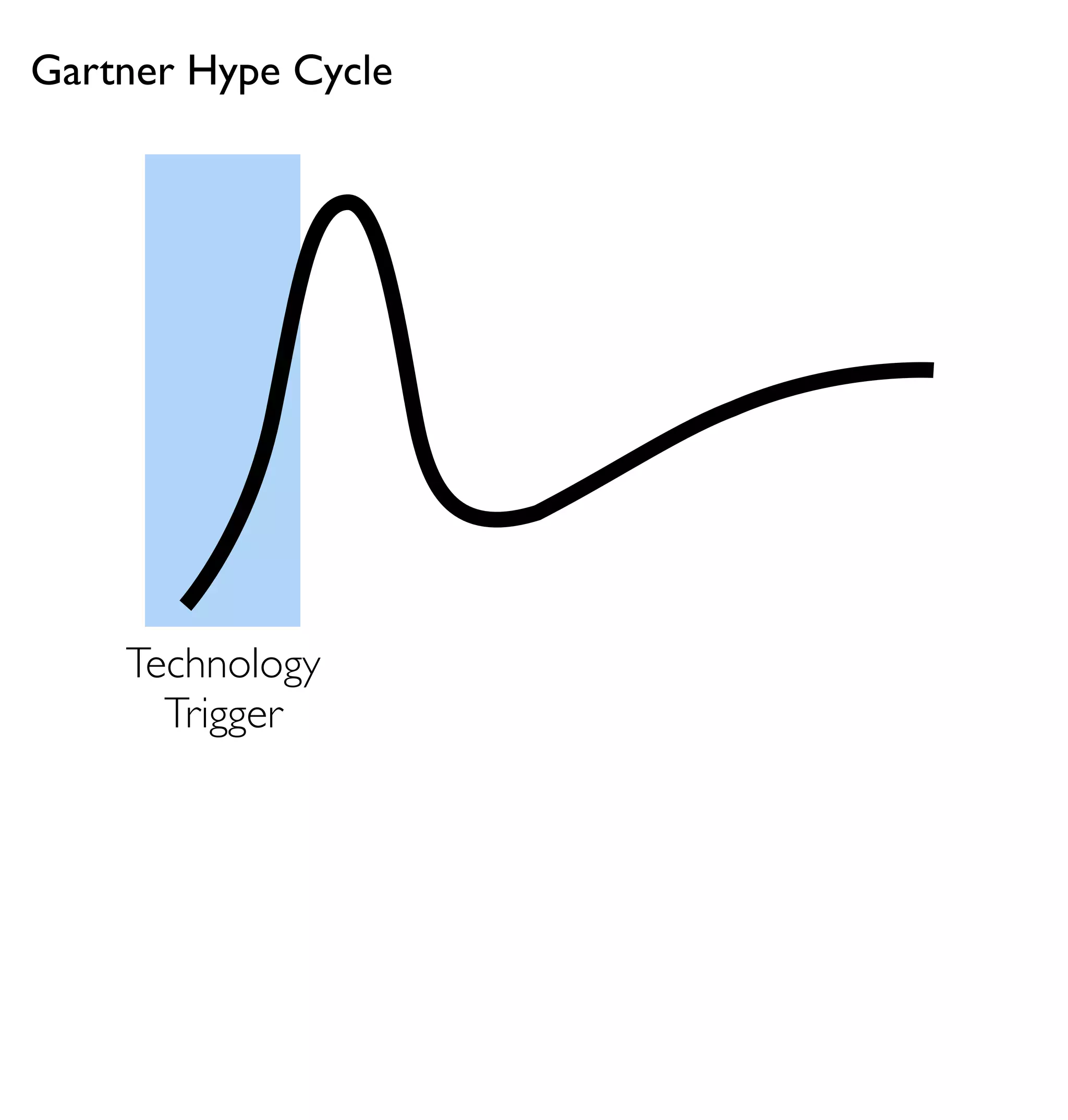
Gartner Hype Cycle


    Technology
      Trigger
Gartner Hype Cycle


            Peak of
            inflated
          expectations
Gartner Hype Cycle


                  Trough of
               disillusionment
Gartner Hype Cycle


                        Slope of
                     enlightenment
Gartner Hype Cycle


                      Plateau of
                     productivity
Gartner Hype Cycle
                                        3D Printing


           Internet of
             Things                                                   App Stores
                                                                                                                               Speech
                                                                                                                             Recognition
      Quantum
      Computing
                                                                    Virtual Worlds


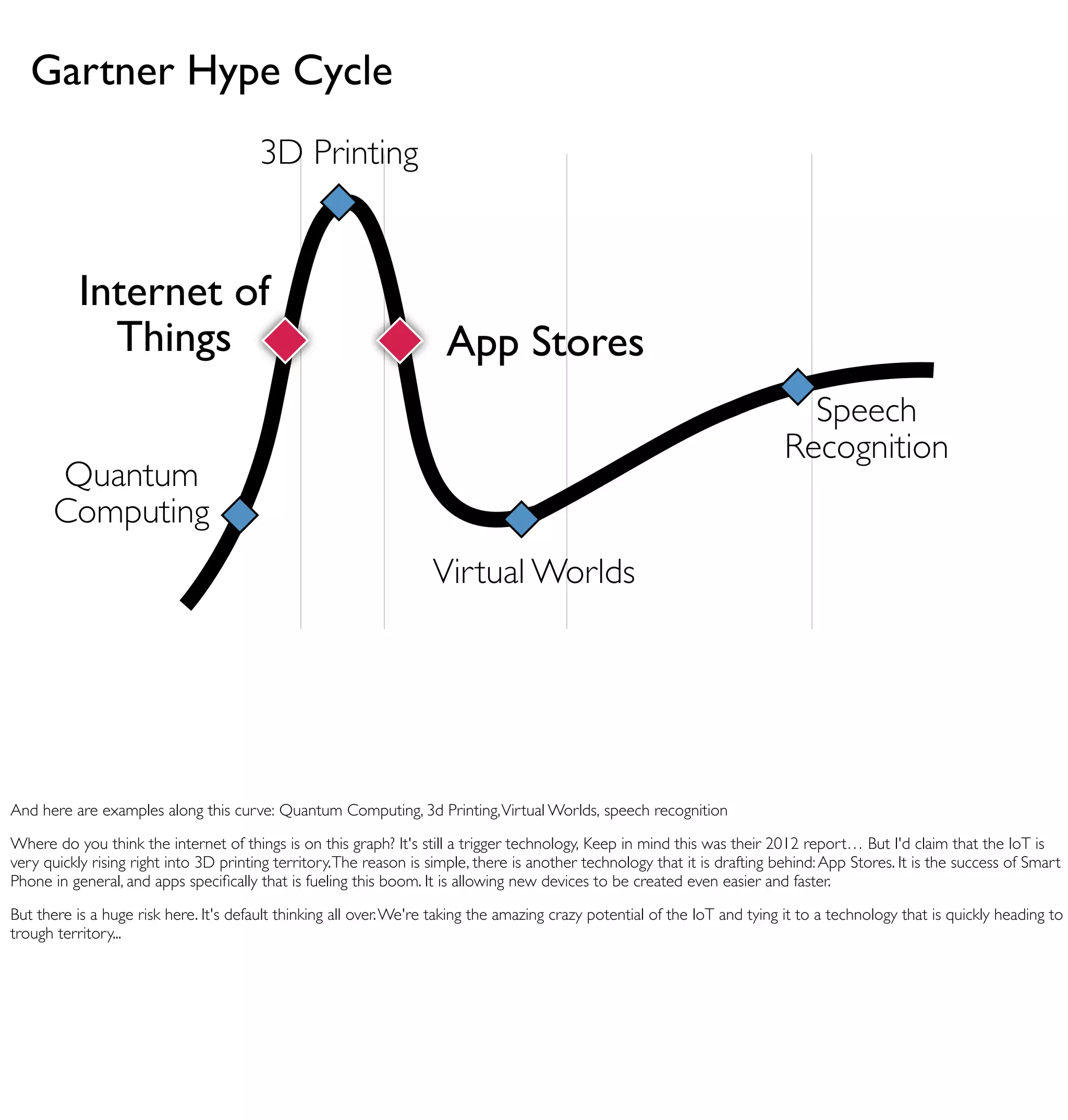
And here are examples along this curve: Quantum Computing, 3d Printing, Virtual Worlds, speech recognition

Where do you think the internet of things is on this graph? It's still a trigger technology, Keep in mind this was their 2012 report… But I'd claim that the IoT is
very quickly rising right into 3D printing territory. The reason is simple, there is another technology that it is drafting behind: App Stores. It is the success of Smart
Phone in general, and apps specifically that is fueling this boom. It is allowing new devices to be created even easier and faster.

But there is a huge risk here. It's default thinking all over. We're taking the amazing crazy potential of the IoT and tying it to a technology that is quickly heading to
trough territory...
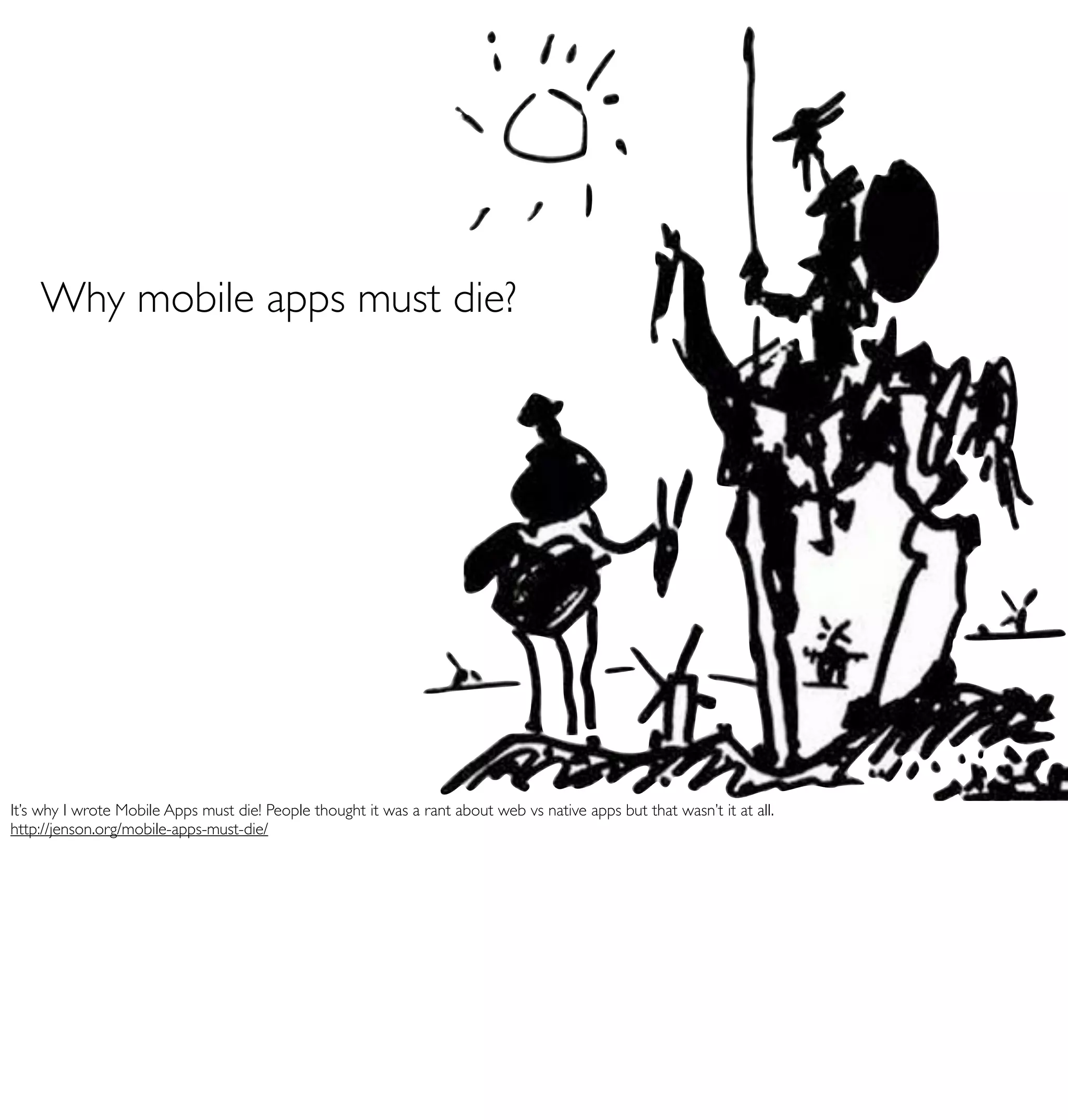
Why mobile apps must die?


It’s why I wrote Mobile Apps must die! People thought it was a rant about web vs native apps but that wasn’t it at all.
http://jenson.org/mobile-apps-must-die/
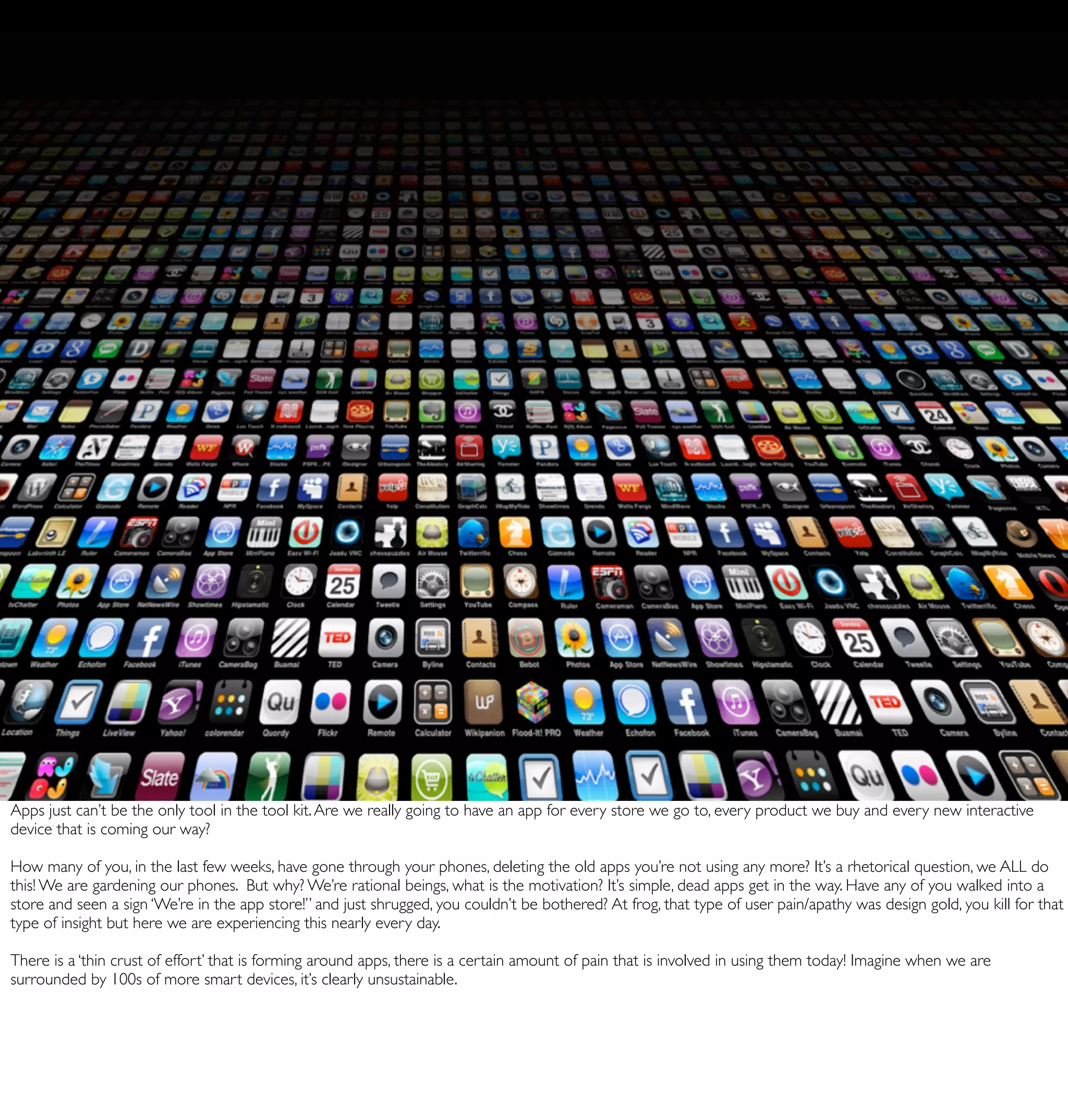
Apps just can’t be the only tool in the tool kit. Are we really going to have an app for every store we go to, every product we buy and every new interactive
device that is coming our way?

How many of you, in the last few weeks, have gone through your phones, deleting the old apps you’re not using any more? It’s a rhetorical question, we ALL do
this! We are gardening our phones. But why? We’re rational beings, what is the motivation? It’s simple, dead apps get in the way. Have any of you walked into a
store and seen a sign ‘We’re in the app store!” and just shrugged, you couldn’t be bothered? At frog, that type of user pain/apathy was design gold, you kill for that
type of insight but here we are experiencing this nearly every day.

There is a ‘thin crust of effort’ that is forming around apps, there is a certain amount of pain that is involved in using them today! Imagine when we are
surrounded by 100s of more smart devices, it’s clearly unsustainable.
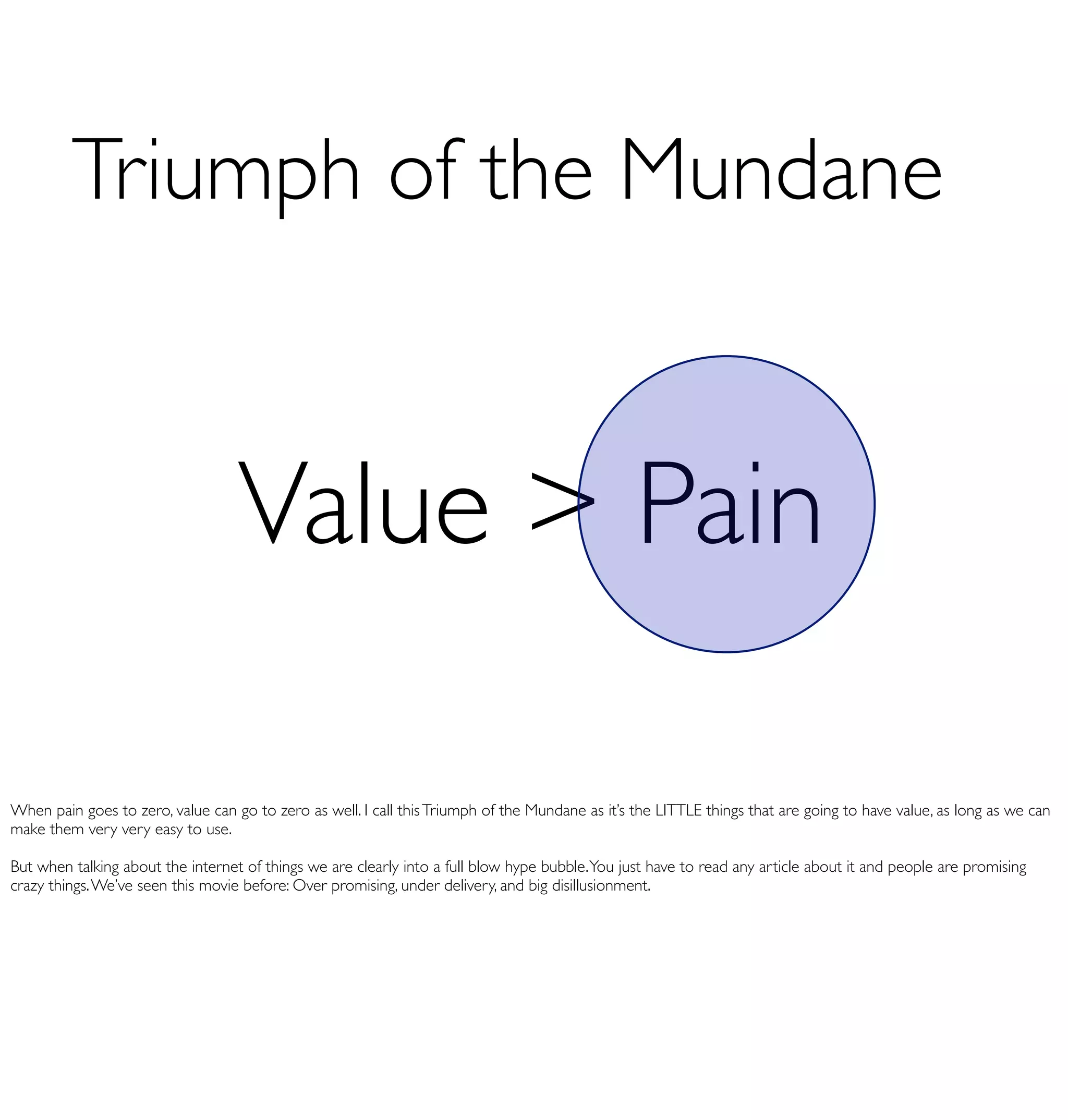
Value > Pain


There is a subtle force at work here, it’s not always about technology, sometimes it’s also about design. There is a basic design axiom that is at the heart of
almost all design: Value must be greater than pain. Let me give you an example. In the 1990’s The UX for SMS was *horrible* but it’s value was so high that
people persevered
Value > Pain


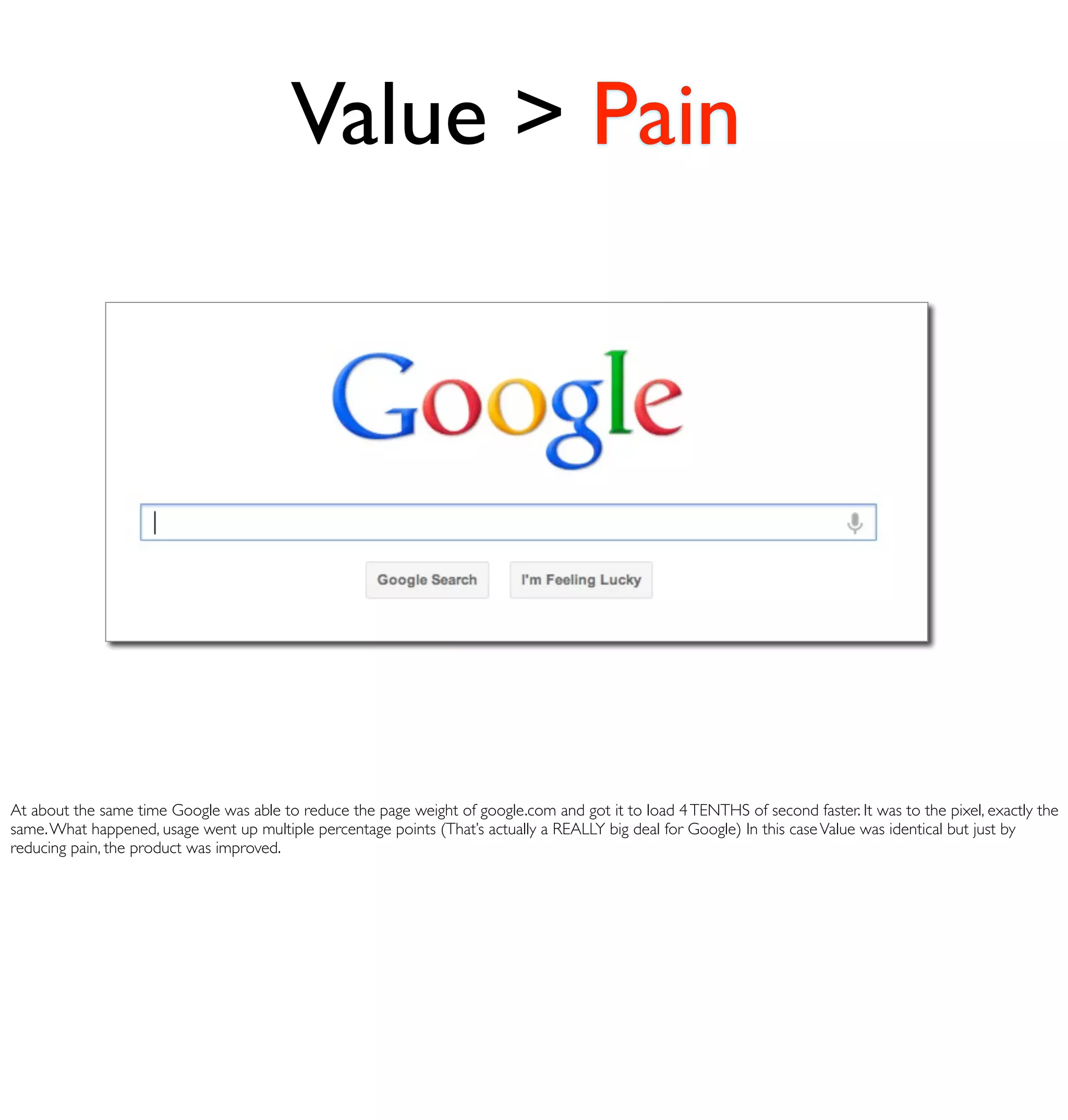
At about the same time Google was able to reduce the page weight of google.com and got it to load 4 TENTHS of second faster. It was to the pixel, exactly the
same. What happened, usage went up multiple percentage points (That’s actually a REALLY big deal for Google) In this case Value was identical but just by
reducing pain, the product was improved.
Triumph of the Mundane


                                   Value > Pain

When pain goes to zero, value can go to zero as well. I call this Triumph of the Mundane as it’s the LITTLE things that are going to have value, as long as we can
make them very very easy to use.

But when talking about the internet of things we are clearly into a full blow hype bubble. You just have to read any article about it and people are promising
crazy things. We’ve seen this movie before: Over promising, under delivery, and big disillusionment.
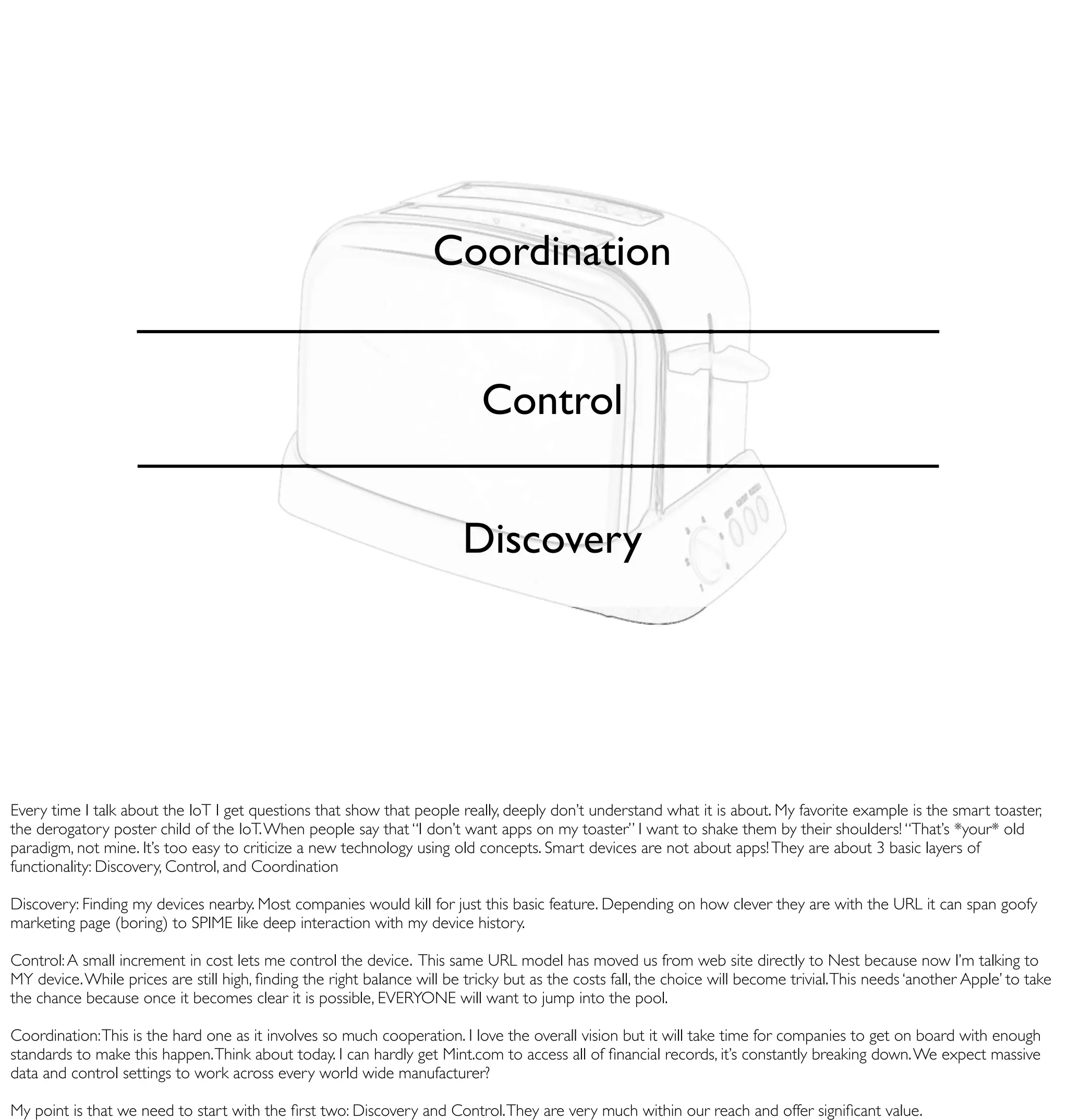
Coordination


                                                                            Control


                                                                         Discovery


Every time I talk about the IoT I get questions that show that people really, deeply don’t understand what it is about. My favorite example is the smart toaster,
the derogatory poster child of the IoT. When people say that “I don’t want apps on my toaster” I want to shake them by their shoulders! “That’s *your* old
paradigm, not mine. It’s too easy to criticize a new technology using old concepts. Smart devices are not about apps! They are about 3 basic layers of
functionality: Discovery, Control, and Coordination

Discovery: Finding my devices nearby. Most companies would kill for just this basic feature. Depending on how clever they are with the URL it can span goofy
marketing page (boring) to SPIME like deep interaction with my device history.

Control: A small increment in cost lets me control the device. This same URL model has moved us from web site directly to Nest because now I’m talking to
MY device. While prices are still high, finding the right balance will be tricky but as the costs fall, the choice will become trivial. This needs ‘another Apple’ to take
the chance because once it becomes clear it is possible, EVERYONE will want to jump into the pool.

Coordination: This is the hard one as it involves so much cooperation. I love the overall vision but it will take time for companies to get on board with enough
standards to make this happen. Think about today. I can hardly get Mint.com to access all of financial records, it’s constantly breaking down. We expect massive
data and control settings to work across every world wide manufacturer?

My point is that we need to start with the first two: Discovery and Control. They are very much within our reach and offer significant value.
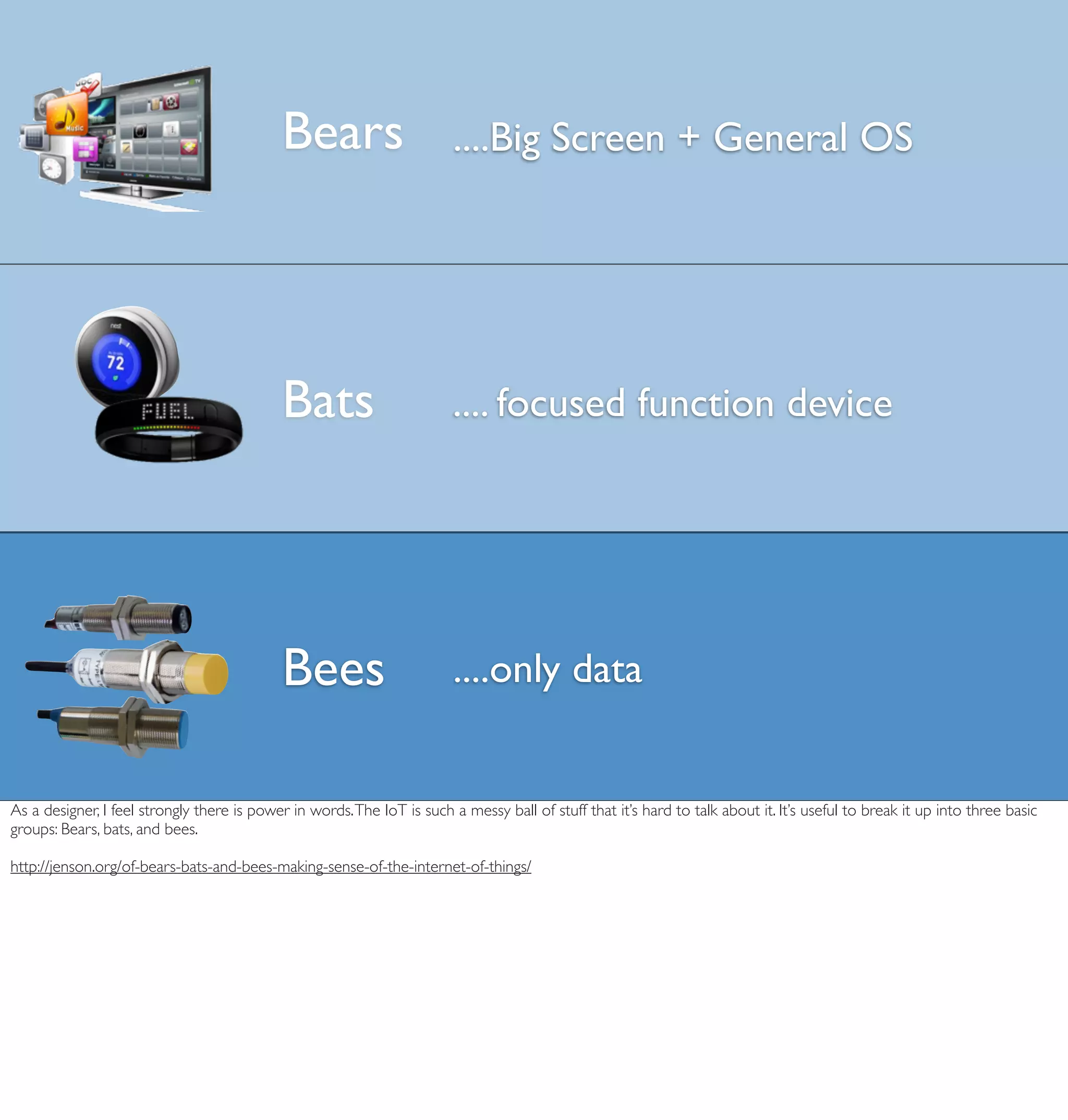
Bears                        ....Big Screen + General OS


                                            Bats                         .... focused function device


                                            Bees                         ....only data


As a designer, I feel strongly there is power in words. The IoT is such a messy ball of stuff that it’s hard to talk about it. It’s useful to break it up into three basic
groups: Bears, bats, and bees.

http://jenson.org/of-bears-bats-and-bees-making-sense-of-the-internet-of-things/
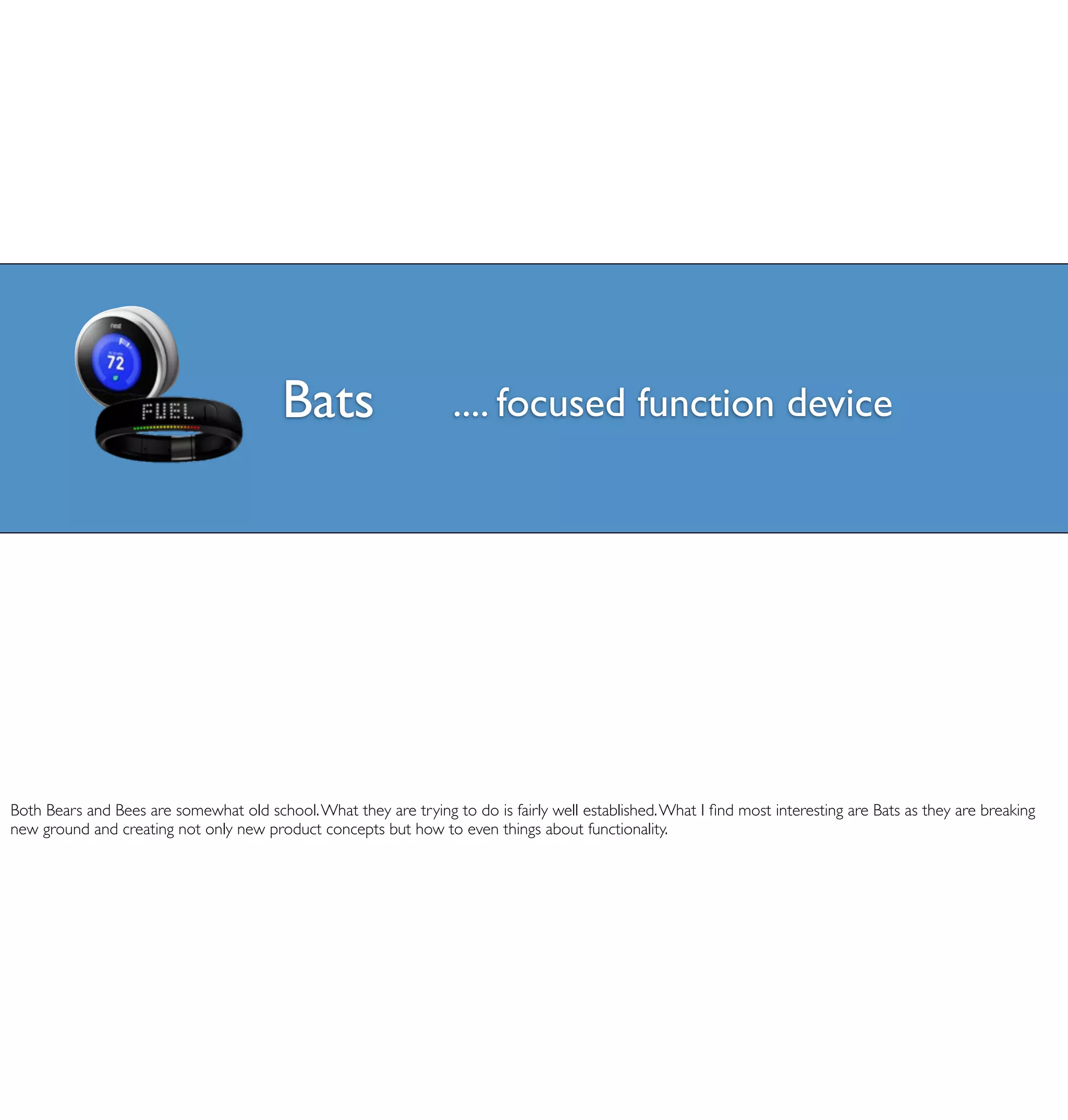
Bats                      .... focused function device


Both Bears and Bees are somewhat old school. What they are trying to do is fairly well established. What I find most interesting are Bats as they are breaking
new ground and creating not only new product concepts but how to even things about functionality.
Just in Time
                                                                                              Interaction


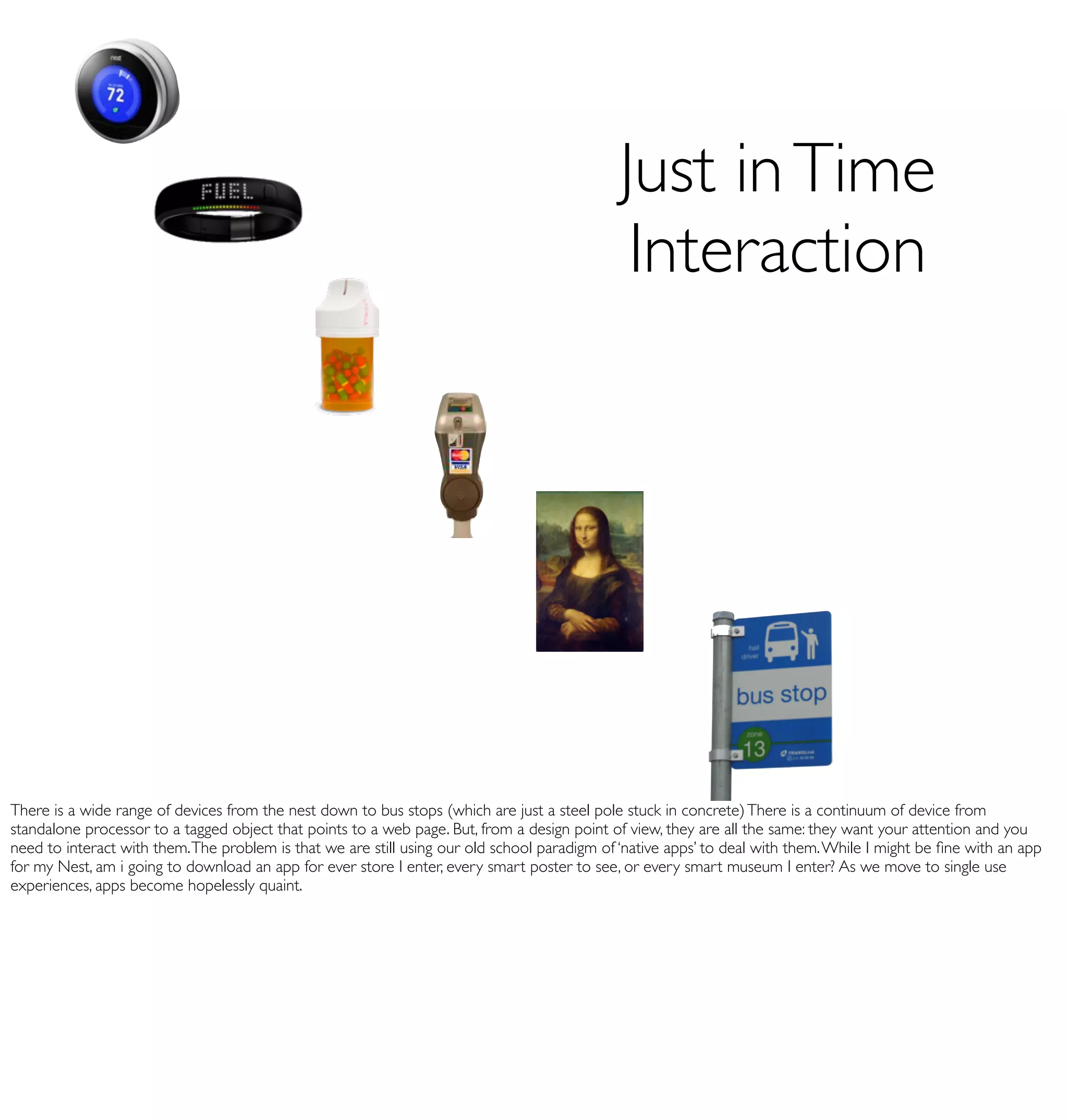
There is a wide range of devices from the nest down to bus stops (which are just a steel pole stuck in concrete) There is a continuum of device from
standalone processor to a tagged object that points to a web page. But, from a design point of view, they are all the same: they want your attention and you
need to interact with them. The problem is that we are still using our old school paradigm of ‘native apps’ to deal with them. While I might be fine with an app
for my Nest, am i going to download an app for ever store I enter, every smart poster to see, or every smart museum I enter? As we move to single use
experiences, apps become hopelessly quaint.
Insanity is doing exactly the same thing....
and expecting a different result.
Einstein
Paradigm
                                                                                                                           Shift


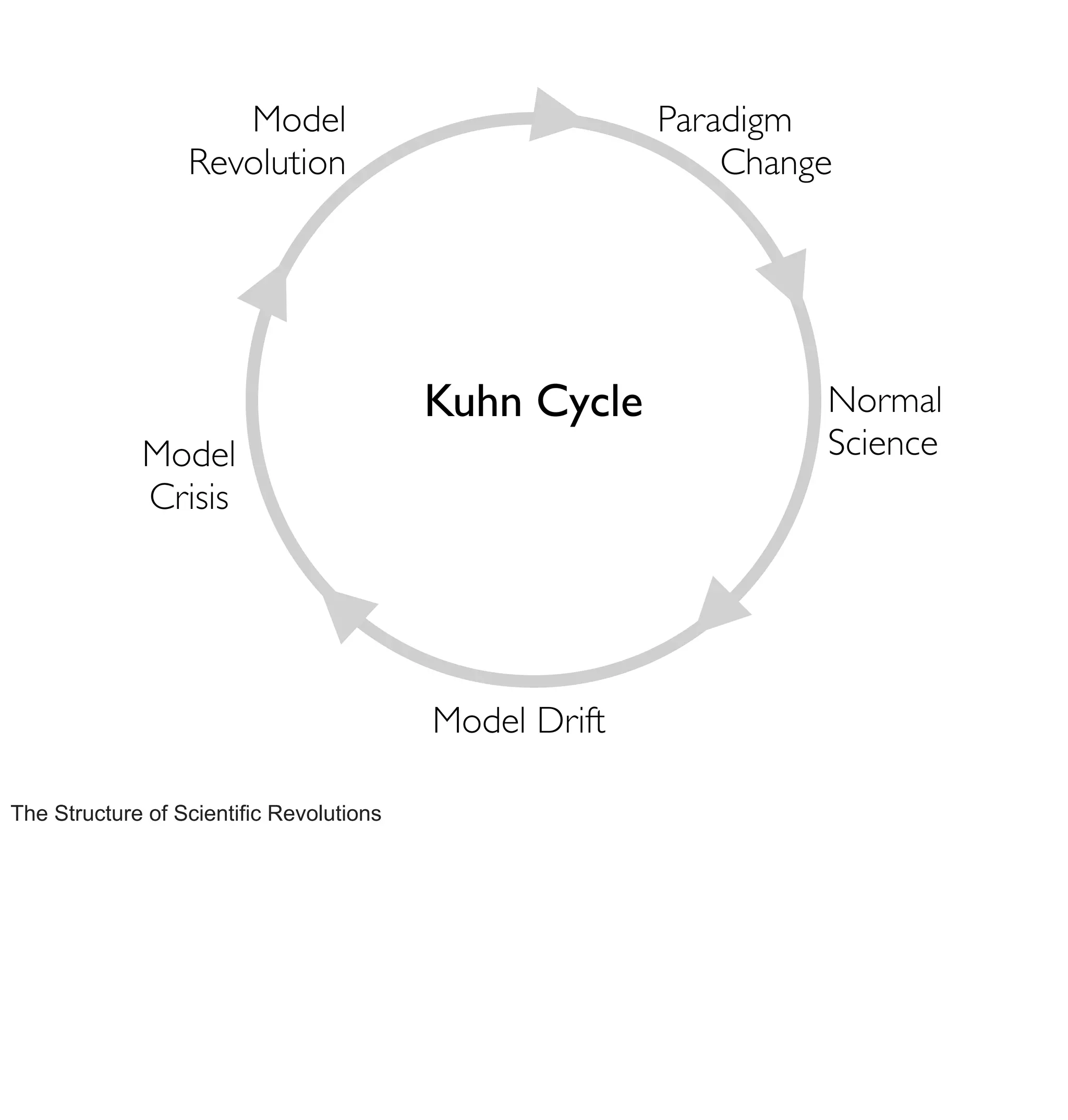
We need a paradigm shift: to see things in a new way. Thomas Kuhn talked about how shifts occur in the scientific community. Before every great shift was a
‘model crisis’ where things started to fray at the edge. Nothing dramatic, the old guard always yells relax, thing are fine and the new blood keeps pushing for
something new. It’s a classic tension.
Model                              Paradigm
                  Revolution                                Change       


                                          Kuhn Cycle               Normal
             Model                                                 Science
             Crisis


                                          Model Drift

The Structure of Scientific Revolutions
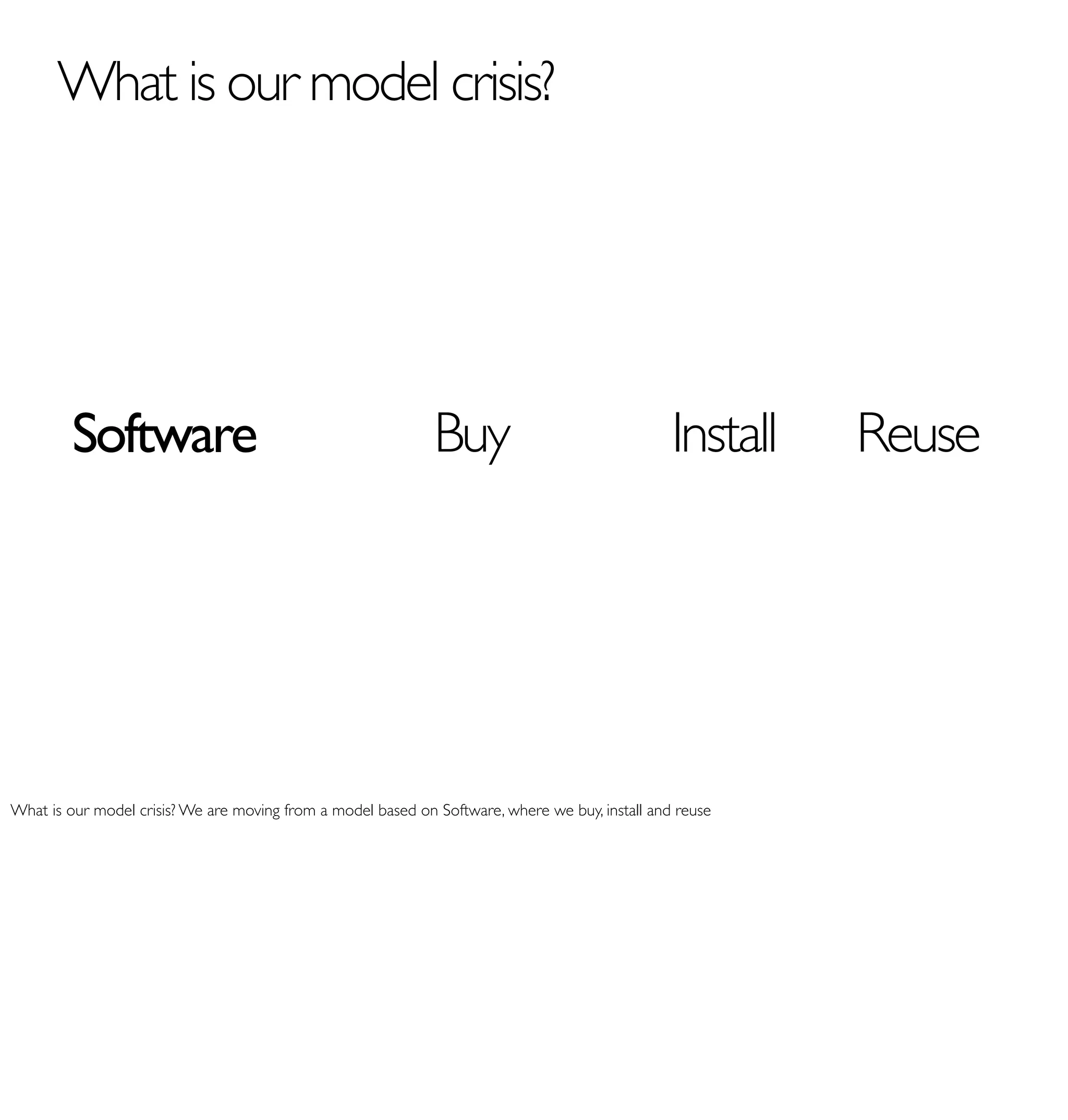
What is our model crisis?


         Software                                             Buy                                Install   Reuse


What is our model crisis? We are moving from a model based on Software, where we buy, install and reuse
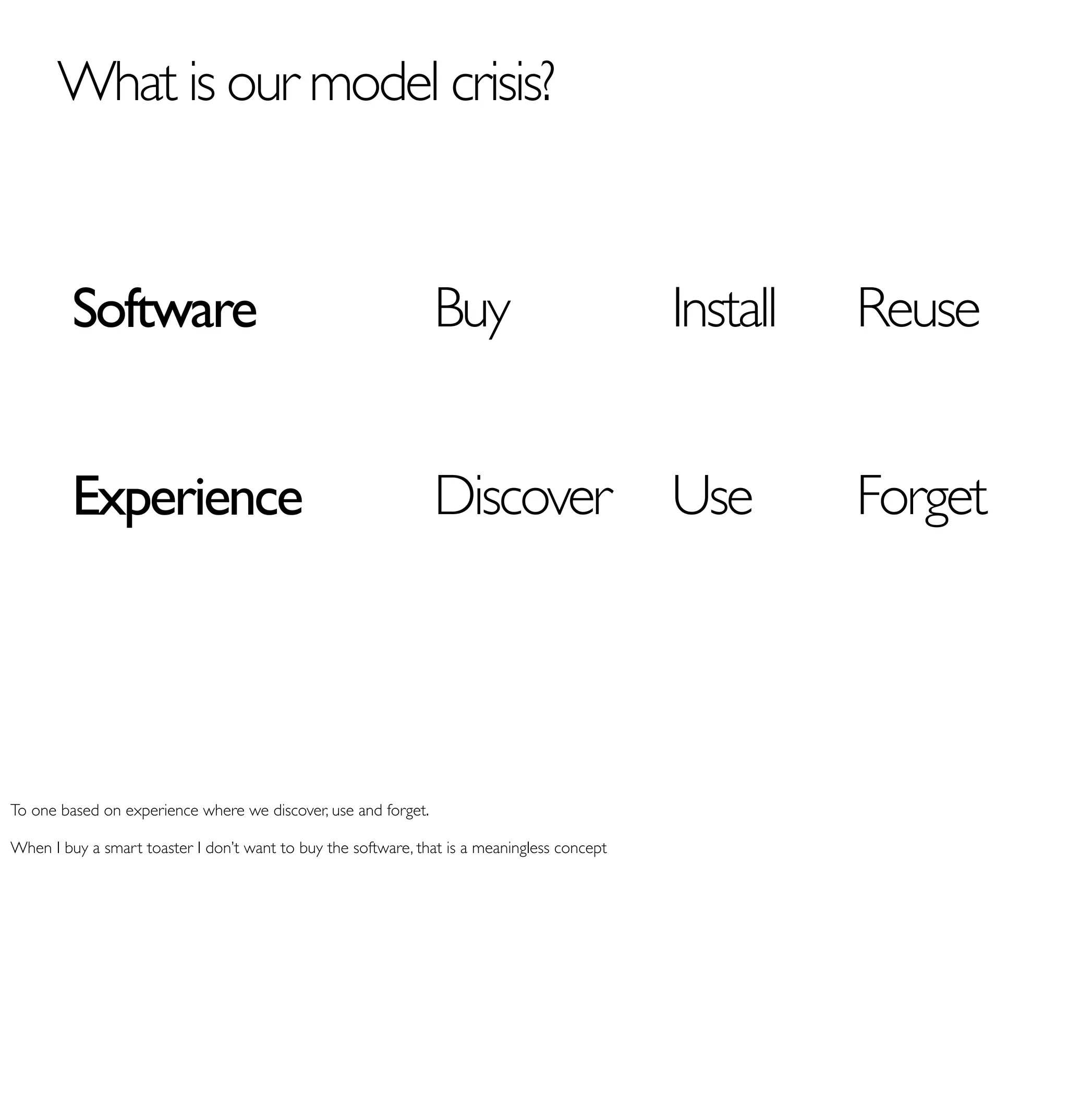
What is our model crisis?


         Software                                               Buy                          Install   Reuse


         Experience                                             Discover                     Use       Forget


To one based on experience where we discover, use and forget.

When I buy a smart toaster I don’t want to buy the software, that is a meaningless concept
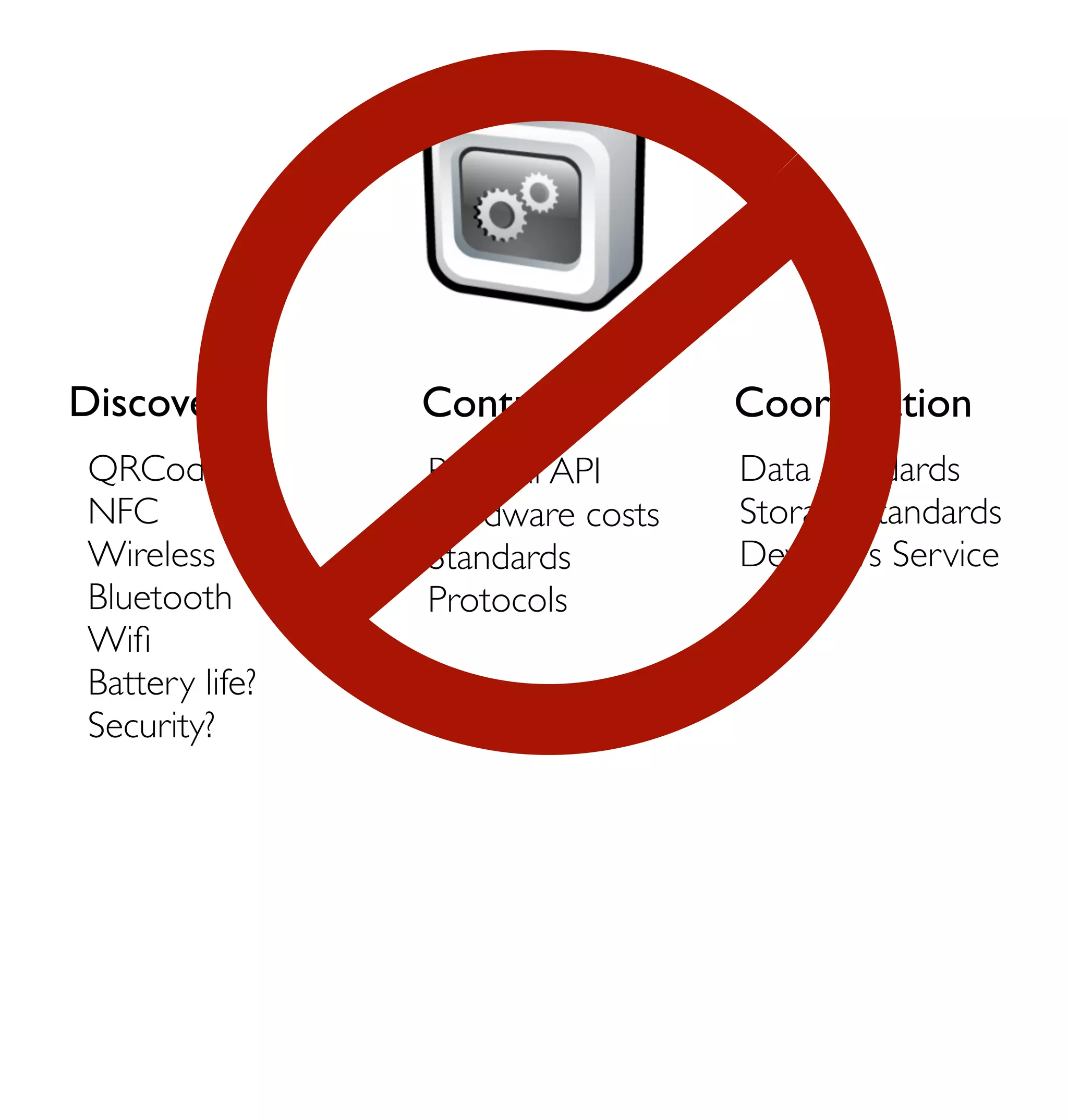
Discovery       Control          Coordination
QRCode          RESTful API      Data standards
NFC             Hardware costs   Storage standards
Wireless        Standards        Device vs Service
Bluetooth       Protocols
Wifi
Battery life?
Security?
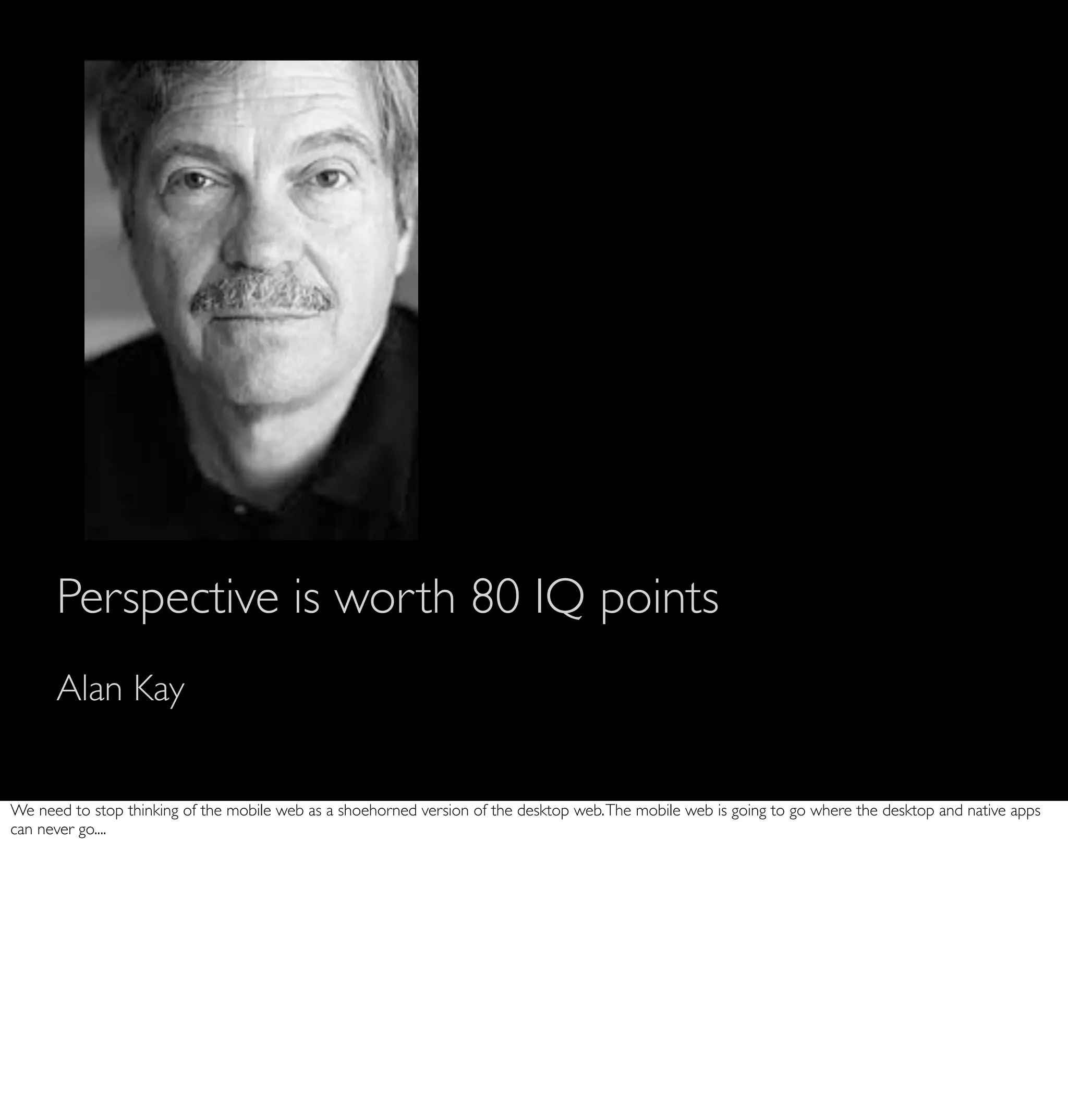
Perspective is worth 80 IQ points
      Alan Kay


We need to stop thinking of the mobile web as a shoehorned version of the desktop web. The mobile web is going to go where the desktop and native apps
can never go....
Silos are counter productive
Remember these guys? They were the ‘pre-web’, for a while, they were much better than the web. They competed, tried to encourage people to come to
them. The web, at least initially, was quite bad, but it eventually overran all of them for the simple reason of scope and reach: they all couldn’t have everything.
Yet this is what we’re doing today: we’re getting locked into silos of devices and content. If an open solution gets started, it will almost certainly be worse at
first, but it will structurally encourage a much better, broader approach. It will blow past these silos over time.
Malcom McLean

Do you know this guy? He is my hero! He single handedly invented the container ship business and then, realizing that it would only work if the world
standardized, he GAVE AWAY ALL OF THIS PATENTS! Of course this was very enlightened self interest as his company reaped the benefit of this but it was
still an overall plus for the world. He was voted ‘Maritime Man of the Century!” for his work.
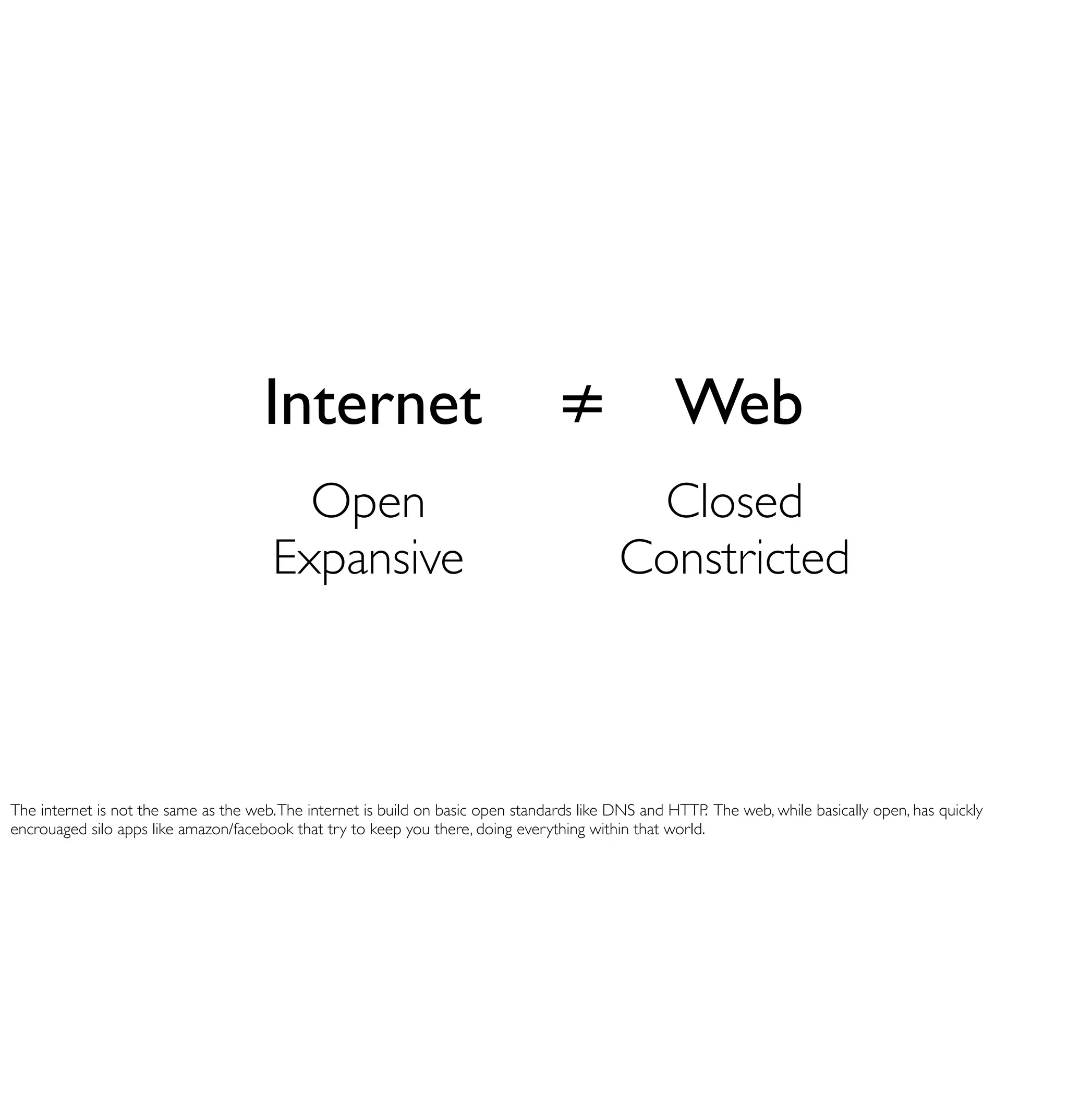
Internet                                     ≠ Web
                                         Open                                                Closed
                                       Expansive                                            Constricted


The internet is not the same as the web. The internet is build on basic open standards like DNS and HTTP. The web, while basically open, has quickly
encrouaged silo apps like amazon/facebook that try to keep you there, doing everything within that world.
All my data, in one place


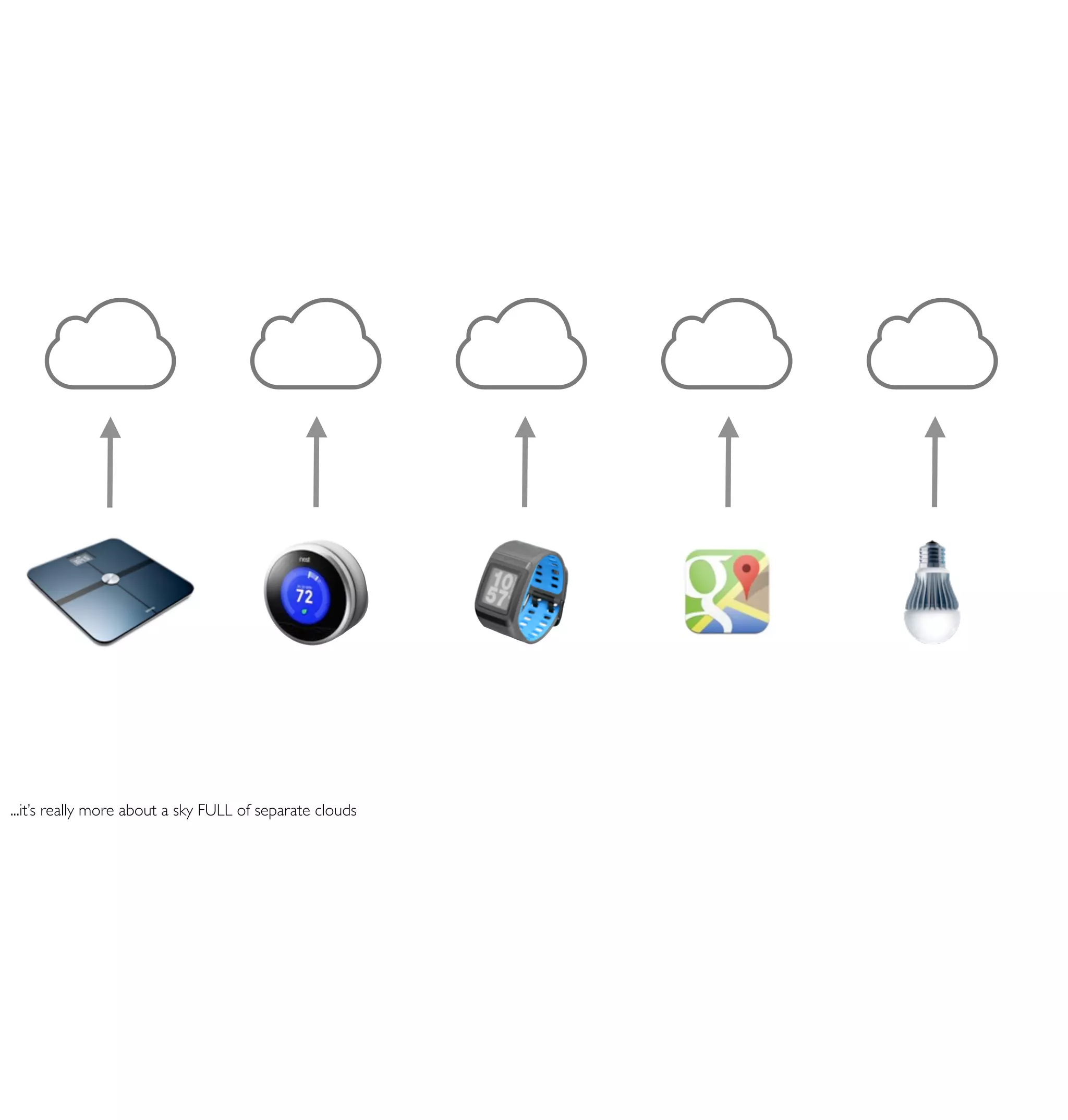
I chuckle whenever people talk about ‘THE cloud’. That’s not quite right...
...it’s really more about a sky FULL of separate clouds
API


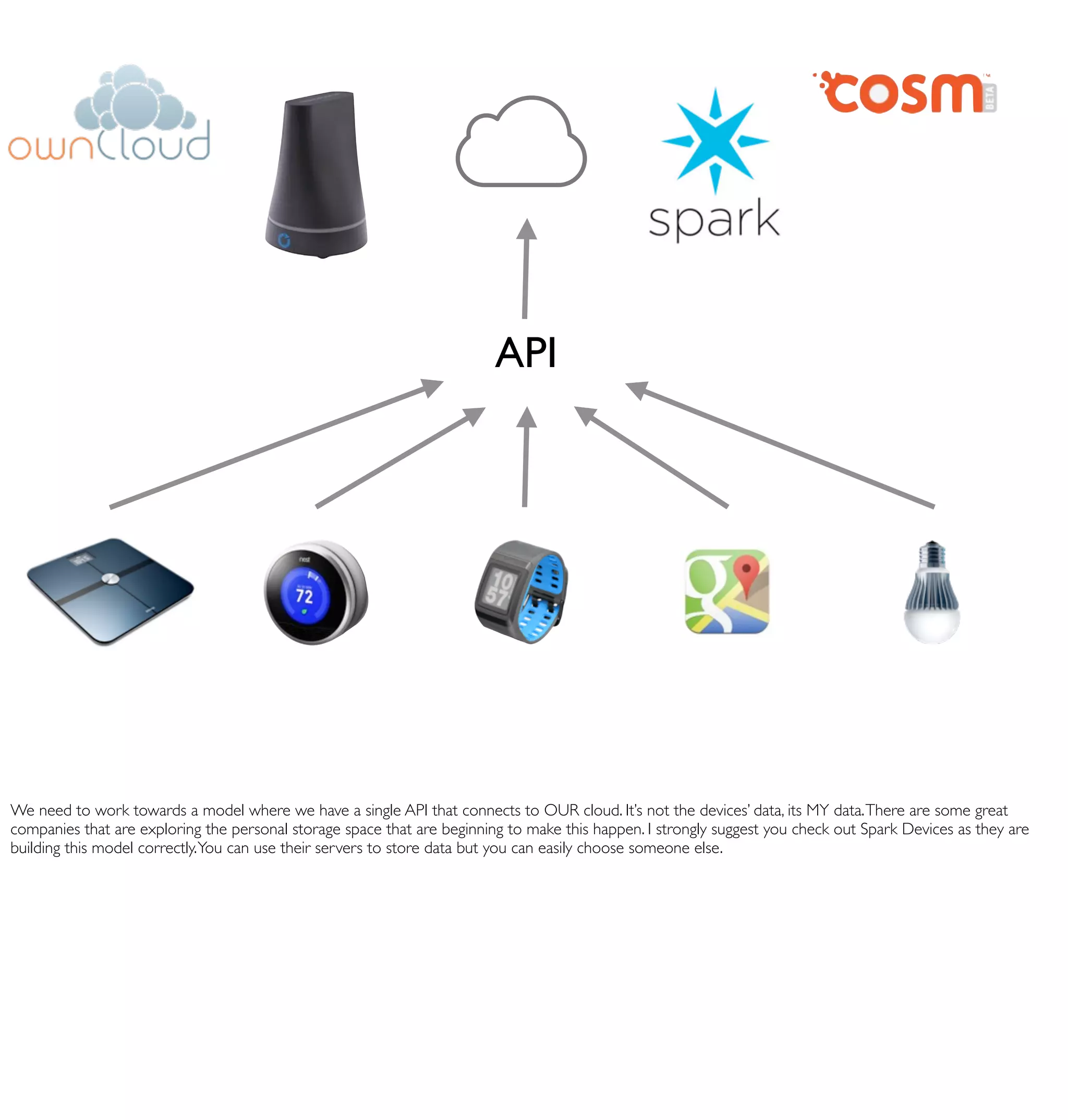
We need to work towards a model where we have a single API that connects to OUR cloud. It’s not the devices’ data, its MY data. There are some great
companies that are exploring the personal storage space that are beginning to make this happen. I strongly suggest you check out Spark Devices as they are
building this model correctly. You can use their servers to store data but you can easily choose someone else.
Google your room
Next
                                                                                         ‘Google’


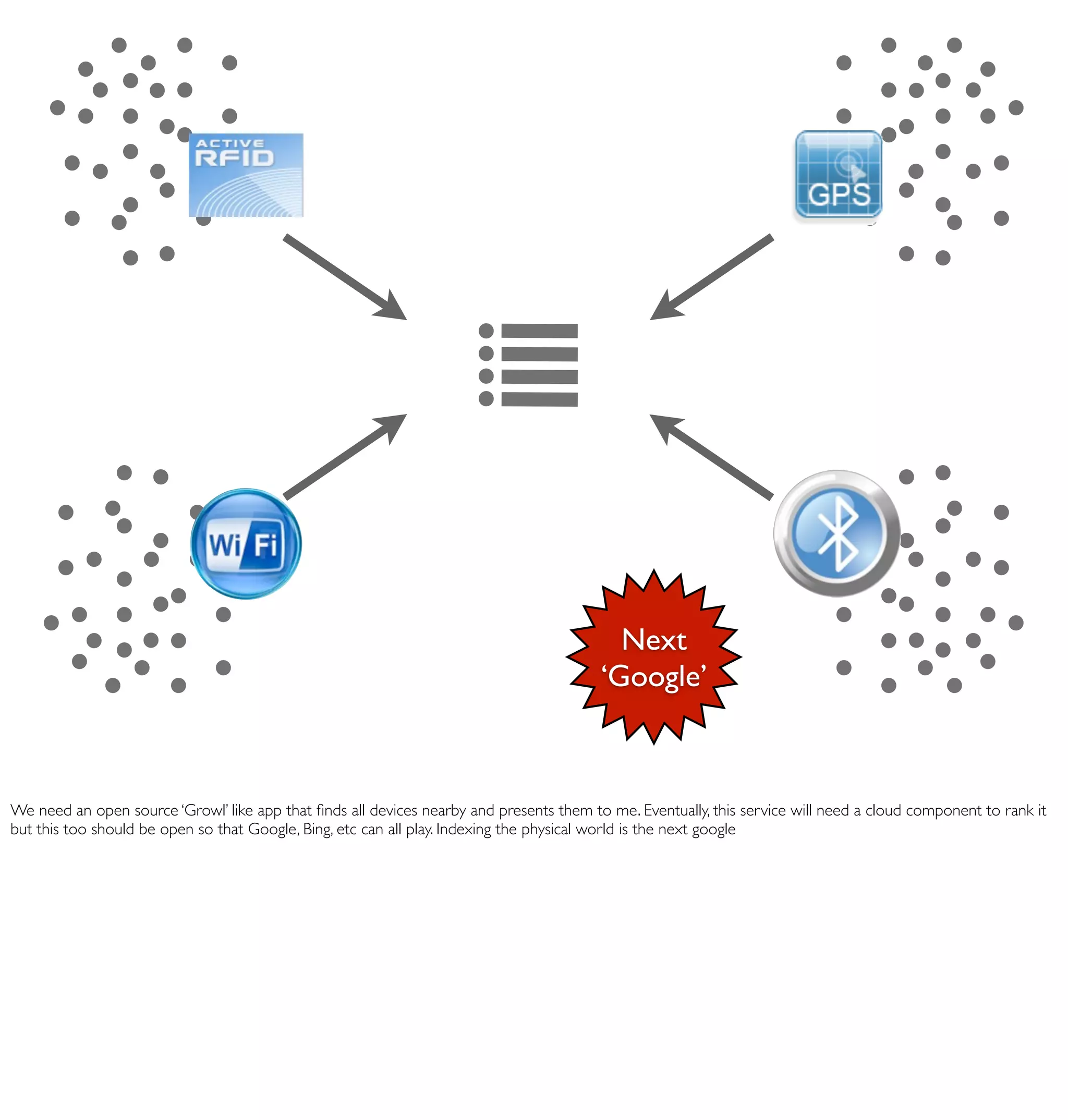
We need an open source ‘Growl’ like app that finds all devices nearby and presents them to me. Eventually, this service will need a cloud component to rank it
but this too should be open so that Google, Bing, etc can all play. Indexing the physical world is the next google
Toyota Prius
                                                                      68
                                                                      Maria Jenson
                                                                      Musée du Louvre
                                                                T-Mobile                       Clear
                                                                      Bang & Olufson
                                                                Notifications Justine
                                                                      Crêpes
                                                                Notifications from David
                                                                     New SMS
                                                                Notifications
                                                                      New SMS from David
                                                                      New SMS from David
                                                                                   3G
                                                                                              2:12 PM


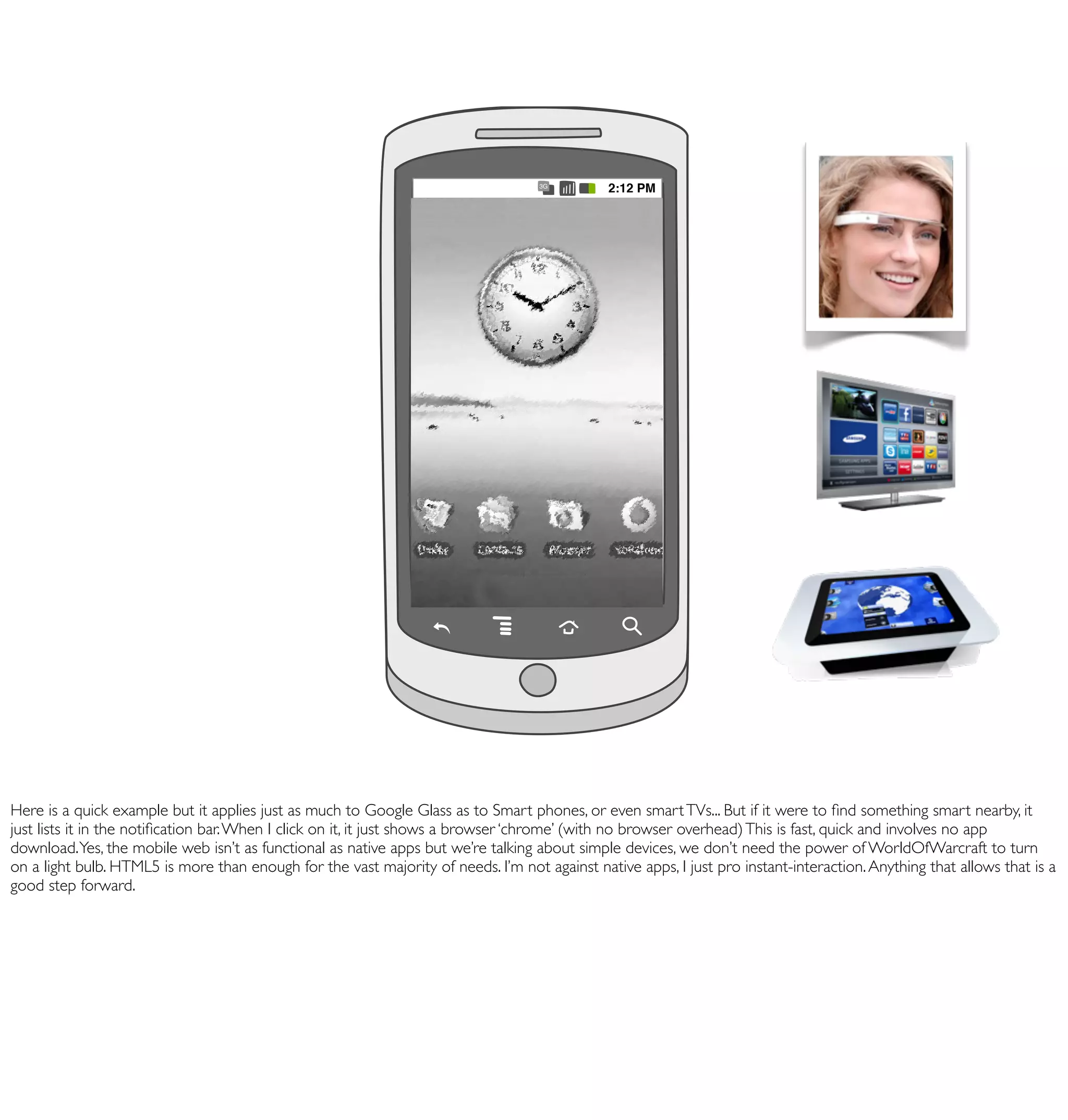
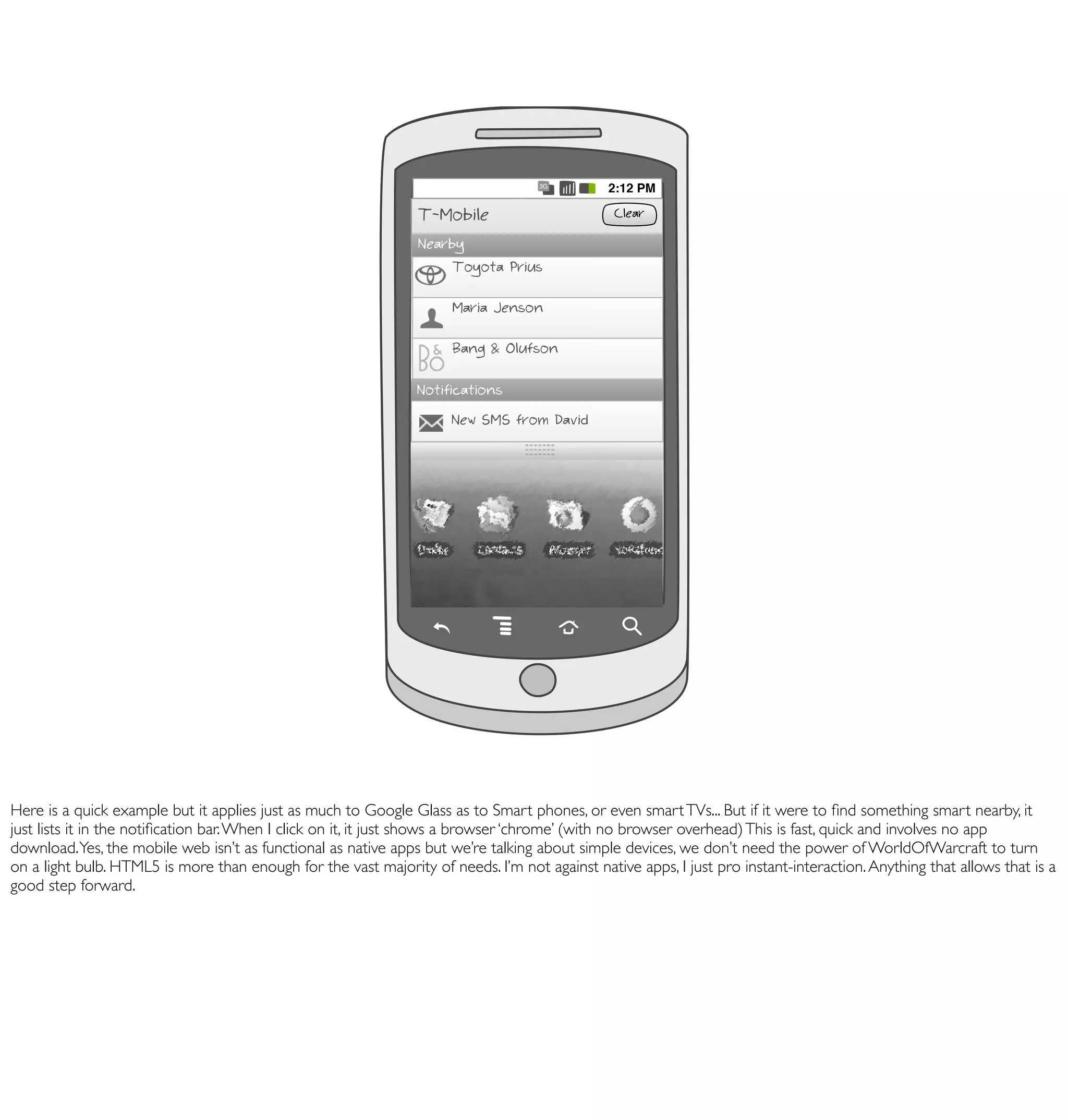
Here is a quick example but it applies just as much to Google Glass as to Smart phones, or even smart TVs... But if it were to find something smart nearby, it
just lists it in the notification bar. When I click on it, it just shows a browser ‘chrome’ (with no browser overhead) This is fast, quick and involves no app
download. Yes, the mobile web isn’t as functional as native apps but we’re talking about simple devices, we don’t need the power of WorldOfWarcraft to turn
on a light bulb. HTML5 is more than enough for the vast majority of needs. I’m not against native apps, I just pro instant-interaction. Anything that allows that is a
good step forward.
68

                                                                      Musée du Louvre

                                                                      Crêpes Justine

                                                                Notifications
                                                                      New SMS from David
                                                                                   3G
                                                                                              2:12 PM

                                                                T-Mobile                       Clear

                                                                Nearby
                                                                    Toyota Prius

                                                                      Maria Jenson

                                                                      Bang & Olufson

                                                                Notifications
                                                                     New SMS from David


Here is a quick example but it applies just as much to Google Glass as to Smart phones, or even smart TVs... But if it were to find something smart nearby, it
just lists it in the notification bar. When I click on it, it just shows a browser ‘chrome’ (with no browser overhead) This is fast, quick and involves no app
download. Yes, the mobile web isn’t as functional as native apps but we’re talking about simple devices, we don’t need the power of WorldOfWarcraft to turn
on a light bulb. HTML5 is more than enough for the vast majority of needs. I’m not against native apps, I just pro instant-interaction. Anything that allows that is a
good step forward.
3G
                                                2:12 PM


                                                          JIT ecosystem


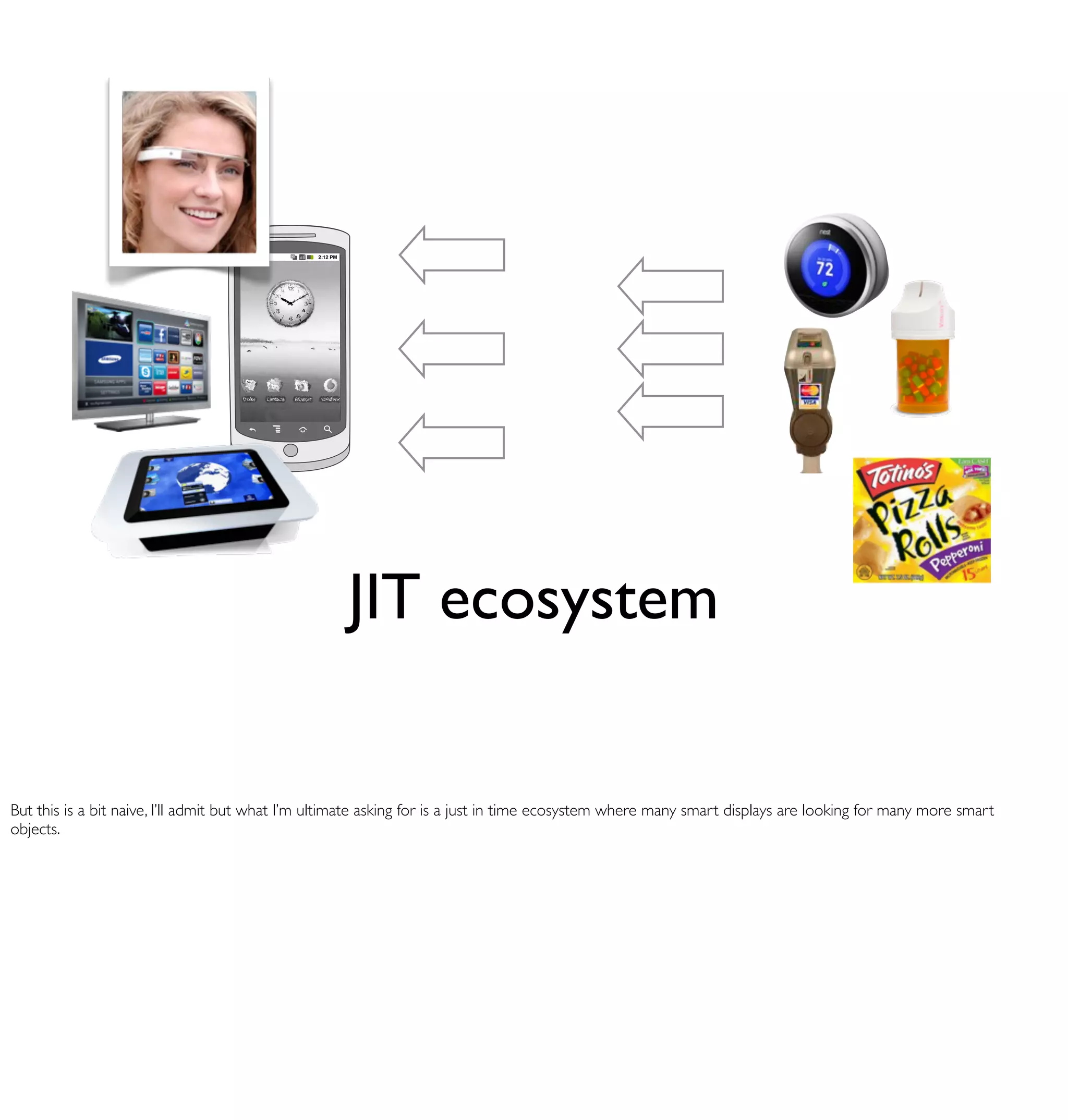
But this is a bit naive, I’ll admit but what I’m ultimate asking for is a just in time ecosystem where many smart displays are looking for many more smart
objects.
Silos are counter productive
                                                ....and so very old school


                                                   All your data


                                                   Google your room


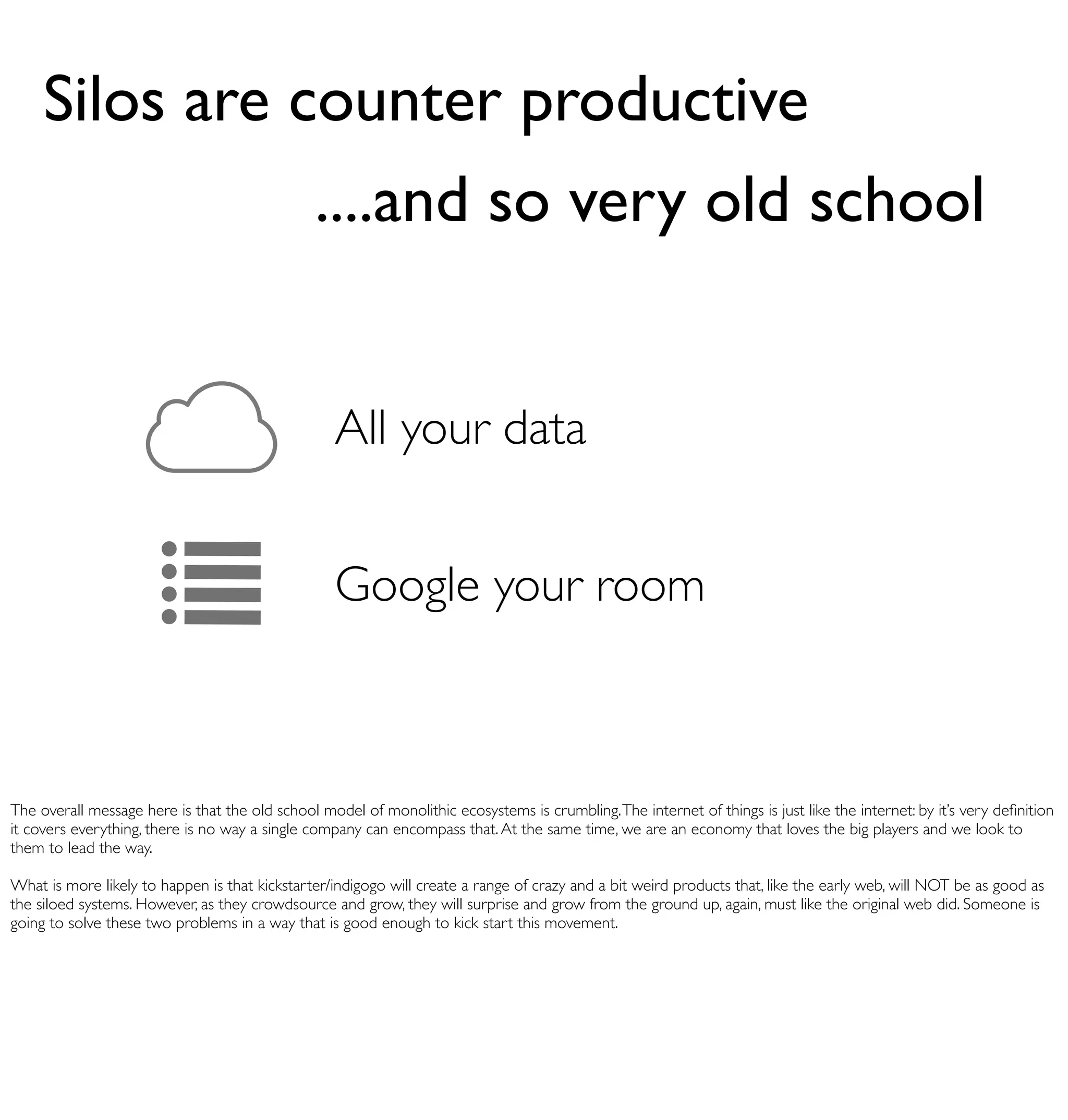
The overall message here is that the old school model of monolithic ecosystems is crumbling. The internet of things is just like the internet: by it’s very definition
it covers everything, there is no way a single company can encompass that. At the same time, we are an economy that loves the big players and we look to
them to lead the way.

What is more likely to happen is that kickstarter/indigogo will create a range of crazy and a bit weird products that, like the early web, will NOT be as good as
the siloed systems. However, as they crowdsource and grow, they will surprise and grow from the ground up, again, must like the original web did. Someone is
going to solve these two problems in a way that is good enough to kick start this movement.
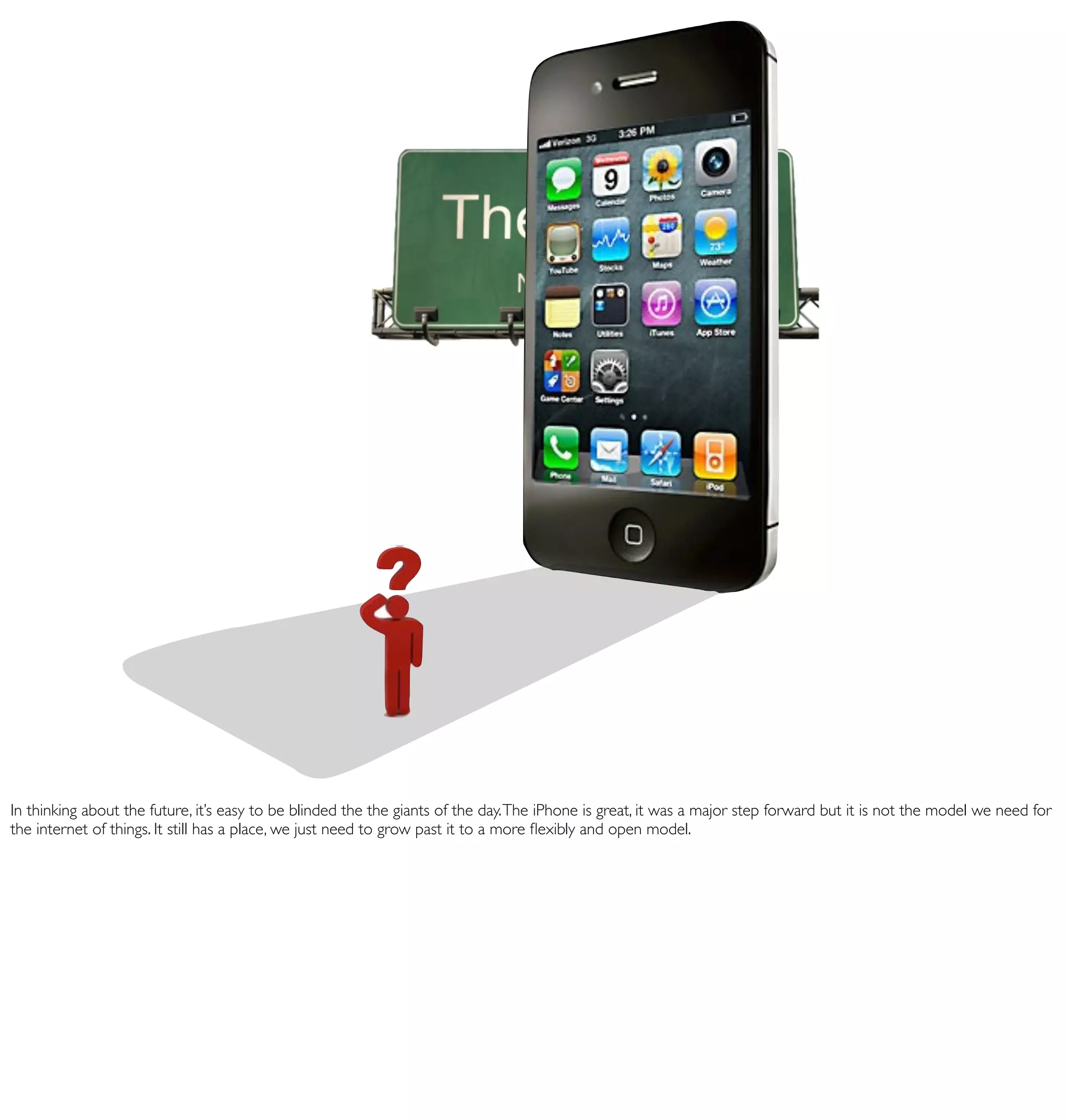
In thinking about the future, it’s easy to be blinded the the giants of the day. The iPhone is great, it was a major step forward but it is not the model we need for
the internet of things. It still has a place, we just need to grow past it to a more flexibly and open model.
In thinking about the future, it’s easy to be blinded the the giants of the day. The iPhone is great, it was a major step forward but it is not the model we need for
the internet of things. It still has a place, we just need to grow past it to a more flexibly and open model.
Power to the people
scott@jenson.org
@scottjenson

jenson.org

2013 ia summit

  • 1.
    Beyond Mobile, BeyondWeb The Internet of things needs our help IA Summit 5 April 2013 @scottjenson jenson.org
  • 2.
    ? Speed Size Cost How do we, as a team, think and build new products? We are all interested about the future. We even come to conference like this to try to answer that question, “What’s happening next?” When we reflect on how far we’ve come, most people just focus on the holy trinity of speed size and cost. But these are *safe* predictions, of course things will get smaller/faster/cheaper. That is incremental innovation and really are just extending the current paradigm.
  • 3.
    Comfort vs Risk What’shappening next? Easy, it’s the iWatch! Soon to be followed by the iRing and the iTieTack. The reason people are so excited about the iWatch is that it makes so much sense (from a certain naive perspective) We can all see it, it’s not a huge leap so we inherently like it. Of course, the iWatch, if it ever comes, will likely be fine product. We just need to be clear: it’s a fairly conservative extension of an existing paradigm. The really big changes are very hard to see. Most stare you right in the face as you walk by. A creative idea takes an equally creative person to understand it. This is why people are so surprisingly conservative when it comes to innovation. While I was at frog, it became painfully clear that much of my job was coaching as our clients all wanted innovation but at the same time, they were deathly afraid of risk. It’s a shocking paradox isn’t it? But it explains why, when thinking of the future, we tend to fall back on known, existing patterns
  • 4.
    Default Thinking I’ve writtenabout this before, in a few articles and a book chapter about how throughout the history of technology we never take a shiny new technology and run with it. We almost always turn around and use it for an something were doing yesterday. We evaluate tomorrow’s technologies by yesterday’s tasks. A classic example is how people initially read radio plays on TV. Of course, they quickly figured it out but that’s how we humans work: we stumble our way into innovation. It’s why designers like to prototype, we don't know what we don’t know.
  • 5.
    We look atthe present through a rearview mirror; we march backwards into the future Marshall McLuhan This is so beautifully phrased and explains why we get technology predictions so horribly wrong. We predict by looking backwards, we don’t appreciate how we almost always stumble our way into the future.
  • 6.
    So how havewe been stumbling? What’s actually been happening recently? We haven’t seen the iWatch (yet) so what has been showing up in the mean time?
  • 7.
    Things like theNest come along
  • 8.
    and the Twinehobbyist sensor, and GloCap, a smart pill bottle the calls you when you forget to take your pills, and about a dozen smart light bulb projects on kickstarter. These are wacky crazy new directions that don’t fit with our current understanding.
  • 9.
    But if youthrow in the idea of a smart city, things really start to get confusing. We are in a situation where the world is running ahead of our ability to conceptualize what is happening. The iWatch is a fine product that is extending and old model. It doesn’t help us make sense of this crazy explosion of new- ness.
  • 10.
    It took usmore than 20 years, but computing has finally moved from conserving resources ingeniously to squandering them creatively. David Gelernter
  • 11.
    Gartner Hype Cycle Howmany of you have heard of the Gartner Hype Cycle? It’s got it’s pros and cons but it’s a fairly entertaining look at how we explore and use any new technology.
  • 12.
    Gartner Hype Cycle Technology Trigger
  • 13.
    Gartner Hype Cycle Peak of inflated expectations
  • 14.
    Gartner Hype Cycle Trough of disillusionment
  • 15.
    Gartner Hype Cycle Slope of enlightenment
  • 16.
    Gartner Hype Cycle Plateau of productivity
  • 17.
    Gartner Hype Cycle 3D Printing Internet of Things App Stores Speech Recognition Quantum Computing Virtual Worlds And here are examples along this curve: Quantum Computing, 3d Printing, Virtual Worlds, speech recognition Where do you think the internet of things is on this graph? It's still a trigger technology, Keep in mind this was their 2012 report… But I'd claim that the IoT is very quickly rising right into 3D printing territory. The reason is simple, there is another technology that it is drafting behind: App Stores. It is the success of Smart Phone in general, and apps specifically that is fueling this boom. It is allowing new devices to be created even easier and faster. But there is a huge risk here. It's default thinking all over. We're taking the amazing crazy potential of the IoT and tying it to a technology that is quickly heading to trough territory...
  • 18.
    Why mobile appsmust die? It’s why I wrote Mobile Apps must die! People thought it was a rant about web vs native apps but that wasn’t it at all. http://jenson.org/mobile-apps-must-die/
  • 19.
    Apps just can’tbe the only tool in the tool kit. Are we really going to have an app for every store we go to, every product we buy and every new interactive device that is coming our way? How many of you, in the last few weeks, have gone through your phones, deleting the old apps you’re not using any more? It’s a rhetorical question, we ALL do this! We are gardening our phones. But why? We’re rational beings, what is the motivation? It’s simple, dead apps get in the way. Have any of you walked into a store and seen a sign ‘We’re in the app store!” and just shrugged, you couldn’t be bothered? At frog, that type of user pain/apathy was design gold, you kill for that type of insight but here we are experiencing this nearly every day. There is a ‘thin crust of effort’ that is forming around apps, there is a certain amount of pain that is involved in using them today! Imagine when we are surrounded by 100s of more smart devices, it’s clearly unsustainable.
  • 20.
    Value > Pain Thereis a subtle force at work here, it’s not always about technology, sometimes it’s also about design. There is a basic design axiom that is at the heart of almost all design: Value must be greater than pain. Let me give you an example. In the 1990’s The UX for SMS was *horrible* but it’s value was so high that people persevered
  • 21.
    Value > Pain Atabout the same time Google was able to reduce the page weight of google.com and got it to load 4 TENTHS of second faster. It was to the pixel, exactly the same. What happened, usage went up multiple percentage points (That’s actually a REALLY big deal for Google) In this case Value was identical but just by reducing pain, the product was improved.
  • 22.
    Triumph of theMundane Value > Pain When pain goes to zero, value can go to zero as well. I call this Triumph of the Mundane as it’s the LITTLE things that are going to have value, as long as we can make them very very easy to use. But when talking about the internet of things we are clearly into a full blow hype bubble. You just have to read any article about it and people are promising crazy things. We’ve seen this movie before: Over promising, under delivery, and big disillusionment.
  • 23.
    Coordination Control Discovery Every time I talk about the IoT I get questions that show that people really, deeply don’t understand what it is about. My favorite example is the smart toaster, the derogatory poster child of the IoT. When people say that “I don’t want apps on my toaster” I want to shake them by their shoulders! “That’s *your* old paradigm, not mine. It’s too easy to criticize a new technology using old concepts. Smart devices are not about apps! They are about 3 basic layers of functionality: Discovery, Control, and Coordination Discovery: Finding my devices nearby. Most companies would kill for just this basic feature. Depending on how clever they are with the URL it can span goofy marketing page (boring) to SPIME like deep interaction with my device history. Control: A small increment in cost lets me control the device. This same URL model has moved us from web site directly to Nest because now I’m talking to MY device. While prices are still high, finding the right balance will be tricky but as the costs fall, the choice will become trivial. This needs ‘another Apple’ to take the chance because once it becomes clear it is possible, EVERYONE will want to jump into the pool. Coordination: This is the hard one as it involves so much cooperation. I love the overall vision but it will take time for companies to get on board with enough standards to make this happen. Think about today. I can hardly get Mint.com to access all of financial records, it’s constantly breaking down. We expect massive data and control settings to work across every world wide manufacturer? My point is that we need to start with the first two: Discovery and Control. They are very much within our reach and offer significant value.
  • 24.
    Bears ....Big Screen + General OS Bats .... focused function device Bees ....only data As a designer, I feel strongly there is power in words. The IoT is such a messy ball of stuff that it’s hard to talk about it. It’s useful to break it up into three basic groups: Bears, bats, and bees. http://jenson.org/of-bears-bats-and-bees-making-sense-of-the-internet-of-things/
  • 25.
    Bats .... focused function device Both Bears and Bees are somewhat old school. What they are trying to do is fairly well established. What I find most interesting are Bats as they are breaking new ground and creating not only new product concepts but how to even things about functionality.
  • 26.
    Just in Time Interaction There is a wide range of devices from the nest down to bus stops (which are just a steel pole stuck in concrete) There is a continuum of device from standalone processor to a tagged object that points to a web page. But, from a design point of view, they are all the same: they want your attention and you need to interact with them. The problem is that we are still using our old school paradigm of ‘native apps’ to deal with them. While I might be fine with an app for my Nest, am i going to download an app for ever store I enter, every smart poster to see, or every smart museum I enter? As we move to single use experiences, apps become hopelessly quaint.
  • 27.
    Insanity is doingexactly the same thing.... and expecting a different result. Einstein
  • 28.
    Paradigm Shift We need a paradigm shift: to see things in a new way. Thomas Kuhn talked about how shifts occur in the scientific community. Before every great shift was a ‘model crisis’ where things started to fray at the edge. Nothing dramatic, the old guard always yells relax, thing are fine and the new blood keeps pushing for something new. It’s a classic tension.
  • 29.
    Model Paradigm Revolution Change        Kuhn Cycle Normal Model Science Crisis Model Drift The Structure of Scientific Revolutions
  • 30.
    What is ourmodel crisis? Software Buy Install Reuse What is our model crisis? We are moving from a model based on Software, where we buy, install and reuse
  • 31.
    What is ourmodel crisis? Software Buy Install Reuse Experience Discover Use Forget To one based on experience where we discover, use and forget. When I buy a smart toaster I don’t want to buy the software, that is a meaningless concept
  • 32.
    Discovery Control Coordination QRCode RESTful API Data standards NFC Hardware costs Storage standards Wireless Standards Device vs Service Bluetooth Protocols Wifi Battery life? Security?
  • 33.
    Perspective is worth80 IQ points Alan Kay We need to stop thinking of the mobile web as a shoehorned version of the desktop web. The mobile web is going to go where the desktop and native apps can never go....
  • 34.
  • 35.
    Remember these guys?They were the ‘pre-web’, for a while, they were much better than the web. They competed, tried to encourage people to come to them. The web, at least initially, was quite bad, but it eventually overran all of them for the simple reason of scope and reach: they all couldn’t have everything.
  • 36.
    Yet this iswhat we’re doing today: we’re getting locked into silos of devices and content. If an open solution gets started, it will almost certainly be worse at first, but it will structurally encourage a much better, broader approach. It will blow past these silos over time.
  • 37.
    Malcom McLean Do youknow this guy? He is my hero! He single handedly invented the container ship business and then, realizing that it would only work if the world standardized, he GAVE AWAY ALL OF THIS PATENTS! Of course this was very enlightened self interest as his company reaped the benefit of this but it was still an overall plus for the world. He was voted ‘Maritime Man of the Century!” for his work.
  • 38.
    Internet ≠ Web Open Closed Expansive Constricted The internet is not the same as the web. The internet is build on basic open standards like DNS and HTTP. The web, while basically open, has quickly encrouaged silo apps like amazon/facebook that try to keep you there, doing everything within that world.
  • 39.
    All my data,in one place I chuckle whenever people talk about ‘THE cloud’. That’s not quite right...
  • 40.
    ...it’s really moreabout a sky FULL of separate clouds
  • 41.
    API We need towork towards a model where we have a single API that connects to OUR cloud. It’s not the devices’ data, its MY data. There are some great companies that are exploring the personal storage space that are beginning to make this happen. I strongly suggest you check out Spark Devices as they are building this model correctly. You can use their servers to store data but you can easily choose someone else.
  • 42.
  • 43.
    Next ‘Google’ We need an open source ‘Growl’ like app that finds all devices nearby and presents them to me. Eventually, this service will need a cloud component to rank it but this too should be open so that Google, Bing, etc can all play. Indexing the physical world is the next google
  • 44.
    Toyota Prius 68 Maria Jenson Musée du Louvre T-Mobile Clear Bang & Olufson Notifications Justine Crêpes Notifications from David New SMS Notifications New SMS from David New SMS from David 3G 2:12 PM Here is a quick example but it applies just as much to Google Glass as to Smart phones, or even smart TVs... But if it were to find something smart nearby, it just lists it in the notification bar. When I click on it, it just shows a browser ‘chrome’ (with no browser overhead) This is fast, quick and involves no app download. Yes, the mobile web isn’t as functional as native apps but we’re talking about simple devices, we don’t need the power of WorldOfWarcraft to turn on a light bulb. HTML5 is more than enough for the vast majority of needs. I’m not against native apps, I just pro instant-interaction. Anything that allows that is a good step forward.
  • 45.
    68 Musée du Louvre Crêpes Justine Notifications New SMS from David 3G 2:12 PM T-Mobile Clear Nearby Toyota Prius Maria Jenson Bang & Olufson Notifications New SMS from David Here is a quick example but it applies just as much to Google Glass as to Smart phones, or even smart TVs... But if it were to find something smart nearby, it just lists it in the notification bar. When I click on it, it just shows a browser ‘chrome’ (with no browser overhead) This is fast, quick and involves no app download. Yes, the mobile web isn’t as functional as native apps but we’re talking about simple devices, we don’t need the power of WorldOfWarcraft to turn on a light bulb. HTML5 is more than enough for the vast majority of needs. I’m not against native apps, I just pro instant-interaction. Anything that allows that is a good step forward.
  • 46.
    3G 2:12 PM JIT ecosystem But this is a bit naive, I’ll admit but what I’m ultimate asking for is a just in time ecosystem where many smart displays are looking for many more smart objects.
  • 47.
    Silos are counterproductive ....and so very old school All your data Google your room The overall message here is that the old school model of monolithic ecosystems is crumbling. The internet of things is just like the internet: by it’s very definition it covers everything, there is no way a single company can encompass that. At the same time, we are an economy that loves the big players and we look to them to lead the way. What is more likely to happen is that kickstarter/indigogo will create a range of crazy and a bit weird products that, like the early web, will NOT be as good as the siloed systems. However, as they crowdsource and grow, they will surprise and grow from the ground up, again, must like the original web did. Someone is going to solve these two problems in a way that is good enough to kick start this movement.
  • 48.
    In thinking aboutthe future, it’s easy to be blinded the the giants of the day. The iPhone is great, it was a major step forward but it is not the model we need for the internet of things. It still has a place, we just need to grow past it to a more flexibly and open model.
  • 49.
    In thinking aboutthe future, it’s easy to be blinded the the giants of the day. The iPhone is great, it was a major step forward but it is not the model we need for the internet of things. It still has a place, we just need to grow past it to a more flexibly and open model.
  • 50.
  • 51.