£5
By Jonathan Kohl
Have you noticed a shift in
technology lately? If you
haven’t, take a look around you
next time you go to a restau-
rant. You will probably see
people using their smart phones
or tablets: fingers tapping away,
eyes staring at the screen, an
eerie blue lighting up their face.
They are focused, engrossed,
addicted, and not to the food,
company and atmosphere in the
restaurant. They are interacting
with (and addicted to) applica-
tions on mobile devices that
are convenient to carry with us
wherever we go.
Mobile devices are
our contact points to applica-
tions, services, the internet, and
increasingly, our social lives.
For example, consider that trip
to a local restaurant and how
mobile technology has become
enmeshed in that experience.
How many of the following
activities can you relate to?
• Searching for a restaurant
nearby (using location-
based services or GPS.)
• Selecting a restaurant based
on cuisine, location or price.
• Reading user reviews and rat-
ings to help make a decision.
• Plottingoutandfollowingdirec-
tionstotherestaurantonamap.
• After arriving, checking
in to a social networking
application, alerting people
in your network of your
current location.
Continued on page 4
By Seth Eliot
In the November 2011 edition of The
Testing Planet, I made several predic-
tions of the future of software testing,
• In part 1, I made the case that
Testing in Production is the natu-
ral way to test software services,
using real users and real environ-
ments to find bugs that matter.
• In part 3, I will explain how the
Cloud will continue to gain trac-
tion and enable testers to exercise
unprecedented effectiveness and
productivity.
The subject of this article is what I
call TestOps, and how it represents the
potential for dramatic change to the
testing profession and how software
organisations test software and organ-
ise to assure software quality.
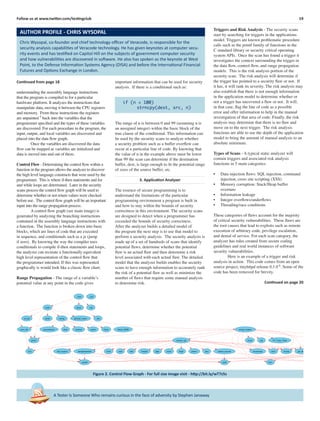
Software Testing Presently
To see the future we must first un-
derstand how most organisations test
software in the present. Figure 1 is a
simple but useful representation of this
current state of affairs.
Continued on page 2
ALSO IN THE NEWS
SETTHELOADTESTTOOL
TORAMMINGSPEED
The vendor’s salesman/
trainer sat next to me at
the conference table...
Continued on page 7
CROSSING THE
TESTING MINEFIELD
You are with a party of
friends and on a beautiful
walk in the countryside...
Continued on page 21
Going mobile:
Testing beyond
the device
WetakealookinsideSauceLabs
THE BUILD-A-TESTER
WORKSHOP
The Testing Planet and
the Software Testing Club
previously introduced...
Continued on page 14
- 219.273- 219.273- 219.273- 219.273- 219.273- 219.273- 219.273
The future of software testing
Part two - TestOps
March 2012 | www.thetestingplanet.com | No: 7
The San Francisco-based company talks automation, security and high-performance infrastructure - see page 12
Could TestOps mean a dramatic change to the testing profession?
THE EVIL TESTER
QUESTION TIME
More provocative advice
for testers who don’t
know what to do!
Continued on page 24
2 March 2012 | www.thetestingplanet.com | Use #testingclub hashtag
Seth Eliot is Senior Knowledge Engineer for Microsoft Test Excellence focusing on driving best
practices for services and cloud development and testing across the company. He previously
was Senior Test Manager, most recently for the team solving exabyte storage and data process-
ing challenges for Bing, and before that enabling developers to innovate by testing new ideas
quickly with users “in production” with the Microsoft Experimentation Platform (http://exp-
platform.com). Testing in Production (TiP), software processes, cloud computing, and other top-
ics are ruminated upon at Seth’s blog at http://bit.ly/seth_qa and on Twitter (@setheliot). Prior
to Microsoft, Seth applied his experience at delivering high quality software services at Ama-
zon.com where he led the Digital QA team to release Amazon MP3 download, Amazon Instant
Video Streaming, and Kindle Services.
AUTHOR PROFILE - SETH ELIOT
How Can I Estimate My Testing?- http://bit.ly/zgIEfu
Main story continued from page 1
Tests are run against the product and the product re-
acts. If this result matches the expected result (the
oracle) it passes... it’s green. A tester can look at all
the passes (greens) and the fails (not-greens) then
make pronouncements about the product quality.
Distilling this down to three stages we get Table 1.
Figure 1. The traditional model
of software testing
Tests are run against the product and the product
reacts. If this result matches the expected result (the
oracle) it passes... it’s green. A tester can look at all
the passes (greens) and the fails (not-greens) then
make pronouncements about the product quality.
Distilling this down to three stages we get Table 1.
Table 1. Three stages of traditional Test
Test results are our output, our signal to be pro-
cessed and interpreted. However in the future
we need to look more at a new signal. Software
services running in data centers have relied on
Operations or “Ops” teams to run the data center.
Ops provisions hardware, configures networking,
then monitors and repairs any production impacting
issues. Now, like the Ops team, testers will need to
have more focus on the live site. Our new quality
signal will come from this live production data,
hence the name TestOps.
Products of the Future
To understand the future of software testing, look
where the growth in software products is taking place:
• Google executes more than 3 billion searches,
2 billion video replays and absorbs 24 hours of
video per minute 1
• Microsoft Bing has grown from 10% of U.S.
Searches in September 2010 to over 30% as of
April 2011 2
• Facebook has about 800 million active users
sharing 30 billion pieces of content per month 3
• Amazon has more than 120 million user ac-
counts, 2 million sellers and 262 billion objects
stored in its S3 cloud storage system 4
• Twitter reached its one-billionth tweet after just
3 years, 2 months and 1 day 5
These successful, growing products are all services.
In the The Future of Software Testing, Part 1 (No-
vember Issue – The Testing Planet) 6
, I discussed
how services allow us to Test in Production by giv-
ing us immediate access to production, where we
examine and change what is happening there. But to
see what else services give us that will change the
way we test, consider these statistics:
• At Google system performance is tracked by their
“Dapper” tool. More than 1 TB of sampled trace
data per day and all data is kept for two weeks 7
• Facebook’s logging framework Scribe collects
approximately 25TB of data daily 8
• eBay collects approximately 50 TB of incre-
mental data every day to perform analytics 9
• Twitter stores 12 TBs of new data daily 10
• Microsoft online properties Bing, MSN, and Ad-
Center collect and process 2 PB of data per day 11
What services give us are telemetry data from users
and the systems they are using, and in the cases
above it is big data. Changing our signal to assess
Continued on page 3
W
ow!Wherehasthetimegone?It
seemslikeonlyaveryshorttimeago
sinceIacceptedtheroleofTheTest-
ingPlanetEditor,andherewearewithmyfirst
issue.AndinanewPremiumformatnoless!
It’sgreattobepartofateamofpassionateand
dedicatedTesterscommittedtoproducingthe
highestqualitypublicationtoinform,educate
andofcourseentertainthetestingcommunity.
It’s fair to say – when I took the job
on, I didn’t realise just how much work was
going to be involved in bringing it all to-
gether. Or how many late nights would be
spent reviewing content and responding to
emails. Or how much of a push would be re-
quired to bring it all together during the final
design and pre-publication stages. It’s been a
<<fascinating/exhilarating/frustrating/[insert
adjective of the day here]>> journey and, if
you’re reading this – WE MADE IT!!!
Of course, time pressure and that
all important final push to get your product
shipped are part of the testing creed, right?
I don’t imagine any of us are strangers to
having our test schedule squeezed to virtual
non-existence, late nights and weekends
working to finish that all important, final
round of tests before we give the all clear.
But what about the time pressure to
stay on top of your game, and keep abreast
of changes in test approach, tools and tech-
nologies? How do you cope with that?
A quote that is still forefront of my
thinking from 2011 is that testing well is all
about learning rapidly (James Bach, Rapid
Software Testing [course]). Testing is chang-
ing, maturing, and evolving all the time, and
we need to evolve with it. Reading The Test-
ing Planet is just one way that you can stay in
touch with the thinking and development of
our community of Testing Professionals. We
invest our time and effort into bringing you the
best thinking and writing, from the best testing
minds so that you can benefit from their expe-
rience, and hopefully become a better tester as
a result. We hope you enjoy it!
LETTER FROM THE CO-EDITOR
Simon Knight
KK
3Follow us at www.twitter.com/testingclub
Contributing - http://bit.ly/Avpevq
Continued from page 2
software quality from test results to telemetry data
is a game changer for testing. Even if your service
does not generate big data, any product operating at
internet scale is going to see usage and data of suf-
ficient magnitude to assess quality.
A New Signal for Quality
Let us update our three stages of test. We’ve deter-
mined that our signal is going to be the telemetry or
big data coming from the system under test. Then
the input can be the real world usage of the product.
Then what about the observe stage? Data
by itself has little value until it used or transformed
to find patterns or prove hypotheses. Such analysis
can be done to calculate Key Performance Indi-
cators (KPIs) which are then compared to target
requirements. Or we can look for patterns in the
data that give insight into the behaviors of users or
systems. These stages are summarized in Table 2.
Table 2. Three Stages of Traditional
Testing and TestOps
We can start by using real production usage to de-
cide where to look. For example with Bing, we can
identify the top 100 query types used and conclude
that we might get the most value by starting to look
there. Among the top queries are those for stock
prices. On Bing the query “Amazon Stock Price”
should return the Finance Instant as top result.
Figure 2 shows what actually happened with one
release, as well as what the missing Finance Instant
Answer should look like.
A classic test approach might be to iterate through
the S&P 500 or the Wilshire 5000 and execute the
query “[company_name] stock price”, substituting
in each company name and searching for where the
instant answer did not fire. We would then find that
the following test cases pass:
• Expedia stock price
• Comcast stock price
• Bed Bath and Beyond stock price
All-pass is not all good in this case as there are bugs
we still have not found. Therefore Bing implement-
ed Bug Miner 12
which enables testers to configure
queries or patterns and see what results real users
are getting. Using real user data Bing found and
fixed these bugs (did not return the Finance Instant
answer) that traditional testing would have missed:
• expedia.com stock price
• Comcast Corporation stock price
• Bed Bath & Beyond stock price
A consideration when using telemetry data as your
signal is that you may have different signals from
different users on different products. The example
in Figure 2 would still seem to “fail” in the UK, but
the international sites do not use the same logic as
the US site. Different regions and different products
will have differing signals that each must be inter-
preted in the context of those respective products.
Another example of using telemetry data
as the signal for quality is Microsoft Hotmail. By
instrumenting their web pages they get anonymised
signals telling them when a user performs actions
like opening or sending a mail for example. Using
this data, testers can calculate how long it takes
across millions of users to perform key tasks, and
interrogate this data to see how Hotmail performs
across different operating systems and web brows-
ers. By using this information key bottlenecks can
be identified. In one example Hotmail re-architected
image size and static content to improve upstream
traffic, improving performance by 50%.
More Ways to Generate the Signal
Monitoring and analyzing production usage to ac-
cess the telemetry data signal for software quality
is a very approachable way to implement Testing
in Production. But there are also more active steps
we can take to vary the input stage of our three step
approach and gain quality insights.
We can start with all those test cases we used to run
in the traditional model. In part 1 I told you about
Microsoft Exchange who re-engineered their 70,000
automated test cases they used to run a lab so that
they could run them in production with their new
hosted Microsoft Exchange Online cloud service.
While test cases in the lab give us the traditional
pass/fail signal, we can take a different approach
in production, instead looking at the success rate
over thousands of continuous runs. Success or
failure is measured by availability and performance
KPIs. For a scenario did we meet the “five nines”
(99.999%) availability? Or did we complete the
task in less than 2 seconds 99.9% of the time? The
signal is still the same, it is still the data coming out
of our system under test, but we are triggering that
signal with our testing. Exchange Online runs thou-
sands of tests constantly in production alerting them
to small non-customer impacting outages which
represent regressions and risks to the service 13
.
They find quality issues before the customer does.
Another way to vary our Inputs is to deploy
the new version, feature, or product change so only a
sub-set of users sees it. This is called Exposure Con-
trol. Using Exposure Control we can run A/B tests,
comparing the data signal from the old version (A)
to the new version (B). Google, Amazon, Microsoft
and others regularly do this. Often UI changes are
assessed based on business metrics, but testers can
also make use of back-end changes “under the cov-
ers” to assess quality metrics. Google regularly tests
changes by limiting exposure to explicit people, just
Googlers, or a percent of all users 14
.
So we can now update our testing model
diagram to represent this new quality signal, and the
three inputs to drive it in Figure 3.
Figure 3. The TestOps model of software testing
TestOps? What Does This Mean for Me?
Just the change in signal alone indicates a big shift
in the testing profession and how we test software.
But what does TestOps mean to the day-to-day
work of the tester?
The roles of the Developer and Tester begin
to change, with each looking more like the other:
• The tester’s focus can be much less on the up-front
testing and running of discrete functional test cases.
Developers have always had responsibility for unit
testing, but to enable testers to focus more on pro-
duction and high context scenarios consider moving
up-front functional testing to the developers. Put
another way, a developer must use every available
Figure 2. A Bing bug....Amazon stock query missing Finance Instant Answer
Continued on page 4
4 March 2012 | www.thetestingplanet.com | Use #testingclub hashtag
Are You a QA Chef? (Or Do You Use Recipes?) - http://bit.ly/zaf9V2
Second story continued from page 1
• Searching the web to answer questions about
the items on the menu. (I always forget what
aioli is.)
• Translating a meal that is in a foreign language.
• Checking the nutritional information for a meal.
• Once the food arrives, taking a picture of it and
uploading it to your social networking profile.
• Friends commenting about the photo and
your meal.
• Throughout the meal, posting and responding
to comments about the meal on your social
networks.
• At the conclusion of a meal, posting positive,
neutral or negative comments about the experi-
ence to restaurant review applications.
• If the experience was poor, ranting on public
social media.
We haven’t even touched on the buzzing and beeping
that occurs while receiving emails, text messages,
and phone calls. Just imagine the technology that
is required to support all of these activities. If you
dissect it, the infrastructure and underlying complex-
ity is amazing. The mobile device is just our primary
contact point to a large amount of technology that
supports our mobile-enhanced, social and work
activities. All those photos we upload and share, all
that data we have access to and send to our social
networks, all have to be stored somewhere and
quickly accessible not only to us, but to those in our
networks. This provides new challenges from a test-
ing perspective.
The people who are using these applications
are using them on the move. They interact with them
physically, in different environments with differ-
ent underlying infrastructures and in all weather. As
testers, we need to interact with the application, find
things that are difficult to input into, and to see, and
find problems that are caused by being in interesting
locations. These are the problems your end users will
encounter the most, and will frustrate them the most.
(I have developed a framework to help with testing
these kinds of activities called I SLICED UP FUN!1
However, merely testing the front end of many
mobile applications ignores the support infrastructure
underneath that allows us to work with the devices
the way we do. We also need to analyze that and
figure out potential weak points that we can exploit
when testing. Two areas that have testing implica-
tions in the mobile space are data and the cloud.
Most testers are familiar with data storage,
and software interactions with data-related soft-
ware and hardware. If you aren’t familiar with “the
cloud”, they are machines that are available for use
for different purposes for a fee. You essentially rent
time, space and processing power from a company
that provides you with access to their machines over
the internet. It’s a relatively inexpensive way to add
processing power, distribute access and store and dis-
tribute data. There are also GPU (graphics process-
ing unit) cloud centers that can be used for graphics
rendering, and movement in areas like grid comput-
REFERENCES CONTINUED...
3. http://www.facebook.com/press/info.
php?statistics http://www.businessweek.com/
magazine/content/10_49/b4206039292096.htm
4. http://blog.twitter.com/2011/03/numbers.html
5. http://www.thetestingplanet.com/2011/11/
november-2011-issue-6/
6. http://research.google.com/pubs/
archive/36356.pdf
7. http://www.infoq.com/presentations/Scale-at-
Facebook
8. http://www.slideshare.net/RandyShoup/more-
best-practices-for-largescale-websites-lessons-
from-ebay
9. http://www.slideshare.net/raffikrikorian/twitter-
by-the-numbers
10. http://research.microsoft.com/en-us/events/
fs2011/helland_cosmos_big_data_and_big_
challenges.pdf
11. Edward Unpingco; Bug Miner; Internal Microsoft
Presentation, Bing Quality Day Feb 11, 2011
12. Experiences of Test Automation; Dorothy
Graham; Jan 2012; ISBN 0321754069; Chapter:
“Moving to the Cloud: The Evolution of TiP,
Continuous Regression Testing in Production”;
Ken Johnston, Felix Deschamps
13. Google: Seattle Conference on Scalability:
Lessons In Building Scalable Systems, Reza
Behforooz http://video.google.com/videopla
y?docid=6202268628085731280 [timestamp:
20:35]
14. http://www.setheliot.com/blog/bsc-east-2011/
15. http://youtu.be/X1jWe5rOu3g
ing to help distribute processing across a wide array
of machines.
Data storage and hardware/software/network
interactions can have an impact on performance. Us-
ing the cloud is a powerful tool, but I’ve had the fol-
lowing challenges when testing software on the cloud:
• You lose the complete control you have over
your own equipment.
• Cloud services may not have the uptime you
are used to.
• Unforeseen network interruptions may occur.
• There are service outages, and bugs that cause
longer, unplanned outages.
These issues can cause time and frustration when
trying to track down performance issues or timing-
related bugs.
Here’s an example: a team I was working
with had developed a mobile application on several
popular smart phone and tablet platforms. They
already had a web infrastructure in place for a web-
based application, but they exploited mobile devices
to help put media in people’s hands. They were able
to use features from mobile devices to enhance this
experience, and provide connectivity and productiv-
ity for remote workers who were often away from
desktops or laptops. The back end infrastructure was
a typical web application using the LAMP stack
(Linux OS, Apache web server, MySQL database
Continued on page 5
means to produce code free of low context bugs that
can be found by running on his desktop.
• TestersnowneedtofocusonaTestOrientedArchitec-
ture15
thatenablesustocollectandidentifytheright
datasignal.Testersneedtocreatetoolstorunthetests
inproduction,monitorthedatasignal,andanalyzethis
signal. Thesearerolesthatlookverydev-like.
The roles of Operations and Tester begin to change,
similarly with each looking more like the other:
• Testers are now focused on the live site- the tra-
ditional domain of operations. The tester’s skill is
now applied in determining the connection between
the data signal and product quality.
• Whether scanning the production data signal or
firing synthetic transactions, the tests we write now
look a lot like monitors. Something Ops has been
doing all along. The value test brings is in moving
these monitors from heartbeats and simple scenari-
os to high context user affecting scenarios.
Across the major services these changes are already tak-
ing place.At Facebook and Microsoft Bing they practice
combined engineering, with no separate test discipline.
The goal is for developers to not only develop code but
to also do all of the TestOps tasks above. This can be a
difficult model to execute and will fail if engineers revert
to “classic” developer responsibilities alone thus abdicat-
ing quality.Aseparate TestOps role can ensure quality is
REFERENCES
1. http://searchengineland.com/by-the-numbers-
twitter-vs-facebook-vs-google-buzz-36709
2. http://mashable.com/2011/04/11/bing-search-growth/
foremost even while blending this test role with Dev and
Ops. Therefore Google,Amazon, and Microsoft services
(other than Bing) instead maintain their test disciplines,
but with high Dev to Test ratios from 3:1 to 8:1. A1:1
ratio is not necessary as testers are no longer writing rafts
of tests for each discrete feature and are instead focusing
on tools and processes to harness the power of the data
signal. Companies likeAmazon.com and Google main-
tain central teams to further put Developers’and Testers’
focus on the live site creating tools to make deployment
and monitoring easier.
It’s All Test, It’s All Good
Yes, Testers can still test up-front. Black box and
exploratory testing still add value and the traditional
test model can still be applied. But depending on your
product - especially if it is a service - the TestOps model
using the big data signal can be your most powerful tool
to assess software quality. In Test is Dead 16
Google’s
Director of Engineering made the case that the data
signal tells us if we built the right thing and that tradi-
tional testing is much less important. Test is not dead.
The power of big data and the data signal will also tell
us what we need to know about quality - not just did we
build the right thing, but did we build it right. □
Continued from page 3
5Follow us at www.twitter.com/testingclub
Please don’t hire me - http://bit.ly/xbMmXg
Continued from page 4
and PHP as the programming language). This
worked well for web applications, but they weren’t
sure how the extra load of more and more people
connecting and downloading and uploading media
files would stress the system. I joined the project
team to help with performance and functional testing.
We tried using load generation tools to
simulate the extra web traffic, but this didn’t address
the media downloading and interactions on mobile
devices. To simulate this effect, we used functional
test automation tools to load the application in a web
browser, sized to the same size as the mobile screen,
and simulated user input by sending messages direct-
ly at the protocol level. We then used virtual servers
and an internal cloud infrastructure to generate load
across multiple machines. After jumping through
a few technical hurdles, we were able to remotely
execute tests over several machines on different net-
works, with about eight simulated mobile clients on
each machine. This effort revealed some astounding
results. The server behaved quite differently with the
mobile client than with the old web client, and some
of the simulated mobile clients suffered from serious
performance and functional problems.
Once these issues had been sorted out, the
process was reversed. Now that we knew some of
the common trouble spots, and were able to simulate
those conditions on the server, while testing with a
small number of mobile devices to see how the real
thing handled server performance problems.
After we felt confident that we had dealt with
most of the performance problems using both ap-
proaches, we pushed out builds to our beta testers and
had them re-test the application in the field. Some of
them still reported serious performance issues, and
a pattern emerged: the people who were the furthest
away from our data center had the worst performance.
Data Implication: Distributed Data with the Cloud
We discovered that when using large media files,
people who were furthest away from the data center
experienced the poorest performance. It turned out that
the combination of lower processing power on the
REFERENCES
1. http://www.kohl.ca/articles/ISLICEDUPFUN.pdf
2. http://radar.oreilly.com/2012/02/nosql-non-
relational-database.html
3. http://www.strozzi.it/cgi-bin/CSA/tw7/I/en_US/
nosql/Home%20Page
4. http://www.w3schools.com/xquery/xquery_
flwor.asp
mobile devices compared to desktop computers,
coupled with the complexity and differing speeds of
data networks made performance problems much
more apparent. Performance issues you barely noticed
on a desktop were unbearable on a mobile device.
We needed a quick fix, so we looked at what
we had done to design tests: we decided to use the
cloud. We were already using cloud services for
some of our media storage, so we expanded those
services to data centers that were closer to the geo-
graphic areas where users experienced poor perfor-
mance. This data distribution using different cloud
centers worked well. This was a bit of a shock for us,
but if you model the system from storage to down-
load and interaction, it begins to make sense.
Data Implication: Reduce Bottlenecks with noSQL
Social networking infrastructures, and systems with
high volume over a large geographic area, have
highlighted interesting data interaction bottlenecks. If
you look at a typical web application such as a LAMP
stack, you tend to have a synchronous flow to and
from the database, and most of us use some sort of
Entity-Relationship Model and SQL to access the data.
(Even if the SQL is generated by an Object-Relational
Mapper.) When you have many reads and writes with
a large amount of data, with different circles of people
who require instant, simultaneous access, you inevi-
tably run into bottleneck issues, which translate into
poor performance at the end user level. Many social
applications store an enormous amount of data, with
users posting pictures, video, sound files and other
items in their systems. Add more users with the ease
of use that mobile devices provide, and bottleneck and
performance problems become worse.
noSQL2
is a movement that gained popular-
ity, in part to help deal with some of these problems.
Social networking systems have different data us-
age and requirements than other applications, so as
programmers tried to solve these problems by adding
parallel database interactions, different hardware and
software solutions, they inevitably began to challenge
the Entity-Relationship Data (ERD) model itself.
What many found is that the ERD model we know
and love does not always work for social data with its
various relationships, and constant interaction. With-
out boring you with technical details, noSQL3
is a dif-
ferent model to save, access, update and read data than
a typical database. There are different technologies
used, many of them are also built to scale rapidly and
cope with the rapid growth and massive data require-
ments that social and similar systems depend on.
From a testing perspective, this means we
have to change the way we interact with data, and
challenge some of our assumptions about how it is
stored. noSQL systems may use something that looks
like a database, or they may store data in different
sorts of files. Querying may use something altogether
different than SQL. One of my favorite SQL alterna-
tives is XQuery’s FLWOR4
(flower) expressions. We
also have to look at configuration and performance,
with less testing tool support than what we enjoy
with traditional, ERD systems.
Many noSQL tools are newly developed, but
the storage principles behind them are the same as any
other persistence model. You will need to adjust how
you think about storage, access and learn different tools.
Bringing it All Together
In many cases, the application we interact with on our
mobile device represents the thin end of the wedge, or
the tip of the technology iceberg. If we run our appli-
cations in ideal environments under ideal conditions,
and ignore the infrastructure they depend on, we will
miss important bugs. The problems our end users run
into aren’t necessarily that easy to discover if we are
sitting in our test lab under ideal conditions.
What happens to the winter user who tries
to use your device with gloves on? What problems
might someone in a different country encounter?
What does our back end infrastructure look like?
Does it depend on new technology? How might it
perform and handle data uploads and downloads
seamlessly? What complications are introduced by
the size and type of data our users require our system
to handle? How might their physical location in rela-
tion to our data center have an impact?
As mobile testers, we need to look at the
entire system and come up with creative ways to
simulate real-world conditions using different kinds of
tools and techniques to help discover the problems that
are important to our users. In this article, we’ve looked
at two specific areas: data and the cloud, but there are
more. When testing mobile devices, research and look
beyond the device to get the full picture. Only testing
from the application-level may not be enough. Testing
mobile applications with the full picture in mind will
lead you to more of the important problems that your
users are likely to encounter. □
Jonathan Kohl is an internationally recog-
nized consultant and technical leader. Based
in Calgary, Alberta, Canada he is the founder
and principal software consultant of Kohl
Concepts, Inc. Jonathan helps companies
define and implement their ideas into prod-
ucts, coaches practitioners as they develop
software on teams, and works with leaders
helping them define and implement their
strategic vision. He is also a popular author
and speaker. As a thought leader in mobile
application testing, exploratory testing,
developing policy and strategy, and help-
ing teams adjust to methodology changes,
Jonathan doesn’t just write and talk about
developing software, he actively helps
teams deliver the best products they can.
AUTHOR PROFILE - JONATHAN KOHL
I am your life. Without me,
you’d be nothing! Mwuhaha
6 March 2012 | www.thetestingplanet.com | Use #testingclub hashtag
By Stephen Janaway
Having accurate test data is important. Of course
you know that already, it’s one of the first things
you are taught as a tester. Data, data, data; there are
many articles in this publication and in blogs across
the internet that can tell you that. “Make sure that
your data reflects your real users”, they say. “Make
sure that you keep that data up to date”. “Make sure
that you have as much data as possible”.
For those of us testing mobile devices and
applications then, whilst all the advice above is
true, there’s more to take into account.
You Need Real Numbers
The first thing you quickly learn when you start to
test mobile devices is that you need to test on mobile
devices. Whilst that may sound obvious, there’s a
little more to that statement than meets the eye.
Real devices mean one thing – real sub-
scriptions.And real subscriptions mean real SIM
cards and real SIMs normally mean real cost. Of
course you can consider outsourcing, or you can
consider using services such as DeviceAnywhere1
,
and these are certainly worthy of consideration,
but at some point you really need to spend some
money and buy some phones or tablets.And you
need real phone numbers to test with.
You need real numbers and real address books
full of other people’s real numbers. This is especially
important when testing either applications that use
contacts and phonebooks, or applications which test
the ability of the device to make or receive calls.
The interruption case when your application stops
or suspends when a call comes in is a very common
place to find bugs. The way the phone reacts when
you stop your application to place a call is equally bug
ridden. To make calls you need real numbers.
Make Sure Your Numbers Are Your Own
OK, so you’ve done your homework and you’ve
got some SIM cards and you’re ready to test. But
first you need an address book in the phone and we
all know that when it comes to filling in a database
Sheet Happens - http://bit.ly/vZYarE
Stephen Janaway
has been working in
software testing for
over 12 years, focusing
on the mobile device
and applications
area. He’s worked for
companies such as
Ericsson, Motorola
and Nokia, in software testing and test
management roles, and is currently heading a
software test and quality assurance group in
Nokia UK, focusing on mass market devices.
Stephen blogs on his favourite subjects
(software testing and Agile techniques,
particularly Kanban) at
www.onegreenhill.blogspot.com and you can
follow him on twitter @onegreenhill.
AUTHORPROFILE-STEPHENJANAWAY
with test data then the more the merrier. So why
not just fill it with that handy backup you made
yesterday from your own phone? After all, you’re
only going to test this yourself and you only need
the data this afternoon.
Or maybe the Test Manager has just popped
by your desk. “Just give this a quick test of your phone”
they’ll say. “You are the only one in the office with a
Windows Phone”. “Oh and I need this done today”.
Stop. Consider this real world scenario that
comes from experience. You needed that phonebook
filled quickly and the personal backup was just too
tempting. So you go ahead, you fill it up and you
start testing. Hang on, there’s a bug, that doesn’t
look right when your application displays user data
from a full phonebook.
Right, it’s time to raise a bug. Add the
details and attach the test data, time for a quick
coffee and then it’s time to go home. Job done?
Well yes and no. You have raised the bug.
You have explained the failure case in detail for the
developer to analyse and you’ve given them the
data to use. Good Job. But wait a minute.
You’ve just handed out your entire address
book to the rest of the company. It will go far. Not
deliberately, but good real-world test data is difficult to
find. So people will use this newly found gem. They’ll
download it from the defect management system and
they’ll store it offline. Before you know it, one of
the automation team will have started to use it. They
probably found it when they started adding the failure
case to the regression test suite. They don’t know it’s
your address book; it’s just test data to them. Suddenly
your Mum starts receiving 20 calls a day from an
unknown number, and there’s no-one on the other end
when she answers. She’s not happy…
Does This Really Happen?
Yes. The story above is a real one. I’ve seen personal
phonebooks passed around in bug reports, I’ve seen
them turn up in automated test scripts and I’ve seen
them used (with the best intentions) in a whole lot
of places that they were never intended to be. I’ve
seen them disappear, only to return a few years later
in test reports from outsourcing companies. This is a
cautionary tale. Treat what’s yours very carefully!
Auto Generation Will Solve This, Right?
Well yes and no. Auto generation of data such
as phone numbers is great when you just need
realistic data in the right format and size. Be
careful, especially when auto generating the phone
numbers. It is very easy to find that you have auto
generated real numbers. And then you have the
same problem as before, except you don’t know
who is accidently being called.
So What Are the Other Options?
Whilst auto generation is ok, there are times when
only a real number will do. For this you need to either
invest in a selection of SIM cards and associated
subscriptions, or you need access to a pool of devices.
Often a combined approach works. Auto-
generate as much data as possible (being careful) and
supplement this with a small selection of real data,
which you control. Larger companies, particularly
in the mobile network vendor space also have entire
closed phone networks, which means they can
allocate as many SIMs and numbers as necessary.
But for everyone else, Pay As You Go, pre-paid
subscriptions are particularly cost effective and can
ensure that when you do not need them that they are
not costing you anything. You should work out the
right number for you, taking into account that it’s
always going to be one more than you think.
The Conclusion of This Cautionary Tale
Be careful with what you have. Make sure you keep
your personal data safe, and don’t take the easy route
when you are testing that application, or when the
boss says “just give it a quick go with your phone,
will you?” Make sure your test data is exactly that.
Otherwise pretty soon you can find that you’ve shared
far more than you were meaning to and once it’s gone
then it’s pretty much impossible to get back. □
1. http://www.keynotedeviceanywhere.com/index.aspx
A cautionary tale
regarding the
importance of exercising
care when choosing
mobile device test data
(a.k.a. be careful who you share your address book with)
7Follow us at www.twitter.com/testingclub
Mind Mapping and Getting “The Big Picture” - http://bit.ly/xQSYu3
By Brian J. Noggle
The vendor’s salesman/trainer sat next to me at
the conference table, his laptop open between us
with the software package that my employer and
his chief developer had selected before they hired
me as their professional quality assurance person.
The vendor was demonstrating the load testing
capabilities of the package, how it could take a
regression test script and run it with simultaneous
virtual users to create a load test. He showed
me how to establish the ramp-up time, wherein I
could add five users every thirty seconds to gently
increase the load on the application under test.
He slid his laptop closer to me and let me
give it a try. I set the virtual user number to the
licensed maximum, 200, and set the ramp-up time
to 0, and then I clicked the button to launch the test,
bringing a virtual thunder strike of load against the
Web application.
“What are you doing?” the seller
whimpered, sounding not unlike the examiner
during my first driver’s license test.
What was I doing? I was certainly ignoring
the white-gloved niceness of performance testing,
where one uses the tool to generate a gentle upward
slope or step line of user load. Performance testing
that allows one to nicely project how the delicate
little application will perform with 25 users on
a sunny Saturday afternoon in late May, when
the winds are low and the cumulous are fluffy
harbingers of continued good weather.
Your performance testing strategy needs not
only to account for a nice, gradual increase in Web
traffic and to create a sense of well-being in knowing
that, in optimal circumstances, your Web application
won’t falter. Your testing strategy must also
challenge your application as much as possible, up
to and including launching all of your virtual users
at once, even targeting all virtual users at a single
function instead of using “realistic” user scenarios.
Once your application is live, any number
Set the
load test
tool to
ramming speed!
Brian J. Noggle has worked in quality assurance and technical writing for over a decade, work-
ing with a variety of software types and industries. He currently works as a freelance software
testing consultant through his own company, Jeracor Group LLC and has recently published a
novel set in the IT world, John Donnelly’s Gold.
AUTHOR PROFILE - BRIAN J. NOGGLE
REFERENCES
1. http://articles.chicagotribune.com/2012-02-04/
business/ct-biz-0204-walgreen-20120204_1_
kermit-crawford-90-day-prescriptions-express-
scripts
2. What is the “Slashdot Effect?” - http://slashdot.
org/faq/slashmeta.shtml#sm600
this magazine now goes to access the given link
for the Slashdot website we are by association
increasing their traffic. In the years since the
Slashdot effect was first noted, other highly
trafficked Web sites and social media, such as
Facebook, Twitter, and Reddit, have arisen with the
ability to focus a large number of users onto a Web
site or application very suddenly.
Your organization might only discover
the traffic spike when it happens, or when your
application breaks because the thousands of new
users arrived without stepping up gradually,
patiently queuing in an orderly fashion to wait for
applications, pools, or database connections to
become available. Viral users are more like rowdy
football fans, all scrambling for the entrance at
once, than theatre patrons.
A Media Blitz
If your organization or application faces consumers
instead of industry professionals, at some point the
company might decide on a media blitz to drive
consumer traffic, and this media planning might
not take into account technical considerations. In
my time at an interactive agency, we maintained a
web site for a consumer packaged good complete
with streaming media and data collection forms.
Some months after we deployed the site, the client
decided to promote the product through non-
Internet means, including television commercials,
print media, and press releases that gained the
notice of national television programs.
Since these decisions lie outside of IT,
sometimes they can be opaque or unnoticed.
Unless you ensure your applications can handle that
user assault at the beginning, you might be called
upon to pick up the pieces very suddenly when your
URL appears on the telly.
Don’t be Gentle
When you have a load testing tool at hand, you
should use it not only to provide some idea of
how your application will perform under load (the
answer, regardless of the numbers, will probably be
“good enough”). Instead, you should also use that
load testing tool to try to break the software through
testing the application with the maximum number
of users all at once to see if your application
can handle that meager number of users without
choking on the various sorts of resource allocation
issues that you would not find with a measured
increase in test load. This is important because
no matter what usage level your organization
anticipates for your application, once you turn it on,
you might find that the actual usage can suddenly
and catastrophically spike beyond even your worst
sleepless nightmares. □
of circumstances will mimic that load testing
assault except that the user load will probably
exceed your virtual user licenses. Many scenarios
might arise, often without input from the IT staff
developing or deploying the application that can
suddenly and dramatically increase traffic to your
application. In many of these circumstances, your
organization’s IT staff might only know about the
traffic spike when it happens.
Circumstances Outside the IT Realm Change
Business considerations outside the IT world can
lead to a sudden spike in user activity. Recently a
backend processing provider for health insurance
prescription benefits ended its relationship with a
large pharmacy chain in the United States.1
As a
result, other pharmacies began transferring many
millions of prescriptions records, many of them
in the first few weeks of the year. The hundred
million or so records represented an addition to the
normal daily transactions.
My pharmacist reported that was down
for a whole day during the first weeks of January
when angry customers queued at service counters
and shook their fists. One might conclude that
a load issue caused the failure (although an
insider reported that it was the common promote-
untested-code-to-production practice that caused
the outage). Still, it provides an example where a
business decision, a partnership ending, or other
circumstance outside of IT’s control could cause
a surge in load for which your gradient load tests
don’t account.
Your Application Goes Viral
You probably already know the meaning of the
Slashdot Effect, but I’ll explain it anyway: When
the technology blog Slashdot2
mentions a Web site
or article, the resulting traffic often overwhelms
underpowered Web sites. If everyone who reads
8 March 2012 | www.thetestingplanet.com | Use #testingclub hashtag
How Can Testers Develop Their Technical Skills? - http://bit.ly/yzsLzr
By Adam Knight
One of the hot trends in technology this year is the
topic of “Big Data” and products targeting the “Big
Data” problem 1
. In May 2011 Mckinsey Global
Institute described Big Data as “The next frontier
for innovation, competition, and productivity” 2
and in December 2011 the International Institute of
Analytics predicted that ‘The growth of “big data
analytics” will outpace all other areas of analytics
in 2012’ 3
. Previously unseen levels of technology
adoption across the world are producing greater and
greater quantities of data which organisations are
looking to analyse using scalable technologies such
as the Hadoop distributed software architecture 4
.
At the same time greater legislation necessitates the
ability to store this information securely.
As big data presents fantastic opportunities
to software vendors, it also poses some significant
problems for test teams in small organisations
who are working in this arena. The use of agile
development processes is becoming ubiquitous
in responsive organisations, with continuous
integration and fast feedback loops allowing
organisations to operate in responsive markets.
When it comes to testing long running,
large scale big data technologies it can be very
difficult to fit the testing operations within the short
development iterations that typify agile processes.
In my current organisation, our product is used to
store many Terabytes of data that will typically take
many servers months to import. In a staged testing
development project we would expect to have a
long running performance and load testing phase in
which test to the performance limits of the system.
How then, do we perform equivalent testing within
a 4 week agile iteration? In order to tackle this
problem, we have to look at the software itself and
test smarter, not harder.
Understanding the System
Big data tools by their very design will incorporate
indexing and layers of abstraction from the data
itself in order to efficiently process massive
volumes of data in usable timescales. In order to
test these applications our testing too, must look
at these same indexes and abstraction layers and
leverage corresponding tests at the appropriate
layers. In this way we can test the scalability of
the system components without necessarily having
to process the full data load that would normally
accompany that scale of operation.
For example, within my current system data
is stored in a database like structure of schema and
tables. Data in each table is stored in 100,000 to
1,000,000 record-sized “partitions” of data. These
partitions are then indexed via a metadata database
which stores the appropriate metadata to look up
the partition efficiently when querying the data
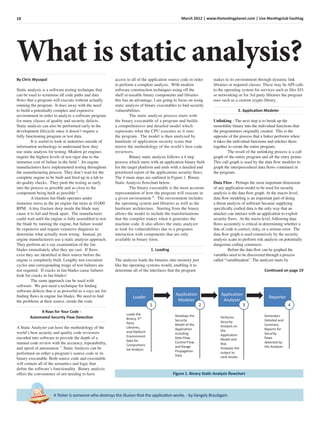
from the application, as shown in Figure 1.
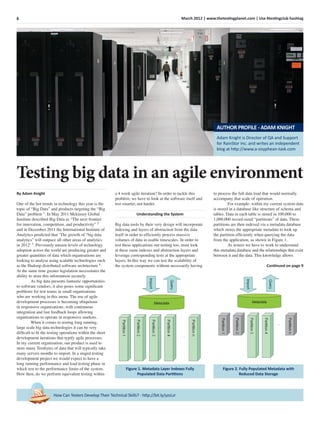
As testers we have to work to understand
this metadata database and the relationships that exist
between it and the data. This knowledge allows
Continued on page 9
Testing big data in an agile environment
Figure 1. Metadata Layer Indexes Fully
Populated Data Partitions
Figure 2. Fully Populated Metadata with
Reduced Data Storage
Adam Knight is Director of QA and Support
for RainStor inc. and writes an independent
blog at http://www.a-sisyphean-task.com
AUTHOR PROFILE - ADAM KNIGHT
9Follow us at www.twitter.com/testingclub
Continued from page 8
us to create test archives in which each layer in the
system behaves exactly as it would in a massive
production system, but with a much lower setup
and storage overhead (Figure 2). By essentially
“mocking” out very small partitions for all but a
target range of dates or imports, we create a metadata
layer that is representative of a much larger system.
Our knowledge of the query mechanism allows us to
seed the remaining partitions (Figure 2 - Partitions 3
and 4) with realistic data to service a customer query
across that data range that is functionally equivalent
to the same query on a much larger system.
Hitting the Ground Running
Whilst it is important to have some testing of newly
installed systems, many of the important performance
tests that need to be performed on big data systems
will be more realistic with a populated installation.
Building each of these up from scratch can be a time
consuming exercise which may not be possible within
the confines of a sprint iteration. The use of virtual
machines and the ability to ‘snapshot’and roll back
to a known hard disk state is a very useful tool for
this kind of operation in smaller scale testing, but is
of limited use for big-data archiving tests given the
scale of storage involved. In order to overcome this
problem, we can make use of various techniques to
pre-populate data into the system prior to executing
new tests. A few techniques that I currently use are:
Static Installation – Configuring the
software against a static, “read-only” installation can
be useful for testing query performance against a
known data set for performance benchmarking.
Backup/Restore - Using the backup/
restore and disaster recovery features of the system
to restore an existing installation in a known state.
As well as being an excellent way of restoring an
installation this also helps to test the backup and
recovery mechanisms themselves through real use.
Data Replication – If the software
supports quick import or replication methods then
we can leverage these to populate an installation
with bulk data far more quickly than through the
standard importing interfaces. For example, we
utilise a product feature to support geographic
replication of data across servers to bulk insert
pre-built data into archives far more rapidly
than the standard import process. Once we have
reached a suitable capacity we can then switch to
standard importing to test performance.
Rolling installation – Having an
installation which is in a “rolling state” whereby
tests import new data and archive out old data at a
continuous rate. This allows for testing at a known
capacity level in a realistic data lifecycle without
the lead time of building up an archive for each
iteration, with the additional benefit of boosting our
version compatibility testing with an installation
that has been running over a long period of time
and many software versions.
Creative Testing
Big data is a growing market requiring specialist
products, which in turn needs specialist testing.
Performance testing as a devoted performance
phase is no longer available to us when working
with agile methodologies.
To support our adoption of agile methods,
as testers we need to constantly use our creativity to
find new ways of executing important performance
and load tests to provide fast feedback within
development iterations.
Here I’ve presented a few of the methods
that we have used to try to address these challenges
and support a successful big data product. This is
certainly not a static list, as big data is getting bigger
by the day. Even as I write this we face greater
scalability challenges and increased use of cloud
resources in order to ramp up the testing of our own
Hadoop integration and consolidate our next step in
the scalability ladder. As more companies look to
move into the big data arena, I believe that testers
are going to be a critical factor in the success of
these organisations through their ability to devise
innovative ways of testing massively scalable
solutions with the resources available to them. □
REFERENCES
1. What is big data? Edd Dumbill, http://radar.
oreilly.com/2012/01/what-is-big-data.html
2. Big Data: The next frontier for innovation,
competition and productivity, McKinsey Global
Institute, http://www.mckinsey.com/Insights/
MGI/Research/Technology_and_Innovation/
Big_data_The_next_frontier_for_innovation
3. Analytics in 2012 Backs Big Data, Cloud Trends.
Justin Kern, Information Management ,
http://www.information-management.com/
news/analytics-predictive-big-data-cloud-IIA-
Davenport-10021670-1.html
4. James Kobielus, Forrester “Hadoop: What Is It
Good For? Absolutely . . . Something”, http://blogs.
forrester.com/james_kobielus/11-06-06-hadoop_
what_is_it_good_for_absolutely_something
Michael Bolton Rob Sabourin
Scott Barber Julian Harty
Fiona Charles James Lyndsay
Rikard Edgren Henrik Andersson Leo Hepis
Michael Albrecht Chris Blain Anne-Marie Charrett
Selena Delesie Anders Dinsen Henrik Emilsson
Carsten Feilberg Markus Gärtner Dawn Haynes
Zeger van Hese Benjamin Kelly Simon Morley
Louise Perold Alan Richardson Torbjörn Ryber
Alexander Rotaru Huib Schoots Neil Thompson
Oliver Vilson Christin Wiedemann Johan Åtting
A European conference on context-driven software testing
The core mission of Let's Test is to help build an active community in Europe of software testers that either identify
themselves with the context-driven school of software testing or are interested in learning more about it.
A full conference for only 15000 SEK. All inclusive!
www.lets-test.com
10 March 2012 | www.thetestingplanet.com | Use #testingclub hashtag
This Just In: QA Employees Are The Best Employees Of All - http://bit.ly/yhoMd3
The periodic table of data –
Pipe dream or possibility?
By Adrian Stokes
I work in a financial environment on a data warehouse
creating business and management intelligence
solutions in a mortgage and savings environment. As a
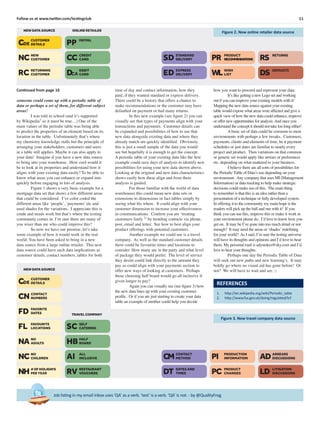
Figure 1. Periodic table of data - An idea by Adrian Stokes
CUSTOMER TITLE
CUSTOMER NAMECTN
CUSTOMER
GENDERCG
CUSTOMER TYPE
CT
CUSTOMER NI
NUMBERNI
CUSTOMER
DATE OF BIRTHCDB
CUSTOMER
PASSWORDCP
ADDRESS
CORRESPONDENCEAC
CUSTOMER
PHONE / MOBILECPM
CUSTOMER
EMAILCE
CONTACT
TYPECT
STAFF
NAMESN
STAFF
NUMBERSNU
ADDRESS
SECURITYAS
STAFF
JOB TITLESJ
PAYMENT
MONTHLYPM
PAYMENT
WEEKLYPW
PAYMENT
METHODPME
PAYMENT
AMOUNTPA
PAYMENT
BREAKPB
PAYMENT
VALUEPV
ACCOUNT
BALANCE CREDITAB
ACCOUNT
BALANCE DEBITABD
PAYMENT
EXTERNALSOURCEPE
PAYMENT
ADDITIONALPAD
PAYMENT
TYPEPT
PAYMENT
DESCRIPTIONPD
PAYMENT
FAILURESPF
CLIENT
TYPECT
CLIENT
DESCRIPTIONCD
CLIENT
VALUECV
CLIENT
SIZECS
CONTACT
METHODCM
DATE OF
CONTACTDC
LENGTH OF
CONTACTLC
TIME OF
CONTACTTC
PRODUCT END
DATEPED
PRODUCT
DURATIONPDU
PRODUCT
VALUEPVA
PRODUCT
TYPEPTY
PRODUCTS /
DELAYEDPDE
PROCEEDS
INPIN
PROCEEDS
OUTPO
POSSESSION
SOLDPS
POSSESSION
SALEPSA
ACC.INLITIGATION
POS TAKENAT
ACC.INLITIGATION
POS ORDEREDAO
ACC.INLITIGATION
COURT PROCEED.AC
ACC.INLITIGATION
SOLICITORAS
ACCOUNT IN
ARREARS-MAJORAA
ACCOUNTIN
ARREARS-MINORAM
PEOPLE
CUSTOMERS /CONTACTS
STAFF / EMPLOYEES
TRANSACTIONS
AMOUT / NUMBER
AMOUNT / VALUE
REVERSALS/REJECTIONS
CLIENTS / VIP
CLIENTS / MEDIUM
CLIENTS / SMALL
TIME / DATES
TIME / DURATION
PRODUCTS / TIMED
PRODUCTS / EXPIRED
PRODUCTS / DELAYED
LITIGATION / SOLICITOR
LITIGATION / COURT
LITIGATION/POSSESSION
LEGEND
tester I don’t want to just help deliver the best value
I can to my team and the customer. I want to be a
facilitator of learning and deliver value to myself
and my company. My job title is Quality Assurance
Analyst and while some have the perception that
‘QA’equals ‘tester’, as well as that important aspect
I try to add value by improving ‘how’we work. So
I’m always looking for opportunities to add value
and improve what we have.
Data can come in many forms, shapes and
sizes. In Star Trek: The Next Generation for instance,
Data is a Lieutenant Commander on a brilliant Sci-
Fi TV series and later spin off films. The idea of a
sentient robot/android with a Pinocchio complex is
an intriguing fantasy of a possible future. Today’s
‘Data’coming out of software systems, like Data after
his ‘emotion’chip can be so annoying! There’s loads
of it, everywhere you go, everywhere you look and
every time you do something, more is generated. And
that’s before you even think about all the logs that
lie alongside the system! Unfortunately, our ‘data’
is not able to communicate with us as easily as the
Commander and we have to find our own ways of
analyzing it and finding its properties and values. With
that in mind, I’ve been thinking of ways to improve
how we categorize the data we have, in order to make it
easier to use.
I have an idea and just maybe, it’s a
possibility, not a pipe dream: It would be nice if
Continued on page 11
11Follow us at www.twitter.com/testingclub
Job listing in my email inbox uses ‘QA’ as a verb. ‘test’ is a verb. ‘QA’ is not. - by @QualityFrog
Continued from page 10
someone could come up with a periodic table of
data or perhaps a set of them, for different subject
areas!
I was told in school (and it’s supported
by Wikipedia1
so it must be true…) One of the
main values of the periodic table was being able
to predict the properties of an element based on its
location in the table. Unfortunately that’s where
my chemistry knowledge stalls but the principle of
arranging your stakeholders, customers and users
in a table still applies. Maybe it can also apply to
your data! Imagine if you have a new data source
to bring into your warehouse. How cool would it
be to look at its properties and understand how it
aligns with your existing data easily? To be able to
know what areas you can enhance or expand into
quickly before engaging in lots of analysis.
Figure 1 shows a very basic example for a
mortgage data set that shows a few different areas
that could be considered. I’ve color coded the
different areas like ‘people’, ‘payments’ etc and
used shades for the variations. I appreciate this is
crude and needs work but that’s where the testing
community comes in. I’m sure there are many of
you wiser than me who could improve this?
So now we have our premise, let’s take
some example of how it would work in the real
world: You have been asked to bring in a new
data source from a large online retailer. This new
data source could have such data implications as
customer details, contact numbers, tables for both
time of day and contact information, how they
paid, if they wanted standard or express delivery.
There could be a history that offers a chance to
make recommendations or the customer may have
defaulted on payment or had many returns.
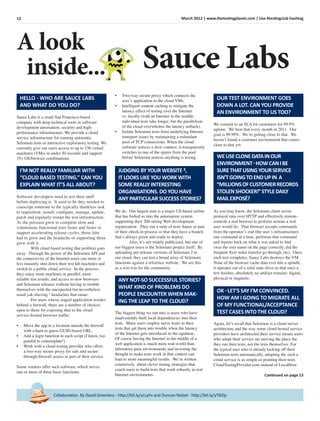
In this new example (see figure 2) you can
visually see that types of payments align with your
transactions and payments. Customer details can
be expanded and possibilities of how to use that
new data alongside existing data and where they
already match are quickly identified. Obviously
this is just a small sample of the data you would
see but hopefully it is enough to get the concept.
A periodic table of your existing data like the first
example could save days of analysis to identify new
possibilities for using your new data shown above.
Looking at the original and new data characteristics
shows easily how these align and from there
analysis is guided.
For those familiar with the world of data
warehouses this could mean new data sets or
extensions to dimensions or fact tables simply by
seeing what fits where. It could align with your
customer dimension to increase your effectiveness
in communications. Confirm you are ‘treating
customers fairly 2
’ by trending contacts via phone,
post, email and letter. See how to best align your
product offerings with potential customers.
Another example we could use is a travel
company. As well as the standard customer details
there could be favourite times and locations to
consider. How many are in the party and what level
of package they would prefer. The level of service
they desire could link directly to the amount they
pay so could align with your payments section to
offer new ways of looking at customers. Perhaps
those choosing half board would go all inclusive if
given longer to pay?
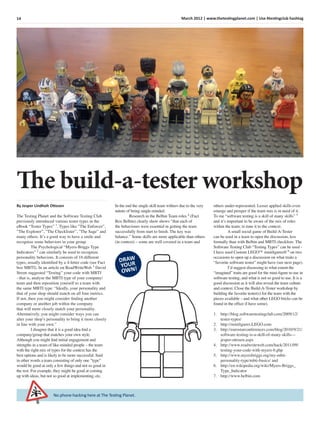
Again you can visually see (see figure 3) how
the new data lines up with your existing customer
profile. Or if you are just starting to create your data
table an example of another could help you decide
REFERENCES
1. http://en.wikipedia.org/wiki/Periodic_table
2. http://www.fsa.gov.uk/doing/regulated/tcf
how you want to proceed and represent your data.
It’s like getting a new Lego set and working
out if you can improve your existing models with it!
Mapping the new data source against your existing
table would expose what areas were affected and give a
quick view of how the new data could enhance, improve
or offer new opportunities for analysis.And once you
understand the concept it should not take too long either!
A basic set of data could be common to most
environments with perhaps a few tweaks. Customers,
payments, clients and elements of time, be it payment
schedules or just dates are familiar to nearly every
project and product. Then variations on that common
or generic set would apply like arrears or preferences
etc. depending on what mattered to your business.
I believe there are all sorts of possibilities for
the Periodic Table of Data’s use depending on your
environment. Any company that uses MI (Management
Information) or data tracking to help make strategic
decisions could make use of this. The main thing
to remember is that this is an idea rather than a
presentation of a technique or fully developed system.
In offering it to the community my main hope is the
readers will pick up the ball and run with it! If you
think you can use this, improve this or make it work in
your environment please do. I’d love to know how you
get on. It may be I’ve gone into too much detail or not
enough? It may need the areas or ‘shades’redefining
for your world? As I said, I’m sure the testing universe
will have its thoughts and opinions and I’d love to hear
them. My personal mail is adystokes@sky.com and I’d
love to hear your thoughts.
Perhaps one day the Periodic Table of Data
will seek out new paths and new learning’s. It may
boldly go where no visual aid has gone before! Or
not? We will have to wait and see. □
Figure 2. New online retailer data source
Figure 3. New travel company data source
NEW
CUSTOMERNC
RETURNING
CUSTOMERRC
PAYPAL
PP
CREDIT
CARDCC
DEBIT
CARDDCA
STANDARD
DELIVERYSD
EXPRESS
DELIVERYED
PRODUCT
RECOMMENDATIONSPR
WISH
LISTWL
RETURNS
RS
DEFAULTS
DS
CUSTOMER
DETAILSCDE
NEW DATA SOURCE ONLINE RETAILER
CONTACT
NUMBERSCN
FAVORITE
DATESFD
FAVOURITE
LOCATIONSFL
NO
ADULTSNA
NO
CHILDRENNC
CUSTOMER
DETAILSCDE
# OF HOLIDAYS
PER YEARNH
SELF
CATERINGSC
HALF
BOARDHB
ALL
INCLUSIVEAI
RESTAURANT
VOUCHERSRV
CONTACT
METHODCM
DATES AND
TIMESDT
PRODUCTION
INFORMATIONPI
PRODUCT
CHANGESPC
ARREARS
DISCUSSIONSAD
LITIGATION
DISCUSSIONSLD
NEW DATA SOURCE
TRAVEL COMPANY
12 March 2012 | www.thetestingplanet.com | Use #testingclub hashtag
Collaboration. By David Greenless - http://bit.ly/yLLpFx and Duncan Nisbet - http://bit.ly/yTlkDp
A look
inside...
HELLO - WHO ARE SAUCE LABS
AND WHAT DO YOU DO?
Sauce Labs
Sauce Labs is a small San Francisco-based
company with deep technical roots in software
development automation, security and high-
performance infrastructure. We provide a cloud
service infrastructure for running automatic
Selenium tests or interactive exploratory testing. We
currently give our users access to up to 150 virtual
machines (VMs) in under 50 seconds and support
35+ OS/browser combinations.
Software developers need to test their stuff
before deploying it. It used to be they needed to
conscript someone to the typically thankless task
to requisition, install, configure, manage, update,
patch and regularly restart the test infrastructure.
As the pressure grew to complete slow and
voluminous functional tests faster and faster to
support accelerating release cycles, those labs
had to grow and the headache of supporting them
grew with it.
With cloud based testing that problem goes
away. Through the power of the Selenium API and
the connectivity of the Internet users can more or
less instantly shut down their test lab machines and
switch to a public cloud service. In the process,
they enjoy more machines in parallel, more
reliable test results, and access to new browsers
and Selenium releases without having to trouble
themselves with the unexpected but nevertheless
usual yak-shaving 1
headaches that ensue.
For users whose staged application resides
behind a firewall, there are a number of choices
open to them for exposing that to the cloud
service-hosted browser traffic:
• Move the app to a location outside the firewall
with a hard-to-guess GUID-based URL.
• Add a login function to each script (I know, too
painful to contemplate!)
• Work with a cloud testing provider who offers
a two-way secure proxy for safe and secure
through-firewall access as part of their service.
Some vendors offer such software, which serves
one or more of three basic functions:
I’M NOT REALLY FAMILIAR WITH
“CLOUD BASED TESTING.” CAN YOU
EXPLAIN WHAT IT’S ALL ABOUT?
• Two-way secure proxy which connects the
user’s application to the cloud VMs.
• Intelligent content caching to mitigate the
latency effect of testing over the Internet
vs. locally (with an Internet in the middle,
individual tests take longer, but the parallelism
of the cloud overwhelms the latency setback).
• Isolate Selenium tests from underlying Internet
transport issues by maintaining a redundant
pool of TCP connections. When the cloud
software notices a slow connect, it transparently
switches to one of the spares from the pool
before Selenium notices anything is wrong.
JUDGING BY YOUR WEBSITE 3,
IT LOOKS LIKE YOU WORK WITH
SOME REALLY INTERESTING
ORGANISATIONS. DO YOU HAVE
ANY PARTICULAR SUCCESS STORIES?
We do. Our largest user is a major US-based airline
that has bolted us into the automation system
supporting their 200-strong Web development
organization. They run a suite of tests Sauce as part
of their check-in process so that they have a branch
that’s always green and ready to deploy.
Also, it’s not widely publicized, but one of
our biggest users is the Selenium project itself. By
uploading pre-release versions of Selenium 2 to
our cloud, they can test a broad array of Selenium
functions against a reference website. We see this
as a win-win for the community.
ANY NOT-SO SUCCESSFUL STORIES?
WHAT KIND OF PROBLEMS DO
PEOPLE ENCOUNTER WHEN MAK-
ING THE LEAP TO THE CLOUD?
The biggest thing we run into is users who have
inadvertently built local dependencies into their
tests. Many users employ naive waits in their
tests that get them into trouble when the latency
of the Internet gets introduced to the equation.
Of course having the Internet in the middle of a
web application is much more real-world than
laboratory-pure environments and investing the
thought to make tests work in that context can
lead to more meaningful results. We’re written
extensively about clever timing strategies that
coach users to build tests that work robustly in real
Internet environments.
OUR TEST ENVIRONMENT GOES
DOWN A LOT. CAN YOU PROVIDE
AN ENVIRONMENT TO US TOO?
We commit to an SLA for customers for 99.9%
uptime. We beat that every month in 2011. Our
goal is 99.99%. We’re getting close to that. We
haven’t found a customer environment that comes
close to that yet.
WEUSECLONEDATAINOUR
ENVIRONMENT-HOWCANIBE
SURETHATUSINGYOURSERVICE
ISN’TGOINGTOENDUPIN A
“MILLIONSOFCUSTOMERRECORDS
STOLENSHOCKER!”STYLEDAILY
MAILEXPOSÉ?
As you may know, the Selenium client server
protocol runs over HTTP and effectively remote-
controls a real browser to perform actions a real
user would do. That browser accepts commands
from the operator’s end (the user’s infrastructure)
one command at a time, performs that command
and reports back on what it was asked to find
(was the user name on the page correctly, did the
frequent flyer miles transfer go through, etc). Once
each test completes, Sauce Labs destroys the VM.
None of the browser cache data ever hits a spindle,
it operates out of a solid state drive so that once a
test finishes, absolutely no artifact remains: digital,
physical or magnetic.
OK-LET’S SAY I’M CONVINCED.
HOW AM I GOING TO MIGRATE ALL
OF MY FUNCTIONAL/ACCEPTANCE
TEST CASES INTO THE CLOUD?
Again, let’s recall that Selenium is a client-server
architecture and the way some cloud-hosted service
providers have architected their service means users
who adopt their service are moving the place the
they run their tests, not the tests themselves. For
the typical user who is already kicking off their
Selenium tests automatically, adopting the such a
cloud service is as simple as pointing their tests
CloudTestingProvider.com instead of LocalHost
Continued on page 13
13Follow us at www.twitter.com/testingclub
Continued from page 12
and inserting a single JSON string in their unit
test framework which specifies three things: what
browser they want us to use, the URL of their
staged application and their account key.
WHAT ABOUT PERFORMANCE
TESTING?
A fair number of our customers encounter what
we affectionately refer to as an “accidental load
test” when they get overly optimistic about how
many concurrent Selenium tests their staged
environment can handle! All kidding aside, we
see massive opportunity (read: we’re expanding
as fast as we can to keep up) in the functional
testing space. There are a number of offerings out
there we’re acquainted with in the cloud-delivered
load / performance testing space with established
customer bases and with whom we enjoy good
working relationships.
GREAT!NOWI’VEOUTSOURCEDALL
OFMYTESTSTOTHECLOUD,IDON’T
NEEDTOHIRETESTERS,RIGHT?
When I decided to rent vs. buy a car, I didn’t give
up the need for walking. You still need to walk to
and from the car regardless of whether you own
and maintain it yourself. So it is with using the
REFERENCES
1. http://catb.org/jargon/html/Y/yak-shaving.html
2. http://saucelabs.com/
3. http://saucelabs.com/blog/index.php/2011/04/
how-to-lose-races-and-win-at-selenium/
cloud to run your tests. You still need people to do
smart things. You just don’t need them to spend
as much time doing the thankless things of setting
up, configuring, restarting, upgrading, patching and
generally being a slave to a test infrastructure.
Thanks to John Dunham (Sauce Labs CEO) and
Ashley Wilson (Sauce Labs Customer Development
Manager) for answering all our questions. □
After the first successful edition of Test Automation Day (2011), we would like
to welcome you to the 2012 edition in Rotterdam, the Netherlands!
The independent conference committee will organize an exciting collection
of keynote sessions, business cases and workshops presented by national &
international thought leaders and experts.
International gurus as Elfriede Dustin (Author and
AutomatedTesting Evangelist, Sr. Systems Engineer at IDT) and
Scott Barber (CTO PerfTestPlus, Co-Founder ofWorkshop
“On Performance and Reliability”) will contribute to the
second edition! Scott Barber will share his experiences
during an exclusive (lunch) tutorial!
Are you interested in this exclusive lunch? Register now! Only the
first 50 registrations will be able to participate.
Register with the special member code!
As a reader of“Testing Planet”, you’ll get a € 100,- discount.
Register with the code:“TAD2012-TPL”on www.testautomationday.com
and pay only € 195,- (excl. VAT) for Test Automation Day!
MORE INFORMATION AND REGISTRATION AT WWW.TESTAUTOMATIONDAY.COM
FOUNDING PARTNER
PARTNERS
SPONSORS
2nd edition,June 21st 2012,WorldTradeCenter ‐ Rotterdam,The Netherlands
annual conference and exhibition
The Future ofTest Automation
Elfriede Dustin Scott Barber
€100,‐discount for readers ofTesting PlanetPay only €195,‐excl. VAT
CONFERENCE ORGANIZATION
PARTICIPANTS KNOWN JANUARY 30TH 2012
EXHIBITORS
KZA BV
SQS NEDERLAND B.V.
VX COMPANY
WWW.MINISTRYOFTESTING.COM
CO-CREATING
SMARTER TESTERS
EDUCATION • COLLABORATION
EVENTS
14 March 2012 | www.thetestingplanet.com | Use #testingclub hashtag
No phone hacking here at The Testing Planet.
The build-a-tester workshop
By Jesper Lindholt Ottosen
The Testing Planet and the Software Testing Club
previously introduced various tester types in the
eBook “Tester Types” 1
. Types like ”The Enforcer”,
”The Explorer”, ”The Checklister”, ”The Sage” and
many others. It’s a good way to have a smile and
recognize some behaviors in your group.
The Psychological “Myers-Briggs Type
Indicators” 2
can similarly be used to recognize
personality behaviors. It consists of 16 different
types, usually identified by a 4-letter code (see Fact
box MBTI). In an article on ReadWriteWeb 3
David
Strom suggested “Testing” your code with MBTI
- that is, analyse the MBTI type of your company/
team and then reposition yourself to a team with
the same MBTI type: “Ideally, your personality and
that of your shop should match on all four metrics.
If not, then you might consider finding another
company or another job within the company
that will more closely match your personality.
Alternatively, you might consider ways you can
alter your shop’s personality to bring it more closely
in line with your own.”
I disagree that it is a good idea find a
company/group that matches your own style.
Although you might find initial engagement and
strengths in a team of like-minded people – the team
with the right mix of types for the context has the
best options and is likely to be more successful. Said
in other words a team consisting of only one ”type”
would be good at only a few things and not so good in
the rest. For example, they might be good at coming
up with ideas, but not so good at implementing, etc.
In the end the single skill team withers due to the very
nature of being single-minded.
Research in the Belbin Team roles 4
(Fact
Box Belbin) clearly show shows “that each of
the behaviours were essential in getting the team
successfully from start to finish. The key was
balance.” Some skills are more applicable than others
(in context) – some are well covered in a team and
others under-represented. Lesser applied skills even
emerge and prosper if the team mix is in need of it.
To me “software testing is a skill of many skills” 5
and it’s important to be aware of the mix of roles
within the team; to tune it to the context.
A small social game of Build-A-Tester
can be used in a team to open the discussion, less
formally than with Belbin and MBTI checklists. The
Software Testing Club “Testing Types” can be used -
I have used Custom LEGO™ minifigures® 6
on two
occasions to open up a discussion on what traits a
“favorite software tester” might have (see next page).
I’d suggest discussing to what extent the
“imagined” traits are good for the mini-figure to use in
software testing, and what is not so good to use. It is a
good discussion as it will also reveal the team culture
and context. Close the Build-A-Tester workshop by
building the favorite tester(s) for the team with the
pieces available – and what other LEGO bricks can be
found in the office (I have some).
1. http://blog.softwaretestingclub.com/2009/12/
tester-types/
2. http://minifigures.LEGO.com
3. http://eurostarconferences.com/blog/2010/9/21/
software-testing-is-a-skill-of-many-skills---
jesper-ottosen.aspx
4. http://www.readwriteweb.com/hack/2011/09/
testing-your-code-with-myers-b.php
5. http://www.myersbriggs.org/my-mbti-
personality-type/mbti-basics/ and
6. http://en.wikipedia.org/wiki/Myers-Briggs_
Type_Indicator
7. http://www.belbin.com
DRAW
YOUR
OWN!
15Follow us at www.twitter.com/testingclub
The Ministry of Testing. Training and events. Not to be missed! www.ministryoftesting.com
Jesper Lindholt Ottosen is a senior test manager with CSC Den-
mark. He has 10 years experience of test management in large scale
telecommunication enterprise environments. Jesper blogs internally
in CSC on testing topics and was a guest blogger for EuroStar2010.
Jesper tweets as @jlottosen. Jesper is an adult fan of LEGO and a
senior test manager at CSC in Denmark. You can find him on Twitter
and Google+ writing about software test and LEGO. This is fan art
and not authorized by LEGO® or CSC.
AUTHOR PROFILE - JESPER LINDHOLT OTTOSEN REFERENCES
1. http://blog.softwaretestingclub.com/2009/12/tester-types/
2. http://www.myersbriggs.org/my-mbti-personality-type/mbti-basics/
3. http://www.readwriteweb.com/hack/2011/09/testing-your-code-with-myers-b.php
4. http://www.belbin.com
5. http://eurostarconferences.com/blog/2010/9/21/software-testing-is-a-skill-of-
many-skills---jesper-ottosen.aspx
6. http://minifigures.LEGO.com
7. http://en.wikipedia.org/wiki/Myers-Briggs_Type_Indicator
8. http://www.belbin.com/content/page/5002/BELBIN(uk)-2011-
TeamRoleSummaryDescriptions.pdf
FACT BOX MBTI 7
First letter - Favourite world
Do you prefer to focus on the outer world or on your own inner world? This is called Extraversion (E) or
Introversion (I).
Second letter - Information
Do you prefer to focus on the basic information you take in or do you prefer to interpret and add
meaning? This is called Sensing (S) or Intuition (N).
Third letter - Decisions
When making decisions, do you prefer to first look at logic and consistency or first look at the people
and special circumstances? This is called Thinking (T) or Feeling (F).
Fourth letter - Structure:
In dealing with the outside world, do you prefer to get things decided or do you prefer to stay open to
new information and options? This is called Judging (J) or Perceiving (P).
FACT BOX BELBIN 8
Plant Generates ideas and solves difficult problems
Resource investigator Explores opportunities and develops contacts
Co-ordinator Delegates effectively
Shaper Has the drive and courage to overcome obstacles
Monitor Evaluator Sees options and judges accurately
Teamworker Listens and averts friction
Implementer Turns ideas into actions and organises work that needs to be done
Completer finisher Polishes and perfects
Specialist Provides knowledge and skills in rare supply
COP DETECTIVE DUMMY EXPLORER STUDENT GUARD HAZMAT
STOP - This
defect is a
violation of the
first requirement
Elementarymy
dear!Thecoffee
stainhereisourlead
tothekillerbug.
You want me
to ram it into a
firewall again?
Yeah, sure!
Hey, there is no
path this way
through the
integrations – yet.
See folks,
I learned
something new
today.
This is my gate;
you shall not pass
without proper
review.
Gear up, we’re
deploying for the
bug bash!
1. UNFIXED BUGS
CAMOUFLAGE OTHER BUGS
How many times have you heard a tester say,
“Good news, I’ve re-tested the bug you fixed and
it’s working perfectly, but I’m now observing a new
bug”? You might be in luck, fixing a bug may reveal no
further problems, but postponing this kind of discovery
is a risky strategy. What happens if that Priority 3 bug
you’ve been ignoring has been camouflaging a Priority
1, or worse still, a bug that will require significant
alterations to the software to fix? If you have one
of these bugs hiding somewhere in your code,
the sooner you discover it, the better. Don’t
delay finding important problems; fix
bugs as soon as you find them.
2. UNFIXED BUGS
SUGGEST QUALITY ISN’T
IMPORTANT
We’re all professionals at heart, but it’s surprising how
quickly a team can find themselves in a downward spiral.
A developer working on software that already contains
hastily written, error prone functions, with little or no unit
test coverage, is likely to add more code of the same nature.
Similarly, a tester who has seen tens of reported bugs go
unfixed is unlikely to be enthusiastic about reporting many
more. Of course, it isn’t just developers and testers that are
affected. Over time, every member of the team will start
to ask themselves, “what’s the point”, why aim for a
high quality product when a substandard one is the
accepted status quo. Don’t set substandard
quality expectations; fix bugs as soon as
you find them.
3. DISCUSSIN
BUGS IS A WA
Regardless of whether it’s
during a dedicated triage
around a desk, discussing unfi
There really is only one questio
this bug need to be fixed”? Eve
is just noise. Should we categ
a Priority 4? How long will it t
113 first or bug 114? These a
avoided (including the often
follow) if teams fixed bugs a
Without doubt, every pro
bugs that need special att
require this level of atte
Don’t waste time
discussions; fix b
you find
6. UNFIXED BUGS
DISTRACT THE ENTIRE TEAM
When somebody encounters an unfixed bug a number
of distracting questions are planted in their mind. Take
a developer who is about to make an enhancement when
they notice a bug. Should they fix the bug first, has somebody
else fixed it but not checked-in, can they rely on the buggy code
to be the basis for their own? Similarly, imagine a tester who
has stumbled across a bug in one functional area whilst setting
up the pre-conditions to test another. Should they postpone
testing the intended area and instead explore around the bug
they stumbled across, has this bug already been reported
and would exploring it be a waste of time, could this
bug (positively or negatively) pollute the results
of the planned tests? Don’t let your team be
distracted by unfixed bugs; fix bugs as
soon as you find them.
7. UNFIXED BUGS HINDER
SHORT-NOTICE RELEASES
Once in a while an event occurs that forces a team to
release all or part of their software when they least expect
it. Maybe an emergency patch is needed to fix a bug in the
production environment, or an unexpected visit from the proj-
ect sponsor requires the latest release to be installed on a demo
laptop. These events can be taxing at the best of times, often
made worse by the presence of one or more unfixed bugs. It may
only take a relatively short time to perform the release itself, but
with unfixed bugs in the code, how long will it take to get the
software ready for release? Even if a team can quickly fix any
bugs blocking the release, there is also the time required to
re-test the bugs to consider. The result is often a delayed
release or a release that contains only the most glar-
ing bugs removed. Don’t let your releases be
hindered by unfixed bugs; fix bugs as soon
as you find them.
8. U
TO IN
No two bugs a
seconds to investi
take minutes to fi
automatically re-
Combine together the
unfixed bugs a project
It’s easy to fall into to
and re-test bugs fades
work and they can b
contingency – this i
place and detailed a
whether the conti
know how lon
until the wo
stakehold
bu
bugs as soon as you find them.
made worse by the presence of one or more unfixed bugs. It may
only take a relatively short time to perform the release itself, but
with unfixed bugs in the code, how long will it take to get the
software ready for release? Even if a team can quickly fix any
bugs blocking the release, there is also the time required to
re-test the bugs to consider. The result is often a delayed
release or a release that contains only the most glar-
REASONS WH
AS SOON AS Y10
NG UNFIXED
ASTE OF TIME
s part of project planning,
meeting or just gathered
fixed bugs is a waste of time.
on that needs answering, “does
erything else, whilst interesting,
gorise this bug as Priority 3 or
take to fix? Should we fix bug
are all questions that could be
n lengthy conversations that
as soon as they found them.
oject will have its share of
ttention, but few projects
ention to be the norm.
with unnecessary
bugs as soon as
d them.
4. UNFIXED BUGS LEAD
TO DUPLICATE EFFORT
The greater the number of unfixed bugs, the harder it
is to identify whether a bug has already been reported.
Imagine a scenario where there are only 5 unfixed bugs.
When a “new” bug is discovered, it’s easy to identify whether
that bug has been reported by someone else. Now imagine
trying to perform the same task when there are 50 unfixed
bugs in circulation. It’s either going to take a disagreeably long
amount of time (time which could be better spent looking for
other bugs) or the thought of such an overwhelming task
will cause it to be abandoned, often leading to duplicate
bugs being reported. These duplicate bugs lead to
duplicate investigation and duplicate re-testing.
Don’t waste time on unnecessary duplication;
fix bugs as soon as you find them.
5. UNFIXED BUGS LEAD
TO UNRELIABLE METRICS
Different teams analyse bugs in different ways.
Some casually monitor how many are left to be fixed,
whilst others track everything from their density to
their lifespan. Regardless of the complexity, every bug-
based metric relies on accurate underlying data. As the
number of unfixed bugs increases, it becomes increasing
difficult to maintain accurate bug information. Even if
the information was correct at the time, the longer
a bug is left unfixed, the greater the chance that
information will diverge from reality. The resulting
misinformation then ripples through the team.
Don’t fall foul of project decisions based
on incorrect information; fix bugs
as soon as you find them.
UNFIXED BUGS LEAD
NACCURATE ESTIMATES
are ever the same. Some require mere
tigate; others take hours to diagnose. Some
fix; others take several days. Some can be
-tested; others require manual verification.
ese uncertainties and you can see why the more
t has the less accurate their estimates become.
o trap of thinking that the effort required to fix
es into insignificance compared to other project
be ignored / managed via a healthy chunk of
is rarely the case. Even with a contingency in
analysis of each bug performed to understand
tingency is sufficient, a team can never truly
ng it will take to fix and re-test each bug
ork is complete. Don’t misinform your
ders with inaccurate estimates; fix
ugs as soon as you find them.
9. FIXING FAMILIAR
CODE IS EASIER THAN
UNFAMILIAR CODE
The human mind is capable of many incredible feats,
but retaining information indefinitely is not one of them.
Over time our memory decays and things we used to know
intimately become blurred and unfamiliar. The code a team
writes is no exception and for this reason it is easier for a team
to fix a bug in code they edited earlier that day compared to
code they haven’t seen for a week or two. A team can re-
duce the effect of memory decay by sticking to good devel-
opment principles, but this will only reduce the effect of
memory decay, it can never alleviate it completely.
Avoid the frustration caused by having to fa-
miliarise yourself with a piece of code you
once knew; fix bugs as soon as you
find them.
10. FIXING A BUG TODAY
COSTS LESS THAN TOMORROW
For all the reasons listed in points 1 to 9, fixing a
bug today will cost you less than fixing the same bug
tomorrow. If a bug is left to fester in the software you
are developing, configuring or maintaining it may camou-
flage other bugs, demotivate the team by suggesting qual-
ity isn’t important, become the topic of pointless conver-
sations, cause duplicate effort, lead to incorrect project
metrics, distract the project team, hinder short-notice
releases, invalidate estimates and lead to unnecessary
frustration. And the longer you leave a bug before
fixing it, the more likely these things are to oc-
cur and to a greater extent. Don’t put your
project at risk; fix bugs as soon as you
find them.
s part of project planning,
meeting or just gathered
fixed bugs is a waste of time.
on that needs answering, “does
erything else, whilst interesting,
4. UNFIXED BUGS LEAD
Some casually monitor how many are left to be fixed,
whilst others track everything from their density to
their lifespan. Regardless of the complexity, every bug-
based metric relies on accurate underlying data. As the
number of unfixed bugs increases, it becomes increasing
difficult to maintain accurate bug information. Even if
the information was correct at the time, the longer
a bug is left unfixed, the greater the chance that
information will diverge from reality. The resulting
misinformation then ripples through the team.
Don’t waste time on unnecessary duplication;
fix bugs as soon as you find them.
ugs as soon as you find them.
10. FIXING A BUG TODAY
COSTS LESS THAN TOMORROW
HY YOU FIX BUGS
YOU FIND THEM
18 March 2012 | www.thetestingplanet.com | Use #testingclub hashtag
What is static analysis?
A Tester is someone who destroys the illusion that the application works. - by Gergely Brautigam
By Chris Wysopal
Static analysis is a software testing technique that
can be used to scrutinise all code paths and data
flows that a program will execute without actually
running the program. It does away with the need
to build a potentially complex and expensive
environment in order to analyze a software program
for many classes of quality and security defects.
Static analysis can also be performed early in the
development lifecycle since it doesn’t require a
fully functioning program or test data.
It is useful to look at industries outside of
information technology to understand how they
use static analysis for testing. Modern jet engines
require the highest levels of test rigor due to the
immense cost of failure in the field 1
. Jet engine
manufacturers have implemented testing throughout
the manufacturing process. They don’t wait for the
complete engine to be built and fired up in a lab to
do quality checks. They push the testing as early
into the process as possible and as close to the
component being built as possible 2
.
A titanium fan blade operates under
immense stress as the jet engine fan turns at 10,000
RPM. A tiny fracture deep inside the blade may
cause it to fail and break apart. The manufacturer
could wait until the engine is fully assembled to test
the blade by running the engine, but failure would
be expensive and require extensive diagnosis to
determine what actually went wrong. Instead, jet
engine manufacturers use a static analysis approach.
They perform an x-ray examination of the fan
blades immediately after they are cast. If flaws
exist they are identified at their source before the
engine is completely built. Lengthy test execution
cycles and corresponding triage of test-failures are
not required. If cracks in fan blades cause failures
look for cracks in fan blades!
The same approach can be used with
software. We just need a technique for finding
software defects that is as powerful as x-rays are for
finding flaws in engine fan blades. We need to find
the problems at their source, inside the code.
X-Rays for Your Code -
Automated Security Flaw Detection
A Static Analyzer can have the methodology of the
world’s best security and quality code reviewers
encoded into software to provide the depth of a
manual code review with the accuracy, repeatability,
and speed of automation 3
. Static Analysis can be
performed on either a program’s source code or its
binary executable. Both source code and executable
will contain all of the semantics and logic that
define the software’s functionality. Binary analysis
offers the convenience of not needing to have
access to all of the application source code in order
to perform a complete analysis. With modern
software construction techniques using off the
shelf re-useable binary components and libraries
this has an advantage. I am going to focus on using
static analysis of binary executables to find security
vulnerabilities.
The static analysis process starts with
the binary executable of a program and builds
a comprehensive and detailed model which
represents what the CPU executes as it runs
the program. The model is then analyzed by
hundreds of application security scans that
mirror the methodology of the world’s best code
reviewers.
Binary static analysis follows a 4 step
process which starts with an application binary built
for the target platform and ends with a detailed and
prioritized report of the applications security flaws.
The 4 main steps are outlined in Figure 1. Binary
Static Analysis flowchart below.
The binary executable is the most accurate
representation of how the program will execute in
a given environment 4
. The environment includes
the operating system and libraries as well as the
hardware architecture. Starting from the binary
allows the model to include the transformations
that the compiler makes when it generates the
machine code. It also allows the static analyzer
to look for vulnerabilities due to a programs
interaction with components that are only
available in binary form.
1. Loading
The analyzer loads the binaries into memory just
like the operating systems would, enabling it to
determine all of the interfaces that the program
makes to its environment through dynamic link
libraries or required classes. These may be API calls
to the operating system for services such as files I/O
or networking or for 3rd party libraries the program
uses such as a custom crypto library.
2. Application Modeler
Unlinking - The next step is to break up the
monolithic binary into the individual functions that
the programmers originally created. This is the
opposite of the process that a linker performs when
it takes the individual functions and stitches them
together to create the entire program.
The result of the unlinking process is a call
graph of the entire program and all the entry points.
This call graph is used by the data flow modeler to
graph the interprocedural data flows contained in
the program.
Data Flow - Perhaps the most important dimension
of any application model to be used for security
analysis is the data flow graph. At the macro level,
data flow modeling is an important part of doing
a threat analysis of software because supplying
specifically crafted data is the only way that an
attacker can interact with an application to exploit
security flaws. At the micro level, following data
flows accurately is critical in determining whether a
line of code is correct, risky, or a serious error. The
data flow graph is used extensively by the security
analysis scans to perform risk analysis on potentially
dangerous coding constructs.
Before the data flow can be graphed the
variables need to be discovered through a process
called “variablization”. The analyzer starts by
Continued on page 19
Figure 1. Binary Static Analysis flowchart
Application
Modeler
Loader
Application
Analyzer
Reporter
1 2 3 4
Loads the
Binary, 3rd
Party
Libraries,
and Platform
Environment
Data for
Comprehens
ive Analysis
Develops the
Security
Model of the
Application
including
Data Flow,
Control Flow,
and Range
Propagation
Data
Performs
Security
Analysis on
the
Application
Model and
Risk
Analyses the
output to
rank results
Generates
Detailed and
Summary
Reports for
Security
flaws
detected by
the Analyzer
19Follow us at www.twitter.com/testingclub
socket
send recv
listengetsockname bind
accept pthread_create
accept_request
close
strlen
not_fou
sprintf
get_linestrcmpunimplemented strcasecmp
strcat statexecute_cgi VC_Copy_Taint
write read fork waitpid
_fini
main
startup
perror
error_die
printf
memset
exit bad_request pipe
thunk_44860
execl dup2 putenv
atexit
atoi cannot_execute
_exit_start
_init
A Tester Is Someone Who remains curious in the face of adversity by Stephen Janaway
Chris Wysopal, co-founder and chief technology officer of Veracode, is responsible for the
security analysis capabilities of Veracode technology. He has given keynotes at computer secu-
rity events and has testified on Capitol Hill on the subjects of government computer security
and how vulnerabilities are discovered in software. He also has spoken as the keynote at West
Point, to the Defense Information Systems Agency (DISA) and before the International Financial
Futures and Options Exchange in London.
AUTHOR PROFILE - CHRIS WYSOPAL
Continued from page 18
understanding the assembly language instructions
that the program is compiled to for a particular
hardware platform. It analyzes the instructions that
manipulate data, moving it between the CPU registers
and memory. From these instructions the registers
are unpainted 5
back into the variables that the
programmer specified and the types of these variables
are discovered. For each procedure in the program, the
input, output, and local variables are discovered and
placed into the data flow graph.
Once the variables are discovered the data
flow can be mapped as variables are initialized and
data is moved into and out of them.
Control Flow - Determining the control flow within a
function in the program allows the analyzer to discover
the high level language constructs that were used by the
programmer. This is where if-then statements and for
and while loops are determined. Later in the security
scans process the control flow graph will be used to
determine whether or not return values were checked
before use. The control flow graph will be an important
input into the range propagation process.
A control flow graph (see main image) is
generated by analyzing the branching instructions
contained in the assembly language instructions with
a function. The function is broken down into basic
blocks, which are lines of code that are executed
in sequence, and conditionals such as a jz (jump
if zero). By knowing the way the compiler uses
conditionals to compile if-then statements and loops,
the analyzer can recreate a functionally equivalent
high level representation of the control flow that
the programmer intended. If this was represented
graphically is would look like a classic flow chart.
Range Propagation - The range of a variable’s
potential value at any point in the code gives
important information that can be used for security
analysis. If there is a conditional such as:
if (n < 100)
strncpy(dest, src, n)
The range of n is between 0 and 99 (assuming n is
an unsigned integer) within the basic block of the
true clause of the conditional. This information can
be used by the security scans to analyze whether
a security problem such as a buffer overflow can
occur at a particular line of code. By knowing that
the value of n in the example above must be lower
than 99 the scan can determine if the destination
buffer, dest, is large enough to fit the potential range
of sizes of the source buffer, src.
3. Application Analyzer
The essence of secure programming is to
understand the limitations of the particular
programming environment a program is built in
and how to stay within the bounds of security
correctness in this environment. The security scans
are designed to detect when a programmer has
exceeded the bounds of security correctness.
After the analyzer builds a detailed model of
the program the next step is to use that model to
perform a security analysis. The security analysis is
made up of a set of hundreds of scans that identify
potential flaws, determine whether the potential
flaw is an actual flaw and then determine a risk
level associated with each actual flaw. The detailed
model that the analyzer builds enables the security
scans to have enough information to accurately rank
the risk of a potential flaw as well as minimize the
number of flaws that require some manual analysis
to determine risk.
Triggers and Risk Analysis - The security scans
start by searching for triggers in the applications
model. Triggers are known problematic procedure
calls such as the printf family of functions in the
C standard library or security critical operating
system APIs. Once the scan has found a trigger it
investigates the context surrounding the trigger in
the data flow, control flow, and range propagation
models. This is the risk analysis portion of the
security scan. The risk analysis will determine if
the trigger has pointed to a security flaw or not. If
it has, it will rank its severity. The risk analysis may
also establish that there is not enough information
in the application model to determine whether or
not a trigger has uncovered a flaw or not. It will,
in that case, flag the line of code as a possible
error and offer information to help in the manual
investigation of that area of code. Finally, the risk
analysis may determine that there is no flaw and
move on to the next trigger. The risk analysis
functions are able to use the depth of the application
model to bring the amount of manual analysis to an
absolute minimum.
Types of Scans - A typical static analyzer will
contain triggers and associated risk analysis
functions in 5 main categories:
• Data injection flaws: SQL injection, command
injection, cross site scripting (XSS)
• Memory corruption: Stack/Heap buffer
overruns
• Information leakage
• Integer overflows/underflows
• Threading/race conditions
These categories of flaws account for the majority
of critical security vulnerabilities. These flaws are
the root causes that lead to exploits such as remote
execution of arbitrary code, privilege escalation,
and denial of service. For each scan category, the
analyzer has rules created from secure coding
guidelines and real world instances of software
security vulnerabilities.
Here is an example of a trigger and risk
analysis in action. This code comes from an open
source project, tinyhttpd release 0.1.0 6
. Some of the
code has been removed for brevity.
Continued on page 20
Figure 2. Control Flow Graph - For full size image visit - http://bit.ly/wT7z5s
20 March 2012 | www.thetestingplanet.com | Use #testingclub hashtag
A tester is someone who, says ....<it depends on the context> - by Jesper Lindholt Ottosen
Continued from page 19
void execute_cgi(int client, const
char *path, const char *method,
const char *query_string)
{
char query_env[255];
sprintf(query_env, “QUERY_
STRING=%s”, query_string);
return;
}
The trigger in this example is the sprintf function call
that contains a %s format specifier with no precision
specifier (i.e. %.100s for 100 characters max). The
trigger causes the static analyzer to probe deeper into
the control flow and data flow graphs of the program
to determine the risk level of the code.
First a little background on sprintf secure
coding issues. The sprintf function 7
can take 3 or
more parameters. First is the target buffer, second
is the format string specifier, then a variable number
of source buffers. In the example above there is
just 1 source buffer. The sprintf function assumes an
unlimited size target buffer. The precision specifier
is an integer positioned in front of the ‘s’ in the
format string to specify maximum string length.
The sprintf function starts by copying the format
string character by character. When it reaches a
%s it copies the data in the first source buffer into
its place. When there is no precision specifier the
sprintf function will perform a memory copy of the
data from the source buffer to the target buffer. It
won’t stop until it reaches a NULL terminator in the
source buffer.
Now here is the security issue. If the
source buffer size plus the format string size
(minus 2 characters for the %s) is larger than the
target buffer there will be a buffer overrun. The
risk analysis function must determine the size of
the source buffer and target buffer by performing
data flow analysis. Once it has these sizes it is
simple math to compute whether or not there is a
potential buffer overrun.
The size of the target buffer was easy to
determine. The variable, query_env, is a local static
buffer of size 255. The source buffer is different. It
is passed into the function as a pointer to a buffer as
an input parameter, query_string. So to determine
its length we need to perform interprocedural data
flow analysis. This means we look for all the places
in the code where the function containing our
trigger is called and perform a data flow analysis
to determine the size of the buffer passed into that
function. In this particular case there is one place
where the function is called. It is at the end of the
following function, accept_request(). Some code
has been removed for brevity.
void accept_request(int client)
{
char buf[1024];
int numchars;
char method[255];
char url[255];
char path[512];
size_t i, j;
int cgi = 0; /* becomes true
if server decides this is a CGI
* program */
char *query_string = NULL;
numchars = get_line(client, buf,
sizeof(buf));
i = 0; j = 0;
while (!ISspace(buf[j]) && (i <
sizeof(method) - 1))
{
method[i] = buf[j];
i++; j++;
}
method[i] = ‘0’;
i = 0;
while (ISspace(buf[j]) && (j <
sizeof(buf)))
j++;
while (!ISspace(buf[j]) &&
(i < sizeof(url) - 1) && (j <
sizeof(buf)))
{
url[i] = buf[j];
i++; j++;
}
url[i] = ‘0’;
if (strcasecmp(method, “GET”) ==
0)
{
query_string = url;
while ((*query_string != ‘?’) &&
(*query_string != ‘0’))
query_string++;
if (*query_string == ‘?’)
{
cgi = 1;
*query_string = ‘0’;
query_string++;
}
}
execute_cgi(client, path,
method, query_string);
close(client);
}
The dataflow graph continues up through the
function call to execute_cgi() . The parameter in
question is the last one, query_string. The variable
query_string is assigned from the variable, url,
which is a local static buffer of size 255. Now the
source buffer size is determined. Returning to the
trigger source code, the size calculation using our
buffer sizes can be performed to determine risk.
sprintf(query_env, “QUERY_
STRING=%s”, query_string);
Source length + format string – 2 (for the %s) is
268. Target length is 255. The target buffer is
not big enough. If an attacker crafts a query string
with a length greater than 242 there will be a
buffer overrun and the likelihood that the attacker
manipulating the size of url could execute arbitrary
code. This is a severe error and would be marked
as such by the analyzer.
It is interesting to note that the tinyhttpd
programmer did a good job of reading data from the
network with a hard size limit and then parsed the
data safely into a few buffers. But when the data was
passed to another function and the subtlety of the sprintf
function was involved, a security flaw was born.
With its comprehensive set of triggers and
risk analysis functions, built on top of a deep model
of the program, static analysis can uncover security
flaws that many expert code reviewers would miss.
And unlike manual review, it can be performed
consistently and with high speed.
3. Reporter
Static analysis typically produces 2 types of reports
for different audiences. The detailed reports are
designed for the developer who is assigned to
remediate the security flaws. The summary reports
are designed for QA or management who are tasked
with tracking security quality from a project or
organization perspective.
Summary Report - At its simplest, the summary
report boils the security flaws down to one number,
the security score. This number is computed by the
number and severity of all the security flaws in the
application being tested. It gives an overall security
quality metric that can be used to track security
remediation of an application or perhaps acceptance
test one. It can also be used to compare the relative
risk of the different applications developed and
used within an organization. The summary report
also contains charts of the security analysis results
by severity and by type, sorted by risk.
Detailed Report - A detailed report is the core output
of static analysis findings. This is the information
that points to the exact line of code where the
security flaw is and gives details explaining what
is wrong with the code and suggestions for how to
fix it. In the sprintf() example given previously, the
detailed report may recommend that the programmer
use a precision specifier to limit the size of the source
buffer that is copied to the target buffer.
Workflow - Static analysis tools and services are
designed to fit the workflow of either a centralized
application security group responsible for the
security of many applications across an organization
or a software development team building a single
application. The workflow consists of 4 steps.
• Prepare a build of the software
• Perform binary analysis and run security scans
to generate results
• Perform additional manual analysis triage on
results (optional)
• View results and remediate.
Continued on page 21
21Follow us at www.twitter.com/testingclub
A tester is someone who is only happy when he’s broken something ... by TestSheepNZ
Continued from page 20
This workflow can be integrated into any
development process and can start as early as
the software is coded and compiled. If testers
can test the software or if a developer can
debug it then it is ready for static analysis to
automatically find security flaws in it.
Detect and Remediate Security Problems at
the Source - Static analysis detects application
security vulnerabilities at the point of their
creation, insecure code. It then guides the
remediation of vulnerabilities to the exact lines
of code that caused them. It can do this quickly,
precisely, and consistently. It assures you that
your applications are coded following modern
secure coding practices.
Manufacturers of modern
mechanical or electronic
technology don’t let their
customers see failures before
looking for flaws. They
don’t even wait until the
product is fully assembled.
Once a particular class of
flaws is well known it is
inspected for during the
production cycle. Static
Analysis brings this level
of repeatable, consistent
quality to securing the
software development
cycle. Welcome to the new
era of software testing and
software security. □
REFERENCES
1. http://www.oobject.com/category/jet-engine-
test-videos/ http://cp.literature.agilent.com/
litweb/pdf/5964-0156E.pdf
2. http://cp.literature.agilent.com/litweb/pdf/5964-
0156E.pdf
3. http://www.slideshare.net/denimgroup/static-
analysis-techniques-for-testing-application-
security-houston-tech-fest
4. http://research.cs.wisc.edu/wpis/papers/
wysinwyx05.pdf
5. The term unpainting comes from the compiler
term, register painting, which is a task a compiler
performs when mapping variables to registers
through the process of register allocation.
6. Source is available at tinyhttpd.sourceforge.net
7. http://www.cplusplus.com/reference/clibrary/
cstdio/sprintf/
Crossing the testing minefield
Let me take you on a journey ...
By Mike Talks
You are with a party of friends and on a beautiful
walk in the countryside. It’s a lovely day, and
according to your map you are making good
time. Sometime soon you should arrive at your
destination - a cafe which has come highly
recommended to you. You can almost smell the
coffee and cakes now!
As you open a gate you accidentally let a
sheep through, which bounds off in front of you.
Imagine the total shock when with a sudden BOOM
it explodes before your eyes. It’s at that moment you
realise that you’ve somehow entered a minefield.
Suddenly your beautiful day has become
treacherous and your good progress has led only
into peril. The only way you’ll get out alive is by
making good decisions from here on in.
There is no doubt that software development
echoes this parable in many ways, especially when
it comes to testing. Our projects can often seem to
make good progress, but little do we realise we’re
just getting ourselves deeper into a minefield.
As testers we can often feel much like that
rambler, we know there’s peril out there in the form
of defects, but we’re not sure where exactly and of
what severity. But often to the rest of our party the
wake-up call will only come when the first mine has
gone off …
How do we best deal with minefields? And
how can we apply that to software?
One approach would be just to back up and
hammer a sign (okay, being very careful where we
hammered it) to warn “Caution Minefield”. Then
we can quite happily state that anyone entering does
so at their own risk, and we did warn them. Some
companies have indeed taken this attitude with
customers, saying “well our customers will let us
know if they find any problems”. The problem with
letting customers loose in a minefield is that you
soon find yourself running short of customers ...
In a similar vein, we can follow the
example of history, and drive a flock of sheep over
Continued on page 22
22 March 2012 | www.thetestingplanet.com | Use #testingclub hashtag
A tester is someone who, after you’ve taken out the trash, shows you that the rest of the house is also in need of cleaning!” by Ola Hyltén
Continued from page 21
the field, and find problems that way (helps to have a
bottle of mint sauce handy though). This can be what
happens when we just try and let loose end users on
our system in a controlled way, and “if it doesn’t fall
over it must be okay,,, And nobody will be harmed”.
This is rather quick and dirty way to test, and although
it should find a lot of problems, it’s rather random,
and not guaranteed to make it completely safe. Who
knows what bits the sheep might be avoiding...
Indeed the sheep may have a mentality towards self-
preservation the shepherd isn’t aware of.
Much better is to bring specialist mine hunters
or engineers in to clear a path. They will need some
expensive equipment like metal detectors to probe
ahead, and when a mine is found, they need to work
with an expert to remove and defuse it. But this is
slow and methodical work, with everything stopping
when a problem is found. In the story above, as your
engineers clear a path, there will be someone who will
complain it’s too slow and the cafe will be closed by
the time you’re across the field.
And though you’ll have cleared a path, the
mine may still not be safe. Your friend needs to go
to the toilet behind a bush whilst this is going on, but
that involves stepping off the safe path. When can
you declare a field safe and move on? Do you keep
going backwards and forward with your engineers until
you’ve covered every square inch? Do you cover the
main footpaths first? Or can you claim it safe if you’ve
not found any mine for the last couple of hours?
How can you ever really be sure? It’s easy to
know about the presence of mines – they have a way
of making their presence known - but how can you be
confident of their absence?
That question is of course one that applies
to testers, managers, developers. How can you be
sure you’ve mine-cleared your software of defects?
Of course you never can be sure, but it doesn’t hurt
to have covered as much ground as possible. Every
landmine you find makes the field safer.
In reality we tend to bring in our specialist
demolition engineers, our testers in to check
methodically as many paths as possible. Then to
cover ourselves, we bring in our users for acceptance,
and send out the sheep …
There’snoidealwaytoreallycoveroffthis
scenario.Nomatterwhattherisk,thereisalwaysadriveto
get tothecafe.Butattheendoftheday,themostimportant
thingisweandeveryoneinourpartyrespectsthatwe’rein
a minefield. Andnottoletourleaderpersuadeus“you’re
all beingsilly,it’sjustonemine,c’monfollowme,they’ll
be outofmeringuesifwedawdle”.
Mike Talks is a software tester with Ki-
wibank who’s based in Wellington. He’s
working on an electronic book, but his big-
gest achievement thus far has been crashing
the conversion application repeatedly. This
it seems is the tester’s lot in life, we only get
the broken toys ... ;-) He’d like to thank his
son Cameron for his knowledge of military
history in writing this article.
AUTHOR PROFILE - MIKE TALKS
Can we say “no”?
By Markus Gärtner
Can we say “No”? Of course we can. We just have
to press our teeth on our lower lip to form an “n”,
followed by opening our mouth and speaking out
the vowel “o”. “No.” Obviously anyone in the
business of software development is capable of
saying “no”, regardless of how impaired your co-
workers might be. So the question rather becomes a
matter of when to say “no.”
When to say “no”
In his book More Secrets of Consulting 1
Jerry
Weinberg describes that he has a medallion as
part of his consultant’s self-esteem toolkit. This
medallion has “yes” written on one side, and “no”
written on the other side. He describes how this
medallion reminds him not only to say “yes” and
to say “no”, but also to really mean the word being
said. The point of the lesson being that we should
say “no” when we really mean “no”, and conversely
that we should say “yes” when we really mean
“yes”, rather than “no”.
But how do we find out when we should
say “no” and really mean it? It seems there are
some occasions in which we can find out whether
we meant “yes” or “no” just after the fact. Most
often these are the occasions when we accuse our
problems of lying in the very nature of software
itself. However software by its definition 2
does not
solve, nor is it responsible for any problem. Rather,
it may be us who are both having, and being the
source of the problem.
For example, consider a programmer who
is working overtime during a critical phase of
their team’s project. For them it seems as if the
requirements from the customer keep on changing
all the time. What is the problem? Who has the
problem? And who can solve the problem?
The problem may seem to be that the
customer is unclear about what they want. Or
perhaps that the customer cannot express their
requirements well. It may also be that the
requirements need to be adjusted over time to
reflect changing market conditions, or a competitor
innovation causes a change in the perception of the
software under development.
Instead of the ever changing requirements
and change requests coming from the customer,
maybe the project manager is the problem. Unable
to perceive that the project is already bloated with
feature requests, the project manager may say “yes”
to each and every request for change coming from
the customer, not understanding that the project
has already consumed all of its slack with everyone
working at their limits. The project manager can
solve this problem easily by saying “no” to any
change requests that the team cannot achieve within
a reasonable timeframe. At the very least they
should check back with their team on this before
saying “yes” to the customer or stakeholder. Of
Continued on page 23
YES NO
23Follow us at www.twitter.com/testingclub
A Tester is someone who finds a misspelled error message, red flags the distribution, and calls it a day. - by Sean P. Morley
Continued from page 22
course, the project manager needs transparency
and insight into the project deliverables in order to
make good decisions in this regard.
Even if the project manager does not confirm
the project schedule with their team, the team are still
capable of giving the project manager feedback.As we
saw earlier, every programmer and every tester should
be able to tell their project managers “no” on their
requests. Either by speaking up clearly, or by writing
the letters down on a piece of paper, or even in an email.
When the individual programmer or tester knows that
he needs to sacrifice technical proficiency or personal
time or even both to the new requests, they have the
legitimate right to say “no” and really mean it.
For example when the project manager asks
the team of testers on the project to work weekend
overtime for eight weeks straight, the test-lead or
manager as well as every other tester on the team
should be able to say “no”, if they believe the
demand is unreasonable. At which point, the project
team may take a step back and seek to identify the
underlying problem (of which excessive workload is
a symptom), thereby fixing the development process.
Another example is the project manager
that ships the product without running all
reasonable tests, either by excluding some of the
available regression tests, or by omitting unit testing
completely. There may be good reasons to do this,
but the team that is not responding with a clear “no”
to these decisions is creating their own technical
problems resulting from untested or complicated
code, or hidden issues with the resulting bugs
coming back from the production environment.
With a clear “no” the project team makes their
viewpoint clear, that such a decision is probably
introducing even more problems in the near future
than the team is willing to take on.
Finally, we may find ourselves in a
company or culture where saying “no” is not
appreciated or simply not allowed. For example,
a tester communicating bad news all the time
may find themselves labelled a “nay-sayer” or not
unsupportive of the project. In such circumstances,
the tester may be fortunate in finding a polite way
to express their disagreement. In rare cases where
this is not possible they may find the not so polite
final way to say “no” by resigning from the team
or the organisation. Though this may sound radical,
sometimes there is little other alternative left.
How to say “no”
Unfortunately just saying “no” when you mean it may
not be sufficient for your “no” to be heard. In order
to make a clear statement on our individual position,
we need to know how to say it in such a way that it is
clearly received and understood. Since a simple “no”
may not reveal which part of the request we are saying
“no” to, we need to elaborate on our reasoning for
saying “no”.
It may be hard for the receiver of the
message to understand whether we are saying
“no” to them personally or whether we are saying
“no” to the content of the request. In the former
case, the individual may feel offended. They may
decide to put us in the “nay-sayer” or “unhelpful”
mental pigeon-hole. So, we need to deliver the “no”
message clearly, as an opposition to the content of
the request rather than an opposition to the person.
Family therapist Virginia Satir developed a
model 3
for congruent communication that helps us
understand how to deliver our message appropriately on
both a verbal and non-verbal level. In her model there
are three parts that need to be considered for congruent
communication: the self, the other, and the context:
1. The self is the opinion of the speaker.
2. The other is the position of the communication
partner.
3. The context is the thing that the communication
is all about.
When we examine our simple “no” from the
perspective of the Satir model it becomes evident
that the message contains only the opinion of the
self and will lead to incongruent interactions. I
suggest instead that we communicate in a manner
that incorporates all three layers of the Satir model.
We need to somehow deliver a message that
appreciates the decision that the other has asked of us,
stating for example that “I am grateful that you come to
me with your request.” This delivers clearly the respect
that we have for the position of the messenger. We
appreciate that we get asked for our professional help.
Making this appreciation explicit shows our gratitude
for having been respected as the technical experts and
reaffirms the position of the communication partner.
This still leaves out the contextual position
however. We need to make clear to which part of the
request we are opposing, maybe accompanied with
a simple statement on our position. So, a congruent
response for the request to work overtime on the
eighth consecutive weekend could be “I appreciate
that you have come to me with your question. But
I’m too tired to work overtime for the eighth weekend
straight.” Or the question to ship the software without
finishing off all the tests may be responded with “I
appreciate your concern that we may lose market
share if we don’t ship right now. But since my name
will be on these classes, I want to make sure we
deliver high quality work. To me this includes good
unit testing.” By responding with the context in mind,
the interaction is going to be much more productive.
Neither are spoken words the only way
to say “no”. We should aim to deliver the message
using appropriate body language 4
. Delivering the
message that we are deeply sorry to reject the request
accompanied in behaviour as well as in our words,
helps the other party to understand our message. For
example, the tester rejecting the question to work
on the weekend may show his mood in a facial
expression, and the developer continuing to write unit
tests may make a regretful gesture with her hand.
Just do it
At times, it may seem hard to say “no”. You have
to make yourself aware that it may be better to say
“no” in a clear manner today than to say “maybe”
now and “I told you it wouldn’t work” tomorrow.
In either case, make up your mind, and say “no”
when you mean it. You can practice saying “no” to
many everyday things. For example try some of the
following exercises saying “no” to checking your
emails every five seconds, or to browsing the web
instead of working on the production class, or to
reading the latest article instead of writing the test
report your boss asked you for. But you can also
say “no” to your boss or project manager, when you
really think that his request is going to guide you to
the path of the next project death march.
So, can you say “no”? □
MarkusGärtnerworksasanAgiletester,trainer,
coachandconsultantwithit-agileGmbH,Ham-
burg,Germany.MarkusfoundedtheGerman
AgileTestingandExploratoryworkshopin2011,
isoneofthefoundersoftheEuropeanchapter
inWeekendTesting,ablack-beltinstructorinthe
Miagi-DoschoolofSoftwareTesting,contributes
totheAgileAllianceFTT-Patternswritingcom-
munityaswellastheSoftwareCraftsmanship
movement.MarkusregularlypresentsatAgile
andtestingconferencesallovertheglobe,as
wellasdedicatinghimselftowritingabouttest-
ing,foremostinanAgilecontext.
AUTHORPROFILE-MARKUSGÄRTNER
REFERENCES
1. Gerald M. Weinberg, More Secrets of Consulting,
Dorset House, 2001
2. http://www.merriam-webster.com/dictionary/
software
3. http://www.springerlink.com/
content/18yvhtk2bw6wqt1n/
4. http://www.amazon.co.uk/Definitive-Book-Body-
Language-Attitudes/dp/0752858785/
a community for software testers
WWW.SOFTWARETESTINGCLUB.COM
24 March 2012 | www.thetestingplanet.com | Use #testingclub hashtag
Education is push, Learning is Pull. Learning is the power of curiosity, #TED speaker Michael Karnjanaprakorn #TED2012 by @Bill_Gross
The Evil Tester
Question TimeProvocative advice for testers who don’t know what to do!
Listen to me
at your peril
What’s all this I hear about how developers
should do eunuch testing? - James
Q1. DEAR EVIL TESTER...
Dear James,
I can’t tell if it is your hearing, or your reading, that
is at fault.
If it is your hearing then you have misheard
the word “unit”. Unit testing is where developers
test an individual thing. For example, if I was a
developer and I had just written a system, then that
system is an individual thing. So I (as a developer)
have to write what is known as a “Unit” test, i.e. an
individual test. So I write a single test to cover my
entire system as a Unit.
This has now evolved in Agile projects
into an advanced process called TDD or Test
Driven Development.
In TDD testers are given complete control
over the project and drive it to completion, which
they do by shouting at the developers as they sprint
around the room. They typically shout things like
“Now write a failing test”, “Check your style”,
“Re factor it into your poker” and other suitably
motivating slogans.
If it is your reading at fault then you
probably mean “enough” testing. And as we know,
there is no such thing as “enough” testing.
And how do we know? Because asking
“How much testing is enough?” is like asking “How
long is a piece of string?”.
As an example, I have a piece of string on
my desk, it is 302 mm long. And it isn’t long enough.
Hope this helps you in your next stand up meeting,
UNCLE E
Areyoutrulyevilorjustmisunderstood?-Vernon
Q2. DEAR EVIL TESTER...
Dear Vernon,
Probably neither. In an attempt to make this section
more interactive I offer you more options, could it be:
1. I’m deliberately engaging in false advertising
for shock effect.
2. I can’t spell. I meant to write “live” tester,
incorrectly wrote it as “vile” tester and hastily
corrected it to “evil” tester. And now I have to
live with this vile tag forever. Poor poor pitiful
me.
3. I got drunk and, well... you know how it goes.
4. <insert your plausible answer here>
EVIL
In the past I have worked with project manag-
ers who have only pretended to manage. Just
in case I come across this sort again in the fu-
ture, I want to know; Should I only pretend to
test too as a form of self-preservation? - Eliza
Q3. DEAR EVIL TESTER...
Ah, a philosophy question. How do you know you don’t
already ‘pretend’to test? What does it mean to ‘really’
test something? But since I don’t do philosophy. I can
answer simply. “NO”.
If you short change yourself then that isn’t self-
preservation. It is allowing your skills and integrity to
slowly rot, wither and die. It is condemning yourself to
victim hood as a response to other people’s actions. Don’t
do that to yourself.
Always.Always.Worktothehighestlevelthatyou
canbeproudof.Thatisanactofself-preservation.Thatisa
processofself-maintenance.Thatisacopingstrategywhich
allowsyoutoweatherthestormsofincredulitythatattempt
toswampyouonprojectafterproject.
I try very hard to get in the habit of evaluating
myself. Not in terms of the actions of others, or in terms
of their expectations of me, or in terms of a ‘generic’
tester. I try to evaluate myself in terms of my expectations
of me.And I try to continually raise my expectations.
I’m not going to tell you to stop evaluating
people and building perceptions of them, because that is
an essential skill to office survival. We have to learn who
the predators are so that we either keep our distance from
them, or hunt them in a pack.
UNCLE EVIL
Why is database testing so painfull? - Mike
Q4. DEAR EVIL TESTER...
Areyou confusing databasetesting with physical torture?
If so, then you’ll want to read my “EvilTester’s Handy
Tips Summary GuidetoTellingTheDifferenceBetween
PhysicalTortureand DatabaseTesting”below. In database
testing wetend to do some, or all, of thefollowing:
• insert data into a set of tables
• delete records when the system isn’t expecting it
• generate data randomly using an automated tool
• stress the database with 1000s of transactions
• use powerful ETL tools on the database
Please don’t confuse the above with actions on your
own person, so for a pain free testing experience,
never do any, or all, of the following:
• insert anything into yourself at work
• ask peopleto steal your chair when you try to sit down
• setup a machine to randomly shoot cutlery at you
• ask your team to help you run the gauntlet
• use power tools on yourself
Don’t worry Mike, we’ve all been there. I’ve still got the
scars to prove it. But by following my handy tips above
I’m sure you’ll start to find database testing less painful.
AUNTIE EVIL □
25Follow us at www.twitter.com/testingclub
5attemptstogetacommentputontoablog-mirrorstheexperienceofpeopletryingtocommentonmine#CaptchasDon’tWork@pkirkham
JESPER LINDHOLT OTTOSEN - 10 JAN 2012
Same problem: Is the cat dead? http://testing.
gobanana.co.uk/?p=707 by Adam Brown
JAMES O’SULLIVAN - 10 JAN 2012 (EDITED)
Very metaphysical. I’d say that a bug doesn’t exist
unless it’s observed by someone :)
TIM HALL - 10 JAN 2012
I’ve seen code that had been in production for two
years, and could never possibly have worked. Since
the customer never reported the bug, concluded that
they never actually used that feature.
Of course, it may be that an end-user has
problems with the feature, but was too low in the
organisation’s food chain to report it.
MARK TOMLINSON - 11 JAN 2012
Bug? What bug? ;-)
NOLAN MACAFEE - 11 JAN 2012
Sort of like “If a tree falls in a forest and no one is
around to hear it, does it make a sound?”
ADAM BROWN - 11 JAN 2012
Thanks for the link, Jesper :)
I would say not. If it has no impact on life and limb,
user experience, systems, software etc and the only
person who cares about it is the tester, I would say
it’s not a bug.
JESPER LINDHOLT OTTOSEN - 11 JAN 2012
Indeed Adam. Also keeping ind mind that a bug is
something that bugs - someone who matters ;-)
ADAM BROWN - 11 JAN 2012
^ I think I’ll be using that as a quote sometime.
ADAM KNIGHT - 11 JAN 2012
A light hearted point but raises an interesting issue
over the oft quoted ‘bugs found in test to bugs
found live’ ratio: if those bugs found in test would
not have been encountered in live use, have you
focussed on the wrong areas?
TIM HALL - 11 JAN 2012
+Adam Knight I’ve often encountered that after
I’ve raised a bug - Frequently get asked whether
a real user would ever attempt to do that. But real
users will often use (or try to use) a system in ways
the original designers didn’t intend rather than
request a new feature.
ADAM KNIGHT - 11 JAN 2012
+Tim Hall good point, this is where I think great
testers differentiate themselves, not just identifying
bugs but also putting forward a compelling case
as to whether they should be fixed as a priority.
My point was primarily to highlight that bugs are
complicated and that apparently simple metrics
based on them can be misleading.
SEAN MORLEY - 11 JAN 2012
I would say yes, it does exist - with the proviso that
it can actually be hit. Of course it can depend on
how you define terms. You might define a bug as
a found fault; not found = no bug. But one way to
define quality is the likelihood that a user will hit a
bug/fault. Thus a lurking bug is a bug nonetheless.
Great points above about compelling cases and
testing the right stuff.
Reminds me of my days in hardware test
generation. We modeled physical faults, and could
grade a test program for coverage. The circuit
design might be such that a fault could not be
found. We could algorithmically prove that, and
adjust the grade. And then there was the argument
about faults which would never be hit based on
intended usage. Interesting stuff.
ROSIE SHERRY - 11 JAN 2012
Some great comments :)
+Nolan MacAfee yup, ‘the tree falling...’ is where
the idea originally came from.
IF THE
CUSTOMER
NEVER SEES A
BUG, DOES IT
EVER EXIST?
One question though - how do you know if a
customer has found a bug? If they report it, then of
course you know, but am sure many don’t bother
reporting bugs. I know I don’t. I occasionally blog
about them for fun though :)
NICOLA SEDGWICK - 13 JAN 2012
How do you define customer? The people with
control of the chequebook, the people who define
the system and the people using the software at
the coalface are often discrete sets with little to no
overlap and each set tends to have a very different
idea of what constitutes a bug.
ROSIE SHERRY - 13 JAN 2012
+Nicola Sedgwick yeah, guess it depends on the
scenario. Types of customers vary between types
of projects.
But if none of them find a bug, does it exist? :)
ROSIE SHERRY - 13 JAN 2012
I’d love to publish some of these answers in the
next TTP - really enjoying the thread...keep some
responses coming!
DAVID RAMSAY - 13 JAN 2012
Under the premise that if a bug isn’t seen then there
isn’t a bug, surely that means if we do not test there
are no bugs and the software can be shipped ;-)
RASMUS KOORITS - 13 JAN 2012
The question is difficult to answer because the
answer will depend on the current state of the
project the bug resides in:
1) Let’s say it’s early in development. We found
a bug. We fixed it! Thus, the customer never sees
it. It used to exist, but not anymore. Is that a valid
answer?
2) Let’s say we find a bug that the customer will
never see (it’s somewhere in the back-end or we
create quick and dirty fixes). Now, even though
the customer never sees it, we still have to take its
existance into account - because some change to the
code base might make the bug appear again.
3) Same thing with dead areas of code. Imagine
a bug exists in lines of code that are actually
commented out. Now, we still have to know that
these lines are trouble; if someone chooses to
reanimate this code some day.
4) Can a customer NOT see a bug yet still be
troubled (bugged) by it? Imagine a performance
issue. The customer (or even everyone in the
development project!!) might think that since the
tool is huge and does lots of work, it’s supposed to
be slow. When in fact it could be really fast if not
for this bug in performance nobody knows about?
Also, a question about your terminology: is there
a difference for you between customer and user?
Imagine software a bank accountant uses to deal
with a customer. The user might have lots of
Continued on page 26
26 March 2012 | www.thetestingplanet.com | Use #testingclub hashtag
Economics of software #testing is to determine and predict the defects early by using predictable models...” #Faking #Unicorns @QualityFrog
Continued from page 25
bugs, but if he finds the correct workarounds, the
customer experience can be flawless.
ANDERS DINSEN - 13 JAN 2012 (EDITED)
The answer to the question depends on our use of
daily language. +Jesper Lindholt Ottosen points
out the similarity of the question to the problems
in (quantum) physics, +Nolan MacAfee compares
with the philosophical question about the falling
tree making a sound or not if noone observes it.
If we define bugs as “something that bugs
someone”, bugs don’t exist until they are observed,
since unobserved bugs don’t bug anyone. If that’s
how we see it, the answer to the question is NO.
But thinking a bit further along this line, if that’s
how we define bugs, testing /produces/ bugs.
But I usually hear testers talk about testing as an
activity which /discovers/ or /finds/ bugs - and the
testing activity is carried out in order to find as many
as possible. In that case, the answer to the question is
YES: The bug is there even if nobody finds it.
So there’s no clear answer to this question - it
depends. On what? It depends on how we talk about
bugs. By observing how we use language, we can
learn a lot about the way we think about the work
we do, and thereby about the way we work.
+Rasmus Koorits regarding your item 1: Is a fallen
tree a tree? is a fixed bug still a bug? :)
JEFF LUCAS - 13 JAN 2012
This is Schrödinger’s issue - it is both a bug and an
enhancement until it is observed. I think we have
discovered the unified theory of intermittent defects.
ROSIE SHERRY - 25 JAN 2012
Another mention of this for reference - http://
jabbawocky.posterous.com/if-users-do-not-
encounter-any-bugs-do-they-ex □
@TESTINGCLUB
“if you find a great many bugs, does that mean
the #testing is effective or the product is lousy?” -
GMWeinberg #QuestionsCountingCantAnswer
@MIGHTYSQUID
@QualityFrog @testingclub Oh, I always plan to plan. :)
@QUALITYFROG
@MightySquid @testingclub a test plan is not
the same as a test plan document. the planning is
everything, the document is nothing. :)
@MIGHTYSQUID
@QualityFrog @testingclub In my experience no
one actually reads my Test Plans but I see your
point. That’s why open comm is important.
@QUALITYFROG
@MightySquid @testingclub in my experience,
explicit pre-defined entrance criteria for testing does
more harm than good.#TestingIsNotAPhase
@MIGHTYSQUID
@QualityFrog @testingclub Agreed. There can be a
metric such as # of failed cases per time period but
common sense should prevail. □
FROM THE
TWITTERSPHERE
The Testing Planet is two years old this issue and,
although we didn’t go all out in our anniversary
celebrations (we’ll do that when we’re five!), we are
making some changes. Since you’re reading this,
there’s a good chance that you’re already aware of
what those changes are and why we feel they’re
necessary, but we want to make sure the record is
straight and give you, our loyal readers the opportunity
to respond to and feedback into the journey.
Supreme Testing Club Overlord Rosie
Sherry has already blogged 1
about some of the
challenges faced by the editorial team. In summary:
• The review and editing process is time
consuming and demands substantial effort from
everybody concerned – the editorial/design
team and the article authors.
• Doing the job properly and producing a
publication that the testing community can be
proud of costs a lot of money.
• The money required to continue publishing
the Testing Planet can only be generated by:
1. Selling much more advertising space, and
2. Charging a fee for the printed and/or digital
publication.
We’re left with a choice then; do we go for option
[1] and abandon the unbiased editorial principles
by which we currently try to operate? Or do we
strive for option [2] and hopefully encourage our
readership to support The Testing Planet cause
and invest in a more sustainable, community led,
professional testing newspaper?
We think option [1] equals selling out.
If we choose this option, The Testing Planet is
likely to be filled with vendor tool based articles
and white papers explaining why Company X’s
proprietary testing methodology will lead to 0
defects and 100% satisfied customers in the next
release. Yes, we do actually get papers like this.
At this point, we have to ask ourselves –
“do we understand our readers?” As a relatively
new addition to The Testing Planet team 2
, I think
we do. I believe that our readers want us to be
something different. I’d assert that they’re hoping
for a daring and vibrant perspective on the culture,
practices, and skills of software testers and the
organisations, products and paradigms within
which they work. I’d like for us to be able to
achieve that lofty goal, but we need your help to
make it happen.
We need your continued support and input.
Our mission is to serve our readers by providing them
with a publication within which their passion for the
software testing craft can be explored and encouraged.
We want to continue to inspire, inform and
educate you, intrepid tester. Will you come with us
on our journey? Will you take this opportunity to
let us know what you think? Will you tell us what
you would like to see in future editions of The
Testing Planet? Would you like to get involved?
Contribute an article? Write a column? Share a
thought, an opinion or write a letter to the editor?
You can let us know your thoughts via
feedback@softwaretestingclub.com or via
@TestingClub using the #TestingPlanet Twitter hashtag.
Thanks for coming along on the journey
so far. I hope to see you farther down the line. And
if you do like what we’re achieving here, please
spread the word! □
REFERENCES
1. http://blog.softwaretestingclub.com/2012/02/
time-for-a-change-2-years-of-the-testingplanet/
2. http://www.thetestingplanet.com/2011/12/
introducing-our-new-editor/
TIME FOR A CHANGE
27Follow us at www.twitter.com/testingclub
Micromanagement is Not Transparency! #pmot icont.ac/UCVP @johannarothman
TESTING TIPS
“For people that have access to a Windows 7
machine, there is a utility called Problem Step
Recorder. It is a utility that records your steps and
outputs them to a nice HTML file (*.mht). It can
record the exact keystrokes and clicks that you
entered or performed. It automatically captures the
screenshots and other technical information. To
access it, navigate to the run command and type
psr. The Problem Step Recorder will then load.”
STEVELAND DANIELS
IE9 comes with it’s own in built backwards
compatibility mode for older browser versions.
This means you can open IE9 and test against
old (7 & 8) versions of IE.
How about getting a dead-link checking
tool (like Xenu) built in to your Continuous
Integration or Overnight Build Process? That
way you can check for the presence of dead-
links after an automated test run.
In several of the modern tabbed browsers it
is possible to open up multiple tabs and then
drag a tab out of the main browser “window”
to create two ‘Windows” operating under one
browser session. This makes it easier to see
both tabs on the same view.
All browsers now come with basic Developer
Tool-kits. Try browsing the options sections
in your favourite browser and opening the
Developer Tools section. You’ll see plenty of
interesting developer features that will help
you in your quest as a Tester. Why not also try
supplementing them with monitoring plugins?
If your products are on the Salesforce App
exchange you get a licence for the Burpsuite
security tool for free!
It’s worth spending an hour each week seeking
out cool browser extentions. Some of these
extentions can extend your capabilities so
dramatically that they become invaluable to your
day to day testing.
Most browsers “back” functionality will
allow you to see numerous historical pages.
Try skipping back three or four pages rather
than just to the last page. Can you gain
access and see things you shouldn’t? Can
you change data and resend that page? What
happens to the underlying data?
There are extensions for all sorts of activities
you might want to do whilst browsing. Well
worth checking out GreaseMonkey scripting too
as this allows you to script out behaviour in the
browser. Very powerful stuff.
ROB LAMBERT
Identify “Steel Thread” scenarios that enable
automated testing of large chunks of functionality
in a short space of time. Often when creating
automated tests you’ll be focused on a specific
area of functionality, e.g. a set of fields. Creating
many such tests and their respective variations
can be time consuming and often leaves gaps in
coverage due to time constraints when trying to
complete all of your tests. Identifying a few higher
level, end-to-end processes (Steel Threads name
and concept coined by Lisa Crispin - “Experiences
in Test Automation”) means that more coverage is
achieved within the timeframe available.
Always strive to insert your test data directly
into the database rather than using a test tool.
You never know when the underlying database
schema’s will change, leaving you without data and
potentially without a data creation mechanism if
your automation suite requires maintenance. Create
your data via inserts in the first instance, and save
yourself a headache further down the line!
Use JMeter for “smoke” tests. In addition to being
a decent load & performance testing tool, JMeter
can also be used for functional testing. Use JMeter
HTTP samplers with Response Assertions across
your website to validate basic functionality before
carrying out further exploratory testing.
Identify security flaws using capture, modify and
replay tools. Did you know that you can circumvent
field validations on your web application? Here’s a
simple way around them: use a capture and modify
tool to manipulate browser requests before they
SIMON KNIGHT
The maturity level of both theAUT (Application Under
Test) and the Tester plays a critical role when testing
software. If and when there is no documentation then
spend as much time as possible to understand the
System orApplication you are dealing with, leaving no
stone unturned. While you carry out your investigations
be sure and do those tedious yet all important screen
shots ( before and after ) and ask questions whenever
you hit an ambiguous function. Simply follow a bottom
up approach. If testers tell me it would be impossible
to test with proper documentation, I then go ahead and
do the testing on their behalf. These are the people who
look for a job but pray not to find any! Hardcore testers
are a rare species. □
LEON VAN STADEN
reach the server. There’s lots of them out there; e.g.
the Burp Suite application, Firefox plugin Tamper,
and the recent OWASP addition ZAP!
a community for software testers
WWW.SOFTWARETESTINGCLUB.COM
TestingFeeds
Wiki
TestersMap
Resources
EventListings
OnlineGroups
JobBoard
eBooks
MeetLots
ofTesters
Videos
Surrey
Chicago
Birmingham
Nottingham
Bristol
Oxford
Winchester
Member
Collaboration
Articles
Glasgow
NewYork
Zagreb
Interviews
News
Cartoons
Chats
Testing
Tips
Content
Advertising
Community
Contributions
Support
Online
Resources
Discounts
Events
TrainingCoursesBlog
Twitter
Facebook
LinkedInGoogle+
SignUp
JoinUp
TESTERS
YOURGUIDETOWHATWEDOFORTHE
SOFTWARETESTINGCOMMUNITY
SOFTWARETESTINGCLUBwww.softwaretestingclub.com
THETESTINGPLANETwww.thetestingplanet.com
MINISTRYOFTESTINGwww.ministryoftesting.com
MEETUPSwww.meetup.com/softwaretestingclub
SOCIALNETWORKING
Forum
Email
Updates
Cambridge
Membership
YourGuidetotheSoftwareTestingClub
acommunityforsoftwaretesters
29Follow us at www.twitter.com/testingclub
A few comments on testing, emulators & tools - http://bit.ly/AAJ40F
the
cartoon corner
CARTOON CORNER BY ANDY GLOVER A.K.A THE CARTOON TESTER - http://cartoontester.blogspot.com/
WWW.MINISTRYOFTESTING.COM
CO-CREATING
SMARTER TESTERS
EDUCATION • COLLABORATION
EVENTS
30 March 2012 | www.thetestingplanet.com | Use #testingclub hashtag
New to software testing? Read this - http://bit.ly/zFdttW
PRACTITEST
Practitest is a SaaS-based Test Management
Solution that supports the entire QA lifecycle,
including requirement & issue tracking.
www.practitest.com
GEMINI
Gemini brings versatile test management,
bug and issue tracking to your team. Sign up
to our cloud-based offering or install locally.
Join the new generation in software project
management with Gemini – no hidden extras
or crazy pricing. 3 Users FREE – No Gimmicks –
Full Edition. www.geminiplatform.com
TESTRAIL
TestRail – Test Case Management Software for
QA and Development Teams. Comprehensive
web-based test case management software
to efficiently manage, track and organize your
software testing efforts. www.gurock.com/testrail
BUG DIGGER
BugDiggerremovesthehardworkfromwebsite
bugreporting.Withthehelpofabrowseradd-on,
automaticallycapturesanduploads:–webpage
screendumpoptionallyannotatedusingbuilt-in
editor,–environmentdetails,and–websiteusage
history.Evenbusyorinexperttesterscancreate
usefulbugreportsinstantly.BugDiggerintegrates
withJIRA,Basecamp,PivotalTracker,FogBugz,
Unfuddle,Redmineandothers.www.bugdigger.com
TESTLODGE
TestLodgeisanonlinetestcasemanagementtoolthat
allowsyoutomanageyourtestplans,requirements,
testcasesandtestrunswitheasealongwithissue
trackerintegration.www.testlodge.com
LOADSTORM
LoadStorm – The lowest cost and easiest cloud
load testing tool. Free account for 25 users. Test
up to 100k vusers. Real-time graphs with key
performance metrics. www.loadstorm.com
TESTOPTIMAL
TestOptimal–Model-baseddata-driventestdesign
andtestautomationtoimprovetestcoverage,
enablerapidresponsetochangesandreducetest
maintenancecost.www.testoptimal.com
XSTUDIO
XStudioisafreeALM/testmanagementsolution
allowingtomanagerequirements/specifications,
scrumprojects,Automated/manualtests,
campaignsanddefects.AnLGPLSDKisalsoincluded
tointerfacewithproprietarytests.www.xqual.com
TESTPLANT
TestPlantdevelopseggPlanttheleadinguser
interfacetesttoolthatcreatesanabstractionofa
GUIforanydevicetype,enablingautomationof
screen-basedtestingthrough‘searchandcompare’.
Downloadnow.www.testplant.com
TEST TOOLS & SOFTWARE
SOFTWARE TESTING TRAINING
SKILLS MATTER
Skills Matter supports a community of 35,000
Software Professionals with the learning and
sharing of skills to write better software. Find
hundreds of meetups, talks, conferences,
skillscasts and workshops on our website:
www.skillsmatter.com
PARASOFT SOATEST
ParasoftSOAtestautomateswebapplicationtesting,
message/protocoltesting,cloudtestingandsecurity
testing.ParasoftSOAtestandParasoftLoadTest
(packagedtogether)ensuresecure,reliable,compliant
businessprocessesandseamlesslyintegratewith
Parasoftlanguageproducts(e.g.,ParasoftJtest)to
THE TESTING PLANET DIRECTORY - GET LISTED WITH THESE AWESOME COMPANIES - thetestingplanet.com/directory
REQTEST
ReQtest is an easy to use bug tracking software,
available in the cloud 24/7. It empowers teams
to work more efficiently and gives decision
makers meaningful data on progress made.
ReQtest includes a requirement management
module which is tightly integrated with the bug
tracking features. www.reqtest.com
TESTWAVE
TestWave is a next generation test management
tool implemented as Software as a Service (SaaS).
It can be deployed instantly and you only pay for
what you use. TestWave is designed for both Test
Managers and Testers, and provides requirements,
test planning, test execution and defect tracking.
Intuitive graphs report testing data in real time.
Reduce your costs and unleash the power of SaaS
with the cloud’s first fully extensible test
management tool. Learn more and sign up for a
free 30 day evaluation: www.testwave.co.uk
helpteamspreventanddetectapplication-layer
defectsfromthestartoftheSDLC.Moreover,
ParasoftSOAtestintegrateswithParasoftVirtualize
toprovidecomprehensiveaccesstotraditionally
difficultorexpensivetoaccessdevelopmentand
testenvironments.ParasoftSOAtestprovides
anintegratedsolutionfor:End-to-endtesting,
Environmentmanagement,Qualitygovernance,
Processvisibilityandcontrol.www.parasoft.com
KALISTICK
Kalistickgivestestersanewsolutiontodesign
efficientteststrategiesfocusingonbusiness
risks.Ouruniquetechnologyanalyzestestcases
footprintsandfunctionalchangestoselectthemost
relevanttestcases.Discoverhowtomoveonestep
aheadintestingefficiency.www.kalistick.com
31Follow us at www.twitter.com/testingclub
Why was there a bug in the computer? It was looking for a byte to eat. - @steveo1967
INDEPENDENT TESTERS, TRAINERS
AND CONSULTANTS
ANNE-MARIE CHARRETT
Anne-Marie Charrett is a testing coach and
trainer with a passion for helping testers
discover their testing strengths and become
the testers they aspire to be. She offers a blend
of online coaching and training on Exploratory
Testing, Career Management and motivating
testers. Anne-Marie is currently working on a
coaching testers book with James Bach, due
out late next year. www.testingtimes.com.au
COMMUNITIES, CONFERENCES
AND NEWS
TEST HATS
Test Hats are an independent software testing
services provider, with offices in the UK and
Spain. We provide a full range of testing services
including System, Performance and Security
testing along with specialised Consultancy and
Training. For near-shore testing our Test Lab
is fully equipped with a range of desktop and
mobile platforms, testing software and tools,
allowing us to provide a quality service at a
competitive price. Visit our website to learn
more about Test Hats and our services. Get in
touch today to talk about how we can help test
your projects. www.testhats.com
REVOLUTION IT
RevolutionITistheleadingQualityAssurance
THE TEST PEOPLE
The Test People delivers the best, most innovative,
highly technical and competitive performance
engineering and test service available today.
Based upon our extensive experience, TTP can
MOOLYA
Moolya is a new generation software testing
services company headquartered in Bangalore,
India founded in 2010. Our focus is to help
business move forward. We believe in helping
our clients to make great products that wow
their customers. That’s when we win. We are
context driven testers highly skilled at exploratory
testing, SBTM, small “a” agile testing and check
automation. How can we help you win smiles on
your customer’s face? sales@moolya.com /
www.moolya.com
ORIGINAL SOFTWARE
Original Software - With a world class record of
innovation, Original Software offers a solution
focused completely on the goal of effective quality
management. By embracing the full spectrum of
Application Quality Management across a wide
range of applications and environments, products
include a quality management platform, dynamic
manual testing, robust test automation and test
data management. More than 400 organisations
operating in over 30 countries use Original
Software solutions. Amongst its customers are
Coca-Cola, Unilever, Barclays Bank, HSBC, FedEx,
Pfizer, DHL and many others. Visit www.origsoft.
com/solutions for more information.
andTesting,managementconsultingfirminAsia
Pacific.WehelpourclientsdeliverITprojectsand
havecoreofferingsacrossProjectManagement,
RequirementsManagementandApplication
Testing.Wehaveover250staffandofficesin
Melbourne,Sydney,Brisbane,Canberra,Adelaide
andSingapore.Ourofferingincludesdelivery
consulting,methodologies,toolsolutionsand
training.WehavestrategicpartnershipswithHP
software,IBMRational,Oracle,AgileAcademyand
SAP.WithHPwehavebeentheleadingHPSoftware
PlatinumPartnerfor4yearsrunningandtheleading
reseller,1stlinetechnicalsupport,trainingand
servicespartner.www.revolutionit.com.au
EUROSTAR
EuroSTARisEurope’spremiersoftwaretestingevent
andwillbetakingplacethisyearinManchester,UK
fromNovember21–November24.AtEuroSTAR
2011,theleadingnamesintestingwillmeetfor
anintensive3-4daysoflearning,networking,
discussion…andafewextracurricularactivities!
Attendeescanchoosefromnumerousthought-
provokingpresentations,intensivetutorials,
interactivesessionsandinspirationalkeynotes.Plus,
visitEurope’slargestsoftwaretestingexhibition
whichwillbeshowcasingtheleadingcompanies
intheindustry.TheEuroSTARTeamhopestosee
youinManchesterlaterthisyearforwhatwillbea
fantastic,funandinnovativeconference!
www.eurostarconferences.com□
THE TESTING PLANET DIRECTORY - GET LISTED WITH THESE AWESOME COMPANIES - thetestingplanet.com/directory
deliver tailored services to address all aspects of
the functional and non-functional test lifecycle,
including highly specialised performance
engineering and test automation services
including automated build and continuous
integration solutions. TTP are at the forefront of
utilising the cloud for test and load environments,
with significant experience in open source and
the major commercial toolsets whilst also coming
armed with our own performance and automation
frameworks. www.thetestpeople.com
ELECTROMIND
ElectroMindofferstraining,consulting,coaching
andmentoringservicestothesoftwaretesting
community.Throughstrongrelationshipswith
world-classtestingexperts,builtupoverseveral
years,ElectroMinddeliversnichetrainingproducts,
testprocessimprovementconsultancyand
innovativepeopleskillsdevelopmentprogrammes.
Ourconsultantsarecomfortableusingboth
traditionalandAgiletestingmethodologieswith
experienceinseveralindustrysectorsincluding
financialservices,telecommunications,onlineretail,
travel,mobileanddigitalmedia.Throughstrategic
partners,ElectroMindcanofferperformance
engineeringservicesincludingloadandstresstesting.
Ouroverallphilosophyissimple.Webelieveyour
softwarequalitymatters.www.electromind.com
SOFTWARE TESTING SOLUTIONS
WWW.MINISTRYOFTESTING.COM

The Testing Planet Issue 7

  • 1.
    £5 By Jonathan Kohl Haveyou noticed a shift in technology lately? If you haven’t, take a look around you next time you go to a restau- rant. You will probably see people using their smart phones or tablets: fingers tapping away, eyes staring at the screen, an eerie blue lighting up their face. They are focused, engrossed, addicted, and not to the food, company and atmosphere in the restaurant. They are interacting with (and addicted to) applica- tions on mobile devices that are convenient to carry with us wherever we go. Mobile devices are our contact points to applica- tions, services, the internet, and increasingly, our social lives. For example, consider that trip to a local restaurant and how mobile technology has become enmeshed in that experience. How many of the following activities can you relate to? • Searching for a restaurant nearby (using location- based services or GPS.) • Selecting a restaurant based on cuisine, location or price. • Reading user reviews and rat- ings to help make a decision. • Plottingoutandfollowingdirec- tionstotherestaurantonamap. • After arriving, checking in to a social networking application, alerting people in your network of your current location. Continued on page 4 By Seth Eliot In the November 2011 edition of The Testing Planet, I made several predic- tions of the future of software testing, • In part 1, I made the case that Testing in Production is the natu- ral way to test software services, using real users and real environ- ments to find bugs that matter. • In part 3, I will explain how the Cloud will continue to gain trac- tion and enable testers to exercise unprecedented effectiveness and productivity. The subject of this article is what I call TestOps, and how it represents the potential for dramatic change to the testing profession and how software organisations test software and organ- ise to assure software quality. Software Testing Presently To see the future we must first un- derstand how most organisations test software in the present. Figure 1 is a simple but useful representation of this current state of affairs. Continued on page 2 ALSO IN THE NEWS SETTHELOADTESTTOOL TORAMMINGSPEED The vendor’s salesman/ trainer sat next to me at the conference table... Continued on page 7 CROSSING THE TESTING MINEFIELD You are with a party of friends and on a beautiful walk in the countryside... Continued on page 21 Going mobile: Testing beyond the device WetakealookinsideSauceLabs THE BUILD-A-TESTER WORKSHOP The Testing Planet and the Software Testing Club previously introduced... Continued on page 14 - 219.273- 219.273- 219.273- 219.273- 219.273- 219.273- 219.273 The future of software testing Part two - TestOps March 2012 | www.thetestingplanet.com | No: 7 The San Francisco-based company talks automation, security and high-performance infrastructure - see page 12 Could TestOps mean a dramatic change to the testing profession? THE EVIL TESTER QUESTION TIME More provocative advice for testers who don’t know what to do! Continued on page 24
  • 2.
    2 March 2012| www.thetestingplanet.com | Use #testingclub hashtag Seth Eliot is Senior Knowledge Engineer for Microsoft Test Excellence focusing on driving best practices for services and cloud development and testing across the company. He previously was Senior Test Manager, most recently for the team solving exabyte storage and data process- ing challenges for Bing, and before that enabling developers to innovate by testing new ideas quickly with users “in production” with the Microsoft Experimentation Platform (http://exp- platform.com). Testing in Production (TiP), software processes, cloud computing, and other top- ics are ruminated upon at Seth’s blog at http://bit.ly/seth_qa and on Twitter (@setheliot). Prior to Microsoft, Seth applied his experience at delivering high quality software services at Ama- zon.com where he led the Digital QA team to release Amazon MP3 download, Amazon Instant Video Streaming, and Kindle Services. AUTHOR PROFILE - SETH ELIOT How Can I Estimate My Testing?- http://bit.ly/zgIEfu Main story continued from page 1 Tests are run against the product and the product re- acts. If this result matches the expected result (the oracle) it passes... it’s green. A tester can look at all the passes (greens) and the fails (not-greens) then make pronouncements about the product quality. Distilling this down to three stages we get Table 1. Figure 1. The traditional model of software testing Tests are run against the product and the product reacts. If this result matches the expected result (the oracle) it passes... it’s green. A tester can look at all the passes (greens) and the fails (not-greens) then make pronouncements about the product quality. Distilling this down to three stages we get Table 1. Table 1. Three stages of traditional Test Test results are our output, our signal to be pro- cessed and interpreted. However in the future we need to look more at a new signal. Software services running in data centers have relied on Operations or “Ops” teams to run the data center. Ops provisions hardware, configures networking, then monitors and repairs any production impacting issues. Now, like the Ops team, testers will need to have more focus on the live site. Our new quality signal will come from this live production data, hence the name TestOps. Products of the Future To understand the future of software testing, look where the growth in software products is taking place: • Google executes more than 3 billion searches, 2 billion video replays and absorbs 24 hours of video per minute 1 • Microsoft Bing has grown from 10% of U.S. Searches in September 2010 to over 30% as of April 2011 2 • Facebook has about 800 million active users sharing 30 billion pieces of content per month 3 • Amazon has more than 120 million user ac- counts, 2 million sellers and 262 billion objects stored in its S3 cloud storage system 4 • Twitter reached its one-billionth tweet after just 3 years, 2 months and 1 day 5 These successful, growing products are all services. In the The Future of Software Testing, Part 1 (No- vember Issue – The Testing Planet) 6 , I discussed how services allow us to Test in Production by giv- ing us immediate access to production, where we examine and change what is happening there. But to see what else services give us that will change the way we test, consider these statistics: • At Google system performance is tracked by their “Dapper” tool. More than 1 TB of sampled trace data per day and all data is kept for two weeks 7 • Facebook’s logging framework Scribe collects approximately 25TB of data daily 8 • eBay collects approximately 50 TB of incre- mental data every day to perform analytics 9 • Twitter stores 12 TBs of new data daily 10 • Microsoft online properties Bing, MSN, and Ad- Center collect and process 2 PB of data per day 11 What services give us are telemetry data from users and the systems they are using, and in the cases above it is big data. Changing our signal to assess Continued on page 3 W ow!Wherehasthetimegone?It seemslikeonlyaveryshorttimeago sinceIacceptedtheroleofTheTest- ingPlanetEditor,andherewearewithmyfirst issue.AndinanewPremiumformatnoless! It’sgreattobepartofateamofpassionateand dedicatedTesterscommittedtoproducingthe highestqualitypublicationtoinform,educate andofcourseentertainthetestingcommunity. It’s fair to say – when I took the job on, I didn’t realise just how much work was going to be involved in bringing it all to- gether. Or how many late nights would be spent reviewing content and responding to emails. Or how much of a push would be re- quired to bring it all together during the final design and pre-publication stages. It’s been a <<fascinating/exhilarating/frustrating/[insert adjective of the day here]>> journey and, if you’re reading this – WE MADE IT!!! Of course, time pressure and that all important final push to get your product shipped are part of the testing creed, right? I don’t imagine any of us are strangers to having our test schedule squeezed to virtual non-existence, late nights and weekends working to finish that all important, final round of tests before we give the all clear. But what about the time pressure to stay on top of your game, and keep abreast of changes in test approach, tools and tech- nologies? How do you cope with that? A quote that is still forefront of my thinking from 2011 is that testing well is all about learning rapidly (James Bach, Rapid Software Testing [course]). Testing is chang- ing, maturing, and evolving all the time, and we need to evolve with it. Reading The Test- ing Planet is just one way that you can stay in touch with the thinking and development of our community of Testing Professionals. We invest our time and effort into bringing you the best thinking and writing, from the best testing minds so that you can benefit from their expe- rience, and hopefully become a better tester as a result. We hope you enjoy it! LETTER FROM THE CO-EDITOR Simon Knight KK
  • 3.
    3Follow us atwww.twitter.com/testingclub Contributing - http://bit.ly/Avpevq Continued from page 2 software quality from test results to telemetry data is a game changer for testing. Even if your service does not generate big data, any product operating at internet scale is going to see usage and data of suf- ficient magnitude to assess quality. A New Signal for Quality Let us update our three stages of test. We’ve deter- mined that our signal is going to be the telemetry or big data coming from the system under test. Then the input can be the real world usage of the product. Then what about the observe stage? Data by itself has little value until it used or transformed to find patterns or prove hypotheses. Such analysis can be done to calculate Key Performance Indi- cators (KPIs) which are then compared to target requirements. Or we can look for patterns in the data that give insight into the behaviors of users or systems. These stages are summarized in Table 2. Table 2. Three Stages of Traditional Testing and TestOps We can start by using real production usage to de- cide where to look. For example with Bing, we can identify the top 100 query types used and conclude that we might get the most value by starting to look there. Among the top queries are those for stock prices. On Bing the query “Amazon Stock Price” should return the Finance Instant as top result. Figure 2 shows what actually happened with one release, as well as what the missing Finance Instant Answer should look like. A classic test approach might be to iterate through the S&P 500 or the Wilshire 5000 and execute the query “[company_name] stock price”, substituting in each company name and searching for where the instant answer did not fire. We would then find that the following test cases pass: • Expedia stock price • Comcast stock price • Bed Bath and Beyond stock price All-pass is not all good in this case as there are bugs we still have not found. Therefore Bing implement- ed Bug Miner 12 which enables testers to configure queries or patterns and see what results real users are getting. Using real user data Bing found and fixed these bugs (did not return the Finance Instant answer) that traditional testing would have missed: • expedia.com stock price • Comcast Corporation stock price • Bed Bath & Beyond stock price A consideration when using telemetry data as your signal is that you may have different signals from different users on different products. The example in Figure 2 would still seem to “fail” in the UK, but the international sites do not use the same logic as the US site. Different regions and different products will have differing signals that each must be inter- preted in the context of those respective products. Another example of using telemetry data as the signal for quality is Microsoft Hotmail. By instrumenting their web pages they get anonymised signals telling them when a user performs actions like opening or sending a mail for example. Using this data, testers can calculate how long it takes across millions of users to perform key tasks, and interrogate this data to see how Hotmail performs across different operating systems and web brows- ers. By using this information key bottlenecks can be identified. In one example Hotmail re-architected image size and static content to improve upstream traffic, improving performance by 50%. More Ways to Generate the Signal Monitoring and analyzing production usage to ac- cess the telemetry data signal for software quality is a very approachable way to implement Testing in Production. But there are also more active steps we can take to vary the input stage of our three step approach and gain quality insights. We can start with all those test cases we used to run in the traditional model. In part 1 I told you about Microsoft Exchange who re-engineered their 70,000 automated test cases they used to run a lab so that they could run them in production with their new hosted Microsoft Exchange Online cloud service. While test cases in the lab give us the traditional pass/fail signal, we can take a different approach in production, instead looking at the success rate over thousands of continuous runs. Success or failure is measured by availability and performance KPIs. For a scenario did we meet the “five nines” (99.999%) availability? Or did we complete the task in less than 2 seconds 99.9% of the time? The signal is still the same, it is still the data coming out of our system under test, but we are triggering that signal with our testing. Exchange Online runs thou- sands of tests constantly in production alerting them to small non-customer impacting outages which represent regressions and risks to the service 13 . They find quality issues before the customer does. Another way to vary our Inputs is to deploy the new version, feature, or product change so only a sub-set of users sees it. This is called Exposure Con- trol. Using Exposure Control we can run A/B tests, comparing the data signal from the old version (A) to the new version (B). Google, Amazon, Microsoft and others regularly do this. Often UI changes are assessed based on business metrics, but testers can also make use of back-end changes “under the cov- ers” to assess quality metrics. Google regularly tests changes by limiting exposure to explicit people, just Googlers, or a percent of all users 14 . So we can now update our testing model diagram to represent this new quality signal, and the three inputs to drive it in Figure 3. Figure 3. The TestOps model of software testing TestOps? What Does This Mean for Me? Just the change in signal alone indicates a big shift in the testing profession and how we test software. But what does TestOps mean to the day-to-day work of the tester? The roles of the Developer and Tester begin to change, with each looking more like the other: • The tester’s focus can be much less on the up-front testing and running of discrete functional test cases. Developers have always had responsibility for unit testing, but to enable testers to focus more on pro- duction and high context scenarios consider moving up-front functional testing to the developers. Put another way, a developer must use every available Figure 2. A Bing bug....Amazon stock query missing Finance Instant Answer Continued on page 4
  • 4.
    4 March 2012| www.thetestingplanet.com | Use #testingclub hashtag Are You a QA Chef? (Or Do You Use Recipes?) - http://bit.ly/zaf9V2 Second story continued from page 1 • Searching the web to answer questions about the items on the menu. (I always forget what aioli is.) • Translating a meal that is in a foreign language. • Checking the nutritional information for a meal. • Once the food arrives, taking a picture of it and uploading it to your social networking profile. • Friends commenting about the photo and your meal. • Throughout the meal, posting and responding to comments about the meal on your social networks. • At the conclusion of a meal, posting positive, neutral or negative comments about the experi- ence to restaurant review applications. • If the experience was poor, ranting on public social media. We haven’t even touched on the buzzing and beeping that occurs while receiving emails, text messages, and phone calls. Just imagine the technology that is required to support all of these activities. If you dissect it, the infrastructure and underlying complex- ity is amazing. The mobile device is just our primary contact point to a large amount of technology that supports our mobile-enhanced, social and work activities. All those photos we upload and share, all that data we have access to and send to our social networks, all have to be stored somewhere and quickly accessible not only to us, but to those in our networks. This provides new challenges from a test- ing perspective. The people who are using these applications are using them on the move. They interact with them physically, in different environments with differ- ent underlying infrastructures and in all weather. As testers, we need to interact with the application, find things that are difficult to input into, and to see, and find problems that are caused by being in interesting locations. These are the problems your end users will encounter the most, and will frustrate them the most. (I have developed a framework to help with testing these kinds of activities called I SLICED UP FUN!1 However, merely testing the front end of many mobile applications ignores the support infrastructure underneath that allows us to work with the devices the way we do. We also need to analyze that and figure out potential weak points that we can exploit when testing. Two areas that have testing implica- tions in the mobile space are data and the cloud. Most testers are familiar with data storage, and software interactions with data-related soft- ware and hardware. If you aren’t familiar with “the cloud”, they are machines that are available for use for different purposes for a fee. You essentially rent time, space and processing power from a company that provides you with access to their machines over the internet. It’s a relatively inexpensive way to add processing power, distribute access and store and dis- tribute data. There are also GPU (graphics process- ing unit) cloud centers that can be used for graphics rendering, and movement in areas like grid comput- REFERENCES CONTINUED... 3. http://www.facebook.com/press/info. php?statistics http://www.businessweek.com/ magazine/content/10_49/b4206039292096.htm 4. http://blog.twitter.com/2011/03/numbers.html 5. http://www.thetestingplanet.com/2011/11/ november-2011-issue-6/ 6. http://research.google.com/pubs/ archive/36356.pdf 7. http://www.infoq.com/presentations/Scale-at- Facebook 8. http://www.slideshare.net/RandyShoup/more- best-practices-for-largescale-websites-lessons- from-ebay 9. http://www.slideshare.net/raffikrikorian/twitter- by-the-numbers 10. http://research.microsoft.com/en-us/events/ fs2011/helland_cosmos_big_data_and_big_ challenges.pdf 11. Edward Unpingco; Bug Miner; Internal Microsoft Presentation, Bing Quality Day Feb 11, 2011 12. Experiences of Test Automation; Dorothy Graham; Jan 2012; ISBN 0321754069; Chapter: “Moving to the Cloud: The Evolution of TiP, Continuous Regression Testing in Production”; Ken Johnston, Felix Deschamps 13. Google: Seattle Conference on Scalability: Lessons In Building Scalable Systems, Reza Behforooz http://video.google.com/videopla y?docid=6202268628085731280 [timestamp: 20:35] 14. http://www.setheliot.com/blog/bsc-east-2011/ 15. http://youtu.be/X1jWe5rOu3g ing to help distribute processing across a wide array of machines. Data storage and hardware/software/network interactions can have an impact on performance. Us- ing the cloud is a powerful tool, but I’ve had the fol- lowing challenges when testing software on the cloud: • You lose the complete control you have over your own equipment. • Cloud services may not have the uptime you are used to. • Unforeseen network interruptions may occur. • There are service outages, and bugs that cause longer, unplanned outages. These issues can cause time and frustration when trying to track down performance issues or timing- related bugs. Here’s an example: a team I was working with had developed a mobile application on several popular smart phone and tablet platforms. They already had a web infrastructure in place for a web- based application, but they exploited mobile devices to help put media in people’s hands. They were able to use features from mobile devices to enhance this experience, and provide connectivity and productiv- ity for remote workers who were often away from desktops or laptops. The back end infrastructure was a typical web application using the LAMP stack (Linux OS, Apache web server, MySQL database Continued on page 5 means to produce code free of low context bugs that can be found by running on his desktop. • TestersnowneedtofocusonaTestOrientedArchitec- ture15 thatenablesustocollectandidentifytheright datasignal.Testersneedtocreatetoolstorunthetests inproduction,monitorthedatasignal,andanalyzethis signal. Thesearerolesthatlookverydev-like. The roles of Operations and Tester begin to change, similarly with each looking more like the other: • Testers are now focused on the live site- the tra- ditional domain of operations. The tester’s skill is now applied in determining the connection between the data signal and product quality. • Whether scanning the production data signal or firing synthetic transactions, the tests we write now look a lot like monitors. Something Ops has been doing all along. The value test brings is in moving these monitors from heartbeats and simple scenari- os to high context user affecting scenarios. Across the major services these changes are already tak- ing place.At Facebook and Microsoft Bing they practice combined engineering, with no separate test discipline. The goal is for developers to not only develop code but to also do all of the TestOps tasks above. This can be a difficult model to execute and will fail if engineers revert to “classic” developer responsibilities alone thus abdicat- ing quality.Aseparate TestOps role can ensure quality is REFERENCES 1. http://searchengineland.com/by-the-numbers- twitter-vs-facebook-vs-google-buzz-36709 2. http://mashable.com/2011/04/11/bing-search-growth/ foremost even while blending this test role with Dev and Ops. Therefore Google,Amazon, and Microsoft services (other than Bing) instead maintain their test disciplines, but with high Dev to Test ratios from 3:1 to 8:1. A1:1 ratio is not necessary as testers are no longer writing rafts of tests for each discrete feature and are instead focusing on tools and processes to harness the power of the data signal. Companies likeAmazon.com and Google main- tain central teams to further put Developers’and Testers’ focus on the live site creating tools to make deployment and monitoring easier. It’s All Test, It’s All Good Yes, Testers can still test up-front. Black box and exploratory testing still add value and the traditional test model can still be applied. But depending on your product - especially if it is a service - the TestOps model using the big data signal can be your most powerful tool to assess software quality. In Test is Dead 16 Google’s Director of Engineering made the case that the data signal tells us if we built the right thing and that tradi- tional testing is much less important. Test is not dead. The power of big data and the data signal will also tell us what we need to know about quality - not just did we build the right thing, but did we build it right. □ Continued from page 3
  • 5.
    5Follow us atwww.twitter.com/testingclub Please don’t hire me - http://bit.ly/xbMmXg Continued from page 4 and PHP as the programming language). This worked well for web applications, but they weren’t sure how the extra load of more and more people connecting and downloading and uploading media files would stress the system. I joined the project team to help with performance and functional testing. We tried using load generation tools to simulate the extra web traffic, but this didn’t address the media downloading and interactions on mobile devices. To simulate this effect, we used functional test automation tools to load the application in a web browser, sized to the same size as the mobile screen, and simulated user input by sending messages direct- ly at the protocol level. We then used virtual servers and an internal cloud infrastructure to generate load across multiple machines. After jumping through a few technical hurdles, we were able to remotely execute tests over several machines on different net- works, with about eight simulated mobile clients on each machine. This effort revealed some astounding results. The server behaved quite differently with the mobile client than with the old web client, and some of the simulated mobile clients suffered from serious performance and functional problems. Once these issues had been sorted out, the process was reversed. Now that we knew some of the common trouble spots, and were able to simulate those conditions on the server, while testing with a small number of mobile devices to see how the real thing handled server performance problems. After we felt confident that we had dealt with most of the performance problems using both ap- proaches, we pushed out builds to our beta testers and had them re-test the application in the field. Some of them still reported serious performance issues, and a pattern emerged: the people who were the furthest away from our data center had the worst performance. Data Implication: Distributed Data with the Cloud We discovered that when using large media files, people who were furthest away from the data center experienced the poorest performance. It turned out that the combination of lower processing power on the REFERENCES 1. http://www.kohl.ca/articles/ISLICEDUPFUN.pdf 2. http://radar.oreilly.com/2012/02/nosql-non- relational-database.html 3. http://www.strozzi.it/cgi-bin/CSA/tw7/I/en_US/ nosql/Home%20Page 4. http://www.w3schools.com/xquery/xquery_ flwor.asp mobile devices compared to desktop computers, coupled with the complexity and differing speeds of data networks made performance problems much more apparent. Performance issues you barely noticed on a desktop were unbearable on a mobile device. We needed a quick fix, so we looked at what we had done to design tests: we decided to use the cloud. We were already using cloud services for some of our media storage, so we expanded those services to data centers that were closer to the geo- graphic areas where users experienced poor perfor- mance. This data distribution using different cloud centers worked well. This was a bit of a shock for us, but if you model the system from storage to down- load and interaction, it begins to make sense. Data Implication: Reduce Bottlenecks with noSQL Social networking infrastructures, and systems with high volume over a large geographic area, have highlighted interesting data interaction bottlenecks. If you look at a typical web application such as a LAMP stack, you tend to have a synchronous flow to and from the database, and most of us use some sort of Entity-Relationship Model and SQL to access the data. (Even if the SQL is generated by an Object-Relational Mapper.) When you have many reads and writes with a large amount of data, with different circles of people who require instant, simultaneous access, you inevi- tably run into bottleneck issues, which translate into poor performance at the end user level. Many social applications store an enormous amount of data, with users posting pictures, video, sound files and other items in their systems. Add more users with the ease of use that mobile devices provide, and bottleneck and performance problems become worse. noSQL2 is a movement that gained popular- ity, in part to help deal with some of these problems. Social networking systems have different data us- age and requirements than other applications, so as programmers tried to solve these problems by adding parallel database interactions, different hardware and software solutions, they inevitably began to challenge the Entity-Relationship Data (ERD) model itself. What many found is that the ERD model we know and love does not always work for social data with its various relationships, and constant interaction. With- out boring you with technical details, noSQL3 is a dif- ferent model to save, access, update and read data than a typical database. There are different technologies used, many of them are also built to scale rapidly and cope with the rapid growth and massive data require- ments that social and similar systems depend on. From a testing perspective, this means we have to change the way we interact with data, and challenge some of our assumptions about how it is stored. noSQL systems may use something that looks like a database, or they may store data in different sorts of files. Querying may use something altogether different than SQL. One of my favorite SQL alterna- tives is XQuery’s FLWOR4 (flower) expressions. We also have to look at configuration and performance, with less testing tool support than what we enjoy with traditional, ERD systems. Many noSQL tools are newly developed, but the storage principles behind them are the same as any other persistence model. You will need to adjust how you think about storage, access and learn different tools. Bringing it All Together In many cases, the application we interact with on our mobile device represents the thin end of the wedge, or the tip of the technology iceberg. If we run our appli- cations in ideal environments under ideal conditions, and ignore the infrastructure they depend on, we will miss important bugs. The problems our end users run into aren’t necessarily that easy to discover if we are sitting in our test lab under ideal conditions. What happens to the winter user who tries to use your device with gloves on? What problems might someone in a different country encounter? What does our back end infrastructure look like? Does it depend on new technology? How might it perform and handle data uploads and downloads seamlessly? What complications are introduced by the size and type of data our users require our system to handle? How might their physical location in rela- tion to our data center have an impact? As mobile testers, we need to look at the entire system and come up with creative ways to simulate real-world conditions using different kinds of tools and techniques to help discover the problems that are important to our users. In this article, we’ve looked at two specific areas: data and the cloud, but there are more. When testing mobile devices, research and look beyond the device to get the full picture. Only testing from the application-level may not be enough. Testing mobile applications with the full picture in mind will lead you to more of the important problems that your users are likely to encounter. □ Jonathan Kohl is an internationally recog- nized consultant and technical leader. Based in Calgary, Alberta, Canada he is the founder and principal software consultant of Kohl Concepts, Inc. Jonathan helps companies define and implement their ideas into prod- ucts, coaches practitioners as they develop software on teams, and works with leaders helping them define and implement their strategic vision. He is also a popular author and speaker. As a thought leader in mobile application testing, exploratory testing, developing policy and strategy, and help- ing teams adjust to methodology changes, Jonathan doesn’t just write and talk about developing software, he actively helps teams deliver the best products they can. AUTHOR PROFILE - JONATHAN KOHL I am your life. Without me, you’d be nothing! Mwuhaha
  • 6.
    6 March 2012| www.thetestingplanet.com | Use #testingclub hashtag By Stephen Janaway Having accurate test data is important. Of course you know that already, it’s one of the first things you are taught as a tester. Data, data, data; there are many articles in this publication and in blogs across the internet that can tell you that. “Make sure that your data reflects your real users”, they say. “Make sure that you keep that data up to date”. “Make sure that you have as much data as possible”. For those of us testing mobile devices and applications then, whilst all the advice above is true, there’s more to take into account. You Need Real Numbers The first thing you quickly learn when you start to test mobile devices is that you need to test on mobile devices. Whilst that may sound obvious, there’s a little more to that statement than meets the eye. Real devices mean one thing – real sub- scriptions.And real subscriptions mean real SIM cards and real SIMs normally mean real cost. Of course you can consider outsourcing, or you can consider using services such as DeviceAnywhere1 , and these are certainly worthy of consideration, but at some point you really need to spend some money and buy some phones or tablets.And you need real phone numbers to test with. You need real numbers and real address books full of other people’s real numbers. This is especially important when testing either applications that use contacts and phonebooks, or applications which test the ability of the device to make or receive calls. The interruption case when your application stops or suspends when a call comes in is a very common place to find bugs. The way the phone reacts when you stop your application to place a call is equally bug ridden. To make calls you need real numbers. Make Sure Your Numbers Are Your Own OK, so you’ve done your homework and you’ve got some SIM cards and you’re ready to test. But first you need an address book in the phone and we all know that when it comes to filling in a database Sheet Happens - http://bit.ly/vZYarE Stephen Janaway has been working in software testing for over 12 years, focusing on the mobile device and applications area. He’s worked for companies such as Ericsson, Motorola and Nokia, in software testing and test management roles, and is currently heading a software test and quality assurance group in Nokia UK, focusing on mass market devices. Stephen blogs on his favourite subjects (software testing and Agile techniques, particularly Kanban) at www.onegreenhill.blogspot.com and you can follow him on twitter @onegreenhill. AUTHORPROFILE-STEPHENJANAWAY with test data then the more the merrier. So why not just fill it with that handy backup you made yesterday from your own phone? After all, you’re only going to test this yourself and you only need the data this afternoon. Or maybe the Test Manager has just popped by your desk. “Just give this a quick test of your phone” they’ll say. “You are the only one in the office with a Windows Phone”. “Oh and I need this done today”. Stop. Consider this real world scenario that comes from experience. You needed that phonebook filled quickly and the personal backup was just too tempting. So you go ahead, you fill it up and you start testing. Hang on, there’s a bug, that doesn’t look right when your application displays user data from a full phonebook. Right, it’s time to raise a bug. Add the details and attach the test data, time for a quick coffee and then it’s time to go home. Job done? Well yes and no. You have raised the bug. You have explained the failure case in detail for the developer to analyse and you’ve given them the data to use. Good Job. But wait a minute. You’ve just handed out your entire address book to the rest of the company. It will go far. Not deliberately, but good real-world test data is difficult to find. So people will use this newly found gem. They’ll download it from the defect management system and they’ll store it offline. Before you know it, one of the automation team will have started to use it. They probably found it when they started adding the failure case to the regression test suite. They don’t know it’s your address book; it’s just test data to them. Suddenly your Mum starts receiving 20 calls a day from an unknown number, and there’s no-one on the other end when she answers. She’s not happy… Does This Really Happen? Yes. The story above is a real one. I’ve seen personal phonebooks passed around in bug reports, I’ve seen them turn up in automated test scripts and I’ve seen them used (with the best intentions) in a whole lot of places that they were never intended to be. I’ve seen them disappear, only to return a few years later in test reports from outsourcing companies. This is a cautionary tale. Treat what’s yours very carefully! Auto Generation Will Solve This, Right? Well yes and no. Auto generation of data such as phone numbers is great when you just need realistic data in the right format and size. Be careful, especially when auto generating the phone numbers. It is very easy to find that you have auto generated real numbers. And then you have the same problem as before, except you don’t know who is accidently being called. So What Are the Other Options? Whilst auto generation is ok, there are times when only a real number will do. For this you need to either invest in a selection of SIM cards and associated subscriptions, or you need access to a pool of devices. Often a combined approach works. Auto- generate as much data as possible (being careful) and supplement this with a small selection of real data, which you control. Larger companies, particularly in the mobile network vendor space also have entire closed phone networks, which means they can allocate as many SIMs and numbers as necessary. But for everyone else, Pay As You Go, pre-paid subscriptions are particularly cost effective and can ensure that when you do not need them that they are not costing you anything. You should work out the right number for you, taking into account that it’s always going to be one more than you think. The Conclusion of This Cautionary Tale Be careful with what you have. Make sure you keep your personal data safe, and don’t take the easy route when you are testing that application, or when the boss says “just give it a quick go with your phone, will you?” Make sure your test data is exactly that. Otherwise pretty soon you can find that you’ve shared far more than you were meaning to and once it’s gone then it’s pretty much impossible to get back. □ 1. http://www.keynotedeviceanywhere.com/index.aspx A cautionary tale regarding the importance of exercising care when choosing mobile device test data (a.k.a. be careful who you share your address book with)
  • 7.
    7Follow us atwww.twitter.com/testingclub Mind Mapping and Getting “The Big Picture” - http://bit.ly/xQSYu3 By Brian J. Noggle The vendor’s salesman/trainer sat next to me at the conference table, his laptop open between us with the software package that my employer and his chief developer had selected before they hired me as their professional quality assurance person. The vendor was demonstrating the load testing capabilities of the package, how it could take a regression test script and run it with simultaneous virtual users to create a load test. He showed me how to establish the ramp-up time, wherein I could add five users every thirty seconds to gently increase the load on the application under test. He slid his laptop closer to me and let me give it a try. I set the virtual user number to the licensed maximum, 200, and set the ramp-up time to 0, and then I clicked the button to launch the test, bringing a virtual thunder strike of load against the Web application. “What are you doing?” the seller whimpered, sounding not unlike the examiner during my first driver’s license test. What was I doing? I was certainly ignoring the white-gloved niceness of performance testing, where one uses the tool to generate a gentle upward slope or step line of user load. Performance testing that allows one to nicely project how the delicate little application will perform with 25 users on a sunny Saturday afternoon in late May, when the winds are low and the cumulous are fluffy harbingers of continued good weather. Your performance testing strategy needs not only to account for a nice, gradual increase in Web traffic and to create a sense of well-being in knowing that, in optimal circumstances, your Web application won’t falter. Your testing strategy must also challenge your application as much as possible, up to and including launching all of your virtual users at once, even targeting all virtual users at a single function instead of using “realistic” user scenarios. Once your application is live, any number Set the load test tool to ramming speed! Brian J. Noggle has worked in quality assurance and technical writing for over a decade, work- ing with a variety of software types and industries. He currently works as a freelance software testing consultant through his own company, Jeracor Group LLC and has recently published a novel set in the IT world, John Donnelly’s Gold. AUTHOR PROFILE - BRIAN J. NOGGLE REFERENCES 1. http://articles.chicagotribune.com/2012-02-04/ business/ct-biz-0204-walgreen-20120204_1_ kermit-crawford-90-day-prescriptions-express- scripts 2. What is the “Slashdot Effect?” - http://slashdot. org/faq/slashmeta.shtml#sm600 this magazine now goes to access the given link for the Slashdot website we are by association increasing their traffic. In the years since the Slashdot effect was first noted, other highly trafficked Web sites and social media, such as Facebook, Twitter, and Reddit, have arisen with the ability to focus a large number of users onto a Web site or application very suddenly. Your organization might only discover the traffic spike when it happens, or when your application breaks because the thousands of new users arrived without stepping up gradually, patiently queuing in an orderly fashion to wait for applications, pools, or database connections to become available. Viral users are more like rowdy football fans, all scrambling for the entrance at once, than theatre patrons. A Media Blitz If your organization or application faces consumers instead of industry professionals, at some point the company might decide on a media blitz to drive consumer traffic, and this media planning might not take into account technical considerations. In my time at an interactive agency, we maintained a web site for a consumer packaged good complete with streaming media and data collection forms. Some months after we deployed the site, the client decided to promote the product through non- Internet means, including television commercials, print media, and press releases that gained the notice of national television programs. Since these decisions lie outside of IT, sometimes they can be opaque or unnoticed. Unless you ensure your applications can handle that user assault at the beginning, you might be called upon to pick up the pieces very suddenly when your URL appears on the telly. Don’t be Gentle When you have a load testing tool at hand, you should use it not only to provide some idea of how your application will perform under load (the answer, regardless of the numbers, will probably be “good enough”). Instead, you should also use that load testing tool to try to break the software through testing the application with the maximum number of users all at once to see if your application can handle that meager number of users without choking on the various sorts of resource allocation issues that you would not find with a measured increase in test load. This is important because no matter what usage level your organization anticipates for your application, once you turn it on, you might find that the actual usage can suddenly and catastrophically spike beyond even your worst sleepless nightmares. □ of circumstances will mimic that load testing assault except that the user load will probably exceed your virtual user licenses. Many scenarios might arise, often without input from the IT staff developing or deploying the application that can suddenly and dramatically increase traffic to your application. In many of these circumstances, your organization’s IT staff might only know about the traffic spike when it happens. Circumstances Outside the IT Realm Change Business considerations outside the IT world can lead to a sudden spike in user activity. Recently a backend processing provider for health insurance prescription benefits ended its relationship with a large pharmacy chain in the United States.1 As a result, other pharmacies began transferring many millions of prescriptions records, many of them in the first few weeks of the year. The hundred million or so records represented an addition to the normal daily transactions. My pharmacist reported that was down for a whole day during the first weeks of January when angry customers queued at service counters and shook their fists. One might conclude that a load issue caused the failure (although an insider reported that it was the common promote- untested-code-to-production practice that caused the outage). Still, it provides an example where a business decision, a partnership ending, or other circumstance outside of IT’s control could cause a surge in load for which your gradient load tests don’t account. Your Application Goes Viral You probably already know the meaning of the Slashdot Effect, but I’ll explain it anyway: When the technology blog Slashdot2 mentions a Web site or article, the resulting traffic often overwhelms underpowered Web sites. If everyone who reads
  • 8.
    8 March 2012| www.thetestingplanet.com | Use #testingclub hashtag How Can Testers Develop Their Technical Skills? - http://bit.ly/yzsLzr By Adam Knight One of the hot trends in technology this year is the topic of “Big Data” and products targeting the “Big Data” problem 1 . In May 2011 Mckinsey Global Institute described Big Data as “The next frontier for innovation, competition, and productivity” 2 and in December 2011 the International Institute of Analytics predicted that ‘The growth of “big data analytics” will outpace all other areas of analytics in 2012’ 3 . Previously unseen levels of technology adoption across the world are producing greater and greater quantities of data which organisations are looking to analyse using scalable technologies such as the Hadoop distributed software architecture 4 . At the same time greater legislation necessitates the ability to store this information securely. As big data presents fantastic opportunities to software vendors, it also poses some significant problems for test teams in small organisations who are working in this arena. The use of agile development processes is becoming ubiquitous in responsive organisations, with continuous integration and fast feedback loops allowing organisations to operate in responsive markets. When it comes to testing long running, large scale big data technologies it can be very difficult to fit the testing operations within the short development iterations that typify agile processes. In my current organisation, our product is used to store many Terabytes of data that will typically take many servers months to import. In a staged testing development project we would expect to have a long running performance and load testing phase in which test to the performance limits of the system. How then, do we perform equivalent testing within a 4 week agile iteration? In order to tackle this problem, we have to look at the software itself and test smarter, not harder. Understanding the System Big data tools by their very design will incorporate indexing and layers of abstraction from the data itself in order to efficiently process massive volumes of data in usable timescales. In order to test these applications our testing too, must look at these same indexes and abstraction layers and leverage corresponding tests at the appropriate layers. In this way we can test the scalability of the system components without necessarily having to process the full data load that would normally accompany that scale of operation. For example, within my current system data is stored in a database like structure of schema and tables. Data in each table is stored in 100,000 to 1,000,000 record-sized “partitions” of data. These partitions are then indexed via a metadata database which stores the appropriate metadata to look up the partition efficiently when querying the data from the application, as shown in Figure 1. As testers we have to work to understand this metadata database and the relationships that exist between it and the data. This knowledge allows Continued on page 9 Testing big data in an agile environment Figure 1. Metadata Layer Indexes Fully Populated Data Partitions Figure 2. Fully Populated Metadata with Reduced Data Storage Adam Knight is Director of QA and Support for RainStor inc. and writes an independent blog at http://www.a-sisyphean-task.com AUTHOR PROFILE - ADAM KNIGHT
  • 9.
    9Follow us atwww.twitter.com/testingclub Continued from page 8 us to create test archives in which each layer in the system behaves exactly as it would in a massive production system, but with a much lower setup and storage overhead (Figure 2). By essentially “mocking” out very small partitions for all but a target range of dates or imports, we create a metadata layer that is representative of a much larger system. Our knowledge of the query mechanism allows us to seed the remaining partitions (Figure 2 - Partitions 3 and 4) with realistic data to service a customer query across that data range that is functionally equivalent to the same query on a much larger system. Hitting the Ground Running Whilst it is important to have some testing of newly installed systems, many of the important performance tests that need to be performed on big data systems will be more realistic with a populated installation. Building each of these up from scratch can be a time consuming exercise which may not be possible within the confines of a sprint iteration. The use of virtual machines and the ability to ‘snapshot’and roll back to a known hard disk state is a very useful tool for this kind of operation in smaller scale testing, but is of limited use for big-data archiving tests given the scale of storage involved. In order to overcome this problem, we can make use of various techniques to pre-populate data into the system prior to executing new tests. A few techniques that I currently use are: Static Installation – Configuring the software against a static, “read-only” installation can be useful for testing query performance against a known data set for performance benchmarking. Backup/Restore - Using the backup/ restore and disaster recovery features of the system to restore an existing installation in a known state. As well as being an excellent way of restoring an installation this also helps to test the backup and recovery mechanisms themselves through real use. Data Replication – If the software supports quick import or replication methods then we can leverage these to populate an installation with bulk data far more quickly than through the standard importing interfaces. For example, we utilise a product feature to support geographic replication of data across servers to bulk insert pre-built data into archives far more rapidly than the standard import process. Once we have reached a suitable capacity we can then switch to standard importing to test performance. Rolling installation – Having an installation which is in a “rolling state” whereby tests import new data and archive out old data at a continuous rate. This allows for testing at a known capacity level in a realistic data lifecycle without the lead time of building up an archive for each iteration, with the additional benefit of boosting our version compatibility testing with an installation that has been running over a long period of time and many software versions. Creative Testing Big data is a growing market requiring specialist products, which in turn needs specialist testing. Performance testing as a devoted performance phase is no longer available to us when working with agile methodologies. To support our adoption of agile methods, as testers we need to constantly use our creativity to find new ways of executing important performance and load tests to provide fast feedback within development iterations. Here I’ve presented a few of the methods that we have used to try to address these challenges and support a successful big data product. This is certainly not a static list, as big data is getting bigger by the day. Even as I write this we face greater scalability challenges and increased use of cloud resources in order to ramp up the testing of our own Hadoop integration and consolidate our next step in the scalability ladder. As more companies look to move into the big data arena, I believe that testers are going to be a critical factor in the success of these organisations through their ability to devise innovative ways of testing massively scalable solutions with the resources available to them. □ REFERENCES 1. What is big data? Edd Dumbill, http://radar. oreilly.com/2012/01/what-is-big-data.html 2. Big Data: The next frontier for innovation, competition and productivity, McKinsey Global Institute, http://www.mckinsey.com/Insights/ MGI/Research/Technology_and_Innovation/ Big_data_The_next_frontier_for_innovation 3. Analytics in 2012 Backs Big Data, Cloud Trends. Justin Kern, Information Management , http://www.information-management.com/ news/analytics-predictive-big-data-cloud-IIA- Davenport-10021670-1.html 4. James Kobielus, Forrester “Hadoop: What Is It Good For? Absolutely . . . Something”, http://blogs. forrester.com/james_kobielus/11-06-06-hadoop_ what_is_it_good_for_absolutely_something Michael Bolton Rob Sabourin Scott Barber Julian Harty Fiona Charles James Lyndsay Rikard Edgren Henrik Andersson Leo Hepis Michael Albrecht Chris Blain Anne-Marie Charrett Selena Delesie Anders Dinsen Henrik Emilsson Carsten Feilberg Markus Gärtner Dawn Haynes Zeger van Hese Benjamin Kelly Simon Morley Louise Perold Alan Richardson Torbjörn Ryber Alexander Rotaru Huib Schoots Neil Thompson Oliver Vilson Christin Wiedemann Johan Åtting A European conference on context-driven software testing The core mission of Let's Test is to help build an active community in Europe of software testers that either identify themselves with the context-driven school of software testing or are interested in learning more about it. A full conference for only 15000 SEK. All inclusive! www.lets-test.com
  • 10.
    10 March 2012| www.thetestingplanet.com | Use #testingclub hashtag This Just In: QA Employees Are The Best Employees Of All - http://bit.ly/yhoMd3 The periodic table of data – Pipe dream or possibility? By Adrian Stokes I work in a financial environment on a data warehouse creating business and management intelligence solutions in a mortgage and savings environment. As a Figure 1. Periodic table of data - An idea by Adrian Stokes CUSTOMER TITLE CUSTOMER NAMECTN CUSTOMER GENDERCG CUSTOMER TYPE CT CUSTOMER NI NUMBERNI CUSTOMER DATE OF BIRTHCDB CUSTOMER PASSWORDCP ADDRESS CORRESPONDENCEAC CUSTOMER PHONE / MOBILECPM CUSTOMER EMAILCE CONTACT TYPECT STAFF NAMESN STAFF NUMBERSNU ADDRESS SECURITYAS STAFF JOB TITLESJ PAYMENT MONTHLYPM PAYMENT WEEKLYPW PAYMENT METHODPME PAYMENT AMOUNTPA PAYMENT BREAKPB PAYMENT VALUEPV ACCOUNT BALANCE CREDITAB ACCOUNT BALANCE DEBITABD PAYMENT EXTERNALSOURCEPE PAYMENT ADDITIONALPAD PAYMENT TYPEPT PAYMENT DESCRIPTIONPD PAYMENT FAILURESPF CLIENT TYPECT CLIENT DESCRIPTIONCD CLIENT VALUECV CLIENT SIZECS CONTACT METHODCM DATE OF CONTACTDC LENGTH OF CONTACTLC TIME OF CONTACTTC PRODUCT END DATEPED PRODUCT DURATIONPDU PRODUCT VALUEPVA PRODUCT TYPEPTY PRODUCTS / DELAYEDPDE PROCEEDS INPIN PROCEEDS OUTPO POSSESSION SOLDPS POSSESSION SALEPSA ACC.INLITIGATION POS TAKENAT ACC.INLITIGATION POS ORDEREDAO ACC.INLITIGATION COURT PROCEED.AC ACC.INLITIGATION SOLICITORAS ACCOUNT IN ARREARS-MAJORAA ACCOUNTIN ARREARS-MINORAM PEOPLE CUSTOMERS /CONTACTS STAFF / EMPLOYEES TRANSACTIONS AMOUT / NUMBER AMOUNT / VALUE REVERSALS/REJECTIONS CLIENTS / VIP CLIENTS / MEDIUM CLIENTS / SMALL TIME / DATES TIME / DURATION PRODUCTS / TIMED PRODUCTS / EXPIRED PRODUCTS / DELAYED LITIGATION / SOLICITOR LITIGATION / COURT LITIGATION/POSSESSION LEGEND tester I don’t want to just help deliver the best value I can to my team and the customer. I want to be a facilitator of learning and deliver value to myself and my company. My job title is Quality Assurance Analyst and while some have the perception that ‘QA’equals ‘tester’, as well as that important aspect I try to add value by improving ‘how’we work. So I’m always looking for opportunities to add value and improve what we have. Data can come in many forms, shapes and sizes. In Star Trek: The Next Generation for instance, Data is a Lieutenant Commander on a brilliant Sci- Fi TV series and later spin off films. The idea of a sentient robot/android with a Pinocchio complex is an intriguing fantasy of a possible future. Today’s ‘Data’coming out of software systems, like Data after his ‘emotion’chip can be so annoying! There’s loads of it, everywhere you go, everywhere you look and every time you do something, more is generated. And that’s before you even think about all the logs that lie alongside the system! Unfortunately, our ‘data’ is not able to communicate with us as easily as the Commander and we have to find our own ways of analyzing it and finding its properties and values. With that in mind, I’ve been thinking of ways to improve how we categorize the data we have, in order to make it easier to use. I have an idea and just maybe, it’s a possibility, not a pipe dream: It would be nice if Continued on page 11
  • 11.
    11Follow us atwww.twitter.com/testingclub Job listing in my email inbox uses ‘QA’ as a verb. ‘test’ is a verb. ‘QA’ is not. - by @QualityFrog Continued from page 10 someone could come up with a periodic table of data or perhaps a set of them, for different subject areas! I was told in school (and it’s supported by Wikipedia1 so it must be true…) One of the main values of the periodic table was being able to predict the properties of an element based on its location in the table. Unfortunately that’s where my chemistry knowledge stalls but the principle of arranging your stakeholders, customers and users in a table still applies. Maybe it can also apply to your data! Imagine if you have a new data source to bring into your warehouse. How cool would it be to look at its properties and understand how it aligns with your existing data easily? To be able to know what areas you can enhance or expand into quickly before engaging in lots of analysis. Figure 1 shows a very basic example for a mortgage data set that shows a few different areas that could be considered. I’ve color coded the different areas like ‘people’, ‘payments’ etc and used shades for the variations. I appreciate this is crude and needs work but that’s where the testing community comes in. I’m sure there are many of you wiser than me who could improve this? So now we have our premise, let’s take some example of how it would work in the real world: You have been asked to bring in a new data source from a large online retailer. This new data source could have such data implications as customer details, contact numbers, tables for both time of day and contact information, how they paid, if they wanted standard or express delivery. There could be a history that offers a chance to make recommendations or the customer may have defaulted on payment or had many returns. In this new example (see figure 2) you can visually see that types of payments align with your transactions and payments. Customer details can be expanded and possibilities of how to use that new data alongside existing data and where they already match are quickly identified. Obviously this is just a small sample of the data you would see but hopefully it is enough to get the concept. A periodic table of your existing data like the first example could save days of analysis to identify new possibilities for using your new data shown above. Looking at the original and new data characteristics shows easily how these align and from there analysis is guided. For those familiar with the world of data warehouses this could mean new data sets or extensions to dimensions or fact tables simply by seeing what fits where. It could align with your customer dimension to increase your effectiveness in communications. Confirm you are ‘treating customers fairly 2 ’ by trending contacts via phone, post, email and letter. See how to best align your product offerings with potential customers. Another example we could use is a travel company. As well as the standard customer details there could be favourite times and locations to consider. How many are in the party and what level of package they would prefer. The level of service they desire could link directly to the amount they pay so could align with your payments section to offer new ways of looking at customers. Perhaps those choosing half board would go all inclusive if given longer to pay? Again you can visually see (see figure 3) how the new data lines up with your existing customer profile. Or if you are just starting to create your data table an example of another could help you decide REFERENCES 1. http://en.wikipedia.org/wiki/Periodic_table 2. http://www.fsa.gov.uk/doing/regulated/tcf how you want to proceed and represent your data. It’s like getting a new Lego set and working out if you can improve your existing models with it! Mapping the new data source against your existing table would expose what areas were affected and give a quick view of how the new data could enhance, improve or offer new opportunities for analysis.And once you understand the concept it should not take too long either! A basic set of data could be common to most environments with perhaps a few tweaks. Customers, payments, clients and elements of time, be it payment schedules or just dates are familiar to nearly every project and product. Then variations on that common or generic set would apply like arrears or preferences etc. depending on what mattered to your business. I believe there are all sorts of possibilities for the Periodic Table of Data’s use depending on your environment. Any company that uses MI (Management Information) or data tracking to help make strategic decisions could make use of this. The main thing to remember is that this is an idea rather than a presentation of a technique or fully developed system. In offering it to the community my main hope is the readers will pick up the ball and run with it! If you think you can use this, improve this or make it work in your environment please do. I’d love to know how you get on. It may be I’ve gone into too much detail or not enough? It may need the areas or ‘shades’redefining for your world? As I said, I’m sure the testing universe will have its thoughts and opinions and I’d love to hear them. My personal mail is adystokes@sky.com and I’d love to hear your thoughts. Perhaps one day the Periodic Table of Data will seek out new paths and new learning’s. It may boldly go where no visual aid has gone before! Or not? We will have to wait and see. □ Figure 2. New online retailer data source Figure 3. New travel company data source NEW CUSTOMERNC RETURNING CUSTOMERRC PAYPAL PP CREDIT CARDCC DEBIT CARDDCA STANDARD DELIVERYSD EXPRESS DELIVERYED PRODUCT RECOMMENDATIONSPR WISH LISTWL RETURNS RS DEFAULTS DS CUSTOMER DETAILSCDE NEW DATA SOURCE ONLINE RETAILER CONTACT NUMBERSCN FAVORITE DATESFD FAVOURITE LOCATIONSFL NO ADULTSNA NO CHILDRENNC CUSTOMER DETAILSCDE # OF HOLIDAYS PER YEARNH SELF CATERINGSC HALF BOARDHB ALL INCLUSIVEAI RESTAURANT VOUCHERSRV CONTACT METHODCM DATES AND TIMESDT PRODUCTION INFORMATIONPI PRODUCT CHANGESPC ARREARS DISCUSSIONSAD LITIGATION DISCUSSIONSLD NEW DATA SOURCE TRAVEL COMPANY
  • 12.
    12 March 2012| www.thetestingplanet.com | Use #testingclub hashtag Collaboration. By David Greenless - http://bit.ly/yLLpFx and Duncan Nisbet - http://bit.ly/yTlkDp A look inside... HELLO - WHO ARE SAUCE LABS AND WHAT DO YOU DO? Sauce Labs Sauce Labs is a small San Francisco-based company with deep technical roots in software development automation, security and high- performance infrastructure. We provide a cloud service infrastructure for running automatic Selenium tests or interactive exploratory testing. We currently give our users access to up to 150 virtual machines (VMs) in under 50 seconds and support 35+ OS/browser combinations. Software developers need to test their stuff before deploying it. It used to be they needed to conscript someone to the typically thankless task to requisition, install, configure, manage, update, patch and regularly restart the test infrastructure. As the pressure grew to complete slow and voluminous functional tests faster and faster to support accelerating release cycles, those labs had to grow and the headache of supporting them grew with it. With cloud based testing that problem goes away. Through the power of the Selenium API and the connectivity of the Internet users can more or less instantly shut down their test lab machines and switch to a public cloud service. In the process, they enjoy more machines in parallel, more reliable test results, and access to new browsers and Selenium releases without having to trouble themselves with the unexpected but nevertheless usual yak-shaving 1 headaches that ensue. For users whose staged application resides behind a firewall, there are a number of choices open to them for exposing that to the cloud service-hosted browser traffic: • Move the app to a location outside the firewall with a hard-to-guess GUID-based URL. • Add a login function to each script (I know, too painful to contemplate!) • Work with a cloud testing provider who offers a two-way secure proxy for safe and secure through-firewall access as part of their service. Some vendors offer such software, which serves one or more of three basic functions: I’M NOT REALLY FAMILIAR WITH “CLOUD BASED TESTING.” CAN YOU EXPLAIN WHAT IT’S ALL ABOUT? • Two-way secure proxy which connects the user’s application to the cloud VMs. • Intelligent content caching to mitigate the latency effect of testing over the Internet vs. locally (with an Internet in the middle, individual tests take longer, but the parallelism of the cloud overwhelms the latency setback). • Isolate Selenium tests from underlying Internet transport issues by maintaining a redundant pool of TCP connections. When the cloud software notices a slow connect, it transparently switches to one of the spares from the pool before Selenium notices anything is wrong. JUDGING BY YOUR WEBSITE 3, IT LOOKS LIKE YOU WORK WITH SOME REALLY INTERESTING ORGANISATIONS. DO YOU HAVE ANY PARTICULAR SUCCESS STORIES? We do. Our largest user is a major US-based airline that has bolted us into the automation system supporting their 200-strong Web development organization. They run a suite of tests Sauce as part of their check-in process so that they have a branch that’s always green and ready to deploy. Also, it’s not widely publicized, but one of our biggest users is the Selenium project itself. By uploading pre-release versions of Selenium 2 to our cloud, they can test a broad array of Selenium functions against a reference website. We see this as a win-win for the community. ANY NOT-SO SUCCESSFUL STORIES? WHAT KIND OF PROBLEMS DO PEOPLE ENCOUNTER WHEN MAK- ING THE LEAP TO THE CLOUD? The biggest thing we run into is users who have inadvertently built local dependencies into their tests. Many users employ naive waits in their tests that get them into trouble when the latency of the Internet gets introduced to the equation. Of course having the Internet in the middle of a web application is much more real-world than laboratory-pure environments and investing the thought to make tests work in that context can lead to more meaningful results. We’re written extensively about clever timing strategies that coach users to build tests that work robustly in real Internet environments. OUR TEST ENVIRONMENT GOES DOWN A LOT. CAN YOU PROVIDE AN ENVIRONMENT TO US TOO? We commit to an SLA for customers for 99.9% uptime. We beat that every month in 2011. Our goal is 99.99%. We’re getting close to that. We haven’t found a customer environment that comes close to that yet. WEUSECLONEDATAINOUR ENVIRONMENT-HOWCANIBE SURETHATUSINGYOURSERVICE ISN’TGOINGTOENDUPIN A “MILLIONSOFCUSTOMERRECORDS STOLENSHOCKER!”STYLEDAILY MAILEXPOSÉ? As you may know, the Selenium client server protocol runs over HTTP and effectively remote- controls a real browser to perform actions a real user would do. That browser accepts commands from the operator’s end (the user’s infrastructure) one command at a time, performs that command and reports back on what it was asked to find (was the user name on the page correctly, did the frequent flyer miles transfer go through, etc). Once each test completes, Sauce Labs destroys the VM. None of the browser cache data ever hits a spindle, it operates out of a solid state drive so that once a test finishes, absolutely no artifact remains: digital, physical or magnetic. OK-LET’S SAY I’M CONVINCED. HOW AM I GOING TO MIGRATE ALL OF MY FUNCTIONAL/ACCEPTANCE TEST CASES INTO THE CLOUD? Again, let’s recall that Selenium is a client-server architecture and the way some cloud-hosted service providers have architected their service means users who adopt their service are moving the place the they run their tests, not the tests themselves. For the typical user who is already kicking off their Selenium tests automatically, adopting the such a cloud service is as simple as pointing their tests CloudTestingProvider.com instead of LocalHost Continued on page 13
  • 13.
    13Follow us atwww.twitter.com/testingclub Continued from page 12 and inserting a single JSON string in their unit test framework which specifies three things: what browser they want us to use, the URL of their staged application and their account key. WHAT ABOUT PERFORMANCE TESTING? A fair number of our customers encounter what we affectionately refer to as an “accidental load test” when they get overly optimistic about how many concurrent Selenium tests their staged environment can handle! All kidding aside, we see massive opportunity (read: we’re expanding as fast as we can to keep up) in the functional testing space. There are a number of offerings out there we’re acquainted with in the cloud-delivered load / performance testing space with established customer bases and with whom we enjoy good working relationships. GREAT!NOWI’VEOUTSOURCEDALL OFMYTESTSTOTHECLOUD,IDON’T NEEDTOHIRETESTERS,RIGHT? When I decided to rent vs. buy a car, I didn’t give up the need for walking. You still need to walk to and from the car regardless of whether you own and maintain it yourself. So it is with using the REFERENCES 1. http://catb.org/jargon/html/Y/yak-shaving.html 2. http://saucelabs.com/ 3. http://saucelabs.com/blog/index.php/2011/04/ how-to-lose-races-and-win-at-selenium/ cloud to run your tests. You still need people to do smart things. You just don’t need them to spend as much time doing the thankless things of setting up, configuring, restarting, upgrading, patching and generally being a slave to a test infrastructure. Thanks to John Dunham (Sauce Labs CEO) and Ashley Wilson (Sauce Labs Customer Development Manager) for answering all our questions. □ After the first successful edition of Test Automation Day (2011), we would like to welcome you to the 2012 edition in Rotterdam, the Netherlands! The independent conference committee will organize an exciting collection of keynote sessions, business cases and workshops presented by national & international thought leaders and experts. International gurus as Elfriede Dustin (Author and AutomatedTesting Evangelist, Sr. Systems Engineer at IDT) and Scott Barber (CTO PerfTestPlus, Co-Founder ofWorkshop “On Performance and Reliability”) will contribute to the second edition! Scott Barber will share his experiences during an exclusive (lunch) tutorial! Are you interested in this exclusive lunch? Register now! Only the first 50 registrations will be able to participate. Register with the special member code! As a reader of“Testing Planet”, you’ll get a € 100,- discount. Register with the code:“TAD2012-TPL”on www.testautomationday.com and pay only € 195,- (excl. VAT) for Test Automation Day! MORE INFORMATION AND REGISTRATION AT WWW.TESTAUTOMATIONDAY.COM FOUNDING PARTNER PARTNERS SPONSORS 2nd edition,June 21st 2012,WorldTradeCenter ‐ Rotterdam,The Netherlands annual conference and exhibition The Future ofTest Automation Elfriede Dustin Scott Barber €100,‐discount for readers ofTesting PlanetPay only €195,‐excl. VAT CONFERENCE ORGANIZATION PARTICIPANTS KNOWN JANUARY 30TH 2012 EXHIBITORS KZA BV SQS NEDERLAND B.V. VX COMPANY WWW.MINISTRYOFTESTING.COM CO-CREATING SMARTER TESTERS EDUCATION • COLLABORATION EVENTS
  • 14.
    14 March 2012| www.thetestingplanet.com | Use #testingclub hashtag No phone hacking here at The Testing Planet. The build-a-tester workshop By Jesper Lindholt Ottosen The Testing Planet and the Software Testing Club previously introduced various tester types in the eBook “Tester Types” 1 . Types like ”The Enforcer”, ”The Explorer”, ”The Checklister”, ”The Sage” and many others. It’s a good way to have a smile and recognize some behaviors in your group. The Psychological “Myers-Briggs Type Indicators” 2 can similarly be used to recognize personality behaviors. It consists of 16 different types, usually identified by a 4-letter code (see Fact box MBTI). In an article on ReadWriteWeb 3 David Strom suggested “Testing” your code with MBTI - that is, analyse the MBTI type of your company/ team and then reposition yourself to a team with the same MBTI type: “Ideally, your personality and that of your shop should match on all four metrics. If not, then you might consider finding another company or another job within the company that will more closely match your personality. Alternatively, you might consider ways you can alter your shop’s personality to bring it more closely in line with your own.” I disagree that it is a good idea find a company/group that matches your own style. Although you might find initial engagement and strengths in a team of like-minded people – the team with the right mix of types for the context has the best options and is likely to be more successful. Said in other words a team consisting of only one ”type” would be good at only a few things and not so good in the rest. For example, they might be good at coming up with ideas, but not so good at implementing, etc. In the end the single skill team withers due to the very nature of being single-minded. Research in the Belbin Team roles 4 (Fact Box Belbin) clearly show shows “that each of the behaviours were essential in getting the team successfully from start to finish. The key was balance.” Some skills are more applicable than others (in context) – some are well covered in a team and others under-represented. Lesser applied skills even emerge and prosper if the team mix is in need of it. To me “software testing is a skill of many skills” 5 and it’s important to be aware of the mix of roles within the team; to tune it to the context. A small social game of Build-A-Tester can be used in a team to open the discussion, less formally than with Belbin and MBTI checklists. The Software Testing Club “Testing Types” can be used - I have used Custom LEGO™ minifigures® 6 on two occasions to open up a discussion on what traits a “favorite software tester” might have (see next page). I’d suggest discussing to what extent the “imagined” traits are good for the mini-figure to use in software testing, and what is not so good to use. It is a good discussion as it will also reveal the team culture and context. Close the Build-A-Tester workshop by building the favorite tester(s) for the team with the pieces available – and what other LEGO bricks can be found in the office (I have some). 1. http://blog.softwaretestingclub.com/2009/12/ tester-types/ 2. http://minifigures.LEGO.com 3. http://eurostarconferences.com/blog/2010/9/21/ software-testing-is-a-skill-of-many-skills--- jesper-ottosen.aspx 4. http://www.readwriteweb.com/hack/2011/09/ testing-your-code-with-myers-b.php 5. http://www.myersbriggs.org/my-mbti- personality-type/mbti-basics/ and 6. http://en.wikipedia.org/wiki/Myers-Briggs_ Type_Indicator 7. http://www.belbin.com DRAW YOUR OWN!
  • 15.
    15Follow us atwww.twitter.com/testingclub The Ministry of Testing. Training and events. Not to be missed! www.ministryoftesting.com Jesper Lindholt Ottosen is a senior test manager with CSC Den- mark. He has 10 years experience of test management in large scale telecommunication enterprise environments. Jesper blogs internally in CSC on testing topics and was a guest blogger for EuroStar2010. Jesper tweets as @jlottosen. Jesper is an adult fan of LEGO and a senior test manager at CSC in Denmark. You can find him on Twitter and Google+ writing about software test and LEGO. This is fan art and not authorized by LEGO® or CSC. AUTHOR PROFILE - JESPER LINDHOLT OTTOSEN REFERENCES 1. http://blog.softwaretestingclub.com/2009/12/tester-types/ 2. http://www.myersbriggs.org/my-mbti-personality-type/mbti-basics/ 3. http://www.readwriteweb.com/hack/2011/09/testing-your-code-with-myers-b.php 4. http://www.belbin.com 5. http://eurostarconferences.com/blog/2010/9/21/software-testing-is-a-skill-of- many-skills---jesper-ottosen.aspx 6. http://minifigures.LEGO.com 7. http://en.wikipedia.org/wiki/Myers-Briggs_Type_Indicator 8. http://www.belbin.com/content/page/5002/BELBIN(uk)-2011- TeamRoleSummaryDescriptions.pdf FACT BOX MBTI 7 First letter - Favourite world Do you prefer to focus on the outer world or on your own inner world? This is called Extraversion (E) or Introversion (I). Second letter - Information Do you prefer to focus on the basic information you take in or do you prefer to interpret and add meaning? This is called Sensing (S) or Intuition (N). Third letter - Decisions When making decisions, do you prefer to first look at logic and consistency or first look at the people and special circumstances? This is called Thinking (T) or Feeling (F). Fourth letter - Structure: In dealing with the outside world, do you prefer to get things decided or do you prefer to stay open to new information and options? This is called Judging (J) or Perceiving (P). FACT BOX BELBIN 8 Plant Generates ideas and solves difficult problems Resource investigator Explores opportunities and develops contacts Co-ordinator Delegates effectively Shaper Has the drive and courage to overcome obstacles Monitor Evaluator Sees options and judges accurately Teamworker Listens and averts friction Implementer Turns ideas into actions and organises work that needs to be done Completer finisher Polishes and perfects Specialist Provides knowledge and skills in rare supply COP DETECTIVE DUMMY EXPLORER STUDENT GUARD HAZMAT STOP - This defect is a violation of the first requirement Elementarymy dear!Thecoffee stainhereisourlead tothekillerbug. You want me to ram it into a firewall again? Yeah, sure! Hey, there is no path this way through the integrations – yet. See folks, I learned something new today. This is my gate; you shall not pass without proper review. Gear up, we’re deploying for the bug bash!
  • 16.
    1. UNFIXED BUGS CAMOUFLAGEOTHER BUGS How many times have you heard a tester say, “Good news, I’ve re-tested the bug you fixed and it’s working perfectly, but I’m now observing a new bug”? You might be in luck, fixing a bug may reveal no further problems, but postponing this kind of discovery is a risky strategy. What happens if that Priority 3 bug you’ve been ignoring has been camouflaging a Priority 1, or worse still, a bug that will require significant alterations to the software to fix? If you have one of these bugs hiding somewhere in your code, the sooner you discover it, the better. Don’t delay finding important problems; fix bugs as soon as you find them. 2. UNFIXED BUGS SUGGEST QUALITY ISN’T IMPORTANT We’re all professionals at heart, but it’s surprising how quickly a team can find themselves in a downward spiral. A developer working on software that already contains hastily written, error prone functions, with little or no unit test coverage, is likely to add more code of the same nature. Similarly, a tester who has seen tens of reported bugs go unfixed is unlikely to be enthusiastic about reporting many more. Of course, it isn’t just developers and testers that are affected. Over time, every member of the team will start to ask themselves, “what’s the point”, why aim for a high quality product when a substandard one is the accepted status quo. Don’t set substandard quality expectations; fix bugs as soon as you find them. 3. DISCUSSIN BUGS IS A WA Regardless of whether it’s during a dedicated triage around a desk, discussing unfi There really is only one questio this bug need to be fixed”? Eve is just noise. Should we categ a Priority 4? How long will it t 113 first or bug 114? These a avoided (including the often follow) if teams fixed bugs a Without doubt, every pro bugs that need special att require this level of atte Don’t waste time discussions; fix b you find 6. UNFIXED BUGS DISTRACT THE ENTIRE TEAM When somebody encounters an unfixed bug a number of distracting questions are planted in their mind. Take a developer who is about to make an enhancement when they notice a bug. Should they fix the bug first, has somebody else fixed it but not checked-in, can they rely on the buggy code to be the basis for their own? Similarly, imagine a tester who has stumbled across a bug in one functional area whilst setting up the pre-conditions to test another. Should they postpone testing the intended area and instead explore around the bug they stumbled across, has this bug already been reported and would exploring it be a waste of time, could this bug (positively or negatively) pollute the results of the planned tests? Don’t let your team be distracted by unfixed bugs; fix bugs as soon as you find them. 7. UNFIXED BUGS HINDER SHORT-NOTICE RELEASES Once in a while an event occurs that forces a team to release all or part of their software when they least expect it. Maybe an emergency patch is needed to fix a bug in the production environment, or an unexpected visit from the proj- ect sponsor requires the latest release to be installed on a demo laptop. These events can be taxing at the best of times, often made worse by the presence of one or more unfixed bugs. It may only take a relatively short time to perform the release itself, but with unfixed bugs in the code, how long will it take to get the software ready for release? Even if a team can quickly fix any bugs blocking the release, there is also the time required to re-test the bugs to consider. The result is often a delayed release or a release that contains only the most glar- ing bugs removed. Don’t let your releases be hindered by unfixed bugs; fix bugs as soon as you find them. 8. U TO IN No two bugs a seconds to investi take minutes to fi automatically re- Combine together the unfixed bugs a project It’s easy to fall into to and re-test bugs fades work and they can b contingency – this i place and detailed a whether the conti know how lon until the wo stakehold bu bugs as soon as you find them. made worse by the presence of one or more unfixed bugs. It may only take a relatively short time to perform the release itself, but with unfixed bugs in the code, how long will it take to get the software ready for release? Even if a team can quickly fix any bugs blocking the release, there is also the time required to re-test the bugs to consider. The result is often a delayed release or a release that contains only the most glar- REASONS WH AS SOON AS Y10
  • 17.
    NG UNFIXED ASTE OFTIME s part of project planning, meeting or just gathered fixed bugs is a waste of time. on that needs answering, “does erything else, whilst interesting, gorise this bug as Priority 3 or take to fix? Should we fix bug are all questions that could be n lengthy conversations that as soon as they found them. oject will have its share of ttention, but few projects ention to be the norm. with unnecessary bugs as soon as d them. 4. UNFIXED BUGS LEAD TO DUPLICATE EFFORT The greater the number of unfixed bugs, the harder it is to identify whether a bug has already been reported. Imagine a scenario where there are only 5 unfixed bugs. When a “new” bug is discovered, it’s easy to identify whether that bug has been reported by someone else. Now imagine trying to perform the same task when there are 50 unfixed bugs in circulation. It’s either going to take a disagreeably long amount of time (time which could be better spent looking for other bugs) or the thought of such an overwhelming task will cause it to be abandoned, often leading to duplicate bugs being reported. These duplicate bugs lead to duplicate investigation and duplicate re-testing. Don’t waste time on unnecessary duplication; fix bugs as soon as you find them. 5. UNFIXED BUGS LEAD TO UNRELIABLE METRICS Different teams analyse bugs in different ways. Some casually monitor how many are left to be fixed, whilst others track everything from their density to their lifespan. Regardless of the complexity, every bug- based metric relies on accurate underlying data. As the number of unfixed bugs increases, it becomes increasing difficult to maintain accurate bug information. Even if the information was correct at the time, the longer a bug is left unfixed, the greater the chance that information will diverge from reality. The resulting misinformation then ripples through the team. Don’t fall foul of project decisions based on incorrect information; fix bugs as soon as you find them. UNFIXED BUGS LEAD NACCURATE ESTIMATES are ever the same. Some require mere tigate; others take hours to diagnose. Some fix; others take several days. Some can be -tested; others require manual verification. ese uncertainties and you can see why the more t has the less accurate their estimates become. o trap of thinking that the effort required to fix es into insignificance compared to other project be ignored / managed via a healthy chunk of is rarely the case. Even with a contingency in analysis of each bug performed to understand tingency is sufficient, a team can never truly ng it will take to fix and re-test each bug ork is complete. Don’t misinform your ders with inaccurate estimates; fix ugs as soon as you find them. 9. FIXING FAMILIAR CODE IS EASIER THAN UNFAMILIAR CODE The human mind is capable of many incredible feats, but retaining information indefinitely is not one of them. Over time our memory decays and things we used to know intimately become blurred and unfamiliar. The code a team writes is no exception and for this reason it is easier for a team to fix a bug in code they edited earlier that day compared to code they haven’t seen for a week or two. A team can re- duce the effect of memory decay by sticking to good devel- opment principles, but this will only reduce the effect of memory decay, it can never alleviate it completely. Avoid the frustration caused by having to fa- miliarise yourself with a piece of code you once knew; fix bugs as soon as you find them. 10. FIXING A BUG TODAY COSTS LESS THAN TOMORROW For all the reasons listed in points 1 to 9, fixing a bug today will cost you less than fixing the same bug tomorrow. If a bug is left to fester in the software you are developing, configuring or maintaining it may camou- flage other bugs, demotivate the team by suggesting qual- ity isn’t important, become the topic of pointless conver- sations, cause duplicate effort, lead to incorrect project metrics, distract the project team, hinder short-notice releases, invalidate estimates and lead to unnecessary frustration. And the longer you leave a bug before fixing it, the more likely these things are to oc- cur and to a greater extent. Don’t put your project at risk; fix bugs as soon as you find them. s part of project planning, meeting or just gathered fixed bugs is a waste of time. on that needs answering, “does erything else, whilst interesting, 4. UNFIXED BUGS LEAD Some casually monitor how many are left to be fixed, whilst others track everything from their density to their lifespan. Regardless of the complexity, every bug- based metric relies on accurate underlying data. As the number of unfixed bugs increases, it becomes increasing difficult to maintain accurate bug information. Even if the information was correct at the time, the longer a bug is left unfixed, the greater the chance that information will diverge from reality. The resulting misinformation then ripples through the team. Don’t waste time on unnecessary duplication; fix bugs as soon as you find them. ugs as soon as you find them. 10. FIXING A BUG TODAY COSTS LESS THAN TOMORROW HY YOU FIX BUGS YOU FIND THEM
  • 18.
    18 March 2012| www.thetestingplanet.com | Use #testingclub hashtag What is static analysis? A Tester is someone who destroys the illusion that the application works. - by Gergely Brautigam By Chris Wysopal Static analysis is a software testing technique that can be used to scrutinise all code paths and data flows that a program will execute without actually running the program. It does away with the need to build a potentially complex and expensive environment in order to analyze a software program for many classes of quality and security defects. Static analysis can also be performed early in the development lifecycle since it doesn’t require a fully functioning program or test data. It is useful to look at industries outside of information technology to understand how they use static analysis for testing. Modern jet engines require the highest levels of test rigor due to the immense cost of failure in the field 1 . Jet engine manufacturers have implemented testing throughout the manufacturing process. They don’t wait for the complete engine to be built and fired up in a lab to do quality checks. They push the testing as early into the process as possible and as close to the component being built as possible 2 . A titanium fan blade operates under immense stress as the jet engine fan turns at 10,000 RPM. A tiny fracture deep inside the blade may cause it to fail and break apart. The manufacturer could wait until the engine is fully assembled to test the blade by running the engine, but failure would be expensive and require extensive diagnosis to determine what actually went wrong. Instead, jet engine manufacturers use a static analysis approach. They perform an x-ray examination of the fan blades immediately after they are cast. If flaws exist they are identified at their source before the engine is completely built. Lengthy test execution cycles and corresponding triage of test-failures are not required. If cracks in fan blades cause failures look for cracks in fan blades! The same approach can be used with software. We just need a technique for finding software defects that is as powerful as x-rays are for finding flaws in engine fan blades. We need to find the problems at their source, inside the code. X-Rays for Your Code - Automated Security Flaw Detection A Static Analyzer can have the methodology of the world’s best security and quality code reviewers encoded into software to provide the depth of a manual code review with the accuracy, repeatability, and speed of automation 3 . Static Analysis can be performed on either a program’s source code or its binary executable. Both source code and executable will contain all of the semantics and logic that define the software’s functionality. Binary analysis offers the convenience of not needing to have access to all of the application source code in order to perform a complete analysis. With modern software construction techniques using off the shelf re-useable binary components and libraries this has an advantage. I am going to focus on using static analysis of binary executables to find security vulnerabilities. The static analysis process starts with the binary executable of a program and builds a comprehensive and detailed model which represents what the CPU executes as it runs the program. The model is then analyzed by hundreds of application security scans that mirror the methodology of the world’s best code reviewers. Binary static analysis follows a 4 step process which starts with an application binary built for the target platform and ends with a detailed and prioritized report of the applications security flaws. The 4 main steps are outlined in Figure 1. Binary Static Analysis flowchart below. The binary executable is the most accurate representation of how the program will execute in a given environment 4 . The environment includes the operating system and libraries as well as the hardware architecture. Starting from the binary allows the model to include the transformations that the compiler makes when it generates the machine code. It also allows the static analyzer to look for vulnerabilities due to a programs interaction with components that are only available in binary form. 1. Loading The analyzer loads the binaries into memory just like the operating systems would, enabling it to determine all of the interfaces that the program makes to its environment through dynamic link libraries or required classes. These may be API calls to the operating system for services such as files I/O or networking or for 3rd party libraries the program uses such as a custom crypto library. 2. Application Modeler Unlinking - The next step is to break up the monolithic binary into the individual functions that the programmers originally created. This is the opposite of the process that a linker performs when it takes the individual functions and stitches them together to create the entire program. The result of the unlinking process is a call graph of the entire program and all the entry points. This call graph is used by the data flow modeler to graph the interprocedural data flows contained in the program. Data Flow - Perhaps the most important dimension of any application model to be used for security analysis is the data flow graph. At the macro level, data flow modeling is an important part of doing a threat analysis of software because supplying specifically crafted data is the only way that an attacker can interact with an application to exploit security flaws. At the micro level, following data flows accurately is critical in determining whether a line of code is correct, risky, or a serious error. The data flow graph is used extensively by the security analysis scans to perform risk analysis on potentially dangerous coding constructs. Before the data flow can be graphed the variables need to be discovered through a process called “variablization”. The analyzer starts by Continued on page 19 Figure 1. Binary Static Analysis flowchart Application Modeler Loader Application Analyzer Reporter 1 2 3 4 Loads the Binary, 3rd Party Libraries, and Platform Environment Data for Comprehens ive Analysis Develops the Security Model of the Application including Data Flow, Control Flow, and Range Propagation Data Performs Security Analysis on the Application Model and Risk Analyses the output to rank results Generates Detailed and Summary Reports for Security flaws detected by the Analyzer
  • 19.
    19Follow us atwww.twitter.com/testingclub socket send recv listengetsockname bind accept pthread_create accept_request close strlen not_fou sprintf get_linestrcmpunimplemented strcasecmp strcat statexecute_cgi VC_Copy_Taint write read fork waitpid _fini main startup perror error_die printf memset exit bad_request pipe thunk_44860 execl dup2 putenv atexit atoi cannot_execute _exit_start _init A Tester Is Someone Who remains curious in the face of adversity by Stephen Janaway Chris Wysopal, co-founder and chief technology officer of Veracode, is responsible for the security analysis capabilities of Veracode technology. He has given keynotes at computer secu- rity events and has testified on Capitol Hill on the subjects of government computer security and how vulnerabilities are discovered in software. He also has spoken as the keynote at West Point, to the Defense Information Systems Agency (DISA) and before the International Financial Futures and Options Exchange in London. AUTHOR PROFILE - CHRIS WYSOPAL Continued from page 18 understanding the assembly language instructions that the program is compiled to for a particular hardware platform. It analyzes the instructions that manipulate data, moving it between the CPU registers and memory. From these instructions the registers are unpainted 5 back into the variables that the programmer specified and the types of these variables are discovered. For each procedure in the program, the input, output, and local variables are discovered and placed into the data flow graph. Once the variables are discovered the data flow can be mapped as variables are initialized and data is moved into and out of them. Control Flow - Determining the control flow within a function in the program allows the analyzer to discover the high level language constructs that were used by the programmer. This is where if-then statements and for and while loops are determined. Later in the security scans process the control flow graph will be used to determine whether or not return values were checked before use. The control flow graph will be an important input into the range propagation process. A control flow graph (see main image) is generated by analyzing the branching instructions contained in the assembly language instructions with a function. The function is broken down into basic blocks, which are lines of code that are executed in sequence, and conditionals such as a jz (jump if zero). By knowing the way the compiler uses conditionals to compile if-then statements and loops, the analyzer can recreate a functionally equivalent high level representation of the control flow that the programmer intended. If this was represented graphically is would look like a classic flow chart. Range Propagation - The range of a variable’s potential value at any point in the code gives important information that can be used for security analysis. If there is a conditional such as: if (n < 100) strncpy(dest, src, n) The range of n is between 0 and 99 (assuming n is an unsigned integer) within the basic block of the true clause of the conditional. This information can be used by the security scans to analyze whether a security problem such as a buffer overflow can occur at a particular line of code. By knowing that the value of n in the example above must be lower than 99 the scan can determine if the destination buffer, dest, is large enough to fit the potential range of sizes of the source buffer, src. 3. Application Analyzer The essence of secure programming is to understand the limitations of the particular programming environment a program is built in and how to stay within the bounds of security correctness in this environment. The security scans are designed to detect when a programmer has exceeded the bounds of security correctness. After the analyzer builds a detailed model of the program the next step is to use that model to perform a security analysis. The security analysis is made up of a set of hundreds of scans that identify potential flaws, determine whether the potential flaw is an actual flaw and then determine a risk level associated with each actual flaw. The detailed model that the analyzer builds enables the security scans to have enough information to accurately rank the risk of a potential flaw as well as minimize the number of flaws that require some manual analysis to determine risk. Triggers and Risk Analysis - The security scans start by searching for triggers in the applications model. Triggers are known problematic procedure calls such as the printf family of functions in the C standard library or security critical operating system APIs. Once the scan has found a trigger it investigates the context surrounding the trigger in the data flow, control flow, and range propagation models. This is the risk analysis portion of the security scan. The risk analysis will determine if the trigger has pointed to a security flaw or not. If it has, it will rank its severity. The risk analysis may also establish that there is not enough information in the application model to determine whether or not a trigger has uncovered a flaw or not. It will, in that case, flag the line of code as a possible error and offer information to help in the manual investigation of that area of code. Finally, the risk analysis may determine that there is no flaw and move on to the next trigger. The risk analysis functions are able to use the depth of the application model to bring the amount of manual analysis to an absolute minimum. Types of Scans - A typical static analyzer will contain triggers and associated risk analysis functions in 5 main categories: • Data injection flaws: SQL injection, command injection, cross site scripting (XSS) • Memory corruption: Stack/Heap buffer overruns • Information leakage • Integer overflows/underflows • Threading/race conditions These categories of flaws account for the majority of critical security vulnerabilities. These flaws are the root causes that lead to exploits such as remote execution of arbitrary code, privilege escalation, and denial of service. For each scan category, the analyzer has rules created from secure coding guidelines and real world instances of software security vulnerabilities. Here is an example of a trigger and risk analysis in action. This code comes from an open source project, tinyhttpd release 0.1.0 6 . Some of the code has been removed for brevity. Continued on page 20 Figure 2. Control Flow Graph - For full size image visit - http://bit.ly/wT7z5s
  • 20.
    20 March 2012| www.thetestingplanet.com | Use #testingclub hashtag A tester is someone who, says ....<it depends on the context> - by Jesper Lindholt Ottosen Continued from page 19 void execute_cgi(int client, const char *path, const char *method, const char *query_string) { char query_env[255]; sprintf(query_env, “QUERY_ STRING=%s”, query_string); return; } The trigger in this example is the sprintf function call that contains a %s format specifier with no precision specifier (i.e. %.100s for 100 characters max). The trigger causes the static analyzer to probe deeper into the control flow and data flow graphs of the program to determine the risk level of the code. First a little background on sprintf secure coding issues. The sprintf function 7 can take 3 or more parameters. First is the target buffer, second is the format string specifier, then a variable number of source buffers. In the example above there is just 1 source buffer. The sprintf function assumes an unlimited size target buffer. The precision specifier is an integer positioned in front of the ‘s’ in the format string to specify maximum string length. The sprintf function starts by copying the format string character by character. When it reaches a %s it copies the data in the first source buffer into its place. When there is no precision specifier the sprintf function will perform a memory copy of the data from the source buffer to the target buffer. It won’t stop until it reaches a NULL terminator in the source buffer. Now here is the security issue. If the source buffer size plus the format string size (minus 2 characters for the %s) is larger than the target buffer there will be a buffer overrun. The risk analysis function must determine the size of the source buffer and target buffer by performing data flow analysis. Once it has these sizes it is simple math to compute whether or not there is a potential buffer overrun. The size of the target buffer was easy to determine. The variable, query_env, is a local static buffer of size 255. The source buffer is different. It is passed into the function as a pointer to a buffer as an input parameter, query_string. So to determine its length we need to perform interprocedural data flow analysis. This means we look for all the places in the code where the function containing our trigger is called and perform a data flow analysis to determine the size of the buffer passed into that function. In this particular case there is one place where the function is called. It is at the end of the following function, accept_request(). Some code has been removed for brevity. void accept_request(int client) { char buf[1024]; int numchars; char method[255]; char url[255]; char path[512]; size_t i, j; int cgi = 0; /* becomes true if server decides this is a CGI * program */ char *query_string = NULL; numchars = get_line(client, buf, sizeof(buf)); i = 0; j = 0; while (!ISspace(buf[j]) && (i < sizeof(method) - 1)) { method[i] = buf[j]; i++; j++; } method[i] = ‘0’; i = 0; while (ISspace(buf[j]) && (j < sizeof(buf))) j++; while (!ISspace(buf[j]) && (i < sizeof(url) - 1) && (j < sizeof(buf))) { url[i] = buf[j]; i++; j++; } url[i] = ‘0’; if (strcasecmp(method, “GET”) == 0) { query_string = url; while ((*query_string != ‘?’) && (*query_string != ‘0’)) query_string++; if (*query_string == ‘?’) { cgi = 1; *query_string = ‘0’; query_string++; } } execute_cgi(client, path, method, query_string); close(client); } The dataflow graph continues up through the function call to execute_cgi() . The parameter in question is the last one, query_string. The variable query_string is assigned from the variable, url, which is a local static buffer of size 255. Now the source buffer size is determined. Returning to the trigger source code, the size calculation using our buffer sizes can be performed to determine risk. sprintf(query_env, “QUERY_ STRING=%s”, query_string); Source length + format string – 2 (for the %s) is 268. Target length is 255. The target buffer is not big enough. If an attacker crafts a query string with a length greater than 242 there will be a buffer overrun and the likelihood that the attacker manipulating the size of url could execute arbitrary code. This is a severe error and would be marked as such by the analyzer. It is interesting to note that the tinyhttpd programmer did a good job of reading data from the network with a hard size limit and then parsed the data safely into a few buffers. But when the data was passed to another function and the subtlety of the sprintf function was involved, a security flaw was born. With its comprehensive set of triggers and risk analysis functions, built on top of a deep model of the program, static analysis can uncover security flaws that many expert code reviewers would miss. And unlike manual review, it can be performed consistently and with high speed. 3. Reporter Static analysis typically produces 2 types of reports for different audiences. The detailed reports are designed for the developer who is assigned to remediate the security flaws. The summary reports are designed for QA or management who are tasked with tracking security quality from a project or organization perspective. Summary Report - At its simplest, the summary report boils the security flaws down to one number, the security score. This number is computed by the number and severity of all the security flaws in the application being tested. It gives an overall security quality metric that can be used to track security remediation of an application or perhaps acceptance test one. It can also be used to compare the relative risk of the different applications developed and used within an organization. The summary report also contains charts of the security analysis results by severity and by type, sorted by risk. Detailed Report - A detailed report is the core output of static analysis findings. This is the information that points to the exact line of code where the security flaw is and gives details explaining what is wrong with the code and suggestions for how to fix it. In the sprintf() example given previously, the detailed report may recommend that the programmer use a precision specifier to limit the size of the source buffer that is copied to the target buffer. Workflow - Static analysis tools and services are designed to fit the workflow of either a centralized application security group responsible for the security of many applications across an organization or a software development team building a single application. The workflow consists of 4 steps. • Prepare a build of the software • Perform binary analysis and run security scans to generate results • Perform additional manual analysis triage on results (optional) • View results and remediate. Continued on page 21
  • 21.
    21Follow us atwww.twitter.com/testingclub A tester is someone who is only happy when he’s broken something ... by TestSheepNZ Continued from page 20 This workflow can be integrated into any development process and can start as early as the software is coded and compiled. If testers can test the software or if a developer can debug it then it is ready for static analysis to automatically find security flaws in it. Detect and Remediate Security Problems at the Source - Static analysis detects application security vulnerabilities at the point of their creation, insecure code. It then guides the remediation of vulnerabilities to the exact lines of code that caused them. It can do this quickly, precisely, and consistently. It assures you that your applications are coded following modern secure coding practices. Manufacturers of modern mechanical or electronic technology don’t let their customers see failures before looking for flaws. They don’t even wait until the product is fully assembled. Once a particular class of flaws is well known it is inspected for during the production cycle. Static Analysis brings this level of repeatable, consistent quality to securing the software development cycle. Welcome to the new era of software testing and software security. □ REFERENCES 1. http://www.oobject.com/category/jet-engine- test-videos/ http://cp.literature.agilent.com/ litweb/pdf/5964-0156E.pdf 2. http://cp.literature.agilent.com/litweb/pdf/5964- 0156E.pdf 3. http://www.slideshare.net/denimgroup/static- analysis-techniques-for-testing-application- security-houston-tech-fest 4. http://research.cs.wisc.edu/wpis/papers/ wysinwyx05.pdf 5. The term unpainting comes from the compiler term, register painting, which is a task a compiler performs when mapping variables to registers through the process of register allocation. 6. Source is available at tinyhttpd.sourceforge.net 7. http://www.cplusplus.com/reference/clibrary/ cstdio/sprintf/ Crossing the testing minefield Let me take you on a journey ... By Mike Talks You are with a party of friends and on a beautiful walk in the countryside. It’s a lovely day, and according to your map you are making good time. Sometime soon you should arrive at your destination - a cafe which has come highly recommended to you. You can almost smell the coffee and cakes now! As you open a gate you accidentally let a sheep through, which bounds off in front of you. Imagine the total shock when with a sudden BOOM it explodes before your eyes. It’s at that moment you realise that you’ve somehow entered a minefield. Suddenly your beautiful day has become treacherous and your good progress has led only into peril. The only way you’ll get out alive is by making good decisions from here on in. There is no doubt that software development echoes this parable in many ways, especially when it comes to testing. Our projects can often seem to make good progress, but little do we realise we’re just getting ourselves deeper into a minefield. As testers we can often feel much like that rambler, we know there’s peril out there in the form of defects, but we’re not sure where exactly and of what severity. But often to the rest of our party the wake-up call will only come when the first mine has gone off … How do we best deal with minefields? And how can we apply that to software? One approach would be just to back up and hammer a sign (okay, being very careful where we hammered it) to warn “Caution Minefield”. Then we can quite happily state that anyone entering does so at their own risk, and we did warn them. Some companies have indeed taken this attitude with customers, saying “well our customers will let us know if they find any problems”. The problem with letting customers loose in a minefield is that you soon find yourself running short of customers ... In a similar vein, we can follow the example of history, and drive a flock of sheep over Continued on page 22
  • 22.
    22 March 2012| www.thetestingplanet.com | Use #testingclub hashtag A tester is someone who, after you’ve taken out the trash, shows you that the rest of the house is also in need of cleaning!” by Ola Hyltén Continued from page 21 the field, and find problems that way (helps to have a bottle of mint sauce handy though). This can be what happens when we just try and let loose end users on our system in a controlled way, and “if it doesn’t fall over it must be okay,,, And nobody will be harmed”. This is rather quick and dirty way to test, and although it should find a lot of problems, it’s rather random, and not guaranteed to make it completely safe. Who knows what bits the sheep might be avoiding... Indeed the sheep may have a mentality towards self- preservation the shepherd isn’t aware of. Much better is to bring specialist mine hunters or engineers in to clear a path. They will need some expensive equipment like metal detectors to probe ahead, and when a mine is found, they need to work with an expert to remove and defuse it. But this is slow and methodical work, with everything stopping when a problem is found. In the story above, as your engineers clear a path, there will be someone who will complain it’s too slow and the cafe will be closed by the time you’re across the field. And though you’ll have cleared a path, the mine may still not be safe. Your friend needs to go to the toilet behind a bush whilst this is going on, but that involves stepping off the safe path. When can you declare a field safe and move on? Do you keep going backwards and forward with your engineers until you’ve covered every square inch? Do you cover the main footpaths first? Or can you claim it safe if you’ve not found any mine for the last couple of hours? How can you ever really be sure? It’s easy to know about the presence of mines – they have a way of making their presence known - but how can you be confident of their absence? That question is of course one that applies to testers, managers, developers. How can you be sure you’ve mine-cleared your software of defects? Of course you never can be sure, but it doesn’t hurt to have covered as much ground as possible. Every landmine you find makes the field safer. In reality we tend to bring in our specialist demolition engineers, our testers in to check methodically as many paths as possible. Then to cover ourselves, we bring in our users for acceptance, and send out the sheep … There’snoidealwaytoreallycoveroffthis scenario.Nomatterwhattherisk,thereisalwaysadriveto get tothecafe.Butattheendoftheday,themostimportant thingisweandeveryoneinourpartyrespectsthatwe’rein a minefield. Andnottoletourleaderpersuadeus“you’re all beingsilly,it’sjustonemine,c’monfollowme,they’ll be outofmeringuesifwedawdle”. Mike Talks is a software tester with Ki- wibank who’s based in Wellington. He’s working on an electronic book, but his big- gest achievement thus far has been crashing the conversion application repeatedly. This it seems is the tester’s lot in life, we only get the broken toys ... ;-) He’d like to thank his son Cameron for his knowledge of military history in writing this article. AUTHOR PROFILE - MIKE TALKS Can we say “no”? By Markus Gärtner Can we say “No”? Of course we can. We just have to press our teeth on our lower lip to form an “n”, followed by opening our mouth and speaking out the vowel “o”. “No.” Obviously anyone in the business of software development is capable of saying “no”, regardless of how impaired your co- workers might be. So the question rather becomes a matter of when to say “no.” When to say “no” In his book More Secrets of Consulting 1 Jerry Weinberg describes that he has a medallion as part of his consultant’s self-esteem toolkit. This medallion has “yes” written on one side, and “no” written on the other side. He describes how this medallion reminds him not only to say “yes” and to say “no”, but also to really mean the word being said. The point of the lesson being that we should say “no” when we really mean “no”, and conversely that we should say “yes” when we really mean “yes”, rather than “no”. But how do we find out when we should say “no” and really mean it? It seems there are some occasions in which we can find out whether we meant “yes” or “no” just after the fact. Most often these are the occasions when we accuse our problems of lying in the very nature of software itself. However software by its definition 2 does not solve, nor is it responsible for any problem. Rather, it may be us who are both having, and being the source of the problem. For example, consider a programmer who is working overtime during a critical phase of their team’s project. For them it seems as if the requirements from the customer keep on changing all the time. What is the problem? Who has the problem? And who can solve the problem? The problem may seem to be that the customer is unclear about what they want. Or perhaps that the customer cannot express their requirements well. It may also be that the requirements need to be adjusted over time to reflect changing market conditions, or a competitor innovation causes a change in the perception of the software under development. Instead of the ever changing requirements and change requests coming from the customer, maybe the project manager is the problem. Unable to perceive that the project is already bloated with feature requests, the project manager may say “yes” to each and every request for change coming from the customer, not understanding that the project has already consumed all of its slack with everyone working at their limits. The project manager can solve this problem easily by saying “no” to any change requests that the team cannot achieve within a reasonable timeframe. At the very least they should check back with their team on this before saying “yes” to the customer or stakeholder. Of Continued on page 23 YES NO
  • 23.
    23Follow us atwww.twitter.com/testingclub A Tester is someone who finds a misspelled error message, red flags the distribution, and calls it a day. - by Sean P. Morley Continued from page 22 course, the project manager needs transparency and insight into the project deliverables in order to make good decisions in this regard. Even if the project manager does not confirm the project schedule with their team, the team are still capable of giving the project manager feedback.As we saw earlier, every programmer and every tester should be able to tell their project managers “no” on their requests. Either by speaking up clearly, or by writing the letters down on a piece of paper, or even in an email. When the individual programmer or tester knows that he needs to sacrifice technical proficiency or personal time or even both to the new requests, they have the legitimate right to say “no” and really mean it. For example when the project manager asks the team of testers on the project to work weekend overtime for eight weeks straight, the test-lead or manager as well as every other tester on the team should be able to say “no”, if they believe the demand is unreasonable. At which point, the project team may take a step back and seek to identify the underlying problem (of which excessive workload is a symptom), thereby fixing the development process. Another example is the project manager that ships the product without running all reasonable tests, either by excluding some of the available regression tests, or by omitting unit testing completely. There may be good reasons to do this, but the team that is not responding with a clear “no” to these decisions is creating their own technical problems resulting from untested or complicated code, or hidden issues with the resulting bugs coming back from the production environment. With a clear “no” the project team makes their viewpoint clear, that such a decision is probably introducing even more problems in the near future than the team is willing to take on. Finally, we may find ourselves in a company or culture where saying “no” is not appreciated or simply not allowed. For example, a tester communicating bad news all the time may find themselves labelled a “nay-sayer” or not unsupportive of the project. In such circumstances, the tester may be fortunate in finding a polite way to express their disagreement. In rare cases where this is not possible they may find the not so polite final way to say “no” by resigning from the team or the organisation. Though this may sound radical, sometimes there is little other alternative left. How to say “no” Unfortunately just saying “no” when you mean it may not be sufficient for your “no” to be heard. In order to make a clear statement on our individual position, we need to know how to say it in such a way that it is clearly received and understood. Since a simple “no” may not reveal which part of the request we are saying “no” to, we need to elaborate on our reasoning for saying “no”. It may be hard for the receiver of the message to understand whether we are saying “no” to them personally or whether we are saying “no” to the content of the request. In the former case, the individual may feel offended. They may decide to put us in the “nay-sayer” or “unhelpful” mental pigeon-hole. So, we need to deliver the “no” message clearly, as an opposition to the content of the request rather than an opposition to the person. Family therapist Virginia Satir developed a model 3 for congruent communication that helps us understand how to deliver our message appropriately on both a verbal and non-verbal level. In her model there are three parts that need to be considered for congruent communication: the self, the other, and the context: 1. The self is the opinion of the speaker. 2. The other is the position of the communication partner. 3. The context is the thing that the communication is all about. When we examine our simple “no” from the perspective of the Satir model it becomes evident that the message contains only the opinion of the self and will lead to incongruent interactions. I suggest instead that we communicate in a manner that incorporates all three layers of the Satir model. We need to somehow deliver a message that appreciates the decision that the other has asked of us, stating for example that “I am grateful that you come to me with your request.” This delivers clearly the respect that we have for the position of the messenger. We appreciate that we get asked for our professional help. Making this appreciation explicit shows our gratitude for having been respected as the technical experts and reaffirms the position of the communication partner. This still leaves out the contextual position however. We need to make clear to which part of the request we are opposing, maybe accompanied with a simple statement on our position. So, a congruent response for the request to work overtime on the eighth consecutive weekend could be “I appreciate that you have come to me with your question. But I’m too tired to work overtime for the eighth weekend straight.” Or the question to ship the software without finishing off all the tests may be responded with “I appreciate your concern that we may lose market share if we don’t ship right now. But since my name will be on these classes, I want to make sure we deliver high quality work. To me this includes good unit testing.” By responding with the context in mind, the interaction is going to be much more productive. Neither are spoken words the only way to say “no”. We should aim to deliver the message using appropriate body language 4 . Delivering the message that we are deeply sorry to reject the request accompanied in behaviour as well as in our words, helps the other party to understand our message. For example, the tester rejecting the question to work on the weekend may show his mood in a facial expression, and the developer continuing to write unit tests may make a regretful gesture with her hand. Just do it At times, it may seem hard to say “no”. You have to make yourself aware that it may be better to say “no” in a clear manner today than to say “maybe” now and “I told you it wouldn’t work” tomorrow. In either case, make up your mind, and say “no” when you mean it. You can practice saying “no” to many everyday things. For example try some of the following exercises saying “no” to checking your emails every five seconds, or to browsing the web instead of working on the production class, or to reading the latest article instead of writing the test report your boss asked you for. But you can also say “no” to your boss or project manager, when you really think that his request is going to guide you to the path of the next project death march. So, can you say “no”? □ MarkusGärtnerworksasanAgiletester,trainer, coachandconsultantwithit-agileGmbH,Ham- burg,Germany.MarkusfoundedtheGerman AgileTestingandExploratoryworkshopin2011, isoneofthefoundersoftheEuropeanchapter inWeekendTesting,ablack-beltinstructorinthe Miagi-DoschoolofSoftwareTesting,contributes totheAgileAllianceFTT-Patternswritingcom- munityaswellastheSoftwareCraftsmanship movement.MarkusregularlypresentsatAgile andtestingconferencesallovertheglobe,as wellasdedicatinghimselftowritingabouttest- ing,foremostinanAgilecontext. AUTHORPROFILE-MARKUSGÄRTNER REFERENCES 1. Gerald M. Weinberg, More Secrets of Consulting, Dorset House, 2001 2. http://www.merriam-webster.com/dictionary/ software 3. http://www.springerlink.com/ content/18yvhtk2bw6wqt1n/ 4. http://www.amazon.co.uk/Definitive-Book-Body- Language-Attitudes/dp/0752858785/ a community for software testers WWW.SOFTWARETESTINGCLUB.COM
  • 24.
    24 March 2012| www.thetestingplanet.com | Use #testingclub hashtag Education is push, Learning is Pull. Learning is the power of curiosity, #TED speaker Michael Karnjanaprakorn #TED2012 by @Bill_Gross The Evil Tester Question TimeProvocative advice for testers who don’t know what to do! Listen to me at your peril What’s all this I hear about how developers should do eunuch testing? - James Q1. DEAR EVIL TESTER... Dear James, I can’t tell if it is your hearing, or your reading, that is at fault. If it is your hearing then you have misheard the word “unit”. Unit testing is where developers test an individual thing. For example, if I was a developer and I had just written a system, then that system is an individual thing. So I (as a developer) have to write what is known as a “Unit” test, i.e. an individual test. So I write a single test to cover my entire system as a Unit. This has now evolved in Agile projects into an advanced process called TDD or Test Driven Development. In TDD testers are given complete control over the project and drive it to completion, which they do by shouting at the developers as they sprint around the room. They typically shout things like “Now write a failing test”, “Check your style”, “Re factor it into your poker” and other suitably motivating slogans. If it is your reading at fault then you probably mean “enough” testing. And as we know, there is no such thing as “enough” testing. And how do we know? Because asking “How much testing is enough?” is like asking “How long is a piece of string?”. As an example, I have a piece of string on my desk, it is 302 mm long. And it isn’t long enough. Hope this helps you in your next stand up meeting, UNCLE E Areyoutrulyevilorjustmisunderstood?-Vernon Q2. DEAR EVIL TESTER... Dear Vernon, Probably neither. In an attempt to make this section more interactive I offer you more options, could it be: 1. I’m deliberately engaging in false advertising for shock effect. 2. I can’t spell. I meant to write “live” tester, incorrectly wrote it as “vile” tester and hastily corrected it to “evil” tester. And now I have to live with this vile tag forever. Poor poor pitiful me. 3. I got drunk and, well... you know how it goes. 4. <insert your plausible answer here> EVIL In the past I have worked with project manag- ers who have only pretended to manage. Just in case I come across this sort again in the fu- ture, I want to know; Should I only pretend to test too as a form of self-preservation? - Eliza Q3. DEAR EVIL TESTER... Ah, a philosophy question. How do you know you don’t already ‘pretend’to test? What does it mean to ‘really’ test something? But since I don’t do philosophy. I can answer simply. “NO”. If you short change yourself then that isn’t self- preservation. It is allowing your skills and integrity to slowly rot, wither and die. It is condemning yourself to victim hood as a response to other people’s actions. Don’t do that to yourself. Always.Always.Worktothehighestlevelthatyou canbeproudof.Thatisanactofself-preservation.Thatisa processofself-maintenance.Thatisacopingstrategywhich allowsyoutoweatherthestormsofincredulitythatattempt toswampyouonprojectafterproject. I try very hard to get in the habit of evaluating myself. Not in terms of the actions of others, or in terms of their expectations of me, or in terms of a ‘generic’ tester. I try to evaluate myself in terms of my expectations of me.And I try to continually raise my expectations. I’m not going to tell you to stop evaluating people and building perceptions of them, because that is an essential skill to office survival. We have to learn who the predators are so that we either keep our distance from them, or hunt them in a pack. UNCLE EVIL Why is database testing so painfull? - Mike Q4. DEAR EVIL TESTER... Areyou confusing databasetesting with physical torture? If so, then you’ll want to read my “EvilTester’s Handy Tips Summary GuidetoTellingTheDifferenceBetween PhysicalTortureand DatabaseTesting”below. In database testing wetend to do some, or all, of thefollowing: • insert data into a set of tables • delete records when the system isn’t expecting it • generate data randomly using an automated tool • stress the database with 1000s of transactions • use powerful ETL tools on the database Please don’t confuse the above with actions on your own person, so for a pain free testing experience, never do any, or all, of the following: • insert anything into yourself at work • ask peopleto steal your chair when you try to sit down • setup a machine to randomly shoot cutlery at you • ask your team to help you run the gauntlet • use power tools on yourself Don’t worry Mike, we’ve all been there. I’ve still got the scars to prove it. But by following my handy tips above I’m sure you’ll start to find database testing less painful. AUNTIE EVIL □
  • 25.
    25Follow us atwww.twitter.com/testingclub 5attemptstogetacommentputontoablog-mirrorstheexperienceofpeopletryingtocommentonmine#CaptchasDon’tWork@pkirkham JESPER LINDHOLT OTTOSEN - 10 JAN 2012 Same problem: Is the cat dead? http://testing. gobanana.co.uk/?p=707 by Adam Brown JAMES O’SULLIVAN - 10 JAN 2012 (EDITED) Very metaphysical. I’d say that a bug doesn’t exist unless it’s observed by someone :) TIM HALL - 10 JAN 2012 I’ve seen code that had been in production for two years, and could never possibly have worked. Since the customer never reported the bug, concluded that they never actually used that feature. Of course, it may be that an end-user has problems with the feature, but was too low in the organisation’s food chain to report it. MARK TOMLINSON - 11 JAN 2012 Bug? What bug? ;-) NOLAN MACAFEE - 11 JAN 2012 Sort of like “If a tree falls in a forest and no one is around to hear it, does it make a sound?” ADAM BROWN - 11 JAN 2012 Thanks for the link, Jesper :) I would say not. If it has no impact on life and limb, user experience, systems, software etc and the only person who cares about it is the tester, I would say it’s not a bug. JESPER LINDHOLT OTTOSEN - 11 JAN 2012 Indeed Adam. Also keeping ind mind that a bug is something that bugs - someone who matters ;-) ADAM BROWN - 11 JAN 2012 ^ I think I’ll be using that as a quote sometime. ADAM KNIGHT - 11 JAN 2012 A light hearted point but raises an interesting issue over the oft quoted ‘bugs found in test to bugs found live’ ratio: if those bugs found in test would not have been encountered in live use, have you focussed on the wrong areas? TIM HALL - 11 JAN 2012 +Adam Knight I’ve often encountered that after I’ve raised a bug - Frequently get asked whether a real user would ever attempt to do that. But real users will often use (or try to use) a system in ways the original designers didn’t intend rather than request a new feature. ADAM KNIGHT - 11 JAN 2012 +Tim Hall good point, this is where I think great testers differentiate themselves, not just identifying bugs but also putting forward a compelling case as to whether they should be fixed as a priority. My point was primarily to highlight that bugs are complicated and that apparently simple metrics based on them can be misleading. SEAN MORLEY - 11 JAN 2012 I would say yes, it does exist - with the proviso that it can actually be hit. Of course it can depend on how you define terms. You might define a bug as a found fault; not found = no bug. But one way to define quality is the likelihood that a user will hit a bug/fault. Thus a lurking bug is a bug nonetheless. Great points above about compelling cases and testing the right stuff. Reminds me of my days in hardware test generation. We modeled physical faults, and could grade a test program for coverage. The circuit design might be such that a fault could not be found. We could algorithmically prove that, and adjust the grade. And then there was the argument about faults which would never be hit based on intended usage. Interesting stuff. ROSIE SHERRY - 11 JAN 2012 Some great comments :) +Nolan MacAfee yup, ‘the tree falling...’ is where the idea originally came from. IF THE CUSTOMER NEVER SEES A BUG, DOES IT EVER EXIST? One question though - how do you know if a customer has found a bug? If they report it, then of course you know, but am sure many don’t bother reporting bugs. I know I don’t. I occasionally blog about them for fun though :) NICOLA SEDGWICK - 13 JAN 2012 How do you define customer? The people with control of the chequebook, the people who define the system and the people using the software at the coalface are often discrete sets with little to no overlap and each set tends to have a very different idea of what constitutes a bug. ROSIE SHERRY - 13 JAN 2012 +Nicola Sedgwick yeah, guess it depends on the scenario. Types of customers vary between types of projects. But if none of them find a bug, does it exist? :) ROSIE SHERRY - 13 JAN 2012 I’d love to publish some of these answers in the next TTP - really enjoying the thread...keep some responses coming! DAVID RAMSAY - 13 JAN 2012 Under the premise that if a bug isn’t seen then there isn’t a bug, surely that means if we do not test there are no bugs and the software can be shipped ;-) RASMUS KOORITS - 13 JAN 2012 The question is difficult to answer because the answer will depend on the current state of the project the bug resides in: 1) Let’s say it’s early in development. We found a bug. We fixed it! Thus, the customer never sees it. It used to exist, but not anymore. Is that a valid answer? 2) Let’s say we find a bug that the customer will never see (it’s somewhere in the back-end or we create quick and dirty fixes). Now, even though the customer never sees it, we still have to take its existance into account - because some change to the code base might make the bug appear again. 3) Same thing with dead areas of code. Imagine a bug exists in lines of code that are actually commented out. Now, we still have to know that these lines are trouble; if someone chooses to reanimate this code some day. 4) Can a customer NOT see a bug yet still be troubled (bugged) by it? Imagine a performance issue. The customer (or even everyone in the development project!!) might think that since the tool is huge and does lots of work, it’s supposed to be slow. When in fact it could be really fast if not for this bug in performance nobody knows about? Also, a question about your terminology: is there a difference for you between customer and user? Imagine software a bank accountant uses to deal with a customer. The user might have lots of Continued on page 26
  • 26.
    26 March 2012| www.thetestingplanet.com | Use #testingclub hashtag Economics of software #testing is to determine and predict the defects early by using predictable models...” #Faking #Unicorns @QualityFrog Continued from page 25 bugs, but if he finds the correct workarounds, the customer experience can be flawless. ANDERS DINSEN - 13 JAN 2012 (EDITED) The answer to the question depends on our use of daily language. +Jesper Lindholt Ottosen points out the similarity of the question to the problems in (quantum) physics, +Nolan MacAfee compares with the philosophical question about the falling tree making a sound or not if noone observes it. If we define bugs as “something that bugs someone”, bugs don’t exist until they are observed, since unobserved bugs don’t bug anyone. If that’s how we see it, the answer to the question is NO. But thinking a bit further along this line, if that’s how we define bugs, testing /produces/ bugs. But I usually hear testers talk about testing as an activity which /discovers/ or /finds/ bugs - and the testing activity is carried out in order to find as many as possible. In that case, the answer to the question is YES: The bug is there even if nobody finds it. So there’s no clear answer to this question - it depends. On what? It depends on how we talk about bugs. By observing how we use language, we can learn a lot about the way we think about the work we do, and thereby about the way we work. +Rasmus Koorits regarding your item 1: Is a fallen tree a tree? is a fixed bug still a bug? :) JEFF LUCAS - 13 JAN 2012 This is Schrödinger’s issue - it is both a bug and an enhancement until it is observed. I think we have discovered the unified theory of intermittent defects. ROSIE SHERRY - 25 JAN 2012 Another mention of this for reference - http:// jabbawocky.posterous.com/if-users-do-not- encounter-any-bugs-do-they-ex □ @TESTINGCLUB “if you find a great many bugs, does that mean the #testing is effective or the product is lousy?” - GMWeinberg #QuestionsCountingCantAnswer @MIGHTYSQUID @QualityFrog @testingclub Oh, I always plan to plan. :) @QUALITYFROG @MightySquid @testingclub a test plan is not the same as a test plan document. the planning is everything, the document is nothing. :) @MIGHTYSQUID @QualityFrog @testingclub In my experience no one actually reads my Test Plans but I see your point. That’s why open comm is important. @QUALITYFROG @MightySquid @testingclub in my experience, explicit pre-defined entrance criteria for testing does more harm than good.#TestingIsNotAPhase @MIGHTYSQUID @QualityFrog @testingclub Agreed. There can be a metric such as # of failed cases per time period but common sense should prevail. □ FROM THE TWITTERSPHERE The Testing Planet is two years old this issue and, although we didn’t go all out in our anniversary celebrations (we’ll do that when we’re five!), we are making some changes. Since you’re reading this, there’s a good chance that you’re already aware of what those changes are and why we feel they’re necessary, but we want to make sure the record is straight and give you, our loyal readers the opportunity to respond to and feedback into the journey. Supreme Testing Club Overlord Rosie Sherry has already blogged 1 about some of the challenges faced by the editorial team. In summary: • The review and editing process is time consuming and demands substantial effort from everybody concerned – the editorial/design team and the article authors. • Doing the job properly and producing a publication that the testing community can be proud of costs a lot of money. • The money required to continue publishing the Testing Planet can only be generated by: 1. Selling much more advertising space, and 2. Charging a fee for the printed and/or digital publication. We’re left with a choice then; do we go for option [1] and abandon the unbiased editorial principles by which we currently try to operate? Or do we strive for option [2] and hopefully encourage our readership to support The Testing Planet cause and invest in a more sustainable, community led, professional testing newspaper? We think option [1] equals selling out. If we choose this option, The Testing Planet is likely to be filled with vendor tool based articles and white papers explaining why Company X’s proprietary testing methodology will lead to 0 defects and 100% satisfied customers in the next release. Yes, we do actually get papers like this. At this point, we have to ask ourselves – “do we understand our readers?” As a relatively new addition to The Testing Planet team 2 , I think we do. I believe that our readers want us to be something different. I’d assert that they’re hoping for a daring and vibrant perspective on the culture, practices, and skills of software testers and the organisations, products and paradigms within which they work. I’d like for us to be able to achieve that lofty goal, but we need your help to make it happen. We need your continued support and input. Our mission is to serve our readers by providing them with a publication within which their passion for the software testing craft can be explored and encouraged. We want to continue to inspire, inform and educate you, intrepid tester. Will you come with us on our journey? Will you take this opportunity to let us know what you think? Will you tell us what you would like to see in future editions of The Testing Planet? Would you like to get involved? Contribute an article? Write a column? Share a thought, an opinion or write a letter to the editor? You can let us know your thoughts via feedback@softwaretestingclub.com or via @TestingClub using the #TestingPlanet Twitter hashtag. Thanks for coming along on the journey so far. I hope to see you farther down the line. And if you do like what we’re achieving here, please spread the word! □ REFERENCES 1. http://blog.softwaretestingclub.com/2012/02/ time-for-a-change-2-years-of-the-testingplanet/ 2. http://www.thetestingplanet.com/2011/12/ introducing-our-new-editor/ TIME FOR A CHANGE
  • 27.
    27Follow us atwww.twitter.com/testingclub Micromanagement is Not Transparency! #pmot icont.ac/UCVP @johannarothman TESTING TIPS “For people that have access to a Windows 7 machine, there is a utility called Problem Step Recorder. It is a utility that records your steps and outputs them to a nice HTML file (*.mht). It can record the exact keystrokes and clicks that you entered or performed. It automatically captures the screenshots and other technical information. To access it, navigate to the run command and type psr. The Problem Step Recorder will then load.” STEVELAND DANIELS IE9 comes with it’s own in built backwards compatibility mode for older browser versions. This means you can open IE9 and test against old (7 & 8) versions of IE. How about getting a dead-link checking tool (like Xenu) built in to your Continuous Integration or Overnight Build Process? That way you can check for the presence of dead- links after an automated test run. In several of the modern tabbed browsers it is possible to open up multiple tabs and then drag a tab out of the main browser “window” to create two ‘Windows” operating under one browser session. This makes it easier to see both tabs on the same view. All browsers now come with basic Developer Tool-kits. Try browsing the options sections in your favourite browser and opening the Developer Tools section. You’ll see plenty of interesting developer features that will help you in your quest as a Tester. Why not also try supplementing them with monitoring plugins? If your products are on the Salesforce App exchange you get a licence for the Burpsuite security tool for free! It’s worth spending an hour each week seeking out cool browser extentions. Some of these extentions can extend your capabilities so dramatically that they become invaluable to your day to day testing. Most browsers “back” functionality will allow you to see numerous historical pages. Try skipping back three or four pages rather than just to the last page. Can you gain access and see things you shouldn’t? Can you change data and resend that page? What happens to the underlying data? There are extensions for all sorts of activities you might want to do whilst browsing. Well worth checking out GreaseMonkey scripting too as this allows you to script out behaviour in the browser. Very powerful stuff. ROB LAMBERT Identify “Steel Thread” scenarios that enable automated testing of large chunks of functionality in a short space of time. Often when creating automated tests you’ll be focused on a specific area of functionality, e.g. a set of fields. Creating many such tests and their respective variations can be time consuming and often leaves gaps in coverage due to time constraints when trying to complete all of your tests. Identifying a few higher level, end-to-end processes (Steel Threads name and concept coined by Lisa Crispin - “Experiences in Test Automation”) means that more coverage is achieved within the timeframe available. Always strive to insert your test data directly into the database rather than using a test tool. You never know when the underlying database schema’s will change, leaving you without data and potentially without a data creation mechanism if your automation suite requires maintenance. Create your data via inserts in the first instance, and save yourself a headache further down the line! Use JMeter for “smoke” tests. In addition to being a decent load & performance testing tool, JMeter can also be used for functional testing. Use JMeter HTTP samplers with Response Assertions across your website to validate basic functionality before carrying out further exploratory testing. Identify security flaws using capture, modify and replay tools. Did you know that you can circumvent field validations on your web application? Here’s a simple way around them: use a capture and modify tool to manipulate browser requests before they SIMON KNIGHT The maturity level of both theAUT (Application Under Test) and the Tester plays a critical role when testing software. If and when there is no documentation then spend as much time as possible to understand the System orApplication you are dealing with, leaving no stone unturned. While you carry out your investigations be sure and do those tedious yet all important screen shots ( before and after ) and ask questions whenever you hit an ambiguous function. Simply follow a bottom up approach. If testers tell me it would be impossible to test with proper documentation, I then go ahead and do the testing on their behalf. These are the people who look for a job but pray not to find any! Hardcore testers are a rare species. □ LEON VAN STADEN reach the server. There’s lots of them out there; e.g. the Burp Suite application, Firefox plugin Tamper, and the recent OWASP addition ZAP! a community for software testers WWW.SOFTWARETESTINGCLUB.COM
  • 28.
  • 29.
    29Follow us atwww.twitter.com/testingclub A few comments on testing, emulators & tools - http://bit.ly/AAJ40F the cartoon corner CARTOON CORNER BY ANDY GLOVER A.K.A THE CARTOON TESTER - http://cartoontester.blogspot.com/ WWW.MINISTRYOFTESTING.COM CO-CREATING SMARTER TESTERS EDUCATION • COLLABORATION EVENTS
  • 30.
    30 March 2012| www.thetestingplanet.com | Use #testingclub hashtag New to software testing? Read this - http://bit.ly/zFdttW PRACTITEST Practitest is a SaaS-based Test Management Solution that supports the entire QA lifecycle, including requirement & issue tracking. www.practitest.com GEMINI Gemini brings versatile test management, bug and issue tracking to your team. Sign up to our cloud-based offering or install locally. Join the new generation in software project management with Gemini – no hidden extras or crazy pricing. 3 Users FREE – No Gimmicks – Full Edition. www.geminiplatform.com TESTRAIL TestRail – Test Case Management Software for QA and Development Teams. Comprehensive web-based test case management software to efficiently manage, track and organize your software testing efforts. www.gurock.com/testrail BUG DIGGER BugDiggerremovesthehardworkfromwebsite bugreporting.Withthehelpofabrowseradd-on, automaticallycapturesanduploads:–webpage screendumpoptionallyannotatedusingbuilt-in editor,–environmentdetails,and–websiteusage history.Evenbusyorinexperttesterscancreate usefulbugreportsinstantly.BugDiggerintegrates withJIRA,Basecamp,PivotalTracker,FogBugz, Unfuddle,Redmineandothers.www.bugdigger.com TESTLODGE TestLodgeisanonlinetestcasemanagementtoolthat allowsyoutomanageyourtestplans,requirements, testcasesandtestrunswitheasealongwithissue trackerintegration.www.testlodge.com LOADSTORM LoadStorm – The lowest cost and easiest cloud load testing tool. Free account for 25 users. Test up to 100k vusers. Real-time graphs with key performance metrics. www.loadstorm.com TESTOPTIMAL TestOptimal–Model-baseddata-driventestdesign andtestautomationtoimprovetestcoverage, enablerapidresponsetochangesandreducetest maintenancecost.www.testoptimal.com XSTUDIO XStudioisafreeALM/testmanagementsolution allowingtomanagerequirements/specifications, scrumprojects,Automated/manualtests, campaignsanddefects.AnLGPLSDKisalsoincluded tointerfacewithproprietarytests.www.xqual.com TESTPLANT TestPlantdevelopseggPlanttheleadinguser interfacetesttoolthatcreatesanabstractionofa GUIforanydevicetype,enablingautomationof screen-basedtestingthrough‘searchandcompare’. Downloadnow.www.testplant.com TEST TOOLS & SOFTWARE SOFTWARE TESTING TRAINING SKILLS MATTER Skills Matter supports a community of 35,000 Software Professionals with the learning and sharing of skills to write better software. Find hundreds of meetups, talks, conferences, skillscasts and workshops on our website: www.skillsmatter.com PARASOFT SOATEST ParasoftSOAtestautomateswebapplicationtesting, message/protocoltesting,cloudtestingandsecurity testing.ParasoftSOAtestandParasoftLoadTest (packagedtogether)ensuresecure,reliable,compliant businessprocessesandseamlesslyintegratewith Parasoftlanguageproducts(e.g.,ParasoftJtest)to THE TESTING PLANET DIRECTORY - GET LISTED WITH THESE AWESOME COMPANIES - thetestingplanet.com/directory THE TESTING PLANET DIRECTORY - GET LISTED WITH THESE AWESOME COMPANIES - thetestingplanet.com/directory REQTEST ReQtest is an easy to use bug tracking software, available in the cloud 24/7. It empowers teams to work more efficiently and gives decision makers meaningful data on progress made. ReQtest includes a requirement management module which is tightly integrated with the bug tracking features. www.reqtest.com TESTWAVE TestWave is a next generation test management tool implemented as Software as a Service (SaaS). It can be deployed instantly and you only pay for what you use. TestWave is designed for both Test Managers and Testers, and provides requirements, test planning, test execution and defect tracking. Intuitive graphs report testing data in real time. Reduce your costs and unleash the power of SaaS with the cloud’s first fully extensible test management tool. Learn more and sign up for a free 30 day evaluation: www.testwave.co.uk helpteamspreventanddetectapplication-layer defectsfromthestartoftheSDLC.Moreover, ParasoftSOAtestintegrateswithParasoftVirtualize toprovidecomprehensiveaccesstotraditionally difficultorexpensivetoaccessdevelopmentand testenvironments.ParasoftSOAtestprovides anintegratedsolutionfor:End-to-endtesting, Environmentmanagement,Qualitygovernance, Processvisibilityandcontrol.www.parasoft.com KALISTICK Kalistickgivestestersanewsolutiontodesign efficientteststrategiesfocusingonbusiness risks.Ouruniquetechnologyanalyzestestcases footprintsandfunctionalchangestoselectthemost relevanttestcases.Discoverhowtomoveonestep aheadintestingefficiency.www.kalistick.com
  • 31.
    31Follow us atwww.twitter.com/testingclub Why was there a bug in the computer? It was looking for a byte to eat. - @steveo1967 INDEPENDENT TESTERS, TRAINERS AND CONSULTANTS ANNE-MARIE CHARRETT Anne-Marie Charrett is a testing coach and trainer with a passion for helping testers discover their testing strengths and become the testers they aspire to be. She offers a blend of online coaching and training on Exploratory Testing, Career Management and motivating testers. Anne-Marie is currently working on a coaching testers book with James Bach, due out late next year. www.testingtimes.com.au COMMUNITIES, CONFERENCES AND NEWS TEST HATS Test Hats are an independent software testing services provider, with offices in the UK and Spain. We provide a full range of testing services including System, Performance and Security testing along with specialised Consultancy and Training. For near-shore testing our Test Lab is fully equipped with a range of desktop and mobile platforms, testing software and tools, allowing us to provide a quality service at a competitive price. Visit our website to learn more about Test Hats and our services. Get in touch today to talk about how we can help test your projects. www.testhats.com REVOLUTION IT RevolutionITistheleadingQualityAssurance THE TEST PEOPLE The Test People delivers the best, most innovative, highly technical and competitive performance engineering and test service available today. Based upon our extensive experience, TTP can MOOLYA Moolya is a new generation software testing services company headquartered in Bangalore, India founded in 2010. Our focus is to help business move forward. We believe in helping our clients to make great products that wow their customers. That’s when we win. We are context driven testers highly skilled at exploratory testing, SBTM, small “a” agile testing and check automation. How can we help you win smiles on your customer’s face? sales@moolya.com / www.moolya.com ORIGINAL SOFTWARE Original Software - With a world class record of innovation, Original Software offers a solution focused completely on the goal of effective quality management. By embracing the full spectrum of Application Quality Management across a wide range of applications and environments, products include a quality management platform, dynamic manual testing, robust test automation and test data management. More than 400 organisations operating in over 30 countries use Original Software solutions. Amongst its customers are Coca-Cola, Unilever, Barclays Bank, HSBC, FedEx, Pfizer, DHL and many others. Visit www.origsoft. com/solutions for more information. andTesting,managementconsultingfirminAsia Pacific.WehelpourclientsdeliverITprojectsand havecoreofferingsacrossProjectManagement, RequirementsManagementandApplication Testing.Wehaveover250staffandofficesin Melbourne,Sydney,Brisbane,Canberra,Adelaide andSingapore.Ourofferingincludesdelivery consulting,methodologies,toolsolutionsand training.WehavestrategicpartnershipswithHP software,IBMRational,Oracle,AgileAcademyand SAP.WithHPwehavebeentheleadingHPSoftware PlatinumPartnerfor4yearsrunningandtheleading reseller,1stlinetechnicalsupport,trainingand servicespartner.www.revolutionit.com.au EUROSTAR EuroSTARisEurope’spremiersoftwaretestingevent andwillbetakingplacethisyearinManchester,UK fromNovember21–November24.AtEuroSTAR 2011,theleadingnamesintestingwillmeetfor anintensive3-4daysoflearning,networking, discussion…andafewextracurricularactivities! Attendeescanchoosefromnumerousthought- provokingpresentations,intensivetutorials, interactivesessionsandinspirationalkeynotes.Plus, visitEurope’slargestsoftwaretestingexhibition whichwillbeshowcasingtheleadingcompanies intheindustry.TheEuroSTARTeamhopestosee youinManchesterlaterthisyearforwhatwillbea fantastic,funandinnovativeconference! www.eurostarconferences.com□ THE TESTING PLANET DIRECTORY - GET LISTED WITH THESE AWESOME COMPANIES - thetestingplanet.com/directory THE TESTING PLANET DIRECTORY - GET LISTED WITH THESE AWESOME COMPANIES - thetestingplanet.com/directory deliver tailored services to address all aspects of the functional and non-functional test lifecycle, including highly specialised performance engineering and test automation services including automated build and continuous integration solutions. TTP are at the forefront of utilising the cloud for test and load environments, with significant experience in open source and the major commercial toolsets whilst also coming armed with our own performance and automation frameworks. www.thetestpeople.com ELECTROMIND ElectroMindofferstraining,consulting,coaching andmentoringservicestothesoftwaretesting community.Throughstrongrelationshipswith world-classtestingexperts,builtupoverseveral years,ElectroMinddeliversnichetrainingproducts, testprocessimprovementconsultancyand innovativepeopleskillsdevelopmentprogrammes. Ourconsultantsarecomfortableusingboth traditionalandAgiletestingmethodologieswith experienceinseveralindustrysectorsincluding financialservices,telecommunications,onlineretail, travel,mobileanddigitalmedia.Throughstrategic partners,ElectroMindcanofferperformance engineeringservicesincludingloadandstresstesting. Ouroverallphilosophyissimple.Webelieveyour softwarequalitymatters.www.electromind.com SOFTWARE TESTING SOLUTIONS
  • 32.