LESSON PLAN
For Junior High School Third Grade Semester 1
Based on Curriculum of 2013
Topic : Similarity and Congruence
Created by:
Afifah Nur Indah Sari 13301244006
International Mathematics Education 2013
Yogyakarta State University
Yogyakarta
2016
LESSON PLAN
School : SMP N 1 Mlati
Class/Semester : IX/2
Subject : Mathematics
Topic : Similarity and Congruence
Subtopic : Similarity
Time allocation : 3 x 40 Minutes
A. Main Competence
1 Appreciating and practicing their religion.
2 Appreciating and practicing honest behavior, discipline, responsibility, caring
(tolerance, mutual assistance), polite, confident, in interacting effectively with the
social and natural environment in the social intercourse and its existence.
3 Understanding knowledge (factual, conceptual and procedural) based on curiosity
about science, technology, arts, culture-related phenomena and events that are
visible.
4 Testing, processing, and presenting concrete context (using, analyzing, string up,
modifying, and creating) and abstract context (writing, reading, calculating,
drawing, and arranging) appropriate with what is learnt at school and other
resources that having equal point of view or theory.
B. Basic Competence and Indicator
Basic Competence Indicator
3.6. Understanding similarity and congruence
of geometry through observation.
3.6.1. Identifying similarity of
planes.
3.6.2. Calculating the sides of
planes and its angles using
similarity.
C. Learning Objectives
1. Students are able to identify similarity of planes.
2. Students are able to calculate the sides of planes and its angles using similarity.
D. Learning Scheme (Cognitive Chain)
E. Description of Material
Similarity
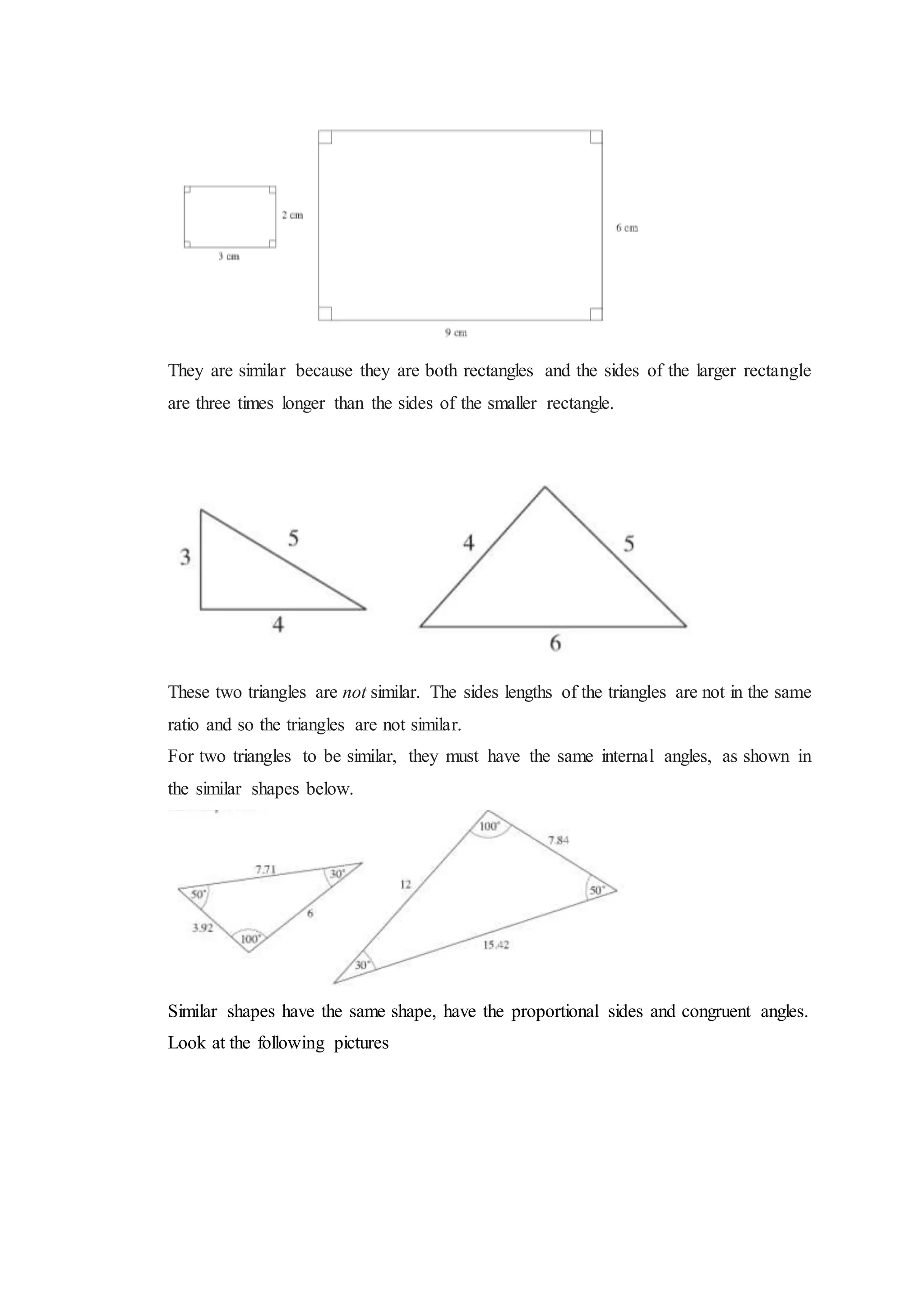
Similar shapes have the same shape but may be different sizes. The two rectangles
shown below are similar – they have the same shape but one is smaller than the other.
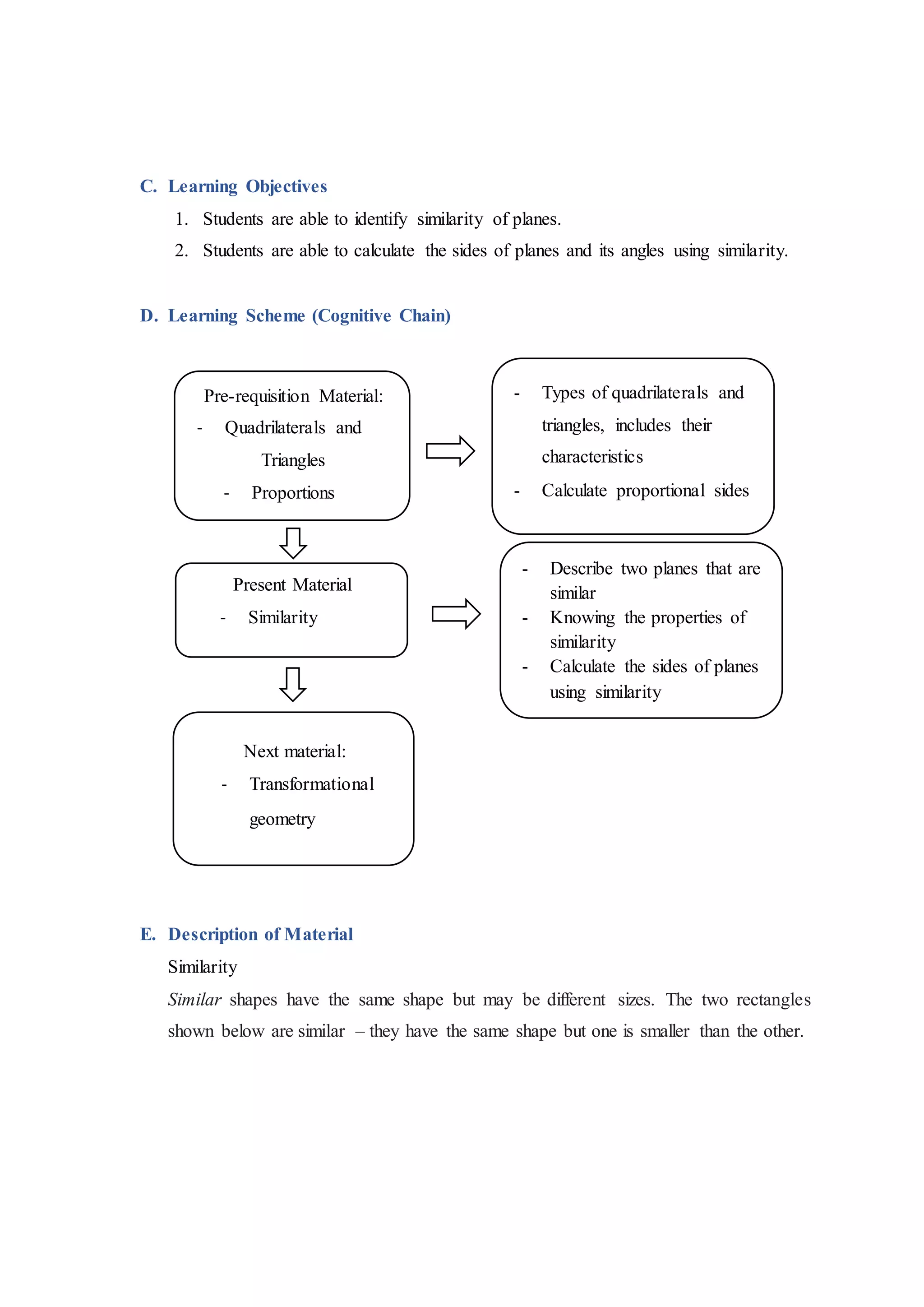
Pre-requisition Material:
- Quadrilaterals and
Triangles
- Proportions
Present Material
- Similarity
Next material:
- Transformational
geometry
- Describe two planes that are
similar
- Knowing the properties of
similarity
- Calculate the sides of planes
using similarity
- Types of quadrilaterals and
triangles, includes their
characteristics
- Calculate proportional sides
They are similar because they are both rectangles and the sides of the larger rectangle
are three times longer than the sides of the smaller rectangle.
These two triangles are not similar. The sides lengths of the triangles are not in the same
ratio and so the triangles are not similar.
For two triangles to be similar, they must have the same internal angles, as shown in
the similar shapes below.
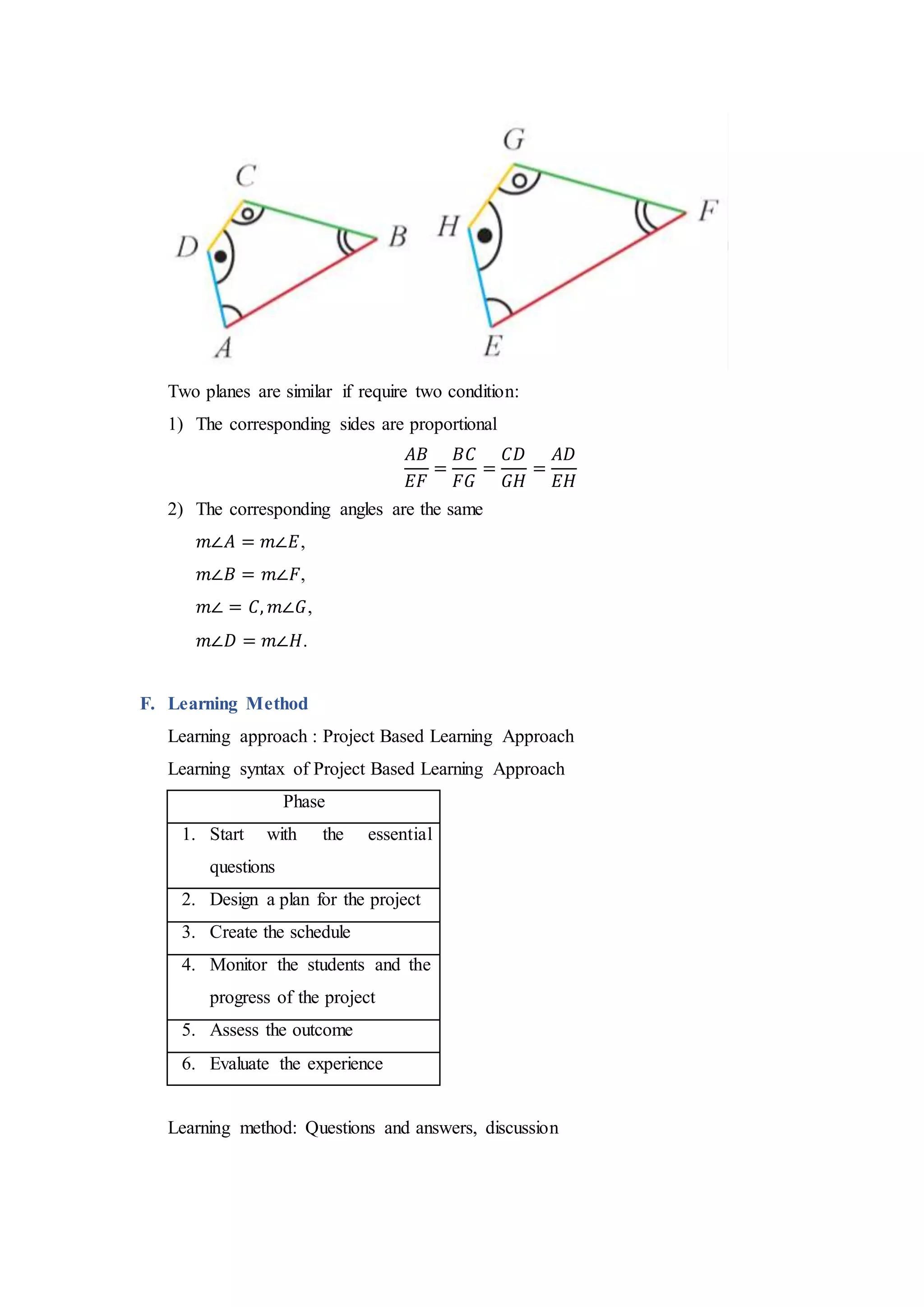
Similar shapes have the same shape, have the proportional sides and congruent angles.
Look at the following pictures
Two planes are similar if require two condition:
1) The corresponding sides are proportional
𝐴𝐵
𝐸𝐹
=
𝐵𝐶
𝐹𝐺
=
𝐶𝐷
𝐺𝐻
=
𝐴𝐷
𝐸𝐻
2) The corresponding angles are the same
𝑚∠𝐴 = 𝑚∠𝐸,
𝑚∠𝐵 = 𝑚∠𝐹,
𝑚∠ = 𝐶, 𝑚∠𝐺,
𝑚∠𝐷 = 𝑚∠𝐻.
F. Learning Method
Learning approach : Project Based Learning Approach
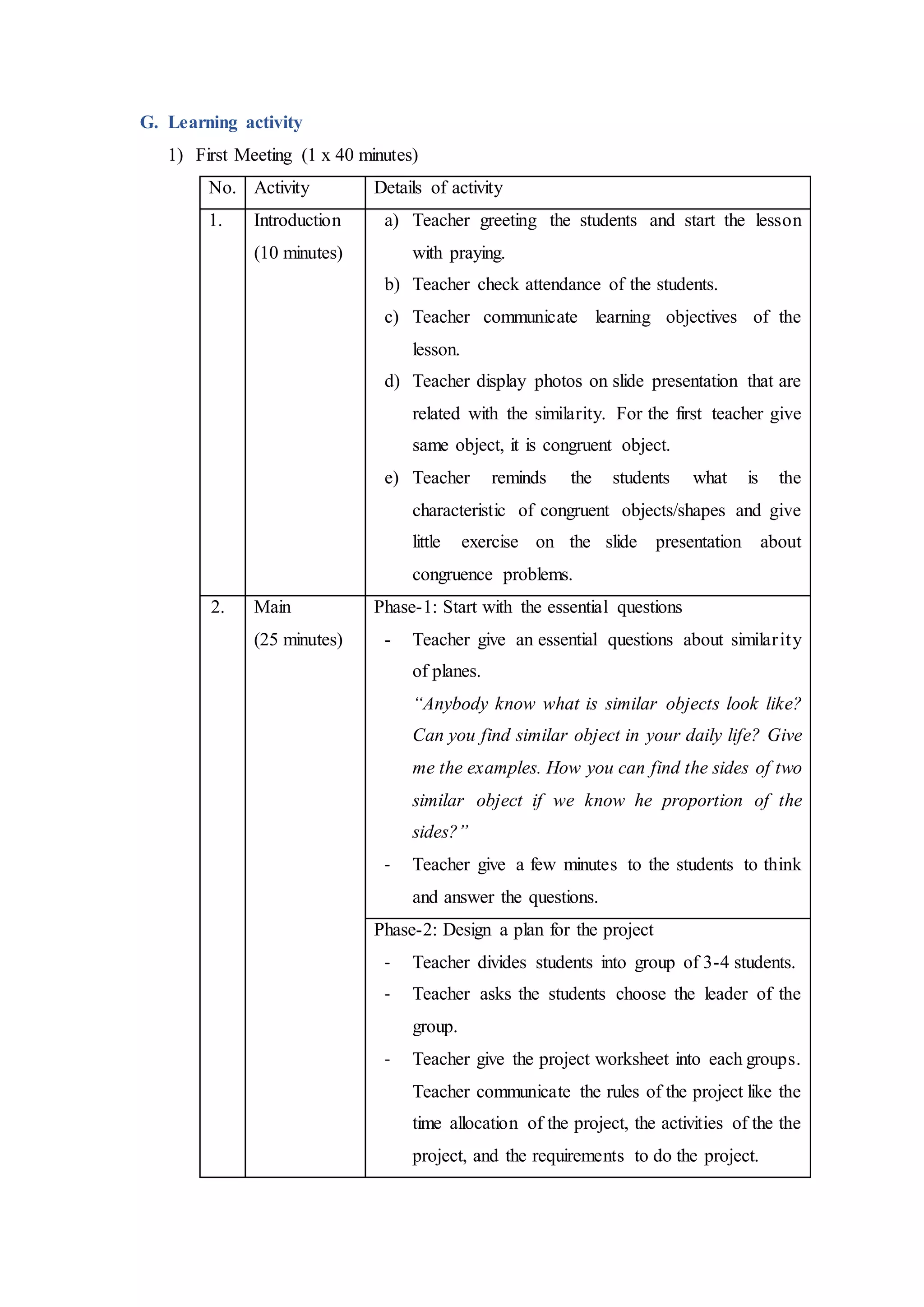
Learning syntax of Project Based Learning Approach
Phase
1. Start with the essential
questions
2. Design a plan for the project
3. Create the schedule
4. Monitor the students and the
progress of the project
5. Assess the outcome
6. Evaluate the experience
Learning method: Questions and answers, discussion
G. Learning activity
1) First Meeting (1 x 40 minutes)
No. Activity Details of activity
1. Introduction
(10 minutes)
a) Teacher greeting the students and start the lesson
with praying.
b) Teacher check attendance of the students.
c) Teacher communicate learning objectives of the
lesson.
d) Teacher display photos on slide presentation that are
related with the similarity. For the first teacher give
same object, it is congruent object.
e) Teacher reminds the students what is the
characteristic of congruent objects/shapes and give
little exercise on the slide presentation about
congruence problems.
2. Main
(25 minutes)
Phase-1: Start with the essential questions
- Teacher give an essential questions about similarity
of planes.
“Anybody know what is similar objects look like?
Can you find similar object in your daily life? Give
me the examples. How you can find the sides of two
similar object if we know he proportion of the
sides?”
- Teacher give a few minutes to the students to think
and answer the questions.
Phase-2: Design a plan for the project
- Teacher divides students into group of 3-4 students.
- Teacher asks the students choose the leader of the
group.
- Teacher give the project worksheet into each groups.
Teacher communicate the rules of the project like the
time allocation of the project, the activities of the the
project, and the requirements to do the project.
Phase-3: Create a schedule
- Teacher facilitate the students to create a schedule
based on time allocation.
- Teacher facilitate the students to create alternative
schedule if there are activities that are not
appropriate with the main schedule.
Phase-4: Monitor the students and the progress of the
project
- The students do the project and share the progress of
the project to teacher.
- Teacher monitor the students if there are some
problems and give motivation to the students
Phase-5: Assess the outcome
- Teacher asses the outcome during monitoring the
students based on standard assessment.
Phase-6: Evaluate the experience
- Students reflect what they have seen during finishing
the project.
3. Closing (5
minutes)
a) Teacher communicate the next material in front of the
class.
b) Teacher give motivation to students and close the
class with pray.
2) Second Meeting (2 x 40 minutes)
No. Activity Details of activity
1. Introduction
(5 minutes)
a) Teacher greeting the students and start the lesson
with praying.
b) Teacher check attendance of the students.
c) Teacher communicate learning objectives of the
lesson.
d) Teacher reminds the students about the previous
material and asks for the project.
3. Main
(70 minutes)
- Teacher asks to the student to submit the report of
the project and present their project in front of the
class.
- The other group give responses.
- After all the groups have presented the project,
then teacher and student conclude the meaning of
similarity.
- Teacher give individual test to the students and
submit it on the end of class.
3. Closing (5
minutes)
a) Teacher collects the answer of the individual test.
b) Teacher communicate the next material in front of
the class.
c) Teacher give motivation to students and close the
class with pray.
H. Evaluation
1. Technic
- Group project and individual exercises.
2. Instrument
- Project worksheet and short individual exercises.
I. Learning Media, Tools dan Resources
1. Learning Media
 Slide presentation
 Whiteboard
2. Tool : Stationery
3. Learning resources
Ministry of Education and Culture. 2013. Matematika Buku Siswa Kelas IX.
Jakarta: Ministry of Education and Culture.
Yogyakarta, June 13th 2016
Teacher
Afifah Nur Indah Sari.
13301244006
Acknowledge,
Lecturer
Dr. Sugiman, M.Si.
NIP. 19650228 199101 1 001

Lesson plan of similarity

  • 1.
    LESSON PLAN For JuniorHigh School Third Grade Semester 1 Based on Curriculum of 2013 Topic : Similarity and Congruence Created by: Afifah Nur Indah Sari 13301244006 International Mathematics Education 2013 Yogyakarta State University Yogyakarta 2016
  • 2.
    LESSON PLAN School :SMP N 1 Mlati Class/Semester : IX/2 Subject : Mathematics Topic : Similarity and Congruence Subtopic : Similarity Time allocation : 3 x 40 Minutes A. Main Competence 1 Appreciating and practicing their religion. 2 Appreciating and practicing honest behavior, discipline, responsibility, caring (tolerance, mutual assistance), polite, confident, in interacting effectively with the social and natural environment in the social intercourse and its existence. 3 Understanding knowledge (factual, conceptual and procedural) based on curiosity about science, technology, arts, culture-related phenomena and events that are visible. 4 Testing, processing, and presenting concrete context (using, analyzing, string up, modifying, and creating) and abstract context (writing, reading, calculating, drawing, and arranging) appropriate with what is learnt at school and other resources that having equal point of view or theory. B. Basic Competence and Indicator Basic Competence Indicator 3.6. Understanding similarity and congruence of geometry through observation. 3.6.1. Identifying similarity of planes. 3.6.2. Calculating the sides of planes and its angles using similarity.
  • 3.
    C. Learning Objectives 1.Students are able to identify similarity of planes. 2. Students are able to calculate the sides of planes and its angles using similarity. D. Learning Scheme (Cognitive Chain) E. Description of Material Similarity Similar shapes have the same shape but may be different sizes. The two rectangles shown below are similar – they have the same shape but one is smaller than the other. Pre-requisition Material: - Quadrilaterals and Triangles - Proportions Present Material - Similarity Next material: - Transformational geometry - Describe two planes that are similar - Knowing the properties of similarity - Calculate the sides of planes using similarity - Types of quadrilaterals and triangles, includes their characteristics - Calculate proportional sides
  • 4.
    They are similarbecause they are both rectangles and the sides of the larger rectangle are three times longer than the sides of the smaller rectangle. These two triangles are not similar. The sides lengths of the triangles are not in the same ratio and so the triangles are not similar. For two triangles to be similar, they must have the same internal angles, as shown in the similar shapes below. Similar shapes have the same shape, have the proportional sides and congruent angles. Look at the following pictures
  • 5.
    Two planes aresimilar if require two condition: 1) The corresponding sides are proportional 𝐴𝐵 𝐸𝐹 = 𝐵𝐶 𝐹𝐺 = 𝐶𝐷 𝐺𝐻 = 𝐴𝐷 𝐸𝐻 2) The corresponding angles are the same 𝑚∠𝐴 = 𝑚∠𝐸, 𝑚∠𝐵 = 𝑚∠𝐹, 𝑚∠ = 𝐶, 𝑚∠𝐺, 𝑚∠𝐷 = 𝑚∠𝐻. F. Learning Method Learning approach : Project Based Learning Approach Learning syntax of Project Based Learning Approach Phase 1. Start with the essential questions 2. Design a plan for the project 3. Create the schedule 4. Monitor the students and the progress of the project 5. Assess the outcome 6. Evaluate the experience Learning method: Questions and answers, discussion
  • 6.
    G. Learning activity 1)First Meeting (1 x 40 minutes) No. Activity Details of activity 1. Introduction (10 minutes) a) Teacher greeting the students and start the lesson with praying. b) Teacher check attendance of the students. c) Teacher communicate learning objectives of the lesson. d) Teacher display photos on slide presentation that are related with the similarity. For the first teacher give same object, it is congruent object. e) Teacher reminds the students what is the characteristic of congruent objects/shapes and give little exercise on the slide presentation about congruence problems. 2. Main (25 minutes) Phase-1: Start with the essential questions - Teacher give an essential questions about similarity of planes. “Anybody know what is similar objects look like? Can you find similar object in your daily life? Give me the examples. How you can find the sides of two similar object if we know he proportion of the sides?” - Teacher give a few minutes to the students to think and answer the questions. Phase-2: Design a plan for the project - Teacher divides students into group of 3-4 students. - Teacher asks the students choose the leader of the group. - Teacher give the project worksheet into each groups. Teacher communicate the rules of the project like the time allocation of the project, the activities of the the project, and the requirements to do the project.
  • 7.
    Phase-3: Create aschedule - Teacher facilitate the students to create a schedule based on time allocation. - Teacher facilitate the students to create alternative schedule if there are activities that are not appropriate with the main schedule. Phase-4: Monitor the students and the progress of the project - The students do the project and share the progress of the project to teacher. - Teacher monitor the students if there are some problems and give motivation to the students Phase-5: Assess the outcome - Teacher asses the outcome during monitoring the students based on standard assessment. Phase-6: Evaluate the experience - Students reflect what they have seen during finishing the project. 3. Closing (5 minutes) a) Teacher communicate the next material in front of the class. b) Teacher give motivation to students and close the class with pray. 2) Second Meeting (2 x 40 minutes) No. Activity Details of activity 1. Introduction (5 minutes) a) Teacher greeting the students and start the lesson with praying. b) Teacher check attendance of the students. c) Teacher communicate learning objectives of the lesson. d) Teacher reminds the students about the previous material and asks for the project.
  • 8.
    3. Main (70 minutes) -Teacher asks to the student to submit the report of the project and present their project in front of the class. - The other group give responses. - After all the groups have presented the project, then teacher and student conclude the meaning of similarity. - Teacher give individual test to the students and submit it on the end of class. 3. Closing (5 minutes) a) Teacher collects the answer of the individual test. b) Teacher communicate the next material in front of the class. c) Teacher give motivation to students and close the class with pray. H. Evaluation 1. Technic - Group project and individual exercises. 2. Instrument - Project worksheet and short individual exercises. I. Learning Media, Tools dan Resources 1. Learning Media  Slide presentation  Whiteboard 2. Tool : Stationery 3. Learning resources Ministry of Education and Culture. 2013. Matematika Buku Siswa Kelas IX. Jakarta: Ministry of Education and Culture.
  • 9.
    Yogyakarta, June 13th2016 Teacher Afifah Nur Indah Sari. 13301244006 Acknowledge, Lecturer Dr. Sugiman, M.Si. NIP. 19650228 199101 1 001