2012
International Institute for Learning, Inc.

LEARNING CATALOGUE
Project, Program and Portfolio Management • Business Analysis • Microsoft® Project and Project Server
                Lean Six Sigma • PRINCE2® • ITIL® • Leadership and Interpersonal Skills


                                INTELLIGENCE, INTEGRITY AND INNOVATION
A Letter From the CEO

    Welcome                                             Welcome to IIL’s 2012 Learning Catalogue!

                                                        As organizations continue to try and do more with less, there is an increased demand for
                                                        higher-level skills in strategic leadership, Project and Program Management, Business Analysis,
                                                        Risk Management, Information Technology and Lean Six Sigma.

                                                        Many economists are hopeful that we will see some signs of recovery in the near future,
                                                        but the job market remains more competitive than ever. Building on your knowledge and
                                                        “polishing your edge” are now not only critical to success… they are critical to survival.

                                  In spite of economic difficulties, new technologies continue to change not only the way we work, play and socialize,
                                  but also the ways in which we plan, learn and share ideas. The enormous increase in e-book sales, mobile learning
                                  solutions and record numbers of tablets, smartphones and 4G devices are just a few signs of the progressive
                                  migration, across industries, toward the virtual space.

                                  More and more, learning is taking place virtually, globally and collaboratively. People all over the world are
                                  connecting online and learning through virtual communities, peer-to-peer networks, mobile devices and social
                                  media platforms.

                                  In response to our customers’ needs, IIL has doubled our focus on our Virtual Classroom offerings and self-paced
                                  on-demand learning products. We have enhanced our Learning Management System to make it more participatory
                                  and enable you to better define your development goals and track your progress. We have also developed project
                                  management and ITSM apps, as well as other mobile learning solutions.

                                  I would like to personally invite you to take advantage of all that IIL has to offer as a learning solution provider,
                                  including our roster of best-in-class instructors, our wide and diverse curriculum, excellent customer service and
                                  array of training methodologies.

                                  Three key values define the IIL brand and guide us in all that we do: Intelligence, Integrity and Innovation.
                                  We pride ourselves in creating customer loyalty and building relationships with individuals and organizations
                                  that last a lifetime.

                                  From your first point of contact with us, we work with you to assess your training needs and help you choose a
                                  course or design a curriculum that meets your business needs and learning preferences. We have a dedicated team
                                  of content and course development specialists whose goal – and passion – is to transform learning into results. As
                                  industry leaders in customized course development, we partner with our clients to provide learning solutions that
                                  translate seamlessly into the workplace and capture more than the original intent.

                                  IIL has now entered our third decade of doing business. Thanks to our customers, we have grown from one small
                                  company into a network of wholly-owned global operating companies in cities all over the world, including: New
                                  York, Toronto, London, Paris, Frankfurt, Singapore, Sydney, Beijing, Hong Kong, Madrid, Mexico City, Trinidad,
                                  Helsinki, Budapest, São Paulo, Bangalore, Dubai, Seoul and Tokyo.

                                  Please read through our catalogue and learn more about our wide selection of courses, products and services. See
                                  for yourself why IIL is the training solution provider of choice for many top global companies, and then take the next
                                  step by finding out what we can do together. I welcome any comments or questions you may have, so feel free to
                                  contact me directly at LaVerne.Johnson@iil.com.

                                  With kind regards,


                                  E. LaVerne Johnson
                                  Founder, President and Chief Executive Officer
                                  International Institute for Learning, Inc.


     www.iil.com
2    International Institute for Learning, Inc.
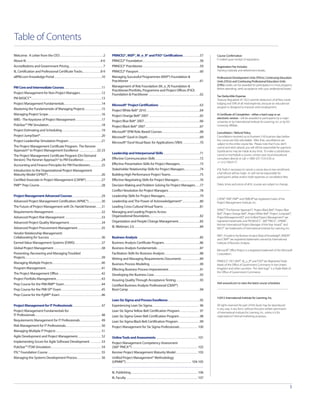
Table of Contents
Welcome: A Letter from the CEO . . . . . . . . . . . . . . . . . . . . . . . . . . . . . . . . . 2                                PRINCE2®, MSP®, M_o_R® and P3O® Certifications . . . . . . . . . . . . . 57                                                    Course Confirmation
                                                                                                                                                                                                                                                                 E-mailed upon receipt of registration.
About IIL . . . . . . . . . . . . . . . . . . . . . . . . . . . . . . . . . . . . . . . . . . . . . . . . . . . . . . . . 4-6     PRINCE2® Foundation . . . . . . . . . . . . . . . . . . . . . . . . . . . . . . . . . . . . . . . . . . . 58
Accreditations and Government Pricing . . . . . . . . . . . . . . . . . . . . . . . . . .7                                        PRINCE2® Practitioner  . . . . . . . . . . . . . . . . . . . . . . . . . . . . . . . . . . . . . . . . . . . 59                Registration Fee Includes
IIL Certification and Professional Certificate Tracks . . . . . . . . . . . . . 8-9                                               PRINCE2® Passport . . . . . . . . . . . . . . . . . . . . . . . . . . . . . . . . . . . . . . . . . . . . . . . 60             Training materials and refreshment breaks.

allPM.com Knowledge Portal . . . . . . . . . . . . . . . . . . . . . . . . . . . . . . . . . . . . 10                             Managing Successful Programmes (MSP®) Foundation &                                                                             Professional Development Units (PDUs), Continuing Education
                                                                                                                                  Practitioner  . . . . . . . . . . . . . . . . . . . . . . . . . . . . . . . . . . . . . . . . . . . . . . . . . . . . . . 61   Units (CEUs) and Continuing Professional Education Units
                                                                                                                                  Management of Risk Foundation (M_o_R) Foundation &                                                                             (CPEs) credits can be awarded for participation in most programs.
PM Core and Intermediate Courses . . . . . . . . . . . . . . . . . . . . . . . . . . . . 11                                                                                                                                                                      Before attending, verify acceptance with your professional board.
                                                                                                                                  Practitioner/Portfolio, Programme and Project Offices (P3O)
Project Management for Non-Project Managers . . . . . . . . . . . . . . . . 12                                                    Foundation & Practitioner  . . . . . . . . . . . . . . . . . . . . . . . . . . . . . . . . . . . . . . . 62                    Tax Deductible Expense
PM BASICS™ . . . . . . . . . . . . . . . . . . . . . . . . . . . . . . . . . . . . . . . . . . . . . . . . . . . . . 13                                                                                                                                          Treasury Regulation #1.162.5 permits deduction of all fees, travel,
Project Management Fundamentals . . . . . . . . . . . . . . . . . . . . . . . . . . . . 14                                        Microsoft® Project Certifications  . . . . . . . . . . . . . . . . . . . . . . . . . . . . . . 63                              lodging and 50% of all meal expenses, because an educational
                                                                                                                                                                                                                                                                 program is designed to improve one’s employment.
Mastering the Fundamentals of Managing Projects . . . . . . . . . . . . . 15                                                      Project White Belt® 2010 . . . . . . . . . . . . . . . . . . . . . . . . . . . . . . . . . . . . . . . . . 64
Managing Project Scope  . . . . . . . . . . . . . . . . . . . . . . . . . . . . . . . . . . . . . . . . 16                        Project Orange Belt® 2007 . . . . . . . . . . . . . . . . . . . . . . . . . . . . . . . . . . . . . . . 65                     A Certificate of Completion - either a hard copy or an
                                                                                                                                                                                                                                                                 electronic version - will be awarded to participants by a major
WBS - The Keystone of Project Management . . . . . . . . . . . . . . . . . . . . 17                                               Project Blue Belt® 2007 . . . . . . . . . . . . . . . . . . . . . . . . . . . . . . . . . . . . . . . . . . 66                 university or by International Institute for Learning, Inc. or by IIL’s
PoleStar™ PM Simulation . . . . . . . . . . . . . . . . . . . . . . . . . . . . . . . . . . . . . . . . 18                        Project Black Belt® 2007  . . . . . . . . . . . . . . . . . . . . . . . . . . . . . . . . . . . . . . . . . 67                 University Affiliate.
Project Estimating and Scheduling . . . . . . . . . . . . . . . . . . . . . . . . . . . . . . 19                                  Microsoft® EPM Role-Based Courses . . . . . . . . . . . . . . . . . . . . . . . . . . . . . 68                                 Cancellation / Refund Policy
Project JumpStart®  . . . . . . . . . . . . . . . . . . . . . . . . . . . . . . . . . . . . . . . . . . . . . . 20                Microsoft® Excel in Depth . . . . . . . . . . . . . . . . . . . . . . . . . . . . . . . . . . . . . . . .69                    Cancellations received up to fourteen (14) business days before
Project Leadership Simulation Program  . . . . . . . . . . . . . . . . . . . . . . . . 21                                                                                                                                                                        the course are fully refundable. After that, cancellations are
                                                                                                                                  Microsoft® Excel Visual Basic for Applications (VBA) . . . . . . . . . . . . . 70                                              subject to the entire course fee. Please note that if you don’t
The Project Management Certificate Program: The Kerzner                                                                                                                                                                                                          cancel and don’t attend, you will still be responsible for payment.
Approach® to Project Management Excellence  . . . . . . . . . . . . . . 22-23                                                                                                                                                                                    Substitutions may be made at any time. To make a substitution,
                                                                                                                                  Leadership and Interpersonal Skills . . . . . . . . . . . . . . . . . . . . . . . . . . . . 71                                 cancel or reschedule a course, contact your local educational
The Project Management Certificate Program (On-Demand
Version): The Kerzner Approach® to PM Excellence . . . . . . . . . . . . . . 24                                                   Effective Communication Skills . . . . . . . . . . . . . . . . . . . . . . . . . . . . . . . . . . 72                          consultant directly or call +1-800-325-1533 (US) or
                                                                                                                                                                                                                                                                 +1-212-758-0177.
Accounting and Finance Principles for PM Practitioners  . . . . . . . . 25                                                        Effective Presentation Skills for Project Managers . . . . . . . . . . . . . . . 73
Introduction to the Organizational Project Management                                                                             Stakeholder Relationship Skills for Project Managers  . . . . . . . . . . . 74                                                 If IIL finds it necessary to cancel a course due to low enrollment,
Maturity Model (OPM3®) . . . . . . . . . . . . . . . . . . . . . . . . . . . . . . . . . . . . . . . . . 26                       Building High-Performance Project Teams . . . . . . . . . . . . . . . . . . . . . . 75                                         a full refund will be made. IIL will not be responsible for
                                                                                                                                                                                                                                                                 participant’s airfare and/or hotel expenses or cancellation fees.
Certified Associate in Project Management (CAPM®) . . . . . . . . . . . . 27                                                      Effective Negotiating Skills for Project Managers . . . . . . . . . . . . . . . . 76
PMP® Prep Course . . . . . . . . . . . . . . . . . . . . . . . . . . . . . . . . . . . . . . . . . . . . . . . 28                 Decision Making and Problem Solving for Project Managers . . . 77                                                              Dates, times and prices of all IIL courses are subject to change.

                                                                                                                                  Conflict Resolution for Project Managers . . . . . . . . . . . . . . . . . . . . . . . . 78
Project Management Advanced Courses . . . . . . . . . . . . . . . . . . . . . . 29                                                Leadership Skills for Project Managers . . . . . . . . . . . . . . . . . . . . . . . . . . 79
                                                                                                                                                                                                                                                                 CAPM®, PMI®, PMP® and PMBOK® are registered marks of the
Advanced Project Management Certification (APMC®) . . . . . . . . . . 30                                                          Leadership and The Power of Acknowledgement® . . . . . . . . . . . . . 80                                                      Project Management Institute, Inc.
The Future of Project Management with Dr. Harold Kerzner . . . . 31                                                               Leading Cross-Cultural Virtual Teams . . . . . . . . . . . . . . . . . . . . . . . . . . . . 81
                                                                                                                                                                                                                                                                 APMC®, The Kerzner Approach®, Project Black Belt®, Project Blue
Requirements Management  . . . . . . . . . . . . . . . . . . . . . . . . . . . . . . . . . . . . 32                               Managing and Leading Projects Across                                                                                           Belt®, Project Orange Belt®, Project White Belt®, Project Jumpstart®,
Advanced Project Risk Management . . . . . . . . . . . . . . . . . . . . . . . . . . . . 33                                       Organizational Boundaries . . . . . . . . . . . . . . . . . . . . . . . . . . . . . . . . . . . . . . 82                       ProjectManagementIQ® and Unified Project Management® are
                                                                                                                                  Organization and People Change Management . . . . . . . . . . . . . . . . 83                                                   registered trademarks and PM BASICS™, 360º PMCA™, UPMM™,
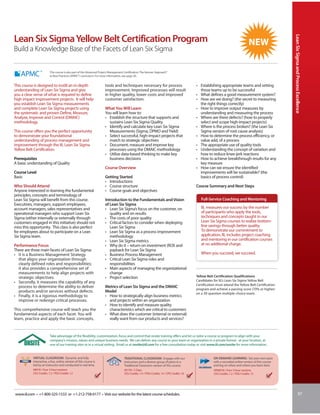
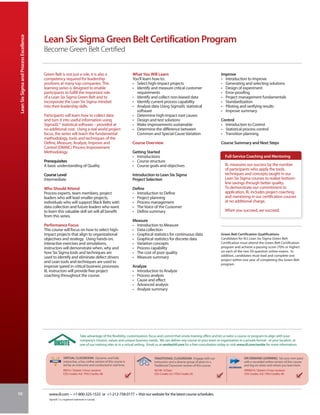
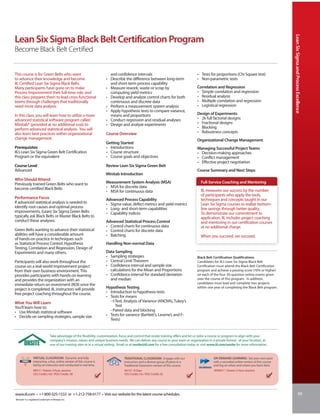
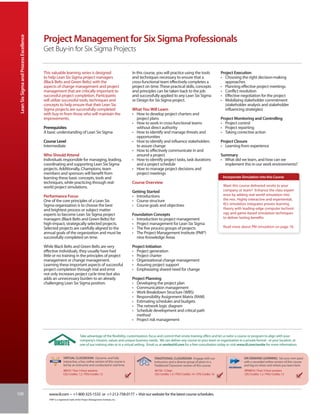
Advanced Project Quality Management  . . . . . . . . . . . . . . . . . . . . . . . . 34
                                                                                                                                                                                                                                                                 Kerzner International Project Manager of the Year Award™ and
Advanced Project Procurement Management . . . . . . . . . . . . . . . . . . 35                                                    IIL Webinars 2.0 . . . . . . . . . . . . . . . . . . . . . . . . . . . . . . . . . . . . . . . . . . . . . . . . . . 84        BACP™ are trademarks of International Institute for Learning, Inc.
Vendor Relationship Management:
                                                                                                                                                                                                                                                                 IIBA®, A Guide to the Business Analysis Body of Knowledge®, BABOK®
Collaborating for Success . . . . . . . . . . . . . . . . . . . . . . . . . . . . . . . . . . . . . . . . 36                      Business Analysis  . . . . . . . . . . . . . . . . . . . . . . . . . . . . . . . . . . . . . . . . . . . . . . . 85
                                                                                                                                                                                                                                                                 and CBAP® are registered trademarks owned by International
Earned Value Management Systems (EVMS) . . . . . . . . . . . . . . . . . . . . 37                                                 Business Analysis Certificate Program . . . . . . . . . . . . . . . . . . . . . . . . . . . 86                                 Institute of Business Analysis.
Global Project Management . . . . . . . . . . . . . . . . . . . . . . . . . . . . . . . . . . . . .38                             Business Analysis Fundamentals  . . . . . . . . . . . . . . . . . . . . . . . . . . . . . . . . 87
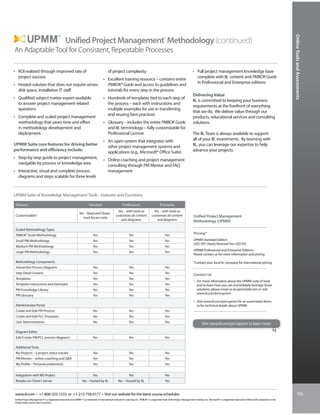
                                                                                                                                                                                                                                                                 Microsoft® Office Project is a registered trademark of the Microsoft
Preventing, Recovering and Managing Troubled                                                                                      Facilitation Skills for Business Analysts . . . . . . . . . . . . . . . . . . . . . . . . . . . 88                             Corporation.
Projects . . . . . . . . . . . . . . . . . . . . . . . . . . . . . . . . . . . . . . . . . . . . . . . . . . . . . . . . . . 39   Writing and Managing Requirements Documents . . . . . . . . . . . . . . 89
                                                                                                                                                                                                                                                                 PRINCE2®, ITIL®, MSP®, M_o_R® and P3O® are Registered Trade
Managing Multiple Projects . . . . . . . . . . . . . . . . . . . . . . . . . . . . . . . . . . . . . 40                           Business Process Modeling . . . . . . . . . . . . . . . . . . . . . . . . . . . . . . . . . . . . . . 90                       Marks of the Office of Government Commerce in the United
Program Management . . . . . . . . . . . . . . . . . . . . . . . . . . . . . . . . . . . . . . . . . . 41                         Effecting Business Process Improvement . . . . . . . . . . . . . . . . . . . . . . . . 91                                      Kingdom and other countries. The Swirl logo™ is a Trade Mark of
The Project Management Office . . . . . . . . . . . . . . . . . . . . . . . . . . . . . . . . . 42                                                                                                                                                               the Office of Government Commerce.
                                                                                                                                  Developing the Business Case . . . . . . . . . . . . . . . . . . . . . . . . . . . . . . . . . . . 92
Project Portfolio Management . . . . . . . . . . . . . . . . . . . . . . . . . . . . . . . . . . 43                               Assuring Quality Through Acceptance Testing . . . . . . . . . . . . . . . . . . 93
Prep Course for the PMI-RMP® Exam . . . . . . . . . . . . . . . . . . . . . . . . . . . . 44                                                                                                                                                                     Visit www.iil.com to view the latest course schedules.
                                                                                                                                  Certified Business Analysis Professional (CBAP®)
Prep Course for the PMI-SP® Exam . . . . . . . . . . . . . . . . . . . . . . . . . . . . . . .45                                  Boot Camp  . . . . . . . . . . . . . . . . . . . . . . . . . . . . . . . . . . . . . . . . . . . . . . . . . . . . . . 94
Prep Course for the PgMP® Exam . . . . . . . . . . . . . . . . . . . . . . . . . . . . . . . . 46
                                                                                                                                                                                                                                                                 ©2012 International Institute for Learning, Inc.
                                                                                                                                  Lean Six Sigma and Process Excellence . . . . . . . . . . . . . . . . . . . . . . . . 95
Project Management for IT Professionals . . . . . . . . . . . . . . . . . . . . .  47                                             Experiencing Lean Six Sigma . . . . . . . . . . . . . . . . . . . . . . . . . . . . . . . . . . .  96                          All rights reserved. No part of this book may be reproduced
                                                                                                                                                                                                                                                                 in any way, in any form, without the prior written permission
Project Management Fundamentals for                                                                                               Lean Six Sigma Yellow Belt Certification Program . . . . . . . . . . . . . .  97                                               of International Institute for Learning, Inc. unless is it for
IT Professionals . . . . . . . . . . . . . . . . . . . . . . . . . . . . . . . . . . . . . . . . . . . . . . . . .  48            Lean Six Sigma Green Belt Certification Program . . . . . . . . . . . . . . . .98                                              organizations’’ internal marketing purposes.
Requirements Management for IT Professionals . . . . . . . . . . . . . . .  49                                                    Lean Six Sigma Black Belt Certification Program  . . . . . . . . . . . . . . . . 99
Risk Management for IT Professionals . . . . . . . . . . . . . . . . . . . . . . . . . .  50                                      Project Management for Six Sigma Professionals . . . . . . . . . . . . .  100
Managing Multiple IT Projects . . . . . . . . . . . . . . . . . . . . . . . . . . . . . . . . . .  51
Agile Development and Project Management . . . . . . . . . . . . . . . . .  52                                                    Online Tools and Assessments  . . . . . . . . . . . . . . . . . . . . . . . . . . . . . . . . 101
Implementing Scrum for Agile Software Development . . . . . . . .  53                                                             Project Management Competency Assessment
PoleStar™ ITSM Simulation . . . . . . . . . . . . . . . . . . . . . . . . . . . . . . . . . . . . .  54                           (360° PMCA™) . . . . . . . . . . . . . . . . . . . . . . . . . . . . . . . . . . . . . . . . . . . . . . . . . . . 102
ITIL® Foundation Course . . . . . . . . . . . . . . . . . . . . . . . . . . . . . . . . . . . . . . . .  55                       Kerzner Project Management Maturity Model . . . . . . . . . . . . . . . . . 103
Managing the Systems Development Process . . . . . . . . . . . . . . . . .  56                                                    Unified Project Management® Methodology
                                                                                                                                  (UPMM™) . . . . . . . . . . . . . . . . . . . . . . . . . . . . . . . . . . . . . . . . . . . . . . . . . . 104-105


                                                                                                                                  IIL Publishing . . . . . . . . . . . . . . . . . . . . . . . . . . . . . . . . . . . . . . . . . . . . . . . . . . . 106
                                                                                                                                  IIL Faculty  . . . . . . . . . . . . . . . . . . . . . . . . . . . . . . . . . . . . . . . . . . . . . . . . . . . . . . 107
About IIL
                                 A Valued Global Business Partner
                                 With a wholly-owned network of operating companies                Innovation in Learning
                                 all over the world and clients in more than 200 countries,        Beginning with global satellite broadcasts in the mid-1990s,
                                 IIL is a global leader in training, consulting, coaching and      IIL has consistently been in the vanguard of companies
                                 mentoring, as well as customized course development.              using technology to create cutting-edge learning solutions.

                                 Our core competencies include: Project, Program and               We continue to be at the forefront of learning innovation,
                                 Portfolio Management; Business Analysis; Microsoft® Project       offering a wide variety of delivery methods to ensure
                                 and Project Server; Lean Six Sigma; PRINCE2®; ITIL® and           optimal learning experiences for companies and individuals.
                                 Leadership and Interpersonal Skills.
                                                                                                   These methods include:
                                 Our Credentials
                                 IIL is a PMI® Charter Global Registered Education Provider        • IIL Virtual Classroom
                                 (R.E.P.), a member of PMI’s Global Executive Council, a             For more than a decade now, our clients have chosen IIL’s
                                 Microsoft Partner with a Microsoft Gold Project and Portfolio       Virtual Classroom as a preferred learning method to meet
                                 Management competency, an IIBA® Endorsed Education                  the increased global training needs of their organizations.
                                 Provider and an Accredited Training Organization (ATO) for          Our Virtual Classroom provides you with interactive,
                                 PRINCE2 and ITIL.                                                   efficient, quality training that is also cost-effective.

                                 We are proud to be the training solution partner of               • Simulation Training
                                 choice for many top global companies.                               IIL’s simulation training integrates proven learning theory
                                                                                                     with state-of-the-art computer technology and game-
                                 What Sets Us Apart                                                  based simulation techniques to deliver lasting benefits.
                                 Our Many Methods of Learning™ enable us to deliver                  We offer simulation training to communicate the value
                                 innovative, effective and consistent training solutions             and accelerate the implementation of best practices in
                                 through a variety of learning approaches (Virtual Classroom,        two of our critical markets: project management and IT
                                 simulation training, interactive On-demand learning,                service management.
                                 traditional classroom and a blended approach).

                                 Choosing IIL as your learning provider is the beginning of        • Traditional Classroom Training
                                 a valuable business partnership. From the first point of            In addition to the public courses designed to meet the
                                 contact, we work with you to assess your training needs             needs of individuals, IIL has a best-in-class instructional
                                 and help you choose a course or design a curriculum that            design team that can customize curriculum to meet the
                                 best suits your individual preferences and business goals.          specific needs of your organization.
                                 Once our partnership begins, you will have a wealth of
                                 opportunities at your fingertips, including:                      • On-demand Training
                                                                                                     Access learning wherever and whenever you need
                                 • A strong network of wholly-owned IIL companies                    it. Our interactive on-demand courses use animation,
                                   strategically located all over the world. We put an               streaming video, computer-aided simulations and
                                    active focus on knowledge sharing in and among our               learning interactions that engage and involve users.
                                    worldwide companies. This allows us to tap into a huge
                                    repository of global best practices when developing            • A Blended Approach
                                    courses, delivering training or customizing learning             Design your own learning experience. Our blended
                                    solutions. We value diversity and are proud to offer many        approach allows you to “mix and match” learning formats
                                    of our programs and learning solutions customized                to best suit your learning style.
                                    and adapted to a range of international languages and
                                    cultures.
                                                                                                   Corporate Solutions -
                                                                                                   It All Comes Together for Our Clients
                                 • A roster of unparalleled trainers, consultants and              We make a measurable difference for our clients, and our
                                   mentors. Our subject matter experts are the best in             results speak for themselves – a large percentage of our
                                    their fields, and their expertise extends across industries    clients are multi-year repeat customers. We have worked
                                    and market sectors.                                            with many of the world’s leading organizations to develop
                                                                                                   professional skills as well as corporate capabilities and
                                 • A comprehensive curriculum of multi-level                       processes.
                                   training courses. We stay ahead of the curve when
                                    developing curriculum, anticipating market demand as           Beyond training courses, IIL provides:
                                    well as the unique needs of our clients.
                                                                                                   • Assessment tools such as the Kerzner Project
                                 • Industry-recognized certificate and certification                 Management Maturity Model (KPM3) and our 360° Project
                                   programs. Enabling you to earn respected credentials,             Management Competency Assessment (360° PMCA™).
                                    our programs open the door to career opportunities.
                                    Our university affiliates are globally-recognized leaders in   • Needs analyses to define gaps and address the
                                    education and innovation.                                        organizational and process changes needed to fill them.


    www.iil.com
4   International Institute for Learning, Inc.
• Custom training solutions to meet the             Global Reach and Consistent Top Quality
  unique needs of your company. For groups          Last year, we conducted classes in more than
  of 12 or more, we can tailor any course or        200 countries and in over 20 languages.
  program to align with your company or             Our stellar roster of international trainers
  team mission, values and unique business          is comprised of elite professionals whose
  needs. We can also deliver any course to you      industry expertise is enhanced by their practical
  in a private format - at your location, at one    classroom experience.
  of our training sites or in a virtual setting.


                                                                                                                                     IIL Asia (Singapore)
                                                    The IIL team is proud to offer many of our
• Measurement of efficiency and                     programs and learning solutions customized
  productivity performance on an individual         and adapted to a range of international
  as well as an organizational level, including     languages and cultures.
  changes in team behavior, return on training
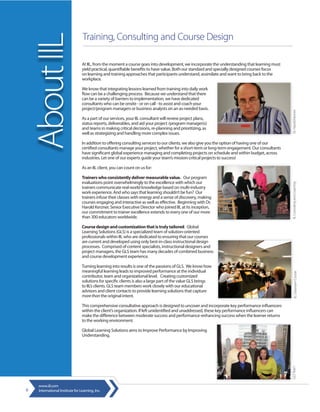
  investment and specific key performance           • In Asia, we recognize the premium
  benchmarks.                                         placed on practical skills, and our courses
                                                      rely heavily on interactive tools like case
                                                      studies and exercises from participants’
• Group coaching and individual mentoring             own projects. We also select one or more
  sessions to help integrate lessons learned          instructors according to each client
  and translate knowledge into practice.              organization’s outlook – a recognized
                                                      Western thought leader in some cases, a
• Process development and improvement                 hands-on local trainer in others.
  through direct, hands-on support or
  proprietary knowledge management                  • Our Paris office, an IIL Regional Centre


                                                                                                         IIL Middle East (Dubai)
  solutions. Our Unified Project Management®          of Excellence, serves as a central hub for
  Methodology (UPMM™) Software Suite                  the Europe, Middle East and Africa region
  supports consistency and quality in the             (EMEA). From this office, our multilingual
  implementation of project, program and              staff centralizes recruitment and scheduling
  portfolio management.                               efforts for expert resources and reinforces
                                                      our service to clients in EMEA. In parallel, the
Developing the Tools You Need                         Paris staff enables IIL to adapt our products,
Many of IIL’s greatest innovations in creating        courses and other services to local industrial,
new and focused tools, techniques and training        cultural and linguistic specifications to serve
have come from close working partnerships             our clients in Belgium, France, Morocco,
with our clients. Our instructional design            Algeria, Tunisia and French-speaking Sub-
expertise allows us to develop brand new              Saharan African countries.
courses and tools or refine existing ones.
                                                    • In Mexico and Latin America, we often
A few examples of this kind of collaboration are:     approach state-of-the-art topics in highly
                                                      pragmatic ways to adapt learning to
• For one of the world’s leading software             cultures only recently evolving into broad
  developers, we trained 1,200 project                industrialization.


                                                                                                                                          IIL France (Paris)
  managers in 22 nations over just a few
  months to support the effective rollout and
  adoption of their pioneering global project       • In the Middle East, we offer best-in-class
  management methodology and to help                  training throughout the region, and our
  increase their internal project management          trainers have extensive project experience
  maturity.                                           in every prevalent industry: oil and gas,
                                                      finance, telecommunications, construction,
                                                      information technology and manufacturing.
• For a large oil and gas company, we                 Our office in Dubai serves both global
  delivered a series of customized Business           and local clients throughout the Gulf
  Analysis and project management training            Cooperation Council (GCC) and beyond,
  programs that helped their project                  offering top quality solutions to many high
  managers significantly improve their on-            profile businesses.
  time and on-budget project delivery rates.
                                                                                                          IIL Mexico (Mexico City)


                                                    IIL companies are based in: Toronto, London,
• For a government agency, we helped                Paris, Frankfurt, Singapore, Sydney, Seoul,
  reduce defects by 76% in one of their key         Beijing, Hong Kong, Madrid, Mexico City, Dubai,
  process areas, resulting in substantial cost      Helsinki, Budapest, São Paulo, Bangalore, Tokyo,
  savings.                                          and New York City - our global headquarters.

• And for one of the world’s leading
  banks, we facilitated an extensive change
  management process after they had
  implemented a major restructuring and
  outsourcing initiative.


                                                                                                                                                               5
Training, Consulting and Course Design

    About IIL                    At IIL, from the moment a course goes into development, we incorporate the understanding that learning must
                                 yield practical, quantifiable benefits to have value. Both our standard and specially designed courses focus
                                 on learning and training approaches that participants understand, assimilate and want to bring back to the
                                 workplace.

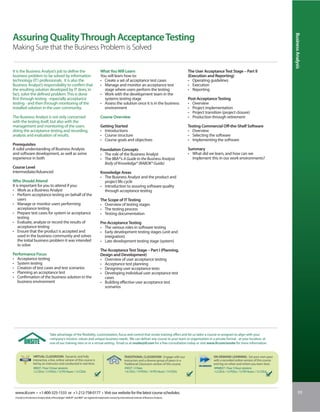
                                 We know that integrating lessons learned from training into daily work
                                 flow can be a challenging process. Because we understand that there
                                 can be a variety of barriers to implementation, we have dedicated
                                 consultants who can be onsite - or on call - to assist and coach your
                                 project/program managers or business analysts on an as-needed basis.


                                                                                                                                                 Dr. Harold Kerzner
                                 As a part of our services, your IIL consultant will review project plans,
                                 status reports, deliverables, and aid your project /program manager(s)
                                 and teams in making critical decisions, re-planning and prioritizing, as
                                 well as strategizing and handling more complex issues.

                                 In addition to offering consulting services to our clients, we also give you the option of having one of our
                                 certified consultants manage your project, whether for a short-term or long-term engagement. Our consultants
                                 have significant global experience managing and completing projects on schedule and within budget, across
                                 industries. Let one of our experts guide your team’s mission-critical projects to success!

                                 As an IIL client, you can count on us for:

                                 Trainers who consistently deliver measurable value. Our program
                                 evaluations point overwhelmingly to the excellence with which our


                                                                                                                                                 IIL Consulting and Coaching
                                 trainers communicate real-world knowledge based on multi-industry
                                 work experience. And who says that learning shouldn’t be fun? Our
                                 trainers infuse their classes with energy and a sense of discovery, making
                                 courses engaging and interactive as well as effective. Beginning with Dr.
                                 Harold Kerzner, Senior Executive Director who joined IIL at its inception,
                                 our commitment to trainer excellence extends to every one of our more
                                 than 300 educators worldwide.

                                 Course design and customization that is truly tailored. Global
                                 Learning Solutions (GLS) is a specialized team of solution-oriented
                                 professionals within IIL who are dedicated to ensuring that our courses
                                 are current and developed using only best-in-class instructional design
                                 processes. Comprised of content specialists, instructional designers and
                                 project managers, the GLS team has many decades of combined business
                                 and course development experience.

                                 Turning learning into results is one of the passions of GLS. We know how
                                 meaningful learning leads to improved performance at the individual


                                                                                                                                                       IIL Classroom Course
                                 contributor, team and organizational level. Creating customized
                                 solutions for specific clients is also a large part of the value GLS brings
                                 to IIL’s clients. GLS team members work closely with our educational
                                 advisors and client contacts to provide learning solutions that capture
                                 more than the original intent.

                                 This comprehensive consultative approach is designed to uncover and incorporate key performance influencers
                                 within the client’s organization. If left unidentified and unaddressed, these key performance influencers can
                                 make the difference between moderate success and performance-enhancing success when the learner returns
                                 to the working environment.

                                 Global Learning Solutions aims to Improve Performance by Improving
                                 Understanding.
                                                                                                                                                 GLS Team


    www.iil.com
6   International Institute for Learning, Inc.
Accreditations
                                                                                                                                                                                                          University Affiliations


                                             Member of PMI®’s Global Executive Council
                                             As a member of the Project Management Institute’s Global Executive Council, IIL is committed
                                             to the advancement of project, program and portfolio management in the global community.
                                             The Global Executive Council is designed to provide corporations with the opportunity to
                                             support and associate with PMI directly and to develop synergies between PMI and senior                                                                  New York University
                                             executives at leading corporations worldwide.
                                                                                                                                                                                                      School of Continuing  Professional
                                             Charter Global Registered Education Provider                                                                                                             Studies (SCPS)
                                             IIL has been recognized by PMI as a Charter Global Registered Education Provider. Attending IIL                                                          www.iil.com/nyuscps
                                             courses is a great way to earn and maintain Professional Development Units (PDUs), and each
                                             hour of scheduled classroom participation qualifies for one PDU. For more information on PMI’s
                                             Professional Development Program or PMP® certification, visit www.pmi.org.

                                             IIBA Endorsed Education Provider
                                             IIL is an Endorsed Education Provider with the International Institute of Business Analysis. We                                                              The University of Southern California
                                             are also proud to be an industry sponsor of IIBA. For more information, visit www.theiiba.org.                                                               Marshall School of Business
                                                                                                                                                                                                          www.iil.com/uscmsb
                                             Microsoft® Corporation
                                             IIL is a Microsoft Partner with a Microsoft Gold Project and Portfolio Management competency.                                                                IIL works with both the NYU School of Continuing 
                                             We provide customized training solutions to help organizations enhance their project                                                                         Professional Studies and the University of Southern
                                                                                                                                                                                                          California Marshall School of Business to offer the very best
                                             management capabilities using the Microsoft Project Enterprise Solution.                                                                                     professional training for today’s business leaders.

                                             ACE College Credit Recommendations                                                                                                                           The certificate programs and courses we offer in
                                             The American Council on Education (ACE) College Credit Recommendation Service (CREDIT)                                                                       conjunction with our university affiliates provide our clients
                                             has recommended several IIL courses for undergraduate and graduate ACE credits. For more                                                                     with a strong advantage in the marketplace. The status
                                             information, please visit www.acenet.edu or call ACE at +1 (202) 939-9434.                                                                                   of our affiliates as global network universities and our
                                                                                                                                                                                                          combined worldwide reach allow for learning experiences
                                                                                                                                                                                                          among a vast and diverse pool of professionals.
                                             Certificate of Course Completion and Continuing Education Units (CEUs)
                                             IIL is an Authorized CEU Sponsor Member of the International Association for Continuing
                                                                                                                                                                                                          Our strategic alliances provide a full menu of courses and
                                             Education and Training (IACET). CEUs are used internationally to maintain records of                                                                         defined learning pathways leading toward a university
                                             completion of organized post-secondary education. One CEU is provided for every ten hours of                                                                 grade report or grade equivalency letter. Joint IIL-university
                                             course participation.                                                                                                                                        websites also assure a fast and easy administrative
                                                                                                                                                                                                          experience for participants.
                                             Continuing Professional Education (CPE) Credit
                                             IIL is registered with the National Association of State Boards of Accountancy (NASBA) as a
                                             sponsor of Continuing Professional Education on the National Registry of CPE Sponsors. State
                                             boards of accountancy have final authority on the acceptance of individual courses for CPE
                                             credit. For more information, visit www. nasba.org.                                                                                                      Government Pricing (GSA)

                                             Women’s Business Enterprise National Council (WBENC)
                                             IIL has received certification from the Women’s Business Enterprise National Council (WBENC).
                                             WBENC’s corporate member list includes such companies as IBM, Motorola, Bank of America,
                                             Pepsi, Sears, Johnson Controls and Microsoft.

                                             Association for Facilities Engineerng (AFE) Partnership                                                                                                  IIL offers special training discounts for federal
                                             IIL is a partner of AFE, the largest dedicated network in the facility, maintenance and plant                                                            government agencies and government contractors
                                             operations profession. AFE members advance the field and their careers using the most                                                                    under IIL’s GSA Federal Supply Schedule
                                             complete range of technical information, education, best practices and sharing of common                                                                 (GS-23F-9834H).
                                             professional experiences. For more information, visit www.AFE.org.
                                                                                                                                                                                                      GSA has already negotiated the prices, services and
                                             PRINCE2®                                                                                                                                                 terms covering many of IIL’s project management
                                             IIL is an APM Group (APMG) Accredited Training Organization (ATO) for PRINCE2. PRINCE2 is a                                                              onsite training and project management products.
                                             structured, process-based approach for project management and is published by the UK-based                                                               This partnership allows IIL to offer quality training at
                                             Office of Government and Commerce. For more information on PRINCE2 or APMG, visit                                                                        a cost-efficient price.
                                             www.apmgroupltd.com.
                                                                                                                                                                                                      •     Groups of 15 or more being trained Onsite can
                                             ITIL®                                                                                                                                                          receive up to a 30% discount on our standard
                                             IIL is an APM Group (APMG) Accredited Training Organization (ATO) for ITIL Foundation Course.                                                                  public course prices.
                                             ITIL (Information Technology Infrastructure Library®) is a set of best practice standards for IT                                                         •     Individual government and government
                                             Service Management. For more information on ITIL or APMG, visit www.apmgroupltd.com.                                                                           contractor employees may also sign up for any
                                                                                                                                                                                                            of IIL’s public and/or Virtual Classroom courses
                                             MSP®                                                                                                                                                           and receive a 15% discount off the published
                                             IIL’s Managing Successful Programmes (MSP) courses are run in partnership with AFA, an APMG                                                                    prices.
                                             ATO for MSP. For more information on MSP or APMG, visit www.apmgroupltd.com.
                                                                                                                                                                                                      •     Groups of five or more signing up for our public
                                                                                                                                                                                                            courses and/or Virtual Classroom courses will
                                             M_o_R®
                                                                                                                                                                                                            receive a 20% discount.
                                             IIL’s Management of Risk (M_o_R) courses are run in partnership with AFA, an APMG ATO for
                                             M_o_R. For more information on M_o_R or APMG, visit www.apmgroupltd.com.
      Accredited by
                                                                                                                                                                                                      For more information about onsite, Virtual or
                                                                                                                                                                                                      classroom courses, email Learning@iil.com or call
                                             P3O®
                            ®                                                                                                                                                                         Ellen Murphy at +1-212-515-5116.
                                             IIL’s Portfolio, Programme and Project Offices (P3O) courses are run in partnership with AFA, an
                                             APMG ATO for P3O. For more information on P3O or APMG, visit www.apmgroupltd.com.
                                                                                                                                                                                                      You may also access GSA’s catalogue online at
                                                                                                                                                                                                      www.gsa.gov.


PMI® and PMP® are registered marks of the Project Management Institute, Inc. IIBA® is a registered trademark owned by International Institute of Business Analysis. Microsoft® is a registered trademark of Microsoft Corporation in the United States                     7
and other countries. PRINCE2®, ITIL®, MSP®, M_o_R®, P3O® and Information Technology Infrastructure Library® are Registered Trade Marks of the Office of Government Commerce in the United Kingdom and other countries. The Swirl logo™ is a
Trade Mark of the Office of Government Commerce.
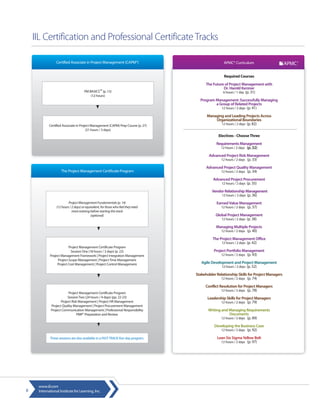
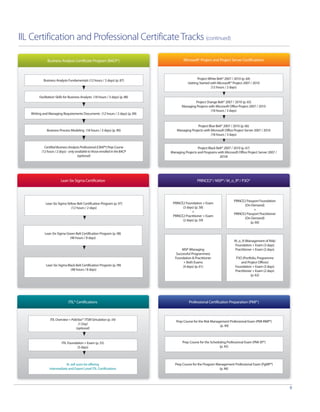
IIL Certification and Professional Certificate Tracks

                 Certified Associate in Project Management (CAPM®)                                 APMC® Curriculum                       APMC ®

                                                                                                   Required Courses
                                                                                         The Future of Project Management with
                                                                                                   Dr. Harold Kerzner
                                      PM BASICSTM (p. 13)                                          6 hours / 1 day (p. 31)
                                          (12 hours)
                                                                                     Program Management: Successfully Managing
                                                                                             a Group of Related Projects
                                                                                                12 hours / 2 days (p. 41)

                                                                                         Managing and Leading Projects Across
                                                                                             Organizational Boundaries
            Certified Associate in Project Management (CAPM) Prep Course (p. 27)                12 hours / 2 days (p. 82)
                                       (21 hours / 3 days)
                                                                                                Electives - Choose Three
                                                                                               Requirements Management
                                                                                                 12 hours / 2 days (p. 32)

                                                                                          Advanced Project Risk Management
                                                                                                12 hours / 2 days (p. 33)

                                                                                         Advanced Project Quality Management
                    The Project Management Certificate Program                                  12 hours / 2 days (p. 34)

                                                                                             Advanced Project Procurement
                                                                                                 12 hours / 2 days (p. 35)

                                                                                            Vendor Relationship Management
                                                                                                 12 hours / 2 days (p. 36)

                          Project Management Fundamentals (p. 14)                              Earned Value Management
                 (12 hours / 2 days) or equivalent, for those who feel they need                  12 hours / 2 days (p. 37)
                             more training before starting this track
                                            (optional)                                        Global Project Management
                                                                                                 12 hours / 2 days (p. 38)

                                                                                               Managing Multiple Projects
                                                                                                 12 hours / 2 days (p. 40)

                                                                                             The Project Management Office
                                                                                                  12 hours / 2 days (p. 42)
                          Project Management Certificate Program
                           Session One (18 hours / 3 days) (p. 22)                           Project Portfolio Management
            Project Management Framework | Project Integration Management                        12 hours / 2 days (p. 43)
                  Project Scope Management | Project Time Management
                 Project Cost Management | Project Control Management                 Agile Development and Project Management
                                                                                                  12 hours / 2 days (p. 52)

                                                                                   Stakeholder Relationship Skills for Project Managers
                                                                                                 12 hours / 2 days (p. 74)

                                                                                        Conflict Resolution for Project Managers
                                                                                                  12 hours / 2 days (p. 78)
                          Project Management Certificate Program
                         Session Two (24 hours / 4 days) (pp. 22-23)                      Leadership Skills for Project Managers
                    Project Risk Management | Project HR Management                              12 hours / 2 days (p. 79)
             Project Quality Management | Project Procurement Management
             Project Communication Management | Professional Responsibility               Writing and Managing Requirements
                                PMP® Preparation and Review                                            Documents
                                                                                                  12 hours / 2 days (p. 89)

                                                                                              Developing the Business Case
                                                                                                 12 hours / 2 days (p. 92)

            These sessions are also available in a FAST TRACK five-day program.                Lean Six Sigma Yellow Belt
                                                                                                 12 hours / 2 days (p. 97)


     www.iil.com
8    International Institute for Learning, Inc.
IIL Certification and Professional Certificate Tracks (continued)

              Business Analysis Certificate Program (BACP®)                              Microsoft® Project and Project Server Certifications


           Business Analysis Fundamentals (12 hours / 2 days) (p. 87)                            Project White Belt® 2007 / 2010 (p. 64)
                                                                                           Getting Started with Microsoft® Project 2007 / 2010
                                                                                                           (12 hours / 2 days)

        Facilitation Skills for Business Analysts (18 hours / 3 days) (p. 88)
                                                                                               Project Orange Belt® 2007 / 2010 (p. 65)
                                                                                       Managing Projects with Microsoft Office Project 2007 / 2010
                                                                                                          (18 hours / 3 days)
   Writing and Managing Requirements Documents (12 hours / 2 days) (p. 89)


                                                                                                  Project Blue Belt® 2007 / 2010 (p. 66)
              Business Process Modeling (18 hours / 3 days) (p. 90)                 Managing Projects with Microsoft Office Project Server 2007 / 2010
                                                                                                           (18 hours / 3 days)


            Certified Business Analysis Professional (CBAP®) Prep Course                          Project Black Belt® 2007 / 2010 (p. 67)
          (12 hours / 2 days) - only available to those enrolled in the BACP    Managing Projects and Programs with Microsoft Office Project Server 2007 /
                                      (optional)                                                                  2010t


                        Lean Six Sigma Certification                                              PRINCE2® / MSP® / M_o_R® / P3O®


                                                                                                                            PRINCE2 Passport Foundation
             Lean Six Sigma Yellow Belt Certification Program (p. 97)            PRINCE2 Foundation + Exam
                                                                                                                                   (On-Demand)
                               (12 hours / 2 days)                                     (3 days) (p. 58)
                                                                                                                                         +
                                                                                             +
                                                                                                                            PRINCE2 Passport Practitioner
                                                                                 PRINCE2 Practitioner + Exam
                                                                                                                                   (On-Demand)
                                                                                       (2 days) (p. 59)
                                                                                                                                      (p. 60)


            Lean Six Sigma Green Belt Certification Program (p. 98)
                             (48 hours / 8 days)
                                                                                                                            M_o_R (Management of Risk)
                                                                                                                            Foundation + Exam (3 days)
                                                                                        MSP (Managing                       Practitioner + Exam (2 days)
                                                                                    Successful Programmes)
                                                                                   Foundation  Practitioner                 P3O (Portfolio, Programme
                                                                                         + Both Exams                            and Project Offices)
             Lean Six Sigma Black Belt Certification Program (p. 99)                    (4 days) (p. 61)                     Foundation + Exam (3 days)
                              (48 hours / 8 days)                                                                            Practitioner + Exam (2 days)
                                                                                                                                        (p. 62)


                              ITIL® Certifications                                          Professional Certification Preparation (PMI® )


                ITIL Overview = PoleStarTM ITSM Simulation (p. 54)                 Prep Course for the Risk Management Professional Exam (PMI-RMP®)
                                      (1 Day)                                                                    (p. 44)
                                    (optional)


                         ITIL Foundation + Exam (p. 55)                                 Prep Course for the Scheduling Professional Exam (PMI-SP®)
                                    (3 days)                                                                      (p. 45)


                           IIL will soon be offering                               Prep Course for the Program Management Professional Exam (PgMP®)
                Intermediate and Expert Level ITIL Certifications                                                (p. 46)


                                                                                                                                                             9
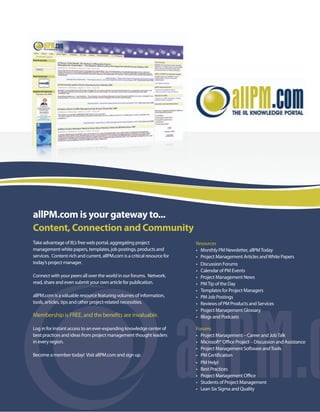
allPM.com is your gateway to...
Content, Connection and Community
Take advantage of IIL’s free web portal, aggregating project               Resources
management white papers, templates, job postings, products and             • Monthly PM Newsletter, allPM Today
services. Content-rich and current, allPM.com is a critical resource for   • Project Management Articles and White Papers
today’s project manager.                                                   • Discussion Forums
                                                                           • Calendar of PM Events
Connect with your peers all over the world in our forums. Network,         • Project Management News
                             y
read, share and even submit your own article for publication.              • PM Tip of the Day
                                                                           • Templates for Project Managers
allPM.com is a valu
        om        valuable resource featuring volumes of information,
                             source                                        • PM Job Postings
    s,
tools, articles, tips and other project-related necessities.               • Reviews of PM Products and Services
                                                                           • Project Management Glossary
                                                                             Proje Mana ement Glo ry
Memb
Membership is FREE, and the benefits are invaluable.
                                          nvaluable                        • Blogs and Podcasts
                                                                                    nd Po casts

Log in for instant access to an ever-expanding knowledge center of
            nstant                             kno    ge cente             Forums
                                                                           F rums
bes
best practices and ideas from project management thought leaders
            ces                        managemen      ught lea             • Proje Mana ement – Car er and Job Talk
                                                                             Project Management Career
   e      egion.
in every region.                                                           • Micro oft® Office Project – Discussion and Assistance
                                                                             Microsoft® O                  iscussion     Ass
                                                                           • Project Management Software and Tool
                                                                             Proje Mana emen              are      Tools
Beco
Become a member today! Visit allPM.com and sign up.                        • PM C tificat n
                                                                                 Certification
                                                                           • PM H p!
                                                                                 Help!
                                                                           • Best Practices
                                                                                    actice
                                                                           • Project Management Office
                                                                             Proje Mana emen
                                                                           • Students of Project Management
                                                                           • Lean Six Sigma and Quality
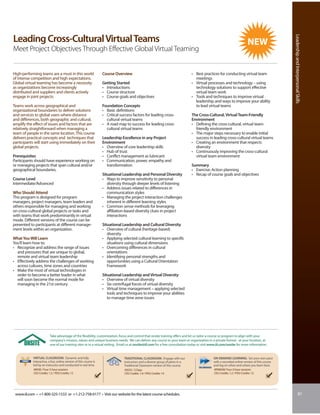
PM Core and Intermediate Courses

                                                                                                            In today’s rapidly changing business environment, project
                                                                                                            management (PM) has become a core competency for all
                                                                                                            organizations. Whether you’re in industry or government, you must
                                                                                                            be able to successfully manage internal projects to stay competitive.

                                                                                                            The discipline of PM applies constantly evolving principles,
                                                                                                            concepts, tools and techniques to improve project performance
                                                                                                            and organizational effectiveness. When properly aligned with
                                                                                                            company goals and objectives, PM adds value by improving your
                                                                                                            ability to consistently deliver the right products - on time and within
                                                                                                            budget - while increasing client satisfaction and employee retention.


 Projects are complex, collaborative efforts frequently involving the participation of stakeholders from various parts of an
 organization. To be successful, project managers must not only be knowledgeable of professional best practices - they
 must also be flexible and adaptable to evolving life cycles, methods, tools and techniques. The same type of project
 in differing environments may require a customized application of accepted PM principles. The most effective project
 managers have the ability to make adjustments based on moment-to-moment assessments of current conditions, while
 operating within the context of a comprehensive plan that makes use of consistent methods and past experience.

 Project management has become a focal point of internal improvement efforts – particularly those efforts designed to
 give organizations a competitive edge. To further a company’s capabilities, Project Management Offices and Centers of
 Excellence are being established, global benchmarking studies are being conducted, and the most successful organiza-
 tions are focusing on continuous improvement and innovation of their PM practices.


 The next two sections of our catalogue are dedicated to our wide curriculum on project, program and portfolio
 management. The PM Core and Intermediate section features courses targeted to those relatively new to the project
 management profession. In these classes you will learn fundamental PM concepts and hone the skills and techniques
 needed to ensure successful project outcomes.

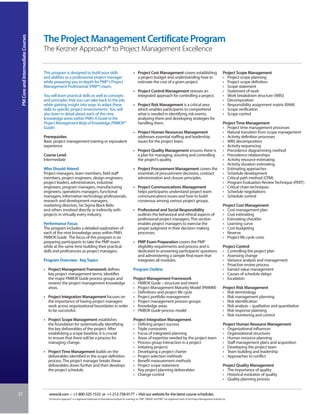
 A standout in this section is IIL’s capstone course, The Project Management Certificate Program: The Kerzner
 Approach® to Project Management Excellence. It is designed to build your skills and abilities as a project manager,
 while at the same time preparing you in-depth for the PMI® Project Management Professional (PMP®) exam.


 PoleStar PM Simulation is a new one-day traditional classroom course that integrates proven learning theory with
                    TM


 computer technology and game-based simulation to deliver a high-impact, holistic learning experience. For onsite
 course delivery, simulation training can also be integrated into many of our other courses, accelerating and enhancing
 your team’s learning experience.


    Leverage the power of our wholly-owned network of IIL companies, strategically located all over the world. We have deep experience working in
    different languages, cultures, countries and industries and are proud to be the training solution partner of choice for many top global companies.
    Find out what we can do together! Contact your local IIL company (listed on the back cover of the catalogue) or email us at learning@iil.com.


    www.iil.com • +1-800-325-1533 or +1-212-758-0177 • Visit our website for the latest course schedules.
The Kerzner Approach® is a registered trademark of International Institute for Learning, Inc. PMI® and PMP® are registered marks of the Project Management Institute, Inc. PoleStar™ is a Trademark of G2G3 Propulsion.
                                                                                                                                                                                                                          11
PM Core and Intermediate Courses


                                    Project Management for Non-Project Managers
                                    Introduction to the Components and Techniques of Managing Projects

                                    It is not uncommon for people unfamiliar with                                      • Identify why project management is critical                Technical Skills in Project Management
                                    project management to be put in positions                                            to business success                                        • Project selection and governance
                                    to support projects and project managers.                                          • Identify the five process groups and nine                  • Project planning tools
                                    They may even be asked to lead projects. To                                          knowledge areas and how they support the                   • Project baselines, tracking and reporting
                                    be a more effective project team member or                                           project management process                                 • Change control concepts
                                    team leader - or even if you are in a project                                      • Describe the importance of both soft skills
                                    support role - a basic understanding of project                                      and technical skills for the project manager               Summary
                                    management principles is essential.                                                                                                             • What did we learn, and how can we
                                                                                                                       Course Overview                                                implement this in our work environments?
                                    This course introduces the concepts and
                                    techniques included in PMI®’s A Guide to                                           Foundation Concepts
                                    the Project Management Body of Knowledge                                           • Project management overview                                  Incorporate Simulation into this Course
                                    (PMBOK® Guide). It provides insight into the                                       • Products, programs and projects
                                    role of a project manager, as well as giving                                       • Formal versus informal project management                    Want this course delivered onsite to your
                                    suggestions on how support personnel can aid                                       • Types of project organizations                               company or team? Enhance the class experi-
                                    in the success of a project.                                                       • Power dimensions                                             ence by adding real-world simulation into the
                                                                                                                       • Project life cycles                                          mix. Highly interactive and experiential, IIL’s
                                    Prerequisites                                                                      • Successful projects                                          simulation integrates proven learning theory
                                                                                                                                                                                      with leading-edge computer technology and
                                    There are no prerequisites for this course                                         Project Management and Business Success                        game-based simulation techniques to deliver
                                                                                                                       • Strategic business value of project                          lasting benefits.
                                    Course Level                                                                         management
                                    Basic                                                                              • Business success and project management                      Read more about PM simulation on page 18.

                                    Who Should Attend                                                                  Project Management Processes
                                    Managers, executives or non-project managers                                       • The five process groups:
                                    working in a project environment, or                                                  - Initiating process group
                                    professionals who work with project managers                                          - Planning process group
                                                                                                                          - Executing process group
                                    Performance Focus                                                                     - Monitoring and controlling process
                                    • Gaining a fundamental understanding                                                    group
                                      of the components and tools of project                                              - Closing process group
                                      management
                                    • Describing the five project management                                           Project Management Knowledge Areas
                                      process groups required for any project                                          • Project integration management
                                    • Exploring the nine knowledge areas of                                            • Project scope management
                                      project management                                                               • Project time management
                                    • Distinguishing between hard and soft skills                                      • Project cost management
                                      as applied to different aspects of project                                       • Project quality management
                                      management                                                                       • Project human resource management
                                    • Reviewing how several technical planning                                         • Project communication management
                                      tools are used to manage projects                                                • Project risk management
                                                                                                                       • Project procurement management
                                    What You Will Learn
                                    You’ll learn how to:                                                               Soft Skills in Project Management
                                    • Describe how project management can                                              • Hard versus soft skills
                                      support your company                                                             • Leadership and management
                                    • Discuss the strategic and business value of                                      • Negotiation
                                      project management                                                               • Conflict management
                                    • Distinguish between formal and informal                                          • Team building and motivation
                                      project management
                                    • Describe various types of organizations and
                                      how they interact with project management


                                                                    Take advantage of the flexibility, customization, focus and control that onsite training offers and let us tailor a course or program to align with your
                                                                    company’s mission, values and unique business needs. We can deliver any course to your team or organization in a private format - at your location, at
                                                                    one of our training sites or in a virtual setting. Email us at onsite@iil.com for a free consultation today or visit www.iil.com/onsite for more information.


                                                    VIRTUAL CLASSROOM: Dynamic and fully                                            TRADITIONAL CLASSROOM: Engage with our                         ON-DEMAND LEARNING: Set your own pace
                                                    interactive, a live, online version of this course is                           instructors and a diverse group of peers in a                  with a recorded online version of this course
                                                    led by an instructor and conducted in real time.                                Traditional Classroom version of this course.                  and log on when and where you learn best.
                                                    #8928 / Four 3-hour sessions                                                   #8214 / 2 Days                                                   #PA8928/ Four 3-hour sessions
                                                    CEU Credits: 1.2 / PDU Credits: 12                                             CEU Credits: 1.4 / PDU Credits: 14                               CEU Credits: 1.2 / PDU Credits: 12


12                                    www.iil.com • +1-800-325-1533 or +1-212-758-0177 • Visit our website for the latest course schedules.
                                       PMI®, PMBOK® and PMP® are registered marks of the Project Management Institute, Inc.
PM Core and Intermediate Courses
PM BASICS™
Project Management Fundamentals at Your Fingertips

Do you or your team members want to                                               Including post-tests after every section as well                                              “Simply stated, PM BASICS is the best on-demand course
improve the way projects are managed?                                             as a master test at the end, PM BASICS can                                                    ever developed for learning the fundamental principles
                                                                                  also be used by senior management as a tool                                                   and processes of project management.”
Do you want to hone the skills, techniques and                                    to assess the level of PM capability within an
tools needed to ensure extraordinary project                                      organization.                                                                                 - Harold Kerzner, Ph.D.
outcomes?
                                                                                  Key Benefits and Features
Do you want the flexibility to train at your own
pace, location and time of your choosing?                                         • Presents PMBOK Guide-aligned terminology
                                                                                    and approach
If you answered yes to any of the above
questions, then you need IIL’s PM BASICS™.                                        • Provides key project management tools
                                                                                    including forms and checklists that you can
What is PM BASICS?                                                                  use on the job and a comprehensive project
PM BASICS is a 12-hour self-paced,                                                  management bibliography and reference
multimedia training program that teaches                                            resource
the fundamentals of project management
across all areas of PMI®’s A Guide to the Project                                 • Addresses critical soft skills such as
Management Body of Knowledge (PMBOK®                                                interpersonal communication and conflict
Guide). Dynamic and interactive, the course                                         management as well as the hard skills
has a friendly and easy-to-use interface and                                        of scheduling, estimating and project
includes real-world case studies and exercises                                      reporting
to ensure increased retention.
                                                                                  • Allows for flexible scheduling of multiple
The on-demand equivalent of our two-day                                             employees and team members while
Project Management Fundamentals course, PM                                          ensuring all participants take away a
BASICS gives you top-quality content as well as                                     common language and methodology
the flexibility to learn at your own pace.
                                                                                  • Gives a comprehensive, content-rich
The course is divided into six major parts,                                         curriculum of material in just 12 hours -- and
including the Program Introduction plus a                                           is comparable with what you would learn
section dedicated to each of the five Project                                       during a two-day instructor-led course
Management process groups: initiating,
planning, executing, monitoring and                                               • This on-demand course will integrate with
controlling and closing. Mastery is ensured                                         virtually all Learning Management Systems
through reference to real-life projects, video
case studies and key exercises built into each
module.

Global Project Management Best Practices
Utilized by organizations all over the world, PM
BASICS has revolutionized the way companies
are pursuing project management. This on-
demand course is the most cost-effective way
to train one or a multitude of employees to use
a proven project management methodology.

Many top global companies use PM BASICS
to create a standardized project management
methodology across their entire enterprise.
By establishing this common project
management language, they are achieving the
first level of proficiency in their Organizational
Project Management Maturity.


                                  Take advantage of the flexibility, customization, focus and control that onsite training offers and let us tailor a course or program to align with your
                                  company’s mission, values and unique business needs. We can deliver any course to your team or organization in a private format - at your location, at
                                  one of our training sites or in a virtual setting. Email us at onsite@iil.com for a free consultation today or visit www.iil.com/onsite for more information.


                  VIRTUAL CLASSROOM: Dynamic and fully                                                      TRADITIONAL CLASSROOM: Engage with our                                                   ON-DEMAND LEARNING: Set your own pace
                  interactive, a live, online version of this course is                                     instructors and a diverse group of peers in a                                            with an interactive online version of this course
                  led by an instructor and conducted in real time.                                          Traditional Classroom version of this course.                                            and log on when and where you learn best.
                                                                                                                                                                                                     PS204i / 12 hours
                                                                                                                                                                                                     CEU Credits: 1.2 / PDU Credits: 12


 www.iil.com • +1-800-325-1533 or +1-212-758-0177 • Visit our website for the latest course schedules.                                                                                                                                                                13
PM BASICS™ is a trademark of International Institute for Learning, Inc. PMI®, PMBOK® and PMP® are registered marks of the Project Management Institute, Inc. This course was authored by PM expert George Pitagorsky, PMP.
PM Core and Intermediate Courses


                                    Project Management Fundamentals
                                    Completing Projects on Time and Within Budget While Increasing Customer Satisfaction


                                    Many projects are performed by highly                              What You Will Learn                                                 • Using the WBS to facilitate project
                                    competent and effective people who have little                     You’ll learn how to:                                                  development
                                    or no project management training. They                            • Describe the project management process
                                    perform projects like process improvement,                           and its benefits                                                  Risk Management
                                    marketing campaign development, new prod-                          • Use project management vocabulary and                             • Defining risk management
                                    uct development, event planning, production                          terminology                                                       • Benefits of risk management in project
                                    and other “tasks” which are projects. Learning                     • Identify characteristics of a successful project                     management
                                    project management on the job is an unneces-                         and create an initial project plan                                • Risk management processes and tools
                                    sary burden in an already challenging position.                    • Perform the major aspects of project
                                                                                                         initiation, project control and close-out                         Estimating
                                    This course provides practical skills, concepts                    • Identify and describe organizational change                       • Defining an estimate
                                    and principles you can take back to the job,                         issues in implementing project management                         • Specific types and methods of estimating
                                    along with insights you’ll need to adapt them                                                                                          • The estimating process
                                    to specific project environments.                                  Course Overview                                                     • Program Evaluation and Review Technique
                                                                                                                                                                              (PERT)
                                    The goal of this course is to achieve quality                      Getting Started                                                     • Final estimate development and validation
                                    performance through effective planning and                         • Introductions
                                    control. We use a process orientation and an                       • Course structure                                                  Scheduling
                                    analytical, systems-oriented approach to prob-                     • Course goals and objective                                        • Scheduling techniques
                                    lem solving and decision making. Throughout                                                                                            • Using a WBS
                                    the course, we integrate the need for collabora-                   Foundation Concepts                                                 • Critical path method
                                    tion and clear communications among people,                        • Project management (PM) process overview                          • Risk assessment and logical schedule
                                    often in multiple organizations.                                   • Focus and benefits of PM                                            alternatives
                                                                                                       • Critical PM skills
                                    Prerequisites                                                      • Concept of competing demands (update on                           Execution and Project Control
                                    There are no prerequisites for this course                           the classical triple constraints)                                 • Elements of project control
                                                                                                                                                                           • Status reporting
                                    Course Level                                                       Project Life Cycle                                                  • Change control
                                    Basic                                                              • Project life cycle overview                                       • Earned value analysis
                                                                                                       • Phases, tasks, deliverables and steps                             • Variance analysis and corrective action
                                    Who Should Attend                                                  • Variations on the life cycle                                      • Project closing/project transition
                                    This course is for people responsible for                          • Checkpoints and milestones                                        • Post-project evaluations
                                    managing, leading, coordinating and working                        • Project selection
                                    on projects who have limited experience or                         • Project governance                                                Collaboration and Organizational Change
                                    knowledge of practical, formal project manage-                     • Roles and responsibilities of the project                         • Overview of the PM process
                                    ment methods. Among those who can benefit                            manager and the project sponsor                                   • Teams
                                    from this course are:                                              • Roles and responsibilities of the team                            • Motivation and expectancy theory
                                    • Members of process and performance                               • Initiating the project and developing the                         • Change and continuous improvement
                                       improvement teams                                                 project charter
                                    • Participants in research and development                         • Linking project objectives to the project                         Summary
                                    • Business planning coordinators                                     team structure                                                    • What did we learn, and how can we
                                    • Technical service and support staff                                                                                                    implement this in our work environments?
                                    • Operations people in financial services                          Requirements
                                    • Administrators and managers responsible                          • Conducting stakeholder assessments                                  Incorporate Simulation into this Course
                                       for coordinating, facilitating or managing                      • Understanding and managing resistance
                                       projects and programs                                           • Communicating and refining requirements                             Want this course delivered onsite to your
                                    • Technical professionals and engineers                            • Defining product/service requirements                               company or team? Enhance the class experi-
                                       moving into project leadership and                              • Change control process                                              ence by adding real-world simulation into the
                                       coordination positions                                          • Communications                                                      mix. Highly interactive and experiential, IIL’s
                                    • Marketing, training and technical writing                                                                                              simulation integrates proven learning theory
                                       professionals                                                   Work Breakdown Structure (WBS)                                        with leading-edge computer technology and
                                    • Six Sigma professionals                                          • The central role of the WBS                                         game-based simulation techniques to deliver
                                                                                                       • Developing a usable WBS                                             lasting benefits.
                                                                                                       • Using the WBS to clarify product constraints
                                                                                                         and activities                                                      Read more about PM simulation on page 18.


                                                             Take advantage of the flexibility, customization, focus and control that onsite training offers and let us tailor a course or program to align with your
                                                             company’s mission, values and unique business needs. We can deliver any course to your team or organization in a private format - at your location, at
                                                             one of our training sites or in a virtual setting. Email us at onsite@iil.com for a free consultation today or visit www.iil.com/onsite for more information.


                                               VIRTUAL CLASSROOM: Dynamic and fully                                 TRADITIONAL CLASSROOM: Engage with our                               ON-DEMAND LEARNING: Set your own pace
                                               interactive, a live, online version of this course is                instructors and a diverse group of peers in a                        with a recorded online version of this course
                                               led by an instructor and conducted in real time.                     Traditional Classroom version of this course.                        and log on when and where you learn best.
                                               #8820 / Four 3-hour sessions                                         #8212 / 2 Days                                                       #PA8820 / Four 3-hour sessions
                                               CEU Credits: 1.2 / PDU Credits: 12                                   CEU Credits: 1.4 / PDU Credits: 14 / CPE Credits: 16                 CEU Credits: 1.2 / PDU Credits: 12


14                                     www.iil.com • +1-800-325-1533 or +1-212-758-0177 • Visit our website for the latest course schedules.
Mastering the Fundamentals of Managing Projects


                                                                                                                                                                                                                                 PM Core and Intermediate Courses
Case Studies, Group Exercises and Practical Experience
Led by Your Company’s Trainer

Mastering the Fundamentals of Managing                                               • Address project initiating and planning
                                                                                                                                                                  What is Blended Learning?
Projects is a blended learning program                                                 issues
designed to teach the principles, key concepts                                       • Identify the major components of project
and core techniques of project management                                              monitoring and controlling, executing and                                  Blended learning streamlines the
for practical application in an organization.                                          closing                                                                    learning process by allocating each
This comprehensive course collection                                                 • Describe the critical need for effective                                   part of the process to the most
combines self-paced learning with face-to-face                                         interpersonal relationships and                                            effective media.
instruction, in which group exercises and                                              communication
dialogue activate and enhance tacit                                                  • Identify and describe cultural change issues                               For example, it is widely recognized
knowledge gained online.                                                               in implementing project management                                         that learning hard skills, definitions
                                                                                     • Identify the nine Knowledge Areas                                          and basic concepts is accomplished
With a unique spin on a “Train the Trainer”                                            presented in PMI®’s A Guide to the Project                                 most efficiently in a self-paced
approach, course materials include a detailed                                          Management Body of Knowledge (PMBOK®                                       media, while deeper exploration
Instructor Guide so that a qualified trainer from                                      Guide)                                                                     and application are best done with a
your own company can facilitate the in-class                                                                                                                      live instructor in a virtual or physical
learning portion of the course. Also included                                        Course Materials                                                             classroom setting.
are Participant Workbooks, case studies, exer-                                       For the Instructor
cises and solutions, PowerPoint decks and                                            A detailed Instructor Guide provides your
other supplemental materials.                                                        trainer with in-depth support in delivering the
                                                                                     course. The Instructor Guide includes:
One of the many benefits of this comprehen-                                          • A general overview and rationale for each
sive course collection is that one of your own                                          module
people can lead a high-quality workshop                                              • The key points associated with each slide
without your company having to go through                                            • Discussion ideas
the lengthy - and risky - course development                                         • Directions for how to handle all activities or
process. Your instructor is encouraged to make                                          exercises and debriefs
the course his or her own by incorporating                                           • Suggested timing
personal examples and experiences relevant to
your company’s business.                                                             In addition to receiving a set of Instructor
                                                                                     Slides, your trainer will be given access to
Course Sections                                                                      a two-hour, recorded online session on
This course collection is comprised of two                                           Instructor Best Practices for the course. The
sections: the self-paced learning portion (PM                                        instructor will also receive a set of all of the
BASICS™ - see page 13) and the in-class learn-                                       participant materials, as well as access to the
ing portion, which is facilitated by your own                                        PM BASICS online self-paced portion of the
qualified instructor.                                                                course.

Core knowledge is presented in the self-paced                                        For the Participants
segment and then reinforced within the                                               The Participant Workbook contains images of
practical context of the in-class experience.                                        the slides used in the course, as well as notes
                                                                                     and comments that elaborate on the slide
What Participants Will Learn                                                         contents. The workbook is used in the
Participants will learn how to:                                                      classroom for keeping participants focused on
• Describe the project management process                                            the content and as a place to make notes.
  in terms of its major process groups:
           - Initiating                                                              After the class, the workbook becomes a                                   In addition to comprehensive course materials, all participants
           - Planning                                                                resource to remind participants what they                                 will receive access to the PM BASICS online self-paced portion
           - Executing                                                               have learned and to use with applying the new                             of the course (for more details, see page 13).
           - Monitoring and controlling                                              knowledge and skills gained from attending
           - Closing                                                                 the course. The workbook also includes a set of
• Use project management vocabulary and                                              Exercises and Case Studies.
  terminology
• Identify the characteristics of a successful
  project and the factors leading to its success


                                  Take advantage of the flexibility, customization, focus and control that onsite training offers and let us tailor a course or program to align with your
                                  company’s mission, values and unique business needs. We can deliver any course to your team or organization in a private format - at your location, at
                                  one of our training sites or in a virtual setting. Email us at onsite@iil.com for a free consultation today or visit www.iil.com/onsite for more information.


                 VIRTUAL CLASSROOM: Dynamic and fully                                                       TRADITIONAL CLASSROOM: Engage with our                              ON-DEMAND LEARNING: Set your own pace
                 interactive, a live, online version of this course is                                      instructors and a diverse group of peers in a                       with a recorded online version of this course
                 led by an instructor and conducted in real time.                                           Traditional Classroom version of this course.                       and log on when and where you learn best.
                 Contact your local IIL company for details                                                 Contact your local IIL company for details                           Contact your local IIL company for details


www.iil.com • +1-800-325-1533 or +1-212-758-0177 • Visit our website for the latest course schedules.                                                                                                                                         15
PM BASICS™ is a trademark of International Institute for Learning, Inc. PMI®, PMBOK® and PMP® are registered marks of the Project Management Institute, Inc.
PM Core and Intermediate Courses


                                    Managing Project Scope
                                    Improve Your Projects’ Probability of Success


                                    The Standish Group continually reports scope                        What You Will Learn                                           Monitoring and Controlling Scope
                                    creep as a major contributor to project failure                     You will learn:                                               • Explain the importance of establishing
                                    internationally. While scope is always dealt                        • The full spectrum of processes that                           control procedures for managing projects
                                    with as a component of a larger workshop,                             constantly interact during a project life cycle               and, in particular, scope
                                    it is seldom focused on exclusively in a one-                         and impact scope                                            • Establish an escalation process to facilitate
                                    day workshop. This program is designed to                           • The nature and characteristics of                             resolution of scope-related issues
                                    demonstrate how effectively managing scope                            requirements definition                                     • Explain the importance of scope verification
                                    requires constant vigilance and discipline                          • How to create and obtain sign-off of a scope                  and the procedures for making sure the
                                    throughout the entire project life cycle.                             document                                                      scope has been delivered as committed
                                                                                                        • How to decompose a scope document into
                                    This course follows the project cycle, focusing                       a Work Breakdown Structure (WBS)                            Project Closeout
                                    specifically on the tools and techniques                            • How to activate Integrated Change Control                   • Describe the three major types of project
                                    required to effectively manage scope. At                              very early in the project life cycle                          closing activities (deployment, evaluation,
                                    each phase you will learn the pitfalls and                          • How to manage scope during the execution                      knowledge management)
                                    best practices, that when applied, can be a                           project phase                                               • Develop a checklist for project deployment
                                    significant factor in success. And while scope is                   • How to verify scope and document lessons                      activities
                                    only one part of the iron triangle, it can have a                     learned                                                     • Explain the different types of post-project
                                    direct bearing on cost and time outcomes for                        • A framework for self-assessment in the area                   evaluations, their respective challenges and
                                    a project.                                                            of scope management key behaviors                             some ideas for meeting those challenges
                                                                                                                                                                      • Facilitate scope verification as part of the
                                    Join us for this exciting program and learn                         Course Overview                                                 project closure exercise
                                    how a few basic scope management principles
                                    implemented in a straightforward and                                Getting Started                                               Summary
                                    logical process can significantly improve your                      • Introductions                                               • What did we learn, and how can we
                                    probability for project success.                                    • Course structure                                              implement this in our work environments?
                                                                                                        • Course goals and objective
                                    Prerequisites
                                                                                                        Foundation Concepts
                                    There are no prerequisites for this course                          • Describe the content and intent of the
                                                                                                          project scope statement
                                    Course Level                                                        • State the contents of the four high-level
                                    Basic                                                                 documents used to get the project
                                                                                                          requirements definition started
                                    Who Should Attend                                                   • State the value and intent of creating the
                                    You should attend this workshop if you man-                           project proposal and the project charter
                                    age single and/or multiple projects within                          • Outline how to perform a stakeholder
                                    your organization. Members of the Project                             assessment to capture the voice of the
                                    Management Office, project and resource                               project customer
                                    managers and team leaders will benefit from
                                    the program.                                                        Progressive Elaboration of Scope
                                                                                                        • Describe the intent and process of the
                                    Performance Focus                                                     progressive elaboration
                                    The goal of the course is to equip you with the                     • Articulate the purpose of a Systems
                                    necessary knowledge, skills and techniques                            Development Life Cycle (SDLC) process and
                                    so that managing scope becomes an ongoing                             its relationship to scope management
                                    process throughout the life of the project. The                     • Explain the scope elaboration process steps
                                    plan is also to turn scope management into a                          and related documents
                                    team game.                                                          • Describe how to analyze stakeholder needs
                                                                                                          and requirements
                                                                                                        • Recognize pitfalls and best practices in the
                                                                                                          progressive elaboration of scope
                                                                                                        • Describe scope elaboration requirements
                                                                                                          within the vendor and contract
                                                                                                          management environment


                                                              Take advantage of the flexibility, customization, focus and control that onsite training offers and let us tailor a course or program to align with your
                                                              company’s mission, values and unique business needs. We can deliver any course to your team or organization in a private format - at your location, at
                                                              one of our training sites or in a virtual setting. Email us at onsite@iil.com for a free consultation today or visit www.iil.com/onsite for more information.


                                                VIRTUAL CLASSROOM: Dynamic and fully                                  TRADITIONAL CLASSROOM: Engage with our                         ON-DEMAND LEARNING: Set your own pace
                                                interactive, a live, online version of this course is                 instructors and a diverse group of peers in a                  with a recorded online version of this course
                                                led by an instructor and conducted in real time.                      Traditional Classroom version of this course.                  and log on when and where you learn best.
                                                #8930 / Two 3-hour sessions                                            #5024 / 1 Day                                                  #PA8930 / Two 3-hour sessions
                                                CEU Credits: 0.6 / PDU Credits: 6                                      CEU Credits: 0.7 / PDU Credits: 7                              CEU Credits: 0.6 / PDU Credits: 6


16                                      www.iil.com • +1-800-325-1533 or +1-212-758-0177 • Visit our website for the latest course schedules.
PM Core and Intermediate Courses
WBS – The Keystone of Project Management
Improve Your Project Planning


It’s amazing how often project managers                             What You Will Learn                                                  WBS and Scheduling
begin the project planning process by making                        You will learn how to:                                               • Component scheduling – high-level
an outlined list of every task they believe                         • Describe the need for a project WBS                                  milestones
will be required to complete a project and                          • Construct a WBS                                                    • Dependencies between work packages
then proclaim they have created the Work                            • Determine the appropriate level of detail in                          - Mandatory (hard)
Breakdown Structure (WBS) for the project. The                        the WBS                                                               - Discretionary (soft)
result is a list of hundreds, or even thousands of                  • Describe the WBS role in the project                                  - External
tasks, many of them having durations of a few                       • Gain practical experience in the                                   • Work package level schedules
days or a few hours.                                                  development, decomposition and use of
                                                                      the WBS                                                            WBS and Execution and Control
Essentially, what they have done is create a                        • Know how the WBS supports and                                      • Responsibility Assignment Matrix (RAM)
“to do” list, which they then use as a checklist                      integrates with project requirements, risk,                          chart used to clarify work package
to measure progress. This approach leads to,                          procurement, estimating, scheduling and                              responsibilities
and even encourages, micromanagement of                               overall project execution                                          • Earned Value Management and tracking of
the resources working on the project without                                                                                               work performance
consideration of more critical aspects of                           Course Overview                                                      • Progress reports, forecasts and corrective
project management such as requirements                                                                                                    and preventive actions used to manage
management, risk management, procurement                            Getting Started                                                        work performance
management, estimating, scheduling,                                 • Introductions
executing and controlling. Further, it makes it                     • Course structure                                                   Summary
impossible to see the big picture - at levels of                    • Course goals and objectives                                        • What did we learn, and how can we
detail - in keeping with the needs of sponsors,                                                                                            implement this in our work environments?
clients, project and functional managers, team                      Introduction
leaders and project performers.                                     • Key definitions
                                                                    • History of the WBS
Join us for this exciting course and learn how to                   • Importance of the WBS
use the WBS to make better-informed business                        • Overall structure
decisions.                                                          • Terminology
                                                                    • Other breakdown structures
Prerequisites                                                       • WBS tools
Basic project management training or
equivalent experience                                               WBS and Requirements
                                                                    • Project scope management processes
Course Level                                                        • Specify the project objectives
Intermediate/Advanced                                               • WBS design based on project deliverable
                                                                    • WBS decomposition process
Who Should Attend                                                   • The “100% rule”
You should attend this workshop if you                              • The WBS and activity definition
manage single and/or multiple projects within
your organization. Members of the Project                           WBS and Risk
Management Office, project and resource man-                        • Using risk identification to enhance the WBS
agers, team leaders and executives will benefit                     • Risk at the project or overall requirements
from the program.                                                     level
                                                                    • Risk breakdown structure or taxonomies
Performance Focus                                                   • Risk management plan – risk components
The goal of the course is to equip you with the                       and work packages
necessary knowledge, skills and techniques so
that you can develop an effective WBS for use                       WBS and Estimating
in planning, executing and controlling your                         • Use of WBS in the estimating process
next project and to provide the basic tools to                      • Components and work packages
enhance efficient re-use of key information in                      • Sizing and algorithmic estimates
future projects.                                                    • Estimating types and usages


                          Take advantage of the flexibility, customization, focus and control that onsite training offers and let us tailor a course or program to align with your
                          company’s mission, values and unique business needs. We can deliver any course to your team or organization in a private format - at your location, at
                          one of our training sites or in a virtual setting. Email us at onsite@iil.com for a free consultation today or visit www.iil.com/onsite for more information.


            VIRTUAL CLASSROOM: Dynamic and fully                                 TRADITIONAL CLASSROOM: Engage with our                                ON-DEMAND LEARNING: Set your own pace
            interactive, a live, online version of this course is                instructors and a diverse group of peers in a                         with a recorded online version of this course
            led by an instructor and conducted in real time.                     Traditional Classroom version of this course.                         and log on when and where you learn best.
            #8807 / Four 3-hour sessions                                          #5012 / 2 Days                                                        #PA8807 / Four 3-hour sessions
            CEU Credits: 1.2 / PDU Credits: 12                                    CEU Credits: 1.4 / PDU Credits: 14 / CPE Credits: 16                  CEU Credits: 1.2 / PDU Credits: 12


 www.iil.com • +1-800-325-1533 or +1-212-758-0177 • Visit our website for the latest course schedules.                                                                                                              17
PM Core and Intermediate Courses


                                    PoleStar™ PM Simulation
                                    Propelling the Enterprise to Faster, Better Results


                                                                                                                            Who Should Attend                                                   Round Three
                                                                                                                            Among those who would benefit from this                             • Sharing the vision
                                                                                                                            learning experience are project and program                         • Project management tools - critical path
                                                                                                                            managers, project team members, operational                         • Analysis, Arrow Diagramming Method
                                                                                                                            managers, project planners, clients/end users,                      • Precedence Diagramming Method
                                                                                                                            executive sponsors, steering committees and                         • Managing risk
                                                                                                                            operational staff.                                                  • Project closing
                                                                                                                                                                                                • Project success
                                                                                                                            Performance Focus
                                                                                                                            The goal of this workshop is to improve
                                                                                                                            the organizational appreciation for and                               The PoleStar PM Simulation
                                                                                                                            performance of project management by
                                                                                                                            building energized and successful project
                                    This interactive simulation is a high-impact,                                           teams; accelerating understanding of Project                          The ability to display real business
                                    energetic and fun way to accelerate                                                     and Portfolio Management best practices and                           performance improvement as a direct
                                    understanding, involvement and acceptance                                               promoting the use of these practices toward                           result of better project performance is
                                    of Project and Portfolio Management (PPM)                                               project, program and/or organizational                                a distinguishing feature of PoleStar PM
                                    best practices in an organization.                                                      success.                                                              simulation. As participants progress
                                                                                                                                                                                                  through the rounds, they witness the
                                    Facilitated over one day in the fast-paced                                              What You Will Learn                                                   actual impact of their actions on the
                                    world of global online retail, the PoleStar PM                                          You’ll learn how to:                                                  fictional business they are supporting.
                                    Simulation brings to life the project-based                                             • Effectively manage projects based upon                              So not only do participants learn to use
                                    behavioral and process issues faced by organiza-                                          project management best practices                                   project management tools and tech-
                                    tions. Authenticity is achieved through realistic                                       • Create a shared understanding of a project                          niques, they recognize their value and
                                    scenarios to which participants can directly relate                                       with key stakeholders                                               are more motivated to apply what they
                                    and with which they will be surprisingly famil-                                         • Obtain commitment to a project’s vision and                         have learned.
                                    iar. This unique experiential learning approach                                           goals
                                    causes breakthrough understanding of PPM best                                           • Apply the most appropriate project                                  The outcome is a powerful combination of
                                    practices and transforms learning into an engag-                                          management practices at each stage of the                           improved capabilities and a holistic under-
                                    ing and highly memorable shared experience.                                               project management life cycle                                       standing that the main objective of Project
                                                                                                                            • Successfully plan, monitor and control project                      and Portfolio Management is ultimately to
                                    Normally delivered over three rounds, the                                                 scope, schedule and cost, using a practical                         improve business performance.
                                    PoleStar PM simulation introduces key PPM                                                 project risk management approach
                                    components using fast-paced, highly-interac-
                                    tive gaming dynamics. Progressing through the                                           Course Overview
                                    rounds, project delivery improves via the
                                    successful application of PPM tools and                                                 Round One
                                    techniques, which are introduced and explained                                          • Working in silos (Operations, Business, Project
                                    at key points in the participants’ learning cycle.                                        Office)
                                                                                                                            • Poor project initiation and communication
                                    These practices allow the teams to deliver                                              • Poor planning
                                    projects of increasing interdependency and                                              • Poor monitoring and control - scope, schedule
                                    complexity, while experiencing the true value                                             and cost
                                    of working in an effective project team in the                                          • Lack of business awareness
                                    context of the surrounding business environ-
                                    ment. This course is aligned with both Project                                          Round Two
                                    Management Institute (PMI®) and APM Group                                               • Working together
                                    (APMG) standards.                                                                       • Improved initiation/planning
                                                                                                                            • Improved monitoring and control
                                    Prerequisites                                                                           • Project management tools - Gantt chart
                                    Experience working in or being impacted by                                              • Work Breakdown Structures
                                    organizational projects                                                                 • Planning adaptive action
                                    Course Level
                                    Basic/Intermediate


                                                                     Take advantage of the flexibility, customization, focus and control that onsite training offers and let us tailor a course or program to align with your
                                                                     company’s mission, values and unique business needs. We can deliver any course to your team or organization in a private format - at your location, at
                                                                     one of our training sites or in a virtual setting. Email us at onsite@iil.com for a free consultation today or visit www.iil.com/onsite for more information.


                                                     VIRTUAL CLASSROOM: Dynamic and fully                                                       TRADITIONAL CLASSROOM: Engage with our                      ON-DEMAND LEARNING: Set your own pace
                                                     interactive, a live, online version of this course is                                      instructors and a diverse group of peers in a               with a recorded online version of this course
                                                     led by an instructor and conducted in real time.                                           Traditional Classroom version of this course.               and log on when and where you learn best.
                                                                                                                                                #3041/ 1 Day
                                                                                                                                                CEU Credits: 0.7 / PDU Credits: 7


18                                     www.iil.com • +1-800-325-1533 or +1-212-758-0177 • Visit our website for the latest course schedules.
                                       PMI® is a registered mark of the Project Management Institute, Inc. PoleStar™ is a Trademark of G2G3 Propulsion.
PM Core and Intermediate Courses
Project Estimating and Scheduling
Creating Realistic Schedules and Budgets


Establishing realistic estimates and schedules                     • Implement useful adjustments to                                    Budget, Risk and Contingency Planning
for projects that support business objectives                        preliminary schedules                                              • Overview of budget, risk and contingency
and meet client expectations is one of the                         • Establish realistic schedule and cost                                planning
most challenging aspects of project planning.                        baselines, with appropriate risk                                   • Determining budget
Delivering those results within the agreed-                          management plans                                                   • Planning risk management
upon time, cost and quality constraints is also                    • Explain the value of and interpret reports                         • Planning contingency reserves
very challenging.                                                    using Earned Value Management (EVM)
                                                                     to manage time and cost performance on                             Project Baseline and Control
Attempting to meet impossible deadlines with                         projects                                                           • Baseline concepts
limited budgets leads to unplanned product                                                                                              • Negotiating and the project baseline
shortfalls, which cause long-term support and                      Course Overview                                                      • Earned Value Management (EVM)
utilization problems. We have all anguished                                                                                             • Project variances and corrective actions
about this recurring problem, but without                          Getting Started                                                      • Facilitating control through reporting
having the skills or knowledge to take action,                     • Introductions
we are unable to break the cycle!                                  • Course structure                                                   Summary
                                                                   • Course goals and objective                                         • What did we learn, and how can we
The goal of this course is to equip you with the                                                                                          implement this in our work environments?
necessary knowledge, skills and techniques so                      Foundation Concepts
that you can establish realistic schedules and                     • Project management basic concepts
budgets for projects that support business                         • Project Estimating and Scheduling (PES)
objectives and meet client expectations.                           • Key driver: the competing project demands
                                                                   • PES process overview
Prerequisites                                                      • PES success factors
Basic project management training or
equivalent experience                                              Project Definition and the Work Breakdown
                                                                   Structure
Course Level                                                       • Project definition overview
Intermediate/Advanced                                              • Work Breakdown Structure (WBS) concepts
                                                                   • Decomposition: key technique for
Who Should Attend                                                     developing the WBS
Those who can benefit from this course
include project managers, as well as all project                   Resource Planning
team members who participate in creating,                          • Resource planning overview
implementing and/or controlling project                            • Identifying resource requirements
schedules.                                                         • Identifying and filling resource gaps
                                                                   • Applying resource planning tools
Performance Focus
• Developing realistic schedules and cost                          Duration Estimating
  estimates                                                        • Estimating overview
• Leveraging the most appropriate tools and                        • Estimating perspectives
  techniques for establishing these realistic                      • Estimating techniques
  schedules and cost estimates                                     • Duration estimating best practices
• Using the baseline and additional tools and
  techniques to effectively control project                        Project Scheduling
  performance                                                      • Project scheduling overview
                                                                   • Dependencies and the project network
What You Will Learn                                                  diagram
You’ll learn how to:                                               • Critical Path Method (CPM)
• Use the Work Breakdown Structure (WBS) as                        • Optimizing the project schedule
  the basis for effective resourcing, estimating
  and scheduling on projects
• Estimate durations using a variety of
  techniques
• Develop reliable preliminary schedules
  using the critical path method


                         Take advantage of the flexibility, customization, focus and control that onsite training offers and let us tailor a course or program to align with your
                         company’s mission, values and unique business needs. We can deliver any course to your team or organization in a private format - at your location, at
                         one of our training sites or in a virtual setting. Email us at onsite@iil.com for a free consultation today or visit www.iil.com/onsite for more information.


           VIRTUAL CLASSROOM: Dynamic and fully                                 TRADITIONAL CLASSROOM: Engage with our                                 ON-DEMAND LEARNING: Set your own pace
           interactive, a live, online version of this course is                instructors and a diverse group of peers in a                          with a recorded online version of this course
           led by an instructor and conducted in real time.                     Traditional Classroom version of this course.                          and log on when and where you learn best.
           #8808 / Four 3-hour sessions                                          #5002 / 2 Days                                                        #PA8808 / Four 3-hour sessions
           CEU Credits: 1.2 / PDU Credits: 12                                    CEU Credits: 1.4 / PDU Credits: 14 / CPE Credits: 16                  CEU Credits: 1.2 / PDU Credits: 12


www.iil.com • +1-800-325-1533 or +1-212-758-0177 • Visit our website for the latest course schedules.                                                                                                               19
Project JumpStart®
 PM Core and Intermediate Courses


                                    The Workshop Designed to Launch Projects Faster


                                    This workshop is not a conventional training                                             attendance is strictly capped at 20 participants              • Types of relationships and constraints
                                    program. Project JumpStart is a three-day,                                               to ensure an ideal level of interaction and                   • Value of slack float
                                    hands-on workshop during which you and                                                   personalization.                                              • Resource allocation
                                    your team members will work on an actual                                                                                                               • Network development, analysis and
                                    project from your organization. An experienced                                           Workshop Preparation                                            scheduling
                                    IIL project management consultant will guide                                             Be sure to bring with you to the workshop:                    • Fine-tuning, logic checking, what if?
                                    your team throughout the workshop. You’ll                                                • Supporting documentation related to your                    • Effective communications
                                    learn practical and creative ways to ensure a                                              target projects
                                    successful and speedy project launch.                                                    • Your laptop computers                                       Executing and Controlling
                                                                                                                                                                                           • Preparing a presentation for management
                                    You will discover methods for identifying                                                Course Overview                                               • Project execution and control
                                    clear project objectives and will have the                                                                                                             • The five baselines
                                    opportunity to apply many ideas and concepts                                             Getting Started                                               • Updating the schedule
                                    from other project teams participating in the                                            • Introductions                                               • Earned value
                                    workshop. You will also develop a new skill set                                          • Course structure                                            • Balanced “scorecarding”
                                    for leading your own team. At the conclusion of                                          • Course goals and objective                                  • Making up time
                                    Project JumpStart, your team will have a clear                                           • Participant expectations                                    • Corrective action, alternatives and
                                    understanding of and commitment to a                                                                                                                     approaches
                                    completed, detailed project plan which will                                              Initiating                                                    • Using reserves
                                    allow you to JumpStart project execution                                                 • Overview of project management in a
                                    immediately!                                                                                competitive business environment                           Closing
                                                                                                                             • Project selection                                           • Completion versus termination
                                    Prerequisites                                                                            • Roles and responsibilities                                  • Identifying control and execution issues
                                    Basic project management training or                                                     • Project charter                                             • Project transition
                                    equivalent experience                                                                    • Team charter                                                • Management presentation
                                                                                                                             • Project requirements and definition                         • Post-workshop coordination
                                    Course Level                                                                             • Stakeholder identification and assessment
                                    Intermediate
                                                                                                                             Planning
                                                                                                                             • Defining project requirements                                   Incorporate Simulation into this Course
                                    • Get projects started faster than ever before                                           • Scope definition documentation
                                    • Tackle more projects with the time you save                                            • Change control process                                          Want this course delivered onsite to your
                                      launching each one                                                                     • Expediting desirable change                                     company or team? Enhance the class experi-
                                    • Ensure measurably better project outcomes                                              • Document specific activities and plans                          ence by adding real-world simulation into the
                                    • Gain a clear understanding of the resources                                            • Stakeholder assessment                                          mix. Highly interactive and experiential, IIL’s
                                      needed to successfully complete your                                                   • Requirements definition                                         simulation integrates proven learning theory
                                      project                                                                                • Assumption and constraint documentation                         with leading-edge computer technology and
                                    • Learn how to measure the success of your                                               • Change control process definition                               game-based simulation techniques to deliver
                                      project                                                                                • Work breakdown structure (WBS): value,                          lasting benefits.
                                    • Understand how working on the right things                                                definitions, procedures, responsibility matrix,
                                      can dramatically accelerate progress                                                      templates, draft responsibility assignment                     Read more about PM simulation on page 18.
                                    • Use your comprehensive workshop manual                                                    matrix (RACI)
                                      as an ongoing reference tool when you’re                                               • Risk management: definition, benefits,
                                      back on the job                                                                           processes and tools, quantification, response
                                    • Get plenty of interaction and personalized                                                planning, control, contingency, identifying
                                      help from IIL‘s consultant                                                                the top ten risk events
                                                                                                                             • Estimating: definition, what to estimate,
                                    Who Should Attend                                                                           methods of estimating, estimating process,
                                    Since this is a hands-on workshop and not a                                                 validation, resource planning
                                    typical training course, we suggest that you
                                    plan to attend Project JumpStart with two to                                             RAM review
                                    four members of your project team. It is desir-                                          • Network development, analysis and
                                    able that your designated team leader has had                                              scheduling
                                    experience participating in at least one other                                           • Learning by doing, precedence diagrams
                                    project. Each class should focus on no more                                              • Critical path method analysis
                                    than five different projects, and the class                                              • Schedule types

                                                                       Take advantage of the flexibility, customization, focus and control that onsite training offers and let us tailor a course or program to align with your
                                                                       company’s mission, values and unique business needs. We can deliver any course to your team or organization in a private format - at your location, at
                                                                       one of our training sites or in a virtual setting. Email us at onsite@iil.com for a free consultation today or visit www.iil.com/onsite for more information.


                                                      VIRTUAL CLASSROOM: Dynamic and fully                                                 TRADITIONAL CLASSROOM: Engage with our                            ON-DEMAND LEARNING: Set your own pace
                                                      interactive, a live, online version of this course is                                instructors and a diverse group of peers in a                     with a recorded online version of this course
                                                      led by an instructor and conducted in real time.                                     Traditional Classroom version of this course.                     and log on when and where you learn best.
                                                                                                                                           #8305 / 3 Days
                                                                                                                                           CEU Credits: 2.1 / PDU Credits: 21


20                                     www.iil.com • +1-800-325-1533 or +1-212-758-0177 • Visit our website for the latest course schedules.
                                        Project JumpStart® is a registered trademark of International Institute for Learning, Inc.
PM Core and Intermediate Courses
Project Leadership Simulation Program
Build Strong Relationships and Teams


                                                                    • Develop defensible project plans covering                          • Managing relationships beyond the project
                                                                      project definition, schedule, resources,                             team
                                                                      contingencies, quality and budget
                                                                    • Use project management tools and                                   Clearly Analyze Project Information and
                                                                      techniques to effectively plan, track and                          Report Status and Needs
                                                                      control projects                                                   • Establishing a project control system to
                                                                    • Improve project team performance                                      manage work in progress
                                                                    • Enhance interpersonal effectiveness                                • Developing project control information –
                                                                    • Analyze project information and report status                         project metrics, reporting, monitoring work,
                                                                      and needs clearly                                                     meetings, informal discussions – to predict
                                                                    • Identify complex trade-offs in project                                project variances
                                                                      decisions, considering all possible                                • Tracking and monitoring direct and indirect
This highly interactive workshop combines                             consequences                                                          measures of project objectives
lectures, video, process consultation, group                                                                                             • Balancing attention to appropriate project
discussions and assessment instruments with                         Course Overview                                                         detail while keeping an eye on the big
both action and reflection. Participants will gain                                                                                          picture and outcomes
hands-on experience using a computer-aided                          Develop Defensible Project Plans
simulation to build a thorough project plan.                        • Defining project purpose, objectives,                              Complex Project Trade-off Decisions
                                                                      requirements and constraints                                       • Integrating the best plans for resources,
Over the course of four days, participants make                     • Building project schedules                                           risk management, scheduling, quality
decisions in a team environment while plan-                         • Planning resource allocation                                         management and costing to build a
ning and implementing a simulated project.                          • Managing project uncertainties                                       consistent project strategy
Participants will also be asked to manage their                     • Planning for quality                                               • Balancing the various resources available
teams. The simulation environment of this                           • Building justifiable budgets through cost                            – contractors, internal staff, vendors,
workshop provides a laboratory to practice and                        accumulation and analysis                                            technology, and training – with project
enhance interpersonal, leadership and team-                                                                                                requirements to optimize implementation
building skills, as well as to build your capability                Apply PM Tools and Techniques to Effectively                           efforts
as a project manager.                                               Plan, Track and Control Projects                                     • Continuously prioritizing work efforts during
                                                                    • Planning                                                             the project life cycle
Prerequisites                                                       • Tracking/controlling                                               • Evaluating alternatives to address project
Basic project management training or                                • Understanding the benefits and capabilities                          variances during implementation and
equivalent experience                                                  of project management software                                      diagnosing the outcome of the alternatives
                                                                                                                                           selected
Course Level                                                        Improve Project Team Performance                                     • Trading-off project objectives during
Intermediate                                                        • Understanding how teams work within the                              execution to achieve project priorities
                                                                      dimensions and stages of team development                          • Accepting and managing short-term
Who Should Attend                                                   • Assessing team strengths and weaknesses                              consequences to ensure beneficial long-term
The program is designed for: project, product                       • Applying process observation and feedback                            results
and program managers; project leaders and                           • Team-building methods
administrators; team leaders and members; field                     • Managing team differences                                          When to Focus on Task and When to Focus on
staff members; project, design, industrial and                      • Building team involvement, commitment,                             Process
manufacturing engineers; sales, operations and                        trust and consensus                                                • Understanding the interrelationships,
functional managers; systems analysts; software                     • Facilitating the team process: removing                              connections and consequences of project
and systems developers; human resource exec-                          blockages, managing meetings, problem                                issues and subsequent project decisions
utives; information technology professionals;                         solving                                                              during execution
research and development managers; market-                                                                                               • Addressing both task and process factors
ing directors; project support staff or others                      Improve Interpersonal Effectiveness                                    at appropriate times to address project
involved directly or indirectly with projects, for                  • Giving and receiving personal feedback                               problems
virtually every industry that needs more than                       • Understanding your team leadership style                           • Building both people and work outcomes
just project management fundamentals.                               • Developing followership/knowing when to                              into project success criteria
                                                                      follow
What You Will Learn                                                 • Influencing the project process and
You’ll learn how to:                                                  outcomes
• Recognize when to focus on a task and when                        • Effectively communicating and actively
  to focus on a process                                               listening                                                          Program developed by Palatine Group/Management Worlds


                          Take advantage of the flexibility, customization, focus and control that onsite training offers and let us tailor a course or program to align with your
                          company’s mission, values and unique business needs. We can deliver any course to your team or organization in a private format - at your location, at
                          one of our training sites or in a virtual setting. Email us at onsite@iil.com for a free consultation today or visit www.iil.com/onsite for more information.


            VIRTUAL CLASSROOM: Dynamic and fully                                  TRADITIONAL CLASSROOM: Engage with our                                     ON-DEMAND LEARNING: Set your own pace
            interactive, a live, online version of this course is                 instructors and a diverse group of peers in a                              with a recorded online version of this course
            led by an instructor and conducted in real time.                      Traditional Classroom version of this course.                              and log on when and where you learn best.
                                                                                  #8111 / 4 Days
                                                                                  CEU Credits: 2.8 / PDU Credits: 28 / CPE Credits: 33


 www.iil.com • +1-800-325-1533 or +1-212-758-0177 • Visit our website for the latest course schedules.                                                                                                                    21
PM Core and Intermediate Courses


                                    The Project Management Certificate Program
                                    The Kerzner Approach® to Project Management Excellence


                                    This program is designed to build your skills                                          • Project Cost Management covers establishing                                             Project Scope Management
                                    and abilities as a professional project manager                                          a project budget and understanding how to                                               • Project scope planning
                                    while preparing you in-depth for PMI®’s Project                                          estimate the cost of a given project.                                                   • Project scope definition
                                    Management Professional (PMP®) exam.                                                                                                                                             • Scope statement
                                                                                                                           • Project Control Management stresses an                                                  • Statement of work
                                    You will learn practical skills as well as concepts                                      integrated approach for controlling a project.                                          • Work breakdown structure (WBS)
                                    and principles that you can take back to the job,                                                                                                                                • Decomposition
                                    while gaining insight into ways to adapt these                                         • Project Risk Management is a critical area                                              • Responsibility assignment matrix (RAM)
                                    skills to specific project environments. You will                                        which enables participants to comprehend                                                • Scope verification
                                    also learn in detail about each of the nine                                              what is needed in identifying risk events,                                              • Scope control
                                    knowledge areas within PMI’s A Guide to the                                              analyzing them and developing strategies for
                                    Project Management Body of Knowledge (PMBOK®                                             handling them.                                                                          Project Time Management
                                    Guide).                                                                                                                                                                          • Project time management processes
                                                                                                                           • Project Human Resources Management                                                      • Natural transition from scope management
                                    Prerequisites                                                                            addresses essential staffing and leadership                                             • Activity definition processes
                                    Basic project management training or equivalent                                          issues for the project team.                                                            • WBS decomposition
                                    experience                                                                                                                                                                       • Activity sequencing
                                                                                                                           • Project Quality Management ensures there is                                             • Precedence diagramming method
                                    Course Level                                                                             a plan for managing, assuring and controlling                                           • Precedence relationships
                                    Intermediate                                                                             the project’s quality.                                                                  • Activity resource estimating
                                                                                                                                                                                                                     • Activity duration estimating
                                    Who Should Attend                                                                      • Project Procurement Management covers the                                               • Estimating approaches
                                    Project managers, team members, field staff                                              essentials of procurement decisions, contract                                           • Schedule development
                                    members, project engineers, design engineers,                                            administration and closure principles.                                                  • Critical path method (CPM)
                                    project leaders, administrators, industrial                                                                                                                                      • Program Evaluation Review Technique (PERT)
                                    engineers, program managers, manufacturing                                             • Project Communications Management                                                       • Critical chain techniques
                                    engineers, operations managers, functional                                               helps participants understand project team                                              • Schedule negotiations
                                    managers, information technology professionals,                                          communications issues and how to build                                                  • Schedule control
                                    research and development managers,                                                       consensus among various project groups.
                                    marketing directors, Six Sigma Black Belts                                                                                                                                       Project Cost Management
                                    and others involved directly or indirectly with                                        • Professional and Social Responsibility                                                  • Cost management plan
                                    projects in virtually every industry.                                                    outlines the behavioral and ethical aspects of                                          • Cost estimating
                                                                                                                             professional project managers. This section                                             • Estimating checklist
                                    Performance Focus                                                                        enables project managers to exercise the                                                • Learning curve
                                    The program includes a detailed exploration of                                           proper judgment in their decision making                                                • Cost budgeting
                                    each of the nine knowledge areas within PMI’s                                            processes.                                                                              • Reserve
                                    PMBOK Guide. The focus of this program is on                                                                                                                                     • Project life cycle costs
                                    preparing participants to take the PMP exam                                            • PMP Exam Preparation covers the PMP
                                    while at the same time building their practical                                          eligibility requirements and process and is                                             Project Control
                                    skills and proficiencies as project managers.                                            dedicated to answering participants’ questions                                          • Controlling the project plan
                                                                                                                             and administering a sample final exam that                                              • Assessing change
                                    Program Overview: Key Topics                                                             integrates all modules.                                                                 • Variance analysis and management
                                                                                                                                                                                                                     • Proactive review process
                                    • Project Management Framework defines                                                 Program Outline                                                                           • Earned value management
                                      key project management terms, identifies                                                                                                                                       • Causes of schedule delays
                                      the major PMBOK Guide process groups and                                             Project Management Framework                                                              • Escalation
                                      reviews the project management knowledge                                             • PMBOK Guide – structure and intent
                                      areas.                                                                               • Project Management Maturity Model (PMMM)                                                Project Risk Management
                                                                                                                           • Definitions and project life cycle                                                      • Risk terminology
                                    • Project Integration Management focuses on                                            • Project portfolio management                                                            • Risk management planning
                                      the importance of having project managers                                            • Project management process groups                                                       • Risk identification
                                      work across organizational boundaries in order                                       • Knowledge areas                                                                         • Risk analysis – qualitative and quantitative
                                      to be successful.                                                                    • PMBOK Guide process model                                                               • Risk response planning
                                                                                                                                                                                                                     • Risk monitoring and control
                                    • Project Scope Management establishes                                                 Project Integration Management
                                      the foundation for systematically identifying                                        • Defining project success                                                                Project Human Resource Management
                                      the key deliverables of the project. After                                           • Triple constraints                                                                      • Organizational influences
                                      establishing a scope baseline, it is crucial                                         • Focus of integrated planning                                                            • Organizational structures
                                      to ensure that there will be a process for                                           • Areas of expertise needed by the project team                                           • Human resource planning
                                      managing change.                                                                     • Process group interaction in a project                                                  • Staff management plans and acquisition
                                                                                                                           • Initiating projects                                                                     • Developing the project team
                                    • Project Time Management builds on the                                                • Developing a project charter                                                            • Team building and leadership
                                      deliverables identified in the scope definition                                      • Project selection methods                                                               • Approaches to conflict
                                      process. The project manager breaks these                                            • Benefit measurement methods
                                      deliverables down further and then develops                                          • Project scope statement                                                                 Project Quality Management
                                      the project schedule.                                                                • Key project planning deliverables                                                       • The importance of quality
                                                                                                                           • Change control                                                                          • Historical evolution of quality
                                                                                                                                                                                                                     • Quality planning process


22                                     www.iil.com • +1-800-325-1533 or +1-212-758-0177 • Visit our website for the latest course schedules.
                                       The Kerzner Approach® is a registered trademark of International Institute for Learning, Inc. PMI®, PMBOK® and PMP® are registered marks of the Project Management Institute, Inc.
PM Core and Intermediate Courses
The Project Management Certificate Program (continued)
The Kerzner Approach® to Project Management Excellence

•    Quality policy                                                                   FOR ONSITE DELIVERY, this program is also
•    Quality assurance                                                                available in a five- or six-day format. Highly
•    Quality control                                                                  scalable, our PM Cert program can be
•    Quality tools                                                                    easily adapted to meet the unique needs
•    Six Sigma                                                                        and requirements of your team or company.

Project Procurement Management                                                        Public offerings of this course typically fall
• Procurement planning process                                                        into a five-day format.
• Buyers and sellers
• Purchase plans and acquisitions                                                     ProjectManagementIQ® Version 10.0
• Types of contracts                                                                  All participants in this program receive a copy of
• Contract costs                                                                      ProjectManagementIQ (PMIQ). Your own personal
• Proposals                                                                           PMP exam preparation coach, PMIQ provides all
• Contract negotiations                                                               of the knowledge and assistance you need to ace
• Contract administration                                                             the exam on your very first try. Now with more
• Contract change control                                                             than 1500 questions, IIL’s comprehensive project
• Legal perspectives                                                                  management learning tool prepares you for both
• Contract closure                                                                    the content and format of the PMP Certification
                                                                                      Exam.
Project Communications Management
• Types of communication                                                                                                                                                     PMP Certification Qualifications
                                                                                      The latest version of PMIQ covers all of the                                           Certification by PMI requires proving your ability
• Communications process                                                              knowledge areas of the PMBOK® Guide and
• Barriers to effective communication                                                                                                                                        to manage projects. You must meet the
                                                                                      includes 500 brand new questions, with hints                                           following requirements:
• Communication planning                                                              and clues for each answer. A sample exam closely
• Stakeholder analysis                                                                mirrors the PMI Certification Exam experience
• Communications plan                                                                                                                                                        • Minimum of 35 hours of project management
                                                                                      and provides feedback on virtually every ques-                                           classroom and/or eLearning instruction
• Communication styles                                                                tion – pointing to the exact pages in the source
• Meetings                                                                                                                                                                   • Bachelor’s degree and 4,500 hours of project
                                                                                      materials that you should review to fill in your                                         management experience over three years/36
• Performance reporting                                                               knowledge gaps.
• Managing stakeholders                                                                                                                                                        months
                                                                                                                                                                             • 7,500 hours of project management
                                                                                      Reduce your study time and gain the utmost                                               experience over five years/60 months (if NO
Professional and Social Responsibility                                                confidence in your Project Management IQ with
• Professional and social responsibility tasks                                                                                                                                 degree)
                                                                                      the latest version of this revolutionary learning                                      • Complete and submit the PMP certification
• Code of conduct                                                                     tool. Your PMP certification awaits!
• Sample questions                                                                                                                                                             application directly to PMI
                                                                                                                                                                             • Pass the four-hour computer-based
                                                                                      The complete PMIQ package includes:                                                      200-question exam
PMP® Exam Preparation                                                                 • ProjectManagementIQ CD-ROM
• The PMP certification process                                                       • Project Management: a Systems Approach to
• PMP examination specifications                                                                                                                                             In order to take the PMP exam, you must apply
                                                                                        Planning, Scheduling and Controlling (Tenth                                          directly to PMI and pay the exam fees prior to
• PMP eligibility requirements                                                          Edition) by Dr. Harold Kerzner
• The revised PMP credential examination                                                                                                                                     the examination. Go to www.pmi.org for detailed
                                                                                      • A Guide to the Project Management Body of                                            information and forms needed for the exam.
  overview                                                                              Knowledge (PMBOK Guide), published by PMI®
• Additional study references                                                         • Quantitative Methods for Project Management
• Formulas and other fun stuff                                                          by Dr. Frank Anbari
• Study plan and study groups
• Application options


                                                  Each attendee will receive a complimentary copy of                                                                   PMIQ is yours FREE for attending the Project Management
                                                  Project Management: A System Approach to Planning,                                                                   Certificate Program! A comprehensive project
                                                  Scheduling and Controlling (Tenth Edition) by Dr. Harold                                                             management learning tool and preparation coach
                                                  Kerzner as well as a copy of the PMBOK Guide.                                                                        for the PMP exam! (a USD 549 value)


                                  Take advantage of the flexibility, customization, focus and control that onsite training offers and let us tailor a course or program to align with your
                                  company’s mission, values and unique business needs. We can deliver any course to your team or organization in a private format - at your location, at
                                  one of our training sites or in a virtual setting. Email us at onsite@iil.com for a free consultation today or visit www.iil.com/onsite for more information.


                 VIRTUAL CLASSROOM: Dynamic and fully                                                     TRADITIONAL CLASSROOM: Engage with our                                                  ON-DEMAND LEARNING: Set your own pace
                 interactive, a live, online version of this course is                                    instructors and a diverse group of peers in a                                           with a recorded online version of this course
                 led by an instructor and conducted in real time.                                         Traditional Classroom version of this course.                                           and log on when and where you learn best.
                  #8860 / Fifteen 3-hour sessions                                                          #8115 / 7-Days                                                                         See page 24
                  CEU Credits: 4.5 / PDU Credits: 45                                                       CEU Credits: 4.6 / PDU Credits: 46


    www.iil.com • +1-800-325-1533 or +1-212-758-0177 • Visit our website for the latest course schedules.                                                                                                                                                      23
The Kerzner Approach® and ProjectManagementIQ® are registered trademarks of International Institute for Learning, Inc PMI®, PMBOK® and PMP® are registered marks of the Project Management Institute, Inc.
The Project Management Certificate Program (On-Demand Version)
 PM Core and Intermediate Courses


                                    The Kerzner Approach® to Project Management Excellence
                                    Web-Based Project Management Training for the Individual or Enterprise

                                    Motivating. Engaging. Effective.
                                    The on-demand version of our Project Management Certificate Program motivates learners                                               “I have found IIL’s [PM Certificate Program] to be extremely
                                                                                                                                                                         flexible and with my busy schedule at work and at home it
                                    with engaging graphics, interactive activities, knowledge checks, PMP® exam tips, quick
                                                                                                                                                                         provides me with on-demand learning anytime, anywhere, 24x7.
                                    quizzes, helpful hints and scenario-based simulations that allow individuals to apply                                                The course material is logically laid out and navigating through
                                    knowledge to their workplace environments.                                                                                           each of the training modules is quick and easy. I would highly
                                                                                                                                                                         recommend IIL’s program for anyone who is preparing to take
                                    Using a team of innovative designers, subject matter experts and eLearning specialists, we                                           the Project Management Professional certification exam and is
                                    have created a state-of-the-art learning program that prepares, shows, instructs, challenges                                         looking for a comprehensive and flexible training curriculum.”
                                    and praises - guiding users through all the steps necessary for managing projects within
                                    deadlines, budgets and stakeholder expectations.                                                                                     Gary Salerno
                                                                                                                                                                         Cablevision - Rainbow Media IT
                                    Dynamic Learning Approach                                                                                                            Jericho, New York 11753
                                    Comprised of 11 Modules and 28 Lessons, the program is designed so that it may be used
                                    in either a linear or non-linear path. Our instructional design engages the learner, providing
                                    multiple paths to explore critical content. Want to refresh a particular skill set? Need specific
                                    information related to your project? Toggle to any lesson or take the straight path from Project
                                    Integration Management through to Project Communications Management.


                                    Curriculum

                                    Project Integration Management                                       Project Human Resource Management
                                    • Developing project charter and preliminary                         • Human resource planning and acquiring
                                      project scope statement                                              project team
                                    • Developing project management plan                                 • Developing and managing project team
                                    • Project execution, monitoring and controlling
                                      project work and integrated change control                         Project Risk Management
                                    • Closing project                                                    • Risk planning and risk identification
                                                                                                         • Qualitative and quantitative risk analysis
                                    Project Scope Management                                             • Risk response planning, monitoring and
                                    • Scope planning                                                       control
                                    • Scope definition and creating Work
                                      Breakdown Structure (WBS)                                           Project Quality Management
                                    • Scope verification and scope control                               • Quality planning process
                                                                                                         • Quality assurance and control process
                                    Project Time Management                                                                                                                    Main dashboard
                                    • Schedule development overview and activity                                                                                               Learners can access lessons, take assessments and track
                                                                                                         Project Procurement Management                                        progress from one central user interface.
                                      definition                                                         • Planning purchases and acquisitions
                                    • Activity sequencing, activity resource                             • Planning contracting
                                      estimating and activity duration estimating                        • Requesting seller responses and selecting
                                    • Schedule development – Critical Path Method                          sellers
                                      (CPM), duration compression                                        • Contract administration and contract closeout
                                    • Critical chain
                                                                                                         Project Communications Management
                                    Cost Management                                                      • Communications planning and information
                                    • Cost estimating and cost budgeting                                   distribution
                                    • Cost control                                                       • Performance reporting and managing
                                                                                                           stakeholders
                                    Project Control                                                                                                                            Ease of use
                                    • Integrated project control                                         Professional Responsibility                                           User-friendly navigation allows learners to jump to any
                                    • Earned Value Management (EVM)                                      • Professional management and professional                            section or topic within a lesson by clicking on a button
                                                                                                                                                                               along the left of the screen. The current position is
                                                                                                           responsibility                                                      indicated by the location bar at the top of the screen.


                                                               Take advantage of the flexibility, customization, focus and control that onsite training offers and let us tailor a course or program to align with your
                                                               company’s mission, values and unique business needs. We can deliver any course to your team or organization in a private format - at your location, at
                                                               one of our training sites or in a virtual setting. Email us at onsite@iil.com for a free consultation today or visit www.iil.com/onsite for more information.


                                                 VIRTUAL CLASSROOM: Dynamic and fully                                 TRADITIONAL CLASSROOM: Engage with our                          ON-DEMAND LEARNING: Set your own pace
                                                 interactive, a live, online version of this course is                instructors and a diverse group of peers in a                   with an interactive online version of this course
                                                 led by an instructor and conducted in real time.                     Traditional Classroom version of this course.                   and log on when and where you learn best.
                                                                                                                                                                                      #PA8115 / 45 hours
                                                                                                                                                                                      CEU Credits: 4.5 / PDU Credits: 45
                                                                                                                                                                                      Price: USD 1750
                                                                                                                                                                                      IIL/University Price: USD 1950


24                                     www.iil.com • +1-800-325-1533 or +1-212-758-0177 • Visit our website for the latest course schedules.
Accounting and Finance Principles for PM Practitioners


                                                                                                                                                                                                PM Core and Intermediate Courses
Manage the Financial Outlook of Your Projects


Do you often feel that you are using different                      What You Will Learn                                          The Financial Management World
numbers to track costs, must support different                      You’ll learn how to:                                         • Focus on financial management
cost structures and charts of accounts and                          • Describe the reason for doing projects                     • Financial cycles
also must meet different time frames? Are                           • Understand the basics of project                           • Budget cycles
you unclear about the relationship between                            management                                                 • Project decision checkpoints
your project’s cost system and budget and the                       • Understand the cost needs of the project                   • Filtering/pipeline process
accounting and financial systems in use in your                       team                                                       • Triple constraints
organization?                                                       • Understand the financial needs of the                      • Basic financial principles
                                                                      company                                                    • Example profitability measures
With the increase in use of the management-                         • Describe how these two apparent conflicting                • Return on investment (ROI)
by-projects concept, projects today are not                           worlds really do reconcile                                 • Return on equity (ROE)
just viewed as a cost to organizations but are                      • Perform simple financial/accounting analysis               • Present value (PV)
viewed as an investment. The project manager                        • Perform simple project performance analysis                • Internal rate of return (IRR)
now requires a broader focus in order to ensure                     • Understand how cash flow and project                       • Break-even analysis
that the project will produce a greater return                        performance baselines are different                        • Cost versus revenue
to the organization. Each project professional                      • Reconcile and work within those differences                • Cost types
must have a thorough grounding in principles                        • Focus on what you are doing now as well as
of accounting and finance in order to determine                       on what you should be doing                                Merging the Two Worlds
the project’s contribution to economic value                                                                                     • Budget cycle versus project life cycle
and to ensure that the project results in a                         Course Overview                                              • Financial and project management
competitive advantage with maximum cash                                                                                          • The two worlds together
flow.                                                               Getting Started                                              • Project performance
                                                                    • Introductions                                              • Status reporting
Learn what you must do to ensure that no                            • Course structure                                           • Earned value analysis
last-minute, unplanned costs, expenses or                           • Course goals and objectives
allocations affect your projects’ financial                                                                                      Summary
outlook.                                                            Introduction                                                 • What did we learn, and how can we
                                                                    • Benefits of project management                               implement this in our work environments?
Prerequisites                                                       • Project focus versus organizational focus
A good working knowledge of project                                 • Accounting and finance in the organization
management, as well as some experience                              • The project manager’s financial responsibility
managing projects
                                                                    The Project Management World
Course Level                                                        • Financial management
Intermediate/Advanced                                               • Focus on project management
                                                                    • Project life cycles
Who Should Attend                                                   • Budget cycles
This program is designed for project and                            • Unified Project Management® Methodology
program managers, as well as team members                             (UPMMTM)
with little or no knowledge of corporate or                         • Project decision checkpoints
project management accounting and finance.                          • Filtering/pipeline process
                                                                    • Triple constraints in project management
Performance Focus                                                   • Project estimating
The goal of the course is to equip you with the                     • Project budgeting
necessary knowledge, skills and techniques to
control the financial profitability of your
projects and ensure that your projects meet the
financial goals of your organization.


                          Take advantage of the flexibility, customization, focus and control that onsite training offers and let us tailor a course or program to align with your
                          company’s mission, values and unique business needs. We can deliver any course to your team or organization in a private format - at your location, at
                          one of our training sites or in a virtual setting. Email us at onsite@iil.com for a free consultation today or visit www.iil.com/onsite for more information.


            VIRTUAL CLASSROOM: Dynamic and fully                                 TRADITIONAL CLASSROOM: Engage with our                         ON-DEMAND LEARNING: Set your own pace
            interactive, a live, online version of this course is                instructors and a diverse group of peers in a                  with a recorded online version of this course
            led by an instructor and conducted in real time.                     Traditional Classroom version of this course.                  and log on when and where you learn best.
            #8810 / Four 3-hour sessions                                         #5007 / 2 Days                                                 #PA8810 / Four 3-hour sessions
            CEU Credits: 1.2 / PDU Credits: 12                                   CEU Credits: 1.4 / PDU Credits: 14                             CEU Credits: 1.2 / PDU Credits: 12


 www.iil.com • +1-800-325-1533 or +1-212-758-0177 • Visit our website for the latest course schedules.                                                                                                       25
PM Core and Intermediate Courses


                                    Organizational Project Management Maturity Model (OPM3®)
                                    Benefits and Practice

                                    By aligning business strategy and processes with                                  • Identify best practices and organizational               Summary
                                    projects and programs through Organizational                                        enablers that form means to maturity                     • What did we learn, and how can we
                                    Project Management, organizations can achieve                                     • Recognize the roles and supporting                         implement this in our work environments?
                                    better performance, better results, profitable                                      organizational structure involved in the
                                    business change and sustainable competitive                                         ongoing successful application of OPM3
                                    advantage. This overview provides insight into
                                    how organizations can realize these benefits                                      Course Overview
                                    through the effective implementation of PMI®’s
                                    Organizational Project Management Maturity                                        Getting Started
                                    Model (OPM3).                                                                     • Introductions
                                                                                                                      • Course structure
                                    The insight and perspective you will gain from                                    • Course goals and objectives
                                    this one-day course will enable you to make a
                                    prudent decision on whether or not OPM3 is                                        Introduction
                                    appropriate for your organization. It will also help                              • Definition of OPM
                                    you chart the most practical course of action and                                 • Characteristics and benefits of maturity
                                    pace for successful deployment of OPM3.                                              models
                                                                                                                      • Overview of Organizational Project
                                    Prerequisites                                                                        Management Maturity
                                    Basic project management training or equivalent                                   • Quantifying project and process maturity
                                    experience
                                                                                                                      OPM3 Overview and Concepts
                                    Course Level                                                                      • OPM3 alignment with PMI core standards
                                    Intermediate                                                                      • OPM3 building blocks and terminology
                                                                                                                      • Organizational coverage of OPM3
                                    Who Should Attend                                                                 • Best practices and Organizational Enablers
                                    • Project, program and portfolio managers                                         • OPM policy and vision
                                    • Project/program sponsors
                                    • Project Management Office (PMO) leadership                                      OPM3 Program Implementation Management
                                      and management                                                                  • Program management approach
                                    • Business planners, Chief Information Officers,                                  • Strategic alignment
                                      Chief Financial Officers                                                        • Sponsorship
                                                                                                                      • Organizational structures
                                    Performance Focus                                                                 • OPM success metrics and benchmarking
                                    • Explains key underlying principles and
                                      essential building blocks of OPM3                                               OPM3 Maturity Stages and Core Capabilities
                                    • Illustrates the multi-dimensional nature of                                     • Maturity Stages
                                      OPM3Execute - an OPM3 self-assessment                                           • Synergy with other process improvement
                                    • Details the implementation process                                                models
                                    • Recommends delivery approaches that                                             • OPM3 improvement cycle and benefits
                                      maximize successful adoption of OPM3 in                                         • OPM3 product suite
                                      real- world settings                                                            • Assessment options and characteristics

                                    What You Will Learn                                                               Organizational Context for Successful OPM3
                                    You’ll learn how to:                                                              Deployment
                                    • Assess the business value of Organizational                                     • OPM3 roles
                                      Project Management (OPM)                                                          - Executive sponsor
                                    • Use the value-driven synergy of business                                          - Program management office
                                      strategy and OPM                                                                  - Program manager
                                    • Value the composition and important                                               - Business change manager
                                      relationships among the OPM3 domains and                                          - Process management
                                      components of maturity
                                    • Compare and contrast OPM3 with other
                                      maturity models


                                                                    Take advantage of the flexibility, customization, focus and control that onsite training offers and let us tailor a course or program to align with your
                                                                    company’s mission, values and unique business needs. We can deliver any course to your team or organization in a private format - at your location, at
                                                                    one of our training sites or in a virtual setting. Email us at onsite@iil.com for a free consultation today or visit www.iil.com/onsite for more information.


                                                    VIRTUAL CLASSROOM: Dynamic and fully                                         TRADITIONAL CLASSROOM: Engage with our                    ON-DEMAND LEARNING: Set your own pace
                                                    interactive, a live, online version of this course is                        instructors and a diverse group of peers in a             with a recorded online version of this course
                                                    led by an instructor and conducted in real time.                             Traditional Classroom version of this course.             and log on when and where you learn best.
                                                     # 8949 / Two 3-hour sessions                                                # 8629 / 1 Day                                            #PA8949 / Two 3-hour sessions
                                                     CEU Credits: 0.6 / PDU Credits: 6                                           CEU Credits: 0.7 / PDU Credits: 7                         CEU Credits: 0.6 / PDU Credits: 6


26                                     www.iil.com • +1-800-325-1533 or +1-212-758-0177 • Visit our website for the latest course schedules.
                                       OPM3®and PMI® are registered marks of the Project Management Institute, Inc.
PM Core and Intermediate Courses
Certified Associate in Project Management (CAPM®)
Get the Knowledge You Need to Pass the CAPM® Exam

Are you planning on taking the PMI® CAPM®                                           Project Scope Management                                            • Plan risk responses (both positive and
examination? This course gives you the                                              • Collect requirements                                                negative)
knowledge you need to pass the exam and                                             • Define scope                                                      • Monitor and control risk
covers CAPM-critical information on project                                         • Create WBS
management theory, principles, techniques                                           • Verify scope                                                      Project Procurement Management
and methods. You’ll also have an opportunity to                                     • Control scope                                                     • Plan procurements
review the kinds of questions you’ll find in the                                                                                                        • Conduct procurements
CAPM exam.                                                                          Project Time Management                                             • Common contract types, their characteristics
                                                                                    • Define activities                                                   and appropriate usage
Prerequisites                                                                       • Sequence activities                                               • Administer procurements
Basic project management training or                                                • Estimate activity resources                                       • Close procurements
equivalent experience                                                               • Estimate activity duration
                                                                                    • Develop schedule                                                  CAPM Exam Review
Course Level                                                                        • Finalize and control a schedule                                   • Setting up a study plan
Basic                                                                                                                                                   • Test-taking strategies
                                                                                    Project Cost Management                                             • Assess your individual knowledge gaps and
Who Should Attend                                                                   • Estimate costs                                                      strengths based on a sample exam
Passing the CAPM exam is a great way to                                             • Determine budget
demonstrate your commitment to project                                              • Control costs
management excellence, and this workshop                                            • Employ Earned Value Management
is specifically designed to help you gain your
CAPM credential. This course would also be                                          Project Quality Management
beneficial to managers or project team                                              • Quality gurus and their key contributions
members who want to improve their                                                   • Plan project quality
effectiveness and enhance their careers.                                            • Perform quality assurance
                                                                                    • Perform quality control
Course Overview                                                                     • Important quality tools and techniques
                                                                                       - Cause and effect diagrams
Getting Started                                                                        - Control charts
• Introductions                                                                        - Histograms and Pareto diagrams
• Course structure                                                                     - Inspections
• Course goals and objective                                                           - Scatter diagrams
                                                                                       - Six Sigma
Becoming a CAPM
• CAPM certification process and the criteria                                       Human Resource Management                                           In addition to comprehensive course materials, all participants
  for certification                                                                 • Develop the human resource plan                                   will receive access to the PM BASICS online self-paced portion
• How to apply for the exam                                                         • Acquire and develop project teams                                 of the course (for more details, see page 13).
• How to complete the experience verification                                       • Compare and contrast relevant
  form                                                                                organizational theories and structures
                                                                                    • Manage a project team
Project Management Framework                                                        • Motivational approaches                                           CAPM Certification Qualifications
• A Guide to the Project Management Body of                                                                                                             Candidates for CAPM are required to hold a minimum of a high
  Knowledge (PMBOK® Guide) framework                                                Project Communications Management                                   school diploma or a global equivalent and can take one of two
• Project management context                                                        • Identify stakeholders                                             paths: 1,500 hours of work on a project team or 23 contact hours
• Project management areas of knowledge                                             • Plan communications                                               of formal project management education. The PMI examination is
                                                                                                                                                        comprised of 150 multiple-choice questions, and the allotted time
• Project management processes and process                                          • Distribute information
                                                                                                                                                        to complete the exam is three hours. The examination is preceded
  groups                                                                            • Manage project stakeholders’ expectations                         by a 15-minute computer tutorial, which is not part of the allotted
                                                                                    • Report performance                                                three hours.
Project Integration Management
• Develop project charter                                                           Project Risk Management
• Develop project management plan                                                   • Plan risk management
• Direct and manage project execution                                               • Identify project risks (both positive and
• Monitor and control project work                                                    negative)
• Perform integrated change control                                                 • Perform qualitative and quantitative risk
• Close project or phase                                                              analysis


                                 Take advantage of the flexibility, customization, focus and control that onsite training offers and let us tailor a course or program to align with your
                                 company’s mission, values and unique business needs. We can deliver any course to your team or organization in a private format - at your location, at
                                 one of our training sites or in a virtual setting. Email us at onsite@iil.com for a free consultation today or visit www.iil.com/onsite for more information.


                 VIRTUAL CLASSROOM: Dynamic and fully                                            TRADITIONAL CLASSROOM: Engage with our                                  ON-DEMAND LEARNING: Set your own pace
                 interactive, a live, online version of this course is                           instructors and a diverse group of peers in a                           with a recorded online version of this course
                 led by an instructor and conducted in real time.                                Traditional Classroom version of this course.                           and log on when and where you learn best.
                  #8849 / Six 3-hour sessions                                                    #8022 / 3 Days                                                          #PA8849/ Six 3-hour sessions
                  CEU Credits: 1.8 / PDU Credits: 18/ CPE Credits: 21                            CEU Credits: 2.1 / PDU Credits: 21 / CPE Credits: 24                    CEU Credits: 1.8 / PDU Credits: 18


 www.iil.com • +1-800-325-1533 or +1-212-758-0177 • Visit our website for the latest course schedules.                                                                                                                                     27
 PMI®, PMBOK® and CAPM® are registered marks of the Project Management Institute, Inc.
PM Core and Intermediate Courses


                                    PMP® PREP
                                    Get Ready to Pass the PMP® Exam


                                    This intensive exam preparation workshop                                           •    Develop project charter                                                           • Stages of team building
                                    will provide a roadmap for how to pass the                                         •    Develop project management plan                                                   • Principles of leadership
                                    Project Management Institute’s (PMI®’s) Project                                    •    Key project planning deliverables                                                 • Understanding human behavior
                                    Management Professional (PMP®) examination.                                        •    Direct and manage project execution
                                    The workshop is kept up to date with the                                           •    Monitor and control project work                                                  Project Communication Management
                                    framework of knowledge outlined by PMI’s                                           •    Perform integrated change control                                                 • Identify stakeholders
                                    A Guide to the Project Management Body of                                          •    Close project or phase                                                            • Plan communications
                                    Knowledge (PMBOK® Guide). IIL’s instructors                                                                                                                               • Communication requirements analysis
                                    will share test-taking tips and study strategies,                                  Project Scope Management                                                               • Stakeholder analysis
                                    and they will review critical materials that                                       • Collect requirements                                                                 • Distribute information
                                    will directly assist you in passing the PMP                                        • Define scope                                                                         • Manage stakeholders’ expectations
                                    exam. The course includes a comprehensive                                          • Create Work Breakdown Structure (WBS)                                                • Communication styles and dimensions
                                    workbook and a sample exam.                                                        • Work package relationship to cost accounts                                           • Report performance
                                                                                                                       • Responsibility Assignment Matrix (RAM)
                                    Prerequisites                                                                      • Verify and control scope                                                             Project Risk Management
                                    You should have at least 15 hours of dedicated                                     • Manage scope creep                                                                   • Plan risk management
                                    project management training before taking                                                                                                                                 • Identify project risks (positive and negative)
                                    this workshop. Also note that before attaining                                     Project Time Management                                                                • Perform qualitative risk analysis
                                    PMP certification, you must meet the standard                                      • Define activities                                                                    • Perform quantitative risk analysis
                                    PMI certification qualifications listed below.                                     • Estimate activity resources and durations                                            • Plan risk responses (positive and negative)
                                                                                                                       • Sequence activities                                                                  • Monitor and control risk
                                    Course Level                                                                       • Precedence Diagramming Method (PDM)
                                    Intermediate                                                                       • Develop schedule                                                                     Project Procurement Management
                                                                                                                                                                                                              • Procurement management – processes
                                    Who Should Attend                                                                  Techniques: Critical Path Method (CPM)                                                 • Plan procurements
                                    This course is ideal for individuals who need                                      • Critical chain technique                                                             • Types of contracts and risks
                                    to prepare for the PMP certification exam as                                       • Schedule compression techniques                                                      • Calculating contract cost
                                    quickly and effectively as possible or for those                                   • Reserve                                                                              • Conduct procurements
                                    who have completed their educational                                                                                                                                      • Types of procurement documents
                                    requirements and need a “refresher” course                                         Project Cost Management                                                                • Evaluation criteria
                                    before taking the PMP exam.                                                        • Estimate costs                                                                       • Negotiation tactics
                                                                                                                       • Estimating checklist                                                                 • Elements of a contract
                                    Course Overview                                                                    • Standard project estimating                                                          • Administer procurements
                                                                                                                       • Determine budget                                                                     • Close procurements
                                    Becoming a PMP                                                                     • Cost baseline – defined
                                    • Benefits of PMP certification                                                    • Control costs                                                                        Professional and Social Responsibility
                                    • Review of the certification process                                              • Earned Value Management (EVM)                                                        • Code of professional conduct
                                    • ProjectManagementIQ® software                                                                                                                                           • Code of conduct values and tasks
                                                                                                                       Project Quality Management
                                    Project Management Framework                                                       • Definition of quality and quality terms                                              PMP Exam Review
                                    • Definitions                                                                      • Quality movement – major contributors                                                • The PMP certification process
                                    • Project management integrated system                                             • Project quality management                                                           • PMP eligibility requirements
                                    • Project life cycles and progressive                                              • Plan quality                                                                         • The PMP credential examination
                                      elaboration                                                                      • Perform Quality Assurance (QA)
                                    • Project stakeholders                                                             • Perform Quality Control (QC)
                                    • PMBOK Guide process groups                                                       • Important quality tools and techniques                                               PMP Certification Qualifications
                                    • PMBOK Guide knowledge areas                                                                                                                                             Candidates for PMI’s PMP certification must have at least 35
                                    • PMBOK Guide process model                                                        Project Human Resource (HR) Management                                                 hours of project management classroom and/or eLearning
                                                                                                                       • Organizational influences                                                            experience. In addition, if they have a Bachelor’s degree (or
                                    Project Integration Management                                                     • Characteristics of organizational structures                                         global equivalent), they must have 4,500 hours of project
                                                                                                                                                                                                              management experience over three years/36 months. With
                                    • Defining project success                                                         • Develop HR plan
                                                                                                                                                                                                              no such degree, 7,500 hours of project management expe-
                                    • Competing demands                                                                • Enterprise environmental factors                                                     rience over five years/60 months are required. Candidates
                                    • Project sponsor role                                                             • Constraints affecting HR planning                                                    must pass the four-hour computer-based 200-question
                                    • Integrated planning                                                              • Staff management plans and acquisition                                               exam and should submit the PMP application directly to
                                    • Project selection methods                                                        • Develop and manage project team                                                      PMI. Exam fees must also be paid directly to PMI before the
                                                                                                                                                                                                              examination. For more information, go to www.pmi.org.


                                                                     Take advantage of the flexibility, customization, focus and control that onsite training offers and let us tailor a course or program to align with your
                                                                     company’s mission, values and unique business needs. We can deliver any course to your team or organization in a private format - at your location, at
                                                                     one of our training sites or in a virtual setting. Email us at onsite@iil.com for a free consultation today or visit www.iil.com/onsite for more information.


                                                     VIRTUAL CLASSROOM: Dynamic and fully                                                      TRADITIONAL CLASSROOM: Engage with our                                             ON-DEMAND LEARNING: Set your own pace
                                                     interactive, a live, online version of this course is                                     instructors and a diverse group of peers in a                                      with a recorded online version of this course
                                                     led by an instructor and conducted in real time.                                          Traditional Classroom version of this course.                                      and log on when and where you learn best.
                                                     #8813 / Four 3-hour sessions                                                               #8624 / 2 Days                                                                    #PA8813 / Four 3-hour sessions
                                                     CEU Credits: 1.2 / PDU Credits: 12                                                         CEU Credits: 1.4 / PDU Credits: 14                                                CEU Credits: 1.2 / PDU Credits: 12


28                                     www.iil.com • +1-800-325-1533 or +1-212-758-0177 • Visit our website for the latest course schedules.
                                       PMI®, PMBOK® and PMP® are registered marks of the Project Management Institute, Inc. ProjectManagementIQ® is a registered trademark of International Institute for Learning, Inc.
www.iil.com
Project Management Advanced Courses

                                                                                                          Companies that are competitive in the marketplace recognize the critical
                                                                                                          importance of project, program and portfolio management (PPM) to the
                                                                                                          success of their organizations. While the difference between simply using PPM
                                                                                                          and being good at it is relatively small, the difference between being good and
                                                                                                          excelling at PPM is a vast divide.

                                                                                                          The companies and project managers who are investing in PPM education are
                                                                                                          continually honing their skills, learning new methodologies and building their
                                                                                                          capacity. They are more than just today’s leaders and innovators: they are
                                                                                                          paving the way for the future.


In Pursuit of Excellence
If you are an experienced project manager or a senior-level manager and you want to build on your expertise, acquire
new skills and go beyond PMP® accreditation, take a look at our wide array of Advanced Project Management courses.

The curriculum in this section is designed to help you deal with complex PPM issues that you face every day - from
dealing with risk and quality initiatives to managing portfolios and multiple projects. These courses and certification
programs will provide you with the competencies to help you align your projects with corporate strategy, direct and
supervise people at every level and control enterprise-level projects and programs.

Advanced Project Management Certification (APMC®)
If you are interested in expanding your knowledge by focusing on today’s higher-level strategic PPM issues, take a look
at our Advanced Project Management Certification - The Kerzner Approach® to Best Practices. This 66-hour certifica-
tion program earns you up to 66 PDUs and can be completed in three to 12 months.

IIL has collaborated with top global organizations to build unique and specialized APMC programs for their project
professionals. Work with one of our educational advisors to choose from select courses in our catalogue - or mix and match
them with courses offered by your company - and create your own customized APMC curriculum.

Accelerated Curriculum and Performance Focus
Whether taken individually or as part of a certification program, our advanced PPM classes will challenge and engage
you, while helping you increase your skills and abilities within specific areas of knowledge.

Deepen your understanding of Earned Value Management implementation within your project or program environ-
ment and learn how best to integrate EVM with risk management. If you are a project manager and you want to build
your level of competence in setting up, planning and managing a group of related projects, take a look at Program
Management, Preparing for the PgMP® Certification or Project Portfolio Management.

Other areas of advanced study include: Preventing, Recovering and Managing Troubled Projects; Organization and
People Change Management; Vendor Relationship Management; as well as accelerated courses in Quality Manage-
ment, Procurement Management, Risk Management and Requirements Management.


   Leverage the power of our wholly-owned network of IIL companies, strategically located all over the world. We have deep experience working in
   different languages, cultures, countries and industries and are proud to be the training solution partner of choice for many top global companies.
   Find out what we can do together! Contact your local IIL company (listed on the back cover of the catalogue) or email us at learning@iil.com.


    www.iil.com • +1-800-325-1533 or +1-212-758-0177 • Visit our website for the latest course schedules.
APMC® and The Kerzner Approach® are registered trademarks of International Institute for Learning, Inc. PMP® and PgMP® are registered marks of the Project anagement Institute, Inc.
                                                                                                                                                                                                     29
Project Management Advanced Courses


                                       Advanced Project Management Certification (APMC®)
                                       The Kerzner Approach® to Best Practices


                                       Advanced Project Management Certification:                                           Bring the APMC Program to Your Company!                                                Build Your APMC Program
                                       The Kerzner Approach to Best Practices                                               If your company has a group of 12 or more                                              Combine your choice of three electives with the
                                       (APMC) is for experienced project managers                                           employees to train, we can deliver the APMC                                            three required courses for a total of 66 hours of
                                       and senior level managers who want to build                                          curriculum to you in a private IIL Virtual                                             credit. The color of the course title denotes the
                                       on expertise, acquire new skills and go beyond                                       Classroom or in a traditional classroom                                                section of the catalogue in which it appears:
                                       PMP® accreditation.                                                                  setting at the location of your choice.                                                purple = Advanced Project Management;
                                                                                                                                                                                                                   brown = Leadership and Interpersonal Skills;
                                       The APMC is a 66-hour certification program                                          IIL has collaborated with top global organiza-                                         green = Business Analysis; red = Lean Six
                                       that earns you up to 66 PDUs and can be                                              tions to build unique and specialized APMC                                             Sigma; turquoise = PM for IT Professionals.
                                       completed within a time period of three and                                          programs for their project professionals.
                                       12 months. Live and fully interactive, APMC
                                       courses are led by top instructors and delivered                                     Work with one of our educational advisors to                                             APMC® Curriculum           APMC ®
                                       online in our Virtual Classroom. (A customized                                       choose from select courses in our catalogue                                             Required Courses
                                       curriculum can also be delivered to your com-                                        - or mix and match them with courses offered
                                       pany in a traditional classroom setting at the                                       by your company - and create your own cus-                                              The Future of Project Management with
                                       location of your choice.)                                                            tomized APMC curriculum.                                                                Dr. Harold Kerzner (p. 31)
                                       Comprised of required courses as well as                                                                                                                                     Program Management: Successfully Managing
                                       electives, the APMC program lets you choose                                                                                                                                  a Group of Related Projects (p. 41)
                                       the project management courses that fit your                                        Performance Focus
                                       needs, interests and schedule.                                                      With IIL, you learn from experts who are also                                            Managing and Leading Projects Across
                                                                                                                           practitioners. The APMC program focuses on                                               Organizational Boundaries (p. 82)
                                       Eligibility and Prerequisites                                                       analyzing current best practices from some of
                                                                                                                           the most successful companies so you learn                                               Electives - Choose Three
                                       Participants who wish to enroll in the APMC
                                       program need to have at least three years                                           how they manage projects. You will also learn                                            Requirements Management (p. 32)
                                       of project management practical experi-                                             how to prepare your teams for the next frontier
                                       ence. They must also have taken IIL’s Project                                       in project management; the secrets of balanc-                                            Advanced Project Risk Management (p. 33)
                                       Management Certificate Program: The Kerzner                                         ing project/program objectives against orga-                                             Advanced Project Quality Management (p. 34)
                                       Approach to Project Management Excellence                                           nizational politics; and the ins and outs of sup-
                                       or equivalent.                                                                      porting global projects/programs, both from a                                            Advanced Project Procurement (p. 35)
                                                                                                                           pragmatic and an interpersonal perspective.
                                                                                                                                                                                                                    Vendor Relationship Management (p. 36)
                                       Participants can waive up to TWO courses
                                       (required or elective) if they have taken them                                      IIL Virtual Classroom Environment                                                        Earned Value Management Systems (p. 37)
                                       within the last one-year period from IIL. Please                                    Thousands of companies have chosen IIL’s
                                       note participants must first take and pass the                                      Virtual Classroom as a preferred learning                                                Global Project Management (p. 38)
                                       post-test to have the course waived. There will be                                  method to meet the increased global
                                       a fee of $150 per course for this activity.                                         training needs of their organizations. Benefit                                           Managing Multiple Projects (p. 40)
                                                                                                                           from our experience in the Virtual Classroom                                             The Project Management Office (p. 42)
                                       Who Should Attend                                                                   space, where we have been active for the past
                                       You should enroll in this program if you want to                                    ten years. Our Virtual Classroom provides com-                                           Project Portfolio Management (p. 43)
                                       expand your knowledge by focusing on today’s                                        panies and individuals with interactive, efficient,
                                                                                                                           quality training that is also cost-effective.                                            Agile Development and Project Management
                                       higher-level strategic project management                                                                                                                                    (p. 52)
                                       issues or dive deeper into more complex tacti-
                                       cal challenges. This program is ideal if you are a                                  The online classes are led by our trainers in real-                                      Stakeholder Relationship Skills for Project
                                                                                                                                                                                                                    Managers (p. 74)
                                       PMP, since all courses in this program earn you                                     time, so you get the benefits of a live classroom
                                       PDUs necessary to maintain your certification.                                      situation in your office. The classes have a good                                        Conflict Resolution for Project Managers (p. 78)
                                                                                                                           balance of instructor-led learning, multimedia
                                       Criteria for Achieving APMC Certification                                           events, discussion, and a wide range of interac-                                         Leadership Skills for Project Managers (p. 79)
                                       In order to be awarded APMC certification,                                          tive exercises from self-reflection to team-based
                                       participants must:                                                                  activities.                                                                              Writing and Managing Requirements
                                                                                                                                                                                                                    Documents (p. 89)
                                       • Complete three required courses and three
                                          of the elective courses (see box on right).                                      Worried about schedule conflicts?                                                        Developing the Business Case (p. 92)
                                       • Achieve a passing score of at least 70% on                                        Don’t be. APMC courses are offered to you
                                          a 30-question online exam for each course                                        real-time or recorded. If you cannot attend a                                            Lean Six Sigma Yellow Belt (p. 97)
                                          (questions are in a multiple-choice format).                                     live class, simply go to the archived class any
                                                                                                                           time and you are all caught up.

                                                                         Take advantage of the flexibility, customization, focus and control that onsite training offers and let us tailor a course or program to align with your
                                                                         company’s mission, values and unique business needs. We can deliver any course to your team or organization in a private format - at your location, at
                                                                         one of our training sites or in a virtual setting. Email us at onsite@iil.com for a free consultation today or visit www.iil.com/onsite for more information.


                                                         VIRTUAL CLASSROOM: Dynamic and fully                                                      TRADITIONAL CLASSROOM: Engage with our                                         ON-DEMAND LEARNING: Set your own pace
                                                         interactive, a live, online version of this course is                                     instructors and a diverse group of peers in a                                  with a recorded online version of this course
                                                         led by an instructor and conducted in real time.                                          Traditional Classroom version of this course.                                  and log on when and where you learn best.
                                                         #8800/ 66 hours                                                                           Course numbers vary based on selection                                          #PA8800 / 66 hours
                                                         CEU Credits: 6.6 / PDU Credits: 66                                                        CEU Credits: 6.6 / PDU Credits: 66


30                                         www.iil.com • +1-800-325-1533 or +1-212-758-0177 • Visit our website for the latest course schedules.
                                           APMC® and The Kerzner Approach® are registered trademarks of International Institute for Learning, Inc. PMI® and PMP® are registered marks of the Project Management Institute, Inc.
The Future of Project Management with Dr. Harold Kerzner


                                                                                                                                                                                                                       Project Management Advanced Courses
Preparing the Next Generation Project Manager

                                  This course is also part of the Advanced Project Management Certification: The Kerzner Approach®
                                  to Best Practices (APMC®) curriculum. For more information, see page 30.


This course will explore how project                                                   How Project Management Has Changed                                  Managing Crisis Projects
management will change over the next                                                   • Today’s view of project management                                • Understanding crisis management
decade to help companies find solutions                                                • How Request for Proposal (RFP) requirements                       • Cases in crisis management
to complex projects.                                                                     have changed
                                                                                       • How executive support has changed                                 Enterprise Project Management
The goal of this course is to give                                                                                                                         Methodologies (EPM) and Frameworks
participants an overview of what the future of                                         Managing Complex Projects
project management might look like.                                                    • Defining complex projects                                         An Introduction to Project Givebacks (Best
                                                                                       • Traditional versus non-traditional projects                       Practices)
Prerequisites                                                                          • Importance of engagement project
Good understanding of project management                                                 management                                                        The Project Office (PO)/Center of Excellence
                                                                                                                                                           (COE)
Course Level                                                                           Stakeholder Management                                              • Characteristics of excellence in a Project
Intermediate to advanced                                                               • Defining stakeholder management                                     Office
                                                                                       • Making bad assumptions about                                      • Measuring the return on investment (ROI) of
Who Should Attend                                                                        stakeholder loyalty                                                 a Project Management Office (PMO)
This course is for project managers, line                                              • Stakeholder identification and classification
managers, sponsors, team members, executives                                           • Critical stakeholder management issues                            Summary
who also function as stakeholders and anyone                                           • Why stakeholder management often fails                            • What did we learn, and how can we
else involved in projects who is interested in                                                                                                               implement this in our work environments?
learning more about what changes may take                                              Why Some Projects Fail
place in project management over the next                                              • The definition of project success and failure
decade.                                                                                • The difficulty in canceling projects
                                                                                       • The need for an “exit” champion
What You Will Learn
You’ll learn how to:                                                                   The Management of Scope Creep
• Recognize the complex projects of the future                                         • Understanding scope creep
• Improve stakeholder management                                                       • Causes of scope creep
• Understand the necessity for flexible project                                        • Ways to minimize scope creep
  management methodologies
• Recognize the importance of value in making                                          Performing Project Health Checks
  project decisions                                                                    • Critical health check issues
                                                                                       • Misconceptions about health checks
Course Overview
                                                                                       Recovery Project Management (Managing
Getting Started                                                                        Distressed Projects)
• Introductions                                                                        • Looking for early warning signs
• Course structure                                                                     • Dangers in the continuation of the death
• Course goals and objectives                                                            spiral

Foundation Concepts                                                                    Value-Driven Project Management
• How project management has changed                                                   • Importance of value
  over the years                                                                       • Changing values in project management and
• Managing complex projects                                                              our view of success
• Stakeholder management                                                               • Identifying the Key Performance Indicators
• Value-driven project management                                                        (KPIs)
• Understanding why some projects will fail                                            • The need for value measurement
• How to recover failing projects                                                      • Designing KPI dashboards
• The importance of managing scope creep                                               • Performing value measurement
• Managing crisis projects


                                  Take advantage of the flexibility, customization, focus and control that onsite training offers and let us tailor a course or program to align with your
                                  company’s mission, values and unique business needs. We can deliver any course to your team or organization in a private format - at your location, at
                                  one of our training sites or in a virtual setting. Email us at onsite@iil.com for a free consultation today or visit www.iil.com/onsite for more information.


                 VIRTUAL CLASSROOM: Dynamic and fully                                                      TRADITIONAL CLASSROOM: Engage with our                      ON-DEMAND LEARNING: Set your own pace
                 interactive, a live, online version of this course is                                     instructors and a diverse group of peers in a               with a recorded online version of this course
                 led by an instructor and conducted in real time.                                          Traditional Classroom version of this course.               and log on when and where you learn best.
                  #8963 / Two 3-hour sessions                                                              #8010 / 1 Day                                               #PA8963 / Two 3-hour sessions
                  CEU Credits: 0.6 / PDU Credits: 6                                                        CEU Credits: 0.7 / PDU Credits: 7                           CEU Credits: 0.6 / PDU Credits: 6


www.iil.com • +1-800-325-1533 or +1-212-758-0177 • Visit our website for the latest course schedules.                                                                                                                                            31
 APMC® and The Kerzner Approach® are registered trademarks of International Institute for Learning, Inc.
Project Management Advanced Courses


                                       Requirements Management
                                       Managing Project Scope from Concept to Completion

                                                                        This course is also part of the Advanced Project Management Certification: The Kerzner Approach®
                                                                        to Best Practices (APMC®) curriculum. For more information, see page 30.


                                       Poor requirements definition and lack of                                            • Elicit, organize and prioritize requirements                                  Gathering Requirements Information
                                       adequate change control procedures to                                               • Systematically analyze, elaborate and derive                                  • Requirements gathering techniques
                                       requirements and scope are the primary                                                requirements at the appropriate levels of                                     • Sources of information
                                       contributors to project difficulty and failure.                                       detail                                                                        • Essential research skills
                                       This workshop will provide you with the                                             • Use checklists, questionnaires and document                                   • Requirements gathering tools
                                       knowledge, tools and techniques required                                              templates in the requirements development
                                       to minimize or avoid these pitfalls.                                                  process                                                                       Using Structured Techniques and Modeling
                                                                                                                           • Negotiate and resolve requirements-related                                    • Models and requirements
                                       Prerequisites                                                                         conflicts among key project stakeholders                                      • Data, process and object models
                                       A good working knowledge of project                                                 • Manage changing requirements across the                                       • Dynamic modeling techniques
                                       management, as well as some experience                                                project life cycle                                                            • Using Use Cases
                                       managing projects                                                                   • Verify requirements during the testing and
                                                                                                                             acceptance phase of the project                                               Specifying Requirements
                                       Course Level                                                                                                                                                        • Specifying requirements
                                       Intermediate/Advanced                                                               Course Overview                                                                 • Essential technical writing skills
                                                                                                                                                                                                           • SMART requirements
                                       Who Should Attend                                                                   Getting Started                                                                 • Quality attributes
                                       You should attend this workshop if you need to:                                     • Introductions                                                                 • Prioritizing requirements
                                       • Acquire and accurately communicate project                                        • Course structure
                                         requirements                                                                      • Course goals and objectives                                                   Managing Changing Requirements
                                       • Negotiate trade-offs that result in potentially                                                                                                                   • Why and when requirements change
                                         more successful projects                                                          Requirements Framework                                                          • Change management and control
                                       • Effectively manage change control                                                 • Project and product requirements definitions                                  • Requirements traceability
                                       • Implement configuration management                                                • Characteristics of good requirements                                          • Requirement tools
                                         consistent with organizational needs                                              • Enumeration of those involved in defining
                                       • Disseminate the principles of effective                                             project requirements                                                          Validating and Verifying Requirements
                                         requirements management to other team                                             • Concept of progressive elaboration and its                                    • Requirements confirmation techniques
                                         member                                                                              application to defining requirements                                          • Validating requirements
                                                                                                                                                                                                           • Verifying requirements
                                       Performance Focus                                                                   Developing Requirements: the Process                                            • Using checklists
                                       • Key stakeholder and influencer identification                                     • High-level requirements development and
                                         and assessment                                                                      management process                                                            Summary
                                       • Requirements documentation                                                        • Iterative components of the requirements                                      • What did we learn, and how can we
                                       • Requirements gathering                                                              development process                                                             implement this in our work environments?
                                       • Progressive elaboration                                                           • Product and project requirements
                                       • Requirements analysis and negotiation                                             • Classifying project requirements
                                       • Requirements validation
                                       • Modeling and structured methods                                                   Progressively Elaborating Product Scope
                                       • Formal specification                                                              • Defining and elaborating scope
                                       • Change control                                                                       - Starting requirements definition
                                       • Configuration management                                                             - Project work request
                                                                                                                              - Requirements overview
                                       What You Will Learn                                                                    - Project proposal
                                       You’ll learn how to:                                                                   - Project charter
                                       • Build a consistent and meaningful                                                 • More detailed documents
                                         requirements taxonomy and hierarchy for                                              - Scope statement
                                         requirements definition and development                                              - Work Breakdown Structure (WBS)
                                       • Use progressive elaboration and modeling                                             - Requirements definition document
                                         techniques in requirements workshops to                                              - Procurement statement of work
                                         elicit and verify requirements                                                    • Contracts and plans
                                       • Validate requirements using reviews,
                                         walkthroughs and inspections


                                                                        Take advantage of the flexibility, customization, focus and control that onsite training offers and let us tailor a course or program to align with your
                                                                        company’s mission, values and unique business needs. We can deliver any course to your team or organization in a private format - at your location, at
                                                                        one of our training sites or in a virtual setting. Email us at onsite@iil.com for a free consultation today or visit www.iil.com/onsite for more information.


                                                        VIRTUAL CLASSROOM: Dynamic and fully                                                        TRADITIONAL CLASSROOM: Engage with our                                ON-DEMAND LEARNING: Set your own pace
                                                        interactive, a live, online version of this course is                                       instructors and a diverse group of peers in a                         with a recorded online version of this course
                                                        led by an instructor and conducted in real time.                                            Traditional Classroom version of this course.                         and log on when and where you learn best.
                                                        #8822 / Four 3-hour sessions                                                                #5001 / 2 Days                                                        #PA8822 / Four 3-hour sessions
                                                        CEU Credits: 1.2 / PDU Credits: 12                                                          CEU Credits: 1.4 / PDU Credits: 14 / CPE Credits: 16                  CEU Credits: 1.2 / PDU Credits: 12


32                                        www.iil.com • +1-800-325-1533 or +1-212-758-0177 • Visit our website for the latest course schedules.
                                          APMC® and The Kerzner Approach® are registered trademarks of International Institute for Learning, Inc.
Advanced Project Risk Management


                                                                                                                                                                                                                                              Project Management Advanced Courses
Working with Uncertainty in Projects

                                  This course is also part of the Advanced Project Management Certification: The Kerzner Approach®
                                  to Best Practices (APMC®) curriculum. For more information, see page 30.


Have you been surprised by unplanned events                                           What You Will Learn                                                                       Perform Quantitative Risk Analysis
during your projects? Are you and your project                                        You’ll learn how to:                                                                      • Adapting quantitative risk analysis for high-
team frequently fighting fires? Well, you are not                                     • Demonstrate how the PMBOK Guide’s risk                                                    risk projects
alone. Uncertainty exists in any project                                                management processes apply to your                                                      • Risk analysis and data quality assessments
environment.                                                                            project’s environment                                                                   • Building a foundation for quantitative risk
                                                                                      • Adapt these processes for a particular high-                                              analysis
While it may not be possible to predict project                                         risk project team’s operating principles                                                • Using discrete quantitative tools
outcomes with 100% certainty, you can influ-                                          • Explain the importance of using risk                                                    • Using continuous quantitative tools
ence the outcome, avoid many potential risks                                            management best practices at single and                                                 • Wrapping up quantitative risk analysis for
and be ready to calmly and efficiently respond                                          enterprise project levels                                                                 high-risk projects
to unavoidable challenges instead of reacting                                         • Lead an initiative to implement risk
to them and possibly making things worse.                                               management best practices in your project                                               Plan Risk Responses
With the proper knowledge, risk can be identi-                                          environment                                                                             • Adapting risk response planning for high-
fied, assessed, planned for and controlled.                                                                                                                                        risk projects
                                                                                      Course Overview                                                                           • Optimizing active risk response strategies
The goal of this course is to teach the specific                                                                                                                                • Leveraging contingencies for high project
knowledge needed to set up risk management                                            Getting Started                                                                              performance
in your projects and to help you implement risk                                       • Introductions                                                                           • Wrapping up risk response planning for
management processes to achieve consistent                                            • Course structure                                                                           high-risk projects
and predictable results in organizations where                                        • Course goals and objectives
a higher level of risk management is required.                                                                                                                                  Monitor and Control Risks
This course is aligned with A Guide to the Project                                    Foundation Concepts                                                                       • Adapting risk monitoring and control for
Management Body of Knowledge (the PMBOK®                                              • Risk-related definitions                                                                  high-risk projects
Guide).                                                                               • The risk management process                                                             • Optimizing risk plan maintenance
                                                                                      • High-risk projects and project failures                                                 • Weaving risk reassessment into the project’s
Prerequisites                                                                         • Classical failures in implementing risk                                                   progress
A good working knowledge of project                                                     management                                                                              • Maintaining a continuous vigil in high-risk
management, as well as some experience                                                                                                                                            project environments
managing projects                                                                     Plan Risk Management
                                                                                      • Project risk management and governance                                                  Summary
Course Level                                                                          • Risk management planning for high-risk                                                  • What did we learn, and how can we
Intermediate/Advanced                                                                    projects                                                                                 implement this in our work environments?
                                                                                      • High-risk variations on a risk management
Who Should Attend                                                                        plan
This course is designed for:
• Project and program managers                                                        Identify Risk
• Managers of project managers                                                        • Adapting the risk identification process for
• Team members working on high-risk                                                      high-risk projects
  projects                                                                            • Recognizing risks spontaneously
                                                                                      • Confirming and structuring risk events for
Performance Focus                                                                        treatment
• Risk planning                                                                       • Wrapping up risk identification for high-risk
• Risk identification                                                                    projects
• Risk assessment (qualitative and
  quantitative)                                                                       Perform Qualitative Risk Analysis
• Risk response planning                                                              • Adapting qualitative risk analysis for high-
• Risk control                                                                          risk projects
                                                                                      • Accelerating risk analysis
                                                                                      • Clearing risk action
                                                                                      • Wrapping up qualitative risk analysis for the
                                                                                        next level


                                  Take advantage of the flexibility, customization, focus and control that onsite training offers and let us tailor a course or program to align with your
                                  company’s mission, values and unique business needs. We can deliver any course to your team or organization in a private format - at your location, at
                                  one of our training sites or in a virtual setting. Email us at onsite@iil.com for a free consultation today or visit www.iil.com/onsite for more information.


                 VIRTUAL CLASSROOM: Dynamic and fully                                                       TRADITIONAL CLASSROOM: Engage with our                                            ON-DEMAND LEARNING: Set your own pace
                 interactive, a live, online version of this course is                                      instructors and a diverse group of peers in a                                     with a recorded online version of this course
                 led by an instructor and conducted in real time.                                           Traditional Classroom version of this course.                                     and log on when and where you learn best.
                 #8890 / Four 3-hour sessions                                                               #8140 / 2 Days                                                                    #PA8890 / Four 3-hour sessions
                 CEU Credits: 1.2 / PDU Credits: 12                                                         CEU Credits: 1.4 / PDU Credits: 14 / CPE Credits: 16                              CEU Credits: 1.2 / PDU Credits: 12


www.iil.com • +1-800-325-1533 or +1-212-758-0177 • Visit our website for the latest course schedules.                                                                                                                                                                   33
APMC® and The Kerzner Approach® are registered trademarks of International Institute for Learning, Inc. PMBOK® is a registered mark of the Project Management Institute, Inc.
Project Management Advanced Courses


                                       Advanced Project Quality Management
                                       Planning, Assurance, Control and Improvement

                                                                       This course is also part of the Advanced Project Management Certification: The Kerzner Approach®
                                                                       to Best Practices (APMC®) curriculum. For more information, see page 30.


                                       In today’s environment, quality is the                                               Performance Focus                                                               • The concept of variation: common and
                                       responsibility of everyone. Project success is                                       • Capturing the critical-to-quality requirements                                  special causes
                                       no longer just the fulfillment of a project on                                         through the Voice of the Customer                                             • Tracking key measurements: control charts
                                       schedule, on budget and within the scope.                                            • Planning the processes to deliver                                             • Root cause analysis
                                                                                                                              requirements at lowest possible cost                                          • Descriptive statistics
                                       Projects aren’t successful unless the customer                                       • Monitoring and controlling key outputs (Ys)
                                       needs are met at the highest level of quality and                                      and inputs (Xs)                                                               Summary
                                       at the lowest cost to the organization. Project                                      • Managing project progress and process                                         • What did we learn, and how can we
                                       managers must know customer needs and                                                  through data (management by fact)                                               implement this in our work environments?
                                       manage to them throughout the project life
                                       cycle in order to gain acceptance.                                                   What You Will Learn
                                                                                                                            You’ll learn how to:
                                       This course provides an interactive, hands-                                          • Identify and validate customer needs and
                                       on environment for participants to practice                                            prioritize requirements
                                       identification of critical quality requirements                                      • Document and standardize key project
                                       (Quality Planning), fulfillment of those                                               management processes
                                       requirements through well designed processes                                         • Collect accurate and useful project data
                                       (Quality Assurance) and statistical awareness of                                     • Improve and error-proof project processes
                                       technical specifications of project deliverables                                       and deliverables
                                       (Quality Control).                                                                   • Identify variation and take appropriate steps
                                                                                                                              to reduce the variation causing defects
                                       Prerequisites                                                                        • Set up and monitor control charts on key
                                       A good working knowledge of project                                                    project measures
                                       management, as well as some experience
                                       managing projects                                                                    Course Overview

                                       Course Level                                                                         Getting Started
                                       Intermediate/Advanced                                                                • Introductions
                                                                                                                            • Course structure
                                       Who Should Attend                                                                    • Course goals and objectives
                                       If your role is to gain customer acceptance at
                                       project completion, this course is an absolute                                       Foundation Concepts
                                       must. It will help you identify, plan, monitor                                       • Quality defined: financial focus
                                       and control high-quality outcomes and the                                            • Quality management
                                       processes that support project management                                            • Process management
                                       initiatives.                                                                         • Cost of quality

                                       Project and program managers, managers of                                            Quality Planning
                                       project managers and executives who must                                             • The project manager’s role in planning
                                       ensure that all customer needs are met at the                                        • Voice of the Customer
                                       lowest possible cost will find this course to be                                     • Data collection: data types
                                       exactly what they need.                                                              • Measurement of system accuracy:
                                                                                                                              operational definitions

                                                                                                                            Quality Assurance
                                                                                                                            • Process management: flow charts
                                                                                                                            • Process analysis
                                                                                                                            • Value-Added Analysis
                                                                                                                            • Error-proofing (Poka-Yoke)
                                                                                                                            • Failure mode and effect analysis

                                                                                                                            Quality Control


                                                                        Take advantage of the flexibility, customization, focus and control that onsite training offers and let us tailor a course or program to align with your
                                                                        company’s mission, values and unique business needs. We can deliver any course to your team or organization in a private format - at your location, at
                                                                        one of our training sites or in a virtual setting. Email us at onsite@iil.com for a free consultation today or visit www.iil.com/onsite for more information.


                                                        VIRTUAL CLASSROOM: Dynamic and fully                                                         TRADITIONAL CLASSROOM: Engage with our                              ON-DEMAND LEARNING: Set your own pace
                                                        interactive, a live, online version of this course is                                        instructors and a diverse group of peers in a                       with a recorded online version of this course
                                                        led by an instructor and conducted in real time.                                             Traditional Classroom version of this course.                       and log on when and where you learn best.
                                                        #8809 / Four 3-hour sessions                                                                 #8009 / 2 Days                                                      #PA8809 / Four 3-hour sessions
                                                        CEU Credits: 1.2 / PDU Credits: 12                                                           CEU Credits: 1.4 / PDU Credits: 14 / CPE Credits: 16                CEU Credits: 1.2 / PDU Credits: 12


34                                         www.iil.com • +1-800-325-1533 or +1-212-758-0177 • Visit our website for the latest course schedules.
                                           APMC® and The Kerzner Approach® are registered trademarks of International Institute for Learning, Inc.
Advanced Project Procurement Management


                                                                                                                                                                                                                              Project Management Advanced Courses
Buyer/Seller Relationships and Contracts

                                  This course is also part of the Advanced Project Management Certification: The Kerzner Approach®
                                  to Best Practices (APMC®) curriculum. For more information, see page 30.


In many projects, procurement activities                                              • Develop and apply a procurement plan by                                  Conduct Procurements
are critical to success. Imagine working in                                             choosing the right procurement strategy for                              • Key pre-bid activities
contractual relationships between buyers                                                the project situation and assigning the right                            • Methods to request seller responses
and suppliers so that there is mutual trust                                             responsibilities to the right people                                     • Proper form and format of proposals
and a common focus on well-defined, mutually                                          • Describe the elements of a proposal and                                  • Elements of a proposal
agreed-upon objectives. This course is designed                                         how they help you determine the most                                     • Joint venture procurements
to equip participants with the necessary                                                qualified seller                                                         • Organize for review of bid proposals
knowledge and skills to manage procurement                                            • Evaluate contracts to ensure that they                                   • Techniques for contract evaluation
activities to maximize effectiveness.                                                   contain sufficient information to accurately                             • Contract negotiation strategies
                                                                                        describe the agreement and enable effective                              • Contract award and contract creation
The goal of this course is to improve your                                              control                                                                    methods
capacity to apply the elements of procurement                                         • Close contracts effectively to address the
management by properly planning for                                                     relationship between client and supplier,                                Administer Procurements
procurement, documenting the need,                                                      termination, retention of information and                                • Administer procurements responsibilities
evaluating proposals, creating contracts and                                            lessons learned                                                          • Principles of contract interpretation
effectively managing the contracts to closeout                                                                                                                   • Primary contract components
for increased project success.                                                        Course Overview                                                            • Project management processes applied to
                                                                                                                                                                   contract administration
Procurement and contract management                                                   Getting Started
address the needs of various types of                                                 • Introductions                                                            Close Procurements
procurement activities, including service                                             • Course structure                                                         • Formal acceptance and closure
acquisition, intellectual property                                                    • Course goals and objectives                                              • Contract termination
considerations, government requirements and                                                                                                                      • Resolution of contract claims
more. This is an exercise-centered course that                                        The Procurement Process                                                    • Contract audits and lessons learned
uses real-world case situations.                                                      • Critical procurement issues and the role of                              • Contract litigation
                                                                                        project management
Prerequisites                                                                         • Procurement steps and models                                             Summary
A good working knowledge of project                                                   • Buyer/seller relationships                                               • What did we learn, and how can we
management, as well as some experience                                                • Common procurement terms                                                   implement this in our work environments?
managing projects                                                                     • Types of procurement and acquisition

Course Level                                                                          Plan Procurements
Intermediate/Advanced                                                                 • Establishing the procurement team
                                                                                      • Organizational procedures and procurement
Who Should Attend                                                                     • Selection of contract type
This course is designed for project managers,                                         • Identifying potential bidders
procurement managers, contract administra-                                            • Contracting document options
tors and project team members. Both buyers                                            • Standard forms and conditions
and sellers will find this course valuable.                                           • Source selection criteria
                                                                                      • Special and general conditions
What You Will Learn                                                                   • Procurement management plan
You’ll learn how to:
• Apply procurement and contract                                                      Define Procurement Requirements
  management techniques to the PM process                                             • Scope management and the procurement
• Select the right sellers based upon a concise                                         requirements link
  Request for Proposal (RFP), with clear                                              • Types of procurement requirements and
  selection criteria that lead to easy evaluation                                       attributes
  of proposals                                                                        • How requirements interrelate
                                                                                      • Procurement Statement of Work (SOW)
                                                                                      • The impact of improperly defining
                                                                                        requirements


                                  Take advantage of the flexibility, customization, focus and control that onsite training offers and let us tailor a course or program to align with your
                                  company’s mission, values and unique business needs. We can deliver any course to your team or organization in a private format - at your location, at
                                  one of our training sites or in a virtual setting. Email us at onsite@iil.com for a free consultation today or visit www.iil.com/onsite for more information.


                 VIRTUAL CLASSROOM: Dynamic and fully                                                     TRADITIONAL CLASSROOM: Engage with our                              ON-DEMAND LEARNING: Set your own pace
                 interactive, a live, online version of this course is                                    instructors and a diverse group of peers in a                       with a recorded online version of this course
                 led by an instructor and conducted in real time.                                         Traditional Classroom version of this course.                       and log on when and where you learn best.
                 #8811 / Four 3-hour sessions                                                             #5003 / 2 Days                                                      #PA8811 / Four 3-hour sessions
                 CEU Credits: 1.2 / PDU Credits: 12                                                       CEU Credits: 1.4 / PDU Credits: 14 / CPE Credits: 16                CEU Credits: 1.2 / PDU Credits: 12


www.iil.com • +1-800-325-1533 or +1-212-758-0177 • Visit our website for the latest course schedules.                                                                                                                                                   35
APMC® and The Kerzner Approach® are registered trademarks of International Institute for Learning, Inc.
Project Management Advanced Courses


                                       Vendor Relationship Management: Collaborating for Success
                                       Working with Vendors to Achieve Peak Performance

                                                                 This course is also part of the Advanced Project Management Certification: The Kerzner Approach®
                                                                 to Best Practices (APMC®) curriculum. For more information, see page 30.


                                       Many times the success of a project is                              Course Overview                                                         Managing Change
                                       dependent upon the contribution of vendors.                                                                                                 • Scope and resources changes
                                       After the selection and procurement of a                            Getting Started                                                         • Requirements changes
                                       vendor, the project manager assumes the                             • Introductions                                                         • Estimating change reserves
                                       responsibility for managing the vendor                              • Course structure                                                      • Dealing with change control
                                       relationship.                                                       • Course goals and objectives
                                                                                                                                                                                   Closing Projects
                                       Managing vendor performance and the                                 Foundation Concepts                                                     • Closing overview
                                       vendor relationship can make or break a                             • Brief overview of the principles of                                   • Completion criteria and acceptance
                                       project. Through case scenarios and an                                procurement                                                           • Transition to production operations
                                       interactive workshop, this course deals with                        • Relationship between risk, requirements                               • Lessons learned before, during and after
                                       the challenging task of delivering a successful                       stability, contract type and cost, quality and                          transition
                                       project involving vendors.                                            project management
                                                                                                                                                                                   Summary
                                       Prerequisites                                                       Looking at Things from the Vendor                                       • What did we learn, and how can we
                                       A good understanding of project                                     Perspective                                                               implement this in our work environments?
                                       management, as well as some experience                              • The engagement management process
                                       managing projects                                                   • Stakeholder analysis
                                                                                                           • Due diligence                                                          Incorporate Simulation into this Course
                                       Course Level                                                        • Defining high-level requirements
                                       Intermediate/Advanced                                                                                                                         Want this course delivered onsite to your
                                                                                                           Starting on the Right Path                                                company or team? Enhance the class experi-
                                       Who Should Attend                                                   • Defining the engagement approach                                        ence by adding real-world simulation into the
                                       This course is designed for project and program                     • Defining warranties and remedies                                        mix. Highly interactive and experiential, IIL’s
                                       managers, as well as functional managers and                        • Defining requirements                                                   simulation integrates proven learning theory
                                       others who have the responsibility of managing                      • Kick-off meetings and work sessions                                     with leading-edge computer technology and
                                       relationships with vendors.                                                                                                                   game-based simulation techniques to deliver
                                                                                                           Managing Quality                                                          lasting benefits.
                                       What You Will Learn                                                 • Defining quality management
                                       You’ll learn how to:                                                • Quality control through the gating process                              Read more about PM simulation on page 18.
                                       • Identify practical issues in vendor and quality                   • Developing acceptance criteria
                                         management and apply cause and effect                             • Quality control: testing, reviews and audits
                                         analysis to identify possible resolutions
                                       • Identify and describe best practices in                           Managing Relationships
                                         vendor management                                                 • Relationship development process
                                       • Identify and describe best practices in quality                   • Contract negotiation strategies
                                         control and vendor performance evaluation                         • Client/vendor relationships
                                         to avoid problems, ensure minimal rework                          • Vendor performance evaluation
                                         and enable realistic estimates                                    • Managing conflict
                                       • Define requirements management and
                                         describe the relationship between it, quality                     Managing and Controlling Vendors and
                                         control, acceptance criteria and vendor                           Projects
                                         performance                                                       • Managing performance expectations
                                       • Identify and apply key concepts and                               • Status reporting
                                         techniques for managing relationships                             • Performance and relationship reviews
                                                                                                           • Accountability
                                                                                                           • Termination


                                                                Take advantage of the flexibility, customization, focus and control that onsite training offers and let us tailor a course or program to align with your
                                                                company’s mission, values and unique business needs. We can deliver any course to your team or organization in a private format - at your location, at
                                                                one of our training sites or in a virtual setting. Email us at onsite@iil.com for a free consultation today or visit www.iil.com/onsite for more information.


                                                  VIRTUAL CLASSROOM: Dynamic and fully                                      TRADITIONAL CLASSROOM: Engage with our                               ON-DEMAND LEARNING: Set your own pace
                                                  interactive, a live, online version of this course is                     instructors and a diverse group of peers in a                        with a recorded online version of this course
                                                  led by an instructor and conducted in real time.                          Traditional Classroom version of this course.                        and log on when and where you learn best.
                                                  #8944 / Four 3-hour sessions                                               #4044 / 2 Days                                                       #PA8944 / Four 3-hour sessions
                                                  CEU Credits: 1.2 / PDU Credits: 12                                         CEU Credits: 1.4 / PDU Credits: 14 / CPE Credits 16                  CEU Credits: 1.2 / PDU Credits: 12


36                                       www.iil.com • +1-800-325-1533 or +1-212-758-0177 • Visit our website for the latest course schedules.
Earned Value Management Systems (EVMS)


                                                                                                                                                                                                                                              Project Management Advanced Courses
Incorporate Best Practices for Program and Project Management Systems

                                  This course is also part of the Advanced Project Management Certification: The Kerzner Approach®
                                  to Best Practices (APMC®) curriculum. For more information, see page 30.


The EVMS processes incorporate best practices                                         Performance Focus                                                                          • Calculating and interpreting measures for
for program and project management systems                                            The goal of this course is to provide you with                                               forecasting results
that require strong applications for program or                                       the knowledge and understanding needed to                                                     - Estimate at completion
enterprise planning and control.                                                      properly implement EVM within your                                                            - Latest revised estimate
                                                                                      organization.                                                                                 - Variance at completion
The processes include integration of program                                                                                                                                        - To-complete performance index
scope, schedule and cost objectives;                                                  What You Will Learn
establishment of a baseline plan for                                                  You’ll learn how to:                                                                       EVM and Risk Management
accomplishment of program objectives;                                                 • Develop a project baseline                                                               • Integrating EVM and risk management
and use of Earned Value Management                                                    • Record actual project performance                                                        • Developing and using a reserve drawdown
techniques for performance measurement                                                • Calculate EVM measures                                                                     curve
during the execution of a program. EVMS                                               • Evaluate project performance based on EVM
provides a solid platform for risk identification,                                      measures                                                                                 Responding to Variances
corrective actions and necessary management                                           • Respond to project variances                                                             • Determining what is a variance
replanning.                                                                           • Integrate EVM and risk management                                                        • Proper process for responding to variances
                                                                                      • Determine if EVM will add value to your                                                  • Response options
The emphasis of this course is on the latest                                            organization
EVMS principles and concepts in accordance                                            • Develop an EVM implementation plan for                                                   Reporting Project Performance
with changes and guidelines for Earned                                                  your organization                                                                        • Determining reporting objectives
Value Management in A Guide to the Project                                                                                                                                       • Determining reporting needs
Management Body of Knowledge (the PMBOK®                                              Course Overview                                                                            • Reporting options
Guide). These concepts may be applied to any                                                                                                                                     • Reporting problems
project, whether government or commercial.                                            Getting Started
                                                                                      • Introductions                                                                            Implementing EVM
Prerequisites                                                                         • Course structure                                                                         • Requirements for an EVMS
Participants should have a working knowledge                                          • Course goals and objectives                                                              • Tailoring the EVMS
of general project management principles and                                                                                                                                     • EVMS “light”
some familiarity with the concept of Earned                                           Foundation Concepts
Value.                                                                                • Definition and benefits of EVM                                                           Summary
                                                                                      • History of EVM and Cost and Schedule                                                     • What did we learn, and how can we
Course Level                                                                            Control System Criteria (C/SCSC)                                                           implement this in our work environments?
Intermediate/Advanced                                                                 • Project applications of EVM

Who Should Attend                                                                     Building a Project Baseline
• All program managers, project managers                                              • Definition of project baseline
  and project team members who need                                                   • Developing a project baseline
  to apply EVMS criteria to current or                                                • Using a project baseline
  future contracts, whether commercial or
  governmental                                                                        Recording Actuals
• Technical staff who are involved in                                                 • Data collection for recording actual project
  Integrated Baseline Reviews or Earned Value                                           performance
  reporting                                                                           • Methods for determining Earned Value
• All program managers, project managers                                              • Improving the data-collection process
  and technical staff applying Earned Value as
  an integral part of fixed asset planning                                            EVM Performance Measures
• Members of the Project Management Office                                            • Calculating and interpreting measures of
  interested in establishing the best and most                                          current status
  current EVMS processes                                                                 - Cost and schedule variance
• Program or project managers who need                                                   - Cost and schedule performance indexes
  to apply EVMS as a risk assessment and
  management tool


                                  Take advantage of the flexibility, customization, focus and control that onsite training offers and let us tailor a course or program to align with your
                                  company’s mission, values and unique business needs. We can deliver any course to your team or organization in a private format - at your location, at
                                  one of our training sites or in a virtual setting. Email us at onsite@iil.com for a free consultation today or visit www.iil.com/onsite for more information.


                  VIRTUAL CLASSROOM: Dynamic and fully                                                       TRADITIONAL CLASSROOM: Engage with our                                           ON-DEMAND LEARNING: Set your own pace
                  interactive, a live, online version of this course is                                      instructors and a diverse group of peers in a                                    with a recorded online version of this course
                  led by an instructor and conducted in real time.                                           Traditional Classroom version of this course.                                    and log on when and where you learn best.
                  #8817 / Four 3-hour sessions                                                               #5017 / 2 Days                                                                   #PA8817 / Four 3-hour sessions
                  CEU Credits: 1.2 / PDU Credits: 12                                                         CEU Credits: 1.4 / PDU Credits: 14 / CPE Credits: 16                             CEU Credits: 1.2 / PDU Credits: 12


www.iil.com • +1-800-325-1533 or +1-212-758-0177 • Visit our website for the latest course schedules.                                                                                                                                                                   37
 APMC® and The Kerzner Approach® are registered trademarks of International Institute for Learning, Inc. PMBOK® is a registered mark of the Project Management Institute, Inc.
Project Management Advanced Courses


                                       Global Project Management
                                       Managing a Project with Global Stakeholders

                                                                        This course is also part of the Advanced Project Management Certification: The Kerzner Approach®
                                                                        to Best Practices (APMC®) curriculum. For more information, see page 30.


                                       Managing a project where customers and                                               What You Will Learn                                                            Monitoring and Controlling the Global Project
                                       support organizations are spread over multiple                                       You’ll learn how to:                                                           • Procurement control
                                       countries and continents is a major challenge                                        • Identify unique characteristics of global                                    • Progress control
                                       in today’s increasingly global environment.                                            projects                                                                     • Stakeholder control
                                       There are different needs for communication,                                         • Identify and analyze global stakeholders for
                                       an awareness of different customs and work                                             a project                                                                    Closing the Global Project
                                       expectations, as well as real legal differences                                      • Communicate effectively with global                                          • Lessons learned for global projects
                                       which must be considered.                                                              stakeholders                                                                 • Closing contracts
                                                                                                                            • Identify cultural differences and determine                                  • Administrative closure
                                       From identifying stakeholders and gathering                                            how to handle them during the project
                                       requirements to planning and controlling the                                         • Control global projects                                                      Summary
                                       project, a global project has its own unique set                                     • Close a global project                                                       • What did we learn, and how can we
                                       of challenges.                                                                                                                                                        implement this in our work environments?
                                                                                                                            Course Overview
                                       The goal of this course is to equip you with the
                                       necessary knowledge, skills and techniques so                                        Getting Started                                                                   Incorporate Simulation into this Course
                                       that you can establish effective management                                          • Introductions
                                                                                                                                                                                                              Want this course delivered onsite to your
                                       and leadership in an environment with a                                              • Course structure
                                                                                                                                                                                                              company or team? Enhance the class experi-
                                       diverse set of stakeholders.                                                         • Course goals and objectives
                                                                                                                                                                                                              ence by adding real-world simulation into the
                                                                                                                                                                                                              mix. Highly interactive and experiential, IIL’s
                                       Prerequisites                                                                        Global Project Management
                                                                                                                                                                                                              simulation integrates proven learning theory
                                       A good working knowledge of project                                                  • What is a global project?
                                                                                                                                                                                                              with leading-edge computer technology and
                                       management, as well as exposure to project                                           • Why is it different from other projects?
                                                                                                                                                                                                              game-based simulation techniques to deliver
                                       leadership issues
                                                                                                                                                                                                              lasting benefits.
                                                                                                                            Initiating the Global Project
                                       Course Level                                                                         • Starting a global project
                                                                                                                                                                                                              Read more about PM simulation on page 18.
                                       Intermediate/Advanced                                                                • Identifying and analyzing stakeholders
                                                                                                                            • The communication plan
                                       Who Should Attend                                                                    • Selecting the project manager
                                       Project managers and all project team                                                • A global project charter
                                       members responsible for initiating, planning
                                       and controlling a global project                                                     Planning the Global Project
                                                                                                                            • Requirements gathering for a global project
                                       Performance Focus                                                                    • Defining the scope
                                       • Identifying stakeholders, gathering their                                          • Estimating and scheduling difficulties for
                                         requirements and creating an effective                                                global projects
                                         communications plan with them                                                      • Staffing the global project
                                       • Leveraging the most appropriate tools                                              • Developing the risk plan
                                         and techniques for operating in a global
                                         environment                                                                        Executing the Global Project
                                       • Customizing stakeholder interaction and                                            • Team building for a global project
                                         project control based on local customs and                                         • Cultural issues
                                         laws                                                                               • Communication styles
                                                                                                                            • Procurement on a global basis
                                                                                                                            • Legal issues


                                                                        Take advantage of the flexibility, customization, focus and control that onsite training offers and let us tailor a course or program to align with your
                                                                        company’s mission, values and unique business needs. We can deliver any course to your team or organization in a private format - at your location, at
                                                                        one of our training sites or in a virtual setting. Email us at onsite@iil.com for a free consultation today or visit www.iil.com/onsite for more information.


                                                       VIRTUAL CLASSROOM: Dynamic and fully                                                         TRADITIONAL CLASSROOM: Engage with our                                ON-DEMAND LEARNING: Set your own pace
                                                       interactive, a live, online version of this course is                                        instructors and a diverse group of peers in a                         with a recorded online version of this course
                                                       led by an instructor and conducted in real time.                                             Traditional Classroom version of this course.                         and log on when and where you learn best.
                                                       #8871 / Four 3-hour sessions                                                                 #3031 / 2 Days                                                         #PA8871 / Four 3-hour sessions
                                                       CEU Credits: 1.2 / PDU Credits: 12 / CPE Credits: 14                                         CEU Credits: 1.4 / PDU Credits: 14 / CPE Credits: 18                   CEU Credits: 1.2 / PDU Credits: 12


38                                        www.iil.com • +1-800-325-1533 or +1-212-758-0177 • Visit our website for the latest course schedules.
                                          APMC® and The Kerzner Approach® are registered trademarks of International Institute for Learning, Inc.
Preventing, Recovering and Managing Troubled Projects


                                                                                                                                                                                                         Project Management Advanced Courses
Get Derailed Projects Back on Track!

If it seems that your projects are often in trouble                       Performance Focus                                             • Balancing on scope and productivity
when assigned to you, this workshop will be of                            • Early recognition of troubles                               • Balancing schedule and cost
value to you. Most seasoned project managers                              • Stakeholder alignment                                       • Selecting the best combination using the
have had their share of experiences with                                  • Problem-solving mindset                                       three Ps: people, process and product
difficult or troubled projects… and unless they                           • Recovery plans
are careful, they will encounter more. The focus                          • Grassroots prevention focus                                 Recovery in Action: Repairs and Restoration
of this workshop is to help the professional                              • Key competencies for preventing or                          • Repairs overview and setting the stage for
project manager more rapidly recognize the                                  managing through troubles                                     change
potential for trouble and correct the course                                                                                            • Implementing repairs through people,
early enough to avoid major problems.                                     What You Will Learn                                             process and product changes
                                                                          You will learn to:                                            • Transition to managing
While the first and most important order of                               • Recognize the major factors that contribute
business is to prevent problems, we know                                    to a potentially “at risk” project                          Prevention Process Defined
that if you are in trouble RIGHT NOW, the first                           • Develop a readily useable checklist of                      • Prevention overview
thing you want to know is how to recover. To                                specific causes leading to troubled projects                • Greater maturity
meet that need, the first half of this course                             • Categorize symptoms of a troubled project                   • Better performance through superior
addresses recovery. The second half of this                                 so as to correctly associate them with root                   planning
course addresses prevention, either by manag-                               causes                                                      • Better performance through managing with
ing a recovered project to completion without                             • Formulatie plans for mitigating and/or                        a focus on risk
further problems or improving your prospects                                eliminating root causes
on future projects.                                                       • Assess the effectiveness of prevention and                  Prevention – Maturity
                                                                            recovery actions and plans                                  • The maturity myth
This workshop does not focus on “failed”                                                                                                • Intensive care for troubled projects
projects but rather on projects headed for                                Course Overview                                               • Preventive medicine for troubled projects
failure without appropriate intervention. This is                                                                                       • An action plan
an exercise-driven, no-nonsense, professional                             Getting Started                                               • Overview of planning phases
practice-focused workshop, positioning you to                             • Introductions                                               • Key decisions for high-level planning
immediately apply tools and lessons learned.                              • Course structure                                            • Key techniques for detailed planning
                                                                          • Course goals and objectives
Prerequisites                                                                                                                           Prevention – Managing Risk
A basic understanding of and experience with                              Foundation Concepts                                           • Final leg of the roadmap
key PM principles and tools, including stake-                             • Characterizing troubled projects                            • Emphasizing ongoing risk management
holder assessment and requirements definition,                            • Distinguishing troubled versus successful                   • Manage stakeholder expectations
integrated configuration management and                                     projects                                                    • Monitoring and controlling requirements
change control, precedence diagramming and                                • Developing a roadmap to recovery and                        • An action plan for preventing, recovering
critical path scheduling, statistical estimating,                           beyond                                                        and managing your own troubled projects
Earned Value techniques and human resource
management. In addition, a PMP® credential                                The Recovery Process Defined                                  Summary
(or global equivalent) is recommended.                                    • Ready, set, recovery                                        • What did we learn, and how can we
                                                                          • Stage A: stakeholder realignment                              implement this in our work environments?
Course Level                                                              • Stage B: recovery blueprint
Intermediate/Advanced                                                     • Stage C: repairs and restoration
                                                                          • Critical success factor: effective decision
Who Should Attend                                                           making                                                          Incorporate Simulation into this Course
The ideal participants for this program include:
                                                                                                                                            Want this course delivered onsite to your
• Project or program managers who regularly                               Recovery in Action: Stakeholder Realignment
                                                                                                                                            company or team? Enhance the class experi-
  manage complex, high-visibility, high-                                  • Overview of stakeholder realignment
                                                                                                                                            ence by adding real-world simulation into the
  priority projects, programs or multi-project                            • Assessing key stakeholders
                                                                                                                                            mix. Highly interactive and experiential, IIL’s
  portfolios                                                              • Establishing realistic stakeholder
                                                                                                                                            simulation integrates proven learning theory
• Project team members who are involved                                     expectations
                                                                                                                                            with leading-edge computer technology and
  with these same situations and want to make                             • Establishing realistic team expectations
                                                                                                                                            game-based simulation techniques to deliver
  a difference on their teams
                                                                                                                                            lasting benefits.
• Managers of project managers in a Project                               Recovery in Action: Recovery Blueprint
  Management Office (PMO) or managers for                                 • Blueprint overview and summary of options
                                                                                                                                            Read more about PM simulation on page 18.
  whom the major part of their day-to-day                                 • Qualitative analysis of root cause
  work is project management-based                                        • Surveying options versus circumstances

                                   Take advantage of the flexibility, customization, focus and control that onsite training offers and let us tailor a course or program to align with your
                                   company’s mission, values and unique business needs. We can deliver any course to your team or organization in a private format - at your location, at
                                   one of our training sites or in a virtual setting. Email us at onsite@iil.com for a free consultation today or visit www.iil.com/onsite for more information.


                  VIRTUAL CLASSROOM: Dynamic and fully                                  TRADITIONAL CLASSROOM: Engage with our                           ON-DEMAND LEARNING: Set your own pace
                  interactive, a live, online version of this course is                 instructors and a diverse group of peers in a                    with a recorded online version of this course
                  led by an instructor and conducted in real time.                      Traditional Classroom version of this course.                    and log on when and where you learn best.
                  #8945 / Four 3-hour sessions                                           #4039 / 2 Days                                                  #PA8945/ Four 3-hour sessions
                  CEU Credits: 1.2 / PDU Credits: 12                                     CEU Credits: 1.4 / PDU Credits: 14                              CEU Credits: 1.2 / PDU Credits: 12


www.iil.com • +1-800-325-1533 or +1-212-758-0177 • Visit our website for the latest course schedules.                                                                                                                              39
 PMP® is a registered mark of the Project Management Institute, Inc.
Project Management Advanced Courses


                                       Managing Multiple Projects
                                       An Exercise-Driven Workshop

                                                                       This course is also part of the Advanced Project Management Certification: The Kerzner Approach®
                                                                       to Best Practices (APMC®) curriculum. For more information, see page 30.


                                       Does your organization work on more than                                            What You Will Learn                                                              Managing Risk Across Multiple Projects
                                       one project at a time? Are there limitations                                        You’ll learn how to:                                                             • Multi-project risk management process
                                       to the type and amount of human and other                                           • Manage stakeholder relationships and                                           • Identifying, assessing and responding to
                                       resources for project assignments?                                                    expectations                                                                     multi-project risks
                                                                                                                           • Prioritize and sequence multiple projects                                      • Critical chain and multi-project risks
                                       Are your projects taking longer and longer                                          • Manage time and stress within a multi-                                         • Risk interrelationship management methods
                                       to complete? Are results less than optimal                                            project environment
                                       because of time pressures on resources?                                             • Effectively navigate the multi-project                                         Creating and Executing the Multi-Project Plan
                                       Would you like to increase project                                                    environment                                                                    • The multi-project plan
                                       “throughput”?                                                                       • Use appropriate methods to plan and                                            • Multi-project scheduling
                                                                                                                             control multiple projects                                                      • Multi-project budgeting
                                       Succeeding in today’s competitive marketplace                                       • Apply scheduling and estimating techniques                                     • Executing and maintaining the multi-project
                                       often requires cycle time reduction - reducing                                      • Maintain a dynamic multi-project schedule                                        plan
                                       the duration of projects and getting results                                                                                                                         • Controlling in the multi-project environment
                                       faster. This workshop will address managing                                         Course Overview                                                                  • Tools in multi-project management
                                       multiple projects within the context of
                                       program or product management.                                                      Getting Started                                                                  Multi-Project Communications
                                                                                                                           • Introductions                                                                  • Effective communication in the multi-project
                                       Planning and managing individual projects is                                        • Course structure                                                                 environment
                                       challenging. When introducing the real-life                                         • Course goals and objectives                                                    • Common communication barriers
                                       limitation of resources and other outside                                                                                                                            • Multiple project communications plan
                                       influences into the multi-project environment,                                      Foundation Concepts                                                              • Resolving multi-project conflicts
                                       those challenges are magnified and new                                              • Portfolio, program and project management
                                       challenges are introduced.                                                            principles                                                                     Summary
                                                                                                                           • The multiple project environment                                               • What did we learn, and how can we
                                       This interactive workshop will position you for                                     • The MMP process model                                                            implement this in our work environments?
                                       immediate action. The goal of this course is to
                                       equip you with the necessary knowledge, skills                                      Developing the Multi-Project List
                                       and techniques so that you can effectively and                                      • Multi-project portfolio management                                              Incorporate Simulation into this Course
                                       productively manage multiple projects.                                              • Project selection
                                                                                                                                                                                                             Want this course delivered onsite to your
                                                                                                                           • Project categories and types
                                                                                                                                                                                                             company or team? Enhance the class experi-
                                       Prerequisites                                                                       • The multi-project list
                                                                                                                                                                                                             ence by adding real-world simulation into the
                                       A good working knowledge of project
                                                                                                                                                                                                             mix. Highly interactive and experiential, IIL’s
                                       management, as well as some experience                                              Multi-Project Logical Dependencies
                                                                                                                                                                                                             simulation integrates proven learning theory
                                       managing projects                                                                   • Project dependencies
                                                                                                                                                                                                             with leading-edge computer technology and
                                                                                                                           • Types of multi-project portfolios
                                                                                                                                                                                                             game-based simulation techniques to deliver
                                       Course Level                                                                        • Categories of logical dependencies across
                                                                                                                                                                                                             lasting benefits.
                                       Intermediate/Advanced                                                                 multiple projects
                                                                                                                           • Project priorities in the multi-project
                                                                                                                                                                                                             Read more about PM simulation on page 18.
                                       Who Should Attend                                                                     schedule
                                       You should attend this workshop if you
                                       manage a single project that is affected by                                         Multi-Project Resource Management
                                       other projects within your organization,                                            • Multi-project resources and resource
                                       participate in or lead resource assignment                                            management concepts
                                       decisions across multiple projects, support                                         • Multi-project resource loading
                                       portfolio management decision-making                                                • Resource pool and resource database
                                       processes for the selection and prioritization of                                   • Multi-project resource issues and
                                       projects or manage multiple projects at your                                          outsourcing
                                       company.                                                                            • Critical chain resource management,
                                                                                                                             including drum resources and multi-tasking


                                                                         Take advantage of the flexibility, customization, focus and control that onsite training offers and let us tailor a course or program to align with your
                                                                         company’s mission, values and unique business needs. We can deliver any course to your team or organization in a private format - at your location, at
                                                                         one of our training sites or in a virtual setting. Email us at onsite@iil.com for a free consultation today or visit www.iil.com/onsite for more information.


                                                        VIRTUAL CLASSROOM: Dynamic and fully                                                         TRADITIONAL CLASSROOM: Engage with our                                 ON-DEMAND LEARNING: Set your own pace
                                                        interactive, a live, online version of this course is                                        instructors and a diverse group of peers in a                          with a recorded online version of this course
                                                        led by an instructor and conducted in real time.                                             Traditional Classroom version of this course.                          and log on when and where you learn best.
                                                         #8814 / Four 3-hour sessions                                                                #8114 / 2 Days                                                         #PA8814 / Four 3-hour sessions
                                                         CEU Credits: 1.2 / PDU Credits: 12                                                          CEU Credits: 1.4 / PDU Credits: 14 / CPE Credits: 16                   CEU Credits: 1.2 / PDU Credits: 12


40                                        www.iil.com • +1-800-325-1533 or +1-212-758-0177 • Visit our website for the latest course schedules.
                                           APMC® and The Kerzner Approach® are registered trademarks of International Institute for Learning, Inc.
Program Management


                                                                                                                                                                                                                                                Project Management Advanced Courses
Successfully Managing a Group of Related Projects

                                  This course is also part of the Advanced Project Management Certification: The Kerzner Approach®
                                  to Best Practices (APMC®) curriculum. For more information, see page 30.


Program managers coordinate the efforts of                                           • Identify the characteristics of a successful                                         • Initiating the program
marketing groups, project teams, product                                               project                                                                              • Authorizing constituent projects
delivery, support, operations and people                                             • Create an initial project plan                                                       • Initiating a team
from other functional groups, including                                              • Identify and perform the major aspects of
multiple suppliers and business partners.                                              project initiation, project control and close-                                       Planning the Program
Their goal is to ensure that proposed business                                         out                                                                                  • The program management plan
changes, complex products and processes                                              • Identify and describe cultural change issues                                         • Interface and transition planning
are implemented to deliver on the programs’                                            in implementing project management                                                   • Planning program scope, schedule, cost,
strategic benefits and objectives.                                                                                                                                            resources and quality
                                                                                     Performance Focus                                                                      • Planning program communication, risk and
The goal of this course is to equip you with the                                     • What a program is, how it fits within a                                                procurement
necessary knowledge, skills and techniques                                             project/program portfolio and how it differs                                         • Planning measurement and performance
to set up, plan, manage and control programs                                           from portfolios and projects                                                           evaluation
based on the most recent PMI® Standard for                                           • How to: structure a program; create
Program Management. You will learn and                                                 a program board to ensure effective                                                  Executing the Program
apply the principles of program management                                             governance; sequence projects; estimate,                                             • Directing and managing program execution
through a case study and up to thirteen                                                schedule and optimize resources; set up                                              • Acquiring and developing the program team
exercises.                                                                             communication, collaboration and reporting                                           • Performing Quality Assurance and
                                                                                       structures; and coordinate ongoing                                                     information distribution
Prerequisites                                                                          operations with various projects                                                     • Managing procurement activities
We recommend that participants have                                                  • How to align program objectives with those
between three and five years of project                                                of the organization, as well as with the                                             Monitoring and Controlling the Program
management experience. Additionally, PMP®                                              community within which it will operate and                                           • Program integrated change control
certification - or a good working knowledge                                            produce results                                                                      • Monitoring and controlling program work
of A Guide to the Project Management Body of                                                                                                                                • Controlling program resources, scope,
Knowledge (the PMBOK® Guide) - is also                                               Course Overview                                                                          quality, schedule and cost
desirable.                                                                                                                                                                  • Controlling program risks, issues,
                                                                                     Getting Started                                                                          communication and contracts
Course Level                                                                         • Introductions                                                                        • Measuring benefits realization
Advanced                                                                             • Course structure
                                                                                     • Course goals and objectives                                                          Closing the Program
Who Should Attend                                                                                                                                                           • Closing the program
You should attend if you plan, control or                                            Project Management Context and Concepts                                                • Closing components
manage the execution of complex projects or                                          • Programs, projects and portfolios: what they                                         • Closing contracts
programs made up of multiple projects often                                            are and how they relate                                                              • Interim and post-program reviews
with operational activities. Roles of suggested                                      • Program management and program
participants include: IT application managers,                                         managers: managing complex efforts to                                                Summary
product managers, event managers and                                                   realize benefits                                                                     • What did we learn, and how can we
consultants. Others who can benefit from this                                        • Benefit management                                                                     implement this in our work environments?
course include those who manage projects                                             • Stakeholder management
within programs, aspiring program managers,                                          • Governance: program management office                                                     Incorporate Simulation into this Course
portfolio managers, program management                                                 and program boards
officers, project management officers,                                               • The Standard for Program Management                                                       Want this course delivered onsite to your
functional managers, marketing directors,                                              overview                                                                                  company or team? Enhance the class experi-
consultants or researchers.                                                                                                                                                      ence by adding real-world simulation into the
                                                                                     Program Management Life Cycle                                                               mix. Highly interactive and experiential, IIL’s
What You Will Learn                                                                  • The difference between program life cycle                                                 simulation integrates proven learning theory
You’ll learn how to:                                                                   and program management processes                                                          with leading-edge computer technology and
• Describe the project management process                                            • Characteristics of program life cycle                                                     game-based simulation techniques to deliver
  and its benefits                                                                   • Benefit management and program life cycle                                                 lasting benefits.
• Use project management vocabulary and                                              • Program governance and program life cycle
  terminology                                                                        • Five phases of program life cycle                                                         Read more about PM simulation on page 18.


                                  Take advantage of the flexibility, customization, focus and control that onsite training offers and let us tailor a course or program to align with your
                                  company’s mission, values and unique business needs. We can deliver any course to your team or organization in a private format - at your location, at
                                  one of our training sites or in a virtual setting. Email us at onsite@iil.com for a free consultation today or visit www.iil.com/onsite for more information.


                  VIRTUAL CLASSROOM: Dynamic and fully                                                     TRADITIONAL CLASSROOM: Engage with our                                               ON-DEMAND LEARNING: Set your own pace
                  interactive, a live, online version of this course is                                    instructors and a diverse group of peers in a                                        with a recorded online version of this course
                  led by an instructor and conducted in real time.                                         Traditional Classroom version of this course.                                        and log on when and where you learn best.
                  #8851 / Four 3-hour sessions                                                              #5035 / 2 Days                                                                      #PA8851 / Four 3-hour sessions
                  CEU Credits: 1.2 / PDU Credits: 12                                                        CEU Credits: 1.4 / PDU Credits: 14                                                  CEU Credits: 1.2 / PDU Credits: 12


 www.iil.com • +1-800-325-1533 or +1-212-758-0177 • Visit our website for the latest course schedules.                                                                                                                                                                    41
 APMC® and The Kerzner Approach® are registered trademarks of International Institute for Learning, Inc. PMI®, PMBOK® and PMP® are registered marks of the Project Management Institute, Inc.
Project Management Advanced Courses


                                       The Project Management Office
                                       A Building Block for Achieving and Managing PM Effectiveness

                                                                This course is also part of the Advanced Project Management Certification: The Kerzner Approach®
                                                                to Best Practices (APMC®) curriculum. For more information, see page 30.


                                       This course addresses the complex issues of                        • Describe the importance of periodic                                     • Identifying troubled projects and
                                       how to integrate a Project Management Office                         evaluations of projects and other Enterprise                              conducting a project audit
                                       (PMO) into the organization while avoiding                           Project Management (EPM) processes                                      • Supporting project recovery
                                       bureaucracy, turf wars and other resistance to a                     (e.g., portfolio management) to provide an
                                       disciplined and flexible PM process throughout                       objective view of maturity and performance                              The PMO’s Role in Project Management
                                       the enterprise. Working with our experts, you                      • Describe project management maturity,                                   Competency Development
                                       will assess the needs of your organization for a                     metrics at maturity levels and the roles and                            • Definition of competency
                                       PMO, be ready to design the kind of PMO that                         responsibilities of the PMO in a maturity                               • The importance of competency in project
                                       will be most effective for you and define the                        assessment                                                                management
                                       path to PM maturity and competency.                                • Describe the role of the PMO in performing                              • The PMO’s role in performing a competency
                                                                                                            a competency analysis and developing and                                  analysis
                                       Issues addressed include: multiple levels of                         using a competency model                                                • The PMO’s role in developing and using a
                                       PMOs, project autonomy, the methodology role                       • Determine the steps needed to implement                                   competency model
                                       of the PMO and whether the PMO should be                             a PMO and effectively position it within the
                                       the “home” of project managers or an enabling                        organization                                                            Project Management Office: Maturity Levels
                                       organization that supports project excellence                                                                                                • Definition of maturity and organizational/
                                       and portfolio management.                                          Course Overview                                                             enterprise project management
                                                                                                                                                                                    • The PMO and maturity models
                                       Prerequisites                                                      Getting Started                                                           • Metrics and key performance indicators
                                       A good working knowledge of project                                • Introductions                                                           • Role of the PMO in the maturity assessment
                                       management, as well as some experience                             • Course structure                                                          process
                                       managing projects                                                  • Course goals and objectives
                                                                                                                                                                                    The Ten-Step Implementation Process
                                       Course Level                                                       Foundation Concepts                                                       • Goals for the PMO
                                       Intermediate/Advanced                                              • Defining a PMO and EPM                                                  • Commitment for a PMO
                                                                                                          • The importance of a PMO                                                 • PMO functions, roles and responsibilities
                                       Who Should Attend                                                  • The desired organizational environment                                  • Processes and tools to be provided by the
                                       The course is designed for senior PM                               • Key characteristics of a PMO                                              PMO
                                       practitioners, PMO staff, managers of PMs and                                                                                                • The PMO resource estimation process
                                       others who want to know what a good PMO is                         Project Success: Different Measures and                                   • The needed budget for the PMO
                                       and how to build and maintain one.                                 Views                                                                     • Staffing the PMO
                                                                                                          • Definition of project success                                           • Assimilating the PMO
                                       Performance Focus                                                  • Client and team views of project success
                                       The goal of this course is to equip you with the                   • Ways to quantify project success                                        Summary
                                       necessary knowledge and skills to establish,                       • Approaches to rate and evaluate the success                             • What did we learn, and how can we
                                       improve and work with a PMO that will be the                          of the project at frequent and regular                                   implement this in our work environments?
                                       catalyst for enterprise project management                            intervals
                                       excellence.                                                                                                                                    Incorporate Simulation into this Course
                                                                                                          PMO Functions: Project-Focused and
                                       What You Will Learn                                                Enterprise-Focused                                                          Want this course delivered onsite to your
                                       You’ll learn how to:                                               • Organization goals and their influence on                                 company or team? Enhance the class experi-
                                       • Describe why it is advantageous for an                             PMO functions                                                             ence by adding real-world simulation into the
                                         organization to have a PMO                                       • Different levels of coverage for the PMO in                               mix. Highly interactive and experiential, IIL’s
                                       • Differentiate between different views of                           the organization                                                          simulation integrates proven learning theory
                                         project success and the role of the PMO                          • Project- and enterprise-focused functions                                 with leading-edge computer technology and
                                         as a facilitator to assure success for all                                                                                                   game-based simulation techniques to deliver
                                         stakeholders                                                     The PMO and Project Control, Audit and                                      lasting benefits.
                                       • Recognize that the PMO can operate on a                          Recovery
                                         continuum from providing specific functions                      • Establishing a control process to identify                                Read more about PM simulation on page 18.
                                         that support individual projects to being                          troubled projects
                                         responsible for the results of all of the                        • Describing the PMO’s role in review, audit
                                         enterprise’s projects                                              and recovery


                                                                Take advantage of the flexibility, customization, focus and control that onsite training offers and let us tailor a course or program to align with your
                                                                company’s mission, values and unique business needs. We can deliver any course to your team or organization in a private format - at your location, at
                                                                one of our training sites or in a virtual setting. Email us at onsite@iil.com for a free consultation today or visit www.iil.com/onsite for more information.


                                                  VIRTUAL CLASSROOM: Dynamic and fully                                      TRADITIONAL CLASSROOM: Engage with our                                 ON-DEMAND LEARNING: Set your own pace
                                                  interactive, a live, online version of this course is                     instructors and a diverse group of peers in a                          with a recorded online version of this course
                                                  led by an instructor and conducted in real time.                          Traditional Classroom version of this course.                          and log on when and where you learn best.
                                                   #8835 / Four 3-hour sessions                                              #8135 / 2 Days                                                        #PA8835 / Four 3-hour sessions
                                                   CEU Credits: 1.2 / PDU Credits: 12                                        CEU Credits: 1.4 / PDU Credits: 14 / CPE Credits: 16                  CEU Credits: 1.2 / PDU Credits: 12


42                                        www.iil.com • +1-800-325-1533 or +1-212-758-0177 • Visit our website for the latest course schedules.
Project Portfolio Management


                                                                                                                                                                                                                                                      Project Management Advanced Courses
How to Increase the Return on Your Organization’s Project Management

                                 This course is also part of the Advanced Project Management Certification: The Kerzner Approach®
                                 to Best Practices (APMC®) curriculum. For more information, see page 30.


This workshop defines the strategy, processes,                                      What You Will Learn                                                                   Acquiring the Right Information
information, analysis and deliverables of an                                        You’ll learn how to:                                                                  • Key portfolio data elements
effective portfolio management approach. You                                        • Define the five fundamental components of                                           • Relating the portfolio data
will learn how to proactively identify, select,                                       the enterprise-level PPM process                                                    • Measuring portfolio performance
de-select and nurture a balanced and desirable                                      • Identify the components of PPM, including                                           • Portfolio information checklists
mix of projects. Effective portfolio management                                       information requirements, principal
improves the multi-project flow through the                                           performers and the relationship among the                                           Analyzing, Balancing and Optimizing the
organization (speed and quality) by minimizing                                        major activities                                                                    Portfolio
unnecessary multi-tasking and priority changes.                                     • Relate the principles of enterprise-level PPM                                       • What is a balanced portfolio?
                                                                                      to business strategy and organizational                                             • Portfolio selection methods
The goal of this course is to provide you with                                        performance                                                                         • Analysis and optimization
knowledge of the components, importance and                                         • Evaluate specific techniques, tools and                                             • Ways to view the portfolio
challenges of implementing enterprise-level                                           models for project selection, prioritization,
project portfolio management (PPM) based                                              resource management and portfolio                                                   Survey of Enterprise PPM Tools
upon your organization’s strategic business                                           balancing                                                                           • Why use PPM tools?
goals.                                                                              • Navigate the organizational change that                                             • The three levels of tools
                                                                                      is required to implement or improve your                                            • Effective selection and use
Prerequisites                                                                         portfolio management process                                                        • Available tools and product suites
We recommend that participants have between                                         • Recognize the benefits and challenges of
three and five years of project management                                            implementing portfolio management within                                            Applying Portfolio Management
experience.                                                                           the business                                                                        • Creating a project portfolio
                                                                                                                                                                          • Refining the portfolio contents
Course Level                                                                        Course Overview                                                                       • Root Cause Analysis
Intermediate/Advanced                                                                                                                                                     • Managing resistance to change
                                                                                    Getting Started
Who Should Attend                                                                   • Introductions                                                                       Summary
• People who support portfolio management                                           • Course structure                                                                    • What did we learn, and how can we
  decision-making processes for the selection                                       • Course goals and objectives                                                           implement this in our work environments?
  and prioritization of projects
• Project Management Office (PMO) team                                              Portfolio Management Framework
  members responsible for or with an interest                                       • Portfolios, programs and projects                                                         Incorporate Simulation into this Course
  in developing and managing their project                                          • A closer look at portfolio management
                                                                                                                                                                                Want this course delivered onsite to your
  portfolio(s)                                                                      • Why portfolio management is important
                                                                                                                                                                                company or team? Enhance the class experi-
                                                                                    • The enterprise portfolio management model
                                                                                                                                                                                ence by adding real-world simulation into the
Performance Focus
                                                                                                                                                                                mix. Highly interactive and experiential, IIL’s
• Defining the objectives of PPM and project                                        Defining the Portfolio Management Process
                                                                                                                                                                                simulation integrates proven learning theory
  portfolio process                                                                 • Portfolio management models and
                                                                                                                                                                                with leading-edge computer technology and
• Strategic planning as it relates to portfolio                                       approaches
                                                                                                                                                                                game-based simulation techniques to deliver
  management                                                                        • Portfolio management process steps
                                                                                                                                                                                lasting benefits.
• Linking the project portfolio with the                                            • Challenges of multi-project management
  resource and asset portfolios                                                     • What is business strategy?
                                                                                                                                                                                Read more about PM simulation on page 18.
• Prioritizing projects, improving project flow                                     • Applying business strategy to the portfolio
  and return on investment (ROI)                                                    • Stepping through a strategic decision
• Managing resource pools and the strategic                                         • Implementing business strategy using PM
  resource(s)                                                                       • Unified Project Management® Methodology
• Avoiding the trap of becoming too involved                                          (UPMM™) approach to strategic decisions
  in the details
• Defining and facilitating the roles and                                           Organizational Factors and Influences
  responsibilities of the PMO, executives and                                       • PM and organizational change
  others                                                                            • Creating the right environment
• Ensuring project ownership and sponsorship                                        • Stakeholder perspectives
                                                                                    • The enterprise PMO


                                  Take advantage of the flexibility, customization, focus and control that onsite training offers and let us tailor a course or program to align with your
                                  company’s mission, values and unique business needs. We can deliver any course to your team or organization in a private format - at your location, at
                                  one of our training sites or in a virtual setting. Email us at onsite@iil.com for a free consultation today or visit www.iil.com/onsite for more information.


                  VIRTUAL CLASSROOM: Dynamic and fully                                                       TRADITIONAL CLASSROOM: Engage with our                                                   ON-DEMAND LEARNING: Set your own pace
                  interactive, a live, online version of this course is                                      instructors and a diverse group of peers in a                                            with a recorded online version of this course
                  led by an instructor and conducted in real time.                                           Traditional Classroom version of this course.                                            and log on when and where you learn best.
                  #8862 / Four 3-hour sessions                                                               #8108 / 2 Days                                                                            #PA8862 / Four 3-hour sessions
                  CEU Credits: 1.2 / PDU Credits: 12                                                         CEU Credits: 1.4 / PDU Credits: 14 / CPE Credits: 16                                      CEU Credits: 1.2 / PDU Credits: 12


 www.iil.com • +1-800-325-1533 or +1-212-758-0177 • Visit our website for the latest course schedules.                                                                                                                                                                          43
 APMC®, The Kerzner Approach® and Unified Project Management® are registered trademarks of International Institute for Learning, Inc. UPMMTM is a trademark of International Institute for Learning, Inc.
Project Management Advanced Courses


                                       Prep Course for the PMI-RMP® Exam
                                       Learn the Risk Management Practice Standard


                                       This workshop is designed for project                                            Risk Governance                                               PMI-RMP Certification Qualifications
                                       managers as well as project participants and                                     • Overview of risk governance domain                          Candidates for PMI-RMP who hold a Bachelor’s degree or
                                       line managers who work directly with risk                                        • Pre-project life cycle (PLC) governance tasks               the global equivalent must have a minimum of 30 hours of
                                       management and who wish to prepare for                                           • Governance tasks performed during the PLC                   classroom and/or eLearning instruction in the area of proj-
                                       the PMI® Risk Management Professional                                            • Post-PLC governance tasks                                   ect risk management. They must also have 3,000 hours of
                                                                                                                                                                                      professional project risk management experience within
                                       (PMI-RMP) exam.
                                                                                                                                                                                      the last five consecutive years. Candidates who have a high
                                                                                                                        Risk Communication
                                                                                                                                                                                      school diploma, Associate’s degree or global equivalent
                                       Prerequisites                                                                    • Overview of risk communication domain                       must have a minimum of 40 hours of classroom and/or
                                       A good working knowledge of project                                              • Value of project risk management                            eLearning instruction in the area of project risk manage-
                                       management, some experience managing                                             • Stakeholders’ sensitivity to project risks                  ment. In addition, they must have 4,500 hours of profes-
                                       projects and a basic understanding of A Guide                                    • Common understanding of project risks                       sional project risk management experience within the last
                                       to the Project Management Body of Knowledge                                      • Status reports that focus on project risks                  five consecutive years. All candidates should complete and
                                       (the PMBOK® Guide)                                                                                                                             submit the PMI-RMP certification application directly to PMI,
                                                                                                                        Risk Analysis Domain – Identification Process                 and they must also pass the 3.5-hour computer-based 170-
                                       Course Level                                                                     • Risk identification overview                                question exam. For more information, go to www.pmi.org.
                                       Intermediate/Advanced                                                            • Risk identification techniques
                                                                                                                        • Risk identification outputs
                                       Who Should Attend
                                       This course is designed for project, product                                     Risk Analysis Domain – Qualitative Process
                                       and program managers and anyone else                                             • Qualitative risk analysis overview
                                       interested in learning more about PMI’s Risk                                     • Analyzing probability and impact                                               Each participant will receive a copy
                                       Management Practice Standard and taking the                                      • Analyzing urgency                                                              of Practice Standard for Project Risk
                                       PMI-RMP exam.                                                                    • Assessing data quality                                                         Management.
                                                                                                                        • Prioritizing risks qualitatively
                                       Performance Focus
                                       The overall goals of this course are to:                                         Risk Analysis Domain – Quantitative Process
                                       • Define the scope of the PMI-RMP credential                                     • Overview of quantitative analysis
                                       • Assist participants in successfully preparing                                  • Using quantitative techniques
                                         to achieve the credential                                                      • Prioritizing risks quantitatively
                                                                                                                        • Establishing control limits
                                       What You Will Learn
                                       You’ll learn how to:                                                             Risk Response Planning
                                       • Explain the value and benefits of the PMI-                                     • Risk response planning overview
                                         RMP credential                                                                 • Developing risk response strategies
                                       • Perform a self-assessment of your                                              • Developing contingency approaches
                                         knowledge and skills                                                           • Presenting recommendations to key
                                       • Prepare a study plan that will allow you to                                       stakeholders
                                         pass the exam
                                                                                                                        Exam Preparation, Recap and Closing
                                       Course Overview                                                                  • Exam application and preparation
                                                                                                                        • Recap of risk exam sources and domains
                                       Getting Started                                                                  • Review of PMBOK Guide’s risk processes
                                       • Introductions                                                                  • Summary of risk interactions with other
                                       • Course structure
                                       • Course goals and objectives                                                    PMBOK Guide Knowledge Areas
                                                                                                                        • Practice exam
                                       Foundation Concepts                                                              • Course closure
                                       • Basic risk concepts
                                       • Project risk characteristics
                                       • PMBOK Guide’s risk management processes
                                       • Scope of the RMP exam


                                                                       Take advantage of the flexibility, customization, focus and control that onsite training offers and let us tailor a course or program to align with your
                                                                       company’s mission, values and unique business needs. We can deliver any course to your team or organization in a private format - at your location, at
                                                                       one of our training sites or in a virtual setting. Email us at onsite@iil.com for a free consultation today or visit www.iil.com/onsite for more information.


                                                       VIRTUAL CLASSROOM: Dynamic and fully                                           TRADITIONAL CLASSROOM: Engage with our                              ON-DEMAND LEARNING: Set your own pace
                                                       interactive, a live, online version of this course is                          instructors and a diverse group of peers in a                       with a recorded online version of this course
                                                       led by an instructor and conducted in real time.                               Traditional Classroom version of this course.                       and log on when and where you learn best.
                                                       #8932 / Four 3-hour sessions                                                   #5029 / 2 Days                                                      #PA8932 / Four 3-hour sessions
                                                       CEU Credits: 1.2 / PDU Credits: 12                                             CEU Credits: 1.4 / PDU Credits: 14                                  CEU Credits: 1.2 / PDU Credits: 12


44                                        www.iil.com • +1-800-325-1533 or +1-212-758-0177 • Visit our website for the latest course schedules.
                                          PMI®, PMBOK® and PMI-RMP® are registered marks of the Project Management Institute, Inc.
Prep Course for the PMI-SP® Exam


                                                                                                                                                                                                                  Project Management Advanced Courses
Learn the Scheduling Practice Standard


This workshop serves as a PMI® Scheduling                                            Schedule Domains                                            Project Human Resource Management
Professional (PMI-SP) intensive exam prepara-                                        • Schedule mission management                               • Human resource processes
tion course. It also presents scheduling practice                                    • Schedule creation                                         • Components of the human resource plan
standards to help a scheduling practitioner                                          • Schedule maintenance                                      • Techniques for obtaining a project team
become more effective. This workshop is kept                                         • Schedule analysis                                         • Techniques for developing the project team
up to date with the framework of knowledge                                           • Schedule communication/reporting                          • Resolving team conflicts
outlined by the Practice Standard for Scheduling,
the PMI Scheduling Professional Examination                                          Project Integration Management                              Project Communications Management
Specification and PMI’s A Guide to the Project                                       • Role of organizational process assets                     • Communication processes
Management Body of Knowledge (the PMBOK®                                             • Role of enterprise environmental factors                  • Defining a communication approach
Guide).                                                                              • Project charter                                           • Communication models/methods
                                                                                     • Project management plan                                   • Communication management plan
Participants are encouraged to obtain a copy                                            - Project baseline                                       • Reporting to others
of the PMBOK Guide as a supplemental study                                              - Subsidiary plans                                       • Performance reports
source prior to taking the exam. The guide may                                       • Managing changes
be downloaded for free by all PMI members.                                           • Reviewing and correcting project work                     Project Risk Management
You do not need the guide to attend the course,                                      • Closing the project or phase                              • Risk management processes
as all materials are provided.                                                                                                                   • Planning for risks
                                                                                     Project Scope Management                                    • Controlling risks
Prerequisites                                                                        • Project scope statement components
A good working knowledge of project                                                  • Role of the Work Breakdown Structure (WBS)                PMI-SP Exam Review
management, some experience managing                                                 • Managing changes                                          • Recommended books
projects and a basic understanding of the                                                                                                        • Exam blueprint
PMBOK Guide                                                                          Project Time Management                                     • Study tips
                                                                                     • Scheduling processes integrated with other                • The PMI-SP credential examination
Course Level                                                                           PMBOK Guide processes                                     • Sample exam questions
Intermediate/Advanced                                                                • Defining activities
                                                                                        - Enterprise environmental factors                       Course Summary and Next Steps
Who Should Attend                                                                       - Organizational process assets
• Individuals who plan to take the exam but                                             - Decomposing the WBS
  need some guidance to create a study path                                          • Sequencing activities                                     PMI-SP Certification Qualifications
• Individuals who are studying for the exam                                             - Arrow diagramming method                               Candidates for PMI-SP who hold a Bachelor’s degree or the
  and want to identify gaps in their knowledge                                          - Precedence diagramming method                          global equivalent must have a minimum of 30 hours of
• Individuals who are interested in a “refresher”                                    • Estimating activity resources                             classroom and/or eLearning instruction in the area of project
  course before sitting for the exam                                                    - Determining resource needs                             scheduling. They must also have 3,500 hours of professional
                                                                                                                                                 project scheduling experience within the last five consecu-
                                                                                        - Using various techniques to plan for
                                                                                                                                                 tive years. Candidates who have a high school diploma,
Course Overview                                                                        resource needs                                            Associate’s degree or global equivalent must have a mini-
                                                                                     • Estimating activity durations                             mum of 40 hours of classroom and/or eLearning instruction
Getting Started                                                                         - Differentiating between various                        in the area of project scheduling. In addition, they must
• Introductions                                                                           estimating techniques                                  have 5,000 hours of professional project scheduling experi-
• Course structure                                                                      - Calculating an estimate from a formula                 ence within the last five consecutive years. All candidates
• Course goals and objectives                                                        • Developing the schedule                                   should complete and submit the PMI-SP certification appli-
                                                                                     • Conducting the forward pass/backward pass                 cation directly to PMI, and they must also pass the 3.5-hour
Becoming a PMI-SP                                                                    • Calculating the critical path                             computer-based 170-question exam. For more information,
• Overview of the PMI-SP credential                                                  • Controlling the schedule                                  go to www.pmi.org.
• Eligibility requirements                                                              - Conducting performance reviews
• The PMI-SP application process                                                        - Analyzing variances
• Benefits of achieving certification                                                   - Updates to various project documents

Scheduling Concepts and Standards                                                    Project Cost Management                                                        Each participant will receive a copy of
• Role of The Practice Standard for Scheduling                                       • Role of the schedule in cost estimating                                      The Practice Standard for Scheduling.
• The schedule development process                                                   • Techniques for estimating
• Essential elements of a schedule                                                   • Budgeting techniques
• Scheduling components                                                              • Cost performance baseline
• Schedule conformance and scoring                                                   • Earned Value Management (EVM)


                                  Take advantage of the flexibility, customization, focus and control that onsite training offers and let us tailor a course or program to align with your
                                  company’s mission, values and unique business needs. We can deliver any course to your team or organization in a private format - at your location, at
                                  one of our training sites or in a virtual setting. Email us at onsite@iil.com for a free consultation today or visit www.iil.com/onsite for more information.


                  VIRTUAL CLASSROOM: Dynamic and fully                                           TRADITIONAL CLASSROOM: Engage with our                           ON-DEMAND LEARNING: Set your own pace
                  interactive, a live, online version of this course is                          instructors and a diverse group of peers in a                    with a recorded online version of this course
                  led by an instructor and conducted in real time.                               Traditional Classroom version of this course.                    and log on when and where you learn best.
                  #8943 / Four 3-hour sessions                                                    #3100 / 2 Days                                                  #PA8943 / Four 3-hour sessions
                  CEU Credits: 1.2 / PDU Credits: 12                                              CEU Credits: 1.4 / PDU Credits: 14                              CEU Credits: 1.2 / PDU Credits: 12


 www.iil.com • +1-800-325-1533 or +1-212-758-0177 • Visit our website for the latest course schedules.                                                                                                                                      45
 PMI®, PMBOK® and PMI-SP® are registered marks of the Project Management Institute, Inc.
Project Management Advanced Courses


                                       Prep Course for the PgMP® Exam
                                       Learn the Program Management Standard


                                       The aim of this course is to prepare                                             Foundation concepts                                          Program Financial Management
                                       professionals who are familiar with the                                          • Programs, projects and portfolios: definitions,            • Establish program financial framework
                                       principles of program management for the                                           differences and how they relate                            • Develop program financial plan
                                       PMI® Program Management Professional (PgMP)                                      • Program management life cycle                              • Estimate and budget program costs
                                       examination. Designed and developed by                                           • Role of program manager and Program                        • Monitor and control program financials
                                       PgMP-certified consultants and instructors,                                        Office
                                       the curriculum is based on PMI’s Standard for                                    • Program management skills and knowledge                    Program Stakeholder Management
                                       Program Management, and A Guide to the Project                                     areas                                                      • Plan program stakeholder management
                                       Management Body of Knowledge (the PMBOK®                                                                                                      • Identify program stakeholders
                                       Guide).                                                                          Program Process Groups                                       • Engage program stakeholders
                                                                                                                        • Five process groups and linkage to five                    • Manage program stakeholders
                                       In addition to preparing for the PgMP exam, you                                    program management phases
                                       will gain a thorough understanding of program                                    • Linkage with six performance domains as                    Program Governance
                                       management. You will also learn about the role                                     described in the examination specification                 • Plan/establish program governance structure
                                       of program managers, the interface between                                       • Linkage with 12 knowledge areas                            • Plan for audits and program quality
                                       project and program managers, the competen-                                                                                                   • Approve component initiation
                                       cies of a program manager and the relationship                                   Program Integration Management                               • Provide governance oversight
                                       between program and portfolio managers.                                          • Initiate program                                           • Manage program benefits
                                       You will understand how program managers                                         • Develop program management plan                            • Monitor and control program changes
                                       align and manage benefits, engage and involve                                    • Develop program infrastructure                             • Approve component transition
                                       stakeholder groups and establish governance                                      • Develop and manage program execution
                                       across the program life cycle.                                                   • Manage program resources                                   Program Management Professional (PgMP)
                                                                                                                        • Monitor and control program performance                    Examination
                                       Prerequisites                                                                    • Close program                                              • Application process and eligibility criteria
                                       We recommend that participants have between                                      • Sample exam questions                                      • Multi-rater assessment
                                       three and five years of PM experience. PMP®                                                                                                   • IIL’s online learning tool – sample exam
                                       certification or a good working knowledge of                                     Program Scope Management                                     • PgMP examination overview and
                                       the PMBOK Guide is also desirable.                                               • Plan program scope                                           specification
                                                                                                                        • Define program goals and objectives
                                       Course Level                                                                     • Develop program requirements                               Course Summary and Next Steps
                                       Advanced                                                                         • Develop program architecture
                                                                                                                        • Develop program Work Breakdown Structure
                                       What You Will Learn                                                              • Manage program architecture                                PgMP Certification Qualifications
                                       You’ll learn:                                                                    • Manage component interfaces                                Candidates for PgMP who hold a Bachelor’s degree or the
                                       • The interrelationships between some of the                                     • Monitor and control program scope                          global equivalent must have a minimum of four years (6,000
                                         42 project management processes and 47                                                                                                      hours) of unique non-overlapping project management
                                         program management processes                                                   Program Time Management                                      experience. They must also have a minimum of four years
                                       • Details on the five phases of the program                                      • Develop program schedule                                   (6,000 hours) of unique non-overlapping program manage-
                                                                                                                                                                                     ment experience. . Candidates who have a high school
                                         management life cycle                                                          • Monitor and control program schedule
                                                                                                                                                                                     diploma, Associate’s degree or global equivalent must have
                                       • Tasks, knowledge and skills of a program                                                                                                    a minimum of four years (6,000 hours) of unique non-over-
                                         manager at each phase and in each process                                      Program Communications Management                            lapping project management experience in addition to a
                                         of the program life cycle                                                      • Plan communications                                        minimum of seven years (10,500 hours) of unique non-over-
                                       • Content of and interrelationships between                                      • Distribute information                                     lapping program management experience. All candidates
                                         the 12 knowledge areas                                                                                                                      should complete and submit the PgMP certification applica-
                                       • What an examination blueprint looks like and                                   Report Program: Program Risk Management                      tion directly to PMI, and they must also pass the 3.5-hour
                                         how to prepare for the PgMP exam                                               • Plan program and risk management                           computer-based 170-question exam. For more information,
                                                                                                                        • Identify and analyze program risks                         go to www.pmi.org.
                                       Course Overview                                                                  • Plan program risk responses
                                                                                                                        • Monitor and control program risks
                                       Getting Started
                                       • Introductions                                                                  Program Procurement Management
                                       • Course structure                                                               • Plan program procurements                                                    Each participant will receive a copy of
                                       • Course goals and objectives                                                    • Conduct program procurements                                                 The Standard for Program Management.
                                                                                                                        • Administer program procurements
                                                                                                                        • Close program procurements


                                                                      Take advantage of the flexibility, customization, focus and control that onsite training offers and let us tailor a course or program to align with your
                                                                      company’s mission, values and unique business needs. We can deliver any course to your team or organization in a private format - at your location, at
                                                                      one of our training sites or in a virtual setting. Email us at onsite@iil.com for a free consultation today or visit www.iil.com/onsite for more information.


                                                       VIRTUAL CLASSROOM: Dynamic and fully                                          TRADITIONAL CLASSROOM: Engage with our                            ON-DEMAND LEARNING: Set your own pace
                                                       interactive, a live, online version of this course is                         instructors and a diverse group of peers in a                     with a recorded online version of this course
                                                       led by an instructor and conducted in real time.                              Traditional Classroom version of this course.                     and log on when and where you learn best.
                                                       #8859 / Four 3-hour sessions                                                  #5039 / 2 Days                                                    #PA8859 / Four 3-hour sessions
                                                       CEU Credits: 1.2 / PDU Credits: 12                                            CEU Credits: 1.4 / PDU Credits: 14                                CEU Credits: 1.2 / PDU Credits: 12


46                                       www.iil.com • +1-800-325-1533 or +1-212-758-0177 • Visit our website for the latest course schedules.
                                          PMI®, PMBOK® and PgMP® are registered marks of the Project Management Institute, Inc.
www.iil.com
Project Management for IT Professionals


                                                                                                           The ability to shift and adapt in fast-paced, dynamic surroundings
                                                                                                           is a critical skill for information technology (IT) professionals. For
                                                                                                           project practitioners, achieving success means integrating timely
                                                                                                           application of technical and interpersonal skills with innovation.

                                                                                                           IIL offers a Project Management curriculum customized for leaders
                                                                                                           in the IT industry to ensure that you remain current and effective.
                                                                                                           Course topics include: The Fundamentals of PM for IT, Require-
                                                                                                           ments and Risk Management, Managing Multiple IT Projects, Man-
                                                                                                           aging the Systems Development Process, Agile, Scrum and ITIL®.


  Be the IT Corporate Leader
  Why wait for other departments or organizations to set the agenda and direction? Learn to define your program or
  project’s course. IIL provides training in emerging and evolving standards, methodologies and best practices for IT
  managers and professionals. These learning opportunities offer enhancements to IT management skills for program
  requirements gathering, product development, management, production and support that can help you establish your
  department’s reputation for foresight and planning.

  Introduce New Approaches
  Today’s market forces are driving the emergence of project and program methodologies that aim to deliver
  production-ready materials in abbreviated timeframes. These disciplines are enhanced by a new generation of Agile
  software development methods which dissolve functional barriers, promote collaboration and enhance role-focused
  views for the application life cycle.

  Agile methods welcome changing requirements, even late in development. Scrum is a framework for managing
  complex projects that is often used in Agile development. It teams up the customer and technical staff so that
  software can rapidly arm the business to secure and maintain its competitive edge.

  Improve Your Level of Service
               The IT Infrastructure Library® (ITIL) is a set of best practice standards for IT service management.
               Leaving room for innovation, ITIL advocates graceful adaptation under changing conditions.
               ITIL employs rough designs and broad parameters rather than rigid frameworks, so that solutions to user
  demands become emergent.

  IIL offers ITIL 2011 Edition Introductory Level courses, including ITIL Foundation (ITIL Foundation Classroom, ITIL
  Foundation On-Demand) and ITIL Awareness, as well as two streams of ITIL Intermediate Level courses – Service
  Capability Courses and Service Lifecycle Courses. In addition, we offer the capstone course of the ITIL Intermediate
  series, “Managing Across the Lifecycle,” successful completion of which allows you to earn your ITIL Expert Qualification.


    Leverage the power of our wholly-owned network of IIL companies, strategically located all over the world. We have deep experience working in
    different languages, cultures, countries and industries and are proud to be the training solution partner of choice for many top global companies.
    Find out what we can do together! Contact your local IIL company (listed on the back cover of the catalogue) or email us at learning@iil.com.


     www.iil.com • +1-800-325-1533 or +1-212-758-0177 • Visit our website for the latest course schedules.
IT Infrastructure Library® and ITIL® are Registered Trade Marks of the Office of Government Commerce in the United Kingdom and other countries. PoleStar™ is a Trademark of G2G3 Propulsion.
                                                                                                                                                                                                             47
Project Management for IT Professionals


                                           Project Management Fundamentals for IT Professionals
                                           Developed for Information Technology Environments

                                           A number of factors impact the project                                breakdown structure (WBS) and establish a                          • Planning project communications
                                           manager’s role within information technology                          baseline project plan                                              • Planning project procurements
                                           (IT) – for instance, the need to fully integrate IT                 • Execute against the baseline project plan
                                           into the business improvement process and the                         while managing change and configuration                            Executing, Monitoring and Controlling
                                           advent of distributed technology and Business                         items                                                              • Executing
                                           Process Reengineering. As a result, the range                       • Monitor and control project activities using                       • Monitoring and controlling
                                           of activities required of a project manager has                       the baseline project plan and Earned Value
                                           greatly increased, as well as the range of people                     Management concepts                                                Project Closing
                                           with whom s/he interacts. This workshop enables                     • Close the project by conducting scope
                                           you to minimize the problems inherent in                              verification, procurement audits, gathering                        Summary
                                           managing a systems development project.                               lessons learned, archiving project records and                     • What did we learn, and how can we
                                                                                                                 releasing resources                                                  implement this in our work environments?
                                           Prerequisites
                                           Basic project management training or equivalent                     Course Overview
                                           experience
                                                                                                               Getting Started                                                      Incorporate Simulation into this Course
                                           Course Level                                                        • Introductions
                                           Basic                                                               • Course structure                                                    Want this course delivered onsite to your
                                                                                                               • Course goals and objectives                                         company or team? Enhance the class experi-
                                           Who Should Attend                                                   • Case study                                                          ence by adding real-world simulation into the
                                           This course is designed for:                                                                                                              mix. Highly interactive and experiential, IIL’s
                                           • Information technology professionals                              Foundation Concepts                                                   simulation integrates proven learning theory
                                           • Product managers                                                  • Key definitions and concepts                                        with leading-edge computer technology and
                                           • Systems and software developers                                   • Methodologies, processes and project life                           game-based simulation techniques to deliver
                                           • Systems analysts and IT managers                                    cycles                                                              lasting benefits.
                                           • Business people who are involved in IT                            • Project success factors and the benefits of
                                             projects                                                            standards and models                                                Read more about ITSM simulation on page 54.

                                           Performance Focus                                                   Originating and Initiating
                                           • A practical, systematic approach to managing                      • Originating projects
                                             IT projects along with project management                         • Initiating projects
                                             skills and concepts
                                           • Realistic planning and control, along with                        Planning Scope and Quality
                                             other project management activities, to                           • Planning project scope
                                             maximize the probability of project success                       • Planning project quality
                                           • You will leave the program with a workable
                                             plan of action for managing IT projects                            Planning Time
                                             effectively and the skills needed to make the                     • Planning project time
                                             plan succeed                                                      • Identifying schedule activities
                                                                                                               • Sequencing schedule activities
                                           What You Will Learn                                                 • Estimating activity resources and time
                                           You’ll learn how to:                                                • Developing the project schedule
                                           • Articulate the benefit of using project
                                             management methodology, processes and                              Planning Risk and Cost
                                             various life cycles for IT projects                               • Planning for project risks
                                           • Articulate various standards and maturity                         • Planning project costs
                                             models that provide benefits to performing                        • Estimating project costs
                                             organizations that manage IT projects                             • Developing a project budget
                                           • Describe governance, gating and the
                                             processes required for project origination                        Planning Human Resources
                                           • Conduct a stakeholder analysis and describe                       • Planning Human Resources
                                             its benefits throughout the project life cycle                    • Developing a project team
                                                                                                               • Developing effective leadership skills

                                           • Gather good requirements, develop a work                          Planning Communication and Procurement


                                                                     Take advantage of the flexibility, customization, focus and control that onsite training offers and let us tailor a course or program to align with your
                                                                     company’s mission, values and unique business needs. We can deliver any course to your team or organization in a private format - at your location, at
                                                                     one of our training sites or in a virtual setting. Email us at onsite@iil.com for a free consultation today or visit www.iil.com/onsite for more information.


                                                       VIRTUAL CLASSROOM: Dynamic and fully                                 TRADITIONAL CLASSROOM: Engage with our                                  ON-DEMAND LEARNING: Set your own pace
                                                       interactive, a live, online version of this course is                instructors and a diverse group of peers in a                           with a recorded online version of this course
                                                       led by an instructor and conducted in real time.                     Traditional Classroom version of this course.                           and log on when and where you learn best.
                                                       #8864 / Six 3-hour sessions                                           #8144 / 3 Days                                                        #PA8864 / Six 3-hour sessions
                                                       CEU Credits: 1.8 / PDU Credits: 18                                    CEU Credits: 2.1 / PDU Credits: 21 / CPE Credits: 25                  CEU Credits: 1.8 / PDU Credits: 18


48                                            www.iil.com • +1-800-325-1533 or +1-212-758-0177 • Visit our website for the latest course schedules.
Project Management for IT Professionals
Requirements Management for IT Professionals
Managing Project Scope from Concept to Completion


The causes of the majority of failed information                    Course Overview                                                     Requirements Specification
technology (IT) projects can be traced to poor                                                                                          • Software Requirements Specification
definition and understanding of requirements.                       Getting Started                                                     • Identifying sources of requirements
Changing requirements create more delays                            • Introductions                                                     • Labeling requirements
than any other factor. If you want to improve                       • Course structure                                                  • Organizing requirements information
project performance, you must improve the                           • Course goals and objectives                                       • Documenting business rules
way you define and manage requirements.                                                                                                 • Creating a requirements traceability matrix
They are the bridge between the customer who                        Introduction to Requirements Management
will describe, pay for and use the system and                       • Objectives of projects                                            Requirements Verification and Control
the technical community who will specify and                        • The project environment                                           • Requirements analysis and verification
provide the system.                                                 • Classifying projects                                              • Requirements pre-reviews
                                                                    • Requirements for systems                                          • Requirements reviews
Prerequisites                                                       • Levels of requirements                                            • Requirements checklists
Basic project management training or                                • Requirements documents                                            • Test cases for verification
equivalent experience                                               • User Requirements Specification                                   • Requirements testing
                                                                    • Voice of the Customer                                             • Requirements change control
Course Level                                                        • Documenting the beginning of the project
Intermediate                                                        • Stakeholder assessment                                            Summary
                                                                    • Roles and responsibilities of stakeholders                        • What did we learn, and how can we
Who Should Attend                                                   • Creating the URS                                                    implement this in our work environments?
This workshop is designed for systems
professionals or business associates who will                       Requirements Development
take part in defining requirements for                              • Five levels of requirements maturity                               Incorporate Simulation into this Course
computer systems development, business                              • Requirements development and the major
reengineering, procedural change or other                             activities                                                         Want this course delivered onsite to your
activities that require the analysis of a business                  • Detailed descriptions of type of requirements                      company or team? Enhance the class experi-
system. There are no technical prerequisites.                       • Quality attributes and example of                                  ence by adding real-world simulation into the
Participants do not need prior experience in                          requirements in traditional “shall” statements                     mix. Highly interactive and experiential, IIL’s
Business Analysis.                                                  • Requirements prioritization                                        simulation integrates proven learning theory
                                                                    • Requirements repository                                            with leading-edge computer technology and
Performance Focus                                                                                                                        game-based simulation techniques to deliver
• You will cultivate the skills needed to identify                  Requirements Elicitation Tools                                       lasting benefits.
  and get full business information from the                        • Interviewing
  right sponsors, clients, users and others                         • Objects and classes                                                Read more about ITSM simulation on page 54.
• You will acquire structured and object-                           • Class, package and sequence diagrams
  oriented modeling techniques and                                  • What does a Use Case look like?
  templates to identify and present business                        • Elements of a Use Case
  and systems requirements clearly and                              • Types of Use Case – textual versus graphical
  effectively                                                       • Use Case and requirements collection
                                                                    • Prototyping
What You Will Learn                                                 • Storyboarding
You’ll learn how to:                                                • Brainstorming
• Determine who the stakeholders are                                • Requirements workshop
  and establish roles and appropriate
  requirements-gathering techniques                                 Requirements Analysis
• Differentiate between business, user,                             • Structured analysis
  functional and system requirements                                • Context diagrams
• Gather requirements and create the User                           • Data flow diagrams
  Requirements Specification (URS) document                         • Entity relationship diagrams
• Develop user and functional Use Cases                             • Structured English
• Create the Software Requirements                                  • Data dictionary
  Specification (SRS) document                                      • Decision table and decision tree


                          Take advantage of the flexibility, customization, focus and control that onsite training offers and let us tailor a course or program to align with your
                          company’s mission, values and unique business needs. We can deliver any course to your team or organization in a private format - at your location, at
                          one of our training sites or in a virtual setting. Email us at onsite@iil.com for a free consultation today or visit www.iil.com/onsite for more information.


            VIRTUAL CLASSROOM: Dynamic and fully                                 TRADITIONAL CLASSROOM: Engage with our                                ON-DEMAND LEARNING: Set your own pace
            interactive, a live, online version of this course is                instructors and a diverse group of peers in a                         with a recorded online version of this course
            led by an instructor and conducted in real time.                     Traditional Classroom version of this course.                         and log on when and where you learn best.
            #8827 / Four 3-hour sessions                                         #5027 / 2 Days                                                        #PA8827 / Four 3-hour sessions
            CEU Credits: 1.2 / PDU Credits: 12                                   CEU Credits: 1.4 / PDU Credits: 14 / CPE Credits: 16                  CEU Credits: 1.2 / PDU Credits: 12


www.iil.com • +1-800-325-1533 or +1-212-758-0177 • Visit our website for the latest course schedules.                                                                                                                       49
Project Management for IT Professionals


                                           Risk Management for IT Professionals
                                           Developed for Information Technology Environments


                                           Information technology (IT) projects can have                                       • Analyze individual risk events and overall                        Plan Risk Response for IT Projects
                                           direct bottom-line impact on companies, cost                                          project risk using IT-specific, practical                         • Plan risk response overview
                                           millions of dollars, cause organizational change                                      approaches                                                        • Active risk response strategies for IT projects
                                           and shift the way the company is perceived by                                       • Plan effective responses to IT-specific                               - Avoidance
                                           clients. Many IT projects are notoriously hard to                                     risk based on the results of risk analysis                            - Mitigation
                                           predict and are filled with risk.                                                     and integrate risk responses into project                             - Transference
                                                                                                                                 schedules and cost estimates                                      • Acceptance and contingency reserves
                                           This course takes a comprehensive look at                                           • Manage and control risk throughout the IT                         • Contingency planning for IT projects
                                           IT project risk management using the Risk                                             project life cycle                                                • Plan risk responses for IT projects
                                           Management Model found in PMI®’s A Guide                                            • Implement selected elements of IT project
                                           to the Project Management Body of Knowledge                                           risk management on your next project                              Monitor and Control Risks for IT Projects
                                           (PMBOK® Guide) within the context of IT Project                                                                                                         • Monitor and control risks overview
                                           Life Cycle (PLC) phases.                                                            Course Overview                                                     • Monitor and control risks tips for IT projects
                                                                                                                                                                                                   • Earned value management system
                                           Prerequisites                                                                       Getting Started                                                     • Technical performance measurement
                                           Basic project management training, as well as                                       • Introductions                                                       systems
                                           one to three years of managing projects in an                                       • Course structure                                                  • Risk management implementation for IT
                                           IT environment                                                                      • Course goals and objectives                                         projects

                                           Course Level                                                                        Foundation Concepts                                                 Summary
                                           Intermediate                                                                        • Basic concepts and purpose                                        • What did we learn, and how can we
                                                                                                                               • Risk and project constraints                                        implement this in our work environments?
                                           Who Should Attend                                                                   • Risk and corporate cultures
                                           This program is designed for:                                                       • Risk management and IT PLC standards                                 Incorporate Simulation into this Course
                                           • IT managers, IT project leaders and IT project
                                             or program managers                                                               Plan Risk Management for IT Projects                                   Want this course delivered onsite to your
                                           • Business Analysts, Systems Analysts and                                           • Plan Risk management process                                         company or team? Enhance the class experi-
                                             other IT professionals who are responsible                                        • Plan Risk management activities                                      ence by adding real-world simulation into the
                                             for planning, controlling and risk                                                    - Design a standard template                                       mix. Highly interactive and experiential, IIL’s
                                             management                                                                            - Assess the project-specific needs                                simulation integrates proven learning theory
                                           • Project coordinators and liaisons who                                                 - Tailor the template                                              with leading-edge computer technology and
                                             represent non-IT organizations in IT projects                                         - Produce a project-specific risk                                  game-based simulation techniques to deliver
                                                                                                                                     management plan                                                  lasting benefits.
                                           Performance Focus                                                                       - Gain consensus
                                           • Assess project risk more effectively, avoid                                       • A risk management plan of IT                                         Read more about ITSM simulation on page 54.
                                             and mitigate risks in project performance                                          projects
                                             and learn from your experience
                                           • Identify risks; evaluate those risks from                                         Identify Risks for IT Projects
                                             multiple perspectives, qualitatively and                                          • Identify risk process overview
                                             quantitatively; determine which risk                                              • Risk categories and examples
                                             responses and mitigation strategies are                                           • Risk identification tools
                                             most appropriate and how to control project                                       • Risk events by project life cycle phases
                                             risk throughout the project life cycle
                                                                                                                               Perform Risk Analysis for IT Projects
                                           What You Will Learn                                                                 • Perform qualitative risk analysis overview
                                           You’ll learn how to:                                                                • Core qualitative tools for IT projects
                                           • Describe the risk management process,                                             • Auxiliary qualitative tools for cost and
                                             using the PMBOK Guide’s standard models                                             schedule estimates
                                             and terminology                                                                   • When to use quantitative analysis for IT
                                           • Discuss the potential barriers to managing                                          projects
                                             risk effectively in IT project organizations
                                           • Develop an effective risk management plan
                                             for IT projects
                                           • Identify project risks using IT-specific,
                                             practical tools


                                                                           Take advantage of the flexibility, customization, focus and control that onsite training offers and let us tailor a course or program to align with your
                                                                           company’s mission, values and unique business needs. We can deliver any course to your team or organization in a private format - at your location, at
                                                                           one of our training sites or in a virtual setting. Email us at onsite@iil.com for a free consultation today or visit www.iil.com/onsite for more information.


                                                           VIRTUAL CLASSROOM: Dynamic and fully                                             TRADITIONAL CLASSROOM: Engage with our                                 ON-DEMAND LEARNING: Set your own pace
                                                           interactive, a live, online version of this course is                            instructors and a diverse group of peers in a                          with a recorded online version of this course
                                                           led by an instructor and conducted in real time.                                 Traditional Classroom version of this course.                          and log on when and where you learn best.
                                                           #8828 / Four 3-hour sessions                                                     #5028 / 2 Days                                                         #PA8828 / Four 3-hour sessions
                                                           CEU Credits: 1.2 / PDU Credits: 12                                               CEU Credits: 1.4 / PDU Credits: 14 / CPE Credits: 16                   CEU Credits: 1.2 / PDU Credits: 12


50                                            www.iil.com • +1-800-325-1533 or +1-212-758-0177 • Visit our website for the latest course schedules.
                                              PMI® and PMBOK® are registered marks of the Project Management Institute, Inc.
Project Management for IT Professionals
Managing Multiple IT Projects
Developed for Information Technology Environments


Managing multi-projects is a critical capability                   Course Overview                                                   • Program status/progress control
in any information technology (IT) organization.                                                                                     • Scorecards and dashboards
Multi-project management relates to project                        Getting Started
managers’ work in balancing projects in process                    • Introductions                                                   Stabilizing Multi-project Environments
while handling requests for new work and                           • Course structure                                                • Architecture, tools, training, reusability,
juggling priorities.                                               • Course goals and objectives                                       baselines and releases
                                                                                                                                     • Maintenance and enhancement activities
Prerequisites                                                      Introduction                                                      • Handling priority shifts
Basic project management training or                               • Systems thinking – taking a holistic view                       • Small, short-term projects and/or ad hoc
equivalent experience                                              • Theory of Constraints and IT multi-project                        projects
                                                                      management                                                     • Protecting development projects from
Course Level                                                       • Key definitions                                                   resource drain
Intermediate                                                       • Multi-project management issues
                                                                                                                                     Multi-project Quality Management and
Who Should Attend                                                  The Context – Organization Structure and                          Organization Change
The workshop is designed for:                                      Project Types                                                     • Understanding, avoiding and addressing
• Program managers                                                 • Structure as a means of better performance                        resistance to change
• Project managers and portfolio managers                          • Roles of functional and operational groups                      • Product and cross-project process reviews
• Relatively senior people with a practical                        • Internal and external client roles in projects                  • Lessons learned and continuous
  involvement in program and portfolio                             • Roles: program, portfolio, functional, product                    improvement
  management                                                         and project managers
                                                                                                                                     Summary
                                                                   Systems Planning and Budgeting                                    • What did we learn, and how can we
Issues to be addressed include implications                        • The need for enterprise-level systems                             implement this in our work environments?
of systems infrastructure and application                            planning
architectures in portfolio management and                          • Strategic planning and portfolio management
program and multi-project management.                              • IT strategy                                                       Incorporate Simulation into this Course
                                                                   • Maximizing the value of the portfolio
What You Will Learn                                                • Planning participants                                             Want this course delivered onsite to your
You’ll learn how to:                                               • Presenting plans to clients and sponsors                          company or team? Enhance the class experi-
• Identify the critical factors in multi-project                   • The portfolio management system                                   ence by adding real-world simulation into the
  management and project portfolio                                                                                                     mix. Highly interactive and experiential, IIL’s
  management, including the interplay                              Selecting and Prioritizing Projects                                 simulation integrates proven learning theory
  between business and technology issues,                          • Project life cycle and PM methodology                             with leading-edge computer technology and
  intra-organizational issues, resource                            • Selection criteria/weights and scores method                      game-based simulation techniques to deliver
  management and cost benefit analysis                             • Scoping and evaluation of projects                                lasting benefits.
• Identify the strategic business and technology                   • Building a business case
  drivers of project selection and prioritization                  • Portfolio balance factors                                         Read more about ITSM simulation on page 54.
  and use checklists of these drivers in project
  and program reviews                                              Resource Management
• Develop multi-project and program plans                          • Multi-project resource management
  using project dependency analysis, risk                          • The Project Office and functional group roles
  analysis, architectural/infrastructure planning,                   and responsibilities
  resource management, project categorization                      • The Critical Chain and Drum Resource
  and other techniques
• Identify the role of a Project Management                        Program and Product Management
  Office in a multi-project management context                     • The relationships between products,
• Describe the principles and impact of Iterative                    programs and projects
  Development and Incremental Development                          • Product costs versus project costs
  approaches in the multi-project context                          • Relationship to incremental development and
• Influence others in the organization                               iterative development
  regarding the improvement of multi-project                       • Project dependency analysis, risk analysis and
  management                                                         project buffers
                                                                   • Operational – deployment, support, change
                                                                     control and configuration management


                         Take advantage of the flexibility, customization, focus and control that onsite training offers and let us tailor a course or program to align with your
                         company’s mission, values and unique business needs. We can deliver any course to your team or organization in a private format - at your location, at
                         one of our training sites or in a virtual setting. Email us at onsite@iil.com for a free consultation today or visit www.iil.com/onsite for more information.


           VIRTUAL CLASSROOM: Dynamic and fully                               TRADITIONAL CLASSROOM: Engage with our                             ON-DEMAND LEARNING: Set your own pace
           interactive, a live, online version of this course is              instructors and a diverse group of peers in a                      with a recorded online version of this course
           led by an instructor and conducted in real time.                   Traditional Classroom version of this course.                      and log on when and where you learn best.
           #8818 / Four 3-hour sessions                                       #8113 / 2 Days                                                     #PA8818 / Four 3-hour sessions
           CEU Credits: 1.2 / PDU Credits: 12                                 CEU Credits: 1.4 / PDU Credits: 14 / CPE Credits: 16               CEU Credits: 1.2 / PDU Credits: 12


www.iil.com • +1-800-325-1533 or +1-212-758-0177 • Visit our website for the latest course schedules.                                                                                                                 51
Project Management for IT Professionals


                                           Agile Development and Project Management
                                           Introducing Agile Development and Its Relationship to Project Management

                                                                         This course is also part of the Advanced Project Management Certification: The Kerzner Approach®
                                                                         to Best Practices (APMC®) curriculum. For more information, see page 30.

                                           The concept of Agile software development                                           • Overarching Agile principles: Agile                        • Influencing beyond our reach (starting from
                                           incorporates the principles and precepts                                              manifesto, its principles and key enablers                   the top down for an Agile method or even
                                           of a number of software development and                                             • Applying Agile concepts to project                           within a more Agile organization, what we
                                           quality management methods that are based                                             management                                                   CAN we do to influence the process for better
                                           on speeding the time to market. The Agile                                           • Journey into Agile territory: topic flow from                results?)
                                           development approach enables cycle time                                               technical practices to leadership/directional
                                           reductions through lower process overhead and                                         practices to implementation                                Summary
                                           more efficient and responsive practices.                                                                                                         • What did we learn, and how can we
                                                                                                                               Solution-focused Agile Development Practices                   implement this in our work environments?
                                           Prerequisites                                                                       (Requirements, Analysis and Design)
                                           Basic understanding of object-oriented terms                                        • From Agile values to Agile practices:
                                           and techniques                                                                        translating the Manifesto into specific
                                                                                                                                 practices, starting with those that are
                                           Course Level                                                                          technical and relate to solving the business
                                           Basic/Intermediate                                                                    problem
                                                                                                                               • Agile requirements practices
                                           Who Should Attend                                                                   • Agile analysis and design practices
                                           This course is designed for:
                                           • Developers interested in learning Agile                                           Product-focused Agile Development Practices
                                             concepts and practices                                                            (Development, Testing and Deployment)
                                           • IT managers                                                                       • Introduction to the technical practices
                                           • Those involved in the Agile approach who                                            associated with building the software
                                             want to refine their techniques or learn some                                       product
                                             new practices                                                                     • Agile development, (post-development)
                                           • Project managers interested in leading their                                        testing and deployment
                                             software projects with more agility
                                                                                                                               Process-focused Agile Development Practices
                                           What You Will Learn                                                                 (Agility and Project Management)
                                           You’ll learn how to:                                                                • Introduction to leadership/directional Agile
                                           • Compare and contrast the Agile approach to                                          practices
                                             the continuum of more traditional software                                        • The Agile environment: Agile analogs to
                                             development approaches                                                              PMI®’s Organizational Project Management or
                                           • Apply selected Agile practices to specific                                          Program Management concerns
                                             software development situations                                                   • Agile initiating, following the PMBOK® Guide
                                           • Explain selected Agile leadership principles                                        structure to explore Agile analogs to the five
                                             that enable an Agile approach to project                                            project management process groups
                                             management, either in or beyond the                                               • Agile planning, executing, monitoring,
                                             software development environment                                                    controlling and closing
                                           • Define and adapt a process for transforming
                                             an existing software development                                                  Implementing Agile Development
                                             methodology to a more Agile approach                                              • Trailblazing an Agile path: introduction to
                                                                                                                                 alternative approaches to implementing
                                           Course Overview                                                                       Agile and four major phases involved in
                                                                                                                                 getting there, regardless of approach
                                           Getting Started                                                                     • To be or not to be Agile? Criteria for
                                           • Introductions                                                                       determining whether Agile is a viable option
                                           • Course structure                                                                    given the environment or specific situation
                                           • Course goals and objectives                                                       • Implementing Agile practices starting from
                                                                                                                                 the bottom-up approach or easiest path, a
                                           Foundation Concepts                                                                   few practices at a time
                                           • Software Development Environment and                                              • Implementing Agile projects: exploring the
                                             Systems Development Life Cycles (SDLCs)                                             bottom-up option to implement an Agile
                                           • Agile approach to software development                                              method, project by project


                                                                           Take advantage of the flexibility, customization, focus and control that onsite training offers and let us tailor a course or program to align with your
                                                                           company’s mission, values and unique business needs. We can deliver any course to your team or organization in a private format - at your location, at
                                                                           one of our training sites or in a virtual setting. Email us at onsite@iil.com for a free consultation today or visit www.iil.com/onsite for more information.


                                                           VIRTUAL CLASSROOM: Dynamic and fully                                             TRADITIONAL CLASSROOM: Engage with our                       ON-DEMAND LEARNING: Set your own pace
                                                           interactive, a live, online version of this course is                            instructors and a diverse group of peers in a                with a recorded online version of this course
                                                           led by an instructor and conducted in real time.                                 Traditional Classroom version of this course.                and log on when and where you learn best.
                                                           #8903 / Four 3-hour sessions                                                     #5105 / 2 Days                                               #PA8903 / Four 3-hour sessions
                                                           CEU Credits: 1.2 / PDU Credits: 12                                               CEU Credits: 1.4 / PDU Credits: 14                           CEU Credits: 1.2 / PDU Credits: 12


52                                            www.iil.com • +1-800-325-1533 or +1-212-758-0177 • Visit our website for the latest course schedules.
                                              PMI® and PMBOK® are registered marks of the Project Management Institute, Inc.
Project Management for IT Professionals
Implementing Scrum for Agile Software Development
A Practical Approach for All Team Members


Scrum is an iterative, incremental framework                       •   Scrum roles and responsibilities                                  Implementing and Scaling Scrum
for developing software products. It allows                        •   The Scrum team environment                                        • Conditions of success for implementing
teams to deliver a potentially shippable set of                    •   Stakeholder and user roles                                          Scrum
functionality for each iteration, providing the                    •   Activity: Identify stakeholder and user roles                     • Implementing Scrum
agility needed to respond to rapidly changing                                                                                            • Sprint metrics
requirements. These characteristics have led                       Initiating a Scrum Project                                            • Introducing Scrum to your organization
to Scrum becoming the most popular method                          • Sprint Zero activities                                              • Scaling Scrum
in the world of Agile software development.                        • Creating a vision statement                                         • Sprint retrospectives
                                                                   • Activity: Define the vision                                         • Activity: Conduct a workshop retrospective
Prerequisites                                                      • Creating the product Backlog
Basic project management training or                               • Guidelines for writing user stories                                 Summary
equivalent experience                                              • Activity: Write user stories for the Product                        • What did we learn, and how can we
                                                                      Backlog                                                              implement this in our work environments?
Course Level                                                       • Writing acceptance tests for user stories
Basic/Intermediate
                                                                   Planning Releases
Who Should Attend                                                  • Planning releases
This course is valuable for all members or                         • Estimating user stories
potential members of Scrum teams, or for                           • Planning Poker
those who are considering implementing                             • Activity: Estimate user stories using Planning
Scrum on projects in their environment.                               Poker
Among those who can benefit from this course                       • Prioritizing user stories
are: Scrum Masters, product owners, software                       • Prioritizing themes for releases
development managers, developers, testers,                         • Activity: Prioritize user stories
Business Analysts, architects, customers and                       • Selecting a Sprint length
users.                                                             • Estimating velocity
                                                                   • Creating a release plan
What You Will Learn                                                • Activity: Create a release plan
You’ll learn how to:
• Describe the Agile values and principles                         Planning a Sprint
• Explain Scrum roles and responsibilities                         • The Sprint planning meeting
• Conduct Scrum ceremonies                                         • Creating a Sprint plan
• Estimate and plan Scrum projects                                 • Creating the Sprint Backlog
• Develop user stories to document                                 • Activity: Create the Team Board and Sprint
  requirements                                                        Backlog for the first Sprint
• Create release and Sprint plans                                  • Commitment and velocity-driven Sprint
• Design conditions of success for                                    planning
  implementing Scrum in your environment
• Describe a process for scaling Scrum for                         Running a Sprint
  large projects                                                   • Conducting a Sprint
                                                                   • The Daily Scrum
Course Overview                                                    • Using burndown charts to track progress
                                                                   • The Team Board
Getting Started                                                    • Activity: Hold a Daily Scrum, update the
• Introductions                                                      Team Board and create a burndown chart
• Course structure                                                 • Negotiating changes during the Sprint
• Course goals and objectives                                      • Techniques for splitting user stories
                                                                   • The Sprint Review Meeting
Scrum Basics                                                       • Managing changes to the Product Backlog
• Scrum overview                                                   • Release software into production
• Agile values and principles                                      • Closing the Scrum project
• Contrasting Agile and waterfall
  development


                         Take advantage of the flexibility, customization, focus and control that onsite training offers and let us tailor a course or program to align with your
                         company’s mission, values and unique business needs. We can deliver any course to your team or organization in a private format - at your location, at
                         one of our training sites or in a virtual setting. Email us at onsite@iil.com for a free consultation today or visit www.iil.com/onsite for more information.


           VIRTUAL CLASSROOM: Dynamic and fully                                   TRADITIONAL CLASSROOM: Engage with our                               ON-DEMAND LEARNING: Set your own pace
           interactive, a live, online version of this course is                  instructors and a diverse group of peers in a                        with a recorded online version of this course
           led by an instructor and conducted in real time.                       Traditional Classroom version of this course.                        and log on when and where you learn best.
           #8904 / Four 3-hour sessions                                           #5106 / 2 Days                                                       #PA8904 / Four 3-hour sessions
           CEU Credits: 1.2 / PDU Credits: 12                                     CEU Credits: 1.4 / PDU Credits: 14 / CPE Credits: 16                 CEU Credits: 1.2 / PDU Credits: 12


www.iil.com • +1-800-325-1533 or +1-212-758-0177 • Visit our website for the latest course schedules.                                                                                                                       53
Project Management for IT Professionals


                                           PoleStar™ ITSM Simulation
                                           Propelling the Enterprise to Faster, Better Technology Results


                                                                                                                                Performance Focus                                                                      Round Four
                                                                                                                                The goal of this course is to improve                                                  • Introducing Financial Management
                                                                                                                                the organizational appreciation for and                                                • Maturing Configuration Management
                                                                                                                                performance of project management
                                                                                                                                by building energized and successful IT                                                Round Five
                                                                                                                                organizations, accelerating understanding                                              • Demonstrating the importance of processes
                                                                                                                                of IT service management best practices and                                              and their relationships
                                                                                                                                promoting the use of these practices toward                                            • Reviewing how ITSM maturity has evolved
                                                                                                                                IT and, in turn, enterprise and organizational                                           and the benefits it brings to the business
                                                                                                                                success.

                                                                                                                                What You Will Learn                                                                         The PoleStar Simulation
                                           This interactive simulation is a high-impact,                                        You’ll learn how to:
                                           energetic and fun way to accelerate                                                  • Create shared energy for ITSM success                                                     The PoleStar Simulation is a high-impact,
                                           understanding, involvement and acceptance of                                         • Gain buy-in and commitment for ITSM                                                       energetic way to accelerate understand-
                                           Information Technology Service Management                                              programs                                                                                  ing, involvement and acceptance of ITSM
                                           (ITSM) best practices in an organization.                                            • Implement best practice initiatives                                                       best practices - particularly ITIL - within
                                                                                                                                  successfully - in particular, IT Infrastructure                                           your organization.
                                           Facilitated over one day in the fast world of                                          Library® (ITIL®) V3
                                           global online retail, this exciting course brings to                                 • Become service-focused, as opposed to                                                     Facilitated in a highly-realistic high
                                           life the IT-based behavioral and process issues                                        technology-focused                                                                        technology industry scenario, the simula-
                                           faced by organizations. Authenticity is achieved                                                                                                                                 tion brings to life the behavioral and pro-
                                           through realistic scenarios to which participants                                    Course Overview                                                                             cess issues faced by IT organizations. This
                                           can directly relate and with which they will be                                                                                                                                  unique experiential learning approach
                                           surprisingly familiar.                                                               Round One                                                                                   causes breakthrough understanding of
                                                                                                                                • Working in silos (IT and the Business)                                                    ITSM and ITIL concepts and transforms
                                           Normally delivered over five rounds, the                                             • Facing communication issues and chaos                                                     learning into an engaging, fun and highly
                                           PoleStar ITSM simulation introduces key IT                                           • Introducing the Service Desk and Incident                                                 memorable shared experience.
                                           service management components using fast-                                              Management
                                           paced, highly-interactive gaming dynamics.
                                                                                                                                Round Two
                                           Progressing through the rounds, participants                                         • Refining and improving Incident
                                           gain increasing operational maturity and                                               Management
                                           a holistic understanding of quality service                                          • Introducing Problem Management,
                                           management along the way. The simulation                                               Knowledge Management and Trend Analysis
                                           experience continues between rounds through                                          • Introducing Availability and Capacity
                                           defined service transition phases, which engage                                        Management
                                           participants in planning for strategic and                                           • Introducing Configuration Management,
                                           operational continuous service improvements.                                           Change Management and Service Level
                                                                                                                                  Management
                                           Prerequisites                                                                        • Facing Business Relationship Management
                                           Any experience working in or being impacted                                            issues
                                           by IT projects
                                                                                                                                Round Three
                                           Course Level                                                                         • Maturing the Service Desk and Incident
                                           Basic/Intermediate                                                                     Management
                                                                                                                                • Maturing Problem Management and the
                                           Who Should Attend                                                                      Knowledge Base
                                           Among those who would benefit from this                                              • Realizing the importance of Change and
                                           learning experience are IT project managers,                                           Release Management
                                           IT project team members, Business Analysts, IT                                       • Introducing Service Continuity Management
                                           operational staff, end users, executive sponsors                                       and Event Management
                                           and members of steering committees for                                               • Introducing Supplier Management and
                                           projects relying upon technology.                                                      Information Security Management


                                                                            Take advantage of the flexibility, customization, focus and control that onsite training offers and let us tailor a course or program to align with your
                                                                            company’s mission, values and unique business needs. We can deliver any course to your team or organization in a private format - at your location, at
                                                                            one of our training sites or in a virtual setting. Email us at onsite@iil.com for a free consultation today or visit www.iil.com/onsite for more information.


                                                            VIRTUAL CLASSROOM: Dynamic and fully                                                     TRADITIONAL CLASSROOM: Engage with our                                                  ON-DEMAND LEARNING: Set your own pace
                                                            interactive, a live, online version of this course is                                    instructors and a diverse group of peers in a                                           with a recorded online version of this course
                                                            led by an instructor and conducted in real time.                                         Traditional Classroom version of this course.                                           and log on when and where you learn best.
                                                                                                                                                      #3040 / 1 Day
                                                                                                                                                      CEU Credits: 0.7 / PDU Credits: 7


54                                            www.iil.com • +1-800-325-1533 or +1-212-758-0177 • Visit our website for the latest course schedules.
                                               PoleStar™ is a Trademark of G2G3 Propulsion.. IT Infrastructure Library® and ITIL® are Registered Trade Marks of the Office of Government Commerce in the United Kingdom and other countries. The Swirl logo™ is a Trade Mark of the Office of Government Commerce.
Project Management for IT Professionals
ITIL® Foundation Course
Key Principles for a Quality IT Infrastructure


This IT Infrastructure Library® (ITIL) V3                                            Service Management as a Practice                                                       • Functions
Foundation course is designed to enable                                              • Overview of service life cycle importance                                               - Service desk
participants to understand the key principles,                                       • Key definitions                                                                         - Technical management
processes, functions, roles and benefits that                                        • Process models and characteristics                                                      - IT operations management
enable Service Management staff to deliver and                                       • Generic roles and responsibilities                                                      - Application management
support quality IT services to their customers.                                                                                                                             • Technology and main output
This course prepares participants for the entry-                                     Service Strategy                                                                       • Roles and responsibilities
level ITIL V3 - ITIL Foundation - qualification.                                     • The three tensions of value creation                                                 • Benefits
                                                                                     • Utility and warranty
Prerequisites                                                                        • Capabilities and resources                                                           Continual Service Improvement
While previous knowledge of ITIL is not required                                     • Service provider types                                                               • Service measurement and Key Performance
to complete this course, Service Management                                          • Processes                                                                              Indicators (KPIs)
knowledge is beneficial.                                                                - Service Portfolio Management (SPM)                                                • Baselines and benchmarks
                                                                                        - Demand Management (DM)                                                            • Deming cycle
Course Level                                                                            - Financial Management (FM)                                                         • CSI model and knowledge management
Basic                                                                                • Technology and main output                                                           • Technology and main output
                                                                                     • Roles and responsibilities                                                           • Roles and responsibilities
Who Should Attend                                                                    • Benefits                                                                             • Benefits
This course is designed for:
• Individuals who require a fundamental                                              Service Design                                                                         Summary
  understanding of the ITIL V3 framework                                             • The four Ps and five major aspects                                                   • The service life cycle
  and how it may be used to improve the                                              • Processes                                                                            • Service life cycle governance
  quality of IT Service Management within an                                            - Service Catalogue Management (SCM)
  organization                                                                          - Service Level Management (SLM)                                                    Operational Elements
• IT professionals who are working within an                                            - Capacity Management (CM)                                                          • Service technology benefits
  organization that has incorporated, or will be                                        - Availability Management                                                           • Generic benefits
  incorporating, the ITIL V3 framework                                                  - IT Service Continuity Management                                                  • The ITIL qualification scheme
• All other staff involved in delivering IT                                                (ITSCM)                                                                          • Review and next steps
  services that use the ITIL V3 methodology                                             - Information Security Management (ISM)
                                                                                        - Supplier Management (SM)
Performance Focus                                                                    • Technology and main output                                                           About the ITIL Foundation Exam
• Service Management and the importance of                                           • Roles and responsibilities                                                           The ITIL Foundation exam consists of 40 questions in a
  ITIL V3                                                                            • Benefits                                                                             multiple-choice format. Delivery is online or paper-based,
• Business and IT integration                                                                                                                                               and participants must achieve a passing score of 65% or
• The importance of Service Operation and                                            Service Transition                                                                     above. The maximum duration of this closed book exam
  Service Transition phases                                                          • Key principles                                                                       is 60 minutes.
• Service design and strategy                                                        • Processes
• Continuous Service Improvement                                                        - Change Management (CM)
• Preparation for the ITIL V3 Foundation exam                                           - Service Asset and Configuration
                                                                                          Management (SACM)
What You Will Learn                                                                     - Release and Deployment
Upon completion, participants will be able to                                             Management (RDM)
demonstrate knowledge and understanding                                                 - Knowledge Management (KM)
                                                                                                                                                                             Incorporate Simulation into this Course
of an internationally recognized best prac-                                          • Technology and main output
tice framework that if correctly adopted and                                         • Roles and responsibilities                                                            Want this course delivered onsite to your
adapted will help an organization create a more                                      • Benefits                                                                              company or team? Enhance the class experi-
structured value-add IT infrastructure.                                                                                                                                      ence by adding real-world simulation into the
                                                                                     Service Operation                                                                       mix. Highly interactive and experiential, IIL’s
Course Overview                                                                      • Conflicting priorities                                                                simulation integrates proven learning theory
                                                                                     • Key principles                                                                        with leading-edge computer technology and
Getting Started                                                                      • Processes                                                                             game-based simulation techniques to deliver
• Introductions                                                                         - Event and Incident Management                                                      lasting benefits.
• Course structure                                                                      - Request Management
• Course goals and objectives                                                           - Problem Management                                                                 Read more about ITSM simulation on page 54.
                                                                                        - Access Management


                                  Take advantage of the flexibility, customization, focus and control that onsite training offers and let us tailor a course or program to align with your
                                  company’s mission, values and unique business needs. We can deliver any course to your team or organization in a private format - at your location, at
                                  one of our training sites or in a virtual setting. Email us at onsite@iil.com for a free consultation today or visit www.iil.com/onsite for more information.


                  VIRTUAL CLASSROOM: Dynamic and fully                                                     TRADITIONAL CLASSROOM: Engage with our                                                 ON-DEMAND LEARNING: Set your own pace
                  interactive, a live, online version of this course is                                    instructors and a diverse group of peers in a                                          with a recorded online version of this course
                  led by an instructor and conducted in real time.                                         Traditional Classroom version of this course.                                          and log on when and where you learn best.
                                                                                                           #5103 / 3 Days
                                                                                                           CEU Credits: 2.1 / PDU Credits: 21


 www.iil.com • +1-800-325-1533 or +1-212-758-0177 • Visit our website for the latest course schedules.                                                                                                                                                                 55
 IT Infrastructure Library® and ITIL® are Registered Trade Marks of the Office of Government Commerce in the United Kingdom and other countries. The Swirl logo™ is a Trade Mark of the Office of Government Commerce.
Project Management for IT Professionals


                                           Managing the Systems Development Process
                                           Developed for Information Technology Environments


                                           This workshop explores the overall Systems                          Strategic Management                                                • Adapt some critical analytical techniques
                                           Development Process (SDP) to give you a                             • Explain how the corporate strategy and                              that can be applied to resolving complex
                                           comprehensive overview of the process from                             product management relate to the systems                           organizational issues inherent in your own
                                           initiation to post-implementation and insight                          development process                                                SDP environment
                                           into the critical techniques and principles in and                  • Describe how project governance/portfolio                         • Describe the importance of enabling
                                           around the process.                                                    management and operations management                               organizational change in your home SDP
                                                                                                                  interrelate to the systems development                             environment
                                           Prerequisites                                                          process                                                          • Suggest ways to integrate organizational
                                           Basic project management training or                                • Define the role of a project management                             change management into your SDP
                                           equivalent experience                                                  office in bridging the gap between strategic                       methodology
                                                                                                                  management and the other critical success
                                           Course Level                                                           factors and evaluate its effectiveness in your                   Summary
                                           Intermediate                                                           environment                                                      • What did we learn, and how can we
                                                                                                                                                                                     implement this in our work environments?
                                           Who Should Attend                                                   Process Management
                                           The workshop is designed for technical staff,                       • Process management standards and
                                           analysts, project and product managers, and                           techniques
                                           user/client team members who take part in                              - Alternative SDP approaches (linear, iterative
                                           information technology (IT) projects. Specific                        and Agile)
                                           technical skills are not required. The workshop                        - Taxonomy of IT project types and
                                           is appropriate for members of in-house systems                        approaches
                                           groups and for members of vendor or                                    - Specific SDP areas
                                           consulting firms.                                                   • Requirements definition
                                                                                                               • Technical solution and product
                                           Performance Focus                                                     integration
                                           The goal of this course is to improve systems                       • Verification and validation
                                           development performance by stepping through                         • Evaluate an existing or potential life cycle
                                           the Critical Success Factors used in addressing                       model with respect to a particular systems
                                           best practices on individual projects, across                         development situation
                                           multiple projects and with respect to critically                    • Lead and/or support the development
                                           interdependent peer processes, i.e., portfolio                        and/or improvement of an SDP life cycle
                                           management and operations management.                                 for a particular systems development
                                                                                                                 environment
                                           Course Overview
                                                                                                               Project Management
                                           Getting Started                                                     • Identify the most critical project
                                           • Introductions                                                       management processes, tools and
                                           • Course structure                                                    techniques to enable an effective SDP
                                           • Course goals and objectives                                       • Describe the specific challenges of using
                                                                                                                 these tools and techniques for systems
                                           Foundation Concepts                                                   development project managers in today’s IT
                                           • Describe the four critical success factors for                      environment
                                             managing the systems development process                          • Lead and/or support an initiative to integrate
                                             (MSDP):                                                             a project management methodology into an
                                               - Strategic management                                            existing SDP
                                               - Process management
                                               - Project management                                            Organization Management
                                               - Organization management                                       • Identify the characteristics of, and take small
                                           • Define basic concepts necessary for                                 steps toward, building a more effective
                                             identifying key challenges and ultimately                           organizational environment for a particular
                                             achieving these critical success factors                            SDP environment


                                                                     Take advantage of the flexibility, customization, focus and control that onsite training offers and let us tailor a course or program to align with your
                                                                     company’s mission, values and unique business needs. We can deliver any course to your team or organization in a private format - at your location, at
                                                                     one of our training sites or in a virtual setting. Email us at onsite@iil.com for a free consultation today or visit www.iil.com/onsite for more information.


                                                       VIRTUAL CLASSROOM: Dynamic and fully                                 TRADITIONAL CLASSROOM: Engage with our                              ON-DEMAND LEARNING: Set your own pace
                                                       interactive, a live, online version of this course is                instructors and a diverse group of peers in a                       with a recorded online version of this course
                                                       led by an instructor and conducted in real time.                     Traditional Classroom version of this course.                       and log on when and where you learn best.
                                                      #8819/ Four 3-hour sessions                                           #5013 / 2 Days                                                      #PA8819 / Four 3-hour sessions
                                                      CEU Credits: 1.2 / PDU Credits: 12                                    CEU Credits: 1.4 / PDU Credits: 14 / CPE Credits: 16                CEU Credits: 1.2 / PDU Credits: 12


56                                            www.iil.com • +1-800-325-1533 or +1-212-758-0177 • Visit our website for the latest course schedules.
www.iil.com
PRINCE2®, MSP®, M_o_R® and P3O®

                                                                                                        The APM Group (APMG) is a leading accreditation, certification and
                                                                                                        qualification organization and serves as the Official Accreditor of
                                                                                                        the UK-based Office of Government Commerce (OGC).

                                                                                                        An APMG Accredited Training Organisation (ATO) for Projects in
                                                                                                        Controlled Environments (PRINCE2), IIL offers Foundation and
                                                                                                        Practitioner Level training in four APMG certifications: PRINCE2,
                                                                                                        Managing Successful Programmes (MSP), Management of Risk
                                                                                                        (M_o_R) and Portfolio, Programme and Project Offices (P3O).


   Project in Controlled Environments (PRINCE2®)
                 PRINCE2 is a structured, process-based approach for project management, providing an easily-tailored and
                 scalable methodology for the management of all types of projects. Published by the OGC, PRINCE2 is a
                 standard frequently used for project management in the UK and more than 150 countries worldwide.

   IIL’s PRINCE2 Foundation and PRINCE2 Practitioner courses are designed to equip you with the necessary knowledge,
   skills and processes to set up, plan, manage and control projects. Fully aligned with the latest edition of the OGC’s
   Managing Successful Projects with PRINCE2, these courses also prepare you to earn the respective PRINCE2 qualifications.

   PRINCE2 Passport is an interactive, on-demand learning package encompassing both Foundation and Practitioner level
   training. Included in this package are the PRINCE2 manual, exam simulations and full Accredited Trainer support.

   Managing Successful Programmes (MSP®)
                The MSP methodology focuses on bringing together related projects to manage their interdependencies.
                MSP Foundation and Practitioner is a four-day course that prepares you to take both the Foundation
                and Practioner exams. The course is aligned with the most recent edition of the OGC’s Managing Success-
                ful Programmes and is run in partnership with AFA, an APMG Accredited Training Organisation for MSP.

   Management of Risk (M_o_R®)
               Within project and programme environments, there will always be risks which need to be identified,
               analyzed and managed. M_o_R provides guidance around risk which can be used across an organization.
               IIL’s M_o_R Foundation and M_o_R Practitioner courses are aligned with the latest version of the OGC’s
               Management of Risk: Guidance for Practitioners and are run in partnership with AFA, an APMG Accredited
               Training Organisation for M_o_R.

   Portfolio, Programme and Project Offices (P3O®)
                  P3O is the latest best practice guidance from the OGC. The P3O model provides a decision enabling/
                           ®


                  delivery support structure for all change within an organization. P3O Foundation and P3O Practitioner
                  are aligned with the latest edition of the OGC’s Portfolio, Programme and Project Offices and are run in
                  partnership with AFA, an APMG Accredited Training Organisation for P3O.


   Leverage the power of our wholly-owned network of IIL companies, strategically located all over the world. We have deep experience working in
   different languages, cultures, countries and industries and are proud to be the training solution partner of choice for many top global companies.
   Find out what we can do together! Contact your local IIL company (listed on the back cover of the catalogue) or email us at learning@iil.com.


    www.iil.com • +1-800-325-1533 or +1-212-758-0177 • Visit our website for the latest course schedules.
PRINCE2®, MSP®, M_o_R® and P3O® are Registered Trade Marks of the Office of Government Commerce in the United Kingdom and other countries. The Swirl logo™ is a Trade Mark of the Office of Government Commerce.
                                                                                                                                                                                                                                 57
PRINCE2®, MSP®, M_o_R® and P3O®


                                   PRINCE2® Foundation
                                   Learning the Basics and Foundation Exam Preparation


                                   Projects fail for a variety of reasons including                                   Performance Focus                                                                    PRINCE2 Processes
                                   poor planning, lack of defined quality                                             • Identifying the PRINCE2 principles, themes,                                        • The PRINCE2 process model mapped to the
                                   criteria, poor understanding of the business                                         processes, techniques and management                                                 four levels of management
                                   drivers, inadequate control and lack of senior                                       products and how they work together                                                • The PRINCE2 process model – Starting up a
                                   management involvement. In other words,                                            • Tailoring PRINCE2 to best meet your project                                          Project (SU), Initiating a Project (IP), Directing
                                   lack of a structured, best-practice approach to                                      needs                                                                                a Project (DP),
                                   project delivery.                                                                  • Preparing to take and pass the PRINCE2                                             • Controlling a Stage (CS), Managing Product
                                                                                                                        Foundation exam                                                                      Delivery (MP), Managing a Stage Boundary
                                   PRINCE2 is process-based approach for                                                                                                                                     (SB), Closing a Project (CP)
                                   project management that provides an easily-                                        What You Will Learn
                                   tailored and scalable methodology for the                                          You’ll learn how to:                                                                 PRINCE2 Foundation Exam Preparation
                                   management of all types of projects.                                               • Identify the benefits and principles                                               • Review of and practice with APMG sample
                                                                                                                        underlying a structured approach to project                                          questions and test papers
                                   The goals of this three-day course are to                                            management
                                   provide you with a thorough grounding in                                           • Define the PRINCE2 method in-depth,                                                PRINCE2 Foundation Exam
                                   the PRINCE2 methodology - which offers a                                             including its principles, themes and
                                   structured, best-practice approach - and to                                          processes
                                   prepare you to take the PRINCE2 Foundation                                         • Prepare and practice for the PRINCE2                                               IIL is an APM Group (APMG) Accredited Training
                                   exam.                                                                                Foundation exam                                                                    Organisation (ATO) for PRINCE2.

                                   Prerequisites                                                                      Course Overview
                                   Basic project management training or                                                                                                                                    About the PRINCE2 Foundation Exam
                                   equivalent experience                                                              Getting Started                                                                      • Multiple choice format
                                                                                                                      • Introductions                                                                      • 75 questions per paper
                                   In addition to between eight to ten hours of                                       • Course structure                                                                   • 5 questions to be “trial” and not counted in scores
                                   pre-course reading, participants are encour-                                       • Course goals and objectives                                                        • 35 marks required (out of 70 available) to pass - 50%
                                   aged to study for approximately two hours per
                                   evening during the course.                                                         Overview of PRINCE2
                                                                                                                      • Structure (principles, themes, processes and
                                   Course Level                                                                         tailoring) and benefits of PRINCE2
                                   Basic to Intermediate                                                              • Key management products
                                                                                                                      • Overview of the PRINCE2 Foundation and
                                   Note: This course may be purchased in conjunction with                               Practitioner exams
                                   the two-day PRINCE2 Practitioner course as part of
                                   IIL’s five-day PRINCE2 Certification program.                                      PRINCE2 Principles and Concepts
                                                                                                                      • Continued business justification
                                   Who Should Attend                                                                  • Learn from experience
                                   This accredited course is suitable for any                                         • Define roles and responsibilities
                                   organization or individual requiring a                                             • Manage by stages
                                   controlled and completely scalable                                                 • Manage by exception
                                   approach to managing projects. It is                                               • Focus on products
                                   particularly suited to individuals newly-                                          • Tailor to suit the project environment
                                   appointed to project roles or those wishing
                                   to gain formal qualifications after previous                                       PRINCE2 Themes
                                   project management experience. The course                                          • Business case
                                   would be of benefit to those with project                                          • Organization
                                   support office or project assurance roles,                                         • Quality
                                   project board members who wish to be hands-                                        • Plans
                                   on and team members aspiring to a more                                             • Risk
                                   senior role.                                                                       • Change
                                                                                                                      • Progress


                                                                    Take advantage of the flexibility, customization, focus and control that onsite training offers and let us tailor a course or program to align with your
                                                                    company’s mission, values and unique business needs. We can deliver any course to your team or organization in a private format - at your location, at
                                                                    one of our training sites or in a virtual setting. Email us at onsite@iil.com for a free consultation today or visit www.iil.com/onsite for more information.


                                                    VIRTUAL CLASSROOM: Dynamic and fully                                                    TRADITIONAL CLASSROOM: Engage with our                                                 ON-DEMAND LEARNING: Set your own pace
                                                    interactive, a live, online version of this course is                                   instructors and a diverse group of peers in a                                          with a recorded online version of this course
                                                    led by an instructor and conducted in real time.                                        Traditional Classroom version of this course.                                          and log on when and where you learn best.
                                                                                                                                            #2054 / 3 Days
                                                                                                                                            2.1 CEUs / 21 PDUs / 21 PD Hours / 21 CDUs
                                                                                                                                            Price: USD 1595


58                                    www.iil.com • +1-800-325-1533 or +1-212-758-0177 • Visit our website for the latest course schedules.
                                       PRINCE2® is a Registered Trade Mark of the Office of Government Commerce in the United Kingdom and other countries. The Swirl logo™ is a Trade Mark of the Office of Government Commerce.
PRINCE2®, MSP®, M_o_R® and P3O®
PRINCE2® Practitioner
Going Beyond the Basics and Practitioner Exam Preparation


The goal of this two-day course is to take those                                    PRINCE2 Practitioner is the highest level                                            PRINCE2 Practitioner Exam Preparation
who have a basic knowledge of PRINCE2 to the                                        qualification within PRINCE2. As per the                                             • Review of and practice with APM Group
next level of understanding and application                                         Office of Government and Commerce, this                                                (APMG) sample questions and test papers

of the methodology as set forth in the official                                     designation qualifies individuals to “apply                                          • Sample project case study scenarios to apply
PRINCE2 manual, Managing Successful Projects                                        PRINCE2 to the running and managing of a                                               the concepts in practice and deepen the
with PRINCE2. This course will prepare you to                                       non-complex project within an environment                                              learning
take and pass the PRINCE2 Practitioner exam,                                        supporting PRINCE2.”
which is held on the afternoon of the second                                                                                                                             PRINCE2 Practitioner Exam
day.                                                                                Performance Focus
                                                                                    • Identifying the PRINCE2 principles, themes,
Using sample exam papers and project case                                             processes, techniques and management                                               IIL is an APMG Accredited Training Organisation
studies provided by the APM Group (APMG),                                             products and describing how they work                                              (ATO) for PRINCE2.
you will learn how to apply the knowledge                                             together
you gained during the PRINCE2 Foundation                                            • Tailoring PRINCE2 to best meet your project
course. You will also have the opportunity to                                         needs                                                                              About the PRINCE2 Practitioner Exam
deepen and refine your learning before taking                                       • Developing a facility with the PRINCE2                                             The PRINCE2 Practitioner exam is in the Objective Testing
the Practitioner exam, which is aimed at testing                                      approach so as to pass the PRINCE2                                                 format, a style of complex multiple-choice examination.
your ability to apply PRINCE2 in an actual                                            Practitioner exam                                                                  • 9 questions per paper with 12 marks available per
project environment.                                                                                                                                                        question – all question items will be worth 1 mark,
                                                                                    What You Will Learn                                                                     making the total number of marks available per paper
Prerequisites                                                                       You’ll learn how to:                                                                    108
Completion of IIL’s PRINCE2 Foundation course                                       • Tailor and apply the principles, themes,                                           • 2.5 hours allowed (no reading time has been added)
(or its equivalent) and a passing mark of                                             process structure, techniques and                                                  • Open-book examination (only the PRINCE2 manual
50% or higher on the most current PRINCE2                                             management products of PRINCE2 within a                                               is allowed)
Foundation exam.                                                                      work environment via carefully selected case
                                                                                      studies
In addition to pre-course reading, there will                                       • Define the PRINCE2 method at the
be approximately two hours of study required                                          Practitioner level
after the first day of the workshop.                                                • Prepare for and take the Practitioner exam

Course Level                                                                        Course Overview
Advanced
                                                                                    Getting Started
Note: This course may be purchased in conjunction with                              • Introductions
the three-day PRINCE2 Foundation course as part of                                  • Course structure
IIL’s five-day PRINCE2 Certification program.                                       • Course goals and objectives

Who Should Attend                                                                   Tailoring PRINCE2
This accredited course has been especially
designed for participants who have received                                         Controlled Start
their PRINCE2 Foundation qualification (based
on the most recent version of the guidance).                                        Controlled Progress
This course would be of benefit to those with
project assurance roles, team members,                                              Controlled Close
project board members who wish to be hands-
on and team members aspiring to a more                                              Product-based Planning
senior role.


                                  Take advantage of the flexibility, customization, focus and control that onsite training offers and let us tailor a course or program to align with your
                                  company’s mission, values and unique business needs. We can deliver any course to your team or organization in a private format - at your location, at
                                  one of our training sites or in a virtual setting. Email us at onsite@iil.com for a free consultation today or visit www.iil.com/onsite for more information.


                  VIRTUAL CLASSROOM: Dynamic and fully                                                    TRADITIONAL CLASSROOM: Engage with our                                             ON-DEMAND LEARNING: Set your own pace
                  interactive, a live, online version of this course is                                   instructors and a diverse group of peers in a                                      with a recorded online version of this course
                  led by an instructor and conducted in real time.                                        Traditional Classroom version of this course.                                      and log on when and where you learn best.
                                                                                                           #2060 / 2 Days
                                                                                                           1.4 CEUs / 14 PDUs / 14 PD Hours / 14 CDUs


 www.iil.com • +1-800-325-1533 or +1-212-758-0177 • Visit our website for the latest course schedules.                                                                                                                                                       59
 PRINCE2® is a Registered Trade Mark of the Office of Government Commerce in the United Kingdom and other countries. The Swirl logo™ is a Trade Mark of the Office of Government Commerce.
PRINCE2®, MSP®, M_o_R® and P3O®


                                   PRINCE2® Passport
                                   On-Demand Training for PRINCE2 Foundation and Practitioner


                                   If you are interested in obtaining PRINCE2 qualifications but would prefer to learn at your own pace, our PRINCE2 Passport is the perfect
                                   solution for you. Accredited by the APM Group (APMG), the three packages below support interactive, on-demand learning for the PRINCE2
                                   Foundation and Practitioner exams.

                                   You may obtain individual or multiple-user licenses on any of the packages below. From the time you purchase a license, you have 12 months to
                                   complete your learning.

                                   All of the packages include:

                                   •    The PRINCE2 manual (Managing Successful Projects with PRINCE2)
                                   •    12 modules with associated lessons
                                   •    Video presentations for each lesson
                                   •    Notes to support each lesson and references to the PRINCE2 manual
                                   •    Module level exam simulation directly aligned to the PRINCE2 syllabus
                                   •    PRINCE2 Foundation and Practitioner exam simulations
                                   •    Interactive exercises to consolidate the learning
                                   •    Extensive Exam Approaches module


                                   Passport Foundation                                                                      Passport Practitioner                                                                  Passport Plus


                                   In addition to the features above, this                                                  In addition to the features above, this                                                Passport Plus is available only to groups
                                   eLearning package includes Accredited                                                    eLearning package includes Accredited                                                  of five or more. In addition to the features
                                   Trainer Support.                                                                         Trainer Support.                                                                       above, this eLearning package also includes
                                                                                                                                                                                                                   Accredited Trainer Support and a one-day
                                   The PRINCE2 Foundation Exam fee is also                                                  The PRINCE2 FoundationExam fee and the                                                 classroom event. Both the PRINCE2
                                   covered in the course price.                                                             PRINCE2 Practitioner Exam fee are both                                                 Foundation and the PRINCE2 Practitioner
                                                                                                                            covered in the course price.                                                           Exam fees are covered in the course price.

                                                  ON-DEMAND LEARNING: Set your own pace                                                  ON-DEMAND LEARNING: Set your own pace                                                     ON-DEMAND LEARNING: Set your own pace
                                                  with an interactive online version of this course                                      with an interactive online version of this course                                         with an interactive online version of this course
                                                  and log on when and where you learn best.                                              and log on when and where you learn best.                                                 and log on when and where you learn best.
                                                  #PS253                                                                                 #PS254                                                                                    #PS255


60                                     www.iil.com • +1-800-325-1533 or +1-212-758-0177 • Visit our website for the latest course schedules.
                                       PRINCE2® is a Registered Trade Mark of the Office of Government Commerce in the United Kingdom and other countries. The Swirl logo™ is a Trade Mark of the Office of Government Commerce.
Managing Successful Programmes (MSP®)
Foundation  Practitioner


                                                                                                                                                                                                                                         PRINCE2®, MSP®, M_o_R® and P3O®
Building Proficiency in MSP and Foundation/Practitioner
Exam Preparation

MSP programme management brings                                                    Performance Focus                                                                    MSP Foundation Exam Preparation
related projects together to manage their                                          • Principles, governance themes and                                                  • Review of and practice with APMG sample
interdependencies. MSP provides those                                                processes (known as the Transformational                                             questions and test papers
responsible for managing programmes with                                             Flow) for use when managing a programme
a structure to help them deliver the business                                      • Benefits of using a structured and consistent                                      MSP Foundation Exam
benefits. This course is a mixture of input                                          approach to programme management
and practical sessions and is facilitated by an                                    • Preparation and practice for both the                                              MSP Practitioner Exam Preparation
APM Group (APMG) approved trainer with                                               Foundation and Practitioner exams                                                  • Review of and practice with APMG sample
practical experience in programme and project                                                                                                                             questions and test papers
management.                                                                        What You Will Learn
                                                                                   You’ll learn how to:                                                                 MSP Practitioner Exam
Built around the APMG syllabus, this course is                                     • Identify and utilize MSP principles,
formally accredited by APMG.                                                         governance themes and processes when
                                                                                     managing a programme                                                               This course is run in partnership with AFA, an
The goal of this four-day course is to provide                                     • Define the benefits of using a structured                                          APMG Accredited Training Organisation (ATO)
participants with an understanding of the MSP                                        and consistent approach to programme                                               for MSP.
philosophy and how it can be applied to live                                         management
programmes. In addition, the course prepares                                       • Prepare for and pass the Foundation exam
participants to take and pass the Foundation                                       • Prepare for and pass the Practitioner exam                                         About the MSP Foundation Exam
exam (given at the end of class on the third                                                                                                                            • 40-minute closed-book exam
day) as well as the Practitioner exam (given at                                    Course Overview                                                                      • 50 multiple-choice style questions
the end of class on the fourth day).                                                                                                                                    • 25 correct answers or more are required to pass
                                                                                   Getting Started                                                                        (30 correct answers required to progress to the
Prerequisites                                                                      • Introductions                                                                        Practitioner examination level)
Basic project management training or                                               • Course structure
equivalent experience, as well as a basic                                          • Course goals and objectives                                                        About the MSP Practitioner Exam
understanding of programme management                                                                                                                                   • 2.5 hours – open-book exam (manual only)
                                                                                   Programme Management Principles                                                      • Objective Testing Exam (OTE) multiple-choice
In addition to between eight to ten hours of                                                                                                                              questions
pre-course reading, participants are encour-                                       Governance Themes                                                                    • 9 questions
aged to study for approximately two hours per                                      • Organisation                                                                       • 180 marks available
evening during the course.                                                         • Vision                                                                             • 90 marks or more are required to pass
                                                                                   • Leadership and stakeholder engagement
Course Level                                                                       • Benefits realisation management
Intermediate                                                                       • Blueprint design and delivery
                                                                                   • Programme planning and control
Note: This course can also be offered as two separate                              • The Business Case
courses onsite.                                                                    • Risk management and issue resolution
                                                                                   • Quality management
Who Should Attend
This accredited course is recommended for                                          Transformational Flow
managers working towards a role with                                               • Identifying a programme
full-time responsibility within a programme                                        • Defining a programme
environment.                                                                       • Managing the tranches
                                                                                   • Delivering the capability
                                                                                   • Realising the benefits
                                                                                   • Closing a programme

                                                                                   Programme Office


                                  Take advantage of the flexibility, customization, focus and control that onsite training offers and let us tailor a course or program to align with your
                                  company’s mission, values and unique business needs. We can deliver any course to your team or organization in a private format - at your location, at
                                  one of our training sites or in a virtual setting. Email us at onsite@iil.com for a free consultation today or visit www.iil.com/onsite for more information.


                  VIRTUAL CLASSROOM: Dynamic and fully                                                    TRADITIONAL CLASSROOM: Engage with our                                         ON-DEMAND LEARNING: Set your own pace
                  interactive, a live, online version of this course is                                   instructors and a diverse group of peers in a                                  with a recorded online version of this course
                  led by an instructor and conducted in real time.                                        Traditional Classroom version of this course.                                  and log on when and where you learn best.
                                                                                                          #2062 / 4 Days
                                                                                                          2.8 CEUs / 28 PDUs / 28 PD Hours / 28 CDUs


 www.iil.com • +1-800-325-1533 or +1-212-758-0177 • Visit our website for the latest course schedules.                                                                                                                                                   61
 MSP® is a Registered Trade Mark of the Office of Government Commerce in the United Kingdom and other countries. The Swirl logo™ is a Trade Mark of the Office of Government Commerce.
PRINCE2®, MSP®, M_o_R® and P3O®


                                   Management of Risk (M_o_R®)
                                   M_o_R® Foundation / M_o_R® Practitioner


                                      M_o_R Foundation                                                                                                             M_o_R Practitioner Course
                                      In project and programme environments, risks always need to                                                                  Prerequisites
                                      be identified, analyzed and managed. M_o_R provides guidance                                                                 Completion of M_o_R Foundation course and a passing mark of
                                      around risk which can be used across an organisation.                                                                        50% or higher on the M_o_R Foundation exam
                                      Prerequisites                                                                                                                Course Level
                                      A basic understanding of projects and programmes                                                                             Advanced
                                      Course Level                                                                                                                 Who Should Attend
                                      Intermediate                                                                                                                 This course will benefit managers with full-time responsibilities for
                                                                                                                                                                   corporate governance or those who are charged with enhancing
                                      Who Should Attend                                                                                                            an organisation’s risk management culture.
                                      Managers, team members or executives with responsibilities for
                                      corporate governance and/or risk management                                                                                  What You Will Learn
                                                                                                                                                                   You’ll learn how to:
                                      What You Will Learn                                                                                                          • Understand risk management maturity and risk specialisms
                                      You’ll learn how to:                                                                                                         • Develop Practioner-level risk management techniques
                                      • Identify the principles, perspectives and techniques underlying                                                            • Select risk management software tools
                                        a structured approach to assessing and managing risk                                                                       • Take and pass the M_o_R Practitioner exam
                                      • Identify and control exposure to different types of risk, including
                                        Strategic, Programme, Project and Operational                                                                                  Both M_o_R courses are run in partnership with AFA, an APMG
                                      • Take and pass the M_o_R Foundation exam                                                                                        Accredited Training Organisation (ATO) for M_o_R.
                                                            #2058 / 3 Days                                                                                                               #2059 / 2 Days
                                                            2.1 CEUs / 21 PDUs / 21 PD Hours / 21 CDUs                                                                                   1.4 CEUs / 14 PDUs / 14 PD Hours / 14 CDUs


                                   Portfolio, Programme and Project Offices (P3O®)
                                   P3O® Foundation / P3O® Practitioner


                                      P3O Foundation                                                                                                               P3O Practitioner
                                      P3O is the latest best practice guidance from the UK’s Office of                                                             Prerequisites
                                      Government Commerce (OGC). The two P3O courses on this page                                                                  Completion of P3O Foundation course and a passing mark of 60%
                                      explore the P3O model, which provides a decision enabling/                                                                   or higher on the P3O Foundation exam
                                      delivery support structure for all change within an organisation.
                                                                                                                                                                   Course Level
                                      Prerequisites                                                                                                                Advanced
                                      A basic understanding of project, programme and portfolio
                                      management is helpful.                                                                                                       Who Should Attend
                                                                                                                                                                   Portfolio, programme or project office staff or those aspiring to
                                      Course Level                                                                                                                 manage or direct the capability of a support office.
                                      Intermediate                                                                                                                                                                                ®


                                                                                                                                                                   What You Will Learn
                                      Who Should Attend                                                                                                            You will learn how to:
                                      Anyone in a portfolio, programme or project office role                                                                      • Tailor the P3O models within a work environment
                                                                                                                                                                   • Apply P3O tools and techniques at the Practitioner level
                                      What You Will Learn               #2065 / 2 Days
                                                                                                                                                                   • Take and pass the Practitioner exam
                                                                        1.4 CEUs / 14 PDUs / 14 PD Hours / 14 CDUs
                                      You will learn how to:            Price: USD 1295
                                      • Identify why, when and how to use P3O models 1595
                                                                        IIL/University Price: USD                                                                      Both P3O courses are run in partnership with AFA, an APMG
                                      • Describe the value P3Os bring to the organisation, including a                                                                 Accredited Training Organisation (ATO) for P3O.
                                        business case, funding models and performance measures
                                      • Take and pass the Foundation exam
                                                          #2055 / 3 Days                                                                                                                #2065 / 2 Days
                                                          2.1 CEUs / 21 PDUs / 21 PD Hours / 21 CDUs                                              ®
                                                                                                                                                                                        1.4 CEUs / 14 PDUs / 14 PD Hours / 14 CDUs     ®


62                                  www.iil.com • +1-800-325-1533 or +1-212-758-0177 • Visit our website for the latest course schedules.
                                    M_o_R® and P3O® are Registered Trade Marks of the Office of Government Commerce in the United Kingdom and other countries. The Swirl logo™ is a Trade Mark of the Office of Government Commerce.
www.iil.com
Microsoft® Project Certifications

                                                                                                                IIL is a Microsoft Partner with a Microsoft Gold Project and Portfolio
                                                                                                                Management competency, and we are dedicated to providing
                                                                                                                individuals, teams and companies with the training they need to
                                                                                                                successfully manage projects and programs using the Microsoft
                                                                                                                Project and Project Server solutions.

                                                                                                                We keep our courseware aligned with the needs of the advancing
                                                                                                                project manager, as well as those of progressive organizations looking
                                                                                                                to be competitive in the global marketplace by increasing their project
                                                                                                                management maturity level and capabilities.

IIL and Microsoft: a Rich History
Beginning in 1998, IIL has been offering “Belt” certification for Microsoft Project. Since that time, we have certified almost 7,000
practitioners. Beginning with the 2007 version of Project and Project Server, IIL helped Microsoft develop its own certification
program, which consists of three credential exams. In addition, Microsoft selected IIL to develop the Microsoft Official Curriculum
(MOC) for this new certification.

IIL’s Project Belt Courses
IIL’s Project Belt courses prepare project managers for Microsoft Official Certification(s), as well as industry-recognized IIL Project Belt
certifications. Our series of Belt courses is progressive, with successful completion of one Belt course (or the equivalent) being a
prerequisite to enrollment in the next level.

• Project White Belt® earns you IIL’s White Belt Certification and complements Project Orange Belt® in preparing you
  for the Microsoft Certified Technology Specialist (MCTS) credential. This course is targeted to individuals relatively new
  to scheduling.
• Project Orange Belt is a bit more advanced, equipping you with the knowledge and skills to build, maintain and control well-
  formed project plans. The Orange Belt course earns you IIL’s Orange Belt Certification and fully prepares you for the MCTS exam.
• Project Blue Belt® teaches you how to initiate, plan, execute, monitor and control enterprise projects using the Project Server
  Enterprise tool, earning you IIL’s Blue Belt Certification.
• Project Black Belt® addresses the management of complex projects using Project Server and Project Professional. This course
  earns you IIL’s Black Belt Certification.

Microsoft Project and Project Server 2010
IIL’s Project 2010 courseware focuses on best practices gathered from thousands of customers and trainers around the world.

In addition to Project White Belt® 2010: Getting Started with Microsoft® Project 2010, IIL offers Project Orange Belt 2010: Managing
Projects with Microsoft® Project 2010, Fast-Track Project Orange Belt® 2010: On-Demand Prep for the MCTS Exam and Project Blue
Belt 2010: Managing Projects with Microsoft® Project Server 2010.

Microsoft Excel
Two Excel® courses - Microsoft Excel in Depth and Microsoft Excel Visual Basic® for Applications - will help you
deepen your understanding of the intricacies and capabilities of Excel.


   Leverage the power of our wholly-owned network of IIL companies, strategically located all over the world. We have deep experience working in
   different languages, cultures, countries and industries and are proud to be the training solution partner of choice for many top global companies.
   Find out what we can do together! Contact your local IIL company (listed on the back cover of the catalogue) or email us at learning@iil.com.


   www.iil.com • +1-800-325-1533 or +1-212-758-0177 • Visit our website for the latest course schedules.
Microsoft®, Excel® and Visual Basic® are registered trademarks of Microsoft Corporation in the United States and other countries. Project White Belt®, Project Orange Belt®, Project Blue Belt® and Project Black Belt® are registered trademarks of International Institute for
                                                                                                                                                                                                                                                                                   63
Learning, Inc.
Microsoft® Project Certifications


                                                    Project White Belt® 2010
                                                    Getting Started with Microsoft® Project 2010


                                     This workshop serves as an introduction to                                             • Apply individual and global formats to views                                             Entering and Assigning Resources
                                     scheduling using Microsoft Project. It is suitable                                       and charts                                                                               • Resource planning
                                     for anyone with a need to use scheduling                                               • Create a summary or executive timeline                                                   • Creating a list of available resources
                                     software such as team members, planners,                                               • Prepare the schedule for printing, reporting                                             • Techniques for assigning resources
                                     project leaders, project managers or other                                               and sharing through other file formats                                                   • Displaying task costs
                                     scheduling practitioners.                                                                                                                                                         • Hands-on exercise
                                                                                                                            Course Overview
                                     This workshop is kept up to date with the                                                                                                                                         Formatting Gantt Chart View
                                     framework of knowledge outlined by the                                                 Getting Started                                                                            • Single and global text formatting
                                     Project Management Institute’s (PMI®’s)                                                • Introductions                                                                            • Single and global Gantt bar formatting
                                     Practice Standard for Scheduling and A Guide                                           • Course structure                                                                         • Working with Gantt chart styles
                                     to the Project Management Body of Knowledge                                            • Course goals and objectives                                                              • Adding drawings/objects to the chart area
                                     (PMBOK® Guide).                                                                                                                                                                   • Hands-on exercise
                                                                                                                            Scheduling Concepts
                                     This course will be led by an IIL certified                                            • Project management concepts                                                              Communicating Information
                                     instructor who will outline the benefits of the                                        • Scheduling concepts                                                                      • Creating a basic timeline view
                                     software, provide tips on using various features                                       • The Critical Path method                                                                 • Rich data exchange
                                     and common shortcuts, recommend guide-                                                                                                                                            • Printing views
                                     lines and discuss the application of scheduling                                        Navigating the User Interface and Views                                                    • Creating basic reports
                                     concepts to manage project work. Participant                                           • Working with the ribbon                                                                  • Creating Excel, PDF and XPS Files
                                     materials include a comprehensive workbook                                             • Working with the quick access toolbar                                                    • Hands-on exercise
                                     with screen captures of various software fea-                                          • Setting general and display options
                                     tures for ease of reference after class.                                               • Gantt chart view                                                                         Course Summary and Next Steps
                                                                                                                            • Calendar view                                                                            • White Belt certification
                                     Prerequisites                                                                          • Network diagram view                                                                        - Exam structure
                                     There are no prerequisites for this course                                             • Getting help                                                                                - Registering for the exam
                                                                                                                            • Hands-on exercise                                                                           - Taking the exam
                                     Course Level                                                                                                                                                                         - Certification award
                                     Basic                                                                                  Setting up a New Schedule                                                                  • Recap of learning objectives
                                                                                                                            • Creating new schedules
                                     Who Should Attend                                                                         - From existing files
                                     • Anyone new to Microsoft Project                                                         - From a template                                                                       This course is also available for Microsoft Office
                                     • Individuals who would like to learn more                                                - From a SharePoint task list                                                           Project 2007 and 2003.
                                       about the scheduling process using                                                      - From an Excel workbook
                                       Microsoft Project                                                                    • Providing the schedule start date
                                     • Individuals on a project management career                                           • Working with the standard calendar                                                       Note: Courses in Microsoft Project also qualify as required
                                       path who need to sharpen their skills in                                             • Hands-on exercise                                                                        education hours for the PMI-SP® (Scheduling Professional)
                                       scheduling                                                                                                                                                                      certification (course information on page 45). Contact your
                                     • Excel® and SharePoint® users                                                         Entering, Modifying and Outlining Task Data                                                education consultant or local IIL company for more information.
                                                                                                                            • Entering and correcting task activities
                                     What You Will Learn                                                                    • Entering an unscheduled task
                                     You’ll learn to:                                                                       • Techniques for entering estimates                                                                       Also available in a 7-hour self-paced format.
                                     • Define key scheduling concepts and terms                                             • Organizing tasks                                                                                        #PS301
                                                                                                                                                                                                                                      CEU Credits: 0.7/ PDU Credits: 7
                                     • Effectively navigate the user interface and                                          • Outlining tasks
                                       interpret common views                                                               • Adding supplemental text
                                     • Configure essential elements of a new                                                • Hands-on exercise
                                       schedule
                                     • Enter and modify a task list                                                         Creating Dependencies by Setting Links
                                     • Record unplanned or partially planned                                                • Dynamic schedules and dependencies
                                       activities                                                                           • Methods for linking tasks
                                     • Set dependencies between tasks                                                       • Switching the scheduling mode
                                     • Create a resource list and generate                                                  • Hands-on exercise
                                       assignments


                                                                       Take advantage of the flexibility, customization, focus and control that onsite training offers and let us tailor a course or program to align with your
                                                                       company’s mission, values and unique business needs. We can deliver any course to your team or organization in a private format - at your location, at
                                                                       one of our training sites or in a virtual setting. Email us at onsite@iil.com for a free consultation today or visit www.iil.com/onsite for more information.


                                                      VIRTUAL CLASSROOM: Dynamic and fully                                                          TRADITIONAL CLASSROOM: Engage with our                                                       ON-DEMAND LEARNING: Set your own pace
                                                      interactive, a live, online version of this course is                                         instructors and a diverse group of peers in a                                                with a recorded online version of this course
                                                      led by an instructor and conducted in real time.                                              Traditional Classroom version of this course.                                                and log on when and where you learn best.
                                                      #8955 / Four 3-hour sessions                                                                  #8288 / 2 Days                                                                               #PA8955 / Four 3-hour sessions
                                                      CEU Credits: 1.2 / PDU Credits: 12                                                            CEU Credits: 1.4 / PDU Credits: 14                                                           CEU Credits: 1.2/ PDU Credits: 12


64                                      www.iil.com • +1-800-325-1533 or +1-212-758-0177 • Visit our website for the latest course schedules.
                                        Microsoft®, Excel® and SharePoint® are registered trademarks of Microsoft Corporation in the United States and other countries. Project White Belt® is a registered trademark of International Institute for Learning, Inc. PMBOK® is a registered mark of the Project
                                        Management Institute, Inc.
Project Orange Belt® 2007


                                                                                                                                                                                                                                                              Microsoft® Project Certifications
                 Managing Projects with Microsoft® Office Project 2007


This course provides participants with the                                               How to Create and Set Up Projects                                                           • Formatting screen elements
knowledge and skills to build, maintain and                                              • Creating and saving projects                                                              • Creating and modifying templates,
control well-formed project plans as well as                                             • Defining properties and options                                                             calendars, fields, tables, formulas, filters,
preparing them for the Microsoft Certified                                               • Creating and organizing the task list                                                       groups and custom views
Technology Specialist (MCTS) exam.                                                       • Importing data
                                                                                         • Modifying and applying calendars                                                           How to Manage Multiple Projects
Prerequisites                                                                            • Setting scheduling options                                                                • Introducing management of multiple
A familiarity with key project management                                                • Entering task estimates                                                                     projects
concepts and terminology is recommended,                                                 • Using a Program Evaluation and Review                                                     • Creating consolidated views and master
as well as basic Windows navigation skills and                                             Technique (PERT) Analysis to estimate task                                                  projects
prior experience managing projects using                                                   durations                                                                                 • Creating links between projects
Microsoft Project.                                                                       • Linking and unlinking tasks                                                               • Calculating single or multiple critical paths
                                                                                         • Adding lag or lead time                                                                   • Saving and opening multiple projects
Course Level                                                                             • Creating and modifying deadlines,                                                         • Sharing resources and analyzing resource
Intermediate                                                                               constraints and task calendars                                                              utilization across multiple projects
                                                                                         • Identifying critical tasks
Who Should Attend                                                                        • Working with task drivers
This course is intended for both novice and                                                                                                                                          To attend this course, you will need to bring a laptop with
experienced project managers and schedulers,                                             How to Work With Resources and Project                                                      Microsoft Office Project 2007 Standard or Professional edition with
or any user of Project 2007 stand-alone desktop                                          Budgets                                                                                     the latest service packs. You may obtain a trial version of this soft-
features (this course excludes Project Server                                            • Introducing resources, assignments and                                                    ware from Microsoft. You will also need a CD-ROM drive and the
features). Participants may be involved in or                                              budgeting                                                                                 power supply for your laptop.
responsible for scheduling, estimating, coordi-                                          • Adding resources to the resource sheet
nating, controlling, budgeting and staffing of                                           • Creating and modifying resource
projects and supporting other users of Project                                             assignments
2007.                                                                                    • Entering project budgets

What You Will Learn                                                                      Understanding Task Types and the Schedule                                                                      Project Orange Belt® 2007
You’ll learn how to:                                                                     Formula
• Create a well-formed project schedule                                                  • Introducing task types and the schedule
• Assign resources to tasks                                                                formula                                                                                        Managing Projects with Microsoft Office Project
• Understand task types and the schedule                                                 • Changing variables and predicting behavior                                                     2007
  formula                                                                                • Applying task types to produce predictable
• Analyze resource utilization                                                             behavior                                                                                       Prepares you for the Microsoft Office Project
• Track progress                                                                                                                                                                          2007 MCTS certification exam
• Customize and format Project 2007 views                                                How to Analyze Resource Utilization and
• Create project reports and analyze project,                                            Track Project Progress
  resource and task data                                                                 • Introducing resource utilization concepts
• Manage multiple projects                                                               • Viewing resource assignments, allocation
                                                                                            and utilization
Course Overview                                                                          • Managing resource availability
                                                                                         • Optimizing and leveling resource                                                                 Project Orange Belt 2010 is also available.
Getting Started                                                                             assignments
• Introductions                                                                          • Working with baselines
• Course structure                                                                       • Entering duration, work and cost updates
• Course goals and objectives                                                            • Discovering variances
                                                                                         • Troubleshooting and getting back on track
How to Enter Data into Project 2007
• Understanding the nature of projects                                                   How to Create, Customize and Format
• Understanding Project 2007 file types                                                  Reports
• Navigating the Project 2007 interface                                                  • Selecting, editing and creating basic reports
• Getting help and guidance                                                              • Configuring print and page setup options
• Configuring options                                                                    • Setting options to correct printing issues
                                                                                         • Exporting reporting data
                                                                                         • Creating and modifying visual reports


                                    Take advantage of the flexibility, customization, focus and control that onsite training offers and let us tailor a course or program to align with your
                                    company’s mission, values and unique business needs. We can deliver any course to your team or organization in a private format - at your location, at
                                    one of our training sites or in a virtual setting. Email us at onsite@iil.com for a free consultation today or visit www.iil.com/onsite for more information.


                   VIRTUAL CLASSROOM: Dynamic and fully                                                          TRADITIONAL CLASSROOM: Engage with our                                                    ON-DEMAND LEARNING: Set your own pace
                   interactive, a live, online version of this course is                                         instructors and a diverse group of peers in a                                             with a recorded online version of this course
                   led by an instructor and conducted in real time.                                              Traditional Classroom version of this course.                                             and log on when and where you learn best.
                   #8960 / Six 3-hour sessions                                                                   #4960 / 3 Days                                                                            #PA8960 / Six 3-hour sessions
                   CEU Credits: 1.8 / PDU Credits: 18                                                            CEU Credits: 2.1 / PDU Credits: 21                                                        CEU Credits: 1.8 / PDU Credits: 18


 www.iil.com • +1-800-325-1533 or +1-212-758-0177 • Visit our website for the latest course schedules.                                                                                                                                                                         65
 Microsoft® is a registered trademark of Microsoft Corporation in the United States and other countries. Project Orange Belt® is a registered trademark of International Institute for Learning, Inc.
Project Blue Belt® 2007
Microsoft® Project Certifications


                                                  Managing Projects with Microsoft® Office Project Server 2007


                                    This course provides participants with the                                            • Monitor and control projects through                                                   • Linking planning documents and using the
                                    knowledge and skills to initiate, plan, execute,                                        processes and baselines                                                                  team discussion feature
                                    monitor and control enterprise projects by                                            • Monitor and control projects by tracking
                                    using the Microsoft Office Project Server 2007                                          task and project progress                                                              How to Execute Projects and Manage
                                    enterprise tool. This is the second course                                            • Monitor and control projects through                                                   Processes, Resources and Deliverables
                                    in the Microsoft Office Project 2007 Official                                           measuring project performance and                                                      • Understanding executing processes
                                    Curriculum series and covers the Microsoft                                              reporting progress                                                                     • Managing resources and deliverables
                                    Enterprise Project Management (EPM) Solution.                                         • Close projects                                                                         • Working with timesheets
                                    It also prepares participants for Microsoft’s                                                                                                                                  • Reporting administrative time
                                    Server 2007 MCTS exam.                                                                Course Overview                                                                          • Configuring personal settings

                                    Prerequisites                                                                         Getting Started With Project 2007 and Project                                            Understanding Monitoring and Controlling
                                    • Project Orange Belt® course is required                                             Server 2007                                                                              • Working with the baselines
                                      before taking Project Blue Belt; however,                                           • Describing the Enterprise Project                                                      • Working with task progress and updates in
                                      participants may skip this if they can                                                Management context                                                                       Project Web Access
                                      demonstrate successful completion of the                                            • Discovering Project Server 2007                                                        • Working with task progress using Project
                                      equivalent Microsoft certification exam.                                            • Differentiating the users of Project Server                                              2007
                                    • Experience using Project 2007 to create                                               2007                                                                                   • Tracking and viewing task information using
                                      project schedules                                                                   • Working with Project Professional 2007 and                                               Outlook® 2007
                                    • Experience with the Microsoft Windows XP®                                             Project Server 2007
                                      or Windows Vista™ operating system                                                                                                                                           Measuring Performance and Reporting
                                    • Experience with Excel®                                                              How to Initiate Projects                                                                 Progress
                                    • Familiarity with key PM concepts and                                                • Understanding initiating processes                                                     • Understanding status reports
                                      terminology in A Guide to the Project                                               • Differentiating the initiating processes in                                            • Reviewing performance metrics and
                                      Management Body of Knowledge (PMBOK®                                                  Project Professional 2007 and Project Web                                                progress reports
                                      Guide)                                                                                Access                                                                                 • Working with the baselines
                                                                                                                          • Managing initiating processes by using
                                    Course Level                                                                            Project Web Access                                                                     How to Close Projects in the Enterprise
                                    Intermediate/Advanced                                                                 • Managing documents in Project Web Access                                               • Understanding the closing process

                                    Who Should Attend                                                                     How to Plan Projects                                                                     Summary
                                    This course is intended for experienced project                                       • Understanding the project management                                                   • What did we learn, and how can we
                                    managers and schedulers. These individuals                                              plan                                                                                     implement this in our work environments?
                                    are capable of managing projects in the Project                                       • Differentiating the Project Server 2007 client
                                    2007 EPM environment, including project and                                             software
                                    non-project efforts, risks, issues, documents,                                        • Developing components of the scope
                                    task progress and timesheets. These individuals                                         management and schedule management
                                    should be familiar with key project manage-                                             plans                                                                                                  Project Blue Belt® 2007
                                    ment concepts and terminology found in                                                • Working with deliverables
                                    the PMBOK Guide and should have advanced
                                    knowledge and capabilities with Project 2007.                                         Understanding the Staffing Management                                                        Managing Projects with Microsoft Office Project
                                                                                                                          Plan                                                                                         Server 2007
                                    What You Will Learn                                                                   • Building a project team
                                    You’ll learn how to:                                                                  • Analyzing and managing resource                                                            Prepares you for the Microsoft Office Project
                                    • Initiate projects                                                                      availability                                                                              Server 2007 MCTS certification exam
                                    • Understand the project planning processes                                           • Understanding resource assignments
                                    • Plan projects through scope, schedule and                                           • Resolving resource overallocation with
                                      staffing management plans                                                              enterprise resources
                                    • Plan resource assignments
                                    • Plan projects through cost, risk and other                                          How to Develop Cost, Risk and Other
                                      planning documents                                                                  Planning Documents
                                    • Execute projects through processes,                                                 • Developing components of the cost                                                              Project Blue Belt 2010 is also available.
                                      resources and deliverables                                                             management plan
                                    • Execute projects by managing timesheets                                             • Developing components of the risk
                                      and personal settings                                                                  management plan


                                                                     Take advantage of the flexibility, customization, focus and control that onsite training offers and let us tailor a course or program to align with your
                                                                     company’s mission, values and unique business needs. We can deliver any course to your team or organization in a private format - at your location, at
                                                                     one of our training sites or in a virtual setting. Email us at onsite@iil.com for a free consultation today or visit www.iil.com/onsite for more information.


                                                     VIRTUAL CLASSROOM: Dynamic and fully                                                         TRADITIONAL CLASSROOM: Engage with our                                                     ON-DEMAND LEARNING: Set your own pace
                                                     interactive, a live, online version of this course is                                        instructors and a diverse group of peers in a                                              with a recorded online version of this course
                                                     led by an instructor and conducted in real time.                                             Traditional Classroom version of this course.                                              and log on when and where you learn best.
                                                     #8970 / Six 3-hour sessions                                                                  #4970 / 3 Days                                                                             #PA8970 / Six 3-hour sessions
                                                     CEU Credits: 1.8 / PDU Credits: 18                                                           CEU Credits: 2.1 / PDU Credits: 21                                                         CEU Credits: 1.8 / PDU Credits: 18


66                                     www.iil.com • +1-800-325-1533 or +1-212-758-0177 • Visit our website for the latest course schedules.
                                       Microsoft®, Windows XP®, Excel®, Outlook® and VistaTM are registered trademarks or trademarks of Microsoft Corporation in the United States and other countries. Project Blue Belt® and Project Orange Belt® are registered trademarks of International Institute for
                                       Learning, Inc. PMBOK® is a registered mark of the Project Management Institute, Inc.
Project Black Belt® 2007


                                                                                                                                                                                                                                                                                   Microsoft® Project Certifications
                 Managing Projects and Programs with Microsoft® Office Project Server 2007


This course will address managing complex                                                • Perform Earned Value Management (EVM)
projects and programs using Project Server                                               • Report and analyze the program data                                                      How to Perform Earned Value Management
2007 and Project Professional 2007. It requires                                          • Manage project workspaces for programs                                                   • Applying EVM
practitioners to apply project management                                                  and the queue                                                                            • Using EVM in Microsoft Project 2007
methodology and experience to the                                                        • Close the program and refine the                                                         • Creating and modifying views and reports
management of projects and program                                                         environment                                                                                for EVM analysis
schedules in a Microsoft Office Enterprise
Project Management (EPM) 2007 environment.                                               Course Overview                                                                            Understanding, Reporting and Analyzing
                                                                                                                                                                                    Program Data
Prerequisites                                                                            How to Manage Enterprise Projects,                                                         • Customizing the enterprise fields and views
A solid understanding of key project                                                     Programs and Portfolios                                                                      to track a program
management concepts and terminology                                                      • Managing projects, programs and portfolios                                               • Proposing changes to the look and feel of a
as found in PMI®’s A Guide to the Project                                                  in an enterprise                                                                           program
Management Body of Knowledge (PMBOK®                                                     • Understanding program management                                                         • Working with an Online Analytical
Guide) is recommended. Extensive hands-on                                                  standards and terminology                                                                  Processing (OLAP) Cube and a data analysis
experience is also recommended in both                                                   • Understanding the EPM solution                                                             view
Project Professional 2007 and Project Web                                                • Navigating the EPM solution interfaces                                                   • Generating and modifying data analysis
Access 2007.                                                                                                                                                                          views
                                                                                         Understanding Program Management                                                           • Configuring a workspace for a project in a
Project Orange Belt® and Project Blue Belt®                                              • Program management in the organization                                                     program
courses are required before taking Black Belt.                                           • Defining the policies and procedures of                                                  • Managing the queue
However, participants may skip these prerequi-                                             program management
site courses if they can demonstrate successful                                          • Program life cycle process and phases                                                    How to Close the Program and Refine the
completion of the equivalent Microsoft                                                                                                                                              Environment
certification exam(s).                                                                   Defining and Creating the Enterprise                                                       • Closing and archiving a program
                                                                                         Environment                                                                                • Refining an enterprise environment
Course Level                                                                             • Reviewing the default settings of Project                                                • Making changes to an EPM environment
Intermediate/Advanced                                                                      Server 2007
                                                                                         • Implementing changes in an enterprise                                                    Summary
Who Should Attend                                                                          environment                                                                              • What did we learn, and how can we
This course is intended for project managers,                                            • Working with and setting up a program                                                      implement this in our work environments?
program managers, members of the Project                                                 • Customizing permissions and enterprise
Management Office as well as those                                                         custom fields
participating in the deployment of an EPM
solution who are responsible for managing,                                               How to Plan the Program
analyzing and reporting on projects and                                                  • Developing a detailed plan of the program
programs in the Microsoft Office EPM                                                     • Establishing project interdependencies in a
environment. Course participants should be                                                 program
able to recommend Office EPM environment                                                 • Finalizing the program plan                                                                                 Project Black Belt® 2007
configurations to create solutions for business                                          • Adding and deleting a project and resetting
problems.                                                                                  the baseline
                                                                                         • Proposing and implementing updates to                                                           Managing Projects and Programs with Microsoft
What You Will Learn                                                                        improve the planning process                                                                    Office Project Server 2007
You’ll learn how to:
• Manage enterprise projects, programs and                                               How to Manage Enterprise Resources
                                                                                                                                                                                           Prepares you for the Microsoft Office Project Server
  portfolios                                                                             • Updating the enterprise resource pool and
                                                                                                                                                                                           2007 MCITP certification exam
• Work with the Microsoft EPM Solution                                                     replacing resources
• Define a standardized methodology for                                                  • Refining the program plan by identifying
  program management                                                                       critical resources
• Define and create the enterprise                                                       • Managing and configuring timesheets and
  environment                                                                              task progress
• Set up the program                                                                     • Proposing improvements to timesheet and
• Plan the program                                                                         task progress configurations
• Manage the program resources                                                           • Reporting time and managing timesheets
• Track timesheets and task progress                                                       and task progress


                                    Take advantage of the flexibility, customization, focus and control that onsite training offers and let us tailor a course or program to align with your
                                    company’s mission, values and unique business needs. We can deliver any course to your team or organization in a private format - at your location, at
                                    one of our training sites or in a virtual setting. Email us at onsite@iil.com for a free consultation today or visit www.iil.com/onsite for more information.


                   VIRTUAL CLASSROOM: Dynamic and fully                                                          TRADITIONAL CLASSROOM: Engage with our                                                       ON-DEMAND LEARNING: Set your own pace
                   interactive, a live, online version of this course is                                         instructors and a diverse group of peers in a                                                with a recorded online version of this course
                   led by an instructor and conducted in real time.                                              Traditional Classroom version of this course.                                                and log on when and where you learn best.
                   #8980 / Eight 3-hour sessions                                                                 #4980 / 4 Days                                                                                #PA8980 / Eight 3-hour sessions
                   CEU Credits: 2.4 / PDU Credits: 24                                                            CEU Credits: 2.8 / PDU Credits: 28                                                            CEU Credits: 2.4 / PDU Credits: 24


 www.iil.com • +1-800-325-1533 or +1-212-758-0177 • Visit our website for the latest course schedules.                                                                                                                                                                                            67
 Microsoft® is a registered trademark of Microsoft Corporation in the United States and other countries. Project Black Belt®, Project Blue Belt® and Project Orange Belt® are registered trademarks of International Institute for Learning, Inc. PMBOK® is a registered mark of
 the Project Management Institute, Inc.
Microsoft® EPM Role-based Courses
 Microsoft® Project Certifications


                                     Organization-Specific Support for the Deployment of Microsoft® Office Project Server 2007


                                     Microsoft EPM 2007 for Project Managers                                              Microsoft EPM 2007 for Team Members                                    Microsoft EPM 2007 for Resource Managers
                                     Prerequisites                                                                        Prerequisites                                                          Prerequisites
                                     Some experience managing projects using                                              There are no prerequisites for this course.                            A good understanding of project and resource
                                     Microsoft Project is recommended.                                                                                                                           management is recommended, as well as prior
                                                                                                                          Course Level                                                           experience managing projects using Microsoft
                                     Course Level                                                                         Basic                                                                  Project.
                                     Intermediate
                                                                                                                          Who Should Attend                                                      Course Level
                                     Who Should Attend                                                                    Project team members who need to report                                Intermediate
                                     Project managers who are planning to                                                 hours spent on project and non-project
                                     use Project Professional and Project Web                                             work to a resource manager and progress                                Who Should Attend
                                     Access in a Microsoft Enterprise Project                                             made towards completing assigned tasks                                 Resource managers who are planning to use
                                     Management (EPM) environment.                                                        to project managers by using Project Web                               Microsoft Project and Project Web Access in a
                                                                                                                          Access.                                                                Microsoft EPM environment.
                                     Performance Focus
                                     This two-day course offers PMs the informa-                                          Performance Focus                                                      Performance Focus
                                     tion they need to effectively manage projects                                        This half-day course is designed to intro-                             This half-day course covers the necessary ele-
                                     in Microsoft Project Server. Participants will                                       duce the Enterprise Project Management                                 ments for effective resource management in
                                     become familiar with Project Web Access                                              (EPM) solution to project team members                                 both Project Web Access and Microsoft Project.
                                     and its collaborative features for managing                                          and demonstrate how to directly interact                               Participants learn how to create and maintain
                                     project documents, risks and issues and for                                          with Project Web Access. Attendees will                                resources and assign them to projects, receive
                                     receiving task updates from resources.                                               configure personal settings and use Project                            timesheets submitted by team members and
                                                                                                                          Web Access to report hours worked by using                             approve project and administrative time. This
                                     What You Will Learn                                                                  timesheets and report task progress by using                           course explores the resource capacity model
                                     You will learn how to:                                                               task updates.                                                          and uses data analysis views to analyze resource
                                     • Discuss how the key roles within Project                                                                                                                  allocation and recommend changes to enter-
                                       Server 2007 fit in the EPM workflow                                                What You Will Learn                                                    prise resources.
                                     • Create a schedule connected to Project                                             You will learn how to:
                                       Server 2007 and assign resources from the                                          • Understand the architecture and                                      What You Will Learn
                                       Enterprise Resource Pool                                                             benefits of Microsoft’s EPM Solution and                             You will learn how to:
                                     • Create master project schedules and set                                              how the team member role fits in the                                 • Describe the different types of resources and
                                       cross-project links to manage programs                                               organizational workflow                                                their main attributes: work, material, local,
                                     • Collaborate with and manage project                                                • Navigate through the Project Web Access                                cost, enterprise generic and enterprise actual
                                       team members on the list of tasks and                                                user interface                                                         resources
                                       assignments for each project                                                       • Quickly respond to changes from the                                  • Set up and maintain resources using the
                                     • Utilize Project Web Access to configure                                              resource manager or project manager                                    Enterprise Resource Pool*
                                       desired project views and to manage                                                  through personal alerts and reminders                                • View and modify resources using the
                                       alerts, reminders and published jobs                                               • Incorporate non-project work efforts with                              Resource Center in Project Web Access
                                     • Collaborate with resource managers to                                                project tasks such that all commitments                              • Understand the resource capacity model and
                                       maximize resource effectiveness                                                      are visible in Project Web Access or                                   how to optimize resource ROI
                                     • Enter project ideas using proposals and                                              Outlook®                                                             • Collaborate with project managers to build
                                       create activity and resource plans for                                             • Provide the project manager with                                       teams on projects using Team Builder and
                                       potential future projects                                                            an accurate update on the status of                                    Project Web Access
                                     • Simplify the team-building process by                                                assignments using task updates and                                   • Understand matching resources with skills
                                       using the Resource Substitution Wizard                                               textual status reports                                                 and the request/demand attribute
                                     • Receive task updates and publish progress                                          • Provide the resource manager with an                                 • Analyze resource assignments and availability
                                       updates to the schedule                                                              accurate update on the hours worked                                    using the Resource Center
                                     • Manage the project workspace and                                                     on project tasks and administrative tasks                            • Utilize generic resource assignments in future
                                       collaborate with others using documents,                                             through timesheets or Outlook                                          time periods to predict resource needs
                                       risks and issues                                                                   • Adjust the timesheet view in Microsoft                               • Receive and approve timesheets and
                                     • Understand the dashboard views,                                                      Project Web Access                                                     respond to administrative time requests
                                       portfolio views and data analysis views                                                                                                                   • Use data analysis views to report on resource
                                     • Conduct real-time manipulation of data                                                                                                                      allocation and resource trends
                                       analysis views including configuration in                                                                                                                 *This feature may be limited to the Project
                                       Excel®                                                                                                                                                    Server administrator.

                                                                      Take advantage of the flexibility, customization, focus and control that onsite training offers and let us tailor a course or program to align with your
                                                                      company’s mission, values and unique business needs. We can deliver any course to your team or organization in a private format - at your location, at
                                                                      one of our training sites or in a virtual setting. Email us at onsite@iil.com for a free consultation today or visit www.iil.com/onsite for more information.


                                                      VIRTUAL CLASSROOM: Dynamic and fully                                                       TRADITIONAL CLASSROOM: Engage with our                          ON-DEMAND LEARNING: Set your own pace
                                                      interactive, a live, online version of this course is                                      instructors and a diverse group of peers in a                   with a recorded online version of this course
                                                      led by an instructor and conducted in real time.                                           Traditional Classroom version of this course.                   and log on when and where you learn best.
                                                      Contact your local IIL company for details                                                  Contact your local IIL company for details                     Contact your local IIL company for details


68                                      www.iil.com • +1-800-325-1533 or +1-212-758-0177 • Visit our website for the latest course schedules.
                                        Microsoft®, Excel® and Outlook® are registered trademarks of Microsoft Corporation in the United States and other countries.
Microsoft® Excel in Depth


                                                                                                                                                                                                                            Microsoft® Project Certifications
Becoming Proficient in the Details of Excel®


This practical course gives participants a solid                                       Excel Overview                                                         Array formulas
background in the features of Excel, as well as                                        • Excel Functions – VLOOKUP, IF, INDEX,                                • Learn how to use the most powerful
a deeper understanding of the best ways to                                               MATCH, CHOOSE, SUMIF, SUMIFS,                                          formulas in Excel
use Excel.                                                                               SUMPRODUCT, DATE, so many more                                       • How to combine many formulas into one
                                                                                       • Using Named ranges, Data Validation,                                   compact array-formula
This is not a beginner’s course in Excel.                                                Sorting, Filtering                                                   • Learn the real power of these formulas and
Participants will learn some advanced features                                         • Learn the Name manager                                                 why regular formulas can’t do the job
such as Pivot Tables, Charting, Tables, Sorting,                                       • Learn the difference between local and                               • Using built-in array formulas, like TREND or
Filtering, Functions and more.                                                           global names                                                           TRANSPOSE
                                                                                       • Ensure correct access to linked workbooks
The goal of this course is to give participants                                        • Ensure data accuracy                                                 Summary
a deeper understanding of the intricacies of                                           • Learn how to use cascading data validation                           What did we learn, and how can we implement
Excel and a new ability to use it efficiently to                                         (for example, once a user chooses “cars”,                            this in our work environments?
produce the solutions they’re seeking.                                                   another cell allows only Ford, Toyota, etc.)
                                                                                       • Sorting by more than 3 fields
Prerequisites                                                                          • Filtering by font, pattern or value
A solid working knowledge of Excel and a                                               • See your data based on things like dates in
desire to become more knowledgeable about                                                the third quarter, or fields where quantity x
its features and benefits                                                                price is greater than some fixed value

Course Level                                                                           Conditional Formatting and Data Formatting
Intermediate/ Advanced                                                                 • Make relevant data stand out
                                                                                       • Isolate highs and lows
Who Should Attend                                                                      • Make error cells invisible
This course is for anyone with a basic working                                         • Learn about Data bars and Icon sets
knowledge of Excel who wishes to enhance
their understanding of the myriad features of                                          Color Scales
Excel and when to use them.                                                            • Highlight differences between worksheets
                                                                                       • Learn all the codes in the Format/Number
What You Will Learn                                                                      list, like (#,##0.00_);(#,##0.00)
You’ll learn how to:                                                                   • Using cell styles
• Use functions like IF, AVERAGE, SUMIF,                                               • Learn all about alignment, protection,
  SUMIFS, SUMPRODUCT, INDEX, MATCH,                                                      borders, colors and more
  CHOOSE, DATE and many more
• Create meaningful charts                                                             Pivot Tables
• Use Pivot Tables                                                                     • How to summarize large amounts of data
• Use Conditional Formatting and Data                                                     with a few clicks
  Validation                                                                           • Learn various ways of presenting the data
• Take advantage of using Named ranges, do                                             • Pivot table tools
  sorting, filtering, tables                                                           • How to customize and format a pivot table
                                                                                          to suit your needs
Course Overview                                                                        • How to group data
                                                                                       • Using the various options to present your
Getting Started                                                                           data
• Introductions
• Course structure                                                                     Charts
• Course goals and objectives                                                          • Learn how to create a chart with one
                                                                                         keystroke!
                                                                                       • The 11 types of built-in charts
                                                                                       • How to customize the charts to make the
                                                                                         information tell the right story
                                                                                       • Using the design, layout and formatting
                                                                                         available to charts in Excel
                                                                                       • Embedded charts versus chart sheets
                                                                                       • How to modify all the pieces of a chart


                                   Take advantage of the flexibility, customization, focus and control that onsite training offers and let us tailor a course or program to align with your
                                   company’s mission, values and unique business needs. We can deliver any course to your team or organization in a private format - at your location, at
                                   one of our training sites or in a virtual setting. Email us at onsite@iil.com for a free consultation today or visit www.iil.com/onsite for more information.


                  VIRTUAL CLASSROOM: Dynamic and fully                                                        TRADITIONAL CLASSROOM: Engage with our                        ON-DEMAND LEARNING: Set your own pace
                  interactive, a live, online version of this course is                                       instructors and a diverse group of peers in a                 with a recorded online version of this course
                  led by an instructor and conducted in real time.                                            Traditional Classroom version of this course.                 and log on when and where you learn best.
                  #8858 / Four 3-hour sessions                                                                Contact your local IIL company for details                    #PA8858 / Four 3-hour sessions
                  CEU Credits: 1.2 / PDU Credits: 12                                                                                                                        CEU Credits: 1.2 / PDU Credits: 12
                  Price: USD 850


www.iil.com • +1-800-325-1533 or +1-212-758-0177 • Visit our website for the latest course schedules.                                                                                                                                        69
Microsoft® and Excel® are registered trademarks of Microsoft Corporation in the United States and other countries.
Microsoft® Project Certifications


                                     Microsoft® Excel Visual Basic for Applications (VBA)
                                     Mastering Automation - Making Things Happen Fast!


                                     This practical course provides a solid back-                                           • Get information to/from a workbook
                                     ground in the capabilities and usage of Visual                                            - How to design a User Form
                                     Basic® for Applications (VBA) programming.                                                - When to use it, when not
                                     It explores macro recording, editing, writing                                             - How to get information to/from a
                                     macros from scratch, making User Forms and                                                  User Form
                                     creating user-defined functions.                                                          - Learn the various controls on a User
                                                                                                                                  Form (button, checkbox, textbox, etc.)
                                     The goal of this course is to provide access to                                           - Using Input boxes and getting messages
                                     the programming environment of Excel® and                                                    to a user
                                     enable participants to make macros that are                                            • Make repetitive tasks happen without
                                     always available to make their usage of Excel                                            errors and quickly: for example, updating a
                                     easier.                                                                                  monthly report using new data
                                                                                                                            • Create your own set of personal utilities
                                     Prerequisites                                                                            which are available to you in every
                                     A solid working knowledge of Excel, and a                                                workbook
                                     desire to get more deeply into the                                                     • Create your own functions in addition to
                                     programming language built in to Excel -                                                 Excel’s wide set, like a weighted average
                                     Visual Basic for Applications.                                                           function
                                                                                                                            • Debugging
                                     Course Level                                                                           • Prevent a workbook from being saved or
                                     Intermediate/ Advanced                                                                   printed unless all required fields are filled in

                                     Who Should Attend                                                                      Summary
                                     This course is for anyone with a solid working                                         • What did we learn, and how can we
                                     knowledge of Excel.                                                                      implement this in our work environments?

                                     What You Will Learn
                                     You’ll learn how to:
                                     • Record macros
                                     • Edit macros
                                     • Debug macros
                                     • Create and use User Forms
                                     • Create user-defined functions
                                     • Explore Event-driven macros (macros which
                                       run when some event occurs, like printing or
                                       saving or using a right-mouse click)

                                     Course Overview

                                     Getting Started
                                     • Introductions
                                     • Course structure
                                     • Course goals and objectives

                                     Macros and User Forms
                                     • Record, edit and maintain your macros
                                     • Learn what can and cannot be recorded
                                     • A quick look at syntax
                                     • A discussion of functions and User Forms

                                     Course Outline
                                     • Record macros
                                     • Examine and learn about the VBE (Visual
                                       Basic Environment) - the place where
                                       macros are stored


                                                                       Take advantage of the flexibility, customization, focus and control that onsite training offers and let us tailor a course or program to align with your
                                                                       company’s mission, values and unique business needs. We can deliver any course to your team or organization in a private format - at your location, at
                                                                       one of our training sites or in a virtual setting. Email us at onsite@iil.com for a free consultation today or visit www.iil.com/onsite for more information.


                                                      VIRTUAL CLASSROOM: Dynamic and fully                                                         TRADITIONAL CLASSROOM: Engage with our          ON-DEMAND LEARNING: Set your own pace
                                                      interactive, a live, online version of this course is                                        instructors and a diverse group of peers in a   with a recorded online version of this course
                                                      led by an instructor and conducted in real time.                                             Traditional Classroom version of this course.   and log on when and where you learn best.
                                                      #8857 / Two 3-hour sessions                                                                  Contact your local IIL company for details      #PA8857 / Two 3-hour sessions
                                                      CEU Credits: 0.6 / PDU Credits: 6                                                                                                            CEU Credits: 0.6 / PDU Credits: 6


70                                      www.iil.com • +1-800-325-1533 or +1-212-758-0177 • Visit our website for the latest course schedules.
                                        Microsoft®, Excel® and Visual Basic® are registered trademarks of Microsoft Corporation in the United States and other countries.
www.iil.com
Leadership and Interpersonal Skills

                                                                                                      Project managers are routinely charged with leading challenging and
                                                                                                      complex projects. Over the course of a project life cycle, they have to deal
                                                                                                      with a wide range of people - including sponsors, team members, clients,
                                                                                                      suppliers and internal department heads - who often have conflicting
                                                                                                      goals and competing priorities. They may also be located in different
                                                                                                      countries and speak different languages.

                                                                                                      Today’s project managers must have the leadership and interpersonal skills
                                                                                                      necessary to work in a culturally sensitive way with a variety of people and
                                                                                                      personalities. IIL’s Leadership and Interpersonal Skills curriculum prepares
                                                                                                      you to handle even the most demanding project and personnel situations.


  An Integrated Skill Set
  The world in which project managers work today is very different than it was a decade - or even a few years - ago.
  Emerging technology has quickened the pace of communication and condensed the global working environment.
  Team meetings may be face-to-face or virtual, and it is critical for project managers to appreciate diversity and
  understand the challenges of working across cultures, time zones and geographies.

  Technical expertise alone is no longer enough to effectively manage projects and programs. Communication,
  negotiation and conflict resolution skills are as necessary as planning, scheduling and analysis. The best leaders are
  those who possess Emotional Intelligence and have the ability to ask the right questions, consult with their team
  members and listen. In addition, Project managers need to use the left (sequential, logical and analytical) and right
  (creative, intuitive, holistic) hemispheres of their brains the way they use their left and right legs to walk.

  Leadership and Interpersonal Skills Curriculum
  The courses in this section of the catalogue are highly interactive and focus on guiding you to develop your own
  personal leadership style and potential. They also help you maximize your competence and comfort level in the
  interpersonal arena.

  Advancing your leadership skills in both traditional and virtual settings will not only improve your team’s performance
  - it will increase stakeholder engagement and commitment. Leadership Skills for Project Managers is a great intro-
  ductory course, while Managing and Leading Projects Across Organizational Boundaries is targeted to leaders with
  a bit more experience. If you work with teams across geographical boundaries, take a look at Leading Cross-Cultural
  Virtual Teams, or learn how to increase engagement and empower your team in Leadership and The Power of Ac-
  knowledgment®.

  Other courses in this section will enhance your ability to motivate and inspire those around you; strengthen your abil-
  ity to deal with negativity, resistance and conflict; and maximize your ability to influence, facilitate, mentor, network
  and coach. They will also help you communicate the right information to the right people at the right time, using the
  most effective channels.


   Leverage the power of our wholly-owned network of IIL companies, strategically located all over the world. We have deep experience working in
   different languages, cultures, countries and industries and are proud to be the training solution partner of choice for many top global companies.
   Find out what we can do together! Contact your local IIL company (listed on the back cover of the catalogue) or email us at learning@iil.com.


    www.iil.com • +1-800-325-1533 or +1-212-758-0177 • Visit our website for the latest course schedules.
“The Power of Acknowledgment®” is a registered trademark and “Leadership Acknowledgment Self-Assessment™” is a trademark of International Institute for Learning, Inc.
                                                                                                                                                                                       71
Leadership and Interpersonal Skills


                                       Effective Communication Skills
                                       Blending Processes, Tools and Interpersonal Skills

                                       Communication is the single most critical                           Course Overview                                               Impact of Infrastructure on Effective
                                       success factor in projects. It provides the                                                                                       Communication
                                       foundation for defining and managing project                        Getting Started                                               • Overview of infrastructure-based impacts on
                                       objectives and scope, planning project                              • Introductions                                                 communications
                                       performance, executing, controlling and                             • Course structure                                            • Using stakeholder analysis in
                                       closing projects. This workshop gives project                       • Course goals and objectives                                   communications management planning
                                       stakeholders at every level the performance                                                                                       • Developing the project communications
                                       edge to make their projects successful.                             Foundational Concepts                                           management plan
                                                                                                           • Communication: definition and process                       • Conducting virtual meetings and effectively
                                       Prerequisites                                                       • Communication: challenges in the project                      managing documents
                                       Basic project management training or                                  environment
                                       equivalent experience                                               • An Effective Project Communications (EPC)                   Practicing Situational Project
                                                                                                             success model                                               Communications
                                       Course Level                                                                                                                      • Overview of practice environment
                                       Basic/Intermediate                                                  Impact of Values on Effective                                 • Conducting communications exercises in
                                                                                                           Communication                                                   various situations
                                       Who Should Attend                                                   • Overview of values-based impacts on                         • Solution templates
                                       Those who lead project teams or work with                             communication                                               • Situation debriefs
                                       managers, peers, customers and/or vendors                           • Behavioral and thinking styles
                                       would benefit from this course. It is particularly                  • Paradigms and attitudes                                     Summary
                                       designed for project managers and members                           • Responsiveness and Emotional Intelligence                   • What did we learn, and how can we
                                       of a Project Management Office (PMO).                                                                                               implement this in our work environments?
                                                                                                           Focus on Basic Communication Skills
                                       Performance Focus                                                   • Overview of basic communication skills
                                       This course will use role play, case study-                         • Basic oral – informal/conversations                          Incorporate Simulation into this Course
                                       based exercises and interactive dialogue to                         • Basic written – informal/e-mail
                                                                                                                                                                           Want this course delivered onsite to your
                                       ensure that we address both practical and                           • Basic written – formal/professional
                                                                                                                                                                           company or team? Enhance the class experi-
                                       situational applications of communication                             deliverables
                                                                                                                                                                           ence by adding real-world simulation into the
                                       concepts, principles and techniques.                                • Basic written – formal/document
                                                                                                                                                                           mix. Highly interactive and experiential, IIL’s
                                                                                                             management
                                                                                                                                                                           simulation integrates proven learning theory
                                       The goal of this course is to improve project
                                                                                                                                                                           with leading-edge computer technology and
                                       performance and project management                                  Focus on Interpersonal Communication Skills
                                                                                                                                                                           game-based simulation techniques to deliver
                                       capability by learning effective communication                      • Overview of interpersonal communication
                                                                                                                                                                           lasting benefits.
                                       skills. These include formal communication,                           skills
                                       such as documentation and reporting, and the                        • Nonverbal skills (body, face, voice)
                                                                                                                                                                           Read more about PM simulation on page 18.
                                       interpersonal aspects that are critical to conflict                 • Listening skills: focusing and filtering
                                       resolution and healthy team and individual                          • Skills for building trust: initiating individual
                                       relationships.                                                        relationships
                                                                                                           • Skills for building trust: giving/receiving
                                       What You Will Learn                                                   feedback
                                       You will learn how to:
                                       • Gather and distribute the right information                       Focus on Team Communication Skills
                                         to the right people, in the right media and                       • Overview of interpersonal communication
                                         at the right time to keep the project on track                      skills
                                         for successful completion                                         • Building trust with project teams
                                       • Address the varying communication                                 • Conducting project business: general
                                         needs of project stakeholders and manage                            meeting skills
                                         communication in a time- and cost-effective                       • Conducting project business: specific project
                                         way                                                                 meeting tips
                                       • Create a communication plan and obtain                            • Meeting major challenges: interacting within
                                         buy-in from the project team                                        the virtual environment
                                       • Listen in a focused, centered and attentive                       • Meeting major challenges: respecting
                                         fashion                                                             diversity


                                                                 Take advantage of the flexibility, customization, focus and control that onsite training offers and let us tailor a course or program to align with your
                                                                 company’s mission, values and unique business needs. We can deliver any course to your team or organization in a private format - at your location, at
                                                                 one of our training sites or in a virtual setting. Email us at onsite@iil.com for a free consultation today or visit www.iil.com/onsite for more information.


                                                   VIRTUAL CLASSROOM: Dynamic and fully                                  TRADITIONAL CLASSROOM: Engage with our                          ON-DEMAND LEARNING: Set your own pace
                                                   interactive, a live, online version of this course is                 instructors and a diverse group of peers in a                   with a recorded online version of this course
                                                   led by an instructor and conducted in real time.                      Traditional Classroom version of this course.                   and log on when and where you learn best.
                                                   #8816 / Four 3-hour sessions                                          #5016 / 2 Days                                                  #PA8816 / Four 3-hour sessions
                                                   CEU Credits: 1.2 / PDU Credits: 12                                    CEU Credits: 1.4 / PDU Credits: 14                              CEU Credits: 1.2 / PDU Credits: 12


72                                        www.iil.com • +1-800-325-1533 or +1-212-758-0177 • Visit our website for the latest course schedules.
Leadership and Interpersonal Skills
Effective Presentation Skills for Project Managers
Create and Deliver Outstanding Presentations


For some people, making a presentation is                           • Structure a presentation that is focused on                Practice Review
something they dread. Just getting through                            the overall goal and provides the necessary                • Feedback and improvements
the event is all that they are focused on and                         detail to keep your audience engaged
effectiveness does not even enter their minds.                      • Give presentations in multiple formats                     Ensuring Effective Delivery
However, with today’s results-oriented, cross-                        and receive constructive feedback that                     • Controlling nervousness
functional team working environment, the                              will immediately help to improve your                      • Reacting to audience signals
ability to present information effectively is                         presentation skills                                        • Handling questions
a “must have” rather than something to be                           • Use ten effective ways to open a                           • Maintaining audience rapport
survived, if success is to be your ultimate goal.                     presentation                                               • Using the power of your voice
                                                                    • Follow an effective three-step process to
This highly interactive two-day course is                             close a presentation                                       Using Visual Aids
designed to help you minimize obstacles when                        • Use a technique that builds on the key points              • The payoffs and pitfalls of using visual aids
creating and delivering effective presentations,                      of your message to ensure your audience                    • Creating effective visuals
allowing you to focus on achieving your desired                       is more likely to respond positively to your
outcomes. During this course you will have                            delivery                                                   Practice/Applying What You’ve Learned
ample opportunities to present and learn from                       • Benefit from tips on delivery, including                   • Preparation
practical experience.                                                 controlling nervousness, handling questions                • Delivery
                                                                      and maintaining rapport                                    • Feedback
Prerequisites                                                       • Use visual aids to support and not detract or              • Opportunity to put into practice the
Basic project management training or                                  replace your message                                         program content and receive a video copy
equivalent experience
                                                                    Course Overview                                              Summary
Course Level                                                                                                                     • What did we learn, and how can we
Basic/Intermediate                                                  Getting Started                                                implement this in our work environments?
                                                                    • Introductions
Who Should Attend                                                   • Course structure
This program is designed for project managers,                      • Course goals and objectives
program managers, portfolio managers,
Business Analysts, functional/line managers and                     Confronting the Task
anyone else responsible for making business                         • Understanding the reactions to making
presentations.                                                        presentations
                                                                    • Identifying the barriers and pitfalls of
Performance Focus                                                     presentations
Delivering an effective presentation can mean                       • “How bad can it be?” – getting in the right
the difference between business success and                           frame of mind
failure. Whether you gain the commitment of                         • Impromptu speaking
your colleagues, boss, team or stakeholders will
directly impact your ability to be successful in                    Understanding Your Audience
your job. Those who can clearly and effectively                     • Identifying your audience’s needs
communicate information in a compelling and                         • Understanding communication styles
meaningful way often achieve their desired                          • Analyzing the communication styles of your
business and personal goals. Organizations                            audience
tend to value and reward individuals whose                          • Practicing with different styles
performance exhibits these behaviors.
                                                                    Planning/Organizing Your Presentation
What You Will Learn                                                 • Clarifying and developing the goal of your
You’ll learn how to:                                                   presentation
• Clearly state the goal of your presentation to                    • Applying your audience analysis
  produce the result you desire                                     • Coordinating and ordering your content
• Recognize the preferred communication                             • Checking the language
  style of your target audience                                     • Structuring the presentation into:
• Construct an opening, body and closing                                 - Opening
  for your presentation that accommodate                                 - Body
  the preferred communication style of your                              - Closing
  audience                                                          • Practice presentation


                          Take advantage of the flexibility, customization, focus and control that onsite training offers and let us tailor a course or program to align with your
                          company’s mission, values and unique business needs. We can deliver any course to your team or organization in a private format - at your location, at
                          one of our training sites or in a virtual setting. Email us at onsite@iil.com for a free consultation today or visit www.iil.com/onsite for more information.


            VIRTUAL CLASSROOM: Dynamic and fully                                 TRADITIONAL CLASSROOM: Engage with our                         ON-DEMAND LEARNING: Set your own pace
            interactive, a live, online version of this course is                instructors and a diverse group of peers in a                  with a recorded online version of this course
            led by an instructor and conducted in real time.                     Traditional Classroom version of this course.                  and log on when and where you learn best.
                                                                                 #5031 / 2 Days
                                                                                 CEU Credits: 1.4 / PDU Credits: 14


 www.iil.com • +1-800-325-1533 or +1-212-758-0177 • Visit our website for the latest course schedules.                                                                                                             73
Leadership and Interpersonal Skills


                                       Stakeholder Relationship Skills for Project Managers
                                       Improve Your Project Relationships

                                                                        This course is also part of the Advanced Project Management Certification: The Kerzner Approach®
                                                                        to Best Practices (APMC®) curriculum. For more information, see page 30.


                                       This two-day course is designed to equip you                                      Foundation Concepts                                          Summary
                                       to analyze the complexities of major                                              • Successful project teams                                   • What did we learn, and how can we
                                       stakeholder relationship categories. You will                                     • Stakeholder relationship skills and project                  implement this in our work environments?
                                       also learn to apply the most appropriate                                            team performance
                                       interpersonal relationship skills to different                                    • Traditional approach to managing
                                       categories of relationships and align the                                           stakeholder relationships                                   Incorporate Simulation into this Course
                                       dynamic needs of stakeholders with a                                              • Dynamic Stakeholder Relationship Model
                                       project’s objective throughout the project life                                                                                                 Want this course delivered onsite to your
                                       cycle.                                                                            Characterizing Project Stakeholder                            company or team? Enhance the class experi-
                                                                                                                         Relationships                                                 ence by adding real-world simulation into the
                                       Prerequisites                                                                     • Overview of stakeholder descriptions                        mix. Highly interactive and experiential, IIL’s
                                       Basic project management training or                                              • Categories of stakeholder relationships                     simulation integrates proven learning theory
                                       equivalent experience                                                             • Stakeholder relationships across the project                with leading-edge computer technology and
                                                                                                                           life cycle                                                  game-based simulation techniques to deliver
                                       Course Level                                                                      • Relationship-based stakeholder assessments                  lasting benefits.
                                       Basic/Intermediate                                                                • Stakeholder relationship skill families
                                                                                                                                                                                       Read more about PM simulation on page 18.
                                       Who Should Attend                                                                 Project Advocacy Skills
                                       This program is designed for functional/line                                      • Overview of the advocacy family of
                                       managers, program managers, project                                                 relationship skills
                                       managers and anyone else who deals with                                           • Promoting project value
                                       various stakeholders on a regular basis.                                          • Cracking business cultures
                                                                                                                         • Negotiating for resources
                                       Performance Focus
                                       The focus of this course is on developing and                                     Project Leadership Skills
                                       refining interpersonal and communication                                          • Overview of the leadership family of
                                       skills to help you get the most out of your                                         relationship skills
                                       relationships with project stakeholders.                                          • Influencing the project team
                                                                                                                         • Facilitating project team results
                                       What You Will Learn                                                               • Mentoring and coaching the project team
                                       You’ll learn how to:                                                              • Practicing leadership skills
                                       • Describe the characteristics of project
                                         relationships as they apply to specific types                                   Project Rapport Skills
                                         of stakeholders across the project life cycle                                   • Overview of the rapport family of
                                       • Apply a consistent method and approach to                                         relationship skills
                                         the identification of stakeholders                                              • Establishing rapport with clients
                                       • Use a relationship-based stakeholder                                            • Enabling change – the preparation and
                                         assessment tool to analyze and identify                                           action stages
                                         ways to improve relationships in projects                                       • Practicing rapport skills
                                       • Apply selected skills from four major families
                                         (defined in this course as “advocacy,”                                          Project Harmony Skills
                                         “leadership,” “rapport” and “harmony”) to                                       • Overview of the harmony family of
                                         improve project relationships                                                     relationship skills
                                                                                                                         • Exploring the primary harmony skills
                                       Course Overview                                                                      - Networking
                                                                                                                            - Creative problem solving
                                       Getting Started                                                                      - Balancing to keep project objectives
                                       • Introductions                                                                   • Integrating harmony skills into the project
                                       • Course structure                                                                  manager’s repertoire
                                       • Course goals and objectives


                                                                       Take advantage of the flexibility, customization, focus and control that onsite training offers and let us tailor a course or program to align with your
                                                                       company’s mission, values and unique business needs. We can deliver any course to your team or organization in a private format - at your location, at
                                                                       one of our training sites or in a virtual setting. Email us at onsite@iil.com for a free consultation today or visit www.iil.com/onsite for more information.


                                                       VIRTUAL CLASSROOM: Dynamic and fully                                           TRADITIONAL CLASSROOM: Engage with our                         ON-DEMAND LEARNING: Set your own pace
                                                       interactive, a live, online version of this course is                          instructors and a diverse group of peers in a                  with a recorded online version of this course
                                                       led by an instructor and conducted in real time.                               Traditional Classroom version of this course.                  and log on when and where you learn best.
                                                       #8961 / Four 3-hour sessions                                                   #6010 / 2 Days                                                 #PA8961 / Four 3-hour sessions
                                                       CEU Credits: 1.2 / PDU Credits: 12                                             CEU Credits: 1.4 / PDU Credits: 14                             CEU Credits: 1.2 / PDU Credits: 12


74                                       www.iil.com • +1-800-325-1533 or +1-212-758-0177 • Visit our website for the latest course schedules.
                                         APMC® is a registered trademark of International Institute for Learning, Inc.
Leadership and Interpersonal Skills
Building High-Performance Project Teams
Develop a Team Poised for Success

This course pulls together the most current and                     Course Overview                                              • Communication strategies
popular theories and writings on this complex                                                                                    • Decision making, authority and
topic and presents an amalgamated view in a                         Getting Started                                                accountability
highly-interactive workshop using an activity-                      • Introductions                                              • Resources
based approach. Students will understand and                        • Course delivery strategy                                   • Team activity
gain the skills required to build and participate                   • Discussion: participant expectations
in high-performance project teams and will                          • Team activity – building a bridge                          Summary
possess the insight to proactively affect change                                                                                 • What did we learn, and how can we
within their respective organizations. They will                    Foundational Team Concepts                                     implement this in our work environments?
learn how to transform their existing culture                       • The nature of teams
into one that promotes high performance.                                - The definition of a team
                                                                        - Types of teams
Prerequisites                                                           - Does the size of the team matter?
Basic project management training or                                • Characteristics of high-performance teams
equivalent experience                                               • Guiding behaviors of high-performance
                                                                      teams
Course Level                                                        • Team activity – characteristics of high-
Intermediate                                                          performance teams
                                                                        - Purpose and values
Who Should Attend                                                       - Empowerment
This two-day workshop is designed for:                                  - Relationship and communication
• Department heads                                                      - Flexibility
• Program managers                                                      - Optimal performance
• Project managers                                                      - Recognition and appreciation
• Team leaders                                                          - Morale

What You Will Learn                                                 Understanding Team Development
You will learn how to:                                              • Stages of team development – Model 1
• Define a team and describe the optimum                            • Stages of team development – Model 2
  team size for effective performance                               • Team activity
• Describe characteristics and guiding
  behaviors of high-performance teams                               Designing a High-Performance Culture
• Describe the major elements of each                               • Corporate cultures
  development stage in two distinct models                              - Cultural characteristics
• Recognize cultural barriers in achieving high                         - The cost of culture
  performance                                                           - Designing high-performance cultures
• List the attributes of a high-performing                              - Assessing your culture
  corporate culture                                                 • Corporate leadership
• Assess your own corporate culture                                 • Leadership tips
• Discuss corporate leadership as a factor in
  building high-performance project teams                           Establishing the Attributes of High
• Describe the three A’s of selecting team                          Performance
  members                                                           • Choosing the right people
• State three leadership responsibilities                           • Team effectiveness
• Describe leadership responsibilities, styles                      • Team leadership
  and roles                                                             - Leadership responsibilities
• List and describe the eight components of                             - Leadership styles
  the team charter model for building high-                         • The Team Charter model
  performance teams                                                     - Team vision, purpose and values
                                                                        - Team norms
                                                                        - Team member roles
                                                                        - Key responsibility areas and goals


                          Take advantage of the flexibility, customization, focus and control that onsite training offers and let us tailor a course or program to align with your
                          company’s mission, values and unique business needs. We can deliver any course to your team or organization in a private format - at your location, at
                          one of our training sites or in a virtual setting. Email us at onsite@iil.com for a free consultation today or visit www.iil.com/onsite for more information.


            VIRTUAL CLASSROOM: Dynamic and fully                                 TRADITIONAL CLASSROOM: Engage with our                         ON-DEMAND LEARNING: Set your own pace
            interactive, a live, online version of this course is                instructors and a diverse group of peers in a                  with a recorded online version of this course
            led by an instructor and conducted in real time.                     Traditional Classroom version of this course.                  and log on when and where you learn best.
            #8805 / Four 3-hour sessions                                         #7005 / 2 Days                                                  #PA8805 / Four 3-hour sessions
            CEU Credits: 1.2 / PDU Credits: 12                                   CEU Credits: 1.4 / PDU Credits: 14                              CEU Credits: 1.2 / PDU Credits: 12


 www.iil.com • +1-800-325-1533 or +1-212-758-0177 • Visit our website for the latest course schedules.                                                                                                             75
Leadership and Interpersonal Skills


                                       Effective Negotiating Skills for Project Managers
                                       The Fast Track to Yes!


                                       Become skillful at dealing with unworkable                         • Applying the basics of a principled                                                 Each attendee will receive a
                                       differences – situations where there appears                         negotiation approach                                                                complimentary copy of the best-
                                       to be no acceptable compromise. This course                        • Developing and using a negotiation                                                  seller Getting to Yes: Negotiating
                                                                                                                                                                                                Agreement Without Giving In, by
                                       shows you how to work toward agreements                              checklist
                                                                                                                                                                                                Roger Fisher and William Ury.
                                       where all parties are pleased with the outcome.
                                       Regardless of whether you bring your most                          Course Overview
                                       challenging situations to this workshop or
                                       work through the compelling real-life class                        Getting Started
                                       examples, you will enhance your personal and                       • Introductions
                                       professional life with powerful new skills.                        • Course structure
                                                                                                          • Course goals and objectives
                                       Prerequisites                                                      • Establishing personal learning objectives
                                       Basic project management training or
                                       equivalent experience                                              Negotiation Basics
                                                                                                          • Understanding the foundational concepts of
                                       Course Level                                                         negotiation
                                       Intermediate/Advanced                                              • Developing an awareness of your own
                                                                                                            negotiation strategies
                                       Who Should Attend                                                  • Negotiation phases
                                       Among those who can benefit from this course                       • Common approaches to negotiating
                                       are:                                                               • Principled negotiating basics
                                       • Project managers                                                 • Personal negotiating strategies
                                       • Program and portfolio managers
                                       • Project team members                                             Project Negotiation Simulation
                                       • Line managers                                                    • Different levels of complexity in negotiations
                                       • Specialists                                                      • Working within negotiation phases and
                                       • Other staff engaged in project negotiations                        identifying when to move into the next
                                          on a regular basis                                                phase
                                                                                                          • Practice in adapting negotiation strategy to
                                       Performance Focus                                                    the dynamics of the negotiation
                                       The goal of this course is to improve your                         • Optimizing negotiation skills
                                       negotiation skills by helping you to identify                      • Simulation role play one: negotiating a
                                       your own preferred negotiation strategies so                         project charter
                                       that you may adapt this to the progress and                        • Simulation role play two: negotiating for
                                       format of any given negotiation.                                     project resources
                                                                                                          • Simulation role play three: negotiating for a
                                       The course is also designed for you to                               specific project resource
                                       experience typical negotiation situations at
                                       certain key points of the life cycle of a project,                 From Training Course to Practical Application
                                       enabling you to develop an awareness of                            • Reviewing personal learning objectives
                                       your effectiveness during negotiations at                          • Assessing development progress
                                       these stages. The majority of time in this                         • Committing to transfer a minimum of three
                                       course is spent on practicing newly-presented                         new behaviors to work environment
                                       negotiation techniques and receiving feedback                      • Peer exercise: achievements
                                       on application for further development and                         • Personal commitments
                                       improvement.
                                                                                                          Summary
                                       What You Will Learn                                                • What did we learn, and how can we
                                       You’ll learn how to improve the chance of                            implement this in our work environments?
                                         successful “win-win” negotiation by:
                                       • Identifying, formulating and applying
                                         effective negotiation strategies
                                       • Recognizing each phase of the negotiation
                                         process and utilizing tactics and tools to
                                         effectively move through each phase


                                                                Take advantage of the flexibility, customization, focus and control that onsite training offers and let us tailor a course or program to align with your
                                                                company’s mission, values and unique business needs. We can deliver any course to your team or organization in a private format - at your location, at
                                                                one of our training sites or in a virtual setting. Email us at onsite@iil.com for a free consultation today or visit www.iil.com/onsite for more information.


                                                  VIRTUAL CLASSROOM: Dynamic and fully                                 TRADITIONAL CLASSROOM: Engage with our                         ON-DEMAND LEARNING: Set your own pace
                                                  interactive, a live, online version of this course is                instructors and a diverse group of peers in a                  with a recorded online version of this course
                                                  led by an instructor and conducted in real time.                     Traditional Classroom version of this course.                  and log on when and where you learn best.
                                                  #8906 / Four 3-hour sessions                                         #5000 / 2 Days                                                  #PA8906 / Four 3-hour sessions
                                                  CEU Credits: 1.2 / PDU Credits: 12                                   CEU Credits: 1.4 / PDU Credits: 14                              CEU Credits: 1.2 / PDU Credits: 12


76                                        www.iil.com • +1-800-325-1533 or +1-212-758-0177 • Visit our website for the latest course schedules.
Leadership and Interpersonal Skills
Decision Making and Problem Solving for Project Managers
Action-oriented Decision Making and Problem Solving


The overall goal of this course is to build the                     Course Overview                                              Summary
experienced project manager’s competency in                                                                                      • What did we learn, and how can we
decision making and problem solving.                                Getting Started                                                implement this in our work environments?
This course will provide the knowledge and                          • Introductions
tools to enhance timely decision making and                         • Course structure
problem solving skills within the framework of                      • Course goals and objectives
the project life cycle.
                                                                    Foundation Concepts
Prerequisites                                                       • Identify the impact of indecision
Basic project management training or                                • Identify key drivers to decision making
equivalent experience                                               • Identify the root causes of indecision
                                                                    • Identify next steps to take
Course Level
Intermediate/Advanced                                               Decision Making Model
                                                                    • Making an appropriate decision for the
Who Should Attend                                                     situation
This program is designed for project managers,                      • How to translate requirements into action
program managers, portfolio managers,                               • How to action a plan
Business Analysts or functional/line managers
who would like to enhance their decision                            Problem Solving Overview
making and problem solving capabilities.                            • The critical elements of problem solving and
                                                                      different approaches
Performance Focus                                                   • How to translate requirements into action
Incisive decision making, strategic questioning,                    • How to action a plan
creative problem solving and solution
development are some of the main areas of                           Analyzing the Problem
focus of this course.                                               • Who wins - the Tortoise or the Hare?
                                                                    • Root cause analysis
What You Will Learn                                                 • Prioritizing the root causes
Upon completion, you will be able to:                               • Cause-effect relationships
• Reinforce the importance of making a sound
  decision in a timely manner                                       Solution Development
• Apply the concept of separating facts from                        • Defining components of a solution
  perceptions                                                       • Testing a solution’s viability
• Describe a structured problem-solving                             • Critical elements of an implementation plan
  approach                                                          • Risk mitigation planning
• Identify the concepts of root cause analysis                      • Gaining approval
  and be able to use some fundamental tools
• Develop perceptive questions and describe                         Sustaining Improvement
  their importance in solving problems                              • Impact and elements of effective change
                                                                    • Operational critical parameters
                                                                    • Transition plans


                          Take advantage of the flexibility, customization, focus and control that onsite training offers and let us tailor a course or program to align with your
                          company’s mission, values and unique business needs. We can deliver any course to your team or organization in a private format - at your location, at
                          one of our training sites or in a virtual setting. Email us at onsite@iil.com for a free consultation today or visit www.iil.com/onsite for more information.


            VIRTUAL CLASSROOM: Dynamic and fully                                 TRADITIONAL CLASSROOM: Engage with our                         ON-DEMAND LEARNING: Set your own pace
            interactive, a live, online version of this course is                instructors and a diverse group of peers in a                  with a recorded online version of this course
            led by an instructor and conducted in real time.                     Traditional Classroom version of this course.                  and log on when and where you learn best.
            #8962 / Four 3-hour sessions                                         #5930 / 2 Days                                                 #PA8962 / Four 3-hour sessions
            CEU Credits: 1.2 / PDU Credits: 12                                   CEU Credits: 1.4 / PDU Credits: 14                             CEU Credits: 1.2 / PDU Credits: 12


 www.iil.com • +1-800-325-1533 or +1-212-758-0177 • Visit our website for the latest course schedules.                                                                                                             77
Leadership and Interpersonal Skills


                                       Conflict Resolution for Project Managers
                                       Strengthen Your Leadership and Communication Skills

                                                                       This course is also part of the Advanced Project Management Certification: The Kerzner Approach®
                                                                       to Best Practices (APMC®) curriculum. For more information, see page 30.


                                       The human factor is a major challenge                                              What You Will Learn                                         Disposition Stage
                                       in every project. If conflicts and negative                                        You’ll learn how to:                                        • Disposition stage overview
                                       behavior are affecting your team’s ability to                                      • Describe the three stages of an enlightened               • Solution synergy
                                       work cooperatively toward its goal, then this                                        conflict resolution process                               • Solution roadmap
                                       workshop is a must for you!                                                        • Explain how selected personal and                         • Stakeholders’ enlightenment
                                                                                                                            interpersonal leadership theories and                     • Practicing disposition
                                       Successful people must, as Stephen Covey                                             techniques support this process
                                       suggests, “be proactive, think win-win, seek first                                 • Identify specific points where project                    Summary
                                       to understand and then to be understood.” This                                       management techniques complement the                      • What did we learn, and how can we
                                       workshop provides you with the day-to-day                                            enlightened process                                         implement this in our work environments?
                                       tools to become a highly successful person and                                     • Practice selected techniques to achieve
                                       leader.                                                                              declaration and definition outcomes
                                                                                                                          • Develop and pursue a personal action
                                       The goal of this course is to provide participants                                   plan for improving your ability to achieve
                                       with the skills to set the context for and                                           disposition outcomes
                                       diagnose specific conflict situations; then, to
                                       evaluate and implement “enlightened” (win/win)                                     Course Overview
                                       solutions.
                                                                                                                          Getting Started
                                       Prerequisites                                                                      • Introductions
                                       Basic project management training or                                               • Course structure
                                       equivalent experience                                                              • Course goals and objectives

                                       Course Level                                                                       Foundation Concepts
                                       Intermediate/Advanced                                                              • Successful project team relationships
                                                                                                                          • Conflict and project team performance
                                       Who Should Attend                                                                  • Traditional conflict resolution approaches
                                       This two-day workshop is designed for project                                      • A more structured approach to conflict
                                       and team leaders, executives, supervisors,                                           resolution – Theory of Constraints
                                       managers, union leaders, program managers                                          • Enlightened conflict resolution process
                                       and anyone else who wants to be more
                                       successful in working with others.                                                 Declaration Stage
                                                                                                                          • Declaration stage overview
                                       Performance Focus                                                                  • Personal commitment
                                       Each participant practices building personal                                       • Common ground
                                       mastery in:                                                                        • Accepted process
                                       • Achieving a personal conflict paradigm shift                                     • Practicing declaration
                                       • Aligning conflict stakeholders’ expectations
                                       • Agreeing on specific paths to conflict                                           Definition Stage
                                         resolution                                                                       • Definition stage overview
                                       • Identifying demands versus needs in the                                          • Conflict containment
                                         context of a common objective                                                    • Exposed barriers
                                       • Neutralizing potential resistance and                                            • Potential solutions
                                         surfacing assumptions                                                            • Practicing definition
                                       • Addressing barriers and generating solutions
                                       • Agreeing upon a win/win solution
                                       • Developing a plan to implement the
                                         solution
                                       • Harnessing the value from the conflict
                                         and celebrating the results.


                                                                        Take advantage of the flexibility, customization, focus and control that onsite training offers and let us tailor a course or program to align with your
                                                                        company’s mission, values and unique business needs. We can deliver any course to your team or organization in a private format - at your location, at
                                                                        one of our training sites or in a virtual setting. Email us at onsite@iil.com for a free consultation today or visit www.iil.com/onsite for more information.


                                                        VIRTUAL CLASSROOM: Dynamic and fully                                          TRADITIONAL CLASSROOM: Engage with our                     ON-DEMAND LEARNING: Set your own pace
                                                        interactive, a live, online version of this course is                         instructors and a diverse group of peers in a              with a recorded online version of this course
                                                        led by an instructor and conducted in real time.                              Traditional Classroom version of this course.              and log on when and where you learn best.
                                                        #8902 / Four 3-hour sessions                                                  #7008 / 2 Days                                             #PA8902 / Four 3-hour sessions
                                                        CEU Credits: 1.2 / PDU Credits: 12                                            CEU Credits: 1.4 / PDU Credits: 14                         CEU Credits: 1.2 / PDU Credits: 12


78                                        www.iil.com • +1-800-325-1533 or +1-212-758-0177 • Visit our website for the latest course schedules.
                                          APMC® is a registered trademark of International Institute for Learning, Inc.
Leadership and Interpersonal Skills
Leadership Skills for Project Managers
Leading Profitable Business Change in Projects and Programs

                        This course is also part of the Advanced Project Management Certification: The Kerzner Approach®
                        to Best Practices (APMC®) curriculum. For more information, see page 30.


Over the past several decades, the focus for                       • Review and evaluate leadership within                           Leadership Enablers and Hindrances
both project and program managers has been                           the context of project and program                              • Review the enablers of successful leadership
simply to manage. In today’s environment,                            management                                                      • Review the hindrances of successful
project and program managers are increasingly                      • Explore the key aspects of leadership and                         leadership
called upon to be both effective managers and                        communication regarding stakeholder                             • Impact of environmental factors such as risk,
leaders. However, management and leadership                          relationship management                                           culture, colleagues
are two distinctly different areas of expertise.
Knowing the difference between management                          Course Overview                                                   Key Underlying Leadership Competencies in
and leadership, as well as how and when to                                                                                           the Project and Program Contexts
switch between the two, is more crucial than                       Getting Started                                                   • Business case for effective leadership
ever to sustaining profitable business change.                     • Introductions                                                   • List of the key leadership competencies
                                                                   • Course structure                                                • The impact of leadership style on delegation
Prerequisites                                                      • Course goals and objectives                                       approaches
Basic project management training or                                                                                                 • Leadership as a form of influencing
equivalent experience                                              Foundational Concepts                                             • Team development as a critical leadership
                                                                   • Class exercise – describe leadership and                          competency
Course Level                                                         management                                                      • Detailed review
Intermediate/Advanced                                              • Leadership and management defined                               • Conduct exercises on the top five
                                                                   • The real and significant differences                              competencies
Who Should Attend                                                  • Situational leadership application
• Project and program managers                                     • Class discussion on leadership within the                       Key Leadership Skills
• Project Management Office personnel                                participants’ settings                                          • Identify the most important leadership skills
• Business stakeholders with various roles in a                    • The synergistic overlap                                         • Conduct practice exercises for the top five
  project and/or program                                           • Colin Powell leadership primer
                                                                   • Role play exercise                                              Summary
Performance Focus                                                                                                                    • What did we learn, and how can we
Developing your leadership skills and abilities                    Proven Leadership Styles                                            implement this in our work environments?
in both traditional and virtual settings will                      • Class discussion:
result in improved team performance, as well                          - What are the primary leadership styles
as increased stakeholder engagement and                              within your setting?
commitment. The focus of this course includes                         - Why do the styles work and/or not
learning to communicate with and manage                               work?
stakeholders more effectively, raise team                          • Transactional leadership
morale and increase clarity around the business                    • Transformational leadership
value contribution of various members of your                      • Situational role play exercise practicing
project team.                                                        transactional and transformational
                                                                     leadership
What You Will Learn                                                • Other styles to consider
You’ll learn how to:                                               • Leadership is confusing: evaluate the top
• Clearly recognize and describe the                                 ten of the Top 50 Rules of Leadership
  differences between leadership and
  management                                                       Selecting the Appropriate Leadership Style
• Effectively communicate organizational                           • Class discussion: name and describe various
  mission, vision, goals and objectives                              leadership styles. How do you know what
• Understand proven rules of leadership and                          type of leadership is appropriate?
  know which are appropriate in various real-                      • Criteria for selecting the right style
  world situations                                                 • Role of self-awareness
• Classify, analyze and practice proven types                      • Situations that match leadership styles
  and styles of leadership                                         • Class discussion: primary leadership styles in
• Identify what leaders really do                                    participants’ settings
• Understand and know when to utilize key “L”                      • Team exercises on applying leadership styles
  competencies                                                         - Results when matched to the situation
                                                                       - Results when not matched to the situation

                         Take advantage of the flexibility, customization, focus and control that onsite training offers and let us tailor a course or program to align with your
                         company’s mission, values and unique business needs. We can deliver any course to your team or organization in a private format - at your location, at
                         one of our training sites or in a virtual setting. Email us at onsite@iil.com for a free consultation today or visit www.iil.com/onsite for more information.


           VIRTUAL CLASSROOM: Dynamic and fully                                      TRADITIONAL CLASSROOM: Engage with our                       ON-DEMAND LEARNING: Set your own pace
           interactive, a live, online version of this course is                     instructors and a diverse group of peers in a                with a recorded online version of this course
           led by an instructor and conducted in real time.                          Traditional Classroom version of this course.                and log on when and where you learn best.
           #8947 / Four 3-hour sessions                                              #5037 / 2 Days                                                #PA8947 / Four 3-hour sessions
           CEU Credits: 1.2 / PDU Credits: 12                                        CEU Credits: 1.4 / PDU Credits: 14                            CEU Credits: 1.2 / PDU Credits: 12


www.iil.com • +1-800-325-1533 or +1-212-758-0177 • Visit our website for the latest course schedules.                                                                                                                79
Leadership and Interpersonal Skills


                                       Leadership and The Power of Acknowledgment®
                                       How to Engage, Motivate and Inspire

                                       Effective leaders make a difference by finding                                 Performance Focus                                                                 Employing the Power of Acknowledgment
                                       ways to sustain people’s level of commitment                                   • Linking effective leadership and business                                       • Consciousness, courage, choice,
                                       and support, especially in the difficult periods                                 sustainability                                                                    communication, commitment
                                       all organizations experience at one time or                                    • Strengthening interpersonal relationships                                       • Overcoming barriers to acknowledgment
                                       another. Sustaining momentum is a key                                          • Motivating teams and corporate                                                  • The seven principles of acknowledgment
                                       leadership domain.                                                               stakeholders                                                                    • The acknowledgment process
                                                                                                                      • Developing personal leadership capabilities
                                       Typically people cannot sustain their levels of                                • Assessing and developing personal                                               Applying the Principles of Acknowledgment
                                       commitment to, and engagement in, organi-                                        acknowledgment skills                                                           Within the Context of Your Personal
                                       zational purpose and goals on their own. This                                                                                                                    Leadership style
                                       non-engagement results in poor performance,                                    What You Will Learn                                                               • Case studies
                                       limited productivity and an erosion of the                                     This workshop is designed to assist participants                                  • Creating your Power of Acknowledgment
                                       bottom line. People need consistent affirmation                                in accomplishing these objectives:                                                  Personal Leadership Action Plan
                                       of their value and contribution to the organi-                                 • Understanding the need for                                                      • Creating a vision statement for
                                       zation in order to know that their efforts are                                    acknowledgment in creating a culture of                                          your organization that incorporates
                                       appreciated. This can be accomplished through                                     appreciation within an organization or team                                      acknowledgment into your corporate culture
                                       acknowledgment.                                                                • Defining “acknowledgment” and
                                                                                                                         understanding its benefits                                                     Summary
                                       Leaders can tap into the power of personal                                     • Overcoming the barriers to using                                                • What did we learn, and how can we
                                       commitment and dedication by acknowledg-                                          acknowledgment                                                                   implement this in our work environments?
                                       ing people in an authentic, heartfelt manner.                                  • Demonstrating the language and subtleties
                                       Leaders who model true acknowledgment                                             of authentic and heartfelt acknowledgment
                                       behavior will inspire others to do the same and                                   behavior
                                       to want to dramatically increase their levels of                               • Describing the principles of                                                                                   Each participant will receive
                                       contribution to the organization.                                                 acknowledgment in the context of your                                                                         a copy of The Power of
                                                                                                                         personal leadership style                                                                                     Acknowledgment by Judith
                                       This program is highly interactive and                                         • Describing how to coach teams, managers                                                                        W. Umlas, as well as a work-
                                       includes a Leadership Acknowledgment Self-                                        and other corporate stakeholders in using                                                                     book.
                                       Assessment™, case studies, role play and a per-                                   the Power of Acknowledgment to produce
                                       sonal leadership action plan.                                                     breakthrough results

                                       Prerequisites                                                                  Course Overview
                                       There are no prerequisites for this course
                                                                                                                      Getting Started
                                       Course Level                                                                   • Introductions                                                                        Testimonials
                                       Basic/Intermediate                                                             • Course structure
                                                                                                                      • Course goals and objectives                                                          “Project managers all over the world... engaged
                                       Who Should Attend                                                              • The Leadership Acknowledgment Self-                                                  with Judy during her presentation and greatly
                                       • Senior and mid-level managers who                                              Assessment                                                                           benefited from the training provided, as
                                         want to improve their leadership skills                                                                                                                             evidenced by the survey results and praise we
                                         by using acknowledgment to enhance                                           The Workforce Engagement Sustainability                                                received from attendees .”
                                         their interpersonal and communication                                        Challenge
                                         capabilities                                                                 • Employees who are engaged, not engaged                                                             - Tresia Eaves, MHR, PMP
                                       • New managers who are being prepared for                                        and actively disengaged                                                                              Chair Emeritus, 2008 - PMI IS SIG
                                         higher levels of leadership                                                  • The costs of non-engagement
                                       • Anyone with hands-on supervisory or                                          • Meeting the engagement sustainability                                                “Many attendees [at the PMI Keystone Chapter
                                         managerial experience and responsibility                                       challenge                                                                            Professional Development Day] including
                                       • Anyone with a current or impending role as                                                                                                                          myself found great benefit in the content
                                         an organizational change agent                                               Acknowledgment, Engagement and                                                         that was shared and the various exercises we
                                       • Anyone who aspires to be a candidate for a                                   Leadership                                                                             performed. I would strongly recommend you
                                         leadership position                                                          • Acknowledgment and its benefits                                                      plan to have [Judy] speak to your organization
                                                                                                                      • Recognition versus acknowledgment                                                    very soon.”
                                                                                                                      • Maslow, Blanchard and Covey: how
                                                                                                                        acknowledgment fits into these models                                                             - Myles Miller, CEO and Owner
                                                                                                                      • Leadership and acknowledgment                                                                       Milo Service Enterprises LLC


                                                                      Take advantage of the flexibility, customization, focus and control that onsite training offers and let us tailor a course or program to align with your
                                                                      company’s mission, values and unique business needs. We can deliver any course to your team or organization in a private format - at your location, at
                                                                      one of our training sites or in a virtual setting. Email us at onsite@iil.com for a free consultation today or visit www.iil.com/onsite for more information.


                                                       VIRTUAL CLASSROOM: Dynamic and fully                                                TRADITIONAL CLASSROOM: Engage with our                                        ON-DEMAND LEARNING: Set your own pace
                                                       interactive, a live, online version of this course is                               instructors and a diverse group of peers in a                                 with a recorded online version of this course
                                                       led by an instructor and conducted in real time.                                    Traditional Classroom version of this course.                                 and log on when and where you learn best.
                                                        #8948 / Two 3-hour sessions                                                          #5040 / 1 Day                                                               #PA8948 / Two 3-hour sessions
                                                        CEU Credits: 0.6 / PDU Credits: 6                                                    CEU Credits: 0.7/ PDU Credits: 7                                            CEU Credits: 0.6 / PDU Credits: 6


80                                        www.iil.com • +1-800-325-1533 or +1-212-758-0177 • Visit our website for the latest course schedules.
                                          “The Power of Acknowledgment®” is a registered trademark and “Leadership Acknowledgment Self-Assessment™” is a trademark of International Institute for Learning, Inc.
Leadership and Interpersonal Skills
Leading Cross-Cultural Virtual Teams
Meet Project Objectives Through Effective Global Virtual Teaming


High-performing teams are a must in this world                      Course Overview                                              • Best practices for conducting virtual team
of intense competition and high expectations.                                                                                      meetings
Global virtual teaming has become a necessity                       Getting Started                                              • Virtual processes and technology – using
as organizations become increasingly                                • Introductions                                                technology solutions to support effective
distributed and suppliers and clients actively                      • Course structure                                             virtual team work
engage in joint projects.                                           • Course goals and objectives                                • Tools and techniques to improve virtual
                                                                                                                                   leadership and ways to improve your ability
Teams work across geographical and                                  Foundation Concepts                                            to lead virtual teams
organizational boundaries to deliver solutions                      • Basic definitions
and services to global users where distance                         • Critical success factors for leading cross-                The Cross-Cultural, Virtual Team-Friendly
and differences, both geographic and cultural,                        cultural virtual teams                                     Environment
amplify the effect of issues and factors that are                   • A road map to success for leading cross-                   • Defining the cross-cultural, virtual team-
relatively straightforward when managing a                            cultural virtual teams                                       friendly environment
team of people in the same location. This course                                                                                 • The major steps necessary to enable initial
delivers practical concepts and techniques that                     Leadership Excellence in any Project                           success in leading cross-cultural virtual teams
participants will start using immediately on their                  Environment                                                  • Creating an environment that respects
global projects.                                                    • Overview of core leadership skills                           diversity
                                                                    • Hub of trust                                               • Continuously improving the cross-cultural
Prerequisites                                                       • Conflict management as lubricant                             virtual team environment
Participants should have experience working on                      • Communication, power, empathy and
or managing projects that span cultural and/or                        transformation                                             Summary
geographical boundaries.                                                                                                         • Exercise: Action planning
                                                                    Situational Leadership and Personal Diversity                • Recap of course goals and objectives
Course Level                                                        • Ways to improve sensitivity to personal
Intermediate/Advanced                                                  diversity through deeper levels of listening
                                                                    • Address issues related to differences in
Who Should Attend                                                      communication styles
This program is designed for program                                • Managing the project interaction challenges
managers, project managers, team leaders and                           inherent in different learning styles
others responsible for managing and working                         • Common sense methods for leveraging
on cross-cultural global projects or tasks and                         affiliation-based diversity clues in project
with teams that work predominantly in virtual                          interactions
mode. Different versions of the course can be
presented to participants at different manage-                      Situational Leadership and Cultural Diversity
ment levels within an organization.                                 • Overview of cultural (heritage-based)
                                                                       diversity
What You Will Learn                                                 • Applying selected cultural learning to specific
You’ll learn how to:                                                   situations using cultural dimensions
• Recognize and address the range of issues                         • Overcoming differences in cultural
  and pressures that are unique to global,                             orientations
  remote and virtual team leadership                                • Identifying personal strengths and
• Effectively address the challenges of working                        opportunities using a Cultural Orientation
  across cultures, time zones and countries                            Framework
• Make the most of virtual technologies in
  order to become a better leader in what                           Situational Leadership and Virtual Diversity
  will soon become the normal mode for                              • Overview of virtual diversity
  managing in the 21st century                                      • Six centrifugal forces of virtual diversity
                                                                    • Virtual time management – applying selected
                                                                       tools and techniques to improve your abilities
                                                                       to manage time zone issues


                          Take advantage of the flexibility, customization, focus and control that onsite training offers and let us tailor a course or program to align with your
                          company’s mission, values and unique business needs. We can deliver any course to your team or organization in a private format - at your location, at
                          one of our training sites or in a virtual setting. Email us at onsite@iil.com for a free consultation today or visit www.iil.com/onsite for more information.


            VIRTUAL CLASSROOM: Dynamic and fully                                 TRADITIONAL CLASSROOM: Engage with our                         ON-DEMAND LEARNING: Set your own pace
            interactive, a live, online version of this course is                instructors and a diverse group of peers in a                  with a recorded online version of this course
            led by an instructor and conducted in real time.                     Traditional Classroom version of this course.                  and log on when and where you learn best.
            #8938 / Four 3-hour sessions                                         #5033 / 2 Days                                                 #PA8938/ Four 3-hour sessions
            CEU Credits: 1.2 / PDU Credits: 12                                   CEU Credits: 1.4 / PDU Credits: 14                             CEU Credits: 1.2 / PDU Credits: 12


 www.iil.com • +1-800-325-1533 or +1-212-758-0177 • Visit our website for the latest course schedules.                                                                                                             81
Leadership and Interpersonal Skills


                                       Managing and Leading Projects Across Organizational Boundaries
                                       Achieving Project Success in Complex Environments Through Collaborative Skills

                                                                       This course is also part of the Advanced Project Management Certification: The Kerzner Approach®
                                                                       to Best Practices (APMC®) curriculum. For more information, see page 30.


                                       Significant projects today are performed by                                        What You Will Learn                                           Gaining Influence
                                       teams of people from multiple organization                                         You’ll learn how to:                                          • Overview of gaining influence
                                       units and, often, multiple companies. When                                         • Assess an organizational culture’s challenges               • Step 1: Determine influence needs
                                       project managers, team leaders or technical                                          and adapt your interpersonal skills and                     • Step 2: Assess influence assets
                                       professionals seek collaborative relationships                                       political acumen to meet them                               • Step 3: Plan approach
                                       across organizational boundaries, they often                                       • Apply basic tools and techniques for building               • Step 4: Implement plan
                                       encounter a daunting array of challenges.                                            relationships and gaining influence across                  • Step 5: Manage progress
                                                                                                                            organizational boundaries
                                       These challenges must be dealt with effectively                                    • Plan a tailored, systematic approach for                    Planning and Implementing Your Approach
                                       across business, political, team, interpersonal                                      gaining support, resources and collaboration                • Overview of Implementation Approach and
                                       and personal levels to successfully meet project                                     from individuals in organizations where you                    Continuous Improvement (IACI)
                                       objectives. The goal of this course is to provide                                    have no formal influence                                    • Enhancing Primary MLPAOB skills through:
                                       participants with a framework for improving                                                                                                         - Identifying and sampling auxiliary MLPAOB
                                       project performance by successfully navigat-                                       Course Overview                                                  skills
                                       ing through the turbulence of organizational                                                                                                        - Practicing MLPAOB skills
                                       cultures.                                                                          Getting Started                                               • Self-reflection: developing a personal action
                                                                                                                          • Introductions                                                  plan (optional - time permitting)
                                       Prerequisites                                                                      • Course structure
                                       Basic project management training or                                               • Course goals and objectives                                 Summary
                                       equivalent experience                                                                                                                            • What did we learn, and how can we
                                                                                                                          Foundation Concepts                                             implement this in our work environments?
                                       Course Level                                                                       • Overview of key course concepts
                                       Intermediate/Advanced                                                              • Managing and leading: the balance and
                                                                                                                            evolution                                                    Incorporate Simulation into this Course
                                       Who Should Attend                                                                  • Managing and leading projects versus
                                       Among those who would benefit from this                                              ongoing work                                                 Want this course delivered onsite to your
                                       course are:                                                                        • Organizations defined and a project                          company or team? Enhance the class experi-
                                       • Project managers, project component                                                manager’s outlook across the structures                      ence by adding real-world simulation into the
                                         leads or project team members                                                    • The Path to Competency in Managing and                       mix. Highly interactive and experiential, IIL’s
                                       • Program and portfolio managers                                                     Leading Projects Across Organizational                       simulation integrates proven learning theory
                                       • Anyone who needs to get work done in the                                           Boundaries (MLPAOB)                                          with leading-edge computer technology and
                                         context of a complex organizational culture                                                                                                     game-based simulation techniques to deliver
                                       • Technical managers                                                               Organizational Cultures and Behaviors                          lasting benefits.
                                       • Business unit managers                                                           • Overview of organizational culture and
                                       • Executives                                                                         behaviors                                                    Read more about PM simulation on page 18.
                                                                                                                          • Organizations and change
                                       This course is highly relevant to people in                                        • Organizational grassroots changes
                                       virtually any industry, function or discipline
                                       involved in projects where they must reach                                         Political Acumen
                                       across organizational boundaries (i.e., depart-                                    • Overview of role and impact of political
                                       ments, functions or business units) for                                              acumen
                                       collaboration, resources or support and who                                        • Role of “politics” in organizations
                                       have little or no formal authority to do so.                                       • Political behaviors
                                                                                                                          • How to improve your political acumen skills
                                       Performance Focus
                                       The goal of this course is to equip you with the                                   Building Relationships
                                       necessary knowledge, skills and techniques to                                      • Strategies for building relationships
                                       help you plan and implement a tailored,                                            • Balance emotion with reason
                                       systematic approach for improving your                                             • “Try to understand”
                                       interpersonal skills in gaining support,                                           • Inquire, consult and listen
                                       resources and collaboration from individuals in                                    • Reliability and building trust
                                       organizations where you have little or no formal
                                       influence.


                                                                        Take advantage of the flexibility, customization, focus and control that onsite training offers and let us tailor a course or program to align with your
                                                                        company’s mission, values and unique business needs. We can deliver any course to your team or organization in a private format - at your location, at
                                                                        one of our training sites or in a virtual setting. Email us at onsite@iil.com for a free consultation today or visit www.iil.com/onsite for more information.


                                                        VIRTUAL CLASSROOM: Dynamic and fully                                            TRADITIONAL CLASSROOM: Engage with our                         ON-DEMAND LEARNING: Set your own pace
                                                        interactive, a live, online version of this course is                           instructors and a diverse group of peers in a                  with a recorded online version of this course
                                                        led by an instructor and conducted in real time.                                Traditional Classroom version of this course.                  and log on when and where you learn best.
                                                        #8867/ Four 3-hour sessions                                                     #5026 / 2 Days                                                 #PA8867/ Four 3-hour sessions
                                                        CEU Credits: 1.2 / PDU Credits: 12                                              CEU Credits: 1.4 / PDU Credits: 14                             CEU Credits: 1.2 / PDU Credits: 12


82                                         www.iil.com • +1-800-325-1533 or +1-212-758-0177 • Visit our website for the latest course schedules.
                                          APMC® is a registered trademark of International Institute for Learning, Inc.
Leadership and Interpersonal Skills
Organization and People Change Management
Moving Beyond Installation to Realization


Selecting the right project through well-                           Performance Focus                                             Application of OPCM Initiation Process
disciplined portfolio management and                                Providing the knowledge, tools and                            • Organizational assessment
effective project execution using project                           techniques to manage change more                              • Stakeholder assessment
management best practices is only part of                           effectively at the practical application level
the recipe for success. As companies mature                         throughout the life cycle of the project. This                Planning Process
in project management by implementing                               includes:                                                     • Cross-functional impact assessment
Project Management Offices (PMOs), portfolio                        • Defining the scope and objectives of OPCM                   • Cultural analysis
management and developing more certified                            • Assessing the risks in introducing changes                  • Organizational change capacity assessment
project managers, they begin to realize a major                        required as a result of projects                           • Resistance assessment
gap in the process: successful implementation                       • Including necessary steps to plan and                       • Change management strategy
happens through committed users.                                       manage change throughout the project life                     development
                                                                       cycle                                                      • Sponsor management
Realizing the true business benefits promised                                                                                     • Change communication planning
by the business cases of corporate projects                         What You Will Learn                                           • Training planning
is accomplished through the people who                              You’ll learn how to:                                          • Rollout/Go Live support planning
ultimately have to buy in, use the new product                      • Identify where and how OPCM activities                      • OPCM cost planning
or process and make it produce the desired                            should be integrated within the full project
results. This can only be measured after the                          life cycle                                                  Executing Process
project is completed and integrated into a                          • Explain key change management principles                    • Communication execution
company’s operations – in other words, during                         and their application to the discipline of                  • Training
its life cycle.                                                       project management                                          • OPCM audit
                                                                    • Recognize human responses to change and
The degree of success in realizing these                              how to mitigate their impact                                Monitoring and Controlling Process
benefits depends on how effective the                               • Demonstrate capacity assessment using                       • Training control
project was in paving the way for the                                 the Duration, Integrity, Commitment,                        • Sponsor control
users to adopt and use the product. In this                           Effort (DICE) analysis model, including                     • OPCM communication control
workshop, we examine a comprehensive                                  interpretation of results and required next
process for Organization and People Change                            steps                                                       Closing Process
Management (OPCM) and how it integrates                             • Explain how to identify and build OPCM                      • Remedial training
into the five project management process                              activities into the project Work Breakdown                  • OPCM effectiveness survey
groups.                                                               Structure (WBS) in the planning phase                       • Final communication
                                                                    • Articulate project manager role
Prerequisites                                                         requirements regarding OPCM                                 Action Planning
A good working knowledge of project                                 • Describe the two minimum communication                      • Leveraging your investment in OPCM
management, as well as some experience                                messages required in all change                             • Leading and managing OPCM
managing projects                                                     management endeavors                                        • Transitioning measurement responsibilities
                                                                    • Identify and neutralize typical barriers to                   to the functional groups
Course Level                                                          effective change implementation
Intermediate/Advanced                                                                                                             Summary
                                                                    Course Overview                                               • What did we learn, and how can we
Who Should Attend                                                                                                                   implement this in our work environments?
This program is designed for project, product                       Getting Started
and program managers; project leaders and                           • Introductions
administrators; team leaders and members;                           • Course structure
field staff members; project, design, industrial                    • Course goals and objectives
and manufacturing engineers; operations,
sales and functional managers; systems                              Change Management Fundamentals
analysts; software and system developers;                           • Change – bridging the gap
human resource executives; information                              • Two models – static or adaptive
technology professionals; research and                              • Emotional responses to change
development managers; marketing                                     • Impact of OPCM on emotional responses
directors; project support staff; or others                         • The human factor
involved directly or indirectly with projects for                   • Language for change
virtually any industry.                                             • Resilience – the antidote for change


                          Take advantage of the flexibility, customization, focus and control that onsite training offers and let us tailor a course or program to align with your
                          company’s mission, values and unique business needs. We can deliver any course to your team or organization in a private format - at your location, at
                          one of our training sites or in a virtual setting. Email us at onsite@iil.com for a free consultation today or visit www.iil.com/onsite for more information.


            VIRTUAL CLASSROOM: Dynamic and fully                                  TRADITIONAL CLASSROOM: Engage with our                         ON-DEMAND LEARNING: Set your own pace
            interactive, a live, online version of this course is                 instructors and a diverse group of peers in a                  with a recorded online version of this course
            led by an instructor and conducted in real time.                      Traditional Classroom version of this course.                  and log on when and where you learn best.
             #8941 / Four 3-hour sessions                                         #4041 / 2 Days                                                 #PA8941 / Four 3-hour sessions
             CEU Credits: 1.2 / PDU Credits: 12                                   CEU Credits: 1.4 / PDU Credits: 14                             CEU Credits: 1.2 / PDU Credits: 12


 www.iil.com • +1-800-325-1533 or +1-212-758-0177 • Visit our website for the latest course schedules.                                                                                                              83
International Institute for Learning, Inc.


IIL Webinars 2.0
Choose from more than 200 Webinars to earn PDUs!

Combining top-quality content with a state-of-the-art virtual classroom and
a cadre of trainers who are the best in their fields is a recipe for success...
YOUR success. Improve your business, leadership and project management
skills with IIL's live, interactive webinars.

Earn valuable PDUs and build your skill set one hour at a time. Choose from
over 200 webinars on topics including:

• Project Management           • Microsoft® Project
• Business Analysis            • Lean Six Sigma
• Information Technology       • Leadership and Interpersonal Skills
• Agile and Scrum              • Risk Management


Earn 20 PDUs for USD $199 on your own time with this convenient,
on-demand package of 20 of our most popular webinars! Open doors to
new possibilities and learn about a wide range of interconnected topics
within all of IIL's business practice areas.

With the PDU PowerPack™ you'll learn to:

• Improve your project results with Lean Six Sigma
• More effectively manage conflict in a virtual environment
• Sharpen your skills in stakeholder management and communication
• Brush up on Business Analysis techniques like elicitation and enterprise
  analysis
• Get up to speed on the latest in Agile and Scrum and
• Enhance your Emotional Intelligence quotient

Go to www.iil.com/webinars and sign up by filling out
a short profile or simply browse our webinar catalog
and jump-start your career today!
Business Analysis

                                                                                                               Over the last several years, the field of Business Analysis has
                                                                                                               experienced exponential growth. More and more, Business
                                                                                                               Analysts are joining project teams to manage the scope of the
                                                                                                               product and solution, leaving project managers with more time
                                                                                                               to manage the scope of the project itself.

                                                                                                               BAs help organizations improve how they conduct their functions
                                                                                                               and activities in order to reduce overall costs, provide more efficient
                                                                                                               use of scarce resources and better support the customer and the
                                                                                                               solutions needed to remain competitive in a global economy.


IIL’s Business Analysis curriculum is aligned with A Guide to the Business Analysis Body of Knowledge® (BABOK® Guide),
so you will familiarize yourself with the content of the BABOK Guide while attending our courses. This will be helpful
for those who aspire to take the Certified Business Analysis Professional (CBAP®) exam sponsored by the Interna-
tional Institute of Business Analysis (IIBA®). Our new CBAP Boot Camp course will fully prepare you to pass the IIBA
exam and obtain your CBAP credential.


Managing projects and their respective solutions can no longer be handled using the silo mentality of the ‘90s and
early 2000s. A holistic approach is needed that includes Business Analysis and project management. Whether you
have substantial Business Analysis experience or are new to BA and want to learn where it fits in the bigger picture
of the project life cycle, take a look at our wide array of courses in this section.


If you are looking to boost your career with professional credentials, you will want to pursue our BACP program.
IIL’s BACP Certificate provides industry-recognized value to companies and employers, as well as helping to ensure
skill-based competencies for participants. Our BACP program provides proven standards and best practices in the
areas of requirements management, business process modeling, writing and managing requirements and
facilitating requirements workshops.


A Business Analyst can provide value to an organization in many ways, including assisting in the development of
the technical and business justification for projects. IIL offers two courses that will assist you in this process.
Developing the Business Case will provide a road map, tools and techniques to build an acceptable business case,
and Effective Business Process Improvement will guide you through optimizing the development of the current
business process.

We also offer three courses that deal with different aspects of requirements management, including: Business
Process Modeling, Writing and Managing Requirements Documents and Business Analysis Facilitation.


    www.iil.com • +1-800-325-1533 or +1-212-758-0177 • Visit our website for the latest course schedules.
A Guide to the Business Analysis Body of Knowledge®, BABOK®, CBAP® and IIBA® are registered trademarks owned by International Institute of Business Analysis. BACP™ is a trademark of International Institute for Learning, Inc.
bacp
 Business Analysis


                                                        Business Analysis Certificate Program
                                               TM


                     Be the Architect of Strategic Goals

                     IIL’s Business Analysis Certificate Program
                                                                                                                                                                      bacp                    Criteria for Receiving the BACP Certificate
                                                                                                                                                                                       TM
                                                                                                                             TM

                     (BACP) is designed to provide you with the core                                               BACP Curriculum                                                            In order to be awarded the BACP Certificate,
                     skills, knowledge and hands-on experience                                                                                                                                participants must:
                     needed to succeed as a Business Analyst in                                                   Business Analysis Fundamentals (p. 87)                                      • Complete the four required courses (top
                     today’s global marketplace.                                                                  2-day Classroom or 12-hour Virtual Classroom course                            four courses in the box to the left)
                                                                                                                                                                                              • Achieve at least a 70% score on each of
                     For participants who opt to take the two-day                                                                                                                                the post-course multiple-choice online
                     Certified Business Analysis Professional (CBAP®)                                             Facilitation Skills for Business                                               exams (a 30-question exam for our two-day
                     Prep Course (an optional part of the curriculum                                              Analysts (p. 88)                                                               courses; a 45-question exam for our three-
                     and ONLY available to those enrolled in the                                                  3-day Classroom or 18-hour Virtual Classroom course
                                                                                                                                                                                                 day courses)
                     BACP), the program will also prepare you to pass
                     the IIBA® Certification exam to obtain your CBAP                                                                                                                         Performance Focus
                     credential.                                                                                                                                                              With IIL, you learn from experts who are also
                                                                                                                  Writing and Managing Requirements                                           practitioners. The BACP program focuses on
                     Depending upon the courses that you choose,                                                  Documents (p. 89)                                                           analyzing current best practices from some of
                     the BACP program earns you between 60 and                                                    2-day Classroom or 12-hour Virtual Classroom course                         the most successful companies utilizing Business
                     70 PDUs and can be completed within a time                                                                                                                               Analysis today. You will learn to better define and
                     period of three to 12 months. BACP courses                                                                                                                               manage requirements, elicit information from
                     may be taken in either our Virtual Classroom                                                 Business Process Modeling (p. 90)                                           stakeholders, analyze business processes and
                     or a traditional classroom setting. While we                                                 3-day Classroom or 18-hour Virtual Classroom course                         find innovative and efficient solutions to even
                     recommend that you take the courses in the                                                                                                                               the most challenging business problems.
                     order shown to the right, you may take them in
                     an order that best fits your needs, interests and                                            Optional Course                                                             Course Delivery Methods
                     schedule.                                                                                    Certified Business Analysis Professional                                    As a participant in the BACP program, you can
                                                                                                                  (CBAP®) Prep Course                                                         choose whether you attend courses in our Virtual
                     Who Should Attend                                                                            12-hour Virtual Classroom course (the 12-hour                               Classroom or in a traditional classroom setting.
                     You should enroll in the BACP if you work                                                    CBAP Prep Course is only available to participants
                     as a Business Analyst, define and manage                                                     in the BACP program)                                                        IIL Virtual Classroom Environment
                     requirements through the development cycle,                                                                                                                              Thousands of companies have chosen IIL’s
                     elicit information from stakeholders to define                                                                                                                           Virtual Classroom as a preferred learning
                     requirements, or if your job involves solving,                                                                                                                           method to meet the increased global
                     defining or analyzing business problems.                                                                                                                                 training needs of their organizations.

                     What You Will Learn in the BACP Program                                                                                                                                  Benefit from our experience in the Virtual
                     You will learn how to:                                                                        Bring the BACP to Your Company!                                            Classroom space, where we have been active
                     • Define the product scope                                                                    If your organization has a group of 12                                     for the past ten years. Our Virtual Classroom
                                                                                                                   or more employees to train, any of our                                     provides companies and individuals with
                     • Work with the development team in the
                                                                                                                   BACP courses can be delivered in a                                         interactive, efficient, quality training that is
                       systems testing stage
                                                                                                                   private IIL Virtual Classroom or in a                                      also cost-effective.
                     • Ensure the solution is usable in the business                                               traditional classroom setting at the
                       environment                                                                                 location of your choice.                                                   Online classes are led by our trainers in real-time,
                     • Acquire information necessary to the                                                                                                                                   so you get the benefits of a live classroom
                       definition of requirements                                                                  Let us customize a BACP program to                                         situation in your office. For an optimum learning
                     • Conduct a requirements information-                                                         meet your specific business needs. Our                                     experience, the courses have a good balance of
                       gathering session                                                                           educational advisors will work with you                                    instructor-led learning, multimedia events,
                     • Write and validate a requirements document                                                  to design a program aligned with your                                      discussion and a wide range of interactive
                     • Manage the changes to requirements                                                          training and development goals.                                            exercises from self-reflection to team-based
                     • Document through the Systems Development                                                                                                                               activities.
                       Life Cycle (SDLC)
                     • Work with Unified Modeling Language (UML)                                                                                                                              Interested in Obtaining Your CBAP Credential?
                       diagrams                                                                                                                                                               For participants who would like to obtain their
                                                                                                                                                                                              CBAP credential, we recommend that you take
                     • Use process modeling in business                                                                                                                                       the optional BACP course - Certified Business
                       diagramming                                                                                                                                                            Analysis Professional (CBAP) Prep Course - in
                     • Diagram and model business processes                                                                                                                                   order to be fully prepared for the examination.
                     • And much more!


                                                      Take advantage of the flexibility, customization, focus and control that onsite training offers and let us tailor a course or program to align with your
                                                      company’s mission, values and unique business needs. We can deliver any course to your team or organization in a private format - at your location, at
                                                      one of our training sites or in a virtual setting. Email us at onsite@iil.com for a free consultation today or visit www.iil.com/onsite for more information.


                                      VIRTUAL CLASSROOM: Dynamic and fully                                                         TRADITIONAL CLASSROOM: Engage with our                                ON-DEMAND LEARNING: Set your own pace
                                      interactive, a live, online version of this course is                                        instructors and a diverse group of peers in a                         with a recorded online version of this course
                                      led by an instructor and conducted in real time.                                             Traditional Classroom version of this course.                         and log on when and where you learn best.
                                     #8900 / 60 hours                                                                              #3000 / 10 Days                                                       #PA8900 / 60 hours
                                     6.0 CEUs / 60 PDUs / 60 PD Hours / 60 CDUs                                                    7.0 CEUs / 70 PDUs / 70 PD Hours / 70 CDUs                            6.0 CEUs / 60 PDUs / 60 PD Hours / 60 CDUs


86                     www.iil.com • +1-800-325-1533 or +1-212-758-0177 • Visit our website for the latest course schedules.
                        CBAP® and IIBA® are registered trademarks owned by International Institute of Business Analysis. BACP™ is a trademark of International Institute for Learning, Inc.
Business Analysis
Business Analysis Fundamentals
Solving the Business Problem


         bacp
                              TM     This course is part of IIL’s Business Analysis Certificate Program (BACPTM), a comprehensive program designed to provide the core skills, knowledge
                                     and hands-on experience needed to succeed as a Business Analyst in today’s global marketplace. For more information, see page 86.


This course teaches participants the overall                                             Course Overview                                                                          Solution Assessment and Validation:
process of Business Analysis and where it fits in                                                                                                                                 Supporting the Balance of the Product Life
the bigger picture of the project life cycle and                                         Foundation Concepts                                                                      Cycle
the business context. The course is interactive                                          • Defining the Business Analyst function                                                 • Overview
and combines discussion, active workshops                                                • Role of the Business Analyst as change agent                                           • Design tasks
and demonstrations of techniques.                                                        • Knowledge areas in the IIBA®’s A Guide to the                                          • Testing tasks
                                                                                           Business Analysis Body of Knowledge (BABOK®                                            • Implementation and production tasks
One goal of this course is to teach participants                                           Guide)
how to achieve bottom-line results that cut                                              • Business Analyst roles and responsibilities                                            Underlying Competencies
through real-world problems. Other goals                                                   through the knowledge areas                                                            • Overview
include improving operations to develop new                                              • Business Analyst roles and relationships                                               • Analytical thinking and problem solving
systems and products and maximizing results                                                through the project life cycle                                                         • Key communication and business skills
through project performance.                                                                                                                                                      • Software applications
                                                                                         Business Analysis Planning and Monitoring:
Prerequisites                                                                            Defining the Process                                                                     Summary
There are no prerequisites for this course - it                                          • Overview                                                                               • What did we learn, and how can we
is suitable for both novices and experienced                                             • Business Analysis planning – roles and                                                   implement this in our work environments?
people who need a clear Business Analysis                                                  responsibilities
model.                                                                                   • Business Analysis planning – processes and
                                                                                           tools                                                                                                    Also available in a 10-hour self-paced format.
Course Level                                                                             • Business Analysis monitoring                                                                             #PS302
                                                                                                                                                                                                    CEU Credits: 1.0/ PDU Credits: 10
Basic/Intermediate
                                                                                         Elicitation: Gathering Information
Who Should Attend                                                                        • Overview of elicitation
It is important for you to attend if you:                                                • Requirements elicitation techniques
• Work as a Business Analyst                                                                (targeted, group and physical)
• Define and manage requirements through
    the development life cycle                                                           Requirements Management and
                                                                                         Communication: Ensuring Stakeholder
Performance Focus                                                                        Involvement
• Business Analysis                                                                      • Overview
• Defining solutions to business problems                                                • Requirements management
• Stakeholder analysis                                                                   • Requirements relationships
• Defining the solution scope                                                            • Requirements communication

What You Will Learn                                                                      Enterprise Analysis: Defining the Problem
You will learn how to:                                                                   • Overview of enterprise analysis
• Define the solution scope                                                              • Define the business need (feasibility study)
• Work with the development team in the                                                  • Business benefit analysis (value versus costs)
  systems testing stage                                                                  • Initial phase gate preparation (business case)
• Ensure the solution is usable in the business
  environment                                                                            Requirements Analysis: Defining the Solution
                                                                                         Model
                                                                                         • Overview of requirements
                                                                                         • The anatomy of a requirement
                                                                                         • Requirements analysis task description
                                                                                         • Requirements analysis techniques


                                   Take advantage of the flexibility, customization, focus and control that onsite training offers and let us tailor a course or program to align with your
                                   company’s mission, values and unique business needs. We can deliver any course to your team or organization in a private format - at your location, at
                                   one of our training sites or in a virtual setting. Email us at onsite@iil.com for a free consultation today or visit www.iil.com/onsite for more information.


                  VIRTUAL CLASSROOM: Dynamic and fully                                                         TRADITIONAL CLASSROOM: Engage with our                                                     ON-DEMAND LEARNING: Set your own pace
                  interactive, a live, online version of this course is                                        instructors and a diverse group of peers in a                                              with a recorded online version of this course
                  led by an instructor and conducted in real time.                                             Traditional Classroom version of this course.                                              and log on when and where you learn best.
                  #8921 / Four 3-hour sessions                                                                 #3021 / 2 Days                                                                              #PA8921 / Four 3-hour sessions
                  1.2 CEUs / 12 PDUs / 12 PD Hours / 12 CDUs                                                   1.4 CEUs / 14 PDUs / 14 PD Hours / 14 CDUs                                                  1.2 CEUs / 12 PDUs / 12 PD Hours / 12 CDUs


www.iil.com • +1-800-325-1533 or +1-212-758-0177 • Visit our website for the latest course schedules.                                                                                                                                                              87
A Guide to the Business Analysis Body of Knowledge® and BABOK® are registered trademarks owned by International Institute of Business Analysis. BACP™ is a trademark of International Institute for Learning, Inc.
Business Analysis


                     Facilitation Skills for Business Analysts
                     Communication and Problem Solving


                           bacp
                                                TM     This course is part of IIL’s Business Analysis Certificate Program (BACPTM), a comprehensive program designed to provide the core skills, knowledge
                                                       and hands-on experience needed to succeed as a Business Analyst in today’s global marketplace. For more information, see page 86.


                     This course teaches the methods needed                                                 Course Overview                                                                           Physical Elicitation Techniques for
                     to organize and run information-gathering                                                                                                                                        Requirements Communication
                     events. It combines the basics of graphic                                              Getting Started                                                                           • Synergy between requirements
                     decision making and modeling with facilitation,                                        • Introductions                                                                             communication and physical elicitation
                     communication and meeting management                                                   • Course structure                                                                          techniques
                     skills.                                                                                • Course goals and objectives                                                             • Cornerstone physical elicitation technique
                                                                                                                                                                                                        – document analysis
                     Prerequisites                                                                          Foundation Concepts                                                                       • Other physical elicitation techniques
                     There are no prerequisites for this course - it                                        • The role of the Business Analyst                                                        • Summary of elicitation techniques by usage
                     is suitable for both novices and experienced                                           • Knowledge areas in the IIBA®’s A Guide to                                                 in the requirements process
                     people who need to elicit business                                                       the Business Analysis Body of Knowledge®                                                • Related interpersonal skills – problem
                     requirements or solve business problems.                                                 (BABOK® Guide)                                                                            solving
                                                                                                            • The Business Analyst and the product/
                     Course Level                                                                             project life cycle                                                                      Requirements Communication Through
                     Basic/Intermediate                                                                     • Facilitation skills for the Business Analyst                                            Solution Assessment and Validation
                                                                                                                                                                                                      • Synergy between requirements
                     Who Should Attend                                                                      Requirements Communication Through                                                          communication and solution assessment
                     It is important for you to attend if you:                                              Business Analysis Planning, Monitoring and                                                  and validation
                     • Work as a Business Analyst                                                           Enterprise Analysis                                                                       • Cornerstone technique – requirements
                     • Define and manage requirements through                                               • Overview of requirements communication                                                    reviews
                         the development life cycle                                                           through Business Analysis planning and                                                  • Related general communication skill
                     • Elicit information from stakeholders to                                                monitoring as well as enterprise analysis                                                 – presenting
                         define requirements                                                                • Meeting basic communication challenges                                                  • Related interpersonal skill – influencing
                     • Solve business problems                                                              • Requirements communication planning
                                                                                                              (including stakeholder assessment)                                                      Special Facilitation Skills – Negotiating and
                     Performance Focus                                                                      • Managing requirements conflicts                                                         Mediating
                     • Business Analysis                                                                                                                                                              • Synergy between requirements
                     • Defining solutions to business                                                       Targeted Elicitation Techniques for                                                         communication, negotiating and mediating
                       problems                                                                             Requirements Communication                                                                • Negotiating
                     • Requirements elicitation                                                             • Synergy between requirements                                                            • Mediating
                     • Facilitation of meetings                                                               communication and requirements elicitation
                     • Negotiation skills and techniques                                                    • The information-gathering plan                                                          Summary
                     • Decision analysis                                                                    • Cornerstone targeted technique, interviews                                              • What did we learn, and how can we
                                                                                                            • Other targeted elicitation techniques                                                     implement this in our work environments?
                     What You Will Learn                                                                    • Related general communication skills
                     You will learn how to:                                                                   (listening and empathy)
                     • Acquire information necessary for the
                       definition of requirements                                                           Group Elicitation Techniques for
                     • Conduct a requirements information-                                                  Requirements Communication
                       gathering session                                                                    • Synergy between requirements
                     • Identify alternate solutions to business                                               communication and group elicitation
                       problems                                                                               techniques
                     • Obtain agreement that the solution is usable                                         • Cornerstone group elicitation technique
                       in the business environment                                                            – requirements workshops
                                                                                                            • Other group elicitation techniques
                                                                                                            • Related general communication skills
                                                                                                              – meeting management best practices
                                                                                                            • Related general communication skills
                                                                                                              – facilitating best practices


                                                      Take advantage of the flexibility, customization, focus and control that onsite training offers and let us tailor a course or program to align with your
                                                      company’s mission, values and unique business needs. We can deliver any course to your team or organization in a private format - at your location, at
                                                      one of our training sites or in a virtual setting. Email us at onsite@iil.com for a free consultation today or visit www.iil.com/onsite for more information.


                                     VIRTUAL CLASSROOM: Dynamic and fully                                                          TRADITIONAL CLASSROOM: Engage with our                                                       ON-DEMAND LEARNING: Set your own pace
                                     interactive, a live, online version of this course is                                         instructors and a diverse group of peers in a                                                with a recorded online version of this course
                                     led by an instructor and conducted in real time.                                              Traditional Classroom version of this course.                                                and log on when and where you learn best.
                                      #8922 / Six 3-hour sessions                                                                  #3022 / 3 Days                                                                               #8922 / Six 3-hour sessions
                                      1.8 CEUs / 18 PDUs / 18 PD Hours / 18 CDUs                                                   2.1 CEUs / 21 PDUs / 21 PD Hours / 21 CDUs                                                   1.8 CEUs / 18 PDUs / 18 PD Hours / 18 CDUs


88                      www.iil.com • +1-800-325-1533 or +1-212-758-0177 • Visit our website for the latest course schedules.
                        A Guide to the Business Analysis Body of Knowledge®, BABOK® and IIBA® are registered trademarks owned by International Institute of Business Analysis. BACP™ is a trademark of International Institute for Learning, Inc.
Business Analysis
Writing and Managing Requirements Documents
Creating the Acceptable, Approvable Requirements Document


        bacp
                             TM     This course is part of IIL’s Business Analysis Certificate Program (BACPTM), a comprehensive program designed to provide the core skills, knowledge
                                    and hands-on experience needed to succeed as a Business Analyst in today’s global marketplace. For more information, see page 86.


                                    This course is also part of the Advanced Project Management Certification: The Kerzner Approach®
                                    to Best Practices (APMC®) curriculum. For more information, see page 30.


Once a Business Analyst has completed the                                                Course Overview                                                                           Managing Requirements Change Through the
information gathering and analysis to produce                                                                                                                                      Product Life Cycle
the solution to a business problem, the results                                          Getting Started                                                                           • Overview of requirements change
must be documented for all stakeholders to                                               • Introductions                                                                             management
see and understand. This course will enhance                                             • Course structure                                                                        • Establishing a formal change management
the skill set needed for writing documents and                                           • Course goals and objectives                                                               process
managing the complex readership with whom                                                                                                                                          • Tracing requirements through design and
Business Analysts interact on a day-to-day basis.                                        Foundation Concepts                                                                         development (build, test and implement)
                                                                                         • The role of the Business Analyst                                                        • Following through to post-implementation
Prerequisites                                                                            • The IIBA®’s A Guide to the Business Analysis                                              (transition and early production)
There are no prerequisites for this course - it                                            Body of Knowledge® (BABOK® Guide)
is suitable for both novices and experienced                                                                                                                                       Summary
people who need to produce requirements                                                  Knowledge Areas                                                                           • What did we learn, and how can we
documents for development.                                                               • The Business Analyst and the product/                                                     implement this in our work environments?
                                                                                           project life cycle
Course Level                                                                             • The requirements documentation process
Basic/Intermediate
                                                                                         Planning for Effective Requirements
Who Should Attend                                                                        Documentation
It is important for you to attend if you:                                                • Overview of requirements documentation
• Work as a Business Analyst                                                                planning
• Define and manage requirements through                                                 • Establishing a common language
    the development life cycle                                                           • Determining best practices for producing
• Prepare requirements documents for                                                        well-formed requirements
    development                                                                          • Producing good and valid requirements

Performance Focus                                                                        Writing Effective Requirements Documents
• Business Analysis                                                                      • Overview of writing requirements
• Defining solutions to business problems                                                  documents
• Selecting an audience for written                                                      • Using a standard structure/template
  communication                                                                          • Applying formatting techniques
• Requirements writing guidelines                                                        • Meeting the challenge of writing
• Writing clear, precise, unambiguous                                                      non-functional requirements
  requirements
• Managing the requirements document                                                     Baselining Requirements Documents
  through the Systems Development Life Cycle                                             • Overview of the requirements baseline
  (SDLC)                                                                                   process
                                                                                         • Verifying requirements
What You Will Learn                                                                      • Validating requirements
You will learn how to:                                                                   • Approving requirements
• Write a requirements document that is
  approvable and acceptable
• Validate a requirements document
• Manage the changes to requirements
  documents through the SDLC


                                    Take advantage of the flexibility, customization, focus and control that onsite training offers and let us tailor a course or program to align with your
                                    company’s mission, values and unique business needs. We can deliver any course to your team or organization in a private format - at your location, at
                                    one of our training sites or in a virtual setting. Email us at onsite@iil.com for a free consultation today or visit www.iil.com/onsite for more information.


                   VIRTUAL CLASSROOM: Dynamic and fully                                                         TRADITIONAL CLASSROOM: Engage with our                                                     ON-DEMAND LEARNING: Set your own pace
                   interactive, a live, online version of this course is                                        instructors and a diverse group of peers in a                                              with a recorded online version of this course
                   led by an instructor and conducted in real time.                                             Traditional Classroom version of this course.                                              and log on when and where you learn best.
                   #8923 / Four 3-hour sessions                                                                 #3023 / 2 Days                                                                             #PA8923 / Four 3-hour sessions
                   1.2 CEUs / 12 PDUs / 12 PD Hours / 12 CDUs                                                   1.4 CEUs / 14 PDUs / 14 PD Hours / 14 CDUs                                                 1.2 CEUs / 12 PDUs / 12 PD Hours / 12 CDUs


 www.iil.com • +1-800-325-1533 or +1-212-758-0177 • Visit our website for the latest course schedules.                                                                                                                                                                    89
 A Guide to the Business Analysis Body of Knowledge®, BABOK® and IIBA® are registered trademarks owned by International Institute of Business Analysis. APMC® is a registered trademark and BACP™ is a trademark of International Institute for Learning, Inc.
Business Analysis


                     Business Process Modeling
                     Diagramming the Business Problem and Solution


                           bacp
                                                TM     This course is part of IIL’s Business Analysis Certificate Program (BACPTM), a comprehensive program designed to provide the core skills, knowledge
                                                       and hands-on experience needed to succeed as a Business Analyst in today’s global marketplace. For more information, see page 86.


                     A process model is a description of a process                                           Course Overview                                                                            Usage Models – Part II (UML Use Cases)
                     in terms of its steps or actions, the data                                                                                                                                         • Overview of Use Cases
                     flowing between them and the participants                                               Getting Started                                                                            • Use Case diagrams
                     in the process. A critical Business Analysis skill,                                     • Introductions                                                                            • Use Case descriptions
                     buisness process modeling applies graphical                                             • Course structure                                                                         • Use Cases and the product life cycle
                     and text communication techniques to                                                    • Course goals and objectives
                     describe the actions, objects and relationships                                                                                                                                    Integrating the Models
                     acted upon in the process, as well as the steps                                         Foundation Concepts                                                                        • Overview of integrating the models
                     that act upon them.                                                                     • The role of the Business Analyst                                                         • General analysis best practices
                                                                                                             • The IIBA®’s A Guide to the Business Analysis                                             • Specific analysis techniques summary
                     This course teaches the technique of process                                              Body of Knowledge® (BABOK® Guide)                                                        • Best practices for transition to design
                     modeling and ties together the core methods
                     of process, behavior and data modeling to                                               Knowledge Areas                                                                            Summary
                     enable Business Analysts to fully describe                                              • Business Process Modeling (BPM) and the                                                  • What did we learn, and how can we
                     business processes in levels of detail from                                               Business Analyst                                                                           implement this in our work environments?
                     multiple perspectives.                                                                  • A practical approach to BPM

                     Prerequisites                                                                           The Context for Modeling Business Processes
                     This course is aimed at people who are                                                  • Overview of context for BPM
                     practicing Business Analysts or who have had                                            • Analyzing stakeholder information
                     previous Business Analysis training.                                                    • Modeling best practices
                                                                                                             • Critical inputs for BPM: business rules
                     Course Level                                                                            • Critical inputs for BPM: context diagrams
                     Intermediate/Advanced
                                                                                                             Data Models
                     Who Should Attend                                                                       • Overview of data modeling
                     It is important for you to attend if you:                                               • Entity relationship diagrams
                     • Work as a Business Analyst                                                            • Object-oriented approach
                     • Define business problems                                                              • Class diagrams
                     • Analyze business processes                                                            • Other data models

                     Performance Focus                                                                       Process Models – Part I (Non-UML)
                     • Business Analysis                                                                     • Overview of process modeling
                     • Defining solutions to business problems                                               • Data flow diagrams
                     • Workflow modeling                                                                     • Workflow diagrams
                     • Data modeling and entity relationship                                                 • Flowcharts
                       analysis
                     • Use Cases                                                                             Process Models – Part II (UML)
                     • Unified Modeling Language (UML) diagrams                                              • Overview of UML Process Models
                                                                                                             • UML Activity Diagrams
                     What You Will Learn                                                                     • UML Sequence Diagrams
                     You will learn how to:
                     • Identify business processes and their                                                 Usage Models – Part I (Non-UML)
                       components                                                                            • Overview of usage modeling
                     • Work with UML diagrams                                                                • Prototyping options
                     • Use process modeling in business                                                      • Static prototyping and storyboards
                       diagramming                                                                           • Dynamic prototyping
                     • Diagram and model business processes                                                  • User Interface Design and user stories


                                                       Take advantage of the flexibility, customization, focus and control that onsite training offers and let us tailor a course or program to align with your
                                                       company’s mission, values and unique business needs. We can deliver any course to your team or organization in a private format - at your location, at
                                                       one of our training sites or in a virtual setting. Email us at onsite@iil.com for a free consultation today or visit www.iil.com/onsite for more information.


                                      VIRTUAL CLASSROOM: Dynamic and fully                                                         TRADITIONAL CLASSROOM: Engage with our                                                       ON-DEMAND LEARNING: Set your own pace
                                      interactive, a live, online version of this course is                                        instructors and a diverse group of peers in a                                                with a recorded online version of this course
                                      led by an instructor and conducted in real time.                                             Traditional Classroom version of this course.                                                and log on when and where you learn best.
                                      #8924 / Six 3-hour sessions                                                                   #3024 / 3 Days                                                                               #PA8924 / Six 3-hour sessions
                                      1.8 CEUs / 18 PDUs / 18 PD Hours / 18 CDUs                                                    2.1 CEUs / 21 PDUs / 21 PD Hours / 21 CDUs                                                   1.8 CEUs / 18 PDUs / 18 PD Hours / 18 CDUs


90                      www.iil.com • +1-800-325-1533 or +1-212-758-0177 • Visit our website for the latest course schedules.
                        A Guide to the Business Analysis Body of Knowledge®, BABOK® and IIBA® are registered trademarks owned by International Institute of Business Analysis. BACP™ is a trademark of International Institute for Learning, Inc.
Business Analysis
Effecting Business Process Improvement
The Proactive Business Analyst


Business Analysts facilitate the solution of                        Course Overview                                              Summary
business problems. The solutions are put into                                                                                    • What did we learn, and how can we
practice as changes to the way people perform                       Getting Started                                                implement this in our work environments?
in their organizations and the tools they use.                      • Introductions
                                                                    • Course structure
The Business Analyst is a change agent who                          • Course goals and objectives
must understand the basic principles of quality
management. This course covers the key role                         Foundation Concepts
that Business Analysts play in organizational                       • Overview of Business Analysis and process
change management.                                                    improvement
                                                                    • Defining the business process
Prerequisites                                                       • Introducing the proactive Business Analyst
This course is aimed at people who are                              • Focusing on business process improvement
practicing Business Analysts or who have had
previous Business Analysis training.                                Launching a Successful Business Process
                                                                    Improvement Project
Course Level                                                        • Overview of the launch phase
Intermediate/Advanced                                               • Understanding and creating organizational
                                                                      strategy
Who Should Attend                                                   • Selecting the target process
It is important for you to attend if you:                           • Aligning the business process improvement
• Work as a Business Analyst                                          project’s goals and objectives with
• Analyze the results of technical solutions to                       organizational strategy
    business problems
• Participate in the initiation and/or                              Defining the Current Process
    management of change in the organization                        • Overview of current process phase
                                                                    • Documenting the business process
Performance Focus                                                   • Business modeling options: work-flow
• Business Analysis                                                   models
• Defining solutions to business problems                           • Business modeling options: Unified
• Managing organizational change                                      Modeling Language (UML) model
• Enterprise analysis                                                 adaptations for business processes
• Analytical methods
• Work-flow modeling and analysis                                   Analyzing the Current Process
• Process and data modeling                                         • Process analysis overview
• Business process reengineering                                    • Evaluation: establishing the control group
                                                                    • Opportunity techniques: multi-disciplinary
What You Will Learn                                                   problem-solving
You will learn how to:                                              • Opportunity techniques: matrices
• Define and document a business process
• Work with various business modeling                               Building and Sustaining a Recommended
  techniques                                                        Process
• Perform an enterprise analysis in                                 • Overview of the recommended process and
  preparation for determining requirements                            beyond
• Analyze business processes to discern                             • Impact analysis
  problems                                                          • Recommended process
                                                                    • Transition to the business case
                                                                    • Return to proactive state


                          Take advantage of the flexibility, customization, focus and control that onsite training offers and let us tailor a course or program to align with your
                          company’s mission, values and unique business needs. We can deliver any course to your team or organization in a private format - at your location, at
                          one of our training sites or in a virtual setting. Email us at onsite@iil.com for a free consultation today or visit www.iil.com/onsite for more information.


            VIRTUAL CLASSROOM: Dynamic and fully                                 TRADITIONAL CLASSROOM: Engage with our                         ON-DEMAND LEARNING: Set your own pace
            interactive, a live, online version of this course is                instructors and a diverse group of peers in a                  with a recorded online version of this course
            led by an instructor and conducted in real time.                     Traditional Classroom version of this course.                  and log on when and where you learn best.
            #8925 / Four 3-hour sessions                                         #3025 / 2 Days                                                 #PA8925 / Four 3-hour sessions
            1.2 CEUs / 12 PDUs / 12 PD Hours / 12 CDUs                           1.4 CEUs / 14 PDUs / 14 PD Hours / 14 CDUs                     1.2 CEUs / 12 PDUs / 12 PD Hours / 12 CDUs


 www.iil.com • +1-800-325-1533 or +1-212-758-0177 • Visit our website for the latest course schedules.                                                                                                   91
Business Analysis


                     Developing the Business Case
                     Defining the Business Problem and Solution Scope

                                                     This course is also part of the Advanced Project Management Certification: The Kerzner Approach®
                                                     to Best Practices (APMC®) curriculum. For more information, see page 30.


                     Business Analysts must be able to create                                             Course Overview                                                                          Summary
                     business case documents that highlight                                                                                                                                        • What did we learn, and how can we
                     project benefits, costs and risks. The business                                      Getting Started                                                                            implement this in our work environments?
                     case is based on the real business problem to                                        • Introductions
                     be solved, and the business case documents                                           • Course structure
                     become parts of proposals, feasibility studies                                       • Course goals and objectives
                     and other decision support documents.
                                                                                                          Foundation Concepts
                     This course teaches the purpose, structure and                                       • The role of the Business Analyst
                     content of a business case. It presents the basic                                    • A Guide to the Business Analysis Body of
                     techniques for determining financial return                                            Knowledge® (BABOK® Guide) knowledge
                     on investment, non-tangible benefits and the                                           areas
                     probability of meeting expectations.                                                 • The Business Analyst and the product/
                                                                                                            project life cycle
                     Prerequisites                                                                        • The business case deliverable
                     There are no prerequisites for this course - it
                     is suitable for both novices and experienced                                         Introducing the Business Case Process
                     people who need to develop and justify the                                           • Overview of the Business Analyst’s role in
                     business case.                                                                          the business case process
                                                                                                          • The Business Analyst before the business
                     Course Level                                                                            case process
                     Basic/Intermediate                                                                   • The Business Analyst during the business
                                                                                                             case process
                     Who Should Attend                                                                    • The Business Analyst after the business case
                     It is important for you to attend if you:                                               process
                     • Work as a Business Analyst
                     • Establish the business case for the solution                                       Defining the Business Case Problem
                         of a business problem                                                            • Overview of defining the business case
                     • Need to provide business justification for a                                         problem
                         solution                                                                         • Problem statement
                                                                                                          • Product vision
                     Performance Focus                                                                    • Objectives and constraints
                     • Business Analysis
                     • Problem definition                                                                 Exploring Business Case Solutions
                     • Defining solutions to business problems                                            • Overview of exploring options
                     • Feasibility study                                                                  • Solution identification for feasibility
                     • Business case development                                                          • Solution definition for analysis
                     • Return on investment (ROI)                                                         • Assessing project risks

                     What You Will Learn                                                                  Justifying the Business Case
                     You will learn how to:                                                               • Overview of justifying the business case
                     • Prepare a business case                                                            • Qualitative justification
                     • Justify the business investment to solve the                                       • Quantitative justification
                       business problem
                     • Perform feasibility studies and ROI analyses                                       Approving the Business Case
                                                                                                          • Overview of business case approval
                                                                                                          • Developing recommendations
                                                                                                          • Preparing the decision package
                                                                                                            – documents
                                                                                                          • Preparing the decision package
                                                                                                            – presentations


                                                      Take advantage of the flexibility, customization, focus and control that onsite training offers and let us tailor a course or program to align with your
                                                      company’s mission, values and unique business needs. We can deliver any course to your team or organization in a private format - at your location, at
                                                      one of our training sites or in a virtual setting. Email us at onsite@iil.com for a free consultation today or visit www.iil.com/onsite for more information.


                                      VIRTUAL CLASSROOM: Dynamic and fully                                                        TRADITIONAL CLASSROOM: Engage with our                                                     ON-DEMAND LEARNING: Set your own pace
                                      interactive, a live, online version of this course is                                       instructors and a diverse group of peers in a                                              with a recorded online version of this course
                                      led by an instructor and conducted in real time.                                            Traditional Classroom version of this course.                                              and log on when and where you learn best.
                                      #8926 / Four 3-hour sessions                                                                 #3026/ 2 Days                                                                              #PA8926 / Four 3-hour sessions
                                      1.2 CEUs /12 PDUs /12 PD Hours /12 CDUs                                                      1.4 CEUs /14 PDUs /14 PD Hours /14 CDUs                                                    1.2 CEUs /12 PDUs /12 PD Hours /12 CDUs


92                      www.iil.com • +1-800-325-1533 or +1-212-758-0177 • Visit our website for the latest course schedules.
                        A Guide to the Business Analysis Body of Knowledge®, BABOK® and IIBA® are registered trademarks owned by International Institute of Business Analysis. APMC® and The Kerzner Approach® are registered trademarks of International Institute for Learning, Inc.
Business Analysis
Assuring Quality Through Acceptance Testing
Making Sure that the Business Problem is Solved


It is the Business Analyst’s job to define the                                         What You Will Learn                                                     The User Acceptance Test Stage – Part II
business problem to be solved by information                                           You will learn how to:                                                  (Execution and Reporting)
technology (IT) professionals. It is also the                                          • Create a set of acceptance test cases                                 • Operating guidelines
Business Analyst’s responsibility to confirm that                                      • Manage and monitor an acceptance test                                 • Execution
the resulting solution developed by IT does, in                                          stage where users perform the testing                                 • Reporting
fact, solve the defined problem. This is done                                          • Work with the development team in the
first through testing - especially acceptance                                            systems testing stage                                                 Post-Acceptance Testing
testing - and then through monitoring of the                                           • Assess the solution once it is in the business                        • Overview
installed solution in the user community.                                                environment                                                           • Project implementation
                                                                                                                                                               • Project transition (project closure)
The Business Analyst is not only concerned                                             Course Overview                                                         • Production through retirement
with the testing itself, but also with the
management and monitoring of the users                                                 Getting Started                                                         Testing Commercial Off-the-Shelf Software
doing the acceptance testing and recording,                                            • Introductions                                                         • Overview
analysis and evaluation of results.                                                    • Course structure                                                      • Selecting the software
                                                                                       • Course goals and objectives                                           • Implementing the software
Prerequisites
A solid understanding of Business Analysis                                             Foundation Concepts                                                     Summary
and software development, as well as some                                              • The role of the Business Analyst                                      • What did we learn, and how can we
experience in both                                                                     • The IIBA®’s A Guide to the Business Analysis                            implement this in our work environments?
                                                                                         Body of Knowledge® (BABOK® Guide)
Course Level
Intermediate/Advanced                                                                  Knowledge Areas
                                                                                       • The Business Analyst and the product and
Who Should Attend                                                                        project life cycle
It is important for you to attend if you:                                              • Introduction to assuring software quality
• Work as a Business Analyst                                                             through acceptance testing
• Perform acceptance testing on behalf of the
    users                                                                              The Scope of IT Testing
• Manage or monitor users performing                                                   • Overview of testing stages
    acceptance testing                                                                 • The testing process
• Prepare test cases for system or acceptance                                          • Testing documentation
    testing
• Evaluate, analyze or record the results of                                           Pre-Acceptance Testing
    acceptance testing                                                                 • The various roles in software testing
• Ensure that the product is accepted and                                              • Early development testing stages (unit and
    used in the business community and solves                                            integration)
    the initial business problem it was intended                                       • Late development testing stage (system)
    to solve
                                                                                       The Acceptance Test Stage – Part I (Planning,
Performance Focus                                                                      Design and Development)
• Acceptance testing                                                                   • Overview of user acceptance testing
• System testing                                                                       • Acceptance test planning
• Creation of test cases and test scenarios                                            • Designing user acceptance tests
• Planning an acceptance test                                                          • Developing individual user acceptance test
• Confirmation of the business solution in the                                           cases
  business environment                                                                 • Building effective user acceptance test
                                                                                         scenarios


                                    Take advantage of the flexibility, customization, focus and control that onsite training offers and let us tailor a course or program to align with your
                                    company’s mission, values and unique business needs. We can deliver any course to your team or organization in a private format - at your location, at
                                    one of our training sites or in a virtual setting. Email us at onsite@iil.com for a free consultation today or visit www.iil.com/onsite for more information.


                   VIRTUAL CLASSROOM: Dynamic and fully                                                        TRADITIONAL CLASSROOM: Engage with our                         ON-DEMAND LEARNING: Set your own pace
                   interactive, a live, online version of this course is                                       instructors and a diverse group of peers in a                  with a recorded online version of this course
                   led by an instructor and conducted in real time.                                            Traditional Classroom version of this course.                  and log on when and where you learn best.
                   #8927 / Four 3-hour sessions                                                                 #3027 / 2 Days                                                 #PA8927 / Four 3-hour sessions
                   1.2 CEUs / 12 PDUs / 12 PD Hours / 12 CDUs                                                   1.4 CEUs / 14 PDUs / 14 PD Hours / 14 CDUs                     1.2 CEUs / 12 PDUs / 12 PD Hours / 12 CDUs


 www.iil.com • +1-800-325-1533 or +1-212-758-0177 • Visit our website for the latest course schedules.                                                                                                                                 93
 A Guide to the Business Analysis Body of Knowledge®, BABOK® and IIBA® are registered trademarks owned by International Institute of Business Analysis.
Certified Business Analysis Professional
 Business Analysis


                     (CBAP®) Boot Camp
                     Targeted Exam Preparation for IIBA® CBAP® Exam Candidates

                     This course provides targeted exam preparation                                         Foundation Concepts for IIBA CBAP Prep                                                     • The beginning or the end?
                     support for the IIBA’s Certified Business Analysis                                     • IIBA – the organization                                                                  • Which way do you go? A game that tests
                     Professional (CBAP) exam candidates, including                                         • Business Analysis – the profession                                                         your solution assessment and validation
                     both A Guide to the Business Analysis Body of                                          • IIBA’s BABOK – the standard                                                                knowledge
                     Knowledge (BABOK® Guide) content review and                                            • IIBA’s CBAP exam – the challenge                                                         • Practice exam
                     an exam preparation tutorial. You will be given
                     a Knowledge Gap Assessment prior to starting                                           Business Analysis Planning and Monitoring                                                  Exam Application/Preparation Process
                     the course, and your score on this will be                                             • Overview                                                                                 Tutorial
                     compared to your modular practice exam (by                                             • Approach activities                                                                      • Applying for the exam
                     knowledge area).                                                                       • Analysis activities                                                                      • Studying for the exam
                                                                                                            • Communication activities                                                                 • Sitting for the exam
                     Prerequisites                                                                          • Process activities                                                                       • Reviewing your Knowledge Gap
                     This course is suitable for experienced people                                         • Performance activities                                                                   • Practicing for the exam
                     who wish to prepare for the CBAP exam.                                                 • Practice exam
                     In order to attain CBAP certification, you                                                                                                                                        Course Summary and Next Steps
                     must meet the standard IIBA certification                                              Elicitation
                     qualifications listed at the end of this page.                                         • Overview
                                                                                                            • Process                                                                                                                                         A Guide to the Business Analysis Body of
                     It is suggested that all participants complete                                         • Activities
                                                                                                                                                                                                             A Guide to the

                                                                                                                                                                                                             Business Analysis
                                                                                                                                                                                                             Body of Knowledge
                                                                                                                                                                                                                                                Version 1.6


                                                                                                                                                                                                                                                              Knowledge (BABOK Guide) is a useful
                     the Knowledge Gap Assessment prior to                                                  • Results                                                                                                                                         accompaniment to this course. Prior to
                     attending the course.                                                                  • What would you do? – a game of knowledge                                                                                                        taking the course we recommend that you
                                                                                                            • Practice exam                                                                                                                                   obtain a free copy of the BABOK Guide from
                     Course Level                                                                                                                                                                            International Institute of Business Analysis
                                                                                                                                                                                                                                                              www.theiiba.org.
                     Intermediate /Advanced                                                                 Requirements Management and
                                                                                                            Communication
                     Who Should Attend                                                                      • Overview
                     Individuals who are planning to sit for the CBAP                                       • Requirements management                                                                  A two-day Virtual Classroom version of this
                     exam                                                                                   • Requirements communication                                                               course is available ONLY to participants in IIL’s
                                                                                                            • Practice exam                                                                            Business Analysis Certificate Program (BACPTM).
                     Performance Focus                                                                      • Play the response game to check your                                                     For more information on the BACP, see page 86.
                     • Knowledge Gap Assessment – pre-work                                                    knowledge
                     • Targeted exam preparation support
                     • BABOK Guide knowledge area overview                                                  Enterprise Analysis
                     • Content review (tasks and techniques)                                                                                                                                           CBAP Certification Qualifications
                                                                                                            • Overview                                                                                 Candidates for IIBA’s CBAP certification must have at least
                     • Exam preparation tutorial                                                            • Defining the business needs
                     • Practice exams after each Knowledge Area                                                                                                                                        7,500 hours of Business Analysis work experience in the
                                                                                                            • Possible solutions                                                                       last ten years engaged in tasks specifically related to the
                                                                                                            • The business case                                                                        knowledge areas as defined within the BABOK Guide. They
                                                                                                            • Practice exam                                                                            must have 900 hours of Business Analysis work experi-
                     You’ll learn how to:                                                                                                                                                              ence engaged in tasks specifically related to at least four
                     • Demonstrate familiarity with the structure                                           Requirements Analysis                                                                      of the six BABOK Guide knowledge areas. In addition, they
                       and content of the BABOK Guide                                                       • Overview                                                                                 must have at least a high school diploma or the global
                     • Improve your probability of passing the                                              • Prioritize requirements                                                                  equivalent; 21 hours of professional development over
                       CBAP exam                                                                            • Organize requirements                                                                    the last four years; and two references from a career man-
                     • Identify your knowledge gaps through the                                             • Specify and model requirements                                                           ager, client or CBAP.
                       use of module practice exams                                                         • Validate and verify requirements
                     • Gauge your readiness for taking the exam by                                          • A picture is worth one thousand words                                                    For more information, go to www.theiiba.org.
                       BABOK Guide knowledge area                                                           • Practice exam

                                                                                                            Solution Assessment and Validation
                                                                                                            • Overview
                     Getting Started                                                                        • Proposed solution
                     • Introductions                                                                        • Allocation requirements
                     • Course structure                                                                     • Getting ready
                     • Course goals and objectives


                                                      Take advantage of the flexibility, customization, focus and control that onsite training offers and let us tailor a course or program to align with your
                                                      company’s mission, values and unique business needs. We can deliver any course to your team or organization in a private format - at your location, at
                                                      one of our training sites or in a virtual setting. Email us at onsite@iil.com for a free consultation today or visit www.iil.com/onsite for more information.


                                     VIRTUAL CLASSROOM: Dynamic and fully                                                          TRADITIONAL CLASSROOM: Engage with our                                                                                     ON-DEMAND LEARNING: Set your own pace
                                     interactive, a live, online version of this course is                                         instructors and a diverse group of peers in a                                                                              with a recorded online version of this course
                                     led by an instructor and conducted in real time.                                              Traditional Classroom version of this course.                                                                              and log on when and where you learn best.
                                     #8929 /Eight 3-hour sessions                                                                  #3017/ 4 Days                                                                                                              #PA8929 / Eight 3-hour sessions
                                     2.4 CEUs / 24 PDUs / 24 PD Hours / 24 CDUs                                                    2.8 CEUs / 28 PDUs / 28 PD Hours / 28 CDUs                                                                                 2.4 CEUs / 24 PDUs / 24 PD Hours / 24 CDUs


94                      www.iil.com • +1-800-325-1533 or +1-212-758-0177 • Visit our website for the latest course schedules.
                       A Guide to the Business Analysis Body of Knowledge®, BABOK®, CBAP® and IIBA® are registered trademarks owned by International Institute of Business Analysis. BACP™ is a trademark of International Institute for Learning, Inc.
www.iil.com
Lean Six Sigma and Process Excellence

                                                                  Lean Six Sigma combines the power of Six Sigma – strategic
                                                                  alignment, customer focus and rigorous analytical tools – with
                                                                  Lean’s focus on speed, delivering breakthrough results. Six Sigma
                                                                  encompasses the Design, Measure, Analyze, Improve, Control
                                                                  (DMAIC) methodology for process improvement.

                                                                  Poor process trumps good people, so process excellence enables
                                                                  all employees to consistently deliver superior results. Lean adds
                                                                  powerful tools for identifying and eliminating waste in processes
                                                                  and drastically reducing cycle times. Putting the two together
                                                                  makes a winning combination.


About Lean Six Sigma
World-class companies from around the globe are touting the culture-changing benefits they have experienced through
a Lean Six Sigma approach. Bottom-line savings are grabbing the attention of executives and shareholders. Improved
process delivery allows employees to remove frustration from their work efforts, which creates immediate buy-in to
change. When employees discover that changes are only made when the data validates improved results, the resistance
to change is minimized. And last but certainly not least, customer satisfaction percentages are going up!

How? Cross-functional teams are utilizing the tools and techniques of project management and process improvement to
fix broken processes and eliminate waste and non-value add costs. DMAIC (Define, Measure, Analyze, Improve, Control)
is the recipe or methodology for process improvement, the backbone of Lean Six Sigma and the starting point for most
companies beginning the Lean Six Sigma journey.

Why Do It?
Bottom-line Results + People Development = Competitive Advantage
In today’s competitive business environment, even the best companies are searching for ways to gain and maintain an
advantage. Lean Six Sigma allows companies to fully engage those who deliver the products and services to customers:
their employees. Armed with the proven tools and techniques of Lean Six Sigma, cross-functional teams will determine
the critical-to-customer factors from a process and measure the capability of a process to deliver those factors on a
right-first-time basis. This all adds up to customer satisfaction at the lowest possible cost – a necessary combination
for world-class status. Leaders engaged in Lean Six Sigma also value the growth and development of their people.
Lean Six Sigma practitioners learn how to ask better questions, get better data, make better decisions and lead higher
performing teams.

IIL Curriculum
IIL integrates Lean tools into the DMAIC methodology to create the Lean Six Sigma courseware. In addition to an
introductory course, Experiencing Lean Six Sigma, we also offer a three-level Belt Certificate program, consisting of
Yellow Belt, Green Belt and Black Belt. If you are a Six Sigma professional interested in learning more about the aspects
of project and change management that are critical to project completion, take at look at Project Management for Six
Sigma Professionals.


 www.iil.com • +1-800-325-1533 or +1-212-758-0177 • Visit our website for the latest course schedules.
                                                                                                                                          95
Lean Six Sigma and Process Excellence


                                         Experiencing Lean Six Sigma
                                         Learn the Value of Lean Six Sigma Process Improvement


                                         This one-day, highly interactive learning                         What You Will Learn                                             Experiencing Lean Six Sigma - DMAIC
                                         experience will demonstrate the power                             • Why companies are selecting Lean Six Sigma                    Overview (the Improvement Recipe)
                                         behind the most potent quality improvement                          to improve and manage quality                                 • Identification of the problem that needs to
                                         methodology in decades. Lean Six Sigma is not                     • How to tie “activity” to improved results                       be fixed
                                         only about process improvement - it changes                       • How to utilize the proven recipe for                          • Ensure the Lean Six Sigma project is set up
                                         the way you think about the business problems                       substantial quality improvement: Define,                        for success
                                         that challenge leaders, workers and customers.                      Measure, Analyze, Improve, Control (DMAIC)                    • Voice of the Customer (VOC): Are you
                                         You will walk away from this session with a                       • The importance of hearing the Voice of the                      listening?
                                         new vision and mindset that will translate into                     Customer                                                      • Metrics: linking strategic and customer
                                         innovative ways of improving and managing                         • The critical factors driving successful Lean Six                measures to the project
                                         processes, projects, products and services.                         Sigma implementation and projects                             • The importance of clear operational
                                         Taking this course is a fantastic way to give                     • That the roadmap to bottom-line                                 definitions: Can you measure it?
                                         Lean Six Sigma a “test drive.”                                      improvement involves reduction in process                     • Verify the accuracy of the measurement
                                                                                                             variation                                                       system
                                         Prerequisites                                                                                                                     • Process mapping (value stream mapping)
                                         A basic understanding of Quality                                  Benefits of Lean Six Sigma                                      • Effectively communicating with data
                                                                                                           • Gives leadership a standard, data-driven                      • Reduce knee-jerk reactions by
                                         Course Level                                                        approach to improving results                                   understanding variation
                                         Basic                                                             • Gives project managers a set of                               • Finding the real root causes of problems
                                                                                                             understandable steps and tools to improve                     • Designing breakthrough solutions
                                         Who Should Attend                                                   project effectiveness                                         • Successful implementation results
                                         Anyone interested in experiencing the                             • Generates higher net income by lowering                       • Develop an effective transition and control
                                         fundamental principles, concepts and                                operating costs                                                 plan
                                         terminology of Lean Six Sigma will benefit from                   • Improves product and service quality
                                         this event.                                                         through defect prevention and reduction                       Summary
                                                                                                           • Improves customer satisfaction and                            • What did we learn, and how can we
                                         Executives, managers, support employees,                            retention by identifying and meeting                            implement this in our work environments?
                                         account managers, sales representatives and                         customer requirements
                                         operational managers who want to know more                        • Improves employee satisfaction by reducing
                                         about Lean Six Sigma or who support Lean Six                        rework
                                         Sigma (either internally or externally through
                                         customers engaged in this initiative) should not                  Course Overview
                                         miss this opportunity.
                                                                                                           Getting Started
                                         Performance Focus                                                 • Introductions
                                         The most widely recognized benefit of Lean Six                    • Course structure
                                         Sigma is process management. Learn the value                      • Course goals and objectives
                                         of transforming varied and “hidden” processes
                                         into ones that are uniform and visible.                           Foundational Concepts of Lean Six Sigma
                                                                                                           • Businesses need a proven approach to
                                         Discover how different types of companies                           improving results
                                         in banking, retail, service, manufacturing,                       • Costs of poor quality
                                         insurance and healthcare have utilized this                       • A quick primer on Lean Six Sigma
                                         methodology to deliver substantial bottom-line                    • Business Process Management
                                         results to shareholders, while simultaneously                     • DMAIC and Define, Measure, Analyze,
                                         improving customer satisfaction and retention.                      Design, Verify (DMADV) improvement
                                         Experiencing the power of Lean Six Sigma                            methodologies
                                         through interactive exercises will lead you to                    • Return on investment (ROI) of Lean Six
                                         “aha” moments of lasting change.                                    Sigma - financial and cultural benefits


                                                                 Take advantage of the flexibility, customization, focus and control that onsite training offers and let us tailor a course or program to align with your
                                                                 company’s mission, values and unique business needs. We can deliver any course to your team or organization in a private format - at your location, at
                                                                 one of our training sites or in a virtual setting. Email us at onsite@iil.com for a free consultation today or visit www.iil.com/onsite for more information.


                                                   VIRTUAL CLASSROOM: Dynamic and fully                               TRADITIONAL CLASSROOM: Engage with our                           ON-DEMAND LEARNING: Set your own pace
                                                   interactive, a live, online version of this course is              instructors and a diverse group of peers in a                    with a recorded online version of this course
                                                   led by an instructor and conducted in real time.                   Traditional Classroom version of this course.                    and log on when and where you learn best.

                                                   #8195 / Two 3-hour sessions                                         #6141 / 1 Day                                                    #PA8195 / Two 3-hour sessions
                                                   CEU Credits: 0.6 / PDU Credits: 6                                   CEU Credits: 0.7 / PDU Credits: 7                                CEU Credits: 0.6 / PDU Credits: 6


96                                        www.iil.com • +1-800-325-1533 or +1-212-758-0177 • Visit our website for the latest course schedules.
Lean Six Sigma and Process Excellence
Lean Six Sigma Yellow Belt Certification Program
Build a Knowledge Base of the Facets of Lean Six Sigma

                         This course is also part of the Advanced Project Management Certification: The Kerzner Approach®
                         to Best Practices (APMC®) curriculum. For more information, see page 30.


This course is designed to instill an in-depth                        tools and techniques necessary for process                            • Establishing appropriate teams and setting
understanding of Lean Six Sigma and give                              improvement. Improved processes will result                             those teams up to be successful
you a clear sense of what is required to define                       in higher quality, lower costs and improved                           • What defines a good measurement system?
high impact improvement projects. It will help                        customer satisfaction.                                                • How are we doing? (the secret to measuring
you establish Lean Six Sigma measurements                                                                                                     the right things correctly)
and complete Lean Six Sigma projects using                            What You Will Learn                                                   • How to improve output measures by
the systematic and proven Define, Measure,                            You will learn how to:                                                  understanding and measuring the process
Analyze, Improve and Control (DMAIC)                                  • Establish the structure that supports and                           • Where are there defects? (how to properly
methodology.                                                            sustains Lean Six Sigma Quality                                       select and scope high-impact projects)
                                                                      • Identify and calculate key Lean Six Sigma                           • Where is the process broken? (the Lean Six
This course offers you the perfect opportunity                          Measurements (Sigma, DPMO and Yield)                                  Sigma version of root cause analysis)
to demonstrate your foundational                                      • Select successful, high-impact projects that                        • How to determine the process efficiency, or
understanding of process management and                                 match to strategic objectives                                         value add, of a process
improvement through the IIL Lean Six Sigma                            • Document, measure and improve key                                   • The appropriate use of quality tools
Yellow Belt Certification.                                              processes using the DMAIC methodology                               • Understanding the concept of variation and
                                                                      • Utilize data-based thinking to make key                               how to reduce knee-jerk reactions
Prerequisites                                                           business decisions                                                  • How to achieve breakthrough results for any
A basic understanding of Quality                                                                                                              key measure
                                                                      Course Overview                                                       • How can we ensure the identified
Course Level                                                                                                                                  improvements will be sustainable? (the
Basic                                                                 Getting Started                                                         basics of process control)
                                                                      • Introductions
Who Should Attend                                                     • Course structure                                                    Course Summary and Next Steps
Anyone interested in learning the fundamental                         • Course goals and objectives
principles, concepts and terminology of
Lean Six Sigma will benefit from this course.                         Introduction to the Fundamentals and Vision                              Full-Service Coaching and Mentoring
Executives, managers, support employees,                              of Lean Six Sigma
account managers, sales representatives and                           • Lean Six Sigma’s focus on the customer, on                             IIL measures our success by the number
operational managers who support Lean Six                                quality and on results                                                of participants who apply the tools,
Sigma (either internally or externally through                        • The costs of poor quality                                              techniques and concepts taught in our
customers engaged in this initiative) should not                      • Critical factors to consider when deploying                            Lean Six Sigma courses to realize bottom-
miss this opportunity. This class is also perfect                        Lean Six Sigma                                                        line savings through better quality.
for employees about to participate on a Lean                          • Lean Six Sigma as a process improvement                                To demonstrate our commitment to
Six Sigma team.                                                          methodology                                                           application, IIL includes project coaching
                                                                      • Lean Six Sigma metrics                                                 and mentoring in our certification courses
Performance Focus                                                     • Why do it – return on investment (ROI) and                             at no additional charge.
There are three main facets of Lean Six Sigma:                           payback for Lean Six Sigma
• It is a Business Management Strategy                                • Business Process Management                                            When you succeed, we succeed.
  that aligns your organization through                               • Critical Lean Six Sigma roles and
  clearly defined roles and responsibilities;                            responsibilities
  it also provides a comprehensive set of                             • Main aspects of managing the organizational
  measurements to help align projects with                               change
  strategic objectives.                                               • Project selection                                                   Yellow Belt Certification Qualifications
• Secondly, it measures the capability of any                                                                                               Candidates for IIL’s Lean Six Sigma Yellow Belt
                                                                                                                                            Certification must attend the Yellow Belt Certification
  process to determine the ability to deliver                         Metrics of Lean Six Sigma and the DMAIC
                                                                                                                                            program and achieve a passing score (70% or higher)
  products and/or services without defects.                           Model                                                                 on a 30-question multiple-choice exam.
• Finally, it is a rigorous methodology to                            • How to strategically align business metrics
  improve or redesign critical processes.                               and projects within an organization
                                                                      • How to identify and measure quality
This comprehensive course will teach you the                            characteristics which are critical to customers
fundamental aspects of each facet. You will                           • What does the customer (internal or external)
learn, practice and apply the basic concepts,                           really want from our products and services?


                         Take advantage of the flexibility, customization, focus and control that onsite training offers and let us tailor a course or program to align with your
                         company’s mission, values and unique business needs. We can deliver any course to your team or organization in a private format - at your location, at
                         one of our training sites or in a virtual setting. Email us at onsite@iil.com for a free consultation today or visit www.iil.com/onsite for more information.


           VIRTUAL CLASSROOM: Dynamic and fully                                      TRADITIONAL CLASSROOM: Engage with our                             ON-DEMAND LEARNING: Set your own pace
           interactive, a live, online version of this course is                     instructors and a diverse group of peers in a                      with a recorded online version of this course
           led by an instructor and conducted in real time.                          Traditional Classroom version of this course.                      and log on when and where you learn best.
           #8918 / Four 3-hour sessions                                              #6139 / 2 Days                                                     #PA8918 / Four 3-hour sessions
           CEU Credits: 1.2 / PDU Credits: 12                                        CEU Credits: 1.4 / PDU Credits: 14 / CPE Credits: 16               CEU Credits: 1.2 / PDU Credits: 12


www.iil.com • +1-800-325-1533 or +1-212-758-0177 • Visit our website for the latest course schedules.                                                                                                                       97
Lean Six Sigma and Process Excellence


                                         Lean Six Sigma Green Belt Certification Program
                                         Become Green Belt Certified


                                         Green Belt is not just a role, it is also a                             What You Will Learn                                           Improve
                                         competency required for leadership                                      You’ll learn how to:                                          • Introduction to Improve
                                         positions at many top companies. This                                   • Select high-impact projects                                 • Generating and selecting solutions
                                         learning series is designed to enable                                   • Identify and measure critical customer                      • Design of experiment
                                         participants to fulfill the important role                                requirements                                                • Error-proofing
                                         of a Lean Six Sigma Green Belt and to                                   • Identify and collect non-biased data                        • Project management fundamentals
                                         incorporate the Lean Six Sigma mindset                                  • Identify current process capability                         • Standardization
                                         into their leadership skills.                                           • Analyze data Using SigmaXL statistical                      • Piloting and verifying results
                                                                                                                   software                                                    • Improve summary
                                         Participants will learn how to collect data                             • Determine high-impact root causes
                                         and turn it into useful information using                               • Design and test solutions                                   Control
                                         SigmaXL® statistical software – provided at                             • Make improvements sustainable                               • Introduction to Control
                                         no additional cost. Using a real world project                          • Determine the difference between                            • Statistical process control
                                         focus, the series will teach the fundamental                              Common and Special Cause Variation                          • Transition planning
                                         methodology, tools and techniques of the
                                         Define, Measure, Analyze, Improve and                                   Course Overview                                               Course Summary and Next Steps
                                         Control (DMAIC) Process Improvement
                                         Methodology.                                                            Getting Started
                                                                                                                 • Introductions                                                 Full-Service Coaching and Mentoring
                                         Prerequisites                                                           • Course structure
                                         A basic understanding of Quality                                        • Course goals and objectives                                   IIL measures our success by the number
                                                                                                                                                                                 of participants who apply the tools,
                                         Course Level                                                            Introduction to Lean Six Sigma                                  techniques and concepts taught in our
                                         Intermediate                                                            Project Selection                                               Lean Six Sigma courses to realize bottom-
                                                                                                                                                                                 line savings through better quality.
                                         Who Should Attend                                                       Define                                                          To demonstrate our commitment to
                                         Process experts, team members, project                                  • Introduction to Define                                        application, IIL includes project coaching
                                         leaders who will lead smaller projects,                                 • Project planning                                              and mentoring in our certification courses
                                         individuals who will support Black Belts with                           • Process management                                            at no additional charge.
                                         data collection and future leaders who want                             • The Voice of the Customer
                                         to learn this valuable skill set will all benefit                       • Define summary                                                When you succeed, we succeed.
                                         from this series.
                                                                                                                 Measure
                                         Performance Focus                                                       • Introduction to Measure
                                         This course will focus on how to select high-                           • Data collection
                                         impact projects that align to organizational                            • Graphical statistics for continuous data                    Green Belt Certification Qualifications
                                         objectives and strategy. Using hands-on,                                • Graphical statistics for discrete data                      Candidates for IIL’s Lean Six Sigma Green Belt
                                         interactive exercises and simulations,                                  • Variation concepts                                          Certification must attend the Green Belt Certification
                                         instructors will demonstrate when, why and                              • Process capability                                          program and achieve a passing score (70% or higher)
                                         how Six Sigma tools and techniques are                                  • The cost of poor quality                                    on each of the two 50-question online exams. In
                                         used to identify and eliminate defect drivers                           • Measure summary                                             addition, candidates must lead and complete one
                                                                                                                                                                               project within one year of completing the Green Belt
                                         and Lean tools and techniques are used to
                                                                                                                                                                               program.
                                         improve speed in critical business processes.                           Analyze
                                         IIL instructors will provide free project                               • Introduction to Analyze
                                         coaching throughout the course.                                         • Process analysis
                                                                                                                 • Cause and effect
                                                                                                                 • Advanced analysis
                                                                                                                 • Analyze summary


                                                                         Take advantage of the flexibility, customization, focus and control that onsite training offers and let us tailor a course or program to align with your
                                                                         company’s mission, values and unique business needs. We can deliver any course to your team or organization in a private format - at your location, at
                                                                         one of our training sites or in a virtual setting. Email us at onsite@iil.com for a free consultation today or visit www.iil.com/onsite for more information.


                                                         VIRTUAL CLASSROOM: Dynamic and fully                                 TRADITIONAL CLASSROOM: Engage with our                           ON-DEMAND LEARNING: Set your own pace
                                                         interactive, a live, online version of this course is                instructors and a diverse group of peers in a                    with a recorded online version of this course
                                                         led by an instructor and conducted in real time.                     Traditional Classroom version of this course.                    and log on when and where you learn best.
                                                         #8914 / Sixteen 3-hour sessions                                      #6148 / 8 Days                                                   #PA8914 / Sixteen 3-hour sessions
                                                         CEU Credits: 4.8 / PDU Credits: 48                                   CEU Credits 5.6 / PDU Credits 56                                 CEU Credits: 4.8 / PDU Credits: 48


98                                          www.iil.com • +1-800-325-1533 or +1-212-758-0177 • Visit our website for the latest course schedules.
                                            SigmaXL® is a registered trademark in Canada.
Lean Six Sigma and Process Excellence
Lean Six Sigma Black Belt Certification Program
Become Black Belt Certified


This course is for Green Belts who want                                      and confidence intervals                                        • Tests for proportions (Chi Square test)
to advance their knowledge and become                                      • Describe the difference between long-term                       • Non-parametric tests
IIL Certified Lean Six Sigma Black Belts.                                    and short-term process capability
Many participants have gone on to make                                     • Measure rework, waste or scrap by                               Correlation and Regression
Process Improvement their full-time role, and                                computing yield metrics                                         • Simple correlation and regression
this class prepares them to lead cross-functional                          • Develop and analyze control charts for both                     • Residual analysis
teams through challenges that traditionally                                  continuous and discrete data                                    • Multiple correlation and regression
need more data analysis.                                                   • Perform a measurement system analysis                           • Logistical regression
                                                                           • Apply hypothesis tests to compare variance,
In this class, you will learn how to utilize a more                          means and proportions                                           Design of Experiments
advanced statistical software program called                               • Conduct regression and residual analyses                        • 2k full factorial designs
Minitab® (provided at no additional cost) to                               • Design and analyze experiments                                  • Fractional designs
perform advanced statistical analysis. You will                                                                                              • Blocking
also learn best practices within organizational                            Course Overview                                                   • Robustness concepts
change management.                                                                                                                           Organizational Change Management
                                                                           Getting Started
Prerequisites                                                              • Introductions                                                   Managing Successful Project Teams
IIL’s Lean Six Sigma Green Belt Certification                              • Course structure                                                • Decision-making approaches
Program or the equivalent                                                  • Course goals and objectives                                     • Conflict management
                                                                                                                                             • Effective project negotiation
Course Level                                                               Review Lean Six Sigma Green Belt
Advanced                                                                                                                                     Course Summary and Next Steps
                                                                           Minitab Introduction
Who Should Attend
Previously trained Green Belts who want to                                 Measurement System Analysis (MSA)                                    Full-Service Coaching and Mentoring
become certified Black Belts                                               • MSA for discrete data
                                                                           • MSA for continuous data                                            IIL measures our success by the number
                                                                                                                                                of participants who apply the tools,
Performance Focus                                                          Advanced Process Capability                                          techniques and concepts taught in our
If advanced statistical analysis is needed to                              • Sigma value, defect metrics and yield metrics                      Lean Six Sigma courses to realize bottom-
identify root causes and optimal process                                   • Long- and short-term capabilities                                  line savings through better quality.
improvements, (Lean) Six Sigma Green Belts                                 • Capability indices                                                 To demonstrate our commitment to
typically ask Black Belts or Master Black Belts to                                                                                              application, IIL includes project coaching
conduct these analyses.                                                    Advanced Statistical Process Control                                 and mentoring in our certification courses
                                                                           • Control charts for continuous data                                 at no additional charge.
Green Belts wanting to advance their statistical                           • Control charts for discrete data
abilities will have a considerable amount                                  • Batching                                                           When you succeed, we succeed.
of hands-on practice in techniques such
as Statistical Process Control, Hypothesis                                 Handling Non-normal Data
Testing, Correlation and Regression, Design of
Experiments and many others.                                               Data Sampling
                                                                           • Sampling strategies                                             Black Belt Certification Qualifications
Participants will also work throughout the                                 • Central Limit Theorem                                           Candidates for IIL’s Lean Six Sigma Black Belt
course on a real-world improvement project                                 • Confidence interval and sample size                             Certification must attend the Black Belt Certification
from their own business environment. This                                    calculations for the Mean and Proportions                       program and achieve a passing score (70% or higher)
provides participants with hands-on learning                               • Confidence interval for standard deviation                      on each of the four 30-question online exams given
and provides the organization with an                                        and median                                                      over the course of this program. In addition,
immediate return on investment (ROI) once the                                                                                                candidates must lead and complete two projects
project is completed. IIL instructors will provide                         Hypothesis Testing                                                within one year of completing the Black Belt program.
free project coaching throughout the course.                               • Introduction to hypothesis tests
                                                                           • Tests for means
What You Will Learn                                                          - t-Test, Analysis of Variance (ANOVA), Tukey’s
You’ll learn how to:                                                             Test
• Use Minitab statistical software                                           - Paired data and blocking
• Decide on sampling strategies, sample size                               • Tests for variance (Bartlett’s, Levene’s and F-
                                                                             Tests)


                                   Take advantage of the flexibility, customization, focus and control that onsite training offers and let us tailor a course or program to align with your
                                   company’s mission, values and unique business needs. We can deliver any course to your team or organization in a private format - at your location, at
                                   one of our training sites or in a virtual setting. Email us at onsite@iil.com for a free consultation today or visit www.iil.com/onsite for more information.


                  VIRTUAL CLASSROOM: Dynamic and fully                                  TRADITIONAL CLASSROOM: Engage with our                           ON-DEMAND LEARNING: Set your own pace
                  interactive, a live, online version of this course is                 instructors and a diverse group of peers in a                    with a recorded online version of this course
                  led by an instructor and conducted in real time.                      Traditional Classroom version of this course.                    and log on when and where you learn best.
                  #8917 / Sixteen 3-hour sessions                                       #6147 / 8 Days                                                   #PA8917 / Sixteen 3-hour sessions
                  CEU Credits: 4.8 / PDU Credits: 48                                    CEU Credits 5.6 / PDU Credits 56


www.iil.com • +1-800-325-1533 or +1-212-758-0177 • Visit our website for the latest course schedules.                                                                                                                        99
Minitab® is a registered trademark in Minitab, Inc.
Lean Six Sigma and Process Excellence


                                         Project Management for Six Sigma Professionals
                                         Get Buy-in for Six Sigma Projects


                                         This valuable learning series is designed                                In this course, you will practice using the tools                    Project Execution
                                         to help Lean Six Sigma project managers                                  and techniques necessary to ensure that a                            • Choosing the right decision-making
                                         (Black Belts and Green Belts) with the                                   cross-functional team effectively completes a                          approaches
                                         aspects of change management and project                                 project on time. These practical skills, concepts                    • Planning effective project meetings
                                         management that are critically important to                              and principles can be taken back to the job                          • Conflict resolution
                                         successful project completion. Participants                              and successfully applied to any Lean Six Sigma                       • Effective negotiation for the project
                                         will utilize successful tools, techniques and                            or Design for Six Sigma project.                                     • Mobilizing stakeholder commitment
                                         concepts to help ensure that their Lean Six                                                                                                     (stakeholder analysis and stakeholder
                                         Sigma projects are successfully completed                                What You Will Learn                                                    influencing strategies)
                                         with buy-in from those who will maintain the                             • How to develop project charters and
                                         improvements.                                                              project plans                                                      Project Monitoring and Controlling
                                                                                                                  • How to work in cross-functional teams                              • Project control
                                         Prerequisites                                                              without direct authority                                           • Project reporting
                                         A basic understanding of Lean Six Sigma                                  • How to identify and manage threats and                             • Taking corrective action
                                                                                                                    opportunities
                                         Course Level                                                             • How to identify and influence stakeholders                         Project Closure
                                         Intermediate                                                               to assure change                                                   • Learning from experience
                                                                                                                  • How to effectively communicate in and
                                         Who Should Attend                                                          around a project                                                   Summary
                                         Individuals responsible for managing, leading,                           • How to identify project tasks, task durations                      • What did we learn, and how can we
                                         coordinating and supporting Lean Six Sigma                                 and a project schedule                                               implement this in our work environments?
                                         projects. Additionally, Champions, team                                  • How to manage project decisions and
                                         members and sponsors will benefit from                                     project meetings
                                         learning these basic concepts, tools and                                                                                                       Incorporate Simulation into this Course
                                         techniques, while practicing through real-                               Course Overview
                                         world project simulations.                                                                                                                     Want this course delivered onsite to your
                                                                                                                  Getting Started                                                       company or team? Enhance the class experi-
                                         Performance Focus                                                        • Introductions                                                       ence by adding real-world simulation into
                                         One of the core principles of a Lean Six                                 • Course structure                                                    the mix. Highly interactive and experiential,
                                         Sigma organization is to choose the best                                 • Course goals and objectives                                         IIL’s simulation integrates proven learning
                                         and brightest process or subject matter                                                                                                        theory with leading-edge computer technol-
                                         experts to become Lean Six Sigma project                                 Foundation Concepts                                                   ogy and game-based simulation techniques
                                         managers (Black Belts and Green Belts) for                               • Introduction to project management                                  to deliver lasting benefits.
                                         high-impact, strategically selected projects.                            • Project management for Lean Six Sigma
                                         Selected projects are carefully aligned to the                           • The five process groups of projects                                 Read more about PM simulation on page 18.
                                         annual goals of the organization and must be                             • The Project Management Institute (PMI®)
                                         successfully completed on time.                                            nine Knowledge Areas

                                         While Black Belts and Green Belts are very                               Project Initiation
                                         effective individuals, they usually have had                             • Project generation
                                         little or no training in the principles of project                       • Project charter
                                         management or change management.                                         • Organizational change management
                                         Learning these important aspects of successful                           • Assuring project support
                                         project completion through trial and error                               • Emphasizing shared need for change
                                         not only increases project cycle time but also
                                         adds an unnecessary burden to an already                                 Project Planning
                                         challenging Lean Six Sigma position.                                     • Developing the project plan
                                                                                                                  • Communication management
                                                                                                                  • Work Breakdown Structure (WBS)
                                                                                                                  • Responsibility Assignment Matrix (RAM)
                                                                                                                  • Estimating schedules and budgets
                                                                                                                  • The network logic diagram
                                                                                                                  • Schedule development and critical path
                                                                                                                    method
                                                                                                                  • Project risk management


                                                                          Take advantage of the flexibility, customization, focus and control that onsite training offers and let us tailor a course or program to align with your
                                                                          company’s mission, values and unique business needs. We can deliver any course to your team or organization in a private format - at your location, at
                                                                          one of our training sites or in a virtual setting. Email us at onsite@iil.com for a free consultation today or visit www.iil.com/onsite for more information.


                                                         VIRTUAL CLASSROOM: Dynamic and fully                                  TRADITIONAL CLASSROOM: Engage with our                                ON-DEMAND LEARNING: Set your own pace
                                                         interactive, a live, online version of this course is                 instructors and a diverse group of peers in a                         with a recorded online version of this course
                                                         led by an instructor and conducted in real time.                      Traditional Classroom version of this course.                         and log on when and where you learn best.
                                                         #8910 / Four 3-hour sessions                                           #6150 / 2 Days                                                       #PA8910 / Four 3-hour sessions
                                                         CEU Credits: 1.2 / PDU Credits: 12                                     CEU Credits: 1.4 / PDU Credits: 14 / CPE Credits: 16                 CEU Credits: 1.2 / PDU Credits: 12


100                                         www.iil.com • +1-800-325-1533 or +1-212-758-0177 • Visit our website for the latest course schedules.
                                            PMI® is a registered mark of the Project Management Institute, Inc.
www.iil.com
Online Tools and Assessments

                                                                                                         Where is your company in its journey toward project
                                                                                                         management (PM) excellence? Are your business needs fully aligned
                                                                                                         with high-impact, results-oriented training and development?

                                                                                                         Whether you are a relatively “mature” organization in your PM capa-
                                                                                                         bilities or whether you are considering implementation of a more
                                                                                                         structured PM approach, the online tools and assessments in this
                                                                                                         section can help you improve your project outcomes, increase your
                                                                                                         profits and advance the professional development of your project
                                                                                                         managers.


   360° Project Management Competency Assessment (360° PMCA™)
   Is the training that your project managers are getting aligned with the business needs of your organization? What are
   their skill gaps, and how are you measuring their growth and development?

   Our 360° PMCA incorporates elements from both the Project Management Institute (PMI®) and the International Project
   Management Association (IPMA®) and measures knowledge and expertise based on five domains and 27 competencies.
   This convenient assessment is easy to use and will help you create development plans, benchmark performance against
   well-defined metrics and measure the effectiveness of improvement efforts.

   Kerzner Project Management Maturity Model (KPM3)
   How is your company performing in the project management arena? How does this performance compare to that of
   your competitors? Developed by Dr. Harold Kerzner, one of the world’s foremost project management experts, the
   KPM3 can help your organization achieve superior levels of project management maturity.

   This time- and cost-efficient tool gives you an in-depth analysis of the state of your company’s PM process at five differ-
   ent levels, factoring in variables such as visibility, consistency and control. Derived from real-life best practices of top
   global companies across industries, the KPM3 will generate an actionable plan to guide your organization to a new level
   of project management success.

   Unified Project Management® Methodology (UPMM™)
   IIL’s revolutionary UPMM is a comprehensive online project management solution for your entire organization. The
   UPMM enables you to leverage our global expertise through a holistic suite of knowledge management tools, and it is
   available in three different versions: Standard, Professional and Enterprise.

   Containing A Guide to the Project Management Body of Knowledge (the PMBOK® Guide) in its entirety, as well as hundreds
   of templates, process models, real-world examples, best practice guidelines, policies and procedures, the UPMM is
   customizable, flexible and dynamic. Save time and effort developing and deploying your own PM methodology. Take
   advantage of this hosted solution that requires no installation or server space and transform the way your company
   does business.


     Leverage the power of our wholly-owned network of IIL companies, strategically located all over the world. We have deep experience working in
     different languages, cultures, countries and industries and are proud to be the training solution partner of choice for many top global companies.
     Find out what we can do together! Contact your local IIL company (listed on the back cover of the catalogue) or email us at learning@iil.com.


     www.iil.com • +1-800-325-1533 or +1-212-758-0177 • Visit our website for the latest course schedules.
                                                                                                                                                                                                                                                                 101
 Unified Project Management® is a registered trademark and UPMM™ and 360° PMCA™ are trademarks of International Institute for Learning, Inc. PMI® and PMBOK® are registered marks of the Project Management Institute, Inc. IPMA® is a registered trademark of
 International Project Management Association.
360º Project Management Competency Assessment (360º PMCA™)
 Online Tools and Assessments


                                                  Online Tool for Identifying and Assessing Training Needs


                                Introducing the 360° Project Management Competency Assessment (360° PMCA)                                                                                                                  How can I learn more?

                                When it comes to project management training and development, are the real needs                                                                                                           For more information or to set up
                                of your company being met?                                                                                                                                                                 an assessment, go to:
                                                                                                                                                                                                                           www.iil.com/360pmca
                                What are the skill gaps that most need to be addressed? Have you allocated your
                                development spending to achieve maximum return on investment (ROI)? Are you matching                                                                                                       Contact:
                                the right people to the right projects?                                                                                                                                                    Global Products  Services:
                                                                                                                                                                                                                           gps@iil.com
                                Our 360° Project Management Competency Assessment can help you measure                                                                                                                     Tel: +1-212-515-5163 or
                                proficiency levels, identify skill gaps and highlight areas of strength and opportunity.                                                                                                   1-800-325-1533, ext. 5163
                                It will then map those needs into a strategic and customized training plan.

                                As the global demand for project management excellence increases, more and more                                                                                                            Client PC Requirements
                                companies are utilizing competency models to align their needs with high-impact,                                                                                                           • Internet connection of at least
                                results-oriented training and development.                                                                                                                                                   56.6 kbs or DSL
                                                                                                                                                                                                                           • 256 MB of RAM
                                How can my company benefit from the 360° PMCA?                                                                                                                                             • 1024 x 786 Screen setting and “True
                                Incorporating elements from both the Project Management Institute (PMI®) and the                                                                                                             Color” (32 Bit)
                                International Project Management Association (IPMA®), the 360° PMCA measures                                                                                                               • Windows XP or later, and Internet
                                knowledge and expertise based on five domains and 27 competencies. It will help                                                                                                              Explorer 6.0+ or Firefox 5.0+ with
                                you create development plans, benchmark performance against well-defined metrics                                                                                                             JavaScript enabled
                                and measure the effectiveness of improvement efforts. Management can use the                                                                                                               • The user must have Microsoft® Excel
                                assessment as a strategic planning tool for learning about individuals and how they                                                                                                          installed to view their end-user report.
                                can improve their skills and enhance their contributions to the organization.

                                The 360° PMCA can also be customized for your company.


                                                Actionable Results                                                                                      Easy to Deploy                                                                          Secure
                                                Assessment results and analysis                                                                         IIL’s 360° PMCA is designed for easy use                                                Our data is housed in a SQL Server
                                                provide the foundation for individual                                                                   and maximum accessibility by the widest                                                 2005 cluster, hosted by RackSpace,
                                                and organizational action. You will                                                                     number of users. The application does                                                   a world-class hosting partner. Our
                                                gain insight into how to improve                                                                        not require users to download additional                                                hosting agreement includes 24/7/365
                                                the effectiveness of PM training and                                                                    software or plug-ins beyond those                                                       monitoring, intrusion detection and
                                                development, develop individual career                                                                  normally used by an internet browser.                                                   managed updates to ensure the latest
                                                guidance plans, match the right people                                                                                                                                                          security updates are applied rigorously.
                                                to the right projects and more. The
                                                result: increased organizational project
                                                management proficiency and maturity.


102                                www.iil.com • +1-800-325-1533 or +1-212-758-0177 • Visit our website for the latest course schedules.
                                  360° PMCA™ is a trademark of International Institute for Learning, Inc. PMI® is a registered mark of the Project Management Institute, Inc. IPMA® is a registered trademark of International Project Management Association. Microsoft® is a registered trademark of the
                                  Microsoft Coporation in the United States and other countries.
Online Tools and Assessments
Kerzner Project Management Maturity Model (KPM3)
Assess Your Organization’s PM Maturity

Where is your company in its journey toward project management (PM) excellence?

How do you rank against your competitors? Where are the gaps in your PM capabilities? What steps can you take to increase profits and improve
project outcomes while maintaining consistent top quality?

Whether you are a veteran or a relative newcomer to the project management arena, the Kerzner Project Management Maturity Model (KPM3) can
help your organization reach a new level of PM excellence.

What does the KPM3 do?
First, it assesses the way your company is performing and the state of its process at five different levels, factoring in variables such as visibility,
consistency and control. The KPM3 will then give you a detailed breakdown of your organizational score, as well as the scores of your individual
project managers. It also benchmarks your performance against that of other companies in your industry and in the wider marketplace.

Next, it will give you through a list of actionable, high-level recommendations designed to increase your competitive position and advance the
professional development of your project managers.

What makes the KPM3 unique?
The KPM3 is named after Dr. Harold Kerzner, one of the world’s
foremost experts in project management strategies and best
practices. Dr. Kerzner developed the KPM3 over a period of
several years, drawing from his extensive work with top
companies all over the globe. Closely aligned with the PMBOK®
Guide, the KPM3 consists of a series of carefully designed
questions on subject areas including common language,
common processes, singular methodology, benchmarking
and continuous improvement.

Can this help me “sell” project management in my
company?
Yes! If you are having difficulty in this area, let the objective
results of the KPM3 assessment do the talking for you.
Management will see how your organization’s PM efforts
compare to those of other companies within and outside of
your industry. Put an end to debates and speculation regarding
your strengths and weaknesses. Instead, spend time and resources on agreeing how you can achieve superior levels of project management maturity.

How can I learn more?
For more information or to schedule an assessment, email us at assessment@iil.com or go to: www.iil.com/pm/kpmmm.


                                                                At each of the staged levels in the KPM3, our tool will calculate your results and display how you performed. You will have access to a
                                                                breakdown of your organization’s and individual project managers’ scores, how you stack up against others in the industry, and how you
                                                                compare to all others who have taken our assessment.
                                                                Armed with this information, you will then be provided with actionable high-level recommendations to improve project management
                                                                excellence to give you an edge in the marketplace and advance the professional development of your project managers.


                                                                Within each of the five levels are a series of multiple-choice questions (totaling 183) that span common language, common processes,
                                                                singular methodology, benchmarking and continuous improvement.
                                                                The questions have been carefully designed to provide meaningful assessment results to a broad range of industries and project
                                                                management experience. At the end of each level, your scores are instantly scored, tabulated and analyzed.


www.iil.com • +1-800-325-1533 or +1-212-758-0177 • Visit our website for the latest course schedules.                                                                                                             103
The Kerzner Approach® is a registered trademark of International Institute for Learning, Inc. PMBOK® is a registered mark of the Project Management Institute, Inc.
Online Tools and Assessments

                                                                          TM


                                                                                Unified Project Management® Methodology Software Suite
                                An Adaptable Tool for Consistent, Repeatable Processes


                                                                                                                                                                                                                            Follow the exact PMBOK® Guide Interactive Process


                                A Roadmap To Project Success
                                Do you have the right solutions to consistently                                                             Enterprise Edition
                                deliver projects on time and within budget?                                                (available as a server installation)
                                Whether you need to continually improve project                                            UPMM Enterprise Edition is a robust and scalable
                                performance or maximize the effectiveness of a                                             solution that addresses the full range of project
                                project management initiative, we understand                                               management knowledge, including portfolio
                                the challenges project managers face in today’s                                            management, program management and
                                competitive business environment. That’s why                                               performance methodology. By accessing UPMM
                                companies around the world leverage our                                                    capabilities as a managed service you will receive                                               Use your company-specific Project Type Selection
                                                                                                                                                                                                                            Wizard
                                expertise to transform the way they do business.                                           continuous updated best practices and gain
                                                                                                                           exposure to every aspect of project management
                                IIL’s Unified Project Management® Methodology                                              knowledge. This tool may be used as a central
                                (UPMM™) is a suite of knowledge management                                                 repository for a company’s project management
                                tools that incorporates a complete project                                                 knowledge to archive and learn from its
                                management methodology. This intelligent                                                   experiences and issue updates on company best
                                approach helps drive project management                                                    practices, policies and procedures.
                                excellence and improves the success of projects.
                                                                                                                           Access Knowledge Anytime, Anywhere
                                The UPMM suite of tools includes:                                                          Flexible and dynamic, the UPMM solutions
                                                                                                                           include proven project management expertise
                                                 Standard Edition                                                          delivered right to your desktop. The PMBOK®
                                (available as a host-based solution)                                                       Guide-aligned knowledge base guides you
                                UPMM Standard Edition is a complete, mature                                                through your projects from start to finish and                                                   Link to detailed process step screens
                                and effective project management knowledge                                                 offers the ability to review lessons learned.
                                resource for project managers to advance the
                                success of their projects. This hosted, web-based                                          Each of these comprehensive tools provides
                                tool is accessible anytime, anywhere and offers                                            templates, examples, guidelines, procedures,
                                hundreds of templates, examples and guidelines                                             policies, best practices, process models and
                                to foster just-in-time learning.                                                           other valuable knowledge required to support
                                                                                                                           consistent and effective performance.
                                                 Professional Edition
                                (available as a host-based solution)                                                       The benefits and business value of the UPMM
                                UPMM Professional Edition allows project                                                   suite:
                                managers, project teams and Project                                                        • Practical guide to project management that
                                Management Offices (PMOs) to completely                                                      enables project management professionals
                                customize the methodology, templates and best                                                to follow a standard and effective approach
                                practices. This hosted, web-based tool enables                                               with minimal effort, achieving consistency and
                                you to capture, catalogue and distribute lessons                                             completeness
                                learned, best practices, common processes and                                              • Minimized time by providing all the knowledge                                                  Obtain hundreds of document templates, checklists
                                procedures to improve performance.                                                           required to manage projects                                                                    and guidelines


104                                 www.iil.com • +1-800-325-1533 or +1-212-758-0177 • Visit our website for the latest course schedules.
                                    Unified Project Management® is a registered trademark and UPMM™ is a trademark of International Institute for Learning, Inc. PMBOK® is a registered mark of the Project Management Institute, Inc.
Online Tools and Assessments
                                           TM


                                                  Unified Project Management® Methodology (continued)
An Adaptable Tool for Consistent, Repeatable Processes

• ROI realized through improved rate of                                                      of project complexity                                                                 • Full project management knowledge base
  project success                                                                                                                                                                    complete with IIL content and PMBOK Guide
                                                                                         • Excellent training resource – contains entire
• Hosted solution that does not require server,                                                                                                                                      in Professional and Enterprise editions
                                                                                           PMBOK® Guide and access to guidelines and
  disk space, installation IT staff                                                        tutorials for every step in the process
                                                                                                                                                                                   Delivering Value
• Qualified subject matter expert available                                              • Hundreds of templates tied to each step of
                                                                                                                                                                                   IIL is committed to keeping your business
  to answer project management related                                                     the process – each with instructions and
                                                                                                                                                                                   requirements at the forefront of everything
  questions                                                                                multiple examples for use in transferring
                                                                                                                                                                                   that we do. We deliver value through our
• Complete and scaled project management                                                   and reusing best practices
                                                                                                                                                                                   products, educational services and consulting
  methodology that saves time and effort                                                 • Glossary – includes the entire PMBOK Guide                                              solutions.
  in methodology development and                                                           and IIL terminology – fully customizable for
  deployment.                                                                              Professional License                                                                    The IIL Team is always available to support
                                                                                         • An open system that integrates with                                                     all of your IIL investments. By teaming with
UPMM Suite core features for driving better                                                                                                                                        IIL, you can leverage our expertise to help
                                                                                           other project management systems and
performance and efficiency include:                                                                                                                                                advance your projects.
                                                                                           applications (e.g., Microsoft® Office Suite)
• Step-by-step guide to project management,                                              • Online coaching and project management
  navigable by process or knowledge area                                                   consulting through PM Mentor and FAQ
• Interactive, visual and complete process                                                 management
  diagrams and steps scalable for three levels


UPMM Suite of Knowledge Management Tools - Features and Functions

 Features                                                                 Standard                          Professional                          Enterprise
                                                                                                      Yes – with tools to                 Yes – with tools to
                                                                 No – Read and Down-
 Customizable?                                                                                       customize all content               customize all content                      Unified Project Management
                                                                   load Access only
                                                                                                         and diagrams                        and diagrams                           Methodology (UPMM)

 Scaled Methodology Types
 PMBOK® Guide Methodology                                                     Yes                                 Yes                                  Yes                          Pricing*
 Small PM Methodology                                                         Yes                                 Yes                                  Yes                          UPMM Standard Edition
                                                                                                                                                                                    USD 595 (Yearly Renewal Fee USD 95)
 Medium PM Methodology                                                        Yes                                 Yes                                  Yes
 Large PM Methodology                                                         Yes                                 Yes                                  Yes                          UPMM Professional and Enterprise Editions
                                                                                                                                                                                    Please contact us for more information and pricing.

 Methodology Components                                                                                                                                                             *Contact your local IIL company for international pricing
 Interactive Process Diagrams                                                 Yes                                 Yes                                  Yes
 Step Detail Screens                                                          Yes                                 Yes                                  Yes
                                                                                                                                                                                    Contact Us
 Templates                                                                    Yes                                 Yes                                  Yes
                                                                                                                                                                                    • For more information about the UPMM suite of tools
 Template Instructions and Examples                                           Yes                                 Yes                                  Yes                            and to learn how you can immediately leverage these
 PM Knowledge Library                                                         Yes                                 Yes                                  Yes                            solutions, please email us at upmm@iil.com or visit
                                                                                                                                                                                      www.iil.com/pm/upmm.
 PM Glossary                                                                  Yes                                 Yes                                  Yes
                                                                                                                                                                                    • Visit www.iil.com/pm/upmm for an automated demo
 Administrator Portal                                                                                                                                                                 or for technical details about UPMM.
 Create and Edit PM Process                                                   No                                  Yes                                  Yes
 Create and Edit PLC Processes                                                No                                  Yes                                  Yes
 User Administration                                                          No                                  Yes                                  Yes                                  Visit www.iil.com/pm/upmm to learn more
 Diagram Editor
 Edit/Create PM/PLC process diagrams                                          No                                  Yes                                  Yes

 Additional Tools
 My Projects – a project status tracker                                       Yes                                 Yes                                  Yes
 PM Mentor – online coaching and QA                                          Yes                                 Yes                                  Yes
 My Profile – Personal preferences                                            Yes                                 Yes
2012 catalog-no-pricing

2012 catalog-no-pricing

  • 1.
    2012 International Institute forLearning, Inc. LEARNING CATALOGUE Project, Program and Portfolio Management • Business Analysis • Microsoft® Project and Project Server Lean Six Sigma • PRINCE2® • ITIL® • Leadership and Interpersonal Skills INTELLIGENCE, INTEGRITY AND INNOVATION
  • 2.
    A Letter Fromthe CEO Welcome Welcome to IIL’s 2012 Learning Catalogue! As organizations continue to try and do more with less, there is an increased demand for higher-level skills in strategic leadership, Project and Program Management, Business Analysis, Risk Management, Information Technology and Lean Six Sigma. Many economists are hopeful that we will see some signs of recovery in the near future, but the job market remains more competitive than ever. Building on your knowledge and “polishing your edge” are now not only critical to success… they are critical to survival. In spite of economic difficulties, new technologies continue to change not only the way we work, play and socialize, but also the ways in which we plan, learn and share ideas. The enormous increase in e-book sales, mobile learning solutions and record numbers of tablets, smartphones and 4G devices are just a few signs of the progressive migration, across industries, toward the virtual space. More and more, learning is taking place virtually, globally and collaboratively. People all over the world are connecting online and learning through virtual communities, peer-to-peer networks, mobile devices and social media platforms. In response to our customers’ needs, IIL has doubled our focus on our Virtual Classroom offerings and self-paced on-demand learning products. We have enhanced our Learning Management System to make it more participatory and enable you to better define your development goals and track your progress. We have also developed project management and ITSM apps, as well as other mobile learning solutions. I would like to personally invite you to take advantage of all that IIL has to offer as a learning solution provider, including our roster of best-in-class instructors, our wide and diverse curriculum, excellent customer service and array of training methodologies. Three key values define the IIL brand and guide us in all that we do: Intelligence, Integrity and Innovation. We pride ourselves in creating customer loyalty and building relationships with individuals and organizations that last a lifetime. From your first point of contact with us, we work with you to assess your training needs and help you choose a course or design a curriculum that meets your business needs and learning preferences. We have a dedicated team of content and course development specialists whose goal – and passion – is to transform learning into results. As industry leaders in customized course development, we partner with our clients to provide learning solutions that translate seamlessly into the workplace and capture more than the original intent. IIL has now entered our third decade of doing business. Thanks to our customers, we have grown from one small company into a network of wholly-owned global operating companies in cities all over the world, including: New York, Toronto, London, Paris, Frankfurt, Singapore, Sydney, Beijing, Hong Kong, Madrid, Mexico City, Trinidad, Helsinki, Budapest, São Paulo, Bangalore, Dubai, Seoul and Tokyo. Please read through our catalogue and learn more about our wide selection of courses, products and services. See for yourself why IIL is the training solution provider of choice for many top global companies, and then take the next step by finding out what we can do together. I welcome any comments or questions you may have, so feel free to contact me directly at LaVerne.Johnson@iil.com. With kind regards, E. LaVerne Johnson Founder, President and Chief Executive Officer International Institute for Learning, Inc. www.iil.com 2 International Institute for Learning, Inc.
  • 3.
    Table of Contents Welcome:A Letter from the CEO . . . . . . . . . . . . . . . . . . . . . . . . . . . . . . . . . 2 PRINCE2®, MSP®, M_o_R® and P3O® Certifications . . . . . . . . . . . . . 57 Course Confirmation E-mailed upon receipt of registration. About IIL . . . . . . . . . . . . . . . . . . . . . . . . . . . . . . . . . . . . . . . . . . . . . . . . . . . . . . . . 4-6 PRINCE2® Foundation . . . . . . . . . . . . . . . . . . . . . . . . . . . . . . . . . . . . . . . . . . . 58 Accreditations and Government Pricing . . . . . . . . . . . . . . . . . . . . . . . . . .7 PRINCE2® Practitioner . . . . . . . . . . . . . . . . . . . . . . . . . . . . . . . . . . . . . . . . . . . 59 Registration Fee Includes IIL Certification and Professional Certificate Tracks . . . . . . . . . . . . . 8-9 PRINCE2® Passport . . . . . . . . . . . . . . . . . . . . . . . . . . . . . . . . . . . . . . . . . . . . . . . 60 Training materials and refreshment breaks. allPM.com Knowledge Portal . . . . . . . . . . . . . . . . . . . . . . . . . . . . . . . . . . . . 10 Managing Successful Programmes (MSP®) Foundation & Professional Development Units (PDUs), Continuing Education Practitioner . . . . . . . . . . . . . . . . . . . . . . . . . . . . . . . . . . . . . . . . . . . . . . . . . . . . . . 61 Units (CEUs) and Continuing Professional Education Units Management of Risk Foundation (M_o_R) Foundation & (CPEs) credits can be awarded for participation in most programs. PM Core and Intermediate Courses . . . . . . . . . . . . . . . . . . . . . . . . . . . . 11 Before attending, verify acceptance with your professional board. Practitioner/Portfolio, Programme and Project Offices (P3O) Project Management for Non-Project Managers . . . . . . . . . . . . . . . . 12 Foundation & Practitioner . . . . . . . . . . . . . . . . . . . . . . . . . . . . . . . . . . . . . . . 62 Tax Deductible Expense PM BASICS™ . . . . . . . . . . . . . . . . . . . . . . . . . . . . . . . . . . . . . . . . . . . . . . . . . . . . . 13 Treasury Regulation #1.162.5 permits deduction of all fees, travel, Project Management Fundamentals . . . . . . . . . . . . . . . . . . . . . . . . . . . . 14 Microsoft® Project Certifications . . . . . . . . . . . . . . . . . . . . . . . . . . . . . . 63 lodging and 50% of all meal expenses, because an educational program is designed to improve one’s employment. Mastering the Fundamentals of Managing Projects . . . . . . . . . . . . . 15 Project White Belt® 2010 . . . . . . . . . . . . . . . . . . . . . . . . . . . . . . . . . . . . . . . . . 64 Managing Project Scope . . . . . . . . . . . . . . . . . . . . . . . . . . . . . . . . . . . . . . . . 16 Project Orange Belt® 2007 . . . . . . . . . . . . . . . . . . . . . . . . . . . . . . . . . . . . . . . 65 A Certificate of Completion - either a hard copy or an electronic version - will be awarded to participants by a major WBS - The Keystone of Project Management . . . . . . . . . . . . . . . . . . . . 17 Project Blue Belt® 2007 . . . . . . . . . . . . . . . . . . . . . . . . . . . . . . . . . . . . . . . . . . 66 university or by International Institute for Learning, Inc. or by IIL’s PoleStar™ PM Simulation . . . . . . . . . . . . . . . . . . . . . . . . . . . . . . . . . . . . . . . . 18 Project Black Belt® 2007 . . . . . . . . . . . . . . . . . . . . . . . . . . . . . . . . . . . . . . . . . 67 University Affiliate. Project Estimating and Scheduling . . . . . . . . . . . . . . . . . . . . . . . . . . . . . . 19 Microsoft® EPM Role-Based Courses . . . . . . . . . . . . . . . . . . . . . . . . . . . . . 68 Cancellation / Refund Policy Project JumpStart® . . . . . . . . . . . . . . . . . . . . . . . . . . . . . . . . . . . . . . . . . . . . . . 20 Microsoft® Excel in Depth . . . . . . . . . . . . . . . . . . . . . . . . . . . . . . . . . . . . . . . .69 Cancellations received up to fourteen (14) business days before Project Leadership Simulation Program . . . . . . . . . . . . . . . . . . . . . . . . 21 the course are fully refundable. After that, cancellations are Microsoft® Excel Visual Basic for Applications (VBA) . . . . . . . . . . . . . 70 subject to the entire course fee. Please note that if you don’t The Project Management Certificate Program: The Kerzner cancel and don’t attend, you will still be responsible for payment. Approach® to Project Management Excellence . . . . . . . . . . . . . . 22-23 Substitutions may be made at any time. To make a substitution, Leadership and Interpersonal Skills . . . . . . . . . . . . . . . . . . . . . . . . . . . . 71 cancel or reschedule a course, contact your local educational The Project Management Certificate Program (On-Demand Version): The Kerzner Approach® to PM Excellence . . . . . . . . . . . . . . 24 Effective Communication Skills . . . . . . . . . . . . . . . . . . . . . . . . . . . . . . . . . . 72 consultant directly or call +1-800-325-1533 (US) or +1-212-758-0177. Accounting and Finance Principles for PM Practitioners . . . . . . . . 25 Effective Presentation Skills for Project Managers . . . . . . . . . . . . . . . 73 Introduction to the Organizational Project Management Stakeholder Relationship Skills for Project Managers . . . . . . . . . . . 74 If IIL finds it necessary to cancel a course due to low enrollment, Maturity Model (OPM3®) . . . . . . . . . . . . . . . . . . . . . . . . . . . . . . . . . . . . . . . . . 26 Building High-Performance Project Teams . . . . . . . . . . . . . . . . . . . . . . 75 a full refund will be made. IIL will not be responsible for participant’s airfare and/or hotel expenses or cancellation fees. Certified Associate in Project Management (CAPM®) . . . . . . . . . . . . 27 Effective Negotiating Skills for Project Managers . . . . . . . . . . . . . . . . 76 PMP® Prep Course . . . . . . . . . . . . . . . . . . . . . . . . . . . . . . . . . . . . . . . . . . . . . . . 28 Decision Making and Problem Solving for Project Managers . . . 77 Dates, times and prices of all IIL courses are subject to change. Conflict Resolution for Project Managers . . . . . . . . . . . . . . . . . . . . . . . . 78 Project Management Advanced Courses . . . . . . . . . . . . . . . . . . . . . . 29 Leadership Skills for Project Managers . . . . . . . . . . . . . . . . . . . . . . . . . . 79 CAPM®, PMI®, PMP® and PMBOK® are registered marks of the Advanced Project Management Certification (APMC®) . . . . . . . . . . 30 Leadership and The Power of Acknowledgement® . . . . . . . . . . . . . 80 Project Management Institute, Inc. The Future of Project Management with Dr. Harold Kerzner . . . . 31 Leading Cross-Cultural Virtual Teams . . . . . . . . . . . . . . . . . . . . . . . . . . . . 81 APMC®, The Kerzner Approach®, Project Black Belt®, Project Blue Requirements Management . . . . . . . . . . . . . . . . . . . . . . . . . . . . . . . . . . . . 32 Managing and Leading Projects Across Belt®, Project Orange Belt®, Project White Belt®, Project Jumpstart®, Advanced Project Risk Management . . . . . . . . . . . . . . . . . . . . . . . . . . . . 33 Organizational Boundaries . . . . . . . . . . . . . . . . . . . . . . . . . . . . . . . . . . . . . . 82 ProjectManagementIQ® and Unified Project Management® are Organization and People Change Management . . . . . . . . . . . . . . . . 83 registered trademarks and PM BASICS™, 360º PMCA™, UPMM™, Advanced Project Quality Management . . . . . . . . . . . . . . . . . . . . . . . . 34 Kerzner International Project Manager of the Year Award™ and Advanced Project Procurement Management . . . . . . . . . . . . . . . . . . 35 IIL Webinars 2.0 . . . . . . . . . . . . . . . . . . . . . . . . . . . . . . . . . . . . . . . . . . . . . . . . . . 84 BACP™ are trademarks of International Institute for Learning, Inc. Vendor Relationship Management: IIBA®, A Guide to the Business Analysis Body of Knowledge®, BABOK® Collaborating for Success . . . . . . . . . . . . . . . . . . . . . . . . . . . . . . . . . . . . . . . . 36 Business Analysis . . . . . . . . . . . . . . . . . . . . . . . . . . . . . . . . . . . . . . . . . . . . . . . 85 and CBAP® are registered trademarks owned by International Earned Value Management Systems (EVMS) . . . . . . . . . . . . . . . . . . . . 37 Business Analysis Certificate Program . . . . . . . . . . . . . . . . . . . . . . . . . . . 86 Institute of Business Analysis. Global Project Management . . . . . . . . . . . . . . . . . . . . . . . . . . . . . . . . . . . . .38 Business Analysis Fundamentals . . . . . . . . . . . . . . . . . . . . . . . . . . . . . . . . 87 Microsoft® Office Project is a registered trademark of the Microsoft Preventing, Recovering and Managing Troubled Facilitation Skills for Business Analysts . . . . . . . . . . . . . . . . . . . . . . . . . . . 88 Corporation. Projects . . . . . . . . . . . . . . . . . . . . . . . . . . . . . . . . . . . . . . . . . . . . . . . . . . . . . . . . . . 39 Writing and Managing Requirements Documents . . . . . . . . . . . . . . 89 PRINCE2®, ITIL®, MSP®, M_o_R® and P3O® are Registered Trade Managing Multiple Projects . . . . . . . . . . . . . . . . . . . . . . . . . . . . . . . . . . . . . 40 Business Process Modeling . . . . . . . . . . . . . . . . . . . . . . . . . . . . . . . . . . . . . . 90 Marks of the Office of Government Commerce in the United Program Management . . . . . . . . . . . . . . . . . . . . . . . . . . . . . . . . . . . . . . . . . . 41 Effecting Business Process Improvement . . . . . . . . . . . . . . . . . . . . . . . . 91 Kingdom and other countries. The Swirl logo™ is a Trade Mark of The Project Management Office . . . . . . . . . . . . . . . . . . . . . . . . . . . . . . . . . 42 the Office of Government Commerce. Developing the Business Case . . . . . . . . . . . . . . . . . . . . . . . . . . . . . . . . . . . 92 Project Portfolio Management . . . . . . . . . . . . . . . . . . . . . . . . . . . . . . . . . . 43 Assuring Quality Through Acceptance Testing . . . . . . . . . . . . . . . . . . 93 Prep Course for the PMI-RMP® Exam . . . . . . . . . . . . . . . . . . . . . . . . . . . . 44 Visit www.iil.com to view the latest course schedules. Certified Business Analysis Professional (CBAP®) Prep Course for the PMI-SP® Exam . . . . . . . . . . . . . . . . . . . . . . . . . . . . . . .45 Boot Camp . . . . . . . . . . . . . . . . . . . . . . . . . . . . . . . . . . . . . . . . . . . . . . . . . . . . . . 94 Prep Course for the PgMP® Exam . . . . . . . . . . . . . . . . . . . . . . . . . . . . . . . . 46 ©2012 International Institute for Learning, Inc. Lean Six Sigma and Process Excellence . . . . . . . . . . . . . . . . . . . . . . . . 95 Project Management for IT Professionals . . . . . . . . . . . . . . . . . . . . . 47 Experiencing Lean Six Sigma . . . . . . . . . . . . . . . . . . . . . . . . . . . . . . . . . . . 96 All rights reserved. No part of this book may be reproduced in any way, in any form, without the prior written permission Project Management Fundamentals for Lean Six Sigma Yellow Belt Certification Program . . . . . . . . . . . . . . 97 of International Institute for Learning, Inc. unless is it for IT Professionals . . . . . . . . . . . . . . . . . . . . . . . . . . . . . . . . . . . . . . . . . . . . . . . . . 48 Lean Six Sigma Green Belt Certification Program . . . . . . . . . . . . . . . .98 organizations’’ internal marketing purposes. Requirements Management for IT Professionals . . . . . . . . . . . . . . . 49 Lean Six Sigma Black Belt Certification Program . . . . . . . . . . . . . . . . 99 Risk Management for IT Professionals . . . . . . . . . . . . . . . . . . . . . . . . . . 50 Project Management for Six Sigma Professionals . . . . . . . . . . . . . 100 Managing Multiple IT Projects . . . . . . . . . . . . . . . . . . . . . . . . . . . . . . . . . . 51 Agile Development and Project Management . . . . . . . . . . . . . . . . . 52 Online Tools and Assessments . . . . . . . . . . . . . . . . . . . . . . . . . . . . . . . . 101 Implementing Scrum for Agile Software Development . . . . . . . . 53 Project Management Competency Assessment PoleStar™ ITSM Simulation . . . . . . . . . . . . . . . . . . . . . . . . . . . . . . . . . . . . . 54 (360° PMCA™) . . . . . . . . . . . . . . . . . . . . . . . . . . . . . . . . . . . . . . . . . . . . . . . . . . . 102 ITIL® Foundation Course . . . . . . . . . . . . . . . . . . . . . . . . . . . . . . . . . . . . . . . . 55 Kerzner Project Management Maturity Model . . . . . . . . . . . . . . . . . 103 Managing the Systems Development Process . . . . . . . . . . . . . . . . . 56 Unified Project Management® Methodology (UPMM™) . . . . . . . . . . . . . . . . . . . . . . . . . . . . . . . . . . . . . . . . . . . . . . . . . . 104-105 IIL Publishing . . . . . . . . . . . . . . . . . . . . . . . . . . . . . . . . . . . . . . . . . . . . . . . . . . . 106 IIL Faculty . . . . . . . . . . . . . . . . . . . . . . . . . . . . . . . . . . . . . . . . . . . . . . . . . . . . . . 107
  • 4.
    About IIL A Valued Global Business Partner With a wholly-owned network of operating companies Innovation in Learning all over the world and clients in more than 200 countries, Beginning with global satellite broadcasts in the mid-1990s, IIL is a global leader in training, consulting, coaching and IIL has consistently been in the vanguard of companies mentoring, as well as customized course development. using technology to create cutting-edge learning solutions. Our core competencies include: Project, Program and We continue to be at the forefront of learning innovation, Portfolio Management; Business Analysis; Microsoft® Project offering a wide variety of delivery methods to ensure and Project Server; Lean Six Sigma; PRINCE2®; ITIL® and optimal learning experiences for companies and individuals. Leadership and Interpersonal Skills. These methods include: Our Credentials IIL is a PMI® Charter Global Registered Education Provider • IIL Virtual Classroom (R.E.P.), a member of PMI’s Global Executive Council, a For more than a decade now, our clients have chosen IIL’s Microsoft Partner with a Microsoft Gold Project and Portfolio Virtual Classroom as a preferred learning method to meet Management competency, an IIBA® Endorsed Education the increased global training needs of their organizations. Provider and an Accredited Training Organization (ATO) for Our Virtual Classroom provides you with interactive, PRINCE2 and ITIL. efficient, quality training that is also cost-effective. We are proud to be the training solution partner of • Simulation Training choice for many top global companies. IIL’s simulation training integrates proven learning theory with state-of-the-art computer technology and game- What Sets Us Apart based simulation techniques to deliver lasting benefits. Our Many Methods of Learning™ enable us to deliver We offer simulation training to communicate the value innovative, effective and consistent training solutions and accelerate the implementation of best practices in through a variety of learning approaches (Virtual Classroom, two of our critical markets: project management and IT simulation training, interactive On-demand learning, service management. traditional classroom and a blended approach). Choosing IIL as your learning provider is the beginning of • Traditional Classroom Training a valuable business partnership. From the first point of In addition to the public courses designed to meet the contact, we work with you to assess your training needs needs of individuals, IIL has a best-in-class instructional and help you choose a course or design a curriculum that design team that can customize curriculum to meet the best suits your individual preferences and business goals. specific needs of your organization. Once our partnership begins, you will have a wealth of opportunities at your fingertips, including: • On-demand Training Access learning wherever and whenever you need • A strong network of wholly-owned IIL companies it. Our interactive on-demand courses use animation, strategically located all over the world. We put an streaming video, computer-aided simulations and active focus on knowledge sharing in and among our learning interactions that engage and involve users. worldwide companies. This allows us to tap into a huge repository of global best practices when developing • A Blended Approach courses, delivering training or customizing learning Design your own learning experience. Our blended solutions. We value diversity and are proud to offer many approach allows you to “mix and match” learning formats of our programs and learning solutions customized to best suit your learning style. and adapted to a range of international languages and cultures. Corporate Solutions - It All Comes Together for Our Clients • A roster of unparalleled trainers, consultants and We make a measurable difference for our clients, and our mentors. Our subject matter experts are the best in results speak for themselves – a large percentage of our their fields, and their expertise extends across industries clients are multi-year repeat customers. We have worked and market sectors. with many of the world’s leading organizations to develop professional skills as well as corporate capabilities and • A comprehensive curriculum of multi-level processes. training courses. We stay ahead of the curve when developing curriculum, anticipating market demand as Beyond training courses, IIL provides: well as the unique needs of our clients. • Assessment tools such as the Kerzner Project • Industry-recognized certificate and certification Management Maturity Model (KPM3) and our 360° Project programs. Enabling you to earn respected credentials, Management Competency Assessment (360° PMCA™). our programs open the door to career opportunities. Our university affiliates are globally-recognized leaders in • Needs analyses to define gaps and address the education and innovation. organizational and process changes needed to fill them. www.iil.com 4 International Institute for Learning, Inc.
  • 5.
    • Custom trainingsolutions to meet the Global Reach and Consistent Top Quality unique needs of your company. For groups Last year, we conducted classes in more than of 12 or more, we can tailor any course or 200 countries and in over 20 languages. program to align with your company or Our stellar roster of international trainers team mission, values and unique business is comprised of elite professionals whose needs. We can also deliver any course to you industry expertise is enhanced by their practical in a private format - at your location, at one classroom experience. of our training sites or in a virtual setting. IIL Asia (Singapore) The IIL team is proud to offer many of our • Measurement of efficiency and programs and learning solutions customized productivity performance on an individual and adapted to a range of international as well as an organizational level, including languages and cultures. changes in team behavior, return on training investment and specific key performance • In Asia, we recognize the premium benchmarks. placed on practical skills, and our courses rely heavily on interactive tools like case studies and exercises from participants’ • Group coaching and individual mentoring own projects. We also select one or more sessions to help integrate lessons learned instructors according to each client and translate knowledge into practice. organization’s outlook – a recognized Western thought leader in some cases, a • Process development and improvement hands-on local trainer in others. through direct, hands-on support or proprietary knowledge management • Our Paris office, an IIL Regional Centre IIL Middle East (Dubai) solutions. Our Unified Project Management® of Excellence, serves as a central hub for Methodology (UPMM™) Software Suite the Europe, Middle East and Africa region supports consistency and quality in the (EMEA). From this office, our multilingual implementation of project, program and staff centralizes recruitment and scheduling portfolio management. efforts for expert resources and reinforces our service to clients in EMEA. In parallel, the Developing the Tools You Need Paris staff enables IIL to adapt our products, Many of IIL’s greatest innovations in creating courses and other services to local industrial, new and focused tools, techniques and training cultural and linguistic specifications to serve have come from close working partnerships our clients in Belgium, France, Morocco, with our clients. Our instructional design Algeria, Tunisia and French-speaking Sub- expertise allows us to develop brand new Saharan African countries. courses and tools or refine existing ones. • In Mexico and Latin America, we often A few examples of this kind of collaboration are: approach state-of-the-art topics in highly pragmatic ways to adapt learning to • For one of the world’s leading software cultures only recently evolving into broad developers, we trained 1,200 project industrialization. IIL France (Paris) managers in 22 nations over just a few months to support the effective rollout and adoption of their pioneering global project • In the Middle East, we offer best-in-class management methodology and to help training throughout the region, and our increase their internal project management trainers have extensive project experience maturity. in every prevalent industry: oil and gas, finance, telecommunications, construction, information technology and manufacturing. • For a large oil and gas company, we Our office in Dubai serves both global delivered a series of customized Business and local clients throughout the Gulf Analysis and project management training Cooperation Council (GCC) and beyond, programs that helped their project offering top quality solutions to many high managers significantly improve their on- profile businesses. time and on-budget project delivery rates. IIL Mexico (Mexico City) IIL companies are based in: Toronto, London, • For a government agency, we helped Paris, Frankfurt, Singapore, Sydney, Seoul, reduce defects by 76% in one of their key Beijing, Hong Kong, Madrid, Mexico City, Dubai, process areas, resulting in substantial cost Helsinki, Budapest, São Paulo, Bangalore, Tokyo, savings. and New York City - our global headquarters. • And for one of the world’s leading banks, we facilitated an extensive change management process after they had implemented a major restructuring and outsourcing initiative. 5
  • 6.
    Training, Consulting andCourse Design About IIL At IIL, from the moment a course goes into development, we incorporate the understanding that learning must yield practical, quantifiable benefits to have value. Both our standard and specially designed courses focus on learning and training approaches that participants understand, assimilate and want to bring back to the workplace. We know that integrating lessons learned from training into daily work flow can be a challenging process. Because we understand that there can be a variety of barriers to implementation, we have dedicated consultants who can be onsite - or on call - to assist and coach your project/program managers or business analysts on an as-needed basis. Dr. Harold Kerzner As a part of our services, your IIL consultant will review project plans, status reports, deliverables, and aid your project /program manager(s) and teams in making critical decisions, re-planning and prioritizing, as well as strategizing and handling more complex issues. In addition to offering consulting services to our clients, we also give you the option of having one of our certified consultants manage your project, whether for a short-term or long-term engagement. Our consultants have significant global experience managing and completing projects on schedule and within budget, across industries. Let one of our experts guide your team’s mission-critical projects to success! As an IIL client, you can count on us for: Trainers who consistently deliver measurable value. Our program evaluations point overwhelmingly to the excellence with which our IIL Consulting and Coaching trainers communicate real-world knowledge based on multi-industry work experience. And who says that learning shouldn’t be fun? Our trainers infuse their classes with energy and a sense of discovery, making courses engaging and interactive as well as effective. Beginning with Dr. Harold Kerzner, Senior Executive Director who joined IIL at its inception, our commitment to trainer excellence extends to every one of our more than 300 educators worldwide. Course design and customization that is truly tailored. Global Learning Solutions (GLS) is a specialized team of solution-oriented professionals within IIL who are dedicated to ensuring that our courses are current and developed using only best-in-class instructional design processes. Comprised of content specialists, instructional designers and project managers, the GLS team has many decades of combined business and course development experience. Turning learning into results is one of the passions of GLS. We know how meaningful learning leads to improved performance at the individual IIL Classroom Course contributor, team and organizational level. Creating customized solutions for specific clients is also a large part of the value GLS brings to IIL’s clients. GLS team members work closely with our educational advisors and client contacts to provide learning solutions that capture more than the original intent. This comprehensive consultative approach is designed to uncover and incorporate key performance influencers within the client’s organization. If left unidentified and unaddressed, these key performance influencers can make the difference between moderate success and performance-enhancing success when the learner returns to the working environment. Global Learning Solutions aims to Improve Performance by Improving Understanding. GLS Team www.iil.com 6 International Institute for Learning, Inc.
  • 7.
    Accreditations University Affiliations Member of PMI®’s Global Executive Council As a member of the Project Management Institute’s Global Executive Council, IIL is committed to the advancement of project, program and portfolio management in the global community. The Global Executive Council is designed to provide corporations with the opportunity to support and associate with PMI directly and to develop synergies between PMI and senior New York University executives at leading corporations worldwide. School of Continuing Professional Charter Global Registered Education Provider Studies (SCPS) IIL has been recognized by PMI as a Charter Global Registered Education Provider. Attending IIL www.iil.com/nyuscps courses is a great way to earn and maintain Professional Development Units (PDUs), and each hour of scheduled classroom participation qualifies for one PDU. For more information on PMI’s Professional Development Program or PMP® certification, visit www.pmi.org. IIBA Endorsed Education Provider IIL is an Endorsed Education Provider with the International Institute of Business Analysis. We The University of Southern California are also proud to be an industry sponsor of IIBA. For more information, visit www.theiiba.org. Marshall School of Business www.iil.com/uscmsb Microsoft® Corporation IIL is a Microsoft Partner with a Microsoft Gold Project and Portfolio Management competency. IIL works with both the NYU School of Continuing We provide customized training solutions to help organizations enhance their project Professional Studies and the University of Southern California Marshall School of Business to offer the very best management capabilities using the Microsoft Project Enterprise Solution. professional training for today’s business leaders. ACE College Credit Recommendations The certificate programs and courses we offer in The American Council on Education (ACE) College Credit Recommendation Service (CREDIT) conjunction with our university affiliates provide our clients has recommended several IIL courses for undergraduate and graduate ACE credits. For more with a strong advantage in the marketplace. The status information, please visit www.acenet.edu or call ACE at +1 (202) 939-9434. of our affiliates as global network universities and our combined worldwide reach allow for learning experiences among a vast and diverse pool of professionals. Certificate of Course Completion and Continuing Education Units (CEUs) IIL is an Authorized CEU Sponsor Member of the International Association for Continuing Our strategic alliances provide a full menu of courses and Education and Training (IACET). CEUs are used internationally to maintain records of defined learning pathways leading toward a university completion of organized post-secondary education. One CEU is provided for every ten hours of grade report or grade equivalency letter. Joint IIL-university course participation. websites also assure a fast and easy administrative experience for participants. Continuing Professional Education (CPE) Credit IIL is registered with the National Association of State Boards of Accountancy (NASBA) as a sponsor of Continuing Professional Education on the National Registry of CPE Sponsors. State boards of accountancy have final authority on the acceptance of individual courses for CPE credit. For more information, visit www. nasba.org. Government Pricing (GSA) Women’s Business Enterprise National Council (WBENC) IIL has received certification from the Women’s Business Enterprise National Council (WBENC). WBENC’s corporate member list includes such companies as IBM, Motorola, Bank of America, Pepsi, Sears, Johnson Controls and Microsoft. Association for Facilities Engineerng (AFE) Partnership IIL offers special training discounts for federal IIL is a partner of AFE, the largest dedicated network in the facility, maintenance and plant government agencies and government contractors operations profession. AFE members advance the field and their careers using the most under IIL’s GSA Federal Supply Schedule complete range of technical information, education, best practices and sharing of common (GS-23F-9834H). professional experiences. For more information, visit www.AFE.org. GSA has already negotiated the prices, services and PRINCE2® terms covering many of IIL’s project management IIL is an APM Group (APMG) Accredited Training Organization (ATO) for PRINCE2. PRINCE2 is a onsite training and project management products. structured, process-based approach for project management and is published by the UK-based This partnership allows IIL to offer quality training at Office of Government and Commerce. For more information on PRINCE2 or APMG, visit a cost-efficient price. www.apmgroupltd.com. • Groups of 15 or more being trained Onsite can ITIL® receive up to a 30% discount on our standard IIL is an APM Group (APMG) Accredited Training Organization (ATO) for ITIL Foundation Course. public course prices. ITIL (Information Technology Infrastructure Library®) is a set of best practice standards for IT • Individual government and government Service Management. For more information on ITIL or APMG, visit www.apmgroupltd.com. contractor employees may also sign up for any of IIL’s public and/or Virtual Classroom courses MSP® and receive a 15% discount off the published IIL’s Managing Successful Programmes (MSP) courses are run in partnership with AFA, an APMG prices. ATO for MSP. For more information on MSP or APMG, visit www.apmgroupltd.com. • Groups of five or more signing up for our public courses and/or Virtual Classroom courses will M_o_R® receive a 20% discount. IIL’s Management of Risk (M_o_R) courses are run in partnership with AFA, an APMG ATO for M_o_R. For more information on M_o_R or APMG, visit www.apmgroupltd.com. Accredited by For more information about onsite, Virtual or classroom courses, email Learning@iil.com or call P3O® ® Ellen Murphy at +1-212-515-5116. IIL’s Portfolio, Programme and Project Offices (P3O) courses are run in partnership with AFA, an APMG ATO for P3O. For more information on P3O or APMG, visit www.apmgroupltd.com. You may also access GSA’s catalogue online at www.gsa.gov. PMI® and PMP® are registered marks of the Project Management Institute, Inc. IIBA® is a registered trademark owned by International Institute of Business Analysis. Microsoft® is a registered trademark of Microsoft Corporation in the United States 7 and other countries. PRINCE2®, ITIL®, MSP®, M_o_R®, P3O® and Information Technology Infrastructure Library® are Registered Trade Marks of the Office of Government Commerce in the United Kingdom and other countries. The Swirl logo™ is a Trade Mark of the Office of Government Commerce.
  • 8.
    IIL Certification andProfessional Certificate Tracks Certified Associate in Project Management (CAPM®) APMC® Curriculum APMC ® Required Courses The Future of Project Management with Dr. Harold Kerzner PM BASICSTM (p. 13) 6 hours / 1 day (p. 31) (12 hours) Program Management: Successfully Managing a Group of Related Projects 12 hours / 2 days (p. 41) Managing and Leading Projects Across Organizational Boundaries Certified Associate in Project Management (CAPM) Prep Course (p. 27) 12 hours / 2 days (p. 82) (21 hours / 3 days) Electives - Choose Three Requirements Management 12 hours / 2 days (p. 32) Advanced Project Risk Management 12 hours / 2 days (p. 33) Advanced Project Quality Management The Project Management Certificate Program 12 hours / 2 days (p. 34) Advanced Project Procurement 12 hours / 2 days (p. 35) Vendor Relationship Management 12 hours / 2 days (p. 36) Project Management Fundamentals (p. 14) Earned Value Management (12 hours / 2 days) or equivalent, for those who feel they need 12 hours / 2 days (p. 37) more training before starting this track (optional) Global Project Management 12 hours / 2 days (p. 38) Managing Multiple Projects 12 hours / 2 days (p. 40) The Project Management Office 12 hours / 2 days (p. 42) Project Management Certificate Program Session One (18 hours / 3 days) (p. 22) Project Portfolio Management Project Management Framework | Project Integration Management 12 hours / 2 days (p. 43) Project Scope Management | Project Time Management Project Cost Management | Project Control Management Agile Development and Project Management 12 hours / 2 days (p. 52) Stakeholder Relationship Skills for Project Managers 12 hours / 2 days (p. 74) Conflict Resolution for Project Managers 12 hours / 2 days (p. 78) Project Management Certificate Program Session Two (24 hours / 4 days) (pp. 22-23) Leadership Skills for Project Managers Project Risk Management | Project HR Management 12 hours / 2 days (p. 79) Project Quality Management | Project Procurement Management Project Communication Management | Professional Responsibility Writing and Managing Requirements PMP® Preparation and Review Documents 12 hours / 2 days (p. 89) Developing the Business Case 12 hours / 2 days (p. 92) These sessions are also available in a FAST TRACK five-day program. Lean Six Sigma Yellow Belt 12 hours / 2 days (p. 97) www.iil.com 8 International Institute for Learning, Inc.
  • 9.
    IIL Certification andProfessional Certificate Tracks (continued) Business Analysis Certificate Program (BACP®) Microsoft® Project and Project Server Certifications Business Analysis Fundamentals (12 hours / 2 days) (p. 87) Project White Belt® 2007 / 2010 (p. 64) Getting Started with Microsoft® Project 2007 / 2010 (12 hours / 2 days) Facilitation Skills for Business Analysts (18 hours / 3 days) (p. 88) Project Orange Belt® 2007 / 2010 (p. 65) Managing Projects with Microsoft Office Project 2007 / 2010 (18 hours / 3 days) Writing and Managing Requirements Documents (12 hours / 2 days) (p. 89) Project Blue Belt® 2007 / 2010 (p. 66) Business Process Modeling (18 hours / 3 days) (p. 90) Managing Projects with Microsoft Office Project Server 2007 / 2010 (18 hours / 3 days) Certified Business Analysis Professional (CBAP®) Prep Course Project Black Belt® 2007 / 2010 (p. 67) (12 hours / 2 days) - only available to those enrolled in the BACP Managing Projects and Programs with Microsoft Office Project Server 2007 / (optional) 2010t Lean Six Sigma Certification PRINCE2® / MSP® / M_o_R® / P3O® PRINCE2 Passport Foundation Lean Six Sigma Yellow Belt Certification Program (p. 97) PRINCE2 Foundation + Exam (On-Demand) (12 hours / 2 days) (3 days) (p. 58) + + PRINCE2 Passport Practitioner PRINCE2 Practitioner + Exam (On-Demand) (2 days) (p. 59) (p. 60) Lean Six Sigma Green Belt Certification Program (p. 98) (48 hours / 8 days) M_o_R (Management of Risk) Foundation + Exam (3 days) MSP (Managing Practitioner + Exam (2 days) Successful Programmes) Foundation Practitioner P3O (Portfolio, Programme + Both Exams and Project Offices) Lean Six Sigma Black Belt Certification Program (p. 99) (4 days) (p. 61) Foundation + Exam (3 days) (48 hours / 8 days) Practitioner + Exam (2 days) (p. 62) ITIL® Certifications Professional Certification Preparation (PMI® ) ITIL Overview = PoleStarTM ITSM Simulation (p. 54) Prep Course for the Risk Management Professional Exam (PMI-RMP®) (1 Day) (p. 44) (optional) ITIL Foundation + Exam (p. 55) Prep Course for the Scheduling Professional Exam (PMI-SP®) (3 days) (p. 45) IIL will soon be offering Prep Course for the Program Management Professional Exam (PgMP®) Intermediate and Expert Level ITIL Certifications (p. 46) 9
  • 10.
    allPM.com is yourgateway to... Content, Connection and Community Take advantage of IIL’s free web portal, aggregating project Resources management white papers, templates, job postings, products and • Monthly PM Newsletter, allPM Today services. Content-rich and current, allPM.com is a critical resource for • Project Management Articles and White Papers today’s project manager. • Discussion Forums • Calendar of PM Events Connect with your peers all over the world in our forums. Network, • Project Management News y read, share and even submit your own article for publication. • PM Tip of the Day • Templates for Project Managers allPM.com is a valu om valuable resource featuring volumes of information, source • PM Job Postings s, tools, articles, tips and other project-related necessities. • Reviews of PM Products and Services • Project Management Glossary Proje Mana ement Glo ry Memb Membership is FREE, and the benefits are invaluable. nvaluable • Blogs and Podcasts nd Po casts Log in for instant access to an ever-expanding knowledge center of nstant kno ge cente Forums F rums bes best practices and ideas from project management thought leaders ces managemen ught lea • Proje Mana ement – Car er and Job Talk Project Management Career e egion. in every region. • Micro oft® Office Project – Discussion and Assistance Microsoft® O iscussion Ass • Project Management Software and Tool Proje Mana emen are Tools Beco Become a member today! Visit allPM.com and sign up. • PM C tificat n Certification • PM H p! Help! • Best Practices actice • Project Management Office Proje Mana emen • Students of Project Management • Lean Six Sigma and Quality
  • 11.
    PM Core andIntermediate Courses In today’s rapidly changing business environment, project management (PM) has become a core competency for all organizations. Whether you’re in industry or government, you must be able to successfully manage internal projects to stay competitive. The discipline of PM applies constantly evolving principles, concepts, tools and techniques to improve project performance and organizational effectiveness. When properly aligned with company goals and objectives, PM adds value by improving your ability to consistently deliver the right products - on time and within budget - while increasing client satisfaction and employee retention. Projects are complex, collaborative efforts frequently involving the participation of stakeholders from various parts of an organization. To be successful, project managers must not only be knowledgeable of professional best practices - they must also be flexible and adaptable to evolving life cycles, methods, tools and techniques. The same type of project in differing environments may require a customized application of accepted PM principles. The most effective project managers have the ability to make adjustments based on moment-to-moment assessments of current conditions, while operating within the context of a comprehensive plan that makes use of consistent methods and past experience. Project management has become a focal point of internal improvement efforts – particularly those efforts designed to give organizations a competitive edge. To further a company’s capabilities, Project Management Offices and Centers of Excellence are being established, global benchmarking studies are being conducted, and the most successful organiza- tions are focusing on continuous improvement and innovation of their PM practices. The next two sections of our catalogue are dedicated to our wide curriculum on project, program and portfolio management. The PM Core and Intermediate section features courses targeted to those relatively new to the project management profession. In these classes you will learn fundamental PM concepts and hone the skills and techniques needed to ensure successful project outcomes. A standout in this section is IIL’s capstone course, The Project Management Certificate Program: The Kerzner Approach® to Project Management Excellence. It is designed to build your skills and abilities as a project manager, while at the same time preparing you in-depth for the PMI® Project Management Professional (PMP®) exam. PoleStar PM Simulation is a new one-day traditional classroom course that integrates proven learning theory with TM computer technology and game-based simulation to deliver a high-impact, holistic learning experience. For onsite course delivery, simulation training can also be integrated into many of our other courses, accelerating and enhancing your team’s learning experience. Leverage the power of our wholly-owned network of IIL companies, strategically located all over the world. We have deep experience working in different languages, cultures, countries and industries and are proud to be the training solution partner of choice for many top global companies. Find out what we can do together! Contact your local IIL company (listed on the back cover of the catalogue) or email us at learning@iil.com. www.iil.com • +1-800-325-1533 or +1-212-758-0177 • Visit our website for the latest course schedules. The Kerzner Approach® is a registered trademark of International Institute for Learning, Inc. PMI® and PMP® are registered marks of the Project Management Institute, Inc. PoleStar™ is a Trademark of G2G3 Propulsion. 11
  • 12.
    PM Core andIntermediate Courses Project Management for Non-Project Managers Introduction to the Components and Techniques of Managing Projects It is not uncommon for people unfamiliar with • Identify why project management is critical Technical Skills in Project Management project management to be put in positions to business success • Project selection and governance to support projects and project managers. • Identify the five process groups and nine • Project planning tools They may even be asked to lead projects. To knowledge areas and how they support the • Project baselines, tracking and reporting be a more effective project team member or project management process • Change control concepts team leader - or even if you are in a project • Describe the importance of both soft skills support role - a basic understanding of project and technical skills for the project manager Summary management principles is essential. • What did we learn, and how can we Course Overview implement this in our work environments? This course introduces the concepts and techniques included in PMI®’s A Guide to Foundation Concepts the Project Management Body of Knowledge • Project management overview Incorporate Simulation into this Course (PMBOK® Guide). It provides insight into the • Products, programs and projects role of a project manager, as well as giving • Formal versus informal project management Want this course delivered onsite to your suggestions on how support personnel can aid • Types of project organizations company or team? Enhance the class experi- in the success of a project. • Power dimensions ence by adding real-world simulation into the • Project life cycles mix. Highly interactive and experiential, IIL’s Prerequisites • Successful projects simulation integrates proven learning theory with leading-edge computer technology and There are no prerequisites for this course Project Management and Business Success game-based simulation techniques to deliver • Strategic business value of project lasting benefits. Course Level management Basic • Business success and project management Read more about PM simulation on page 18. Who Should Attend Project Management Processes Managers, executives or non-project managers • The five process groups: working in a project environment, or - Initiating process group professionals who work with project managers - Planning process group - Executing process group Performance Focus - Monitoring and controlling process • Gaining a fundamental understanding group of the components and tools of project - Closing process group management • Describing the five project management Project Management Knowledge Areas process groups required for any project • Project integration management • Exploring the nine knowledge areas of • Project scope management project management • Project time management • Distinguishing between hard and soft skills • Project cost management as applied to different aspects of project • Project quality management management • Project human resource management • Reviewing how several technical planning • Project communication management tools are used to manage projects • Project risk management • Project procurement management What You Will Learn You’ll learn how to: Soft Skills in Project Management • Describe how project management can • Hard versus soft skills support your company • Leadership and management • Discuss the strategic and business value of • Negotiation project management • Conflict management • Distinguish between formal and informal • Team building and motivation project management • Describe various types of organizations and how they interact with project management Take advantage of the flexibility, customization, focus and control that onsite training offers and let us tailor a course or program to align with your company’s mission, values and unique business needs. We can deliver any course to your team or organization in a private format - at your location, at one of our training sites or in a virtual setting. Email us at onsite@iil.com for a free consultation today or visit www.iil.com/onsite for more information. VIRTUAL CLASSROOM: Dynamic and fully TRADITIONAL CLASSROOM: Engage with our ON-DEMAND LEARNING: Set your own pace interactive, a live, online version of this course is instructors and a diverse group of peers in a with a recorded online version of this course led by an instructor and conducted in real time. Traditional Classroom version of this course. and log on when and where you learn best. #8928 / Four 3-hour sessions #8214 / 2 Days #PA8928/ Four 3-hour sessions CEU Credits: 1.2 / PDU Credits: 12 CEU Credits: 1.4 / PDU Credits: 14 CEU Credits: 1.2 / PDU Credits: 12 12 www.iil.com • +1-800-325-1533 or +1-212-758-0177 • Visit our website for the latest course schedules. PMI®, PMBOK® and PMP® are registered marks of the Project Management Institute, Inc.
  • 13.
    PM Core andIntermediate Courses PM BASICS™ Project Management Fundamentals at Your Fingertips Do you or your team members want to Including post-tests after every section as well “Simply stated, PM BASICS is the best on-demand course improve the way projects are managed? as a master test at the end, PM BASICS can ever developed for learning the fundamental principles also be used by senior management as a tool and processes of project management.” Do you want to hone the skills, techniques and to assess the level of PM capability within an tools needed to ensure extraordinary project organization. - Harold Kerzner, Ph.D. outcomes? Key Benefits and Features Do you want the flexibility to train at your own pace, location and time of your choosing? • Presents PMBOK Guide-aligned terminology and approach If you answered yes to any of the above questions, then you need IIL’s PM BASICS™. • Provides key project management tools including forms and checklists that you can What is PM BASICS? use on the job and a comprehensive project PM BASICS is a 12-hour self-paced, management bibliography and reference multimedia training program that teaches resource the fundamentals of project management across all areas of PMI®’s A Guide to the Project • Addresses critical soft skills such as Management Body of Knowledge (PMBOK® interpersonal communication and conflict Guide). Dynamic and interactive, the course management as well as the hard skills has a friendly and easy-to-use interface and of scheduling, estimating and project includes real-world case studies and exercises reporting to ensure increased retention. • Allows for flexible scheduling of multiple The on-demand equivalent of our two-day employees and team members while Project Management Fundamentals course, PM ensuring all participants take away a BASICS gives you top-quality content as well as common language and methodology the flexibility to learn at your own pace. • Gives a comprehensive, content-rich The course is divided into six major parts, curriculum of material in just 12 hours -- and including the Program Introduction plus a is comparable with what you would learn section dedicated to each of the five Project during a two-day instructor-led course Management process groups: initiating, planning, executing, monitoring and • This on-demand course will integrate with controlling and closing. Mastery is ensured virtually all Learning Management Systems through reference to real-life projects, video case studies and key exercises built into each module. Global Project Management Best Practices Utilized by organizations all over the world, PM BASICS has revolutionized the way companies are pursuing project management. This on- demand course is the most cost-effective way to train one or a multitude of employees to use a proven project management methodology. Many top global companies use PM BASICS to create a standardized project management methodology across their entire enterprise. By establishing this common project management language, they are achieving the first level of proficiency in their Organizational Project Management Maturity. Take advantage of the flexibility, customization, focus and control that onsite training offers and let us tailor a course or program to align with your company’s mission, values and unique business needs. We can deliver any course to your team or organization in a private format - at your location, at one of our training sites or in a virtual setting. Email us at onsite@iil.com for a free consultation today or visit www.iil.com/onsite for more information. VIRTUAL CLASSROOM: Dynamic and fully TRADITIONAL CLASSROOM: Engage with our ON-DEMAND LEARNING: Set your own pace interactive, a live, online version of this course is instructors and a diverse group of peers in a with an interactive online version of this course led by an instructor and conducted in real time. Traditional Classroom version of this course. and log on when and where you learn best. PS204i / 12 hours CEU Credits: 1.2 / PDU Credits: 12 www.iil.com • +1-800-325-1533 or +1-212-758-0177 • Visit our website for the latest course schedules. 13 PM BASICS™ is a trademark of International Institute for Learning, Inc. PMI®, PMBOK® and PMP® are registered marks of the Project Management Institute, Inc. This course was authored by PM expert George Pitagorsky, PMP.
  • 14.
    PM Core andIntermediate Courses Project Management Fundamentals Completing Projects on Time and Within Budget While Increasing Customer Satisfaction Many projects are performed by highly What You Will Learn • Using the WBS to facilitate project competent and effective people who have little You’ll learn how to: development or no project management training. They • Describe the project management process perform projects like process improvement, and its benefits Risk Management marketing campaign development, new prod- • Use project management vocabulary and • Defining risk management uct development, event planning, production terminology • Benefits of risk management in project and other “tasks” which are projects. Learning • Identify characteristics of a successful project management project management on the job is an unneces- and create an initial project plan • Risk management processes and tools sary burden in an already challenging position. • Perform the major aspects of project initiation, project control and close-out Estimating This course provides practical skills, concepts • Identify and describe organizational change • Defining an estimate and principles you can take back to the job, issues in implementing project management • Specific types and methods of estimating along with insights you’ll need to adapt them • The estimating process to specific project environments. Course Overview • Program Evaluation and Review Technique (PERT) The goal of this course is to achieve quality Getting Started • Final estimate development and validation performance through effective planning and • Introductions control. We use a process orientation and an • Course structure Scheduling analytical, systems-oriented approach to prob- • Course goals and objective • Scheduling techniques lem solving and decision making. Throughout • Using a WBS the course, we integrate the need for collabora- Foundation Concepts • Critical path method tion and clear communications among people, • Project management (PM) process overview • Risk assessment and logical schedule often in multiple organizations. • Focus and benefits of PM alternatives • Critical PM skills Prerequisites • Concept of competing demands (update on Execution and Project Control There are no prerequisites for this course the classical triple constraints) • Elements of project control • Status reporting Course Level Project Life Cycle • Change control Basic • Project life cycle overview • Earned value analysis • Phases, tasks, deliverables and steps • Variance analysis and corrective action Who Should Attend • Variations on the life cycle • Project closing/project transition This course is for people responsible for • Checkpoints and milestones • Post-project evaluations managing, leading, coordinating and working • Project selection on projects who have limited experience or • Project governance Collaboration and Organizational Change knowledge of practical, formal project manage- • Roles and responsibilities of the project • Overview of the PM process ment methods. Among those who can benefit manager and the project sponsor • Teams from this course are: • Roles and responsibilities of the team • Motivation and expectancy theory • Members of process and performance • Initiating the project and developing the • Change and continuous improvement improvement teams project charter • Participants in research and development • Linking project objectives to the project Summary • Business planning coordinators team structure • What did we learn, and how can we • Technical service and support staff implement this in our work environments? • Operations people in financial services Requirements • Administrators and managers responsible • Conducting stakeholder assessments Incorporate Simulation into this Course for coordinating, facilitating or managing • Understanding and managing resistance projects and programs • Communicating and refining requirements Want this course delivered onsite to your • Technical professionals and engineers • Defining product/service requirements company or team? Enhance the class experi- moving into project leadership and • Change control process ence by adding real-world simulation into the coordination positions • Communications mix. Highly interactive and experiential, IIL’s • Marketing, training and technical writing simulation integrates proven learning theory professionals Work Breakdown Structure (WBS) with leading-edge computer technology and • Six Sigma professionals • The central role of the WBS game-based simulation techniques to deliver • Developing a usable WBS lasting benefits. • Using the WBS to clarify product constraints and activities Read more about PM simulation on page 18. Take advantage of the flexibility, customization, focus and control that onsite training offers and let us tailor a course or program to align with your company’s mission, values and unique business needs. We can deliver any course to your team or organization in a private format - at your location, at one of our training sites or in a virtual setting. Email us at onsite@iil.com for a free consultation today or visit www.iil.com/onsite for more information. VIRTUAL CLASSROOM: Dynamic and fully TRADITIONAL CLASSROOM: Engage with our ON-DEMAND LEARNING: Set your own pace interactive, a live, online version of this course is instructors and a diverse group of peers in a with a recorded online version of this course led by an instructor and conducted in real time. Traditional Classroom version of this course. and log on when and where you learn best. #8820 / Four 3-hour sessions #8212 / 2 Days #PA8820 / Four 3-hour sessions CEU Credits: 1.2 / PDU Credits: 12 CEU Credits: 1.4 / PDU Credits: 14 / CPE Credits: 16 CEU Credits: 1.2 / PDU Credits: 12 14 www.iil.com • +1-800-325-1533 or +1-212-758-0177 • Visit our website for the latest course schedules.
  • 15.
    Mastering the Fundamentalsof Managing Projects PM Core and Intermediate Courses Case Studies, Group Exercises and Practical Experience Led by Your Company’s Trainer Mastering the Fundamentals of Managing • Address project initiating and planning What is Blended Learning? Projects is a blended learning program issues designed to teach the principles, key concepts • Identify the major components of project and core techniques of project management monitoring and controlling, executing and Blended learning streamlines the for practical application in an organization. closing learning process by allocating each This comprehensive course collection • Describe the critical need for effective part of the process to the most combines self-paced learning with face-to-face interpersonal relationships and effective media. instruction, in which group exercises and communication dialogue activate and enhance tacit • Identify and describe cultural change issues For example, it is widely recognized knowledge gained online. in implementing project management that learning hard skills, definitions • Identify the nine Knowledge Areas and basic concepts is accomplished With a unique spin on a “Train the Trainer” presented in PMI®’s A Guide to the Project most efficiently in a self-paced approach, course materials include a detailed Management Body of Knowledge (PMBOK® media, while deeper exploration Instructor Guide so that a qualified trainer from Guide) and application are best done with a your own company can facilitate the in-class live instructor in a virtual or physical learning portion of the course. Also included Course Materials classroom setting. are Participant Workbooks, case studies, exer- For the Instructor cises and solutions, PowerPoint decks and A detailed Instructor Guide provides your other supplemental materials. trainer with in-depth support in delivering the course. The Instructor Guide includes: One of the many benefits of this comprehen- • A general overview and rationale for each sive course collection is that one of your own module people can lead a high-quality workshop • The key points associated with each slide without your company having to go through • Discussion ideas the lengthy - and risky - course development • Directions for how to handle all activities or process. Your instructor is encouraged to make exercises and debriefs the course his or her own by incorporating • Suggested timing personal examples and experiences relevant to your company’s business. In addition to receiving a set of Instructor Slides, your trainer will be given access to Course Sections a two-hour, recorded online session on This course collection is comprised of two Instructor Best Practices for the course. The sections: the self-paced learning portion (PM instructor will also receive a set of all of the BASICS™ - see page 13) and the in-class learn- participant materials, as well as access to the ing portion, which is facilitated by your own PM BASICS online self-paced portion of the qualified instructor. course. Core knowledge is presented in the self-paced For the Participants segment and then reinforced within the The Participant Workbook contains images of practical context of the in-class experience. the slides used in the course, as well as notes and comments that elaborate on the slide What Participants Will Learn contents. The workbook is used in the Participants will learn how to: classroom for keeping participants focused on • Describe the project management process the content and as a place to make notes. in terms of its major process groups: - Initiating After the class, the workbook becomes a In addition to comprehensive course materials, all participants - Planning resource to remind participants what they will receive access to the PM BASICS online self-paced portion - Executing have learned and to use with applying the new of the course (for more details, see page 13). - Monitoring and controlling knowledge and skills gained from attending - Closing the course. The workbook also includes a set of • Use project management vocabulary and Exercises and Case Studies. terminology • Identify the characteristics of a successful project and the factors leading to its success Take advantage of the flexibility, customization, focus and control that onsite training offers and let us tailor a course or program to align with your company’s mission, values and unique business needs. We can deliver any course to your team or organization in a private format - at your location, at one of our training sites or in a virtual setting. Email us at onsite@iil.com for a free consultation today or visit www.iil.com/onsite for more information. VIRTUAL CLASSROOM: Dynamic and fully TRADITIONAL CLASSROOM: Engage with our ON-DEMAND LEARNING: Set your own pace interactive, a live, online version of this course is instructors and a diverse group of peers in a with a recorded online version of this course led by an instructor and conducted in real time. Traditional Classroom version of this course. and log on when and where you learn best. Contact your local IIL company for details Contact your local IIL company for details Contact your local IIL company for details www.iil.com • +1-800-325-1533 or +1-212-758-0177 • Visit our website for the latest course schedules. 15 PM BASICS™ is a trademark of International Institute for Learning, Inc. PMI®, PMBOK® and PMP® are registered marks of the Project Management Institute, Inc.
  • 16.
    PM Core andIntermediate Courses Managing Project Scope Improve Your Projects’ Probability of Success The Standish Group continually reports scope What You Will Learn Monitoring and Controlling Scope creep as a major contributor to project failure You will learn: • Explain the importance of establishing internationally. While scope is always dealt • The full spectrum of processes that control procedures for managing projects with as a component of a larger workshop, constantly interact during a project life cycle and, in particular, scope it is seldom focused on exclusively in a one- and impact scope • Establish an escalation process to facilitate day workshop. This program is designed to • The nature and characteristics of resolution of scope-related issues demonstrate how effectively managing scope requirements definition • Explain the importance of scope verification requires constant vigilance and discipline • How to create and obtain sign-off of a scope and the procedures for making sure the throughout the entire project life cycle. document scope has been delivered as committed • How to decompose a scope document into This course follows the project cycle, focusing a Work Breakdown Structure (WBS) Project Closeout specifically on the tools and techniques • How to activate Integrated Change Control • Describe the three major types of project required to effectively manage scope. At very early in the project life cycle closing activities (deployment, evaluation, each phase you will learn the pitfalls and • How to manage scope during the execution knowledge management) best practices, that when applied, can be a project phase • Develop a checklist for project deployment significant factor in success. And while scope is • How to verify scope and document lessons activities only one part of the iron triangle, it can have a learned • Explain the different types of post-project direct bearing on cost and time outcomes for • A framework for self-assessment in the area evaluations, their respective challenges and a project. of scope management key behaviors some ideas for meeting those challenges • Facilitate scope verification as part of the Join us for this exciting program and learn Course Overview project closure exercise how a few basic scope management principles implemented in a straightforward and Getting Started Summary logical process can significantly improve your • Introductions • What did we learn, and how can we probability for project success. • Course structure implement this in our work environments? • Course goals and objective Prerequisites Foundation Concepts There are no prerequisites for this course • Describe the content and intent of the project scope statement Course Level • State the contents of the four high-level Basic documents used to get the project requirements definition started Who Should Attend • State the value and intent of creating the You should attend this workshop if you man- project proposal and the project charter age single and/or multiple projects within • Outline how to perform a stakeholder your organization. Members of the Project assessment to capture the voice of the Management Office, project and resource project customer managers and team leaders will benefit from the program. Progressive Elaboration of Scope • Describe the intent and process of the Performance Focus progressive elaboration The goal of the course is to equip you with the • Articulate the purpose of a Systems necessary knowledge, skills and techniques Development Life Cycle (SDLC) process and so that managing scope becomes an ongoing its relationship to scope management process throughout the life of the project. The • Explain the scope elaboration process steps plan is also to turn scope management into a and related documents team game. • Describe how to analyze stakeholder needs and requirements • Recognize pitfalls and best practices in the progressive elaboration of scope • Describe scope elaboration requirements within the vendor and contract management environment Take advantage of the flexibility, customization, focus and control that onsite training offers and let us tailor a course or program to align with your company’s mission, values and unique business needs. We can deliver any course to your team or organization in a private format - at your location, at one of our training sites or in a virtual setting. Email us at onsite@iil.com for a free consultation today or visit www.iil.com/onsite for more information. VIRTUAL CLASSROOM: Dynamic and fully TRADITIONAL CLASSROOM: Engage with our ON-DEMAND LEARNING: Set your own pace interactive, a live, online version of this course is instructors and a diverse group of peers in a with a recorded online version of this course led by an instructor and conducted in real time. Traditional Classroom version of this course. and log on when and where you learn best. #8930 / Two 3-hour sessions #5024 / 1 Day #PA8930 / Two 3-hour sessions CEU Credits: 0.6 / PDU Credits: 6 CEU Credits: 0.7 / PDU Credits: 7 CEU Credits: 0.6 / PDU Credits: 6 16 www.iil.com • +1-800-325-1533 or +1-212-758-0177 • Visit our website for the latest course schedules.
  • 17.
    PM Core andIntermediate Courses WBS – The Keystone of Project Management Improve Your Project Planning It’s amazing how often project managers What You Will Learn WBS and Scheduling begin the project planning process by making You will learn how to: • Component scheduling – high-level an outlined list of every task they believe • Describe the need for a project WBS milestones will be required to complete a project and • Construct a WBS • Dependencies between work packages then proclaim they have created the Work • Determine the appropriate level of detail in - Mandatory (hard) Breakdown Structure (WBS) for the project. The the WBS - Discretionary (soft) result is a list of hundreds, or even thousands of • Describe the WBS role in the project - External tasks, many of them having durations of a few • Gain practical experience in the • Work package level schedules days or a few hours. development, decomposition and use of the WBS WBS and Execution and Control Essentially, what they have done is create a • Know how the WBS supports and • Responsibility Assignment Matrix (RAM) “to do” list, which they then use as a checklist integrates with project requirements, risk, chart used to clarify work package to measure progress. This approach leads to, procurement, estimating, scheduling and responsibilities and even encourages, micromanagement of overall project execution • Earned Value Management and tracking of the resources working on the project without work performance consideration of more critical aspects of Course Overview • Progress reports, forecasts and corrective project management such as requirements and preventive actions used to manage management, risk management, procurement Getting Started work performance management, estimating, scheduling, • Introductions executing and controlling. Further, it makes it • Course structure Summary impossible to see the big picture - at levels of • Course goals and objectives • What did we learn, and how can we detail - in keeping with the needs of sponsors, implement this in our work environments? clients, project and functional managers, team Introduction leaders and project performers. • Key definitions • History of the WBS Join us for this exciting course and learn how to • Importance of the WBS use the WBS to make better-informed business • Overall structure decisions. • Terminology • Other breakdown structures Prerequisites • WBS tools Basic project management training or equivalent experience WBS and Requirements • Project scope management processes Course Level • Specify the project objectives Intermediate/Advanced • WBS design based on project deliverable • WBS decomposition process Who Should Attend • The “100% rule” You should attend this workshop if you • The WBS and activity definition manage single and/or multiple projects within your organization. Members of the Project WBS and Risk Management Office, project and resource man- • Using risk identification to enhance the WBS agers, team leaders and executives will benefit • Risk at the project or overall requirements from the program. level • Risk breakdown structure or taxonomies Performance Focus • Risk management plan – risk components The goal of the course is to equip you with the and work packages necessary knowledge, skills and techniques so that you can develop an effective WBS for use WBS and Estimating in planning, executing and controlling your • Use of WBS in the estimating process next project and to provide the basic tools to • Components and work packages enhance efficient re-use of key information in • Sizing and algorithmic estimates future projects. • Estimating types and usages Take advantage of the flexibility, customization, focus and control that onsite training offers and let us tailor a course or program to align with your company’s mission, values and unique business needs. We can deliver any course to your team or organization in a private format - at your location, at one of our training sites or in a virtual setting. Email us at onsite@iil.com for a free consultation today or visit www.iil.com/onsite for more information. VIRTUAL CLASSROOM: Dynamic and fully TRADITIONAL CLASSROOM: Engage with our ON-DEMAND LEARNING: Set your own pace interactive, a live, online version of this course is instructors and a diverse group of peers in a with a recorded online version of this course led by an instructor and conducted in real time. Traditional Classroom version of this course. and log on when and where you learn best. #8807 / Four 3-hour sessions #5012 / 2 Days #PA8807 / Four 3-hour sessions CEU Credits: 1.2 / PDU Credits: 12 CEU Credits: 1.4 / PDU Credits: 14 / CPE Credits: 16 CEU Credits: 1.2 / PDU Credits: 12 www.iil.com • +1-800-325-1533 or +1-212-758-0177 • Visit our website for the latest course schedules. 17
  • 18.
    PM Core andIntermediate Courses PoleStar™ PM Simulation Propelling the Enterprise to Faster, Better Results Who Should Attend Round Three Among those who would benefit from this • Sharing the vision learning experience are project and program • Project management tools - critical path managers, project team members, operational • Analysis, Arrow Diagramming Method managers, project planners, clients/end users, • Precedence Diagramming Method executive sponsors, steering committees and • Managing risk operational staff. • Project closing • Project success Performance Focus The goal of this workshop is to improve the organizational appreciation for and The PoleStar PM Simulation performance of project management by building energized and successful project This interactive simulation is a high-impact, teams; accelerating understanding of Project The ability to display real business energetic and fun way to accelerate and Portfolio Management best practices and performance improvement as a direct understanding, involvement and acceptance promoting the use of these practices toward result of better project performance is of Project and Portfolio Management (PPM) project, program and/or organizational a distinguishing feature of PoleStar PM best practices in an organization. success. simulation. As participants progress through the rounds, they witness the Facilitated over one day in the fast-paced What You Will Learn actual impact of their actions on the world of global online retail, the PoleStar PM You’ll learn how to: fictional business they are supporting. Simulation brings to life the project-based • Effectively manage projects based upon So not only do participants learn to use behavioral and process issues faced by organiza- project management best practices project management tools and tech- tions. Authenticity is achieved through realistic • Create a shared understanding of a project niques, they recognize their value and scenarios to which participants can directly relate with key stakeholders are more motivated to apply what they and with which they will be surprisingly famil- • Obtain commitment to a project’s vision and have learned. iar. This unique experiential learning approach goals causes breakthrough understanding of PPM best • Apply the most appropriate project The outcome is a powerful combination of practices and transforms learning into an engag- management practices at each stage of the improved capabilities and a holistic under- ing and highly memorable shared experience. project management life cycle standing that the main objective of Project • Successfully plan, monitor and control project and Portfolio Management is ultimately to Normally delivered over three rounds, the scope, schedule and cost, using a practical improve business performance. PoleStar PM simulation introduces key PPM project risk management approach components using fast-paced, highly-interac- tive gaming dynamics. Progressing through the Course Overview rounds, project delivery improves via the successful application of PPM tools and Round One techniques, which are introduced and explained • Working in silos (Operations, Business, Project at key points in the participants’ learning cycle. Office) • Poor project initiation and communication These practices allow the teams to deliver • Poor planning projects of increasing interdependency and • Poor monitoring and control - scope, schedule complexity, while experiencing the true value and cost of working in an effective project team in the • Lack of business awareness context of the surrounding business environ- ment. This course is aligned with both Project Round Two Management Institute (PMI®) and APM Group • Working together (APMG) standards. • Improved initiation/planning • Improved monitoring and control Prerequisites • Project management tools - Gantt chart Experience working in or being impacted by • Work Breakdown Structures organizational projects • Planning adaptive action Course Level Basic/Intermediate Take advantage of the flexibility, customization, focus and control that onsite training offers and let us tailor a course or program to align with your company’s mission, values and unique business needs. We can deliver any course to your team or organization in a private format - at your location, at one of our training sites or in a virtual setting. Email us at onsite@iil.com for a free consultation today or visit www.iil.com/onsite for more information. VIRTUAL CLASSROOM: Dynamic and fully TRADITIONAL CLASSROOM: Engage with our ON-DEMAND LEARNING: Set your own pace interactive, a live, online version of this course is instructors and a diverse group of peers in a with a recorded online version of this course led by an instructor and conducted in real time. Traditional Classroom version of this course. and log on when and where you learn best. #3041/ 1 Day CEU Credits: 0.7 / PDU Credits: 7 18 www.iil.com • +1-800-325-1533 or +1-212-758-0177 • Visit our website for the latest course schedules. PMI® is a registered mark of the Project Management Institute, Inc. PoleStar™ is a Trademark of G2G3 Propulsion.
  • 19.
    PM Core andIntermediate Courses Project Estimating and Scheduling Creating Realistic Schedules and Budgets Establishing realistic estimates and schedules • Implement useful adjustments to Budget, Risk and Contingency Planning for projects that support business objectives preliminary schedules • Overview of budget, risk and contingency and meet client expectations is one of the • Establish realistic schedule and cost planning most challenging aspects of project planning. baselines, with appropriate risk • Determining budget Delivering those results within the agreed- management plans • Planning risk management upon time, cost and quality constraints is also • Explain the value of and interpret reports • Planning contingency reserves very challenging. using Earned Value Management (EVM) to manage time and cost performance on Project Baseline and Control Attempting to meet impossible deadlines with projects • Baseline concepts limited budgets leads to unplanned product • Negotiating and the project baseline shortfalls, which cause long-term support and Course Overview • Earned Value Management (EVM) utilization problems. We have all anguished • Project variances and corrective actions about this recurring problem, but without Getting Started • Facilitating control through reporting having the skills or knowledge to take action, • Introductions we are unable to break the cycle! • Course structure Summary • Course goals and objective • What did we learn, and how can we The goal of this course is to equip you with the implement this in our work environments? necessary knowledge, skills and techniques so Foundation Concepts that you can establish realistic schedules and • Project management basic concepts budgets for projects that support business • Project Estimating and Scheduling (PES) objectives and meet client expectations. • Key driver: the competing project demands • PES process overview Prerequisites • PES success factors Basic project management training or equivalent experience Project Definition and the Work Breakdown Structure Course Level • Project definition overview Intermediate/Advanced • Work Breakdown Structure (WBS) concepts • Decomposition: key technique for Who Should Attend developing the WBS Those who can benefit from this course include project managers, as well as all project Resource Planning team members who participate in creating, • Resource planning overview implementing and/or controlling project • Identifying resource requirements schedules. • Identifying and filling resource gaps • Applying resource planning tools Performance Focus • Developing realistic schedules and cost Duration Estimating estimates • Estimating overview • Leveraging the most appropriate tools and • Estimating perspectives techniques for establishing these realistic • Estimating techniques schedules and cost estimates • Duration estimating best practices • Using the baseline and additional tools and techniques to effectively control project Project Scheduling performance • Project scheduling overview • Dependencies and the project network What You Will Learn diagram You’ll learn how to: • Critical Path Method (CPM) • Use the Work Breakdown Structure (WBS) as • Optimizing the project schedule the basis for effective resourcing, estimating and scheduling on projects • Estimate durations using a variety of techniques • Develop reliable preliminary schedules using the critical path method Take advantage of the flexibility, customization, focus and control that onsite training offers and let us tailor a course or program to align with your company’s mission, values and unique business needs. We can deliver any course to your team or organization in a private format - at your location, at one of our training sites or in a virtual setting. Email us at onsite@iil.com for a free consultation today or visit www.iil.com/onsite for more information. VIRTUAL CLASSROOM: Dynamic and fully TRADITIONAL CLASSROOM: Engage with our ON-DEMAND LEARNING: Set your own pace interactive, a live, online version of this course is instructors and a diverse group of peers in a with a recorded online version of this course led by an instructor and conducted in real time. Traditional Classroom version of this course. and log on when and where you learn best. #8808 / Four 3-hour sessions #5002 / 2 Days #PA8808 / Four 3-hour sessions CEU Credits: 1.2 / PDU Credits: 12 CEU Credits: 1.4 / PDU Credits: 14 / CPE Credits: 16 CEU Credits: 1.2 / PDU Credits: 12 www.iil.com • +1-800-325-1533 or +1-212-758-0177 • Visit our website for the latest course schedules. 19
  • 20.
    Project JumpStart® PMCore and Intermediate Courses The Workshop Designed to Launch Projects Faster This workshop is not a conventional training attendance is strictly capped at 20 participants • Types of relationships and constraints program. Project JumpStart is a three-day, to ensure an ideal level of interaction and • Value of slack float hands-on workshop during which you and personalization. • Resource allocation your team members will work on an actual • Network development, analysis and project from your organization. An experienced Workshop Preparation scheduling IIL project management consultant will guide Be sure to bring with you to the workshop: • Fine-tuning, logic checking, what if? your team throughout the workshop. You’ll • Supporting documentation related to your • Effective communications learn practical and creative ways to ensure a target projects successful and speedy project launch. • Your laptop computers Executing and Controlling • Preparing a presentation for management You will discover methods for identifying Course Overview • Project execution and control clear project objectives and will have the • The five baselines opportunity to apply many ideas and concepts Getting Started • Updating the schedule from other project teams participating in the • Introductions • Earned value workshop. You will also develop a new skill set • Course structure • Balanced “scorecarding” for leading your own team. At the conclusion of • Course goals and objective • Making up time Project JumpStart, your team will have a clear • Participant expectations • Corrective action, alternatives and understanding of and commitment to a approaches completed, detailed project plan which will Initiating • Using reserves allow you to JumpStart project execution • Overview of project management in a immediately! competitive business environment Closing • Project selection • Completion versus termination Prerequisites • Roles and responsibilities • Identifying control and execution issues Basic project management training or • Project charter • Project transition equivalent experience • Team charter • Management presentation • Project requirements and definition • Post-workshop coordination Course Level • Stakeholder identification and assessment Intermediate Planning • Defining project requirements Incorporate Simulation into this Course • Get projects started faster than ever before • Scope definition documentation • Tackle more projects with the time you save • Change control process Want this course delivered onsite to your launching each one • Expediting desirable change company or team? Enhance the class experi- • Ensure measurably better project outcomes • Document specific activities and plans ence by adding real-world simulation into the • Gain a clear understanding of the resources • Stakeholder assessment mix. Highly interactive and experiential, IIL’s needed to successfully complete your • Requirements definition simulation integrates proven learning theory project • Assumption and constraint documentation with leading-edge computer technology and • Learn how to measure the success of your • Change control process definition game-based simulation techniques to deliver project • Work breakdown structure (WBS): value, lasting benefits. • Understand how working on the right things definitions, procedures, responsibility matrix, can dramatically accelerate progress templates, draft responsibility assignment Read more about PM simulation on page 18. • Use your comprehensive workshop manual matrix (RACI) as an ongoing reference tool when you’re • Risk management: definition, benefits, back on the job processes and tools, quantification, response • Get plenty of interaction and personalized planning, control, contingency, identifying help from IIL‘s consultant the top ten risk events • Estimating: definition, what to estimate, Who Should Attend methods of estimating, estimating process, Since this is a hands-on workshop and not a validation, resource planning typical training course, we suggest that you plan to attend Project JumpStart with two to RAM review four members of your project team. It is desir- • Network development, analysis and able that your designated team leader has had scheduling experience participating in at least one other • Learning by doing, precedence diagrams project. Each class should focus on no more • Critical path method analysis than five different projects, and the class • Schedule types Take advantage of the flexibility, customization, focus and control that onsite training offers and let us tailor a course or program to align with your company’s mission, values and unique business needs. We can deliver any course to your team or organization in a private format - at your location, at one of our training sites or in a virtual setting. Email us at onsite@iil.com for a free consultation today or visit www.iil.com/onsite for more information. VIRTUAL CLASSROOM: Dynamic and fully TRADITIONAL CLASSROOM: Engage with our ON-DEMAND LEARNING: Set your own pace interactive, a live, online version of this course is instructors and a diverse group of peers in a with a recorded online version of this course led by an instructor and conducted in real time. Traditional Classroom version of this course. and log on when and where you learn best. #8305 / 3 Days CEU Credits: 2.1 / PDU Credits: 21 20 www.iil.com • +1-800-325-1533 or +1-212-758-0177 • Visit our website for the latest course schedules. Project JumpStart® is a registered trademark of International Institute for Learning, Inc.
  • 21.
    PM Core andIntermediate Courses Project Leadership Simulation Program Build Strong Relationships and Teams • Develop defensible project plans covering • Managing relationships beyond the project project definition, schedule, resources, team contingencies, quality and budget • Use project management tools and Clearly Analyze Project Information and techniques to effectively plan, track and Report Status and Needs control projects • Establishing a project control system to • Improve project team performance manage work in progress • Enhance interpersonal effectiveness • Developing project control information – • Analyze project information and report status project metrics, reporting, monitoring work, and needs clearly meetings, informal discussions – to predict • Identify complex trade-offs in project project variances decisions, considering all possible • Tracking and monitoring direct and indirect This highly interactive workshop combines consequences measures of project objectives lectures, video, process consultation, group • Balancing attention to appropriate project discussions and assessment instruments with Course Overview detail while keeping an eye on the big both action and reflection. Participants will gain picture and outcomes hands-on experience using a computer-aided Develop Defensible Project Plans simulation to build a thorough project plan. • Defining project purpose, objectives, Complex Project Trade-off Decisions requirements and constraints • Integrating the best plans for resources, Over the course of four days, participants make • Building project schedules risk management, scheduling, quality decisions in a team environment while plan- • Planning resource allocation management and costing to build a ning and implementing a simulated project. • Managing project uncertainties consistent project strategy Participants will also be asked to manage their • Planning for quality • Balancing the various resources available teams. The simulation environment of this • Building justifiable budgets through cost – contractors, internal staff, vendors, workshop provides a laboratory to practice and accumulation and analysis technology, and training – with project enhance interpersonal, leadership and team- requirements to optimize implementation building skills, as well as to build your capability Apply PM Tools and Techniques to Effectively efforts as a project manager. Plan, Track and Control Projects • Continuously prioritizing work efforts during • Planning the project life cycle Prerequisites • Tracking/controlling • Evaluating alternatives to address project Basic project management training or • Understanding the benefits and capabilities variances during implementation and equivalent experience of project management software diagnosing the outcome of the alternatives selected Course Level Improve Project Team Performance • Trading-off project objectives during Intermediate • Understanding how teams work within the execution to achieve project priorities dimensions and stages of team development • Accepting and managing short-term Who Should Attend • Assessing team strengths and weaknesses consequences to ensure beneficial long-term The program is designed for: project, product • Applying process observation and feedback results and program managers; project leaders and • Team-building methods administrators; team leaders and members; field • Managing team differences When to Focus on Task and When to Focus on staff members; project, design, industrial and • Building team involvement, commitment, Process manufacturing engineers; sales, operations and trust and consensus • Understanding the interrelationships, functional managers; systems analysts; software • Facilitating the team process: removing connections and consequences of project and systems developers; human resource exec- blockages, managing meetings, problem issues and subsequent project decisions utives; information technology professionals; solving during execution research and development managers; market- • Addressing both task and process factors ing directors; project support staff or others Improve Interpersonal Effectiveness at appropriate times to address project involved directly or indirectly with projects, for • Giving and receiving personal feedback problems virtually every industry that needs more than • Understanding your team leadership style • Building both people and work outcomes just project management fundamentals. • Developing followership/knowing when to into project success criteria follow What You Will Learn • Influencing the project process and You’ll learn how to: outcomes • Recognize when to focus on a task and when • Effectively communicating and actively to focus on a process listening Program developed by Palatine Group/Management Worlds Take advantage of the flexibility, customization, focus and control that onsite training offers and let us tailor a course or program to align with your company’s mission, values and unique business needs. We can deliver any course to your team or organization in a private format - at your location, at one of our training sites or in a virtual setting. Email us at onsite@iil.com for a free consultation today or visit www.iil.com/onsite for more information. VIRTUAL CLASSROOM: Dynamic and fully TRADITIONAL CLASSROOM: Engage with our ON-DEMAND LEARNING: Set your own pace interactive, a live, online version of this course is instructors and a diverse group of peers in a with a recorded online version of this course led by an instructor and conducted in real time. Traditional Classroom version of this course. and log on when and where you learn best. #8111 / 4 Days CEU Credits: 2.8 / PDU Credits: 28 / CPE Credits: 33 www.iil.com • +1-800-325-1533 or +1-212-758-0177 • Visit our website for the latest course schedules. 21
  • 22.
    PM Core andIntermediate Courses The Project Management Certificate Program The Kerzner Approach® to Project Management Excellence This program is designed to build your skills • Project Cost Management covers establishing Project Scope Management and abilities as a professional project manager a project budget and understanding how to • Project scope planning while preparing you in-depth for PMI®’s Project estimate the cost of a given project. • Project scope definition Management Professional (PMP®) exam. • Scope statement • Project Control Management stresses an • Statement of work You will learn practical skills as well as concepts integrated approach for controlling a project. • Work breakdown structure (WBS) and principles that you can take back to the job, • Decomposition while gaining insight into ways to adapt these • Project Risk Management is a critical area • Responsibility assignment matrix (RAM) skills to specific project environments. You will which enables participants to comprehend • Scope verification also learn in detail about each of the nine what is needed in identifying risk events, • Scope control knowledge areas within PMI’s A Guide to the analyzing them and developing strategies for Project Management Body of Knowledge (PMBOK® handling them. Project Time Management Guide). • Project time management processes • Project Human Resources Management • Natural transition from scope management Prerequisites addresses essential staffing and leadership • Activity definition processes Basic project management training or equivalent issues for the project team. • WBS decomposition experience • Activity sequencing • Project Quality Management ensures there is • Precedence diagramming method Course Level a plan for managing, assuring and controlling • Precedence relationships Intermediate the project’s quality. • Activity resource estimating • Activity duration estimating Who Should Attend • Project Procurement Management covers the • Estimating approaches Project managers, team members, field staff essentials of procurement decisions, contract • Schedule development members, project engineers, design engineers, administration and closure principles. • Critical path method (CPM) project leaders, administrators, industrial • Program Evaluation Review Technique (PERT) engineers, program managers, manufacturing • Project Communications Management • Critical chain techniques engineers, operations managers, functional helps participants understand project team • Schedule negotiations managers, information technology professionals, communications issues and how to build • Schedule control research and development managers, consensus among various project groups. marketing directors, Six Sigma Black Belts Project Cost Management and others involved directly or indirectly with • Professional and Social Responsibility • Cost management plan projects in virtually every industry. outlines the behavioral and ethical aspects of • Cost estimating professional project managers. This section • Estimating checklist Performance Focus enables project managers to exercise the • Learning curve The program includes a detailed exploration of proper judgment in their decision making • Cost budgeting each of the nine knowledge areas within PMI’s processes. • Reserve PMBOK Guide. The focus of this program is on • Project life cycle costs preparing participants to take the PMP exam • PMP Exam Preparation covers the PMP while at the same time building their practical eligibility requirements and process and is Project Control skills and proficiencies as project managers. dedicated to answering participants’ questions • Controlling the project plan and administering a sample final exam that • Assessing change Program Overview: Key Topics integrates all modules. • Variance analysis and management • Proactive review process • Project Management Framework defines Program Outline • Earned value management key project management terms, identifies • Causes of schedule delays the major PMBOK Guide process groups and Project Management Framework • Escalation reviews the project management knowledge • PMBOK Guide – structure and intent areas. • Project Management Maturity Model (PMMM) Project Risk Management • Definitions and project life cycle • Risk terminology • Project Integration Management focuses on • Project portfolio management • Risk management planning the importance of having project managers • Project management process groups • Risk identification work across organizational boundaries in order • Knowledge areas • Risk analysis – qualitative and quantitative to be successful. • PMBOK Guide process model • Risk response planning • Risk monitoring and control • Project Scope Management establishes Project Integration Management the foundation for systematically identifying • Defining project success Project Human Resource Management the key deliverables of the project. After • Triple constraints • Organizational influences establishing a scope baseline, it is crucial • Focus of integrated planning • Organizational structures to ensure that there will be a process for • Areas of expertise needed by the project team • Human resource planning managing change. • Process group interaction in a project • Staff management plans and acquisition • Initiating projects • Developing the project team • Project Time Management builds on the • Developing a project charter • Team building and leadership deliverables identified in the scope definition • Project selection methods • Approaches to conflict process. The project manager breaks these • Benefit measurement methods deliverables down further and then develops • Project scope statement Project Quality Management the project schedule. • Key project planning deliverables • The importance of quality • Change control • Historical evolution of quality • Quality planning process 22 www.iil.com • +1-800-325-1533 or +1-212-758-0177 • Visit our website for the latest course schedules. The Kerzner Approach® is a registered trademark of International Institute for Learning, Inc. PMI®, PMBOK® and PMP® are registered marks of the Project Management Institute, Inc.
  • 23.
    PM Core andIntermediate Courses The Project Management Certificate Program (continued) The Kerzner Approach® to Project Management Excellence • Quality policy FOR ONSITE DELIVERY, this program is also • Quality assurance available in a five- or six-day format. Highly • Quality control scalable, our PM Cert program can be • Quality tools easily adapted to meet the unique needs • Six Sigma and requirements of your team or company. Project Procurement Management Public offerings of this course typically fall • Procurement planning process into a five-day format. • Buyers and sellers • Purchase plans and acquisitions ProjectManagementIQ® Version 10.0 • Types of contracts All participants in this program receive a copy of • Contract costs ProjectManagementIQ (PMIQ). Your own personal • Proposals PMP exam preparation coach, PMIQ provides all • Contract negotiations of the knowledge and assistance you need to ace • Contract administration the exam on your very first try. Now with more • Contract change control than 1500 questions, IIL’s comprehensive project • Legal perspectives management learning tool prepares you for both • Contract closure the content and format of the PMP Certification Exam. Project Communications Management • Types of communication PMP Certification Qualifications The latest version of PMIQ covers all of the Certification by PMI requires proving your ability • Communications process knowledge areas of the PMBOK® Guide and • Barriers to effective communication to manage projects. You must meet the includes 500 brand new questions, with hints following requirements: • Communication planning and clues for each answer. A sample exam closely • Stakeholder analysis mirrors the PMI Certification Exam experience • Communications plan • Minimum of 35 hours of project management and provides feedback on virtually every ques- classroom and/or eLearning instruction • Communication styles tion – pointing to the exact pages in the source • Meetings • Bachelor’s degree and 4,500 hours of project materials that you should review to fill in your management experience over three years/36 • Performance reporting knowledge gaps. • Managing stakeholders months • 7,500 hours of project management Reduce your study time and gain the utmost experience over five years/60 months (if NO Professional and Social Responsibility confidence in your Project Management IQ with • Professional and social responsibility tasks degree) the latest version of this revolutionary learning • Complete and submit the PMP certification • Code of conduct tool. Your PMP certification awaits! • Sample questions application directly to PMI • Pass the four-hour computer-based The complete PMIQ package includes: 200-question exam PMP® Exam Preparation • ProjectManagementIQ CD-ROM • The PMP certification process • Project Management: a Systems Approach to • PMP examination specifications In order to take the PMP exam, you must apply Planning, Scheduling and Controlling (Tenth directly to PMI and pay the exam fees prior to • PMP eligibility requirements Edition) by Dr. Harold Kerzner • The revised PMP credential examination the examination. Go to www.pmi.org for detailed • A Guide to the Project Management Body of information and forms needed for the exam. overview Knowledge (PMBOK Guide), published by PMI® • Additional study references • Quantitative Methods for Project Management • Formulas and other fun stuff by Dr. Frank Anbari • Study plan and study groups • Application options Each attendee will receive a complimentary copy of PMIQ is yours FREE for attending the Project Management Project Management: A System Approach to Planning, Certificate Program! A comprehensive project Scheduling and Controlling (Tenth Edition) by Dr. Harold management learning tool and preparation coach Kerzner as well as a copy of the PMBOK Guide. for the PMP exam! (a USD 549 value) Take advantage of the flexibility, customization, focus and control that onsite training offers and let us tailor a course or program to align with your company’s mission, values and unique business needs. We can deliver any course to your team or organization in a private format - at your location, at one of our training sites or in a virtual setting. Email us at onsite@iil.com for a free consultation today or visit www.iil.com/onsite for more information. VIRTUAL CLASSROOM: Dynamic and fully TRADITIONAL CLASSROOM: Engage with our ON-DEMAND LEARNING: Set your own pace interactive, a live, online version of this course is instructors and a diverse group of peers in a with a recorded online version of this course led by an instructor and conducted in real time. Traditional Classroom version of this course. and log on when and where you learn best. #8860 / Fifteen 3-hour sessions #8115 / 7-Days See page 24 CEU Credits: 4.5 / PDU Credits: 45 CEU Credits: 4.6 / PDU Credits: 46 www.iil.com • +1-800-325-1533 or +1-212-758-0177 • Visit our website for the latest course schedules. 23 The Kerzner Approach® and ProjectManagementIQ® are registered trademarks of International Institute for Learning, Inc PMI®, PMBOK® and PMP® are registered marks of the Project Management Institute, Inc.
  • 24.
    The Project ManagementCertificate Program (On-Demand Version) PM Core and Intermediate Courses The Kerzner Approach® to Project Management Excellence Web-Based Project Management Training for the Individual or Enterprise Motivating. Engaging. Effective. The on-demand version of our Project Management Certificate Program motivates learners “I have found IIL’s [PM Certificate Program] to be extremely flexible and with my busy schedule at work and at home it with engaging graphics, interactive activities, knowledge checks, PMP® exam tips, quick provides me with on-demand learning anytime, anywhere, 24x7. quizzes, helpful hints and scenario-based simulations that allow individuals to apply The course material is logically laid out and navigating through knowledge to their workplace environments. each of the training modules is quick and easy. I would highly recommend IIL’s program for anyone who is preparing to take Using a team of innovative designers, subject matter experts and eLearning specialists, we the Project Management Professional certification exam and is have created a state-of-the-art learning program that prepares, shows, instructs, challenges looking for a comprehensive and flexible training curriculum.” and praises - guiding users through all the steps necessary for managing projects within deadlines, budgets and stakeholder expectations. Gary Salerno Cablevision - Rainbow Media IT Dynamic Learning Approach Jericho, New York 11753 Comprised of 11 Modules and 28 Lessons, the program is designed so that it may be used in either a linear or non-linear path. Our instructional design engages the learner, providing multiple paths to explore critical content. Want to refresh a particular skill set? Need specific information related to your project? Toggle to any lesson or take the straight path from Project Integration Management through to Project Communications Management. Curriculum Project Integration Management Project Human Resource Management • Developing project charter and preliminary • Human resource planning and acquiring project scope statement project team • Developing project management plan • Developing and managing project team • Project execution, monitoring and controlling project work and integrated change control Project Risk Management • Closing project • Risk planning and risk identification • Qualitative and quantitative risk analysis Project Scope Management • Risk response planning, monitoring and • Scope planning control • Scope definition and creating Work Breakdown Structure (WBS) Project Quality Management • Scope verification and scope control • Quality planning process • Quality assurance and control process Project Time Management Main dashboard • Schedule development overview and activity Learners can access lessons, take assessments and track Project Procurement Management progress from one central user interface. definition • Planning purchases and acquisitions • Activity sequencing, activity resource • Planning contracting estimating and activity duration estimating • Requesting seller responses and selecting • Schedule development – Critical Path Method sellers (CPM), duration compression • Contract administration and contract closeout • Critical chain Project Communications Management Cost Management • Communications planning and information • Cost estimating and cost budgeting distribution • Cost control • Performance reporting and managing stakeholders Project Control Ease of use • Integrated project control Professional Responsibility User-friendly navigation allows learners to jump to any • Earned Value Management (EVM) • Professional management and professional section or topic within a lesson by clicking on a button along the left of the screen. The current position is responsibility indicated by the location bar at the top of the screen. Take advantage of the flexibility, customization, focus and control that onsite training offers and let us tailor a course or program to align with your company’s mission, values and unique business needs. We can deliver any course to your team or organization in a private format - at your location, at one of our training sites or in a virtual setting. Email us at onsite@iil.com for a free consultation today or visit www.iil.com/onsite for more information. VIRTUAL CLASSROOM: Dynamic and fully TRADITIONAL CLASSROOM: Engage with our ON-DEMAND LEARNING: Set your own pace interactive, a live, online version of this course is instructors and a diverse group of peers in a with an interactive online version of this course led by an instructor and conducted in real time. Traditional Classroom version of this course. and log on when and where you learn best. #PA8115 / 45 hours CEU Credits: 4.5 / PDU Credits: 45 Price: USD 1750 IIL/University Price: USD 1950 24 www.iil.com • +1-800-325-1533 or +1-212-758-0177 • Visit our website for the latest course schedules.
  • 25.
    Accounting and FinancePrinciples for PM Practitioners PM Core and Intermediate Courses Manage the Financial Outlook of Your Projects Do you often feel that you are using different What You Will Learn The Financial Management World numbers to track costs, must support different You’ll learn how to: • Focus on financial management cost structures and charts of accounts and • Describe the reason for doing projects • Financial cycles also must meet different time frames? Are • Understand the basics of project • Budget cycles you unclear about the relationship between management • Project decision checkpoints your project’s cost system and budget and the • Understand the cost needs of the project • Filtering/pipeline process accounting and financial systems in use in your team • Triple constraints organization? • Understand the financial needs of the • Basic financial principles company • Example profitability measures With the increase in use of the management- • Describe how these two apparent conflicting • Return on investment (ROI) by-projects concept, projects today are not worlds really do reconcile • Return on equity (ROE) just viewed as a cost to organizations but are • Perform simple financial/accounting analysis • Present value (PV) viewed as an investment. The project manager • Perform simple project performance analysis • Internal rate of return (IRR) now requires a broader focus in order to ensure • Understand how cash flow and project • Break-even analysis that the project will produce a greater return performance baselines are different • Cost versus revenue to the organization. Each project professional • Reconcile and work within those differences • Cost types must have a thorough grounding in principles • Focus on what you are doing now as well as of accounting and finance in order to determine on what you should be doing Merging the Two Worlds the project’s contribution to economic value • Budget cycle versus project life cycle and to ensure that the project results in a Course Overview • Financial and project management competitive advantage with maximum cash • The two worlds together flow. Getting Started • Project performance • Introductions • Status reporting Learn what you must do to ensure that no • Course structure • Earned value analysis last-minute, unplanned costs, expenses or • Course goals and objectives allocations affect your projects’ financial Summary outlook. Introduction • What did we learn, and how can we • Benefits of project management implement this in our work environments? Prerequisites • Project focus versus organizational focus A good working knowledge of project • Accounting and finance in the organization management, as well as some experience • The project manager’s financial responsibility managing projects The Project Management World Course Level • Financial management Intermediate/Advanced • Focus on project management • Project life cycles Who Should Attend • Budget cycles This program is designed for project and • Unified Project Management® Methodology program managers, as well as team members (UPMMTM) with little or no knowledge of corporate or • Project decision checkpoints project management accounting and finance. • Filtering/pipeline process • Triple constraints in project management Performance Focus • Project estimating The goal of the course is to equip you with the • Project budgeting necessary knowledge, skills and techniques to control the financial profitability of your projects and ensure that your projects meet the financial goals of your organization. Take advantage of the flexibility, customization, focus and control that onsite training offers and let us tailor a course or program to align with your company’s mission, values and unique business needs. We can deliver any course to your team or organization in a private format - at your location, at one of our training sites or in a virtual setting. Email us at onsite@iil.com for a free consultation today or visit www.iil.com/onsite for more information. VIRTUAL CLASSROOM: Dynamic and fully TRADITIONAL CLASSROOM: Engage with our ON-DEMAND LEARNING: Set your own pace interactive, a live, online version of this course is instructors and a diverse group of peers in a with a recorded online version of this course led by an instructor and conducted in real time. Traditional Classroom version of this course. and log on when and where you learn best. #8810 / Four 3-hour sessions #5007 / 2 Days #PA8810 / Four 3-hour sessions CEU Credits: 1.2 / PDU Credits: 12 CEU Credits: 1.4 / PDU Credits: 14 CEU Credits: 1.2 / PDU Credits: 12 www.iil.com • +1-800-325-1533 or +1-212-758-0177 • Visit our website for the latest course schedules. 25
  • 26.
    PM Core andIntermediate Courses Organizational Project Management Maturity Model (OPM3®) Benefits and Practice By aligning business strategy and processes with • Identify best practices and organizational Summary projects and programs through Organizational enablers that form means to maturity • What did we learn, and how can we Project Management, organizations can achieve • Recognize the roles and supporting implement this in our work environments? better performance, better results, profitable organizational structure involved in the business change and sustainable competitive ongoing successful application of OPM3 advantage. This overview provides insight into how organizations can realize these benefits Course Overview through the effective implementation of PMI®’s Organizational Project Management Maturity Getting Started Model (OPM3). • Introductions • Course structure The insight and perspective you will gain from • Course goals and objectives this one-day course will enable you to make a prudent decision on whether or not OPM3 is Introduction appropriate for your organization. It will also help • Definition of OPM you chart the most practical course of action and • Characteristics and benefits of maturity pace for successful deployment of OPM3. models • Overview of Organizational Project Prerequisites Management Maturity Basic project management training or equivalent • Quantifying project and process maturity experience OPM3 Overview and Concepts Course Level • OPM3 alignment with PMI core standards Intermediate • OPM3 building blocks and terminology • Organizational coverage of OPM3 Who Should Attend • Best practices and Organizational Enablers • Project, program and portfolio managers • OPM policy and vision • Project/program sponsors • Project Management Office (PMO) leadership OPM3 Program Implementation Management and management • Program management approach • Business planners, Chief Information Officers, • Strategic alignment Chief Financial Officers • Sponsorship • Organizational structures Performance Focus • OPM success metrics and benchmarking • Explains key underlying principles and essential building blocks of OPM3 OPM3 Maturity Stages and Core Capabilities • Illustrates the multi-dimensional nature of • Maturity Stages OPM3Execute - an OPM3 self-assessment • Synergy with other process improvement • Details the implementation process models • Recommends delivery approaches that • OPM3 improvement cycle and benefits maximize successful adoption of OPM3 in • OPM3 product suite real- world settings • Assessment options and characteristics What You Will Learn Organizational Context for Successful OPM3 You’ll learn how to: Deployment • Assess the business value of Organizational • OPM3 roles Project Management (OPM) - Executive sponsor • Use the value-driven synergy of business - Program management office strategy and OPM - Program manager • Value the composition and important - Business change manager relationships among the OPM3 domains and - Process management components of maturity • Compare and contrast OPM3 with other maturity models Take advantage of the flexibility, customization, focus and control that onsite training offers and let us tailor a course or program to align with your company’s mission, values and unique business needs. We can deliver any course to your team or organization in a private format - at your location, at one of our training sites or in a virtual setting. Email us at onsite@iil.com for a free consultation today or visit www.iil.com/onsite for more information. VIRTUAL CLASSROOM: Dynamic and fully TRADITIONAL CLASSROOM: Engage with our ON-DEMAND LEARNING: Set your own pace interactive, a live, online version of this course is instructors and a diverse group of peers in a with a recorded online version of this course led by an instructor and conducted in real time. Traditional Classroom version of this course. and log on when and where you learn best. # 8949 / Two 3-hour sessions # 8629 / 1 Day #PA8949 / Two 3-hour sessions CEU Credits: 0.6 / PDU Credits: 6 CEU Credits: 0.7 / PDU Credits: 7 CEU Credits: 0.6 / PDU Credits: 6 26 www.iil.com • +1-800-325-1533 or +1-212-758-0177 • Visit our website for the latest course schedules. OPM3®and PMI® are registered marks of the Project Management Institute, Inc.
  • 27.
    PM Core andIntermediate Courses Certified Associate in Project Management (CAPM®) Get the Knowledge You Need to Pass the CAPM® Exam Are you planning on taking the PMI® CAPM® Project Scope Management • Plan risk responses (both positive and examination? This course gives you the • Collect requirements negative) knowledge you need to pass the exam and • Define scope • Monitor and control risk covers CAPM-critical information on project • Create WBS management theory, principles, techniques • Verify scope Project Procurement Management and methods. You’ll also have an opportunity to • Control scope • Plan procurements review the kinds of questions you’ll find in the • Conduct procurements CAPM exam. Project Time Management • Common contract types, their characteristics • Define activities and appropriate usage Prerequisites • Sequence activities • Administer procurements Basic project management training or • Estimate activity resources • Close procurements equivalent experience • Estimate activity duration • Develop schedule CAPM Exam Review Course Level • Finalize and control a schedule • Setting up a study plan Basic • Test-taking strategies Project Cost Management • Assess your individual knowledge gaps and Who Should Attend • Estimate costs strengths based on a sample exam Passing the CAPM exam is a great way to • Determine budget demonstrate your commitment to project • Control costs management excellence, and this workshop • Employ Earned Value Management is specifically designed to help you gain your CAPM credential. This course would also be Project Quality Management beneficial to managers or project team • Quality gurus and their key contributions members who want to improve their • Plan project quality effectiveness and enhance their careers. • Perform quality assurance • Perform quality control Course Overview • Important quality tools and techniques - Cause and effect diagrams Getting Started - Control charts • Introductions - Histograms and Pareto diagrams • Course structure - Inspections • Course goals and objective - Scatter diagrams - Six Sigma Becoming a CAPM • CAPM certification process and the criteria Human Resource Management In addition to comprehensive course materials, all participants for certification • Develop the human resource plan will receive access to the PM BASICS online self-paced portion • How to apply for the exam • Acquire and develop project teams of the course (for more details, see page 13). • How to complete the experience verification • Compare and contrast relevant form organizational theories and structures • Manage a project team Project Management Framework • Motivational approaches CAPM Certification Qualifications • A Guide to the Project Management Body of Candidates for CAPM are required to hold a minimum of a high Knowledge (PMBOK® Guide) framework Project Communications Management school diploma or a global equivalent and can take one of two • Project management context • Identify stakeholders paths: 1,500 hours of work on a project team or 23 contact hours • Project management areas of knowledge • Plan communications of formal project management education. The PMI examination is comprised of 150 multiple-choice questions, and the allotted time • Project management processes and process • Distribute information to complete the exam is three hours. The examination is preceded groups • Manage project stakeholders’ expectations by a 15-minute computer tutorial, which is not part of the allotted • Report performance three hours. Project Integration Management • Develop project charter Project Risk Management • Develop project management plan • Plan risk management • Direct and manage project execution • Identify project risks (both positive and • Monitor and control project work negative) • Perform integrated change control • Perform qualitative and quantitative risk • Close project or phase analysis Take advantage of the flexibility, customization, focus and control that onsite training offers and let us tailor a course or program to align with your company’s mission, values and unique business needs. We can deliver any course to your team or organization in a private format - at your location, at one of our training sites or in a virtual setting. Email us at onsite@iil.com for a free consultation today or visit www.iil.com/onsite for more information. VIRTUAL CLASSROOM: Dynamic and fully TRADITIONAL CLASSROOM: Engage with our ON-DEMAND LEARNING: Set your own pace interactive, a live, online version of this course is instructors and a diverse group of peers in a with a recorded online version of this course led by an instructor and conducted in real time. Traditional Classroom version of this course. and log on when and where you learn best. #8849 / Six 3-hour sessions #8022 / 3 Days #PA8849/ Six 3-hour sessions CEU Credits: 1.8 / PDU Credits: 18/ CPE Credits: 21 CEU Credits: 2.1 / PDU Credits: 21 / CPE Credits: 24 CEU Credits: 1.8 / PDU Credits: 18 www.iil.com • +1-800-325-1533 or +1-212-758-0177 • Visit our website for the latest course schedules. 27 PMI®, PMBOK® and CAPM® are registered marks of the Project Management Institute, Inc.
  • 28.
    PM Core andIntermediate Courses PMP® PREP Get Ready to Pass the PMP® Exam This intensive exam preparation workshop • Develop project charter • Stages of team building will provide a roadmap for how to pass the • Develop project management plan • Principles of leadership Project Management Institute’s (PMI®’s) Project • Key project planning deliverables • Understanding human behavior Management Professional (PMP®) examination. • Direct and manage project execution The workshop is kept up to date with the • Monitor and control project work Project Communication Management framework of knowledge outlined by PMI’s • Perform integrated change control • Identify stakeholders A Guide to the Project Management Body of • Close project or phase • Plan communications Knowledge (PMBOK® Guide). IIL’s instructors • Communication requirements analysis will share test-taking tips and study strategies, Project Scope Management • Stakeholder analysis and they will review critical materials that • Collect requirements • Distribute information will directly assist you in passing the PMP • Define scope • Manage stakeholders’ expectations exam. The course includes a comprehensive • Create Work Breakdown Structure (WBS) • Communication styles and dimensions workbook and a sample exam. • Work package relationship to cost accounts • Report performance • Responsibility Assignment Matrix (RAM) Prerequisites • Verify and control scope Project Risk Management You should have at least 15 hours of dedicated • Manage scope creep • Plan risk management project management training before taking • Identify project risks (positive and negative) this workshop. Also note that before attaining Project Time Management • Perform qualitative risk analysis PMP certification, you must meet the standard • Define activities • Perform quantitative risk analysis PMI certification qualifications listed below. • Estimate activity resources and durations • Plan risk responses (positive and negative) • Sequence activities • Monitor and control risk Course Level • Precedence Diagramming Method (PDM) Intermediate • Develop schedule Project Procurement Management • Procurement management – processes Who Should Attend Techniques: Critical Path Method (CPM) • Plan procurements This course is ideal for individuals who need • Critical chain technique • Types of contracts and risks to prepare for the PMP certification exam as • Schedule compression techniques • Calculating contract cost quickly and effectively as possible or for those • Reserve • Conduct procurements who have completed their educational • Types of procurement documents requirements and need a “refresher” course Project Cost Management • Evaluation criteria before taking the PMP exam. • Estimate costs • Negotiation tactics • Estimating checklist • Elements of a contract Course Overview • Standard project estimating • Administer procurements • Determine budget • Close procurements Becoming a PMP • Cost baseline – defined • Benefits of PMP certification • Control costs Professional and Social Responsibility • Review of the certification process • Earned Value Management (EVM) • Code of professional conduct • ProjectManagementIQ® software • Code of conduct values and tasks Project Quality Management Project Management Framework • Definition of quality and quality terms PMP Exam Review • Definitions • Quality movement – major contributors • The PMP certification process • Project management integrated system • Project quality management • PMP eligibility requirements • Project life cycles and progressive • Plan quality • The PMP credential examination elaboration • Perform Quality Assurance (QA) • Project stakeholders • Perform Quality Control (QC) • PMBOK Guide process groups • Important quality tools and techniques PMP Certification Qualifications • PMBOK Guide knowledge areas Candidates for PMI’s PMP certification must have at least 35 • PMBOK Guide process model Project Human Resource (HR) Management hours of project management classroom and/or eLearning • Organizational influences experience. In addition, if they have a Bachelor’s degree (or Project Integration Management • Characteristics of organizational structures global equivalent), they must have 4,500 hours of project management experience over three years/36 months. With • Defining project success • Develop HR plan no such degree, 7,500 hours of project management expe- • Competing demands • Enterprise environmental factors rience over five years/60 months are required. Candidates • Project sponsor role • Constraints affecting HR planning must pass the four-hour computer-based 200-question • Integrated planning • Staff management plans and acquisition exam and should submit the PMP application directly to • Project selection methods • Develop and manage project team PMI. Exam fees must also be paid directly to PMI before the examination. For more information, go to www.pmi.org. Take advantage of the flexibility, customization, focus and control that onsite training offers and let us tailor a course or program to align with your company’s mission, values and unique business needs. We can deliver any course to your team or organization in a private format - at your location, at one of our training sites or in a virtual setting. Email us at onsite@iil.com for a free consultation today or visit www.iil.com/onsite for more information. VIRTUAL CLASSROOM: Dynamic and fully TRADITIONAL CLASSROOM: Engage with our ON-DEMAND LEARNING: Set your own pace interactive, a live, online version of this course is instructors and a diverse group of peers in a with a recorded online version of this course led by an instructor and conducted in real time. Traditional Classroom version of this course. and log on when and where you learn best. #8813 / Four 3-hour sessions #8624 / 2 Days #PA8813 / Four 3-hour sessions CEU Credits: 1.2 / PDU Credits: 12 CEU Credits: 1.4 / PDU Credits: 14 CEU Credits: 1.2 / PDU Credits: 12 28 www.iil.com • +1-800-325-1533 or +1-212-758-0177 • Visit our website for the latest course schedules. PMI®, PMBOK® and PMP® are registered marks of the Project Management Institute, Inc. ProjectManagementIQ® is a registered trademark of International Institute for Learning, Inc.
  • 29.
    www.iil.com Project Management AdvancedCourses Companies that are competitive in the marketplace recognize the critical importance of project, program and portfolio management (PPM) to the success of their organizations. While the difference between simply using PPM and being good at it is relatively small, the difference between being good and excelling at PPM is a vast divide. The companies and project managers who are investing in PPM education are continually honing their skills, learning new methodologies and building their capacity. They are more than just today’s leaders and innovators: they are paving the way for the future. In Pursuit of Excellence If you are an experienced project manager or a senior-level manager and you want to build on your expertise, acquire new skills and go beyond PMP® accreditation, take a look at our wide array of Advanced Project Management courses. The curriculum in this section is designed to help you deal with complex PPM issues that you face every day - from dealing with risk and quality initiatives to managing portfolios and multiple projects. These courses and certification programs will provide you with the competencies to help you align your projects with corporate strategy, direct and supervise people at every level and control enterprise-level projects and programs. Advanced Project Management Certification (APMC®) If you are interested in expanding your knowledge by focusing on today’s higher-level strategic PPM issues, take a look at our Advanced Project Management Certification - The Kerzner Approach® to Best Practices. This 66-hour certifica- tion program earns you up to 66 PDUs and can be completed in three to 12 months. IIL has collaborated with top global organizations to build unique and specialized APMC programs for their project professionals. Work with one of our educational advisors to choose from select courses in our catalogue - or mix and match them with courses offered by your company - and create your own customized APMC curriculum. Accelerated Curriculum and Performance Focus Whether taken individually or as part of a certification program, our advanced PPM classes will challenge and engage you, while helping you increase your skills and abilities within specific areas of knowledge. Deepen your understanding of Earned Value Management implementation within your project or program environ- ment and learn how best to integrate EVM with risk management. If you are a project manager and you want to build your level of competence in setting up, planning and managing a group of related projects, take a look at Program Management, Preparing for the PgMP® Certification or Project Portfolio Management. Other areas of advanced study include: Preventing, Recovering and Managing Troubled Projects; Organization and People Change Management; Vendor Relationship Management; as well as accelerated courses in Quality Manage- ment, Procurement Management, Risk Management and Requirements Management. Leverage the power of our wholly-owned network of IIL companies, strategically located all over the world. We have deep experience working in different languages, cultures, countries and industries and are proud to be the training solution partner of choice for many top global companies. Find out what we can do together! Contact your local IIL company (listed on the back cover of the catalogue) or email us at learning@iil.com. www.iil.com • +1-800-325-1533 or +1-212-758-0177 • Visit our website for the latest course schedules. APMC® and The Kerzner Approach® are registered trademarks of International Institute for Learning, Inc. PMP® and PgMP® are registered marks of the Project anagement Institute, Inc. 29
  • 30.
    Project Management AdvancedCourses Advanced Project Management Certification (APMC®) The Kerzner Approach® to Best Practices Advanced Project Management Certification: Bring the APMC Program to Your Company! Build Your APMC Program The Kerzner Approach to Best Practices If your company has a group of 12 or more Combine your choice of three electives with the (APMC) is for experienced project managers employees to train, we can deliver the APMC three required courses for a total of 66 hours of and senior level managers who want to build curriculum to you in a private IIL Virtual credit. The color of the course title denotes the on expertise, acquire new skills and go beyond Classroom or in a traditional classroom section of the catalogue in which it appears: PMP® accreditation. setting at the location of your choice. purple = Advanced Project Management; brown = Leadership and Interpersonal Skills; The APMC is a 66-hour certification program IIL has collaborated with top global organiza- green = Business Analysis; red = Lean Six that earns you up to 66 PDUs and can be tions to build unique and specialized APMC Sigma; turquoise = PM for IT Professionals. completed within a time period of three and programs for their project professionals. 12 months. Live and fully interactive, APMC courses are led by top instructors and delivered Work with one of our educational advisors to APMC® Curriculum APMC ® online in our Virtual Classroom. (A customized choose from select courses in our catalogue Required Courses curriculum can also be delivered to your com- - or mix and match them with courses offered pany in a traditional classroom setting at the by your company - and create your own cus- The Future of Project Management with location of your choice.) tomized APMC curriculum. Dr. Harold Kerzner (p. 31) Comprised of required courses as well as Program Management: Successfully Managing electives, the APMC program lets you choose a Group of Related Projects (p. 41) the project management courses that fit your Performance Focus needs, interests and schedule. With IIL, you learn from experts who are also Managing and Leading Projects Across practitioners. The APMC program focuses on Organizational Boundaries (p. 82) Eligibility and Prerequisites analyzing current best practices from some of the most successful companies so you learn Electives - Choose Three Participants who wish to enroll in the APMC program need to have at least three years how they manage projects. You will also learn Requirements Management (p. 32) of project management practical experi- how to prepare your teams for the next frontier ence. They must also have taken IIL’s Project in project management; the secrets of balanc- Advanced Project Risk Management (p. 33) Management Certificate Program: The Kerzner ing project/program objectives against orga- Advanced Project Quality Management (p. 34) Approach to Project Management Excellence nizational politics; and the ins and outs of sup- or equivalent. porting global projects/programs, both from a Advanced Project Procurement (p. 35) pragmatic and an interpersonal perspective. Vendor Relationship Management (p. 36) Participants can waive up to TWO courses (required or elective) if they have taken them IIL Virtual Classroom Environment Earned Value Management Systems (p. 37) within the last one-year period from IIL. Please Thousands of companies have chosen IIL’s note participants must first take and pass the Virtual Classroom as a preferred learning Global Project Management (p. 38) post-test to have the course waived. There will be method to meet the increased global a fee of $150 per course for this activity. training needs of their organizations. Benefit Managing Multiple Projects (p. 40) from our experience in the Virtual Classroom The Project Management Office (p. 42) Who Should Attend space, where we have been active for the past You should enroll in this program if you want to ten years. Our Virtual Classroom provides com- Project Portfolio Management (p. 43) expand your knowledge by focusing on today’s panies and individuals with interactive, efficient, quality training that is also cost-effective. Agile Development and Project Management higher-level strategic project management (p. 52) issues or dive deeper into more complex tacti- cal challenges. This program is ideal if you are a The online classes are led by our trainers in real- Stakeholder Relationship Skills for Project Managers (p. 74) PMP, since all courses in this program earn you time, so you get the benefits of a live classroom PDUs necessary to maintain your certification. situation in your office. The classes have a good Conflict Resolution for Project Managers (p. 78) balance of instructor-led learning, multimedia Criteria for Achieving APMC Certification events, discussion, and a wide range of interac- Leadership Skills for Project Managers (p. 79) In order to be awarded APMC certification, tive exercises from self-reflection to team-based participants must: activities. Writing and Managing Requirements Documents (p. 89) • Complete three required courses and three of the elective courses (see box on right). Worried about schedule conflicts? Developing the Business Case (p. 92) • Achieve a passing score of at least 70% on Don’t be. APMC courses are offered to you a 30-question online exam for each course real-time or recorded. If you cannot attend a Lean Six Sigma Yellow Belt (p. 97) (questions are in a multiple-choice format). live class, simply go to the archived class any time and you are all caught up. Take advantage of the flexibility, customization, focus and control that onsite training offers and let us tailor a course or program to align with your company’s mission, values and unique business needs. We can deliver any course to your team or organization in a private format - at your location, at one of our training sites or in a virtual setting. Email us at onsite@iil.com for a free consultation today or visit www.iil.com/onsite for more information. VIRTUAL CLASSROOM: Dynamic and fully TRADITIONAL CLASSROOM: Engage with our ON-DEMAND LEARNING: Set your own pace interactive, a live, online version of this course is instructors and a diverse group of peers in a with a recorded online version of this course led by an instructor and conducted in real time. Traditional Classroom version of this course. and log on when and where you learn best. #8800/ 66 hours Course numbers vary based on selection #PA8800 / 66 hours CEU Credits: 6.6 / PDU Credits: 66 CEU Credits: 6.6 / PDU Credits: 66 30 www.iil.com • +1-800-325-1533 or +1-212-758-0177 • Visit our website for the latest course schedules. APMC® and The Kerzner Approach® are registered trademarks of International Institute for Learning, Inc. PMI® and PMP® are registered marks of the Project Management Institute, Inc.
  • 31.
    The Future ofProject Management with Dr. Harold Kerzner Project Management Advanced Courses Preparing the Next Generation Project Manager This course is also part of the Advanced Project Management Certification: The Kerzner Approach® to Best Practices (APMC®) curriculum. For more information, see page 30. This course will explore how project How Project Management Has Changed Managing Crisis Projects management will change over the next • Today’s view of project management • Understanding crisis management decade to help companies find solutions • How Request for Proposal (RFP) requirements • Cases in crisis management to complex projects. have changed • How executive support has changed Enterprise Project Management The goal of this course is to give Methodologies (EPM) and Frameworks participants an overview of what the future of Managing Complex Projects project management might look like. • Defining complex projects An Introduction to Project Givebacks (Best • Traditional versus non-traditional projects Practices) Prerequisites • Importance of engagement project Good understanding of project management management The Project Office (PO)/Center of Excellence (COE) Course Level Stakeholder Management • Characteristics of excellence in a Project Intermediate to advanced • Defining stakeholder management Office • Making bad assumptions about • Measuring the return on investment (ROI) of Who Should Attend stakeholder loyalty a Project Management Office (PMO) This course is for project managers, line • Stakeholder identification and classification managers, sponsors, team members, executives • Critical stakeholder management issues Summary who also function as stakeholders and anyone • Why stakeholder management often fails • What did we learn, and how can we else involved in projects who is interested in implement this in our work environments? learning more about what changes may take Why Some Projects Fail place in project management over the next • The definition of project success and failure decade. • The difficulty in canceling projects • The need for an “exit” champion What You Will Learn You’ll learn how to: The Management of Scope Creep • Recognize the complex projects of the future • Understanding scope creep • Improve stakeholder management • Causes of scope creep • Understand the necessity for flexible project • Ways to minimize scope creep management methodologies • Recognize the importance of value in making Performing Project Health Checks project decisions • Critical health check issues • Misconceptions about health checks Course Overview Recovery Project Management (Managing Getting Started Distressed Projects) • Introductions • Looking for early warning signs • Course structure • Dangers in the continuation of the death • Course goals and objectives spiral Foundation Concepts Value-Driven Project Management • How project management has changed • Importance of value over the years • Changing values in project management and • Managing complex projects our view of success • Stakeholder management • Identifying the Key Performance Indicators • Value-driven project management (KPIs) • Understanding why some projects will fail • The need for value measurement • How to recover failing projects • Designing KPI dashboards • The importance of managing scope creep • Performing value measurement • Managing crisis projects Take advantage of the flexibility, customization, focus and control that onsite training offers and let us tailor a course or program to align with your company’s mission, values and unique business needs. We can deliver any course to your team or organization in a private format - at your location, at one of our training sites or in a virtual setting. Email us at onsite@iil.com for a free consultation today or visit www.iil.com/onsite for more information. VIRTUAL CLASSROOM: Dynamic and fully TRADITIONAL CLASSROOM: Engage with our ON-DEMAND LEARNING: Set your own pace interactive, a live, online version of this course is instructors and a diverse group of peers in a with a recorded online version of this course led by an instructor and conducted in real time. Traditional Classroom version of this course. and log on when and where you learn best. #8963 / Two 3-hour sessions #8010 / 1 Day #PA8963 / Two 3-hour sessions CEU Credits: 0.6 / PDU Credits: 6 CEU Credits: 0.7 / PDU Credits: 7 CEU Credits: 0.6 / PDU Credits: 6 www.iil.com • +1-800-325-1533 or +1-212-758-0177 • Visit our website for the latest course schedules. 31 APMC® and The Kerzner Approach® are registered trademarks of International Institute for Learning, Inc.
  • 32.
    Project Management AdvancedCourses Requirements Management Managing Project Scope from Concept to Completion This course is also part of the Advanced Project Management Certification: The Kerzner Approach® to Best Practices (APMC®) curriculum. For more information, see page 30. Poor requirements definition and lack of • Elicit, organize and prioritize requirements Gathering Requirements Information adequate change control procedures to • Systematically analyze, elaborate and derive • Requirements gathering techniques requirements and scope are the primary requirements at the appropriate levels of • Sources of information contributors to project difficulty and failure. detail • Essential research skills This workshop will provide you with the • Use checklists, questionnaires and document • Requirements gathering tools knowledge, tools and techniques required templates in the requirements development to minimize or avoid these pitfalls. process Using Structured Techniques and Modeling • Negotiate and resolve requirements-related • Models and requirements Prerequisites conflicts among key project stakeholders • Data, process and object models A good working knowledge of project • Manage changing requirements across the • Dynamic modeling techniques management, as well as some experience project life cycle • Using Use Cases managing projects • Verify requirements during the testing and acceptance phase of the project Specifying Requirements Course Level • Specifying requirements Intermediate/Advanced Course Overview • Essential technical writing skills • SMART requirements Who Should Attend Getting Started • Quality attributes You should attend this workshop if you need to: • Introductions • Prioritizing requirements • Acquire and accurately communicate project • Course structure requirements • Course goals and objectives Managing Changing Requirements • Negotiate trade-offs that result in potentially • Why and when requirements change more successful projects Requirements Framework • Change management and control • Effectively manage change control • Project and product requirements definitions • Requirements traceability • Implement configuration management • Characteristics of good requirements • Requirement tools consistent with organizational needs • Enumeration of those involved in defining • Disseminate the principles of effective project requirements Validating and Verifying Requirements requirements management to other team • Concept of progressive elaboration and its • Requirements confirmation techniques member application to defining requirements • Validating requirements • Verifying requirements Performance Focus Developing Requirements: the Process • Using checklists • Key stakeholder and influencer identification • High-level requirements development and and assessment management process Summary • Requirements documentation • Iterative components of the requirements • What did we learn, and how can we • Requirements gathering development process implement this in our work environments? • Progressive elaboration • Product and project requirements • Requirements analysis and negotiation • Classifying project requirements • Requirements validation • Modeling and structured methods Progressively Elaborating Product Scope • Formal specification • Defining and elaborating scope • Change control - Starting requirements definition • Configuration management - Project work request - Requirements overview What You Will Learn - Project proposal You’ll learn how to: - Project charter • Build a consistent and meaningful • More detailed documents requirements taxonomy and hierarchy for - Scope statement requirements definition and development - Work Breakdown Structure (WBS) • Use progressive elaboration and modeling - Requirements definition document techniques in requirements workshops to - Procurement statement of work elicit and verify requirements • Contracts and plans • Validate requirements using reviews, walkthroughs and inspections Take advantage of the flexibility, customization, focus and control that onsite training offers and let us tailor a course or program to align with your company’s mission, values and unique business needs. We can deliver any course to your team or organization in a private format - at your location, at one of our training sites or in a virtual setting. Email us at onsite@iil.com for a free consultation today or visit www.iil.com/onsite for more information. VIRTUAL CLASSROOM: Dynamic and fully TRADITIONAL CLASSROOM: Engage with our ON-DEMAND LEARNING: Set your own pace interactive, a live, online version of this course is instructors and a diverse group of peers in a with a recorded online version of this course led by an instructor and conducted in real time. Traditional Classroom version of this course. and log on when and where you learn best. #8822 / Four 3-hour sessions #5001 / 2 Days #PA8822 / Four 3-hour sessions CEU Credits: 1.2 / PDU Credits: 12 CEU Credits: 1.4 / PDU Credits: 14 / CPE Credits: 16 CEU Credits: 1.2 / PDU Credits: 12 32 www.iil.com • +1-800-325-1533 or +1-212-758-0177 • Visit our website for the latest course schedules. APMC® and The Kerzner Approach® are registered trademarks of International Institute for Learning, Inc.
  • 33.
    Advanced Project RiskManagement Project Management Advanced Courses Working with Uncertainty in Projects This course is also part of the Advanced Project Management Certification: The Kerzner Approach® to Best Practices (APMC®) curriculum. For more information, see page 30. Have you been surprised by unplanned events What You Will Learn Perform Quantitative Risk Analysis during your projects? Are you and your project You’ll learn how to: • Adapting quantitative risk analysis for high- team frequently fighting fires? Well, you are not • Demonstrate how the PMBOK Guide’s risk risk projects alone. Uncertainty exists in any project management processes apply to your • Risk analysis and data quality assessments environment. project’s environment • Building a foundation for quantitative risk • Adapt these processes for a particular high- analysis While it may not be possible to predict project risk project team’s operating principles • Using discrete quantitative tools outcomes with 100% certainty, you can influ- • Explain the importance of using risk • Using continuous quantitative tools ence the outcome, avoid many potential risks management best practices at single and • Wrapping up quantitative risk analysis for and be ready to calmly and efficiently respond enterprise project levels high-risk projects to unavoidable challenges instead of reacting • Lead an initiative to implement risk to them and possibly making things worse. management best practices in your project Plan Risk Responses With the proper knowledge, risk can be identi- environment • Adapting risk response planning for high- fied, assessed, planned for and controlled. risk projects Course Overview • Optimizing active risk response strategies The goal of this course is to teach the specific • Leveraging contingencies for high project knowledge needed to set up risk management Getting Started performance in your projects and to help you implement risk • Introductions • Wrapping up risk response planning for management processes to achieve consistent • Course structure high-risk projects and predictable results in organizations where • Course goals and objectives a higher level of risk management is required. Monitor and Control Risks This course is aligned with A Guide to the Project Foundation Concepts • Adapting risk monitoring and control for Management Body of Knowledge (the PMBOK® • Risk-related definitions high-risk projects Guide). • The risk management process • Optimizing risk plan maintenance • High-risk projects and project failures • Weaving risk reassessment into the project’s Prerequisites • Classical failures in implementing risk progress A good working knowledge of project management • Maintaining a continuous vigil in high-risk management, as well as some experience project environments managing projects Plan Risk Management • Project risk management and governance Summary Course Level • Risk management planning for high-risk • What did we learn, and how can we Intermediate/Advanced projects implement this in our work environments? • High-risk variations on a risk management Who Should Attend plan This course is designed for: • Project and program managers Identify Risk • Managers of project managers • Adapting the risk identification process for • Team members working on high-risk high-risk projects projects • Recognizing risks spontaneously • Confirming and structuring risk events for Performance Focus treatment • Risk planning • Wrapping up risk identification for high-risk • Risk identification projects • Risk assessment (qualitative and quantitative) Perform Qualitative Risk Analysis • Risk response planning • Adapting qualitative risk analysis for high- • Risk control risk projects • Accelerating risk analysis • Clearing risk action • Wrapping up qualitative risk analysis for the next level Take advantage of the flexibility, customization, focus and control that onsite training offers and let us tailor a course or program to align with your company’s mission, values and unique business needs. We can deliver any course to your team or organization in a private format - at your location, at one of our training sites or in a virtual setting. Email us at onsite@iil.com for a free consultation today or visit www.iil.com/onsite for more information. VIRTUAL CLASSROOM: Dynamic and fully TRADITIONAL CLASSROOM: Engage with our ON-DEMAND LEARNING: Set your own pace interactive, a live, online version of this course is instructors and a diverse group of peers in a with a recorded online version of this course led by an instructor and conducted in real time. Traditional Classroom version of this course. and log on when and where you learn best. #8890 / Four 3-hour sessions #8140 / 2 Days #PA8890 / Four 3-hour sessions CEU Credits: 1.2 / PDU Credits: 12 CEU Credits: 1.4 / PDU Credits: 14 / CPE Credits: 16 CEU Credits: 1.2 / PDU Credits: 12 www.iil.com • +1-800-325-1533 or +1-212-758-0177 • Visit our website for the latest course schedules. 33 APMC® and The Kerzner Approach® are registered trademarks of International Institute for Learning, Inc. PMBOK® is a registered mark of the Project Management Institute, Inc.
  • 34.
    Project Management AdvancedCourses Advanced Project Quality Management Planning, Assurance, Control and Improvement This course is also part of the Advanced Project Management Certification: The Kerzner Approach® to Best Practices (APMC®) curriculum. For more information, see page 30. In today’s environment, quality is the Performance Focus • The concept of variation: common and responsibility of everyone. Project success is • Capturing the critical-to-quality requirements special causes no longer just the fulfillment of a project on through the Voice of the Customer • Tracking key measurements: control charts schedule, on budget and within the scope. • Planning the processes to deliver • Root cause analysis requirements at lowest possible cost • Descriptive statistics Projects aren’t successful unless the customer • Monitoring and controlling key outputs (Ys) needs are met at the highest level of quality and and inputs (Xs) Summary at the lowest cost to the organization. Project • Managing project progress and process • What did we learn, and how can we managers must know customer needs and through data (management by fact) implement this in our work environments? manage to them throughout the project life cycle in order to gain acceptance. What You Will Learn You’ll learn how to: This course provides an interactive, hands- • Identify and validate customer needs and on environment for participants to practice prioritize requirements identification of critical quality requirements • Document and standardize key project (Quality Planning), fulfillment of those management processes requirements through well designed processes • Collect accurate and useful project data (Quality Assurance) and statistical awareness of • Improve and error-proof project processes technical specifications of project deliverables and deliverables (Quality Control). • Identify variation and take appropriate steps to reduce the variation causing defects Prerequisites • Set up and monitor control charts on key A good working knowledge of project project measures management, as well as some experience managing projects Course Overview Course Level Getting Started Intermediate/Advanced • Introductions • Course structure Who Should Attend • Course goals and objectives If your role is to gain customer acceptance at project completion, this course is an absolute Foundation Concepts must. It will help you identify, plan, monitor • Quality defined: financial focus and control high-quality outcomes and the • Quality management processes that support project management • Process management initiatives. • Cost of quality Project and program managers, managers of Quality Planning project managers and executives who must • The project manager’s role in planning ensure that all customer needs are met at the • Voice of the Customer lowest possible cost will find this course to be • Data collection: data types exactly what they need. • Measurement of system accuracy: operational definitions Quality Assurance • Process management: flow charts • Process analysis • Value-Added Analysis • Error-proofing (Poka-Yoke) • Failure mode and effect analysis Quality Control Take advantage of the flexibility, customization, focus and control that onsite training offers and let us tailor a course or program to align with your company’s mission, values and unique business needs. We can deliver any course to your team or organization in a private format - at your location, at one of our training sites or in a virtual setting. Email us at onsite@iil.com for a free consultation today or visit www.iil.com/onsite for more information. VIRTUAL CLASSROOM: Dynamic and fully TRADITIONAL CLASSROOM: Engage with our ON-DEMAND LEARNING: Set your own pace interactive, a live, online version of this course is instructors and a diverse group of peers in a with a recorded online version of this course led by an instructor and conducted in real time. Traditional Classroom version of this course. and log on when and where you learn best. #8809 / Four 3-hour sessions #8009 / 2 Days #PA8809 / Four 3-hour sessions CEU Credits: 1.2 / PDU Credits: 12 CEU Credits: 1.4 / PDU Credits: 14 / CPE Credits: 16 CEU Credits: 1.2 / PDU Credits: 12 34 www.iil.com • +1-800-325-1533 or +1-212-758-0177 • Visit our website for the latest course schedules. APMC® and The Kerzner Approach® are registered trademarks of International Institute for Learning, Inc.
  • 35.
    Advanced Project ProcurementManagement Project Management Advanced Courses Buyer/Seller Relationships and Contracts This course is also part of the Advanced Project Management Certification: The Kerzner Approach® to Best Practices (APMC®) curriculum. For more information, see page 30. In many projects, procurement activities • Develop and apply a procurement plan by Conduct Procurements are critical to success. Imagine working in choosing the right procurement strategy for • Key pre-bid activities contractual relationships between buyers the project situation and assigning the right • Methods to request seller responses and suppliers so that there is mutual trust responsibilities to the right people • Proper form and format of proposals and a common focus on well-defined, mutually • Describe the elements of a proposal and • Elements of a proposal agreed-upon objectives. This course is designed how they help you determine the most • Joint venture procurements to equip participants with the necessary qualified seller • Organize for review of bid proposals knowledge and skills to manage procurement • Evaluate contracts to ensure that they • Techniques for contract evaluation activities to maximize effectiveness. contain sufficient information to accurately • Contract negotiation strategies describe the agreement and enable effective • Contract award and contract creation The goal of this course is to improve your control methods capacity to apply the elements of procurement • Close contracts effectively to address the management by properly planning for relationship between client and supplier, Administer Procurements procurement, documenting the need, termination, retention of information and • Administer procurements responsibilities evaluating proposals, creating contracts and lessons learned • Principles of contract interpretation effectively managing the contracts to closeout • Primary contract components for increased project success. Course Overview • Project management processes applied to contract administration Procurement and contract management Getting Started address the needs of various types of • Introductions Close Procurements procurement activities, including service • Course structure • Formal acceptance and closure acquisition, intellectual property • Course goals and objectives • Contract termination considerations, government requirements and • Resolution of contract claims more. This is an exercise-centered course that The Procurement Process • Contract audits and lessons learned uses real-world case situations. • Critical procurement issues and the role of • Contract litigation project management Prerequisites • Procurement steps and models Summary A good working knowledge of project • Buyer/seller relationships • What did we learn, and how can we management, as well as some experience • Common procurement terms implement this in our work environments? managing projects • Types of procurement and acquisition Course Level Plan Procurements Intermediate/Advanced • Establishing the procurement team • Organizational procedures and procurement Who Should Attend • Selection of contract type This course is designed for project managers, • Identifying potential bidders procurement managers, contract administra- • Contracting document options tors and project team members. Both buyers • Standard forms and conditions and sellers will find this course valuable. • Source selection criteria • Special and general conditions What You Will Learn • Procurement management plan You’ll learn how to: • Apply procurement and contract Define Procurement Requirements management techniques to the PM process • Scope management and the procurement • Select the right sellers based upon a concise requirements link Request for Proposal (RFP), with clear • Types of procurement requirements and selection criteria that lead to easy evaluation attributes of proposals • How requirements interrelate • Procurement Statement of Work (SOW) • The impact of improperly defining requirements Take advantage of the flexibility, customization, focus and control that onsite training offers and let us tailor a course or program to align with your company’s mission, values and unique business needs. We can deliver any course to your team or organization in a private format - at your location, at one of our training sites or in a virtual setting. Email us at onsite@iil.com for a free consultation today or visit www.iil.com/onsite for more information. VIRTUAL CLASSROOM: Dynamic and fully TRADITIONAL CLASSROOM: Engage with our ON-DEMAND LEARNING: Set your own pace interactive, a live, online version of this course is instructors and a diverse group of peers in a with a recorded online version of this course led by an instructor and conducted in real time. Traditional Classroom version of this course. and log on when and where you learn best. #8811 / Four 3-hour sessions #5003 / 2 Days #PA8811 / Four 3-hour sessions CEU Credits: 1.2 / PDU Credits: 12 CEU Credits: 1.4 / PDU Credits: 14 / CPE Credits: 16 CEU Credits: 1.2 / PDU Credits: 12 www.iil.com • +1-800-325-1533 or +1-212-758-0177 • Visit our website for the latest course schedules. 35 APMC® and The Kerzner Approach® are registered trademarks of International Institute for Learning, Inc.
  • 36.
    Project Management AdvancedCourses Vendor Relationship Management: Collaborating for Success Working with Vendors to Achieve Peak Performance This course is also part of the Advanced Project Management Certification: The Kerzner Approach® to Best Practices (APMC®) curriculum. For more information, see page 30. Many times the success of a project is Course Overview Managing Change dependent upon the contribution of vendors. • Scope and resources changes After the selection and procurement of a Getting Started • Requirements changes vendor, the project manager assumes the • Introductions • Estimating change reserves responsibility for managing the vendor • Course structure • Dealing with change control relationship. • Course goals and objectives Closing Projects Managing vendor performance and the Foundation Concepts • Closing overview vendor relationship can make or break a • Brief overview of the principles of • Completion criteria and acceptance project. Through case scenarios and an procurement • Transition to production operations interactive workshop, this course deals with • Relationship between risk, requirements • Lessons learned before, during and after the challenging task of delivering a successful stability, contract type and cost, quality and transition project involving vendors. project management Summary Prerequisites Looking at Things from the Vendor • What did we learn, and how can we A good understanding of project Perspective implement this in our work environments? management, as well as some experience • The engagement management process managing projects • Stakeholder analysis • Due diligence Incorporate Simulation into this Course Course Level • Defining high-level requirements Intermediate/Advanced Want this course delivered onsite to your Starting on the Right Path company or team? Enhance the class experi- Who Should Attend • Defining the engagement approach ence by adding real-world simulation into the This course is designed for project and program • Defining warranties and remedies mix. Highly interactive and experiential, IIL’s managers, as well as functional managers and • Defining requirements simulation integrates proven learning theory others who have the responsibility of managing • Kick-off meetings and work sessions with leading-edge computer technology and relationships with vendors. game-based simulation techniques to deliver Managing Quality lasting benefits. What You Will Learn • Defining quality management You’ll learn how to: • Quality control through the gating process Read more about PM simulation on page 18. • Identify practical issues in vendor and quality • Developing acceptance criteria management and apply cause and effect • Quality control: testing, reviews and audits analysis to identify possible resolutions • Identify and describe best practices in Managing Relationships vendor management • Relationship development process • Identify and describe best practices in quality • Contract negotiation strategies control and vendor performance evaluation • Client/vendor relationships to avoid problems, ensure minimal rework • Vendor performance evaluation and enable realistic estimates • Managing conflict • Define requirements management and describe the relationship between it, quality Managing and Controlling Vendors and control, acceptance criteria and vendor Projects performance • Managing performance expectations • Identify and apply key concepts and • Status reporting techniques for managing relationships • Performance and relationship reviews • Accountability • Termination Take advantage of the flexibility, customization, focus and control that onsite training offers and let us tailor a course or program to align with your company’s mission, values and unique business needs. We can deliver any course to your team or organization in a private format - at your location, at one of our training sites or in a virtual setting. Email us at onsite@iil.com for a free consultation today or visit www.iil.com/onsite for more information. VIRTUAL CLASSROOM: Dynamic and fully TRADITIONAL CLASSROOM: Engage with our ON-DEMAND LEARNING: Set your own pace interactive, a live, online version of this course is instructors and a diverse group of peers in a with a recorded online version of this course led by an instructor and conducted in real time. Traditional Classroom version of this course. and log on when and where you learn best. #8944 / Four 3-hour sessions #4044 / 2 Days #PA8944 / Four 3-hour sessions CEU Credits: 1.2 / PDU Credits: 12 CEU Credits: 1.4 / PDU Credits: 14 / CPE Credits 16 CEU Credits: 1.2 / PDU Credits: 12 36 www.iil.com • +1-800-325-1533 or +1-212-758-0177 • Visit our website for the latest course schedules.
  • 37.
    Earned Value ManagementSystems (EVMS) Project Management Advanced Courses Incorporate Best Practices for Program and Project Management Systems This course is also part of the Advanced Project Management Certification: The Kerzner Approach® to Best Practices (APMC®) curriculum. For more information, see page 30. The EVMS processes incorporate best practices Performance Focus • Calculating and interpreting measures for for program and project management systems The goal of this course is to provide you with forecasting results that require strong applications for program or the knowledge and understanding needed to - Estimate at completion enterprise planning and control. properly implement EVM within your - Latest revised estimate organization. - Variance at completion The processes include integration of program - To-complete performance index scope, schedule and cost objectives; What You Will Learn establishment of a baseline plan for You’ll learn how to: EVM and Risk Management accomplishment of program objectives; • Develop a project baseline • Integrating EVM and risk management and use of Earned Value Management • Record actual project performance • Developing and using a reserve drawdown techniques for performance measurement • Calculate EVM measures curve during the execution of a program. EVMS • Evaluate project performance based on EVM provides a solid platform for risk identification, measures Responding to Variances corrective actions and necessary management • Respond to project variances • Determining what is a variance replanning. • Integrate EVM and risk management • Proper process for responding to variances • Determine if EVM will add value to your • Response options The emphasis of this course is on the latest organization EVMS principles and concepts in accordance • Develop an EVM implementation plan for Reporting Project Performance with changes and guidelines for Earned your organization • Determining reporting objectives Value Management in A Guide to the Project • Determining reporting needs Management Body of Knowledge (the PMBOK® Course Overview • Reporting options Guide). These concepts may be applied to any • Reporting problems project, whether government or commercial. Getting Started • Introductions Implementing EVM Prerequisites • Course structure • Requirements for an EVMS Participants should have a working knowledge • Course goals and objectives • Tailoring the EVMS of general project management principles and • EVMS “light” some familiarity with the concept of Earned Foundation Concepts Value. • Definition and benefits of EVM Summary • History of EVM and Cost and Schedule • What did we learn, and how can we Course Level Control System Criteria (C/SCSC) implement this in our work environments? Intermediate/Advanced • Project applications of EVM Who Should Attend Building a Project Baseline • All program managers, project managers • Definition of project baseline and project team members who need • Developing a project baseline to apply EVMS criteria to current or • Using a project baseline future contracts, whether commercial or governmental Recording Actuals • Technical staff who are involved in • Data collection for recording actual project Integrated Baseline Reviews or Earned Value performance reporting • Methods for determining Earned Value • All program managers, project managers • Improving the data-collection process and technical staff applying Earned Value as an integral part of fixed asset planning EVM Performance Measures • Members of the Project Management Office • Calculating and interpreting measures of interested in establishing the best and most current status current EVMS processes - Cost and schedule variance • Program or project managers who need - Cost and schedule performance indexes to apply EVMS as a risk assessment and management tool Take advantage of the flexibility, customization, focus and control that onsite training offers and let us tailor a course or program to align with your company’s mission, values and unique business needs. We can deliver any course to your team or organization in a private format - at your location, at one of our training sites or in a virtual setting. Email us at onsite@iil.com for a free consultation today or visit www.iil.com/onsite for more information. VIRTUAL CLASSROOM: Dynamic and fully TRADITIONAL CLASSROOM: Engage with our ON-DEMAND LEARNING: Set your own pace interactive, a live, online version of this course is instructors and a diverse group of peers in a with a recorded online version of this course led by an instructor and conducted in real time. Traditional Classroom version of this course. and log on when and where you learn best. #8817 / Four 3-hour sessions #5017 / 2 Days #PA8817 / Four 3-hour sessions CEU Credits: 1.2 / PDU Credits: 12 CEU Credits: 1.4 / PDU Credits: 14 / CPE Credits: 16 CEU Credits: 1.2 / PDU Credits: 12 www.iil.com • +1-800-325-1533 or +1-212-758-0177 • Visit our website for the latest course schedules. 37 APMC® and The Kerzner Approach® are registered trademarks of International Institute for Learning, Inc. PMBOK® is a registered mark of the Project Management Institute, Inc.
  • 38.
    Project Management AdvancedCourses Global Project Management Managing a Project with Global Stakeholders This course is also part of the Advanced Project Management Certification: The Kerzner Approach® to Best Practices (APMC®) curriculum. For more information, see page 30. Managing a project where customers and What You Will Learn Monitoring and Controlling the Global Project support organizations are spread over multiple You’ll learn how to: • Procurement control countries and continents is a major challenge • Identify unique characteristics of global • Progress control in today’s increasingly global environment. projects • Stakeholder control There are different needs for communication, • Identify and analyze global stakeholders for an awareness of different customs and work a project Closing the Global Project expectations, as well as real legal differences • Communicate effectively with global • Lessons learned for global projects which must be considered. stakeholders • Closing contracts • Identify cultural differences and determine • Administrative closure From identifying stakeholders and gathering how to handle them during the project requirements to planning and controlling the • Control global projects Summary project, a global project has its own unique set • Close a global project • What did we learn, and how can we of challenges. implement this in our work environments? Course Overview The goal of this course is to equip you with the necessary knowledge, skills and techniques so Getting Started Incorporate Simulation into this Course that you can establish effective management • Introductions Want this course delivered onsite to your and leadership in an environment with a • Course structure company or team? Enhance the class experi- diverse set of stakeholders. • Course goals and objectives ence by adding real-world simulation into the mix. Highly interactive and experiential, IIL’s Prerequisites Global Project Management simulation integrates proven learning theory A good working knowledge of project • What is a global project? with leading-edge computer technology and management, as well as exposure to project • Why is it different from other projects? game-based simulation techniques to deliver leadership issues lasting benefits. Initiating the Global Project Course Level • Starting a global project Read more about PM simulation on page 18. Intermediate/Advanced • Identifying and analyzing stakeholders • The communication plan Who Should Attend • Selecting the project manager Project managers and all project team • A global project charter members responsible for initiating, planning and controlling a global project Planning the Global Project • Requirements gathering for a global project Performance Focus • Defining the scope • Identifying stakeholders, gathering their • Estimating and scheduling difficulties for requirements and creating an effective global projects communications plan with them • Staffing the global project • Leveraging the most appropriate tools • Developing the risk plan and techniques for operating in a global environment Executing the Global Project • Customizing stakeholder interaction and • Team building for a global project project control based on local customs and • Cultural issues laws • Communication styles • Procurement on a global basis • Legal issues Take advantage of the flexibility, customization, focus and control that onsite training offers and let us tailor a course or program to align with your company’s mission, values and unique business needs. We can deliver any course to your team or organization in a private format - at your location, at one of our training sites or in a virtual setting. Email us at onsite@iil.com for a free consultation today or visit www.iil.com/onsite for more information. VIRTUAL CLASSROOM: Dynamic and fully TRADITIONAL CLASSROOM: Engage with our ON-DEMAND LEARNING: Set your own pace interactive, a live, online version of this course is instructors and a diverse group of peers in a with a recorded online version of this course led by an instructor and conducted in real time. Traditional Classroom version of this course. and log on when and where you learn best. #8871 / Four 3-hour sessions #3031 / 2 Days #PA8871 / Four 3-hour sessions CEU Credits: 1.2 / PDU Credits: 12 / CPE Credits: 14 CEU Credits: 1.4 / PDU Credits: 14 / CPE Credits: 18 CEU Credits: 1.2 / PDU Credits: 12 38 www.iil.com • +1-800-325-1533 or +1-212-758-0177 • Visit our website for the latest course schedules. APMC® and The Kerzner Approach® are registered trademarks of International Institute for Learning, Inc.
  • 39.
    Preventing, Recovering andManaging Troubled Projects Project Management Advanced Courses Get Derailed Projects Back on Track! If it seems that your projects are often in trouble Performance Focus • Balancing on scope and productivity when assigned to you, this workshop will be of • Early recognition of troubles • Balancing schedule and cost value to you. Most seasoned project managers • Stakeholder alignment • Selecting the best combination using the have had their share of experiences with • Problem-solving mindset three Ps: people, process and product difficult or troubled projects… and unless they • Recovery plans are careful, they will encounter more. The focus • Grassroots prevention focus Recovery in Action: Repairs and Restoration of this workshop is to help the professional • Key competencies for preventing or • Repairs overview and setting the stage for project manager more rapidly recognize the managing through troubles change potential for trouble and correct the course • Implementing repairs through people, early enough to avoid major problems. What You Will Learn process and product changes You will learn to: • Transition to managing While the first and most important order of • Recognize the major factors that contribute business is to prevent problems, we know to a potentially “at risk” project Prevention Process Defined that if you are in trouble RIGHT NOW, the first • Develop a readily useable checklist of • Prevention overview thing you want to know is how to recover. To specific causes leading to troubled projects • Greater maturity meet that need, the first half of this course • Categorize symptoms of a troubled project • Better performance through superior addresses recovery. The second half of this so as to correctly associate them with root planning course addresses prevention, either by manag- causes • Better performance through managing with ing a recovered project to completion without • Formulatie plans for mitigating and/or a focus on risk further problems or improving your prospects eliminating root causes on future projects. • Assess the effectiveness of prevention and Prevention – Maturity recovery actions and plans • The maturity myth This workshop does not focus on “failed” • Intensive care for troubled projects projects but rather on projects headed for Course Overview • Preventive medicine for troubled projects failure without appropriate intervention. This is • An action plan an exercise-driven, no-nonsense, professional Getting Started • Overview of planning phases practice-focused workshop, positioning you to • Introductions • Key decisions for high-level planning immediately apply tools and lessons learned. • Course structure • Key techniques for detailed planning • Course goals and objectives Prerequisites Prevention – Managing Risk A basic understanding of and experience with Foundation Concepts • Final leg of the roadmap key PM principles and tools, including stake- • Characterizing troubled projects • Emphasizing ongoing risk management holder assessment and requirements definition, • Distinguishing troubled versus successful • Manage stakeholder expectations integrated configuration management and projects • Monitoring and controlling requirements change control, precedence diagramming and • Developing a roadmap to recovery and • An action plan for preventing, recovering critical path scheduling, statistical estimating, beyond and managing your own troubled projects Earned Value techniques and human resource management. In addition, a PMP® credential The Recovery Process Defined Summary (or global equivalent) is recommended. • Ready, set, recovery • What did we learn, and how can we • Stage A: stakeholder realignment implement this in our work environments? Course Level • Stage B: recovery blueprint Intermediate/Advanced • Stage C: repairs and restoration • Critical success factor: effective decision Who Should Attend making Incorporate Simulation into this Course The ideal participants for this program include: Want this course delivered onsite to your • Project or program managers who regularly Recovery in Action: Stakeholder Realignment company or team? Enhance the class experi- manage complex, high-visibility, high- • Overview of stakeholder realignment ence by adding real-world simulation into the priority projects, programs or multi-project • Assessing key stakeholders mix. Highly interactive and experiential, IIL’s portfolios • Establishing realistic stakeholder simulation integrates proven learning theory • Project team members who are involved expectations with leading-edge computer technology and with these same situations and want to make • Establishing realistic team expectations game-based simulation techniques to deliver a difference on their teams lasting benefits. • Managers of project managers in a Project Recovery in Action: Recovery Blueprint Management Office (PMO) or managers for • Blueprint overview and summary of options Read more about PM simulation on page 18. whom the major part of their day-to-day • Qualitative analysis of root cause work is project management-based • Surveying options versus circumstances Take advantage of the flexibility, customization, focus and control that onsite training offers and let us tailor a course or program to align with your company’s mission, values and unique business needs. We can deliver any course to your team or organization in a private format - at your location, at one of our training sites or in a virtual setting. Email us at onsite@iil.com for a free consultation today or visit www.iil.com/onsite for more information. VIRTUAL CLASSROOM: Dynamic and fully TRADITIONAL CLASSROOM: Engage with our ON-DEMAND LEARNING: Set your own pace interactive, a live, online version of this course is instructors and a diverse group of peers in a with a recorded online version of this course led by an instructor and conducted in real time. Traditional Classroom version of this course. and log on when and where you learn best. #8945 / Four 3-hour sessions #4039 / 2 Days #PA8945/ Four 3-hour sessions CEU Credits: 1.2 / PDU Credits: 12 CEU Credits: 1.4 / PDU Credits: 14 CEU Credits: 1.2 / PDU Credits: 12 www.iil.com • +1-800-325-1533 or +1-212-758-0177 • Visit our website for the latest course schedules. 39 PMP® is a registered mark of the Project Management Institute, Inc.
  • 40.
    Project Management AdvancedCourses Managing Multiple Projects An Exercise-Driven Workshop This course is also part of the Advanced Project Management Certification: The Kerzner Approach® to Best Practices (APMC®) curriculum. For more information, see page 30. Does your organization work on more than What You Will Learn Managing Risk Across Multiple Projects one project at a time? Are there limitations You’ll learn how to: • Multi-project risk management process to the type and amount of human and other • Manage stakeholder relationships and • Identifying, assessing and responding to resources for project assignments? expectations multi-project risks • Prioritize and sequence multiple projects • Critical chain and multi-project risks Are your projects taking longer and longer • Manage time and stress within a multi- • Risk interrelationship management methods to complete? Are results less than optimal project environment because of time pressures on resources? • Effectively navigate the multi-project Creating and Executing the Multi-Project Plan Would you like to increase project environment • The multi-project plan “throughput”? • Use appropriate methods to plan and • Multi-project scheduling control multiple projects • Multi-project budgeting Succeeding in today’s competitive marketplace • Apply scheduling and estimating techniques • Executing and maintaining the multi-project often requires cycle time reduction - reducing • Maintain a dynamic multi-project schedule plan the duration of projects and getting results • Controlling in the multi-project environment faster. This workshop will address managing Course Overview • Tools in multi-project management multiple projects within the context of program or product management. Getting Started Multi-Project Communications • Introductions • Effective communication in the multi-project Planning and managing individual projects is • Course structure environment challenging. When introducing the real-life • Course goals and objectives • Common communication barriers limitation of resources and other outside • Multiple project communications plan influences into the multi-project environment, Foundation Concepts • Resolving multi-project conflicts those challenges are magnified and new • Portfolio, program and project management challenges are introduced. principles Summary • The multiple project environment • What did we learn, and how can we This interactive workshop will position you for • The MMP process model implement this in our work environments? immediate action. The goal of this course is to equip you with the necessary knowledge, skills Developing the Multi-Project List and techniques so that you can effectively and • Multi-project portfolio management Incorporate Simulation into this Course productively manage multiple projects. • Project selection Want this course delivered onsite to your • Project categories and types company or team? Enhance the class experi- Prerequisites • The multi-project list ence by adding real-world simulation into the A good working knowledge of project mix. Highly interactive and experiential, IIL’s management, as well as some experience Multi-Project Logical Dependencies simulation integrates proven learning theory managing projects • Project dependencies with leading-edge computer technology and • Types of multi-project portfolios game-based simulation techniques to deliver Course Level • Categories of logical dependencies across lasting benefits. Intermediate/Advanced multiple projects • Project priorities in the multi-project Read more about PM simulation on page 18. Who Should Attend schedule You should attend this workshop if you manage a single project that is affected by Multi-Project Resource Management other projects within your organization, • Multi-project resources and resource participate in or lead resource assignment management concepts decisions across multiple projects, support • Multi-project resource loading portfolio management decision-making • Resource pool and resource database processes for the selection and prioritization of • Multi-project resource issues and projects or manage multiple projects at your outsourcing company. • Critical chain resource management, including drum resources and multi-tasking Take advantage of the flexibility, customization, focus and control that onsite training offers and let us tailor a course or program to align with your company’s mission, values and unique business needs. We can deliver any course to your team or organization in a private format - at your location, at one of our training sites or in a virtual setting. Email us at onsite@iil.com for a free consultation today or visit www.iil.com/onsite for more information. VIRTUAL CLASSROOM: Dynamic and fully TRADITIONAL CLASSROOM: Engage with our ON-DEMAND LEARNING: Set your own pace interactive, a live, online version of this course is instructors and a diverse group of peers in a with a recorded online version of this course led by an instructor and conducted in real time. Traditional Classroom version of this course. and log on when and where you learn best. #8814 / Four 3-hour sessions #8114 / 2 Days #PA8814 / Four 3-hour sessions CEU Credits: 1.2 / PDU Credits: 12 CEU Credits: 1.4 / PDU Credits: 14 / CPE Credits: 16 CEU Credits: 1.2 / PDU Credits: 12 40 www.iil.com • +1-800-325-1533 or +1-212-758-0177 • Visit our website for the latest course schedules. APMC® and The Kerzner Approach® are registered trademarks of International Institute for Learning, Inc.
  • 41.
    Program Management Project Management Advanced Courses Successfully Managing a Group of Related Projects This course is also part of the Advanced Project Management Certification: The Kerzner Approach® to Best Practices (APMC®) curriculum. For more information, see page 30. Program managers coordinate the efforts of • Identify the characteristics of a successful • Initiating the program marketing groups, project teams, product project • Authorizing constituent projects delivery, support, operations and people • Create an initial project plan • Initiating a team from other functional groups, including • Identify and perform the major aspects of multiple suppliers and business partners. project initiation, project control and close- Planning the Program Their goal is to ensure that proposed business out • The program management plan changes, complex products and processes • Identify and describe cultural change issues • Interface and transition planning are implemented to deliver on the programs’ in implementing project management • Planning program scope, schedule, cost, strategic benefits and objectives. resources and quality Performance Focus • Planning program communication, risk and The goal of this course is to equip you with the • What a program is, how it fits within a procurement necessary knowledge, skills and techniques project/program portfolio and how it differs • Planning measurement and performance to set up, plan, manage and control programs from portfolios and projects evaluation based on the most recent PMI® Standard for • How to: structure a program; create Program Management. You will learn and a program board to ensure effective Executing the Program apply the principles of program management governance; sequence projects; estimate, • Directing and managing program execution through a case study and up to thirteen schedule and optimize resources; set up • Acquiring and developing the program team exercises. communication, collaboration and reporting • Performing Quality Assurance and structures; and coordinate ongoing information distribution Prerequisites operations with various projects • Managing procurement activities We recommend that participants have • How to align program objectives with those between three and five years of project of the organization, as well as with the Monitoring and Controlling the Program management experience. Additionally, PMP® community within which it will operate and • Program integrated change control certification - or a good working knowledge produce results • Monitoring and controlling program work of A Guide to the Project Management Body of • Controlling program resources, scope, Knowledge (the PMBOK® Guide) - is also Course Overview quality, schedule and cost desirable. • Controlling program risks, issues, Getting Started communication and contracts Course Level • Introductions • Measuring benefits realization Advanced • Course structure • Course goals and objectives Closing the Program Who Should Attend • Closing the program You should attend if you plan, control or Project Management Context and Concepts • Closing components manage the execution of complex projects or • Programs, projects and portfolios: what they • Closing contracts programs made up of multiple projects often are and how they relate • Interim and post-program reviews with operational activities. Roles of suggested • Program management and program participants include: IT application managers, managers: managing complex efforts to Summary product managers, event managers and realize benefits • What did we learn, and how can we consultants. Others who can benefit from this • Benefit management implement this in our work environments? course include those who manage projects • Stakeholder management within programs, aspiring program managers, • Governance: program management office Incorporate Simulation into this Course portfolio managers, program management and program boards officers, project management officers, • The Standard for Program Management Want this course delivered onsite to your functional managers, marketing directors, overview company or team? Enhance the class experi- consultants or researchers. ence by adding real-world simulation into the Program Management Life Cycle mix. Highly interactive and experiential, IIL’s What You Will Learn • The difference between program life cycle simulation integrates proven learning theory You’ll learn how to: and program management processes with leading-edge computer technology and • Describe the project management process • Characteristics of program life cycle game-based simulation techniques to deliver and its benefits • Benefit management and program life cycle lasting benefits. • Use project management vocabulary and • Program governance and program life cycle terminology • Five phases of program life cycle Read more about PM simulation on page 18. Take advantage of the flexibility, customization, focus and control that onsite training offers and let us tailor a course or program to align with your company’s mission, values and unique business needs. We can deliver any course to your team or organization in a private format - at your location, at one of our training sites or in a virtual setting. Email us at onsite@iil.com for a free consultation today or visit www.iil.com/onsite for more information. VIRTUAL CLASSROOM: Dynamic and fully TRADITIONAL CLASSROOM: Engage with our ON-DEMAND LEARNING: Set your own pace interactive, a live, online version of this course is instructors and a diverse group of peers in a with a recorded online version of this course led by an instructor and conducted in real time. Traditional Classroom version of this course. and log on when and where you learn best. #8851 / Four 3-hour sessions #5035 / 2 Days #PA8851 / Four 3-hour sessions CEU Credits: 1.2 / PDU Credits: 12 CEU Credits: 1.4 / PDU Credits: 14 CEU Credits: 1.2 / PDU Credits: 12 www.iil.com • +1-800-325-1533 or +1-212-758-0177 • Visit our website for the latest course schedules. 41 APMC® and The Kerzner Approach® are registered trademarks of International Institute for Learning, Inc. PMI®, PMBOK® and PMP® are registered marks of the Project Management Institute, Inc.
  • 42.
    Project Management AdvancedCourses The Project Management Office A Building Block for Achieving and Managing PM Effectiveness This course is also part of the Advanced Project Management Certification: The Kerzner Approach® to Best Practices (APMC®) curriculum. For more information, see page 30. This course addresses the complex issues of • Describe the importance of periodic • Identifying troubled projects and how to integrate a Project Management Office evaluations of projects and other Enterprise conducting a project audit (PMO) into the organization while avoiding Project Management (EPM) processes • Supporting project recovery bureaucracy, turf wars and other resistance to a (e.g., portfolio management) to provide an disciplined and flexible PM process throughout objective view of maturity and performance The PMO’s Role in Project Management the enterprise. Working with our experts, you • Describe project management maturity, Competency Development will assess the needs of your organization for a metrics at maturity levels and the roles and • Definition of competency PMO, be ready to design the kind of PMO that responsibilities of the PMO in a maturity • The importance of competency in project will be most effective for you and define the assessment management path to PM maturity and competency. • Describe the role of the PMO in performing • The PMO’s role in performing a competency a competency analysis and developing and analysis Issues addressed include: multiple levels of using a competency model • The PMO’s role in developing and using a PMOs, project autonomy, the methodology role • Determine the steps needed to implement competency model of the PMO and whether the PMO should be a PMO and effectively position it within the the “home” of project managers or an enabling organization Project Management Office: Maturity Levels organization that supports project excellence • Definition of maturity and organizational/ and portfolio management. Course Overview enterprise project management • The PMO and maturity models Prerequisites Getting Started • Metrics and key performance indicators A good working knowledge of project • Introductions • Role of the PMO in the maturity assessment management, as well as some experience • Course structure process managing projects • Course goals and objectives The Ten-Step Implementation Process Course Level Foundation Concepts • Goals for the PMO Intermediate/Advanced • Defining a PMO and EPM • Commitment for a PMO • The importance of a PMO • PMO functions, roles and responsibilities Who Should Attend • The desired organizational environment • Processes and tools to be provided by the The course is designed for senior PM • Key characteristics of a PMO PMO practitioners, PMO staff, managers of PMs and • The PMO resource estimation process others who want to know what a good PMO is Project Success: Different Measures and • The needed budget for the PMO and how to build and maintain one. Views • Staffing the PMO • Definition of project success • Assimilating the PMO Performance Focus • Client and team views of project success The goal of this course is to equip you with the • Ways to quantify project success Summary necessary knowledge and skills to establish, • Approaches to rate and evaluate the success • What did we learn, and how can we improve and work with a PMO that will be the of the project at frequent and regular implement this in our work environments? catalyst for enterprise project management intervals excellence. Incorporate Simulation into this Course PMO Functions: Project-Focused and What You Will Learn Enterprise-Focused Want this course delivered onsite to your You’ll learn how to: • Organization goals and their influence on company or team? Enhance the class experi- • Describe why it is advantageous for an PMO functions ence by adding real-world simulation into the organization to have a PMO • Different levels of coverage for the PMO in mix. Highly interactive and experiential, IIL’s • Differentiate between different views of the organization simulation integrates proven learning theory project success and the role of the PMO • Project- and enterprise-focused functions with leading-edge computer technology and as a facilitator to assure success for all game-based simulation techniques to deliver stakeholders The PMO and Project Control, Audit and lasting benefits. • Recognize that the PMO can operate on a Recovery continuum from providing specific functions • Establishing a control process to identify Read more about PM simulation on page 18. that support individual projects to being troubled projects responsible for the results of all of the • Describing the PMO’s role in review, audit enterprise’s projects and recovery Take advantage of the flexibility, customization, focus and control that onsite training offers and let us tailor a course or program to align with your company’s mission, values and unique business needs. We can deliver any course to your team or organization in a private format - at your location, at one of our training sites or in a virtual setting. Email us at onsite@iil.com for a free consultation today or visit www.iil.com/onsite for more information. VIRTUAL CLASSROOM: Dynamic and fully TRADITIONAL CLASSROOM: Engage with our ON-DEMAND LEARNING: Set your own pace interactive, a live, online version of this course is instructors and a diverse group of peers in a with a recorded online version of this course led by an instructor and conducted in real time. Traditional Classroom version of this course. and log on when and where you learn best. #8835 / Four 3-hour sessions #8135 / 2 Days #PA8835 / Four 3-hour sessions CEU Credits: 1.2 / PDU Credits: 12 CEU Credits: 1.4 / PDU Credits: 14 / CPE Credits: 16 CEU Credits: 1.2 / PDU Credits: 12 42 www.iil.com • +1-800-325-1533 or +1-212-758-0177 • Visit our website for the latest course schedules.
  • 43.
    Project Portfolio Management Project Management Advanced Courses How to Increase the Return on Your Organization’s Project Management This course is also part of the Advanced Project Management Certification: The Kerzner Approach® to Best Practices (APMC®) curriculum. For more information, see page 30. This workshop defines the strategy, processes, What You Will Learn Acquiring the Right Information information, analysis and deliverables of an You’ll learn how to: • Key portfolio data elements effective portfolio management approach. You • Define the five fundamental components of • Relating the portfolio data will learn how to proactively identify, select, the enterprise-level PPM process • Measuring portfolio performance de-select and nurture a balanced and desirable • Identify the components of PPM, including • Portfolio information checklists mix of projects. Effective portfolio management information requirements, principal improves the multi-project flow through the performers and the relationship among the Analyzing, Balancing and Optimizing the organization (speed and quality) by minimizing major activities Portfolio unnecessary multi-tasking and priority changes. • Relate the principles of enterprise-level PPM • What is a balanced portfolio? to business strategy and organizational • Portfolio selection methods The goal of this course is to provide you with performance • Analysis and optimization knowledge of the components, importance and • Evaluate specific techniques, tools and • Ways to view the portfolio challenges of implementing enterprise-level models for project selection, prioritization, project portfolio management (PPM) based resource management and portfolio Survey of Enterprise PPM Tools upon your organization’s strategic business balancing • Why use PPM tools? goals. • Navigate the organizational change that • The three levels of tools is required to implement or improve your • Effective selection and use Prerequisites portfolio management process • Available tools and product suites We recommend that participants have between • Recognize the benefits and challenges of three and five years of project management implementing portfolio management within Applying Portfolio Management experience. the business • Creating a project portfolio • Refining the portfolio contents Course Level Course Overview • Root Cause Analysis Intermediate/Advanced • Managing resistance to change Getting Started Who Should Attend • Introductions Summary • People who support portfolio management • Course structure • What did we learn, and how can we decision-making processes for the selection • Course goals and objectives implement this in our work environments? and prioritization of projects • Project Management Office (PMO) team Portfolio Management Framework members responsible for or with an interest • Portfolios, programs and projects Incorporate Simulation into this Course in developing and managing their project • A closer look at portfolio management Want this course delivered onsite to your portfolio(s) • Why portfolio management is important company or team? Enhance the class experi- • The enterprise portfolio management model ence by adding real-world simulation into the Performance Focus mix. Highly interactive and experiential, IIL’s • Defining the objectives of PPM and project Defining the Portfolio Management Process simulation integrates proven learning theory portfolio process • Portfolio management models and with leading-edge computer technology and • Strategic planning as it relates to portfolio approaches game-based simulation techniques to deliver management • Portfolio management process steps lasting benefits. • Linking the project portfolio with the • Challenges of multi-project management resource and asset portfolios • What is business strategy? Read more about PM simulation on page 18. • Prioritizing projects, improving project flow • Applying business strategy to the portfolio and return on investment (ROI) • Stepping through a strategic decision • Managing resource pools and the strategic • Implementing business strategy using PM resource(s) • Unified Project Management® Methodology • Avoiding the trap of becoming too involved (UPMM™) approach to strategic decisions in the details • Defining and facilitating the roles and Organizational Factors and Influences responsibilities of the PMO, executives and • PM and organizational change others • Creating the right environment • Ensuring project ownership and sponsorship • Stakeholder perspectives • The enterprise PMO Take advantage of the flexibility, customization, focus and control that onsite training offers and let us tailor a course or program to align with your company’s mission, values and unique business needs. We can deliver any course to your team or organization in a private format - at your location, at one of our training sites or in a virtual setting. Email us at onsite@iil.com for a free consultation today or visit www.iil.com/onsite for more information. VIRTUAL CLASSROOM: Dynamic and fully TRADITIONAL CLASSROOM: Engage with our ON-DEMAND LEARNING: Set your own pace interactive, a live, online version of this course is instructors and a diverse group of peers in a with a recorded online version of this course led by an instructor and conducted in real time. Traditional Classroom version of this course. and log on when and where you learn best. #8862 / Four 3-hour sessions #8108 / 2 Days #PA8862 / Four 3-hour sessions CEU Credits: 1.2 / PDU Credits: 12 CEU Credits: 1.4 / PDU Credits: 14 / CPE Credits: 16 CEU Credits: 1.2 / PDU Credits: 12 www.iil.com • +1-800-325-1533 or +1-212-758-0177 • Visit our website for the latest course schedules. 43 APMC®, The Kerzner Approach® and Unified Project Management® are registered trademarks of International Institute for Learning, Inc. UPMMTM is a trademark of International Institute for Learning, Inc.
  • 44.
    Project Management AdvancedCourses Prep Course for the PMI-RMP® Exam Learn the Risk Management Practice Standard This workshop is designed for project Risk Governance PMI-RMP Certification Qualifications managers as well as project participants and • Overview of risk governance domain Candidates for PMI-RMP who hold a Bachelor’s degree or line managers who work directly with risk • Pre-project life cycle (PLC) governance tasks the global equivalent must have a minimum of 30 hours of management and who wish to prepare for • Governance tasks performed during the PLC classroom and/or eLearning instruction in the area of proj- the PMI® Risk Management Professional • Post-PLC governance tasks ect risk management. They must also have 3,000 hours of professional project risk management experience within (PMI-RMP) exam. the last five consecutive years. Candidates who have a high Risk Communication school diploma, Associate’s degree or global equivalent Prerequisites • Overview of risk communication domain must have a minimum of 40 hours of classroom and/or A good working knowledge of project • Value of project risk management eLearning instruction in the area of project risk manage- management, some experience managing • Stakeholders’ sensitivity to project risks ment. In addition, they must have 4,500 hours of profes- projects and a basic understanding of A Guide • Common understanding of project risks sional project risk management experience within the last to the Project Management Body of Knowledge • Status reports that focus on project risks five consecutive years. All candidates should complete and (the PMBOK® Guide) submit the PMI-RMP certification application directly to PMI, Risk Analysis Domain – Identification Process and they must also pass the 3.5-hour computer-based 170- Course Level • Risk identification overview question exam. For more information, go to www.pmi.org. Intermediate/Advanced • Risk identification techniques • Risk identification outputs Who Should Attend This course is designed for project, product Risk Analysis Domain – Qualitative Process and program managers and anyone else • Qualitative risk analysis overview interested in learning more about PMI’s Risk • Analyzing probability and impact Each participant will receive a copy Management Practice Standard and taking the • Analyzing urgency of Practice Standard for Project Risk PMI-RMP exam. • Assessing data quality Management. • Prioritizing risks qualitatively Performance Focus The overall goals of this course are to: Risk Analysis Domain – Quantitative Process • Define the scope of the PMI-RMP credential • Overview of quantitative analysis • Assist participants in successfully preparing • Using quantitative techniques to achieve the credential • Prioritizing risks quantitatively • Establishing control limits What You Will Learn You’ll learn how to: Risk Response Planning • Explain the value and benefits of the PMI- • Risk response planning overview RMP credential • Developing risk response strategies • Perform a self-assessment of your • Developing contingency approaches knowledge and skills • Presenting recommendations to key • Prepare a study plan that will allow you to stakeholders pass the exam Exam Preparation, Recap and Closing Course Overview • Exam application and preparation • Recap of risk exam sources and domains Getting Started • Review of PMBOK Guide’s risk processes • Introductions • Summary of risk interactions with other • Course structure • Course goals and objectives PMBOK Guide Knowledge Areas • Practice exam Foundation Concepts • Course closure • Basic risk concepts • Project risk characteristics • PMBOK Guide’s risk management processes • Scope of the RMP exam Take advantage of the flexibility, customization, focus and control that onsite training offers and let us tailor a course or program to align with your company’s mission, values and unique business needs. We can deliver any course to your team or organization in a private format - at your location, at one of our training sites or in a virtual setting. Email us at onsite@iil.com for a free consultation today or visit www.iil.com/onsite for more information. VIRTUAL CLASSROOM: Dynamic and fully TRADITIONAL CLASSROOM: Engage with our ON-DEMAND LEARNING: Set your own pace interactive, a live, online version of this course is instructors and a diverse group of peers in a with a recorded online version of this course led by an instructor and conducted in real time. Traditional Classroom version of this course. and log on when and where you learn best. #8932 / Four 3-hour sessions #5029 / 2 Days #PA8932 / Four 3-hour sessions CEU Credits: 1.2 / PDU Credits: 12 CEU Credits: 1.4 / PDU Credits: 14 CEU Credits: 1.2 / PDU Credits: 12 44 www.iil.com • +1-800-325-1533 or +1-212-758-0177 • Visit our website for the latest course schedules. PMI®, PMBOK® and PMI-RMP® are registered marks of the Project Management Institute, Inc.
  • 45.
    Prep Course forthe PMI-SP® Exam Project Management Advanced Courses Learn the Scheduling Practice Standard This workshop serves as a PMI® Scheduling Schedule Domains Project Human Resource Management Professional (PMI-SP) intensive exam prepara- • Schedule mission management • Human resource processes tion course. It also presents scheduling practice • Schedule creation • Components of the human resource plan standards to help a scheduling practitioner • Schedule maintenance • Techniques for obtaining a project team become more effective. This workshop is kept • Schedule analysis • Techniques for developing the project team up to date with the framework of knowledge • Schedule communication/reporting • Resolving team conflicts outlined by the Practice Standard for Scheduling, the PMI Scheduling Professional Examination Project Integration Management Project Communications Management Specification and PMI’s A Guide to the Project • Role of organizational process assets • Communication processes Management Body of Knowledge (the PMBOK® • Role of enterprise environmental factors • Defining a communication approach Guide). • Project charter • Communication models/methods • Project management plan • Communication management plan Participants are encouraged to obtain a copy - Project baseline • Reporting to others of the PMBOK Guide as a supplemental study - Subsidiary plans • Performance reports source prior to taking the exam. The guide may • Managing changes be downloaded for free by all PMI members. • Reviewing and correcting project work Project Risk Management You do not need the guide to attend the course, • Closing the project or phase • Risk management processes as all materials are provided. • Planning for risks Project Scope Management • Controlling risks Prerequisites • Project scope statement components A good working knowledge of project • Role of the Work Breakdown Structure (WBS) PMI-SP Exam Review management, some experience managing • Managing changes • Recommended books projects and a basic understanding of the • Exam blueprint PMBOK Guide Project Time Management • Study tips • Scheduling processes integrated with other • The PMI-SP credential examination Course Level PMBOK Guide processes • Sample exam questions Intermediate/Advanced • Defining activities - Enterprise environmental factors Course Summary and Next Steps Who Should Attend - Organizational process assets • Individuals who plan to take the exam but - Decomposing the WBS need some guidance to create a study path • Sequencing activities PMI-SP Certification Qualifications • Individuals who are studying for the exam - Arrow diagramming method Candidates for PMI-SP who hold a Bachelor’s degree or the and want to identify gaps in their knowledge - Precedence diagramming method global equivalent must have a minimum of 30 hours of • Individuals who are interested in a “refresher” • Estimating activity resources classroom and/or eLearning instruction in the area of project course before sitting for the exam - Determining resource needs scheduling. They must also have 3,500 hours of professional project scheduling experience within the last five consecu- - Using various techniques to plan for tive years. Candidates who have a high school diploma, Course Overview resource needs Associate’s degree or global equivalent must have a mini- • Estimating activity durations mum of 40 hours of classroom and/or eLearning instruction Getting Started - Differentiating between various in the area of project scheduling. In addition, they must • Introductions estimating techniques have 5,000 hours of professional project scheduling experi- • Course structure - Calculating an estimate from a formula ence within the last five consecutive years. All candidates • Course goals and objectives • Developing the schedule should complete and submit the PMI-SP certification appli- • Conducting the forward pass/backward pass cation directly to PMI, and they must also pass the 3.5-hour Becoming a PMI-SP • Calculating the critical path computer-based 170-question exam. For more information, • Overview of the PMI-SP credential • Controlling the schedule go to www.pmi.org. • Eligibility requirements - Conducting performance reviews • The PMI-SP application process - Analyzing variances • Benefits of achieving certification - Updates to various project documents Scheduling Concepts and Standards Project Cost Management Each participant will receive a copy of • Role of The Practice Standard for Scheduling • Role of the schedule in cost estimating The Practice Standard for Scheduling. • The schedule development process • Techniques for estimating • Essential elements of a schedule • Budgeting techniques • Scheduling components • Cost performance baseline • Schedule conformance and scoring • Earned Value Management (EVM) Take advantage of the flexibility, customization, focus and control that onsite training offers and let us tailor a course or program to align with your company’s mission, values and unique business needs. We can deliver any course to your team or organization in a private format - at your location, at one of our training sites or in a virtual setting. Email us at onsite@iil.com for a free consultation today or visit www.iil.com/onsite for more information. VIRTUAL CLASSROOM: Dynamic and fully TRADITIONAL CLASSROOM: Engage with our ON-DEMAND LEARNING: Set your own pace interactive, a live, online version of this course is instructors and a diverse group of peers in a with a recorded online version of this course led by an instructor and conducted in real time. Traditional Classroom version of this course. and log on when and where you learn best. #8943 / Four 3-hour sessions #3100 / 2 Days #PA8943 / Four 3-hour sessions CEU Credits: 1.2 / PDU Credits: 12 CEU Credits: 1.4 / PDU Credits: 14 CEU Credits: 1.2 / PDU Credits: 12 www.iil.com • +1-800-325-1533 or +1-212-758-0177 • Visit our website for the latest course schedules. 45 PMI®, PMBOK® and PMI-SP® are registered marks of the Project Management Institute, Inc.
  • 46.
    Project Management AdvancedCourses Prep Course for the PgMP® Exam Learn the Program Management Standard The aim of this course is to prepare Foundation concepts Program Financial Management professionals who are familiar with the • Programs, projects and portfolios: definitions, • Establish program financial framework principles of program management for the differences and how they relate • Develop program financial plan PMI® Program Management Professional (PgMP) • Program management life cycle • Estimate and budget program costs examination. Designed and developed by • Role of program manager and Program • Monitor and control program financials PgMP-certified consultants and instructors, Office the curriculum is based on PMI’s Standard for • Program management skills and knowledge Program Stakeholder Management Program Management, and A Guide to the Project areas • Plan program stakeholder management Management Body of Knowledge (the PMBOK® • Identify program stakeholders Guide). Program Process Groups • Engage program stakeholders • Five process groups and linkage to five • Manage program stakeholders In addition to preparing for the PgMP exam, you program management phases will gain a thorough understanding of program • Linkage with six performance domains as Program Governance management. You will also learn about the role described in the examination specification • Plan/establish program governance structure of program managers, the interface between • Linkage with 12 knowledge areas • Plan for audits and program quality project and program managers, the competen- • Approve component initiation cies of a program manager and the relationship Program Integration Management • Provide governance oversight between program and portfolio managers. • Initiate program • Manage program benefits You will understand how program managers • Develop program management plan • Monitor and control program changes align and manage benefits, engage and involve • Develop program infrastructure • Approve component transition stakeholder groups and establish governance • Develop and manage program execution across the program life cycle. • Manage program resources Program Management Professional (PgMP) • Monitor and control program performance Examination Prerequisites • Close program • Application process and eligibility criteria We recommend that participants have between • Sample exam questions • Multi-rater assessment three and five years of PM experience. PMP® • IIL’s online learning tool – sample exam certification or a good working knowledge of Program Scope Management • PgMP examination overview and the PMBOK Guide is also desirable. • Plan program scope specification • Define program goals and objectives Course Level • Develop program requirements Course Summary and Next Steps Advanced • Develop program architecture • Develop program Work Breakdown Structure What You Will Learn • Manage program architecture PgMP Certification Qualifications You’ll learn: • Manage component interfaces Candidates for PgMP who hold a Bachelor’s degree or the • The interrelationships between some of the • Monitor and control program scope global equivalent must have a minimum of four years (6,000 42 project management processes and 47 hours) of unique non-overlapping project management program management processes Program Time Management experience. They must also have a minimum of four years • Details on the five phases of the program • Develop program schedule (6,000 hours) of unique non-overlapping program manage- ment experience. . Candidates who have a high school management life cycle • Monitor and control program schedule diploma, Associate’s degree or global equivalent must have • Tasks, knowledge and skills of a program a minimum of four years (6,000 hours) of unique non-over- manager at each phase and in each process Program Communications Management lapping project management experience in addition to a of the program life cycle • Plan communications minimum of seven years (10,500 hours) of unique non-over- • Content of and interrelationships between • Distribute information lapping program management experience. All candidates the 12 knowledge areas should complete and submit the PgMP certification applica- • What an examination blueprint looks like and Report Program: Program Risk Management tion directly to PMI, and they must also pass the 3.5-hour how to prepare for the PgMP exam • Plan program and risk management computer-based 170-question exam. For more information, • Identify and analyze program risks go to www.pmi.org. Course Overview • Plan program risk responses • Monitor and control program risks Getting Started • Introductions Program Procurement Management • Course structure • Plan program procurements Each participant will receive a copy of • Course goals and objectives • Conduct program procurements The Standard for Program Management. • Administer program procurements • Close program procurements Take advantage of the flexibility, customization, focus and control that onsite training offers and let us tailor a course or program to align with your company’s mission, values and unique business needs. We can deliver any course to your team or organization in a private format - at your location, at one of our training sites or in a virtual setting. Email us at onsite@iil.com for a free consultation today or visit www.iil.com/onsite for more information. VIRTUAL CLASSROOM: Dynamic and fully TRADITIONAL CLASSROOM: Engage with our ON-DEMAND LEARNING: Set your own pace interactive, a live, online version of this course is instructors and a diverse group of peers in a with a recorded online version of this course led by an instructor and conducted in real time. Traditional Classroom version of this course. and log on when and where you learn best. #8859 / Four 3-hour sessions #5039 / 2 Days #PA8859 / Four 3-hour sessions CEU Credits: 1.2 / PDU Credits: 12 CEU Credits: 1.4 / PDU Credits: 14 CEU Credits: 1.2 / PDU Credits: 12 46 www.iil.com • +1-800-325-1533 or +1-212-758-0177 • Visit our website for the latest course schedules. PMI®, PMBOK® and PgMP® are registered marks of the Project Management Institute, Inc.
  • 47.
    www.iil.com Project Management forIT Professionals The ability to shift and adapt in fast-paced, dynamic surroundings is a critical skill for information technology (IT) professionals. For project practitioners, achieving success means integrating timely application of technical and interpersonal skills with innovation. IIL offers a Project Management curriculum customized for leaders in the IT industry to ensure that you remain current and effective. Course topics include: The Fundamentals of PM for IT, Require- ments and Risk Management, Managing Multiple IT Projects, Man- aging the Systems Development Process, Agile, Scrum and ITIL®. Be the IT Corporate Leader Why wait for other departments or organizations to set the agenda and direction? Learn to define your program or project’s course. IIL provides training in emerging and evolving standards, methodologies and best practices for IT managers and professionals. These learning opportunities offer enhancements to IT management skills for program requirements gathering, product development, management, production and support that can help you establish your department’s reputation for foresight and planning. Introduce New Approaches Today’s market forces are driving the emergence of project and program methodologies that aim to deliver production-ready materials in abbreviated timeframes. These disciplines are enhanced by a new generation of Agile software development methods which dissolve functional barriers, promote collaboration and enhance role-focused views for the application life cycle. Agile methods welcome changing requirements, even late in development. Scrum is a framework for managing complex projects that is often used in Agile development. It teams up the customer and technical staff so that software can rapidly arm the business to secure and maintain its competitive edge. Improve Your Level of Service The IT Infrastructure Library® (ITIL) is a set of best practice standards for IT service management. Leaving room for innovation, ITIL advocates graceful adaptation under changing conditions. ITIL employs rough designs and broad parameters rather than rigid frameworks, so that solutions to user demands become emergent. IIL offers ITIL 2011 Edition Introductory Level courses, including ITIL Foundation (ITIL Foundation Classroom, ITIL Foundation On-Demand) and ITIL Awareness, as well as two streams of ITIL Intermediate Level courses – Service Capability Courses and Service Lifecycle Courses. In addition, we offer the capstone course of the ITIL Intermediate series, “Managing Across the Lifecycle,” successful completion of which allows you to earn your ITIL Expert Qualification. Leverage the power of our wholly-owned network of IIL companies, strategically located all over the world. We have deep experience working in different languages, cultures, countries and industries and are proud to be the training solution partner of choice for many top global companies. Find out what we can do together! Contact your local IIL company (listed on the back cover of the catalogue) or email us at learning@iil.com. www.iil.com • +1-800-325-1533 or +1-212-758-0177 • Visit our website for the latest course schedules. IT Infrastructure Library® and ITIL® are Registered Trade Marks of the Office of Government Commerce in the United Kingdom and other countries. PoleStar™ is a Trademark of G2G3 Propulsion. 47
  • 48.
    Project Management forIT Professionals Project Management Fundamentals for IT Professionals Developed for Information Technology Environments A number of factors impact the project breakdown structure (WBS) and establish a • Planning project communications manager’s role within information technology baseline project plan • Planning project procurements (IT) – for instance, the need to fully integrate IT • Execute against the baseline project plan into the business improvement process and the while managing change and configuration Executing, Monitoring and Controlling advent of distributed technology and Business items • Executing Process Reengineering. As a result, the range • Monitor and control project activities using • Monitoring and controlling of activities required of a project manager has the baseline project plan and Earned Value greatly increased, as well as the range of people Management concepts Project Closing with whom s/he interacts. This workshop enables • Close the project by conducting scope you to minimize the problems inherent in verification, procurement audits, gathering Summary managing a systems development project. lessons learned, archiving project records and • What did we learn, and how can we releasing resources implement this in our work environments? Prerequisites Basic project management training or equivalent Course Overview experience Getting Started Incorporate Simulation into this Course Course Level • Introductions Basic • Course structure Want this course delivered onsite to your • Course goals and objectives company or team? Enhance the class experi- Who Should Attend • Case study ence by adding real-world simulation into the This course is designed for: mix. Highly interactive and experiential, IIL’s • Information technology professionals Foundation Concepts simulation integrates proven learning theory • Product managers • Key definitions and concepts with leading-edge computer technology and • Systems and software developers • Methodologies, processes and project life game-based simulation techniques to deliver • Systems analysts and IT managers cycles lasting benefits. • Business people who are involved in IT • Project success factors and the benefits of projects standards and models Read more about ITSM simulation on page 54. Performance Focus Originating and Initiating • A practical, systematic approach to managing • Originating projects IT projects along with project management • Initiating projects skills and concepts • Realistic planning and control, along with Planning Scope and Quality other project management activities, to • Planning project scope maximize the probability of project success • Planning project quality • You will leave the program with a workable plan of action for managing IT projects Planning Time effectively and the skills needed to make the • Planning project time plan succeed • Identifying schedule activities • Sequencing schedule activities What You Will Learn • Estimating activity resources and time You’ll learn how to: • Developing the project schedule • Articulate the benefit of using project management methodology, processes and Planning Risk and Cost various life cycles for IT projects • Planning for project risks • Articulate various standards and maturity • Planning project costs models that provide benefits to performing • Estimating project costs organizations that manage IT projects • Developing a project budget • Describe governance, gating and the processes required for project origination Planning Human Resources • Conduct a stakeholder analysis and describe • Planning Human Resources its benefits throughout the project life cycle • Developing a project team • Developing effective leadership skills • Gather good requirements, develop a work Planning Communication and Procurement Take advantage of the flexibility, customization, focus and control that onsite training offers and let us tailor a course or program to align with your company’s mission, values and unique business needs. We can deliver any course to your team or organization in a private format - at your location, at one of our training sites or in a virtual setting. Email us at onsite@iil.com for a free consultation today or visit www.iil.com/onsite for more information. VIRTUAL CLASSROOM: Dynamic and fully TRADITIONAL CLASSROOM: Engage with our ON-DEMAND LEARNING: Set your own pace interactive, a live, online version of this course is instructors and a diverse group of peers in a with a recorded online version of this course led by an instructor and conducted in real time. Traditional Classroom version of this course. and log on when and where you learn best. #8864 / Six 3-hour sessions #8144 / 3 Days #PA8864 / Six 3-hour sessions CEU Credits: 1.8 / PDU Credits: 18 CEU Credits: 2.1 / PDU Credits: 21 / CPE Credits: 25 CEU Credits: 1.8 / PDU Credits: 18 48 www.iil.com • +1-800-325-1533 or +1-212-758-0177 • Visit our website for the latest course schedules.
  • 49.
    Project Management forIT Professionals Requirements Management for IT Professionals Managing Project Scope from Concept to Completion The causes of the majority of failed information Course Overview Requirements Specification technology (IT) projects can be traced to poor • Software Requirements Specification definition and understanding of requirements. Getting Started • Identifying sources of requirements Changing requirements create more delays • Introductions • Labeling requirements than any other factor. If you want to improve • Course structure • Organizing requirements information project performance, you must improve the • Course goals and objectives • Documenting business rules way you define and manage requirements. • Creating a requirements traceability matrix They are the bridge between the customer who Introduction to Requirements Management will describe, pay for and use the system and • Objectives of projects Requirements Verification and Control the technical community who will specify and • The project environment • Requirements analysis and verification provide the system. • Classifying projects • Requirements pre-reviews • Requirements for systems • Requirements reviews Prerequisites • Levels of requirements • Requirements checklists Basic project management training or • Requirements documents • Test cases for verification equivalent experience • User Requirements Specification • Requirements testing • Voice of the Customer • Requirements change control Course Level • Documenting the beginning of the project Intermediate • Stakeholder assessment Summary • Roles and responsibilities of stakeholders • What did we learn, and how can we Who Should Attend • Creating the URS implement this in our work environments? This workshop is designed for systems professionals or business associates who will Requirements Development take part in defining requirements for • Five levels of requirements maturity Incorporate Simulation into this Course computer systems development, business • Requirements development and the major reengineering, procedural change or other activities Want this course delivered onsite to your activities that require the analysis of a business • Detailed descriptions of type of requirements company or team? Enhance the class experi- system. There are no technical prerequisites. • Quality attributes and example of ence by adding real-world simulation into the Participants do not need prior experience in requirements in traditional “shall” statements mix. Highly interactive and experiential, IIL’s Business Analysis. • Requirements prioritization simulation integrates proven learning theory • Requirements repository with leading-edge computer technology and Performance Focus game-based simulation techniques to deliver • You will cultivate the skills needed to identify Requirements Elicitation Tools lasting benefits. and get full business information from the • Interviewing right sponsors, clients, users and others • Objects and classes Read more about ITSM simulation on page 54. • You will acquire structured and object- • Class, package and sequence diagrams oriented modeling techniques and • What does a Use Case look like? templates to identify and present business • Elements of a Use Case and systems requirements clearly and • Types of Use Case – textual versus graphical effectively • Use Case and requirements collection • Prototyping What You Will Learn • Storyboarding You’ll learn how to: • Brainstorming • Determine who the stakeholders are • Requirements workshop and establish roles and appropriate requirements-gathering techniques Requirements Analysis • Differentiate between business, user, • Structured analysis functional and system requirements • Context diagrams • Gather requirements and create the User • Data flow diagrams Requirements Specification (URS) document • Entity relationship diagrams • Develop user and functional Use Cases • Structured English • Create the Software Requirements • Data dictionary Specification (SRS) document • Decision table and decision tree Take advantage of the flexibility, customization, focus and control that onsite training offers and let us tailor a course or program to align with your company’s mission, values and unique business needs. We can deliver any course to your team or organization in a private format - at your location, at one of our training sites or in a virtual setting. Email us at onsite@iil.com for a free consultation today or visit www.iil.com/onsite for more information. VIRTUAL CLASSROOM: Dynamic and fully TRADITIONAL CLASSROOM: Engage with our ON-DEMAND LEARNING: Set your own pace interactive, a live, online version of this course is instructors and a diverse group of peers in a with a recorded online version of this course led by an instructor and conducted in real time. Traditional Classroom version of this course. and log on when and where you learn best. #8827 / Four 3-hour sessions #5027 / 2 Days #PA8827 / Four 3-hour sessions CEU Credits: 1.2 / PDU Credits: 12 CEU Credits: 1.4 / PDU Credits: 14 / CPE Credits: 16 CEU Credits: 1.2 / PDU Credits: 12 www.iil.com • +1-800-325-1533 or +1-212-758-0177 • Visit our website for the latest course schedules. 49
  • 50.
    Project Management forIT Professionals Risk Management for IT Professionals Developed for Information Technology Environments Information technology (IT) projects can have • Analyze individual risk events and overall Plan Risk Response for IT Projects direct bottom-line impact on companies, cost project risk using IT-specific, practical • Plan risk response overview millions of dollars, cause organizational change approaches • Active risk response strategies for IT projects and shift the way the company is perceived by • Plan effective responses to IT-specific - Avoidance clients. Many IT projects are notoriously hard to risk based on the results of risk analysis - Mitigation predict and are filled with risk. and integrate risk responses into project - Transference schedules and cost estimates • Acceptance and contingency reserves This course takes a comprehensive look at • Manage and control risk throughout the IT • Contingency planning for IT projects IT project risk management using the Risk project life cycle • Plan risk responses for IT projects Management Model found in PMI®’s A Guide • Implement selected elements of IT project to the Project Management Body of Knowledge risk management on your next project Monitor and Control Risks for IT Projects (PMBOK® Guide) within the context of IT Project • Monitor and control risks overview Life Cycle (PLC) phases. Course Overview • Monitor and control risks tips for IT projects • Earned value management system Prerequisites Getting Started • Technical performance measurement Basic project management training, as well as • Introductions systems one to three years of managing projects in an • Course structure • Risk management implementation for IT IT environment • Course goals and objectives projects Course Level Foundation Concepts Summary Intermediate • Basic concepts and purpose • What did we learn, and how can we • Risk and project constraints implement this in our work environments? Who Should Attend • Risk and corporate cultures This program is designed for: • Risk management and IT PLC standards Incorporate Simulation into this Course • IT managers, IT project leaders and IT project or program managers Plan Risk Management for IT Projects Want this course delivered onsite to your • Business Analysts, Systems Analysts and • Plan Risk management process company or team? Enhance the class experi- other IT professionals who are responsible • Plan Risk management activities ence by adding real-world simulation into the for planning, controlling and risk - Design a standard template mix. Highly interactive and experiential, IIL’s management - Assess the project-specific needs simulation integrates proven learning theory • Project coordinators and liaisons who - Tailor the template with leading-edge computer technology and represent non-IT organizations in IT projects - Produce a project-specific risk game-based simulation techniques to deliver management plan lasting benefits. Performance Focus - Gain consensus • Assess project risk more effectively, avoid • A risk management plan of IT Read more about ITSM simulation on page 54. and mitigate risks in project performance projects and learn from your experience • Identify risks; evaluate those risks from Identify Risks for IT Projects multiple perspectives, qualitatively and • Identify risk process overview quantitatively; determine which risk • Risk categories and examples responses and mitigation strategies are • Risk identification tools most appropriate and how to control project • Risk events by project life cycle phases risk throughout the project life cycle Perform Risk Analysis for IT Projects What You Will Learn • Perform qualitative risk analysis overview You’ll learn how to: • Core qualitative tools for IT projects • Describe the risk management process, • Auxiliary qualitative tools for cost and using the PMBOK Guide’s standard models schedule estimates and terminology • When to use quantitative analysis for IT • Discuss the potential barriers to managing projects risk effectively in IT project organizations • Develop an effective risk management plan for IT projects • Identify project risks using IT-specific, practical tools Take advantage of the flexibility, customization, focus and control that onsite training offers and let us tailor a course or program to align with your company’s mission, values and unique business needs. We can deliver any course to your team or organization in a private format - at your location, at one of our training sites or in a virtual setting. Email us at onsite@iil.com for a free consultation today or visit www.iil.com/onsite for more information. VIRTUAL CLASSROOM: Dynamic and fully TRADITIONAL CLASSROOM: Engage with our ON-DEMAND LEARNING: Set your own pace interactive, a live, online version of this course is instructors and a diverse group of peers in a with a recorded online version of this course led by an instructor and conducted in real time. Traditional Classroom version of this course. and log on when and where you learn best. #8828 / Four 3-hour sessions #5028 / 2 Days #PA8828 / Four 3-hour sessions CEU Credits: 1.2 / PDU Credits: 12 CEU Credits: 1.4 / PDU Credits: 14 / CPE Credits: 16 CEU Credits: 1.2 / PDU Credits: 12 50 www.iil.com • +1-800-325-1533 or +1-212-758-0177 • Visit our website for the latest course schedules. PMI® and PMBOK® are registered marks of the Project Management Institute, Inc.
  • 51.
    Project Management forIT Professionals Managing Multiple IT Projects Developed for Information Technology Environments Managing multi-projects is a critical capability Course Overview • Program status/progress control in any information technology (IT) organization. • Scorecards and dashboards Multi-project management relates to project Getting Started managers’ work in balancing projects in process • Introductions Stabilizing Multi-project Environments while handling requests for new work and • Course structure • Architecture, tools, training, reusability, juggling priorities. • Course goals and objectives baselines and releases • Maintenance and enhancement activities Prerequisites Introduction • Handling priority shifts Basic project management training or • Systems thinking – taking a holistic view • Small, short-term projects and/or ad hoc equivalent experience • Theory of Constraints and IT multi-project projects management • Protecting development projects from Course Level • Key definitions resource drain Intermediate • Multi-project management issues Multi-project Quality Management and Who Should Attend The Context – Organization Structure and Organization Change The workshop is designed for: Project Types • Understanding, avoiding and addressing • Program managers • Structure as a means of better performance resistance to change • Project managers and portfolio managers • Roles of functional and operational groups • Product and cross-project process reviews • Relatively senior people with a practical • Internal and external client roles in projects • Lessons learned and continuous involvement in program and portfolio • Roles: program, portfolio, functional, product improvement management and project managers Summary Systems Planning and Budgeting • What did we learn, and how can we Issues to be addressed include implications • The need for enterprise-level systems implement this in our work environments? of systems infrastructure and application planning architectures in portfolio management and • Strategic planning and portfolio management program and multi-project management. • IT strategy Incorporate Simulation into this Course • Maximizing the value of the portfolio What You Will Learn • Planning participants Want this course delivered onsite to your You’ll learn how to: • Presenting plans to clients and sponsors company or team? Enhance the class experi- • Identify the critical factors in multi-project • The portfolio management system ence by adding real-world simulation into the management and project portfolio mix. Highly interactive and experiential, IIL’s management, including the interplay Selecting and Prioritizing Projects simulation integrates proven learning theory between business and technology issues, • Project life cycle and PM methodology with leading-edge computer technology and intra-organizational issues, resource • Selection criteria/weights and scores method game-based simulation techniques to deliver management and cost benefit analysis • Scoping and evaluation of projects lasting benefits. • Identify the strategic business and technology • Building a business case drivers of project selection and prioritization • Portfolio balance factors Read more about ITSM simulation on page 54. and use checklists of these drivers in project and program reviews Resource Management • Develop multi-project and program plans • Multi-project resource management using project dependency analysis, risk • The Project Office and functional group roles analysis, architectural/infrastructure planning, and responsibilities resource management, project categorization • The Critical Chain and Drum Resource and other techniques • Identify the role of a Project Management Program and Product Management Office in a multi-project management context • The relationships between products, • Describe the principles and impact of Iterative programs and projects Development and Incremental Development • Product costs versus project costs approaches in the multi-project context • Relationship to incremental development and • Influence others in the organization iterative development regarding the improvement of multi-project • Project dependency analysis, risk analysis and management project buffers • Operational – deployment, support, change control and configuration management Take advantage of the flexibility, customization, focus and control that onsite training offers and let us tailor a course or program to align with your company’s mission, values and unique business needs. We can deliver any course to your team or organization in a private format - at your location, at one of our training sites or in a virtual setting. Email us at onsite@iil.com for a free consultation today or visit www.iil.com/onsite for more information. VIRTUAL CLASSROOM: Dynamic and fully TRADITIONAL CLASSROOM: Engage with our ON-DEMAND LEARNING: Set your own pace interactive, a live, online version of this course is instructors and a diverse group of peers in a with a recorded online version of this course led by an instructor and conducted in real time. Traditional Classroom version of this course. and log on when and where you learn best. #8818 / Four 3-hour sessions #8113 / 2 Days #PA8818 / Four 3-hour sessions CEU Credits: 1.2 / PDU Credits: 12 CEU Credits: 1.4 / PDU Credits: 14 / CPE Credits: 16 CEU Credits: 1.2 / PDU Credits: 12 www.iil.com • +1-800-325-1533 or +1-212-758-0177 • Visit our website for the latest course schedules. 51
  • 52.
    Project Management forIT Professionals Agile Development and Project Management Introducing Agile Development and Its Relationship to Project Management This course is also part of the Advanced Project Management Certification: The Kerzner Approach® to Best Practices (APMC®) curriculum. For more information, see page 30. The concept of Agile software development • Overarching Agile principles: Agile • Influencing beyond our reach (starting from incorporates the principles and precepts manifesto, its principles and key enablers the top down for an Agile method or even of a number of software development and • Applying Agile concepts to project within a more Agile organization, what we quality management methods that are based management CAN we do to influence the process for better on speeding the time to market. The Agile • Journey into Agile territory: topic flow from results?) development approach enables cycle time technical practices to leadership/directional reductions through lower process overhead and practices to implementation Summary more efficient and responsive practices. • What did we learn, and how can we Solution-focused Agile Development Practices implement this in our work environments? Prerequisites (Requirements, Analysis and Design) Basic understanding of object-oriented terms • From Agile values to Agile practices: and techniques translating the Manifesto into specific practices, starting with those that are Course Level technical and relate to solving the business Basic/Intermediate problem • Agile requirements practices Who Should Attend • Agile analysis and design practices This course is designed for: • Developers interested in learning Agile Product-focused Agile Development Practices concepts and practices (Development, Testing and Deployment) • IT managers • Introduction to the technical practices • Those involved in the Agile approach who associated with building the software want to refine their techniques or learn some product new practices • Agile development, (post-development) • Project managers interested in leading their testing and deployment software projects with more agility Process-focused Agile Development Practices What You Will Learn (Agility and Project Management) You’ll learn how to: • Introduction to leadership/directional Agile • Compare and contrast the Agile approach to practices the continuum of more traditional software • The Agile environment: Agile analogs to development approaches PMI®’s Organizational Project Management or • Apply selected Agile practices to specific Program Management concerns software development situations • Agile initiating, following the PMBOK® Guide • Explain selected Agile leadership principles structure to explore Agile analogs to the five that enable an Agile approach to project project management process groups management, either in or beyond the • Agile planning, executing, monitoring, software development environment controlling and closing • Define and adapt a process for transforming an existing software development Implementing Agile Development methodology to a more Agile approach • Trailblazing an Agile path: introduction to alternative approaches to implementing Course Overview Agile and four major phases involved in getting there, regardless of approach Getting Started • To be or not to be Agile? Criteria for • Introductions determining whether Agile is a viable option • Course structure given the environment or specific situation • Course goals and objectives • Implementing Agile practices starting from the bottom-up approach or easiest path, a Foundation Concepts few practices at a time • Software Development Environment and • Implementing Agile projects: exploring the Systems Development Life Cycles (SDLCs) bottom-up option to implement an Agile • Agile approach to software development method, project by project Take advantage of the flexibility, customization, focus and control that onsite training offers and let us tailor a course or program to align with your company’s mission, values and unique business needs. We can deliver any course to your team or organization in a private format - at your location, at one of our training sites or in a virtual setting. Email us at onsite@iil.com for a free consultation today or visit www.iil.com/onsite for more information. VIRTUAL CLASSROOM: Dynamic and fully TRADITIONAL CLASSROOM: Engage with our ON-DEMAND LEARNING: Set your own pace interactive, a live, online version of this course is instructors and a diverse group of peers in a with a recorded online version of this course led by an instructor and conducted in real time. Traditional Classroom version of this course. and log on when and where you learn best. #8903 / Four 3-hour sessions #5105 / 2 Days #PA8903 / Four 3-hour sessions CEU Credits: 1.2 / PDU Credits: 12 CEU Credits: 1.4 / PDU Credits: 14 CEU Credits: 1.2 / PDU Credits: 12 52 www.iil.com • +1-800-325-1533 or +1-212-758-0177 • Visit our website for the latest course schedules. PMI® and PMBOK® are registered marks of the Project Management Institute, Inc.
  • 53.
    Project Management forIT Professionals Implementing Scrum for Agile Software Development A Practical Approach for All Team Members Scrum is an iterative, incremental framework • Scrum roles and responsibilities Implementing and Scaling Scrum for developing software products. It allows • The Scrum team environment • Conditions of success for implementing teams to deliver a potentially shippable set of • Stakeholder and user roles Scrum functionality for each iteration, providing the • Activity: Identify stakeholder and user roles • Implementing Scrum agility needed to respond to rapidly changing • Sprint metrics requirements. These characteristics have led Initiating a Scrum Project • Introducing Scrum to your organization to Scrum becoming the most popular method • Sprint Zero activities • Scaling Scrum in the world of Agile software development. • Creating a vision statement • Sprint retrospectives • Activity: Define the vision • Activity: Conduct a workshop retrospective Prerequisites • Creating the product Backlog Basic project management training or • Guidelines for writing user stories Summary equivalent experience • Activity: Write user stories for the Product • What did we learn, and how can we Backlog implement this in our work environments? Course Level • Writing acceptance tests for user stories Basic/Intermediate Planning Releases Who Should Attend • Planning releases This course is valuable for all members or • Estimating user stories potential members of Scrum teams, or for • Planning Poker those who are considering implementing • Activity: Estimate user stories using Planning Scrum on projects in their environment. Poker Among those who can benefit from this course • Prioritizing user stories are: Scrum Masters, product owners, software • Prioritizing themes for releases development managers, developers, testers, • Activity: Prioritize user stories Business Analysts, architects, customers and • Selecting a Sprint length users. • Estimating velocity • Creating a release plan What You Will Learn • Activity: Create a release plan You’ll learn how to: • Describe the Agile values and principles Planning a Sprint • Explain Scrum roles and responsibilities • The Sprint planning meeting • Conduct Scrum ceremonies • Creating a Sprint plan • Estimate and plan Scrum projects • Creating the Sprint Backlog • Develop user stories to document • Activity: Create the Team Board and Sprint requirements Backlog for the first Sprint • Create release and Sprint plans • Commitment and velocity-driven Sprint • Design conditions of success for planning implementing Scrum in your environment • Describe a process for scaling Scrum for Running a Sprint large projects • Conducting a Sprint • The Daily Scrum Course Overview • Using burndown charts to track progress • The Team Board Getting Started • Activity: Hold a Daily Scrum, update the • Introductions Team Board and create a burndown chart • Course structure • Negotiating changes during the Sprint • Course goals and objectives • Techniques for splitting user stories • The Sprint Review Meeting Scrum Basics • Managing changes to the Product Backlog • Scrum overview • Release software into production • Agile values and principles • Closing the Scrum project • Contrasting Agile and waterfall development Take advantage of the flexibility, customization, focus and control that onsite training offers and let us tailor a course or program to align with your company’s mission, values and unique business needs. We can deliver any course to your team or organization in a private format - at your location, at one of our training sites or in a virtual setting. Email us at onsite@iil.com for a free consultation today or visit www.iil.com/onsite for more information. VIRTUAL CLASSROOM: Dynamic and fully TRADITIONAL CLASSROOM: Engage with our ON-DEMAND LEARNING: Set your own pace interactive, a live, online version of this course is instructors and a diverse group of peers in a with a recorded online version of this course led by an instructor and conducted in real time. Traditional Classroom version of this course. and log on when and where you learn best. #8904 / Four 3-hour sessions #5106 / 2 Days #PA8904 / Four 3-hour sessions CEU Credits: 1.2 / PDU Credits: 12 CEU Credits: 1.4 / PDU Credits: 14 / CPE Credits: 16 CEU Credits: 1.2 / PDU Credits: 12 www.iil.com • +1-800-325-1533 or +1-212-758-0177 • Visit our website for the latest course schedules. 53
  • 54.
    Project Management forIT Professionals PoleStar™ ITSM Simulation Propelling the Enterprise to Faster, Better Technology Results Performance Focus Round Four The goal of this course is to improve • Introducing Financial Management the organizational appreciation for and • Maturing Configuration Management performance of project management by building energized and successful IT Round Five organizations, accelerating understanding • Demonstrating the importance of processes of IT service management best practices and and their relationships promoting the use of these practices toward • Reviewing how ITSM maturity has evolved IT and, in turn, enterprise and organizational and the benefits it brings to the business success. What You Will Learn The PoleStar Simulation This interactive simulation is a high-impact, You’ll learn how to: energetic and fun way to accelerate • Create shared energy for ITSM success The PoleStar Simulation is a high-impact, understanding, involvement and acceptance of • Gain buy-in and commitment for ITSM energetic way to accelerate understand- Information Technology Service Management programs ing, involvement and acceptance of ITSM (ITSM) best practices in an organization. • Implement best practice initiatives best practices - particularly ITIL - within successfully - in particular, IT Infrastructure your organization. Facilitated over one day in the fast world of Library® (ITIL®) V3 global online retail, this exciting course brings to • Become service-focused, as opposed to Facilitated in a highly-realistic high life the IT-based behavioral and process issues technology-focused technology industry scenario, the simula- faced by organizations. Authenticity is achieved tion brings to life the behavioral and pro- through realistic scenarios to which participants Course Overview cess issues faced by IT organizations. This can directly relate and with which they will be unique experiential learning approach surprisingly familiar. Round One causes breakthrough understanding of • Working in silos (IT and the Business) ITSM and ITIL concepts and transforms Normally delivered over five rounds, the • Facing communication issues and chaos learning into an engaging, fun and highly PoleStar ITSM simulation introduces key IT • Introducing the Service Desk and Incident memorable shared experience. service management components using fast- Management paced, highly-interactive gaming dynamics. Round Two Progressing through the rounds, participants • Refining and improving Incident gain increasing operational maturity and Management a holistic understanding of quality service • Introducing Problem Management, management along the way. The simulation Knowledge Management and Trend Analysis experience continues between rounds through • Introducing Availability and Capacity defined service transition phases, which engage Management participants in planning for strategic and • Introducing Configuration Management, operational continuous service improvements. Change Management and Service Level Management Prerequisites • Facing Business Relationship Management Any experience working in or being impacted issues by IT projects Round Three Course Level • Maturing the Service Desk and Incident Basic/Intermediate Management • Maturing Problem Management and the Who Should Attend Knowledge Base Among those who would benefit from this • Realizing the importance of Change and learning experience are IT project managers, Release Management IT project team members, Business Analysts, IT • Introducing Service Continuity Management operational staff, end users, executive sponsors and Event Management and members of steering committees for • Introducing Supplier Management and projects relying upon technology. Information Security Management Take advantage of the flexibility, customization, focus and control that onsite training offers and let us tailor a course or program to align with your company’s mission, values and unique business needs. We can deliver any course to your team or organization in a private format - at your location, at one of our training sites or in a virtual setting. Email us at onsite@iil.com for a free consultation today or visit www.iil.com/onsite for more information. VIRTUAL CLASSROOM: Dynamic and fully TRADITIONAL CLASSROOM: Engage with our ON-DEMAND LEARNING: Set your own pace interactive, a live, online version of this course is instructors and a diverse group of peers in a with a recorded online version of this course led by an instructor and conducted in real time. Traditional Classroom version of this course. and log on when and where you learn best. #3040 / 1 Day CEU Credits: 0.7 / PDU Credits: 7 54 www.iil.com • +1-800-325-1533 or +1-212-758-0177 • Visit our website for the latest course schedules. PoleStar™ is a Trademark of G2G3 Propulsion.. IT Infrastructure Library® and ITIL® are Registered Trade Marks of the Office of Government Commerce in the United Kingdom and other countries. The Swirl logo™ is a Trade Mark of the Office of Government Commerce.
  • 55.
    Project Management forIT Professionals ITIL® Foundation Course Key Principles for a Quality IT Infrastructure This IT Infrastructure Library® (ITIL) V3 Service Management as a Practice • Functions Foundation course is designed to enable • Overview of service life cycle importance - Service desk participants to understand the key principles, • Key definitions - Technical management processes, functions, roles and benefits that • Process models and characteristics - IT operations management enable Service Management staff to deliver and • Generic roles and responsibilities - Application management support quality IT services to their customers. • Technology and main output This course prepares participants for the entry- Service Strategy • Roles and responsibilities level ITIL V3 - ITIL Foundation - qualification. • The three tensions of value creation • Benefits • Utility and warranty Prerequisites • Capabilities and resources Continual Service Improvement While previous knowledge of ITIL is not required • Service provider types • Service measurement and Key Performance to complete this course, Service Management • Processes Indicators (KPIs) knowledge is beneficial. - Service Portfolio Management (SPM) • Baselines and benchmarks - Demand Management (DM) • Deming cycle Course Level - Financial Management (FM) • CSI model and knowledge management Basic • Technology and main output • Technology and main output • Roles and responsibilities • Roles and responsibilities Who Should Attend • Benefits • Benefits This course is designed for: • Individuals who require a fundamental Service Design Summary understanding of the ITIL V3 framework • The four Ps and five major aspects • The service life cycle and how it may be used to improve the • Processes • Service life cycle governance quality of IT Service Management within an - Service Catalogue Management (SCM) organization - Service Level Management (SLM) Operational Elements • IT professionals who are working within an - Capacity Management (CM) • Service technology benefits organization that has incorporated, or will be - Availability Management • Generic benefits incorporating, the ITIL V3 framework - IT Service Continuity Management • The ITIL qualification scheme • All other staff involved in delivering IT (ITSCM) • Review and next steps services that use the ITIL V3 methodology - Information Security Management (ISM) - Supplier Management (SM) Performance Focus • Technology and main output About the ITIL Foundation Exam • Service Management and the importance of • Roles and responsibilities The ITIL Foundation exam consists of 40 questions in a ITIL V3 • Benefits multiple-choice format. Delivery is online or paper-based, • Business and IT integration and participants must achieve a passing score of 65% or • The importance of Service Operation and Service Transition above. The maximum duration of this closed book exam Service Transition phases • Key principles is 60 minutes. • Service design and strategy • Processes • Continuous Service Improvement - Change Management (CM) • Preparation for the ITIL V3 Foundation exam - Service Asset and Configuration Management (SACM) What You Will Learn - Release and Deployment Upon completion, participants will be able to Management (RDM) demonstrate knowledge and understanding - Knowledge Management (KM) Incorporate Simulation into this Course of an internationally recognized best prac- • Technology and main output tice framework that if correctly adopted and • Roles and responsibilities Want this course delivered onsite to your adapted will help an organization create a more • Benefits company or team? Enhance the class experi- structured value-add IT infrastructure. ence by adding real-world simulation into the Service Operation mix. Highly interactive and experiential, IIL’s Course Overview • Conflicting priorities simulation integrates proven learning theory • Key principles with leading-edge computer technology and Getting Started • Processes game-based simulation techniques to deliver • Introductions - Event and Incident Management lasting benefits. • Course structure - Request Management • Course goals and objectives - Problem Management Read more about ITSM simulation on page 54. - Access Management Take advantage of the flexibility, customization, focus and control that onsite training offers and let us tailor a course or program to align with your company’s mission, values and unique business needs. We can deliver any course to your team or organization in a private format - at your location, at one of our training sites or in a virtual setting. Email us at onsite@iil.com for a free consultation today or visit www.iil.com/onsite for more information. VIRTUAL CLASSROOM: Dynamic and fully TRADITIONAL CLASSROOM: Engage with our ON-DEMAND LEARNING: Set your own pace interactive, a live, online version of this course is instructors and a diverse group of peers in a with a recorded online version of this course led by an instructor and conducted in real time. Traditional Classroom version of this course. and log on when and where you learn best. #5103 / 3 Days CEU Credits: 2.1 / PDU Credits: 21 www.iil.com • +1-800-325-1533 or +1-212-758-0177 • Visit our website for the latest course schedules. 55 IT Infrastructure Library® and ITIL® are Registered Trade Marks of the Office of Government Commerce in the United Kingdom and other countries. The Swirl logo™ is a Trade Mark of the Office of Government Commerce.
  • 56.
    Project Management forIT Professionals Managing the Systems Development Process Developed for Information Technology Environments This workshop explores the overall Systems Strategic Management • Adapt some critical analytical techniques Development Process (SDP) to give you a • Explain how the corporate strategy and that can be applied to resolving complex comprehensive overview of the process from product management relate to the systems organizational issues inherent in your own initiation to post-implementation and insight development process SDP environment into the critical techniques and principles in and • Describe how project governance/portfolio • Describe the importance of enabling around the process. management and operations management organizational change in your home SDP interrelate to the systems development environment Prerequisites process • Suggest ways to integrate organizational Basic project management training or • Define the role of a project management change management into your SDP equivalent experience office in bridging the gap between strategic methodology management and the other critical success Course Level factors and evaluate its effectiveness in your Summary Intermediate environment • What did we learn, and how can we implement this in our work environments? Who Should Attend Process Management The workshop is designed for technical staff, • Process management standards and analysts, project and product managers, and techniques user/client team members who take part in - Alternative SDP approaches (linear, iterative information technology (IT) projects. Specific and Agile) technical skills are not required. The workshop - Taxonomy of IT project types and is appropriate for members of in-house systems approaches groups and for members of vendor or - Specific SDP areas consulting firms. • Requirements definition • Technical solution and product Performance Focus integration The goal of this course is to improve systems • Verification and validation development performance by stepping through • Evaluate an existing or potential life cycle the Critical Success Factors used in addressing model with respect to a particular systems best practices on individual projects, across development situation multiple projects and with respect to critically • Lead and/or support the development interdependent peer processes, i.e., portfolio and/or improvement of an SDP life cycle management and operations management. for a particular systems development environment Course Overview Project Management Getting Started • Identify the most critical project • Introductions management processes, tools and • Course structure techniques to enable an effective SDP • Course goals and objectives • Describe the specific challenges of using these tools and techniques for systems Foundation Concepts development project managers in today’s IT • Describe the four critical success factors for environment managing the systems development process • Lead and/or support an initiative to integrate (MSDP): a project management methodology into an - Strategic management existing SDP - Process management - Project management Organization Management - Organization management • Identify the characteristics of, and take small • Define basic concepts necessary for steps toward, building a more effective identifying key challenges and ultimately organizational environment for a particular achieving these critical success factors SDP environment Take advantage of the flexibility, customization, focus and control that onsite training offers and let us tailor a course or program to align with your company’s mission, values and unique business needs. We can deliver any course to your team or organization in a private format - at your location, at one of our training sites or in a virtual setting. Email us at onsite@iil.com for a free consultation today or visit www.iil.com/onsite for more information. VIRTUAL CLASSROOM: Dynamic and fully TRADITIONAL CLASSROOM: Engage with our ON-DEMAND LEARNING: Set your own pace interactive, a live, online version of this course is instructors and a diverse group of peers in a with a recorded online version of this course led by an instructor and conducted in real time. Traditional Classroom version of this course. and log on when and where you learn best. #8819/ Four 3-hour sessions #5013 / 2 Days #PA8819 / Four 3-hour sessions CEU Credits: 1.2 / PDU Credits: 12 CEU Credits: 1.4 / PDU Credits: 14 / CPE Credits: 16 CEU Credits: 1.2 / PDU Credits: 12 56 www.iil.com • +1-800-325-1533 or +1-212-758-0177 • Visit our website for the latest course schedules.
  • 57.
    www.iil.com PRINCE2®, MSP®, M_o_R®and P3O® The APM Group (APMG) is a leading accreditation, certification and qualification organization and serves as the Official Accreditor of the UK-based Office of Government Commerce (OGC). An APMG Accredited Training Organisation (ATO) for Projects in Controlled Environments (PRINCE2), IIL offers Foundation and Practitioner Level training in four APMG certifications: PRINCE2, Managing Successful Programmes (MSP), Management of Risk (M_o_R) and Portfolio, Programme and Project Offices (P3O). Project in Controlled Environments (PRINCE2®) PRINCE2 is a structured, process-based approach for project management, providing an easily-tailored and scalable methodology for the management of all types of projects. Published by the OGC, PRINCE2 is a standard frequently used for project management in the UK and more than 150 countries worldwide. IIL’s PRINCE2 Foundation and PRINCE2 Practitioner courses are designed to equip you with the necessary knowledge, skills and processes to set up, plan, manage and control projects. Fully aligned with the latest edition of the OGC’s Managing Successful Projects with PRINCE2, these courses also prepare you to earn the respective PRINCE2 qualifications. PRINCE2 Passport is an interactive, on-demand learning package encompassing both Foundation and Practitioner level training. Included in this package are the PRINCE2 manual, exam simulations and full Accredited Trainer support. Managing Successful Programmes (MSP®) The MSP methodology focuses on bringing together related projects to manage their interdependencies. MSP Foundation and Practitioner is a four-day course that prepares you to take both the Foundation and Practioner exams. The course is aligned with the most recent edition of the OGC’s Managing Success- ful Programmes and is run in partnership with AFA, an APMG Accredited Training Organisation for MSP. Management of Risk (M_o_R®) Within project and programme environments, there will always be risks which need to be identified, analyzed and managed. M_o_R provides guidance around risk which can be used across an organization. IIL’s M_o_R Foundation and M_o_R Practitioner courses are aligned with the latest version of the OGC’s Management of Risk: Guidance for Practitioners and are run in partnership with AFA, an APMG Accredited Training Organisation for M_o_R. Portfolio, Programme and Project Offices (P3O®) P3O is the latest best practice guidance from the OGC. The P3O model provides a decision enabling/ ® delivery support structure for all change within an organization. P3O Foundation and P3O Practitioner are aligned with the latest edition of the OGC’s Portfolio, Programme and Project Offices and are run in partnership with AFA, an APMG Accredited Training Organisation for P3O. Leverage the power of our wholly-owned network of IIL companies, strategically located all over the world. We have deep experience working in different languages, cultures, countries and industries and are proud to be the training solution partner of choice for many top global companies. Find out what we can do together! Contact your local IIL company (listed on the back cover of the catalogue) or email us at learning@iil.com. www.iil.com • +1-800-325-1533 or +1-212-758-0177 • Visit our website for the latest course schedules. PRINCE2®, MSP®, M_o_R® and P3O® are Registered Trade Marks of the Office of Government Commerce in the United Kingdom and other countries. The Swirl logo™ is a Trade Mark of the Office of Government Commerce. 57
  • 58.
    PRINCE2®, MSP®, M_o_R®and P3O® PRINCE2® Foundation Learning the Basics and Foundation Exam Preparation Projects fail for a variety of reasons including Performance Focus PRINCE2 Processes poor planning, lack of defined quality • Identifying the PRINCE2 principles, themes, • The PRINCE2 process model mapped to the criteria, poor understanding of the business processes, techniques and management four levels of management drivers, inadequate control and lack of senior products and how they work together • The PRINCE2 process model – Starting up a management involvement. In other words, • Tailoring PRINCE2 to best meet your project Project (SU), Initiating a Project (IP), Directing lack of a structured, best-practice approach to needs a Project (DP), project delivery. • Preparing to take and pass the PRINCE2 • Controlling a Stage (CS), Managing Product Foundation exam Delivery (MP), Managing a Stage Boundary PRINCE2 is process-based approach for (SB), Closing a Project (CP) project management that provides an easily- What You Will Learn tailored and scalable methodology for the You’ll learn how to: PRINCE2 Foundation Exam Preparation management of all types of projects. • Identify the benefits and principles • Review of and practice with APMG sample underlying a structured approach to project questions and test papers The goals of this three-day course are to management provide you with a thorough grounding in • Define the PRINCE2 method in-depth, PRINCE2 Foundation Exam the PRINCE2 methodology - which offers a including its principles, themes and structured, best-practice approach - and to processes prepare you to take the PRINCE2 Foundation • Prepare and practice for the PRINCE2 IIL is an APM Group (APMG) Accredited Training exam. Foundation exam Organisation (ATO) for PRINCE2. Prerequisites Course Overview Basic project management training or About the PRINCE2 Foundation Exam equivalent experience Getting Started • Multiple choice format • Introductions • 75 questions per paper In addition to between eight to ten hours of • Course structure • 5 questions to be “trial” and not counted in scores pre-course reading, participants are encour- • Course goals and objectives • 35 marks required (out of 70 available) to pass - 50% aged to study for approximately two hours per evening during the course. Overview of PRINCE2 • Structure (principles, themes, processes and Course Level tailoring) and benefits of PRINCE2 Basic to Intermediate • Key management products • Overview of the PRINCE2 Foundation and Note: This course may be purchased in conjunction with Practitioner exams the two-day PRINCE2 Practitioner course as part of IIL’s five-day PRINCE2 Certification program. PRINCE2 Principles and Concepts • Continued business justification Who Should Attend • Learn from experience This accredited course is suitable for any • Define roles and responsibilities organization or individual requiring a • Manage by stages controlled and completely scalable • Manage by exception approach to managing projects. It is • Focus on products particularly suited to individuals newly- • Tailor to suit the project environment appointed to project roles or those wishing to gain formal qualifications after previous PRINCE2 Themes project management experience. The course • Business case would be of benefit to those with project • Organization support office or project assurance roles, • Quality project board members who wish to be hands- • Plans on and team members aspiring to a more • Risk senior role. • Change • Progress Take advantage of the flexibility, customization, focus and control that onsite training offers and let us tailor a course or program to align with your company’s mission, values and unique business needs. We can deliver any course to your team or organization in a private format - at your location, at one of our training sites or in a virtual setting. Email us at onsite@iil.com for a free consultation today or visit www.iil.com/onsite for more information. VIRTUAL CLASSROOM: Dynamic and fully TRADITIONAL CLASSROOM: Engage with our ON-DEMAND LEARNING: Set your own pace interactive, a live, online version of this course is instructors and a diverse group of peers in a with a recorded online version of this course led by an instructor and conducted in real time. Traditional Classroom version of this course. and log on when and where you learn best. #2054 / 3 Days 2.1 CEUs / 21 PDUs / 21 PD Hours / 21 CDUs Price: USD 1595 58 www.iil.com • +1-800-325-1533 or +1-212-758-0177 • Visit our website for the latest course schedules. PRINCE2® is a Registered Trade Mark of the Office of Government Commerce in the United Kingdom and other countries. The Swirl logo™ is a Trade Mark of the Office of Government Commerce.
  • 59.
    PRINCE2®, MSP®, M_o_R®and P3O® PRINCE2® Practitioner Going Beyond the Basics and Practitioner Exam Preparation The goal of this two-day course is to take those PRINCE2 Practitioner is the highest level PRINCE2 Practitioner Exam Preparation who have a basic knowledge of PRINCE2 to the qualification within PRINCE2. As per the • Review of and practice with APM Group next level of understanding and application Office of Government and Commerce, this (APMG) sample questions and test papers of the methodology as set forth in the official designation qualifies individuals to “apply • Sample project case study scenarios to apply PRINCE2 manual, Managing Successful Projects PRINCE2 to the running and managing of a the concepts in practice and deepen the with PRINCE2. This course will prepare you to non-complex project within an environment learning take and pass the PRINCE2 Practitioner exam, supporting PRINCE2.” which is held on the afternoon of the second PRINCE2 Practitioner Exam day. Performance Focus • Identifying the PRINCE2 principles, themes, Using sample exam papers and project case processes, techniques and management IIL is an APMG Accredited Training Organisation studies provided by the APM Group (APMG), products and describing how they work (ATO) for PRINCE2. you will learn how to apply the knowledge together you gained during the PRINCE2 Foundation • Tailoring PRINCE2 to best meet your project course. You will also have the opportunity to needs About the PRINCE2 Practitioner Exam deepen and refine your learning before taking • Developing a facility with the PRINCE2 The PRINCE2 Practitioner exam is in the Objective Testing the Practitioner exam, which is aimed at testing approach so as to pass the PRINCE2 format, a style of complex multiple-choice examination. your ability to apply PRINCE2 in an actual Practitioner exam • 9 questions per paper with 12 marks available per project environment. question – all question items will be worth 1 mark, What You Will Learn making the total number of marks available per paper Prerequisites You’ll learn how to: 108 Completion of IIL’s PRINCE2 Foundation course • Tailor and apply the principles, themes, • 2.5 hours allowed (no reading time has been added) (or its equivalent) and a passing mark of process structure, techniques and • Open-book examination (only the PRINCE2 manual 50% or higher on the most current PRINCE2 management products of PRINCE2 within a is allowed) Foundation exam. work environment via carefully selected case studies In addition to pre-course reading, there will • Define the PRINCE2 method at the be approximately two hours of study required Practitioner level after the first day of the workshop. • Prepare for and take the Practitioner exam Course Level Course Overview Advanced Getting Started Note: This course may be purchased in conjunction with • Introductions the three-day PRINCE2 Foundation course as part of • Course structure IIL’s five-day PRINCE2 Certification program. • Course goals and objectives Who Should Attend Tailoring PRINCE2 This accredited course has been especially designed for participants who have received Controlled Start their PRINCE2 Foundation qualification (based on the most recent version of the guidance). Controlled Progress This course would be of benefit to those with project assurance roles, team members, Controlled Close project board members who wish to be hands- on and team members aspiring to a more Product-based Planning senior role. Take advantage of the flexibility, customization, focus and control that onsite training offers and let us tailor a course or program to align with your company’s mission, values and unique business needs. We can deliver any course to your team or organization in a private format - at your location, at one of our training sites or in a virtual setting. Email us at onsite@iil.com for a free consultation today or visit www.iil.com/onsite for more information. VIRTUAL CLASSROOM: Dynamic and fully TRADITIONAL CLASSROOM: Engage with our ON-DEMAND LEARNING: Set your own pace interactive, a live, online version of this course is instructors and a diverse group of peers in a with a recorded online version of this course led by an instructor and conducted in real time. Traditional Classroom version of this course. and log on when and where you learn best. #2060 / 2 Days 1.4 CEUs / 14 PDUs / 14 PD Hours / 14 CDUs www.iil.com • +1-800-325-1533 or +1-212-758-0177 • Visit our website for the latest course schedules. 59 PRINCE2® is a Registered Trade Mark of the Office of Government Commerce in the United Kingdom and other countries. The Swirl logo™ is a Trade Mark of the Office of Government Commerce.
  • 60.
    PRINCE2®, MSP®, M_o_R®and P3O® PRINCE2® Passport On-Demand Training for PRINCE2 Foundation and Practitioner If you are interested in obtaining PRINCE2 qualifications but would prefer to learn at your own pace, our PRINCE2 Passport is the perfect solution for you. Accredited by the APM Group (APMG), the three packages below support interactive, on-demand learning for the PRINCE2 Foundation and Practitioner exams. You may obtain individual or multiple-user licenses on any of the packages below. From the time you purchase a license, you have 12 months to complete your learning. All of the packages include: • The PRINCE2 manual (Managing Successful Projects with PRINCE2) • 12 modules with associated lessons • Video presentations for each lesson • Notes to support each lesson and references to the PRINCE2 manual • Module level exam simulation directly aligned to the PRINCE2 syllabus • PRINCE2 Foundation and Practitioner exam simulations • Interactive exercises to consolidate the learning • Extensive Exam Approaches module Passport Foundation Passport Practitioner Passport Plus In addition to the features above, this In addition to the features above, this Passport Plus is available only to groups eLearning package includes Accredited eLearning package includes Accredited of five or more. In addition to the features Trainer Support. Trainer Support. above, this eLearning package also includes Accredited Trainer Support and a one-day The PRINCE2 Foundation Exam fee is also The PRINCE2 FoundationExam fee and the classroom event. Both the PRINCE2 covered in the course price. PRINCE2 Practitioner Exam fee are both Foundation and the PRINCE2 Practitioner covered in the course price. Exam fees are covered in the course price. ON-DEMAND LEARNING: Set your own pace ON-DEMAND LEARNING: Set your own pace ON-DEMAND LEARNING: Set your own pace with an interactive online version of this course with an interactive online version of this course with an interactive online version of this course and log on when and where you learn best. and log on when and where you learn best. and log on when and where you learn best. #PS253 #PS254 #PS255 60 www.iil.com • +1-800-325-1533 or +1-212-758-0177 • Visit our website for the latest course schedules. PRINCE2® is a Registered Trade Mark of the Office of Government Commerce in the United Kingdom and other countries. The Swirl logo™ is a Trade Mark of the Office of Government Commerce.
  • 61.
    Managing Successful Programmes(MSP®) Foundation Practitioner PRINCE2®, MSP®, M_o_R® and P3O® Building Proficiency in MSP and Foundation/Practitioner Exam Preparation MSP programme management brings Performance Focus MSP Foundation Exam Preparation related projects together to manage their • Principles, governance themes and • Review of and practice with APMG sample interdependencies. MSP provides those processes (known as the Transformational questions and test papers responsible for managing programmes with Flow) for use when managing a programme a structure to help them deliver the business • Benefits of using a structured and consistent MSP Foundation Exam benefits. This course is a mixture of input approach to programme management and practical sessions and is facilitated by an • Preparation and practice for both the MSP Practitioner Exam Preparation APM Group (APMG) approved trainer with Foundation and Practitioner exams • Review of and practice with APMG sample practical experience in programme and project questions and test papers management. What You Will Learn You’ll learn how to: MSP Practitioner Exam Built around the APMG syllabus, this course is • Identify and utilize MSP principles, formally accredited by APMG. governance themes and processes when managing a programme This course is run in partnership with AFA, an The goal of this four-day course is to provide • Define the benefits of using a structured APMG Accredited Training Organisation (ATO) participants with an understanding of the MSP and consistent approach to programme for MSP. philosophy and how it can be applied to live management programmes. In addition, the course prepares • Prepare for and pass the Foundation exam participants to take and pass the Foundation • Prepare for and pass the Practitioner exam About the MSP Foundation Exam exam (given at the end of class on the third • 40-minute closed-book exam day) as well as the Practitioner exam (given at Course Overview • 50 multiple-choice style questions the end of class on the fourth day). • 25 correct answers or more are required to pass Getting Started (30 correct answers required to progress to the Prerequisites • Introductions Practitioner examination level) Basic project management training or • Course structure equivalent experience, as well as a basic • Course goals and objectives About the MSP Practitioner Exam understanding of programme management • 2.5 hours – open-book exam (manual only) Programme Management Principles • Objective Testing Exam (OTE) multiple-choice In addition to between eight to ten hours of questions pre-course reading, participants are encour- Governance Themes • 9 questions aged to study for approximately two hours per • Organisation • 180 marks available evening during the course. • Vision • 90 marks or more are required to pass • Leadership and stakeholder engagement Course Level • Benefits realisation management Intermediate • Blueprint design and delivery • Programme planning and control Note: This course can also be offered as two separate • The Business Case courses onsite. • Risk management and issue resolution • Quality management Who Should Attend This accredited course is recommended for Transformational Flow managers working towards a role with • Identifying a programme full-time responsibility within a programme • Defining a programme environment. • Managing the tranches • Delivering the capability • Realising the benefits • Closing a programme Programme Office Take advantage of the flexibility, customization, focus and control that onsite training offers and let us tailor a course or program to align with your company’s mission, values and unique business needs. We can deliver any course to your team or organization in a private format - at your location, at one of our training sites or in a virtual setting. Email us at onsite@iil.com for a free consultation today or visit www.iil.com/onsite for more information. VIRTUAL CLASSROOM: Dynamic and fully TRADITIONAL CLASSROOM: Engage with our ON-DEMAND LEARNING: Set your own pace interactive, a live, online version of this course is instructors and a diverse group of peers in a with a recorded online version of this course led by an instructor and conducted in real time. Traditional Classroom version of this course. and log on when and where you learn best. #2062 / 4 Days 2.8 CEUs / 28 PDUs / 28 PD Hours / 28 CDUs www.iil.com • +1-800-325-1533 or +1-212-758-0177 • Visit our website for the latest course schedules. 61 MSP® is a Registered Trade Mark of the Office of Government Commerce in the United Kingdom and other countries. The Swirl logo™ is a Trade Mark of the Office of Government Commerce.
  • 62.
    PRINCE2®, MSP®, M_o_R®and P3O® Management of Risk (M_o_R®) M_o_R® Foundation / M_o_R® Practitioner M_o_R Foundation M_o_R Practitioner Course In project and programme environments, risks always need to Prerequisites be identified, analyzed and managed. M_o_R provides guidance Completion of M_o_R Foundation course and a passing mark of around risk which can be used across an organisation. 50% or higher on the M_o_R Foundation exam Prerequisites Course Level A basic understanding of projects and programmes Advanced Course Level Who Should Attend Intermediate This course will benefit managers with full-time responsibilities for corporate governance or those who are charged with enhancing Who Should Attend an organisation’s risk management culture. Managers, team members or executives with responsibilities for corporate governance and/or risk management What You Will Learn You’ll learn how to: What You Will Learn • Understand risk management maturity and risk specialisms You’ll learn how to: • Develop Practioner-level risk management techniques • Identify the principles, perspectives and techniques underlying • Select risk management software tools a structured approach to assessing and managing risk • Take and pass the M_o_R Practitioner exam • Identify and control exposure to different types of risk, including Strategic, Programme, Project and Operational Both M_o_R courses are run in partnership with AFA, an APMG • Take and pass the M_o_R Foundation exam Accredited Training Organisation (ATO) for M_o_R. #2058 / 3 Days #2059 / 2 Days 2.1 CEUs / 21 PDUs / 21 PD Hours / 21 CDUs 1.4 CEUs / 14 PDUs / 14 PD Hours / 14 CDUs Portfolio, Programme and Project Offices (P3O®) P3O® Foundation / P3O® Practitioner P3O Foundation P3O Practitioner P3O is the latest best practice guidance from the UK’s Office of Prerequisites Government Commerce (OGC). The two P3O courses on this page Completion of P3O Foundation course and a passing mark of 60% explore the P3O model, which provides a decision enabling/ or higher on the P3O Foundation exam delivery support structure for all change within an organisation. Course Level Prerequisites Advanced A basic understanding of project, programme and portfolio management is helpful. Who Should Attend Portfolio, programme or project office staff or those aspiring to Course Level manage or direct the capability of a support office. Intermediate ® What You Will Learn Who Should Attend You will learn how to: Anyone in a portfolio, programme or project office role • Tailor the P3O models within a work environment • Apply P3O tools and techniques at the Practitioner level What You Will Learn #2065 / 2 Days • Take and pass the Practitioner exam 1.4 CEUs / 14 PDUs / 14 PD Hours / 14 CDUs You will learn how to: Price: USD 1295 • Identify why, when and how to use P3O models 1595 IIL/University Price: USD Both P3O courses are run in partnership with AFA, an APMG • Describe the value P3Os bring to the organisation, including a Accredited Training Organisation (ATO) for P3O. business case, funding models and performance measures • Take and pass the Foundation exam #2055 / 3 Days #2065 / 2 Days 2.1 CEUs / 21 PDUs / 21 PD Hours / 21 CDUs ® 1.4 CEUs / 14 PDUs / 14 PD Hours / 14 CDUs ® 62 www.iil.com • +1-800-325-1533 or +1-212-758-0177 • Visit our website for the latest course schedules. M_o_R® and P3O® are Registered Trade Marks of the Office of Government Commerce in the United Kingdom and other countries. The Swirl logo™ is a Trade Mark of the Office of Government Commerce.
  • 63.
    www.iil.com Microsoft® Project Certifications IIL is a Microsoft Partner with a Microsoft Gold Project and Portfolio Management competency, and we are dedicated to providing individuals, teams and companies with the training they need to successfully manage projects and programs using the Microsoft Project and Project Server solutions. We keep our courseware aligned with the needs of the advancing project manager, as well as those of progressive organizations looking to be competitive in the global marketplace by increasing their project management maturity level and capabilities. IIL and Microsoft: a Rich History Beginning in 1998, IIL has been offering “Belt” certification for Microsoft Project. Since that time, we have certified almost 7,000 practitioners. Beginning with the 2007 version of Project and Project Server, IIL helped Microsoft develop its own certification program, which consists of three credential exams. In addition, Microsoft selected IIL to develop the Microsoft Official Curriculum (MOC) for this new certification. IIL’s Project Belt Courses IIL’s Project Belt courses prepare project managers for Microsoft Official Certification(s), as well as industry-recognized IIL Project Belt certifications. Our series of Belt courses is progressive, with successful completion of one Belt course (or the equivalent) being a prerequisite to enrollment in the next level. • Project White Belt® earns you IIL’s White Belt Certification and complements Project Orange Belt® in preparing you for the Microsoft Certified Technology Specialist (MCTS) credential. This course is targeted to individuals relatively new to scheduling. • Project Orange Belt is a bit more advanced, equipping you with the knowledge and skills to build, maintain and control well- formed project plans. The Orange Belt course earns you IIL’s Orange Belt Certification and fully prepares you for the MCTS exam. • Project Blue Belt® teaches you how to initiate, plan, execute, monitor and control enterprise projects using the Project Server Enterprise tool, earning you IIL’s Blue Belt Certification. • Project Black Belt® addresses the management of complex projects using Project Server and Project Professional. This course earns you IIL’s Black Belt Certification. Microsoft Project and Project Server 2010 IIL’s Project 2010 courseware focuses on best practices gathered from thousands of customers and trainers around the world. In addition to Project White Belt® 2010: Getting Started with Microsoft® Project 2010, IIL offers Project Orange Belt 2010: Managing Projects with Microsoft® Project 2010, Fast-Track Project Orange Belt® 2010: On-Demand Prep for the MCTS Exam and Project Blue Belt 2010: Managing Projects with Microsoft® Project Server 2010. Microsoft Excel Two Excel® courses - Microsoft Excel in Depth and Microsoft Excel Visual Basic® for Applications - will help you deepen your understanding of the intricacies and capabilities of Excel. Leverage the power of our wholly-owned network of IIL companies, strategically located all over the world. We have deep experience working in different languages, cultures, countries and industries and are proud to be the training solution partner of choice for many top global companies. Find out what we can do together! Contact your local IIL company (listed on the back cover of the catalogue) or email us at learning@iil.com. www.iil.com • +1-800-325-1533 or +1-212-758-0177 • Visit our website for the latest course schedules. Microsoft®, Excel® and Visual Basic® are registered trademarks of Microsoft Corporation in the United States and other countries. Project White Belt®, Project Orange Belt®, Project Blue Belt® and Project Black Belt® are registered trademarks of International Institute for 63 Learning, Inc.
  • 64.
    Microsoft® Project Certifications Project White Belt® 2010 Getting Started with Microsoft® Project 2010 This workshop serves as an introduction to • Apply individual and global formats to views Entering and Assigning Resources scheduling using Microsoft Project. It is suitable and charts • Resource planning for anyone with a need to use scheduling • Create a summary or executive timeline • Creating a list of available resources software such as team members, planners, • Prepare the schedule for printing, reporting • Techniques for assigning resources project leaders, project managers or other and sharing through other file formats • Displaying task costs scheduling practitioners. • Hands-on exercise Course Overview This workshop is kept up to date with the Formatting Gantt Chart View framework of knowledge outlined by the Getting Started • Single and global text formatting Project Management Institute’s (PMI®’s) • Introductions • Single and global Gantt bar formatting Practice Standard for Scheduling and A Guide • Course structure • Working with Gantt chart styles to the Project Management Body of Knowledge • Course goals and objectives • Adding drawings/objects to the chart area (PMBOK® Guide). • Hands-on exercise Scheduling Concepts This course will be led by an IIL certified • Project management concepts Communicating Information instructor who will outline the benefits of the • Scheduling concepts • Creating a basic timeline view software, provide tips on using various features • The Critical Path method • Rich data exchange and common shortcuts, recommend guide- • Printing views lines and discuss the application of scheduling Navigating the User Interface and Views • Creating basic reports concepts to manage project work. Participant • Working with the ribbon • Creating Excel, PDF and XPS Files materials include a comprehensive workbook • Working with the quick access toolbar • Hands-on exercise with screen captures of various software fea- • Setting general and display options tures for ease of reference after class. • Gantt chart view Course Summary and Next Steps • Calendar view • White Belt certification Prerequisites • Network diagram view - Exam structure There are no prerequisites for this course • Getting help - Registering for the exam • Hands-on exercise - Taking the exam Course Level - Certification award Basic Setting up a New Schedule • Recap of learning objectives • Creating new schedules Who Should Attend - From existing files • Anyone new to Microsoft Project - From a template This course is also available for Microsoft Office • Individuals who would like to learn more - From a SharePoint task list Project 2007 and 2003. about the scheduling process using - From an Excel workbook Microsoft Project • Providing the schedule start date • Individuals on a project management career • Working with the standard calendar Note: Courses in Microsoft Project also qualify as required path who need to sharpen their skills in • Hands-on exercise education hours for the PMI-SP® (Scheduling Professional) scheduling certification (course information on page 45). Contact your • Excel® and SharePoint® users Entering, Modifying and Outlining Task Data education consultant or local IIL company for more information. • Entering and correcting task activities What You Will Learn • Entering an unscheduled task You’ll learn to: • Techniques for entering estimates Also available in a 7-hour self-paced format. • Define key scheduling concepts and terms • Organizing tasks #PS301 CEU Credits: 0.7/ PDU Credits: 7 • Effectively navigate the user interface and • Outlining tasks interpret common views • Adding supplemental text • Configure essential elements of a new • Hands-on exercise schedule • Enter and modify a task list Creating Dependencies by Setting Links • Record unplanned or partially planned • Dynamic schedules and dependencies activities • Methods for linking tasks • Set dependencies between tasks • Switching the scheduling mode • Create a resource list and generate • Hands-on exercise assignments Take advantage of the flexibility, customization, focus and control that onsite training offers and let us tailor a course or program to align with your company’s mission, values and unique business needs. We can deliver any course to your team or organization in a private format - at your location, at one of our training sites or in a virtual setting. Email us at onsite@iil.com for a free consultation today or visit www.iil.com/onsite for more information. VIRTUAL CLASSROOM: Dynamic and fully TRADITIONAL CLASSROOM: Engage with our ON-DEMAND LEARNING: Set your own pace interactive, a live, online version of this course is instructors and a diverse group of peers in a with a recorded online version of this course led by an instructor and conducted in real time. Traditional Classroom version of this course. and log on when and where you learn best. #8955 / Four 3-hour sessions #8288 / 2 Days #PA8955 / Four 3-hour sessions CEU Credits: 1.2 / PDU Credits: 12 CEU Credits: 1.4 / PDU Credits: 14 CEU Credits: 1.2/ PDU Credits: 12 64 www.iil.com • +1-800-325-1533 or +1-212-758-0177 • Visit our website for the latest course schedules. Microsoft®, Excel® and SharePoint® are registered trademarks of Microsoft Corporation in the United States and other countries. Project White Belt® is a registered trademark of International Institute for Learning, Inc. PMBOK® is a registered mark of the Project Management Institute, Inc.
  • 65.
    Project Orange Belt®2007 Microsoft® Project Certifications Managing Projects with Microsoft® Office Project 2007 This course provides participants with the How to Create and Set Up Projects • Formatting screen elements knowledge and skills to build, maintain and • Creating and saving projects • Creating and modifying templates, control well-formed project plans as well as • Defining properties and options calendars, fields, tables, formulas, filters, preparing them for the Microsoft Certified • Creating and organizing the task list groups and custom views Technology Specialist (MCTS) exam. • Importing data • Modifying and applying calendars How to Manage Multiple Projects Prerequisites • Setting scheduling options • Introducing management of multiple A familiarity with key project management • Entering task estimates projects concepts and terminology is recommended, • Using a Program Evaluation and Review • Creating consolidated views and master as well as basic Windows navigation skills and Technique (PERT) Analysis to estimate task projects prior experience managing projects using durations • Creating links between projects Microsoft Project. • Linking and unlinking tasks • Calculating single or multiple critical paths • Adding lag or lead time • Saving and opening multiple projects Course Level • Creating and modifying deadlines, • Sharing resources and analyzing resource Intermediate constraints and task calendars utilization across multiple projects • Identifying critical tasks Who Should Attend • Working with task drivers This course is intended for both novice and To attend this course, you will need to bring a laptop with experienced project managers and schedulers, How to Work With Resources and Project Microsoft Office Project 2007 Standard or Professional edition with or any user of Project 2007 stand-alone desktop Budgets the latest service packs. You may obtain a trial version of this soft- features (this course excludes Project Server • Introducing resources, assignments and ware from Microsoft. You will also need a CD-ROM drive and the features). Participants may be involved in or budgeting power supply for your laptop. responsible for scheduling, estimating, coordi- • Adding resources to the resource sheet nating, controlling, budgeting and staffing of • Creating and modifying resource projects and supporting other users of Project assignments 2007. • Entering project budgets What You Will Learn Understanding Task Types and the Schedule Project Orange Belt® 2007 You’ll learn how to: Formula • Create a well-formed project schedule • Introducing task types and the schedule • Assign resources to tasks formula Managing Projects with Microsoft Office Project • Understand task types and the schedule • Changing variables and predicting behavior 2007 formula • Applying task types to produce predictable • Analyze resource utilization behavior Prepares you for the Microsoft Office Project • Track progress 2007 MCTS certification exam • Customize and format Project 2007 views How to Analyze Resource Utilization and • Create project reports and analyze project, Track Project Progress resource and task data • Introducing resource utilization concepts • Manage multiple projects • Viewing resource assignments, allocation and utilization Course Overview • Managing resource availability • Optimizing and leveling resource Project Orange Belt 2010 is also available. Getting Started assignments • Introductions • Working with baselines • Course structure • Entering duration, work and cost updates • Course goals and objectives • Discovering variances • Troubleshooting and getting back on track How to Enter Data into Project 2007 • Understanding the nature of projects How to Create, Customize and Format • Understanding Project 2007 file types Reports • Navigating the Project 2007 interface • Selecting, editing and creating basic reports • Getting help and guidance • Configuring print and page setup options • Configuring options • Setting options to correct printing issues • Exporting reporting data • Creating and modifying visual reports Take advantage of the flexibility, customization, focus and control that onsite training offers and let us tailor a course or program to align with your company’s mission, values and unique business needs. We can deliver any course to your team or organization in a private format - at your location, at one of our training sites or in a virtual setting. Email us at onsite@iil.com for a free consultation today or visit www.iil.com/onsite for more information. VIRTUAL CLASSROOM: Dynamic and fully TRADITIONAL CLASSROOM: Engage with our ON-DEMAND LEARNING: Set your own pace interactive, a live, online version of this course is instructors and a diverse group of peers in a with a recorded online version of this course led by an instructor and conducted in real time. Traditional Classroom version of this course. and log on when and where you learn best. #8960 / Six 3-hour sessions #4960 / 3 Days #PA8960 / Six 3-hour sessions CEU Credits: 1.8 / PDU Credits: 18 CEU Credits: 2.1 / PDU Credits: 21 CEU Credits: 1.8 / PDU Credits: 18 www.iil.com • +1-800-325-1533 or +1-212-758-0177 • Visit our website for the latest course schedules. 65 Microsoft® is a registered trademark of Microsoft Corporation in the United States and other countries. Project Orange Belt® is a registered trademark of International Institute for Learning, Inc.
  • 66.
    Project Blue Belt®2007 Microsoft® Project Certifications Managing Projects with Microsoft® Office Project Server 2007 This course provides participants with the • Monitor and control projects through • Linking planning documents and using the knowledge and skills to initiate, plan, execute, processes and baselines team discussion feature monitor and control enterprise projects by • Monitor and control projects by tracking using the Microsoft Office Project Server 2007 task and project progress How to Execute Projects and Manage enterprise tool. This is the second course • Monitor and control projects through Processes, Resources and Deliverables in the Microsoft Office Project 2007 Official measuring project performance and • Understanding executing processes Curriculum series and covers the Microsoft reporting progress • Managing resources and deliverables Enterprise Project Management (EPM) Solution. • Close projects • Working with timesheets It also prepares participants for Microsoft’s • Reporting administrative time Server 2007 MCTS exam. Course Overview • Configuring personal settings Prerequisites Getting Started With Project 2007 and Project Understanding Monitoring and Controlling • Project Orange Belt® course is required Server 2007 • Working with the baselines before taking Project Blue Belt; however, • Describing the Enterprise Project • Working with task progress and updates in participants may skip this if they can Management context Project Web Access demonstrate successful completion of the • Discovering Project Server 2007 • Working with task progress using Project equivalent Microsoft certification exam. • Differentiating the users of Project Server 2007 • Experience using Project 2007 to create 2007 • Tracking and viewing task information using project schedules • Working with Project Professional 2007 and Outlook® 2007 • Experience with the Microsoft Windows XP® Project Server 2007 or Windows Vista™ operating system Measuring Performance and Reporting • Experience with Excel® How to Initiate Projects Progress • Familiarity with key PM concepts and • Understanding initiating processes • Understanding status reports terminology in A Guide to the Project • Differentiating the initiating processes in • Reviewing performance metrics and Management Body of Knowledge (PMBOK® Project Professional 2007 and Project Web progress reports Guide) Access • Working with the baselines • Managing initiating processes by using Course Level Project Web Access How to Close Projects in the Enterprise Intermediate/Advanced • Managing documents in Project Web Access • Understanding the closing process Who Should Attend How to Plan Projects Summary This course is intended for experienced project • Understanding the project management • What did we learn, and how can we managers and schedulers. These individuals plan implement this in our work environments? are capable of managing projects in the Project • Differentiating the Project Server 2007 client 2007 EPM environment, including project and software non-project efforts, risks, issues, documents, • Developing components of the scope task progress and timesheets. These individuals management and schedule management should be familiar with key project manage- plans Project Blue Belt® 2007 ment concepts and terminology found in • Working with deliverables the PMBOK Guide and should have advanced knowledge and capabilities with Project 2007. Understanding the Staffing Management Managing Projects with Microsoft Office Project Plan Server 2007 What You Will Learn • Building a project team You’ll learn how to: • Analyzing and managing resource Prepares you for the Microsoft Office Project • Initiate projects availability Server 2007 MCTS certification exam • Understand the project planning processes • Understanding resource assignments • Plan projects through scope, schedule and • Resolving resource overallocation with staffing management plans enterprise resources • Plan resource assignments • Plan projects through cost, risk and other How to Develop Cost, Risk and Other planning documents Planning Documents • Execute projects through processes, • Developing components of the cost Project Blue Belt 2010 is also available. resources and deliverables management plan • Execute projects by managing timesheets • Developing components of the risk and personal settings management plan Take advantage of the flexibility, customization, focus and control that onsite training offers and let us tailor a course or program to align with your company’s mission, values and unique business needs. We can deliver any course to your team or organization in a private format - at your location, at one of our training sites or in a virtual setting. Email us at onsite@iil.com for a free consultation today or visit www.iil.com/onsite for more information. VIRTUAL CLASSROOM: Dynamic and fully TRADITIONAL CLASSROOM: Engage with our ON-DEMAND LEARNING: Set your own pace interactive, a live, online version of this course is instructors and a diverse group of peers in a with a recorded online version of this course led by an instructor and conducted in real time. Traditional Classroom version of this course. and log on when and where you learn best. #8970 / Six 3-hour sessions #4970 / 3 Days #PA8970 / Six 3-hour sessions CEU Credits: 1.8 / PDU Credits: 18 CEU Credits: 2.1 / PDU Credits: 21 CEU Credits: 1.8 / PDU Credits: 18 66 www.iil.com • +1-800-325-1533 or +1-212-758-0177 • Visit our website for the latest course schedules. Microsoft®, Windows XP®, Excel®, Outlook® and VistaTM are registered trademarks or trademarks of Microsoft Corporation in the United States and other countries. Project Blue Belt® and Project Orange Belt® are registered trademarks of International Institute for Learning, Inc. PMBOK® is a registered mark of the Project Management Institute, Inc.
  • 67.
    Project Black Belt®2007 Microsoft® Project Certifications Managing Projects and Programs with Microsoft® Office Project Server 2007 This course will address managing complex • Perform Earned Value Management (EVM) projects and programs using Project Server • Report and analyze the program data How to Perform Earned Value Management 2007 and Project Professional 2007. It requires • Manage project workspaces for programs • Applying EVM practitioners to apply project management and the queue • Using EVM in Microsoft Project 2007 methodology and experience to the • Close the program and refine the • Creating and modifying views and reports management of projects and program environment for EVM analysis schedules in a Microsoft Office Enterprise Project Management (EPM) 2007 environment. Course Overview Understanding, Reporting and Analyzing Program Data Prerequisites How to Manage Enterprise Projects, • Customizing the enterprise fields and views A solid understanding of key project Programs and Portfolios to track a program management concepts and terminology • Managing projects, programs and portfolios • Proposing changes to the look and feel of a as found in PMI®’s A Guide to the Project in an enterprise program Management Body of Knowledge (PMBOK® • Understanding program management • Working with an Online Analytical Guide) is recommended. Extensive hands-on standards and terminology Processing (OLAP) Cube and a data analysis experience is also recommended in both • Understanding the EPM solution view Project Professional 2007 and Project Web • Navigating the EPM solution interfaces • Generating and modifying data analysis Access 2007. views Understanding Program Management • Configuring a workspace for a project in a Project Orange Belt® and Project Blue Belt® • Program management in the organization program courses are required before taking Black Belt. • Defining the policies and procedures of • Managing the queue However, participants may skip these prerequi- program management site courses if they can demonstrate successful • Program life cycle process and phases How to Close the Program and Refine the completion of the equivalent Microsoft Environment certification exam(s). Defining and Creating the Enterprise • Closing and archiving a program Environment • Refining an enterprise environment Course Level • Reviewing the default settings of Project • Making changes to an EPM environment Intermediate/Advanced Server 2007 • Implementing changes in an enterprise Summary Who Should Attend environment • What did we learn, and how can we This course is intended for project managers, • Working with and setting up a program implement this in our work environments? program managers, members of the Project • Customizing permissions and enterprise Management Office as well as those custom fields participating in the deployment of an EPM solution who are responsible for managing, How to Plan the Program analyzing and reporting on projects and • Developing a detailed plan of the program programs in the Microsoft Office EPM • Establishing project interdependencies in a environment. Course participants should be program able to recommend Office EPM environment • Finalizing the program plan Project Black Belt® 2007 configurations to create solutions for business • Adding and deleting a project and resetting problems. the baseline • Proposing and implementing updates to Managing Projects and Programs with Microsoft What You Will Learn improve the planning process Office Project Server 2007 You’ll learn how to: • Manage enterprise projects, programs and How to Manage Enterprise Resources Prepares you for the Microsoft Office Project Server portfolios • Updating the enterprise resource pool and 2007 MCITP certification exam • Work with the Microsoft EPM Solution replacing resources • Define a standardized methodology for • Refining the program plan by identifying program management critical resources • Define and create the enterprise • Managing and configuring timesheets and environment task progress • Set up the program • Proposing improvements to timesheet and • Plan the program task progress configurations • Manage the program resources • Reporting time and managing timesheets • Track timesheets and task progress and task progress Take advantage of the flexibility, customization, focus and control that onsite training offers and let us tailor a course or program to align with your company’s mission, values and unique business needs. We can deliver any course to your team or organization in a private format - at your location, at one of our training sites or in a virtual setting. Email us at onsite@iil.com for a free consultation today or visit www.iil.com/onsite for more information. VIRTUAL CLASSROOM: Dynamic and fully TRADITIONAL CLASSROOM: Engage with our ON-DEMAND LEARNING: Set your own pace interactive, a live, online version of this course is instructors and a diverse group of peers in a with a recorded online version of this course led by an instructor and conducted in real time. Traditional Classroom version of this course. and log on when and where you learn best. #8980 / Eight 3-hour sessions #4980 / 4 Days #PA8980 / Eight 3-hour sessions CEU Credits: 2.4 / PDU Credits: 24 CEU Credits: 2.8 / PDU Credits: 28 CEU Credits: 2.4 / PDU Credits: 24 www.iil.com • +1-800-325-1533 or +1-212-758-0177 • Visit our website for the latest course schedules. 67 Microsoft® is a registered trademark of Microsoft Corporation in the United States and other countries. Project Black Belt®, Project Blue Belt® and Project Orange Belt® are registered trademarks of International Institute for Learning, Inc. PMBOK® is a registered mark of the Project Management Institute, Inc.
  • 68.
    Microsoft® EPM Role-basedCourses Microsoft® Project Certifications Organization-Specific Support for the Deployment of Microsoft® Office Project Server 2007 Microsoft EPM 2007 for Project Managers Microsoft EPM 2007 for Team Members Microsoft EPM 2007 for Resource Managers Prerequisites Prerequisites Prerequisites Some experience managing projects using There are no prerequisites for this course. A good understanding of project and resource Microsoft Project is recommended. management is recommended, as well as prior Course Level experience managing projects using Microsoft Course Level Basic Project. Intermediate Who Should Attend Course Level Who Should Attend Project team members who need to report Intermediate Project managers who are planning to hours spent on project and non-project use Project Professional and Project Web work to a resource manager and progress Who Should Attend Access in a Microsoft Enterprise Project made towards completing assigned tasks Resource managers who are planning to use Management (EPM) environment. to project managers by using Project Web Microsoft Project and Project Web Access in a Access. Microsoft EPM environment. Performance Focus This two-day course offers PMs the informa- Performance Focus Performance Focus tion they need to effectively manage projects This half-day course is designed to intro- This half-day course covers the necessary ele- in Microsoft Project Server. Participants will duce the Enterprise Project Management ments for effective resource management in become familiar with Project Web Access (EPM) solution to project team members both Project Web Access and Microsoft Project. and its collaborative features for managing and demonstrate how to directly interact Participants learn how to create and maintain project documents, risks and issues and for with Project Web Access. Attendees will resources and assign them to projects, receive receiving task updates from resources. configure personal settings and use Project timesheets submitted by team members and Web Access to report hours worked by using approve project and administrative time. This What You Will Learn timesheets and report task progress by using course explores the resource capacity model You will learn how to: task updates. and uses data analysis views to analyze resource • Discuss how the key roles within Project allocation and recommend changes to enter- Server 2007 fit in the EPM workflow What You Will Learn prise resources. • Create a schedule connected to Project You will learn how to: Server 2007 and assign resources from the • Understand the architecture and What You Will Learn Enterprise Resource Pool benefits of Microsoft’s EPM Solution and You will learn how to: • Create master project schedules and set how the team member role fits in the • Describe the different types of resources and cross-project links to manage programs organizational workflow their main attributes: work, material, local, • Collaborate with and manage project • Navigate through the Project Web Access cost, enterprise generic and enterprise actual team members on the list of tasks and user interface resources assignments for each project • Quickly respond to changes from the • Set up and maintain resources using the • Utilize Project Web Access to configure resource manager or project manager Enterprise Resource Pool* desired project views and to manage through personal alerts and reminders • View and modify resources using the alerts, reminders and published jobs • Incorporate non-project work efforts with Resource Center in Project Web Access • Collaborate with resource managers to project tasks such that all commitments • Understand the resource capacity model and maximize resource effectiveness are visible in Project Web Access or how to optimize resource ROI • Enter project ideas using proposals and Outlook® • Collaborate with project managers to build create activity and resource plans for • Provide the project manager with teams on projects using Team Builder and potential future projects an accurate update on the status of Project Web Access • Simplify the team-building process by assignments using task updates and • Understand matching resources with skills using the Resource Substitution Wizard textual status reports and the request/demand attribute • Receive task updates and publish progress • Provide the resource manager with an • Analyze resource assignments and availability updates to the schedule accurate update on the hours worked using the Resource Center • Manage the project workspace and on project tasks and administrative tasks • Utilize generic resource assignments in future collaborate with others using documents, through timesheets or Outlook time periods to predict resource needs risks and issues • Adjust the timesheet view in Microsoft • Receive and approve timesheets and • Understand the dashboard views, Project Web Access respond to administrative time requests portfolio views and data analysis views • Use data analysis views to report on resource • Conduct real-time manipulation of data allocation and resource trends analysis views including configuration in *This feature may be limited to the Project Excel® Server administrator. Take advantage of the flexibility, customization, focus and control that onsite training offers and let us tailor a course or program to align with your company’s mission, values and unique business needs. We can deliver any course to your team or organization in a private format - at your location, at one of our training sites or in a virtual setting. Email us at onsite@iil.com for a free consultation today or visit www.iil.com/onsite for more information. VIRTUAL CLASSROOM: Dynamic and fully TRADITIONAL CLASSROOM: Engage with our ON-DEMAND LEARNING: Set your own pace interactive, a live, online version of this course is instructors and a diverse group of peers in a with a recorded online version of this course led by an instructor and conducted in real time. Traditional Classroom version of this course. and log on when and where you learn best. Contact your local IIL company for details Contact your local IIL company for details Contact your local IIL company for details 68 www.iil.com • +1-800-325-1533 or +1-212-758-0177 • Visit our website for the latest course schedules. Microsoft®, Excel® and Outlook® are registered trademarks of Microsoft Corporation in the United States and other countries.
  • 69.
    Microsoft® Excel inDepth Microsoft® Project Certifications Becoming Proficient in the Details of Excel® This practical course gives participants a solid Excel Overview Array formulas background in the features of Excel, as well as • Excel Functions – VLOOKUP, IF, INDEX, • Learn how to use the most powerful a deeper understanding of the best ways to MATCH, CHOOSE, SUMIF, SUMIFS, formulas in Excel use Excel. SUMPRODUCT, DATE, so many more • How to combine many formulas into one • Using Named ranges, Data Validation, compact array-formula This is not a beginner’s course in Excel. Sorting, Filtering • Learn the real power of these formulas and Participants will learn some advanced features • Learn the Name manager why regular formulas can’t do the job such as Pivot Tables, Charting, Tables, Sorting, • Learn the difference between local and • Using built-in array formulas, like TREND or Filtering, Functions and more. global names TRANSPOSE • Ensure correct access to linked workbooks The goal of this course is to give participants • Ensure data accuracy Summary a deeper understanding of the intricacies of • Learn how to use cascading data validation What did we learn, and how can we implement Excel and a new ability to use it efficiently to (for example, once a user chooses “cars”, this in our work environments? produce the solutions they’re seeking. another cell allows only Ford, Toyota, etc.) • Sorting by more than 3 fields Prerequisites • Filtering by font, pattern or value A solid working knowledge of Excel and a • See your data based on things like dates in desire to become more knowledgeable about the third quarter, or fields where quantity x its features and benefits price is greater than some fixed value Course Level Conditional Formatting and Data Formatting Intermediate/ Advanced • Make relevant data stand out • Isolate highs and lows Who Should Attend • Make error cells invisible This course is for anyone with a basic working • Learn about Data bars and Icon sets knowledge of Excel who wishes to enhance their understanding of the myriad features of Color Scales Excel and when to use them. • Highlight differences between worksheets • Learn all the codes in the Format/Number What You Will Learn list, like (#,##0.00_);(#,##0.00) You’ll learn how to: • Using cell styles • Use functions like IF, AVERAGE, SUMIF, • Learn all about alignment, protection, SUMIFS, SUMPRODUCT, INDEX, MATCH, borders, colors and more CHOOSE, DATE and many more • Create meaningful charts Pivot Tables • Use Pivot Tables • How to summarize large amounts of data • Use Conditional Formatting and Data with a few clicks Validation • Learn various ways of presenting the data • Take advantage of using Named ranges, do • Pivot table tools sorting, filtering, tables • How to customize and format a pivot table to suit your needs Course Overview • How to group data • Using the various options to present your Getting Started data • Introductions • Course structure Charts • Course goals and objectives • Learn how to create a chart with one keystroke! • The 11 types of built-in charts • How to customize the charts to make the information tell the right story • Using the design, layout and formatting available to charts in Excel • Embedded charts versus chart sheets • How to modify all the pieces of a chart Take advantage of the flexibility, customization, focus and control that onsite training offers and let us tailor a course or program to align with your company’s mission, values and unique business needs. We can deliver any course to your team or organization in a private format - at your location, at one of our training sites or in a virtual setting. Email us at onsite@iil.com for a free consultation today or visit www.iil.com/onsite for more information. VIRTUAL CLASSROOM: Dynamic and fully TRADITIONAL CLASSROOM: Engage with our ON-DEMAND LEARNING: Set your own pace interactive, a live, online version of this course is instructors and a diverse group of peers in a with a recorded online version of this course led by an instructor and conducted in real time. Traditional Classroom version of this course. and log on when and where you learn best. #8858 / Four 3-hour sessions Contact your local IIL company for details #PA8858 / Four 3-hour sessions CEU Credits: 1.2 / PDU Credits: 12 CEU Credits: 1.2 / PDU Credits: 12 Price: USD 850 www.iil.com • +1-800-325-1533 or +1-212-758-0177 • Visit our website for the latest course schedules. 69 Microsoft® and Excel® are registered trademarks of Microsoft Corporation in the United States and other countries.
  • 70.
    Microsoft® Project Certifications Microsoft® Excel Visual Basic for Applications (VBA) Mastering Automation - Making Things Happen Fast! This practical course provides a solid back- • Get information to/from a workbook ground in the capabilities and usage of Visual - How to design a User Form Basic® for Applications (VBA) programming. - When to use it, when not It explores macro recording, editing, writing - How to get information to/from a macros from scratch, making User Forms and User Form creating user-defined functions. - Learn the various controls on a User Form (button, checkbox, textbox, etc.) The goal of this course is to provide access to - Using Input boxes and getting messages the programming environment of Excel® and to a user enable participants to make macros that are • Make repetitive tasks happen without always available to make their usage of Excel errors and quickly: for example, updating a easier. monthly report using new data • Create your own set of personal utilities Prerequisites which are available to you in every A solid working knowledge of Excel, and a workbook desire to get more deeply into the • Create your own functions in addition to programming language built in to Excel - Excel’s wide set, like a weighted average Visual Basic for Applications. function • Debugging Course Level • Prevent a workbook from being saved or Intermediate/ Advanced printed unless all required fields are filled in Who Should Attend Summary This course is for anyone with a solid working • What did we learn, and how can we knowledge of Excel. implement this in our work environments? What You Will Learn You’ll learn how to: • Record macros • Edit macros • Debug macros • Create and use User Forms • Create user-defined functions • Explore Event-driven macros (macros which run when some event occurs, like printing or saving or using a right-mouse click) Course Overview Getting Started • Introductions • Course structure • Course goals and objectives Macros and User Forms • Record, edit and maintain your macros • Learn what can and cannot be recorded • A quick look at syntax • A discussion of functions and User Forms Course Outline • Record macros • Examine and learn about the VBE (Visual Basic Environment) - the place where macros are stored Take advantage of the flexibility, customization, focus and control that onsite training offers and let us tailor a course or program to align with your company’s mission, values and unique business needs. We can deliver any course to your team or organization in a private format - at your location, at one of our training sites or in a virtual setting. Email us at onsite@iil.com for a free consultation today or visit www.iil.com/onsite for more information. VIRTUAL CLASSROOM: Dynamic and fully TRADITIONAL CLASSROOM: Engage with our ON-DEMAND LEARNING: Set your own pace interactive, a live, online version of this course is instructors and a diverse group of peers in a with a recorded online version of this course led by an instructor and conducted in real time. Traditional Classroom version of this course. and log on when and where you learn best. #8857 / Two 3-hour sessions Contact your local IIL company for details #PA8857 / Two 3-hour sessions CEU Credits: 0.6 / PDU Credits: 6 CEU Credits: 0.6 / PDU Credits: 6 70 www.iil.com • +1-800-325-1533 or +1-212-758-0177 • Visit our website for the latest course schedules. Microsoft®, Excel® and Visual Basic® are registered trademarks of Microsoft Corporation in the United States and other countries.
  • 71.
    www.iil.com Leadership and InterpersonalSkills Project managers are routinely charged with leading challenging and complex projects. Over the course of a project life cycle, they have to deal with a wide range of people - including sponsors, team members, clients, suppliers and internal department heads - who often have conflicting goals and competing priorities. They may also be located in different countries and speak different languages. Today’s project managers must have the leadership and interpersonal skills necessary to work in a culturally sensitive way with a variety of people and personalities. IIL’s Leadership and Interpersonal Skills curriculum prepares you to handle even the most demanding project and personnel situations. An Integrated Skill Set The world in which project managers work today is very different than it was a decade - or even a few years - ago. Emerging technology has quickened the pace of communication and condensed the global working environment. Team meetings may be face-to-face or virtual, and it is critical for project managers to appreciate diversity and understand the challenges of working across cultures, time zones and geographies. Technical expertise alone is no longer enough to effectively manage projects and programs. Communication, negotiation and conflict resolution skills are as necessary as planning, scheduling and analysis. The best leaders are those who possess Emotional Intelligence and have the ability to ask the right questions, consult with their team members and listen. In addition, Project managers need to use the left (sequential, logical and analytical) and right (creative, intuitive, holistic) hemispheres of their brains the way they use their left and right legs to walk. Leadership and Interpersonal Skills Curriculum The courses in this section of the catalogue are highly interactive and focus on guiding you to develop your own personal leadership style and potential. They also help you maximize your competence and comfort level in the interpersonal arena. Advancing your leadership skills in both traditional and virtual settings will not only improve your team’s performance - it will increase stakeholder engagement and commitment. Leadership Skills for Project Managers is a great intro- ductory course, while Managing and Leading Projects Across Organizational Boundaries is targeted to leaders with a bit more experience. If you work with teams across geographical boundaries, take a look at Leading Cross-Cultural Virtual Teams, or learn how to increase engagement and empower your team in Leadership and The Power of Ac- knowledgment®. Other courses in this section will enhance your ability to motivate and inspire those around you; strengthen your abil- ity to deal with negativity, resistance and conflict; and maximize your ability to influence, facilitate, mentor, network and coach. They will also help you communicate the right information to the right people at the right time, using the most effective channels. Leverage the power of our wholly-owned network of IIL companies, strategically located all over the world. We have deep experience working in different languages, cultures, countries and industries and are proud to be the training solution partner of choice for many top global companies. Find out what we can do together! Contact your local IIL company (listed on the back cover of the catalogue) or email us at learning@iil.com. www.iil.com • +1-800-325-1533 or +1-212-758-0177 • Visit our website for the latest course schedules. “The Power of Acknowledgment®” is a registered trademark and “Leadership Acknowledgment Self-Assessment™” is a trademark of International Institute for Learning, Inc. 71
  • 72.
    Leadership and InterpersonalSkills Effective Communication Skills Blending Processes, Tools and Interpersonal Skills Communication is the single most critical Course Overview Impact of Infrastructure on Effective success factor in projects. It provides the Communication foundation for defining and managing project Getting Started • Overview of infrastructure-based impacts on objectives and scope, planning project • Introductions communications performance, executing, controlling and • Course structure • Using stakeholder analysis in closing projects. This workshop gives project • Course goals and objectives communications management planning stakeholders at every level the performance • Developing the project communications edge to make their projects successful. Foundational Concepts management plan • Communication: definition and process • Conducting virtual meetings and effectively Prerequisites • Communication: challenges in the project managing documents Basic project management training or environment equivalent experience • An Effective Project Communications (EPC) Practicing Situational Project success model Communications Course Level • Overview of practice environment Basic/Intermediate Impact of Values on Effective • Conducting communications exercises in Communication various situations Who Should Attend • Overview of values-based impacts on • Solution templates Those who lead project teams or work with communication • Situation debriefs managers, peers, customers and/or vendors • Behavioral and thinking styles would benefit from this course. It is particularly • Paradigms and attitudes Summary designed for project managers and members • Responsiveness and Emotional Intelligence • What did we learn, and how can we of a Project Management Office (PMO). implement this in our work environments? Focus on Basic Communication Skills Performance Focus • Overview of basic communication skills This course will use role play, case study- • Basic oral – informal/conversations Incorporate Simulation into this Course based exercises and interactive dialogue to • Basic written – informal/e-mail Want this course delivered onsite to your ensure that we address both practical and • Basic written – formal/professional company or team? Enhance the class experi- situational applications of communication deliverables ence by adding real-world simulation into the concepts, principles and techniques. • Basic written – formal/document mix. Highly interactive and experiential, IIL’s management simulation integrates proven learning theory The goal of this course is to improve project with leading-edge computer technology and performance and project management Focus on Interpersonal Communication Skills game-based simulation techniques to deliver capability by learning effective communication • Overview of interpersonal communication lasting benefits. skills. These include formal communication, skills such as documentation and reporting, and the • Nonverbal skills (body, face, voice) Read more about PM simulation on page 18. interpersonal aspects that are critical to conflict • Listening skills: focusing and filtering resolution and healthy team and individual • Skills for building trust: initiating individual relationships. relationships • Skills for building trust: giving/receiving What You Will Learn feedback You will learn how to: • Gather and distribute the right information Focus on Team Communication Skills to the right people, in the right media and • Overview of interpersonal communication at the right time to keep the project on track skills for successful completion • Building trust with project teams • Address the varying communication • Conducting project business: general needs of project stakeholders and manage meeting skills communication in a time- and cost-effective • Conducting project business: specific project way meeting tips • Create a communication plan and obtain • Meeting major challenges: interacting within buy-in from the project team the virtual environment • Listen in a focused, centered and attentive • Meeting major challenges: respecting fashion diversity Take advantage of the flexibility, customization, focus and control that onsite training offers and let us tailor a course or program to align with your company’s mission, values and unique business needs. We can deliver any course to your team or organization in a private format - at your location, at one of our training sites or in a virtual setting. Email us at onsite@iil.com for a free consultation today or visit www.iil.com/onsite for more information. VIRTUAL CLASSROOM: Dynamic and fully TRADITIONAL CLASSROOM: Engage with our ON-DEMAND LEARNING: Set your own pace interactive, a live, online version of this course is instructors and a diverse group of peers in a with a recorded online version of this course led by an instructor and conducted in real time. Traditional Classroom version of this course. and log on when and where you learn best. #8816 / Four 3-hour sessions #5016 / 2 Days #PA8816 / Four 3-hour sessions CEU Credits: 1.2 / PDU Credits: 12 CEU Credits: 1.4 / PDU Credits: 14 CEU Credits: 1.2 / PDU Credits: 12 72 www.iil.com • +1-800-325-1533 or +1-212-758-0177 • Visit our website for the latest course schedules.
  • 73.
    Leadership and InterpersonalSkills Effective Presentation Skills for Project Managers Create and Deliver Outstanding Presentations For some people, making a presentation is • Structure a presentation that is focused on Practice Review something they dread. Just getting through the overall goal and provides the necessary • Feedback and improvements the event is all that they are focused on and detail to keep your audience engaged effectiveness does not even enter their minds. • Give presentations in multiple formats Ensuring Effective Delivery However, with today’s results-oriented, cross- and receive constructive feedback that • Controlling nervousness functional team working environment, the will immediately help to improve your • Reacting to audience signals ability to present information effectively is presentation skills • Handling questions a “must have” rather than something to be • Use ten effective ways to open a • Maintaining audience rapport survived, if success is to be your ultimate goal. presentation • Using the power of your voice • Follow an effective three-step process to This highly interactive two-day course is close a presentation Using Visual Aids designed to help you minimize obstacles when • Use a technique that builds on the key points • The payoffs and pitfalls of using visual aids creating and delivering effective presentations, of your message to ensure your audience • Creating effective visuals allowing you to focus on achieving your desired is more likely to respond positively to your outcomes. During this course you will have delivery Practice/Applying What You’ve Learned ample opportunities to present and learn from • Benefit from tips on delivery, including • Preparation practical experience. controlling nervousness, handling questions • Delivery and maintaining rapport • Feedback Prerequisites • Use visual aids to support and not detract or • Opportunity to put into practice the Basic project management training or replace your message program content and receive a video copy equivalent experience Course Overview Summary Course Level • What did we learn, and how can we Basic/Intermediate Getting Started implement this in our work environments? • Introductions Who Should Attend • Course structure This program is designed for project managers, • Course goals and objectives program managers, portfolio managers, Business Analysts, functional/line managers and Confronting the Task anyone else responsible for making business • Understanding the reactions to making presentations. presentations • Identifying the barriers and pitfalls of Performance Focus presentations Delivering an effective presentation can mean • “How bad can it be?” – getting in the right the difference between business success and frame of mind failure. Whether you gain the commitment of • Impromptu speaking your colleagues, boss, team or stakeholders will directly impact your ability to be successful in Understanding Your Audience your job. Those who can clearly and effectively • Identifying your audience’s needs communicate information in a compelling and • Understanding communication styles meaningful way often achieve their desired • Analyzing the communication styles of your business and personal goals. Organizations audience tend to value and reward individuals whose • Practicing with different styles performance exhibits these behaviors. Planning/Organizing Your Presentation What You Will Learn • Clarifying and developing the goal of your You’ll learn how to: presentation • Clearly state the goal of your presentation to • Applying your audience analysis produce the result you desire • Coordinating and ordering your content • Recognize the preferred communication • Checking the language style of your target audience • Structuring the presentation into: • Construct an opening, body and closing - Opening for your presentation that accommodate - Body the preferred communication style of your - Closing audience • Practice presentation Take advantage of the flexibility, customization, focus and control that onsite training offers and let us tailor a course or program to align with your company’s mission, values and unique business needs. We can deliver any course to your team or organization in a private format - at your location, at one of our training sites or in a virtual setting. Email us at onsite@iil.com for a free consultation today or visit www.iil.com/onsite for more information. VIRTUAL CLASSROOM: Dynamic and fully TRADITIONAL CLASSROOM: Engage with our ON-DEMAND LEARNING: Set your own pace interactive, a live, online version of this course is instructors and a diverse group of peers in a with a recorded online version of this course led by an instructor and conducted in real time. Traditional Classroom version of this course. and log on when and where you learn best. #5031 / 2 Days CEU Credits: 1.4 / PDU Credits: 14 www.iil.com • +1-800-325-1533 or +1-212-758-0177 • Visit our website for the latest course schedules. 73
  • 74.
    Leadership and InterpersonalSkills Stakeholder Relationship Skills for Project Managers Improve Your Project Relationships This course is also part of the Advanced Project Management Certification: The Kerzner Approach® to Best Practices (APMC®) curriculum. For more information, see page 30. This two-day course is designed to equip you Foundation Concepts Summary to analyze the complexities of major • Successful project teams • What did we learn, and how can we stakeholder relationship categories. You will • Stakeholder relationship skills and project implement this in our work environments? also learn to apply the most appropriate team performance interpersonal relationship skills to different • Traditional approach to managing categories of relationships and align the stakeholder relationships Incorporate Simulation into this Course dynamic needs of stakeholders with a • Dynamic Stakeholder Relationship Model project’s objective throughout the project life Want this course delivered onsite to your cycle. Characterizing Project Stakeholder company or team? Enhance the class experi- Relationships ence by adding real-world simulation into the Prerequisites • Overview of stakeholder descriptions mix. Highly interactive and experiential, IIL’s Basic project management training or • Categories of stakeholder relationships simulation integrates proven learning theory equivalent experience • Stakeholder relationships across the project with leading-edge computer technology and life cycle game-based simulation techniques to deliver Course Level • Relationship-based stakeholder assessments lasting benefits. Basic/Intermediate • Stakeholder relationship skill families Read more about PM simulation on page 18. Who Should Attend Project Advocacy Skills This program is designed for functional/line • Overview of the advocacy family of managers, program managers, project relationship skills managers and anyone else who deals with • Promoting project value various stakeholders on a regular basis. • Cracking business cultures • Negotiating for resources Performance Focus The focus of this course is on developing and Project Leadership Skills refining interpersonal and communication • Overview of the leadership family of skills to help you get the most out of your relationship skills relationships with project stakeholders. • Influencing the project team • Facilitating project team results What You Will Learn • Mentoring and coaching the project team You’ll learn how to: • Practicing leadership skills • Describe the characteristics of project relationships as they apply to specific types Project Rapport Skills of stakeholders across the project life cycle • Overview of the rapport family of • Apply a consistent method and approach to relationship skills the identification of stakeholders • Establishing rapport with clients • Use a relationship-based stakeholder • Enabling change – the preparation and assessment tool to analyze and identify action stages ways to improve relationships in projects • Practicing rapport skills • Apply selected skills from four major families (defined in this course as “advocacy,” Project Harmony Skills “leadership,” “rapport” and “harmony”) to • Overview of the harmony family of improve project relationships relationship skills • Exploring the primary harmony skills Course Overview - Networking - Creative problem solving Getting Started - Balancing to keep project objectives • Introductions • Integrating harmony skills into the project • Course structure manager’s repertoire • Course goals and objectives Take advantage of the flexibility, customization, focus and control that onsite training offers and let us tailor a course or program to align with your company’s mission, values and unique business needs. We can deliver any course to your team or organization in a private format - at your location, at one of our training sites or in a virtual setting. Email us at onsite@iil.com for a free consultation today or visit www.iil.com/onsite for more information. VIRTUAL CLASSROOM: Dynamic and fully TRADITIONAL CLASSROOM: Engage with our ON-DEMAND LEARNING: Set your own pace interactive, a live, online version of this course is instructors and a diverse group of peers in a with a recorded online version of this course led by an instructor and conducted in real time. Traditional Classroom version of this course. and log on when and where you learn best. #8961 / Four 3-hour sessions #6010 / 2 Days #PA8961 / Four 3-hour sessions CEU Credits: 1.2 / PDU Credits: 12 CEU Credits: 1.4 / PDU Credits: 14 CEU Credits: 1.2 / PDU Credits: 12 74 www.iil.com • +1-800-325-1533 or +1-212-758-0177 • Visit our website for the latest course schedules. APMC® is a registered trademark of International Institute for Learning, Inc.
  • 75.
    Leadership and InterpersonalSkills Building High-Performance Project Teams Develop a Team Poised for Success This course pulls together the most current and Course Overview • Communication strategies popular theories and writings on this complex • Decision making, authority and topic and presents an amalgamated view in a Getting Started accountability highly-interactive workshop using an activity- • Introductions • Resources based approach. Students will understand and • Course delivery strategy • Team activity gain the skills required to build and participate • Discussion: participant expectations in high-performance project teams and will • Team activity – building a bridge Summary possess the insight to proactively affect change • What did we learn, and how can we within their respective organizations. They will Foundational Team Concepts implement this in our work environments? learn how to transform their existing culture • The nature of teams into one that promotes high performance. - The definition of a team - Types of teams Prerequisites - Does the size of the team matter? Basic project management training or • Characteristics of high-performance teams equivalent experience • Guiding behaviors of high-performance teams Course Level • Team activity – characteristics of high- Intermediate performance teams - Purpose and values Who Should Attend - Empowerment This two-day workshop is designed for: - Relationship and communication • Department heads - Flexibility • Program managers - Optimal performance • Project managers - Recognition and appreciation • Team leaders - Morale What You Will Learn Understanding Team Development You will learn how to: • Stages of team development – Model 1 • Define a team and describe the optimum • Stages of team development – Model 2 team size for effective performance • Team activity • Describe characteristics and guiding behaviors of high-performance teams Designing a High-Performance Culture • Describe the major elements of each • Corporate cultures development stage in two distinct models - Cultural characteristics • Recognize cultural barriers in achieving high - The cost of culture performance - Designing high-performance cultures • List the attributes of a high-performing - Assessing your culture corporate culture • Corporate leadership • Assess your own corporate culture • Leadership tips • Discuss corporate leadership as a factor in building high-performance project teams Establishing the Attributes of High • Describe the three A’s of selecting team Performance members • Choosing the right people • State three leadership responsibilities • Team effectiveness • Describe leadership responsibilities, styles • Team leadership and roles - Leadership responsibilities • List and describe the eight components of - Leadership styles the team charter model for building high- • The Team Charter model performance teams - Team vision, purpose and values - Team norms - Team member roles - Key responsibility areas and goals Take advantage of the flexibility, customization, focus and control that onsite training offers and let us tailor a course or program to align with your company’s mission, values and unique business needs. We can deliver any course to your team or organization in a private format - at your location, at one of our training sites or in a virtual setting. Email us at onsite@iil.com for a free consultation today or visit www.iil.com/onsite for more information. VIRTUAL CLASSROOM: Dynamic and fully TRADITIONAL CLASSROOM: Engage with our ON-DEMAND LEARNING: Set your own pace interactive, a live, online version of this course is instructors and a diverse group of peers in a with a recorded online version of this course led by an instructor and conducted in real time. Traditional Classroom version of this course. and log on when and where you learn best. #8805 / Four 3-hour sessions #7005 / 2 Days #PA8805 / Four 3-hour sessions CEU Credits: 1.2 / PDU Credits: 12 CEU Credits: 1.4 / PDU Credits: 14 CEU Credits: 1.2 / PDU Credits: 12 www.iil.com • +1-800-325-1533 or +1-212-758-0177 • Visit our website for the latest course schedules. 75
  • 76.
    Leadership and InterpersonalSkills Effective Negotiating Skills for Project Managers The Fast Track to Yes! Become skillful at dealing with unworkable • Applying the basics of a principled Each attendee will receive a differences – situations where there appears negotiation approach complimentary copy of the best- to be no acceptable compromise. This course • Developing and using a negotiation seller Getting to Yes: Negotiating Agreement Without Giving In, by shows you how to work toward agreements checklist Roger Fisher and William Ury. where all parties are pleased with the outcome. Regardless of whether you bring your most Course Overview challenging situations to this workshop or work through the compelling real-life class Getting Started examples, you will enhance your personal and • Introductions professional life with powerful new skills. • Course structure • Course goals and objectives Prerequisites • Establishing personal learning objectives Basic project management training or equivalent experience Negotiation Basics • Understanding the foundational concepts of Course Level negotiation Intermediate/Advanced • Developing an awareness of your own negotiation strategies Who Should Attend • Negotiation phases Among those who can benefit from this course • Common approaches to negotiating are: • Principled negotiating basics • Project managers • Personal negotiating strategies • Program and portfolio managers • Project team members Project Negotiation Simulation • Line managers • Different levels of complexity in negotiations • Specialists • Working within negotiation phases and • Other staff engaged in project negotiations identifying when to move into the next on a regular basis phase • Practice in adapting negotiation strategy to Performance Focus the dynamics of the negotiation The goal of this course is to improve your • Optimizing negotiation skills negotiation skills by helping you to identify • Simulation role play one: negotiating a your own preferred negotiation strategies so project charter that you may adapt this to the progress and • Simulation role play two: negotiating for format of any given negotiation. project resources • Simulation role play three: negotiating for a The course is also designed for you to specific project resource experience typical negotiation situations at certain key points of the life cycle of a project, From Training Course to Practical Application enabling you to develop an awareness of • Reviewing personal learning objectives your effectiveness during negotiations at • Assessing development progress these stages. The majority of time in this • Committing to transfer a minimum of three course is spent on practicing newly-presented new behaviors to work environment negotiation techniques and receiving feedback • Peer exercise: achievements on application for further development and • Personal commitments improvement. Summary What You Will Learn • What did we learn, and how can we You’ll learn how to improve the chance of implement this in our work environments? successful “win-win” negotiation by: • Identifying, formulating and applying effective negotiation strategies • Recognizing each phase of the negotiation process and utilizing tactics and tools to effectively move through each phase Take advantage of the flexibility, customization, focus and control that onsite training offers and let us tailor a course or program to align with your company’s mission, values and unique business needs. We can deliver any course to your team or organization in a private format - at your location, at one of our training sites or in a virtual setting. Email us at onsite@iil.com for a free consultation today or visit www.iil.com/onsite for more information. VIRTUAL CLASSROOM: Dynamic and fully TRADITIONAL CLASSROOM: Engage with our ON-DEMAND LEARNING: Set your own pace interactive, a live, online version of this course is instructors and a diverse group of peers in a with a recorded online version of this course led by an instructor and conducted in real time. Traditional Classroom version of this course. and log on when and where you learn best. #8906 / Four 3-hour sessions #5000 / 2 Days #PA8906 / Four 3-hour sessions CEU Credits: 1.2 / PDU Credits: 12 CEU Credits: 1.4 / PDU Credits: 14 CEU Credits: 1.2 / PDU Credits: 12 76 www.iil.com • +1-800-325-1533 or +1-212-758-0177 • Visit our website for the latest course schedules.
  • 77.
    Leadership and InterpersonalSkills Decision Making and Problem Solving for Project Managers Action-oriented Decision Making and Problem Solving The overall goal of this course is to build the Course Overview Summary experienced project manager’s competency in • What did we learn, and how can we decision making and problem solving. Getting Started implement this in our work environments? This course will provide the knowledge and • Introductions tools to enhance timely decision making and • Course structure problem solving skills within the framework of • Course goals and objectives the project life cycle. Foundation Concepts Prerequisites • Identify the impact of indecision Basic project management training or • Identify key drivers to decision making equivalent experience • Identify the root causes of indecision • Identify next steps to take Course Level Intermediate/Advanced Decision Making Model • Making an appropriate decision for the Who Should Attend situation This program is designed for project managers, • How to translate requirements into action program managers, portfolio managers, • How to action a plan Business Analysts or functional/line managers who would like to enhance their decision Problem Solving Overview making and problem solving capabilities. • The critical elements of problem solving and different approaches Performance Focus • How to translate requirements into action Incisive decision making, strategic questioning, • How to action a plan creative problem solving and solution development are some of the main areas of Analyzing the Problem focus of this course. • Who wins - the Tortoise or the Hare? • Root cause analysis What You Will Learn • Prioritizing the root causes Upon completion, you will be able to: • Cause-effect relationships • Reinforce the importance of making a sound decision in a timely manner Solution Development • Apply the concept of separating facts from • Defining components of a solution perceptions • Testing a solution’s viability • Describe a structured problem-solving • Critical elements of an implementation plan approach • Risk mitigation planning • Identify the concepts of root cause analysis • Gaining approval and be able to use some fundamental tools • Develop perceptive questions and describe Sustaining Improvement their importance in solving problems • Impact and elements of effective change • Operational critical parameters • Transition plans Take advantage of the flexibility, customization, focus and control that onsite training offers and let us tailor a course or program to align with your company’s mission, values and unique business needs. We can deliver any course to your team or organization in a private format - at your location, at one of our training sites or in a virtual setting. Email us at onsite@iil.com for a free consultation today or visit www.iil.com/onsite for more information. VIRTUAL CLASSROOM: Dynamic and fully TRADITIONAL CLASSROOM: Engage with our ON-DEMAND LEARNING: Set your own pace interactive, a live, online version of this course is instructors and a diverse group of peers in a with a recorded online version of this course led by an instructor and conducted in real time. Traditional Classroom version of this course. and log on when and where you learn best. #8962 / Four 3-hour sessions #5930 / 2 Days #PA8962 / Four 3-hour sessions CEU Credits: 1.2 / PDU Credits: 12 CEU Credits: 1.4 / PDU Credits: 14 CEU Credits: 1.2 / PDU Credits: 12 www.iil.com • +1-800-325-1533 or +1-212-758-0177 • Visit our website for the latest course schedules. 77
  • 78.
    Leadership and InterpersonalSkills Conflict Resolution for Project Managers Strengthen Your Leadership and Communication Skills This course is also part of the Advanced Project Management Certification: The Kerzner Approach® to Best Practices (APMC®) curriculum. For more information, see page 30. The human factor is a major challenge What You Will Learn Disposition Stage in every project. If conflicts and negative You’ll learn how to: • Disposition stage overview behavior are affecting your team’s ability to • Describe the three stages of an enlightened • Solution synergy work cooperatively toward its goal, then this conflict resolution process • Solution roadmap workshop is a must for you! • Explain how selected personal and • Stakeholders’ enlightenment interpersonal leadership theories and • Practicing disposition Successful people must, as Stephen Covey techniques support this process suggests, “be proactive, think win-win, seek first • Identify specific points where project Summary to understand and then to be understood.” This management techniques complement the • What did we learn, and how can we workshop provides you with the day-to-day enlightened process implement this in our work environments? tools to become a highly successful person and • Practice selected techniques to achieve leader. declaration and definition outcomes • Develop and pursue a personal action The goal of this course is to provide participants plan for improving your ability to achieve with the skills to set the context for and disposition outcomes diagnose specific conflict situations; then, to evaluate and implement “enlightened” (win/win) Course Overview solutions. Getting Started Prerequisites • Introductions Basic project management training or • Course structure equivalent experience • Course goals and objectives Course Level Foundation Concepts Intermediate/Advanced • Successful project team relationships • Conflict and project team performance Who Should Attend • Traditional conflict resolution approaches This two-day workshop is designed for project • A more structured approach to conflict and team leaders, executives, supervisors, resolution – Theory of Constraints managers, union leaders, program managers • Enlightened conflict resolution process and anyone else who wants to be more successful in working with others. Declaration Stage • Declaration stage overview Performance Focus • Personal commitment Each participant practices building personal • Common ground mastery in: • Accepted process • Achieving a personal conflict paradigm shift • Practicing declaration • Aligning conflict stakeholders’ expectations • Agreeing on specific paths to conflict Definition Stage resolution • Definition stage overview • Identifying demands versus needs in the • Conflict containment context of a common objective • Exposed barriers • Neutralizing potential resistance and • Potential solutions surfacing assumptions • Practicing definition • Addressing barriers and generating solutions • Agreeing upon a win/win solution • Developing a plan to implement the solution • Harnessing the value from the conflict and celebrating the results. Take advantage of the flexibility, customization, focus and control that onsite training offers and let us tailor a course or program to align with your company’s mission, values and unique business needs. We can deliver any course to your team or organization in a private format - at your location, at one of our training sites or in a virtual setting. Email us at onsite@iil.com for a free consultation today or visit www.iil.com/onsite for more information. VIRTUAL CLASSROOM: Dynamic and fully TRADITIONAL CLASSROOM: Engage with our ON-DEMAND LEARNING: Set your own pace interactive, a live, online version of this course is instructors and a diverse group of peers in a with a recorded online version of this course led by an instructor and conducted in real time. Traditional Classroom version of this course. and log on when and where you learn best. #8902 / Four 3-hour sessions #7008 / 2 Days #PA8902 / Four 3-hour sessions CEU Credits: 1.2 / PDU Credits: 12 CEU Credits: 1.4 / PDU Credits: 14 CEU Credits: 1.2 / PDU Credits: 12 78 www.iil.com • +1-800-325-1533 or +1-212-758-0177 • Visit our website for the latest course schedules. APMC® is a registered trademark of International Institute for Learning, Inc.
  • 79.
    Leadership and InterpersonalSkills Leadership Skills for Project Managers Leading Profitable Business Change in Projects and Programs This course is also part of the Advanced Project Management Certification: The Kerzner Approach® to Best Practices (APMC®) curriculum. For more information, see page 30. Over the past several decades, the focus for • Review and evaluate leadership within Leadership Enablers and Hindrances both project and program managers has been the context of project and program • Review the enablers of successful leadership simply to manage. In today’s environment, management • Review the hindrances of successful project and program managers are increasingly • Explore the key aspects of leadership and leadership called upon to be both effective managers and communication regarding stakeholder • Impact of environmental factors such as risk, leaders. However, management and leadership relationship management culture, colleagues are two distinctly different areas of expertise. Knowing the difference between management Course Overview Key Underlying Leadership Competencies in and leadership, as well as how and when to the Project and Program Contexts switch between the two, is more crucial than Getting Started • Business case for effective leadership ever to sustaining profitable business change. • Introductions • List of the key leadership competencies • Course structure • The impact of leadership style on delegation Prerequisites • Course goals and objectives approaches Basic project management training or • Leadership as a form of influencing equivalent experience Foundational Concepts • Team development as a critical leadership • Class exercise – describe leadership and competency Course Level management • Detailed review Intermediate/Advanced • Leadership and management defined • Conduct exercises on the top five • The real and significant differences competencies Who Should Attend • Situational leadership application • Project and program managers • Class discussion on leadership within the Key Leadership Skills • Project Management Office personnel participants’ settings • Identify the most important leadership skills • Business stakeholders with various roles in a • The synergistic overlap • Conduct practice exercises for the top five project and/or program • Colin Powell leadership primer • Role play exercise Summary Performance Focus • What did we learn, and how can we Developing your leadership skills and abilities Proven Leadership Styles implement this in our work environments? in both traditional and virtual settings will • Class discussion: result in improved team performance, as well - What are the primary leadership styles as increased stakeholder engagement and within your setting? commitment. The focus of this course includes - Why do the styles work and/or not learning to communicate with and manage work? stakeholders more effectively, raise team • Transactional leadership morale and increase clarity around the business • Transformational leadership value contribution of various members of your • Situational role play exercise practicing project team. transactional and transformational leadership What You Will Learn • Other styles to consider You’ll learn how to: • Leadership is confusing: evaluate the top • Clearly recognize and describe the ten of the Top 50 Rules of Leadership differences between leadership and management Selecting the Appropriate Leadership Style • Effectively communicate organizational • Class discussion: name and describe various mission, vision, goals and objectives leadership styles. How do you know what • Understand proven rules of leadership and type of leadership is appropriate? know which are appropriate in various real- • Criteria for selecting the right style world situations • Role of self-awareness • Classify, analyze and practice proven types • Situations that match leadership styles and styles of leadership • Class discussion: primary leadership styles in • Identify what leaders really do participants’ settings • Understand and know when to utilize key “L” • Team exercises on applying leadership styles competencies - Results when matched to the situation - Results when not matched to the situation Take advantage of the flexibility, customization, focus and control that onsite training offers and let us tailor a course or program to align with your company’s mission, values and unique business needs. We can deliver any course to your team or organization in a private format - at your location, at one of our training sites or in a virtual setting. Email us at onsite@iil.com for a free consultation today or visit www.iil.com/onsite for more information. VIRTUAL CLASSROOM: Dynamic and fully TRADITIONAL CLASSROOM: Engage with our ON-DEMAND LEARNING: Set your own pace interactive, a live, online version of this course is instructors and a diverse group of peers in a with a recorded online version of this course led by an instructor and conducted in real time. Traditional Classroom version of this course. and log on when and where you learn best. #8947 / Four 3-hour sessions #5037 / 2 Days #PA8947 / Four 3-hour sessions CEU Credits: 1.2 / PDU Credits: 12 CEU Credits: 1.4 / PDU Credits: 14 CEU Credits: 1.2 / PDU Credits: 12 www.iil.com • +1-800-325-1533 or +1-212-758-0177 • Visit our website for the latest course schedules. 79
  • 80.
    Leadership and InterpersonalSkills Leadership and The Power of Acknowledgment® How to Engage, Motivate and Inspire Effective leaders make a difference by finding Performance Focus Employing the Power of Acknowledgment ways to sustain people’s level of commitment • Linking effective leadership and business • Consciousness, courage, choice, and support, especially in the difficult periods sustainability communication, commitment all organizations experience at one time or • Strengthening interpersonal relationships • Overcoming barriers to acknowledgment another. Sustaining momentum is a key • Motivating teams and corporate • The seven principles of acknowledgment leadership domain. stakeholders • The acknowledgment process • Developing personal leadership capabilities Typically people cannot sustain their levels of • Assessing and developing personal Applying the Principles of Acknowledgment commitment to, and engagement in, organi- acknowledgment skills Within the Context of Your Personal zational purpose and goals on their own. This Leadership style non-engagement results in poor performance, What You Will Learn • Case studies limited productivity and an erosion of the This workshop is designed to assist participants • Creating your Power of Acknowledgment bottom line. People need consistent affirmation in accomplishing these objectives: Personal Leadership Action Plan of their value and contribution to the organi- • Understanding the need for • Creating a vision statement for zation in order to know that their efforts are acknowledgment in creating a culture of your organization that incorporates appreciated. This can be accomplished through appreciation within an organization or team acknowledgment into your corporate culture acknowledgment. • Defining “acknowledgment” and understanding its benefits Summary Leaders can tap into the power of personal • Overcoming the barriers to using • What did we learn, and how can we commitment and dedication by acknowledg- acknowledgment implement this in our work environments? ing people in an authentic, heartfelt manner. • Demonstrating the language and subtleties Leaders who model true acknowledgment of authentic and heartfelt acknowledgment behavior will inspire others to do the same and behavior to want to dramatically increase their levels of • Describing the principles of Each participant will receive contribution to the organization. acknowledgment in the context of your a copy of The Power of personal leadership style Acknowledgment by Judith This program is highly interactive and • Describing how to coach teams, managers W. Umlas, as well as a work- includes a Leadership Acknowledgment Self- and other corporate stakeholders in using book. Assessment™, case studies, role play and a per- the Power of Acknowledgment to produce sonal leadership action plan. breakthrough results Prerequisites Course Overview There are no prerequisites for this course Getting Started Course Level • Introductions Testimonials Basic/Intermediate • Course structure • Course goals and objectives “Project managers all over the world... engaged Who Should Attend • The Leadership Acknowledgment Self- with Judy during her presentation and greatly • Senior and mid-level managers who Assessment benefited from the training provided, as want to improve their leadership skills evidenced by the survey results and praise we by using acknowledgment to enhance The Workforce Engagement Sustainability received from attendees .” their interpersonal and communication Challenge capabilities • Employees who are engaged, not engaged - Tresia Eaves, MHR, PMP • New managers who are being prepared for and actively disengaged Chair Emeritus, 2008 - PMI IS SIG higher levels of leadership • The costs of non-engagement • Anyone with hands-on supervisory or • Meeting the engagement sustainability “Many attendees [at the PMI Keystone Chapter managerial experience and responsibility challenge Professional Development Day] including • Anyone with a current or impending role as myself found great benefit in the content an organizational change agent Acknowledgment, Engagement and that was shared and the various exercises we • Anyone who aspires to be a candidate for a Leadership performed. I would strongly recommend you leadership position • Acknowledgment and its benefits plan to have [Judy] speak to your organization • Recognition versus acknowledgment very soon.” • Maslow, Blanchard and Covey: how acknowledgment fits into these models - Myles Miller, CEO and Owner • Leadership and acknowledgment Milo Service Enterprises LLC Take advantage of the flexibility, customization, focus and control that onsite training offers and let us tailor a course or program to align with your company’s mission, values and unique business needs. We can deliver any course to your team or organization in a private format - at your location, at one of our training sites or in a virtual setting. Email us at onsite@iil.com for a free consultation today or visit www.iil.com/onsite for more information. VIRTUAL CLASSROOM: Dynamic and fully TRADITIONAL CLASSROOM: Engage with our ON-DEMAND LEARNING: Set your own pace interactive, a live, online version of this course is instructors and a diverse group of peers in a with a recorded online version of this course led by an instructor and conducted in real time. Traditional Classroom version of this course. and log on when and where you learn best. #8948 / Two 3-hour sessions #5040 / 1 Day #PA8948 / Two 3-hour sessions CEU Credits: 0.6 / PDU Credits: 6 CEU Credits: 0.7/ PDU Credits: 7 CEU Credits: 0.6 / PDU Credits: 6 80 www.iil.com • +1-800-325-1533 or +1-212-758-0177 • Visit our website for the latest course schedules. “The Power of Acknowledgment®” is a registered trademark and “Leadership Acknowledgment Self-Assessment™” is a trademark of International Institute for Learning, Inc.
  • 81.
    Leadership and InterpersonalSkills Leading Cross-Cultural Virtual Teams Meet Project Objectives Through Effective Global Virtual Teaming High-performing teams are a must in this world Course Overview • Best practices for conducting virtual team of intense competition and high expectations. meetings Global virtual teaming has become a necessity Getting Started • Virtual processes and technology – using as organizations become increasingly • Introductions technology solutions to support effective distributed and suppliers and clients actively • Course structure virtual team work engage in joint projects. • Course goals and objectives • Tools and techniques to improve virtual leadership and ways to improve your ability Teams work across geographical and Foundation Concepts to lead virtual teams organizational boundaries to deliver solutions • Basic definitions and services to global users where distance • Critical success factors for leading cross- The Cross-Cultural, Virtual Team-Friendly and differences, both geographic and cultural, cultural virtual teams Environment amplify the effect of issues and factors that are • A road map to success for leading cross- • Defining the cross-cultural, virtual team- relatively straightforward when managing a cultural virtual teams friendly environment team of people in the same location. This course • The major steps necessary to enable initial delivers practical concepts and techniques that Leadership Excellence in any Project success in leading cross-cultural virtual teams participants will start using immediately on their Environment • Creating an environment that respects global projects. • Overview of core leadership skills diversity • Hub of trust • Continuously improving the cross-cultural Prerequisites • Conflict management as lubricant virtual team environment Participants should have experience working on • Communication, power, empathy and or managing projects that span cultural and/or transformation Summary geographical boundaries. • Exercise: Action planning Situational Leadership and Personal Diversity • Recap of course goals and objectives Course Level • Ways to improve sensitivity to personal Intermediate/Advanced diversity through deeper levels of listening • Address issues related to differences in Who Should Attend communication styles This program is designed for program • Managing the project interaction challenges managers, project managers, team leaders and inherent in different learning styles others responsible for managing and working • Common sense methods for leveraging on cross-cultural global projects or tasks and affiliation-based diversity clues in project with teams that work predominantly in virtual interactions mode. Different versions of the course can be presented to participants at different manage- Situational Leadership and Cultural Diversity ment levels within an organization. • Overview of cultural (heritage-based) diversity What You Will Learn • Applying selected cultural learning to specific You’ll learn how to: situations using cultural dimensions • Recognize and address the range of issues • Overcoming differences in cultural and pressures that are unique to global, orientations remote and virtual team leadership • Identifying personal strengths and • Effectively address the challenges of working opportunities using a Cultural Orientation across cultures, time zones and countries Framework • Make the most of virtual technologies in order to become a better leader in what Situational Leadership and Virtual Diversity will soon become the normal mode for • Overview of virtual diversity managing in the 21st century • Six centrifugal forces of virtual diversity • Virtual time management – applying selected tools and techniques to improve your abilities to manage time zone issues Take advantage of the flexibility, customization, focus and control that onsite training offers and let us tailor a course or program to align with your company’s mission, values and unique business needs. We can deliver any course to your team or organization in a private format - at your location, at one of our training sites or in a virtual setting. Email us at onsite@iil.com for a free consultation today or visit www.iil.com/onsite for more information. VIRTUAL CLASSROOM: Dynamic and fully TRADITIONAL CLASSROOM: Engage with our ON-DEMAND LEARNING: Set your own pace interactive, a live, online version of this course is instructors and a diverse group of peers in a with a recorded online version of this course led by an instructor and conducted in real time. Traditional Classroom version of this course. and log on when and where you learn best. #8938 / Four 3-hour sessions #5033 / 2 Days #PA8938/ Four 3-hour sessions CEU Credits: 1.2 / PDU Credits: 12 CEU Credits: 1.4 / PDU Credits: 14 CEU Credits: 1.2 / PDU Credits: 12 www.iil.com • +1-800-325-1533 or +1-212-758-0177 • Visit our website for the latest course schedules. 81
  • 82.
    Leadership and InterpersonalSkills Managing and Leading Projects Across Organizational Boundaries Achieving Project Success in Complex Environments Through Collaborative Skills This course is also part of the Advanced Project Management Certification: The Kerzner Approach® to Best Practices (APMC®) curriculum. For more information, see page 30. Significant projects today are performed by What You Will Learn Gaining Influence teams of people from multiple organization You’ll learn how to: • Overview of gaining influence units and, often, multiple companies. When • Assess an organizational culture’s challenges • Step 1: Determine influence needs project managers, team leaders or technical and adapt your interpersonal skills and • Step 2: Assess influence assets professionals seek collaborative relationships political acumen to meet them • Step 3: Plan approach across organizational boundaries, they often • Apply basic tools and techniques for building • Step 4: Implement plan encounter a daunting array of challenges. relationships and gaining influence across • Step 5: Manage progress organizational boundaries These challenges must be dealt with effectively • Plan a tailored, systematic approach for Planning and Implementing Your Approach across business, political, team, interpersonal gaining support, resources and collaboration • Overview of Implementation Approach and and personal levels to successfully meet project from individuals in organizations where you Continuous Improvement (IACI) objectives. The goal of this course is to provide have no formal influence • Enhancing Primary MLPAOB skills through: participants with a framework for improving - Identifying and sampling auxiliary MLPAOB project performance by successfully navigat- Course Overview skills ing through the turbulence of organizational - Practicing MLPAOB skills cultures. Getting Started • Self-reflection: developing a personal action • Introductions plan (optional - time permitting) Prerequisites • Course structure Basic project management training or • Course goals and objectives Summary equivalent experience • What did we learn, and how can we Foundation Concepts implement this in our work environments? Course Level • Overview of key course concepts Intermediate/Advanced • Managing and leading: the balance and evolution Incorporate Simulation into this Course Who Should Attend • Managing and leading projects versus Among those who would benefit from this ongoing work Want this course delivered onsite to your course are: • Organizations defined and a project company or team? Enhance the class experi- • Project managers, project component manager’s outlook across the structures ence by adding real-world simulation into the leads or project team members • The Path to Competency in Managing and mix. Highly interactive and experiential, IIL’s • Program and portfolio managers Leading Projects Across Organizational simulation integrates proven learning theory • Anyone who needs to get work done in the Boundaries (MLPAOB) with leading-edge computer technology and context of a complex organizational culture game-based simulation techniques to deliver • Technical managers Organizational Cultures and Behaviors lasting benefits. • Business unit managers • Overview of organizational culture and • Executives behaviors Read more about PM simulation on page 18. • Organizations and change This course is highly relevant to people in • Organizational grassroots changes virtually any industry, function or discipline involved in projects where they must reach Political Acumen across organizational boundaries (i.e., depart- • Overview of role and impact of political ments, functions or business units) for acumen collaboration, resources or support and who • Role of “politics” in organizations have little or no formal authority to do so. • Political behaviors • How to improve your political acumen skills Performance Focus The goal of this course is to equip you with the Building Relationships necessary knowledge, skills and techniques to • Strategies for building relationships help you plan and implement a tailored, • Balance emotion with reason systematic approach for improving your • “Try to understand” interpersonal skills in gaining support, • Inquire, consult and listen resources and collaboration from individuals in • Reliability and building trust organizations where you have little or no formal influence. Take advantage of the flexibility, customization, focus and control that onsite training offers and let us tailor a course or program to align with your company’s mission, values and unique business needs. We can deliver any course to your team or organization in a private format - at your location, at one of our training sites or in a virtual setting. Email us at onsite@iil.com for a free consultation today or visit www.iil.com/onsite for more information. VIRTUAL CLASSROOM: Dynamic and fully TRADITIONAL CLASSROOM: Engage with our ON-DEMAND LEARNING: Set your own pace interactive, a live, online version of this course is instructors and a diverse group of peers in a with a recorded online version of this course led by an instructor and conducted in real time. Traditional Classroom version of this course. and log on when and where you learn best. #8867/ Four 3-hour sessions #5026 / 2 Days #PA8867/ Four 3-hour sessions CEU Credits: 1.2 / PDU Credits: 12 CEU Credits: 1.4 / PDU Credits: 14 CEU Credits: 1.2 / PDU Credits: 12 82 www.iil.com • +1-800-325-1533 or +1-212-758-0177 • Visit our website for the latest course schedules. APMC® is a registered trademark of International Institute for Learning, Inc.
  • 83.
    Leadership and InterpersonalSkills Organization and People Change Management Moving Beyond Installation to Realization Selecting the right project through well- Performance Focus Application of OPCM Initiation Process disciplined portfolio management and Providing the knowledge, tools and • Organizational assessment effective project execution using project techniques to manage change more • Stakeholder assessment management best practices is only part of effectively at the practical application level the recipe for success. As companies mature throughout the life cycle of the project. This Planning Process in project management by implementing includes: • Cross-functional impact assessment Project Management Offices (PMOs), portfolio • Defining the scope and objectives of OPCM • Cultural analysis management and developing more certified • Assessing the risks in introducing changes • Organizational change capacity assessment project managers, they begin to realize a major required as a result of projects • Resistance assessment gap in the process: successful implementation • Including necessary steps to plan and • Change management strategy happens through committed users. manage change throughout the project life development cycle • Sponsor management Realizing the true business benefits promised • Change communication planning by the business cases of corporate projects What You Will Learn • Training planning is accomplished through the people who You’ll learn how to: • Rollout/Go Live support planning ultimately have to buy in, use the new product • Identify where and how OPCM activities • OPCM cost planning or process and make it produce the desired should be integrated within the full project results. This can only be measured after the life cycle Executing Process project is completed and integrated into a • Explain key change management principles • Communication execution company’s operations – in other words, during and their application to the discipline of • Training its life cycle. project management • OPCM audit • Recognize human responses to change and The degree of success in realizing these how to mitigate their impact Monitoring and Controlling Process benefits depends on how effective the • Demonstrate capacity assessment using • Training control project was in paving the way for the the Duration, Integrity, Commitment, • Sponsor control users to adopt and use the product. In this Effort (DICE) analysis model, including • OPCM communication control workshop, we examine a comprehensive interpretation of results and required next process for Organization and People Change steps Closing Process Management (OPCM) and how it integrates • Explain how to identify and build OPCM • Remedial training into the five project management process activities into the project Work Breakdown • OPCM effectiveness survey groups. Structure (WBS) in the planning phase • Final communication • Articulate project manager role Prerequisites requirements regarding OPCM Action Planning A good working knowledge of project • Describe the two minimum communication • Leveraging your investment in OPCM management, as well as some experience messages required in all change • Leading and managing OPCM managing projects management endeavors • Transitioning measurement responsibilities • Identify and neutralize typical barriers to to the functional groups Course Level effective change implementation Intermediate/Advanced Summary Course Overview • What did we learn, and how can we Who Should Attend implement this in our work environments? This program is designed for project, product Getting Started and program managers; project leaders and • Introductions administrators; team leaders and members; • Course structure field staff members; project, design, industrial • Course goals and objectives and manufacturing engineers; operations, sales and functional managers; systems Change Management Fundamentals analysts; software and system developers; • Change – bridging the gap human resource executives; information • Two models – static or adaptive technology professionals; research and • Emotional responses to change development managers; marketing • Impact of OPCM on emotional responses directors; project support staff; or others • The human factor involved directly or indirectly with projects for • Language for change virtually any industry. • Resilience – the antidote for change Take advantage of the flexibility, customization, focus and control that onsite training offers and let us tailor a course or program to align with your company’s mission, values and unique business needs. We can deliver any course to your team or organization in a private format - at your location, at one of our training sites or in a virtual setting. Email us at onsite@iil.com for a free consultation today or visit www.iil.com/onsite for more information. VIRTUAL CLASSROOM: Dynamic and fully TRADITIONAL CLASSROOM: Engage with our ON-DEMAND LEARNING: Set your own pace interactive, a live, online version of this course is instructors and a diverse group of peers in a with a recorded online version of this course led by an instructor and conducted in real time. Traditional Classroom version of this course. and log on when and where you learn best. #8941 / Four 3-hour sessions #4041 / 2 Days #PA8941 / Four 3-hour sessions CEU Credits: 1.2 / PDU Credits: 12 CEU Credits: 1.4 / PDU Credits: 14 CEU Credits: 1.2 / PDU Credits: 12 www.iil.com • +1-800-325-1533 or +1-212-758-0177 • Visit our website for the latest course schedules. 83
  • 84.
    International Institute forLearning, Inc. IIL Webinars 2.0 Choose from more than 200 Webinars to earn PDUs! Combining top-quality content with a state-of-the-art virtual classroom and a cadre of trainers who are the best in their fields is a recipe for success... YOUR success. Improve your business, leadership and project management skills with IIL's live, interactive webinars. Earn valuable PDUs and build your skill set one hour at a time. Choose from over 200 webinars on topics including: • Project Management • Microsoft® Project • Business Analysis • Lean Six Sigma • Information Technology • Leadership and Interpersonal Skills • Agile and Scrum • Risk Management Earn 20 PDUs for USD $199 on your own time with this convenient, on-demand package of 20 of our most popular webinars! Open doors to new possibilities and learn about a wide range of interconnected topics within all of IIL's business practice areas. With the PDU PowerPack™ you'll learn to: • Improve your project results with Lean Six Sigma • More effectively manage conflict in a virtual environment • Sharpen your skills in stakeholder management and communication • Brush up on Business Analysis techniques like elicitation and enterprise analysis • Get up to speed on the latest in Agile and Scrum and • Enhance your Emotional Intelligence quotient Go to www.iil.com/webinars and sign up by filling out a short profile or simply browse our webinar catalog and jump-start your career today!
  • 85.
    Business Analysis Over the last several years, the field of Business Analysis has experienced exponential growth. More and more, Business Analysts are joining project teams to manage the scope of the product and solution, leaving project managers with more time to manage the scope of the project itself. BAs help organizations improve how they conduct their functions and activities in order to reduce overall costs, provide more efficient use of scarce resources and better support the customer and the solutions needed to remain competitive in a global economy. IIL’s Business Analysis curriculum is aligned with A Guide to the Business Analysis Body of Knowledge® (BABOK® Guide), so you will familiarize yourself with the content of the BABOK Guide while attending our courses. This will be helpful for those who aspire to take the Certified Business Analysis Professional (CBAP®) exam sponsored by the Interna- tional Institute of Business Analysis (IIBA®). Our new CBAP Boot Camp course will fully prepare you to pass the IIBA exam and obtain your CBAP credential. Managing projects and their respective solutions can no longer be handled using the silo mentality of the ‘90s and early 2000s. A holistic approach is needed that includes Business Analysis and project management. Whether you have substantial Business Analysis experience or are new to BA and want to learn where it fits in the bigger picture of the project life cycle, take a look at our wide array of courses in this section. If you are looking to boost your career with professional credentials, you will want to pursue our BACP program. IIL’s BACP Certificate provides industry-recognized value to companies and employers, as well as helping to ensure skill-based competencies for participants. Our BACP program provides proven standards and best practices in the areas of requirements management, business process modeling, writing and managing requirements and facilitating requirements workshops. A Business Analyst can provide value to an organization in many ways, including assisting in the development of the technical and business justification for projects. IIL offers two courses that will assist you in this process. Developing the Business Case will provide a road map, tools and techniques to build an acceptable business case, and Effective Business Process Improvement will guide you through optimizing the development of the current business process. We also offer three courses that deal with different aspects of requirements management, including: Business Process Modeling, Writing and Managing Requirements Documents and Business Analysis Facilitation. www.iil.com • +1-800-325-1533 or +1-212-758-0177 • Visit our website for the latest course schedules. A Guide to the Business Analysis Body of Knowledge®, BABOK®, CBAP® and IIBA® are registered trademarks owned by International Institute of Business Analysis. BACP™ is a trademark of International Institute for Learning, Inc.
  • 86.
    bacp Business Analysis Business Analysis Certificate Program TM Be the Architect of Strategic Goals IIL’s Business Analysis Certificate Program bacp Criteria for Receiving the BACP Certificate TM TM (BACP) is designed to provide you with the core BACP Curriculum In order to be awarded the BACP Certificate, skills, knowledge and hands-on experience participants must: needed to succeed as a Business Analyst in Business Analysis Fundamentals (p. 87) • Complete the four required courses (top today’s global marketplace. 2-day Classroom or 12-hour Virtual Classroom course four courses in the box to the left) • Achieve at least a 70% score on each of For participants who opt to take the two-day the post-course multiple-choice online Certified Business Analysis Professional (CBAP®) Facilitation Skills for Business exams (a 30-question exam for our two-day Prep Course (an optional part of the curriculum Analysts (p. 88) courses; a 45-question exam for our three- and ONLY available to those enrolled in the 3-day Classroom or 18-hour Virtual Classroom course day courses) BACP), the program will also prepare you to pass the IIBA® Certification exam to obtain your CBAP Performance Focus credential. With IIL, you learn from experts who are also Writing and Managing Requirements practitioners. The BACP program focuses on Depending upon the courses that you choose, Documents (p. 89) analyzing current best practices from some of the BACP program earns you between 60 and 2-day Classroom or 12-hour Virtual Classroom course the most successful companies utilizing Business 70 PDUs and can be completed within a time Analysis today. You will learn to better define and period of three to 12 months. BACP courses manage requirements, elicit information from may be taken in either our Virtual Classroom Business Process Modeling (p. 90) stakeholders, analyze business processes and or a traditional classroom setting. While we 3-day Classroom or 18-hour Virtual Classroom course find innovative and efficient solutions to even recommend that you take the courses in the the most challenging business problems. order shown to the right, you may take them in an order that best fits your needs, interests and Optional Course Course Delivery Methods schedule. Certified Business Analysis Professional As a participant in the BACP program, you can (CBAP®) Prep Course choose whether you attend courses in our Virtual Who Should Attend 12-hour Virtual Classroom course (the 12-hour Classroom or in a traditional classroom setting. You should enroll in the BACP if you work CBAP Prep Course is only available to participants as a Business Analyst, define and manage in the BACP program) IIL Virtual Classroom Environment requirements through the development cycle, Thousands of companies have chosen IIL’s elicit information from stakeholders to define Virtual Classroom as a preferred learning requirements, or if your job involves solving, method to meet the increased global defining or analyzing business problems. training needs of their organizations. What You Will Learn in the BACP Program Benefit from our experience in the Virtual You will learn how to: Bring the BACP to Your Company! Classroom space, where we have been active • Define the product scope If your organization has a group of 12 for the past ten years. Our Virtual Classroom or more employees to train, any of our provides companies and individuals with • Work with the development team in the BACP courses can be delivered in a interactive, efficient, quality training that is systems testing stage private IIL Virtual Classroom or in a also cost-effective. • Ensure the solution is usable in the business traditional classroom setting at the environment location of your choice. Online classes are led by our trainers in real-time, • Acquire information necessary to the so you get the benefits of a live classroom definition of requirements Let us customize a BACP program to situation in your office. For an optimum learning • Conduct a requirements information- meet your specific business needs. Our experience, the courses have a good balance of gathering session educational advisors will work with you instructor-led learning, multimedia events, • Write and validate a requirements document to design a program aligned with your discussion and a wide range of interactive • Manage the changes to requirements training and development goals. exercises from self-reflection to team-based • Document through the Systems Development activities. Life Cycle (SDLC) • Work with Unified Modeling Language (UML) Interested in Obtaining Your CBAP Credential? diagrams For participants who would like to obtain their CBAP credential, we recommend that you take • Use process modeling in business the optional BACP course - Certified Business diagramming Analysis Professional (CBAP) Prep Course - in • Diagram and model business processes order to be fully prepared for the examination. • And much more! Take advantage of the flexibility, customization, focus and control that onsite training offers and let us tailor a course or program to align with your company’s mission, values and unique business needs. We can deliver any course to your team or organization in a private format - at your location, at one of our training sites or in a virtual setting. Email us at onsite@iil.com for a free consultation today or visit www.iil.com/onsite for more information. VIRTUAL CLASSROOM: Dynamic and fully TRADITIONAL CLASSROOM: Engage with our ON-DEMAND LEARNING: Set your own pace interactive, a live, online version of this course is instructors and a diverse group of peers in a with a recorded online version of this course led by an instructor and conducted in real time. Traditional Classroom version of this course. and log on when and where you learn best. #8900 / 60 hours #3000 / 10 Days #PA8900 / 60 hours 6.0 CEUs / 60 PDUs / 60 PD Hours / 60 CDUs 7.0 CEUs / 70 PDUs / 70 PD Hours / 70 CDUs 6.0 CEUs / 60 PDUs / 60 PD Hours / 60 CDUs 86 www.iil.com • +1-800-325-1533 or +1-212-758-0177 • Visit our website for the latest course schedules. CBAP® and IIBA® are registered trademarks owned by International Institute of Business Analysis. BACP™ is a trademark of International Institute for Learning, Inc.
  • 87.
    Business Analysis Business AnalysisFundamentals Solving the Business Problem bacp TM This course is part of IIL’s Business Analysis Certificate Program (BACPTM), a comprehensive program designed to provide the core skills, knowledge and hands-on experience needed to succeed as a Business Analyst in today’s global marketplace. For more information, see page 86. This course teaches participants the overall Course Overview Solution Assessment and Validation: process of Business Analysis and where it fits in Supporting the Balance of the Product Life the bigger picture of the project life cycle and Foundation Concepts Cycle the business context. The course is interactive • Defining the Business Analyst function • Overview and combines discussion, active workshops • Role of the Business Analyst as change agent • Design tasks and demonstrations of techniques. • Knowledge areas in the IIBA®’s A Guide to the • Testing tasks Business Analysis Body of Knowledge (BABOK® • Implementation and production tasks One goal of this course is to teach participants Guide) how to achieve bottom-line results that cut • Business Analyst roles and responsibilities Underlying Competencies through real-world problems. Other goals through the knowledge areas • Overview include improving operations to develop new • Business Analyst roles and relationships • Analytical thinking and problem solving systems and products and maximizing results through the project life cycle • Key communication and business skills through project performance. • Software applications Business Analysis Planning and Monitoring: Prerequisites Defining the Process Summary There are no prerequisites for this course - it • Overview • What did we learn, and how can we is suitable for both novices and experienced • Business Analysis planning – roles and implement this in our work environments? people who need a clear Business Analysis responsibilities model. • Business Analysis planning – processes and tools Also available in a 10-hour self-paced format. Course Level • Business Analysis monitoring #PS302 CEU Credits: 1.0/ PDU Credits: 10 Basic/Intermediate Elicitation: Gathering Information Who Should Attend • Overview of elicitation It is important for you to attend if you: • Requirements elicitation techniques • Work as a Business Analyst (targeted, group and physical) • Define and manage requirements through the development life cycle Requirements Management and Communication: Ensuring Stakeholder Performance Focus Involvement • Business Analysis • Overview • Defining solutions to business problems • Requirements management • Stakeholder analysis • Requirements relationships • Defining the solution scope • Requirements communication What You Will Learn Enterprise Analysis: Defining the Problem You will learn how to: • Overview of enterprise analysis • Define the solution scope • Define the business need (feasibility study) • Work with the development team in the • Business benefit analysis (value versus costs) systems testing stage • Initial phase gate preparation (business case) • Ensure the solution is usable in the business environment Requirements Analysis: Defining the Solution Model • Overview of requirements • The anatomy of a requirement • Requirements analysis task description • Requirements analysis techniques Take advantage of the flexibility, customization, focus and control that onsite training offers and let us tailor a course or program to align with your company’s mission, values and unique business needs. We can deliver any course to your team or organization in a private format - at your location, at one of our training sites or in a virtual setting. Email us at onsite@iil.com for a free consultation today or visit www.iil.com/onsite for more information. VIRTUAL CLASSROOM: Dynamic and fully TRADITIONAL CLASSROOM: Engage with our ON-DEMAND LEARNING: Set your own pace interactive, a live, online version of this course is instructors and a diverse group of peers in a with a recorded online version of this course led by an instructor and conducted in real time. Traditional Classroom version of this course. and log on when and where you learn best. #8921 / Four 3-hour sessions #3021 / 2 Days #PA8921 / Four 3-hour sessions 1.2 CEUs / 12 PDUs / 12 PD Hours / 12 CDUs 1.4 CEUs / 14 PDUs / 14 PD Hours / 14 CDUs 1.2 CEUs / 12 PDUs / 12 PD Hours / 12 CDUs www.iil.com • +1-800-325-1533 or +1-212-758-0177 • Visit our website for the latest course schedules. 87 A Guide to the Business Analysis Body of Knowledge® and BABOK® are registered trademarks owned by International Institute of Business Analysis. BACP™ is a trademark of International Institute for Learning, Inc.
  • 88.
    Business Analysis Facilitation Skills for Business Analysts Communication and Problem Solving bacp TM This course is part of IIL’s Business Analysis Certificate Program (BACPTM), a comprehensive program designed to provide the core skills, knowledge and hands-on experience needed to succeed as a Business Analyst in today’s global marketplace. For more information, see page 86. This course teaches the methods needed Course Overview Physical Elicitation Techniques for to organize and run information-gathering Requirements Communication events. It combines the basics of graphic Getting Started • Synergy between requirements decision making and modeling with facilitation, • Introductions communication and physical elicitation communication and meeting management • Course structure techniques skills. • Course goals and objectives • Cornerstone physical elicitation technique – document analysis Prerequisites Foundation Concepts • Other physical elicitation techniques There are no prerequisites for this course - it • The role of the Business Analyst • Summary of elicitation techniques by usage is suitable for both novices and experienced • Knowledge areas in the IIBA®’s A Guide to in the requirements process people who need to elicit business the Business Analysis Body of Knowledge® • Related interpersonal skills – problem requirements or solve business problems. (BABOK® Guide) solving • The Business Analyst and the product/ Course Level project life cycle Requirements Communication Through Basic/Intermediate • Facilitation skills for the Business Analyst Solution Assessment and Validation • Synergy between requirements Who Should Attend Requirements Communication Through communication and solution assessment It is important for you to attend if you: Business Analysis Planning, Monitoring and and validation • Work as a Business Analyst Enterprise Analysis • Cornerstone technique – requirements • Define and manage requirements through • Overview of requirements communication reviews the development life cycle through Business Analysis planning and • Related general communication skill • Elicit information from stakeholders to monitoring as well as enterprise analysis – presenting define requirements • Meeting basic communication challenges • Related interpersonal skill – influencing • Solve business problems • Requirements communication planning (including stakeholder assessment) Special Facilitation Skills – Negotiating and Performance Focus • Managing requirements conflicts Mediating • Business Analysis • Synergy between requirements • Defining solutions to business Targeted Elicitation Techniques for communication, negotiating and mediating problems Requirements Communication • Negotiating • Requirements elicitation • Synergy between requirements • Mediating • Facilitation of meetings communication and requirements elicitation • Negotiation skills and techniques • The information-gathering plan Summary • Decision analysis • Cornerstone targeted technique, interviews • What did we learn, and how can we • Other targeted elicitation techniques implement this in our work environments? What You Will Learn • Related general communication skills You will learn how to: (listening and empathy) • Acquire information necessary for the definition of requirements Group Elicitation Techniques for • Conduct a requirements information- Requirements Communication gathering session • Synergy between requirements • Identify alternate solutions to business communication and group elicitation problems techniques • Obtain agreement that the solution is usable • Cornerstone group elicitation technique in the business environment – requirements workshops • Other group elicitation techniques • Related general communication skills – meeting management best practices • Related general communication skills – facilitating best practices Take advantage of the flexibility, customization, focus and control that onsite training offers and let us tailor a course or program to align with your company’s mission, values and unique business needs. We can deliver any course to your team or organization in a private format - at your location, at one of our training sites or in a virtual setting. Email us at onsite@iil.com for a free consultation today or visit www.iil.com/onsite for more information. VIRTUAL CLASSROOM: Dynamic and fully TRADITIONAL CLASSROOM: Engage with our ON-DEMAND LEARNING: Set your own pace interactive, a live, online version of this course is instructors and a diverse group of peers in a with a recorded online version of this course led by an instructor and conducted in real time. Traditional Classroom version of this course. and log on when and where you learn best. #8922 / Six 3-hour sessions #3022 / 3 Days #8922 / Six 3-hour sessions 1.8 CEUs / 18 PDUs / 18 PD Hours / 18 CDUs 2.1 CEUs / 21 PDUs / 21 PD Hours / 21 CDUs 1.8 CEUs / 18 PDUs / 18 PD Hours / 18 CDUs 88 www.iil.com • +1-800-325-1533 or +1-212-758-0177 • Visit our website for the latest course schedules. A Guide to the Business Analysis Body of Knowledge®, BABOK® and IIBA® are registered trademarks owned by International Institute of Business Analysis. BACP™ is a trademark of International Institute for Learning, Inc.
  • 89.
    Business Analysis Writing andManaging Requirements Documents Creating the Acceptable, Approvable Requirements Document bacp TM This course is part of IIL’s Business Analysis Certificate Program (BACPTM), a comprehensive program designed to provide the core skills, knowledge and hands-on experience needed to succeed as a Business Analyst in today’s global marketplace. For more information, see page 86. This course is also part of the Advanced Project Management Certification: The Kerzner Approach® to Best Practices (APMC®) curriculum. For more information, see page 30. Once a Business Analyst has completed the Course Overview Managing Requirements Change Through the information gathering and analysis to produce Product Life Cycle the solution to a business problem, the results Getting Started • Overview of requirements change must be documented for all stakeholders to • Introductions management see and understand. This course will enhance • Course structure • Establishing a formal change management the skill set needed for writing documents and • Course goals and objectives process managing the complex readership with whom • Tracing requirements through design and Business Analysts interact on a day-to-day basis. Foundation Concepts development (build, test and implement) • The role of the Business Analyst • Following through to post-implementation Prerequisites • The IIBA®’s A Guide to the Business Analysis (transition and early production) There are no prerequisites for this course - it Body of Knowledge® (BABOK® Guide) is suitable for both novices and experienced Summary people who need to produce requirements Knowledge Areas • What did we learn, and how can we documents for development. • The Business Analyst and the product/ implement this in our work environments? project life cycle Course Level • The requirements documentation process Basic/Intermediate Planning for Effective Requirements Who Should Attend Documentation It is important for you to attend if you: • Overview of requirements documentation • Work as a Business Analyst planning • Define and manage requirements through • Establishing a common language the development life cycle • Determining best practices for producing • Prepare requirements documents for well-formed requirements development • Producing good and valid requirements Performance Focus Writing Effective Requirements Documents • Business Analysis • Overview of writing requirements • Defining solutions to business problems documents • Selecting an audience for written • Using a standard structure/template communication • Applying formatting techniques • Requirements writing guidelines • Meeting the challenge of writing • Writing clear, precise, unambiguous non-functional requirements requirements • Managing the requirements document Baselining Requirements Documents through the Systems Development Life Cycle • Overview of the requirements baseline (SDLC) process • Verifying requirements What You Will Learn • Validating requirements You will learn how to: • Approving requirements • Write a requirements document that is approvable and acceptable • Validate a requirements document • Manage the changes to requirements documents through the SDLC Take advantage of the flexibility, customization, focus and control that onsite training offers and let us tailor a course or program to align with your company’s mission, values and unique business needs. We can deliver any course to your team or organization in a private format - at your location, at one of our training sites or in a virtual setting. Email us at onsite@iil.com for a free consultation today or visit www.iil.com/onsite for more information. VIRTUAL CLASSROOM: Dynamic and fully TRADITIONAL CLASSROOM: Engage with our ON-DEMAND LEARNING: Set your own pace interactive, a live, online version of this course is instructors and a diverse group of peers in a with a recorded online version of this course led by an instructor and conducted in real time. Traditional Classroom version of this course. and log on when and where you learn best. #8923 / Four 3-hour sessions #3023 / 2 Days #PA8923 / Four 3-hour sessions 1.2 CEUs / 12 PDUs / 12 PD Hours / 12 CDUs 1.4 CEUs / 14 PDUs / 14 PD Hours / 14 CDUs 1.2 CEUs / 12 PDUs / 12 PD Hours / 12 CDUs www.iil.com • +1-800-325-1533 or +1-212-758-0177 • Visit our website for the latest course schedules. 89 A Guide to the Business Analysis Body of Knowledge®, BABOK® and IIBA® are registered trademarks owned by International Institute of Business Analysis. APMC® is a registered trademark and BACP™ is a trademark of International Institute for Learning, Inc.
  • 90.
    Business Analysis Business Process Modeling Diagramming the Business Problem and Solution bacp TM This course is part of IIL’s Business Analysis Certificate Program (BACPTM), a comprehensive program designed to provide the core skills, knowledge and hands-on experience needed to succeed as a Business Analyst in today’s global marketplace. For more information, see page 86. A process model is a description of a process Course Overview Usage Models – Part II (UML Use Cases) in terms of its steps or actions, the data • Overview of Use Cases flowing between them and the participants Getting Started • Use Case diagrams in the process. A critical Business Analysis skill, • Introductions • Use Case descriptions buisness process modeling applies graphical • Course structure • Use Cases and the product life cycle and text communication techniques to • Course goals and objectives describe the actions, objects and relationships Integrating the Models acted upon in the process, as well as the steps Foundation Concepts • Overview of integrating the models that act upon them. • The role of the Business Analyst • General analysis best practices • The IIBA®’s A Guide to the Business Analysis • Specific analysis techniques summary This course teaches the technique of process Body of Knowledge® (BABOK® Guide) • Best practices for transition to design modeling and ties together the core methods of process, behavior and data modeling to Knowledge Areas Summary enable Business Analysts to fully describe • Business Process Modeling (BPM) and the • What did we learn, and how can we business processes in levels of detail from Business Analyst implement this in our work environments? multiple perspectives. • A practical approach to BPM Prerequisites The Context for Modeling Business Processes This course is aimed at people who are • Overview of context for BPM practicing Business Analysts or who have had • Analyzing stakeholder information previous Business Analysis training. • Modeling best practices • Critical inputs for BPM: business rules Course Level • Critical inputs for BPM: context diagrams Intermediate/Advanced Data Models Who Should Attend • Overview of data modeling It is important for you to attend if you: • Entity relationship diagrams • Work as a Business Analyst • Object-oriented approach • Define business problems • Class diagrams • Analyze business processes • Other data models Performance Focus Process Models – Part I (Non-UML) • Business Analysis • Overview of process modeling • Defining solutions to business problems • Data flow diagrams • Workflow modeling • Workflow diagrams • Data modeling and entity relationship • Flowcharts analysis • Use Cases Process Models – Part II (UML) • Unified Modeling Language (UML) diagrams • Overview of UML Process Models • UML Activity Diagrams What You Will Learn • UML Sequence Diagrams You will learn how to: • Identify business processes and their Usage Models – Part I (Non-UML) components • Overview of usage modeling • Work with UML diagrams • Prototyping options • Use process modeling in business • Static prototyping and storyboards diagramming • Dynamic prototyping • Diagram and model business processes • User Interface Design and user stories Take advantage of the flexibility, customization, focus and control that onsite training offers and let us tailor a course or program to align with your company’s mission, values and unique business needs. We can deliver any course to your team or organization in a private format - at your location, at one of our training sites or in a virtual setting. Email us at onsite@iil.com for a free consultation today or visit www.iil.com/onsite for more information. VIRTUAL CLASSROOM: Dynamic and fully TRADITIONAL CLASSROOM: Engage with our ON-DEMAND LEARNING: Set your own pace interactive, a live, online version of this course is instructors and a diverse group of peers in a with a recorded online version of this course led by an instructor and conducted in real time. Traditional Classroom version of this course. and log on when and where you learn best. #8924 / Six 3-hour sessions #3024 / 3 Days #PA8924 / Six 3-hour sessions 1.8 CEUs / 18 PDUs / 18 PD Hours / 18 CDUs 2.1 CEUs / 21 PDUs / 21 PD Hours / 21 CDUs 1.8 CEUs / 18 PDUs / 18 PD Hours / 18 CDUs 90 www.iil.com • +1-800-325-1533 or +1-212-758-0177 • Visit our website for the latest course schedules. A Guide to the Business Analysis Body of Knowledge®, BABOK® and IIBA® are registered trademarks owned by International Institute of Business Analysis. BACP™ is a trademark of International Institute for Learning, Inc.
  • 91.
    Business Analysis Effecting BusinessProcess Improvement The Proactive Business Analyst Business Analysts facilitate the solution of Course Overview Summary business problems. The solutions are put into • What did we learn, and how can we practice as changes to the way people perform Getting Started implement this in our work environments? in their organizations and the tools they use. • Introductions • Course structure The Business Analyst is a change agent who • Course goals and objectives must understand the basic principles of quality management. This course covers the key role Foundation Concepts that Business Analysts play in organizational • Overview of Business Analysis and process change management. improvement • Defining the business process Prerequisites • Introducing the proactive Business Analyst This course is aimed at people who are • Focusing on business process improvement practicing Business Analysts or who have had previous Business Analysis training. Launching a Successful Business Process Improvement Project Course Level • Overview of the launch phase Intermediate/Advanced • Understanding and creating organizational strategy Who Should Attend • Selecting the target process It is important for you to attend if you: • Aligning the business process improvement • Work as a Business Analyst project’s goals and objectives with • Analyze the results of technical solutions to organizational strategy business problems • Participate in the initiation and/or Defining the Current Process management of change in the organization • Overview of current process phase • Documenting the business process Performance Focus • Business modeling options: work-flow • Business Analysis models • Defining solutions to business problems • Business modeling options: Unified • Managing organizational change Modeling Language (UML) model • Enterprise analysis adaptations for business processes • Analytical methods • Work-flow modeling and analysis Analyzing the Current Process • Process and data modeling • Process analysis overview • Business process reengineering • Evaluation: establishing the control group • Opportunity techniques: multi-disciplinary What You Will Learn problem-solving You will learn how to: • Opportunity techniques: matrices • Define and document a business process • Work with various business modeling Building and Sustaining a Recommended techniques Process • Perform an enterprise analysis in • Overview of the recommended process and preparation for determining requirements beyond • Analyze business processes to discern • Impact analysis problems • Recommended process • Transition to the business case • Return to proactive state Take advantage of the flexibility, customization, focus and control that onsite training offers and let us tailor a course or program to align with your company’s mission, values and unique business needs. We can deliver any course to your team or organization in a private format - at your location, at one of our training sites or in a virtual setting. Email us at onsite@iil.com for a free consultation today or visit www.iil.com/onsite for more information. VIRTUAL CLASSROOM: Dynamic and fully TRADITIONAL CLASSROOM: Engage with our ON-DEMAND LEARNING: Set your own pace interactive, a live, online version of this course is instructors and a diverse group of peers in a with a recorded online version of this course led by an instructor and conducted in real time. Traditional Classroom version of this course. and log on when and where you learn best. #8925 / Four 3-hour sessions #3025 / 2 Days #PA8925 / Four 3-hour sessions 1.2 CEUs / 12 PDUs / 12 PD Hours / 12 CDUs 1.4 CEUs / 14 PDUs / 14 PD Hours / 14 CDUs 1.2 CEUs / 12 PDUs / 12 PD Hours / 12 CDUs www.iil.com • +1-800-325-1533 or +1-212-758-0177 • Visit our website for the latest course schedules. 91
  • 92.
    Business Analysis Developing the Business Case Defining the Business Problem and Solution Scope This course is also part of the Advanced Project Management Certification: The Kerzner Approach® to Best Practices (APMC®) curriculum. For more information, see page 30. Business Analysts must be able to create Course Overview Summary business case documents that highlight • What did we learn, and how can we project benefits, costs and risks. The business Getting Started implement this in our work environments? case is based on the real business problem to • Introductions be solved, and the business case documents • Course structure become parts of proposals, feasibility studies • Course goals and objectives and other decision support documents. Foundation Concepts This course teaches the purpose, structure and • The role of the Business Analyst content of a business case. It presents the basic • A Guide to the Business Analysis Body of techniques for determining financial return Knowledge® (BABOK® Guide) knowledge on investment, non-tangible benefits and the areas probability of meeting expectations. • The Business Analyst and the product/ project life cycle Prerequisites • The business case deliverable There are no prerequisites for this course - it is suitable for both novices and experienced Introducing the Business Case Process people who need to develop and justify the • Overview of the Business Analyst’s role in business case. the business case process • The Business Analyst before the business Course Level case process Basic/Intermediate • The Business Analyst during the business case process Who Should Attend • The Business Analyst after the business case It is important for you to attend if you: process • Work as a Business Analyst • Establish the business case for the solution Defining the Business Case Problem of a business problem • Overview of defining the business case • Need to provide business justification for a problem solution • Problem statement • Product vision Performance Focus • Objectives and constraints • Business Analysis • Problem definition Exploring Business Case Solutions • Defining solutions to business problems • Overview of exploring options • Feasibility study • Solution identification for feasibility • Business case development • Solution definition for analysis • Return on investment (ROI) • Assessing project risks What You Will Learn Justifying the Business Case You will learn how to: • Overview of justifying the business case • Prepare a business case • Qualitative justification • Justify the business investment to solve the • Quantitative justification business problem • Perform feasibility studies and ROI analyses Approving the Business Case • Overview of business case approval • Developing recommendations • Preparing the decision package – documents • Preparing the decision package – presentations Take advantage of the flexibility, customization, focus and control that onsite training offers and let us tailor a course or program to align with your company’s mission, values and unique business needs. We can deliver any course to your team or organization in a private format - at your location, at one of our training sites or in a virtual setting. Email us at onsite@iil.com for a free consultation today or visit www.iil.com/onsite for more information. VIRTUAL CLASSROOM: Dynamic and fully TRADITIONAL CLASSROOM: Engage with our ON-DEMAND LEARNING: Set your own pace interactive, a live, online version of this course is instructors and a diverse group of peers in a with a recorded online version of this course led by an instructor and conducted in real time. Traditional Classroom version of this course. and log on when and where you learn best. #8926 / Four 3-hour sessions #3026/ 2 Days #PA8926 / Four 3-hour sessions 1.2 CEUs /12 PDUs /12 PD Hours /12 CDUs 1.4 CEUs /14 PDUs /14 PD Hours /14 CDUs 1.2 CEUs /12 PDUs /12 PD Hours /12 CDUs 92 www.iil.com • +1-800-325-1533 or +1-212-758-0177 • Visit our website for the latest course schedules. A Guide to the Business Analysis Body of Knowledge®, BABOK® and IIBA® are registered trademarks owned by International Institute of Business Analysis. APMC® and The Kerzner Approach® are registered trademarks of International Institute for Learning, Inc.
  • 93.
    Business Analysis Assuring QualityThrough Acceptance Testing Making Sure that the Business Problem is Solved It is the Business Analyst’s job to define the What You Will Learn The User Acceptance Test Stage – Part II business problem to be solved by information You will learn how to: (Execution and Reporting) technology (IT) professionals. It is also the • Create a set of acceptance test cases • Operating guidelines Business Analyst’s responsibility to confirm that • Manage and monitor an acceptance test • Execution the resulting solution developed by IT does, in stage where users perform the testing • Reporting fact, solve the defined problem. This is done • Work with the development team in the first through testing - especially acceptance systems testing stage Post-Acceptance Testing testing - and then through monitoring of the • Assess the solution once it is in the business • Overview installed solution in the user community. environment • Project implementation • Project transition (project closure) The Business Analyst is not only concerned Course Overview • Production through retirement with the testing itself, but also with the management and monitoring of the users Getting Started Testing Commercial Off-the-Shelf Software doing the acceptance testing and recording, • Introductions • Overview analysis and evaluation of results. • Course structure • Selecting the software • Course goals and objectives • Implementing the software Prerequisites A solid understanding of Business Analysis Foundation Concepts Summary and software development, as well as some • The role of the Business Analyst • What did we learn, and how can we experience in both • The IIBA®’s A Guide to the Business Analysis implement this in our work environments? Body of Knowledge® (BABOK® Guide) Course Level Intermediate/Advanced Knowledge Areas • The Business Analyst and the product and Who Should Attend project life cycle It is important for you to attend if you: • Introduction to assuring software quality • Work as a Business Analyst through acceptance testing • Perform acceptance testing on behalf of the users The Scope of IT Testing • Manage or monitor users performing • Overview of testing stages acceptance testing • The testing process • Prepare test cases for system or acceptance • Testing documentation testing • Evaluate, analyze or record the results of Pre-Acceptance Testing acceptance testing • The various roles in software testing • Ensure that the product is accepted and • Early development testing stages (unit and used in the business community and solves integration) the initial business problem it was intended • Late development testing stage (system) to solve The Acceptance Test Stage – Part I (Planning, Performance Focus Design and Development) • Acceptance testing • Overview of user acceptance testing • System testing • Acceptance test planning • Creation of test cases and test scenarios • Designing user acceptance tests • Planning an acceptance test • Developing individual user acceptance test • Confirmation of the business solution in the cases business environment • Building effective user acceptance test scenarios Take advantage of the flexibility, customization, focus and control that onsite training offers and let us tailor a course or program to align with your company’s mission, values and unique business needs. We can deliver any course to your team or organization in a private format - at your location, at one of our training sites or in a virtual setting. Email us at onsite@iil.com for a free consultation today or visit www.iil.com/onsite for more information. VIRTUAL CLASSROOM: Dynamic and fully TRADITIONAL CLASSROOM: Engage with our ON-DEMAND LEARNING: Set your own pace interactive, a live, online version of this course is instructors and a diverse group of peers in a with a recorded online version of this course led by an instructor and conducted in real time. Traditional Classroom version of this course. and log on when and where you learn best. #8927 / Four 3-hour sessions #3027 / 2 Days #PA8927 / Four 3-hour sessions 1.2 CEUs / 12 PDUs / 12 PD Hours / 12 CDUs 1.4 CEUs / 14 PDUs / 14 PD Hours / 14 CDUs 1.2 CEUs / 12 PDUs / 12 PD Hours / 12 CDUs www.iil.com • +1-800-325-1533 or +1-212-758-0177 • Visit our website for the latest course schedules. 93 A Guide to the Business Analysis Body of Knowledge®, BABOK® and IIBA® are registered trademarks owned by International Institute of Business Analysis.
  • 94.
    Certified Business AnalysisProfessional Business Analysis (CBAP®) Boot Camp Targeted Exam Preparation for IIBA® CBAP® Exam Candidates This course provides targeted exam preparation Foundation Concepts for IIBA CBAP Prep • The beginning or the end? support for the IIBA’s Certified Business Analysis • IIBA – the organization • Which way do you go? A game that tests Professional (CBAP) exam candidates, including • Business Analysis – the profession your solution assessment and validation both A Guide to the Business Analysis Body of • IIBA’s BABOK – the standard knowledge Knowledge (BABOK® Guide) content review and • IIBA’s CBAP exam – the challenge • Practice exam an exam preparation tutorial. You will be given a Knowledge Gap Assessment prior to starting Business Analysis Planning and Monitoring Exam Application/Preparation Process the course, and your score on this will be • Overview Tutorial compared to your modular practice exam (by • Approach activities • Applying for the exam knowledge area). • Analysis activities • Studying for the exam • Communication activities • Sitting for the exam Prerequisites • Process activities • Reviewing your Knowledge Gap This course is suitable for experienced people • Performance activities • Practicing for the exam who wish to prepare for the CBAP exam. • Practice exam In order to attain CBAP certification, you Course Summary and Next Steps must meet the standard IIBA certification Elicitation qualifications listed at the end of this page. • Overview • Process A Guide to the Business Analysis Body of It is suggested that all participants complete • Activities A Guide to the Business Analysis Body of Knowledge Version 1.6 Knowledge (BABOK Guide) is a useful the Knowledge Gap Assessment prior to • Results accompaniment to this course. Prior to attending the course. • What would you do? – a game of knowledge taking the course we recommend that you • Practice exam obtain a free copy of the BABOK Guide from Course Level International Institute of Business Analysis www.theiiba.org. Intermediate /Advanced Requirements Management and Communication Who Should Attend • Overview Individuals who are planning to sit for the CBAP • Requirements management A two-day Virtual Classroom version of this exam • Requirements communication course is available ONLY to participants in IIL’s • Practice exam Business Analysis Certificate Program (BACPTM). Performance Focus • Play the response game to check your For more information on the BACP, see page 86. • Knowledge Gap Assessment – pre-work knowledge • Targeted exam preparation support • BABOK Guide knowledge area overview Enterprise Analysis • Content review (tasks and techniques) CBAP Certification Qualifications • Overview Candidates for IIBA’s CBAP certification must have at least • Exam preparation tutorial • Defining the business needs • Practice exams after each Knowledge Area 7,500 hours of Business Analysis work experience in the • Possible solutions last ten years engaged in tasks specifically related to the • The business case knowledge areas as defined within the BABOK Guide. They • Practice exam must have 900 hours of Business Analysis work experi- You’ll learn how to: ence engaged in tasks specifically related to at least four • Demonstrate familiarity with the structure Requirements Analysis of the six BABOK Guide knowledge areas. In addition, they and content of the BABOK Guide • Overview must have at least a high school diploma or the global • Improve your probability of passing the • Prioritize requirements equivalent; 21 hours of professional development over CBAP exam • Organize requirements the last four years; and two references from a career man- • Identify your knowledge gaps through the • Specify and model requirements ager, client or CBAP. use of module practice exams • Validate and verify requirements • Gauge your readiness for taking the exam by • A picture is worth one thousand words For more information, go to www.theiiba.org. BABOK Guide knowledge area • Practice exam Solution Assessment and Validation • Overview Getting Started • Proposed solution • Introductions • Allocation requirements • Course structure • Getting ready • Course goals and objectives Take advantage of the flexibility, customization, focus and control that onsite training offers and let us tailor a course or program to align with your company’s mission, values and unique business needs. We can deliver any course to your team or organization in a private format - at your location, at one of our training sites or in a virtual setting. Email us at onsite@iil.com for a free consultation today or visit www.iil.com/onsite for more information. VIRTUAL CLASSROOM: Dynamic and fully TRADITIONAL CLASSROOM: Engage with our ON-DEMAND LEARNING: Set your own pace interactive, a live, online version of this course is instructors and a diverse group of peers in a with a recorded online version of this course led by an instructor and conducted in real time. Traditional Classroom version of this course. and log on when and where you learn best. #8929 /Eight 3-hour sessions #3017/ 4 Days #PA8929 / Eight 3-hour sessions 2.4 CEUs / 24 PDUs / 24 PD Hours / 24 CDUs 2.8 CEUs / 28 PDUs / 28 PD Hours / 28 CDUs 2.4 CEUs / 24 PDUs / 24 PD Hours / 24 CDUs 94 www.iil.com • +1-800-325-1533 or +1-212-758-0177 • Visit our website for the latest course schedules. A Guide to the Business Analysis Body of Knowledge®, BABOK®, CBAP® and IIBA® are registered trademarks owned by International Institute of Business Analysis. BACP™ is a trademark of International Institute for Learning, Inc.
  • 95.
    www.iil.com Lean Six Sigmaand Process Excellence Lean Six Sigma combines the power of Six Sigma – strategic alignment, customer focus and rigorous analytical tools – with Lean’s focus on speed, delivering breakthrough results. Six Sigma encompasses the Design, Measure, Analyze, Improve, Control (DMAIC) methodology for process improvement. Poor process trumps good people, so process excellence enables all employees to consistently deliver superior results. Lean adds powerful tools for identifying and eliminating waste in processes and drastically reducing cycle times. Putting the two together makes a winning combination. About Lean Six Sigma World-class companies from around the globe are touting the culture-changing benefits they have experienced through a Lean Six Sigma approach. Bottom-line savings are grabbing the attention of executives and shareholders. Improved process delivery allows employees to remove frustration from their work efforts, which creates immediate buy-in to change. When employees discover that changes are only made when the data validates improved results, the resistance to change is minimized. And last but certainly not least, customer satisfaction percentages are going up! How? Cross-functional teams are utilizing the tools and techniques of project management and process improvement to fix broken processes and eliminate waste and non-value add costs. DMAIC (Define, Measure, Analyze, Improve, Control) is the recipe or methodology for process improvement, the backbone of Lean Six Sigma and the starting point for most companies beginning the Lean Six Sigma journey. Why Do It? Bottom-line Results + People Development = Competitive Advantage In today’s competitive business environment, even the best companies are searching for ways to gain and maintain an advantage. Lean Six Sigma allows companies to fully engage those who deliver the products and services to customers: their employees. Armed with the proven tools and techniques of Lean Six Sigma, cross-functional teams will determine the critical-to-customer factors from a process and measure the capability of a process to deliver those factors on a right-first-time basis. This all adds up to customer satisfaction at the lowest possible cost – a necessary combination for world-class status. Leaders engaged in Lean Six Sigma also value the growth and development of their people. Lean Six Sigma practitioners learn how to ask better questions, get better data, make better decisions and lead higher performing teams. IIL Curriculum IIL integrates Lean tools into the DMAIC methodology to create the Lean Six Sigma courseware. In addition to an introductory course, Experiencing Lean Six Sigma, we also offer a three-level Belt Certificate program, consisting of Yellow Belt, Green Belt and Black Belt. If you are a Six Sigma professional interested in learning more about the aspects of project and change management that are critical to project completion, take at look at Project Management for Six Sigma Professionals. www.iil.com • +1-800-325-1533 or +1-212-758-0177 • Visit our website for the latest course schedules. 95
  • 96.
    Lean Six Sigmaand Process Excellence Experiencing Lean Six Sigma Learn the Value of Lean Six Sigma Process Improvement This one-day, highly interactive learning What You Will Learn Experiencing Lean Six Sigma - DMAIC experience will demonstrate the power • Why companies are selecting Lean Six Sigma Overview (the Improvement Recipe) behind the most potent quality improvement to improve and manage quality • Identification of the problem that needs to methodology in decades. Lean Six Sigma is not • How to tie “activity” to improved results be fixed only about process improvement - it changes • How to utilize the proven recipe for • Ensure the Lean Six Sigma project is set up the way you think about the business problems substantial quality improvement: Define, for success that challenge leaders, workers and customers. Measure, Analyze, Improve, Control (DMAIC) • Voice of the Customer (VOC): Are you You will walk away from this session with a • The importance of hearing the Voice of the listening? new vision and mindset that will translate into Customer • Metrics: linking strategic and customer innovative ways of improving and managing • The critical factors driving successful Lean Six measures to the project processes, projects, products and services. Sigma implementation and projects • The importance of clear operational Taking this course is a fantastic way to give • That the roadmap to bottom-line definitions: Can you measure it? Lean Six Sigma a “test drive.” improvement involves reduction in process • Verify the accuracy of the measurement variation system Prerequisites • Process mapping (value stream mapping) A basic understanding of Quality Benefits of Lean Six Sigma • Effectively communicating with data • Gives leadership a standard, data-driven • Reduce knee-jerk reactions by Course Level approach to improving results understanding variation Basic • Gives project managers a set of • Finding the real root causes of problems understandable steps and tools to improve • Designing breakthrough solutions Who Should Attend project effectiveness • Successful implementation results Anyone interested in experiencing the • Generates higher net income by lowering • Develop an effective transition and control fundamental principles, concepts and operating costs plan terminology of Lean Six Sigma will benefit from • Improves product and service quality this event. through defect prevention and reduction Summary • Improves customer satisfaction and • What did we learn, and how can we Executives, managers, support employees, retention by identifying and meeting implement this in our work environments? account managers, sales representatives and customer requirements operational managers who want to know more • Improves employee satisfaction by reducing about Lean Six Sigma or who support Lean Six rework Sigma (either internally or externally through customers engaged in this initiative) should not Course Overview miss this opportunity. Getting Started Performance Focus • Introductions The most widely recognized benefit of Lean Six • Course structure Sigma is process management. Learn the value • Course goals and objectives of transforming varied and “hidden” processes into ones that are uniform and visible. Foundational Concepts of Lean Six Sigma • Businesses need a proven approach to Discover how different types of companies improving results in banking, retail, service, manufacturing, • Costs of poor quality insurance and healthcare have utilized this • A quick primer on Lean Six Sigma methodology to deliver substantial bottom-line • Business Process Management results to shareholders, while simultaneously • DMAIC and Define, Measure, Analyze, improving customer satisfaction and retention. Design, Verify (DMADV) improvement Experiencing the power of Lean Six Sigma methodologies through interactive exercises will lead you to • Return on investment (ROI) of Lean Six “aha” moments of lasting change. Sigma - financial and cultural benefits Take advantage of the flexibility, customization, focus and control that onsite training offers and let us tailor a course or program to align with your company’s mission, values and unique business needs. We can deliver any course to your team or organization in a private format - at your location, at one of our training sites or in a virtual setting. Email us at onsite@iil.com for a free consultation today or visit www.iil.com/onsite for more information. VIRTUAL CLASSROOM: Dynamic and fully TRADITIONAL CLASSROOM: Engage with our ON-DEMAND LEARNING: Set your own pace interactive, a live, online version of this course is instructors and a diverse group of peers in a with a recorded online version of this course led by an instructor and conducted in real time. Traditional Classroom version of this course. and log on when and where you learn best. #8195 / Two 3-hour sessions #6141 / 1 Day #PA8195 / Two 3-hour sessions CEU Credits: 0.6 / PDU Credits: 6 CEU Credits: 0.7 / PDU Credits: 7 CEU Credits: 0.6 / PDU Credits: 6 96 www.iil.com • +1-800-325-1533 or +1-212-758-0177 • Visit our website for the latest course schedules.
  • 97.
    Lean Six Sigmaand Process Excellence Lean Six Sigma Yellow Belt Certification Program Build a Knowledge Base of the Facets of Lean Six Sigma This course is also part of the Advanced Project Management Certification: The Kerzner Approach® to Best Practices (APMC®) curriculum. For more information, see page 30. This course is designed to instill an in-depth tools and techniques necessary for process • Establishing appropriate teams and setting understanding of Lean Six Sigma and give improvement. Improved processes will result those teams up to be successful you a clear sense of what is required to define in higher quality, lower costs and improved • What defines a good measurement system? high impact improvement projects. It will help customer satisfaction. • How are we doing? (the secret to measuring you establish Lean Six Sigma measurements the right things correctly) and complete Lean Six Sigma projects using What You Will Learn • How to improve output measures by the systematic and proven Define, Measure, You will learn how to: understanding and measuring the process Analyze, Improve and Control (DMAIC) • Establish the structure that supports and • Where are there defects? (how to properly methodology. sustains Lean Six Sigma Quality select and scope high-impact projects) • Identify and calculate key Lean Six Sigma • Where is the process broken? (the Lean Six This course offers you the perfect opportunity Measurements (Sigma, DPMO and Yield) Sigma version of root cause analysis) to demonstrate your foundational • Select successful, high-impact projects that • How to determine the process efficiency, or understanding of process management and match to strategic objectives value add, of a process improvement through the IIL Lean Six Sigma • Document, measure and improve key • The appropriate use of quality tools Yellow Belt Certification. processes using the DMAIC methodology • Understanding the concept of variation and • Utilize data-based thinking to make key how to reduce knee-jerk reactions Prerequisites business decisions • How to achieve breakthrough results for any A basic understanding of Quality key measure Course Overview • How can we ensure the identified Course Level improvements will be sustainable? (the Basic Getting Started basics of process control) • Introductions Who Should Attend • Course structure Course Summary and Next Steps Anyone interested in learning the fundamental • Course goals and objectives principles, concepts and terminology of Lean Six Sigma will benefit from this course. Introduction to the Fundamentals and Vision Full-Service Coaching and Mentoring Executives, managers, support employees, of Lean Six Sigma account managers, sales representatives and • Lean Six Sigma’s focus on the customer, on IIL measures our success by the number operational managers who support Lean Six quality and on results of participants who apply the tools, Sigma (either internally or externally through • The costs of poor quality techniques and concepts taught in our customers engaged in this initiative) should not • Critical factors to consider when deploying Lean Six Sigma courses to realize bottom- miss this opportunity. This class is also perfect Lean Six Sigma line savings through better quality. for employees about to participate on a Lean • Lean Six Sigma as a process improvement To demonstrate our commitment to Six Sigma team. methodology application, IIL includes project coaching • Lean Six Sigma metrics and mentoring in our certification courses Performance Focus • Why do it – return on investment (ROI) and at no additional charge. There are three main facets of Lean Six Sigma: payback for Lean Six Sigma • It is a Business Management Strategy • Business Process Management When you succeed, we succeed. that aligns your organization through • Critical Lean Six Sigma roles and clearly defined roles and responsibilities; responsibilities it also provides a comprehensive set of • Main aspects of managing the organizational measurements to help align projects with change strategic objectives. • Project selection Yellow Belt Certification Qualifications • Secondly, it measures the capability of any Candidates for IIL’s Lean Six Sigma Yellow Belt Certification must attend the Yellow Belt Certification process to determine the ability to deliver Metrics of Lean Six Sigma and the DMAIC program and achieve a passing score (70% or higher) products and/or services without defects. Model on a 30-question multiple-choice exam. • Finally, it is a rigorous methodology to • How to strategically align business metrics improve or redesign critical processes. and projects within an organization • How to identify and measure quality This comprehensive course will teach you the characteristics which are critical to customers fundamental aspects of each facet. You will • What does the customer (internal or external) learn, practice and apply the basic concepts, really want from our products and services? Take advantage of the flexibility, customization, focus and control that onsite training offers and let us tailor a course or program to align with your company’s mission, values and unique business needs. We can deliver any course to your team or organization in a private format - at your location, at one of our training sites or in a virtual setting. Email us at onsite@iil.com for a free consultation today or visit www.iil.com/onsite for more information. VIRTUAL CLASSROOM: Dynamic and fully TRADITIONAL CLASSROOM: Engage with our ON-DEMAND LEARNING: Set your own pace interactive, a live, online version of this course is instructors and a diverse group of peers in a with a recorded online version of this course led by an instructor and conducted in real time. Traditional Classroom version of this course. and log on when and where you learn best. #8918 / Four 3-hour sessions #6139 / 2 Days #PA8918 / Four 3-hour sessions CEU Credits: 1.2 / PDU Credits: 12 CEU Credits: 1.4 / PDU Credits: 14 / CPE Credits: 16 CEU Credits: 1.2 / PDU Credits: 12 www.iil.com • +1-800-325-1533 or +1-212-758-0177 • Visit our website for the latest course schedules. 97
  • 98.
    Lean Six Sigmaand Process Excellence Lean Six Sigma Green Belt Certification Program Become Green Belt Certified Green Belt is not just a role, it is also a What You Will Learn Improve competency required for leadership You’ll learn how to: • Introduction to Improve positions at many top companies. This • Select high-impact projects • Generating and selecting solutions learning series is designed to enable • Identify and measure critical customer • Design of experiment participants to fulfill the important role requirements • Error-proofing of a Lean Six Sigma Green Belt and to • Identify and collect non-biased data • Project management fundamentals incorporate the Lean Six Sigma mindset • Identify current process capability • Standardization into their leadership skills. • Analyze data Using SigmaXL statistical • Piloting and verifying results software • Improve summary Participants will learn how to collect data • Determine high-impact root causes and turn it into useful information using • Design and test solutions Control SigmaXL® statistical software – provided at • Make improvements sustainable • Introduction to Control no additional cost. Using a real world project • Determine the difference between • Statistical process control focus, the series will teach the fundamental Common and Special Cause Variation • Transition planning methodology, tools and techniques of the Define, Measure, Analyze, Improve and Course Overview Course Summary and Next Steps Control (DMAIC) Process Improvement Methodology. Getting Started • Introductions Full-Service Coaching and Mentoring Prerequisites • Course structure A basic understanding of Quality • Course goals and objectives IIL measures our success by the number of participants who apply the tools, Course Level Introduction to Lean Six Sigma techniques and concepts taught in our Intermediate Project Selection Lean Six Sigma courses to realize bottom- line savings through better quality. Who Should Attend Define To demonstrate our commitment to Process experts, team members, project • Introduction to Define application, IIL includes project coaching leaders who will lead smaller projects, • Project planning and mentoring in our certification courses individuals who will support Black Belts with • Process management at no additional charge. data collection and future leaders who want • The Voice of the Customer to learn this valuable skill set will all benefit • Define summary When you succeed, we succeed. from this series. Measure Performance Focus • Introduction to Measure This course will focus on how to select high- • Data collection impact projects that align to organizational • Graphical statistics for continuous data Green Belt Certification Qualifications objectives and strategy. Using hands-on, • Graphical statistics for discrete data Candidates for IIL’s Lean Six Sigma Green Belt interactive exercises and simulations, • Variation concepts Certification must attend the Green Belt Certification instructors will demonstrate when, why and • Process capability program and achieve a passing score (70% or higher) how Six Sigma tools and techniques are • The cost of poor quality on each of the two 50-question online exams. In used to identify and eliminate defect drivers • Measure summary addition, candidates must lead and complete one project within one year of completing the Green Belt and Lean tools and techniques are used to program. improve speed in critical business processes. Analyze IIL instructors will provide free project • Introduction to Analyze coaching throughout the course. • Process analysis • Cause and effect • Advanced analysis • Analyze summary Take advantage of the flexibility, customization, focus and control that onsite training offers and let us tailor a course or program to align with your company’s mission, values and unique business needs. We can deliver any course to your team or organization in a private format - at your location, at one of our training sites or in a virtual setting. Email us at onsite@iil.com for a free consultation today or visit www.iil.com/onsite for more information. VIRTUAL CLASSROOM: Dynamic and fully TRADITIONAL CLASSROOM: Engage with our ON-DEMAND LEARNING: Set your own pace interactive, a live, online version of this course is instructors and a diverse group of peers in a with a recorded online version of this course led by an instructor and conducted in real time. Traditional Classroom version of this course. and log on when and where you learn best. #8914 / Sixteen 3-hour sessions #6148 / 8 Days #PA8914 / Sixteen 3-hour sessions CEU Credits: 4.8 / PDU Credits: 48 CEU Credits 5.6 / PDU Credits 56 CEU Credits: 4.8 / PDU Credits: 48 98 www.iil.com • +1-800-325-1533 or +1-212-758-0177 • Visit our website for the latest course schedules. SigmaXL® is a registered trademark in Canada.
  • 99.
    Lean Six Sigmaand Process Excellence Lean Six Sigma Black Belt Certification Program Become Black Belt Certified This course is for Green Belts who want and confidence intervals • Tests for proportions (Chi Square test) to advance their knowledge and become • Describe the difference between long-term • Non-parametric tests IIL Certified Lean Six Sigma Black Belts. and short-term process capability Many participants have gone on to make • Measure rework, waste or scrap by Correlation and Regression Process Improvement their full-time role, and computing yield metrics • Simple correlation and regression this class prepares them to lead cross-functional • Develop and analyze control charts for both • Residual analysis teams through challenges that traditionally continuous and discrete data • Multiple correlation and regression need more data analysis. • Perform a measurement system analysis • Logistical regression • Apply hypothesis tests to compare variance, In this class, you will learn how to utilize a more means and proportions Design of Experiments advanced statistical software program called • Conduct regression and residual analyses • 2k full factorial designs Minitab® (provided at no additional cost) to • Design and analyze experiments • Fractional designs perform advanced statistical analysis. You will • Blocking also learn best practices within organizational Course Overview • Robustness concepts change management. Organizational Change Management Getting Started Prerequisites • Introductions Managing Successful Project Teams IIL’s Lean Six Sigma Green Belt Certification • Course structure • Decision-making approaches Program or the equivalent • Course goals and objectives • Conflict management • Effective project negotiation Course Level Review Lean Six Sigma Green Belt Advanced Course Summary and Next Steps Minitab Introduction Who Should Attend Previously trained Green Belts who want to Measurement System Analysis (MSA) Full-Service Coaching and Mentoring become certified Black Belts • MSA for discrete data • MSA for continuous data IIL measures our success by the number of participants who apply the tools, Performance Focus Advanced Process Capability techniques and concepts taught in our If advanced statistical analysis is needed to • Sigma value, defect metrics and yield metrics Lean Six Sigma courses to realize bottom- identify root causes and optimal process • Long- and short-term capabilities line savings through better quality. improvements, (Lean) Six Sigma Green Belts • Capability indices To demonstrate our commitment to typically ask Black Belts or Master Black Belts to application, IIL includes project coaching conduct these analyses. Advanced Statistical Process Control and mentoring in our certification courses • Control charts for continuous data at no additional charge. Green Belts wanting to advance their statistical • Control charts for discrete data abilities will have a considerable amount • Batching When you succeed, we succeed. of hands-on practice in techniques such as Statistical Process Control, Hypothesis Handling Non-normal Data Testing, Correlation and Regression, Design of Experiments and many others. Data Sampling • Sampling strategies Black Belt Certification Qualifications Participants will also work throughout the • Central Limit Theorem Candidates for IIL’s Lean Six Sigma Black Belt course on a real-world improvement project • Confidence interval and sample size Certification must attend the Black Belt Certification from their own business environment. This calculations for the Mean and Proportions program and achieve a passing score (70% or higher) provides participants with hands-on learning • Confidence interval for standard deviation on each of the four 30-question online exams given and provides the organization with an and median over the course of this program. In addition, immediate return on investment (ROI) once the candidates must lead and complete two projects project is completed. IIL instructors will provide Hypothesis Testing within one year of completing the Black Belt program. free project coaching throughout the course. • Introduction to hypothesis tests • Tests for means What You Will Learn - t-Test, Analysis of Variance (ANOVA), Tukey’s You’ll learn how to: Test • Use Minitab statistical software - Paired data and blocking • Decide on sampling strategies, sample size • Tests for variance (Bartlett’s, Levene’s and F- Tests) Take advantage of the flexibility, customization, focus and control that onsite training offers and let us tailor a course or program to align with your company’s mission, values and unique business needs. We can deliver any course to your team or organization in a private format - at your location, at one of our training sites or in a virtual setting. Email us at onsite@iil.com for a free consultation today or visit www.iil.com/onsite for more information. VIRTUAL CLASSROOM: Dynamic and fully TRADITIONAL CLASSROOM: Engage with our ON-DEMAND LEARNING: Set your own pace interactive, a live, online version of this course is instructors and a diverse group of peers in a with a recorded online version of this course led by an instructor and conducted in real time. Traditional Classroom version of this course. and log on when and where you learn best. #8917 / Sixteen 3-hour sessions #6147 / 8 Days #PA8917 / Sixteen 3-hour sessions CEU Credits: 4.8 / PDU Credits: 48 CEU Credits 5.6 / PDU Credits 56 www.iil.com • +1-800-325-1533 or +1-212-758-0177 • Visit our website for the latest course schedules. 99 Minitab® is a registered trademark in Minitab, Inc.
  • 100.
    Lean Six Sigmaand Process Excellence Project Management for Six Sigma Professionals Get Buy-in for Six Sigma Projects This valuable learning series is designed In this course, you will practice using the tools Project Execution to help Lean Six Sigma project managers and techniques necessary to ensure that a • Choosing the right decision-making (Black Belts and Green Belts) with the cross-functional team effectively completes a approaches aspects of change management and project project on time. These practical skills, concepts • Planning effective project meetings management that are critically important to and principles can be taken back to the job • Conflict resolution successful project completion. Participants and successfully applied to any Lean Six Sigma • Effective negotiation for the project will utilize successful tools, techniques and or Design for Six Sigma project. • Mobilizing stakeholder commitment concepts to help ensure that their Lean Six (stakeholder analysis and stakeholder Sigma projects are successfully completed What You Will Learn influencing strategies) with buy-in from those who will maintain the • How to develop project charters and improvements. project plans Project Monitoring and Controlling • How to work in cross-functional teams • Project control Prerequisites without direct authority • Project reporting A basic understanding of Lean Six Sigma • How to identify and manage threats and • Taking corrective action opportunities Course Level • How to identify and influence stakeholders Project Closure Intermediate to assure change • Learning from experience • How to effectively communicate in and Who Should Attend around a project Summary Individuals responsible for managing, leading, • How to identify project tasks, task durations • What did we learn, and how can we coordinating and supporting Lean Six Sigma and a project schedule implement this in our work environments? projects. Additionally, Champions, team • How to manage project decisions and members and sponsors will benefit from project meetings learning these basic concepts, tools and Incorporate Simulation into this Course techniques, while practicing through real- Course Overview world project simulations. Want this course delivered onsite to your Getting Started company or team? Enhance the class experi- Performance Focus • Introductions ence by adding real-world simulation into One of the core principles of a Lean Six • Course structure the mix. Highly interactive and experiential, Sigma organization is to choose the best • Course goals and objectives IIL’s simulation integrates proven learning and brightest process or subject matter theory with leading-edge computer technol- experts to become Lean Six Sigma project Foundation Concepts ogy and game-based simulation techniques managers (Black Belts and Green Belts) for • Introduction to project management to deliver lasting benefits. high-impact, strategically selected projects. • Project management for Lean Six Sigma Selected projects are carefully aligned to the • The five process groups of projects Read more about PM simulation on page 18. annual goals of the organization and must be • The Project Management Institute (PMI®) successfully completed on time. nine Knowledge Areas While Black Belts and Green Belts are very Project Initiation effective individuals, they usually have had • Project generation little or no training in the principles of project • Project charter management or change management. • Organizational change management Learning these important aspects of successful • Assuring project support project completion through trial and error • Emphasizing shared need for change not only increases project cycle time but also adds an unnecessary burden to an already Project Planning challenging Lean Six Sigma position. • Developing the project plan • Communication management • Work Breakdown Structure (WBS) • Responsibility Assignment Matrix (RAM) • Estimating schedules and budgets • The network logic diagram • Schedule development and critical path method • Project risk management Take advantage of the flexibility, customization, focus and control that onsite training offers and let us tailor a course or program to align with your company’s mission, values and unique business needs. We can deliver any course to your team or organization in a private format - at your location, at one of our training sites or in a virtual setting. Email us at onsite@iil.com for a free consultation today or visit www.iil.com/onsite for more information. VIRTUAL CLASSROOM: Dynamic and fully TRADITIONAL CLASSROOM: Engage with our ON-DEMAND LEARNING: Set your own pace interactive, a live, online version of this course is instructors and a diverse group of peers in a with a recorded online version of this course led by an instructor and conducted in real time. Traditional Classroom version of this course. and log on when and where you learn best. #8910 / Four 3-hour sessions #6150 / 2 Days #PA8910 / Four 3-hour sessions CEU Credits: 1.2 / PDU Credits: 12 CEU Credits: 1.4 / PDU Credits: 14 / CPE Credits: 16 CEU Credits: 1.2 / PDU Credits: 12 100 www.iil.com • +1-800-325-1533 or +1-212-758-0177 • Visit our website for the latest course schedules. PMI® is a registered mark of the Project Management Institute, Inc.
  • 101.
    www.iil.com Online Tools andAssessments Where is your company in its journey toward project management (PM) excellence? Are your business needs fully aligned with high-impact, results-oriented training and development? Whether you are a relatively “mature” organization in your PM capa- bilities or whether you are considering implementation of a more structured PM approach, the online tools and assessments in this section can help you improve your project outcomes, increase your profits and advance the professional development of your project managers. 360° Project Management Competency Assessment (360° PMCA™) Is the training that your project managers are getting aligned with the business needs of your organization? What are their skill gaps, and how are you measuring their growth and development? Our 360° PMCA incorporates elements from both the Project Management Institute (PMI®) and the International Project Management Association (IPMA®) and measures knowledge and expertise based on five domains and 27 competencies. This convenient assessment is easy to use and will help you create development plans, benchmark performance against well-defined metrics and measure the effectiveness of improvement efforts. Kerzner Project Management Maturity Model (KPM3) How is your company performing in the project management arena? How does this performance compare to that of your competitors? Developed by Dr. Harold Kerzner, one of the world’s foremost project management experts, the KPM3 can help your organization achieve superior levels of project management maturity. This time- and cost-efficient tool gives you an in-depth analysis of the state of your company’s PM process at five differ- ent levels, factoring in variables such as visibility, consistency and control. Derived from real-life best practices of top global companies across industries, the KPM3 will generate an actionable plan to guide your organization to a new level of project management success. Unified Project Management® Methodology (UPMM™) IIL’s revolutionary UPMM is a comprehensive online project management solution for your entire organization. The UPMM enables you to leverage our global expertise through a holistic suite of knowledge management tools, and it is available in three different versions: Standard, Professional and Enterprise. Containing A Guide to the Project Management Body of Knowledge (the PMBOK® Guide) in its entirety, as well as hundreds of templates, process models, real-world examples, best practice guidelines, policies and procedures, the UPMM is customizable, flexible and dynamic. Save time and effort developing and deploying your own PM methodology. Take advantage of this hosted solution that requires no installation or server space and transform the way your company does business. Leverage the power of our wholly-owned network of IIL companies, strategically located all over the world. We have deep experience working in different languages, cultures, countries and industries and are proud to be the training solution partner of choice for many top global companies. Find out what we can do together! Contact your local IIL company (listed on the back cover of the catalogue) or email us at learning@iil.com. www.iil.com • +1-800-325-1533 or +1-212-758-0177 • Visit our website for the latest course schedules. 101 Unified Project Management® is a registered trademark and UPMM™ and 360° PMCA™ are trademarks of International Institute for Learning, Inc. PMI® and PMBOK® are registered marks of the Project Management Institute, Inc. IPMA® is a registered trademark of International Project Management Association.
  • 102.
    360º Project ManagementCompetency Assessment (360º PMCA™) Online Tools and Assessments Online Tool for Identifying and Assessing Training Needs Introducing the 360° Project Management Competency Assessment (360° PMCA) How can I learn more? When it comes to project management training and development, are the real needs For more information or to set up of your company being met? an assessment, go to: www.iil.com/360pmca What are the skill gaps that most need to be addressed? Have you allocated your development spending to achieve maximum return on investment (ROI)? Are you matching Contact: the right people to the right projects? Global Products Services: gps@iil.com Our 360° Project Management Competency Assessment can help you measure Tel: +1-212-515-5163 or proficiency levels, identify skill gaps and highlight areas of strength and opportunity. 1-800-325-1533, ext. 5163 It will then map those needs into a strategic and customized training plan. As the global demand for project management excellence increases, more and more Client PC Requirements companies are utilizing competency models to align their needs with high-impact, • Internet connection of at least results-oriented training and development. 56.6 kbs or DSL • 256 MB of RAM How can my company benefit from the 360° PMCA? • 1024 x 786 Screen setting and “True Incorporating elements from both the Project Management Institute (PMI®) and the Color” (32 Bit) International Project Management Association (IPMA®), the 360° PMCA measures • Windows XP or later, and Internet knowledge and expertise based on five domains and 27 competencies. It will help Explorer 6.0+ or Firefox 5.0+ with you create development plans, benchmark performance against well-defined metrics JavaScript enabled and measure the effectiveness of improvement efforts. Management can use the • The user must have Microsoft® Excel assessment as a strategic planning tool for learning about individuals and how they installed to view their end-user report. can improve their skills and enhance their contributions to the organization. The 360° PMCA can also be customized for your company. Actionable Results Easy to Deploy Secure Assessment results and analysis IIL’s 360° PMCA is designed for easy use Our data is housed in a SQL Server provide the foundation for individual and maximum accessibility by the widest 2005 cluster, hosted by RackSpace, and organizational action. You will number of users. The application does a world-class hosting partner. Our gain insight into how to improve not require users to download additional hosting agreement includes 24/7/365 the effectiveness of PM training and software or plug-ins beyond those monitoring, intrusion detection and development, develop individual career normally used by an internet browser. managed updates to ensure the latest guidance plans, match the right people security updates are applied rigorously. to the right projects and more. The result: increased organizational project management proficiency and maturity. 102 www.iil.com • +1-800-325-1533 or +1-212-758-0177 • Visit our website for the latest course schedules. 360° PMCA™ is a trademark of International Institute for Learning, Inc. PMI® is a registered mark of the Project Management Institute, Inc. IPMA® is a registered trademark of International Project Management Association. Microsoft® is a registered trademark of the Microsoft Coporation in the United States and other countries.
  • 103.
    Online Tools andAssessments Kerzner Project Management Maturity Model (KPM3) Assess Your Organization’s PM Maturity Where is your company in its journey toward project management (PM) excellence? How do you rank against your competitors? Where are the gaps in your PM capabilities? What steps can you take to increase profits and improve project outcomes while maintaining consistent top quality? Whether you are a veteran or a relative newcomer to the project management arena, the Kerzner Project Management Maturity Model (KPM3) can help your organization reach a new level of PM excellence. What does the KPM3 do? First, it assesses the way your company is performing and the state of its process at five different levels, factoring in variables such as visibility, consistency and control. The KPM3 will then give you a detailed breakdown of your organizational score, as well as the scores of your individual project managers. It also benchmarks your performance against that of other companies in your industry and in the wider marketplace. Next, it will give you through a list of actionable, high-level recommendations designed to increase your competitive position and advance the professional development of your project managers. What makes the KPM3 unique? The KPM3 is named after Dr. Harold Kerzner, one of the world’s foremost experts in project management strategies and best practices. Dr. Kerzner developed the KPM3 over a period of several years, drawing from his extensive work with top companies all over the globe. Closely aligned with the PMBOK® Guide, the KPM3 consists of a series of carefully designed questions on subject areas including common language, common processes, singular methodology, benchmarking and continuous improvement. Can this help me “sell” project management in my company? Yes! If you are having difficulty in this area, let the objective results of the KPM3 assessment do the talking for you. Management will see how your organization’s PM efforts compare to those of other companies within and outside of your industry. Put an end to debates and speculation regarding your strengths and weaknesses. Instead, spend time and resources on agreeing how you can achieve superior levels of project management maturity. How can I learn more? For more information or to schedule an assessment, email us at assessment@iil.com or go to: www.iil.com/pm/kpmmm. At each of the staged levels in the KPM3, our tool will calculate your results and display how you performed. You will have access to a breakdown of your organization’s and individual project managers’ scores, how you stack up against others in the industry, and how you compare to all others who have taken our assessment. Armed with this information, you will then be provided with actionable high-level recommendations to improve project management excellence to give you an edge in the marketplace and advance the professional development of your project managers. Within each of the five levels are a series of multiple-choice questions (totaling 183) that span common language, common processes, singular methodology, benchmarking and continuous improvement. The questions have been carefully designed to provide meaningful assessment results to a broad range of industries and project management experience. At the end of each level, your scores are instantly scored, tabulated and analyzed. www.iil.com • +1-800-325-1533 or +1-212-758-0177 • Visit our website for the latest course schedules. 103 The Kerzner Approach® is a registered trademark of International Institute for Learning, Inc. PMBOK® is a registered mark of the Project Management Institute, Inc.
  • 104.
    Online Tools andAssessments TM Unified Project Management® Methodology Software Suite An Adaptable Tool for Consistent, Repeatable Processes Follow the exact PMBOK® Guide Interactive Process A Roadmap To Project Success Do you have the right solutions to consistently Enterprise Edition deliver projects on time and within budget? (available as a server installation) Whether you need to continually improve project UPMM Enterprise Edition is a robust and scalable performance or maximize the effectiveness of a solution that addresses the full range of project project management initiative, we understand management knowledge, including portfolio the challenges project managers face in today’s management, program management and competitive business environment. That’s why performance methodology. By accessing UPMM companies around the world leverage our capabilities as a managed service you will receive Use your company-specific Project Type Selection Wizard expertise to transform the way they do business. continuous updated best practices and gain exposure to every aspect of project management IIL’s Unified Project Management® Methodology knowledge. This tool may be used as a central (UPMM™) is a suite of knowledge management repository for a company’s project management tools that incorporates a complete project knowledge to archive and learn from its management methodology. This intelligent experiences and issue updates on company best approach helps drive project management practices, policies and procedures. excellence and improves the success of projects. Access Knowledge Anytime, Anywhere The UPMM suite of tools includes: Flexible and dynamic, the UPMM solutions include proven project management expertise Standard Edition delivered right to your desktop. The PMBOK® (available as a host-based solution) Guide-aligned knowledge base guides you UPMM Standard Edition is a complete, mature through your projects from start to finish and Link to detailed process step screens and effective project management knowledge offers the ability to review lessons learned. resource for project managers to advance the success of their projects. This hosted, web-based Each of these comprehensive tools provides tool is accessible anytime, anywhere and offers templates, examples, guidelines, procedures, hundreds of templates, examples and guidelines policies, best practices, process models and to foster just-in-time learning. other valuable knowledge required to support consistent and effective performance. Professional Edition (available as a host-based solution) The benefits and business value of the UPMM UPMM Professional Edition allows project suite: managers, project teams and Project • Practical guide to project management that Management Offices (PMOs) to completely enables project management professionals customize the methodology, templates and best to follow a standard and effective approach practices. This hosted, web-based tool enables with minimal effort, achieving consistency and you to capture, catalogue and distribute lessons completeness learned, best practices, common processes and • Minimized time by providing all the knowledge Obtain hundreds of document templates, checklists procedures to improve performance. required to manage projects and guidelines 104 www.iil.com • +1-800-325-1533 or +1-212-758-0177 • Visit our website for the latest course schedules. Unified Project Management® is a registered trademark and UPMM™ is a trademark of International Institute for Learning, Inc. PMBOK® is a registered mark of the Project Management Institute, Inc.
  • 105.
    Online Tools andAssessments TM Unified Project Management® Methodology (continued) An Adaptable Tool for Consistent, Repeatable Processes • ROI realized through improved rate of of project complexity • Full project management knowledge base project success complete with IIL content and PMBOK Guide • Excellent training resource – contains entire • Hosted solution that does not require server, in Professional and Enterprise editions PMBOK® Guide and access to guidelines and disk space, installation IT staff tutorials for every step in the process Delivering Value • Qualified subject matter expert available • Hundreds of templates tied to each step of IIL is committed to keeping your business to answer project management related the process – each with instructions and requirements at the forefront of everything questions multiple examples for use in transferring that we do. We deliver value through our • Complete and scaled project management and reusing best practices products, educational services and consulting methodology that saves time and effort • Glossary – includes the entire PMBOK Guide solutions. in methodology development and and IIL terminology – fully customizable for deployment. Professional License The IIL Team is always available to support • An open system that integrates with all of your IIL investments. By teaming with UPMM Suite core features for driving better IIL, you can leverage our expertise to help other project management systems and performance and efficiency include: advance your projects. applications (e.g., Microsoft® Office Suite) • Step-by-step guide to project management, • Online coaching and project management navigable by process or knowledge area consulting through PM Mentor and FAQ • Interactive, visual and complete process management diagrams and steps scalable for three levels UPMM Suite of Knowledge Management Tools - Features and Functions Features Standard Professional Enterprise Yes – with tools to Yes – with tools to No – Read and Down- Customizable? customize all content customize all content Unified Project Management load Access only and diagrams and diagrams Methodology (UPMM) Scaled Methodology Types PMBOK® Guide Methodology Yes Yes Yes Pricing* Small PM Methodology Yes Yes Yes UPMM Standard Edition USD 595 (Yearly Renewal Fee USD 95) Medium PM Methodology Yes Yes Yes Large PM Methodology Yes Yes Yes UPMM Professional and Enterprise Editions Please contact us for more information and pricing. Methodology Components *Contact your local IIL company for international pricing Interactive Process Diagrams Yes Yes Yes Step Detail Screens Yes Yes Yes Contact Us Templates Yes Yes Yes • For more information about the UPMM suite of tools Template Instructions and Examples Yes Yes Yes and to learn how you can immediately leverage these PM Knowledge Library Yes Yes Yes solutions, please email us at upmm@iil.com or visit www.iil.com/pm/upmm. PM Glossary Yes Yes Yes • Visit www.iil.com/pm/upmm for an automated demo Administrator Portal or for technical details about UPMM. Create and Edit PM Process No Yes Yes Create and Edit PLC Processes No Yes Yes User Administration No Yes Yes Visit www.iil.com/pm/upmm to learn more Diagram Editor Edit/Create PM/PLC process diagrams No Yes Yes Additional Tools My Projects – a project status tracker Yes Yes Yes PM Mentor – online coaching and QA Yes Yes Yes My Profile – Personal preferences Yes Yes