An Online Learning
Collaborative Method for
Traffic Forecasting and
Routing Optimization
Hyeshin Chu
2020. 11. 13
IEEE Transactions on Intelligent Transportation Systems 2020
Zhengang Gao, Yingfeng Zhang, Jingxiang Lv, Yang Liu, and Ying Liu
Contents
• Overview of the Paper
• Background and Motivation
• Overall Architecture of Online Learning
Collaborative Optimization
• Online Learning Data-Driven Model and
Collaborative Optimization Mechanism
• Case Study: Xi’an city
• Conclusion and Future Work
2
Overview of the Paper
• Motivation
 To solve urban traffic problems.
 To integrate separate and independent traffic monitoring subsystems and vehicles
with computational resources.
 To enhance the self-adaptive collaboration between road segments and vehicles by
combining short-term traffic forecasting and real-time routing optimization.
• Main Contribution
 To design a system architecture of online learning collaborative optimization.
 To construct an online learning data-driven model.
 To propose a collaborative optimization mechanism.
 To conduct a case study based on Xi’an city with a proof of concept prototype system.
3
Overview of the Paper
• Index Terms
 Collaborative Optimization
• A design architecture specifically created for large-scale distributed-analysis applications.
• To enhance interdisciplinary compatibility and the appropriate solution by a system-level
coordination process.
• To allow domain-specific issues to be accommodated by disciplinary analysts, while requiring
interdisciplinary decisions to be reached by consensus.
• To encourage easy interaction between different disciplines(teams), and automatic process.
 Traffic Forecasting and Routing Optimization
 Cyber-Physical Systems(CPS)
• Integrations of computation and physical processes.
• To emphasize an interaction between computing system and the physical world including all
object around humans such as natural environment, vehicle, and houses.
• To construct a collaborative relationship between each system object which observe, calculate
and control physical phenomenon.
RD Braun, “Collaborative optimization: An architecture for large-scale distributed design,” 1997.
EA Lee, “Cyber physical systems: Design challenges,” ISORC. 2008.
4
Background and Motivation
• The worldwide fast-growing car ownership has adverse consequences of
traffic problems in urban areas [1]
 Traffic congestion: 8.8 billion hours of travel delay
 Vehicle emissions and exhaust: 3.3 billion gallons of extra fuel consumption
 Waste of resources: $166 billion for urban areas of the United States.
• The advancement of Intelligent Transportation Systems (ITS) [2]
 The Internet of Things (IoT) [3], [4]
 Cloud Computing [5], [6]
 Cyber-Physical Systems (CPS) [7], [8]
• Few Research has been conducted for both forecasting and routing problems
5
Background and Motivation
• Research Questions
 1. How to make an effective use of IoT technologies to collect and aggregate online
and real-time data from road segments and vehicles for enhanced transparency and
intelligence of urban traffic systems?
 2. How to establish a CPS model with the integration of distributed physical entities
and computational resources to depict real-time status and dynamic behavior of
road segments and vehicles?
 3. How to construct an online learning data-driven model to extract prior knowledge
from historical and online traffic data and strengthen collaborative relations
between road segments and vehicles?
6
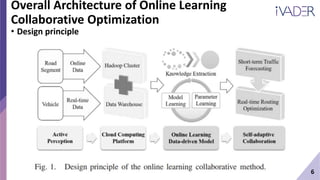
Overall Architecture of Online Learning
Collaborative Optimization
• Design principle
7
Overall Architecture of Online Learning
Collaborative Optimization
• Design principle
• [Step 1] Data Acquisition
 By leveraging IoT technologies
 Road segment: automatic number plate
recognition (ANPR) cameras
 Vehicle: preinstalled devices consist of
sensors, processors, and communication
modules.
8
Overall Architecture of Online Learning
Collaborative Optimization
• Design principle
• [Step 2] Data Analysis
 To store and analyze these data
 Hadoop Cluster: semi & unstructured data
 Data Warehouse: structured data
9
Overall Architecture of Online Learning
Collaborative Optimization
• Design principle
• [Step 3] Extract prior
knowledge from the
collected data
 Model Learning: based
on historical data
 Parameter learning:
based on online data
10
Overall Architecture of Online Learning
Collaborative Optimization
• Design principle
• [Step 4] Traffic diversion and vehicle navigation
 To combine short-term traffic forecasting and real-time routing optimization
11
Online Learning Data-Driven Model and
Collaborative Optimization Mechanism
• Overall
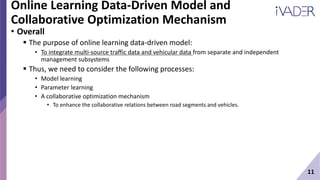
 The purpose of online learning data-driven model:
• To integrate multi-source traffic data and vehicular data from separate and independent
management subsystems
 Thus, we need to consider the following processes:
• Model learning
• Parameter learning
• A collaborative optimization mechanism
• To enhance the collaborative relations between road segments and vehicles.
12
Online Learning Data-Driven Model and
Collaborative Optimization Mechanism
• Model learning
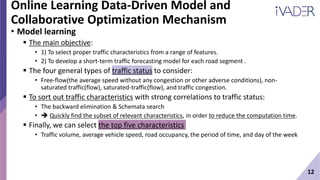
 The main objective:
• 1) To select proper traffic characteristics from a range of features.
• 2) To develop a short-term traffic forecasting model for each road segment .
 The four general types of traffic status to consider:
• Free-flow(the average speed without any congestion or other adverse conditions), non-
saturated traffic(flow), saturated-traffic(flow), and traffic congestion.
 To sort out traffic characteristics with strong correlations to traffic status:
• The backward elimination & Schemata search
•  Quickly find the subset of relevant characteristics, in order to reduce the computation time.
 Finally, we can select the top five characteristics
• Traffic volume, average vehicle speed, road occupancy, the period of time, and day of the week
13
Online Learning Data-Driven Model and
Collaborative Optimization Mechanism
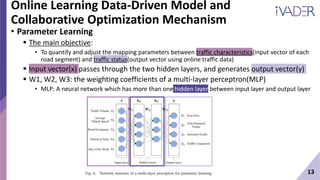
• Parameter Learning
 The main objective:
• To quantify and adjust the mapping parameters between traffic characteristics(input vector of each
road segment) and traffic status(output vector using online traffic data)
 Input vector(x) passes through the two hidden layers, and generates output vector(y)
 W1, W2, W3: the weighting coefficients of a multi-layer perceptron(MLP)
• MLP: A neural network which has more than one hidden layer between input layer and output layer
14
Online Learning Data-Driven Model and
Collaborative Optimization Mechanism
• Collaborative Optimization Mechanism
 The main objective:
• To enhance the collaborative relations between road segments and vehicles.
 By combining short-term traffic forecasting and real-time routing optimization
• KPIs: travel distance, travel time, and fuel consumption.
 [Step 1] Calculate the traffic status probability of each route.
 [Step 2] Implement the real-time routing optimization with the consideration of three KPIs.
 [Step 3] Generate a finite set of R of feasible routes and the optimal route for vehicles.
 [Step 4] Iterate the whole process  Iteratively update, store and suggest optimal route.
4
2
15
Case Study
• Proof of concept prototype system
 [Step 1] Data Collection and Aggregation
• Road segment  Online traffic data
• OBU, GPS tracker, ANPR camera  Real-time
vehicle data
 [Step 2] Data Analysis
• The collected data were uploaded to the cloud
computing platform.
 [Step 3] Prior knowledge extraction
• From the collected historical and online data.
• The online learning data-driven model with
model learning and parameter learning was
executed on the cloud computing platform.
 [Step 4] Optimal Route Result
• Generated and transmitted to vehicular cloud
clients such as mobile apps and web browsers.
Online
traffic data
4 1
1
2, 3
16
Case Study
• Experiment Setting
 Data:
• Annual data(2018), obtained from the Traffic Bureau of Shaanxi Province (5 minute intervals)
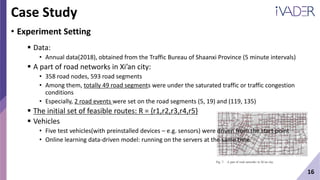
 A part of road networks in Xi’an city:
• 358 road nodes, 593 road segments
• Among them, totally 49 road segments were under the saturated traffic or traffic congestion
conditions
• Especially, 2 road events were set on the road segments (5, 19) and (119, 135)
 The initial set of feasible routes: R = {r1,r2,r3,r4,r5}
 Vehicles
• Five test vehicles(with preinstalled devices – e.g. sensors) were driven from the start point
• Online learning data-driven model: running on the servers at the same time
17
Case Study
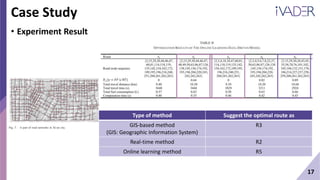
• Experiment Result
Type of method Suggest the optimal route as
GIS-based method
(GIS: Geographic Information System)
R3
Real-time method R2
Online learning method R5
18
Case Study
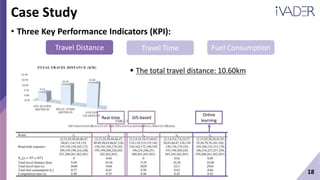
• Three Key Performance Indicators (KPI):
Travel Distance Travel Time Fuel Consumption
 The total travel distance: 10.60km
GIS-basedReal-time
Online
learning
19
Case Study
• Three Key Performance Indicators (KPI):
Travel Distance Travel Time Fuel Consumption
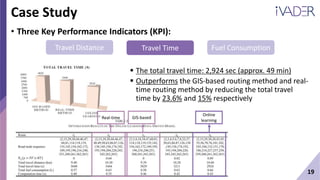
 The total travel time: 2,924 sec (approx. 49 min)
 Outperforms the GIS-based routing method and real-
time routing method by reducing the total travel
time by 23.6% and 15% respectively
GIS-basedReal-time
Online
learning
20
Case Study
• Three Key Performance Indicators (KPI):
Travel Distance Travel Time Fuel Consumption
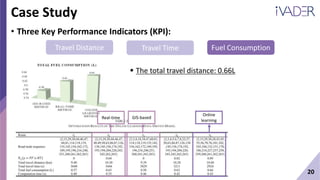
 The total travel distance: 0.66L
GIS-basedReal-time
Online
learning
21
Conclusion and Future Work
• The Main Contributions
 The design of a system architecture of online learning collaborative optimization
• To integrate separate and independent traffic monitoring subsystems and vehicles with
computational resources
 Traffic and vehicular data fusion and technologies integration
• To utilize an online traffic data extracted from road segments, and real-time vehicular data
extracted from vehicles
• To construct an online learning data-driven model including model learning and parameter
learning .
• To propose a collaborative optimization mechanism.
 A case study based on Xi’an city with a proof of concept prototype system
• To indicate that the proposed method is effective to reduce the travel time.
• To show the computation time used is reasonable in real-life applications.
22
Conclusion and Future Work
• Future Research
 Other types of models and methods for short-term traffic forecasting and real-time
routing optimization will be further explored.
 One of the most impressive parts of this paper is that the authors list up possible
problems in traffic domain (e.g. forecasting and routing problems) and think of an
integrated way to solve more than one problems at a time.
 I like the way the authors consider the actual (including both current and potential)
users. To represent their perspective, the authors show the experimental result with
a case study and illustrate how the model solves real-life problems.
201113 Hyeshin Chu

201113 Hyeshin Chu

  • 1.
    An Online Learning CollaborativeMethod for Traffic Forecasting and Routing Optimization Hyeshin Chu 2020. 11. 13 IEEE Transactions on Intelligent Transportation Systems 2020 Zhengang Gao, Yingfeng Zhang, Jingxiang Lv, Yang Liu, and Ying Liu
  • 2.
    Contents • Overview ofthe Paper • Background and Motivation • Overall Architecture of Online Learning Collaborative Optimization • Online Learning Data-Driven Model and Collaborative Optimization Mechanism • Case Study: Xi’an city • Conclusion and Future Work
  • 3.
    2 Overview of thePaper • Motivation  To solve urban traffic problems.  To integrate separate and independent traffic monitoring subsystems and vehicles with computational resources.  To enhance the self-adaptive collaboration between road segments and vehicles by combining short-term traffic forecasting and real-time routing optimization. • Main Contribution  To design a system architecture of online learning collaborative optimization.  To construct an online learning data-driven model.  To propose a collaborative optimization mechanism.  To conduct a case study based on Xi’an city with a proof of concept prototype system.
  • 4.
    3 Overview of thePaper • Index Terms  Collaborative Optimization • A design architecture specifically created for large-scale distributed-analysis applications. • To enhance interdisciplinary compatibility and the appropriate solution by a system-level coordination process. • To allow domain-specific issues to be accommodated by disciplinary analysts, while requiring interdisciplinary decisions to be reached by consensus. • To encourage easy interaction between different disciplines(teams), and automatic process.  Traffic Forecasting and Routing Optimization  Cyber-Physical Systems(CPS) • Integrations of computation and physical processes. • To emphasize an interaction between computing system and the physical world including all object around humans such as natural environment, vehicle, and houses. • To construct a collaborative relationship between each system object which observe, calculate and control physical phenomenon. RD Braun, “Collaborative optimization: An architecture for large-scale distributed design,” 1997. EA Lee, “Cyber physical systems: Design challenges,” ISORC. 2008.
  • 5.
    4 Background and Motivation •The worldwide fast-growing car ownership has adverse consequences of traffic problems in urban areas [1]  Traffic congestion: 8.8 billion hours of travel delay  Vehicle emissions and exhaust: 3.3 billion gallons of extra fuel consumption  Waste of resources: $166 billion for urban areas of the United States. • The advancement of Intelligent Transportation Systems (ITS) [2]  The Internet of Things (IoT) [3], [4]  Cloud Computing [5], [6]  Cyber-Physical Systems (CPS) [7], [8] • Few Research has been conducted for both forecasting and routing problems
  • 6.
    5 Background and Motivation •Research Questions  1. How to make an effective use of IoT technologies to collect and aggregate online and real-time data from road segments and vehicles for enhanced transparency and intelligence of urban traffic systems?  2. How to establish a CPS model with the integration of distributed physical entities and computational resources to depict real-time status and dynamic behavior of road segments and vehicles?  3. How to construct an online learning data-driven model to extract prior knowledge from historical and online traffic data and strengthen collaborative relations between road segments and vehicles?
  • 7.
    6 Overall Architecture ofOnline Learning Collaborative Optimization • Design principle
  • 8.
    7 Overall Architecture ofOnline Learning Collaborative Optimization • Design principle • [Step 1] Data Acquisition  By leveraging IoT technologies  Road segment: automatic number plate recognition (ANPR) cameras  Vehicle: preinstalled devices consist of sensors, processors, and communication modules.
  • 9.
    8 Overall Architecture ofOnline Learning Collaborative Optimization • Design principle • [Step 2] Data Analysis  To store and analyze these data  Hadoop Cluster: semi & unstructured data  Data Warehouse: structured data
  • 10.
    9 Overall Architecture ofOnline Learning Collaborative Optimization • Design principle • [Step 3] Extract prior knowledge from the collected data  Model Learning: based on historical data  Parameter learning: based on online data
  • 11.
    10 Overall Architecture ofOnline Learning Collaborative Optimization • Design principle • [Step 4] Traffic diversion and vehicle navigation  To combine short-term traffic forecasting and real-time routing optimization
  • 12.
    11 Online Learning Data-DrivenModel and Collaborative Optimization Mechanism • Overall  The purpose of online learning data-driven model: • To integrate multi-source traffic data and vehicular data from separate and independent management subsystems  Thus, we need to consider the following processes: • Model learning • Parameter learning • A collaborative optimization mechanism • To enhance the collaborative relations between road segments and vehicles.
  • 13.
    12 Online Learning Data-DrivenModel and Collaborative Optimization Mechanism • Model learning  The main objective: • 1) To select proper traffic characteristics from a range of features. • 2) To develop a short-term traffic forecasting model for each road segment .  The four general types of traffic status to consider: • Free-flow(the average speed without any congestion or other adverse conditions), non- saturated traffic(flow), saturated-traffic(flow), and traffic congestion.  To sort out traffic characteristics with strong correlations to traffic status: • The backward elimination & Schemata search •  Quickly find the subset of relevant characteristics, in order to reduce the computation time.  Finally, we can select the top five characteristics • Traffic volume, average vehicle speed, road occupancy, the period of time, and day of the week
  • 14.
    13 Online Learning Data-DrivenModel and Collaborative Optimization Mechanism • Parameter Learning  The main objective: • To quantify and adjust the mapping parameters between traffic characteristics(input vector of each road segment) and traffic status(output vector using online traffic data)  Input vector(x) passes through the two hidden layers, and generates output vector(y)  W1, W2, W3: the weighting coefficients of a multi-layer perceptron(MLP) • MLP: A neural network which has more than one hidden layer between input layer and output layer
  • 15.
    14 Online Learning Data-DrivenModel and Collaborative Optimization Mechanism • Collaborative Optimization Mechanism  The main objective: • To enhance the collaborative relations between road segments and vehicles.  By combining short-term traffic forecasting and real-time routing optimization • KPIs: travel distance, travel time, and fuel consumption.  [Step 1] Calculate the traffic status probability of each route.  [Step 2] Implement the real-time routing optimization with the consideration of three KPIs.  [Step 3] Generate a finite set of R of feasible routes and the optimal route for vehicles.  [Step 4] Iterate the whole process  Iteratively update, store and suggest optimal route. 4 2
  • 16.
    15 Case Study • Proofof concept prototype system  [Step 1] Data Collection and Aggregation • Road segment  Online traffic data • OBU, GPS tracker, ANPR camera  Real-time vehicle data  [Step 2] Data Analysis • The collected data were uploaded to the cloud computing platform.  [Step 3] Prior knowledge extraction • From the collected historical and online data. • The online learning data-driven model with model learning and parameter learning was executed on the cloud computing platform.  [Step 4] Optimal Route Result • Generated and transmitted to vehicular cloud clients such as mobile apps and web browsers. Online traffic data 4 1 1 2, 3
  • 17.
    16 Case Study • ExperimentSetting  Data: • Annual data(2018), obtained from the Traffic Bureau of Shaanxi Province (5 minute intervals)  A part of road networks in Xi’an city: • 358 road nodes, 593 road segments • Among them, totally 49 road segments were under the saturated traffic or traffic congestion conditions • Especially, 2 road events were set on the road segments (5, 19) and (119, 135)  The initial set of feasible routes: R = {r1,r2,r3,r4,r5}  Vehicles • Five test vehicles(with preinstalled devices – e.g. sensors) were driven from the start point • Online learning data-driven model: running on the servers at the same time
  • 18.
    17 Case Study • ExperimentResult Type of method Suggest the optimal route as GIS-based method (GIS: Geographic Information System) R3 Real-time method R2 Online learning method R5
  • 19.
    18 Case Study • ThreeKey Performance Indicators (KPI): Travel Distance Travel Time Fuel Consumption  The total travel distance: 10.60km GIS-basedReal-time Online learning
  • 20.
    19 Case Study • ThreeKey Performance Indicators (KPI): Travel Distance Travel Time Fuel Consumption  The total travel time: 2,924 sec (approx. 49 min)  Outperforms the GIS-based routing method and real- time routing method by reducing the total travel time by 23.6% and 15% respectively GIS-basedReal-time Online learning
  • 21.
    20 Case Study • ThreeKey Performance Indicators (KPI): Travel Distance Travel Time Fuel Consumption  The total travel distance: 0.66L GIS-basedReal-time Online learning
  • 22.
    21 Conclusion and FutureWork • The Main Contributions  The design of a system architecture of online learning collaborative optimization • To integrate separate and independent traffic monitoring subsystems and vehicles with computational resources  Traffic and vehicular data fusion and technologies integration • To utilize an online traffic data extracted from road segments, and real-time vehicular data extracted from vehicles • To construct an online learning data-driven model including model learning and parameter learning . • To propose a collaborative optimization mechanism.  A case study based on Xi’an city with a proof of concept prototype system • To indicate that the proposed method is effective to reduce the travel time. • To show the computation time used is reasonable in real-life applications.
  • 23.
    22 Conclusion and FutureWork • Future Research  Other types of models and methods for short-term traffic forecasting and real-time routing optimization will be further explored.  One of the most impressive parts of this paper is that the authors list up possible problems in traffic domain (e.g. forecasting and routing problems) and think of an integrated way to solve more than one problems at a time.  I like the way the authors consider the actual (including both current and potential) users. To represent their perspective, the authors show the experimental result with a case study and illustrate how the model solves real-life problems.