Overview of the European
Research Group on Mobile
Emission Sources (ERMES)

European Commission
DG Joint Research Centre
Institute for Energy and Transport
The ERMES Group
“European Research group on Mobile Emission Sources”
• European network that brings together transport emission
modellers and researchers, funding agencies, industry
representatives and other stakeholders
• Coordinated and partly funded by JRC
• Primary interface between modellers and EC
• First focus on road transport, others to follow
Aims of ERMES
• to become a permanent network of mobile emission
modellers and model users
• to coordinate research and measurement
programmes for the improvement of transport emission
inventories in Europe
• to become an international reference point for mobile
emissions modelling and related topics in Europe
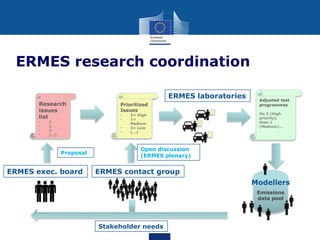
ERMES research coordination
ERMES laboratories
Research
issues
list
•
•
•
•

1
2
3
(...)

Prioritized
Issues
•
•

•
•

Proposal

ERMES exec. board

2= High
1=
Medium
3= Low
(...)

Adjusted test
programmes
Do 2 (High
priority),
then 1
(Medium)...

Open discussion
(ERMES plenary)

ERMES contact group
Modellers
Emissions
data pool

Stakeholder needs
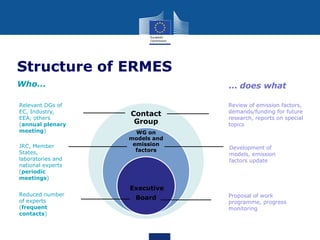
Structure of ERMES
Who...
Relevant DGs of
EC, Industry,
EEA, others
(annual plenary
meeting)
JRC, Member
States,
laboratories and
national experts
(periodic
meetings)
Reduced number
of experts
(frequent
contacts)

... does what
Contact
Group
WG on
models and
emission
factors

Review of emission factors,
demands/funding for future
research, reports on special
topics

Development of
models, emission
factors update

Executive
Board

Proposal of work
programme, progress
monitoring
ERMES executive board
M. Cristina Galassi

maria-cristina.galassi@ec.europa.eu

Stefan Hausberger
Mario Keller

- mario.keller@infras.ch

Leon Ntziachristos
Ake Sjodin

- Hausberger@ivt.tugraz.at

- leon@auth.gr

- ake.sjodin@ivl.se)

Norbert Ligterink

Heinz Steven

- norbert.ligterink (at) tno.nl

- Heinz.Steven@t-online.de
ERMES main focus
ERMES coordinates the research work and emissions
measurement programmes needed for the update of vehicle
emission models
•

Maintenance updates: needed to improve the coverage of newer vehicle
technologies (e.g. EURO 5/6 V/VI)

•

Methodological improvements: models are subject to periodic reviews
(e.g. evaporative emissions estimation methodology)

•

Long-term technological changes and environmental target monitoring
(e.g. alternative fuels, real-world CO2 emissions)
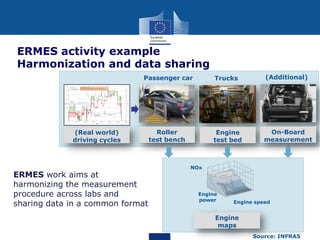
ERMES activity example
Harmonization and data sharing
Passenger car

Trucks

(Additional)

Roller
test bench

Engine
test bed

On-Board
measurement
s

(Real world)
driving cycles

ERMES work aims at
harmonizing the measurement
procedure across labs and
sharing data in a common format

NOx

Engine
power

Engine speed

Engine
maps
Source: INFRAS
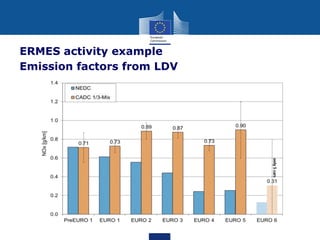
ERMES activity example
Emission factors from LDV
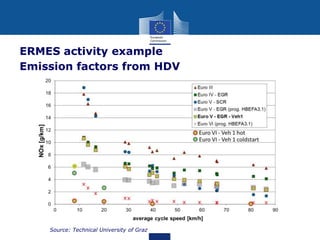
ERMES activity example
Emission factors from HDV

Source: Technical University of Graz
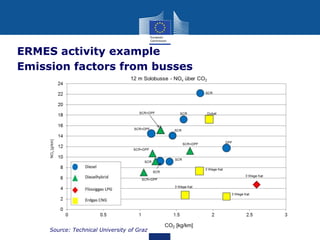
ERMES activity example
Emission factors from busses

Source: Technical University of Graz
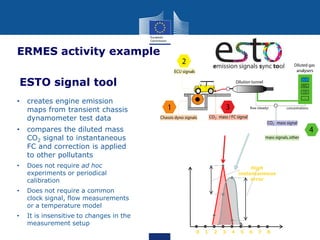
ERMES activity example
ESTO signal tool
•

creates engine emission
maps from transient chassis
dynamometer test data

•

compares the diluted mass
CO2 signal to instantaneous
FC and correction is applied
to other pollutants

•

Does not require ad hoc
experiments or periodical
calibration

•

Does not require a common
clock signal, flow measurements
or a temperature model

•

It is insensitive to changes in the
measurement setup

High
instantaneous
error

0

1

2

3

4

5

6

7

8
ERMES activity example
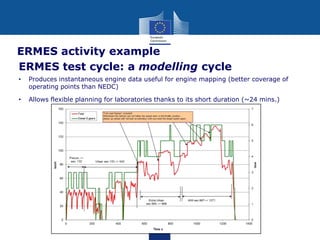
ERMES test cycle: a modelling cycle
•

Produces instantaneous engine data useful for engine mapping (better coverage of
operating points than NEDC)

•

Allows flexible planning for laboratories thanks to its short duration (~24 mins.)
Vehicle emission models
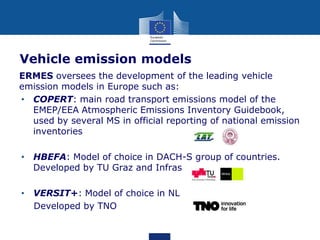
ERMES oversees the development of the leading vehicle
emission models in Europe such as:
• COPERT: main road transport emissions model of the
EMEP/EEA Atmospheric Emissions Inventory Guidebook,
used by several MS in official reporting of national emission
inventories
• HBEFA: Model of choice in DACH-S group of countries.
Developed by TU Graz and Infras
• VERSIT+: Model of choice in NL
Developed by TNO
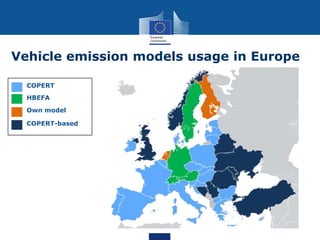
Vehicle emission models usage in Europe
COPERT
HBEFA
Own model
COPERT-based
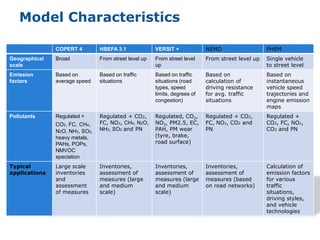
Model Characteristics
COPERT 4

HBEFA 3.1

VERSIT +

NEMO

PHEM

Geographical
scale

Broad

From street level up

From street level
up

From street level up

Single vehicle
to street level

Emission
factors

Based on
average speed

Based on traffic
situations

Based on traffic
situations (road
types, speed
limits, degrees of
congestion)

Based on
calculation of
driving resistance
for avg. traffic
situations

Based on
instantaneous
vehicle speed
trajectories and
engine emission
maps

Pollutants

Regulated +

Regulated + CO2,
FC, NO2, CH4, N2O,
NH3, SO2 and PN

Regulated, CO2,
NO2, PM2.5, EC,
PAH, PM wear
(tyre, brake,
road surface)

Regulated + CO2,
FC, NO2, CO2 and
PN

Regulated +
CO2, FC, NO2,
CO2 and PN

Inventories,
assessment of
measures (large
and medium
scale)

Inventories,
assessment of
measures (large
and medium
scale)

Inventories,
assessment of
measures (based
on road networks)

Calculation of
emission factors
for various
traffic
situations,
driving styles,
and vehicle
technologies

CO2, FC, CH4,
N2O, NH3, SO2,
heavy metals,
PAHs, POPs,
NMVOC
speciation
Typical
applications

Large scale
inventories
and
assessment
of measures
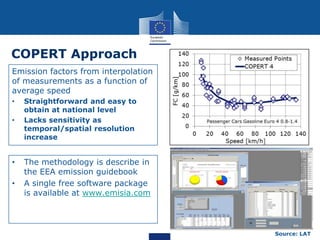
COPERT Approach
Emission factors from interpolation
of measurements as a function of
average speed
•
•

•
•

Straightforward and easy to
obtain at national level
Lacks sensitivity as
temporal/spatial resolution
increase

The methodology is describe in
the EEA emission guidebook
A single free software package
is available at www.emisia.com

Source: LAT
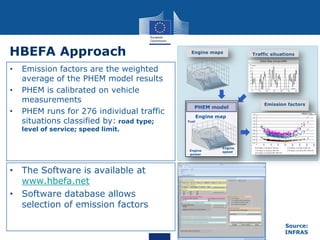
HBEFA Approach
•
•
•

Emission factors are the weighted
average of the PHEM model results
PHEM is calibrated on vehicle
measurements
PHEM runs for 276 individual traffic
situations classified by: road type;

Engine maps

PHEM model

Traffic situations

Emission factors

Engine map
Fuel

level of service; speed limit.

Engine
power

Engine
speed

• The Software is available at
www.hbefa.net
• Software database allows
selection of emission factors
Source:
INFRAS
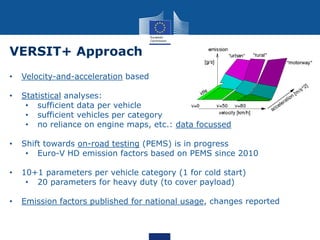
VERSIT+ Approach
•

Velocity-and-acceleration based

•

Statistical analyses:
• sufficient data per vehicle
• sufficient vehicles per category
• no reliance on engine maps, etc.: data focussed

•

Shift towards on-road testing (PEMS) is in progress
• Euro-V HD emission factors based on PEMS since 2010

•

10+1 parameters per vehicle category (1 for cold start)
• 20 parameters for heavy duty (to cover payload)

•

Emission factors published for national usage, changes reported
Share your activities
Join the ERMES group
www.ermes-group.eu

Ermes-group presentation

  • 1.
    Overview of theEuropean Research Group on Mobile Emission Sources (ERMES) European Commission DG Joint Research Centre Institute for Energy and Transport
  • 2.
    The ERMES Group “EuropeanResearch group on Mobile Emission Sources” • European network that brings together transport emission modellers and researchers, funding agencies, industry representatives and other stakeholders • Coordinated and partly funded by JRC • Primary interface between modellers and EC • First focus on road transport, others to follow
  • 3.
    Aims of ERMES •to become a permanent network of mobile emission modellers and model users • to coordinate research and measurement programmes for the improvement of transport emission inventories in Europe • to become an international reference point for mobile emissions modelling and related topics in Europe
  • 4.
    ERMES research coordination ERMESlaboratories Research issues list • • • • 1 2 3 (...) Prioritized Issues • • • • Proposal ERMES exec. board 2= High 1= Medium 3= Low (...) Adjusted test programmes Do 2 (High priority), then 1 (Medium)... Open discussion (ERMES plenary) ERMES contact group Modellers Emissions data pool Stakeholder needs
  • 5.
    Structure of ERMES Who... RelevantDGs of EC, Industry, EEA, others (annual plenary meeting) JRC, Member States, laboratories and national experts (periodic meetings) Reduced number of experts (frequent contacts) ... does what Contact Group WG on models and emission factors Review of emission factors, demands/funding for future research, reports on special topics Development of models, emission factors update Executive Board Proposal of work programme, progress monitoring
  • 6.
    ERMES executive board M.Cristina Galassi maria-cristina.galassi@ec.europa.eu Stefan Hausberger Mario Keller - mario.keller@infras.ch Leon Ntziachristos Ake Sjodin - Hausberger@ivt.tugraz.at - leon@auth.gr - ake.sjodin@ivl.se) Norbert Ligterink Heinz Steven - norbert.ligterink (at) tno.nl - Heinz.Steven@t-online.de
  • 7.
    ERMES main focus ERMEScoordinates the research work and emissions measurement programmes needed for the update of vehicle emission models • Maintenance updates: needed to improve the coverage of newer vehicle technologies (e.g. EURO 5/6 V/VI) • Methodological improvements: models are subject to periodic reviews (e.g. evaporative emissions estimation methodology) • Long-term technological changes and environmental target monitoring (e.g. alternative fuels, real-world CO2 emissions)
  • 8.
    ERMES activity example Harmonizationand data sharing Passenger car Trucks (Additional) Roller test bench Engine test bed On-Board measurement s (Real world) driving cycles ERMES work aims at harmonizing the measurement procedure across labs and sharing data in a common format NOx Engine power Engine speed Engine maps Source: INFRAS
  • 9.
  • 10.
    ERMES activity example Emissionfactors from HDV Source: Technical University of Graz
  • 11.
    ERMES activity example Emissionfactors from busses Source: Technical University of Graz
  • 12.
    ERMES activity example ESTOsignal tool • creates engine emission maps from transient chassis dynamometer test data • compares the diluted mass CO2 signal to instantaneous FC and correction is applied to other pollutants • Does not require ad hoc experiments or periodical calibration • Does not require a common clock signal, flow measurements or a temperature model • It is insensitive to changes in the measurement setup High instantaneous error 0 1 2 3 4 5 6 7 8
  • 13.
    ERMES activity example ERMEStest cycle: a modelling cycle • Produces instantaneous engine data useful for engine mapping (better coverage of operating points than NEDC) • Allows flexible planning for laboratories thanks to its short duration (~24 mins.)
  • 14.
    Vehicle emission models ERMESoversees the development of the leading vehicle emission models in Europe such as: • COPERT: main road transport emissions model of the EMEP/EEA Atmospheric Emissions Inventory Guidebook, used by several MS in official reporting of national emission inventories • HBEFA: Model of choice in DACH-S group of countries. Developed by TU Graz and Infras • VERSIT+: Model of choice in NL Developed by TNO
  • 15.
    Vehicle emission modelsusage in Europe COPERT HBEFA Own model COPERT-based
  • 16.
    Model Characteristics COPERT 4 HBEFA3.1 VERSIT + NEMO PHEM Geographical scale Broad From street level up From street level up From street level up Single vehicle to street level Emission factors Based on average speed Based on traffic situations Based on traffic situations (road types, speed limits, degrees of congestion) Based on calculation of driving resistance for avg. traffic situations Based on instantaneous vehicle speed trajectories and engine emission maps Pollutants Regulated + Regulated + CO2, FC, NO2, CH4, N2O, NH3, SO2 and PN Regulated, CO2, NO2, PM2.5, EC, PAH, PM wear (tyre, brake, road surface) Regulated + CO2, FC, NO2, CO2 and PN Regulated + CO2, FC, NO2, CO2 and PN Inventories, assessment of measures (large and medium scale) Inventories, assessment of measures (large and medium scale) Inventories, assessment of measures (based on road networks) Calculation of emission factors for various traffic situations, driving styles, and vehicle technologies CO2, FC, CH4, N2O, NH3, SO2, heavy metals, PAHs, POPs, NMVOC speciation Typical applications Large scale inventories and assessment of measures
  • 17.
    COPERT Approach Emission factorsfrom interpolation of measurements as a function of average speed • • • • Straightforward and easy to obtain at national level Lacks sensitivity as temporal/spatial resolution increase The methodology is describe in the EEA emission guidebook A single free software package is available at www.emisia.com Source: LAT
  • 18.
    HBEFA Approach • • • Emission factorsare the weighted average of the PHEM model results PHEM is calibrated on vehicle measurements PHEM runs for 276 individual traffic situations classified by: road type; Engine maps PHEM model Traffic situations Emission factors Engine map Fuel level of service; speed limit. Engine power Engine speed • The Software is available at www.hbefa.net • Software database allows selection of emission factors Source: INFRAS
  • 19.
    VERSIT+ Approach • Velocity-and-acceleration based • Statisticalanalyses: • sufficient data per vehicle • sufficient vehicles per category • no reliance on engine maps, etc.: data focussed • Shift towards on-road testing (PEMS) is in progress • Euro-V HD emission factors based on PEMS since 2010 • 10+1 parameters per vehicle category (1 for cold start) • 20 parameters for heavy duty (to cover payload) • Emission factors published for national usage, changes reported
  • 20.
    Share your activities Jointhe ERMES group www.ermes-group.eu

Editor's Notes