Later Byzantine Art
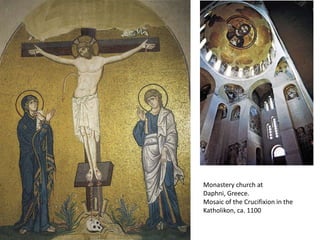
Monastery church at Daphni, Greece.Mosaic of the Crucifixion in the Katholikon, ca. 1100
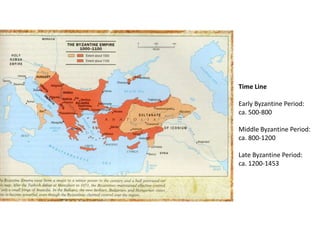
Time LineEarly Byzantine Period: ca. 500-800Middle Byzantine Period: ca. 800-1200Late Byzantine Period: ca. 1200-1453
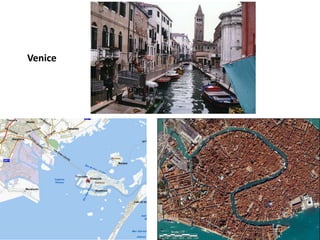
Venice
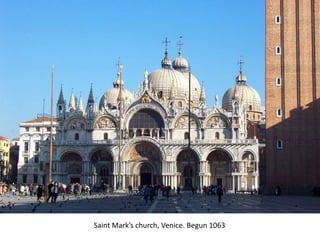
Saint Mark’s church, Venice. Begun 1063
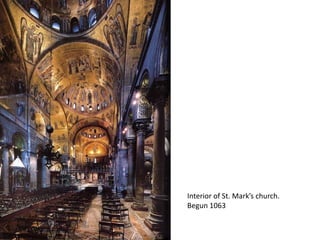
Interior of St. Mark’s church. Begun 1063
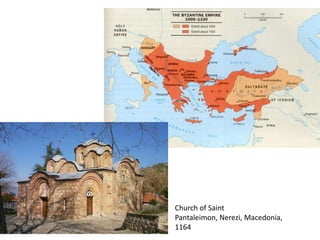
Church of Saint Pantaleimon, Nerezi, Macedonia, 1164
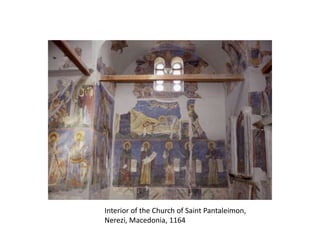
Interior of the Church of Saint Pantaleimon, Nerezi, Macedonia, 1164
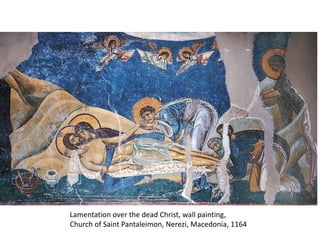
Lamentation over the dead Christ, wall painting, Church of Saint Pantaleimon, Nerezi, Macedonia, 1164
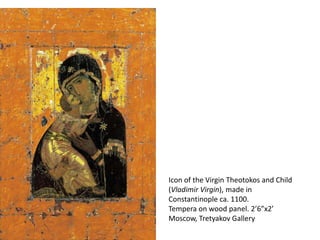
Icon of the Virgin Theotokos and Child (Vladimir Virgin), made in Constantinople ca. 1100. Tempera on wood panel. 2’6”x2’Moscow, Tretyakov Gallery
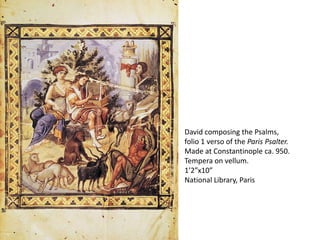
David composing the Psalms, folio 1 verso of the Paris Psalter. Made at Constantinople ca. 950. Tempera on vellum.1’2”x10”National Library, Paris
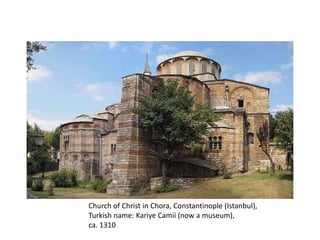
Church of Christ in Chora, Constantinople (Istanbul), Turkish name: KariyeCamii (now a museum),ca. 1310
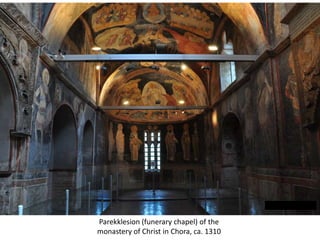
Parekklesion (funerary chapel) of the monastery of Christ in Chora, ca. 1310
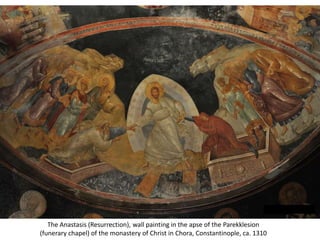
The Anastasis (Resurrection), wall painting in the apse of the Parekklesion (funerary chapel) of the monastery of Christ in Chora, Constantinople, ca. 1310

2011 survey late_byzantium

Editor's Notes

  • #4 There is military and economic dominance of the city of Venice at this time – and there is a need to display this dominance through art at this time.
  • #5 The city became a main settlement around the 9th century – this has to do with the rise in the populaiton of the area – this was the period of Gothic invasion, and many sought refuge here. It was popular at the time to associate a city with a patron saint. Venice did not have one until 829 until a trade expedition was made to Egypt and the relics of St. Mark were discovered, and brought back to Venice where a church was erected in his honor – he became the patron saint of the city.
  • #6 Dedicated in honor to his patron saint – the people of Venice looked to Constantine’s architecture to build St. Mark’s church.
  • #7 A row of three domes in the center. This keeps with traditions of Byzantine art, but on a much larger scale. This shows the influence that Byzantine art on Venice.
  • #8 Other churches are much more downscaled than St. Marks – there is not as much money for finance large buildings of churches. There is centralized architecture – ideal of public liturgy. Exterior is usually plain, with intricacy on the interior. Mosaics were less used, and paintings were preferred at this time because they were less expesive.
  • #9 The style refers back to more naturalism – due to the fact that the preferred style is fresco wall painting. The figures are set in a brilliant blue background that still attempts to keep with the reduction in a naturalistic landscape.
  • #10 Shows the image of Christ after he was taken down from the cross, and the lamentation process that occurs afterward. There is more of a theological influence, and much more emotion is being displayed.
  • #11 One of the most famous icons that is from this period. Reflect the use that these items were put through – carried around, took from place to place. Used in processions during the liturgy, and when they were set up for lamentation, they would have candles set up before them. Reflects the sorrow of Mary in what suffering her son will go through in the future. The gold garments represents a more stylized version of art.
  • #12 Religions manuscript – contains images from the book of psalms. The images do not entirely show the events of the pslams. Depicts David, and a female figure shown in classical dress and posed in a classical manner. Musical qualities – David is playing a harp. Shows an Old Testament figure in a New Testament context. Manuscripts were the most expensive of decoration.
  • #13 Buildings remain in smaller scale – this is one of the more important monasteries – Chora was an aristocratic neighborhood in Constantinople.
  • #14 Identified as a tomb for an aristocratic donor, reserves original decoratons – used to commemorate the dead.
  • #15 References the fact of Christ’s ressurection and his decent into the realm of Satan where he tramples him. He dramatically pulls figures out of purgatory. He is usually shown pulling the figures of Adam and Eve. Figures shown are old testament kings, wearing crown. A new dynamic era of art. The background is kept dark, somber