ELECTROPHORESIS
GROUP NO 2
1. Attiqa Irshad
2. JAVERIA ASIF
3. SIDRA KHAN SHAHID
4. JOWARIA WAJIH
5. FARINA FARUQUI
6. NEELAM
7. FARHEEN JAVED
8. HADIQA
9. ANAM
ELECTROPHORESIS
Electrophoresis :The term electrophoresis comes from the Greek means ,”transport by
electricity”.
In 1807,a Russian Physicist, Alexander Rauss observed a novel phenomenon- when
electricity was passed through a glass tube containing water and clay ,colloidal
particles moved towards the positive electrode when applied electric field.
DEFINITION:
Electrophoresis describes the migration of charged particles under the
influence of electric field.
PURPOSE FOR CARRYING OUT ELECTROPHORESIS:
1.To determine the number ,amount and mobility of compounds in given sample or to
separate them.
2.To obtain information about the electrical double layers surrounding the particles.
3.Determination of molecular weight of proteins and DNA sequencing.
PRINCIPLE
Any charged ion or molecule migrates when placed in an electric field .The rate of
migration depend upon its net charge ,size , shape and the applied electric
current.
EQUATION: It can be expressed as;
v=E q/f
v=velocity of migration of the molecule
E=electric field in volts per cm
q=net electric charge on the molecule.
f=frictional coefficient.
The movement of charged particle in an electric field is expressed in terms of
electrophoretic mobility denoted by u where,
u=v/E OR
u=q/f
Electrophoretic mobility (u)of a molecule is directly proportional to charge density
(charge/mass ratio).
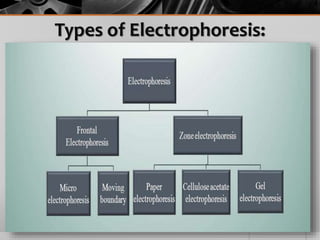
Types of Electrophoresis:
Factors affecting Electrophoresis Mobility
 Charge : The higher the charge , greater is the
electrophoresis mobility. The charge is dependent on pH of the
medium.
 Size : The bigger molecules have a small electrophoretic
mobility compared to the smaller particles.
 Shape : The globular protein will migrate fatser than the
fibrous protein.
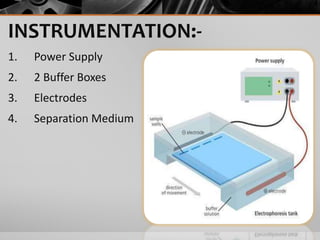
INSTRUMENTATION:-
1. Power Supply
2. 2 Buffer Boxes
3. Electrodes
4. Separation Medium
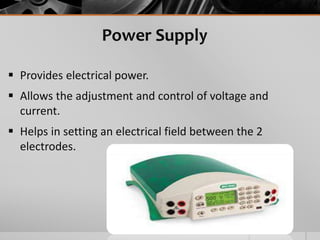
Power Supply
 Provides electrical power.
 Allows the adjustment and control of voltage and
current.
 Helps in setting an electrical field between the 2
electrodes.
Buffer :-
Gave multiple functions:-
 Carries the applied current.
 Maintains the pH.
 Determine the electrical charge on solute.
Example: Tris Acetate- EDTA(TAE) for nucleic acid
and DNA.
Tri-borate- EDTA(TBE) for DNA.
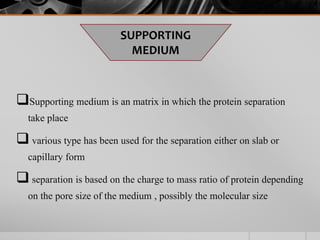
Supporting medium is an matrix in which the protein separation
take place
 various type has been used for the separation either on slab or
capillary form
 separation is based on the charge to mass ratio of protein depending
on the pore size of the medium , possibly the molecular size
SUPPORTING
MEDIUM
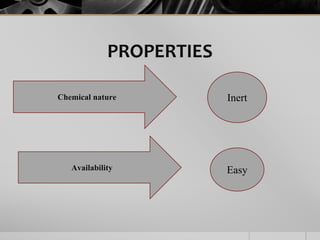
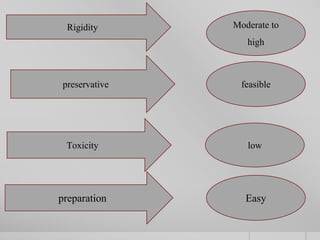
Chemical nature Inert
Availability Easy
PROPERTIES
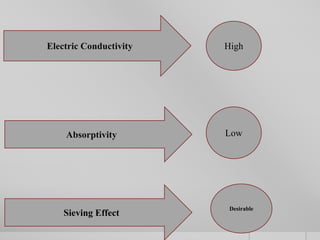
Electric Conductivity High
Absorptivity Low
Sieving Effect Desirable
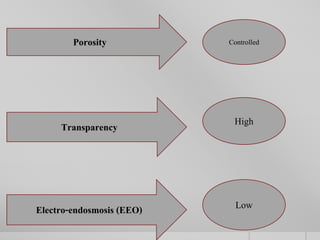
Porosity
Transparency
Electro-endosmosis (EEO)
Controlled
High
Low
Rigidity
preservative
Toxicity
Moderate to
high
feasible
low
preparation Easy
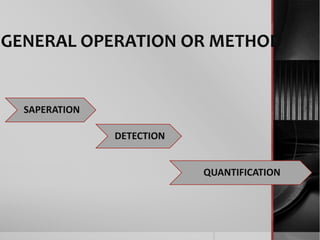
GENERAL OPERATION OR METHOD
SAPERATION
DETECTION
QUANTIFICATION
GEL ELECTROPHORESIS
KEY POINTS:
 Gel electrophoresis is a laboratory method used to separate
mixtures of DNA, RNA, or proteins according to molecular size.
 In gel electrophoresis, the molecules to be separated are
pushed by an electrical field through a gel that contains small
pores.
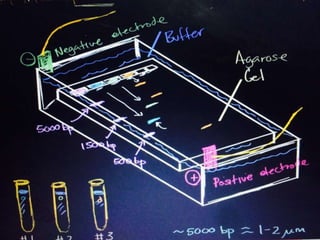
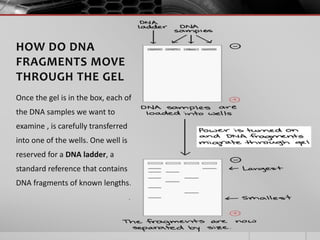
HOW DO DNA
FRAGMENTS MOVE
THROUGH THE GEL
Once the gel is in the box, each of
the DNA samples we want to
examine , is carefully transferred
into one of the wells. One well is
reserved for a DNA ladder, a
standard reference that contains
DNA fragments of known lengths.
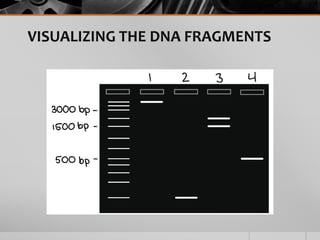
VISUALIZING THE DNA FRAGMENTS
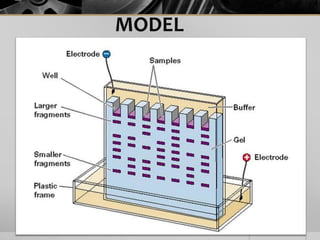
MODEL
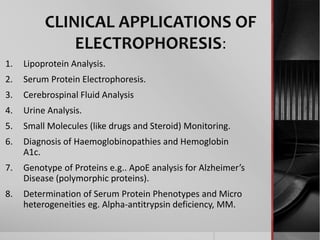
CLINICAL APPLICATIONS OF
ELECTROPHORESIS:
1. Lipoprotein Analysis.
2. Serum Protein Electrophoresis.
3. Cerebrospinal Fluid Analysis
4. Urine Analysis.
5. Small Molecules (like drugs and Steroid) Monitoring.
6. Diagnosis of Haemoglobinopathies and Hemoglobin
A1c.
7. Genotype of Proteins e.g.. ApoE analysis for Alzheimer’s
Disease (polymorphic proteins).
8. Determination of Serum Protein Phenotypes and Micro
heterogeneities eg. Alpha-antitrypsin deficiency, MM.
Technical Considerations
During operation of electrophoresis four
point must be considered:
Buffers
Sample
Stain Solution
ELECTROENDOSMOSIS
Technical Consideration
Buffer
 Should be in minor amount.
 After every cycle should change
buffer coz ph Altered due to
electrolysis of liquids.
 Should be used after cooler.
Sample
 Appropriate amount of sample is
used
 Avoid overloading
 Diluted serum uses
Technical Considerations
STAIN SOLUTION
 Specific dye is used
 Inhibit vaporization
ELECTROENDOSMOSIS
 Ionic cloud is mobile
 Positive ion moves towards cathode.
 Surface gel is negatively charged and should
be immobile.
 Macromolecules are strongly charged and
can alter the flow in opposite direction.
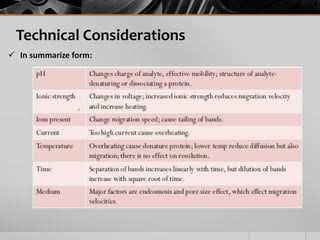
Technical Considerations
 In summarize form:

Electrophoresis

  • 1.
    ELECTROPHORESIS GROUP NO 2 1.Attiqa Irshad 2. JAVERIA ASIF 3. SIDRA KHAN SHAHID 4. JOWARIA WAJIH 5. FARINA FARUQUI 6. NEELAM 7. FARHEEN JAVED 8. HADIQA 9. ANAM
  • 2.
    ELECTROPHORESIS Electrophoresis :The termelectrophoresis comes from the Greek means ,”transport by electricity”. In 1807,a Russian Physicist, Alexander Rauss observed a novel phenomenon- when electricity was passed through a glass tube containing water and clay ,colloidal particles moved towards the positive electrode when applied electric field. DEFINITION: Electrophoresis describes the migration of charged particles under the influence of electric field. PURPOSE FOR CARRYING OUT ELECTROPHORESIS: 1.To determine the number ,amount and mobility of compounds in given sample or to separate them. 2.To obtain information about the electrical double layers surrounding the particles. 3.Determination of molecular weight of proteins and DNA sequencing.
  • 3.
    PRINCIPLE Any charged ionor molecule migrates when placed in an electric field .The rate of migration depend upon its net charge ,size , shape and the applied electric current. EQUATION: It can be expressed as; v=E q/f v=velocity of migration of the molecule E=electric field in volts per cm q=net electric charge on the molecule. f=frictional coefficient. The movement of charged particle in an electric field is expressed in terms of electrophoretic mobility denoted by u where, u=v/E OR u=q/f Electrophoretic mobility (u)of a molecule is directly proportional to charge density (charge/mass ratio).
  • 4.
  • 5.
    Factors affecting ElectrophoresisMobility  Charge : The higher the charge , greater is the electrophoresis mobility. The charge is dependent on pH of the medium.  Size : The bigger molecules have a small electrophoretic mobility compared to the smaller particles.  Shape : The globular protein will migrate fatser than the fibrous protein.
  • 6.
    INSTRUMENTATION:- 1. Power Supply 2.2 Buffer Boxes 3. Electrodes 4. Separation Medium
  • 7.
    Power Supply  Provideselectrical power.  Allows the adjustment and control of voltage and current.  Helps in setting an electrical field between the 2 electrodes.
  • 8.
    Buffer :- Gave multiplefunctions:-  Carries the applied current.  Maintains the pH.  Determine the electrical charge on solute. Example: Tris Acetate- EDTA(TAE) for nucleic acid and DNA. Tri-borate- EDTA(TBE) for DNA.
  • 9.
    Supporting medium isan matrix in which the protein separation take place  various type has been used for the separation either on slab or capillary form  separation is based on the charge to mass ratio of protein depending on the pore size of the medium , possibly the molecular size SUPPORTING MEDIUM
  • 10.
  • 11.
    Electric Conductivity High AbsorptivityLow Sieving Effect Desirable
  • 12.
  • 13.
  • 14.
    GENERAL OPERATION ORMETHOD SAPERATION DETECTION QUANTIFICATION
  • 15.
    GEL ELECTROPHORESIS KEY POINTS: Gel electrophoresis is a laboratory method used to separate mixtures of DNA, RNA, or proteins according to molecular size.  In gel electrophoresis, the molecules to be separated are pushed by an electrical field through a gel that contains small pores.
  • 17.
    HOW DO DNA FRAGMENTSMOVE THROUGH THE GEL Once the gel is in the box, each of the DNA samples we want to examine , is carefully transferred into one of the wells. One well is reserved for a DNA ladder, a standard reference that contains DNA fragments of known lengths.
  • 18.
  • 19.
  • 20.
    CLINICAL APPLICATIONS OF ELECTROPHORESIS: 1.Lipoprotein Analysis. 2. Serum Protein Electrophoresis. 3. Cerebrospinal Fluid Analysis 4. Urine Analysis. 5. Small Molecules (like drugs and Steroid) Monitoring. 6. Diagnosis of Haemoglobinopathies and Hemoglobin A1c. 7. Genotype of Proteins e.g.. ApoE analysis for Alzheimer’s Disease (polymorphic proteins). 8. Determination of Serum Protein Phenotypes and Micro heterogeneities eg. Alpha-antitrypsin deficiency, MM.
  • 21.
    Technical Considerations During operationof electrophoresis four point must be considered: Buffers Sample Stain Solution ELECTROENDOSMOSIS
  • 22.
    Technical Consideration Buffer  Shouldbe in minor amount.  After every cycle should change buffer coz ph Altered due to electrolysis of liquids.  Should be used after cooler. Sample  Appropriate amount of sample is used  Avoid overloading  Diluted serum uses
  • 23.
    Technical Considerations STAIN SOLUTION Specific dye is used  Inhibit vaporization ELECTROENDOSMOSIS  Ionic cloud is mobile  Positive ion moves towards cathode.  Surface gel is negatively charged and should be immobile.  Macromolecules are strongly charged and can alter the flow in opposite direction.
  • 24.