EXPLORING EFFECTIVE STRATEGIES FOR COMMUNICATING WITH CROSS-
GENERATIONAL ALUMNI OF PRIVATE COLLEGES
Research Study
EXPLORING EFFECTIVE STRATEGIES FOR
COMMUNICATING WITH CROSS-GENERATIONAL
ALUMNI OF PRIVATE COLLEGES.
December 9, 2015
Kristi Ellstrom
University of Nebraska-Lincoln, College of Journalism and Mass
Communication
Lacie Westcott
University of Nebraska-Lincoln, College of Journalism and Mass
Communication
Mikaela Yeager
University of Nebraska-Lincoln, College of Journalism and Mass
Communication
EXPLORING EFFECTIVE STRATEGIES FOR COMMUNICATING WITH CROSS-
GENERATIONAL ALUMNI OF PRIVATE COLLEGES
Introduction
Rising college seniors are oftentimes introduced to the concept of “giving back” to their
college or university months—and in some cases years—before they approach graduation day.
Some make the decision to maintain a connection, while others do not give staying involved a
second thought. In either case, both segments of graduates possess a permanent link to their alma
mater and, thus, remain a target of interest for the colleges and universities that seek their
graduates’ continued involvement and support.
Determining how to recruit and maintain a supportive and loyal alumni base is a common
challenge faced by higher education institutions throughout the U.S. Along with graduates
varying widely in key demographics such as age, geographic location, and socioeconomic status,
they also bestow dissimilar values, interests, beliefs, behaviors and attitudes in various realms of
life that largely stem from the era in which they were born. Given this array of distinctions,
college and university alumni associations are obliged to find specific ways to target, recruit and
communicate to a multi-generational audience of potential members and donors.
The Model: Private Colleges in Nebraska
This study aimed to find lucrative communication strategies that can be applied to any
private college’s alumni communications plan. For this reason, alumni from various private
colleges throughout Nebraska were selected as participants of this study. The differentiation in
student life experiences and career paths of these alumni make the findings of this study more
universal in nature in that they can be piloted at private colleges of any kind.
Problem Statement
EXPLORING EFFECTIVE STRATEGIES FOR COMMUNICATING WITH CROSS-
GENERATIONAL ALUMNI OF PRIVATE COLLEGES
Increasing the amount in which alumni of private colleges “give back” to their alma
mater, either in the form of time or donations, is an opportunity that exists across all generations.
This research study seeks to find effective marketing and communication methods for propelling
alumni of each generation to become and/or maintain a loyal and supportive connection with
their alma mater.
Justification of Research
As private colleges aim to build and/or sustain a positive image among their
constituents—prospective students, current students, employees, alumni, and the public at large—
they must find innovative ways to maintain a competitive edge over local and national
competitors. To achieve this, the continual addition of new resources, learning facilities
reflective of modern-day professional practice, and engagement opportunities to advance overall
student satisfaction are needed, thus making it vital to maintain and stimulate involvement and
monetary support from alumni.
The researchers of this study conducted in-depth secondary research and found little
information pertaining to preferred communication methods of private college or university
alumni of different generations. In an effort to close this gap in research, the researchers
conducted in-depth primary research using actual private college and university alumni.
Research Questions
1. What is the difference in the preferred communication methods received by alumni who
are Millennials compared with those of Generation X, Baby Boomers, and the Silent
Generation?
EXPLORING EFFECTIVE STRATEGIES FOR COMMUNICATING WITH CROSS-
GENERATIONAL ALUMNI OF PRIVATE COLLEGES
2. What is the difference in the frequency in which alumni who are Millennials prefer to
receive communications compared with the frequency preferred by Generation X, Baby
Boomers, and the Silent Generation?
3. Is there a difference in how effective communications received by Millennials are in
comparison to those received by Generation X, Baby Boomers, and the Silent
Generation?
Purpose Statement
The purpose of this primary research study will be to understand what the most effective
communication methods are for increasing and maintaining the involvement of alumni and how
those methods differ across generations. Alumni will generally be defined as individuals who
have either attended and/or have graduated from a private college. Millennials (Gen Y) are those
who are currently 18–34 years old; Generation Xers are those aged 35–50; Baby Boomers are
51–69 years old; and individuals of the Silent generation are 70–90 years old. In this study, the
terms “young alumni” will reference Millennials, and “older alumni” will reference members of
Generation X, Baby Boomers, and the Silent Generation.
Literature Review
Private colleges and universities throughout the U.S. struggle to find lucrative ways to
increase alumni philanthropy. New targeting and outreach initiatives are constantly being
piloted, and some have proven to be quite profitable with respect to their impact on alumni
affinity and donations.
Existing Research & Key Areas
EXPLORING EFFECTIVE STRATEGIES FOR COMMUNICATING WITH CROSS-
GENERATIONAL ALUMNI OF PRIVATE COLLEGES
Several key areas pertaining to effective college and university alumni outreach methods
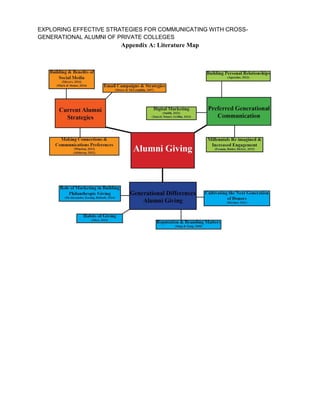
emerged (see Appendix A for a complete literature map) : (a) current strategies used to connect
with alumni; (b) preferred modes of communication across generations; and (c) generational
differences in alumni engagement.
Current strategies used to connect with alumni.
A large portion of research studies conducted in the last 10 years attest to the power of
integrating online social alumni networks to strengthen alumni engagement and stimulate giving.
Along with successful outcomes, a major draw in communicating to alumni via social networks
is the cost-effectiveness and immediacy to reach target segments. Unlike traditional methods of
outreach, such as phone-a-thons and print mailers, alumni choose to opt in to the social network,
and many of them already have a strong online presence of their own, which opens up an
opportunity for them to serve as sharers of news or ambassadors for their alma mater (Meyers,
2014).
According to an annual study conducted by the Council for Advancement and Support of
Education (CASE), 90 percent of educational institutions use Facebook to reach alumni, 73
percent use micro-blogging website Twitter and professional-networking website LinkedIn, and
56 percent use video-sharing website YouTube (Mack & Stoner, 2014). The use of online mobile
photo-sharing/video-sharing and social networking service Instagram has also risen to 32
percent. Of the 1,671 U.S. institutions surveyed by CASE, 47 percent are using social media to
raise money, and 43 percent of those institutions raised more than $10,000 in 2014. Most of
these institutions (78 percent) reported that much of their fundraising success was garnered by
posting solicitations on their institution’s various social networking sites. Additionally, many
EXPLORING EFFECTIVE STRATEGIES FOR COMMUNICATING WITH CROSS-
GENERATIONAL ALUMNI OF PRIVATE COLLEGES
institutions (87 percent) use social media to keep donors up to date, and 70 percent use it to
thank donors.
In 2009, Middlebury College created Facebook groups of the institution’s alumni classes
and set a goal to inspire 60 percent of its 25,000 graduates to make a gift in a multi-month
period. As donations trickled in, alumni posted on Facebook that they had made a contribution
and encouraged other alumni to do the same. Young alumni who worked for the college provided
updates on Middlebury’s Twitter page, which were retweeted by others. In the end, Middlebury
exceeded its donation goal (Masterson & Carew, 2010).
Winston (2013) notes that many schools have use LinkedIn as a method for gathering
current job titles and contact information from graduates. If a college or university possesses its
own LinkedIn "University Page," and an alumnus lists the name of the institution under the
educational experience section of his own personal LinkedIn profile page, the institution is given
access to certain information about the alumnus, including but not excluded to: degree earned,
graduation date, current place of employment, and residence.
Some colleges and universities have found it difficult to mine through social networking
sites like Facebook and LinkedIn to collect alumni data and contact information, so they have
taken it upon themselves to construct their own college/university-specific online networking
sites (Hermes, 2008). Elon University’s online “town square” called E2 is a private, closed
environment that allows alumni to interact similarly as they would on Facebook but also offers
additional features, including the option to post a résumé. While the overall goal with internally
built networking sites is to make it easier for alumni to connect with their classmates and their
alma mater, the institutions themselves are also directly benefitting. Any time an alumnus makes
a change to his or her profile on the college’s social networking site, internal databases that
EXPLORING EFFECTIVE STRATEGIES FOR COMMUNICATING WITH CROSS-
GENERATIONAL ALUMNI OF PRIVATE COLLEGES
house alumni information are automatically updated, making it easier for colleges to reach
alumni in the future. Additionally, colleges may also integrate the sites with their print
publications, delivering some content online to allow alumni to interact immediately (Hermes,
2008).
Like social media, e-mail is viewed as an inexpensive, efficient way for colleges and
universities to stay in front of alumni, communicate donation opportunities, and build stronger
relationships (Moore & McLaughlin, 2007). In their nationwide research study, Mack and Stoner
(2014) found that 46 percent of educational institutions consider e-mail more effective than some
social media channels, and an additional 31 percent rated it over all social media. A plausible
reason for this finding, as noted by a respondent in the study, is that older alumni still prefer snail
mail or e-mail, making it necessary to segment the alumni into groups and target them through
different media vehicles.
Despite the rise of online communications, research indicates that traditional, offline
alumni outreach strategies are also still effective. In 2009, the polling firm International
Communications Research (ICR) surveyed 1,100 college graduates to learn more about their
preferences for receiving information from their alma maters. Approximately 57 percent
preferred direct mail compared to 31 percent who selected e-mail (Afolayan, 2012).
While the aforementioned information is helpful in discerning modern and effective
strategies for building alumni philanthropy and engagement, research regarding how alumni of
varying generations prefer to receive communications from their alma mater is scant. This gap in
the literature led to the development of a primary research question: What is the difference in the
preferred communication methods received by alumni who are Millennials compared with those
of Generation X, Baby Boomers, and the Silent Generation? This research study will explore
EXPLORING EFFECTIVE STRATEGIES FOR COMMUNICATING WITH CROSS-
GENERATIONAL ALUMNI OF PRIVATE COLLEGES
what forms of communications different generations of alumni prefer, how often they prefer to
receive communications, and what type of methods and messaging will convert them into donors
and involved members of their college alumni association.
Preferred modes of communication by generations.
Technological advancements over the past few decades have both enhanced and inhibited
the way in which organizations stay in contact with their graduates. In modern day, college
alumni associations are charged with effectively communicating with graduates belonging to
four generations. Each generation poses an opportunity for enhancing the methods of
communication. Older generations can still be reached by way of traditional forms of
communication including email, telephone calls and direct mailers as indicated by prior research.
Reaching the younger generation, the Millennials, will require a different strategic approach.
Millennials, also known as Digital Natives, the Net Generation, Generation @ and the
Dot.Com Generation, require a more strategic digital approach as indicated by research.
Advertisers are charged with continual innovation in their marketing communications strategies.
Communication with consumers through digital media will be a large focus of marketing,
advertising and public relations professionals in the upcoming years (Smith, 2011). Alumni
associations are at a crossroads with overall objective of growing their Millennial memberships.
This generation now makes up the largest portion of college graduates (Tanyel, Stuart
and Griffin, 2013). With a large amount of discretionary income, estimated at over $1.3 trillion,
members of this generation are increasingly becoming the target of marketing, advertising and
public relations professionals (Fromm, Butler, & Dickey, 2015). By the year 2020, it is estimated
that 23 million college students will belong to this generation (Tanyel et al., 2013). They have
been characterized by researchers as investigative and opinionated and possess the need to
EXPLORING EFFECTIVE STRATEGIES FOR COMMUNICATING WITH CROSS-
GENERATIONAL ALUMNI OF PRIVATE COLLEGES
authenticate information (Smith, 2011). The Internet is central in their lives. They use it to
stream music and movies, research information, connect and socialize with friends, purchase
products and consume news. This is all done on multiple devices and, in many occasions, at the
same time. It is important to point out that this generation views digital advertising as intrusive
and disruptive (Tanyel et al.,2013). When researching preferred methods of communication from
brands with which they have an existing relationship include email and social media (2012). The
Millennial generation has a tendency to trust their peers and consult with social media networks
for information and opinions prior to making a decision to make a large purchase or spend a
large amount of money (Smith, 2011).
The top digital tools used by public relations professionals today are email, Internet,
blogs, videoconferencing, podcasts, video sharing and social media networks, specifically
Facebook and Twitter (Agozzino, 2012).To become a part of the conversation, advertisers and
public relation professionals have adapted their message content to fit the preferred
communication style of the young generation. Social media marketing poses a unique
opportunity to enhance brand reputation and awareness in the minds of users (Agozzino, 2012).
When creating social media content, it is key that the information is shareworthy in order for
viewers to engage with brand created content (Fromm et al., 2015). Marketers have viewed
word-of-mouth, also known as word-of-mouse, as the ultimate form of advertising for years.
(Fromm et al., 2015).
Research revealed multiple aspects as to the preferences of Millennials regarding their
interactions with brands. Millennials are more than willing to share content, as long as it fits
within the confounds of their character and personality (Fromm et al., 2015). They are also
passionate about being a part of something bigger. Brands that have a social cause get more
EXPLORING EFFECTIVE STRATEGIES FOR COMMUNICATING WITH CROSS-
GENERATIONAL ALUMNI OF PRIVATE COLLEGES
attention from this generation (Fromm et al., 2015). There is a stipulation for their participation,
however. They expect credit for their actions and participation in the brand’s cause.
Millennials are master multimedia multitaskers. As preferred media vehicles have
evolved over the years with changing generations, the Internet is considered the medium of
choice for Millennials (Tanyel et al., 2013). It is important to point out that this generation is
extremely concerned with the ethics of Internet advertising (Tanyel et al., 2013). As a result,
marketing, advertising and public relations professionals are adapting their digital content in an
effort to create a partnership as opposed to pushing their messages onto an unassuming audience.
Research indicates that 87 percent of Millennials create online content through social media
tools; 43% of them read blogs; and 72 percent of them view online videos through channels such
as YouTube (Agozinno, 2012). Brand communities are becoming increasingly popular due to the
ease of remaining in contact with peers of similar interests and aspirations. Public relations
professionals are tapping into this potentially powerful communication channel (Smith, 2011).
Generational differences in alumni engagement.
While there have been numerous research efforts focused on alumni giving based on
philanthropic motivations for donating, it is important to grasp how generational differences adds
to the behaviors of gifting. Colleges across the country have struggled with membership decline
in alumni associations and are feeling pressured to uphold significance to this group of potential
donors (Borden, Shaker, & Kienker, 2013). Altruistic feelings generally emerge and a desire to
give back to the establishments that lead to personal success develop as a person ages. “Studies
show that as a person ages, developmental and moral reasoning can evolve in terms of helping
others” (Drezner, p. 65). The Silent Generation, ages 70-90, is more giving with alumni
donations than Generation X, ages 35-65 (Drezner, 2011). According to Drezner (2011),
EXPLORING EFFECTIVE STRATEGIES FOR COMMUNICATING WITH CROSS-
GENERATIONAL ALUMNI OF PRIVATE COLLEGES
formulated numbers of giving based on constant dollars, the Silent Generation is 29% more
likely to give than Baby Boomers and 38% more likely than Generation X. Numbers were not
calculated at the time of this study for Millennials. However, it was noted this generation is more
likely to donate in the form of time, instead of monetarily and the number of volunteered hours
per year were double than they were 10 years ago (Drezner, 2011). While this might be viewed
as a downside to an establishment seeking to grow its alumni donations, it should be observed
that differences in giving such as volunteering and in-kind contributions can be very important to
a college institution. College universities may need to adapt their strategies as to seeking
donations and building continued relationships with alumni because of this new age movement.
Millennials may be still fresh out of school with student debt load weighing on their shoulders.
Many might think, “Why would I give back to a school when I am still paying for my degree?”
This might be an obstacle to overcome for colleges since mentalities are often difficult to change
in the short term.
It is believed there are mainly two areas to describe donor motivations: their own self-
interest and a personal belief in altruism (Sung & Yang, 2009). A student’s immersion in school
activities such as volunteering, sports, or fundraising builds a strong relationship between the
academic institution and the student (Drezner, 2011). One of the most significant factors in
whether alumni donate and also the level of giving are dependent on the person’s satisfaction
with their experience while at school (Sung & Yang, 2009). Other ways of measuring potential
alumni giving after graduation are influenced greatly by the program of study and whether or not
the college experience met the expectations after the student has been in the real world for a
significant period of time (Sung & Yang, 2009). Older generations put more emphasis on the
prestige of certain universities and educational experiences. Therefore, a school’s reputation is
EXPLORING EFFECTIVE STRATEGIES FOR COMMUNICATING WITH CROSS-
GENERATIONAL ALUMNI OF PRIVATE COLLEGES
directly correlated with a person’s perception of their own experience there. Sung and Yang
(2009) discovered in their research that the reputation and the relationship the alum had over the
years with the university held a solid base of the students’ support of their alma mater. In another
study conducted by Borden, Shaker, and Kienker (2013), the effect of alumni status on giving,
especially looking at currently employed alumni, found a significant connection between an
individual’s degree of commitment and perceptions of the college’s prestige.
Meer (2013) found a connection between alumni who give when they are fresh out of
college and when they are 20 or more years out of school and whether giving early on leads to
more generous gifts when they are older in age. From the study based on one university, it was
discovered that alumni who donate shortly after graduation do indeed form the habit of giving,
which then indicates a higher donation when the same person reaches age 40 and above (Meer,
2013). McAlexander, Koenig, and DuFault (2014) suggest more exploration in regard to the
alumni aging and family life-cycle that could affect potential donations based on knowing the
audience, then being able to produce targeted message toward that specific generation. This is
another reason research on generational alumni giving is needed.
Methods
Individuals & Objects
Sample selection.
All participants of this research study are alumni of various private colleges in Nebraska.
The sample pool includes males and females with ages ranging from 25–72. Though all
EXPLORING EFFECTIVE STRATEGIES FOR COMMUNICATING WITH CROSS-
GENERATIONAL ALUMNI OF PRIVATE COLLEGES
individuals in the study graduated from a private college in Nebraska, a small percentage do not
currently live in the state.
Sample method & size.
Three focus groups were conducted, each with four participants fitting the criteria
outlined in the sample selection. The focus group participants were selected using judgment
sampling (Davis, 2012). Each member of the research team recruited four alumni who graduated
from private colleges in Nebraska by contacting them via social media. Each of the alumni had
some type of personal or professional connection with one of the researchers of this study.
The alumni in the first focus group were all Millennials and consisted of three females
and one male; the alumni in the second focus group were all females and included one
Millennial, two Generation Xers and one Silent Generation; and the third focus group included
one Millennial and three members of Generation X.
Exclusions.
Although unlikely that any potential participants of the study would fall into this age
group, researchers of the study ensured none of the participants were below the age of 20, as this
study aims to find the most preferred and effective communication strategies for Millennials and
older generations only.
Research Design
After thorough investigation of current literature, the researchers of this study concluded
that identifying effective communications strategies for engaging private college alumni is a
sparsely researched topic. To achieve concrete insight, this study enveloped a mixed methods
EXPLORING EFFECTIVE STRATEGIES FOR COMMUNICATING WITH CROSS-
GENERATIONAL ALUMNI OF PRIVATE COLLEGES
approach. According to Creswell and Clark (2007), a mixed methods approach can be considered
a type of research design, a methodology, and a method, each of which entails both philosophical
assumptions as well as methods of inquiry (p. 5). In the initial phase of conducting primary
research, the researchers of this study refer to the term mixed methods research as a methodology
that takes assumptions the researchers made about alumni communications and giving habits and
used them as a guide for collecting data via a qualitative study. Once that step was complete, the
researchers analyzed the data from the focus groups to form a quantitative instrument (a survey)
that, if used in a follow-up study, could provide a better understanding of the research problem
than what the qualitative study could provide on its own.
The end goals of the primary research included: 1) identifying what types of content and
modes of communication appeal to each generation of private college/university alumni; 2)
determining if the preferred methods of communication for each generation would have any
effect on alumni giving and engagement; 3) determining if private colleges should implement
segmented alumni communications plans based on the age group in which their graduates fall;
and 4) developing a quantitative instrument to be used in future research.
The qualitative portion of the study (focus groups) garnered generalizability about the
attitudes and preferences of the respondents with respect to the communications they receive
from their alma mater. Information and themes gleaned from the focus group sessions helped
shape different topics addressed within a quantitative instrument (survey).
Instrumentation & procedures.
Qualitative data collection was completed through the use of three separate focus groups
that included four participants each. Informed consent forms (see complete qualitative study
EXPLORING EFFECTIVE STRATEGIES FOR COMMUNICATING WITH CROSS-
GENERATIONAL ALUMNI OF PRIVATE COLLEGES
consent form in Appendix B) were distributed to each focus group participant explaining steps
taken to maximize confidentiality.
Phase I: focus groups.
The researchers used judgment sampling to recruit focus group participants who
represent all desired generations for the study. The goal in organizing the focus groups was to
investigate concerns, experiences, attitudes and beliefs related to the impact communications
have on alumni giving and engagement. This data facilitated the development of additional
questions to ask the survey respondents and garner additional insight about effective
communication strategies.
In all, researchers conducted three focus group sessions to collect qualitative data on
preferred methods, frequency and effectiveness of communications received by alumni from
their alma mater. All participants attended a private institution during their undergraduate and/or
graduate studies. Focus groups were facilitated in Alliance, Neb., Holdrege, Neb., and Omaha,
Neb. All individuals were voluntary participants with prior connections to the researchers of this
study.
Researchers posted focus group invitations on their personal Facebook walls, made direct
phone calls and sent email correspondence to recruit participants. Participants were required to
be at least 20 years of age and posses a four-year degree from a private institution. Fourteen
participants volunteered for the study. After identifying dates and times for the three focus group
sessions, two participants had prior commitments and opted out of the study. In the end, four
alumni participated in each focus group, equating to a total of twelve subjects.
The researchers served as moderators of the focus group sessions and utilized the same
discussion guide (see Appendix C for a full copy of the discussion guide) to facilitate each
EXPLORING EFFECTIVE STRATEGIES FOR COMMUNICATING WITH CROSS-
GENERATIONAL ALUMNI OF PRIVATE COLLEGES
discussion. Topics outlined in the guide included educational experience, current level of
engagement and involvement, communication preferences, and future engagement and
involvement with alma maters.
Each focus group session commenced with an explanation of the purpose of the study,
including what the data would be used for and what steps would be taken to ensure participant
confidentiality. All participants signed a pre-approved informed consent document prior to
beginning the discussion. Researchers utilized audio recordings, which allowed them to fully
interact with participants. The recordings were used by researchers to transcribe discussions for
data analysis. After transcription, the recordings were deleted. Each focus group session lasted
50–60 minutes.
Participant demographics.
Demographics and backgrounds of the 12 participants varied. Cohorts represented
included Millennials (50%), Generation X (42%), and Silent (8%) generations. Eleven of the
twelve participants attended a private institution during their undergraduate studies. One
participant received a graduate degree from a private institution. Male and female participants
were two and ten, respectively. All private institutions discussed were located in Omaha (41%),
Lincoln (17%), Hastings (25%) and Crete (17%), Nebraska. Four (33%) of the participants
transferred to their private alma mater from a public institution; one (8%) participant attended a
public institution for her undergraduate degree prior to obtaining her graduate degree from a
private institution; and one (8%) participant attended her private alma mater for her
undergraduate studies prior to obtaining her graduate degree from a public institution.
Phase II: survey.
EXPLORING EFFECTIVE STRATEGIES FOR COMMUNICATING WITH CROSS-
GENERATIONAL ALUMNI OF PRIVATE COLLEGES
Although a quantitative instrument was not used to develop findings for this research
project, the researchers of this study leveraged the findings and themes that emerged in the focus
group sessions to construct a quantitative survey that could be used in a future research study of
similar context (see Appendix B to view complete version of survey).
The survey questions reflect the data findings and themes that emerged in the focus
groups. Additional information regarding current alumni involvement, current receptiveness to
alumni communications, and potential future connectedness were key areas that guided the
construction of the quantitative survey.
The researchers piloted the survey with four actual private college/university alumni to
determine what enhancements could be made to the survey if used in a future research study.
Overall, feedback received was positive. Respondents expressed satisfaction with the flow,
structure, and ease of the questions and reported it taking between three and six minutes to
complete.
The researchers also created a separate informed consent form (see Appendix D for
complete form) for future survey respondents to read and sign prior to completing the
questionnaire.
Findings
Qualitative Findings
The discussion guide created and used by the focus group facilitators helped maintain
structure throughout the sessions and ensured specific topics were addressed. Comments from
the respondents probed additional questions from the facilitators to gather more in-depth insight
related to each topic, thus causing various themes to emerge. These patterns of responses helped
EXPLORING EFFECTIVE STRATEGIES FOR COMMUNICATING WITH CROSS-
GENERATIONAL ALUMNI OF PRIVATE COLLEGES
formulate questions for a potential quantitative study (to be used in a separate study and
administered to a larger sample pool) to better understand focus group participants’ attitudes,
opinions, and behaviors in relation to how and how often they prefer to receive different types of
communications from their alma mater.
Satisfaction with Educational Experience
In the context of the focus groups, educational experience referred to the participants’
level of satisfaction with the services, opportunities, policies, procedures and learning
environment their alma mater provided.
Eleven of the 12 focus group participants reported being overall satisfied with their
educational experience. They believe the small class sizes, personalized instruction, and quality
of instruction were advantageous to them as both students and graduates just starting off in their
careers.
Small class sizes with one-on-one interactions with professors were a primary reason for
their positive feelings. “You’re more than just a number,” noted a 32-year-old participant. “In a
small school, everyone knows you by name [and you] felt like you could always go to your
professor with questions or concerns. That personal connection is extremely important for my
success.” A Millennial participant stated that she continues to keep in touch with several of her
instructors, “whereas at [previous university attended], they really didn’t even know me.” A 35-
year-old Generation Xer stated, “I will forever be grateful to one of my professors. She was
instrumental in me choosing school psychology as a career. If it weren’t for her, I wouldn’t be
where I am today.”
In addition to instructor satisfaction, some of the participants see the value in their
education. “I think I’m receiving the benefits of the education I paid for,” commented a female,
EXPLORING EFFECTIVE STRATEGIES FOR COMMUNICATING WITH CROSS-
GENERATIONAL ALUMNI OF PRIVATE COLLEGES
age 25. “Comparing myself to some peers in my field who have gone to other schools, I feel like
I’m better prepared in some aspects than they were.” The examples she provided to support this
perception included her ability to pass certain required competency exams with much more ease
than her coworkers and her level of confidence when it came to carrying out her job
responsibilities.
While, overall, statements regarding educational experience were positive, one
participant, age 27, also voiced his criticisms. “I had a slightly different experience. “The degree
I chose, there wasn’t a big job market for, so it was pretty risky going into it. After graduating
and trying to maneuver my way into an industry driven by money and nepotism, not talent, I felt
like my education was a joke.” As he elaborated on his feelings, he referred to his private
institution as an unethical money-maker that leads aspiring musicians and engineers to believe
their education is a fruitful investment when, in all actuality, they will graduate with little hope
of ever finding a job in their field..
Older Generations Show More Current Involvement
Overall, the Gen X and Silent Generation participants appear to be more engaged with
their alma maters in comparison to Millennial participants. They show more charisma for
attending alumni-related events and a greater likelihood to make a donation.
One of the key questions asked in each of the focus groups pertained to the participants’
attendance at alumni events. Half of the participants reported being invited to class reunions.
Three participants (25%), with representatives of Millennials, Generation X and the Silent
Generation, attend their reunions regularly. “[Name of alma mater] has an every-year class
reunion, and then they celebrate the big five-year increment. It’s just like high school,” shared a
35-year-old participant, who enjoys reuniting with her college friends in a similar fashion as her
EXPLORING EFFECTIVE STRATEGIES FOR COMMUNICATING WITH CROSS-
GENERATIONAL ALUMNI OF PRIVATE COLLEGES
former high school classmates. The Silent Generation participant has regularly attended class
reunions over the decades, including her recent 50-year reunion.
Sixty-seven percent of younger Millennial participants (age 27 and younger) reported that
not enough time has passed since graduation for them to receive an invitation to a milestone
reunion. The other one-third have attended an alumni event and reported that they received
notification for the event by a personal invitation through the mail.
When asked how many participants currently make regular donation to their alma mater,
one-fourth responded yes (one Millennial, one Generation X, one Silent Generation). Some
participants said they care about their institutions and would like to continue receiving
communications from them with the hope they will someday be ready and willing to donate. “I
think when I get to a point in my life where I’m more financially stable, I will definitely be more
likely to donate,” said one Millennial.
Two Millennial participants agreed they would be more likely to make a financial
contribution to their alma mater if they had a say as to where their funds were going. “If there’s a
checklist of what you can put your money towards, I think people would be more likely to give,
especially if it’s something they’re passionate about or something that was lacking at the college
when I was there,” said a Millennial participant.
Expressing the Desire to Stay Connected
Participants were asked to discuss current methods of communication implemented by
their alma maters, specifically what communication vehicles are utilized and what the content is
typically like.
When asked how many participants received donation solicitation by telephone, nearly
half of the participants reported they had received a call from their alma mater, three of which
EXPLORING EFFECTIVE STRATEGIES FOR COMMUNICATING WITH CROSS-
GENERATIONAL ALUMNI OF PRIVATE COLLEGES
were Millennials, one of Generation X and one of the Silent Generation. Telephone was the least
preferred method of communication among all participants, as many of them believe a phone call
to be a typical approach to request a monetary donation. “It is a bit annoying when the alumni
association began immediately calling after you graduated asking for money,” stated a 40-year-
old Generation Xer. We had student loans and were just entering the workforce living off of
ramen noodles and they wanted money!” A Generation X participant also noted her displeasure.
“I feel like my connection to the alumni association is money please, money please, money
please.”
All of the participants reported receiving newsletters, emails and/or direct mailers from
their alma maters, and the frequency in which they received them ranged from once per year to
almost monthly. Eighty percent of Generation X participants and the single member of the Silent
Generation reported their primary communication preference to be a printed quarterly magazine.
The one member of Generation X not in agreeance with her cohort stated, “I was at a different
stage in life. I was married and in the process of obtaining a graduate degree. My alma mater has
since discontinued my program, so I really do not have any ties to them anymore.” (female, age
40).
When asked what type of content they prefer to read about in their alumni newsletters or
magazines, 100% of Gen X, 100% of Silent Generation and 8%of Millennial participants
reported that they enjoy reading the Class Notes section and learning about upcoming alumni
events. “In the back of the [name of alma mater] magazine, there is a spot listed by your class
date that lists marriages, babies and deaths so you can keep track of the lives of your fellow
classmates,” noted a 35-year-old participant.
EXPLORING EFFECTIVE STRATEGIES FOR COMMUNICATING WITH CROSS-
GENERATIONAL ALUMNI OF PRIVATE COLLEGES
In addition to quarterly printed newsletters, 40% of Generation X participants would like
to receive emails from their alma mater. The two participants of this generation agreed that the
convenience of having emails allowed them to read the information at their leisure on their
smartphones as time allowed.
Millennials reported various preferences in terms of how they prefer to hear from their
alma maters. One-third prefer to receive a printed quarterly magazine or newsletter, one-third
prefer to receive information via email, and one-third were apathetic to receiving any
information from their alma mater. “I like to flip through the magazine and look for familiar
faces, [...] to see what types of changes the college is making, [...and] to know what the teachers
who brought me to this point in my life are doing now,” commented one Millennial. Another
participant of the Millennial group felt differently. “I want information to be accessible at my
fingertips. If I can’t read it on my phone, I probably won’t see it. I think the mailing address I
still have on file [at the college] is my parents’ address.”
Sixty-seven percent of Millennials reported that a personalized invitation through the
mail would be the preferred method of communication for special events, such as class reunions
or charity fundraisers. “Receiving a nice paper invite would ensure I receive the
communication,” said a Millennial participant. “If it’s only posted on social media, I might miss
it.”
All participants, with the exception of the Silent Generation participant, currently follow
their alma maters on social media. “In our generation, almost everyone is on Facebook, so it just
makes sense to use it,” said one Millennial participant. “I follow [name of alma mater] on
Facebook, Twitter, and LinkedIn,” stated a Gen X participant. “I also participate in the [alumni]
mentorship program through their LinkedIn page.” All Millennials reported they would join a
EXPLORING EFFECTIVE STRATEGIES FOR COMMUNICATING WITH CROSS-
GENERATIONAL ALUMNI OF PRIVATE COLLEGES
closed alumni social networking group,—even those who voiced they do not wish to receive
communications from their alma mater—but they would prefer it to be on a platform on which
they currently have a profile set up, such as Facebook. “I’m busy,” stated a 25-year-old
participant. “I probably wouldn’t take the time to seek out this new platform and fill out all of
my information.” Half of them prefer that communications be targeted to their graduating class
and academic program. Another Millennial, age 27, said, “I would want it [closed social
networking site] to be for JUST my class because those are the people I care to stay in touch
with, but I think any alumni Facebook group, even if it were for all alumni, would be good; I just
might not be as involved.”
For the most part, Gen X participants and the Silent Generation participant prefer to
receive quarterly alumni magazines/newsletters in the mail, and Gen X participants are also open
to receiving news via email and social media. A small percentage of Millennials both receive and
regularly read the printed version of their alumni magazine/newsletter. The majority of
Millennials prefer digital communications, such as emails and social media posts, and all would
be open to joining a closed, alumni Facebook group.
The Varying Preferences of Communication Frequency
Sixty-seven percent (four out of six) of the Millennial participants preferred to receive
email and social media communications on a monthly basis. One stated that communications
accessible via smartphone, such as text messaging or personal emails, would be welcome. One
participant, age 30, preferred to seek out the information herself on a regular basis through social
media and the website. “I keep connected with the webpage and the online newsletter, as well as
postings on Facebook.” Two Millennial participants stated that they do not wish to keep in touch
with their alma mater at all. “I’ve moved on,” said a 27-year-old. “I’m disinterested in what’s
EXPLORING EFFECTIVE STRATEGIES FOR COMMUNICATING WITH CROSS-
GENERATIONAL ALUMNI OF PRIVATE COLLEGES
going on at the college. I got what I wanted out of it, and now I’m in a different place.” Two
participants preferred targeted monthly communications through Facebook as long as the content
is targeted to their graduating class and academic program.
Three of the five Generation X and the Silent Generation participants enjoy receiving a
quarterly newsletter or magazine from their alma mater. “I love the quarterly publications. They
feel like a magazine to me. They are written very well. The best is the current events and alumni
news. We have family and friends who have gone there and I can see news about them,” stated a
50-year-old Generation Xer.
New/Continued Communications Do Not Directly Translate to Greater Alumni Involvement
Several participants noted they would like to continue hearing from their alma maters and
may consider becoming more involved with their alumni associations in the future as their
personal and professional lives permit.
In all three focus groups, participants expressed the gratitude of experiencing a personal
connection while attending classes with their alma maters. Small class sizes allowed for
professors to know them by name and give them one-on-one attention. Personalized
communication and engagement post-graduation remains just as important to participants.
Even if the alumni associations of the private institutions they attended changed their
communication strategies to meet their preferences, two participants, one Millennial and one Gen
Xer, would not consider donating in the future. “Five years from now I think I’ll be even more
disconnected from my college, so even if I’m in a better place to donate, I’m not sure I would,”
stated a Millennial participant, who reiterated his displeasure with his educational experience.
One Millennial would consider donating after getting established. One Millennial would
participate actively during events.
EXPLORING EFFECTIVE STRATEGIES FOR COMMUNICATING WITH CROSS-
GENERATIONAL ALUMNI OF PRIVATE COLLEGES
The researchers gleaned several key takeaways from the qualitative portion of the study
pertaining to the effects student experience and modes and frequency of communications have
on cross-generational alumni giving habits, including:
 All but one participant was satisfied with his/her educational experience.
 The percentage of Gen X and Silent Generation participants who currently give back to
their alma mater is more than double that of the Millennial participants.
 Millennials expressed similar and different preferences regarding modes and frequency of
receiving alumni communications. However, all said they would join a private alumni
Facebook page.
 The majority of non-Millennial participants enjoy receiving quarterly alumni newsletters
in the mail.
 The majority of Gen X participants and the Silent Generation participant do not prefer to
receive e-mail communications.
 More than half of the Millennial participants who do not currently give back to their alma
mater hope to make donations and attend events in the future, assuming:
 Time and money become less restrictive.
 Options of funds to donate to are provided.
 Events are appealing to their interests and/or support a cause about which they are
passionate.
 None of the participants could guarantee that changed communication strategies would
generate a greater likelihood to give back to their alma maters; however, all but one
Millennial participant wish to continue receiving communications, and those participants
currently are or hope to give back in the future.
EXPLORING EFFECTIVE STRATEGIES FOR COMMUNICATING WITH CROSS-
GENERATIONAL ALUMNI OF PRIVATE COLLEGES
Preparing the Survey
A quantitative survey (see Appendix E) was compiled based on insights gained and
themes that emerged from the focus group discussions. Quantitative questions collected data
pertaining to participant demographics, current methods of communication received, level of
engagement with the communications, preferred frequency of communications, content interests,
behavioral questions regarding digital communications and special event participation, and
overall satisfaction with educational experience.
The researchers recruited four individuals who fit the criteria of this study via email and
private Facebook messages to complete the survey. The purpose of this step was not to collect
data, but rather to pretest the survey and identify any possible problem areas. As Davis (2012)
advises, pretesting the questionnaire is important because it offers the insights needed to improve
wording, format, and organization to diminish the possibility of receiving faulty results (p. 339).
Specifically, the pretest aimed to 1) ensure none of the questions were confusing; 2) ensure none
of the questions lacked exhaustiveness or exclusivity; and 3) add, eliminate, or edit questions
based on respondent feedback. The researchers recruited the participants via one of the
researcher’s personal Facebook page.
Three Millennials, ages 27, 28 and 29, and one Generation Xer, age 38, completed the
preliminary survey as a means to provide general feedback about the survey’s length, question
sequence, question comprehension and, most importantly, to discern if the data collected from
the survey benefits the primary research questions of the study. Prior to completing the survey,
one of the researchers explained to the respondents how important exhaustiveness and
exclusivity are in writing multiple choice survey questions (Davis).
EXPLORING EFFECTIVE STRATEGIES FOR COMMUNICATING WITH CROSS-
GENERATIONAL ALUMNI OF PRIVATE COLLEGES
After receiving substantial positive feedback from the test group, the researchers made
two changes to the survey. One of the questions regarding frequency in which the respondents
receive an alumni magazine or newsletter did not include an “annually” option, so that was
added. Also, when asked the questions, Which of the following is your first preference for
receiving alumni news, events and involvement opportunities?, one of the respondents requested
a “none” option be added to the multiple choice list. Overall, respondents felt the length of the
survey was reasonable and that the questions were considerably easy to comprehend.
Discussion
The purpose of this study was to research what the most effective communication
methods are for increasing and maintaining the involvement of alumni and how those methods
differ across generations. To achieve this, primary research aimed to identify the difference in
the preferred communication methods received by alumni who are Millennials compared with
those of Generation X, Baby Boomers, and the Silent Generation; the difference in the frequency
in which alumni who are Millennials prefer to receive communications compared with the
frequency preferred by Generation X, Baby Boomers, and the Silent Generation; and the
difference in how effective communications received by Millennials are in comparison to those
received by Generation X, Baby Boomers, and the Silent Generation.
The use of qualitative research (focus groups) allowed the researchers to collect data
from a diverse age group, to provide the wide-scoped data of opinions from various generations
of alumni, and to develop a quantitative survey that was piloted with four alumni (three
Millennials and one Generation Xer) from the same private college.
Focus group findings indicated that the modes and frequency in which alumni receive
communications differ both across and within generations. All in all, feedback from focus group
EXPLORING EFFECTIVE STRATEGIES FOR COMMUNICATING WITH CROSS-
GENERATIONAL ALUMNI OF PRIVATE COLLEGES
participants did not provide strong enough evidence to support the idea that preferred methods,
types, and frequency of alumni communications would make them more or less likely to give
back to their alma maters in the form of time or donations. The mixed and uncertain responses of
the focus group participants in this realm facilitated additional questioning in the quantitative
study.
A few clear themes emerged from the qualitative research, including how the Gen X and
Silent Generation participants appear to be more engaged with their alma maters in comparison
to Millennial participants. The vast majority of respondents reported being overall satisfied with
their educational experience. They believe the small class sizes, personalized instruction, and
quality of instruction were advantageous to them as both students and graduates just starting off
in their careers. Further inference could be made that those who felt connected with their alma
mater would be more likely to give back in the form of in-kind or monetary donations, which
was voiced by several of the focus group participants and, additionally, found in the research
conducted by Drezner (2011). Many of the focus group participants remarked they would like
their alma maters to remain in contact and would consider the possibility of becoming more
involved with their alumni associations in the future as their personal and professional lives
allow.
The focus groups had a varied perspective as to what alumni communication should look
like with graduates. These findings indicate that there is not a clear correlation between the
original theories and the information gathered from the focus groups; however, it can be
determined each generation prefers different forms of delivery in regard to college alumni
association outreach. For instance, as prior research by Mack and Stoner (2014) indicated, older
generations prefer traditional forms of communication including: mail, personal phone calls and
EXPLORING EFFECTIVE STRATEGIES FOR COMMUNICATING WITH CROSS-
GENERATIONAL ALUMNI OF PRIVATE COLLEGES
in-person visitations. The qualitative research conducted for this study aligned with this notion.
The above-mentioned previous research also connected social media and email in congruence
with Millennials, which this current research again acknowledged.
The researchers used the feedback gathered from the quantitative questionnaire primarily
to refine the survey from a technical and structural standpoint; however, the responses reaffirmed
several findings from the qualitative study in terms of how alumni of varying generations prefer
to receive communications from their alma mater regarding specific news and events. One
reiteration was that, despite changing communication strategies, all three of the Millennials could
not confidently state they would eventually become more likely to give back to their alma mater
in the form of donations or involvement. However, they would like to continue to receive such
communications in the event that they are in a better financial position to someday offer
donations.
Limitations
A key strength in this study was the connections each of the researchers had with
individuals who graduated from a private institution in Nebraska, which enabled access to prime
focus group participants. Another strength within the group was one of the members is
professionally employed with a private college in Omaha, allowing first-hand knowledge of how
private colleges approach alumni communications. This experience also assisted researchers in
the area of how private colleges operate, since all of the researchers graduated from public
institutions. The research project had two limiting factors during data gathering, which impacted
the overall outcome of the project. First, focus groups were restricted to three geographical areas
in Nebraska, and time to find willing participants was limited. As for the quantitative portion of
this study, only four respondents completed the survey strictly as a means to ensure it was
EXPLORING EFFECTIVE STRATEGIES FOR COMMUNICATING WITH CROSS-
GENERATIONAL ALUMNI OF PRIVATE COLLEGES
reasonably comprehensible, not overly time-consuming, and that category responses were
exhaustive and exclusive. Thus, the data retrieved from the survey respondents was not used to
draw implications for this study, but rather to prime it for a future study that could glean
indicative motives behind alumni giving and the relationship with generational factors.
Implications
Generational research is a broad but important facet in the ever-changing world today.
Because all three researchers fit into the Millennial generation category, bias was an inevitable
part of this project. While the researchers were held to the highest standards, it is important to
note this potential for research bias in this study.
This study identified several best practices private colleges could use when aiming to
keep or develop a strong relationship with their alumi. Based on both secondary and primary
research findings, the researchers of this study believe all private colleges should implement a
closed alumni social networking group. For example, a closed Facebook group dedicated to each
graduating class could be incorporated as part of a brand community for members to keep in
touch and would dually serve as a hub to keep alumni informed of the college’s happenings.
Along with their proven effectiveness at other colleges and the positive feedback received in the
focus groups surrounding this concept, private online communities are a cost-effective and
efficient way for institutions to build and maintain an engaged alumni base. Another best
practice which can be gleaned from this data is the implementation of immediate, continued
contact with alumni after graduation, which was recognized as an important factor by the focus
group participants. Lastly, while there was no concrete data to show the preferred method of
communication between generations, it was clearly acknowledged by the primary research that
EXPLORING EFFECTIVE STRATEGIES FOR COMMUNICATING WITH CROSS-
GENERATIONAL ALUMNI OF PRIVATE COLLEGES
communication in general was key to a bountiful alumni/college relationship. This means that
alumni value any form of outreach produced by their alma mater.
Although this study did not exhaust the avenues each generation of alumni prefer to
receive from their alma mater, it did add new knowledge to the gap in existing research, which
lacks data regarding effective cross-generational alumni communication strategies. The primary
research conducted in this study shows the importance of the need to cater a strategic message in
the form of various media to be impactful with former graduates of different generations. For
example, rather than simply disclosing which communication tactics have generated positive
results with respect to alumni giving and involvement (the approach used in existing research),
this study draws attention to the need for segmenting communication plans based on generational
behaviors and preferences.
All in all, the findings of this study serve as a credible indication that cross-generational
alumni communication preferences do differ and could impact habits of giving back to one’s
alma mater, there remains a need for continued research to discern what types of strategies are
necessary to reach multi-generational alumni of private colleges. To further expand this line of
research, it is recommended to sample specific multi-generational alumni from one private
institution to gather focused data as to behaviors and motivations of graduates. By using the
information gathered from the qualitative study and initial findings from the piloted quantitative
survey, private colleges in Nebraska will be able to better identify ways in which alumni from
various generations prefer to receive communication; however, more data will be needed to
determine how these modes of communication can elicit or inspire alumni to donate or give back
to their alma mater. To achieve this, the researchers of this study recommend conducting another
EXPLORING EFFECTIVE STRATEGIES FOR COMMUNICATING WITH CROSS-
GENERATIONAL ALUMNI OF PRIVATE COLLEGES
mixed methods study that entails focus groups with more dispersed representation of
generations, as well as an extensive quantitative study that entails the sample pool.
EXPLORING EFFECTIVE STRATEGIES FOR COMMUNICATING WITH CROSS-
GENERATIONAL ALUMNI OF PRIVATE COLLEGES
References
Afolayan, L. (2012). Alumni giving : An examination of communication and solicitation
preferences at a public university in North Carolina. 38-41. Retrieved October 4, 2015,
from WorldCat.
Agozzino, A. (2012). Building a Personal Relationship through Social Media: A Study of
Millennial Students’ Brand Engagement. Ohio Communication Journal. Volume 50-
2012, pp. 181-204.
Borden, V., Shaker, G., & Kienker, B. (2013). The Impact of Alumni Status on
Institutional Giving by Faculty and Staff. Research in Higher Education Res High Educ,
196-217.
Carew, E., & Masterson, K. (2010). 5 colleges that inspire alumni giving, and how they do it.
Chronicle of Higher Education, 56(24), 3-4.
Creswell, J., & Clark, V. (2007). Designing and conducting mixed methods research (p. 5).
Thousand Oaks, Calif.: SAGE Publications.
Drezner, N. (2011). Engaging Students and Young Alumni: The Importance of
Cultivating the Next Generation of Donors. In Philanthropy and fundraising in American
higher education (pp. 65-70). San Francisco, Calif.
Fromm, J., Butler, C., & Dickey, C. (2015). How to engage Millennials: Re-imaging the
consumer as a partner, not a target audience, to increase engagement. Journal of Brand
Strategy. Vol. 4, No. 1, 27-36.
Mack, J., & Stoner, M. (2014). Social media enters the mainstream: report on the use of social
media in advancement, 2014. Washington, D.C.: Council for Advancement and Support
of Education.
EXPLORING EFFECTIVE STRATEGIES FOR COMMUNICATING WITH CROSS-
GENERATIONAL ALUMNI OF PRIVATE COLLEGES
Mcalexander, J., Koenig, H., & Dufault, B. (2014). Advancement in higher education:
The role of marketing in building philanthropic giving. Journal of Marketing for Higher
Education, 243-256.
Meer, J. (2013). The Habit Of Giving. Economic Inquiry, 2002-2017.
Meyers, H. (2014). Activating Online Alumni: Building and Benefiting from
Alumni Social Networks. Retrieved October 1, 2015, from
https://www.questia.com/magazine/1G1-382233605/activating-online-alumni-building-
and-benefiting.
Moore, R., & McLaughlin, C. (2007). Alumni relationships in the electronic age: An assessment
of a permission based e-mail campaign. College Student Journal, 41(4), 987.
Smith, K. (2011). Digital marketing strategies that Millennials find appealing,
motivating, or just annoying. Journal of Strategic Marketing. Vol. 19, No. 6. October
2011, 489-499.
Sung, M., & Yang, S. (2008). Student–university relationships and reputation: A study of
the links between key factors fostering students’ supportive behavioral intentions towards
their university. Higher Education, 787-811.
Tanyel, F., Stuart, E., & Griffin, J. (2013). Have “Millennials” Embraced Digital Advertising as
They Have Embraced Digital Media? Journal of Promotional Management. 19:652-673.
Winston, H. (2013). Looking to Make Connections, Alumni Offices Log On to LinkedIn.
Chronicle of Higher Education, 60(9), A16-A17.
EXPLORING EFFECTIVE STRATEGIES FOR COMMUNICATING WITH CROSS-
GENERATIONAL ALUMNI OF PRIVATE COLLEGES
Appendix A: Literature Map
EXPLORING EFFECTIVE STRATEGIES FOR COMMUNICATING WITH CROSS-
GENERATIONAL ALUMNI OF PRIVATE COLLEGES
Appendix B: Qualitative Study Consent Form
Informed Consent Procedures and Participant Confidentiality
Identification of Project
Current methods of communication to graduates from private colleges and level of
alumni loyalty as measured by donations, both monetary and volunteerism.
Purpose of the Research
The purpose of this focus group will be to identify best practices in effectively
communicating with graduates from private institutions as well as the degree of loyalty and
commitment of graduates to their alma mater through philanthropic participation.
Procedures
You will be asked to answer a series of open-ended questions about your current level of
support addition to preferred methods of communication with the alumni association of your
specific collegiate institution. It will take no longer than 60 minutes to participate in the study.
The interviews will be audio-recorded for data analysis. The researcher will also take notes
during the interview. The data will be treated confidentially and will only be seen by the
principal and secondary investigators. The digital audio files as well as the transcriptions will be
kept on the principal investigator’s personal computer in a password-protected folder. After
seven years, all records will be permanently deleted. You will have the opportunity to see and
comment on emerging categories and theory development.
Risks and/or Discomforts
There are no known risks or discomforts associated with this research.
EXPLORING EFFECTIVE STRATEGIES FOR COMMUNICATING WITH CROSS-
GENERATIONAL ALUMNI OF PRIVATE COLLEGES
Benefits
You may find the opportunity to reflect on the group’s discussion as enjoyable. The
information gained from this study may help to better understand the methods of communication
from your alma mater’s alumni association. You are welcome to receive a copy of the finished
study if you wish.
Confidentiality
There is a small risk that your identity may be revealed by the thick, rich description of
the themes and quotes. Therefore, the researcher cannot guarantee confidentiality but will take
precautions to ensure against breaches of confidentiality. Digital audio files and transcriptions of
interviews will be stored in a password-protected folder on the investigator’s personal computer
for seven years and then permanently deleted. The information obtained in this study will only be
used as a part of the ADPR881 graduate course at the University of Nebraska-Lincoln. The
qualitative data will be presented in themes and illustrated with direct quotes but the identity of
the respondent will not be directly revealed.
Compensation
There will be no compensation for participating in this research.
Opportunity to Ask Questions
You may ask any questions concerning this research and have those questions answered
before agreeing to participate in or during the study. Or you may call the investigator at any time
at 308-995-3131. Please contact the investigator:
 if you want to voice concerns or complaints about the research
EXPLORING EFFECTIVE STRATEGIES FOR COMMUNICATING WITH CROSS-
GENERATIONAL ALUMNI OF PRIVATE COLLEGES
 in the event of a research related injury
Freedom to Withdraw
Your decision to participate is voluntary. You may decide not to participate or withdraw
from this study at any time. Your decision will not adversely affect your relationship with the
investigator or the University of Nebraska. Your decision will not result in any loss or benefits to
which you are otherwise entitled.
Consent, Right to Receive a Copy
By signing this informed consent form you agree to participate in this study and having
read and understood the information presented. Your decision to participate or not participate is
completely voluntary, and your signature certified that you have decided to participate. You will
receive a copy of this consent for to keep.
Please indicate below whether you consent to have your interview audio-recorded:
______ Yes _______ No
________________________________ _________________
Signature of Research Participant Date
Name and Phone Numbers of Investigators
Kristi Ellstrom………………….308-672-1164
Mikaela Yeager………………...402-552-2685
Lacie Westcott…………………308-995-3131
EXPLORING EFFECTIVE STRATEGIES FOR COMMUNICATING WITH CROSS-
GENERATIONAL ALUMNI OF PRIVATE COLLEGES
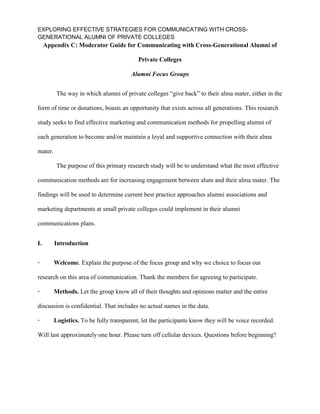
Appendix C: Moderator Guide for Communicating with Cross-Generational Alumni of
Private Colleges
Alumni Focus Groups
The way in which alumni of private colleges “give back” to their alma mater, either in the
form of time or donations, boasts an opportunity that exists across all generations. This research
study seeks to find effective marketing and communication methods for propelling alumni of
each generation to become and/or maintain a loyal and supportive connection with their alma
mater.
The purpose of this primary research study will be to understand what the most effective
communication methods are for increasing engagement between alum and their alma mater. The
findings will be used to determine current best practice approaches alumni associations and
marketing departments at small private colleges could implement in their alumni
communications plans.
I. Introduction
· Welcome. Explain the purpose of the focus group and why we choice to focus our
research on this area of communication. Thank the members for agreeing to participate.
· Methods. Let the group know all of their thoughts and opinions matter and the entire
discussion is confidential. That includes no actual names in the data.
· Logistics. To be fully transparent, let the participants know they will be voice recorded.
Will last approximately one hour. Please turn off cellular devices. Questions before beginning?
EXPLORING EFFECTIVE STRATEGIES FOR COMMUNICATING WITH CROSS-
GENERATIONAL ALUMNI OF PRIVATE COLLEGES
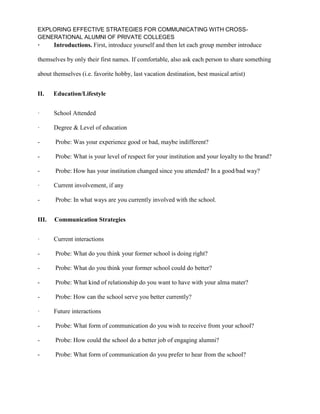
· Introductions. First, introduce yourself and then let each group member introduce
themselves by only their first names. If comfortable, also ask each person to share something
about themselves (i.e. favorite hobby, last vacation destination, best musical artist)
II. Education/Lifestyle
· School Attended
· Degree & Level of education
- Probe: Was your experience good or bad, maybe indifferent?
- Probe: What is your level of respect for your institution and your loyalty to the brand?
- Probe: How has your institution changed since you attended? In a good/bad way?
· Current involvement, if any
- Probe: In what ways are you currently involved with the school.
III. Communication Strategies
· Current interactions
- Probe: What do you think your former school is doing right?
- Probe: What do you think your former school could do better?
- Probe: What kind of relationship do you want to have with your alma mater?
- Probe: How can the school serve you better currently?
· Future interactions
- Probe: What form of communication do you wish to receive from your school?
- Probe: How could the school do a better job of engaging alumni?
- Probe: What form of communication do you prefer to hear from the school?
EXPLORING EFFECTIVE STRATEGIES FOR COMMUNICATING WITH CROSS-
GENERATIONAL ALUMNI OF PRIVATE COLLEGES
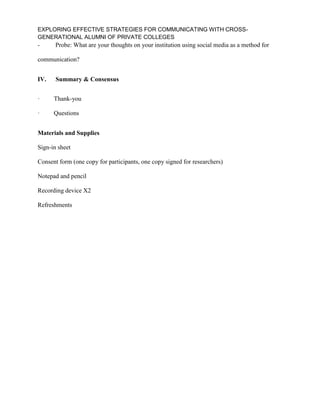
- Probe: What are your thoughts on your institution using social media as a method for
communication?
IV. Summary & Consensus
· Thank-you
· Questions
Materials and Supplies
Sign-in sheet
Consent form (one copy for participants, one copy signed for researchers)
Notepad and pencil
Recording device X2
Refreshments
EXPLORING EFFECTIVE STRATEGIES FOR COMMUNICATING WITH CROSS-
GENERATIONAL ALUMNI OF PRIVATE COLLEGES
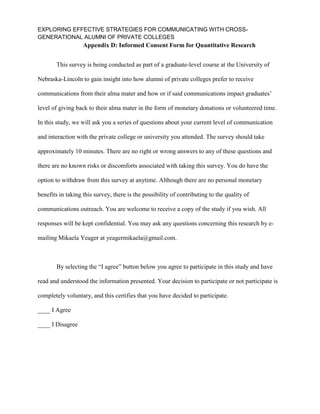
Appendix D: Informed Consent Form for Quantitative Research
This survey is being conducted as part of a graduate-level course at the University of
Nebraska-Lincoln to gain insight into how alumni of private colleges prefer to receive
communications from their alma mater and how or if said communications impact graduates’
level of giving back to their alma mater in the form of monetary donations or volunteered time.
In this study, we will ask you a series of questions about your current level of communication
and interaction with the private college or university you attended. The survey should take
approximately 10 minutes. There are no right or wrong answers to any of these questions and
there are no known risks or discomforts associated with taking this survey. You do have the
option to withdraw from this survey at anytime. Although there are no personal monetary
benefits in taking this survey, there is the possibility of contributing to the quality of
communications outreach. You are welcome to receive a copy of the study if you wish. All
responses will be kept confidential. You may ask any questions concerning this research by e-
mailing Mikaela Yeager at yeagermikaela@gmail.com.
By selecting the “I agree” button below you agree to participate in this study and have
read and understood the information presented. Your decision to participate or not participate is
completely voluntary, and this certifies that you have decided to participate.
____ I Agree
____ I Disagree
EXPLORING EFFECTIVE STRATEGIES FOR COMMUNICATING WITH CROSS-
GENERATIONAL ALUMNI OF PRIVATE COLLEGES
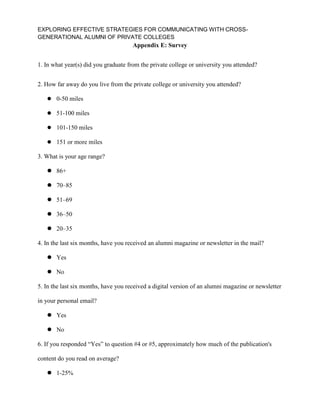
Appendix E: Survey
1. In what year(s) did you graduate from the private college or university you attended?
2. How far away do you live from the private college or university you attended?
 0-50 miles
 51-100 miles
 101-150 miles
 151 or more miles
3. What is your age range?
 86+
 70–85
 51–69
 36–50
 20–35
4. In the last six months, have you received an alumni magazine or newsletter in the mail?
 Yes
 No
5. In the last six months, have you received a digital version of an alumni magazine or newsletter
in your personal email?
 Yes
 No
6. If you responded “Yes” to question #4 or #5, approximately how much of the publication's
content do you read on average?
 1-25%
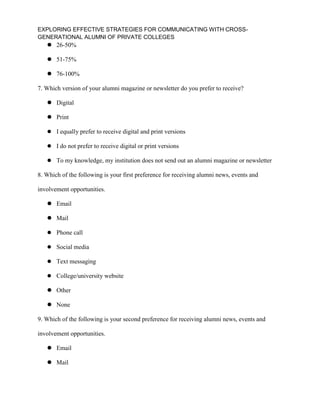
EXPLORING EFFECTIVE STRATEGIES FOR COMMUNICATING WITH CROSS-
GENERATIONAL ALUMNI OF PRIVATE COLLEGES
 26-50%
 51-75%
 76-100%
7. Which version of your alumni magazine or newsletter do you prefer to receive?
 Digital
 Print
 I equally prefer to receive digital and print versions
 I do not prefer to receive digital or print versions
 To my knowledge, my institution does not send out an alumni magazine or newsletter
8. Which of the following is your first preference for receiving alumni news, events and
involvement opportunities.
 Email
 Mail
 Phone call
 Social media
 Text messaging
 College/university website
 Other
 None
9. Which of the following is your second preference for receiving alumni news, events and
involvement opportunities.
 Email
 Mail
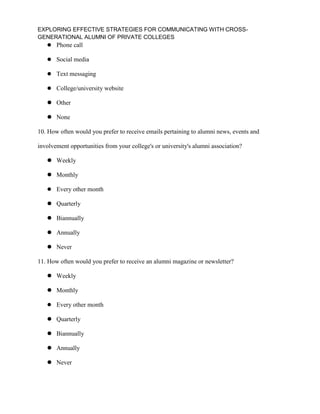
EXPLORING EFFECTIVE STRATEGIES FOR COMMUNICATING WITH CROSS-
GENERATIONAL ALUMNI OF PRIVATE COLLEGES
 Phone call
 Social media
 Text messaging
 College/university website
 Other
 None
10. How often would you prefer to receive emails pertaining to alumni news, events and
involvement opportunities from your college's or university's alumni association?
 Weekly
 Monthly
 Every other month
 Quarterly
 Biannually
 Annually
 Never
11. How often would you prefer to receive an alumni magazine or newsletter?
 Weekly
 Monthly
 Every other month
 Quarterly
 Biannually
 Annually
 Never
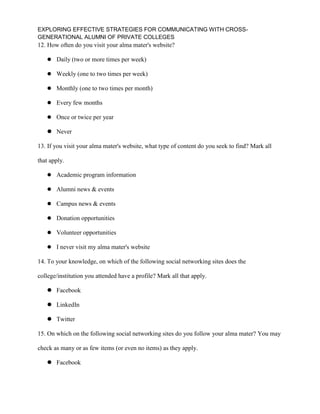
EXPLORING EFFECTIVE STRATEGIES FOR COMMUNICATING WITH CROSS-
GENERATIONAL ALUMNI OF PRIVATE COLLEGES
12. How often do you visit your alma mater's website?
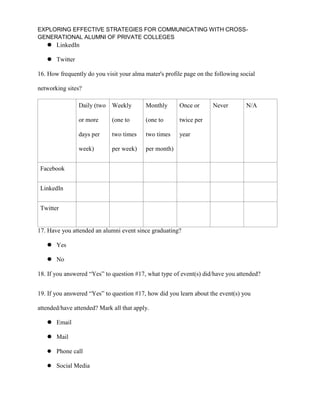
 Daily (two or more times per week)
 Weekly (one to two times per week)
 Monthly (one to two times per month)
 Every few months
 Once or twice per year
 Never
13. If you visit your alma mater's website, what type of content do you seek to find? Mark all
that apply.
 Academic program information
 Alumni news & events
 Campus news & events
 Donation opportunities
 Volunteer opportunities
 I never visit my alma mater's website
14. To your knowledge, on which of the following social networking sites does the
college/institution you attended have a profile? Mark all that apply.
 Facebook
 LinkedIn
 Twitter
15. On which on the following social networking sites do you follow your alma mater? You may
check as many or as few items (or even no items) as they apply.
 Facebook
EXPLORING EFFECTIVE STRATEGIES FOR COMMUNICATING WITH CROSS-
GENERATIONAL ALUMNI OF PRIVATE COLLEGES
 LinkedIn
 Twitter
16. How frequently do you visit your alma mater's profile page on the following social
networking sites?
Daily (two
or more
days per
week)
Weekly
(one to
two times
per week)
Monthly
(one to
two times
per month)
Once or
twice per
year
Never N/A
Facebook
LinkedIn
Twitter
17. Have you attended an alumni event since graduating?
 Yes
 No
18. If you answered “Yes” to question #17, what type of event(s) did/have you attended?
19. If you answered “Yes” to question #17, how did you learn about the event(s) you
attended/have attended? Mark all that apply.
 Email
 Mail
 Phone call
 Social Media
EXPLORING EFFECTIVE STRATEGIES FOR COMMUNICATING WITH CROSS-
GENERATIONAL ALUMNI OF PRIVATE COLLEGES
 College/university website
 Word-of-mouth
 I don't remember
 Other
20. If you answered “No” to question #17, which of the following reason(s) explains why have
not attended any events? Mark all that apply.

 Cost to attend
 Lack of awareness
 Other priorities
 Travel (I live too far away)
 The type of events offered do not interest me
 Other
21. Have you made a donation to your alma mater since graduating?
 Yes
 No
22. If you answered “No” to question #21, which of the following reason(s) explains why have
chosen not to donate? Mark all that apply.
 Lack of awareness of donation opportunities
 I prefer to donate to other causes, charities, and/or organizations
 Unable to donate at this time
 I was, overall, dissatisfied with my educational experience
 Other
EXPLORING EFFECTIVE STRATEGIES FOR COMMUNICATING WITH CROSS-
GENERATIONAL ALUMNI OF PRIVATE COLLEGES
23. If you answered “Yes” to question #21, how did you learn about the donation
opportunity/opportunities? Mark all that apply.
 Email
 Mail
 Phone call
 Social media
 College/university website
 Word-of-mouth
 I do not remember
 Other
24. If your alma mater were to set up a private, online social networking site embedded into
Facebook that was exclusive to alumni, would you join it?
 Yes
 No
25. If you answered “Yes” to question #24, which of the following describes how you would use
the private, online social networking space? You may check as many or as few items (or even no
items) as they apply.
 To post or review job openings
 To receive announcements about alumni achievements
 To receive information about upcoming alumni events
 To receive information about upcoming fundraising opportunities
 To stay connected/network with fellow alumni
 Other
EXPLORING EFFECTIVE STRATEGIES FOR COMMUNICATING WITH CROSS-
GENERATIONAL ALUMNI OF PRIVATE COLLEGES
26. If your institution's alumni association altered its communication methods to best suit your
preferences, how likely do you think it is that your involvement with the alumni association
would increase?
1 2 3 4 5
Very likely Very unlikely
27. Can you please explain your response to question #26?
28. With "1" being very satisfied and "5" being very dissatisfied, can you rate your overall level
of satisfaction with the educational experience you received?
1 2 3 4 5

Final Report

  • 1.
    EXPLORING EFFECTIVE STRATEGIESFOR COMMUNICATING WITH CROSS- GENERATIONAL ALUMNI OF PRIVATE COLLEGES Research Study EXPLORING EFFECTIVE STRATEGIES FOR COMMUNICATING WITH CROSS-GENERATIONAL ALUMNI OF PRIVATE COLLEGES. December 9, 2015 Kristi Ellstrom University of Nebraska-Lincoln, College of Journalism and Mass Communication Lacie Westcott University of Nebraska-Lincoln, College of Journalism and Mass Communication Mikaela Yeager University of Nebraska-Lincoln, College of Journalism and Mass Communication
  • 2.
    EXPLORING EFFECTIVE STRATEGIESFOR COMMUNICATING WITH CROSS- GENERATIONAL ALUMNI OF PRIVATE COLLEGES Introduction Rising college seniors are oftentimes introduced to the concept of “giving back” to their college or university months—and in some cases years—before they approach graduation day. Some make the decision to maintain a connection, while others do not give staying involved a second thought. In either case, both segments of graduates possess a permanent link to their alma mater and, thus, remain a target of interest for the colleges and universities that seek their graduates’ continued involvement and support. Determining how to recruit and maintain a supportive and loyal alumni base is a common challenge faced by higher education institutions throughout the U.S. Along with graduates varying widely in key demographics such as age, geographic location, and socioeconomic status, they also bestow dissimilar values, interests, beliefs, behaviors and attitudes in various realms of life that largely stem from the era in which they were born. Given this array of distinctions, college and university alumni associations are obliged to find specific ways to target, recruit and communicate to a multi-generational audience of potential members and donors. The Model: Private Colleges in Nebraska This study aimed to find lucrative communication strategies that can be applied to any private college’s alumni communications plan. For this reason, alumni from various private colleges throughout Nebraska were selected as participants of this study. The differentiation in student life experiences and career paths of these alumni make the findings of this study more universal in nature in that they can be piloted at private colleges of any kind. Problem Statement
  • 3.
    EXPLORING EFFECTIVE STRATEGIESFOR COMMUNICATING WITH CROSS- GENERATIONAL ALUMNI OF PRIVATE COLLEGES Increasing the amount in which alumni of private colleges “give back” to their alma mater, either in the form of time or donations, is an opportunity that exists across all generations. This research study seeks to find effective marketing and communication methods for propelling alumni of each generation to become and/or maintain a loyal and supportive connection with their alma mater. Justification of Research As private colleges aim to build and/or sustain a positive image among their constituents—prospective students, current students, employees, alumni, and the public at large— they must find innovative ways to maintain a competitive edge over local and national competitors. To achieve this, the continual addition of new resources, learning facilities reflective of modern-day professional practice, and engagement opportunities to advance overall student satisfaction are needed, thus making it vital to maintain and stimulate involvement and monetary support from alumni. The researchers of this study conducted in-depth secondary research and found little information pertaining to preferred communication methods of private college or university alumni of different generations. In an effort to close this gap in research, the researchers conducted in-depth primary research using actual private college and university alumni. Research Questions 1. What is the difference in the preferred communication methods received by alumni who are Millennials compared with those of Generation X, Baby Boomers, and the Silent Generation?
  • 4.
    EXPLORING EFFECTIVE STRATEGIESFOR COMMUNICATING WITH CROSS- GENERATIONAL ALUMNI OF PRIVATE COLLEGES 2. What is the difference in the frequency in which alumni who are Millennials prefer to receive communications compared with the frequency preferred by Generation X, Baby Boomers, and the Silent Generation? 3. Is there a difference in how effective communications received by Millennials are in comparison to those received by Generation X, Baby Boomers, and the Silent Generation? Purpose Statement The purpose of this primary research study will be to understand what the most effective communication methods are for increasing and maintaining the involvement of alumni and how those methods differ across generations. Alumni will generally be defined as individuals who have either attended and/or have graduated from a private college. Millennials (Gen Y) are those who are currently 18–34 years old; Generation Xers are those aged 35–50; Baby Boomers are 51–69 years old; and individuals of the Silent generation are 70–90 years old. In this study, the terms “young alumni” will reference Millennials, and “older alumni” will reference members of Generation X, Baby Boomers, and the Silent Generation. Literature Review Private colleges and universities throughout the U.S. struggle to find lucrative ways to increase alumni philanthropy. New targeting and outreach initiatives are constantly being piloted, and some have proven to be quite profitable with respect to their impact on alumni affinity and donations. Existing Research & Key Areas
  • 5.
    EXPLORING EFFECTIVE STRATEGIESFOR COMMUNICATING WITH CROSS- GENERATIONAL ALUMNI OF PRIVATE COLLEGES Several key areas pertaining to effective college and university alumni outreach methods emerged (see Appendix A for a complete literature map) : (a) current strategies used to connect with alumni; (b) preferred modes of communication across generations; and (c) generational differences in alumni engagement. Current strategies used to connect with alumni. A large portion of research studies conducted in the last 10 years attest to the power of integrating online social alumni networks to strengthen alumni engagement and stimulate giving. Along with successful outcomes, a major draw in communicating to alumni via social networks is the cost-effectiveness and immediacy to reach target segments. Unlike traditional methods of outreach, such as phone-a-thons and print mailers, alumni choose to opt in to the social network, and many of them already have a strong online presence of their own, which opens up an opportunity for them to serve as sharers of news or ambassadors for their alma mater (Meyers, 2014). According to an annual study conducted by the Council for Advancement and Support of Education (CASE), 90 percent of educational institutions use Facebook to reach alumni, 73 percent use micro-blogging website Twitter and professional-networking website LinkedIn, and 56 percent use video-sharing website YouTube (Mack & Stoner, 2014). The use of online mobile photo-sharing/video-sharing and social networking service Instagram has also risen to 32 percent. Of the 1,671 U.S. institutions surveyed by CASE, 47 percent are using social media to raise money, and 43 percent of those institutions raised more than $10,000 in 2014. Most of these institutions (78 percent) reported that much of their fundraising success was garnered by posting solicitations on their institution’s various social networking sites. Additionally, many
  • 6.
    EXPLORING EFFECTIVE STRATEGIESFOR COMMUNICATING WITH CROSS- GENERATIONAL ALUMNI OF PRIVATE COLLEGES institutions (87 percent) use social media to keep donors up to date, and 70 percent use it to thank donors. In 2009, Middlebury College created Facebook groups of the institution’s alumni classes and set a goal to inspire 60 percent of its 25,000 graduates to make a gift in a multi-month period. As donations trickled in, alumni posted on Facebook that they had made a contribution and encouraged other alumni to do the same. Young alumni who worked for the college provided updates on Middlebury’s Twitter page, which were retweeted by others. In the end, Middlebury exceeded its donation goal (Masterson & Carew, 2010). Winston (2013) notes that many schools have use LinkedIn as a method for gathering current job titles and contact information from graduates. If a college or university possesses its own LinkedIn "University Page," and an alumnus lists the name of the institution under the educational experience section of his own personal LinkedIn profile page, the institution is given access to certain information about the alumnus, including but not excluded to: degree earned, graduation date, current place of employment, and residence. Some colleges and universities have found it difficult to mine through social networking sites like Facebook and LinkedIn to collect alumni data and contact information, so they have taken it upon themselves to construct their own college/university-specific online networking sites (Hermes, 2008). Elon University’s online “town square” called E2 is a private, closed environment that allows alumni to interact similarly as they would on Facebook but also offers additional features, including the option to post a résumé. While the overall goal with internally built networking sites is to make it easier for alumni to connect with their classmates and their alma mater, the institutions themselves are also directly benefitting. Any time an alumnus makes a change to his or her profile on the college’s social networking site, internal databases that
  • 7.
    EXPLORING EFFECTIVE STRATEGIESFOR COMMUNICATING WITH CROSS- GENERATIONAL ALUMNI OF PRIVATE COLLEGES house alumni information are automatically updated, making it easier for colleges to reach alumni in the future. Additionally, colleges may also integrate the sites with their print publications, delivering some content online to allow alumni to interact immediately (Hermes, 2008). Like social media, e-mail is viewed as an inexpensive, efficient way for colleges and universities to stay in front of alumni, communicate donation opportunities, and build stronger relationships (Moore & McLaughlin, 2007). In their nationwide research study, Mack and Stoner (2014) found that 46 percent of educational institutions consider e-mail more effective than some social media channels, and an additional 31 percent rated it over all social media. A plausible reason for this finding, as noted by a respondent in the study, is that older alumni still prefer snail mail or e-mail, making it necessary to segment the alumni into groups and target them through different media vehicles. Despite the rise of online communications, research indicates that traditional, offline alumni outreach strategies are also still effective. In 2009, the polling firm International Communications Research (ICR) surveyed 1,100 college graduates to learn more about their preferences for receiving information from their alma maters. Approximately 57 percent preferred direct mail compared to 31 percent who selected e-mail (Afolayan, 2012). While the aforementioned information is helpful in discerning modern and effective strategies for building alumni philanthropy and engagement, research regarding how alumni of varying generations prefer to receive communications from their alma mater is scant. This gap in the literature led to the development of a primary research question: What is the difference in the preferred communication methods received by alumni who are Millennials compared with those of Generation X, Baby Boomers, and the Silent Generation? This research study will explore
  • 8.
    EXPLORING EFFECTIVE STRATEGIESFOR COMMUNICATING WITH CROSS- GENERATIONAL ALUMNI OF PRIVATE COLLEGES what forms of communications different generations of alumni prefer, how often they prefer to receive communications, and what type of methods and messaging will convert them into donors and involved members of their college alumni association. Preferred modes of communication by generations. Technological advancements over the past few decades have both enhanced and inhibited the way in which organizations stay in contact with their graduates. In modern day, college alumni associations are charged with effectively communicating with graduates belonging to four generations. Each generation poses an opportunity for enhancing the methods of communication. Older generations can still be reached by way of traditional forms of communication including email, telephone calls and direct mailers as indicated by prior research. Reaching the younger generation, the Millennials, will require a different strategic approach. Millennials, also known as Digital Natives, the Net Generation, Generation @ and the Dot.Com Generation, require a more strategic digital approach as indicated by research. Advertisers are charged with continual innovation in their marketing communications strategies. Communication with consumers through digital media will be a large focus of marketing, advertising and public relations professionals in the upcoming years (Smith, 2011). Alumni associations are at a crossroads with overall objective of growing their Millennial memberships. This generation now makes up the largest portion of college graduates (Tanyel, Stuart and Griffin, 2013). With a large amount of discretionary income, estimated at over $1.3 trillion, members of this generation are increasingly becoming the target of marketing, advertising and public relations professionals (Fromm, Butler, & Dickey, 2015). By the year 2020, it is estimated that 23 million college students will belong to this generation (Tanyel et al., 2013). They have been characterized by researchers as investigative and opinionated and possess the need to
  • 9.
    EXPLORING EFFECTIVE STRATEGIESFOR COMMUNICATING WITH CROSS- GENERATIONAL ALUMNI OF PRIVATE COLLEGES authenticate information (Smith, 2011). The Internet is central in their lives. They use it to stream music and movies, research information, connect and socialize with friends, purchase products and consume news. This is all done on multiple devices and, in many occasions, at the same time. It is important to point out that this generation views digital advertising as intrusive and disruptive (Tanyel et al.,2013). When researching preferred methods of communication from brands with which they have an existing relationship include email and social media (2012). The Millennial generation has a tendency to trust their peers and consult with social media networks for information and opinions prior to making a decision to make a large purchase or spend a large amount of money (Smith, 2011). The top digital tools used by public relations professionals today are email, Internet, blogs, videoconferencing, podcasts, video sharing and social media networks, specifically Facebook and Twitter (Agozzino, 2012).To become a part of the conversation, advertisers and public relation professionals have adapted their message content to fit the preferred communication style of the young generation. Social media marketing poses a unique opportunity to enhance brand reputation and awareness in the minds of users (Agozzino, 2012). When creating social media content, it is key that the information is shareworthy in order for viewers to engage with brand created content (Fromm et al., 2015). Marketers have viewed word-of-mouth, also known as word-of-mouse, as the ultimate form of advertising for years. (Fromm et al., 2015). Research revealed multiple aspects as to the preferences of Millennials regarding their interactions with brands. Millennials are more than willing to share content, as long as it fits within the confounds of their character and personality (Fromm et al., 2015). They are also passionate about being a part of something bigger. Brands that have a social cause get more
  • 10.
    EXPLORING EFFECTIVE STRATEGIESFOR COMMUNICATING WITH CROSS- GENERATIONAL ALUMNI OF PRIVATE COLLEGES attention from this generation (Fromm et al., 2015). There is a stipulation for their participation, however. They expect credit for their actions and participation in the brand’s cause. Millennials are master multimedia multitaskers. As preferred media vehicles have evolved over the years with changing generations, the Internet is considered the medium of choice for Millennials (Tanyel et al., 2013). It is important to point out that this generation is extremely concerned with the ethics of Internet advertising (Tanyel et al., 2013). As a result, marketing, advertising and public relations professionals are adapting their digital content in an effort to create a partnership as opposed to pushing their messages onto an unassuming audience. Research indicates that 87 percent of Millennials create online content through social media tools; 43% of them read blogs; and 72 percent of them view online videos through channels such as YouTube (Agozinno, 2012). Brand communities are becoming increasingly popular due to the ease of remaining in contact with peers of similar interests and aspirations. Public relations professionals are tapping into this potentially powerful communication channel (Smith, 2011). Generational differences in alumni engagement. While there have been numerous research efforts focused on alumni giving based on philanthropic motivations for donating, it is important to grasp how generational differences adds to the behaviors of gifting. Colleges across the country have struggled with membership decline in alumni associations and are feeling pressured to uphold significance to this group of potential donors (Borden, Shaker, & Kienker, 2013). Altruistic feelings generally emerge and a desire to give back to the establishments that lead to personal success develop as a person ages. “Studies show that as a person ages, developmental and moral reasoning can evolve in terms of helping others” (Drezner, p. 65). The Silent Generation, ages 70-90, is more giving with alumni donations than Generation X, ages 35-65 (Drezner, 2011). According to Drezner (2011),
  • 11.
    EXPLORING EFFECTIVE STRATEGIESFOR COMMUNICATING WITH CROSS- GENERATIONAL ALUMNI OF PRIVATE COLLEGES formulated numbers of giving based on constant dollars, the Silent Generation is 29% more likely to give than Baby Boomers and 38% more likely than Generation X. Numbers were not calculated at the time of this study for Millennials. However, it was noted this generation is more likely to donate in the form of time, instead of monetarily and the number of volunteered hours per year were double than they were 10 years ago (Drezner, 2011). While this might be viewed as a downside to an establishment seeking to grow its alumni donations, it should be observed that differences in giving such as volunteering and in-kind contributions can be very important to a college institution. College universities may need to adapt their strategies as to seeking donations and building continued relationships with alumni because of this new age movement. Millennials may be still fresh out of school with student debt load weighing on their shoulders. Many might think, “Why would I give back to a school when I am still paying for my degree?” This might be an obstacle to overcome for colleges since mentalities are often difficult to change in the short term. It is believed there are mainly two areas to describe donor motivations: their own self- interest and a personal belief in altruism (Sung & Yang, 2009). A student’s immersion in school activities such as volunteering, sports, or fundraising builds a strong relationship between the academic institution and the student (Drezner, 2011). One of the most significant factors in whether alumni donate and also the level of giving are dependent on the person’s satisfaction with their experience while at school (Sung & Yang, 2009). Other ways of measuring potential alumni giving after graduation are influenced greatly by the program of study and whether or not the college experience met the expectations after the student has been in the real world for a significant period of time (Sung & Yang, 2009). Older generations put more emphasis on the prestige of certain universities and educational experiences. Therefore, a school’s reputation is
  • 12.
    EXPLORING EFFECTIVE STRATEGIESFOR COMMUNICATING WITH CROSS- GENERATIONAL ALUMNI OF PRIVATE COLLEGES directly correlated with a person’s perception of their own experience there. Sung and Yang (2009) discovered in their research that the reputation and the relationship the alum had over the years with the university held a solid base of the students’ support of their alma mater. In another study conducted by Borden, Shaker, and Kienker (2013), the effect of alumni status on giving, especially looking at currently employed alumni, found a significant connection between an individual’s degree of commitment and perceptions of the college’s prestige. Meer (2013) found a connection between alumni who give when they are fresh out of college and when they are 20 or more years out of school and whether giving early on leads to more generous gifts when they are older in age. From the study based on one university, it was discovered that alumni who donate shortly after graduation do indeed form the habit of giving, which then indicates a higher donation when the same person reaches age 40 and above (Meer, 2013). McAlexander, Koenig, and DuFault (2014) suggest more exploration in regard to the alumni aging and family life-cycle that could affect potential donations based on knowing the audience, then being able to produce targeted message toward that specific generation. This is another reason research on generational alumni giving is needed. Methods Individuals & Objects Sample selection. All participants of this research study are alumni of various private colleges in Nebraska. The sample pool includes males and females with ages ranging from 25–72. Though all
  • 13.
    EXPLORING EFFECTIVE STRATEGIESFOR COMMUNICATING WITH CROSS- GENERATIONAL ALUMNI OF PRIVATE COLLEGES individuals in the study graduated from a private college in Nebraska, a small percentage do not currently live in the state. Sample method & size. Three focus groups were conducted, each with four participants fitting the criteria outlined in the sample selection. The focus group participants were selected using judgment sampling (Davis, 2012). Each member of the research team recruited four alumni who graduated from private colleges in Nebraska by contacting them via social media. Each of the alumni had some type of personal or professional connection with one of the researchers of this study. The alumni in the first focus group were all Millennials and consisted of three females and one male; the alumni in the second focus group were all females and included one Millennial, two Generation Xers and one Silent Generation; and the third focus group included one Millennial and three members of Generation X. Exclusions. Although unlikely that any potential participants of the study would fall into this age group, researchers of the study ensured none of the participants were below the age of 20, as this study aims to find the most preferred and effective communication strategies for Millennials and older generations only. Research Design After thorough investigation of current literature, the researchers of this study concluded that identifying effective communications strategies for engaging private college alumni is a sparsely researched topic. To achieve concrete insight, this study enveloped a mixed methods
  • 14.
    EXPLORING EFFECTIVE STRATEGIESFOR COMMUNICATING WITH CROSS- GENERATIONAL ALUMNI OF PRIVATE COLLEGES approach. According to Creswell and Clark (2007), a mixed methods approach can be considered a type of research design, a methodology, and a method, each of which entails both philosophical assumptions as well as methods of inquiry (p. 5). In the initial phase of conducting primary research, the researchers of this study refer to the term mixed methods research as a methodology that takes assumptions the researchers made about alumni communications and giving habits and used them as a guide for collecting data via a qualitative study. Once that step was complete, the researchers analyzed the data from the focus groups to form a quantitative instrument (a survey) that, if used in a follow-up study, could provide a better understanding of the research problem than what the qualitative study could provide on its own. The end goals of the primary research included: 1) identifying what types of content and modes of communication appeal to each generation of private college/university alumni; 2) determining if the preferred methods of communication for each generation would have any effect on alumni giving and engagement; 3) determining if private colleges should implement segmented alumni communications plans based on the age group in which their graduates fall; and 4) developing a quantitative instrument to be used in future research. The qualitative portion of the study (focus groups) garnered generalizability about the attitudes and preferences of the respondents with respect to the communications they receive from their alma mater. Information and themes gleaned from the focus group sessions helped shape different topics addressed within a quantitative instrument (survey). Instrumentation & procedures. Qualitative data collection was completed through the use of three separate focus groups that included four participants each. Informed consent forms (see complete qualitative study
  • 15.
    EXPLORING EFFECTIVE STRATEGIESFOR COMMUNICATING WITH CROSS- GENERATIONAL ALUMNI OF PRIVATE COLLEGES consent form in Appendix B) were distributed to each focus group participant explaining steps taken to maximize confidentiality. Phase I: focus groups. The researchers used judgment sampling to recruit focus group participants who represent all desired generations for the study. The goal in organizing the focus groups was to investigate concerns, experiences, attitudes and beliefs related to the impact communications have on alumni giving and engagement. This data facilitated the development of additional questions to ask the survey respondents and garner additional insight about effective communication strategies. In all, researchers conducted three focus group sessions to collect qualitative data on preferred methods, frequency and effectiveness of communications received by alumni from their alma mater. All participants attended a private institution during their undergraduate and/or graduate studies. Focus groups were facilitated in Alliance, Neb., Holdrege, Neb., and Omaha, Neb. All individuals were voluntary participants with prior connections to the researchers of this study. Researchers posted focus group invitations on their personal Facebook walls, made direct phone calls and sent email correspondence to recruit participants. Participants were required to be at least 20 years of age and posses a four-year degree from a private institution. Fourteen participants volunteered for the study. After identifying dates and times for the three focus group sessions, two participants had prior commitments and opted out of the study. In the end, four alumni participated in each focus group, equating to a total of twelve subjects. The researchers served as moderators of the focus group sessions and utilized the same discussion guide (see Appendix C for a full copy of the discussion guide) to facilitate each
  • 16.
    EXPLORING EFFECTIVE STRATEGIESFOR COMMUNICATING WITH CROSS- GENERATIONAL ALUMNI OF PRIVATE COLLEGES discussion. Topics outlined in the guide included educational experience, current level of engagement and involvement, communication preferences, and future engagement and involvement with alma maters. Each focus group session commenced with an explanation of the purpose of the study, including what the data would be used for and what steps would be taken to ensure participant confidentiality. All participants signed a pre-approved informed consent document prior to beginning the discussion. Researchers utilized audio recordings, which allowed them to fully interact with participants. The recordings were used by researchers to transcribe discussions for data analysis. After transcription, the recordings were deleted. Each focus group session lasted 50–60 minutes. Participant demographics. Demographics and backgrounds of the 12 participants varied. Cohorts represented included Millennials (50%), Generation X (42%), and Silent (8%) generations. Eleven of the twelve participants attended a private institution during their undergraduate studies. One participant received a graduate degree from a private institution. Male and female participants were two and ten, respectively. All private institutions discussed were located in Omaha (41%), Lincoln (17%), Hastings (25%) and Crete (17%), Nebraska. Four (33%) of the participants transferred to their private alma mater from a public institution; one (8%) participant attended a public institution for her undergraduate degree prior to obtaining her graduate degree from a private institution; and one (8%) participant attended her private alma mater for her undergraduate studies prior to obtaining her graduate degree from a public institution. Phase II: survey.
  • 17.
    EXPLORING EFFECTIVE STRATEGIESFOR COMMUNICATING WITH CROSS- GENERATIONAL ALUMNI OF PRIVATE COLLEGES Although a quantitative instrument was not used to develop findings for this research project, the researchers of this study leveraged the findings and themes that emerged in the focus group sessions to construct a quantitative survey that could be used in a future research study of similar context (see Appendix B to view complete version of survey). The survey questions reflect the data findings and themes that emerged in the focus groups. Additional information regarding current alumni involvement, current receptiveness to alumni communications, and potential future connectedness were key areas that guided the construction of the quantitative survey. The researchers piloted the survey with four actual private college/university alumni to determine what enhancements could be made to the survey if used in a future research study. Overall, feedback received was positive. Respondents expressed satisfaction with the flow, structure, and ease of the questions and reported it taking between three and six minutes to complete. The researchers also created a separate informed consent form (see Appendix D for complete form) for future survey respondents to read and sign prior to completing the questionnaire. Findings Qualitative Findings The discussion guide created and used by the focus group facilitators helped maintain structure throughout the sessions and ensured specific topics were addressed. Comments from the respondents probed additional questions from the facilitators to gather more in-depth insight related to each topic, thus causing various themes to emerge. These patterns of responses helped
  • 18.
    EXPLORING EFFECTIVE STRATEGIESFOR COMMUNICATING WITH CROSS- GENERATIONAL ALUMNI OF PRIVATE COLLEGES formulate questions for a potential quantitative study (to be used in a separate study and administered to a larger sample pool) to better understand focus group participants’ attitudes, opinions, and behaviors in relation to how and how often they prefer to receive different types of communications from their alma mater. Satisfaction with Educational Experience In the context of the focus groups, educational experience referred to the participants’ level of satisfaction with the services, opportunities, policies, procedures and learning environment their alma mater provided. Eleven of the 12 focus group participants reported being overall satisfied with their educational experience. They believe the small class sizes, personalized instruction, and quality of instruction were advantageous to them as both students and graduates just starting off in their careers. Small class sizes with one-on-one interactions with professors were a primary reason for their positive feelings. “You’re more than just a number,” noted a 32-year-old participant. “In a small school, everyone knows you by name [and you] felt like you could always go to your professor with questions or concerns. That personal connection is extremely important for my success.” A Millennial participant stated that she continues to keep in touch with several of her instructors, “whereas at [previous university attended], they really didn’t even know me.” A 35- year-old Generation Xer stated, “I will forever be grateful to one of my professors. She was instrumental in me choosing school psychology as a career. If it weren’t for her, I wouldn’t be where I am today.” In addition to instructor satisfaction, some of the participants see the value in their education. “I think I’m receiving the benefits of the education I paid for,” commented a female,
  • 19.
    EXPLORING EFFECTIVE STRATEGIESFOR COMMUNICATING WITH CROSS- GENERATIONAL ALUMNI OF PRIVATE COLLEGES age 25. “Comparing myself to some peers in my field who have gone to other schools, I feel like I’m better prepared in some aspects than they were.” The examples she provided to support this perception included her ability to pass certain required competency exams with much more ease than her coworkers and her level of confidence when it came to carrying out her job responsibilities. While, overall, statements regarding educational experience were positive, one participant, age 27, also voiced his criticisms. “I had a slightly different experience. “The degree I chose, there wasn’t a big job market for, so it was pretty risky going into it. After graduating and trying to maneuver my way into an industry driven by money and nepotism, not talent, I felt like my education was a joke.” As he elaborated on his feelings, he referred to his private institution as an unethical money-maker that leads aspiring musicians and engineers to believe their education is a fruitful investment when, in all actuality, they will graduate with little hope of ever finding a job in their field.. Older Generations Show More Current Involvement Overall, the Gen X and Silent Generation participants appear to be more engaged with their alma maters in comparison to Millennial participants. They show more charisma for attending alumni-related events and a greater likelihood to make a donation. One of the key questions asked in each of the focus groups pertained to the participants’ attendance at alumni events. Half of the participants reported being invited to class reunions. Three participants (25%), with representatives of Millennials, Generation X and the Silent Generation, attend their reunions regularly. “[Name of alma mater] has an every-year class reunion, and then they celebrate the big five-year increment. It’s just like high school,” shared a 35-year-old participant, who enjoys reuniting with her college friends in a similar fashion as her
  • 20.
    EXPLORING EFFECTIVE STRATEGIESFOR COMMUNICATING WITH CROSS- GENERATIONAL ALUMNI OF PRIVATE COLLEGES former high school classmates. The Silent Generation participant has regularly attended class reunions over the decades, including her recent 50-year reunion. Sixty-seven percent of younger Millennial participants (age 27 and younger) reported that not enough time has passed since graduation for them to receive an invitation to a milestone reunion. The other one-third have attended an alumni event and reported that they received notification for the event by a personal invitation through the mail. When asked how many participants currently make regular donation to their alma mater, one-fourth responded yes (one Millennial, one Generation X, one Silent Generation). Some participants said they care about their institutions and would like to continue receiving communications from them with the hope they will someday be ready and willing to donate. “I think when I get to a point in my life where I’m more financially stable, I will definitely be more likely to donate,” said one Millennial. Two Millennial participants agreed they would be more likely to make a financial contribution to their alma mater if they had a say as to where their funds were going. “If there’s a checklist of what you can put your money towards, I think people would be more likely to give, especially if it’s something they’re passionate about or something that was lacking at the college when I was there,” said a Millennial participant. Expressing the Desire to Stay Connected Participants were asked to discuss current methods of communication implemented by their alma maters, specifically what communication vehicles are utilized and what the content is typically like. When asked how many participants received donation solicitation by telephone, nearly half of the participants reported they had received a call from their alma mater, three of which
  • 21.
    EXPLORING EFFECTIVE STRATEGIESFOR COMMUNICATING WITH CROSS- GENERATIONAL ALUMNI OF PRIVATE COLLEGES were Millennials, one of Generation X and one of the Silent Generation. Telephone was the least preferred method of communication among all participants, as many of them believe a phone call to be a typical approach to request a monetary donation. “It is a bit annoying when the alumni association began immediately calling after you graduated asking for money,” stated a 40-year- old Generation Xer. We had student loans and were just entering the workforce living off of ramen noodles and they wanted money!” A Generation X participant also noted her displeasure. “I feel like my connection to the alumni association is money please, money please, money please.” All of the participants reported receiving newsletters, emails and/or direct mailers from their alma maters, and the frequency in which they received them ranged from once per year to almost monthly. Eighty percent of Generation X participants and the single member of the Silent Generation reported their primary communication preference to be a printed quarterly magazine. The one member of Generation X not in agreeance with her cohort stated, “I was at a different stage in life. I was married and in the process of obtaining a graduate degree. My alma mater has since discontinued my program, so I really do not have any ties to them anymore.” (female, age 40). When asked what type of content they prefer to read about in their alumni newsletters or magazines, 100% of Gen X, 100% of Silent Generation and 8%of Millennial participants reported that they enjoy reading the Class Notes section and learning about upcoming alumni events. “In the back of the [name of alma mater] magazine, there is a spot listed by your class date that lists marriages, babies and deaths so you can keep track of the lives of your fellow classmates,” noted a 35-year-old participant.
  • 22.
    EXPLORING EFFECTIVE STRATEGIESFOR COMMUNICATING WITH CROSS- GENERATIONAL ALUMNI OF PRIVATE COLLEGES In addition to quarterly printed newsletters, 40% of Generation X participants would like to receive emails from their alma mater. The two participants of this generation agreed that the convenience of having emails allowed them to read the information at their leisure on their smartphones as time allowed. Millennials reported various preferences in terms of how they prefer to hear from their alma maters. One-third prefer to receive a printed quarterly magazine or newsletter, one-third prefer to receive information via email, and one-third were apathetic to receiving any information from their alma mater. “I like to flip through the magazine and look for familiar faces, [...] to see what types of changes the college is making, [...and] to know what the teachers who brought me to this point in my life are doing now,” commented one Millennial. Another participant of the Millennial group felt differently. “I want information to be accessible at my fingertips. If I can’t read it on my phone, I probably won’t see it. I think the mailing address I still have on file [at the college] is my parents’ address.” Sixty-seven percent of Millennials reported that a personalized invitation through the mail would be the preferred method of communication for special events, such as class reunions or charity fundraisers. “Receiving a nice paper invite would ensure I receive the communication,” said a Millennial participant. “If it’s only posted on social media, I might miss it.” All participants, with the exception of the Silent Generation participant, currently follow their alma maters on social media. “In our generation, almost everyone is on Facebook, so it just makes sense to use it,” said one Millennial participant. “I follow [name of alma mater] on Facebook, Twitter, and LinkedIn,” stated a Gen X participant. “I also participate in the [alumni] mentorship program through their LinkedIn page.” All Millennials reported they would join a
  • 23.
    EXPLORING EFFECTIVE STRATEGIESFOR COMMUNICATING WITH CROSS- GENERATIONAL ALUMNI OF PRIVATE COLLEGES closed alumni social networking group,—even those who voiced they do not wish to receive communications from their alma mater—but they would prefer it to be on a platform on which they currently have a profile set up, such as Facebook. “I’m busy,” stated a 25-year-old participant. “I probably wouldn’t take the time to seek out this new platform and fill out all of my information.” Half of them prefer that communications be targeted to their graduating class and academic program. Another Millennial, age 27, said, “I would want it [closed social networking site] to be for JUST my class because those are the people I care to stay in touch with, but I think any alumni Facebook group, even if it were for all alumni, would be good; I just might not be as involved.” For the most part, Gen X participants and the Silent Generation participant prefer to receive quarterly alumni magazines/newsletters in the mail, and Gen X participants are also open to receiving news via email and social media. A small percentage of Millennials both receive and regularly read the printed version of their alumni magazine/newsletter. The majority of Millennials prefer digital communications, such as emails and social media posts, and all would be open to joining a closed, alumni Facebook group. The Varying Preferences of Communication Frequency Sixty-seven percent (four out of six) of the Millennial participants preferred to receive email and social media communications on a monthly basis. One stated that communications accessible via smartphone, such as text messaging or personal emails, would be welcome. One participant, age 30, preferred to seek out the information herself on a regular basis through social media and the website. “I keep connected with the webpage and the online newsletter, as well as postings on Facebook.” Two Millennial participants stated that they do not wish to keep in touch with their alma mater at all. “I’ve moved on,” said a 27-year-old. “I’m disinterested in what’s
  • 24.
    EXPLORING EFFECTIVE STRATEGIESFOR COMMUNICATING WITH CROSS- GENERATIONAL ALUMNI OF PRIVATE COLLEGES going on at the college. I got what I wanted out of it, and now I’m in a different place.” Two participants preferred targeted monthly communications through Facebook as long as the content is targeted to their graduating class and academic program. Three of the five Generation X and the Silent Generation participants enjoy receiving a quarterly newsletter or magazine from their alma mater. “I love the quarterly publications. They feel like a magazine to me. They are written very well. The best is the current events and alumni news. We have family and friends who have gone there and I can see news about them,” stated a 50-year-old Generation Xer. New/Continued Communications Do Not Directly Translate to Greater Alumni Involvement Several participants noted they would like to continue hearing from their alma maters and may consider becoming more involved with their alumni associations in the future as their personal and professional lives permit. In all three focus groups, participants expressed the gratitude of experiencing a personal connection while attending classes with their alma maters. Small class sizes allowed for professors to know them by name and give them one-on-one attention. Personalized communication and engagement post-graduation remains just as important to participants. Even if the alumni associations of the private institutions they attended changed their communication strategies to meet their preferences, two participants, one Millennial and one Gen Xer, would not consider donating in the future. “Five years from now I think I’ll be even more disconnected from my college, so even if I’m in a better place to donate, I’m not sure I would,” stated a Millennial participant, who reiterated his displeasure with his educational experience. One Millennial would consider donating after getting established. One Millennial would participate actively during events.
  • 25.
    EXPLORING EFFECTIVE STRATEGIESFOR COMMUNICATING WITH CROSS- GENERATIONAL ALUMNI OF PRIVATE COLLEGES The researchers gleaned several key takeaways from the qualitative portion of the study pertaining to the effects student experience and modes and frequency of communications have on cross-generational alumni giving habits, including:  All but one participant was satisfied with his/her educational experience.  The percentage of Gen X and Silent Generation participants who currently give back to their alma mater is more than double that of the Millennial participants.  Millennials expressed similar and different preferences regarding modes and frequency of receiving alumni communications. However, all said they would join a private alumni Facebook page.  The majority of non-Millennial participants enjoy receiving quarterly alumni newsletters in the mail.  The majority of Gen X participants and the Silent Generation participant do not prefer to receive e-mail communications.  More than half of the Millennial participants who do not currently give back to their alma mater hope to make donations and attend events in the future, assuming:  Time and money become less restrictive.  Options of funds to donate to are provided.  Events are appealing to their interests and/or support a cause about which they are passionate.  None of the participants could guarantee that changed communication strategies would generate a greater likelihood to give back to their alma maters; however, all but one Millennial participant wish to continue receiving communications, and those participants currently are or hope to give back in the future.
  • 26.
    EXPLORING EFFECTIVE STRATEGIESFOR COMMUNICATING WITH CROSS- GENERATIONAL ALUMNI OF PRIVATE COLLEGES Preparing the Survey A quantitative survey (see Appendix E) was compiled based on insights gained and themes that emerged from the focus group discussions. Quantitative questions collected data pertaining to participant demographics, current methods of communication received, level of engagement with the communications, preferred frequency of communications, content interests, behavioral questions regarding digital communications and special event participation, and overall satisfaction with educational experience. The researchers recruited four individuals who fit the criteria of this study via email and private Facebook messages to complete the survey. The purpose of this step was not to collect data, but rather to pretest the survey and identify any possible problem areas. As Davis (2012) advises, pretesting the questionnaire is important because it offers the insights needed to improve wording, format, and organization to diminish the possibility of receiving faulty results (p. 339). Specifically, the pretest aimed to 1) ensure none of the questions were confusing; 2) ensure none of the questions lacked exhaustiveness or exclusivity; and 3) add, eliminate, or edit questions based on respondent feedback. The researchers recruited the participants via one of the researcher’s personal Facebook page. Three Millennials, ages 27, 28 and 29, and one Generation Xer, age 38, completed the preliminary survey as a means to provide general feedback about the survey’s length, question sequence, question comprehension and, most importantly, to discern if the data collected from the survey benefits the primary research questions of the study. Prior to completing the survey, one of the researchers explained to the respondents how important exhaustiveness and exclusivity are in writing multiple choice survey questions (Davis).
  • 27.
    EXPLORING EFFECTIVE STRATEGIESFOR COMMUNICATING WITH CROSS- GENERATIONAL ALUMNI OF PRIVATE COLLEGES After receiving substantial positive feedback from the test group, the researchers made two changes to the survey. One of the questions regarding frequency in which the respondents receive an alumni magazine or newsletter did not include an “annually” option, so that was added. Also, when asked the questions, Which of the following is your first preference for receiving alumni news, events and involvement opportunities?, one of the respondents requested a “none” option be added to the multiple choice list. Overall, respondents felt the length of the survey was reasonable and that the questions were considerably easy to comprehend. Discussion The purpose of this study was to research what the most effective communication methods are for increasing and maintaining the involvement of alumni and how those methods differ across generations. To achieve this, primary research aimed to identify the difference in the preferred communication methods received by alumni who are Millennials compared with those of Generation X, Baby Boomers, and the Silent Generation; the difference in the frequency in which alumni who are Millennials prefer to receive communications compared with the frequency preferred by Generation X, Baby Boomers, and the Silent Generation; and the difference in how effective communications received by Millennials are in comparison to those received by Generation X, Baby Boomers, and the Silent Generation. The use of qualitative research (focus groups) allowed the researchers to collect data from a diverse age group, to provide the wide-scoped data of opinions from various generations of alumni, and to develop a quantitative survey that was piloted with four alumni (three Millennials and one Generation Xer) from the same private college. Focus group findings indicated that the modes and frequency in which alumni receive communications differ both across and within generations. All in all, feedback from focus group
  • 28.
    EXPLORING EFFECTIVE STRATEGIESFOR COMMUNICATING WITH CROSS- GENERATIONAL ALUMNI OF PRIVATE COLLEGES participants did not provide strong enough evidence to support the idea that preferred methods, types, and frequency of alumni communications would make them more or less likely to give back to their alma maters in the form of time or donations. The mixed and uncertain responses of the focus group participants in this realm facilitated additional questioning in the quantitative study. A few clear themes emerged from the qualitative research, including how the Gen X and Silent Generation participants appear to be more engaged with their alma maters in comparison to Millennial participants. The vast majority of respondents reported being overall satisfied with their educational experience. They believe the small class sizes, personalized instruction, and quality of instruction were advantageous to them as both students and graduates just starting off in their careers. Further inference could be made that those who felt connected with their alma mater would be more likely to give back in the form of in-kind or monetary donations, which was voiced by several of the focus group participants and, additionally, found in the research conducted by Drezner (2011). Many of the focus group participants remarked they would like their alma maters to remain in contact and would consider the possibility of becoming more involved with their alumni associations in the future as their personal and professional lives allow. The focus groups had a varied perspective as to what alumni communication should look like with graduates. These findings indicate that there is not a clear correlation between the original theories and the information gathered from the focus groups; however, it can be determined each generation prefers different forms of delivery in regard to college alumni association outreach. For instance, as prior research by Mack and Stoner (2014) indicated, older generations prefer traditional forms of communication including: mail, personal phone calls and
  • 29.
    EXPLORING EFFECTIVE STRATEGIESFOR COMMUNICATING WITH CROSS- GENERATIONAL ALUMNI OF PRIVATE COLLEGES in-person visitations. The qualitative research conducted for this study aligned with this notion. The above-mentioned previous research also connected social media and email in congruence with Millennials, which this current research again acknowledged. The researchers used the feedback gathered from the quantitative questionnaire primarily to refine the survey from a technical and structural standpoint; however, the responses reaffirmed several findings from the qualitative study in terms of how alumni of varying generations prefer to receive communications from their alma mater regarding specific news and events. One reiteration was that, despite changing communication strategies, all three of the Millennials could not confidently state they would eventually become more likely to give back to their alma mater in the form of donations or involvement. However, they would like to continue to receive such communications in the event that they are in a better financial position to someday offer donations. Limitations A key strength in this study was the connections each of the researchers had with individuals who graduated from a private institution in Nebraska, which enabled access to prime focus group participants. Another strength within the group was one of the members is professionally employed with a private college in Omaha, allowing first-hand knowledge of how private colleges approach alumni communications. This experience also assisted researchers in the area of how private colleges operate, since all of the researchers graduated from public institutions. The research project had two limiting factors during data gathering, which impacted the overall outcome of the project. First, focus groups were restricted to three geographical areas in Nebraska, and time to find willing participants was limited. As for the quantitative portion of this study, only four respondents completed the survey strictly as a means to ensure it was
  • 30.
    EXPLORING EFFECTIVE STRATEGIESFOR COMMUNICATING WITH CROSS- GENERATIONAL ALUMNI OF PRIVATE COLLEGES reasonably comprehensible, not overly time-consuming, and that category responses were exhaustive and exclusive. Thus, the data retrieved from the survey respondents was not used to draw implications for this study, but rather to prime it for a future study that could glean indicative motives behind alumni giving and the relationship with generational factors. Implications Generational research is a broad but important facet in the ever-changing world today. Because all three researchers fit into the Millennial generation category, bias was an inevitable part of this project. While the researchers were held to the highest standards, it is important to note this potential for research bias in this study. This study identified several best practices private colleges could use when aiming to keep or develop a strong relationship with their alumi. Based on both secondary and primary research findings, the researchers of this study believe all private colleges should implement a closed alumni social networking group. For example, a closed Facebook group dedicated to each graduating class could be incorporated as part of a brand community for members to keep in touch and would dually serve as a hub to keep alumni informed of the college’s happenings. Along with their proven effectiveness at other colleges and the positive feedback received in the focus groups surrounding this concept, private online communities are a cost-effective and efficient way for institutions to build and maintain an engaged alumni base. Another best practice which can be gleaned from this data is the implementation of immediate, continued contact with alumni after graduation, which was recognized as an important factor by the focus group participants. Lastly, while there was no concrete data to show the preferred method of communication between generations, it was clearly acknowledged by the primary research that
  • 31.
    EXPLORING EFFECTIVE STRATEGIESFOR COMMUNICATING WITH CROSS- GENERATIONAL ALUMNI OF PRIVATE COLLEGES communication in general was key to a bountiful alumni/college relationship. This means that alumni value any form of outreach produced by their alma mater. Although this study did not exhaust the avenues each generation of alumni prefer to receive from their alma mater, it did add new knowledge to the gap in existing research, which lacks data regarding effective cross-generational alumni communication strategies. The primary research conducted in this study shows the importance of the need to cater a strategic message in the form of various media to be impactful with former graduates of different generations. For example, rather than simply disclosing which communication tactics have generated positive results with respect to alumni giving and involvement (the approach used in existing research), this study draws attention to the need for segmenting communication plans based on generational behaviors and preferences. All in all, the findings of this study serve as a credible indication that cross-generational alumni communication preferences do differ and could impact habits of giving back to one’s alma mater, there remains a need for continued research to discern what types of strategies are necessary to reach multi-generational alumni of private colleges. To further expand this line of research, it is recommended to sample specific multi-generational alumni from one private institution to gather focused data as to behaviors and motivations of graduates. By using the information gathered from the qualitative study and initial findings from the piloted quantitative survey, private colleges in Nebraska will be able to better identify ways in which alumni from various generations prefer to receive communication; however, more data will be needed to determine how these modes of communication can elicit or inspire alumni to donate or give back to their alma mater. To achieve this, the researchers of this study recommend conducting another
  • 32.
    EXPLORING EFFECTIVE STRATEGIESFOR COMMUNICATING WITH CROSS- GENERATIONAL ALUMNI OF PRIVATE COLLEGES mixed methods study that entails focus groups with more dispersed representation of generations, as well as an extensive quantitative study that entails the sample pool.
  • 33.
    EXPLORING EFFECTIVE STRATEGIESFOR COMMUNICATING WITH CROSS- GENERATIONAL ALUMNI OF PRIVATE COLLEGES References Afolayan, L. (2012). Alumni giving : An examination of communication and solicitation preferences at a public university in North Carolina. 38-41. Retrieved October 4, 2015, from WorldCat. Agozzino, A. (2012). Building a Personal Relationship through Social Media: A Study of Millennial Students’ Brand Engagement. Ohio Communication Journal. Volume 50- 2012, pp. 181-204. Borden, V., Shaker, G., & Kienker, B. (2013). The Impact of Alumni Status on Institutional Giving by Faculty and Staff. Research in Higher Education Res High Educ, 196-217. Carew, E., & Masterson, K. (2010). 5 colleges that inspire alumni giving, and how they do it. Chronicle of Higher Education, 56(24), 3-4. Creswell, J., & Clark, V. (2007). Designing and conducting mixed methods research (p. 5). Thousand Oaks, Calif.: SAGE Publications. Drezner, N. (2011). Engaging Students and Young Alumni: The Importance of Cultivating the Next Generation of Donors. In Philanthropy and fundraising in American higher education (pp. 65-70). San Francisco, Calif. Fromm, J., Butler, C., & Dickey, C. (2015). How to engage Millennials: Re-imaging the consumer as a partner, not a target audience, to increase engagement. Journal of Brand Strategy. Vol. 4, No. 1, 27-36. Mack, J., & Stoner, M. (2014). Social media enters the mainstream: report on the use of social media in advancement, 2014. Washington, D.C.: Council for Advancement and Support of Education.
  • 34.
    EXPLORING EFFECTIVE STRATEGIESFOR COMMUNICATING WITH CROSS- GENERATIONAL ALUMNI OF PRIVATE COLLEGES Mcalexander, J., Koenig, H., & Dufault, B. (2014). Advancement in higher education: The role of marketing in building philanthropic giving. Journal of Marketing for Higher Education, 243-256. Meer, J. (2013). The Habit Of Giving. Economic Inquiry, 2002-2017. Meyers, H. (2014). Activating Online Alumni: Building and Benefiting from Alumni Social Networks. Retrieved October 1, 2015, from https://www.questia.com/magazine/1G1-382233605/activating-online-alumni-building- and-benefiting. Moore, R., & McLaughlin, C. (2007). Alumni relationships in the electronic age: An assessment of a permission based e-mail campaign. College Student Journal, 41(4), 987. Smith, K. (2011). Digital marketing strategies that Millennials find appealing, motivating, or just annoying. Journal of Strategic Marketing. Vol. 19, No. 6. October 2011, 489-499. Sung, M., & Yang, S. (2008). Student–university relationships and reputation: A study of the links between key factors fostering students’ supportive behavioral intentions towards their university. Higher Education, 787-811. Tanyel, F., Stuart, E., & Griffin, J. (2013). Have “Millennials” Embraced Digital Advertising as They Have Embraced Digital Media? Journal of Promotional Management. 19:652-673. Winston, H. (2013). Looking to Make Connections, Alumni Offices Log On to LinkedIn. Chronicle of Higher Education, 60(9), A16-A17.
  • 35.
    EXPLORING EFFECTIVE STRATEGIESFOR COMMUNICATING WITH CROSS- GENERATIONAL ALUMNI OF PRIVATE COLLEGES Appendix A: Literature Map
  • 36.
    EXPLORING EFFECTIVE STRATEGIESFOR COMMUNICATING WITH CROSS- GENERATIONAL ALUMNI OF PRIVATE COLLEGES Appendix B: Qualitative Study Consent Form Informed Consent Procedures and Participant Confidentiality Identification of Project Current methods of communication to graduates from private colleges and level of alumni loyalty as measured by donations, both monetary and volunteerism. Purpose of the Research The purpose of this focus group will be to identify best practices in effectively communicating with graduates from private institutions as well as the degree of loyalty and commitment of graduates to their alma mater through philanthropic participation. Procedures You will be asked to answer a series of open-ended questions about your current level of support addition to preferred methods of communication with the alumni association of your specific collegiate institution. It will take no longer than 60 minutes to participate in the study. The interviews will be audio-recorded for data analysis. The researcher will also take notes during the interview. The data will be treated confidentially and will only be seen by the principal and secondary investigators. The digital audio files as well as the transcriptions will be kept on the principal investigator’s personal computer in a password-protected folder. After seven years, all records will be permanently deleted. You will have the opportunity to see and comment on emerging categories and theory development. Risks and/or Discomforts There are no known risks or discomforts associated with this research.
  • 37.
    EXPLORING EFFECTIVE STRATEGIESFOR COMMUNICATING WITH CROSS- GENERATIONAL ALUMNI OF PRIVATE COLLEGES Benefits You may find the opportunity to reflect on the group’s discussion as enjoyable. The information gained from this study may help to better understand the methods of communication from your alma mater’s alumni association. You are welcome to receive a copy of the finished study if you wish. Confidentiality There is a small risk that your identity may be revealed by the thick, rich description of the themes and quotes. Therefore, the researcher cannot guarantee confidentiality but will take precautions to ensure against breaches of confidentiality. Digital audio files and transcriptions of interviews will be stored in a password-protected folder on the investigator’s personal computer for seven years and then permanently deleted. The information obtained in this study will only be used as a part of the ADPR881 graduate course at the University of Nebraska-Lincoln. The qualitative data will be presented in themes and illustrated with direct quotes but the identity of the respondent will not be directly revealed. Compensation There will be no compensation for participating in this research. Opportunity to Ask Questions You may ask any questions concerning this research and have those questions answered before agreeing to participate in or during the study. Or you may call the investigator at any time at 308-995-3131. Please contact the investigator:  if you want to voice concerns or complaints about the research
  • 38.
    EXPLORING EFFECTIVE STRATEGIESFOR COMMUNICATING WITH CROSS- GENERATIONAL ALUMNI OF PRIVATE COLLEGES  in the event of a research related injury Freedom to Withdraw Your decision to participate is voluntary. You may decide not to participate or withdraw from this study at any time. Your decision will not adversely affect your relationship with the investigator or the University of Nebraska. Your decision will not result in any loss or benefits to which you are otherwise entitled. Consent, Right to Receive a Copy By signing this informed consent form you agree to participate in this study and having read and understood the information presented. Your decision to participate or not participate is completely voluntary, and your signature certified that you have decided to participate. You will receive a copy of this consent for to keep. Please indicate below whether you consent to have your interview audio-recorded: ______ Yes _______ No ________________________________ _________________ Signature of Research Participant Date Name and Phone Numbers of Investigators Kristi Ellstrom………………….308-672-1164 Mikaela Yeager………………...402-552-2685 Lacie Westcott…………………308-995-3131
  • 39.
    EXPLORING EFFECTIVE STRATEGIESFOR COMMUNICATING WITH CROSS- GENERATIONAL ALUMNI OF PRIVATE COLLEGES Appendix C: Moderator Guide for Communicating with Cross-Generational Alumni of Private Colleges Alumni Focus Groups The way in which alumni of private colleges “give back” to their alma mater, either in the form of time or donations, boasts an opportunity that exists across all generations. This research study seeks to find effective marketing and communication methods for propelling alumni of each generation to become and/or maintain a loyal and supportive connection with their alma mater. The purpose of this primary research study will be to understand what the most effective communication methods are for increasing engagement between alum and their alma mater. The findings will be used to determine current best practice approaches alumni associations and marketing departments at small private colleges could implement in their alumni communications plans. I. Introduction · Welcome. Explain the purpose of the focus group and why we choice to focus our research on this area of communication. Thank the members for agreeing to participate. · Methods. Let the group know all of their thoughts and opinions matter and the entire discussion is confidential. That includes no actual names in the data. · Logistics. To be fully transparent, let the participants know they will be voice recorded. Will last approximately one hour. Please turn off cellular devices. Questions before beginning?
  • 40.
    EXPLORING EFFECTIVE STRATEGIESFOR COMMUNICATING WITH CROSS- GENERATIONAL ALUMNI OF PRIVATE COLLEGES · Introductions. First, introduce yourself and then let each group member introduce themselves by only their first names. If comfortable, also ask each person to share something about themselves (i.e. favorite hobby, last vacation destination, best musical artist) II. Education/Lifestyle · School Attended · Degree & Level of education - Probe: Was your experience good or bad, maybe indifferent? - Probe: What is your level of respect for your institution and your loyalty to the brand? - Probe: How has your institution changed since you attended? In a good/bad way? · Current involvement, if any - Probe: In what ways are you currently involved with the school. III. Communication Strategies · Current interactions - Probe: What do you think your former school is doing right? - Probe: What do you think your former school could do better? - Probe: What kind of relationship do you want to have with your alma mater? - Probe: How can the school serve you better currently? · Future interactions - Probe: What form of communication do you wish to receive from your school? - Probe: How could the school do a better job of engaging alumni? - Probe: What form of communication do you prefer to hear from the school?
  • 41.
    EXPLORING EFFECTIVE STRATEGIESFOR COMMUNICATING WITH CROSS- GENERATIONAL ALUMNI OF PRIVATE COLLEGES - Probe: What are your thoughts on your institution using social media as a method for communication? IV. Summary & Consensus · Thank-you · Questions Materials and Supplies Sign-in sheet Consent form (one copy for participants, one copy signed for researchers) Notepad and pencil Recording device X2 Refreshments
  • 42.
    EXPLORING EFFECTIVE STRATEGIESFOR COMMUNICATING WITH CROSS- GENERATIONAL ALUMNI OF PRIVATE COLLEGES Appendix D: Informed Consent Form for Quantitative Research This survey is being conducted as part of a graduate-level course at the University of Nebraska-Lincoln to gain insight into how alumni of private colleges prefer to receive communications from their alma mater and how or if said communications impact graduates’ level of giving back to their alma mater in the form of monetary donations or volunteered time. In this study, we will ask you a series of questions about your current level of communication and interaction with the private college or university you attended. The survey should take approximately 10 minutes. There are no right or wrong answers to any of these questions and there are no known risks or discomforts associated with taking this survey. You do have the option to withdraw from this survey at anytime. Although there are no personal monetary benefits in taking this survey, there is the possibility of contributing to the quality of communications outreach. You are welcome to receive a copy of the study if you wish. All responses will be kept confidential. You may ask any questions concerning this research by e- mailing Mikaela Yeager at yeagermikaela@gmail.com. By selecting the “I agree” button below you agree to participate in this study and have read and understood the information presented. Your decision to participate or not participate is completely voluntary, and this certifies that you have decided to participate. ____ I Agree ____ I Disagree
  • 43.
    EXPLORING EFFECTIVE STRATEGIESFOR COMMUNICATING WITH CROSS- GENERATIONAL ALUMNI OF PRIVATE COLLEGES Appendix E: Survey 1. In what year(s) did you graduate from the private college or university you attended? 2. How far away do you live from the private college or university you attended?  0-50 miles  51-100 miles  101-150 miles  151 or more miles 3. What is your age range?  86+  70–85  51–69  36–50  20–35 4. In the last six months, have you received an alumni magazine or newsletter in the mail?  Yes  No 5. In the last six months, have you received a digital version of an alumni magazine or newsletter in your personal email?  Yes  No 6. If you responded “Yes” to question #4 or #5, approximately how much of the publication's content do you read on average?  1-25%
  • 44.
    EXPLORING EFFECTIVE STRATEGIESFOR COMMUNICATING WITH CROSS- GENERATIONAL ALUMNI OF PRIVATE COLLEGES  26-50%  51-75%  76-100% 7. Which version of your alumni magazine or newsletter do you prefer to receive?  Digital  Print  I equally prefer to receive digital and print versions  I do not prefer to receive digital or print versions  To my knowledge, my institution does not send out an alumni magazine or newsletter 8. Which of the following is your first preference for receiving alumni news, events and involvement opportunities.  Email  Mail  Phone call  Social media  Text messaging  College/university website  Other  None 9. Which of the following is your second preference for receiving alumni news, events and involvement opportunities.  Email  Mail
  • 45.
    EXPLORING EFFECTIVE STRATEGIESFOR COMMUNICATING WITH CROSS- GENERATIONAL ALUMNI OF PRIVATE COLLEGES  Phone call  Social media  Text messaging  College/university website  Other  None 10. How often would you prefer to receive emails pertaining to alumni news, events and involvement opportunities from your college's or university's alumni association?  Weekly  Monthly  Every other month  Quarterly  Biannually  Annually  Never 11. How often would you prefer to receive an alumni magazine or newsletter?  Weekly  Monthly  Every other month  Quarterly  Biannually  Annually  Never
  • 46.
    EXPLORING EFFECTIVE STRATEGIESFOR COMMUNICATING WITH CROSS- GENERATIONAL ALUMNI OF PRIVATE COLLEGES 12. How often do you visit your alma mater's website?  Daily (two or more times per week)  Weekly (one to two times per week)  Monthly (one to two times per month)  Every few months  Once or twice per year  Never 13. If you visit your alma mater's website, what type of content do you seek to find? Mark all that apply.  Academic program information  Alumni news & events  Campus news & events  Donation opportunities  Volunteer opportunities  I never visit my alma mater's website 14. To your knowledge, on which of the following social networking sites does the college/institution you attended have a profile? Mark all that apply.  Facebook  LinkedIn  Twitter 15. On which on the following social networking sites do you follow your alma mater? You may check as many or as few items (or even no items) as they apply.  Facebook
  • 47.
    EXPLORING EFFECTIVE STRATEGIESFOR COMMUNICATING WITH CROSS- GENERATIONAL ALUMNI OF PRIVATE COLLEGES  LinkedIn  Twitter 16. How frequently do you visit your alma mater's profile page on the following social networking sites? Daily (two or more days per week) Weekly (one to two times per week) Monthly (one to two times per month) Once or twice per year Never N/A Facebook LinkedIn Twitter 17. Have you attended an alumni event since graduating?  Yes  No 18. If you answered “Yes” to question #17, what type of event(s) did/have you attended? 19. If you answered “Yes” to question #17, how did you learn about the event(s) you attended/have attended? Mark all that apply.  Email  Mail  Phone call  Social Media
  • 48.
    EXPLORING EFFECTIVE STRATEGIESFOR COMMUNICATING WITH CROSS- GENERATIONAL ALUMNI OF PRIVATE COLLEGES  College/university website  Word-of-mouth  I don't remember  Other 20. If you answered “No” to question #17, which of the following reason(s) explains why have not attended any events? Mark all that apply.
  Cost to attend  Lack of awareness  Other priorities  Travel (I live too far away)  The type of events offered do not interest me  Other 21. Have you made a donation to your alma mater since graduating?  Yes  No 22. If you answered “No” to question #21, which of the following reason(s) explains why have chosen not to donate? Mark all that apply.  Lack of awareness of donation opportunities  I prefer to donate to other causes, charities, and/or organizations  Unable to donate at this time  I was, overall, dissatisfied with my educational experience  Other
  • 49.
    EXPLORING EFFECTIVE STRATEGIESFOR COMMUNICATING WITH CROSS- GENERATIONAL ALUMNI OF PRIVATE COLLEGES 23. If you answered “Yes” to question #21, how did you learn about the donation opportunity/opportunities? Mark all that apply.  Email  Mail  Phone call  Social media  College/university website  Word-of-mouth  I do not remember  Other 24. If your alma mater were to set up a private, online social networking site embedded into Facebook that was exclusive to alumni, would you join it?  Yes  No 25. If you answered “Yes” to question #24, which of the following describes how you would use the private, online social networking space? You may check as many or as few items (or even no items) as they apply.  To post or review job openings  To receive announcements about alumni achievements  To receive information about upcoming alumni events  To receive information about upcoming fundraising opportunities  To stay connected/network with fellow alumni  Other
  • 50.
    EXPLORING EFFECTIVE STRATEGIESFOR COMMUNICATING WITH CROSS- GENERATIONAL ALUMNI OF PRIVATE COLLEGES 26. If your institution's alumni association altered its communication methods to best suit your preferences, how likely do you think it is that your involvement with the alumni association would increase? 1 2 3 4 5 Very likely Very unlikely 27. Can you please explain your response to question #26? 28. With "1" being very satisfied and "5" being very dissatisfied, can you rate your overall level of satisfaction with the educational experience you received? 1 2 3 4 5