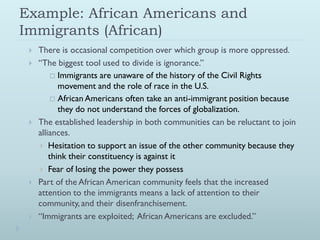
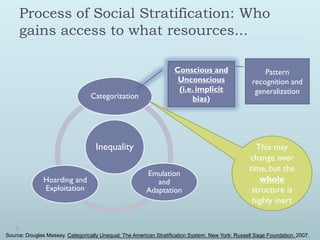
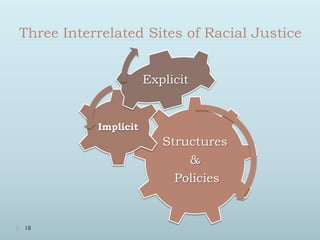
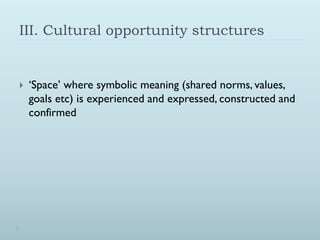
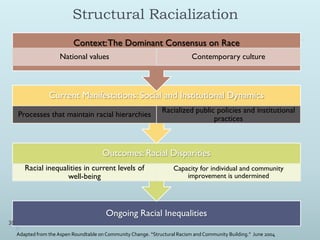
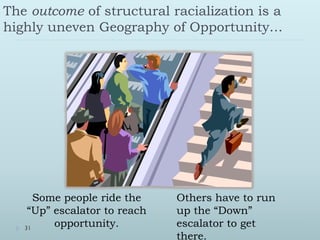
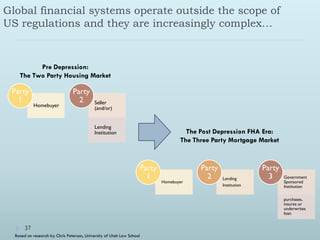
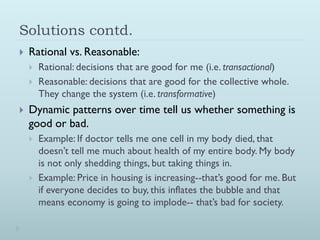
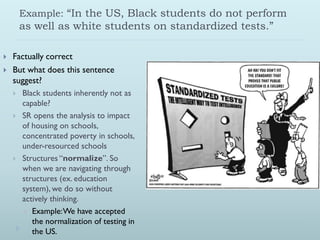
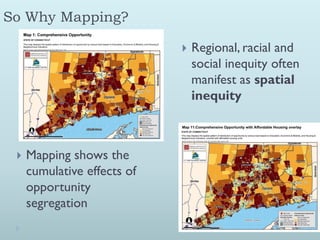
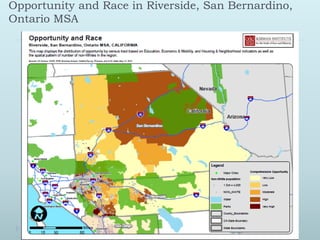
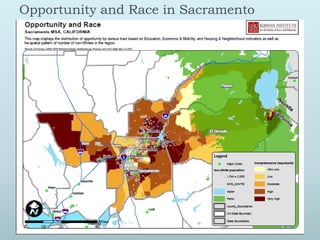
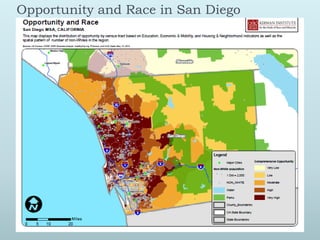
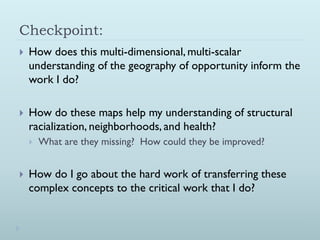
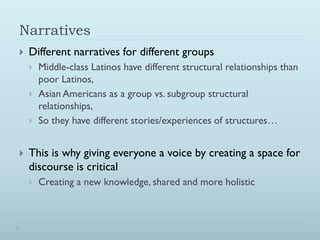
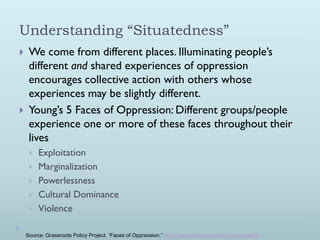
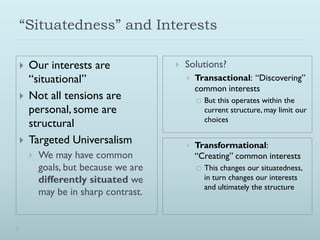
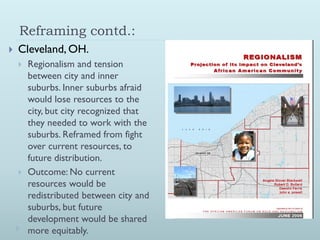
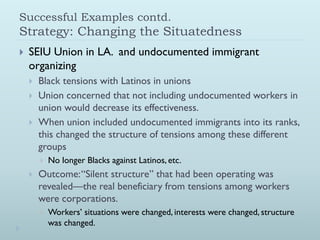
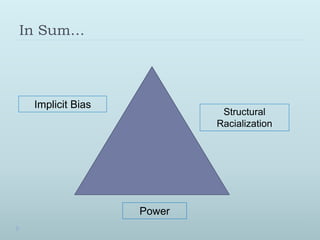
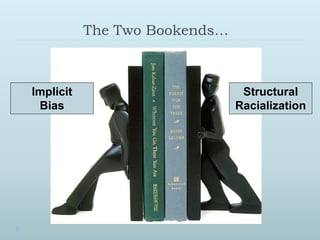
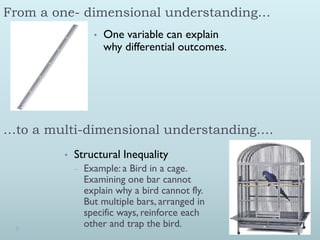
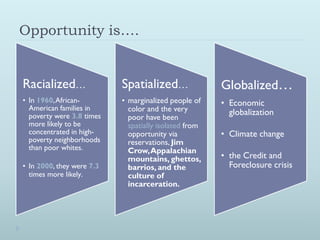
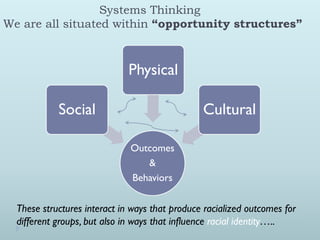
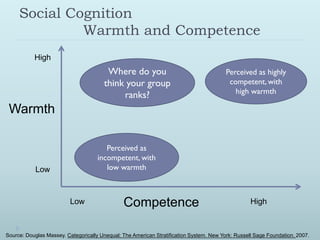
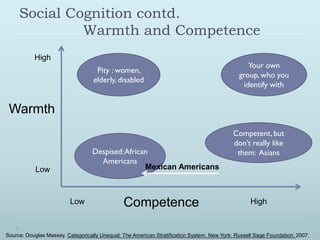
This document summarizes a presentation about structural racialization and opportunity mapping. It discusses how understanding of opportunity has evolved from one-dimensional to multi-dimensional, recognizing the interaction of physical, social, and cultural structures that produce racialized outcomes. It addresses concepts like implicit bias, intergroup relations, and the geography of opportunity. Solutions require recognizing how implicit and explicit biases interact with policies and institutions to maintain racial hierarchies through processes like categorization, inequality, and exploitation. Mapping is presented as a way to show the spatial inequities produced by opportunity segregation and the cumulative effects of structures that mediate different groups' access to resources.

![Studies of Intergroup Relations
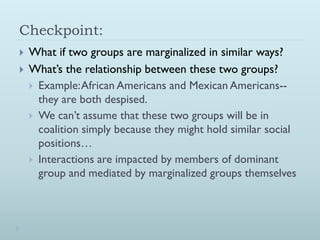
Rodriguez and Segura (2004). Latinos and Blacks often share socioeconomic
circumstances, but these shared circumstances “lead to shared positions only
when the similarity of circumstances and their root causes are accurately
perceived. .. [However] middle class Latinos or higher educated African-
Americans might not necessarily perceive their own co-ethnics, let alone the
other group, as sharing needs and, hence, political interests.” (10)
“While common circumstances may lead to the perception of shared
interests, there is simultaneously a second likely effect – the very high
likelihood that these groups will be forced to engage in competition
over jobs, over control of labor unions and sectors of the economy, and even
over demographic hegemony at the neighborhood level.” (11)
To the extent it exists, is emerging cooperation the product of genuinely
shared values and preferences, or rather the result of circumstances and
structured choices?](https://image.slidesharecdn.com/20100527tcetraining-110924121256-phpapp01/85/Structural-Racialization-and-Opportunity-Mapping-13-320.jpg)
![Intergroup Relations, contd.
Kaufman (2007).“In the multiethnic city, the minority group that
garners the top spot in the political arena gets a disproportionate
amount of [these] resources…. In this ‘winner takes most’ system of
minority rewards, the prospect of being in the winning coalition is a
powerful incentive to coalesce with White voters against competing
minority groups.” (87)
It’s a 3-player game, and the minority group in coalition with
Whites always wins.
McClain et. al. (2006). Study found that “the overwhelming majority
of Latino immigrant respondents (78.3%) feel that they have the
most in common with whites and the least in common with blacks
(52.8%). Curiously, the relatively warm feelings toward whites and
the coolness toward blacks among Latino respondents are not
mutual.” (579-580)](https://image.slidesharecdn.com/20100527tcetraining-110924121256-phpapp01/85/Structural-Racialization-and-Opportunity-Mapping-14-320.jpg)