LIBR534 – Health information sources & services Module IV: Collect Lecture 2- Health Sciences Reference March 18, 2010 Greg Rowell & Dean Giustini, SLAIS Adjunct faculty
Module IV Class 2 - Agenda Principles of Hospital Medical Reference Reference Competencies Review Medical Informatics education – Hersch, 2002 BREAK General Health and Medical Reference Consumer Health Complementary and Alternative Medicine Rowell-Giustini – LIBR534
Rowell-Giustini – LIBR534 Learning Objectives  At completion of class, you should have an overview of:  Who uses Health Sciences Libraries  Role and impact of information in clinical care  Core competencies and roles of HSL librarians in a changing health environment Consumer Health Information sources and issues CAM sources and issues
Rowell-Giustini – LIBR534 Definition of reference in HSLs Reference services in a health sciences library may be broadly defined as... “ any assistance given by the library staff to users seeking information…”  Type of reference service provided depends on library setting, type of library services offered, who the patron is and the type of  information they   want
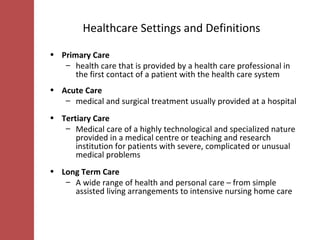
Healthcare Settings and Definitions Primary Care health care that is provided by a health care professional in the first contact of a patient with the health care system  Acute Care medical and surgical treatment usually provided at a hospital Tertiary Care Medical care of a highly technological and specialized nature provided in a medical centre or teaching and research institution for patients with severe, complicated or unusual medical problems  Long Term Care A wide range of health and personal care – from simple assisted living arrangements to intensive nursing home care
Rowell-Giustini – LIBR534 Who is asking? Doctors Nurses Pharmacologists, OT, PT, RT, X-Ray Perfusionists,  Dieticians Administrators Researchers Students  Patients and family members
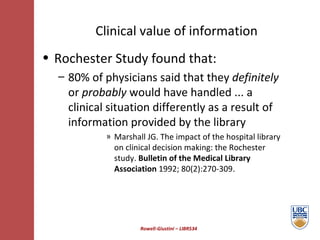
Clinical value of information Rowell-Giustini – LIBR534 Rochester Study found that: 80% of physicians said that they  definitely  or  probably  would have handled ... a clinical situation differently as a result of information provided by the library Marshall JG. The impact of the hospital library on clinical decision making: the Rochester study.  Bulletin of the Medical Library Association  1992; 80(2):270-309 .
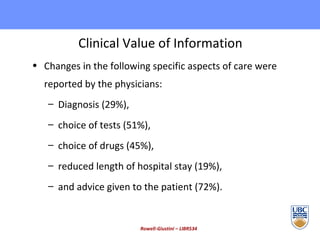
Clinical Value of Information Changes in the following specific aspects of care were reported by the physicians:  Diagnosis (29%),  choice of tests (51%),  choice of drugs (45%),  reduced length of hospital stay (19%), and advice given to the patient (72%). Rowell-Giustini – LIBR534
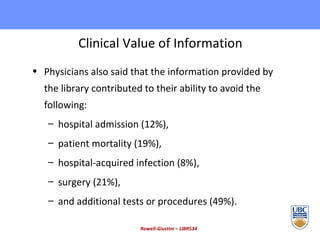
Clinical Value of Information Physicians also said that the information provided by the library contributed to their ability to avoid the following: hospital admission (12%),  patient mortality (19%),  hospital-acquired infection (8%),  surgery (21%),  and additional tests or procedures (49%).  Rowell-Giustini – LIBR534
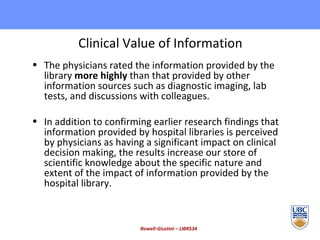
Clinical Value of Information The physicians rated the information provided by the library  more highly  than that provided by other information sources such as diagnostic imaging, lab tests, and discussions with colleagues. In addition to confirming earlier research findings that information provided by hospital libraries is perceived by physicians as having a significant impact on clinical decision making, the results increase our store of scientific knowledge about the specific nature and extent of the impact of information provided by the hospital library. Rowell-Giustini – LIBR534
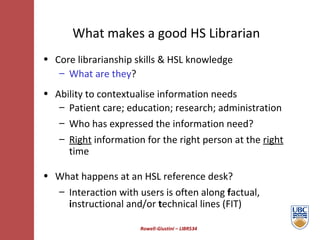
Rowell-Giustini – LIBR534 What makes a good HS Librarian Core librarianship skills & HSL knowledge What are they ? Ability to contextualise information needs  Patient care; education; research; administration  Who has expressed the information need? Right  information for the right person at the  right  time What happens at an HSL reference desk? Interaction with users is often along  f actual,  i nstructional and/or  t echnical lines (FIT)
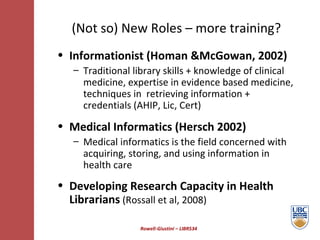
Rowell-Giustini – LIBR534 (Not so) New Roles – more training? Informationist (Homan &McGowan, 2002) Traditional library skills + knowledge of clinical medicine, expertise in evidence based medicine, techniques in  retrieving information + credentials (AHIP, Lic, Cert) Medical Informatics (Hersch 2002) Medical informatics is the field concerned with acquiring, storing, and using information in health care Developing Research Capacity in Health   Librarians   (Rossall et al, 2008)
CADTH Seminar / Web Cast Health Information — Is it a Public Good? http://www.cadth.ca/index.php/en/events/webcast-public-good

2010 03 18 Mod 4 Class 2

  • 1.
    LIBR534 – Healthinformation sources & services Module IV: Collect Lecture 2- Health Sciences Reference March 18, 2010 Greg Rowell & Dean Giustini, SLAIS Adjunct faculty
  • 2.
    Module IV Class2 - Agenda Principles of Hospital Medical Reference Reference Competencies Review Medical Informatics education – Hersch, 2002 BREAK General Health and Medical Reference Consumer Health Complementary and Alternative Medicine Rowell-Giustini – LIBR534
  • 3.
    Rowell-Giustini – LIBR534Learning Objectives At completion of class, you should have an overview of: Who uses Health Sciences Libraries Role and impact of information in clinical care Core competencies and roles of HSL librarians in a changing health environment Consumer Health Information sources and issues CAM sources and issues
  • 4.
    Rowell-Giustini – LIBR534Definition of reference in HSLs Reference services in a health sciences library may be broadly defined as... “ any assistance given by the library staff to users seeking information…” Type of reference service provided depends on library setting, type of library services offered, who the patron is and the type of information they want
  • 5.
    Healthcare Settings andDefinitions Primary Care health care that is provided by a health care professional in the first contact of a patient with the health care system Acute Care medical and surgical treatment usually provided at a hospital Tertiary Care Medical care of a highly technological and specialized nature provided in a medical centre or teaching and research institution for patients with severe, complicated or unusual medical problems Long Term Care A wide range of health and personal care – from simple assisted living arrangements to intensive nursing home care
  • 6.
    Rowell-Giustini – LIBR534Who is asking? Doctors Nurses Pharmacologists, OT, PT, RT, X-Ray Perfusionists, Dieticians Administrators Researchers Students Patients and family members
  • 7.
    Clinical value ofinformation Rowell-Giustini – LIBR534 Rochester Study found that: 80% of physicians said that they definitely or probably would have handled ... a clinical situation differently as a result of information provided by the library Marshall JG. The impact of the hospital library on clinical decision making: the Rochester study. Bulletin of the Medical Library Association 1992; 80(2):270-309 .
  • 8.
    Clinical Value ofInformation Changes in the following specific aspects of care were reported by the physicians: Diagnosis (29%), choice of tests (51%), choice of drugs (45%), reduced length of hospital stay (19%), and advice given to the patient (72%). Rowell-Giustini – LIBR534
  • 9.
    Clinical Value ofInformation Physicians also said that the information provided by the library contributed to their ability to avoid the following: hospital admission (12%), patient mortality (19%), hospital-acquired infection (8%), surgery (21%), and additional tests or procedures (49%). Rowell-Giustini – LIBR534
  • 10.
    Clinical Value ofInformation The physicians rated the information provided by the library more highly than that provided by other information sources such as diagnostic imaging, lab tests, and discussions with colleagues. In addition to confirming earlier research findings that information provided by hospital libraries is perceived by physicians as having a significant impact on clinical decision making, the results increase our store of scientific knowledge about the specific nature and extent of the impact of information provided by the hospital library. Rowell-Giustini – LIBR534
  • 11.
    Rowell-Giustini – LIBR534What makes a good HS Librarian Core librarianship skills & HSL knowledge What are they ? Ability to contextualise information needs Patient care; education; research; administration Who has expressed the information need? Right information for the right person at the right time What happens at an HSL reference desk? Interaction with users is often along f actual, i nstructional and/or t echnical lines (FIT)
  • 12.
    Rowell-Giustini – LIBR534(Not so) New Roles – more training? Informationist (Homan &McGowan, 2002) Traditional library skills + knowledge of clinical medicine, expertise in evidence based medicine, techniques in retrieving information + credentials (AHIP, Lic, Cert) Medical Informatics (Hersch 2002) Medical informatics is the field concerned with acquiring, storing, and using information in health care Developing Research Capacity in Health Librarians (Rossall et al, 2008)
  • 13.
    CADTH Seminar /Web Cast Health Information — Is it a Public Good? http://www.cadth.ca/index.php/en/events/webcast-public-good

Editor's Notes

  • #9 In addition to confirming earlier research findings that information provided by hospital libraries is perceived by physicians as having a significant impact on clinical decision making, the results increase our store of scientific knowledge about the specific nature and extent of the impact of information provided by the hospital library.
  • #10 In addition to confirming earlier research findings that information provided by hospital libraries is perceived by physicians as having a significant impact on clinical decision making, the results increase our store of scientific knowledge about the specific nature and extent of the impact of information provided by the hospital library.
  • #11 In addition to confirming earlier research findings that information provided by hospital libraries is perceived by physicians as having a significant impact on clinical decision making, the results increase our store of scientific knowledge about the specific nature and extent of the impact of information provided by the hospital library.
  • #12 Library Catalogue Reference Competencies doc