© BBC MMIX
Jonathan Hassell
Acting Chair, BSi IST/45
European Accessibility Summit, Frankfurt am Main
27th
March 2009
British Accessibility Standards
- PAS-78 to BS8878
© BBC MMIX
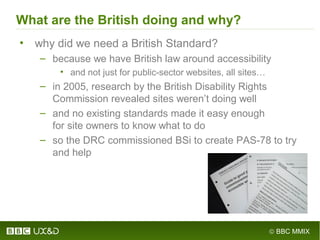
What are the British doing and why?
• why did we need a British Standard?
– because we have British law around accessibility
• and not just for public-sector websites, all sites…
– in 2005, research by the British Disability Rights
Commission revealed sites weren’t doing well
– and no existing standards made it easy enough
for site owners to know what to do
– so the DRC commissioned BSi to create PAS-78 to try
and help
© BBC MMIX
Aims of PAS-78
– to give a guide to the whole process of commissioning,
producing and maintaining a website from a site owner’s
point of view
– to not replace other standards, but to provide a non-
technical person’s guide to how those standards should
be used to help ensure a development project results in an
accessible product
– it focuses on, advising site owners on:
• a quick background in disabled people’s use of the web;
• how to create an accessibility policy for the creation of their site
• what to look for if they are contracting the work out to a supplier
• how to choose technologies to uphold that policy
(making much reference to WAI)
• how to test the resulting site against that policy
– are best-efforts enough cf guidelines, or does it actually have to
work with users?
© BBC MMIX
Drivers to bring PAS-78 up to date…
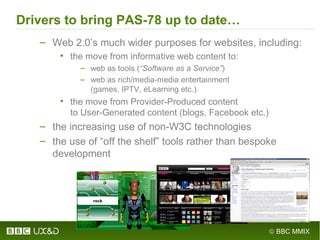
– Web 2.0’s much wider purposes for websites, including:
• the move from informative web content to:
– web as tools (“Software as a Service”)
– web as rich/media-media entertainment
(games, IPTV, eLearning etc.)
• the move from Provider-Produced content
to User-Generated content (blogs, Facebook etc.)
– the increasing use of non-W3C technologies
– the use of “off the shelf” tools rather than bespoke
development
© BBC MMIX
BS8878 – progress and debate
– work began early 2008
– a first draft was created by end Nov 2008
(before WCAG 2 was confirmed)
• NB. the final version is very likely to use WCAG 2 as the base of
its technical guidelines
– there were some things which were maybe a bit premature in
the first draft
– however, the comments on the draft have been very
illuminating on its future direction
– many of the comments completely disagree with each
other on many fundamental issues
– it’s already obvious that our standard, like many out there,
cannot please everyone
– but, from these comments, we know what issues it must
cover
© BBC MMIX
The big issues BS8878 will cover
– whether accessibility is about disabled people or more than that
• are we talking about accessibility to users, devices or browsers?
• if users: whether we are aiming for “access for all”, access for targeted groups of
disabled users, or should include the needs of elderly people
– whether the level of access to aim for should be
accessibility, usability, or even user-experience
– whether the standard should dictate a level of conformance…
• or be a best practice guide stating a number of levels which could be aimed for and
the implications of selecting each level
– what the best way of testing is: how well automated or manual checklist
testing based on a standard (like WCAG 2), or task-based user testing with
disabled people, can capture barriers for disabled people
– how to avoid being too constraining about technology use
– when we should encourage best practice in interfacing with assistive
technologies and when to encourage sites to provide accessibility features
or preferences themselves (personalisation)
– how much to include guidance on authoring tools (cf. ATAG)
© BBC MMIX
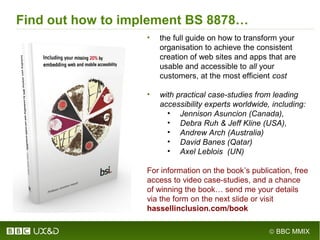
• the full guide on how to transform your
organisation to achieve the consistent
creation of web sites and apps that are
usable and accessible to all your
customers, at the most efficient cost
• with practical case-studies from leading
accessibility experts worldwide, including:
• Jennison Asuncion (Canada),
• Debra Ruh & Jeff Kline (USA),
• Andrew Arch (Australia)
• David Banes (Qatar)
• Axel Leblois (UN)
For information on the book’s publication, free
access to video case-studies, and a chance
of winning the book… send me your details
via the form on the next slide or visit
hassellinclusion.com/book
Find out how to implement BS 8878…
© BBC MMIX
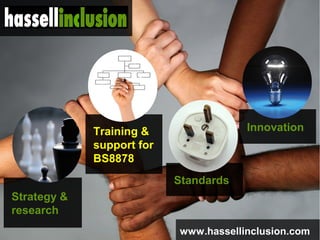
Training &
support for
BS8878
Standards
Innovation
www.hassellinclusion.com
Strategy &
research
© BBC MMIX
e: jonathan@hassellinclusion.com
t: @jonhassell
w: www.hassellinclusion.com
Contact me
© BBC MMIX
e: jonathan@hassellinclusion.com
t: @jonhassell
w: www.hassellinclusion.com
Contact me

2009: British Accessibility Standards - PAS-78 to BS8878

  • 1.
    © BBC MMIX JonathanHassell Acting Chair, BSi IST/45 European Accessibility Summit, Frankfurt am Main 27th March 2009 British Accessibility Standards - PAS-78 to BS8878
  • 2.
    © BBC MMIX Whatare the British doing and why? • why did we need a British Standard? – because we have British law around accessibility • and not just for public-sector websites, all sites… – in 2005, research by the British Disability Rights Commission revealed sites weren’t doing well – and no existing standards made it easy enough for site owners to know what to do – so the DRC commissioned BSi to create PAS-78 to try and help
  • 3.
    © BBC MMIX Aimsof PAS-78 – to give a guide to the whole process of commissioning, producing and maintaining a website from a site owner’s point of view – to not replace other standards, but to provide a non- technical person’s guide to how those standards should be used to help ensure a development project results in an accessible product – it focuses on, advising site owners on: • a quick background in disabled people’s use of the web; • how to create an accessibility policy for the creation of their site • what to look for if they are contracting the work out to a supplier • how to choose technologies to uphold that policy (making much reference to WAI) • how to test the resulting site against that policy – are best-efforts enough cf guidelines, or does it actually have to work with users?
  • 4.
    © BBC MMIX Driversto bring PAS-78 up to date… – Web 2.0’s much wider purposes for websites, including: • the move from informative web content to: – web as tools (“Software as a Service”) – web as rich/media-media entertainment (games, IPTV, eLearning etc.) • the move from Provider-Produced content to User-Generated content (blogs, Facebook etc.) – the increasing use of non-W3C technologies – the use of “off the shelf” tools rather than bespoke development
  • 5.
    © BBC MMIX BS8878– progress and debate – work began early 2008 – a first draft was created by end Nov 2008 (before WCAG 2 was confirmed) • NB. the final version is very likely to use WCAG 2 as the base of its technical guidelines – there were some things which were maybe a bit premature in the first draft – however, the comments on the draft have been very illuminating on its future direction – many of the comments completely disagree with each other on many fundamental issues – it’s already obvious that our standard, like many out there, cannot please everyone – but, from these comments, we know what issues it must cover
  • 6.
    © BBC MMIX Thebig issues BS8878 will cover – whether accessibility is about disabled people or more than that • are we talking about accessibility to users, devices or browsers? • if users: whether we are aiming for “access for all”, access for targeted groups of disabled users, or should include the needs of elderly people – whether the level of access to aim for should be accessibility, usability, or even user-experience – whether the standard should dictate a level of conformance… • or be a best practice guide stating a number of levels which could be aimed for and the implications of selecting each level – what the best way of testing is: how well automated or manual checklist testing based on a standard (like WCAG 2), or task-based user testing with disabled people, can capture barriers for disabled people – how to avoid being too constraining about technology use – when we should encourage best practice in interfacing with assistive technologies and when to encourage sites to provide accessibility features or preferences themselves (personalisation) – how much to include guidance on authoring tools (cf. ATAG)
  • 7.
    © BBC MMIX •the full guide on how to transform your organisation to achieve the consistent creation of web sites and apps that are usable and accessible to all your customers, at the most efficient cost • with practical case-studies from leading accessibility experts worldwide, including: • Jennison Asuncion (Canada), • Debra Ruh & Jeff Kline (USA), • Andrew Arch (Australia) • David Banes (Qatar) • Axel Leblois (UN) For information on the book’s publication, free access to video case-studies, and a chance of winning the book… send me your details via the form on the next slide or visit hassellinclusion.com/book Find out how to implement BS 8878…
  • 8.
    © BBC MMIX Training& support for BS8878 Standards Innovation www.hassellinclusion.com Strategy & research
  • 9.
    © BBC MMIX e:jonathan@hassellinclusion.com t: @jonhassell w: www.hassellinclusion.com Contact me
  • 10.
    © BBC MMIX e:jonathan@hassellinclusion.com t: @jonhassell w: www.hassellinclusion.com Contact me

Editor's Notes

  • #8 SID:0105
  • #9 Strategy and research researching users needs from technology and how evolving technology directions will present challenges and opportunities to supporting those needs standards setting the right international standards BS8878 => ISO... embedding training consultancy support tools innovation innovation through inclusion inclusion solutions finding the hard/costly barriers for inclusion finding ways to create solutions for them licensing those solutions at low cost to the widest number of websites