1
Red Hat Deep Dive SessionsRed Hat Deep Dive Sessions
Linux on System zLinux on System z
Shawn Wells (swells@redhat.com)
W/W Lead Architect, Linux on System z
Team Lead, System z SMEs
2
Introduction
 Shawn Wells (swells@redhat.com)
Lead Architect, Linux on System z
Team Lead, System z SMEs
Phone: +1 443 534 0130
3
Agenda
 Scheduled questions to be answered in this session:
 What's the Linux on System z development process?
 What's in RHEL now?  What's on the roadmap?
 Provisioning & Patch Management in RHN
 Security Update
SELinux, Audit, etc
Linux on System z
Development Process
5
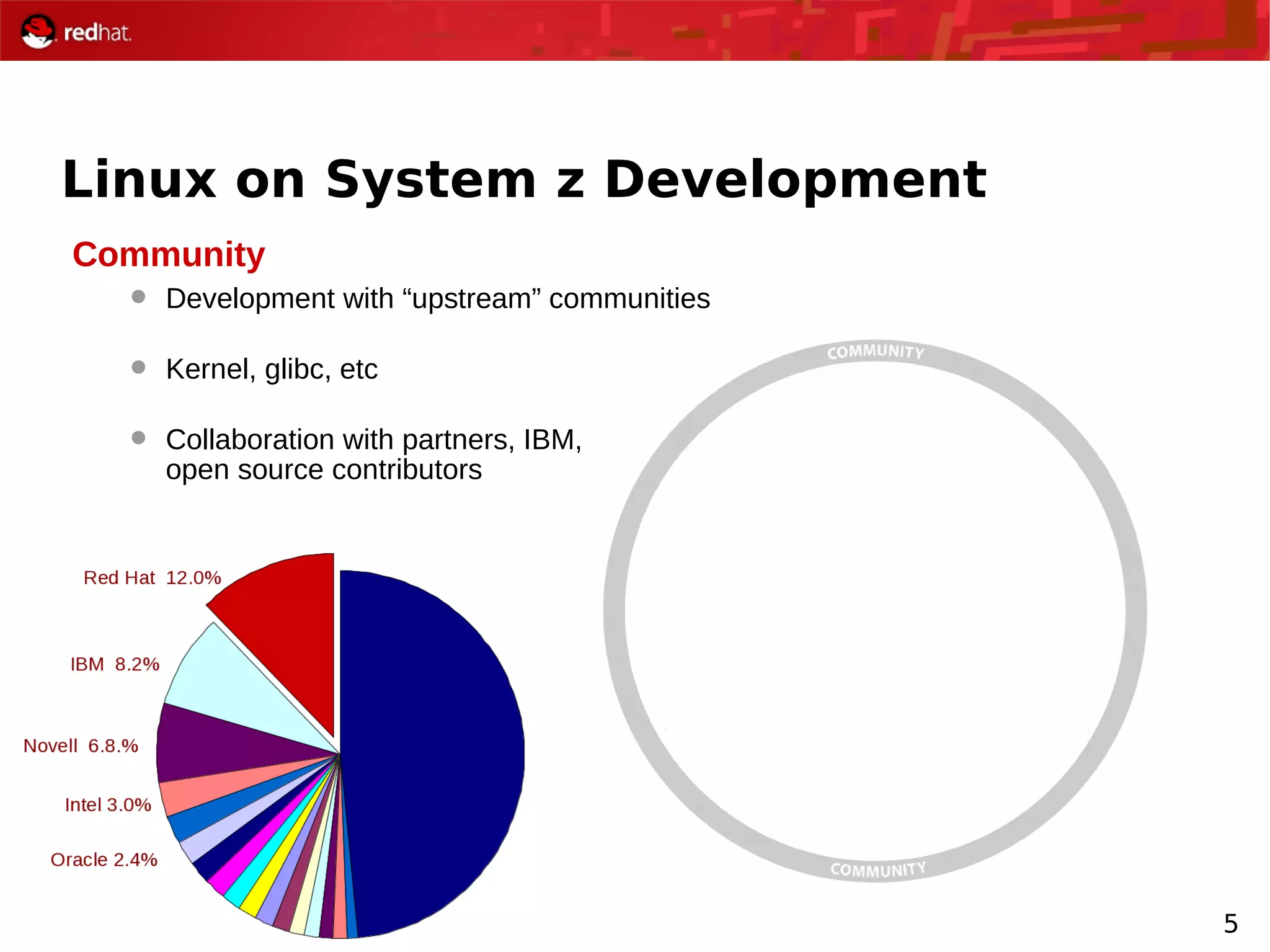
Linux on System z Development
Community
 Development with “upstream” communities
 Kernel, glibc, etc
 Collaboration with partners, IBM,
open source contributors
6
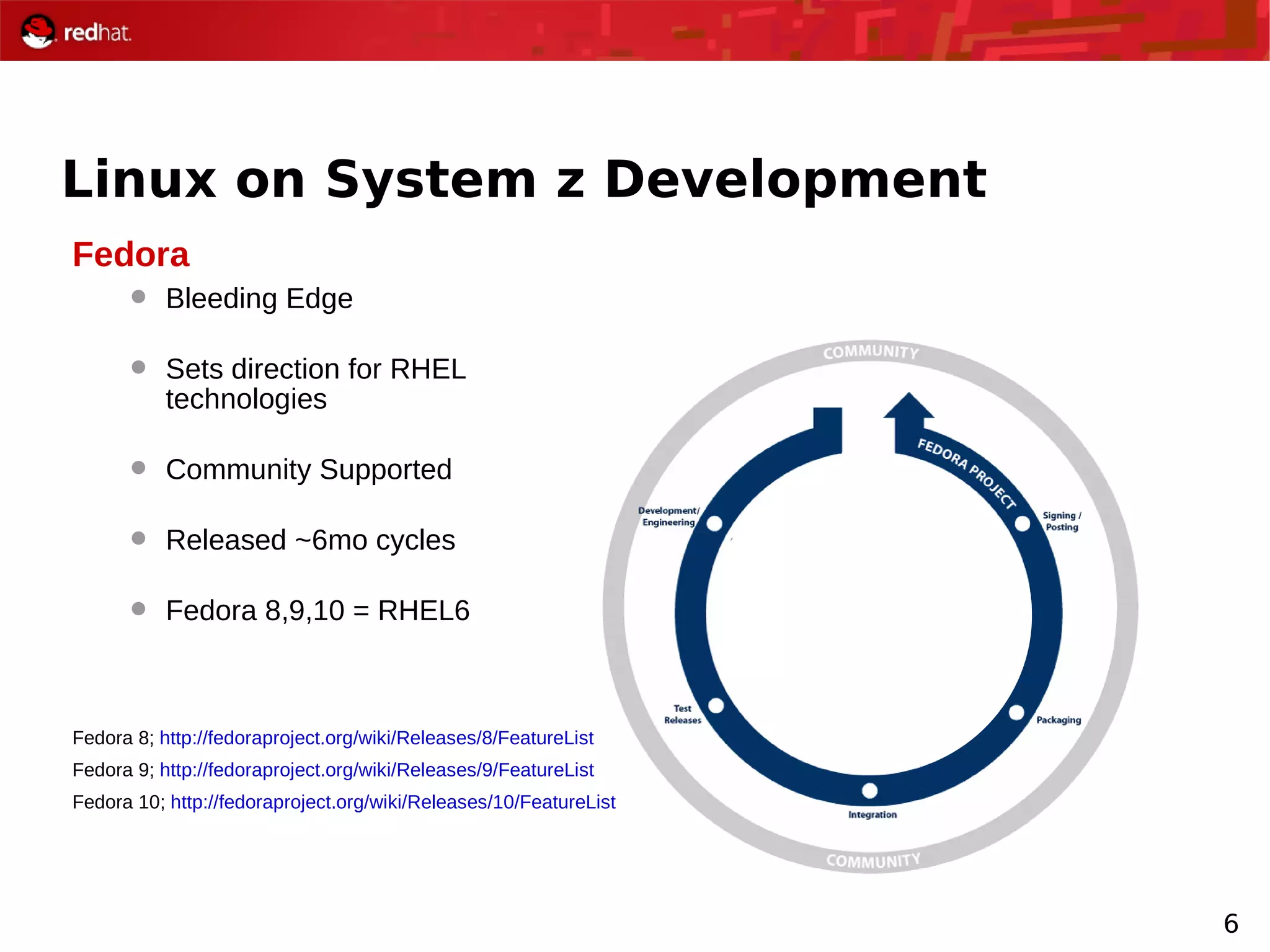
Linux on System z Development
Fedora
 Bleeding Edge
 Sets direction for RHEL
technologies
 Community Supported
 Released ~6mo cycles
 Fedora 8,9,10 = RHEL6
Fedora 8; http://fedoraproject.org/wiki/Releases/8/FeatureList
Fedora 9; http://fedoraproject.org/wiki/Releases/9/FeatureList
Fedora 10; http://fedoraproject.org/wiki/Releases/10/FeatureList
7
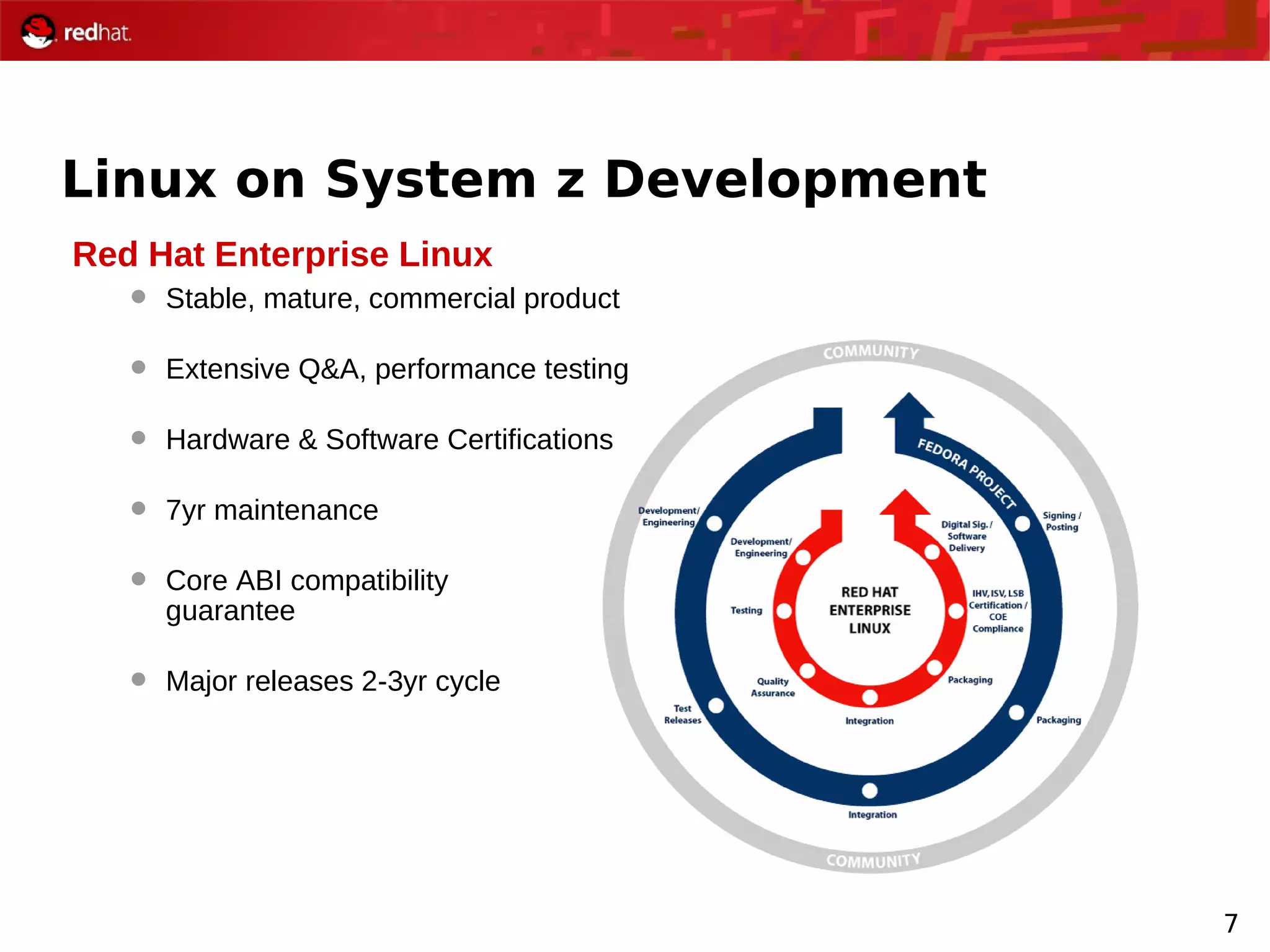
Linux on System z Development
Red Hat Enterprise Linux
 Stable, mature, commercial product
 Extensive Q&A, performance testing
 Hardware & Software Certifications
 7yr maintenance
 Core ABI compatibility
guarantee
 Major releases 2-3yr cycle
8
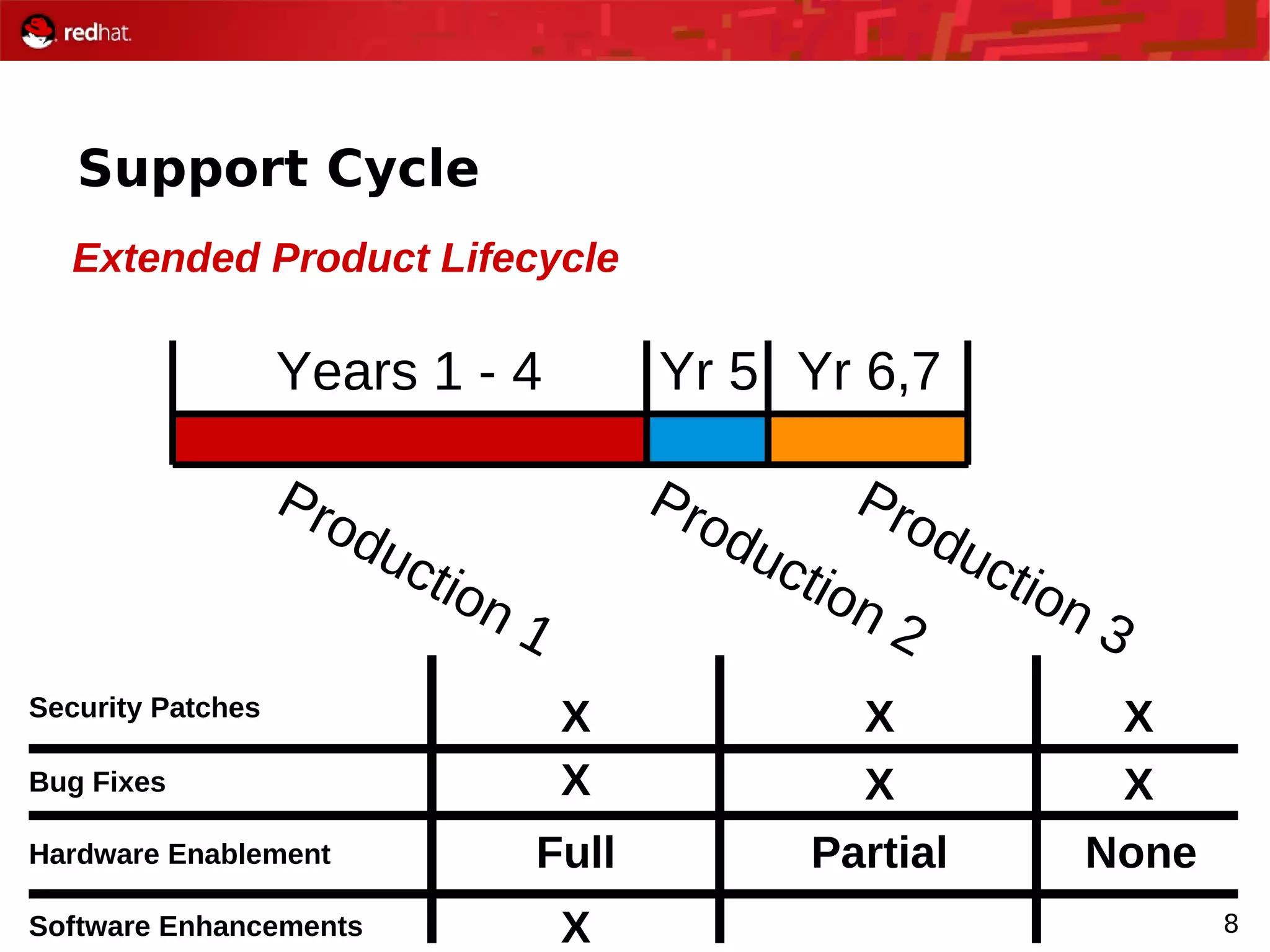
Support Cycle
Extended Product Lifecycle
Years 1 - 4 Yr 6,7Yr 5
Production 1
Production 2
Production 3
Security Patches
Bug Fixes
Hardware Enablement
Software Enhancements
X
X
X
Full
X
X
Partial
X
X
None
9
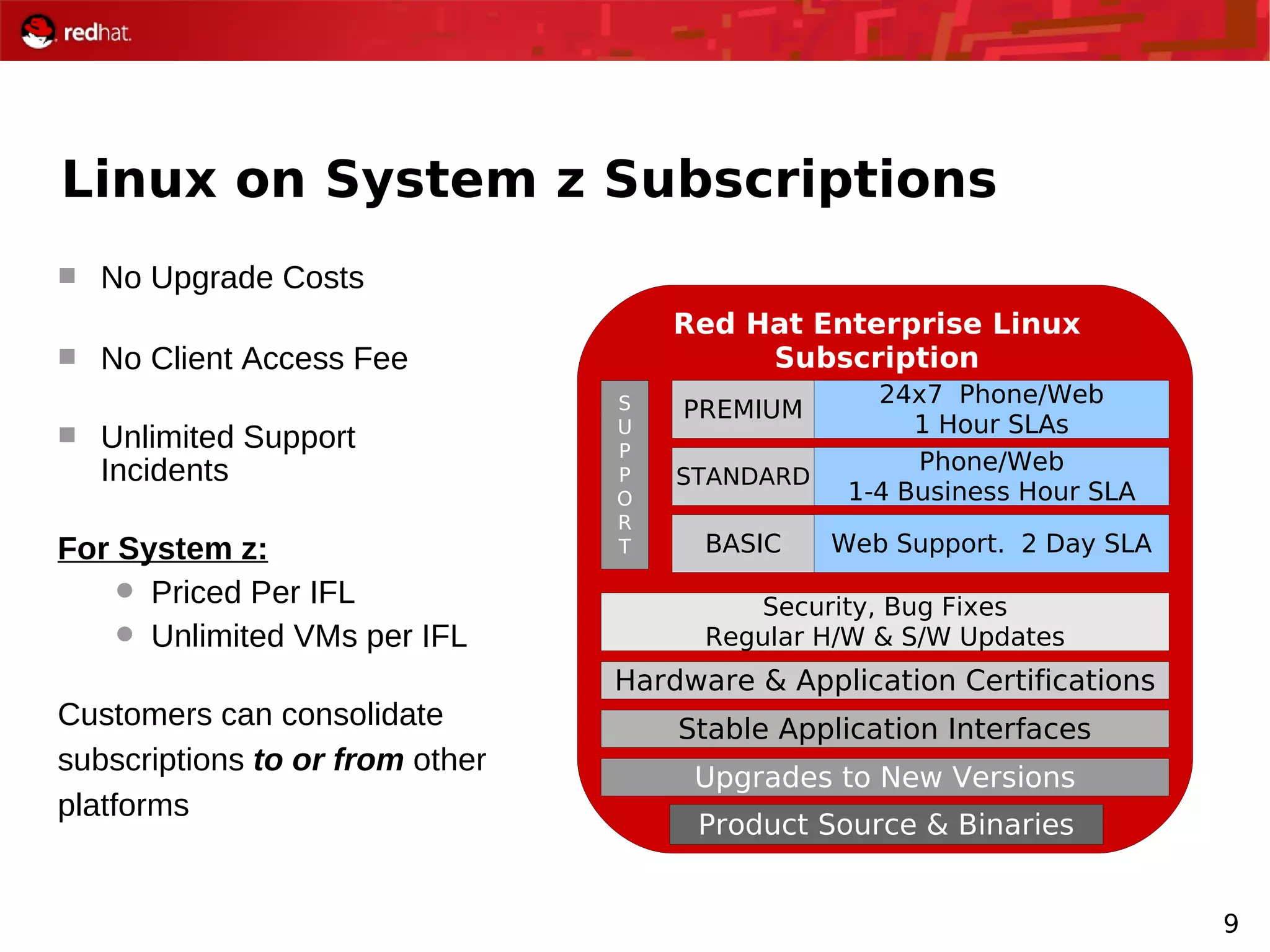
Linux on System z Subscriptions
Product Source & Binaries
Upgrades to New Versions
Stable Application Interfaces
Hardware & Application Certifications
Security, Bug Fixes
Regular H/W & S/W Updates
Web Support. 2 Day SLABASIC
Phone/Web
1-4 Business Hour SLA
STANDARD
24x7 Phone/Web
1 Hour SLAs
PREMIUMS
U
P
P
O
R
T
Red Hat Enterprise Linux
Subscription
 No Upgrade Costs
 No Client Access Fee
 Unlimited Support
Incidents
For System z:
 Priced Per IFL
 Unlimited VMs per IFL
Customers can consolidate
subscriptions to or from other
platforms
10
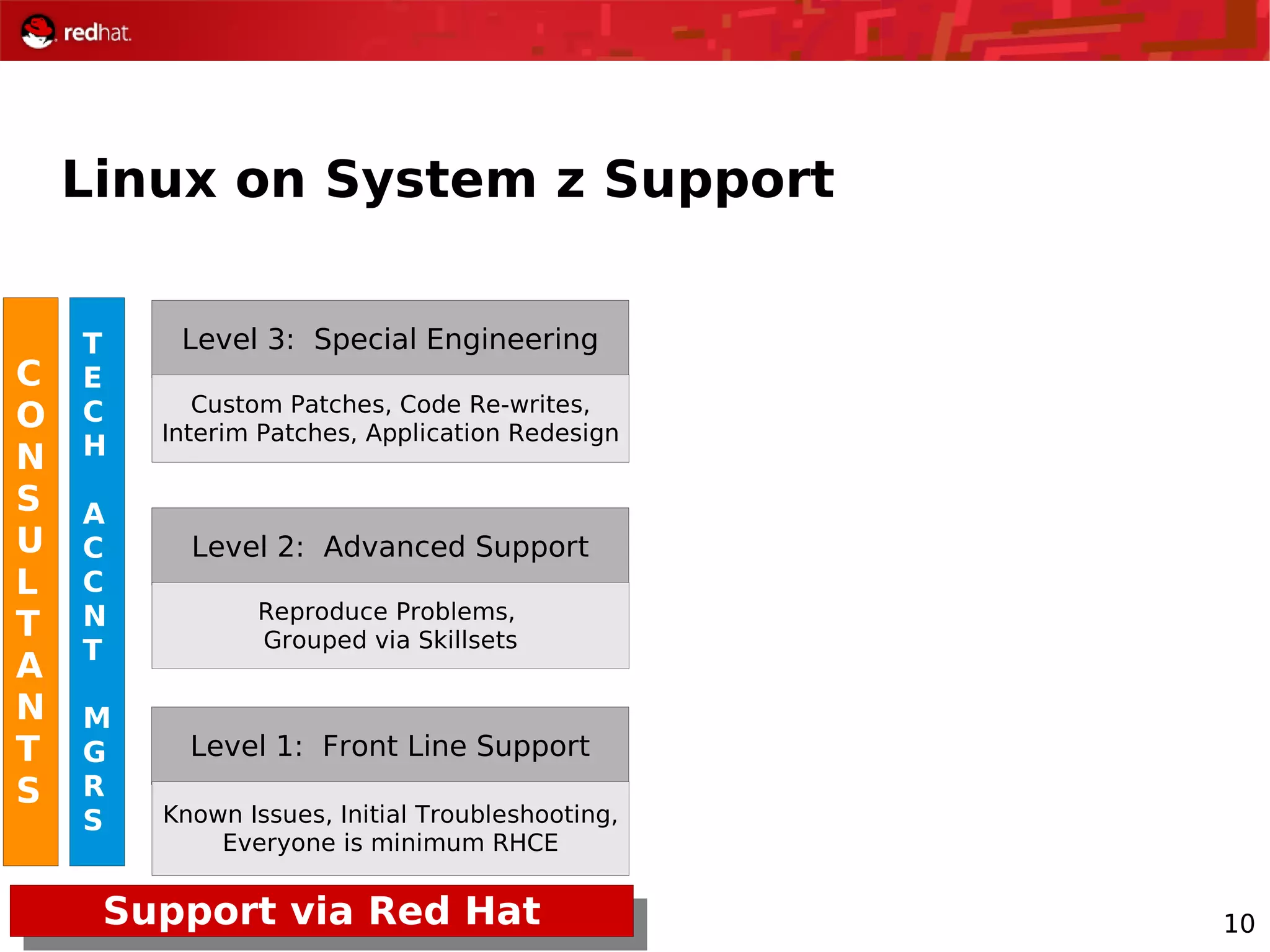
Linux on System z Support
Support via Red Hat
T
E
C
H
A
C
C
N
T
M
G
R
S
Level 1: Front Line Support
Known Issues, Initial Troubleshooting,
Everyone is minimum RHCE
Level 2: Advanced Support
Reproduce Problems,
Grouped via Skillsets
Level 3: Special Engineering
Custom Patches, Code Re-writes,
Interim Patches, Application Redesign
C
O
N
S
U
L
T
A
N
T
S
11
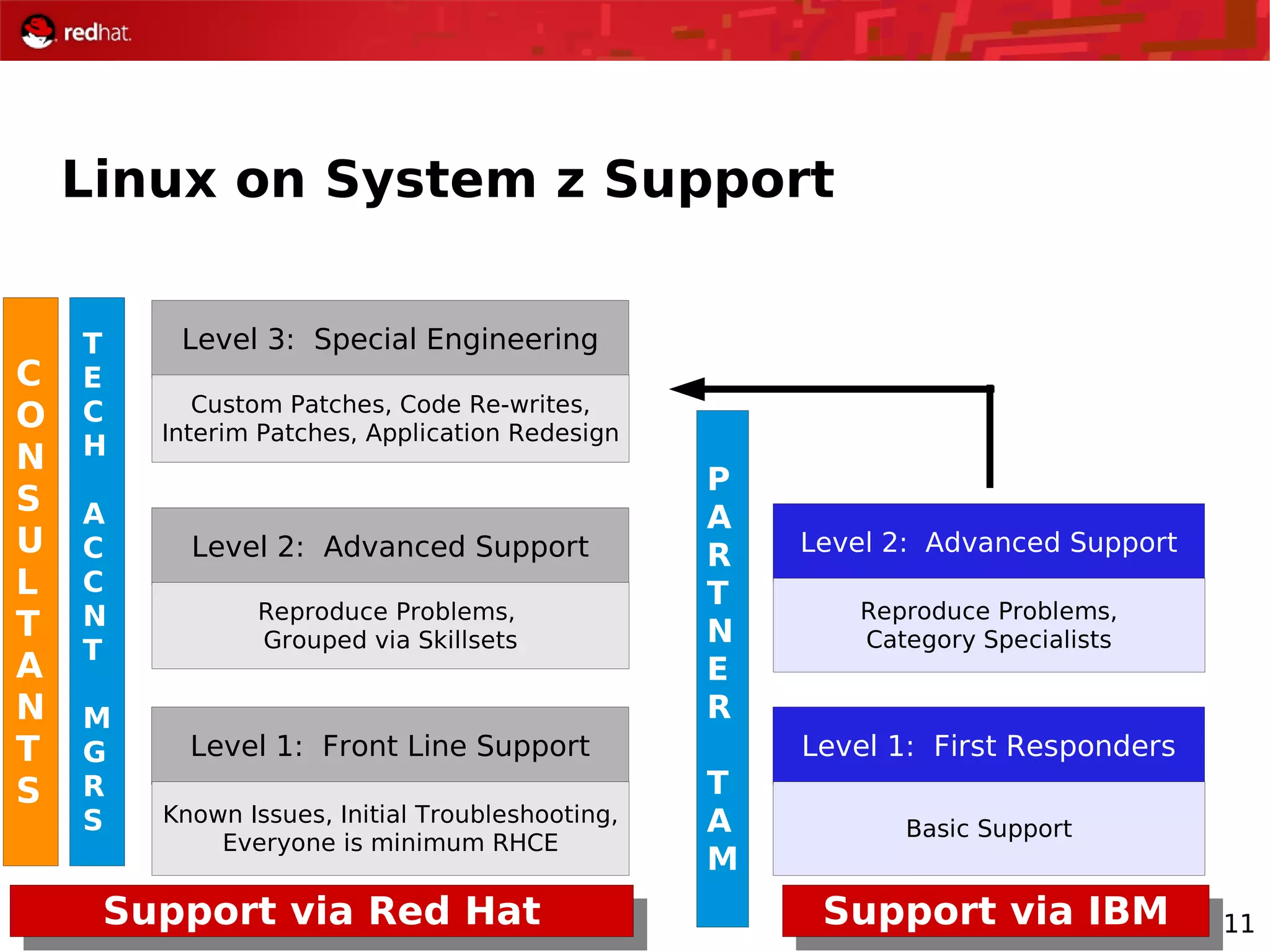
Linux on System z Support
Support via Red Hat
T
E
C
H
A
C
C
N
T
M
G
R
S
Level 1: Front Line Support
Known Issues, Initial Troubleshooting,
Everyone is minimum RHCE
Level 2: Advanced Support
Reproduce Problems,
Grouped via Skillsets
Level 3: Special Engineering
Custom Patches, Code Re-writes,
Interim Patches, Application Redesign
C
O
N
S
U
L
T
A
N
T
S
Support via IBM
Level 1: First Responders
Basic Support
Level 2: Advanced Support
Reproduce Problems,
Category Specialists
P
A
R
T
N
E
R
T
A
M
What's in RHEL now?
What's on the road map?
13
14
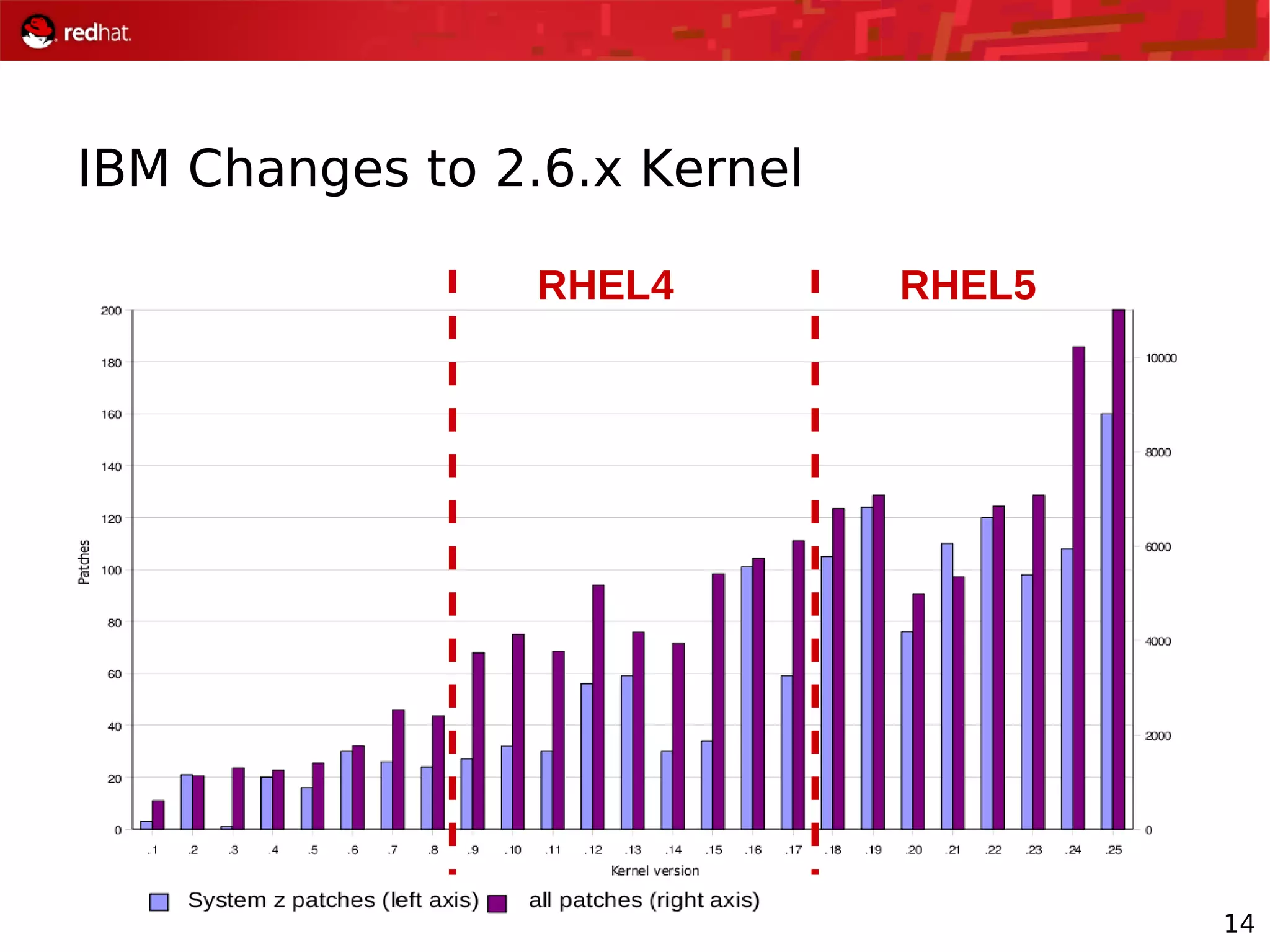
IBM Changes to 2.6.x Kernel
RHEL5RHEL4
15
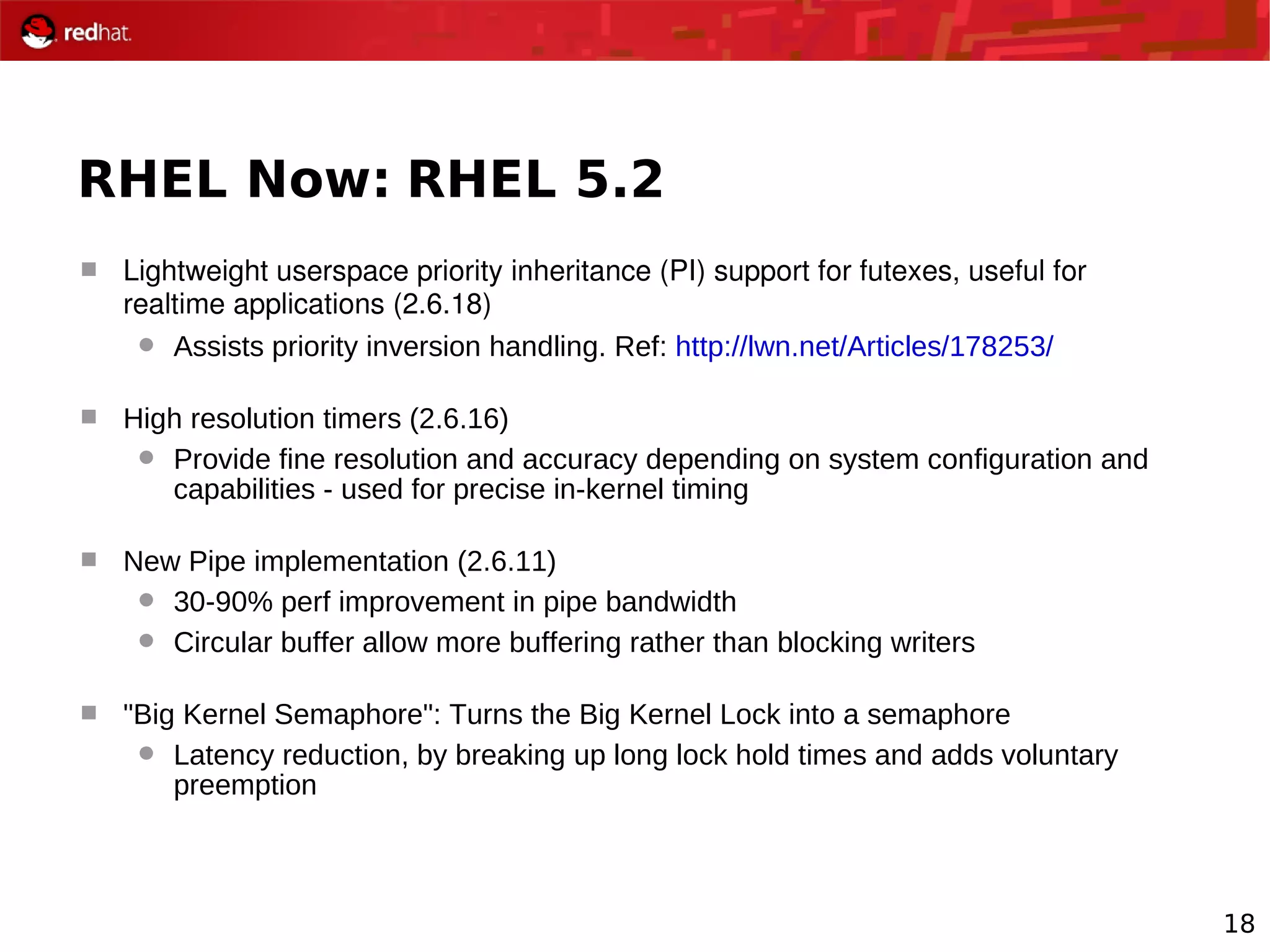
RHEL Now: RHEL 5.2
 Support for z10
 Dynamic CHPID reconfiguration
 Improved “ssh -X” with VPN during installation process
 Better network performance with skb scatter-gather support
 Implementation of SCSI dump infrastructure
16
RHEL Now: RHEL 5.2
 Accelerated in­kernel Crypto
 Support for crypto algorithms of z10
 SHA-512, SHA-384, AES-192, AES-256
 Two OSA ports per CHPID; Four port exploitation
 Exploit next OSA adapter generation which offers two ports within one CHPID. The
additional port number 1 can be specified with the qeth sysfs-attribute “portno”
 Support is available only for OSA-Express3 GbE SX and LX on z10, running in LPAR
or z/VM guest (PFT for z/VM APAR VM64277 required!)
17
RHEL Now: RHEL 5.2
 Large Page Support
 This adds hugetblfs support on System z, using both hardware large page support if
available, and software large page emulation (with shared hugetblfs pagetables) on
older hardware
 skb scatter-gather support for large incoming messages
 This avoids allocating big chunks of consecutive memory and should increase
networking throughput in some situations for large incoming packets
Full Release Notes At: redhat.com
http://www.redhat.com/docs/en-
US/Red_Hat_Enterprise_Linux/5.2/html/Release_Notes/s390x/index.html
18
RHEL Now: RHEL 5.2
 Lightweight userspace priority inheritance (PI) support for futexes, useful for 
realtime applications (2.6.18)
 Assists priority inversion handling. Ref: http://lwn.net/Articles/178253/
 High resolution timers (2.6.16)
 Provide fine resolution and accuracy depending on system configuration and
capabilities - used for precise in-kernel timing
 New Pipe implementation (2.6.11)
 30-90% perf improvement in pipe bandwidth
 Circular buffer allow more buffering rather than blocking writers
 "Big Kernel Semaphore": Turns the Big Kernel Lock into a semaphore
 Latency reduction, by breaking up long lock hold times and adds voluntary
preemption
19
RHEL Now: RHEL 5.2
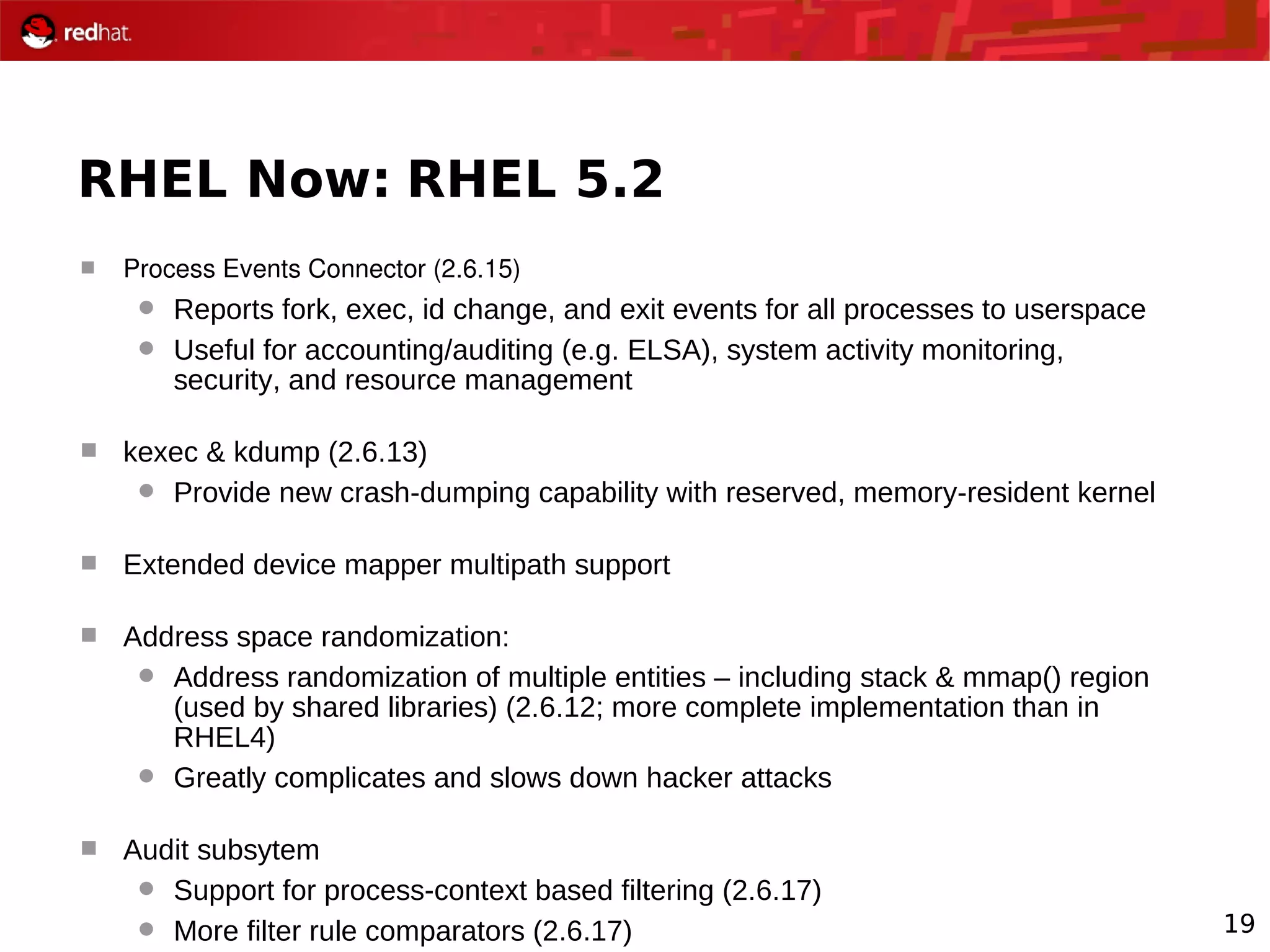
 Process Events Connector (2.6.15)
 Reports fork, exec, id change, and exit events for all processes to userspace
 Useful for accounting/auditing (e.g. ELSA), system activity monitoring,
security, and resource management
 kexec & kdump (2.6.13)
 Provide new crash-dumping capability with reserved, memory-resident kernel
 Extended device mapper multipath support
 Address space randomization:
 Address randomization of multiple entities – including stack & mmap() region
(used by shared libraries) (2.6.12; more complete implementation than in
RHEL4)
 Greatly complicates and slows down hacker attacks
 Audit subsytem
 Support for process-context based filtering (2.6.17)
 More filter rule comparators (2.6.17)
20
RHEL Now: RHEL 5.2
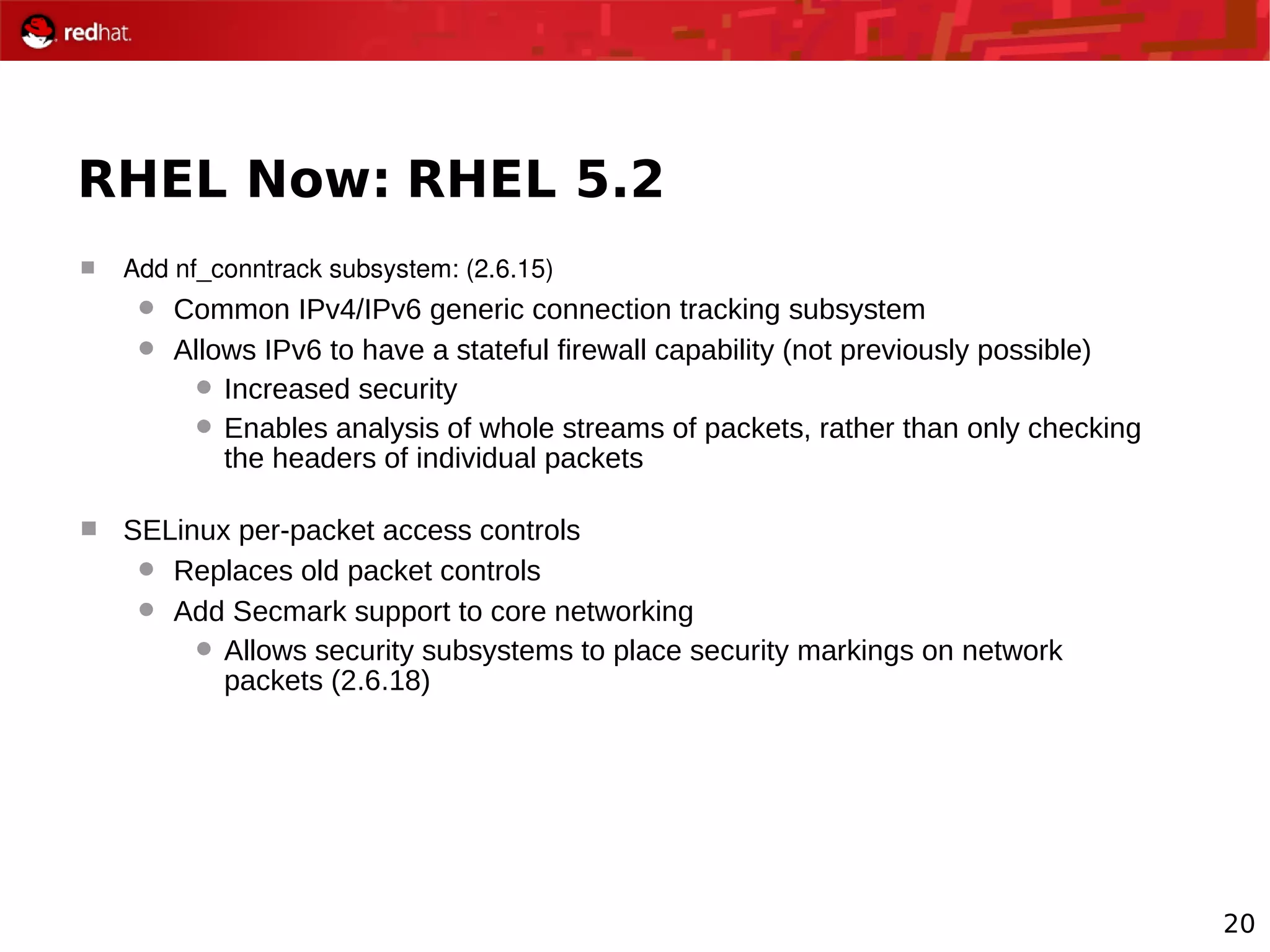
 Add nf_conntrack subsystem: (2.6.15)
 Common IPv4/IPv6 generic connection tracking subsystem
 Allows IPv6 to have a stateful firewall capability (not previously possible)
 Increased security
 Enables analysis of whole streams of packets, rather than only checking
the headers of individual packets
 SELinux per-packet access controls
 Replaces old packet controls
 Add Secmark support to core networking
 Allows security subsystems to place security markings on network
packets (2.6.18)
21
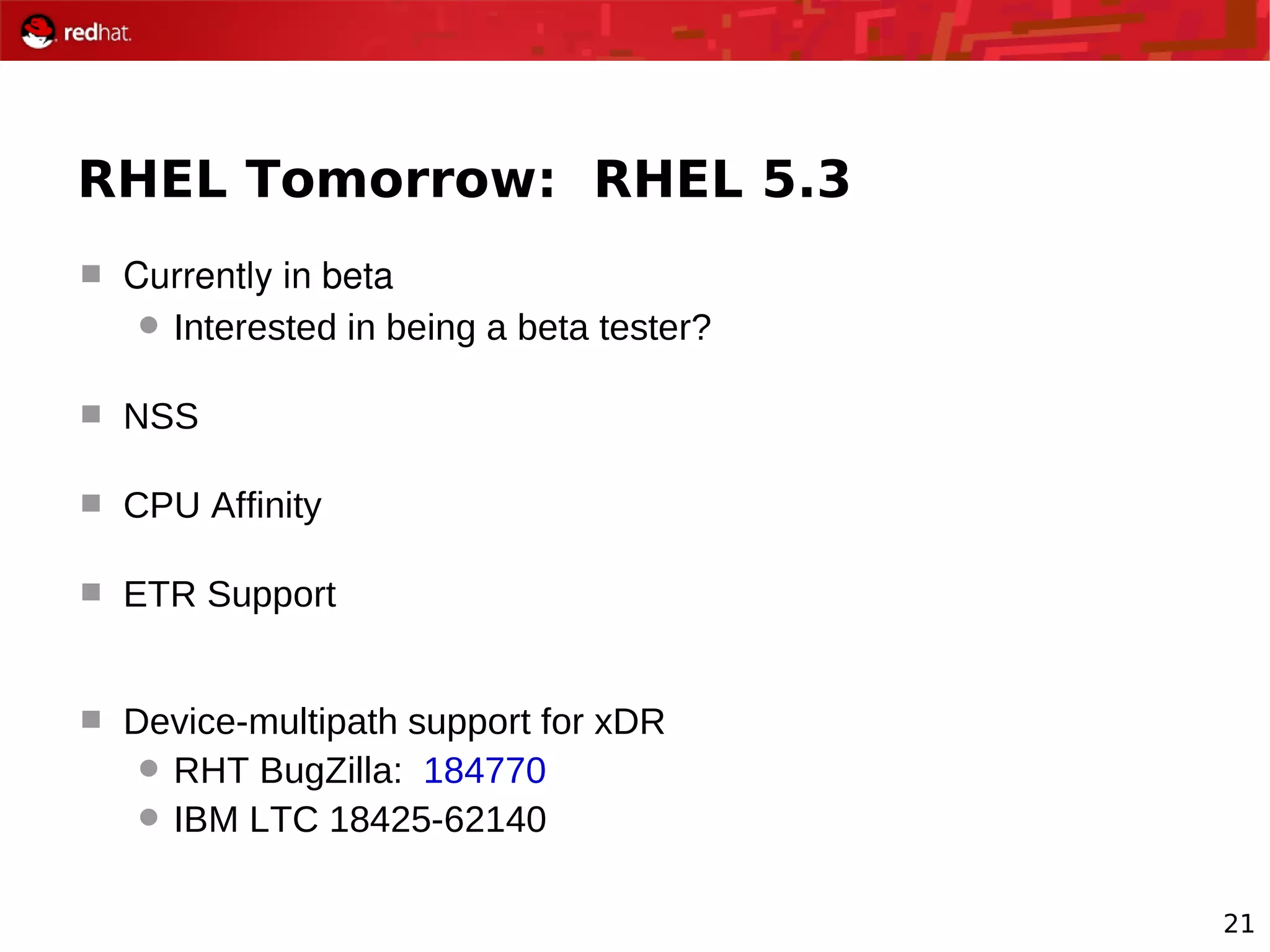
RHEL Tomorrow: RHEL 5.3
 Currently in beta
 Interested in being a beta tester?
 NSS
 CPU Affinity
 ETR Support
 Device-multipath support for xDR
 RHT BugZilla: 184770
 IBM LTC 18425-62140
22
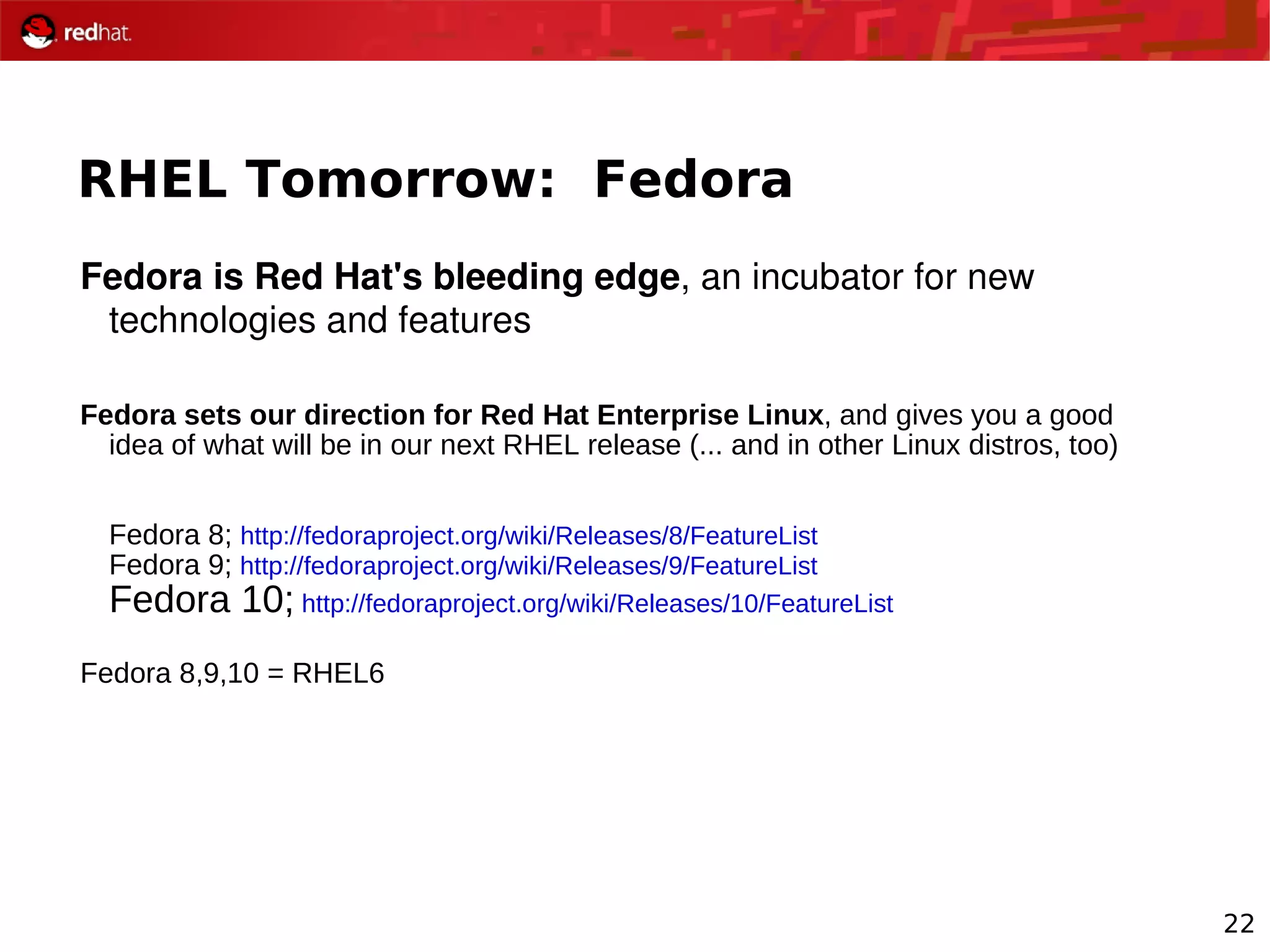
RHEL Tomorrow: Fedora
Fedora is Red Hat's bleeding edge, an incubator for new 
technologies and features
Fedora sets our direction for Red Hat Enterprise Linux, and gives you a good
idea of what will be in our next RHEL release (... and in other Linux distros, too)
Fedora 8; http://fedoraproject.org/wiki/Releases/8/FeatureList
Fedora 9; http://fedoraproject.org/wiki/Releases/9/FeatureList
Fedora 10; http://fedoraproject.org/wiki/Releases/10/FeatureList
Fedora 8,9,10 = RHEL6
23
RHEL Tomorrow: “In Place” Upgrade
Currently a beta feature in RHEL 5.3
“In Place” Upgrades:  preupgrade
Will download files needed to upgrade, 
Store them locally on disk
Reboot you into the installer
Not a true in­place upgrade (yet)!
 Benefit
The longest part of an install is when packages are 
downloaded to the local machine
Pre­Upgrade downloads and stores packages locally, 
while the machine is running/in production
Reboot directly into the installer
24
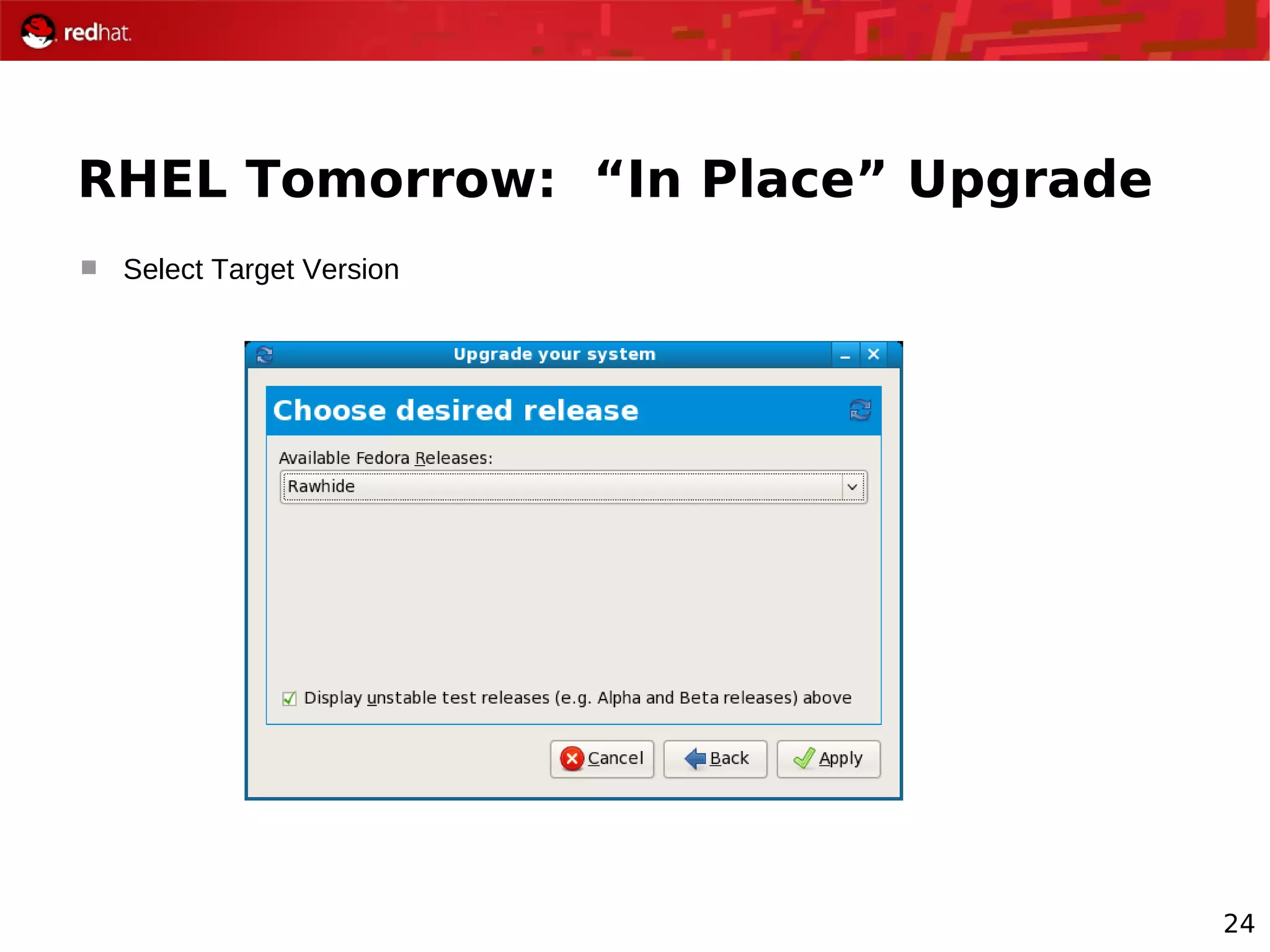
RHEL Tomorrow: “In Place” Upgrade
 Select Target Version
25
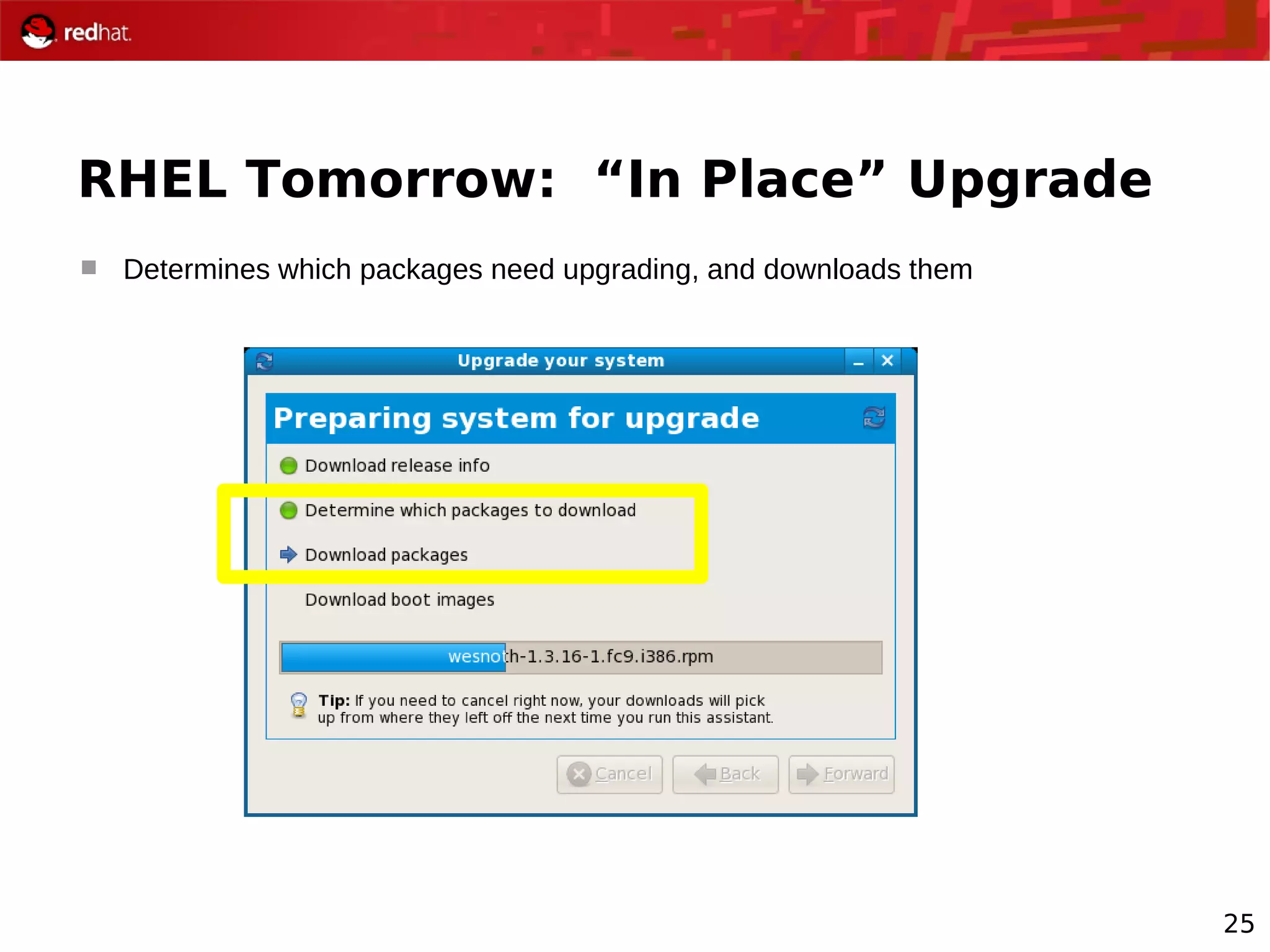
RHEL Tomorrow: “In Place” Upgrade
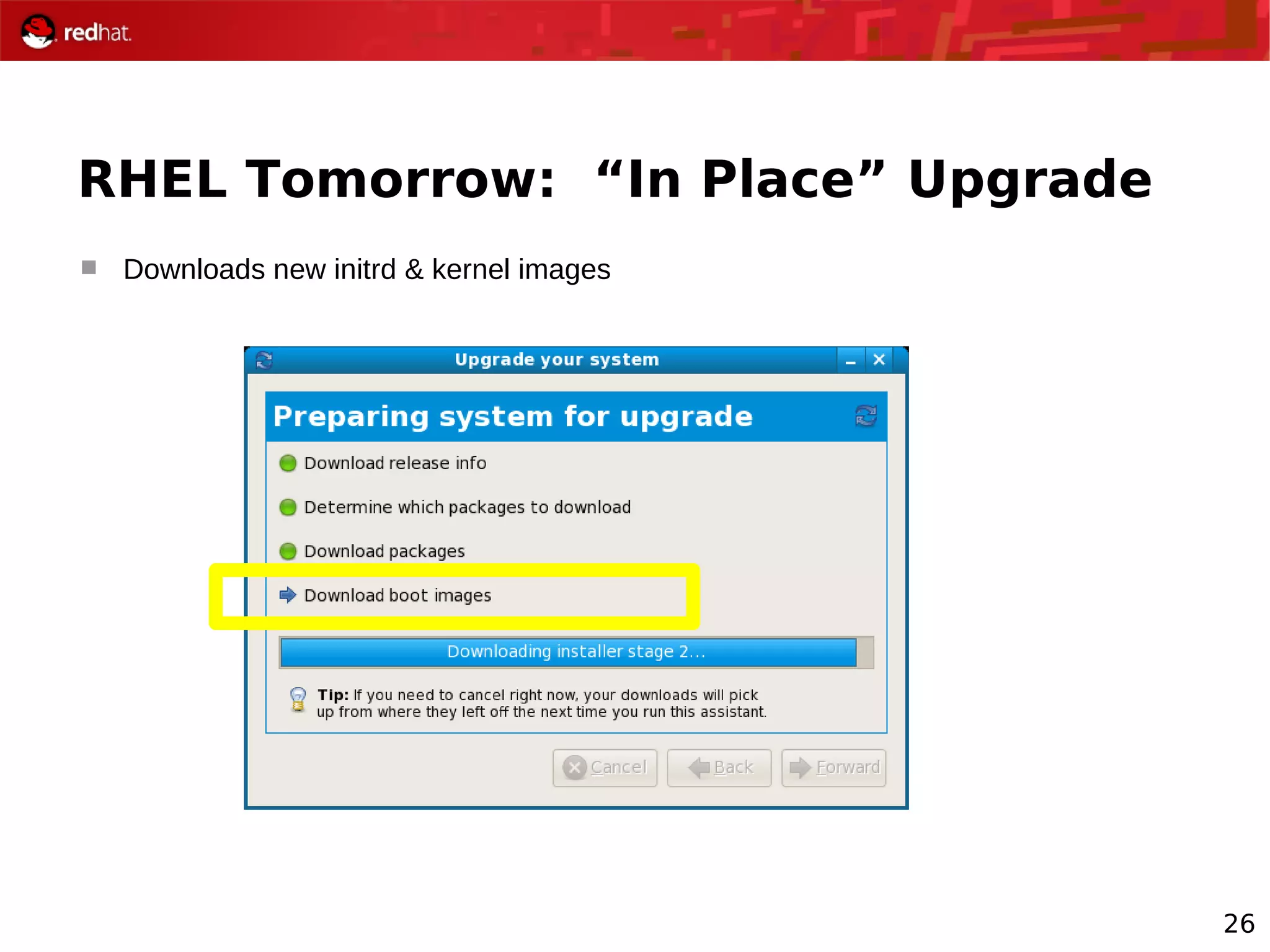
 Determines which packages need upgrading, and downloads them
26
RHEL Tomorrow: “In Place” Upgrade
 Downloads new initrd & kernel images
27
RHEL Tomorrow: “In Place” Upgrade
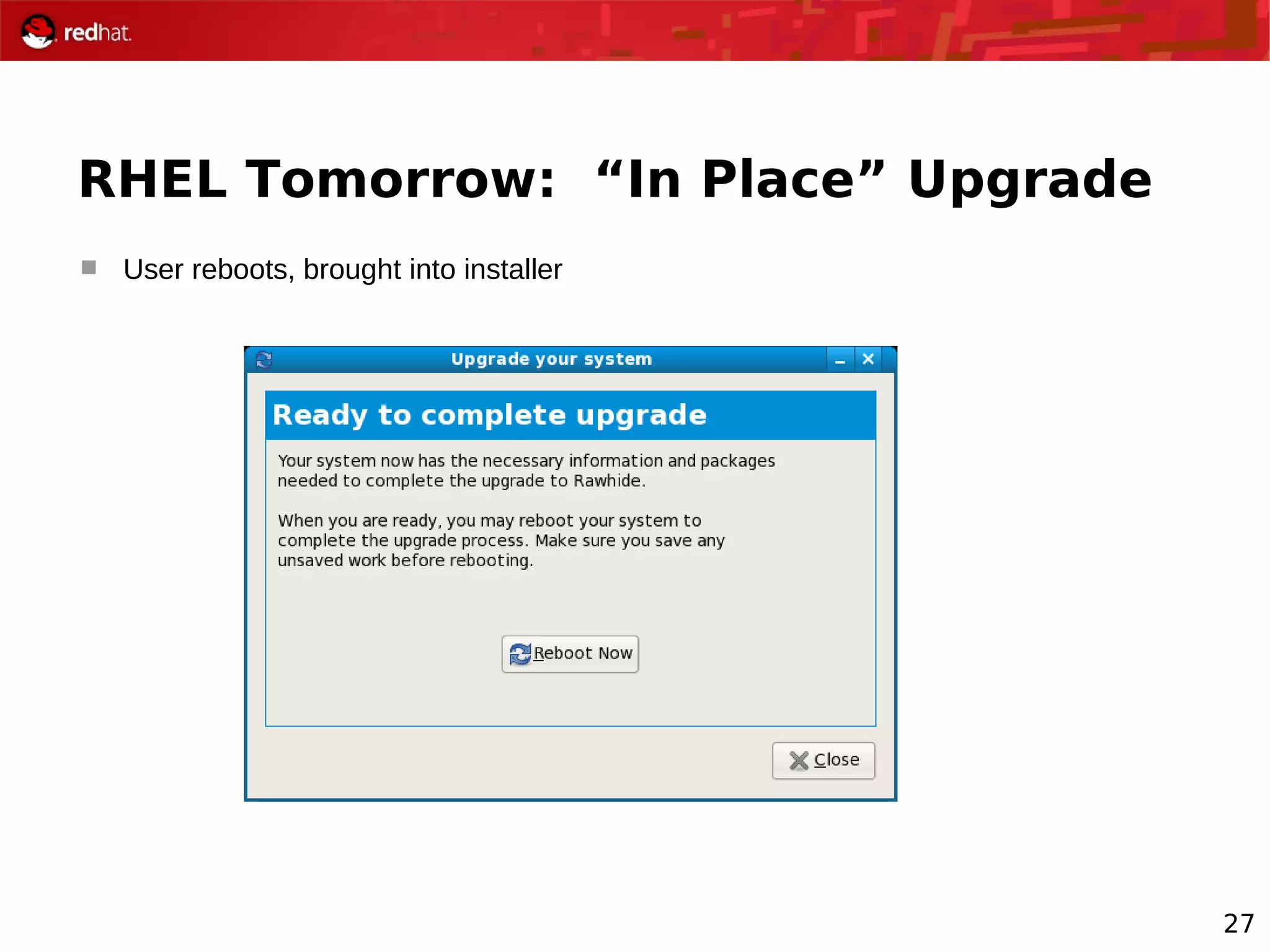
 User reboots, brought into installer
28
RHEL Tomorrow: gnome-control-center
 gnome­control­center
 It is not YaST (yet)
 It is a unified GUI for package management and system configuration
 Benefit
 Progress towards a YaST-like tool in RHEL (currently we have the
system­config­* GUIs/TUIs)
29
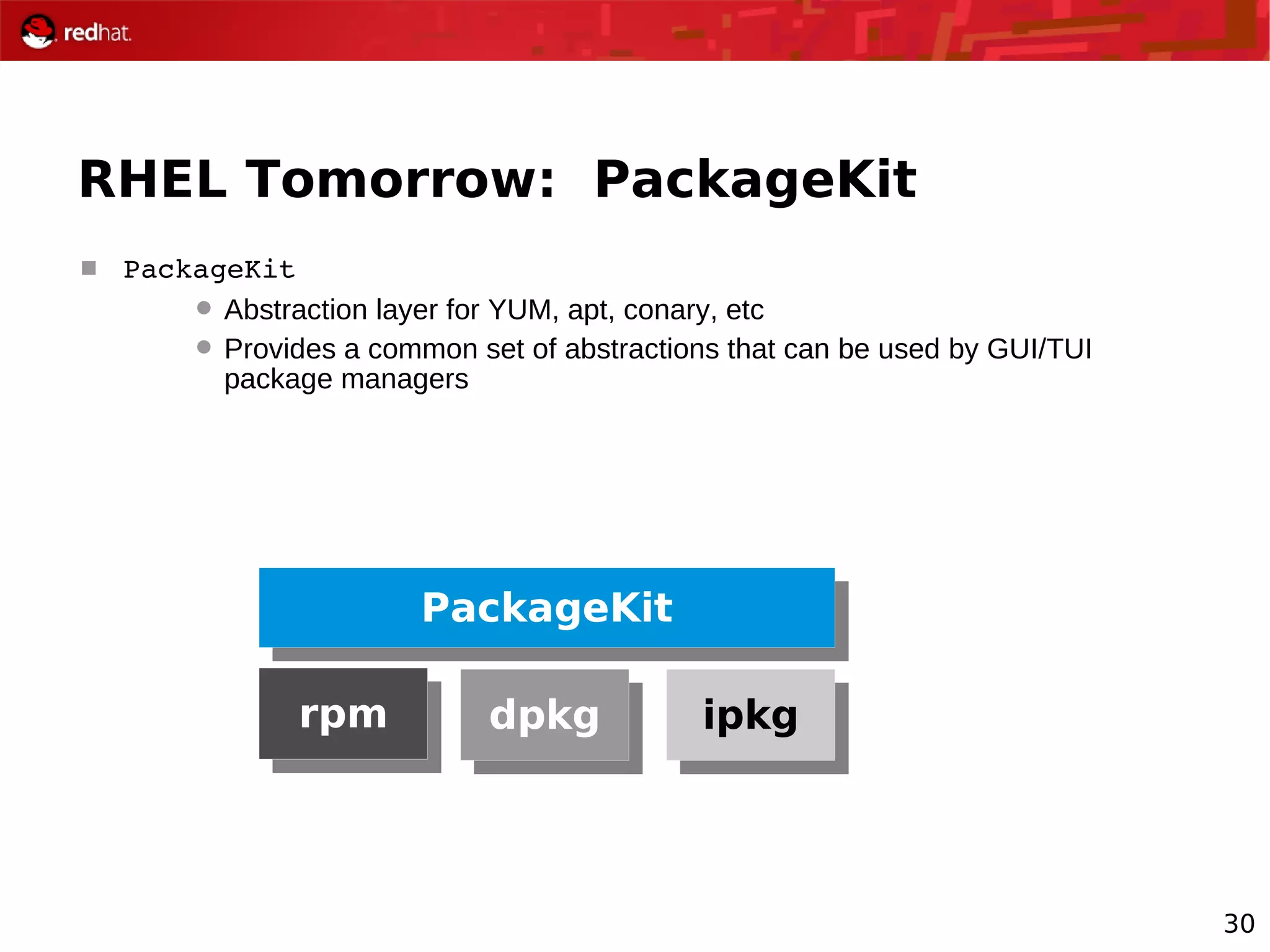
RHEL Tomorrow: PackageKit
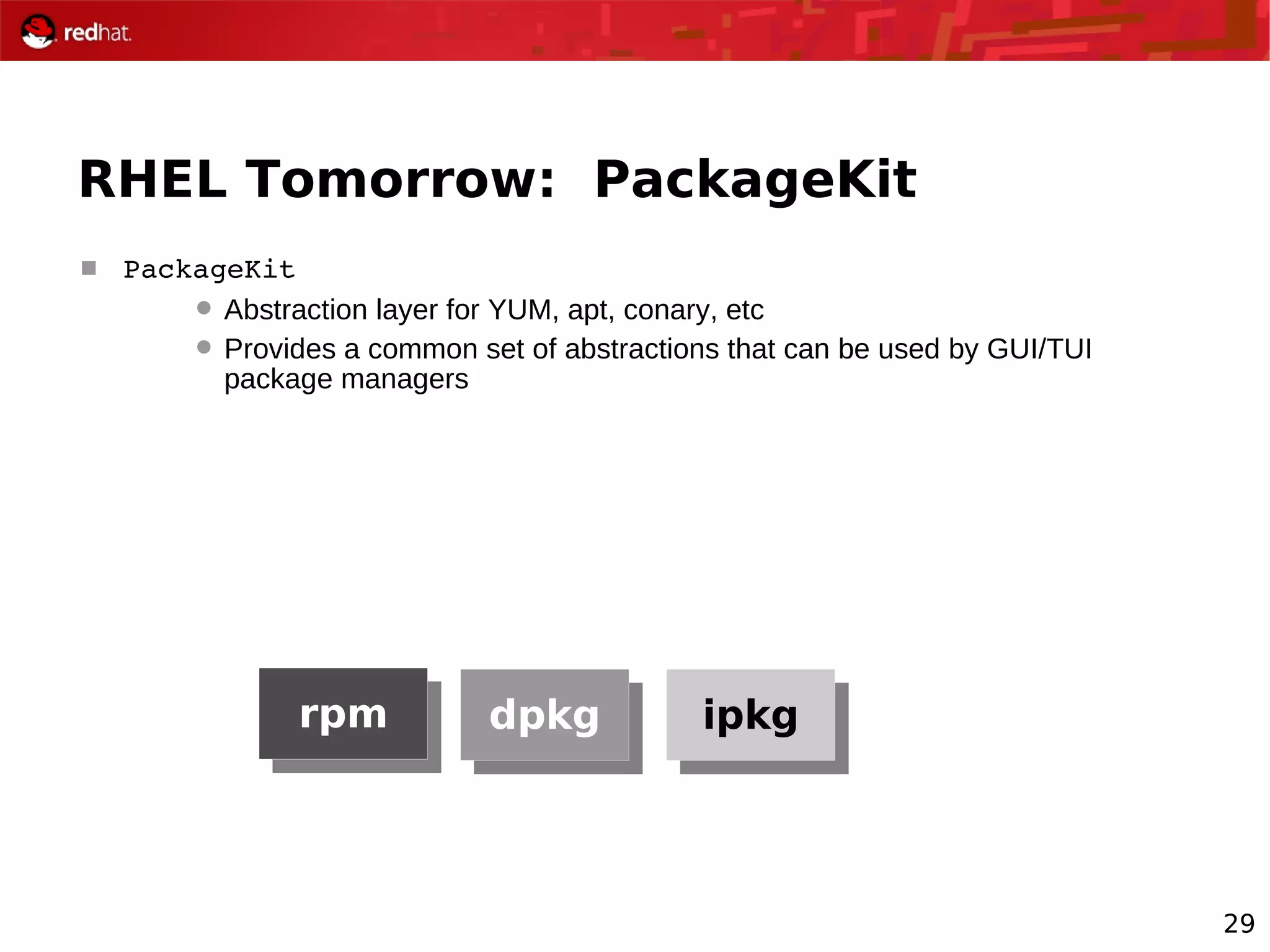
 PackageKit
 Abstraction layer for YUM, apt, conary, etc
 Provides a common set of abstractions that can be used by GUI/TUI
package managers
rpm dpkg ipkg
30
RHEL Tomorrow: PackageKit
 PackageKit
 Abstraction layer for YUM, apt, conary, etc
 Provides a common set of abstractions that can be used by GUI/TUI
package managers
PackageKit
rpm dpkg ipkg
31
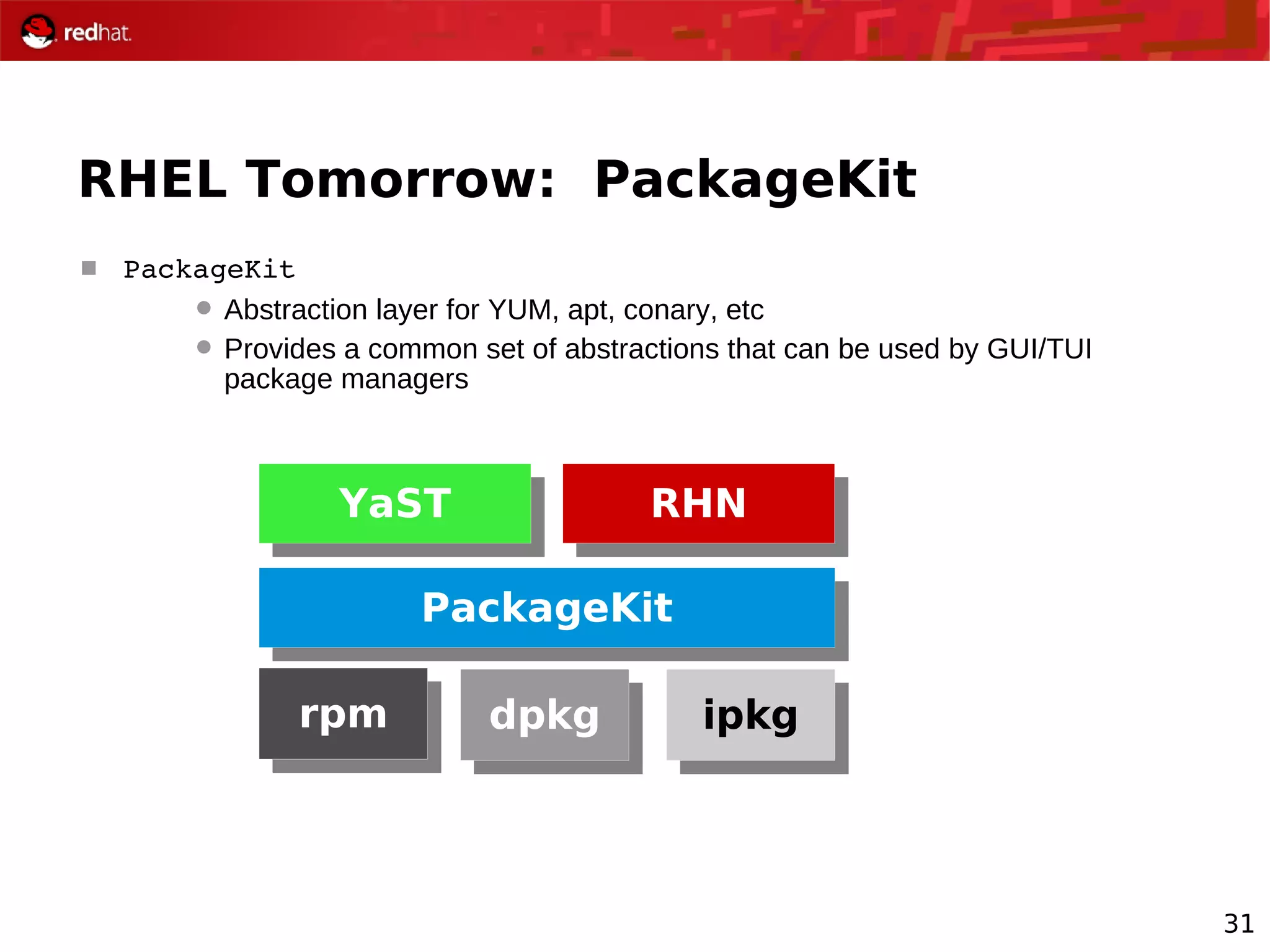
RHEL Tomorrow: PackageKit
 PackageKit
 Abstraction layer for YUM, apt, conary, etc
 Provides a common set of abstractions that can be used by GUI/TUI
package managers
PackageKit
YaST RHN
rpm dpkg ipkg
Linux Virtualization on
System z
33
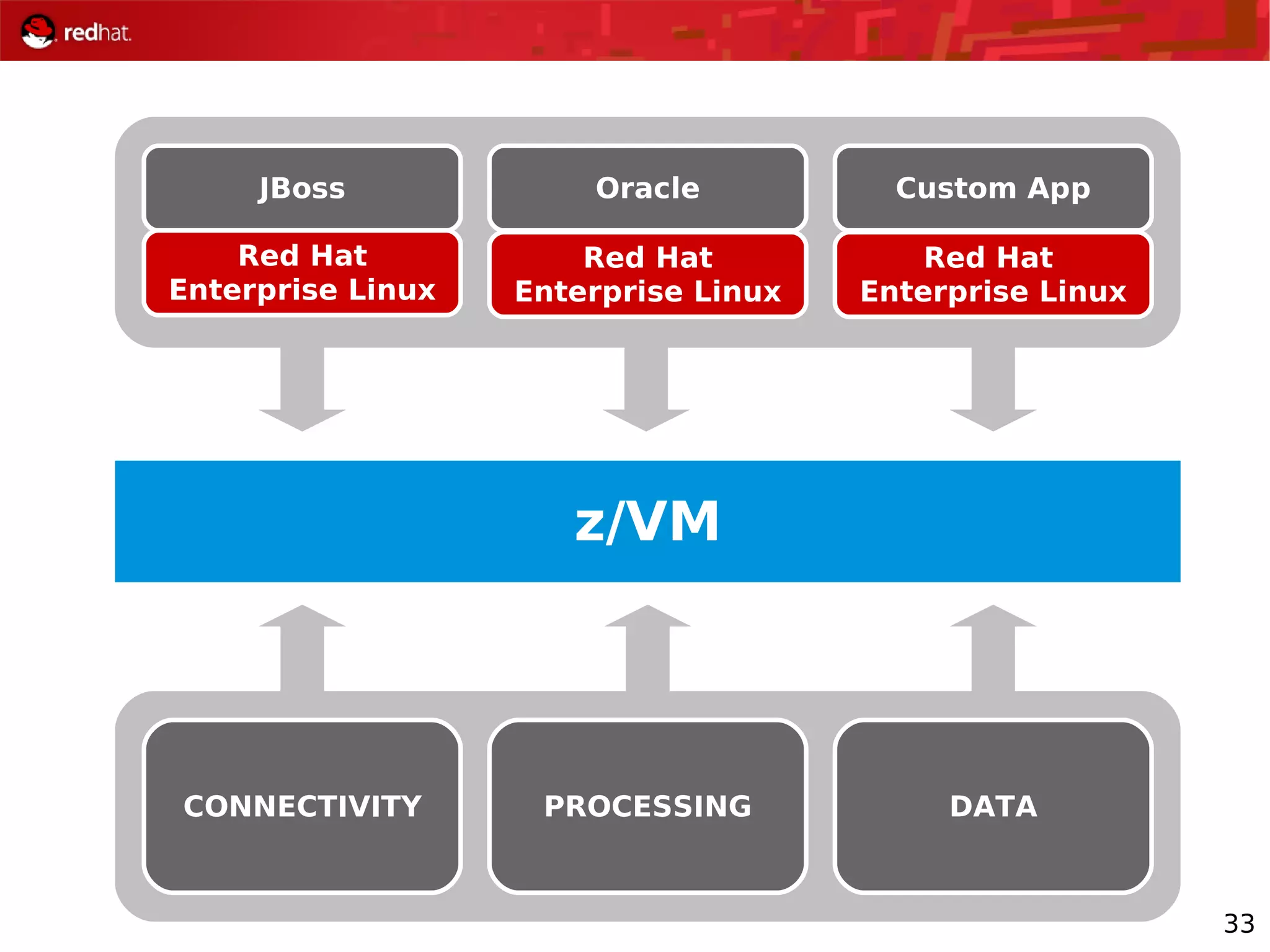
CONNECTIVITY PROCESSING DATA
z/VM
JBoss Oracle Custom App
Red Hat
Enterprise Linux
Red Hat
Enterprise Linux
Red Hat
Enterprise Linux
Using RHN Satellite
to Manage s390/s390x & distributed
35
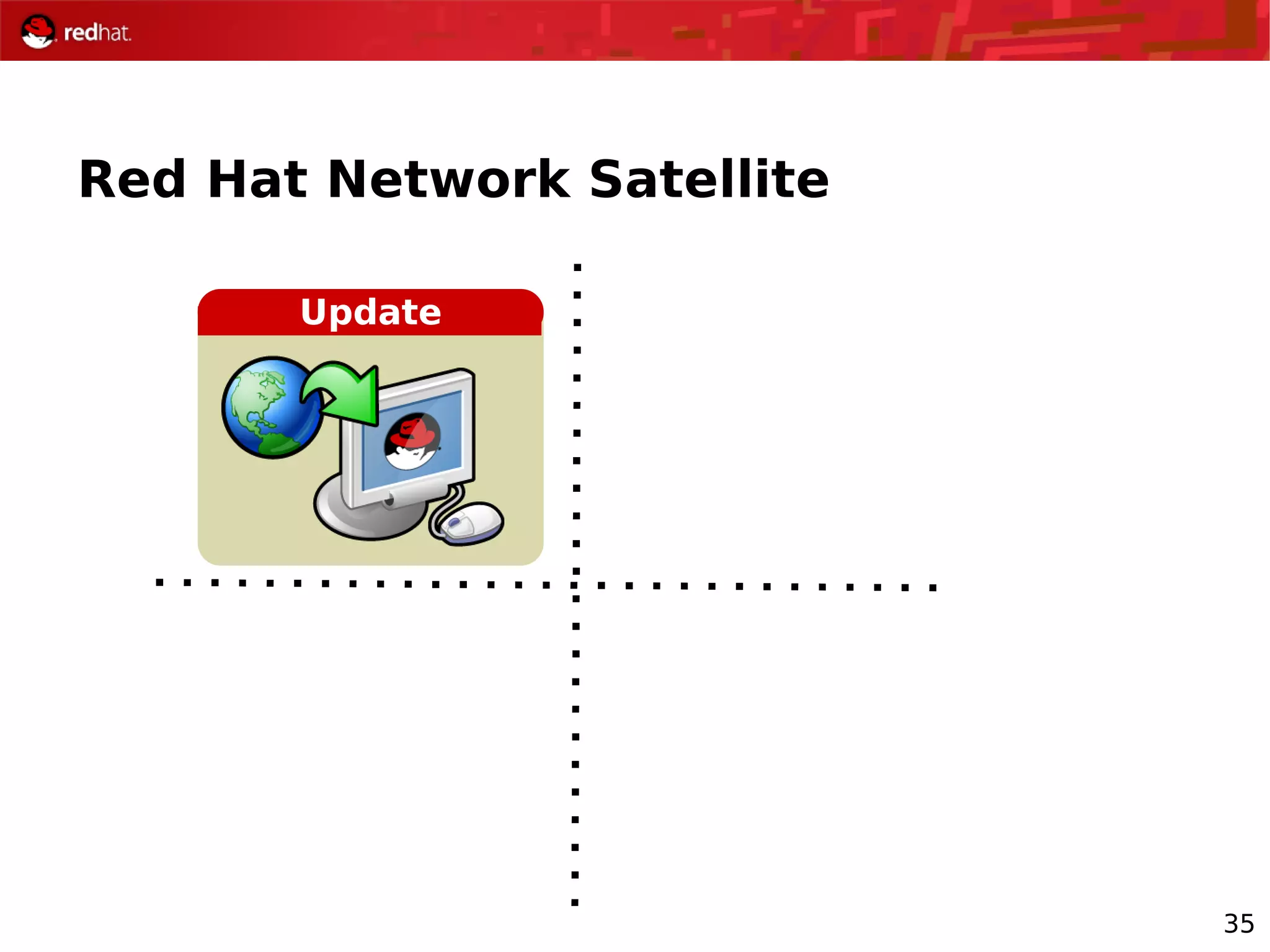
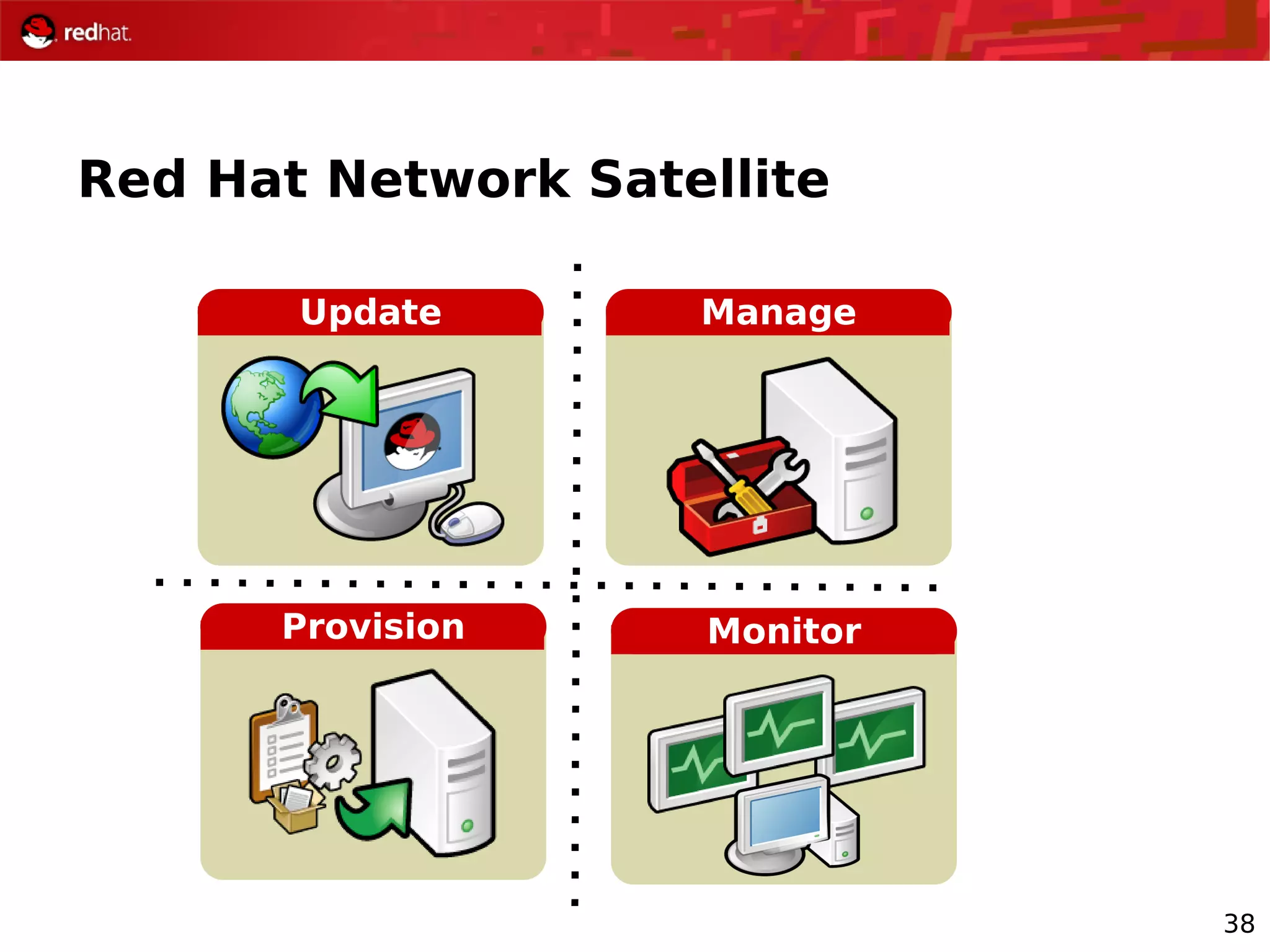
Red Hat Network Satellite
Update
36
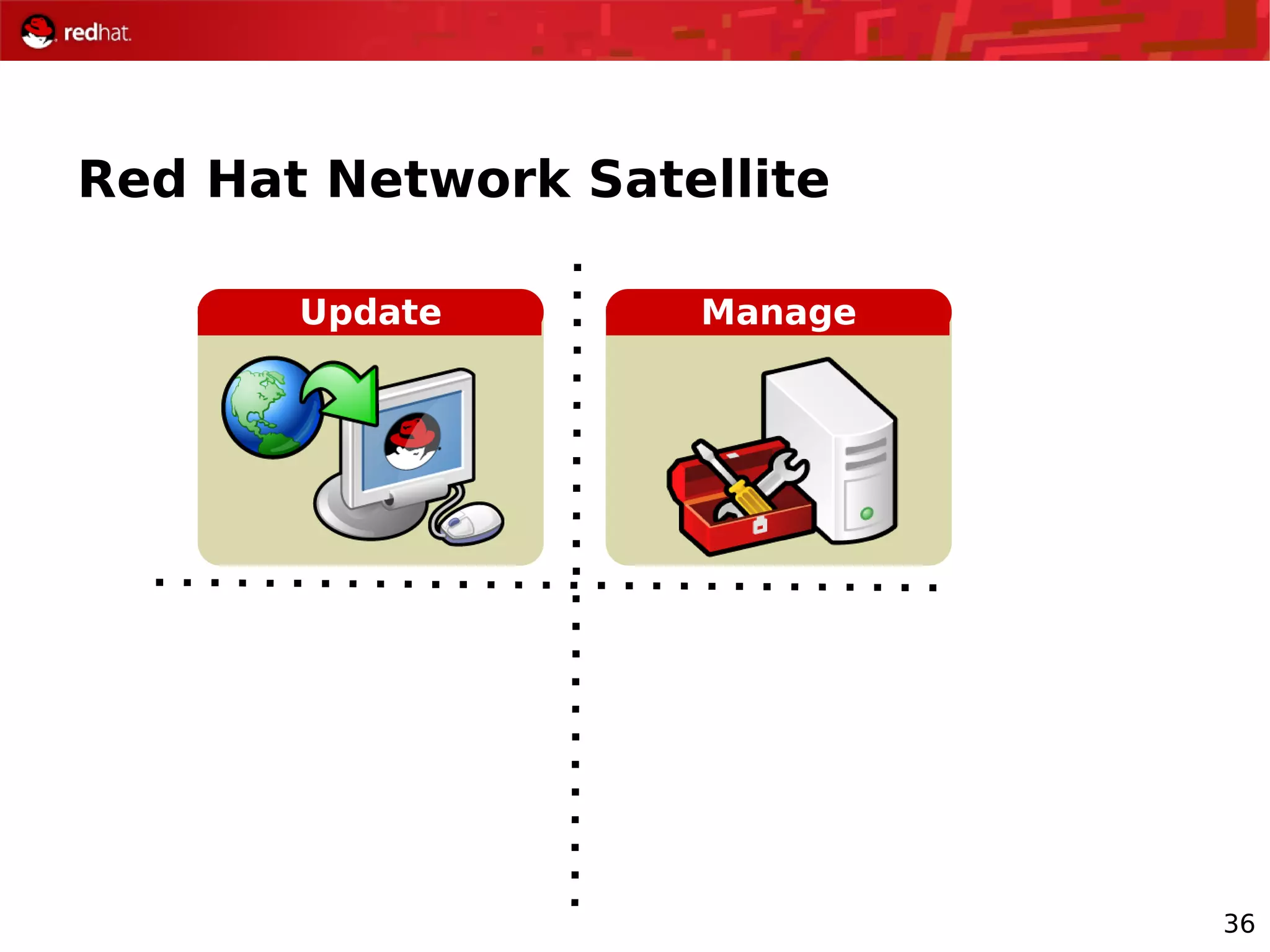
Red Hat Network Satellite
Update Manage
37
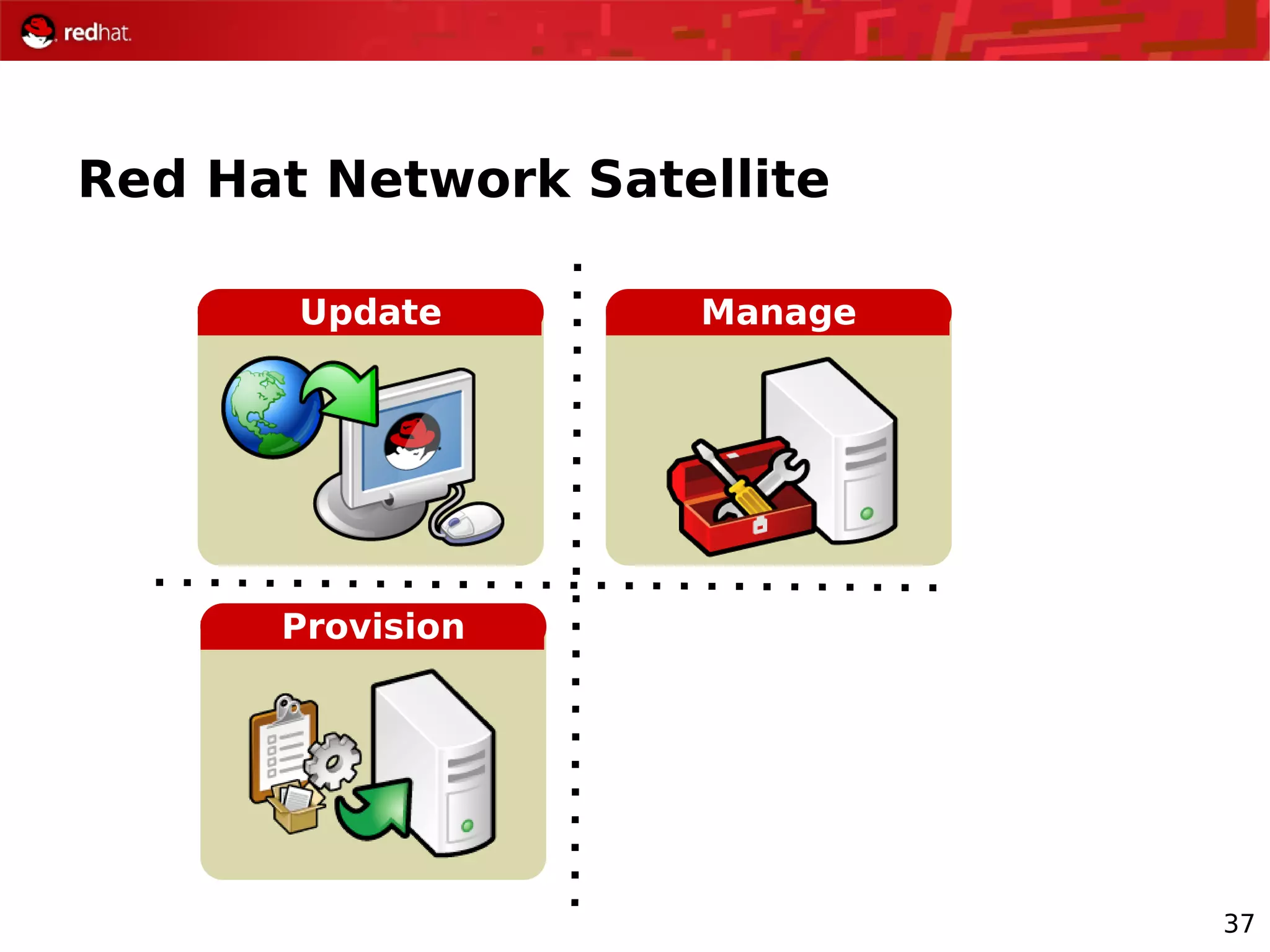
Red Hat Network Satellite
Update Manage
Provision
38
Red Hat Network Satellite
Update Manage
MonitorProvision
39
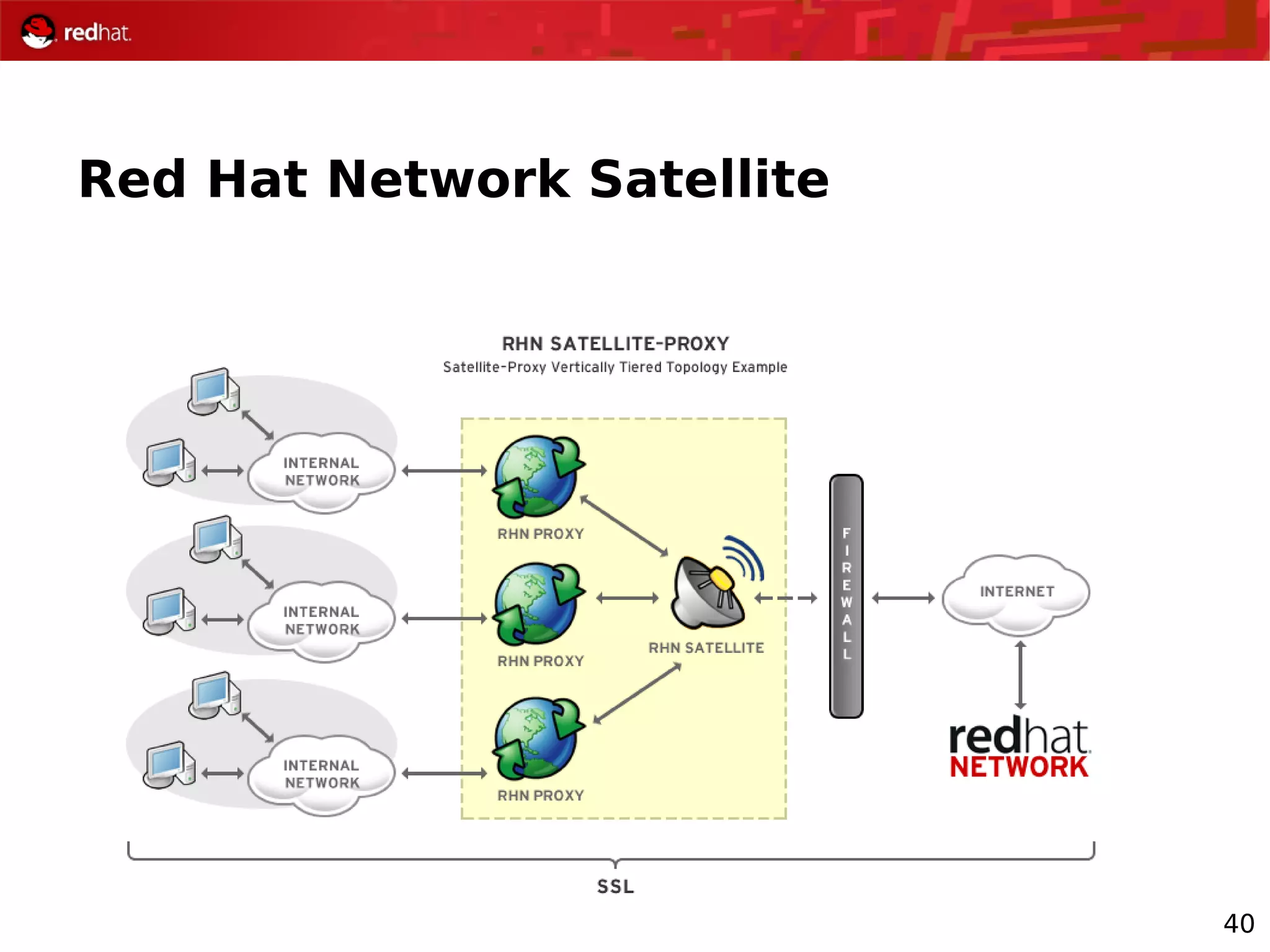
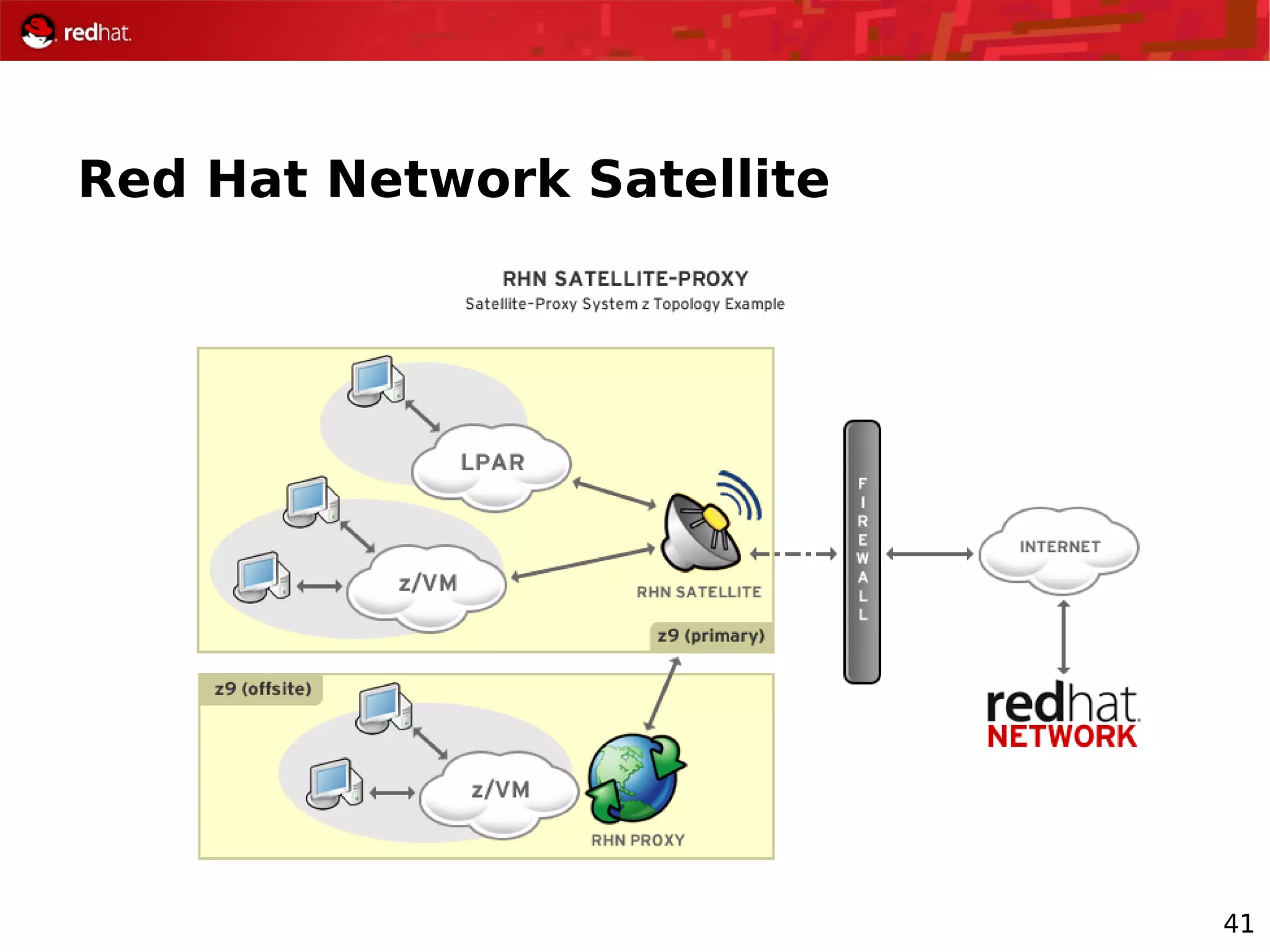
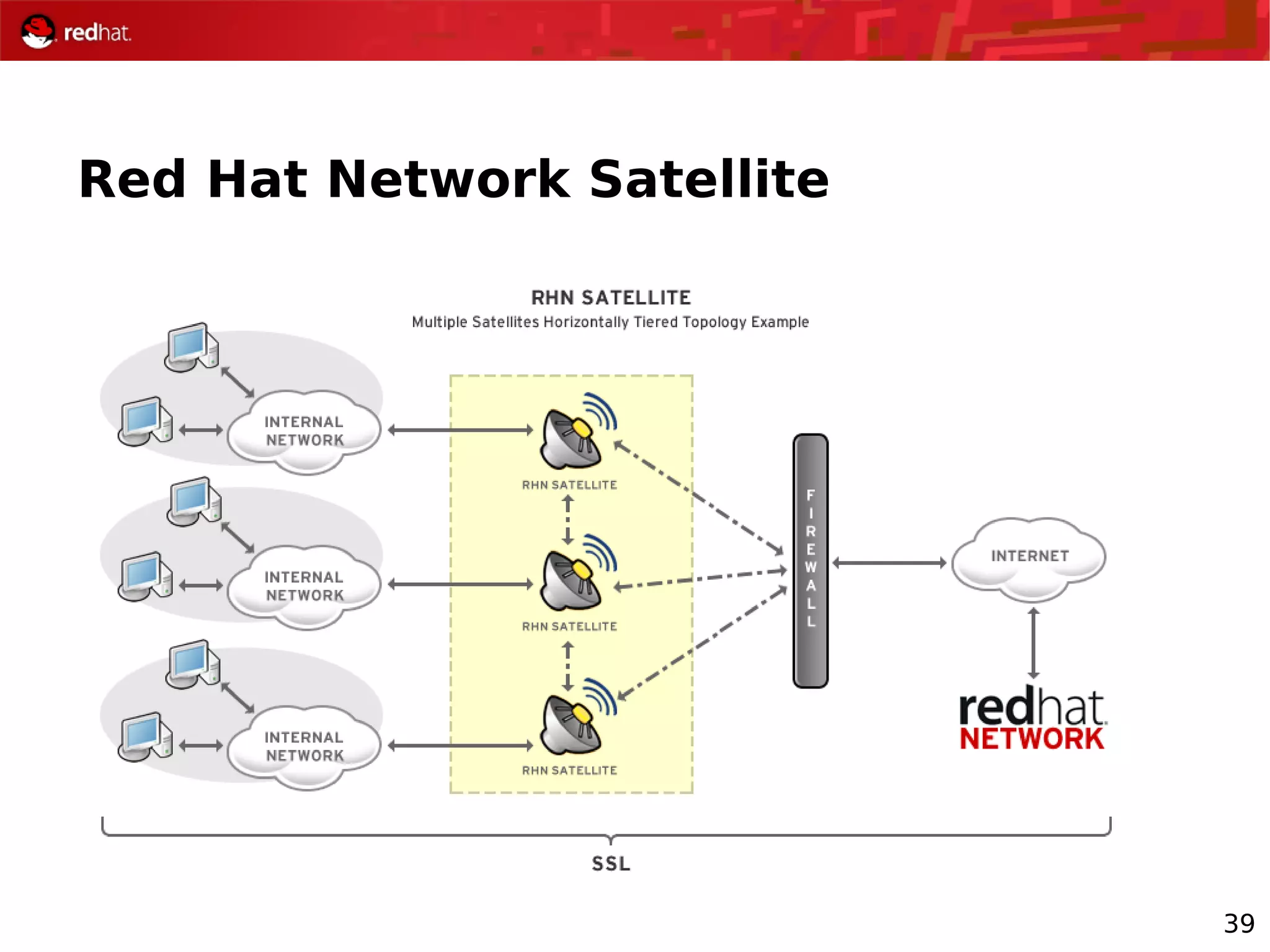
Red Hat Network Satellite
40
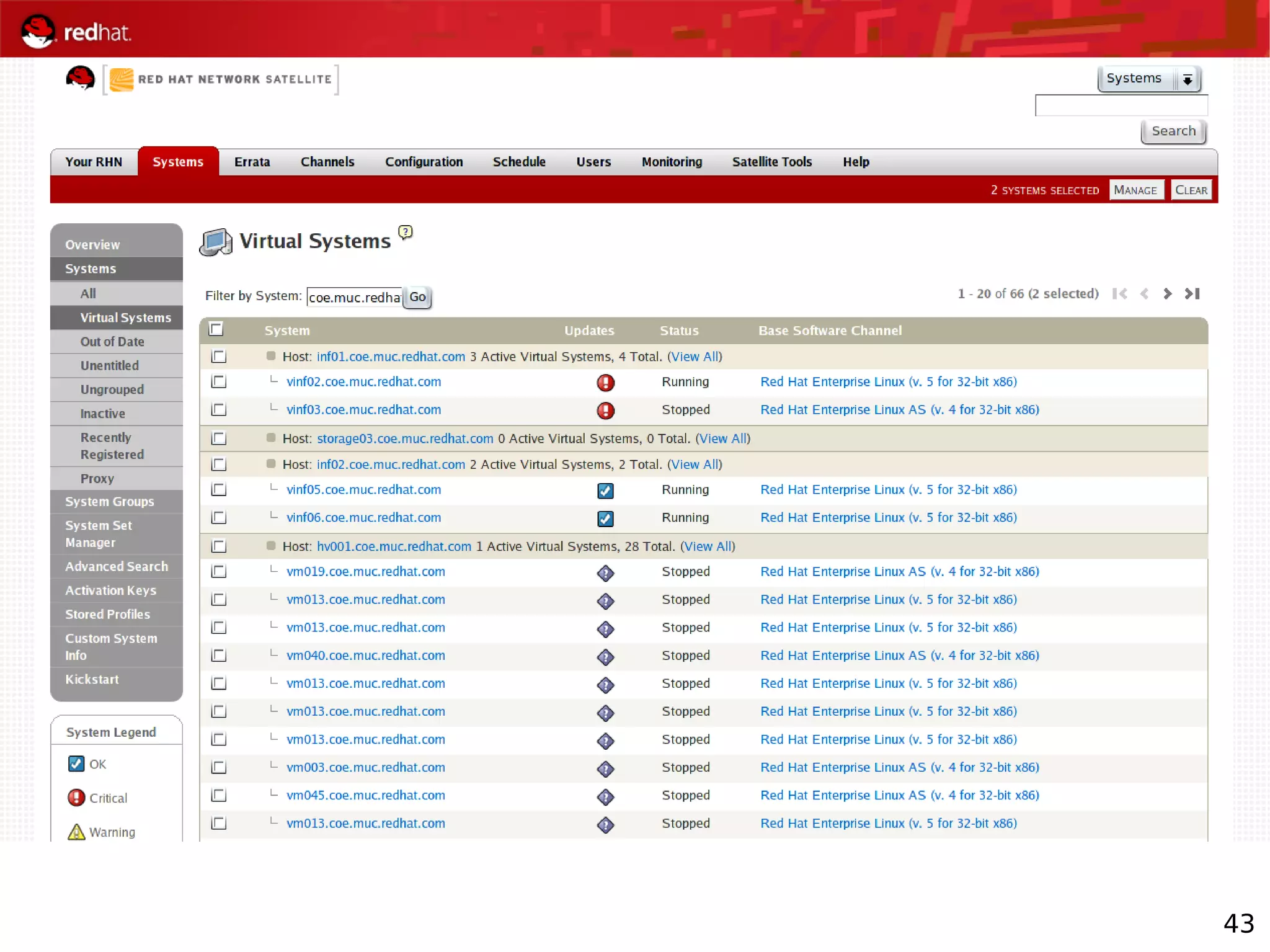
Red Hat Network Satellite
41
Red Hat Network Satellite
42
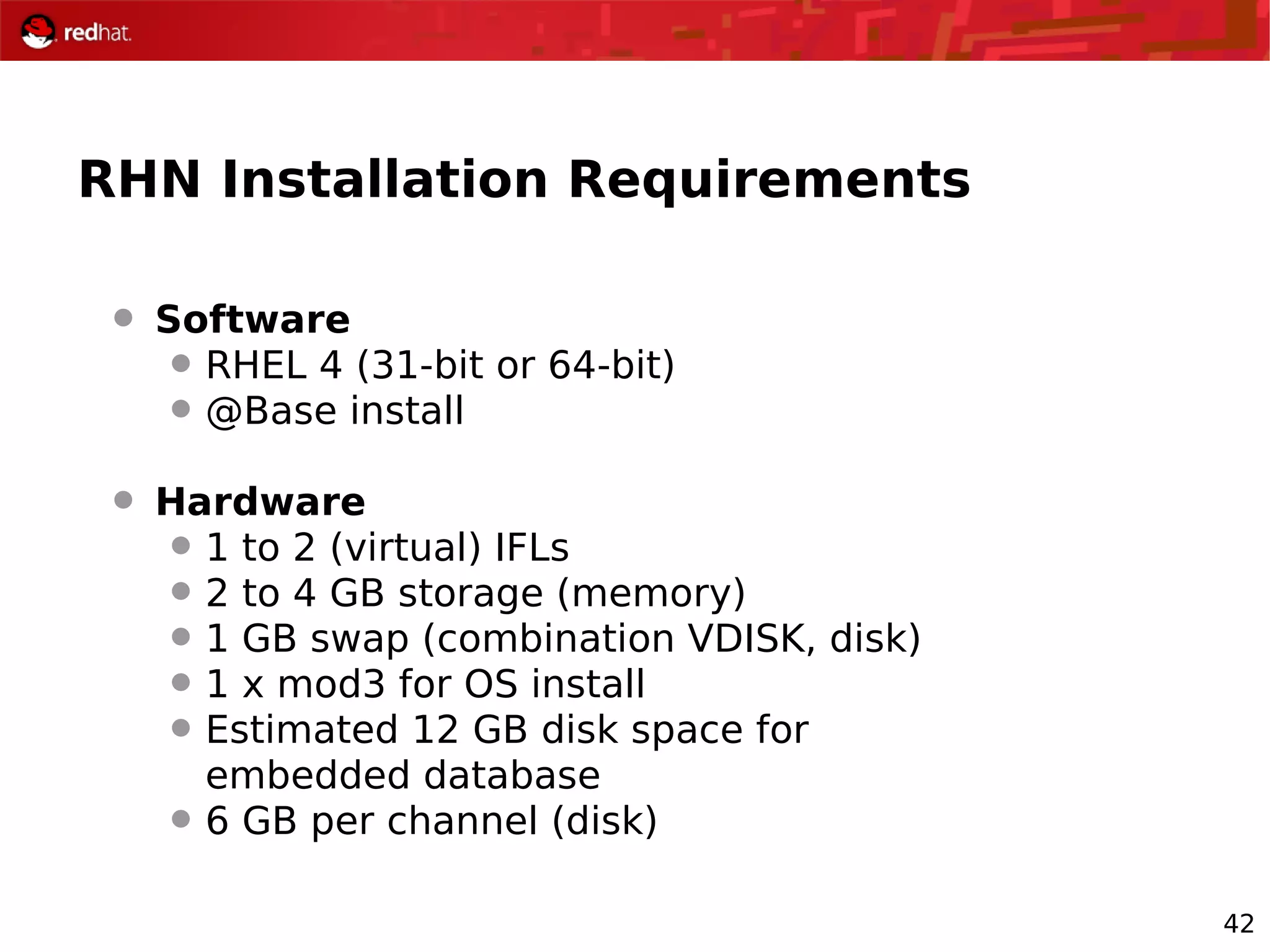
RHN Installation Requirements
 Software
 RHEL 4 (31-bit or 64-bit)
 @Base install
 Hardware
 1 to 2 (virtual) IFLs
 2 to 4 GB storage (memory)
 1 GB swap (combination VDISK, disk)
 1 x mod3 for OS install
 Estimated 12 GB disk space for
embedded database
 6 GB per channel (disk)
43
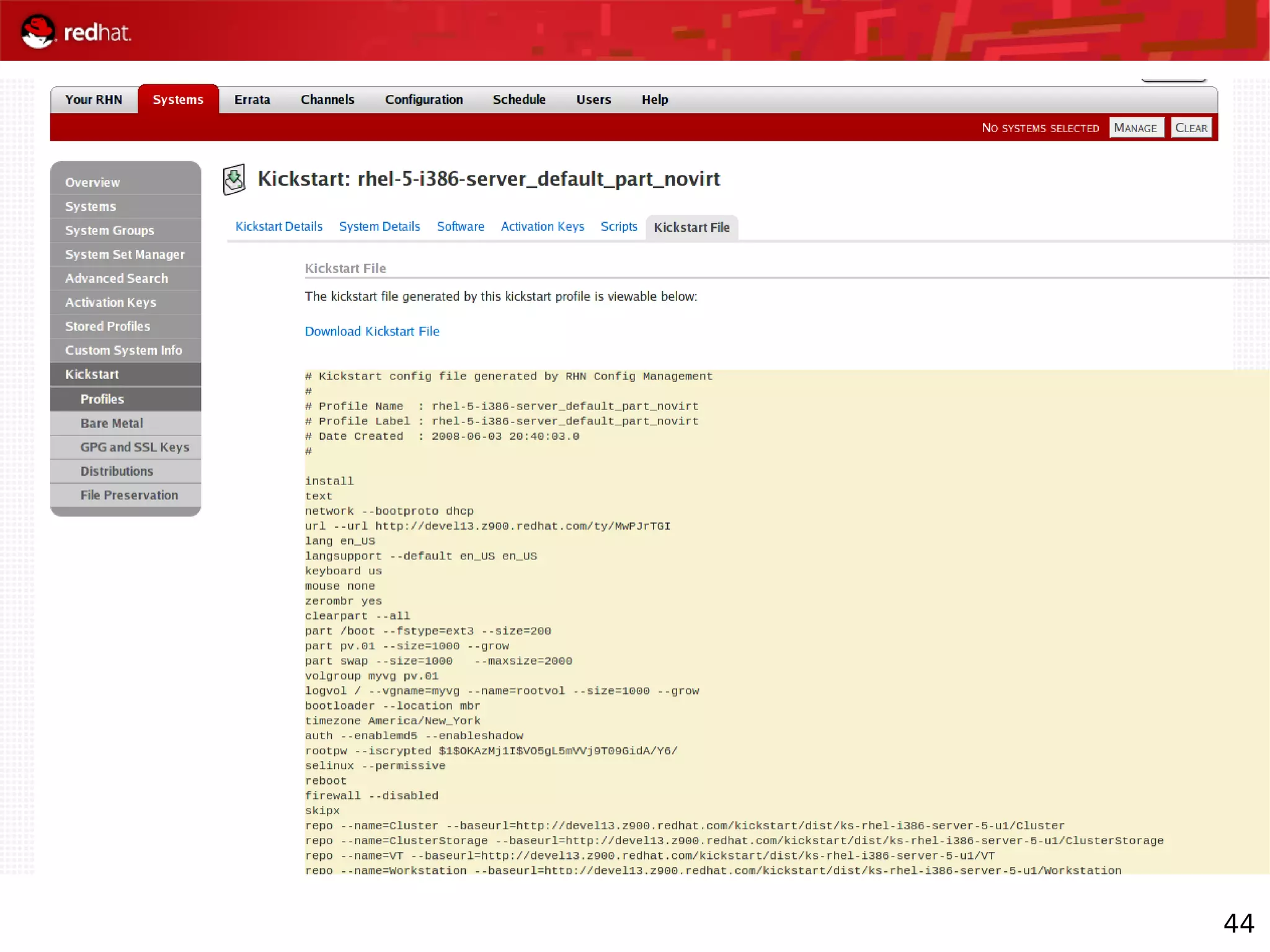
44
45
RHN Satellite Is Now Open Source
http://spacewalk.redhat.com
 Announced at Red Hat Summit 2008
 .... remember the Fedora -> RHEL model?
Security
47
Agenda
 Why do we need SELinux?  What are the principal concepts?
 SELinux Details
 Type Enforcement
 What are the available policies?
 What's a policy actually made of?
 How do I {add, change} a policy?
 What's the associated overhead?
 Usage
 User Perspective
 Admin Perspective
 Scenarios
 Fixing the RHT Corporate VPN “update”
Name of Presentation
Red Hat
Presenter
Why do we need 
SELinux?
49
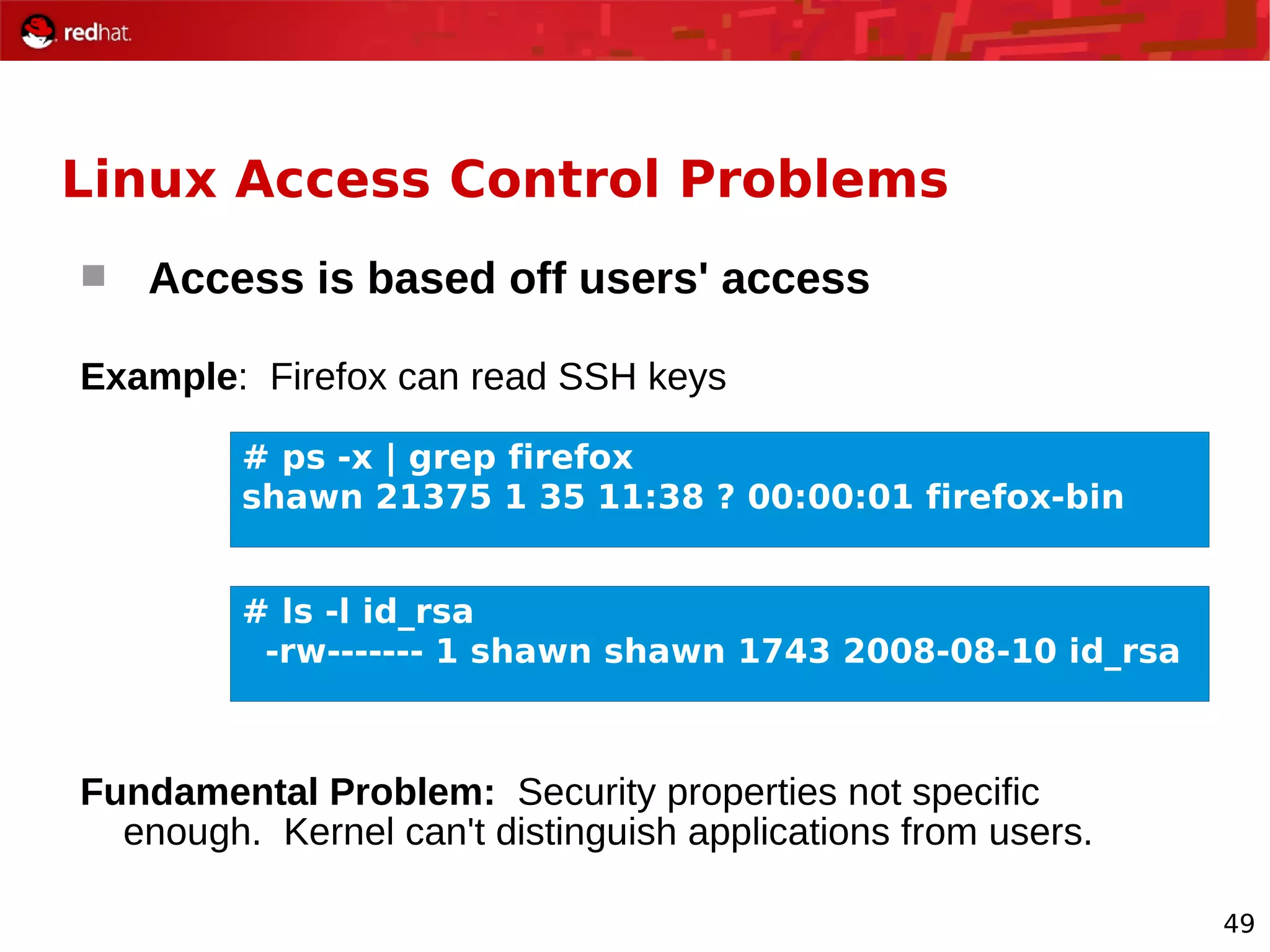
Linux Access Control Problems
 Access is based off users' access
Example: Firefox can read SSH keys
Fundamental Problem: Security properties not specific
enough. Kernel can't distinguish applications from users.
# ps -x | grep firefox
shawn 21375 1 35 11:38 ? 00:00:01 firefox-bin
# ls -l id_rsa
-rw------- 1 shawn shawn 1743 2008-08-10 id_rsa
50
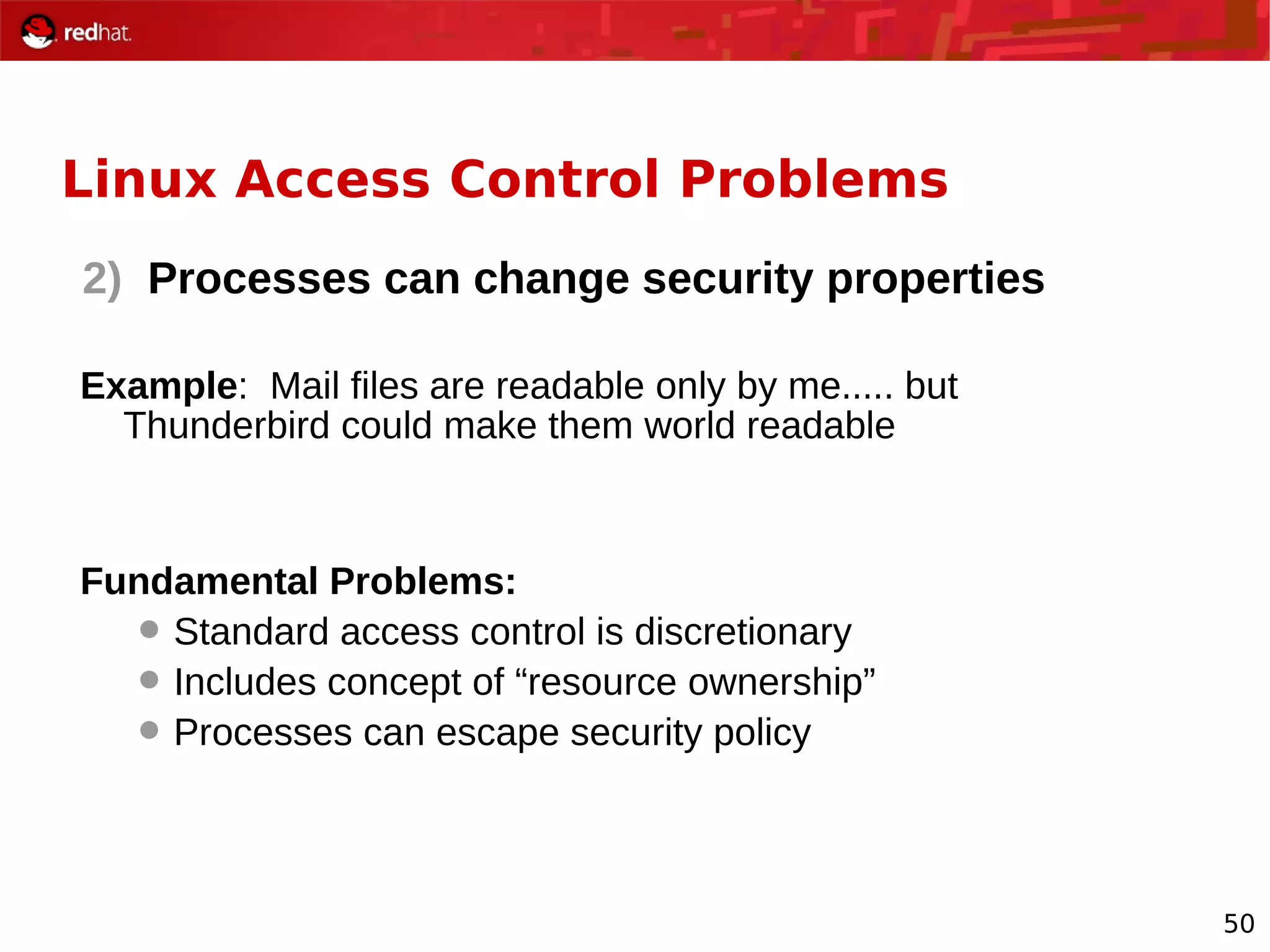
Linux Access Control Problems
2) Processes can change security properties
Example: Mail files are readable only by me..... but
Thunderbird could make them world readable
Fundamental Problems:
 Standard access control is discretionary
 Includes concept of “resource ownership”
 Processes can escape security policy
51
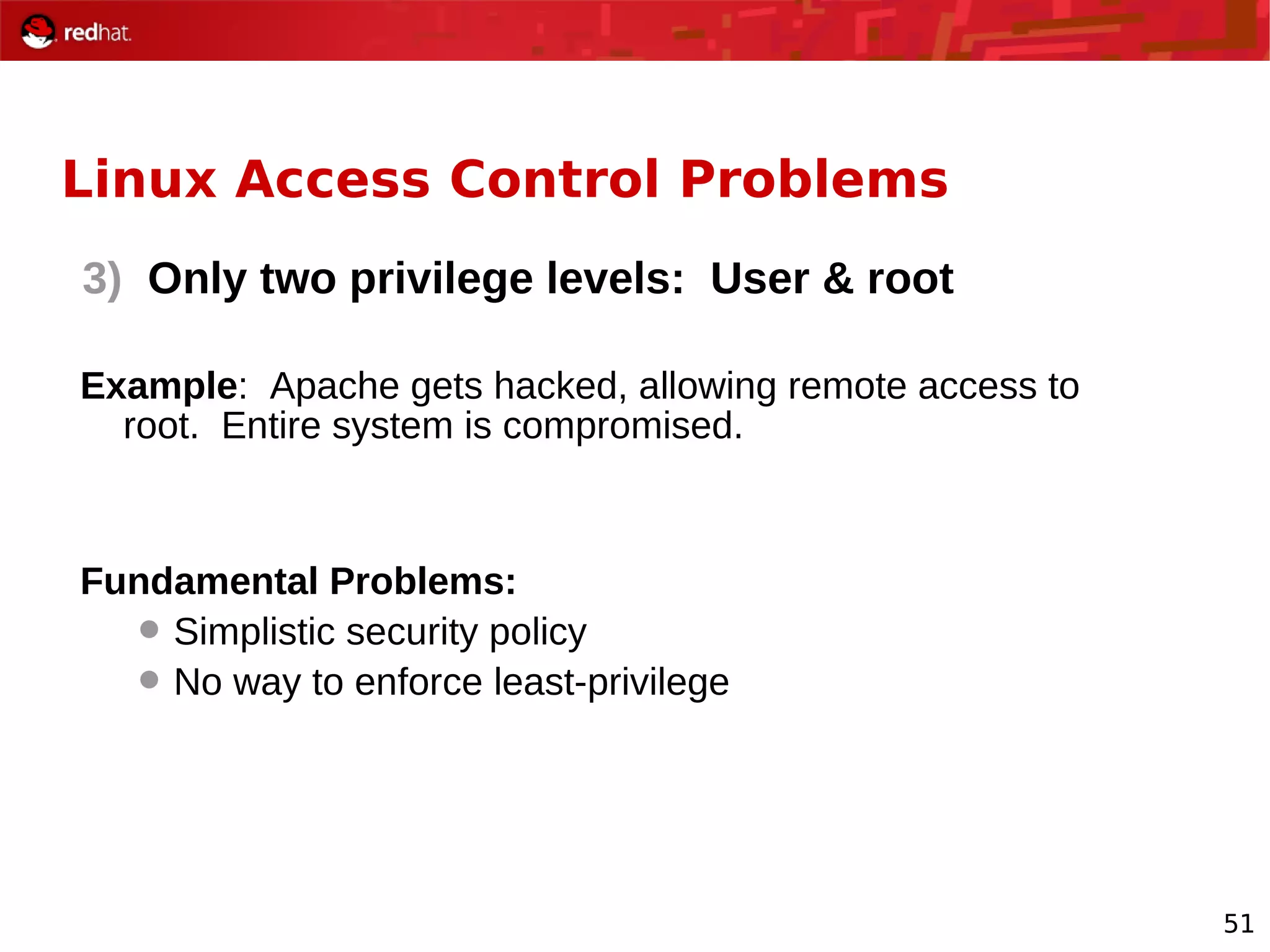
Linux Access Control Problems
3) Only two privilege levels: User & root
Example: Apache gets hacked, allowing remote access to
root. Entire system is compromised.
Fundamental Problems:
 Simplistic security policy
 No way to enforce least-privilege
52
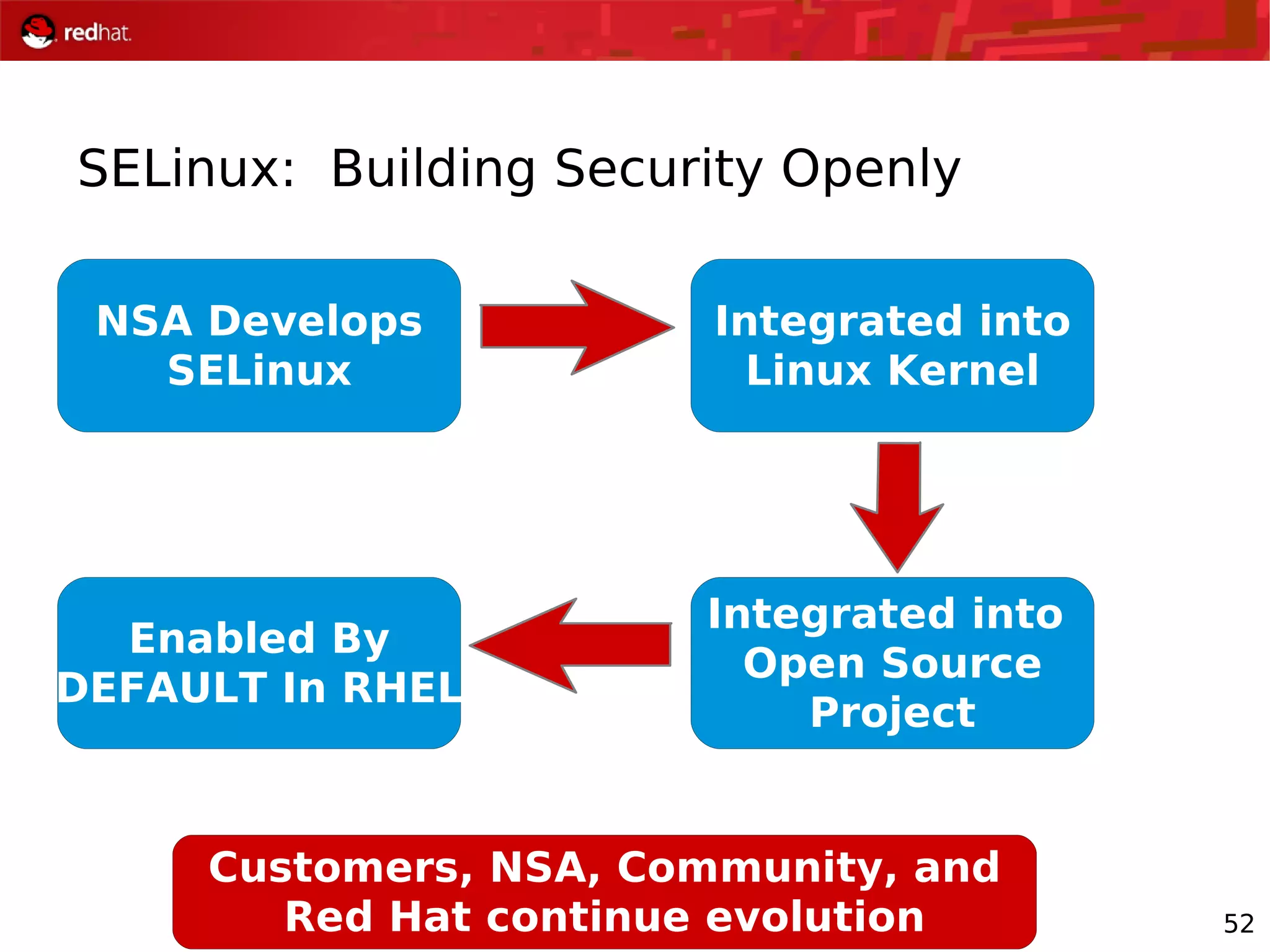
SELinux: Building Security Openly
NSA Develops
SELinux
Integrated into
Linux Kernel
Integrated into
Open Source
Project
Enabled By
DEFAULT In RHEL
Customers, NSA, Community, and
Red Hat continue evolution
53
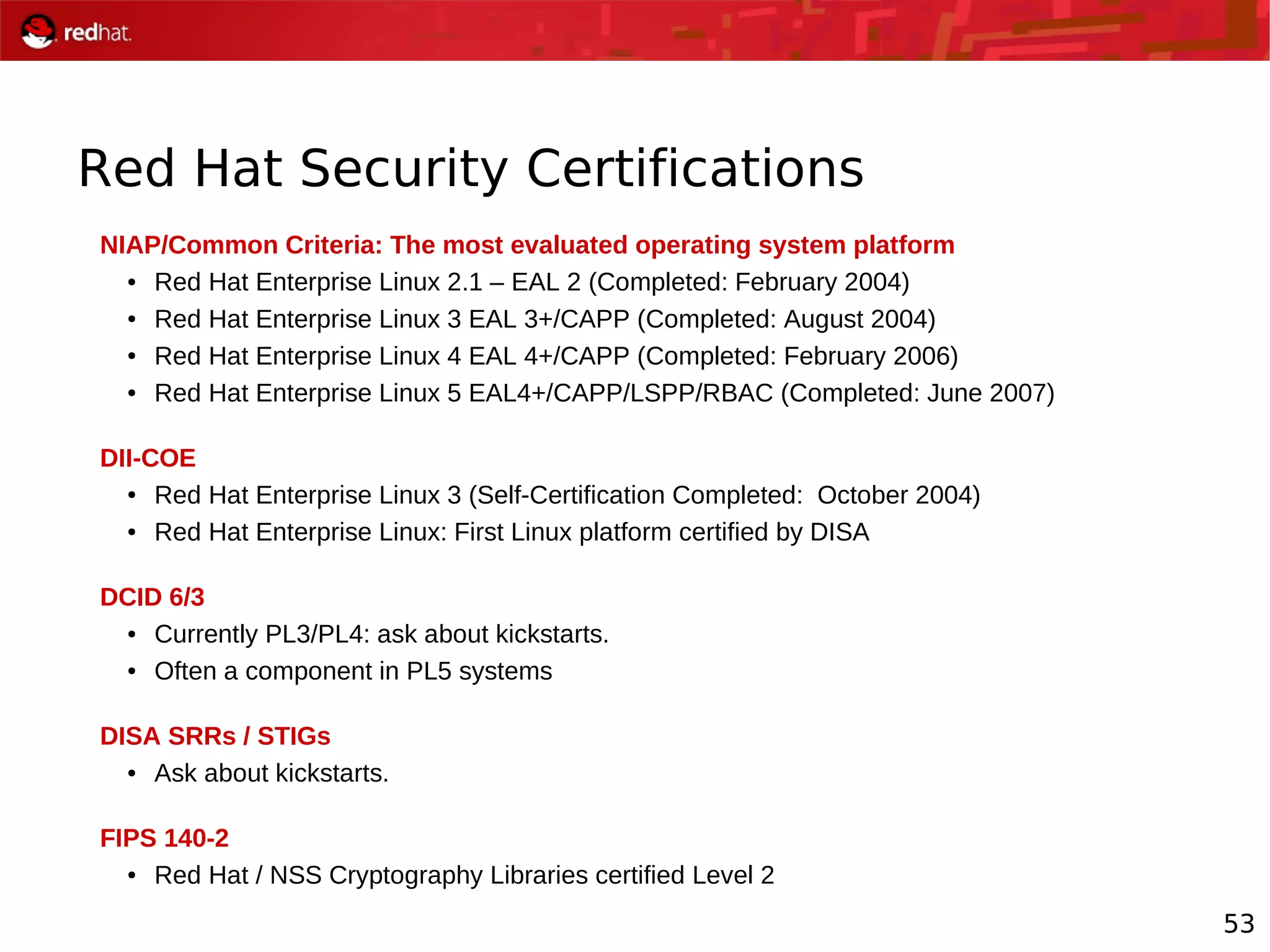
Red Hat Security Certifications
NIAP/Common Criteria: The most evaluated operating system platform
● Red Hat Enterprise Linux 2.1 – EAL 2 (Completed: February 2004)
● Red Hat Enterprise Linux 3 EAL 3+/CAPP (Completed: August 2004)
● Red Hat Enterprise Linux 4 EAL 4+/CAPP (Completed: February 2006)
● Red Hat Enterprise Linux 5 EAL4+/CAPP/LSPP/RBAC (Completed: June 2007)
DII-COE
● Red Hat Enterprise Linux 3 (Self-Certification Completed: October 2004)
● Red Hat Enterprise Linux: First Linux platform certified by DISA
DCID 6/3
● Currently PL3/PL4: ask about kickstarts.
● Often a component in PL5 systems
DISA SRRs / STIGs
● Ask about kickstarts.
FIPS 140-2
● Red Hat / NSS Cryptography Libraries certified Level 2
54
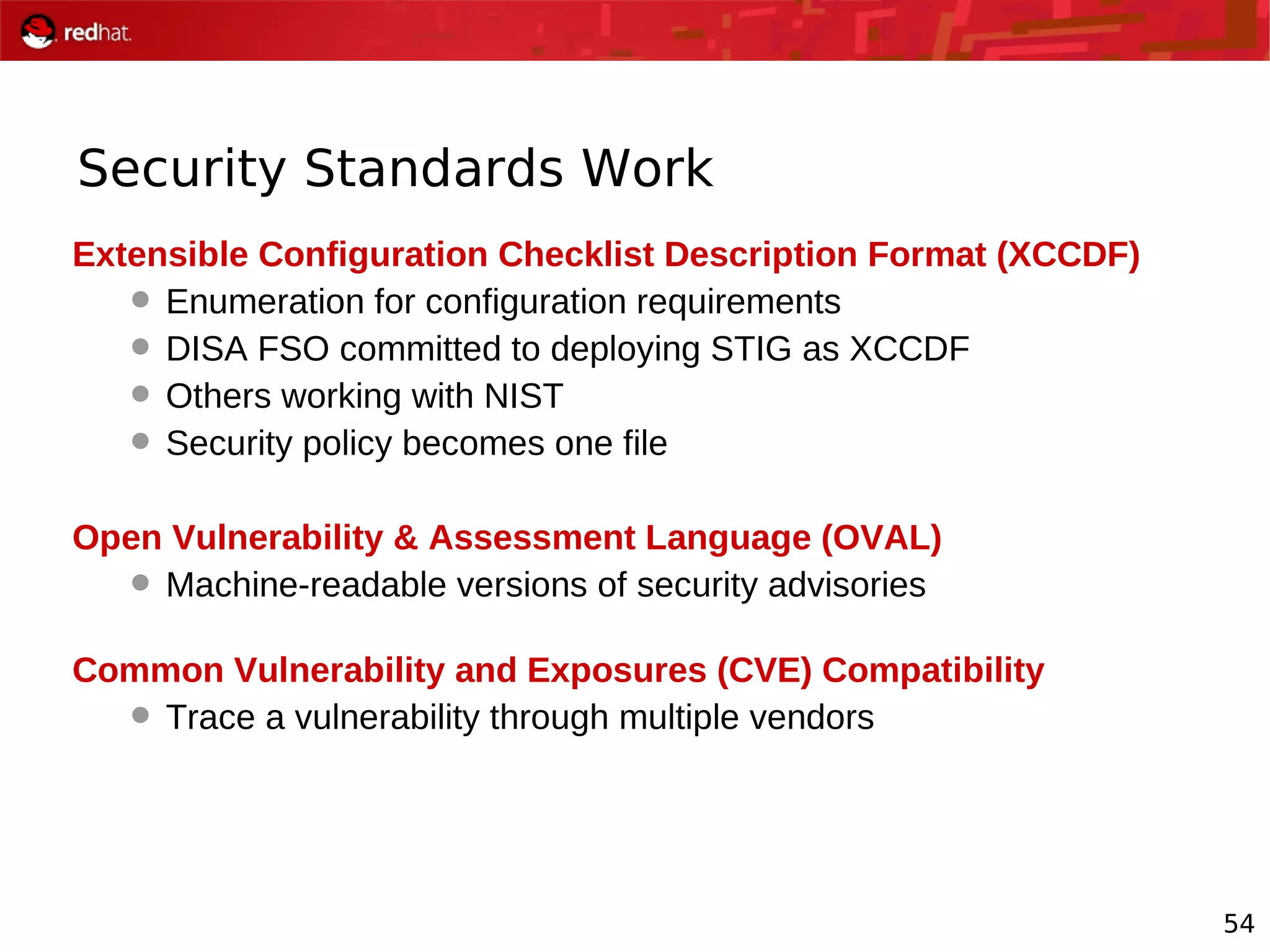
Security Standards Work
Extensible Configuration Checklist Description Format (XCCDF)
 Enumeration for configuration requirements
 DISA FSO committed to deploying STIG as XCCDF
 Others working with NIST
 Security policy becomes one file
Open Vulnerability & Assessment Language (OVAL)
 Machine-readable versions of security advisories
Common Vulnerability and Exposures (CVE) Compatibility
 Trace a vulnerability through multiple vendors
Name of Presentation
Red Hat
Presenter
How's it work?
56
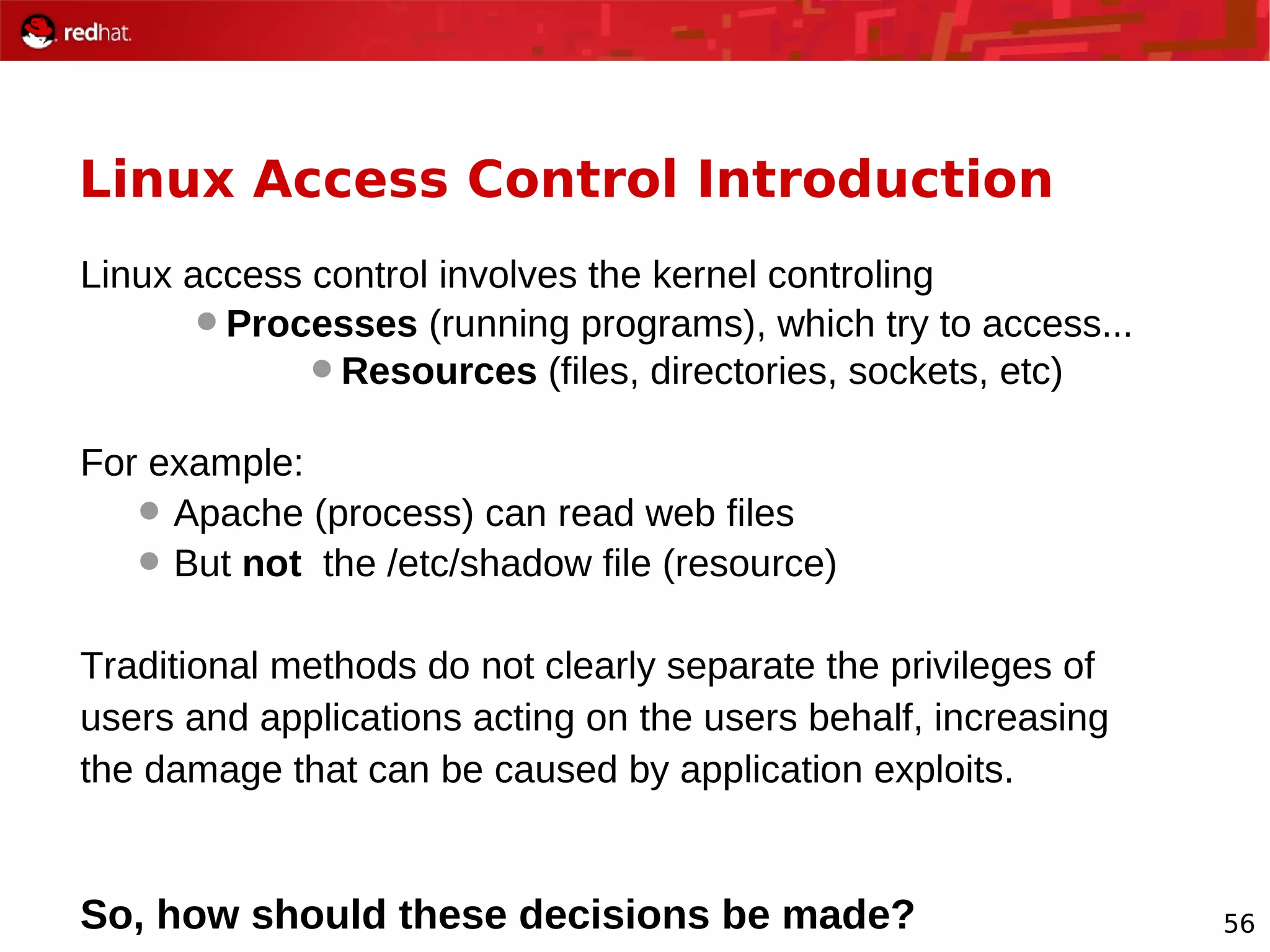
Linux Access Control Introduction
Linux access control involves the kernel controling
Processes (running programs), which try to access...
Resources (files, directories, sockets, etc)
For example:
 Apache (process) can read web files
 But not the /etc/shadow file (resource)
Traditional methods do not clearly separate the privileges of
users and applications acting on the users behalf, increasing
the damage that can be caused by application exploits.
So, how should these decisions be made?
57
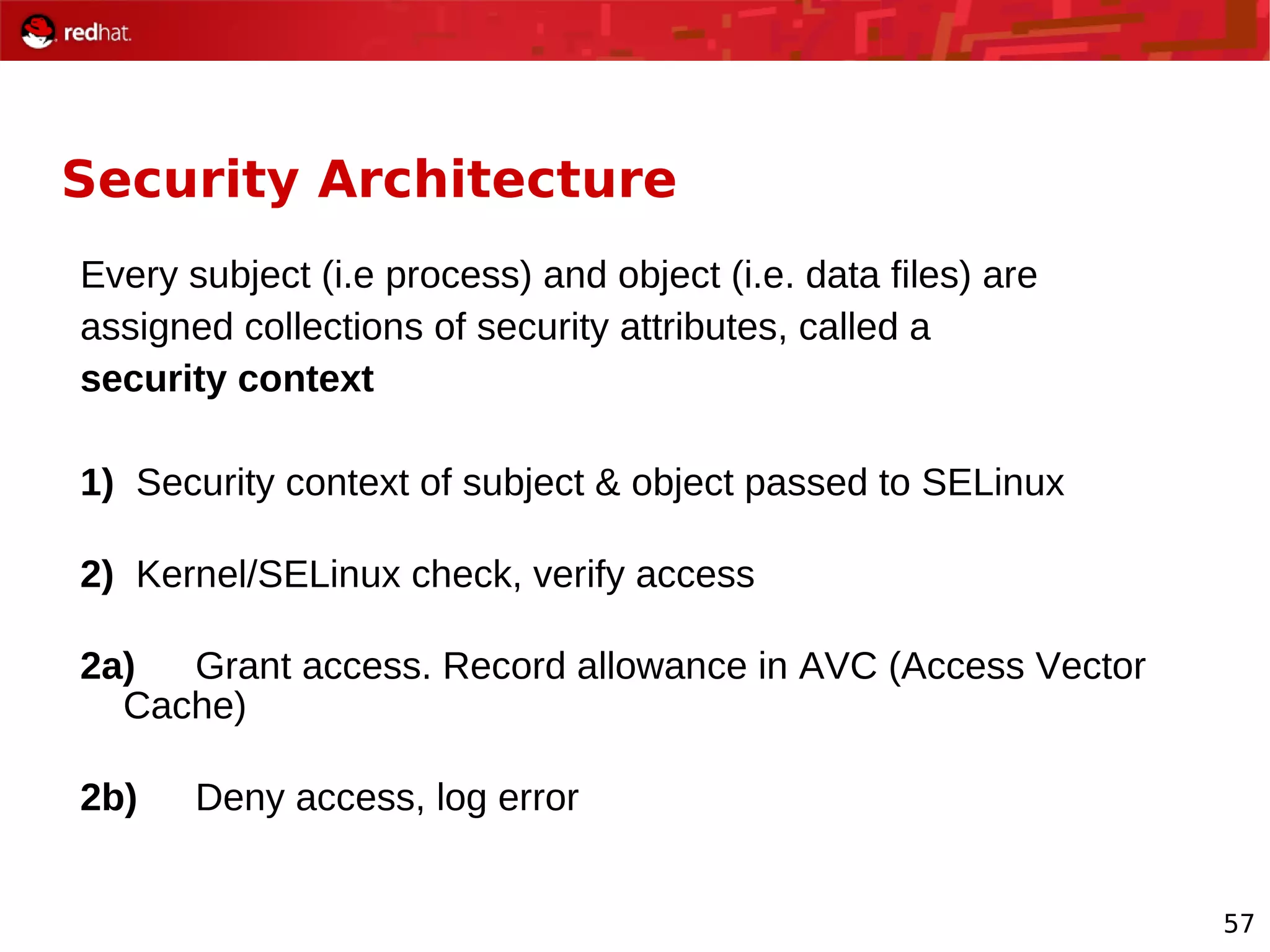
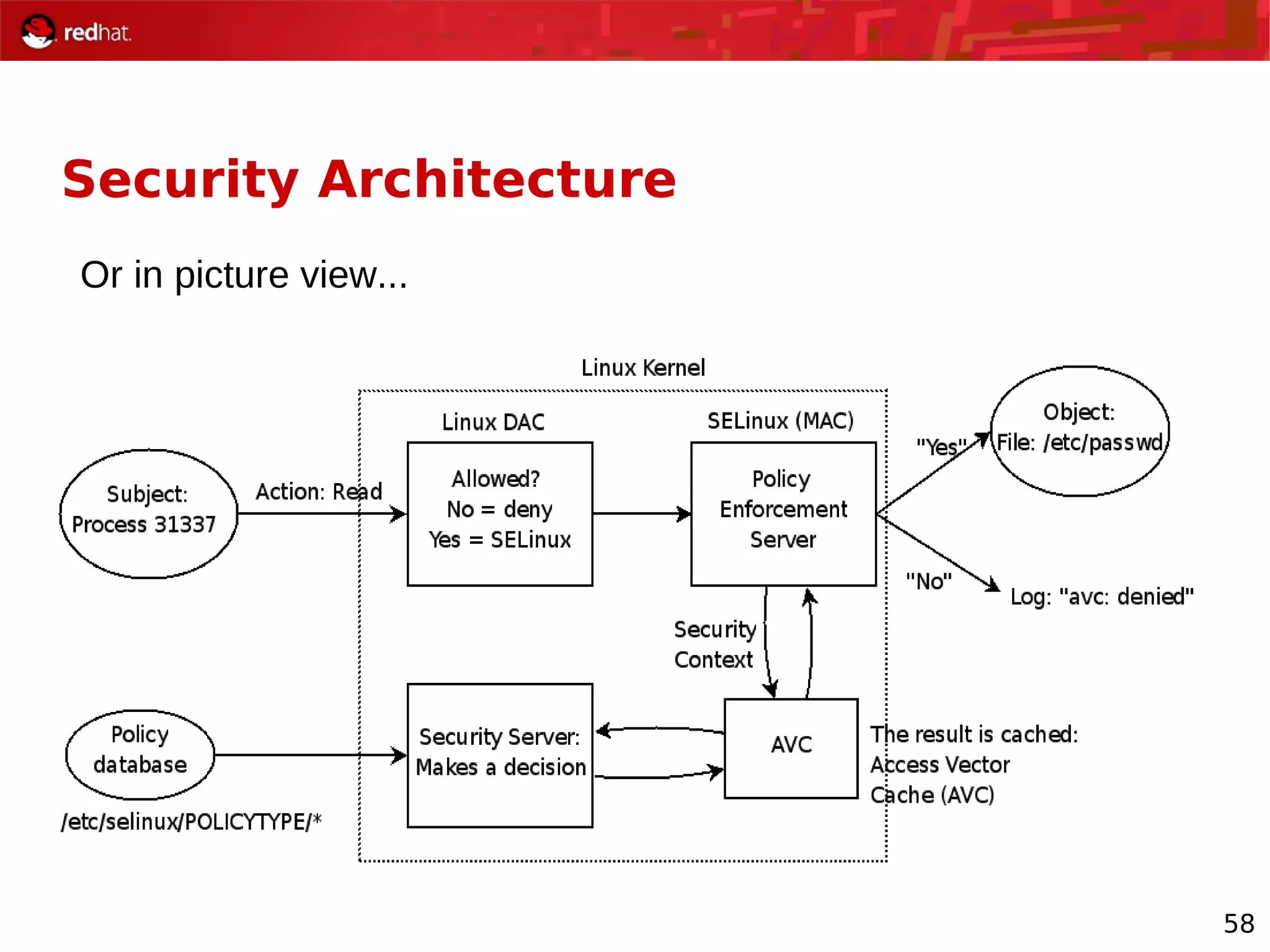
Security Architecture
Every subject (i.e process) and object (i.e. data files) are
assigned collections of security attributes, called a
security context
1) Security context of subject & object passed to SELinux
2) Kernel/SELinux check, verify access
2a) Grant access. Record allowance in AVC (Access Vector
Cache)
2b) Deny access, log error
58
Security Architecture
Or in picture view...
Name of Presentation
Red Hat
Presenter
SELinux Details
60
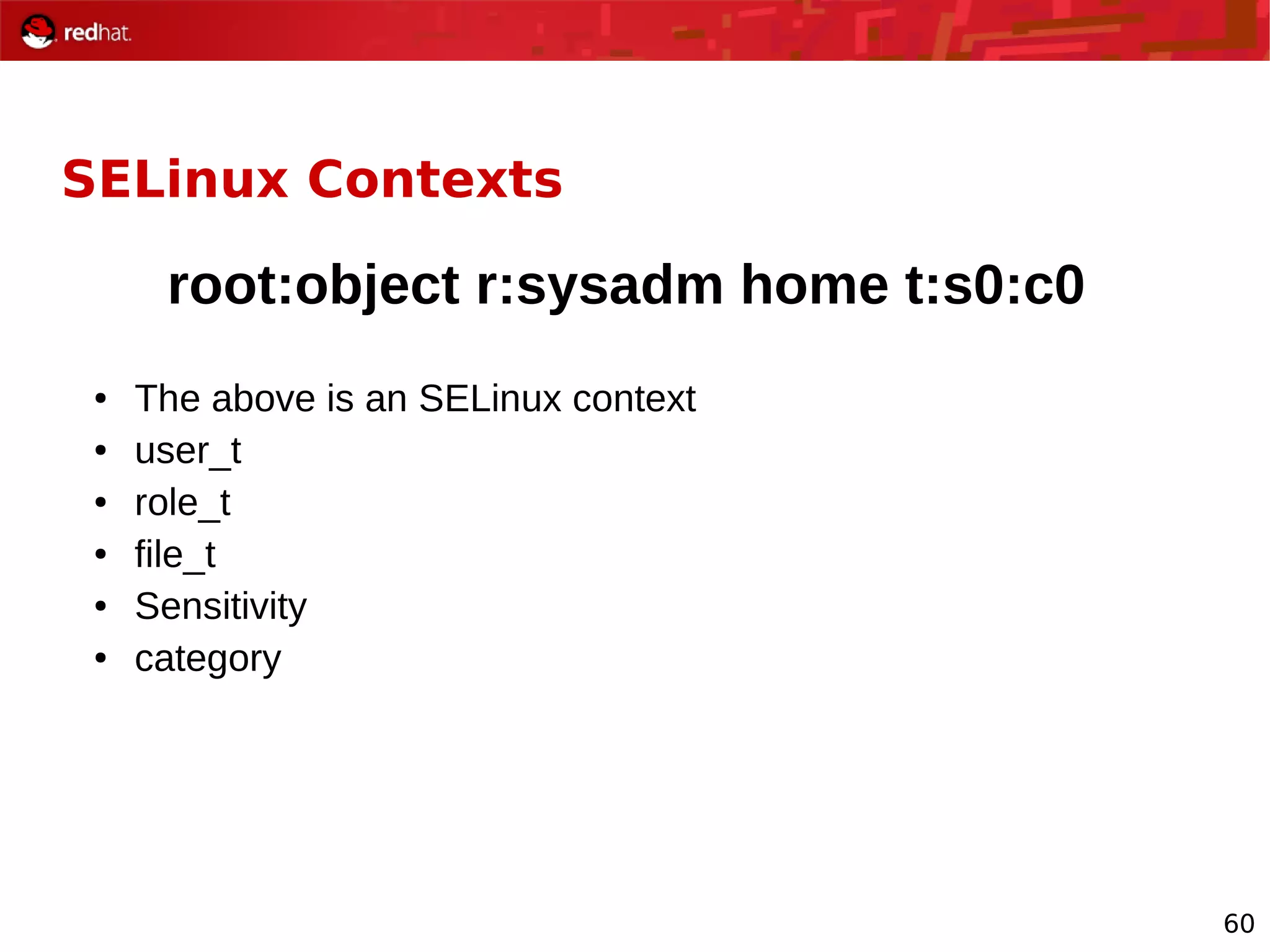
SELinux Contexts
root:object r:sysadm home t:s0:c0
● The above is an SELinux context
● user_t
● role_t
● file_t
● Sensitivity
● category
61
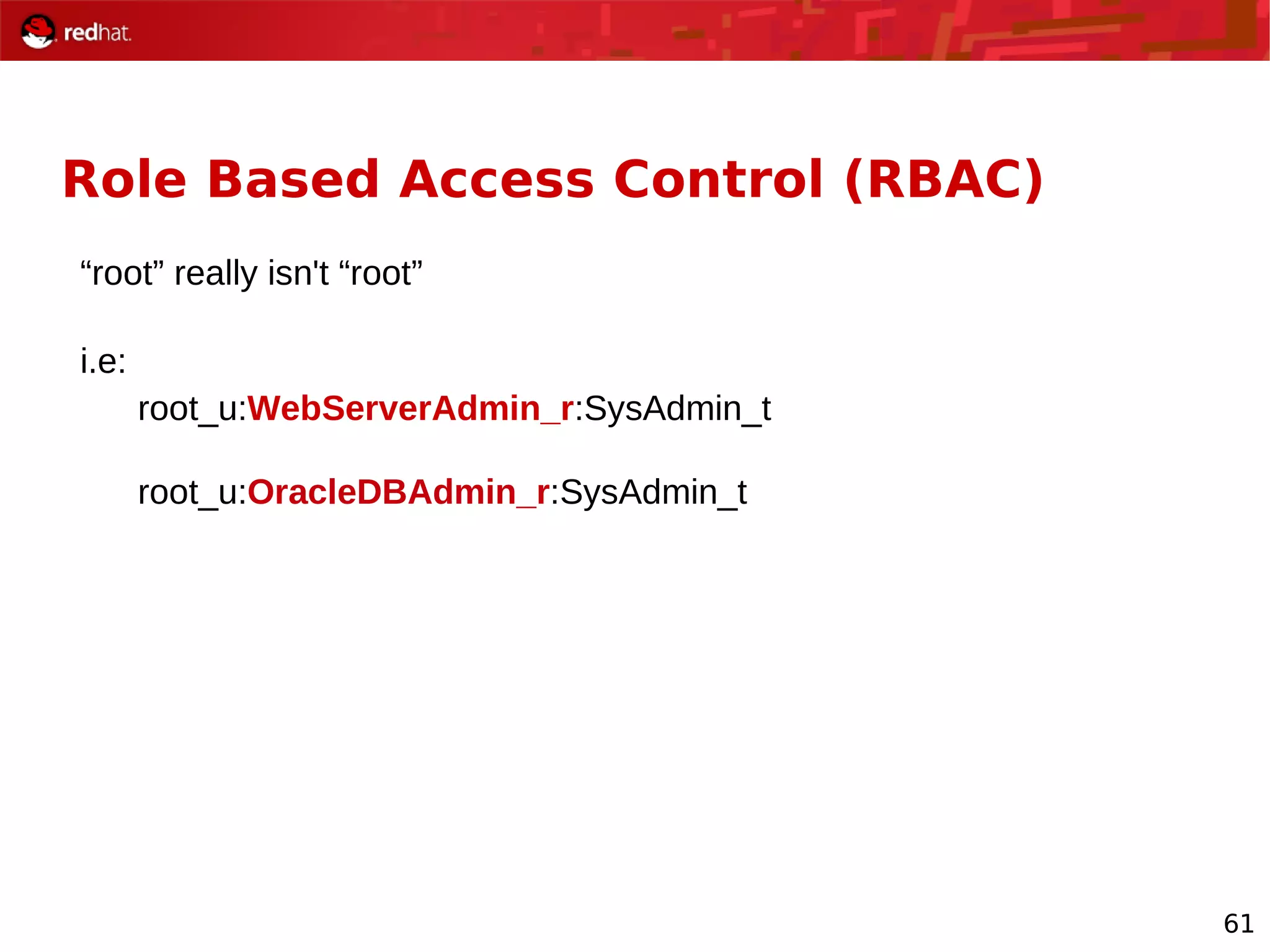
Role Based Access Control (RBAC)
“root” really isn't “root”
i.e:
root_u:WebServerAdmin_r:SysAdmin_t
root_u:OracleDBAdmin_r:SysAdmin_t
62
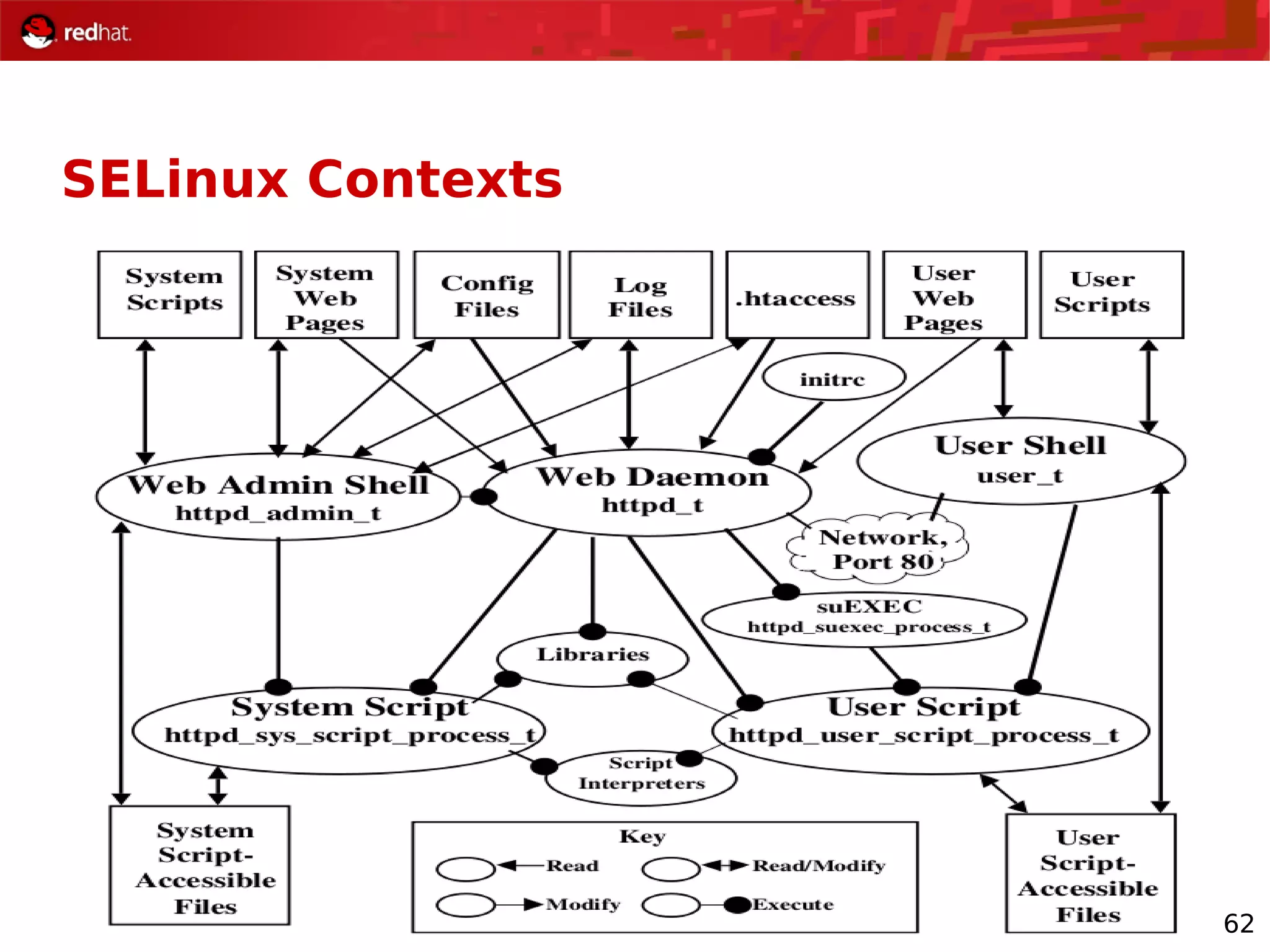
SELinux Contexts
63
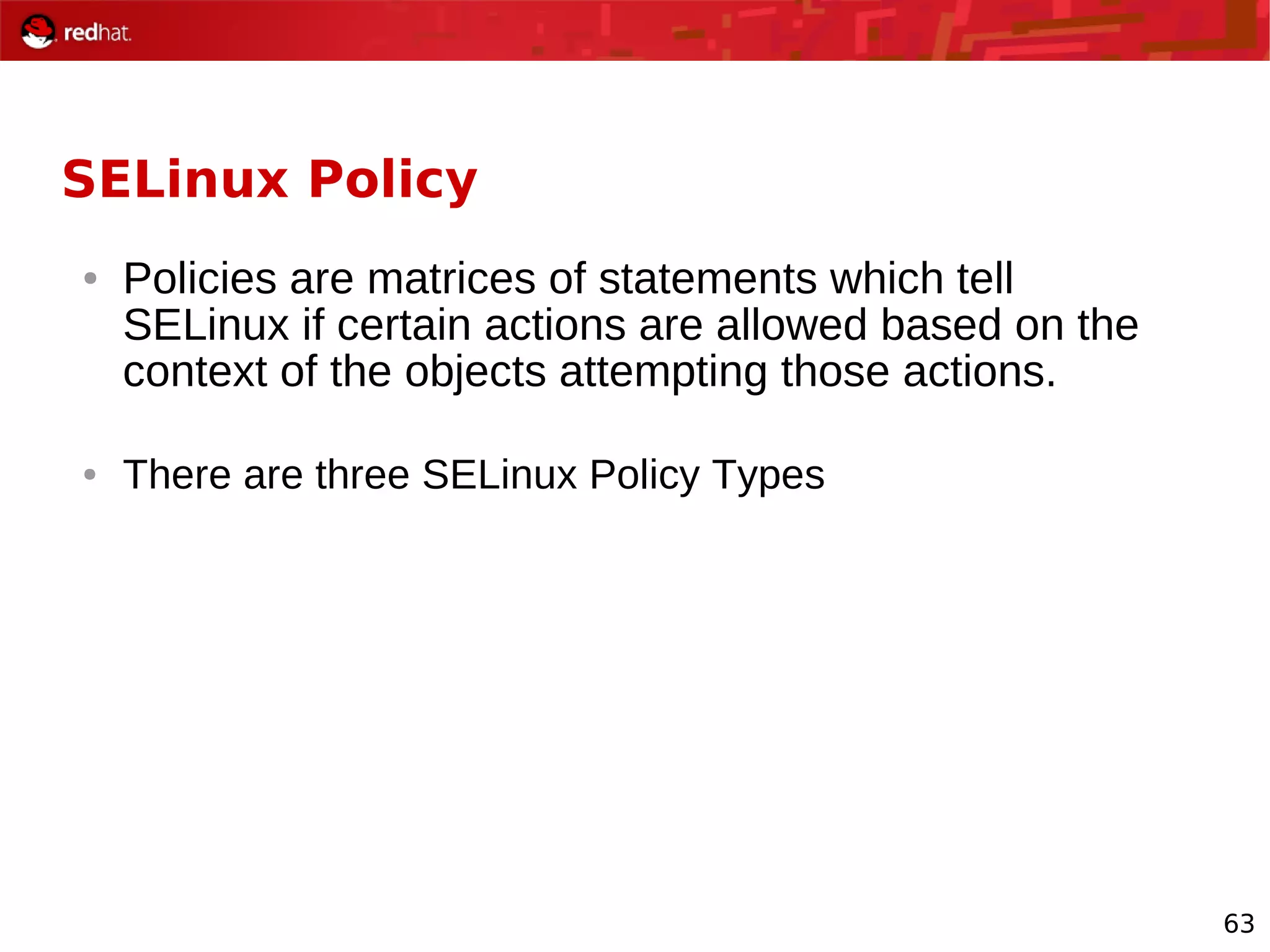
SELinux Policy
● Policies are matrices of statements which tell
SELinux if certain actions are allowed based on the
context of the objects attempting those actions.
● There are three SELinux Policy Types
64
The Three SELinux Policy Types
 Targeted Policy
 Default policy in RHEL5. Supported by HelpDesk.
 Targets specific applications to lock down.
 Allows all other applications to run in the unconfined
domain (unconfined_t)
 Applications running in the unconfined domain run as
if SELinux were disabled
65
The Three SELinux Policy Types
2) Strict Policy
 Denies access to everything by default
 Complete protection for all processes on the system
 Requires that policies be written for all applications,
often requires customization
 Strict is type enforcement with added types for users
(e.g. user_t and user_firefox_t).
 Not enabled by Red Hat as default
66
The Three SELinux Policy Types
3) Multi-Level Security (MLS)
 Focuses on confidentiality (i.e. separation of multiple
classifications of data)
 Ability to manage {processes, users} with varying
levels of access. (i.e. “the need to know”)
 Uses category & sensitivity levels
67
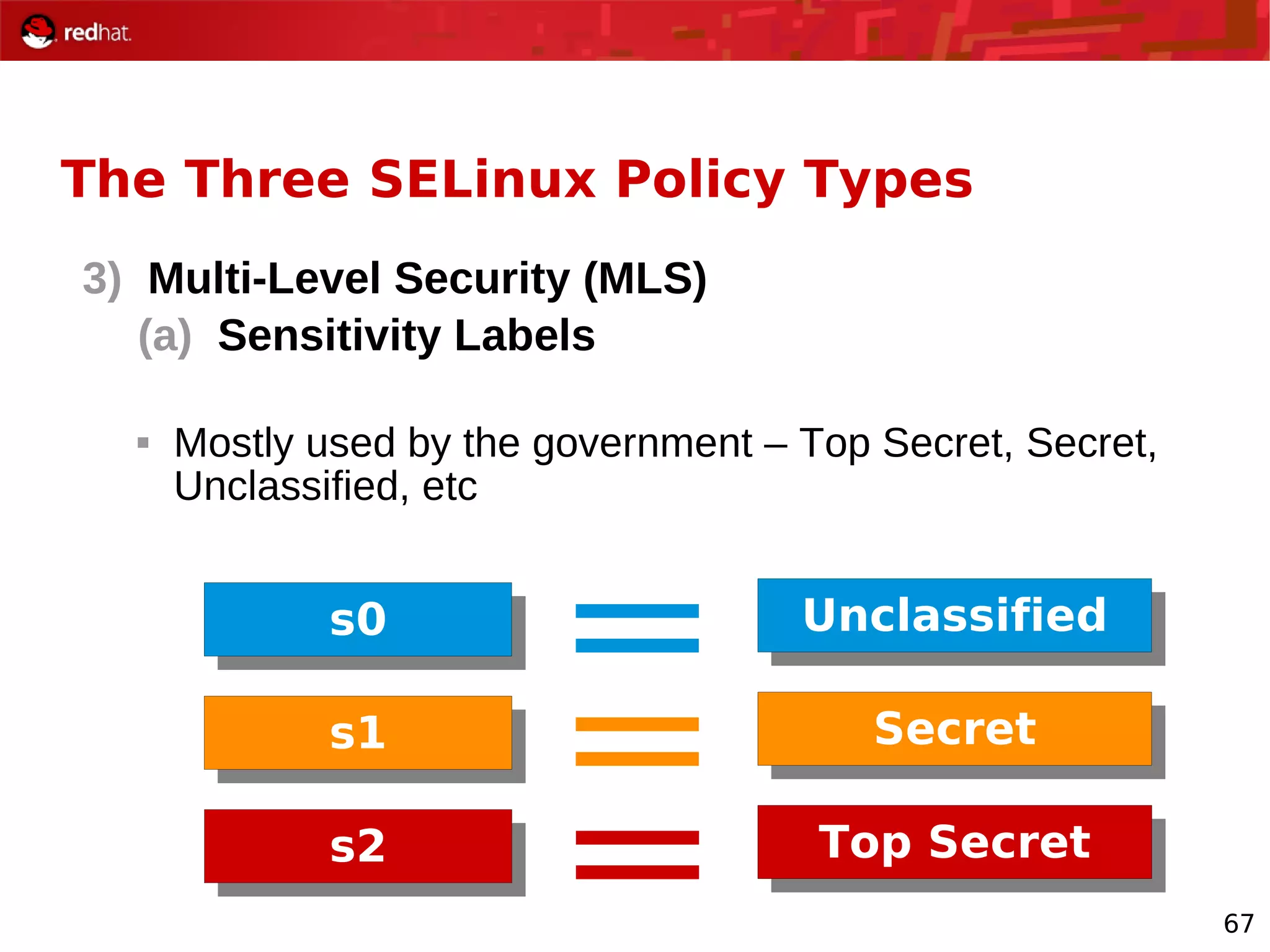
The Three SELinux Policy Types
3) Multi-Level Security (MLS)
(a) Sensitivity Labels
 Mostly used by the government – Top Secret, Secret,
Unclassified, etc
s0 Unclassified
s1 Secret
s2 Top Secret
68
The Three SELinux Policy Types
3) Multi-Level Security (MLS)
(b) Category Labels
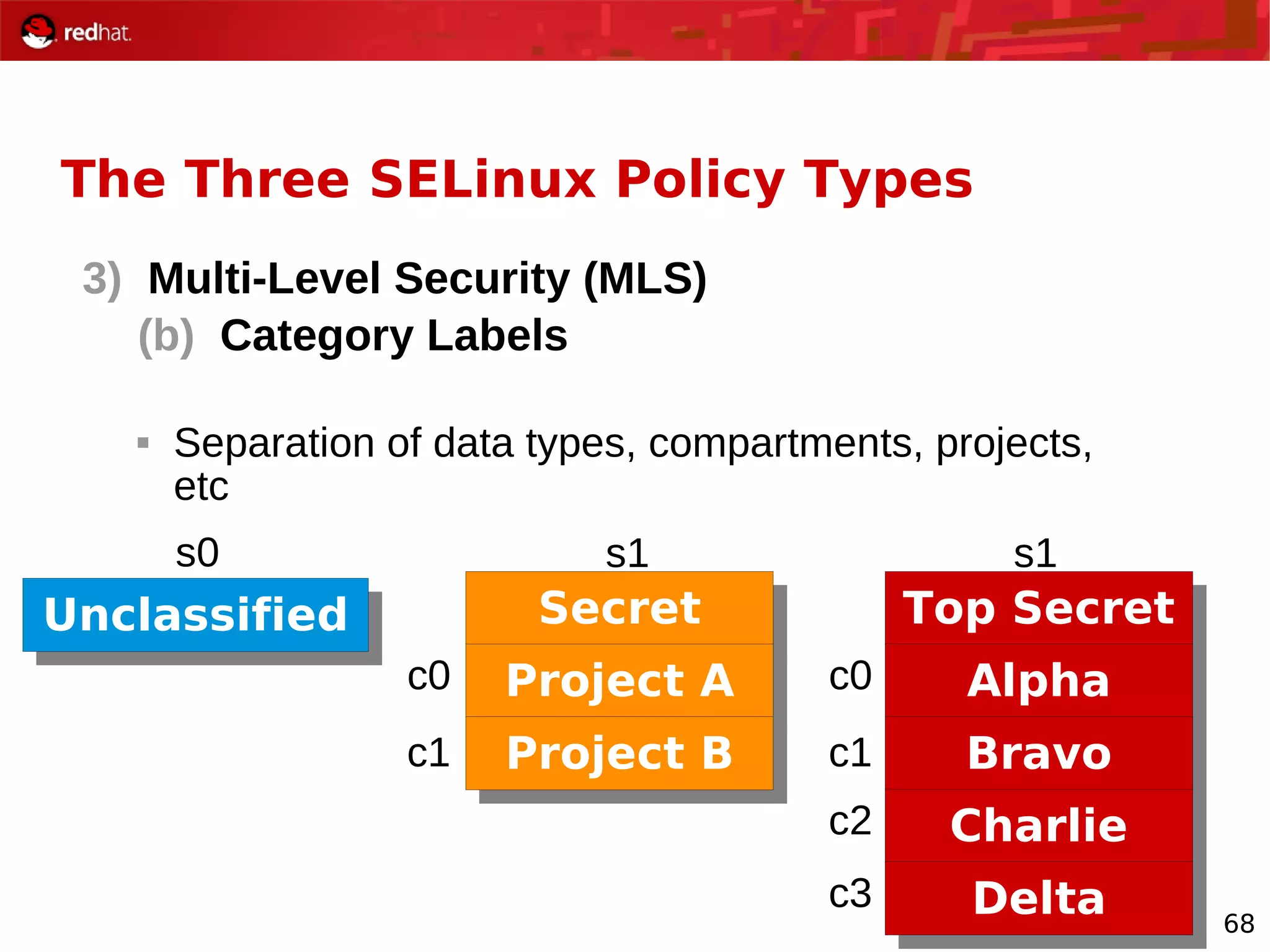
 Separation of data types, compartments, projects,
etc
Unclassified Secret Top Secret
Project A
Project B
Alpha
Bravo
Charlie
Delta
s0 s1 s1
c0
c1
c2
c3
c0
c1
69
The Three SELinux Policy Types
3) Multi-Level Security (MLS)
(b) Polyinstantiation & pam_namespace
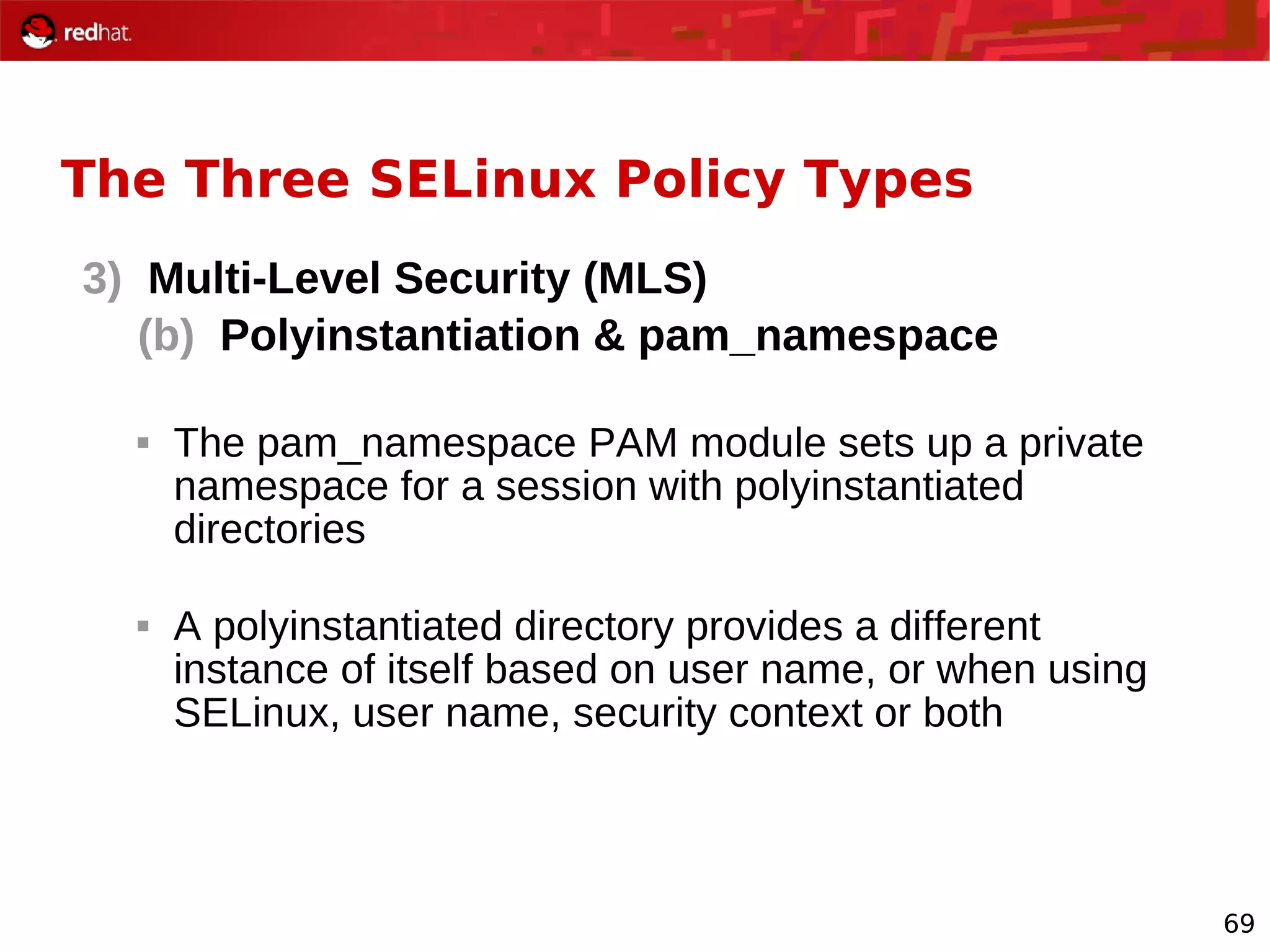
 The pam_namespace PAM module sets up a private
namespace for a session with polyinstantiated
directories
 A polyinstantiated directory provides a different
instance of itself based on user name, or when using
SELinux, user name, security context or both
70
The Three SELinux Policy Types
3) Multi-Level Security (MLS)
(b) Polyinstantiation & pam_namespace
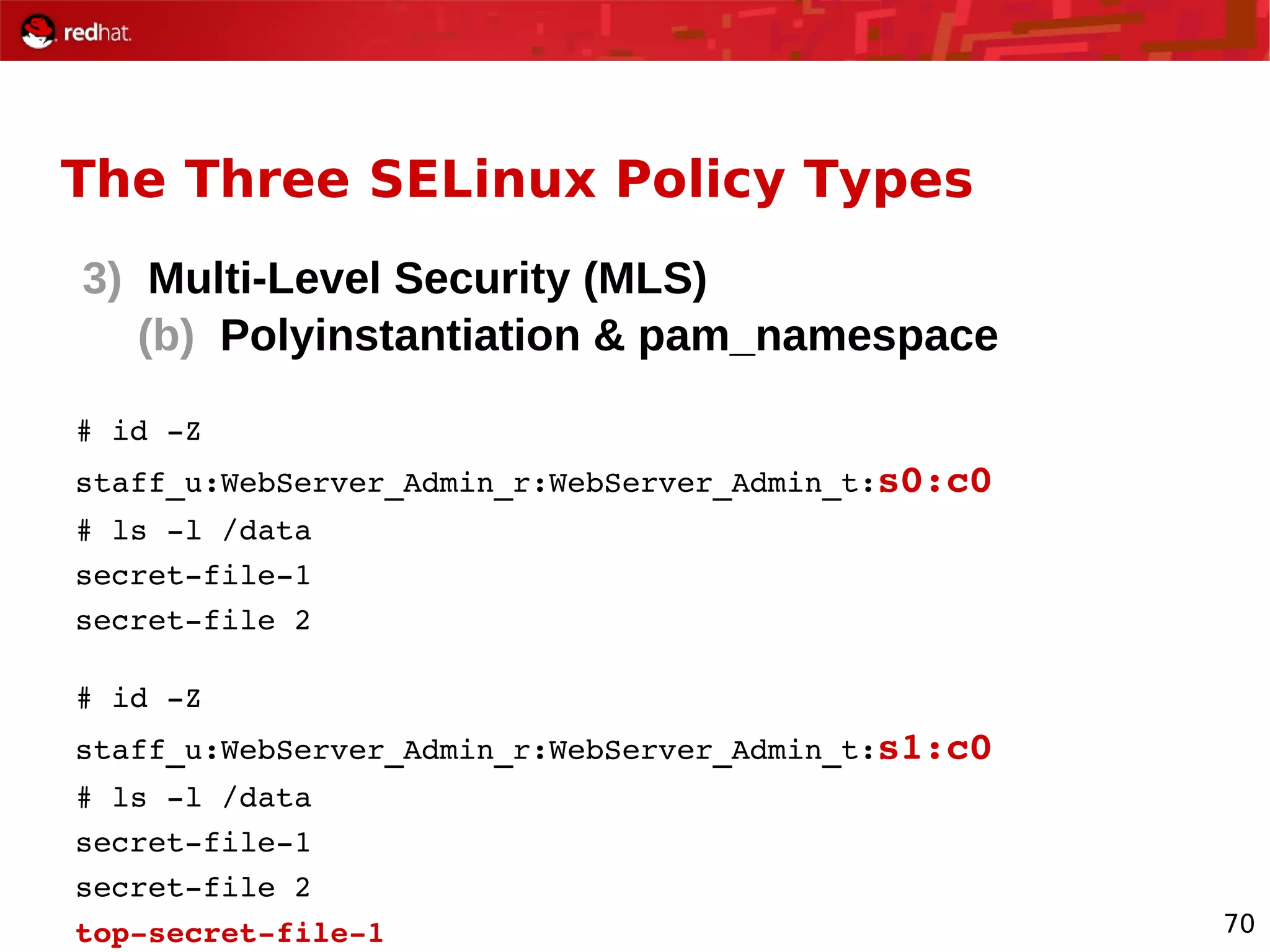
# id ­Z
staff_u:WebServer_Admin_r:WebServer_Admin_t:s0:c0
# ls ­l /data
secret­file­1
secret­file 2
# id ­Z
staff_u:WebServer_Admin_r:WebServer_Admin_t:s1:c0
# ls ­l /data
secret­file­1
secret­file 2
top­secret­file­1
71
The Three SELinux Policy Types
Multi-Level Security (MLS) & Common Criteria
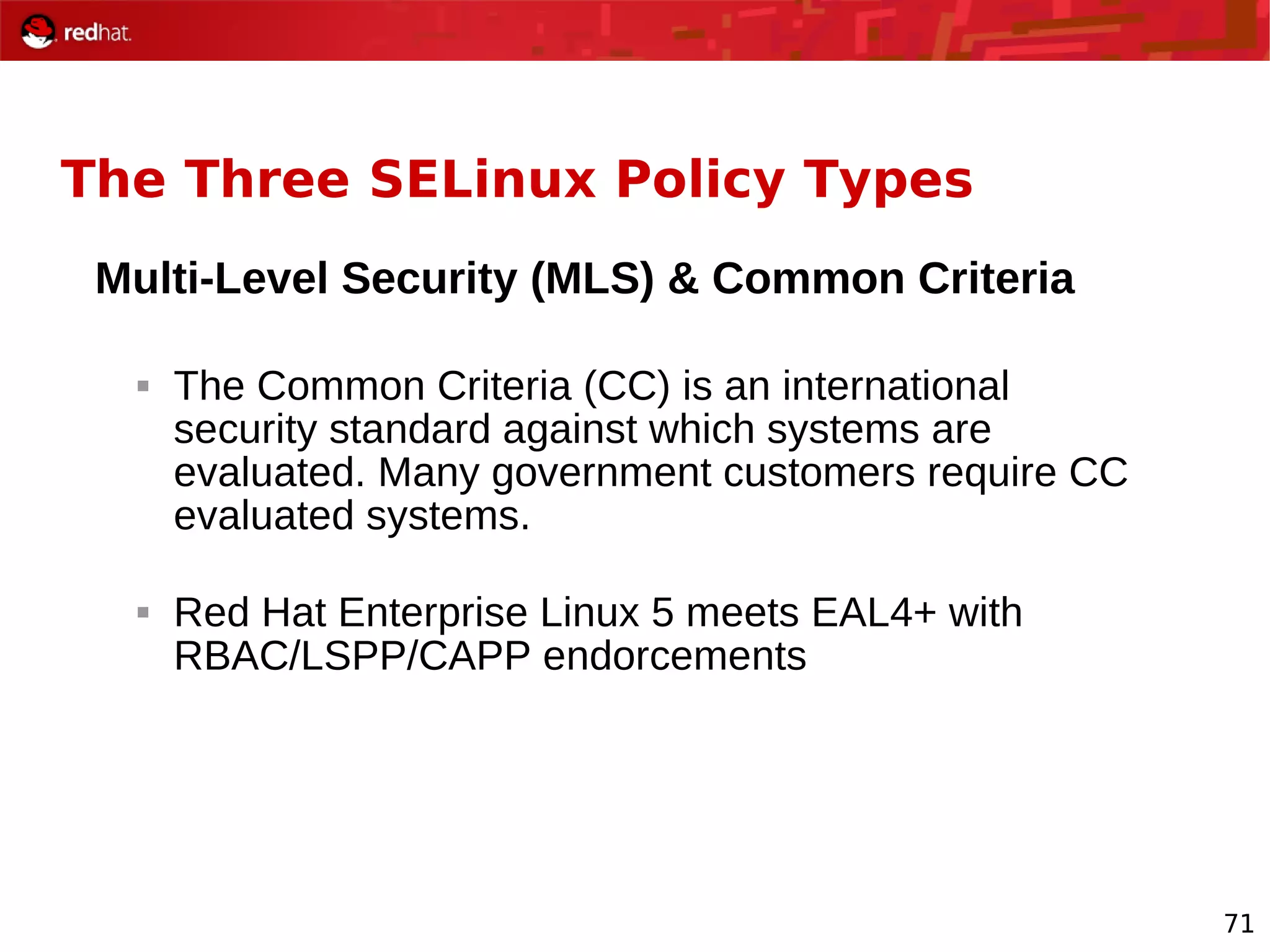
 The Common Criteria (CC) is an international
security standard against which systems are
evaluated. Many government customers require CC
evaluated systems.
 Red Hat Enterprise Linux 5 meets EAL4+ with
RBAC/LSPP/CAPP endorcements
72
What's the Performance Overhead?
73
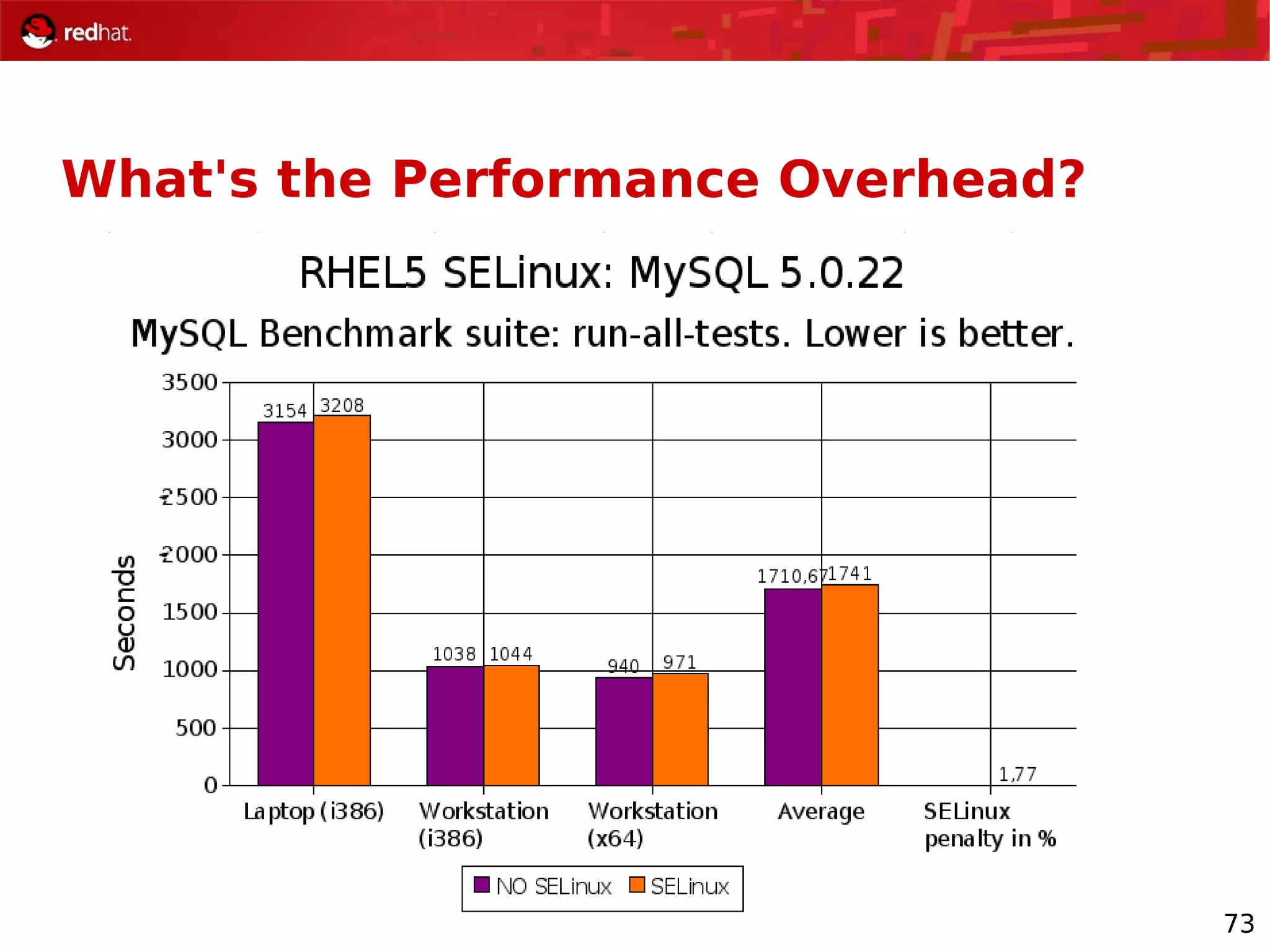
What's the Performance Overhead?
74
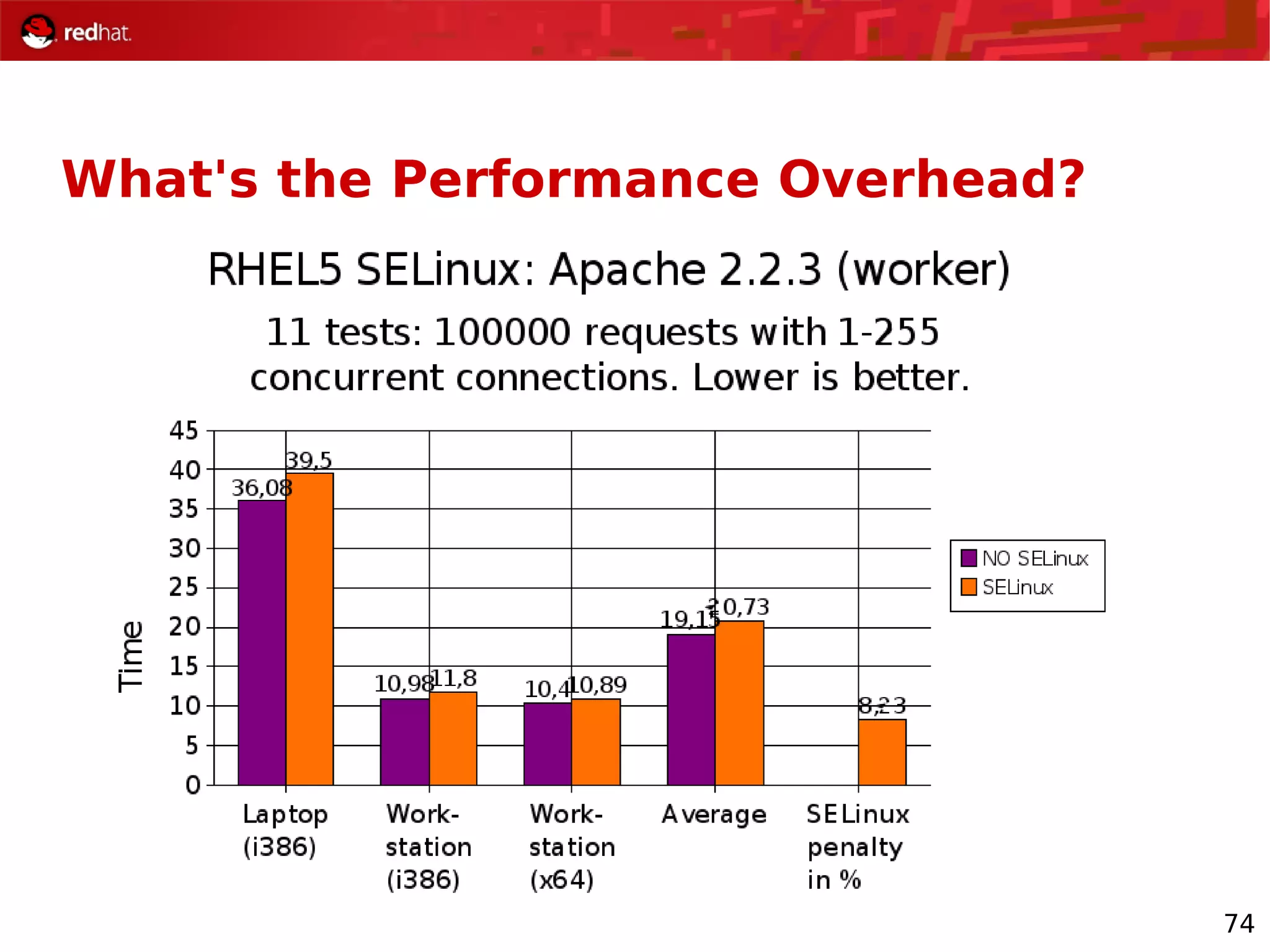
What's the Performance Overhead?
75
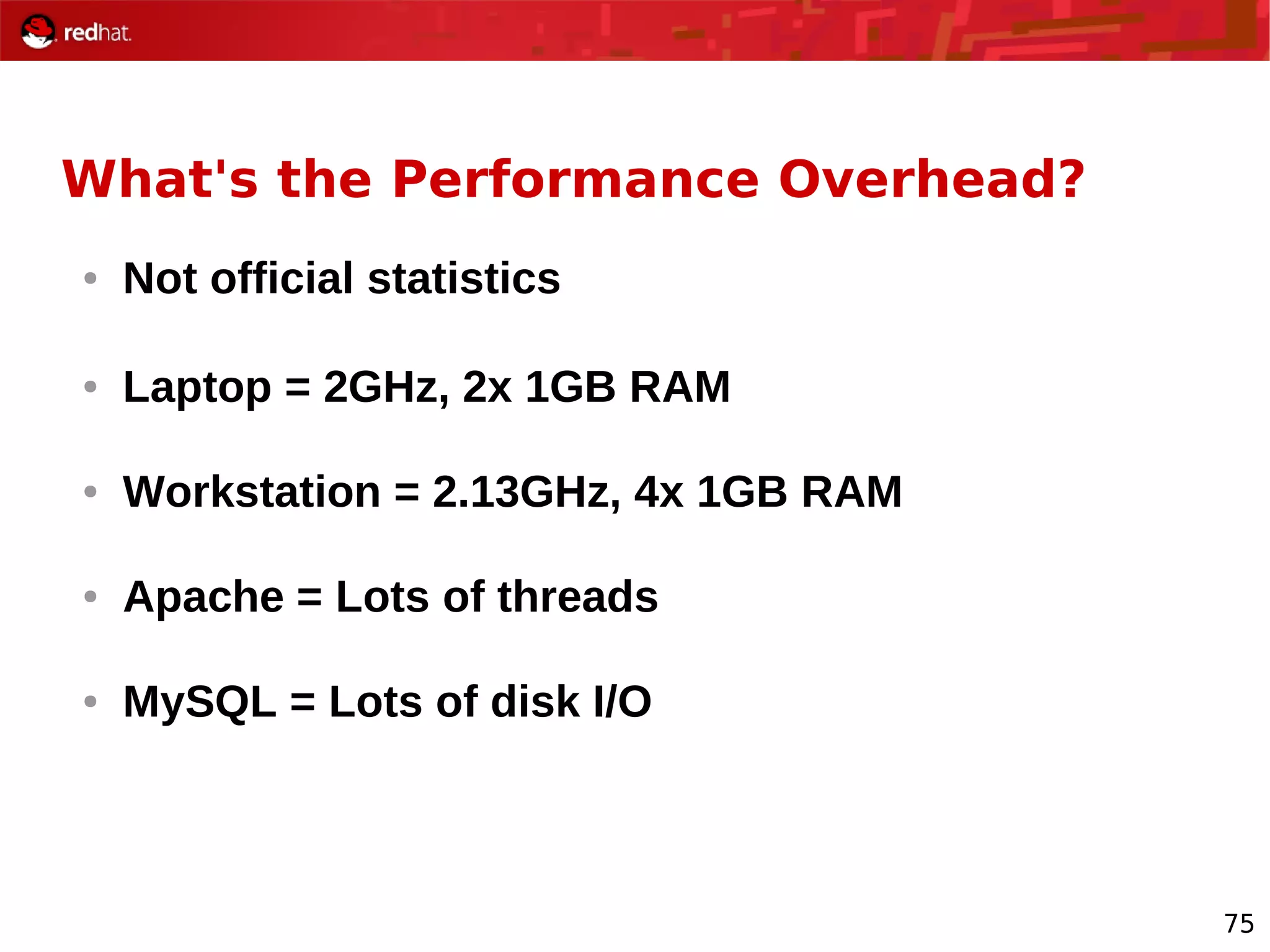
What's the Performance Overhead?
● Not official statistics
● Laptop = 2GHz, 2x 1GB RAM
● Workstation = 2.13GHz, 4x 1GB RAM
● Apache = Lots of threads
● MySQL = Lots of disk I/O
Name of Presentation
Red Hat
Presenter
SELinux Usage
(GUI & console)
77
End-User Perspective
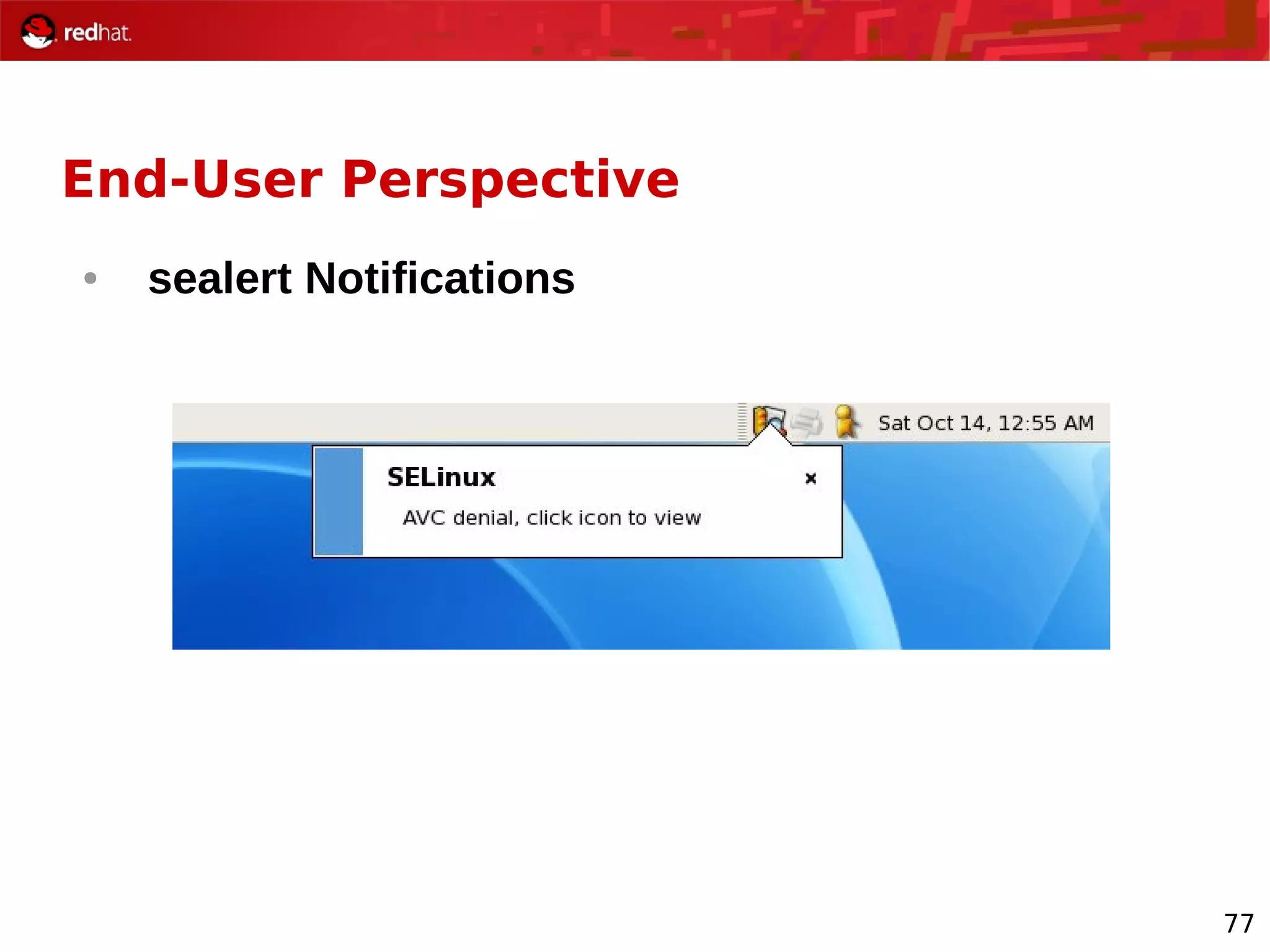
● sealert Notifications
78
End-User Perspective
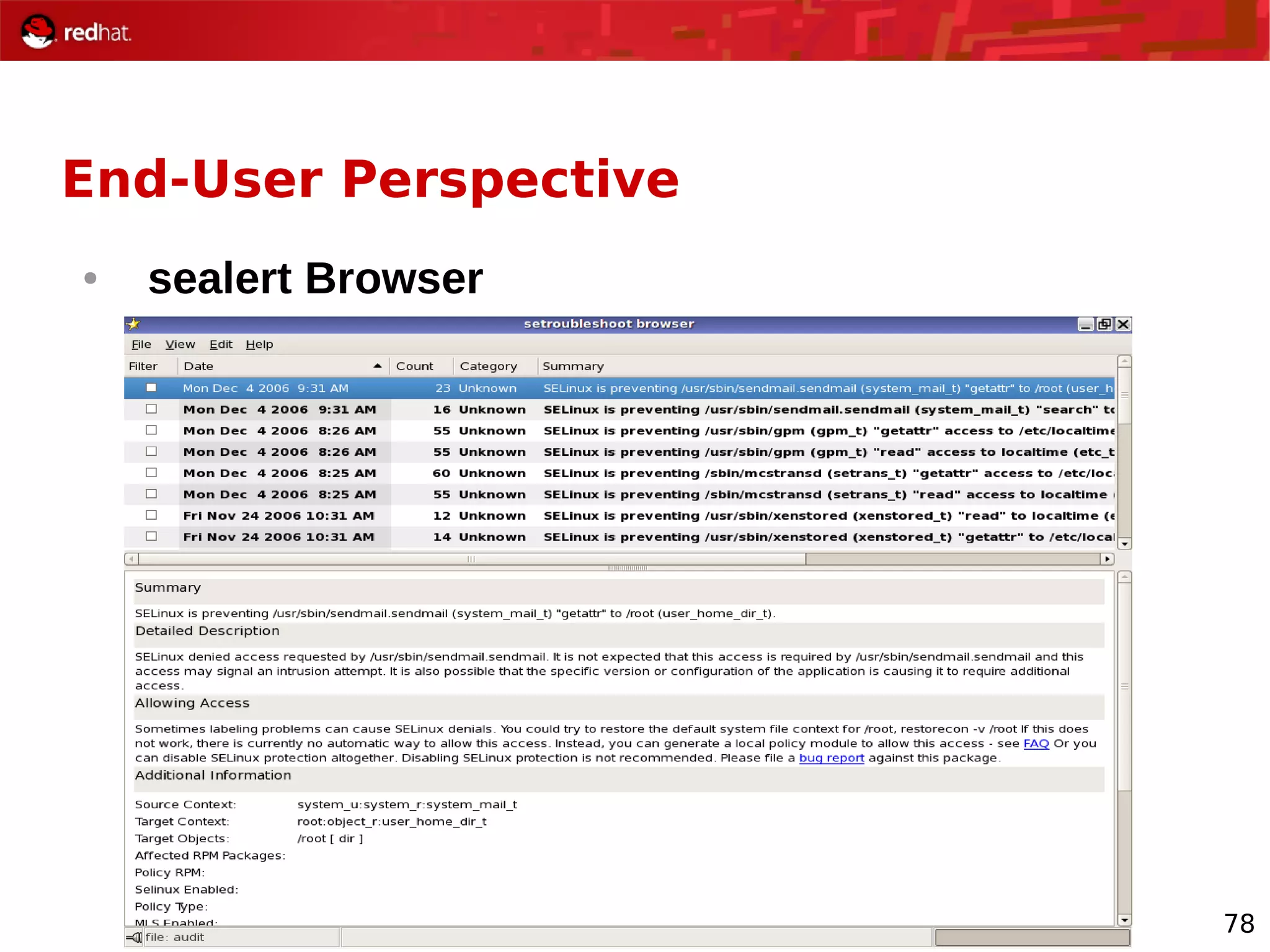
● sealert Browser
79
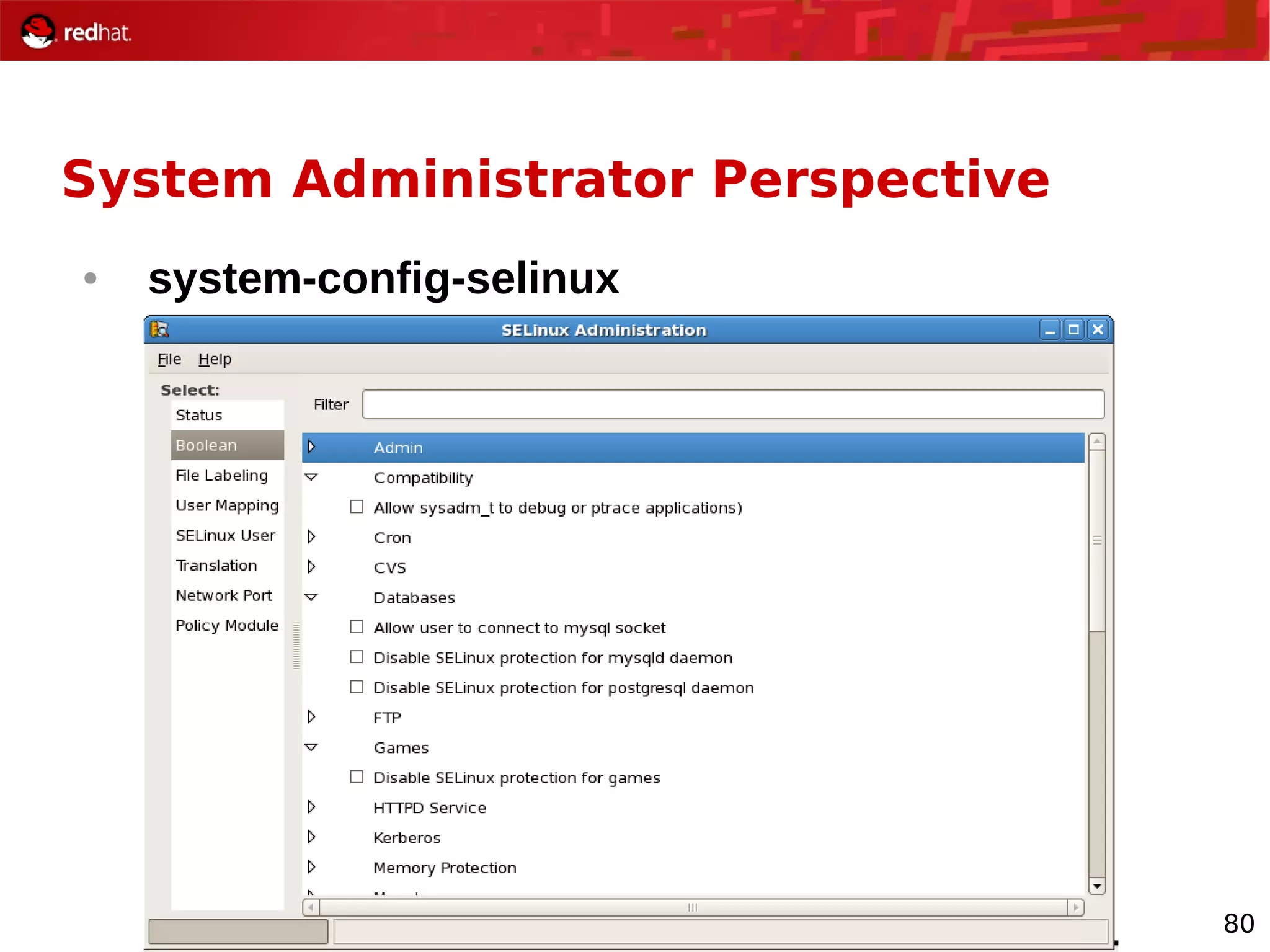
System Administrator Perspective
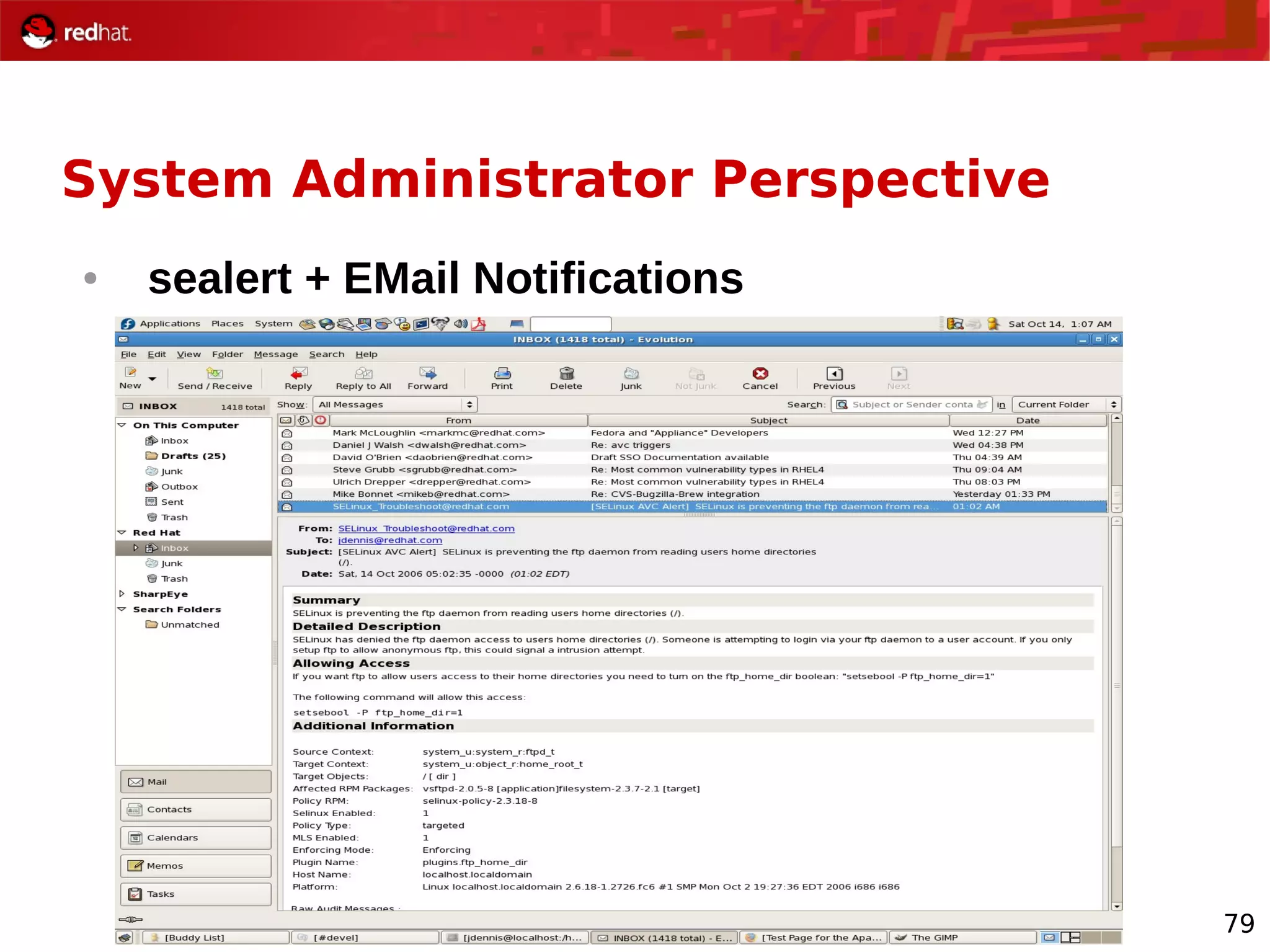
● sealert + EMail Notifications
80
System Administrator Perspective
● system-config-selinux
81
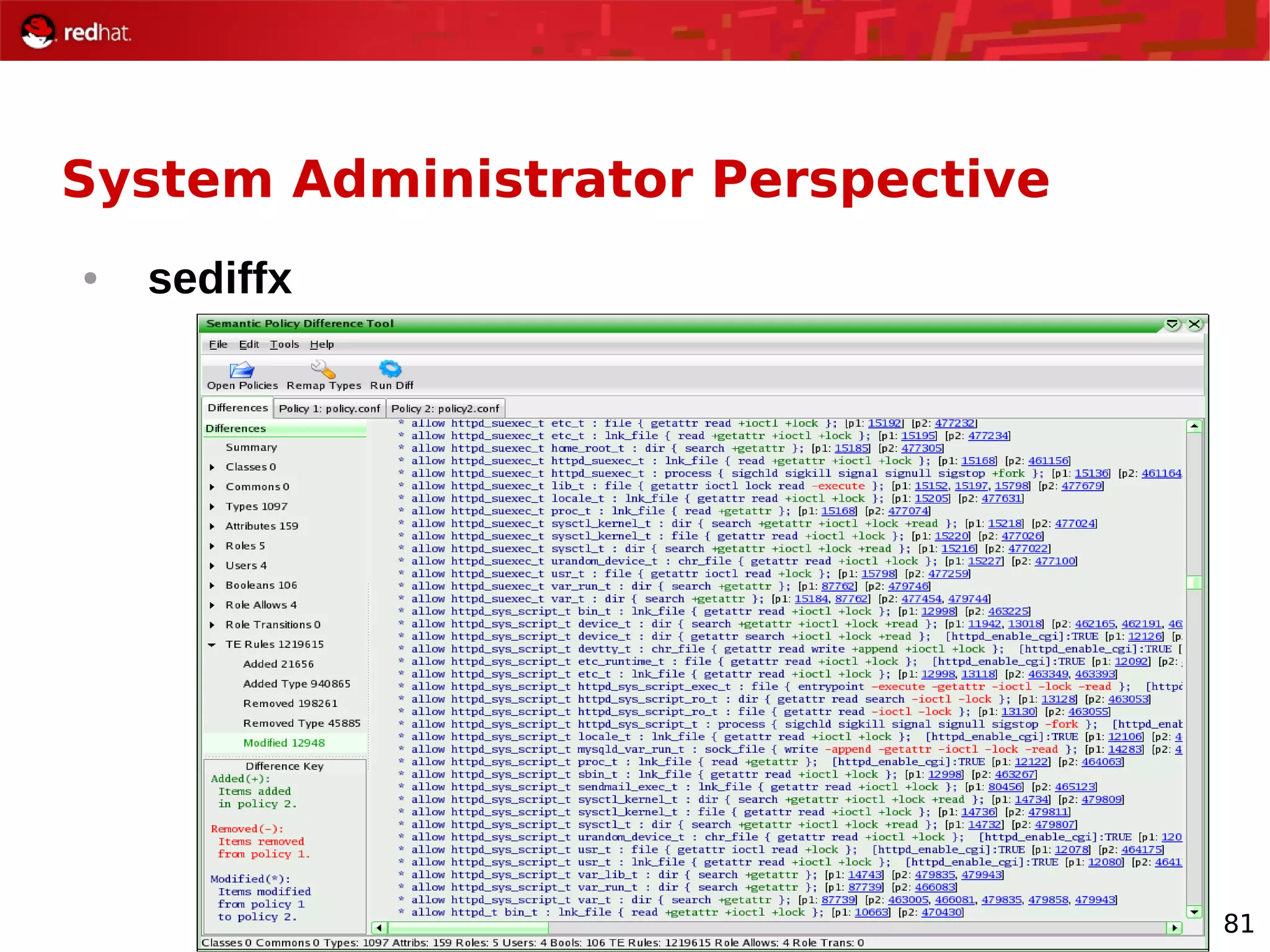
System Administrator Perspective
● sediffx
82
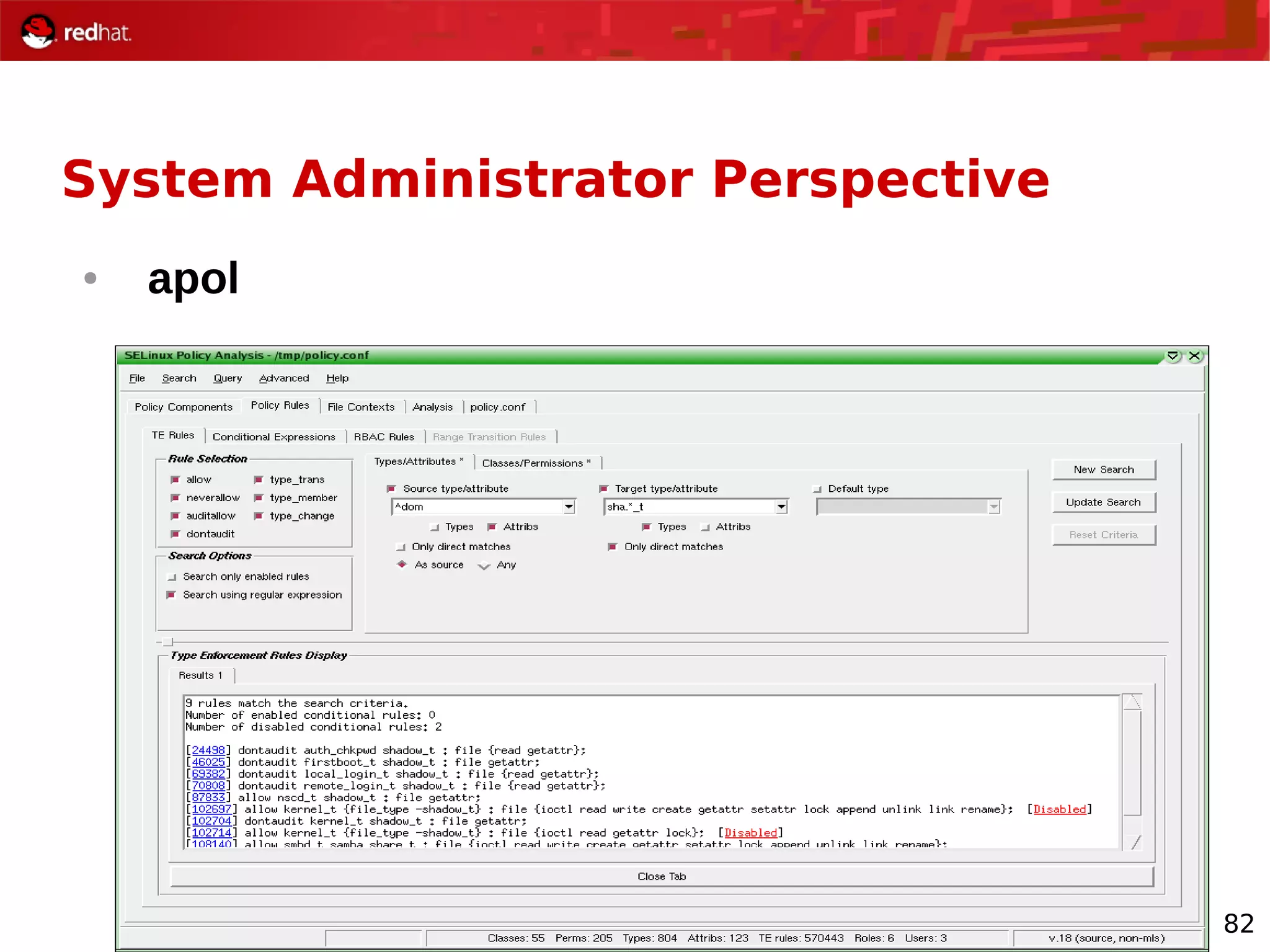
System Administrator Perspective
● apol
Name of Presentation
Red Hat
Presenter
SELinux Usage
(Hints & Tips)
84
System Administrator Perspective
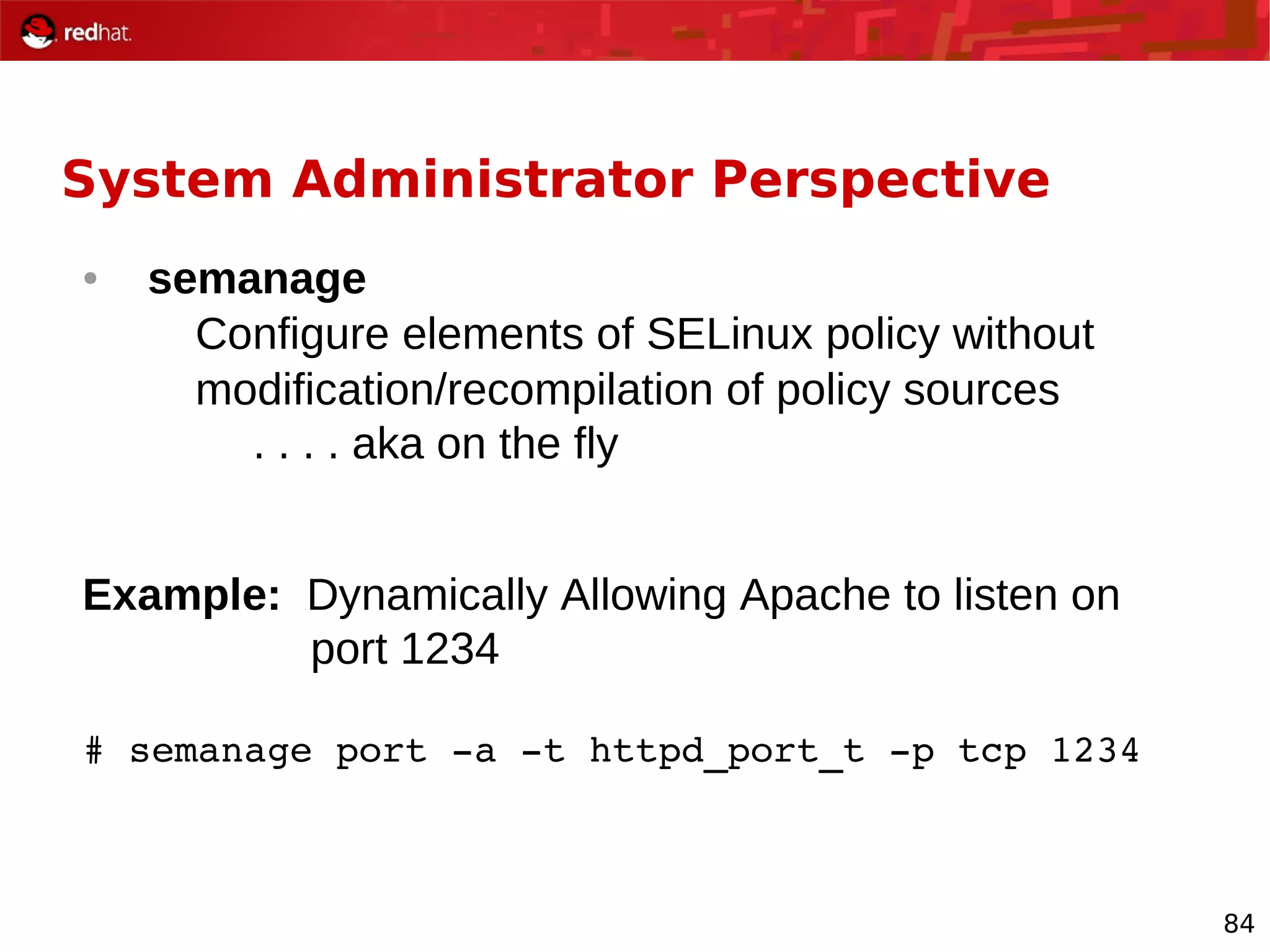
● semanage
Configure elements of SELinux policy without
modification/recompilation of policy sources
. . . . aka on the fly
Example: Dynamically Allowing Apache to listen on
port 1234
# semanage port ­a ­t httpd_port_t ­p tcp 1234
85
System Administrator Perspective
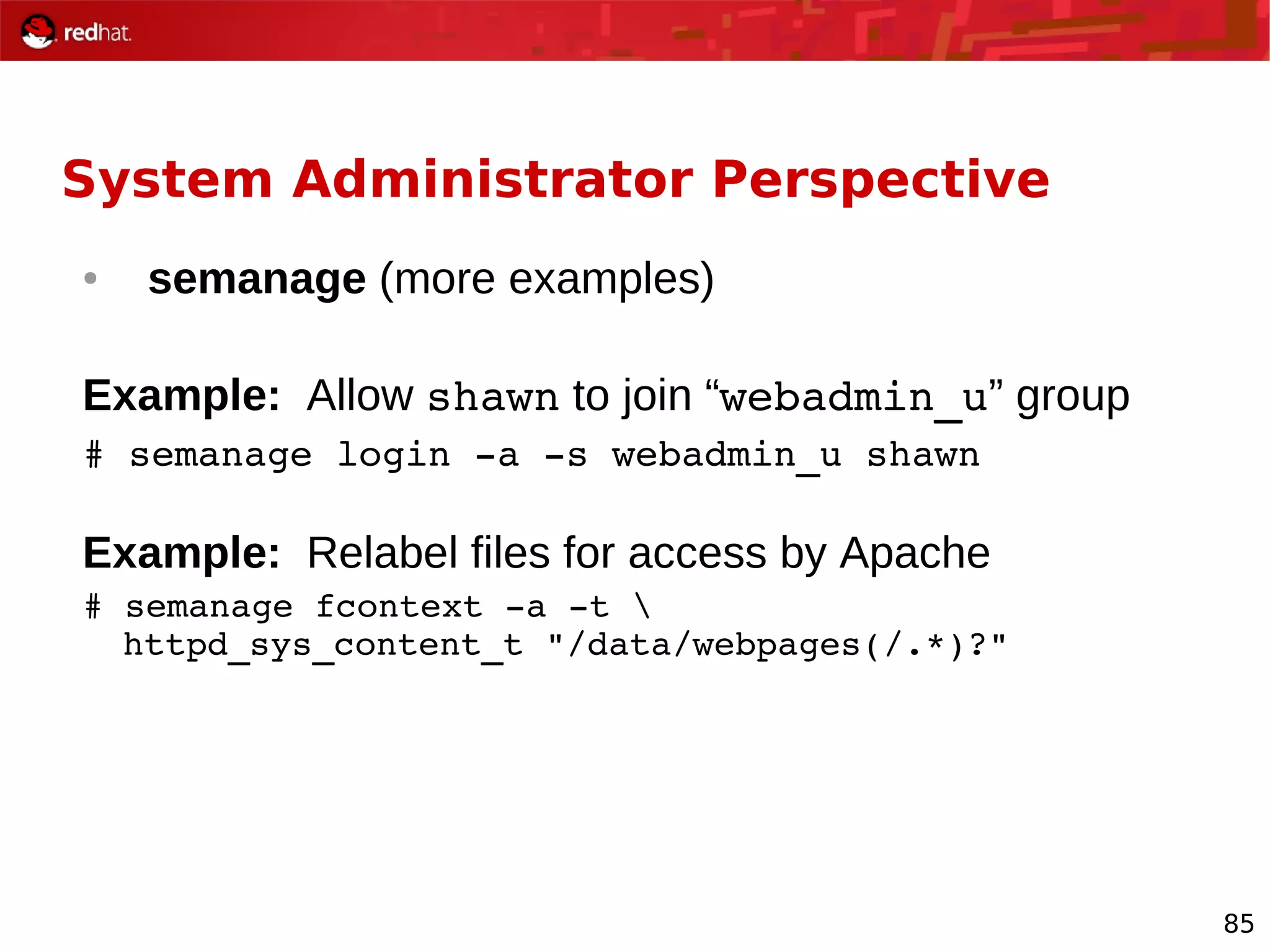
● semanage (more examples)
Example: Allow shawn to join “webadmin_u” group
# semanage login ­a ­s webadmin_u shawn
Example: Relabel files for access by Apache
# semanage fcontext ­a ­t 
httpd_sys_content_t "/data/webpages(/.*)?"
86
System Administrator Perspective
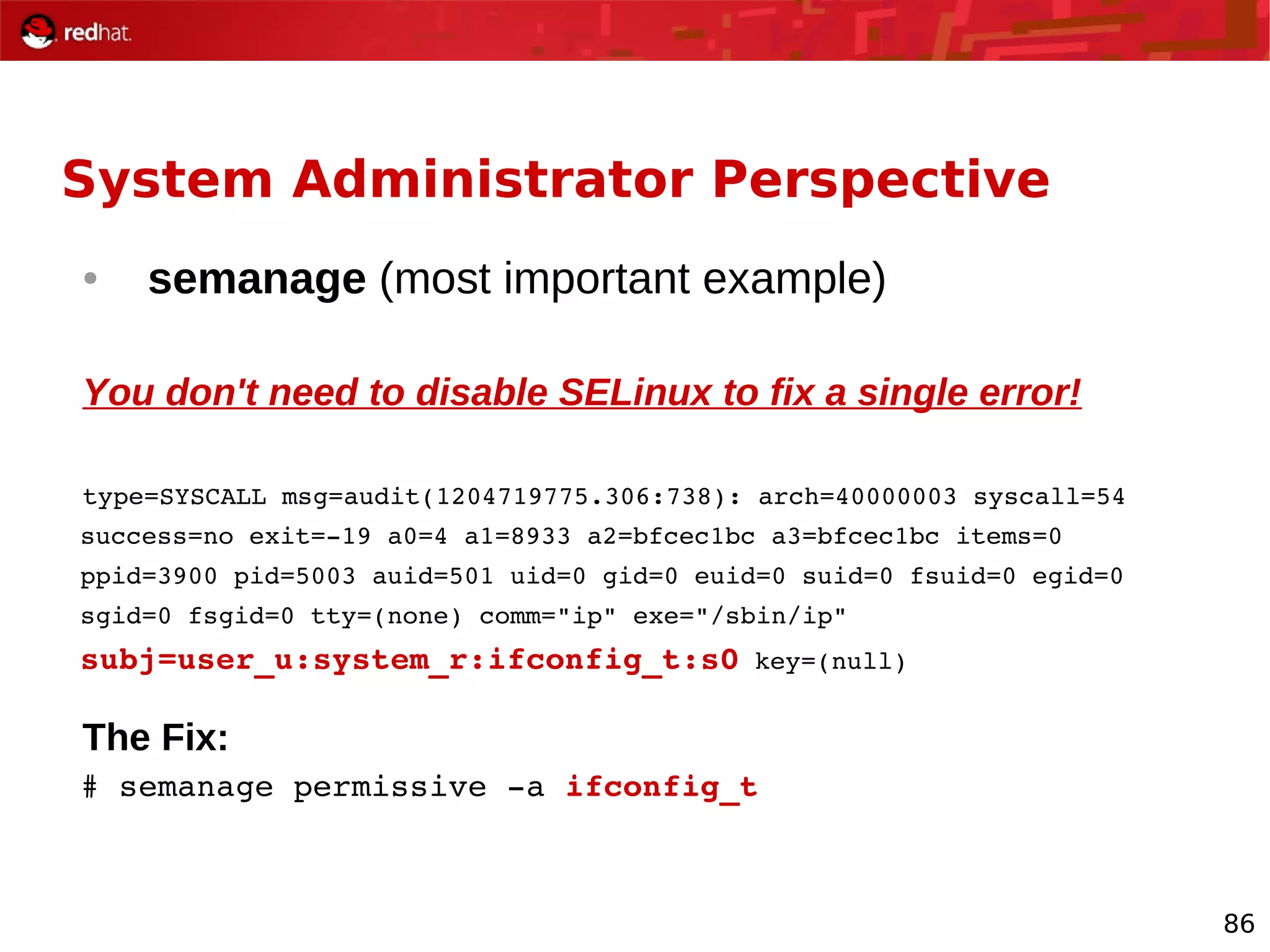
● semanage (most important example)
You don't need to disable SELinux to fix a single error!
type=SYSCALL msg=audit(1204719775.306:738): arch=40000003 syscall=54
success=no exit=­19 a0=4 a1=8933 a2=bfcec1bc a3=bfcec1bc items=0
ppid=3900 pid=5003 auid=501 uid=0 gid=0 euid=0 suid=0 fsuid=0 egid=0
sgid=0 fsgid=0 tty=(none) comm="ip" exe="/sbin/ip"
subj=user_u:system_r:ifconfig_t:s0 key=(null)
The Fix:
# semanage permissive ­a ifconfig_t
87
System Administrator Perspective
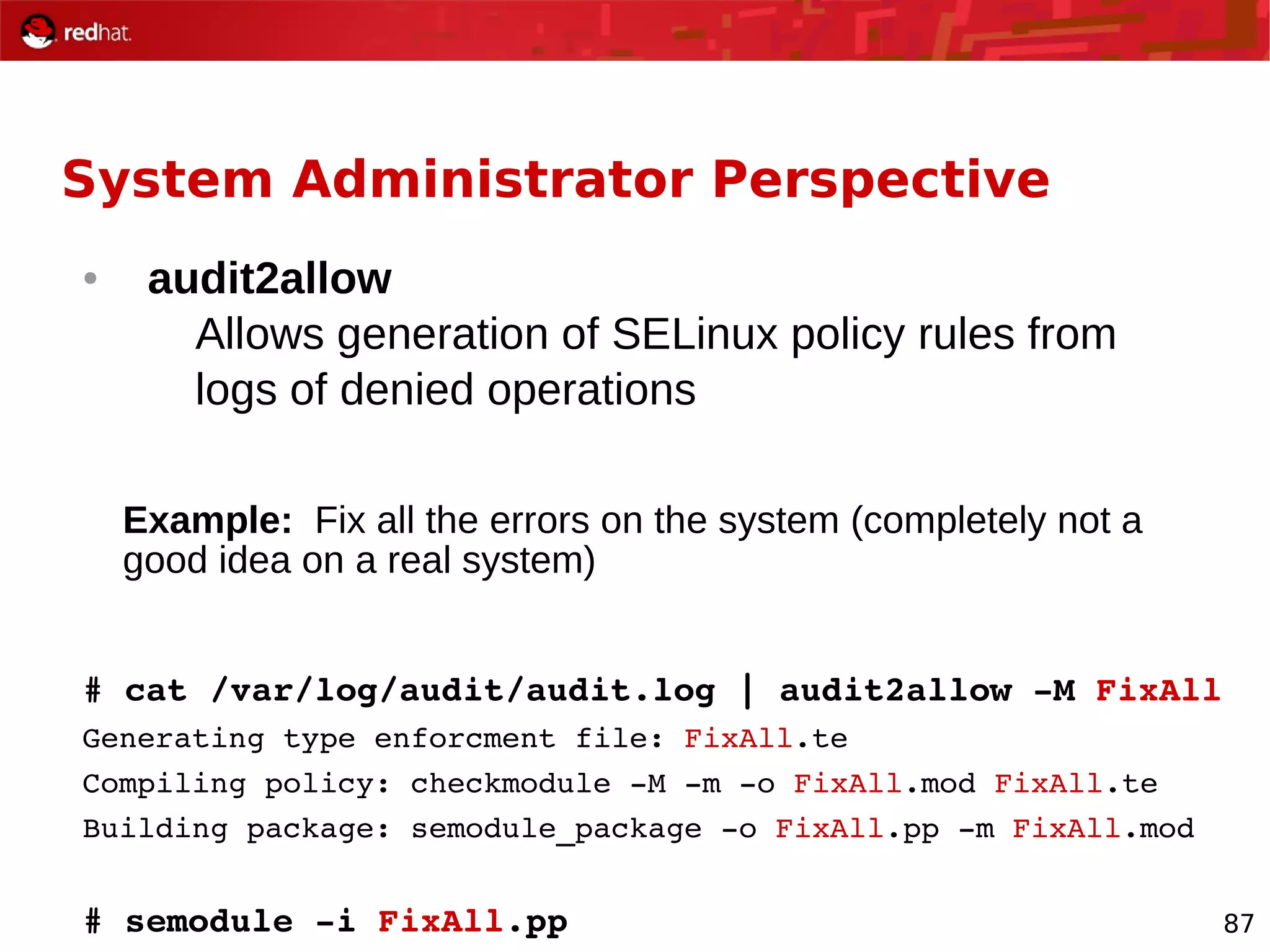
● audit2allow
Allows generation of SELinux policy rules from
logs of denied operations
Example: Fix all the errors on the system (completely not a
good idea on a real system)
# cat /var/log/audit/audit.log | audit2allow ­M FixAll
Generating type enforcment file: FixAll.te
Compiling policy: checkmodule ­M ­m ­o FixAll.mod FixAll.te
Building package: semodule_package ­o FixAll.pp ­m FixAll.mod
# semodule ­i FixAll.pp
Name of Presentation
Red Hat
Presenter
Scenarios
89
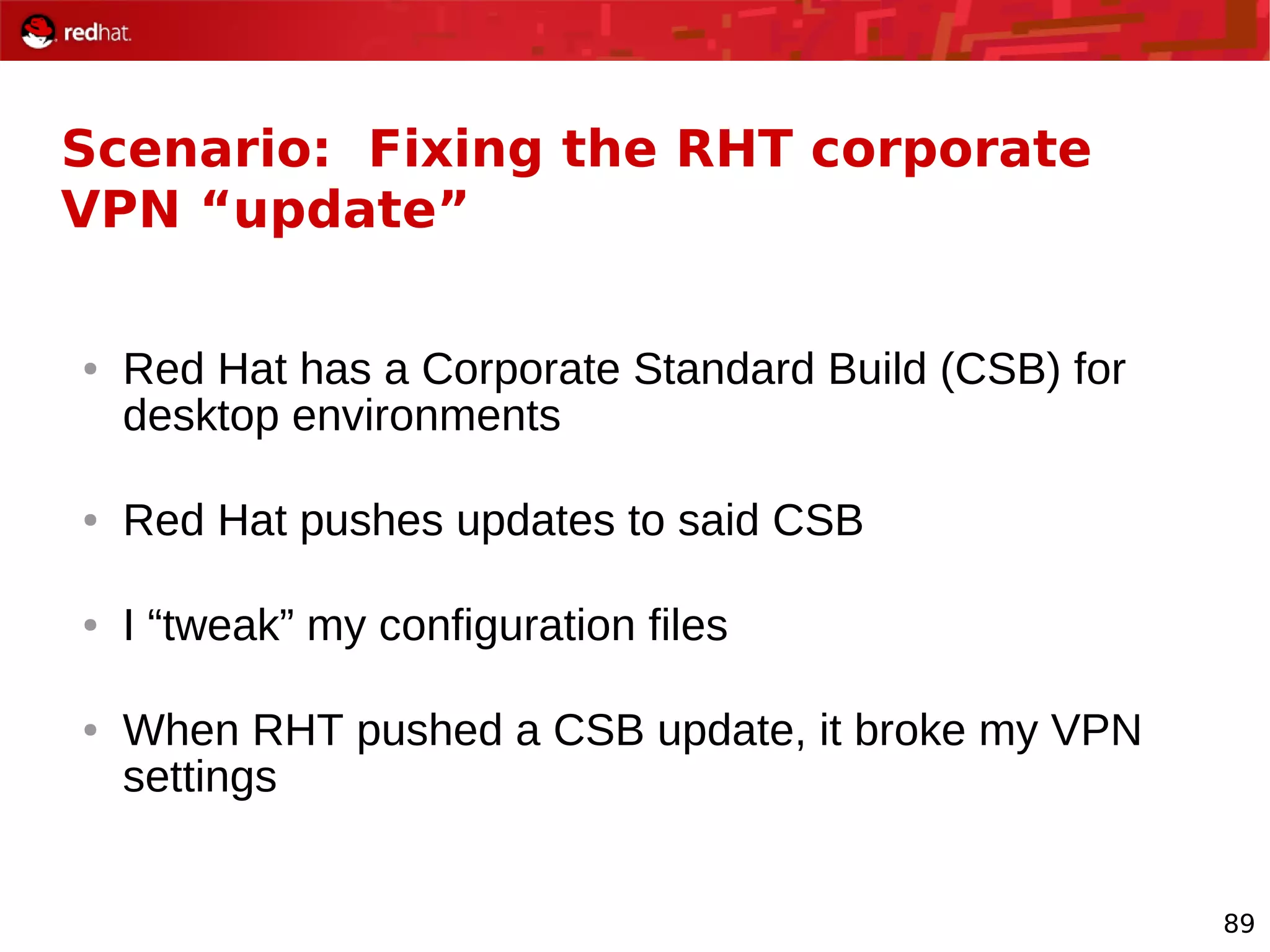
Scenario: Fixing the RHT corporate
VPN “update”
● Red Hat has a Corporate Standard Build (CSB) for
desktop environments
● Red Hat pushes updates to said CSB
● I “tweak” my configuration files
● When RHT pushed a CSB update, it broke my VPN
settings
90
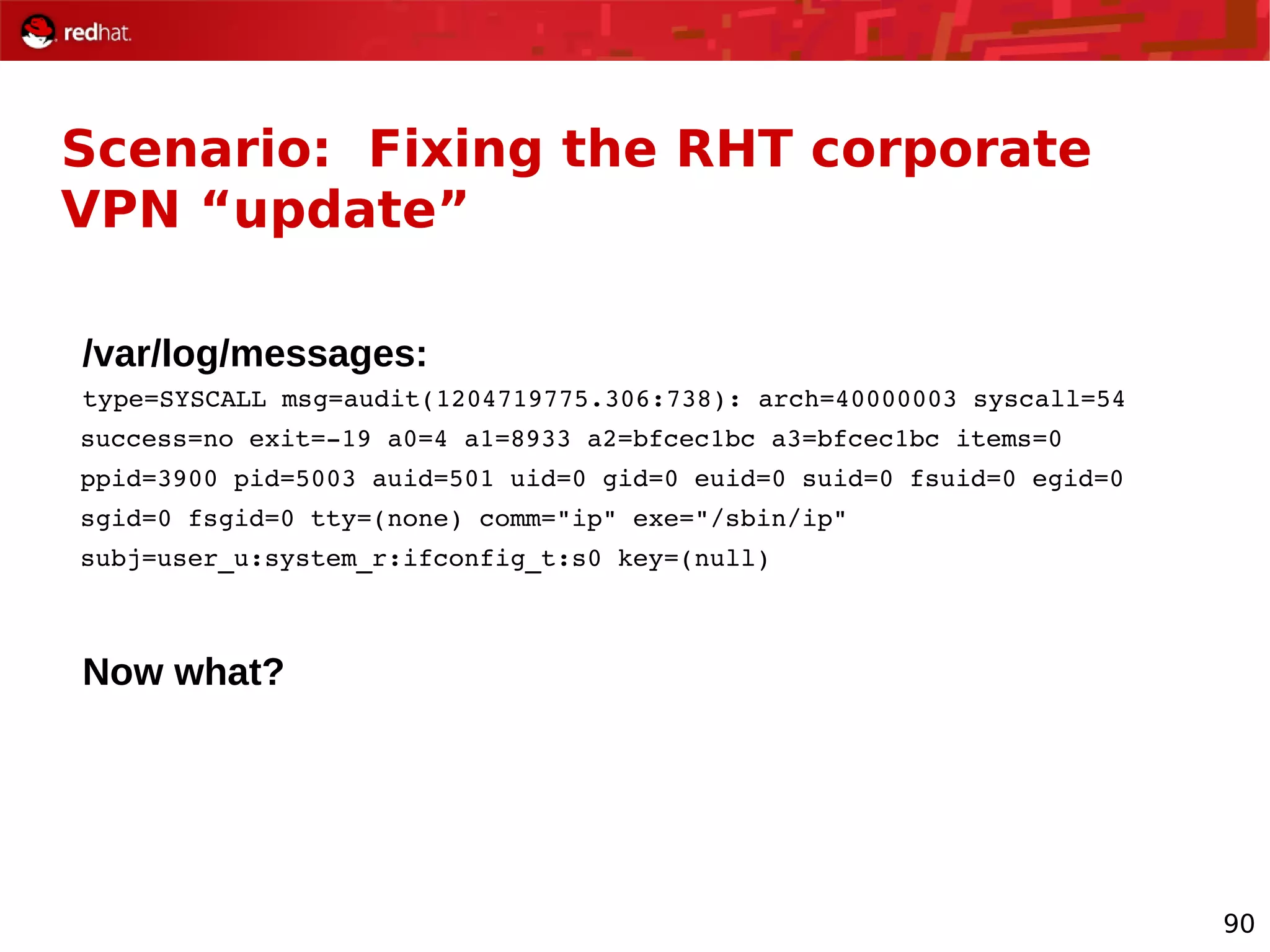
Scenario: Fixing the RHT corporate
VPN “update”
/var/log/messages:
type=SYSCALL msg=audit(1204719775.306:738): arch=40000003 syscall=54
success=no exit=­19 a0=4 a1=8933 a2=bfcec1bc a3=bfcec1bc items=0
ppid=3900 pid=5003 auid=501 uid=0 gid=0 euid=0 suid=0 fsuid=0 egid=0
sgid=0 fsgid=0 tty=(none) comm="ip" exe="/sbin/ip"
subj=user_u:system_r:ifconfig_t:s0 key=(null)
Now what?
91
Scenario: Fixing the RHT corporate
VPN “update”
type=SYSCALL msg=audit(1204719775.306:738): arch=40000003 syscall=54
success=no exit=­19 a0=4 a1=8933 a2=bfcec1bc a3=bfcec1bc items=0
ppid=3900 pid=5003 auid=501 uid=0 gid=0 euid=0 suid=0 fsuid=0 egid=0
sgid=0 fsgid=0 tty=(none) comm="ip" exe="/sbin/ip"
subj=user_u:system_r:ifconfig_t:s0 key=(null)
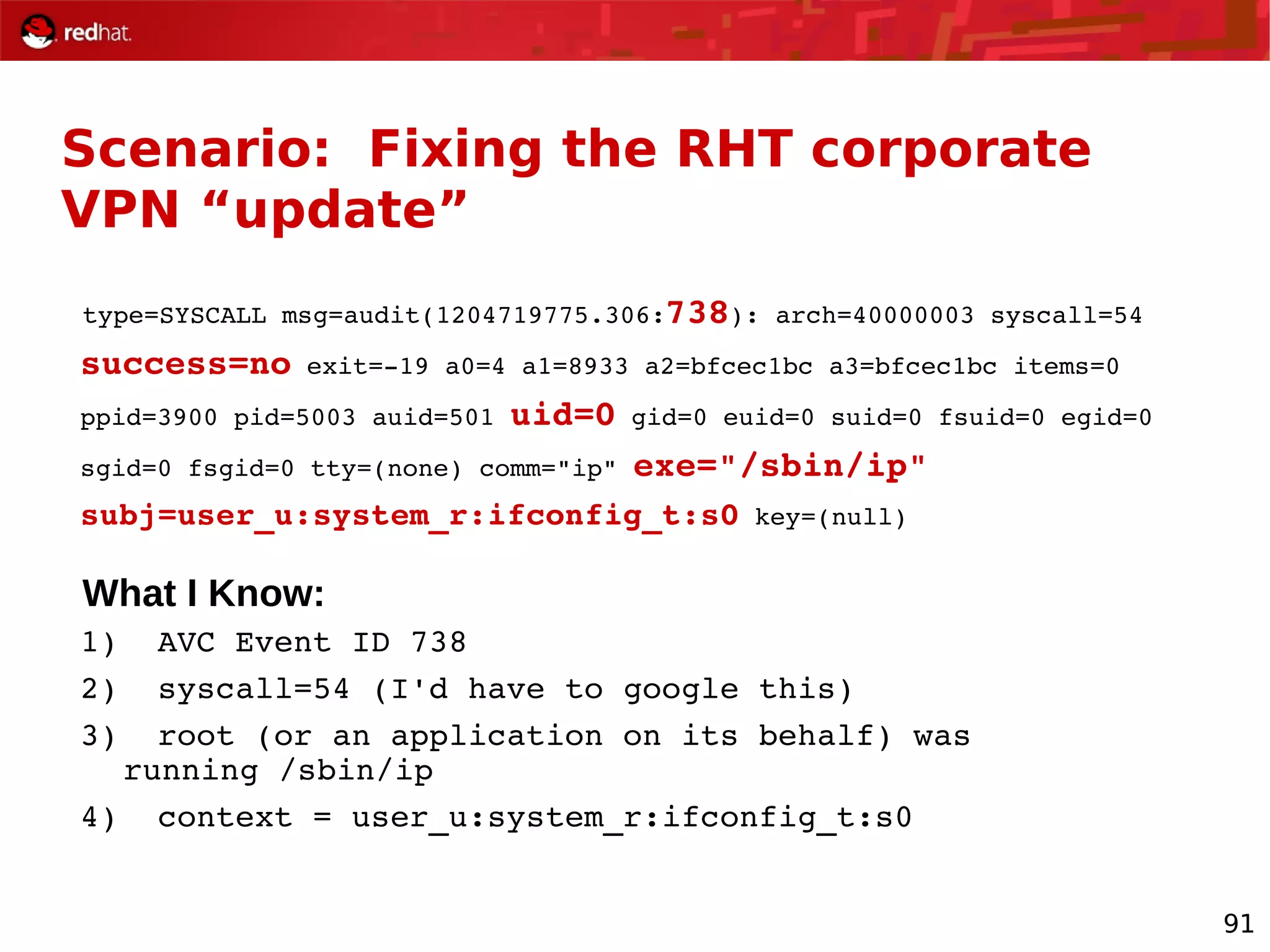
What I Know:
1)  AVC Event ID 738
2)  syscall=54 (I'd have to google this)
3)  root (or an application on its behalf) was 
running /sbin/ip
4)  context = user_u:system_r:ifconfig_t:s0
92
Scenario: Fixing the RHT corporate
VPN “update”
type=SYSCALL msg=audit(1204719775.306:738): arch=40000003 syscall=54
success=no exit=­19 a0=4 a1=8933 a2=bfcec1bc a3=bfcec1bc items=0
ppid=3900 pid=5003 auid=501 uid=0 gid=0 euid=0 suid=0 fsuid=0 egid=0
sgid=0 fsgid=0 tty=(none) comm="ip" exe="/sbin/ip"
subj=user_u:system_r:ifconfig_t:s0 key=(null)
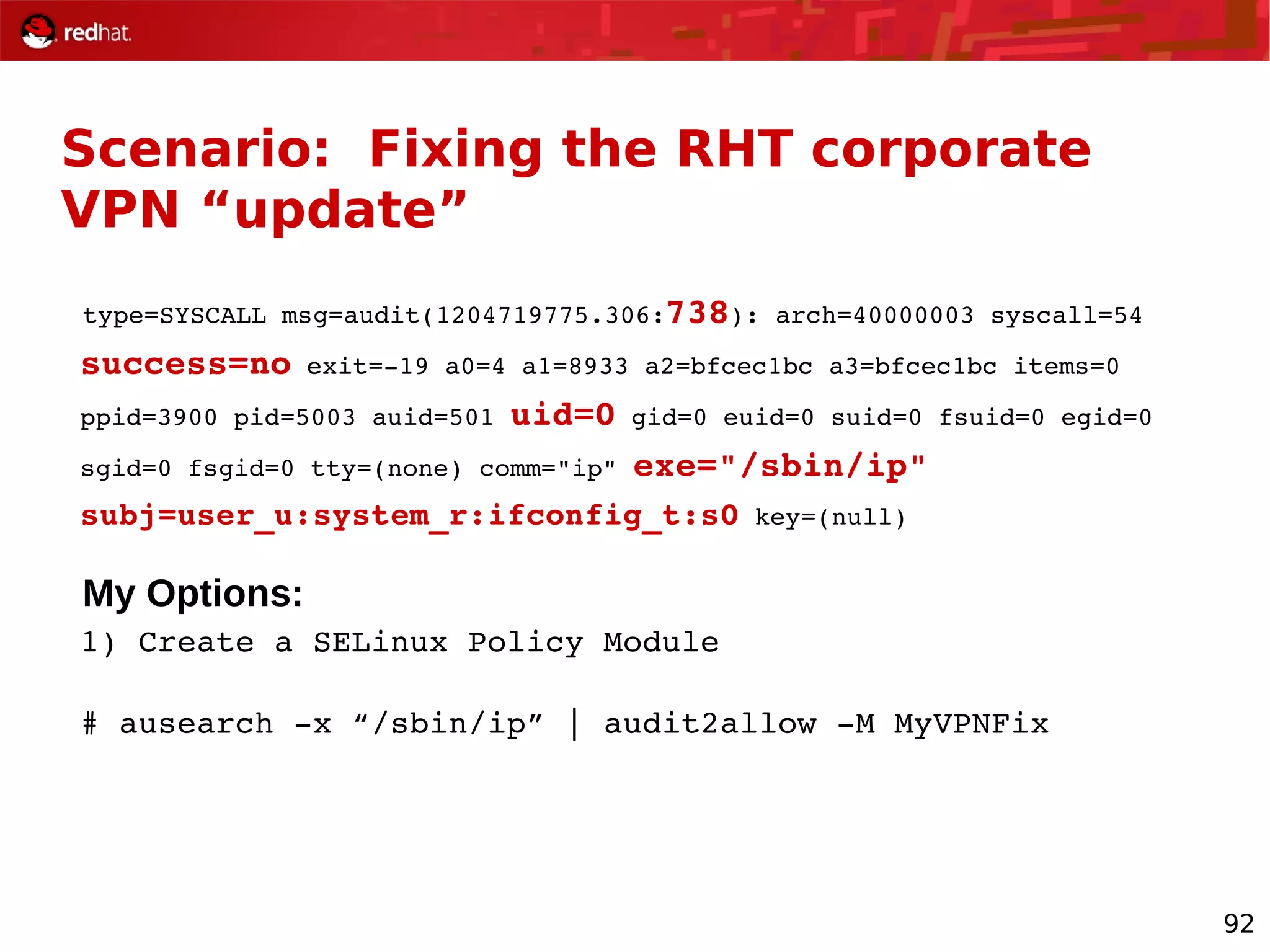
My Options:
1) Create a SELinux Policy Module
# ausearch ­x “/sbin/ip” | audit2allow ­M MyVPNFix
93
Scenario: Fixing the RHT corporate
VPN “update”
type=SYSCALL msg=audit(1204719775.306:738): arch=40000003 syscall=54
success=no exit=­19 a0=4 a1=8933 a2=bfcec1bc a3=bfcec1bc items=0
ppid=3900 pid=5003 auid=501 uid=0 gid=0 euid=0 suid=0 fsuid=0 egid=0
sgid=0 fsgid=0 tty=(none) comm="ip" exe="/sbin/ip"
subj=user_u:system_r:ifconfig_t:s0 key=(null)
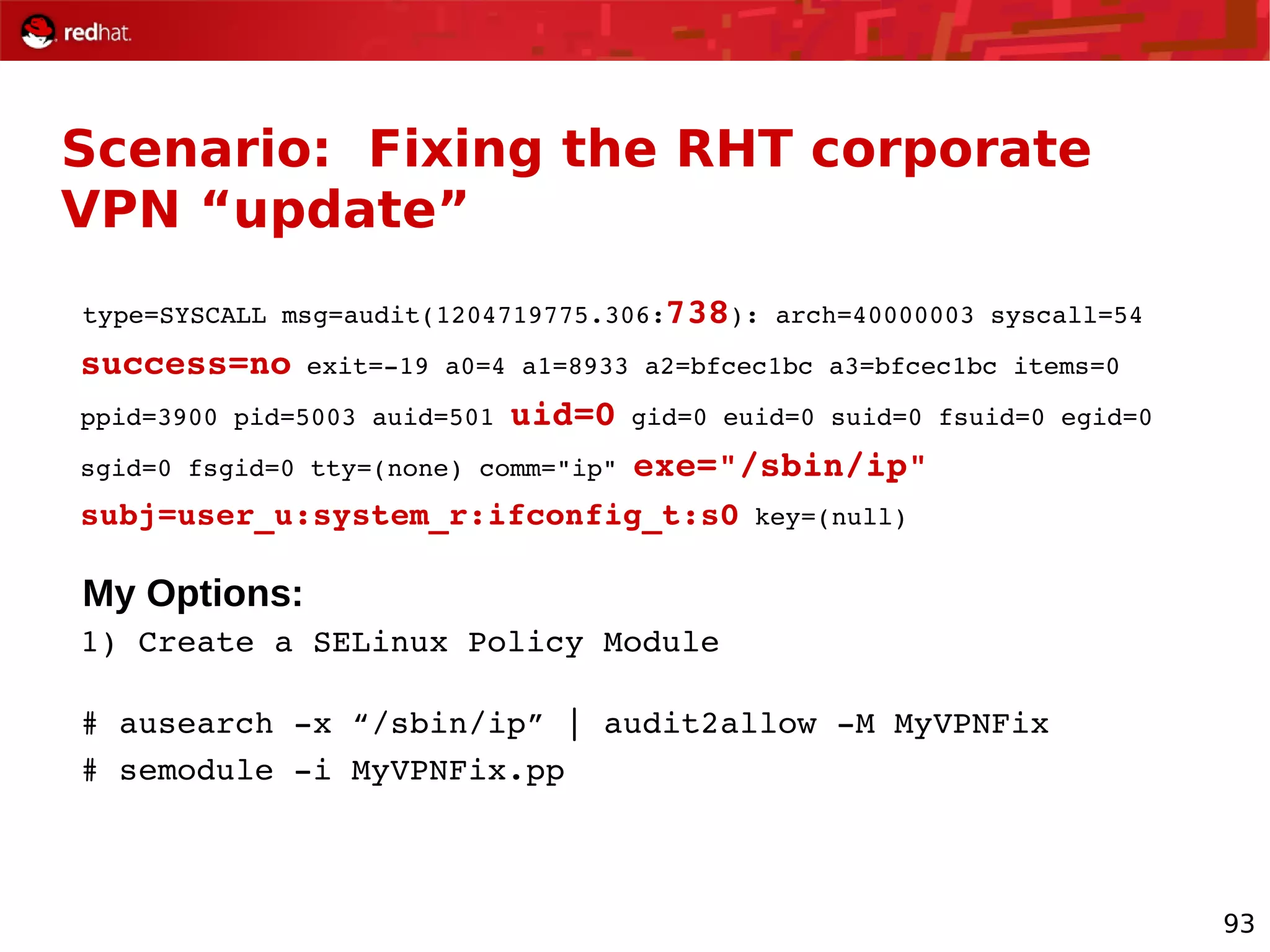
My Options:
1) Create a SELinux Policy Module
# ausearch ­x “/sbin/ip” | audit2allow ­M MyVPNFix
# semodule ­i MyVPNFix.pp
94
Scenario: Fixing the RHT corporate
VPN “update”
type=SYSCALL msg=audit(1204719775.306:738): arch=40000003 syscall=54
success=no exit=­19 a0=4 a1=8933 a2=bfcec1bc a3=bfcec1bc items=0
ppid=3900 pid=5003 auid=501 uid=0 gid=0 euid=0 suid=0 fsuid=0 egid=0
sgid=0 fsgid=0 tty=(none) comm="ip" exe="/sbin/ip"
subj=user_u:system_r:ifconfig_t:s0 key=(null)
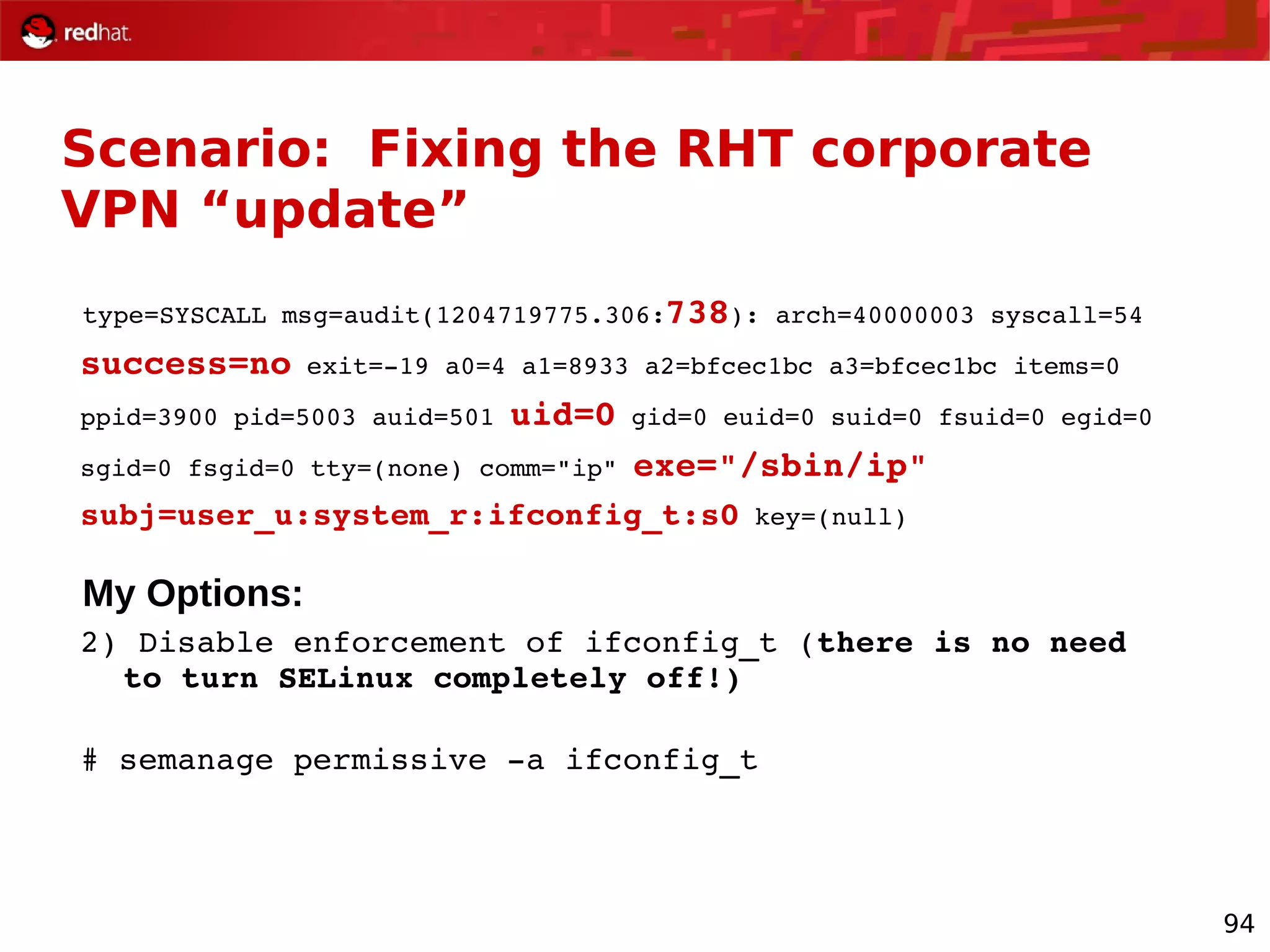
My Options:
2) Disable enforcement of ifconfig_t (there is no need 
to turn SELinux completely off!)
# semanage permissive ­a ifconfig_t
What'd I forget?
Open Discussion

2008-11-13 CAVMEN RHEL for System z Deep Dive

  • 1.
    1 Red Hat DeepDive SessionsRed Hat Deep Dive Sessions Linux on System zLinux on System z Shawn Wells (swells@redhat.com) W/W Lead Architect, Linux on System z Team Lead, System z SMEs
  • 2.
  • 3.
    3 Agenda  Scheduled questions to be answered in this session:  What's the Linux on System z development process? What's in RHEL now?  What's on the roadmap?  Provisioning & Patch Management in RHN  Security Update SELinux, Audit, etc
  • 4.
    Linux on Systemz Development Process
  • 5.
    5 Linux on Systemz Development Community  Development with “upstream” communities  Kernel, glibc, etc  Collaboration with partners, IBM, open source contributors
  • 6.
    6 Linux on Systemz Development Fedora  Bleeding Edge  Sets direction for RHEL technologies  Community Supported  Released ~6mo cycles  Fedora 8,9,10 = RHEL6 Fedora 8; http://fedoraproject.org/wiki/Releases/8/FeatureList Fedora 9; http://fedoraproject.org/wiki/Releases/9/FeatureList Fedora 10; http://fedoraproject.org/wiki/Releases/10/FeatureList
  • 7.
    7 Linux on Systemz Development Red Hat Enterprise Linux  Stable, mature, commercial product  Extensive Q&A, performance testing  Hardware & Software Certifications  7yr maintenance  Core ABI compatibility guarantee  Major releases 2-3yr cycle
  • 8.
    8 Support Cycle Extended ProductLifecycle Years 1 - 4 Yr 6,7Yr 5 Production 1 Production 2 Production 3 Security Patches Bug Fixes Hardware Enablement Software Enhancements X X X Full X X Partial X X None
  • 9.
    9 Linux on Systemz Subscriptions Product Source & Binaries Upgrades to New Versions Stable Application Interfaces Hardware & Application Certifications Security, Bug Fixes Regular H/W & S/W Updates Web Support. 2 Day SLABASIC Phone/Web 1-4 Business Hour SLA STANDARD 24x7 Phone/Web 1 Hour SLAs PREMIUMS U P P O R T Red Hat Enterprise Linux Subscription  No Upgrade Costs  No Client Access Fee  Unlimited Support Incidents For System z:  Priced Per IFL  Unlimited VMs per IFL Customers can consolidate subscriptions to or from other platforms
  • 10.
    10 Linux on Systemz Support Support via Red Hat T E C H A C C N T M G R S Level 1: Front Line Support Known Issues, Initial Troubleshooting, Everyone is minimum RHCE Level 2: Advanced Support Reproduce Problems, Grouped via Skillsets Level 3: Special Engineering Custom Patches, Code Re-writes, Interim Patches, Application Redesign C O N S U L T A N T S
  • 11.
    11 Linux on Systemz Support Support via Red Hat T E C H A C C N T M G R S Level 1: Front Line Support Known Issues, Initial Troubleshooting, Everyone is minimum RHCE Level 2: Advanced Support Reproduce Problems, Grouped via Skillsets Level 3: Special Engineering Custom Patches, Code Re-writes, Interim Patches, Application Redesign C O N S U L T A N T S Support via IBM Level 1: First Responders Basic Support Level 2: Advanced Support Reproduce Problems, Category Specialists P A R T N E R T A M
  • 12.
    What's in RHELnow? What's on the road map?
  • 13.
  • 14.
    14 IBM Changes to2.6.x Kernel RHEL5RHEL4
  • 15.
    15 RHEL Now: RHEL5.2  Support for z10  Dynamic CHPID reconfiguration  Improved “ssh -X” with VPN during installation process  Better network performance with skb scatter-gather support  Implementation of SCSI dump infrastructure
  • 16.
    16 RHEL Now: RHEL5.2  Accelerated in­kernel Crypto  Support for crypto algorithms of z10  SHA-512, SHA-384, AES-192, AES-256  Two OSA ports per CHPID; Four port exploitation  Exploit next OSA adapter generation which offers two ports within one CHPID. The additional port number 1 can be specified with the qeth sysfs-attribute “portno”  Support is available only for OSA-Express3 GbE SX and LX on z10, running in LPAR or z/VM guest (PFT for z/VM APAR VM64277 required!)
  • 17.
    17 RHEL Now: RHEL5.2  Large Page Support  This adds hugetblfs support on System z, using both hardware large page support if available, and software large page emulation (with shared hugetblfs pagetables) on older hardware  skb scatter-gather support for large incoming messages  This avoids allocating big chunks of consecutive memory and should increase networking throughput in some situations for large incoming packets Full Release Notes At: redhat.com http://www.redhat.com/docs/en- US/Red_Hat_Enterprise_Linux/5.2/html/Release_Notes/s390x/index.html
  • 18.
    18 RHEL Now: RHEL5.2  Lightweight userspace priority inheritance (PI) support for futexes, useful for  realtime applications (2.6.18)  Assists priority inversion handling. Ref: http://lwn.net/Articles/178253/  High resolution timers (2.6.16)  Provide fine resolution and accuracy depending on system configuration and capabilities - used for precise in-kernel timing  New Pipe implementation (2.6.11)  30-90% perf improvement in pipe bandwidth  Circular buffer allow more buffering rather than blocking writers  "Big Kernel Semaphore": Turns the Big Kernel Lock into a semaphore  Latency reduction, by breaking up long lock hold times and adds voluntary preemption
  • 19.
    19 RHEL Now: RHEL5.2  Process Events Connector (2.6.15)  Reports fork, exec, id change, and exit events for all processes to userspace  Useful for accounting/auditing (e.g. ELSA), system activity monitoring, security, and resource management  kexec & kdump (2.6.13)  Provide new crash-dumping capability with reserved, memory-resident kernel  Extended device mapper multipath support  Address space randomization:  Address randomization of multiple entities – including stack & mmap() region (used by shared libraries) (2.6.12; more complete implementation than in RHEL4)  Greatly complicates and slows down hacker attacks  Audit subsytem  Support for process-context based filtering (2.6.17)  More filter rule comparators (2.6.17)
  • 20.
    20 RHEL Now: RHEL5.2  Add nf_conntrack subsystem: (2.6.15)  Common IPv4/IPv6 generic connection tracking subsystem  Allows IPv6 to have a stateful firewall capability (not previously possible)  Increased security  Enables analysis of whole streams of packets, rather than only checking the headers of individual packets  SELinux per-packet access controls  Replaces old packet controls  Add Secmark support to core networking  Allows security subsystems to place security markings on network packets (2.6.18)
  • 21.
    21 RHEL Tomorrow: RHEL5.3  Currently in beta  Interested in being a beta tester?  NSS  CPU Affinity  ETR Support  Device-multipath support for xDR  RHT BugZilla: 184770  IBM LTC 18425-62140
  • 22.
    22 RHEL Tomorrow: Fedora Fedora is Red Hat's bleeding edge, an incubator for new  technologies and features Fedorasets our direction for Red Hat Enterprise Linux, and gives you a good idea of what will be in our next RHEL release (... and in other Linux distros, too) Fedora 8; http://fedoraproject.org/wiki/Releases/8/FeatureList Fedora 9; http://fedoraproject.org/wiki/Releases/9/FeatureList Fedora 10; http://fedoraproject.org/wiki/Releases/10/FeatureList Fedora 8,9,10 = RHEL6
  • 23.
    23 RHEL Tomorrow: “InPlace” Upgrade Currently a beta feature in RHEL 5.3 “In Place” Upgrades:  preupgrade Will download files needed to upgrade,  Store them locally on disk Reboot you into the installer Not a true in­place upgrade (yet)!  Benefit The longest part of an install is when packages are  downloaded to the local machine Pre­Upgrade downloads and stores packages locally,  while the machine is running/in production Reboot directly into the installer
  • 24.
    24 RHEL Tomorrow: “InPlace” Upgrade  Select Target Version
  • 25.
    25 RHEL Tomorrow: “InPlace” Upgrade  Determines which packages need upgrading, and downloads them
  • 26.
    26 RHEL Tomorrow: “InPlace” Upgrade  Downloads new initrd & kernel images
  • 27.
    27 RHEL Tomorrow: “InPlace” Upgrade  User reboots, brought into installer
  • 28.
    28 RHEL Tomorrow: gnome-control-center gnome­control­center  It is not YaST (yet)  It is a unified GUI for package management and system configuration  Benefit  Progress towards a YaST-like tool in RHEL (currently we have the system­config­* GUIs/TUIs)
  • 29.
    29 RHEL Tomorrow: PackageKit PackageKit  Abstraction layer for YUM, apt, conary, etc  Provides a common set of abstractions that can be used by GUI/TUI package managers rpm dpkg ipkg
  • 30.
    30 RHEL Tomorrow: PackageKit PackageKit  Abstraction layer for YUM, apt, conary, etc  Provides a common set of abstractions that can be used by GUI/TUI package managers PackageKit rpm dpkg ipkg
  • 31.
    31 RHEL Tomorrow: PackageKit PackageKit  Abstraction layer for YUM, apt, conary, etc  Provides a common set of abstractions that can be used by GUI/TUI package managers PackageKit YaST RHN rpm dpkg ipkg
  • 32.
  • 33.
    33 CONNECTIVITY PROCESSING DATA z/VM JBossOracle Custom App Red Hat Enterprise Linux Red Hat Enterprise Linux Red Hat Enterprise Linux
  • 34.
    Using RHN Satellite toManage s390/s390x & distributed
  • 35.
    35 Red Hat NetworkSatellite Update
  • 36.
    36 Red Hat NetworkSatellite Update Manage
  • 37.
    37 Red Hat NetworkSatellite Update Manage Provision
  • 38.
    38 Red Hat NetworkSatellite Update Manage MonitorProvision
  • 39.
  • 40.
  • 41.
  • 42.
    42 RHN Installation Requirements Software  RHEL 4 (31-bit or 64-bit)  @Base install  Hardware  1 to 2 (virtual) IFLs  2 to 4 GB storage (memory)  1 GB swap (combination VDISK, disk)  1 x mod3 for OS install  Estimated 12 GB disk space for embedded database  6 GB per channel (disk)
  • 43.
  • 44.
  • 45.
    45 RHN Satellite IsNow Open Source http://spacewalk.redhat.com  Announced at Red Hat Summit 2008  .... remember the Fedora -> RHEL model?
  • 46.
  • 47.
    47 Agenda  Why do we need SELinux?  What are the principal concepts?  SELinux Details Type Enforcement  What are the available policies?  What's a policy actually made of?  How do I {add, change} a policy?  What's the associated overhead?  Usage  User Perspective  Admin Perspective  Scenarios  Fixing the RHT Corporate VPN “update”
  • 48.
  • 49.
    49 Linux Access ControlProblems  Access is based off users' access Example: Firefox can read SSH keys Fundamental Problem: Security properties not specific enough. Kernel can't distinguish applications from users. # ps -x | grep firefox shawn 21375 1 35 11:38 ? 00:00:01 firefox-bin # ls -l id_rsa -rw------- 1 shawn shawn 1743 2008-08-10 id_rsa
  • 50.
    50 Linux Access ControlProblems 2) Processes can change security properties Example: Mail files are readable only by me..... but Thunderbird could make them world readable Fundamental Problems:  Standard access control is discretionary  Includes concept of “resource ownership”  Processes can escape security policy
  • 51.
    51 Linux Access ControlProblems 3) Only two privilege levels: User & root Example: Apache gets hacked, allowing remote access to root. Entire system is compromised. Fundamental Problems:  Simplistic security policy  No way to enforce least-privilege
  • 52.
    52 SELinux: Building SecurityOpenly NSA Develops SELinux Integrated into Linux Kernel Integrated into Open Source Project Enabled By DEFAULT In RHEL Customers, NSA, Community, and Red Hat continue evolution
  • 53.
    53 Red Hat SecurityCertifications NIAP/Common Criteria: The most evaluated operating system platform ● Red Hat Enterprise Linux 2.1 – EAL 2 (Completed: February 2004) ● Red Hat Enterprise Linux 3 EAL 3+/CAPP (Completed: August 2004) ● Red Hat Enterprise Linux 4 EAL 4+/CAPP (Completed: February 2006) ● Red Hat Enterprise Linux 5 EAL4+/CAPP/LSPP/RBAC (Completed: June 2007) DII-COE ● Red Hat Enterprise Linux 3 (Self-Certification Completed: October 2004) ● Red Hat Enterprise Linux: First Linux platform certified by DISA DCID 6/3 ● Currently PL3/PL4: ask about kickstarts. ● Often a component in PL5 systems DISA SRRs / STIGs ● Ask about kickstarts. FIPS 140-2 ● Red Hat / NSS Cryptography Libraries certified Level 2
  • 54.
    54 Security Standards Work ExtensibleConfiguration Checklist Description Format (XCCDF)  Enumeration for configuration requirements  DISA FSO committed to deploying STIG as XCCDF  Others working with NIST  Security policy becomes one file Open Vulnerability & Assessment Language (OVAL)  Machine-readable versions of security advisories Common Vulnerability and Exposures (CVE) Compatibility  Trace a vulnerability through multiple vendors
  • 55.
  • 56.
    56 Linux Access ControlIntroduction Linux access control involves the kernel controling Processes (running programs), which try to access... Resources (files, directories, sockets, etc) For example:  Apache (process) can read web files  But not the /etc/shadow file (resource) Traditional methods do not clearly separate the privileges of users and applications acting on the users behalf, increasing the damage that can be caused by application exploits. So, how should these decisions be made?
  • 57.
    57 Security Architecture Every subject(i.e process) and object (i.e. data files) are assigned collections of security attributes, called a security context 1) Security context of subject & object passed to SELinux 2) Kernel/SELinux check, verify access 2a) Grant access. Record allowance in AVC (Access Vector Cache) 2b) Deny access, log error
  • 58.
  • 59.
  • 60.
    60 SELinux Contexts root:object r:sysadmhome t:s0:c0 ● The above is an SELinux context ● user_t ● role_t ● file_t ● Sensitivity ● category
  • 61.
    61 Role Based AccessControl (RBAC) “root” really isn't “root” i.e: root_u:WebServerAdmin_r:SysAdmin_t root_u:OracleDBAdmin_r:SysAdmin_t
  • 62.
  • 63.
    63 SELinux Policy ● Policiesare matrices of statements which tell SELinux if certain actions are allowed based on the context of the objects attempting those actions. ● There are three SELinux Policy Types
  • 64.
    64 The Three SELinuxPolicy Types  Targeted Policy  Default policy in RHEL5. Supported by HelpDesk.  Targets specific applications to lock down.  Allows all other applications to run in the unconfined domain (unconfined_t)  Applications running in the unconfined domain run as if SELinux were disabled
  • 65.
    65 The Three SELinuxPolicy Types 2) Strict Policy  Denies access to everything by default  Complete protection for all processes on the system  Requires that policies be written for all applications, often requires customization  Strict is type enforcement with added types for users (e.g. user_t and user_firefox_t).  Not enabled by Red Hat as default
  • 66.
    66 The Three SELinuxPolicy Types 3) Multi-Level Security (MLS)  Focuses on confidentiality (i.e. separation of multiple classifications of data)  Ability to manage {processes, users} with varying levels of access. (i.e. “the need to know”)  Uses category & sensitivity levels
  • 67.
    67 The Three SELinuxPolicy Types 3) Multi-Level Security (MLS) (a) Sensitivity Labels  Mostly used by the government – Top Secret, Secret, Unclassified, etc s0 Unclassified s1 Secret s2 Top Secret
  • 68.
    68 The Three SELinuxPolicy Types 3) Multi-Level Security (MLS) (b) Category Labels  Separation of data types, compartments, projects, etc Unclassified Secret Top Secret Project A Project B Alpha Bravo Charlie Delta s0 s1 s1 c0 c1 c2 c3 c0 c1
  • 69.
    69 The Three SELinuxPolicy Types 3) Multi-Level Security (MLS) (b) Polyinstantiation & pam_namespace  The pam_namespace PAM module sets up a private namespace for a session with polyinstantiated directories  A polyinstantiated directory provides a different instance of itself based on user name, or when using SELinux, user name, security context or both
  • 70.
    70 The Three SELinuxPolicy Types 3) Multi-Level Security (MLS) (b) Polyinstantiation & pam_namespace # id ­Z staff_u:WebServer_Admin_r:WebServer_Admin_t:s0:c0 # ls ­l /data secret­file­1 secret­file 2 # id ­Z staff_u:WebServer_Admin_r:WebServer_Admin_t:s1:c0 # ls ­l /data secret­file­1 secret­file 2 top­secret­file­1
  • 71.
    71 The Three SELinuxPolicy Types Multi-Level Security (MLS) & Common Criteria  The Common Criteria (CC) is an international security standard against which systems are evaluated. Many government customers require CC evaluated systems.  Red Hat Enterprise Linux 5 meets EAL4+ with RBAC/LSPP/CAPP endorcements
  • 72.
  • 73.
  • 74.
  • 75.
    75 What's the PerformanceOverhead? ● Not official statistics ● Laptop = 2GHz, 2x 1GB RAM ● Workstation = 2.13GHz, 4x 1GB RAM ● Apache = Lots of threads ● MySQL = Lots of disk I/O
  • 76.
  • 77.
  • 78.
  • 79.
    79 System Administrator Perspective ●sealert + EMail Notifications
  • 80.
  • 81.
  • 82.
  • 83.
  • 84.
    84 System Administrator Perspective ●semanage Configure elements of SELinux policy without modification/recompilation of policy sources . . . . aka on the fly Example: Dynamically Allowing Apache to listen on port 1234 # semanage port ­a ­t httpd_port_t ­p tcp 1234
  • 85.
    85 System Administrator Perspective ●semanage (more examples) Example: Allow shawn to join “webadmin_u” group # semanage login ­a ­s webadmin_u shawn Example: Relabel files for access by Apache # semanage fcontext ­a ­t  httpd_sys_content_t "/data/webpages(/.*)?"
  • 86.
    86 System Administrator Perspective ●semanage (most important example) You don't need to disable SELinux to fix a single error! type=SYSCALL msg=audit(1204719775.306:738): arch=40000003 syscall=54 success=no exit=­19 a0=4 a1=8933 a2=bfcec1bc a3=bfcec1bc items=0 ppid=3900 pid=5003 auid=501 uid=0 gid=0 euid=0 suid=0 fsuid=0 egid=0 sgid=0 fsgid=0 tty=(none) comm="ip" exe="/sbin/ip" subj=user_u:system_r:ifconfig_t:s0 key=(null) The Fix: # semanage permissive ­a ifconfig_t
  • 87.
    87 System Administrator Perspective ●audit2allow Allows generation of SELinux policy rules from logs of denied operations Example: Fix all the errors on the system (completely not a good idea on a real system) # cat /var/log/audit/audit.log | audit2allow ­M FixAll Generating type enforcment file: FixAll.te Compiling policy: checkmodule ­M ­m ­o FixAll.mod FixAll.te Building package: semodule_package ­o FixAll.pp ­m FixAll.mod # semodule ­i FixAll.pp
  • 88.
  • 89.
    89 Scenario: Fixing theRHT corporate VPN “update” ● Red Hat has a Corporate Standard Build (CSB) for desktop environments ● Red Hat pushes updates to said CSB ● I “tweak” my configuration files ● When RHT pushed a CSB update, it broke my VPN settings
  • 90.
    90 Scenario: Fixing theRHT corporate VPN “update” /var/log/messages: type=SYSCALL msg=audit(1204719775.306:738): arch=40000003 syscall=54 success=no exit=­19 a0=4 a1=8933 a2=bfcec1bc a3=bfcec1bc items=0 ppid=3900 pid=5003 auid=501 uid=0 gid=0 euid=0 suid=0 fsuid=0 egid=0 sgid=0 fsgid=0 tty=(none) comm="ip" exe="/sbin/ip" subj=user_u:system_r:ifconfig_t:s0 key=(null) Now what?
  • 91.
    91 Scenario: Fixing theRHT corporate VPN “update” type=SYSCALL msg=audit(1204719775.306:738): arch=40000003 syscall=54 success=no exit=­19 a0=4 a1=8933 a2=bfcec1bc a3=bfcec1bc items=0 ppid=3900 pid=5003 auid=501 uid=0 gid=0 euid=0 suid=0 fsuid=0 egid=0 sgid=0 fsgid=0 tty=(none) comm="ip" exe="/sbin/ip" subj=user_u:system_r:ifconfig_t:s0 key=(null) What I Know: 1)  AVC Event ID 738 2)  syscall=54 (I'd have to google this) 3)  root (or an application on its behalf) was  running /sbin/ip 4)  context = user_u:system_r:ifconfig_t:s0
  • 92.
    92 Scenario: Fixing theRHT corporate VPN “update” type=SYSCALL msg=audit(1204719775.306:738): arch=40000003 syscall=54 success=no exit=­19 a0=4 a1=8933 a2=bfcec1bc a3=bfcec1bc items=0 ppid=3900 pid=5003 auid=501 uid=0 gid=0 euid=0 suid=0 fsuid=0 egid=0 sgid=0 fsgid=0 tty=(none) comm="ip" exe="/sbin/ip" subj=user_u:system_r:ifconfig_t:s0 key=(null) My Options: 1) Create a SELinux Policy Module # ausearch ­x “/sbin/ip” | audit2allow ­M MyVPNFix
  • 93.
    93 Scenario: Fixing theRHT corporate VPN “update” type=SYSCALL msg=audit(1204719775.306:738): arch=40000003 syscall=54 success=no exit=­19 a0=4 a1=8933 a2=bfcec1bc a3=bfcec1bc items=0 ppid=3900 pid=5003 auid=501 uid=0 gid=0 euid=0 suid=0 fsuid=0 egid=0 sgid=0 fsgid=0 tty=(none) comm="ip" exe="/sbin/ip" subj=user_u:system_r:ifconfig_t:s0 key=(null) My Options: 1) Create a SELinux Policy Module # ausearch ­x “/sbin/ip” | audit2allow ­M MyVPNFix # semodule ­i MyVPNFix.pp
  • 94.
    94 Scenario: Fixing theRHT corporate VPN “update” type=SYSCALL msg=audit(1204719775.306:738): arch=40000003 syscall=54 success=no exit=­19 a0=4 a1=8933 a2=bfcec1bc a3=bfcec1bc items=0 ppid=3900 pid=5003 auid=501 uid=0 gid=0 euid=0 suid=0 fsuid=0 egid=0 sgid=0 fsgid=0 tty=(none) comm="ip" exe="/sbin/ip" subj=user_u:system_r:ifconfig_t:s0 key=(null) My Options: 2) Disable enforcement of ifconfig_t (there is no need  to turn SELinux completely off!) # semanage permissive ­a ifconfig_t
  • 95.