
Journalism as Social Networking: Lessons from the Australian  youdecide2007  Project Professor Terry Flew, Media and Communication, Queensland University of Technology Dr. Jason Wilson, e-Democracy Director,  GetUp!
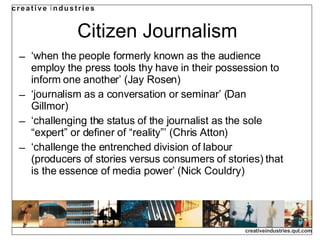
Citizen Journalism ‘ when the people formerly known as the audience employ the press tools thy have in their possession to inform one another’ (Jay Rosen) ‘ journalism as a conversation or seminar’ (Dan Gillmor) ‘ challenging the status of the journalist as the sole “expert” or definer of “reality”’ (Chris Atton) ‘ challenge the entrenched division of labour (producers of stories versus consumers of stories) that is the essence of media power’ (Nick Couldry)
youdecide2007  Australian Federal election citizen journalism site
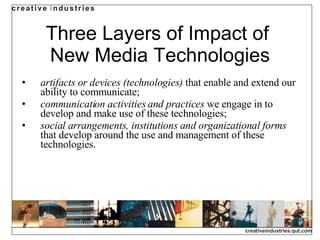
Three Layers of Impact of  New Media Technologies artifacts or devices (technologies)  that enable and extend our ability to communicate; communication activities and practices  we engage in to develop and make use of these technologies; social arrangements, institutions and organizational forms  that develop around the use and management of these technologies.
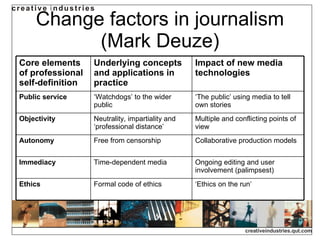
Change factors in journalism (Mark Deuze) ‘ Ethics on the run’ Formal code of ethics Ethics Ongoing editing and user involvement (palimpsest) Time-dependent media Immediacy Collaborative production models Free from censorship Autonomy Multiple and conflicting points of view Neutrality, impartiality and ‘professional distance’ Objectivity ‘ The public’ using media to tell own stories ‘ Watchdogs’ to the wider public Public service Impact of new media technologies Underlying concepts and applications in practice Core elements of professional self-definition
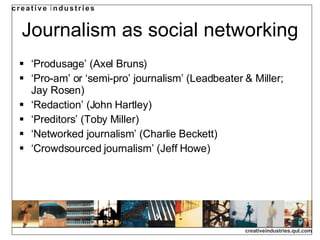
Journalism as social networking ‘ Produsage’ (Axel Bruns) ‘ Pro-am’ or ‘semi-pro’ journalism’ (Leadbeater & Miller; Jay Rosen) ‘ Redaction’ (John Hartley) ‘ Preditors’ (Toby Miller) ‘ Networked journalism’ (Charlie Beckett) ‘ Crowdsourced journalism’ (Jeff Howe)
 
 
Types of citizen journalism/ networked journalism work Content work Networking Community work Technical work
Content work Editing and making content Sustaining a news generating community Managing legal and ethical issues Managing quality issues Generating stories for site ‘stickiness’ and signposting
Networking Integrating into broader ecology of mainstream and independent news sources Visibility and viability Cultivating sources and publicity outlets Re-use of content across multiple platforms and sites
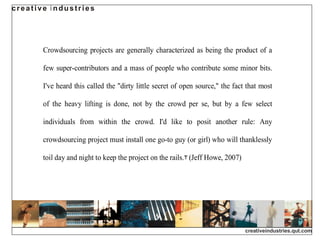
Community work Service to users including site participants ‘Pros’ as educators and honest brokers Cultivation of ‘super-contributors’ User needs Training Site-specific information Mediation
Technical work On-site tech work Off-site tech work Meta-tech work
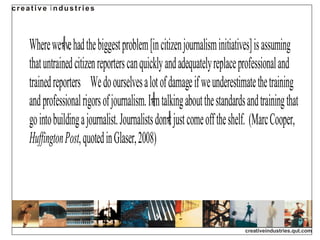
Conclusions Significance of citizen journalism may be more in prototyping new production models and practices than in overall audience size/user base Relationship between mainstream media and independent sites is more permeable than either side commonly acknowledges - ‘R&D’ of future news production Sharing of experiences is vital, as all initiatives are works in progress rather than finished models Rethinking journalism training and education out of its ‘high modernist’ mode

2008 CPRF Presentation

  • 1.
    Journalism as SocialNetworking: Lessons from the Australian youdecide2007 Project Professor Terry Flew, Media and Communication, Queensland University of Technology Dr. Jason Wilson, e-Democracy Director, GetUp!
  • 2.
    Citizen Journalism ‘when the people formerly known as the audience employ the press tools thy have in their possession to inform one another’ (Jay Rosen) ‘ journalism as a conversation or seminar’ (Dan Gillmor) ‘ challenging the status of the journalist as the sole “expert” or definer of “reality”’ (Chris Atton) ‘ challenge the entrenched division of labour (producers of stories versus consumers of stories) that is the essence of media power’ (Nick Couldry)
  • 3.
    youdecide2007 AustralianFederal election citizen journalism site
  • 4.
    Three Layers ofImpact of New Media Technologies artifacts or devices (technologies) that enable and extend our ability to communicate; communication activities and practices we engage in to develop and make use of these technologies; social arrangements, institutions and organizational forms that develop around the use and management of these technologies.
  • 5.
    Change factors injournalism (Mark Deuze) ‘ Ethics on the run’ Formal code of ethics Ethics Ongoing editing and user involvement (palimpsest) Time-dependent media Immediacy Collaborative production models Free from censorship Autonomy Multiple and conflicting points of view Neutrality, impartiality and ‘professional distance’ Objectivity ‘ The public’ using media to tell own stories ‘ Watchdogs’ to the wider public Public service Impact of new media technologies Underlying concepts and applications in practice Core elements of professional self-definition
  • 6.
    Journalism as socialnetworking ‘ Produsage’ (Axel Bruns) ‘ Pro-am’ or ‘semi-pro’ journalism’ (Leadbeater & Miller; Jay Rosen) ‘ Redaction’ (John Hartley) ‘ Preditors’ (Toby Miller) ‘ Networked journalism’ (Charlie Beckett) ‘ Crowdsourced journalism’ (Jeff Howe)
  • 7.
  • 8.
  • 9.
    Types of citizenjournalism/ networked journalism work Content work Networking Community work Technical work
  • 10.
    Content work Editingand making content Sustaining a news generating community Managing legal and ethical issues Managing quality issues Generating stories for site ‘stickiness’ and signposting
  • 11.
    Networking Integrating intobroader ecology of mainstream and independent news sources Visibility and viability Cultivating sources and publicity outlets Re-use of content across multiple platforms and sites
  • 12.
    Community work Serviceto users including site participants ‘Pros’ as educators and honest brokers Cultivation of ‘super-contributors’ User needs Training Site-specific information Mediation
  • 13.
    Technical work On-sitetech work Off-site tech work Meta-tech work
  • 14.
    Conclusions Significance ofcitizen journalism may be more in prototyping new production models and practices than in overall audience size/user base Relationship between mainstream media and independent sites is more permeable than either side commonly acknowledges - ‘R&D’ of future news production Sharing of experiences is vital, as all initiatives are works in progress rather than finished models Rethinking journalism training and education out of its ‘high modernist’ mode