Strategic Directions in
Journalism Education
Donica Mensing
@donica
Reynolds School of Journalism
University of Nevada, Reno
Should we change?
Time to choose
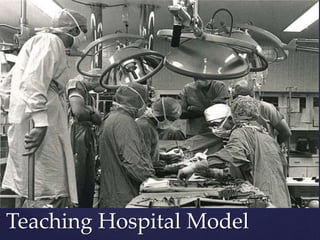
Teaching Hospital Model
 “To make up for the loss of the reporting that economically
devastated news organizations can no longer afford”
(Nicholas Lemann, 2009)
 So that “universities [will] become forceful partners in
revitalizing an industry at the very core of democracy”
(Open Letter to America's University Presidents, 2012)
 Because pedagogically the best way to learn journalism is to
do it (Newton, 2013)
“becoming significant producers of
original news reporting”
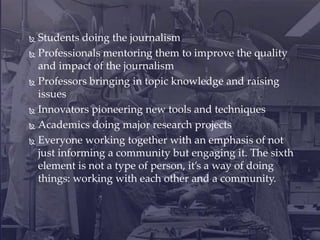
 Students doing the journalism
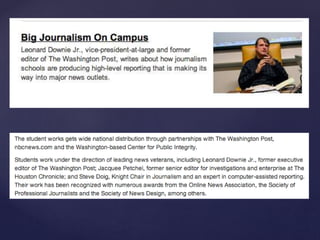
 Professionals mentoring them to improve the quality
and impact of the journalism
 Professors bringing in topic knowledge and raising
issues
 Innovators pioneering new tools and techniques
 Academics doing major research projects
 Everyone working together with an emphasis of not
just informing a community but engaging it. The sixth
element is not a type of person, it’s a way of doing
things: working with each other and a community.
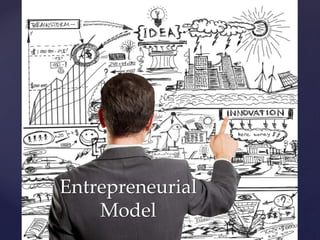
Entrepreneurial
Model
 From supply side to demand side
 From institutional networks to
social networks
 From routines to reflexivity
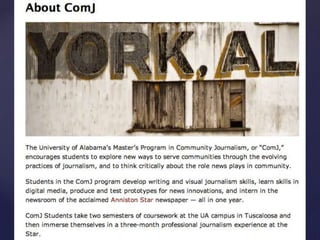
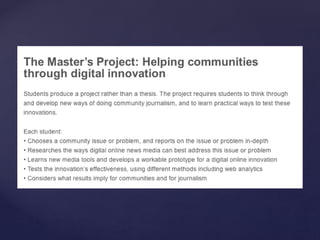
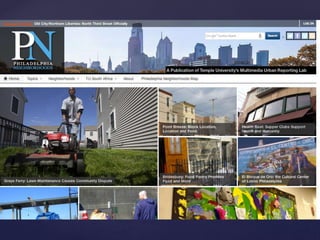
Community Innovation Model
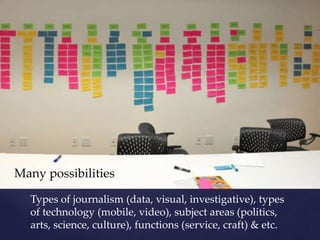
Types of journalism (data, visual, investigative), types
of technology (mobile, video), subject areas (politics,
arts, science, culture), functions (service, craft) & etc.
Many possibilities
 Skills and interests of faculty
 Amount and type of existing resources
 Potential for additional funding
 Other units at the university interested in collaboration
 Skills and resources of alumni
 Size of community
 Needs of local communities
 Media opportunities in the region
 Competition from other regional programs
How to choose
Why choose?

Mensing ejta2014

  • 1.
    Strategic Directions in JournalismEducation Donica Mensing @donica Reynolds School of Journalism University of Nevada, Reno
  • 2.
  • 3.
  • 4.
  • 5.
     “To makeup for the loss of the reporting that economically devastated news organizations can no longer afford” (Nicholas Lemann, 2009)  So that “universities [will] become forceful partners in revitalizing an industry at the very core of democracy” (Open Letter to America's University Presidents, 2012)  Because pedagogically the best way to learn journalism is to do it (Newton, 2013) “becoming significant producers of original news reporting”
  • 6.
     Students doingthe journalism  Professionals mentoring them to improve the quality and impact of the journalism  Professors bringing in topic knowledge and raising issues  Innovators pioneering new tools and techniques  Academics doing major research projects  Everyone working together with an emphasis of not just informing a community but engaging it. The sixth element is not a type of person, it’s a way of doing things: working with each other and a community.
  • 10.
  • 12.
     From supplyside to demand side  From institutional networks to social networks  From routines to reflexivity
  • 14.
  • 19.
    Types of journalism(data, visual, investigative), types of technology (mobile, video), subject areas (politics, arts, science, culture), functions (service, craft) & etc. Many possibilities
  • 20.
     Skills andinterests of faculty  Amount and type of existing resources  Potential for additional funding  Other units at the university interested in collaboration  Skills and resources of alumni  Size of community  Needs of local communities  Media opportunities in the region  Competition from other regional programs How to choose
  • 21.

Editor's Notes

  • #4 Like individuals, journalism programs that develop expertise in particular areas can build a brand and reputation, attracting motivated students, competent faculties, and committed partners.   The range of choices for journalism programs used to be much more narrow. In examining journalism programs in the US, I have been struck by the similarities of their course offerings and curriculum.   As programs continue to change, however, they have begun to diversify. Now programs can focus on teaching students to be storytellers in multiple media or data analysts with visualization skills; they can focus on developing social media expertise and community managers or experts in video, audio, photography and the written word; subject area specialists and experts in particular media channels or investigative journalists or watchdog specialists.
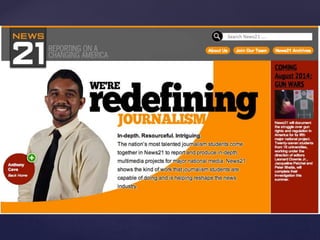
  • #8 News21 was first launched in 2005 by three American foundations as part of a $20 million grant. Since 2008, Arizona State University has received more than $10 million to fund the program, which provides an intensive spring seminar and a 10-week paid summer fellowship. Schools pay $10,000 to support students chosen to participate in the program. This year 27 students are participating in producing a multimedia stories about issues related to guns. The students are supervised by five outstanding professional journalists and stories are published and broadcast by major US news outlets.
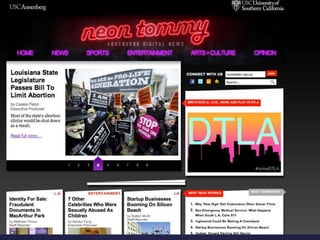
  • #10 Marc Cooper, USC faculty member, who runs Annenberg Digital News which publishes student-run Neon Tommy
  • #17 University of Alabama