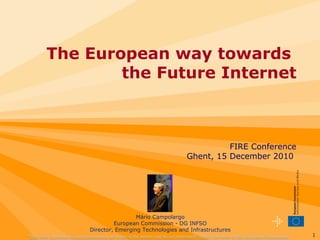
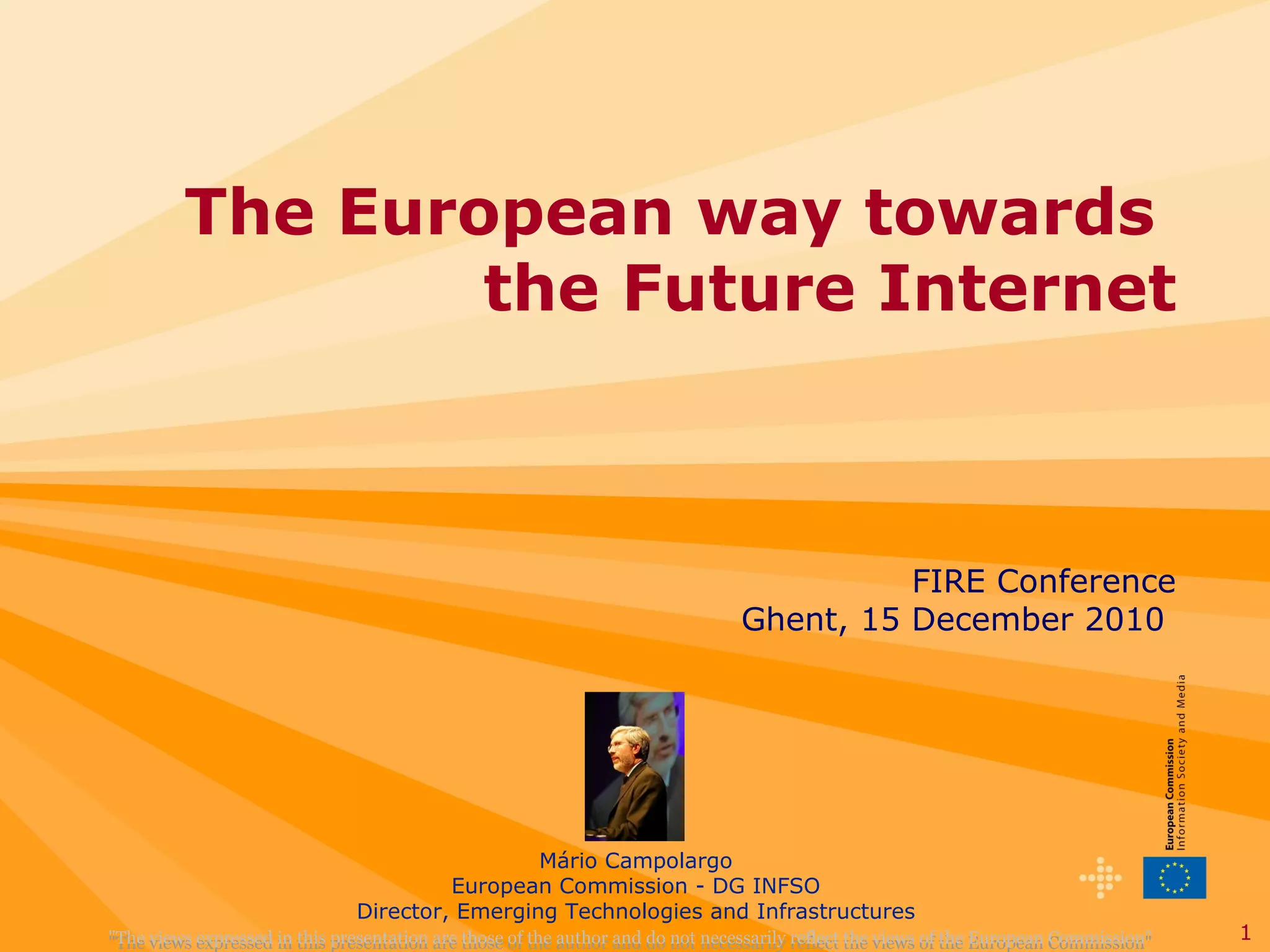
"The views expressed in this presentation are those of the author and do not necessarily reflect the views of the European Commission" "The views expressed in this presentation are those of the author and do not necessarily reflect the views of the European Commission" The European way towards  the Future Internet FIRE Conference Ghent, 15 December 2010  Mário Campolargo European Commission - DG INFSO Director, Emerging Technologies and Infrastructures
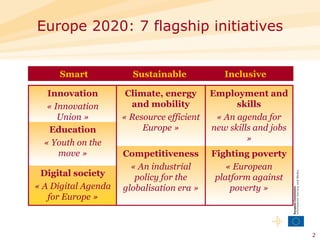
Europe 2020: 7 flagship initiatives Smart  Sustainable  Inclusive Innovation « Innovation Union » Climate, energy and mobility « Resource efficient Europe » Employment and skills « An agenda for new skills and jobs » Education « Youth on the move » Competitiveness « An industrial policy for the globalisation era » Fighting poverty « European platform against poverty » Digital society « A Digital Agenda for Europe »
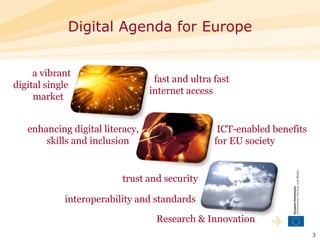
Digital Agenda for Europe fast and ultra fast internet access  a vibrant digital single .   market  .   ICT-enabled benefits for EU society interoperability and standards enhancing digital literacy, skills and inclusion  .   Research & Innovation trust and security
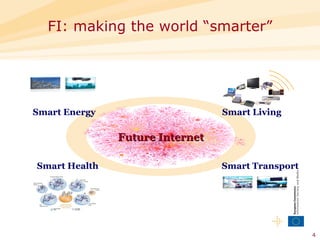
FI: making the world “smarter” Smart Energy Smart Living Smart Transport Smart Health Future Internet
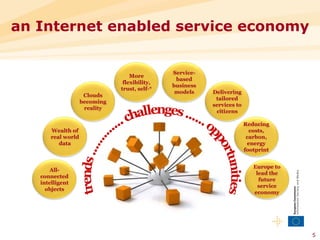
an Internet enabled service economy trends ............. challenges ...... opportunities Reducing costs, carbon, energy footprint Europe to lead the future service economy Delivering tailored services to citizens More flexibility, trust, self-* Clouds becoming reality Wealth of real world data All-connected intelligent objects Service-based business models
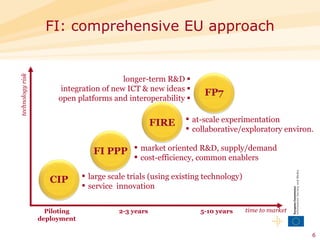
time to market technology risk Piloting deployment 2-3 years 5-10 years CIP FI PPP FIRE FP7 large scale trials (using existing technology) service  innovation market oriented R&D, supply/demand cost-efficiency, common enablers at-scale experimentation collaborative/exploratory environ. longer-term R&D   integration of new ICT & new ideas   open platforms and interoperability   FI: comprehensive EU approach
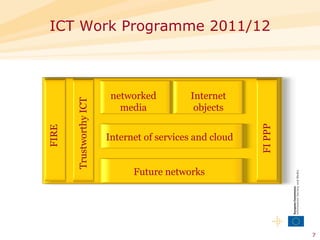
ICT Work Programme 2011/12 Future networks FIRE Trustworthy ICT Internet of services and cloud Internet objects FI PPP networked media
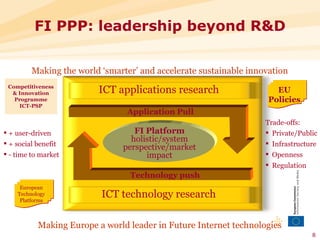
Making the world ‘smarter’ and accelerate sustainable innovation Trade-offs: Private/Public Infrastructure Openness Regulation EU Policies ICT applications research Making Europe a world leader in Future Internet technologies FI PPP: leadership beyond R&D + user-driven  + social benefit - time to market European Technology Platforms Competitiveness & Innovation Programme ICT-PSP ICT technology research FI Platform holistic/system perspective/market impact Application Pull Technology push
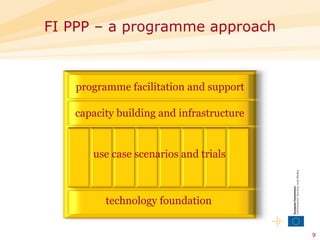
FI PPP – a programme approach programme facilitation and support capacity building and infrastructure use case scenarios and trials technology foundation
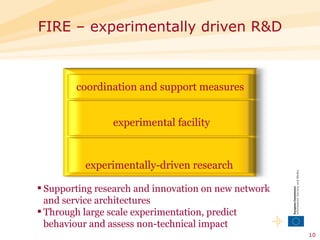
FIRE – experimentally driven R&D coordination and support measures experimental facility experimentally-driven research Supporting research and innovation on new network and service architectures Through large scale experimentation, predict behaviour and assess non-technical impact
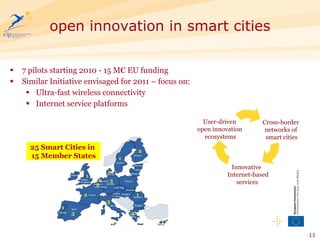
7 pilots starting 2010 - 15 M€ EU funding Similar Initiative envisaged for 2011 – focus on: Ultra-fast wireless connectivity Internet service platforms 25 Smart Cities in  15 Member States open innovation in smart cities User-driven  open innovation  ecosystems Cross-border  networks of  smart cities Innovative    Internet-based  services
FI: complementary vectors
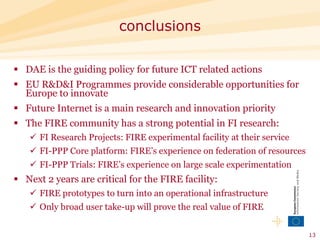
DAE is the guiding policy for future ICT related actions EU R&D&I Programmes provide considerable opportunities for Europe to innovate  Future Internet is a main research and innovation priority  The FIRE community has a strong potential in FI research: FI Research Projects: FIRE experimental facility at their service FI-PPP Core platform: FIRE’s experience on federation of resources  FI-PPP Trials: FIRE’s experience on large scale experimentation  Next 2 years are critical for the FIRE facility: FIRE prototypes to turn into an operational infrastructure Only broad user take-up will prove the real value of FIRE  conclusions

Mario campolargo - FIRE in the general Future Internet Strategy

  • 1.
    "The views expressedin this presentation are those of the author and do not necessarily reflect the views of the European Commission" "The views expressed in this presentation are those of the author and do not necessarily reflect the views of the European Commission" The European way towards the Future Internet FIRE Conference Ghent, 15 December 2010 Mário Campolargo European Commission - DG INFSO Director, Emerging Technologies and Infrastructures
  • 2.
    Europe 2020: 7flagship initiatives Smart Sustainable Inclusive Innovation « Innovation Union » Climate, energy and mobility « Resource efficient Europe » Employment and skills « An agenda for new skills and jobs » Education « Youth on the move » Competitiveness « An industrial policy for the globalisation era » Fighting poverty « European platform against poverty » Digital society « A Digital Agenda for Europe »
  • 3.
    Digital Agenda forEurope fast and ultra fast internet access a vibrant digital single . market . ICT-enabled benefits for EU society interoperability and standards enhancing digital literacy, skills and inclusion . Research & Innovation trust and security
  • 4.
    FI: making theworld “smarter” Smart Energy Smart Living Smart Transport Smart Health Future Internet
  • 5.
    an Internet enabledservice economy trends ............. challenges ...... opportunities Reducing costs, carbon, energy footprint Europe to lead the future service economy Delivering tailored services to citizens More flexibility, trust, self-* Clouds becoming reality Wealth of real world data All-connected intelligent objects Service-based business models
  • 6.
    time to markettechnology risk Piloting deployment 2-3 years 5-10 years CIP FI PPP FIRE FP7 large scale trials (using existing technology) service innovation market oriented R&D, supply/demand cost-efficiency, common enablers at-scale experimentation collaborative/exploratory environ. longer-term R&D  integration of new ICT & new ideas  open platforms and interoperability  FI: comprehensive EU approach
  • 7.
    ICT Work Programme2011/12 Future networks FIRE Trustworthy ICT Internet of services and cloud Internet objects FI PPP networked media
  • 8.
    Making the world‘smarter’ and accelerate sustainable innovation Trade-offs: Private/Public Infrastructure Openness Regulation EU Policies ICT applications research Making Europe a world leader in Future Internet technologies FI PPP: leadership beyond R&D + user-driven + social benefit - time to market European Technology Platforms Competitiveness & Innovation Programme ICT-PSP ICT technology research FI Platform holistic/system perspective/market impact Application Pull Technology push
  • 9.
    FI PPP –a programme approach programme facilitation and support capacity building and infrastructure use case scenarios and trials technology foundation
  • 10.
    FIRE – experimentallydriven R&D coordination and support measures experimental facility experimentally-driven research Supporting research and innovation on new network and service architectures Through large scale experimentation, predict behaviour and assess non-technical impact
  • 11.
    7 pilots starting2010 - 15 M€ EU funding Similar Initiative envisaged for 2011 – focus on: Ultra-fast wireless connectivity Internet service platforms 25 Smart Cities in 15 Member States open innovation in smart cities User-driven open innovation ecosystems Cross-border networks of smart cities Innovative Internet-based services
  • 12.
  • 13.
    DAE is theguiding policy for future ICT related actions EU R&D&I Programmes provide considerable opportunities for Europe to innovate Future Internet is a main research and innovation priority The FIRE community has a strong potential in FI research: FI Research Projects: FIRE experimental facility at their service FI-PPP Core platform: FIRE’s experience on federation of resources FI-PPP Trials: FIRE’s experience on large scale experimentation Next 2 years are critical for the FIRE facility: FIRE prototypes to turn into an operational infrastructure Only broad user take-up will prove the real value of FIRE conclusions