SSAIE & the 5th Call  Investing in Software & Services Research Arian Zwegers European Commission Information Society and Media Directorate General Software & Service Architectures and Infrastructures Unit
Overview  Why investing in EU ICT research? Trends in business and ICT ICT market in EU ICT research in EU Framework Programmes ICT Objective 1.2
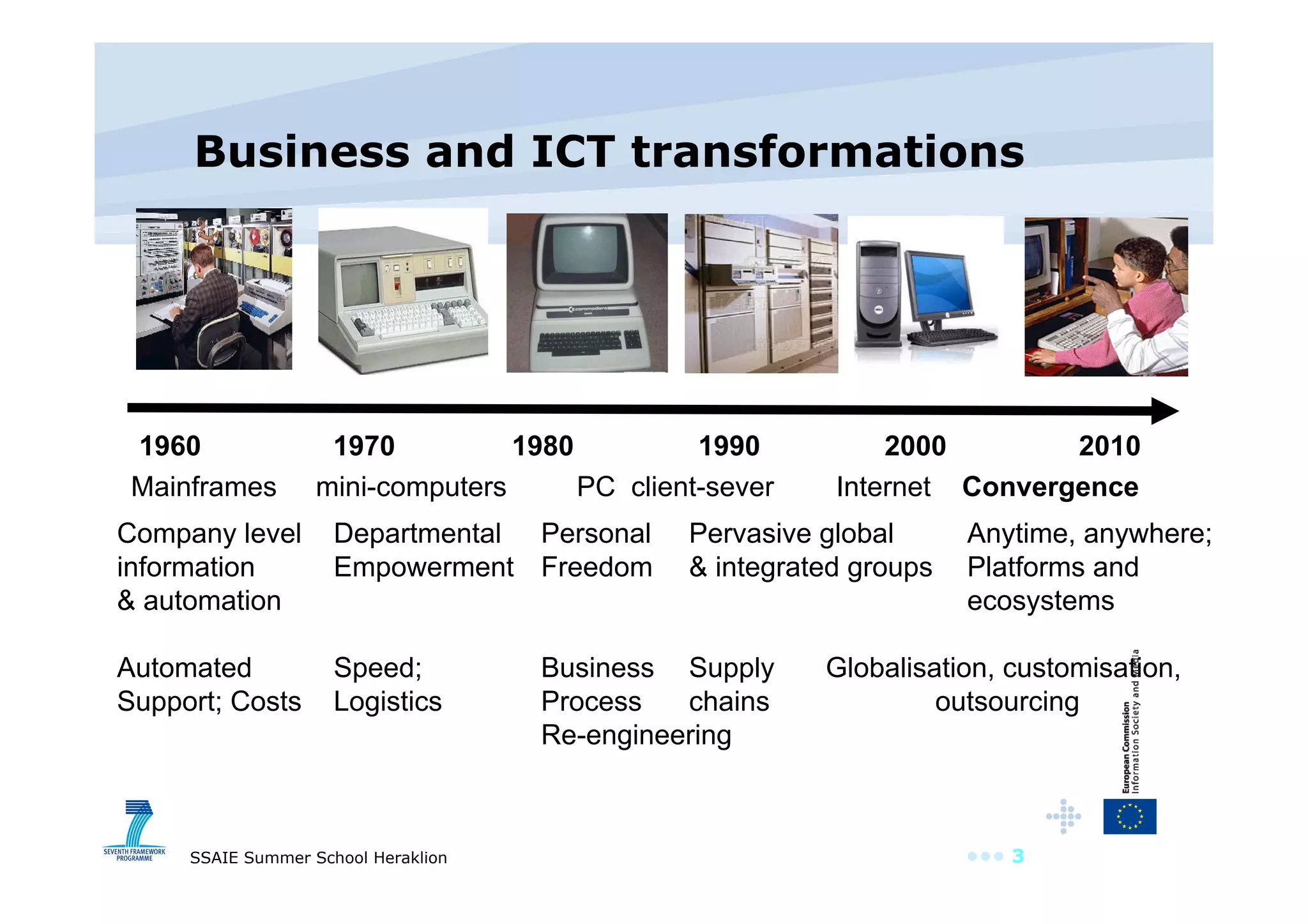
Business and ICT transformations 1960  1970  1980  1990  2000  2010 Mainframes  mini-computers  PC  client-sever  Internet  Convergence Company level information & automation Automated  Support; Costs Departmental Empowerment Speed; Logistics Personal Freedom Business Process Re-engineering Pervasive global & integrated groups Supply chains Anytime, anywhere; Platforms and  ecosystems Globalisation, customisation,  outsourcing
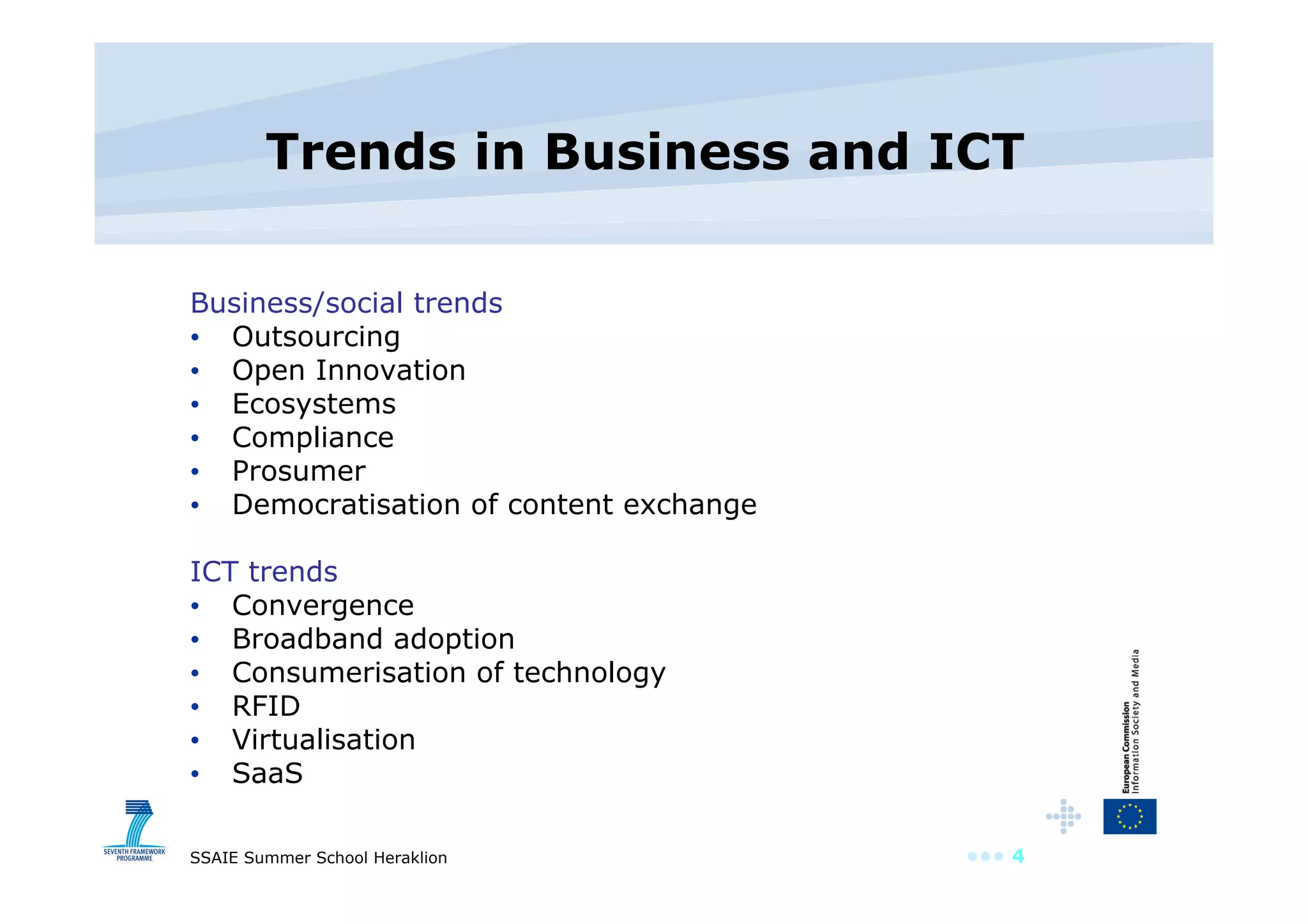
Trends in Business and ICT Business/social trends Outsourcing Open Innovation Ecosystems Compliance Prosumer Democratisation of content exchange ICT trends Convergence Broadband adoption Consumerisation of technology RFID Virtualisation SaaS
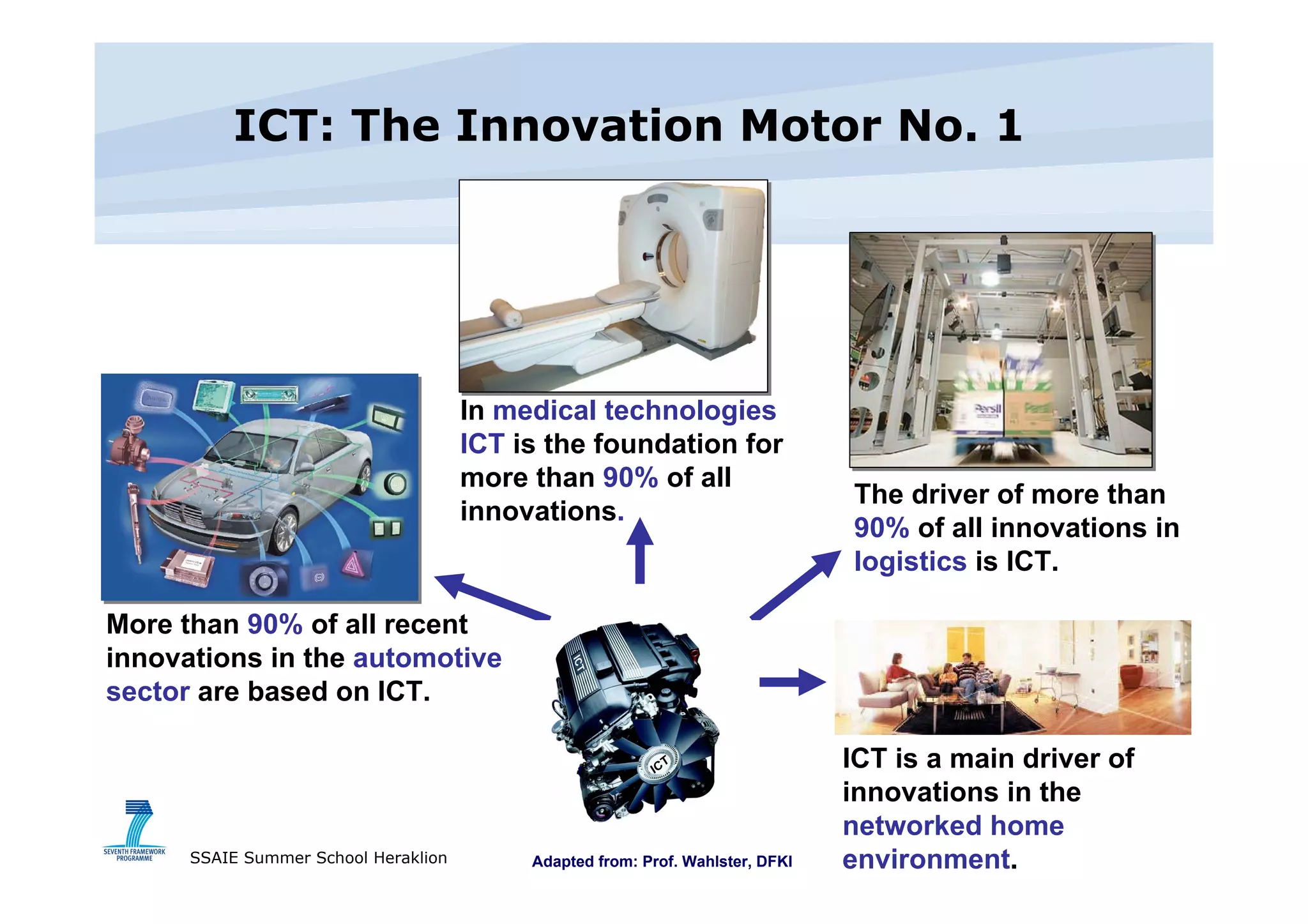
ICT: The Innovation Motor No. 1 In  medical technologies ICT  is the foundation for more than  90%  of all innovations . The driver of more than  90%  of all innovations in  logistics  is ICT. More than  90%  of all recent innovations in the  automotive sector  are based on ICT. Adapted from: Prof. Wahlster, DFKI ICT is a main driver of innovations in the  networked home environment .
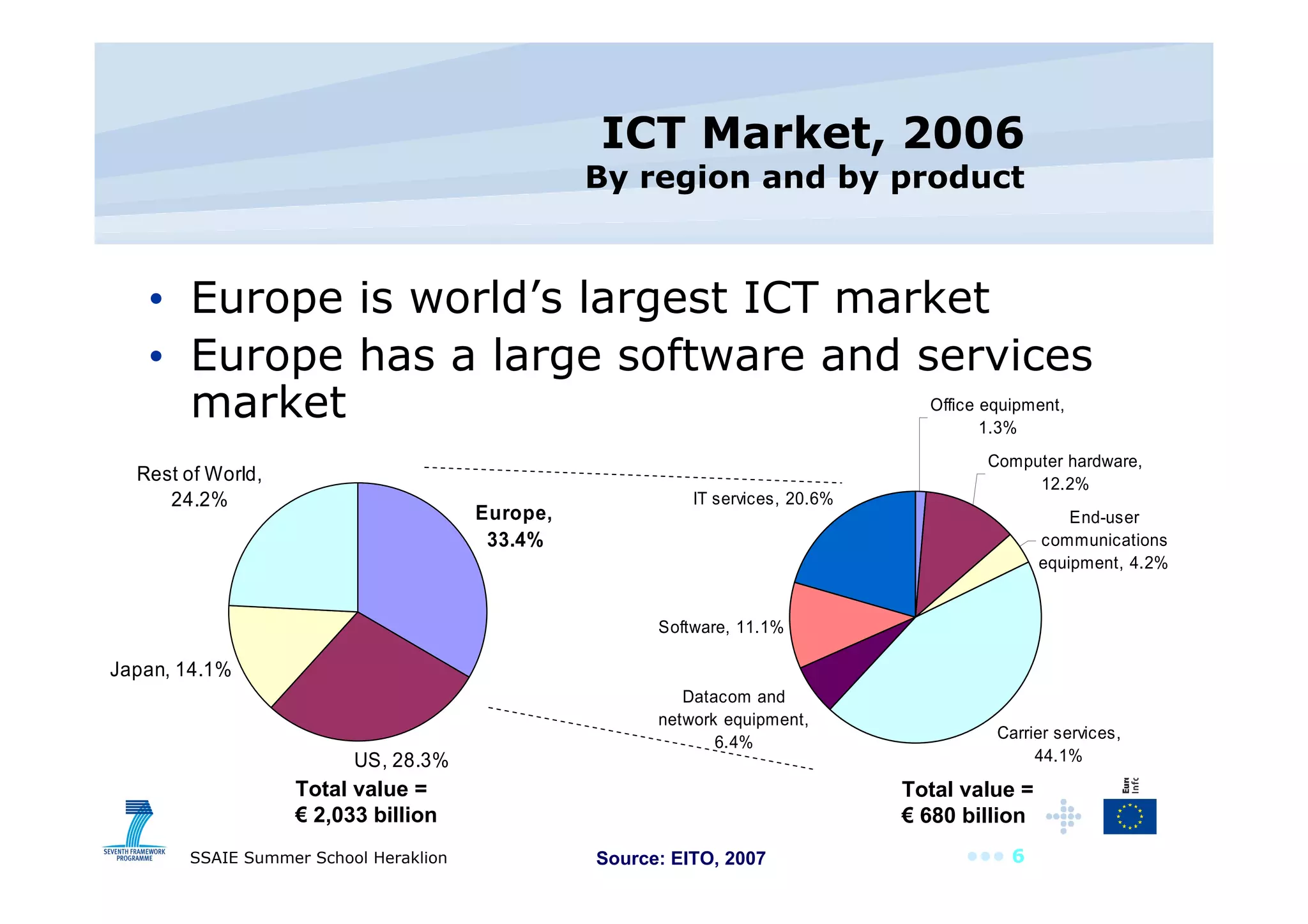
ICT Market, 2006 By region and by product Total value = € 2,033 billion Total value = € 680 billion Source: EITO, 2007 Europe is world’s largest ICT market Europe has a large software and services market
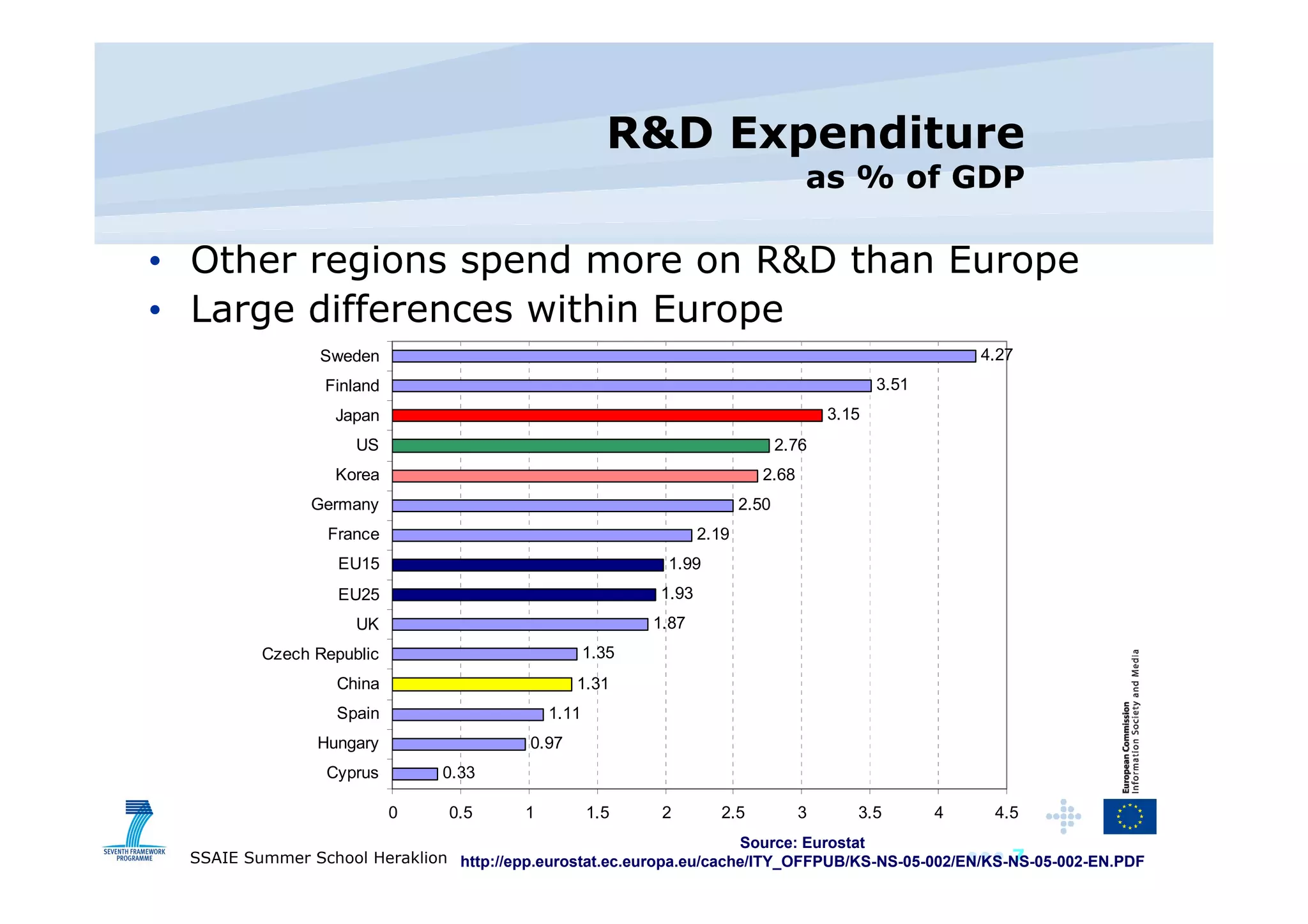
R&D Expenditure as % of GDP Source: Eurostat http://epp.eurostat.ec.europa.eu/cache/ITY_OFFPUB/KS-NS-05-002/EN/KS-NS-05-002-EN.PDF Other regions spend more on R&D than Europe Large differences within Europe
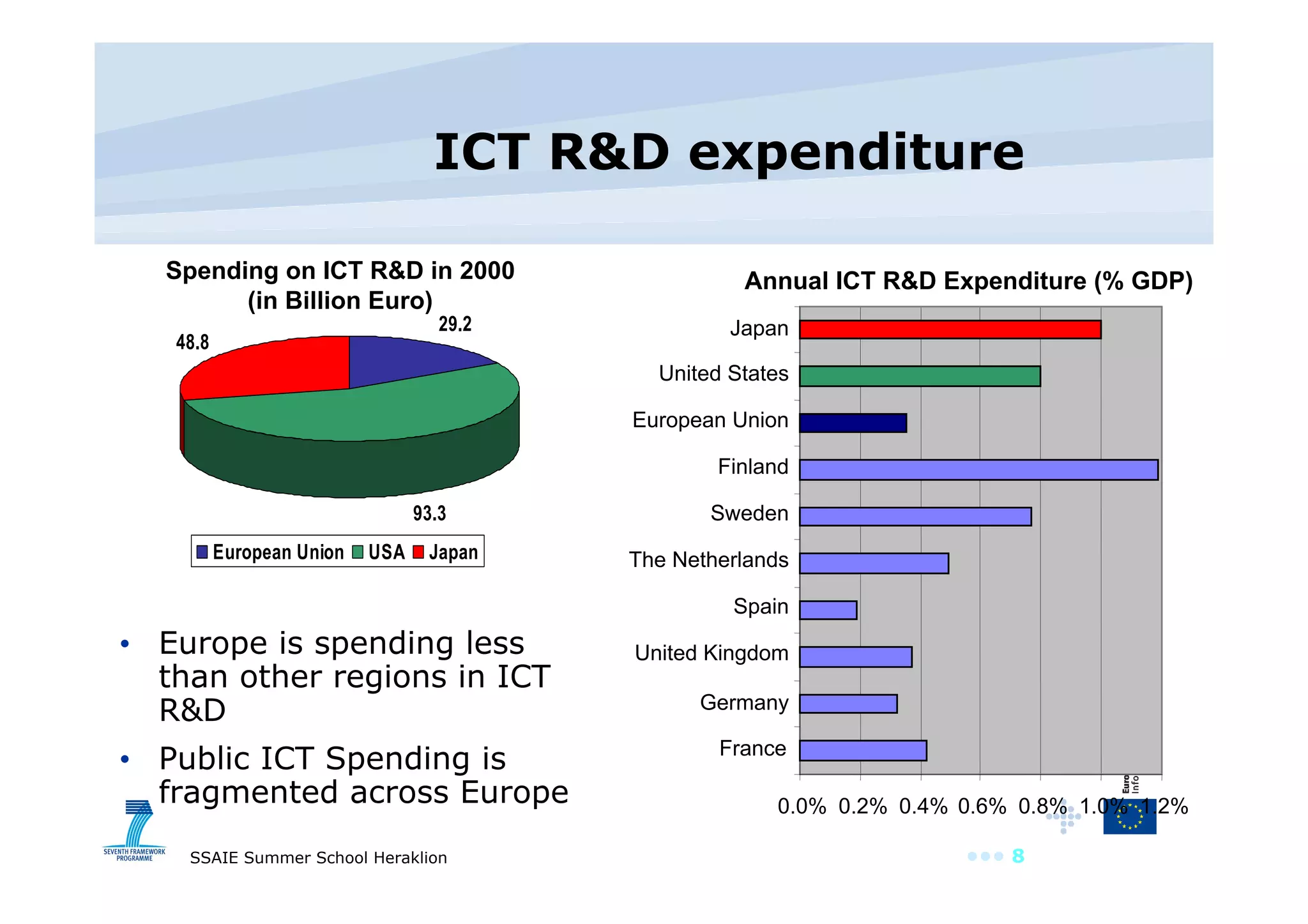
ICT R&D expenditure Europe is spending less than other regions in ICT R&D Public ICT Spending is fragmented across Europe 0.0% 0.2% 0.4% 0.6% 0.8% 1.0% 1.2% France Germany United Kingdom Spain The Netherlands Sweden Finland European Union United States Japan Annual ICT R&D Expenditure (% GDP) Spending on ICT R&D in 2000  (in Billion Euro)
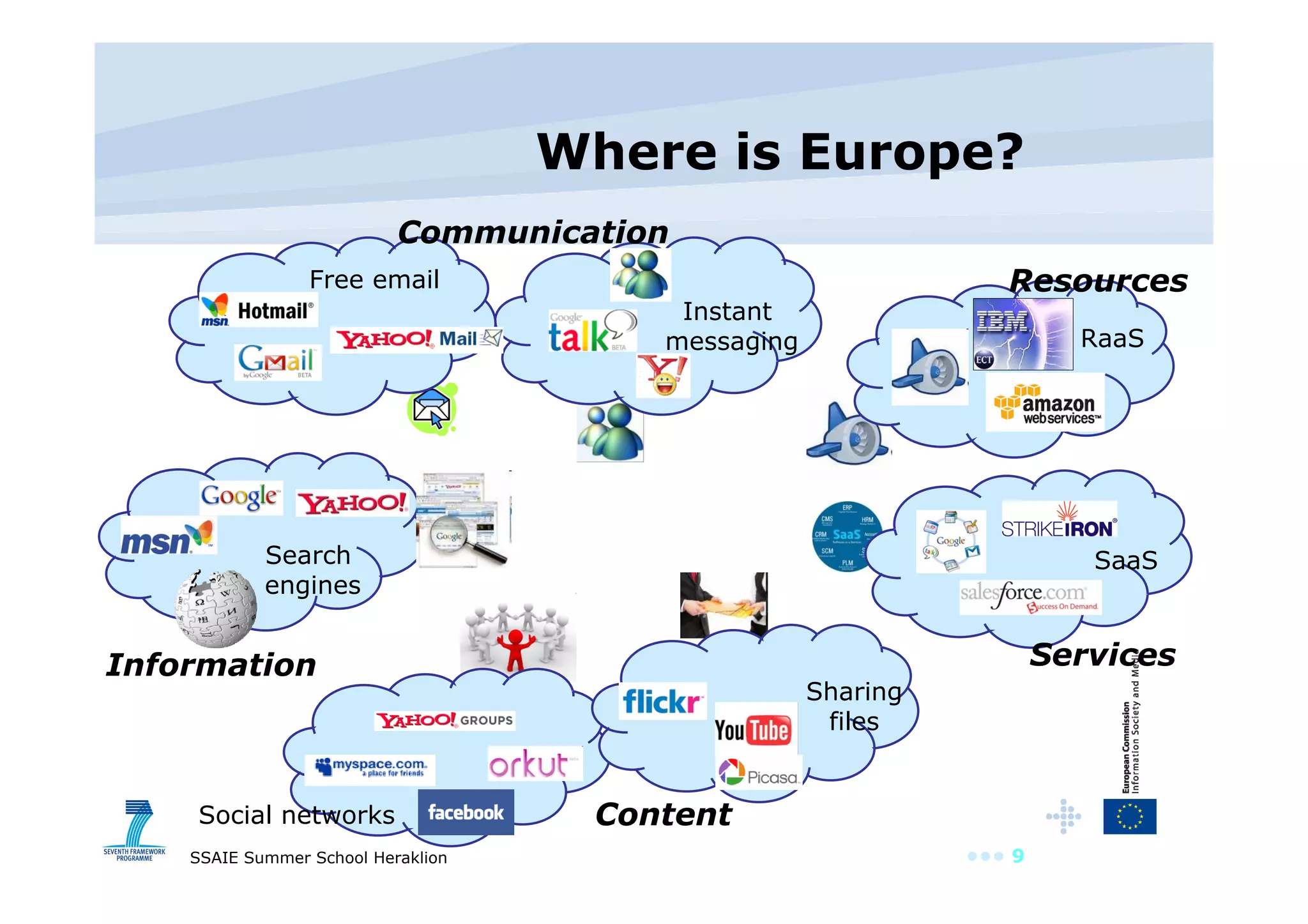
Where is Europe? Free email RaaS SaaS Sharing files Social networks Communication Information Content Services Resources Search  engines Instant  messaging
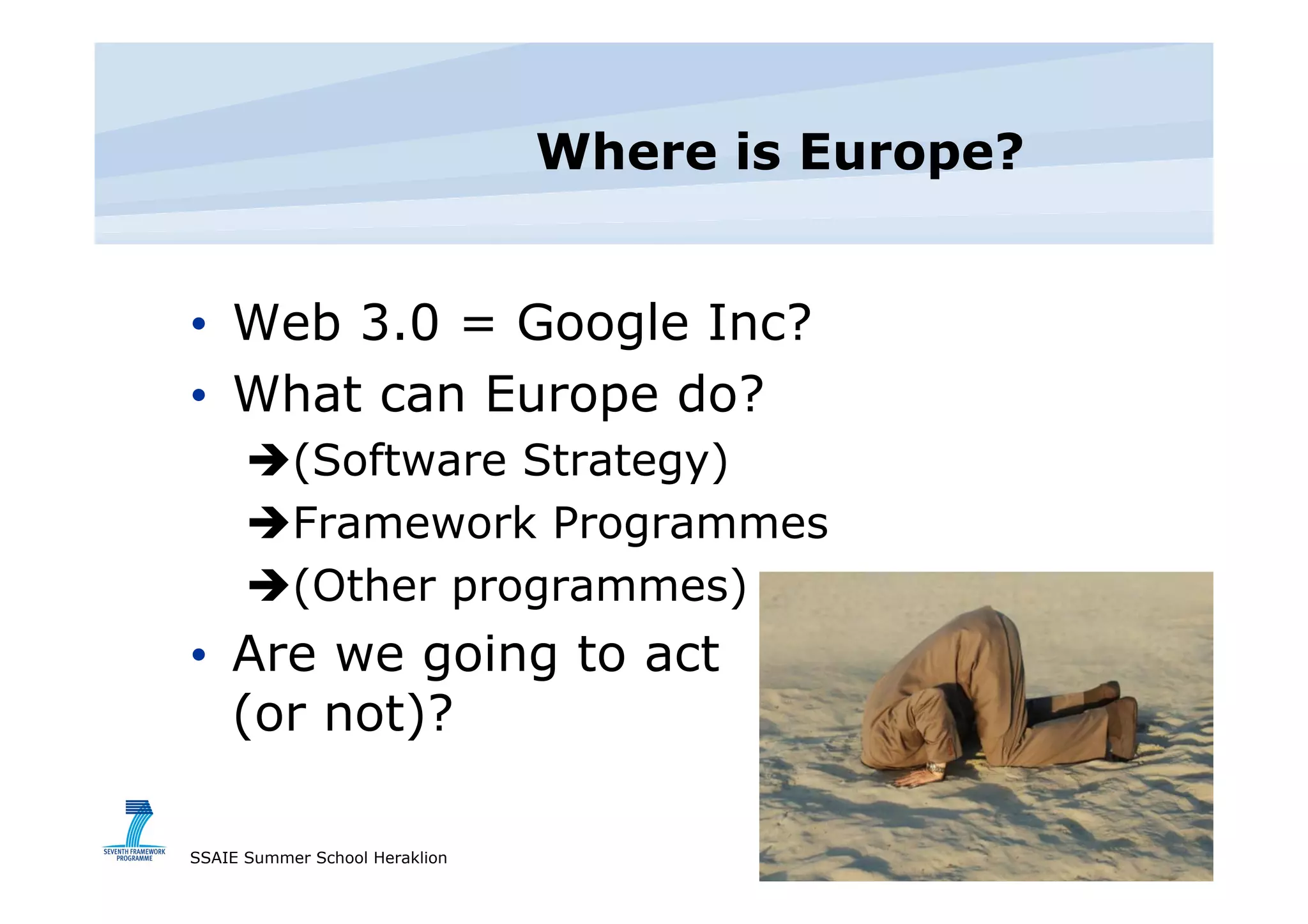
Where is Europe? Web 3.0 = Google Inc? What can Europe do?  (Software Strategy) Framework Programmes (Other programmes) Are we going to act (or not)?
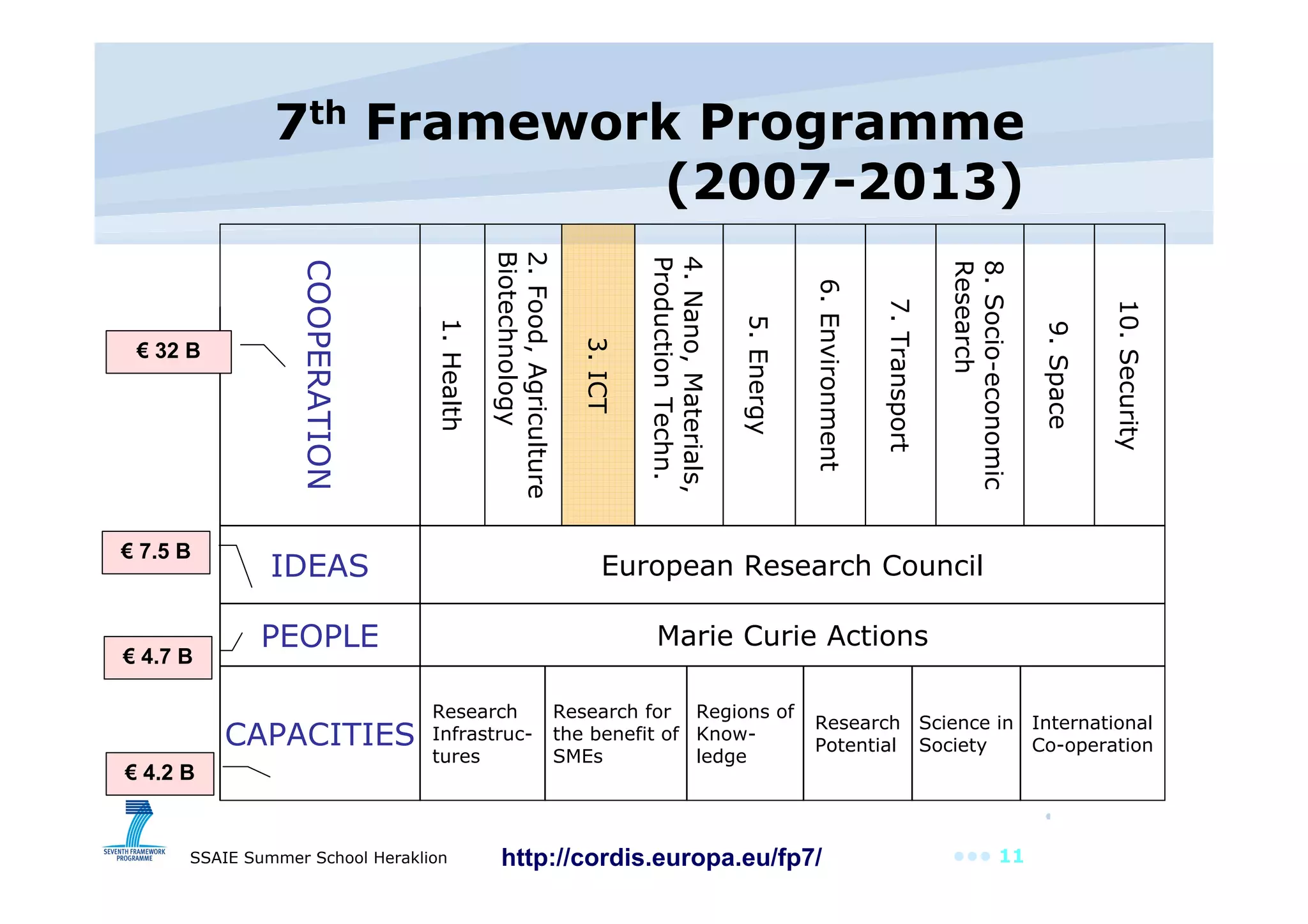
7 th  Framework Programme (2007-2013) International Co-operation Science in Society Research Potential Regions of Know-ledge Research for the benefit of SMEs Research Infrastruc-tures CAPACITIES Marie Curie Actions PEOPLE European Research Council IDEAS 9. Space 8. Socio-economic Research 7. Transport 6. Environment 5. Energy 4. Nano, Materials, Production Techn. 3. ICT 2. Food, Agriculture Biotechnology 1. Health COOPERATION http://cordis.europa.eu/fp7/ €  32 B €  7.5 B €  4.7 B €  4.2 B 10. Security
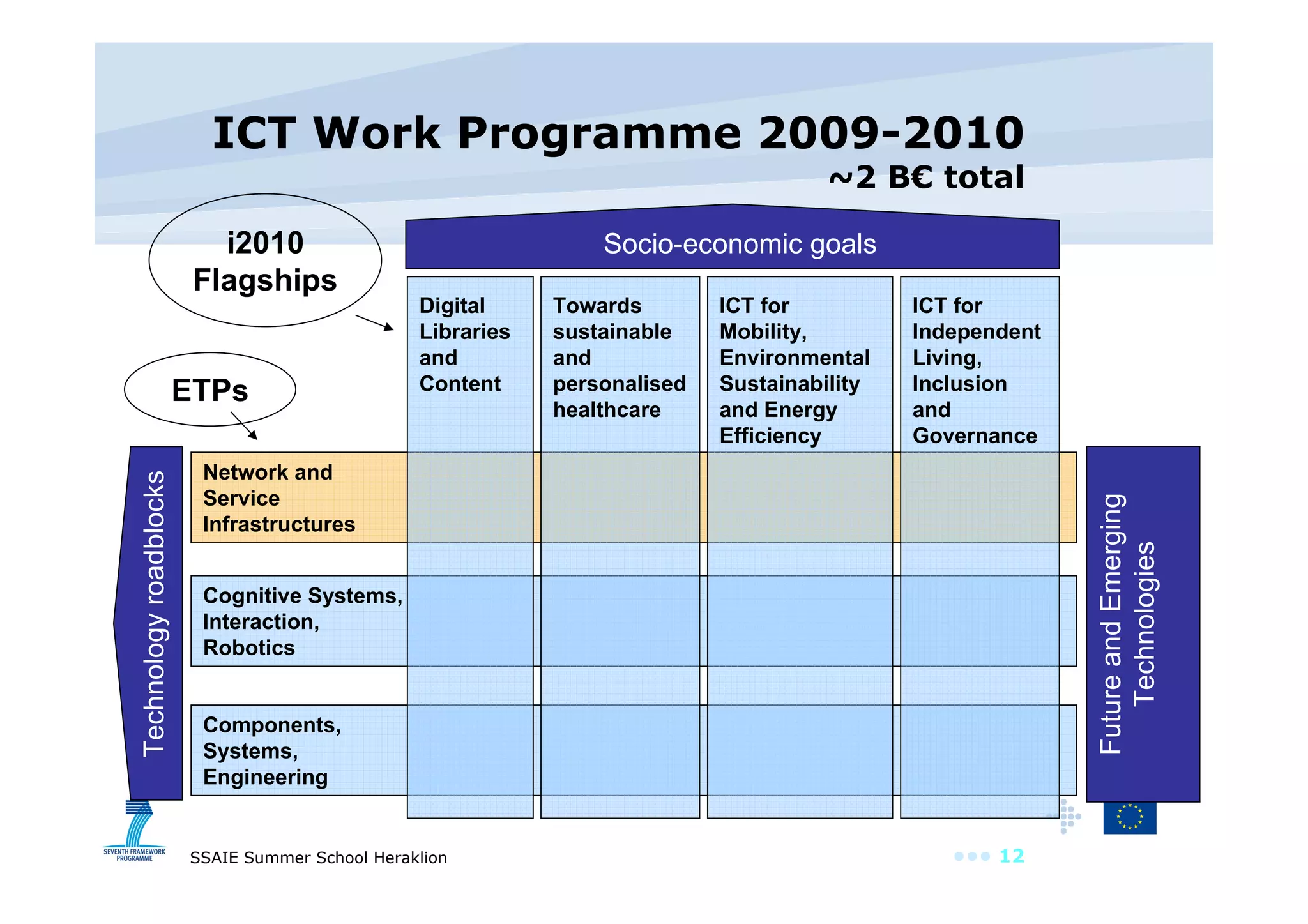
ICT Work Programme 2009-2010 ~2 B€ total Future and Emerging  Technologies Cognitive Systems,  Interaction,  Robotics Network and  Service  Infrastructures Components,  Systems, Engineering Digital Libraries and Content Towards sustainable and personalised healthcare ICT for Mobility, Environmental Sustainability and Energy Efficiency ICT for Independent Living, Inclusion and Governance  Socio-economic goals Technology roadblocks ETPs i2010 Flagships
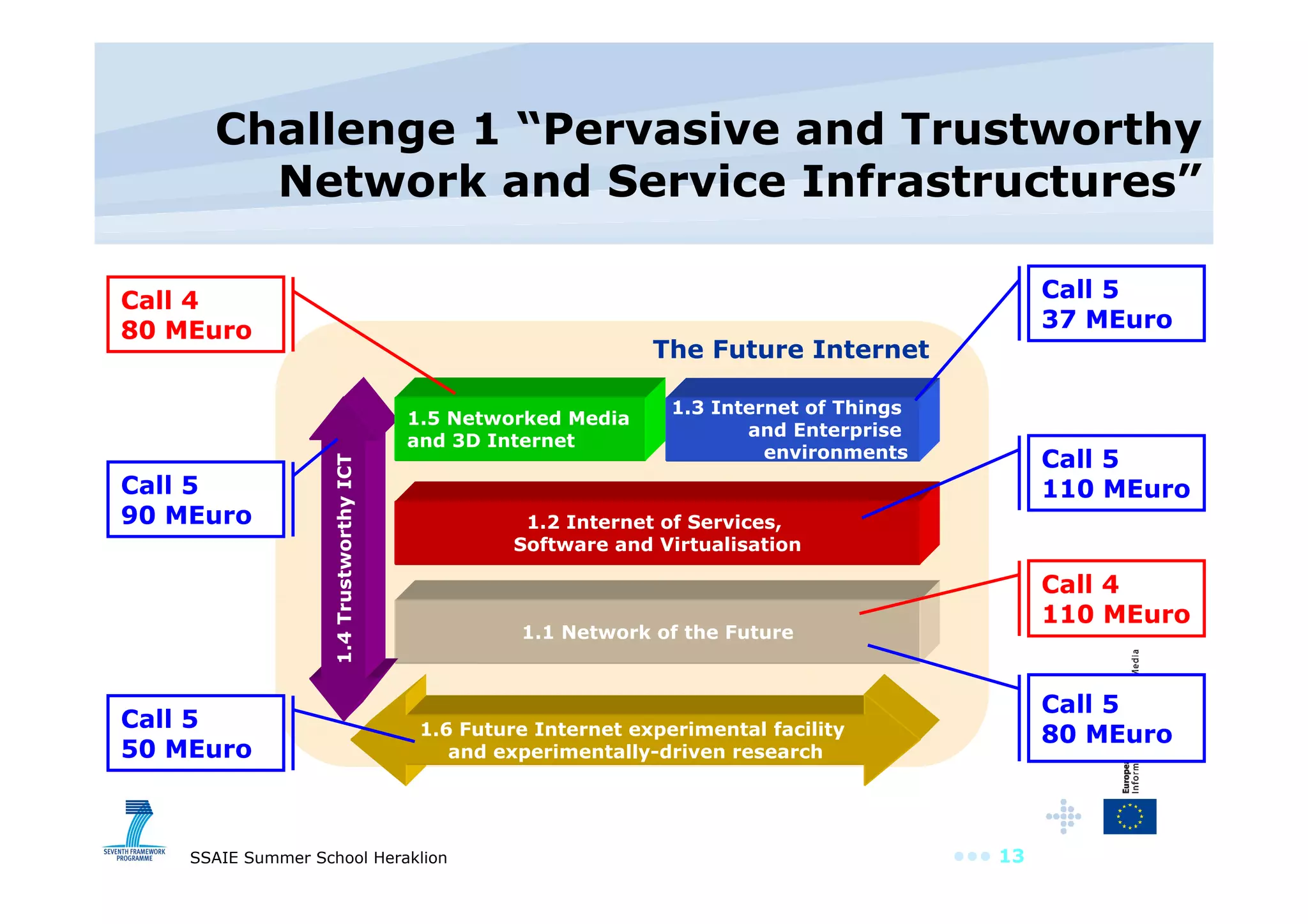
Challenge 1 “Pervasive and Trustworthy Network and Service Infrastructures” 1.1  Network of the Future 1.6  Future Internet experimental facility  and experimentally-driven research 1.2  Internet of Services,  Software and Virtualisation 1.4 Trustworthy ICT 1.3  Internet of Things  and Enterprise  environments 1.5 Networked Media  and 3D Internet The Future Internet Call 4 80 MEuro Call 4 110 MEuro Call 5 37 MEuro Call 5 110 MEuro Call 5 90 MEuro Call 5 50 MEuro Call 5 80 MEuro
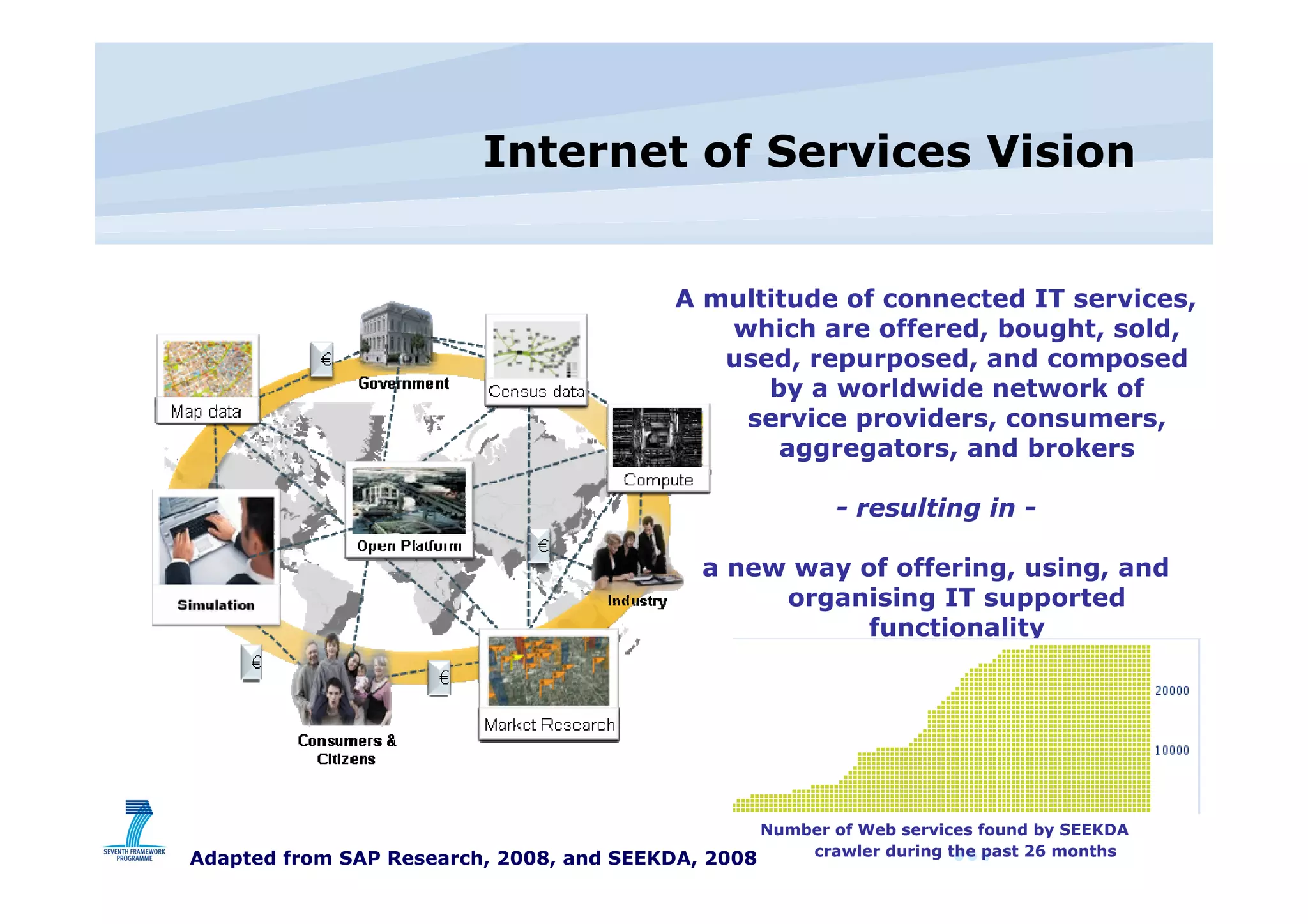
Internet of Services Vision eChallenges 2008, Stockholm Adapted from SAP Research, 2008, and SEEKDA, 2008 Number of Web services found by SEEKDA crawler during the past 26 months   A multitude of connected IT services, which are offered, bought, sold, used, repurposed, and composed by a worldwide network of service providers, consumers, aggregators, and brokers - resulting in - a new way of offering, using, and organising IT supported functionality
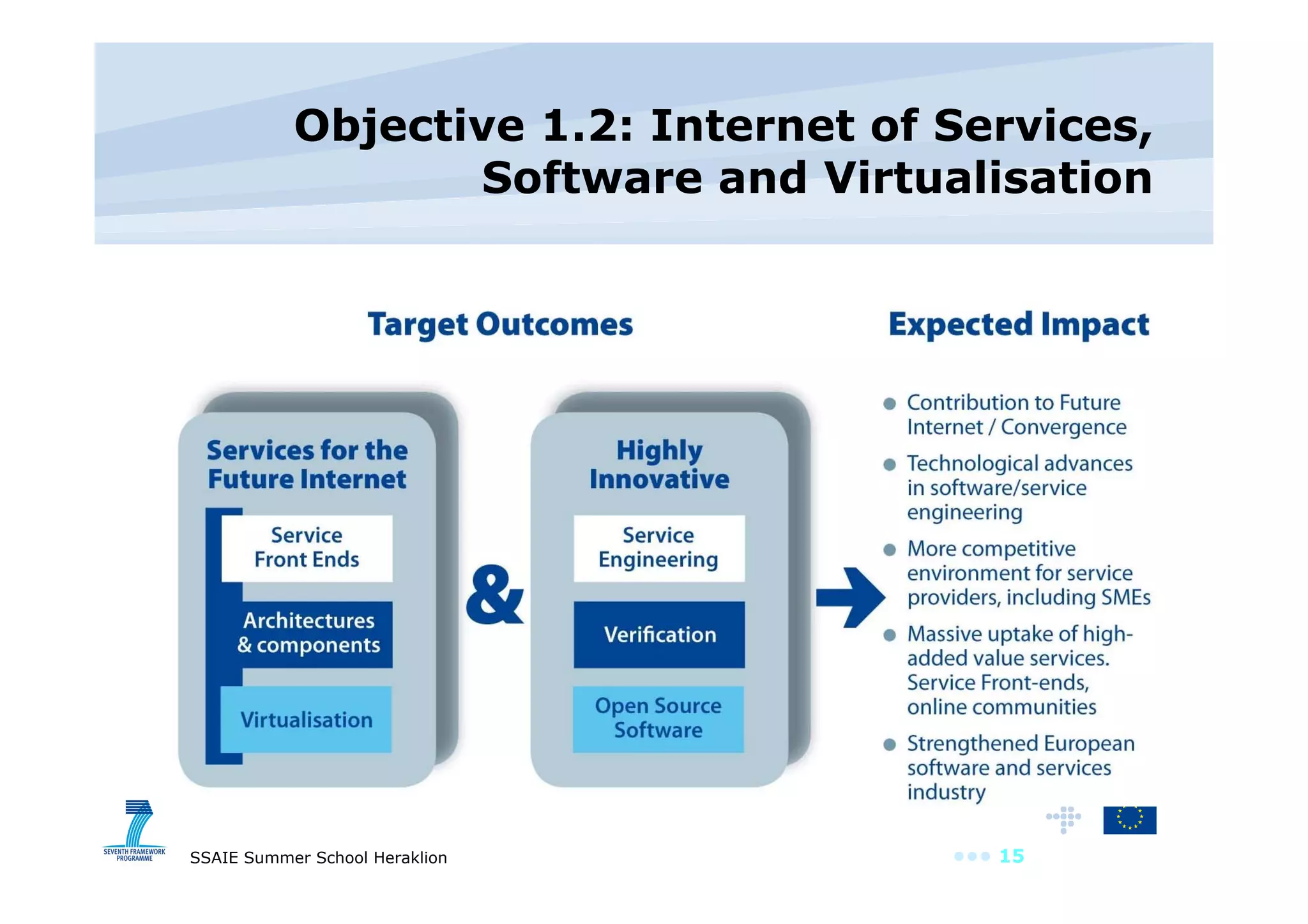
Objective 1.2: Internet of Services, Software and Virtualisation
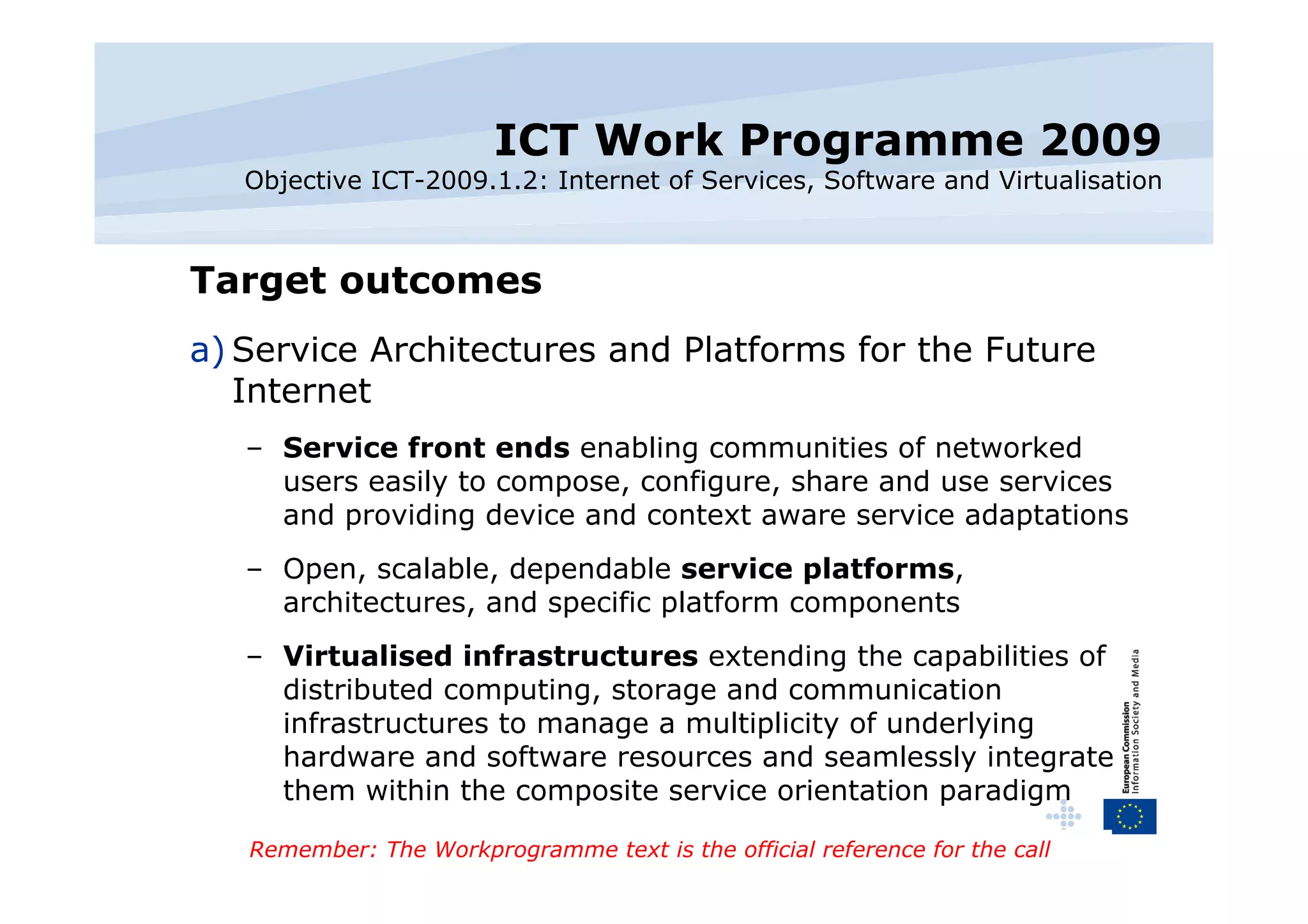
ICT Work Programme 2009 Objective ICT-2009.1.2: Internet of Services, Software and Virtualisation Target outcomes Service Architectures and Platforms for the Future Internet Service front ends  enabling communities of networked users easily to compose, configure, share and use services and providing device and context aware service adaptations Open, scalable, dependable  service platforms , architectures, and specific platform components Virtualised infrastructures  extending the capabilities of distributed computing, storage and communication infrastructures to manage a multiplicity of underlying hardware and software resources and seamlessly integrate them within the composite service orientation paradigm Remember: The Workprogramme text is the official reference for the call
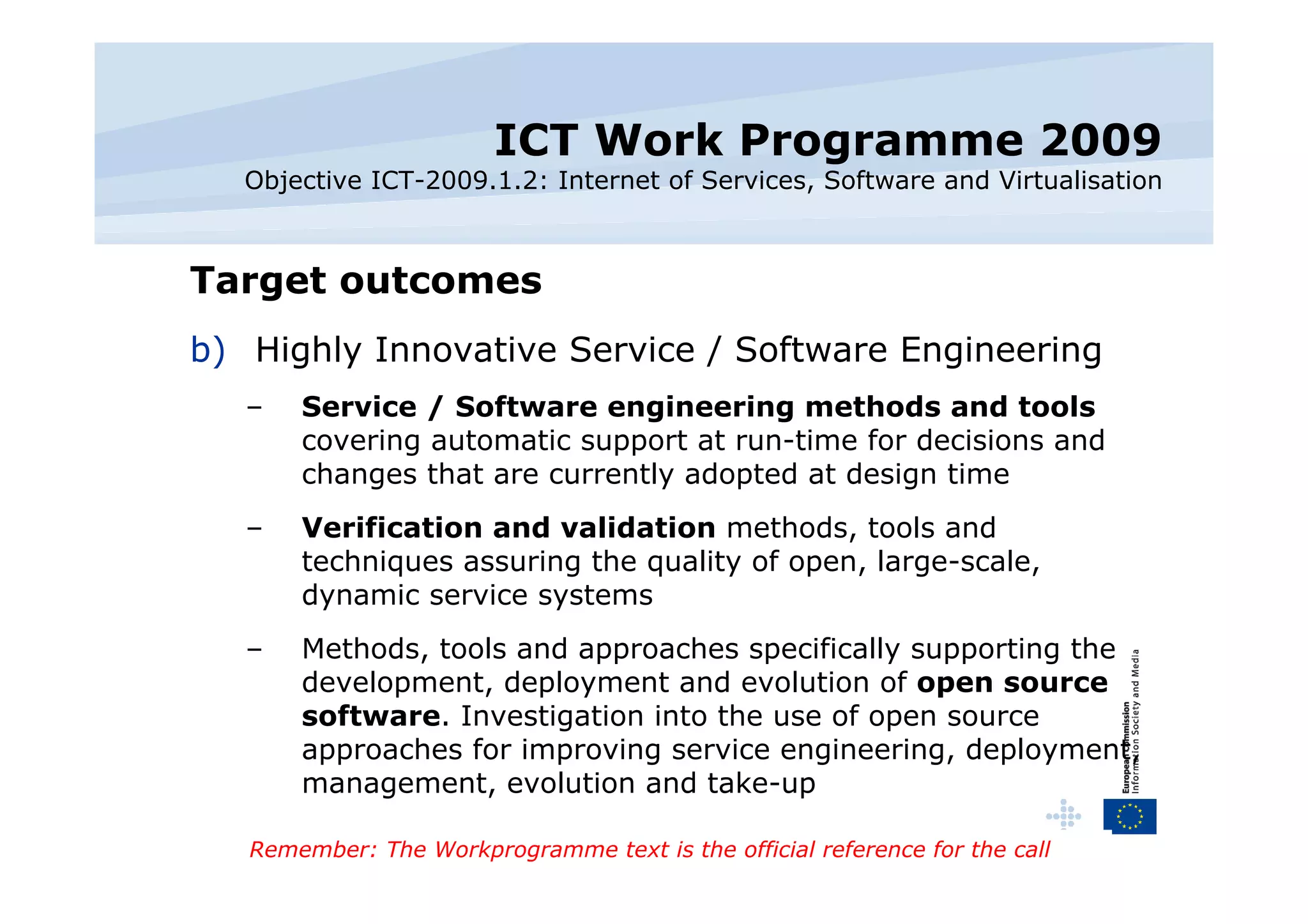
ICT Work Programme 2009 Objective ICT-2009.1.2: Internet of Services, Software and Virtualisation Target outcomes Highly Innovative Service / Software Engineering Service / Software engineering methods and tools  covering automatic support at run-time for decisions and changes that are currently adopted at design time Verification and validation  methods, tools and techniques assuring the quality of open, large-scale, dynamic service systems Methods, tools and approaches specifically supporting the development, deployment and evolution of  open source software . Investigation into the use of open source approaches for improving service engineering, deployment, management, evolution and take-up Remember: The Workprogramme text is the official reference for the call
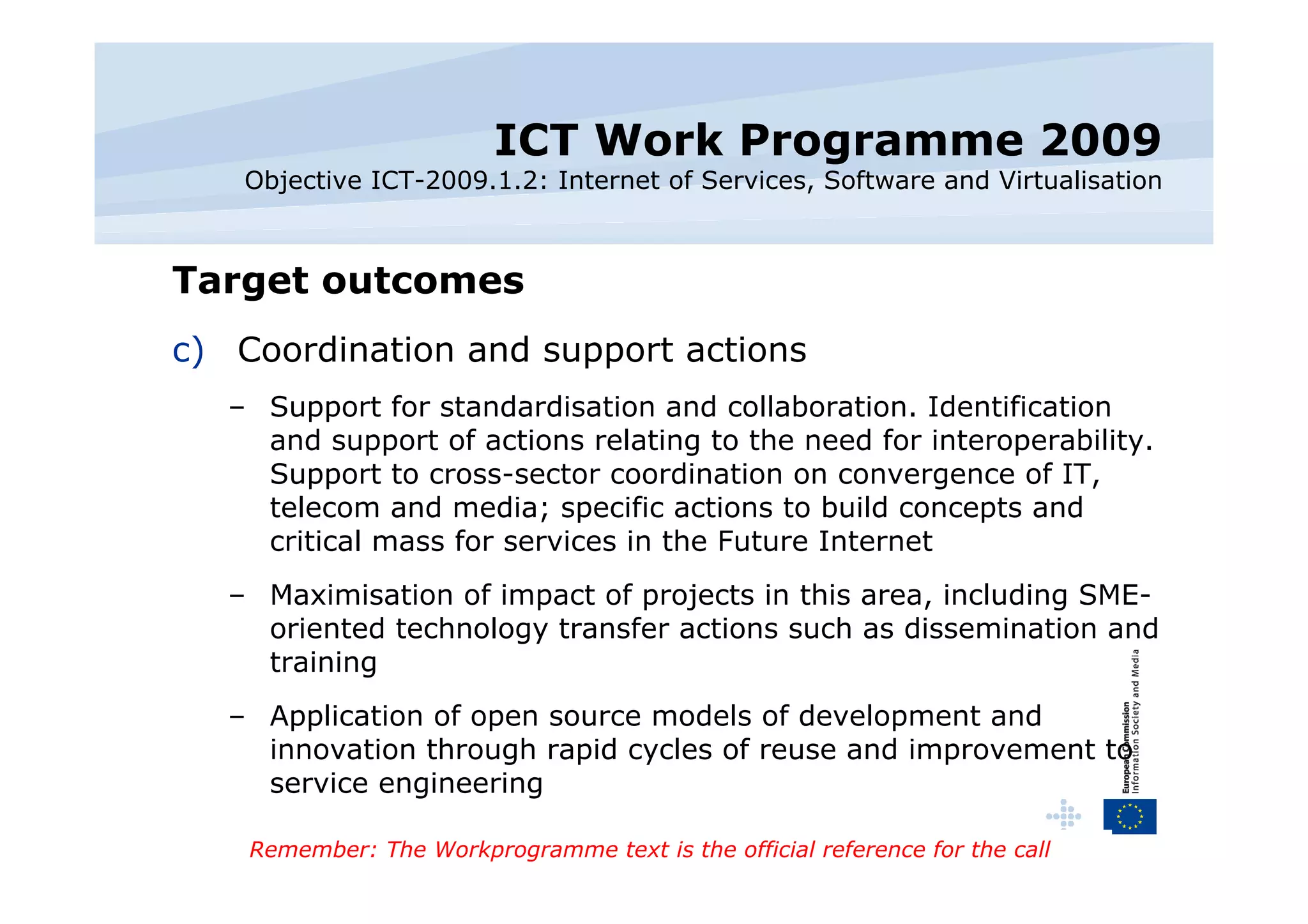
ICT Work Programme 2009 Objective ICT-2009.1.2: Internet of Services, Software and Virtualisation Target outcomes Coordination and support actions Support for standardisation and collaboration. Identification and support of actions relating to the need for interoperability. Support to cross-sector coordination on convergence of IT, telecom and media; specific actions to build concepts and critical mass for services in the Future Internet Maximisation of impact of projects in this area, including SME-oriented technology transfer actions such as dissemination and training Application of open source models of development and innovation through rapid cycles of reuse and improvement to service engineering Remember: The Workprogramme text is the official reference for the call
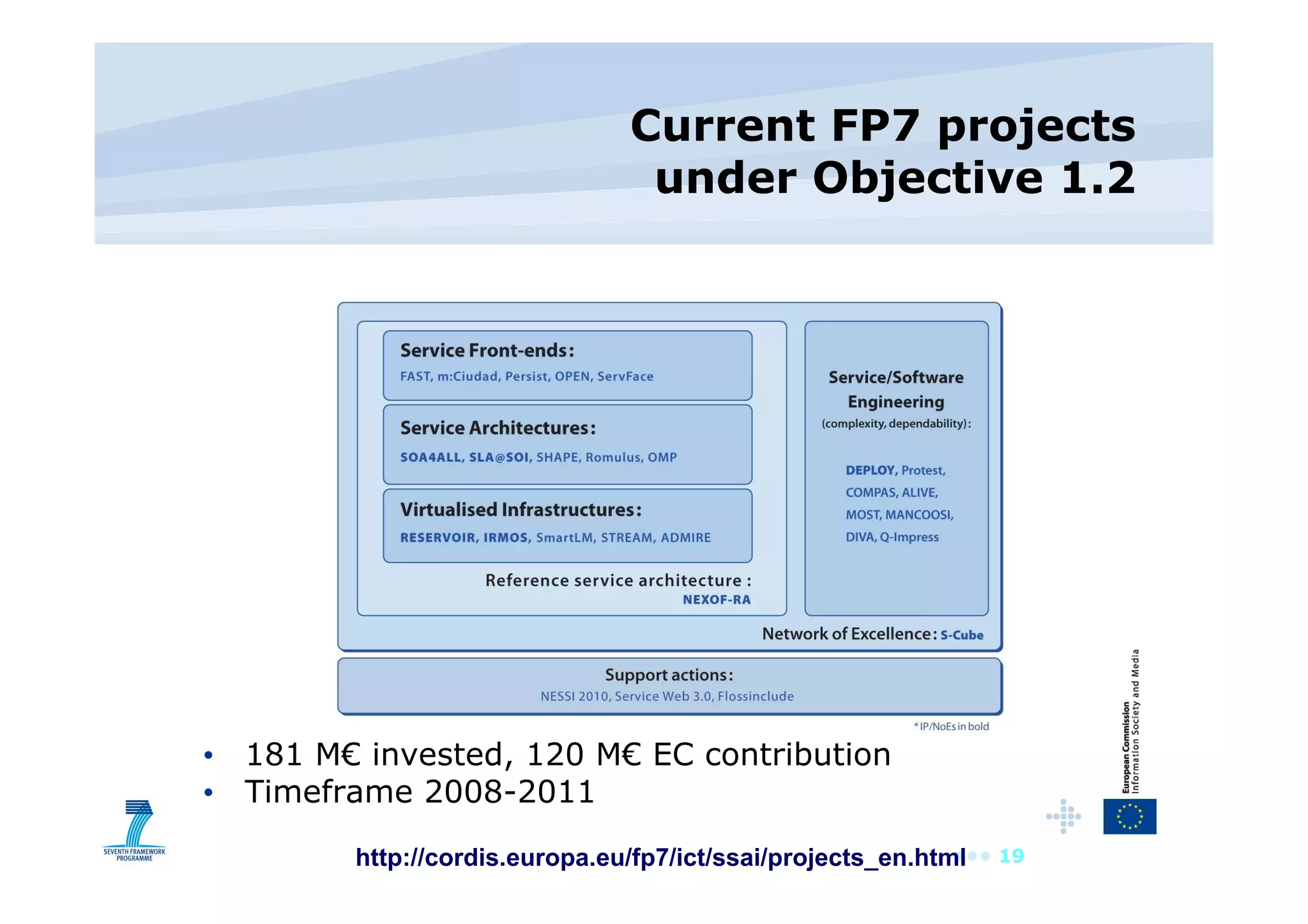
Current FP7 projects under Objective 1.2 http://cordis.europa.eu/fp7/ict/ssai/projects_en.html 181 M€ invested, 120 M€ EC contribution Timeframe 2008-2011
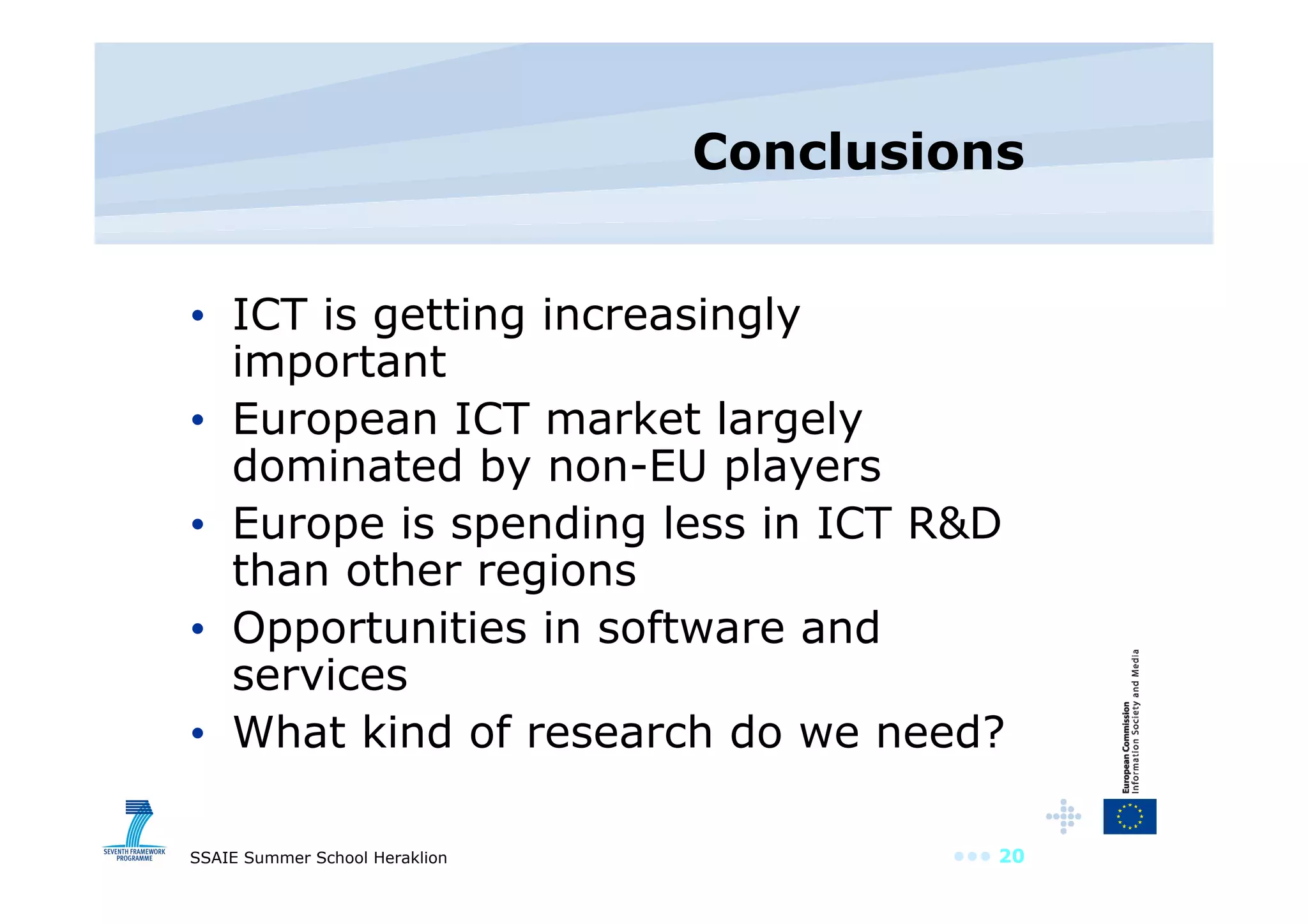
Conclusions ICT is getting increasingly important European ICT market largely dominated by non-EU players Europe is spending less in ICT R&D than other regions Opportunities in software and services What kind of research do we need?
We need YOU
 
Questions?
For more information FP7 http://cordis.europa.eu/fp7/ http://cordis.europa.eu/fp7/ict/ Software & Service Architectures and Infrastructures http://cordis.europa.eu/software-services Future Internet http://ec.europa.eu/foi  http://www.future-internet.eu/ E-mail [email_address]

20090616 Investing in Software & Services Research

  • 1.
    SSAIE & the5th Call Investing in Software & Services Research Arian Zwegers European Commission Information Society and Media Directorate General Software & Service Architectures and Infrastructures Unit
  • 2.
    Overview Whyinvesting in EU ICT research? Trends in business and ICT ICT market in EU ICT research in EU Framework Programmes ICT Objective 1.2
  • 3.
    Business and ICTtransformations 1960 1970 1980 1990 2000 2010 Mainframes mini-computers PC client-sever Internet Convergence Company level information & automation Automated Support; Costs Departmental Empowerment Speed; Logistics Personal Freedom Business Process Re-engineering Pervasive global & integrated groups Supply chains Anytime, anywhere; Platforms and ecosystems Globalisation, customisation, outsourcing
  • 4.
    Trends in Businessand ICT Business/social trends Outsourcing Open Innovation Ecosystems Compliance Prosumer Democratisation of content exchange ICT trends Convergence Broadband adoption Consumerisation of technology RFID Virtualisation SaaS
  • 5.
    ICT: The InnovationMotor No. 1 In medical technologies ICT is the foundation for more than 90% of all innovations . The driver of more than 90% of all innovations in logistics is ICT. More than 90% of all recent innovations in the automotive sector are based on ICT. Adapted from: Prof. Wahlster, DFKI ICT is a main driver of innovations in the networked home environment .
  • 6.
    ICT Market, 2006By region and by product Total value = € 2,033 billion Total value = € 680 billion Source: EITO, 2007 Europe is world’s largest ICT market Europe has a large software and services market
  • 7.
    R&D Expenditure as% of GDP Source: Eurostat http://epp.eurostat.ec.europa.eu/cache/ITY_OFFPUB/KS-NS-05-002/EN/KS-NS-05-002-EN.PDF Other regions spend more on R&D than Europe Large differences within Europe
  • 8.
    ICT R&D expenditureEurope is spending less than other regions in ICT R&D Public ICT Spending is fragmented across Europe 0.0% 0.2% 0.4% 0.6% 0.8% 1.0% 1.2% France Germany United Kingdom Spain The Netherlands Sweden Finland European Union United States Japan Annual ICT R&D Expenditure (% GDP) Spending on ICT R&D in 2000 (in Billion Euro)
  • 9.
    Where is Europe?Free email RaaS SaaS Sharing files Social networks Communication Information Content Services Resources Search engines Instant messaging
  • 10.
    Where is Europe?Web 3.0 = Google Inc? What can Europe do?  (Software Strategy) Framework Programmes (Other programmes) Are we going to act (or not)?
  • 11.
    7 th Framework Programme (2007-2013) International Co-operation Science in Society Research Potential Regions of Know-ledge Research for the benefit of SMEs Research Infrastruc-tures CAPACITIES Marie Curie Actions PEOPLE European Research Council IDEAS 9. Space 8. Socio-economic Research 7. Transport 6. Environment 5. Energy 4. Nano, Materials, Production Techn. 3. ICT 2. Food, Agriculture Biotechnology 1. Health COOPERATION http://cordis.europa.eu/fp7/ € 32 B € 7.5 B € 4.7 B € 4.2 B 10. Security
  • 12.
    ICT Work Programme2009-2010 ~2 B€ total Future and Emerging Technologies Cognitive Systems, Interaction, Robotics Network and Service Infrastructures Components, Systems, Engineering Digital Libraries and Content Towards sustainable and personalised healthcare ICT for Mobility, Environmental Sustainability and Energy Efficiency ICT for Independent Living, Inclusion and Governance Socio-economic goals Technology roadblocks ETPs i2010 Flagships
  • 13.
    Challenge 1 “Pervasiveand Trustworthy Network and Service Infrastructures” 1.1 Network of the Future 1.6 Future Internet experimental facility and experimentally-driven research 1.2 Internet of Services, Software and Virtualisation 1.4 Trustworthy ICT 1.3 Internet of Things and Enterprise environments 1.5 Networked Media and 3D Internet The Future Internet Call 4 80 MEuro Call 4 110 MEuro Call 5 37 MEuro Call 5 110 MEuro Call 5 90 MEuro Call 5 50 MEuro Call 5 80 MEuro
  • 14.
    Internet of ServicesVision eChallenges 2008, Stockholm Adapted from SAP Research, 2008, and SEEKDA, 2008 Number of Web services found by SEEKDA crawler during the past 26 months A multitude of connected IT services, which are offered, bought, sold, used, repurposed, and composed by a worldwide network of service providers, consumers, aggregators, and brokers - resulting in - a new way of offering, using, and organising IT supported functionality
  • 15.
    Objective 1.2: Internetof Services, Software and Virtualisation
  • 16.
    ICT Work Programme2009 Objective ICT-2009.1.2: Internet of Services, Software and Virtualisation Target outcomes Service Architectures and Platforms for the Future Internet Service front ends enabling communities of networked users easily to compose, configure, share and use services and providing device and context aware service adaptations Open, scalable, dependable service platforms , architectures, and specific platform components Virtualised infrastructures extending the capabilities of distributed computing, storage and communication infrastructures to manage a multiplicity of underlying hardware and software resources and seamlessly integrate them within the composite service orientation paradigm Remember: The Workprogramme text is the official reference for the call
  • 17.
    ICT Work Programme2009 Objective ICT-2009.1.2: Internet of Services, Software and Virtualisation Target outcomes Highly Innovative Service / Software Engineering Service / Software engineering methods and tools covering automatic support at run-time for decisions and changes that are currently adopted at design time Verification and validation methods, tools and techniques assuring the quality of open, large-scale, dynamic service systems Methods, tools and approaches specifically supporting the development, deployment and evolution of open source software . Investigation into the use of open source approaches for improving service engineering, deployment, management, evolution and take-up Remember: The Workprogramme text is the official reference for the call
  • 18.
    ICT Work Programme2009 Objective ICT-2009.1.2: Internet of Services, Software and Virtualisation Target outcomes Coordination and support actions Support for standardisation and collaboration. Identification and support of actions relating to the need for interoperability. Support to cross-sector coordination on convergence of IT, telecom and media; specific actions to build concepts and critical mass for services in the Future Internet Maximisation of impact of projects in this area, including SME-oriented technology transfer actions such as dissemination and training Application of open source models of development and innovation through rapid cycles of reuse and improvement to service engineering Remember: The Workprogramme text is the official reference for the call
  • 19.
    Current FP7 projectsunder Objective 1.2 http://cordis.europa.eu/fp7/ict/ssai/projects_en.html 181 M€ invested, 120 M€ EC contribution Timeframe 2008-2011
  • 20.
    Conclusions ICT isgetting increasingly important European ICT market largely dominated by non-EU players Europe is spending less in ICT R&D than other regions Opportunities in software and services What kind of research do we need?
  • 21.
  • 22.
  • 23.
  • 24.
    For more informationFP7 http://cordis.europa.eu/fp7/ http://cordis.europa.eu/fp7/ict/ Software & Service Architectures and Infrastructures http://cordis.europa.eu/software-services Future Internet http://ec.europa.eu/foi http://www.future-internet.eu/ E-mail [email_address]