Europako diru-laguntza
deialdiak ulertzeko hiztegi bat
Josu Waliño
2013/06/19
1. ERA (European Research Area)
2. Framework Programme
3. FP7
4. LLP
5. 'Work Programmes' and 'Calls for Proposals
6. Funding schemes
7. Europe 2020
8. Horizon 2020
9. Erasmus for All
10. Creative Europe
11. NCP, LEAR and PIC
12. Project proposal
Glosarioa
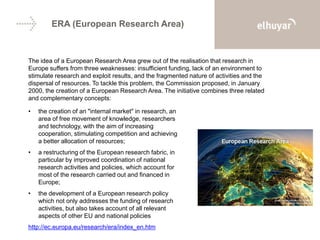
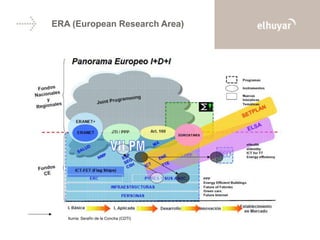
ERA (European Research Area)
The idea of a European Research Area grew out of the realisation that research in
Europe suffers from three weaknesses: insufficient funding, lack of an environment to
stimulate research and exploit results, and the fragmented nature of activities and the
dispersal of resources. To tackle this problem, the Commission proposed, in January
2000, the creation of a European Research Area. The initiative combines three related
and complementary concepts:
• the creation of an "internal market" in research, an
area of free movement of knowledge, researchers
and technology, with the aim of increasing
cooperation, stimulating competition and achieving
a better allocation of resources;
• a restructuring of the European research fabric, in
particular by improved coordination of national
research activities and policies, which account for
most of the research carried out and financed in
Europe;
• the development of a European research policy
which not only addresses the funding of research
activities, but also takes account of all relevant
aspects of other EU and national policies
http://ec.europa.eu/research/era/index_en.htm
ERA (European Research Area)
Iturria: Serafín de la Concha (CDTI)
Framework Programme
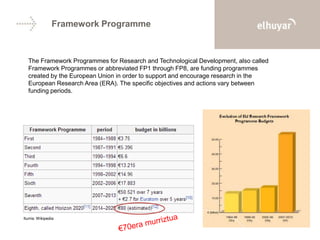
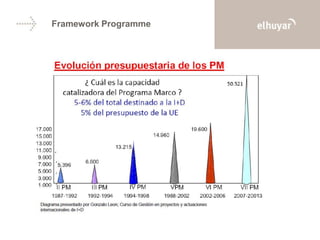
The Framework Programmes for Research and Technological Development, also called
Framework Programmes or abbreviated FP1 through FP8, are funding programmes
created by the European Union in order to support and encourage research in the
European Research Area (ERA). The specific objectives and actions vary between
funding periods.
Iturria: Wikipedia
Framework Programme
FP7
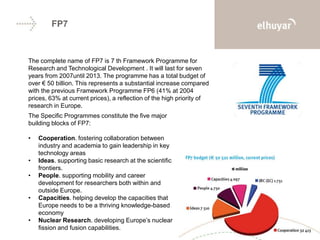
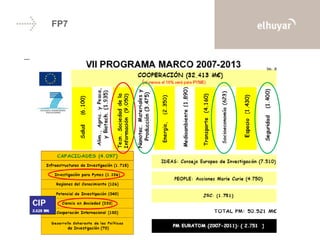
The complete name of FP7 is 7 th Framework Programme for
Research and Technological Development . It will last for seven
years from 2007until 2013. The programme has a total budget of
over € 50 billion. This represents a substantial increase compared
with the previous Framework Programme FP6 (41% at 2004
prices, 63% at current prices), a reflection of the high priority of
research in Europe.
The Specific Programmes constitute the five major
building blocks of FP7:
• Cooperation. fostering collaboration between
industry and academia to gain leadership in key
technology areas
• Ideas. supporting basic research at the scientific
frontiers.
• People. supporting mobility and career
development for researchers both within and
outside Europe.
• Capacities. helping develop the capacities that
Europe needs to be a thriving knowledge-based
economy
• Nuclear Research. developing Europe’s nuclear
fission and fusion capabilities.
FP7
Lifelong Learning Programme (LLP)
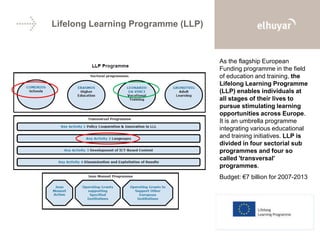
As the flagship European
Funding programme in the field
of education and training, the
Lifelong Learning Programme
(LLP) enables individuals at
all stages of their lives to
pursue stimulating learning
opportunities across Europe.
It is an umbrella programme
integrating various educational
and training initiatives. LLP is
divided in four sectorial sub
programmes and four so
called 'transversal'
programmes.
Budget: €7 billion for 2007-2013
'Work Programmes' and 'Calls for
Proposals'
The concrete plans for implementing the Specific Programmes are announced by the
European Commission in annual 'Work Programmes'. These work programmes include
the schedule of 'Calls for Proposals', commonly known just as 'Calls', to be published
during the year. Each Call usually covers specific research areas, and you may have to
wait until the publication of a Call which covers your exact area of interest.
How will I know when a Call for Proposals is issued?
All Calls are announced in the EU's Official Journal (which is the official source of EU
documents). The annual work programmes and the full texts of the Calls are published
on the FP7 section of CORDIS, the web site dedicated to EU-supported research.
CORDIS is continuously updated with the latest information on Calls for proposals, as
well as other information and services related to Community research. CORDIS will help
you find information - and plan your proposal.
http://cordis.europa.eu/fp7/home_en.html
Funding Schemes
"Funding schemes" are the types of projects, by which FP7 and LLP are implemented. These
are some of the more usuals:
FP7
• Collaborative projects (STREP and IPs) are focused research projects with clearly defined scientific and
technological objectives and specific expected results.
• Networks of Excellence are designed for research institutions willing to combine and functionally integrate
a substantial part of their activities and capacities in a given field, in order to create a European "virtual
research centre" in this field.
• Coordination and support actions cover not the research itself, but the coordination and networking of
projects, programmes and policies.
LLP
• Multilateral Projects. Projects which aim to develop, promote and disseminate educational good practice.
• Multilateral Networks. Networks which represent as a minimum organisations from 6 countries and aim to
develop education in their subject area or discipline.
• Accompanying Measures aim to support various activities which will clearly contribute to achieving the
Comenius Programme objectives
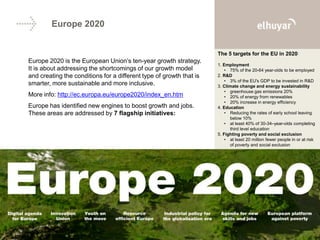
Europe 2020
Europe 2020 is the European Union’s ten-year growth strategy.
It is about addressing the shortcomings of our growth model
and creating the conditions for a different type of growth that is
smarter, more sustainable and more inclusive.
More info: http://ec.europa.eu/europe2020/index_en.htm
Europe has identified new engines to boost growth and jobs.
These areas are addressed by 7 flagship initiatives:
The 5 targets for the EU in 2020:
1. Employment
• 75% of the 20-64 year-olds to be employed
2. R&D
• 3% of the EU's GDP to be invested in R&D
3. Climate change and energy sustainability
• greenhouse gas emissions 20%
• 20% of energy from renewables
• 20% increase in energy efficiency
4. Education
• Reducing the rates of early school leaving
below 10%
• at least 40% of 30-34–year-olds completing
third level education
5. Fighting poverty and social exclusion
• at least 20 million fewer people in or at risk
of poverty and social exclusion
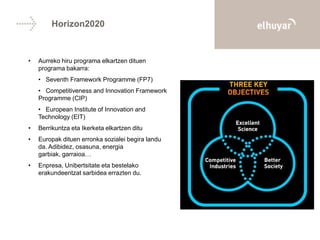
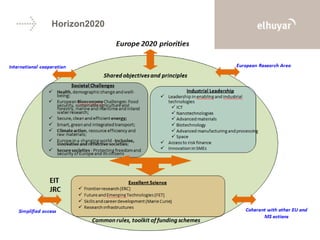
Horizon2020
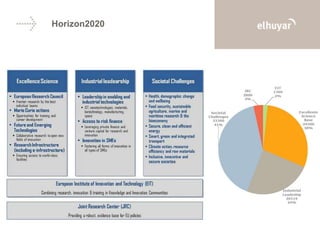
• Aurreko hiru programa elkartzen dituen
programa bakarra:
• Seventh Framework Programme (FP7)
• Competitiveness and Innovation Framework
Programme (CIP)
• European Institute of Innovation and
Technology (EIT)
• Berrikuntza eta Ikerketa elkartzen ditu
• Europak dituen erronka sozialei begira landu
da. Adibidez, osasuna, energia
garbiak, garraioa…
• Enpresa, Unibertsitate eta bestelako
erakundeentzat sarbidea errazten du.
Horizon2020
Horizon2020
Erasmus for All
The European Commission has published its proposal for the next generation of programmes entitled
‘Erasmus for All’, which will focus on education, training, youth and sport. The proposal outlines a new
integrated and streamlined approach, simplifying access routes to funding for beneficiaries.
Erasmus for All
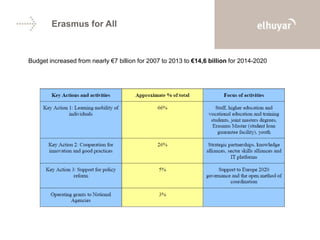
Budget increased from nearly €7 billion for 2007 to 2013 to €14,6 billion for 2014-2020
Creative Europe
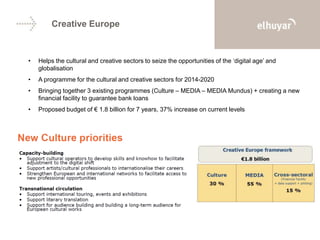
• Helps the cultural and creative sectors to seize the opportunities of the ‘digital age’ and
globalisation
• A programme for the cultural and creative sectors for 2014-2020
• Bringing together 3 existing programmes (Culture – MEDIA – MEDIA Mundus) + creating a new
financial facility to guarantee bank loans
• Proposed budget of € 1.8 billion for 7 years, 37% increase on current levels
NCP, LEAR and PIC
• National Contact Point (NCP): NCPs provide information and
guidance to anyone wishing to participate in EU research and
are able to offer personalised support in the proposer’s own
language. The NCPs are usually national structures set up and
financed by the governments of the 27 EU Member States and
the states associated to the Seventh Framework Programme
(FP7). Espainikoak hemen daude.
• Legal Entity Appointed Representative (LEAR): A legal
signatory of each legal entity must appoint one person (the so-
called LEAR – Legal Entity Appointed Representative) for
being the correspondent towards the Commission on all issues
related to the legal status of the entity. The LEAR
communicates his/her role internally in his/her organisation
and provides the PIC to other employees dealing with
proposals and grant agreements
• Participant Identification Code (PIC): All organisations
participating in FP7 will be assigned a Participant Identification
Code (or PIC). The organisations that already have signed an
FP7 grant agreement have already been assigned a PIC.
Project proposal
Iturria: Guía práctica de gestión de proyectos europeos
Eskerrik asko!

Europako diru-laguntza deialdiak ulertzeko hiztegi bat

  • 1.
    Europako diru-laguntza deialdiak ulertzekohiztegi bat Josu Waliño 2013/06/19
  • 2.
    1. ERA (EuropeanResearch Area) 2. Framework Programme 3. FP7 4. LLP 5. 'Work Programmes' and 'Calls for Proposals 6. Funding schemes 7. Europe 2020 8. Horizon 2020 9. Erasmus for All 10. Creative Europe 11. NCP, LEAR and PIC 12. Project proposal Glosarioa
  • 3.
    ERA (European ResearchArea) The idea of a European Research Area grew out of the realisation that research in Europe suffers from three weaknesses: insufficient funding, lack of an environment to stimulate research and exploit results, and the fragmented nature of activities and the dispersal of resources. To tackle this problem, the Commission proposed, in January 2000, the creation of a European Research Area. The initiative combines three related and complementary concepts: • the creation of an "internal market" in research, an area of free movement of knowledge, researchers and technology, with the aim of increasing cooperation, stimulating competition and achieving a better allocation of resources; • a restructuring of the European research fabric, in particular by improved coordination of national research activities and policies, which account for most of the research carried out and financed in Europe; • the development of a European research policy which not only addresses the funding of research activities, but also takes account of all relevant aspects of other EU and national policies http://ec.europa.eu/research/era/index_en.htm
  • 4.
    ERA (European ResearchArea) Iturria: Serafín de la Concha (CDTI)
  • 5.
    Framework Programme The FrameworkProgrammes for Research and Technological Development, also called Framework Programmes or abbreviated FP1 through FP8, are funding programmes created by the European Union in order to support and encourage research in the European Research Area (ERA). The specific objectives and actions vary between funding periods. Iturria: Wikipedia
  • 6.
  • 7.
    FP7 The complete nameof FP7 is 7 th Framework Programme for Research and Technological Development . It will last for seven years from 2007until 2013. The programme has a total budget of over € 50 billion. This represents a substantial increase compared with the previous Framework Programme FP6 (41% at 2004 prices, 63% at current prices), a reflection of the high priority of research in Europe. The Specific Programmes constitute the five major building blocks of FP7: • Cooperation. fostering collaboration between industry and academia to gain leadership in key technology areas • Ideas. supporting basic research at the scientific frontiers. • People. supporting mobility and career development for researchers both within and outside Europe. • Capacities. helping develop the capacities that Europe needs to be a thriving knowledge-based economy • Nuclear Research. developing Europe’s nuclear fission and fusion capabilities.
  • 8.
  • 9.
    Lifelong Learning Programme(LLP) As the flagship European Funding programme in the field of education and training, the Lifelong Learning Programme (LLP) enables individuals at all stages of their lives to pursue stimulating learning opportunities across Europe. It is an umbrella programme integrating various educational and training initiatives. LLP is divided in four sectorial sub programmes and four so called 'transversal' programmes. Budget: €7 billion for 2007-2013
  • 10.
    'Work Programmes' and'Calls for Proposals' The concrete plans for implementing the Specific Programmes are announced by the European Commission in annual 'Work Programmes'. These work programmes include the schedule of 'Calls for Proposals', commonly known just as 'Calls', to be published during the year. Each Call usually covers specific research areas, and you may have to wait until the publication of a Call which covers your exact area of interest. How will I know when a Call for Proposals is issued? All Calls are announced in the EU's Official Journal (which is the official source of EU documents). The annual work programmes and the full texts of the Calls are published on the FP7 section of CORDIS, the web site dedicated to EU-supported research. CORDIS is continuously updated with the latest information on Calls for proposals, as well as other information and services related to Community research. CORDIS will help you find information - and plan your proposal. http://cordis.europa.eu/fp7/home_en.html
  • 11.
    Funding Schemes "Funding schemes"are the types of projects, by which FP7 and LLP are implemented. These are some of the more usuals: FP7 • Collaborative projects (STREP and IPs) are focused research projects with clearly defined scientific and technological objectives and specific expected results. • Networks of Excellence are designed for research institutions willing to combine and functionally integrate a substantial part of their activities and capacities in a given field, in order to create a European "virtual research centre" in this field. • Coordination and support actions cover not the research itself, but the coordination and networking of projects, programmes and policies. LLP • Multilateral Projects. Projects which aim to develop, promote and disseminate educational good practice. • Multilateral Networks. Networks which represent as a minimum organisations from 6 countries and aim to develop education in their subject area or discipline. • Accompanying Measures aim to support various activities which will clearly contribute to achieving the Comenius Programme objectives
  • 12.
    Europe 2020 Europe 2020is the European Union’s ten-year growth strategy. It is about addressing the shortcomings of our growth model and creating the conditions for a different type of growth that is smarter, more sustainable and more inclusive. More info: http://ec.europa.eu/europe2020/index_en.htm Europe has identified new engines to boost growth and jobs. These areas are addressed by 7 flagship initiatives: The 5 targets for the EU in 2020: 1. Employment • 75% of the 20-64 year-olds to be employed 2. R&D • 3% of the EU's GDP to be invested in R&D 3. Climate change and energy sustainability • greenhouse gas emissions 20% • 20% of energy from renewables • 20% increase in energy efficiency 4. Education • Reducing the rates of early school leaving below 10% • at least 40% of 30-34–year-olds completing third level education 5. Fighting poverty and social exclusion • at least 20 million fewer people in or at risk of poverty and social exclusion
  • 14.
    Horizon2020 • Aurreko hiruprograma elkartzen dituen programa bakarra: • Seventh Framework Programme (FP7) • Competitiveness and Innovation Framework Programme (CIP) • European Institute of Innovation and Technology (EIT) • Berrikuntza eta Ikerketa elkartzen ditu • Europak dituen erronka sozialei begira landu da. Adibidez, osasuna, energia garbiak, garraioa… • Enpresa, Unibertsitate eta bestelako erakundeentzat sarbidea errazten du.
  • 15.
  • 16.
  • 18.
    Erasmus for All TheEuropean Commission has published its proposal for the next generation of programmes entitled ‘Erasmus for All’, which will focus on education, training, youth and sport. The proposal outlines a new integrated and streamlined approach, simplifying access routes to funding for beneficiaries.
  • 19.
    Erasmus for All Budgetincreased from nearly €7 billion for 2007 to 2013 to €14,6 billion for 2014-2020
  • 20.
    Creative Europe • Helpsthe cultural and creative sectors to seize the opportunities of the ‘digital age’ and globalisation • A programme for the cultural and creative sectors for 2014-2020 • Bringing together 3 existing programmes (Culture – MEDIA – MEDIA Mundus) + creating a new financial facility to guarantee bank loans • Proposed budget of € 1.8 billion for 7 years, 37% increase on current levels
  • 21.
    NCP, LEAR andPIC • National Contact Point (NCP): NCPs provide information and guidance to anyone wishing to participate in EU research and are able to offer personalised support in the proposer’s own language. The NCPs are usually national structures set up and financed by the governments of the 27 EU Member States and the states associated to the Seventh Framework Programme (FP7). Espainikoak hemen daude. • Legal Entity Appointed Representative (LEAR): A legal signatory of each legal entity must appoint one person (the so- called LEAR – Legal Entity Appointed Representative) for being the correspondent towards the Commission on all issues related to the legal status of the entity. The LEAR communicates his/her role internally in his/her organisation and provides the PIC to other employees dealing with proposals and grant agreements • Participant Identification Code (PIC): All organisations participating in FP7 will be assigned a Participant Identification Code (or PIC). The organisations that already have signed an FP7 grant agreement have already been assigned a PIC.
  • 22.
    Project proposal Iturria: Guíapráctica de gestión de proyectos europeos
  • 23.