Bringing Great Ideas to Life   FP7 Ideas programme  Meelis Kadaja Archimedes Foundation
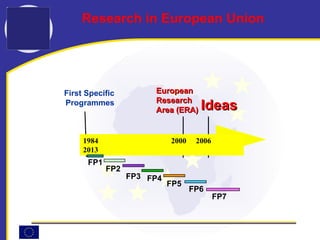
First Specific Programmes FP1 FP 6 FP 5 FP 4 European Research Area (ERA) FP 2 FP 3 FP7 Ideas Research in European  Union 1984  2000  2006  2013
Solution:  The FP7  Ideas  Specific Programme to support the truly creative scientists  to make the unpredictable and spectacular discoveries  that can change the course of human understandings.  A problem:  Europe does not perform well in terms of truly  outstanding research
Boost European excellence in frontier research basic research in science and technology is important to economic and social welfare; research at and beyond the frontiers of current understanding is the most challenging research area; research at frontiers of current understanding is characterized by an absence of disciplinary boundaries.  Strategic Aim
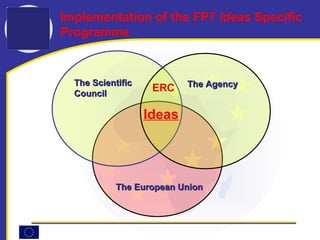
The European Union Implementation of t he   FP7  Ideas  Specific Programme Ideas The Scientific  Council The Agency ERC
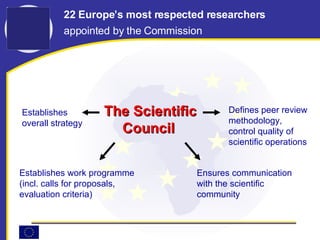
22 Europe’s most respected researchers  appointed by the Commission The Scientific Council Ensures communication  with the scientific community Establishes  overall strategy Establishes work programme (incl. calls for proposals,  evaluation criteria) Defines peer review  methodology,  control quality of  scientific operations
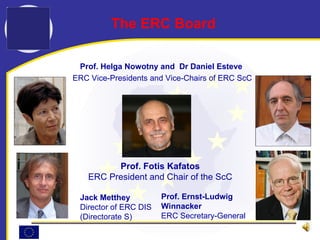
The ERC Board Prof. Fotis Kafatos ERC President and Chair of the ScC Prof. Helga Nowotny  and  Dr Daniel Esteve   ERC Vice-Presidents and Vice-Chairs of ERC ScC Prof. Ernst-Ludwig Winnacker ERC Secretary-General Jack Metthey Director of ERC DIS (Directorate S)
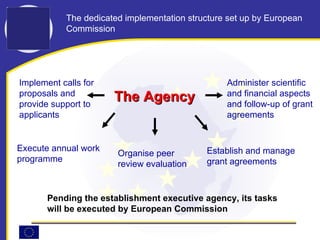
The  A gency The dedicated implementation structure set up by European Commission  Pending the establishment executive   agency, its tasks  will  be executed by European Commission Execute annual work programme  Implement calls for proposals and provide support to applicants Organise peer review evaluation Establish and manage grant agreements Administer scientific and financial aspects and follow-up of grant agreements
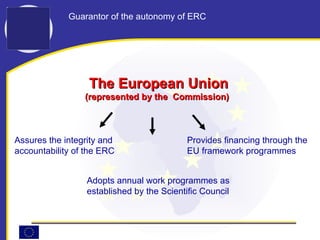
The European Union (represented by the  Commission) Provide s  financing through the EU framework programmes Guarant or of the  autonomy of ERC Assures the integrity and accountability of the ERC Adopts annual work programmes as established by the Scientific Council
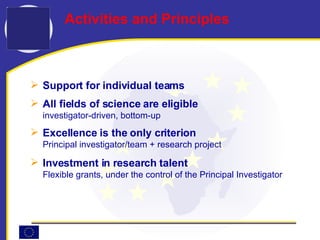
Support for individual teams  All fields of science are eligible investigator-driven, bottom-up  Excellence is the only criterion Principal investigator/team + research project  Investment in research talent Flexible grants, under the control of the Principal Investigator Activities and Principles
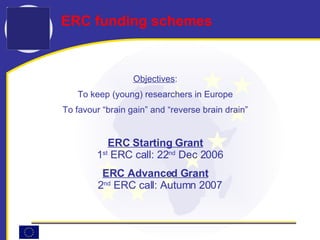
ERC funding schemes Objectives : To k eep (young) researchers in Europe To f avour “brain gain” and “reverse brain drain” ERC Starting Grant 1 st  ERC call: 22 nd  Dec 2006 ERC Advanced Grant 2 nd  ERC call: Autumn 2007
Support researchers at the start of their independent research career and  establishment of their first research team Provide a support for  transition  from working under a supervisor to independent research Supply grants   to  support the creation of excellent new teams  which bring energy and new ideas to their disciplines ERC Starting Grant (ERC Starting Independent Researcher Grant)
~  € 300M per year (approximately  ⅓ of ERC annual budget )  € 100k – 400k per grant per year € 0.5-2.0M per grant ~ 250 Starting Grants per year, each for up to 5 years 1400+ Starting Grants over 7 years of FP7 ERC Starting Grant (ERC Starting Independent Researcher Grant)
Designed to support excellent investigator-initiated research projects by established investigators Should complement the ERC Starting Grant scheme by targeting researchers who have already established their independence as team leaders € 100k-500k per grant per year max € 2 ,5  million per grant ca. 200 grants per year ERC Advanced Grant  (ERC Advanced Investigator Researcher Grant)
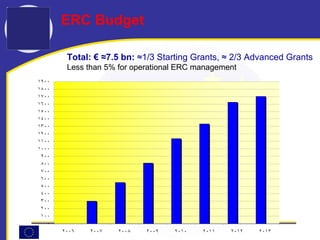
ERC Budget Total: € ≈7.5 bn :  ≈1/3 Starting Grants, ≈ 2/3 Advanced Grants Less than 5% for operational ERC management
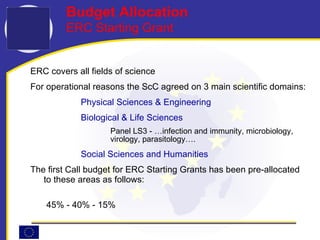
ERC covers all fields of science For operational reasons the ScC agreed on 3 main scientific   domains: Physical Sciences & Engineering Biological & Life Sciences Panel LS3 - …infection and immunity, microbiology,  virology, parasitology…. Social Sciences and Humanities The first Call budget for ERC Starting Grants has been pre-allocated to these areas as follows: 45% - 40% - 15% Budget Allocation ERC Starting Grant
Team leader + team members (if needed) The Team Leader (“Principal Investigator”) has the -  power to assemble his/her research group (team); -  freedom to choose the research topic.   Who can apply ?   Individual Teams
Ideas (ERC specific programme) encourages participation of researchers  from European and non-European countries  Level of participation varies with regard to  roles  and  funding Roles: Principal Investigator Can be of any nationality But:  PI’s host organisation needs to be established in EU Member States or Associated Countries, or be a international European Interest Organisations (such as CERN, EMBL, etc.) or the JRC Team Members Can be of  any age, nationality  in almost any country . Who can apply?  European and International Teams
PI young researcher is the applicant between 2-9 from the first PhD   degree. However up to 12 years extensions of this period may be allowed in case of eligible career breaks PI and contributing investigators (team members) Any nationality  One ERC Grant per investigator only may be active at any  t ime Hosting institution Located in a European Union or associated country Intra-European grant portability allowed Eligibility ERC Starting Grant
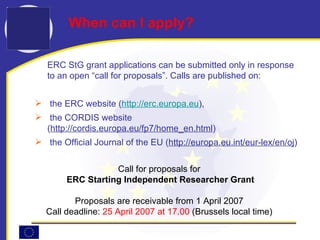
ERC StG grant applications can be submitted only in response to   an open “call for proposals”. Calls are published on : the ERC website ( http://erc.europa.eu ), the CORDIS website ( http://cordis.europa.eu/fp7/home_en.html )  the Official Journal of the EU ( http://europa.eu.int/eur-lex/en/oj )  When can I apply? Call for proposals for ERC Starting Independent Researcher Grant P roposals are receivable from 1 April 2007 Call deadline:   25 April 2007 at 17.00   (Brussels local time)
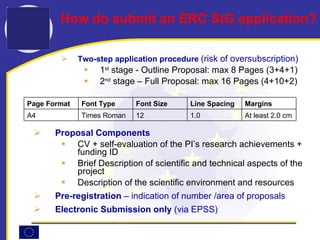
Two-step application procedure  (risk of oversubscription) 1 st  stage - Outline Proposal: max 8 Pages (3+4+1) 2 nd  stage – Full Proposal: max 16 Pages (4+10+2) Proposal Components CV + self-evaluation of the PI’s research achievements + funding ID Brief Description of scientific and technical aspects of the project Description of the scientific environment and resources Pre-registration  – indication of number /area of proposals Electronic Submission only  (via EPSS) How do submit an ERC StG application? At least 2.0 cm 1.0 12 Times Roman A4 Margins Line Spacing Font Size Font Type Page Format
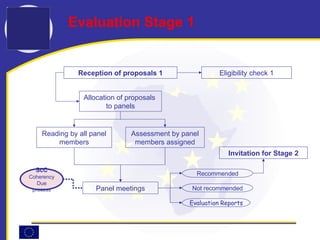
Reception of proposals 1 Allocation of proposals  to panels Panel meetings Evaluation Reports Not recommended Recommended Eligibility check 1 Invitation for Stage 2 ScC  Coherency  Due process Evaluation Stage  1 Assessment by panel members assigned Reading by all panel members
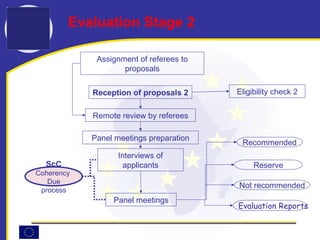
Reception of proposals 2 Eligibility check 2 Remote review by referees Interviews of applicants Panel meetings preparation Panel meetings Assignment of referees to proposals Evaluation Reports Reserve Not recommended Recommended ScC  Coherency  Due process Evaluation Stage  2
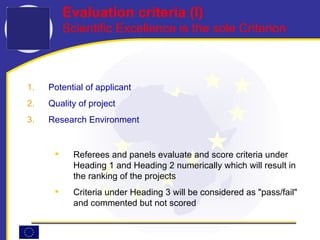
Evaluation criteria (I) Scientific Excellence is the sole Criterion Potential of applicant Quality of project Research Environment Referees and panels evaluate and score criteria under Heading 1 and Heading 2 numerically which will result in the ranking of the projects Criteria under Heading 3 will be considered as "pass/fail" and commented but not scored
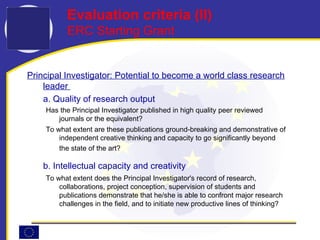
Principal Investigator: Potential to become a world class research leader  a. Quality of research output Has the Principal Investigator published in high quality peer reviewed journals or the equivalent? To what extent are these publications ground-breaking and demonstrative of independent creative thinking and capacity to go significantly beyond the state of the art?   b. Intellectual capacity and creativity To what extent does the Principal Investigator's record of research, collaborations, project conception, supervision of students and publications demonstrate that he/she is able to confront major research challenges in the field, and to initiate new productive lines of thinking? Evaluation criteria (I I ) ERC Starting Grant
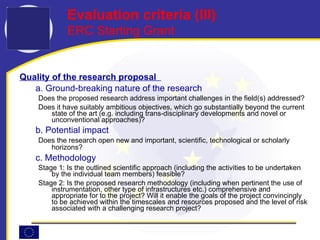
Quality of the research proposal   a. Ground-breaking nature of the research Does the proposed research address important challenges in the field(s) addressed? Does it have suitably ambitious objectives, which go substantially beyond the current state of the art (e.g. including trans-disciplinary developments and novel or unconventional approaches)?  b. Potential impact Does the research open new and important, scientific, technological or scholarly horizons?   c. Methodology Stage 1: Is the outlined scientific approach (including the activities to be undertaken by the individual team members) feasible? Stage 2: Is the proposed research methodology (including when pertinent the use of instrumentation, other type of infrastructures etc.) comprehensive and appropriate for to the project? Will it enable the goals of the project convincingly to be achieved within the timescales and resources proposed and the level of risk associated with a challenging research project? Evaluation criteria ( I I I ) ERC Starting Grant
Research Environment   a. Transition to independence Will the proposed project enable the Principal Investigator to make or consolidate the transition to independence?  b. Host institution [normally applicant legal entity] Does the institution hosting the project have most of the infrastructure necessary for the research to be carried out? Is it in a position to provide an appropriate intellectual environment and infrastructural support and to assist in achieving the ambitions for the project and the Principal Investigator?  c. Participation of other legal entities If it is proposed that other legal entities participate in the project, in addition to the applicant legal entity, is their participation fully justified by the scientific added value they bring to the project?  Evaluation criteria ( IV ) ERC Starting Grant
http:// erc.europa.eu Further Information

FP7 Specific Programme Ideas (March 2007)

  • 1.
    Bringing Great Ideasto Life FP7 Ideas programme Meelis Kadaja Archimedes Foundation
  • 2.
    First Specific ProgrammesFP1 FP 6 FP 5 FP 4 European Research Area (ERA) FP 2 FP 3 FP7 Ideas Research in European Union 1984 2000 2006 2013
  • 3.
    Solution: TheFP7 Ideas Specific Programme to support the truly creative scientists to make the unpredictable and spectacular discoveries that can change the course of human understandings. A problem: Europe does not perform well in terms of truly outstanding research
  • 4.
    Boost European excellencein frontier research basic research in science and technology is important to economic and social welfare; research at and beyond the frontiers of current understanding is the most challenging research area; research at frontiers of current understanding is characterized by an absence of disciplinary boundaries. Strategic Aim
  • 5.
    The European UnionImplementation of t he FP7 Ideas Specific Programme Ideas The Scientific Council The Agency ERC
  • 6.
    22 Europe’s mostrespected researchers appointed by the Commission The Scientific Council Ensures communication with the scientific community Establishes overall strategy Establishes work programme (incl. calls for proposals, evaluation criteria) Defines peer review methodology, control quality of scientific operations
  • 7.
    The ERC BoardProf. Fotis Kafatos ERC President and Chair of the ScC Prof. Helga Nowotny and Dr Daniel Esteve ERC Vice-Presidents and Vice-Chairs of ERC ScC Prof. Ernst-Ludwig Winnacker ERC Secretary-General Jack Metthey Director of ERC DIS (Directorate S)
  • 8.
    The Agency The dedicated implementation structure set up by European Commission Pending the establishment executive agency, its tasks will be executed by European Commission Execute annual work programme Implement calls for proposals and provide support to applicants Organise peer review evaluation Establish and manage grant agreements Administer scientific and financial aspects and follow-up of grant agreements
  • 9.
    The European Union(represented by the Commission) Provide s financing through the EU framework programmes Guarant or of the autonomy of ERC Assures the integrity and accountability of the ERC Adopts annual work programmes as established by the Scientific Council
  • 10.
    Support for individualteams All fields of science are eligible investigator-driven, bottom-up Excellence is the only criterion Principal investigator/team + research project Investment in research talent Flexible grants, under the control of the Principal Investigator Activities and Principles
  • 11.
    ERC funding schemesObjectives : To k eep (young) researchers in Europe To f avour “brain gain” and “reverse brain drain” ERC Starting Grant 1 st ERC call: 22 nd Dec 2006 ERC Advanced Grant 2 nd ERC call: Autumn 2007
  • 12.
    Support researchers atthe start of their independent research career and establishment of their first research team Provide a support for transition from working under a supervisor to independent research Supply grants to support the creation of excellent new teams which bring energy and new ideas to their disciplines ERC Starting Grant (ERC Starting Independent Researcher Grant)
  • 13.
    ~ €300M per year (approximately ⅓ of ERC annual budget ) € 100k – 400k per grant per year € 0.5-2.0M per grant ~ 250 Starting Grants per year, each for up to 5 years 1400+ Starting Grants over 7 years of FP7 ERC Starting Grant (ERC Starting Independent Researcher Grant)
  • 14.
    Designed to supportexcellent investigator-initiated research projects by established investigators Should complement the ERC Starting Grant scheme by targeting researchers who have already established their independence as team leaders € 100k-500k per grant per year max € 2 ,5 million per grant ca. 200 grants per year ERC Advanced Grant (ERC Advanced Investigator Researcher Grant)
  • 15.
    ERC Budget Total:€ ≈7.5 bn : ≈1/3 Starting Grants, ≈ 2/3 Advanced Grants Less than 5% for operational ERC management
  • 16.
    ERC covers allfields of science For operational reasons the ScC agreed on 3 main scientific domains: Physical Sciences & Engineering Biological & Life Sciences Panel LS3 - …infection and immunity, microbiology, virology, parasitology…. Social Sciences and Humanities The first Call budget for ERC Starting Grants has been pre-allocated to these areas as follows: 45% - 40% - 15% Budget Allocation ERC Starting Grant
  • 17.
    Team leader +team members (if needed) The Team Leader (“Principal Investigator”) has the - power to assemble his/her research group (team); - freedom to choose the research topic. Who can apply ? Individual Teams
  • 18.
    Ideas (ERC specificprogramme) encourages participation of researchers from European and non-European countries Level of participation varies with regard to roles and funding Roles: Principal Investigator Can be of any nationality But: PI’s host organisation needs to be established in EU Member States or Associated Countries, or be a international European Interest Organisations (such as CERN, EMBL, etc.) or the JRC Team Members Can be of any age, nationality in almost any country . Who can apply? European and International Teams
  • 19.
    PI young researcheris the applicant between 2-9 from the first PhD degree. However up to 12 years extensions of this period may be allowed in case of eligible career breaks PI and contributing investigators (team members) Any nationality One ERC Grant per investigator only may be active at any t ime Hosting institution Located in a European Union or associated country Intra-European grant portability allowed Eligibility ERC Starting Grant
  • 20.
    ERC StG grantapplications can be submitted only in response to an open “call for proposals”. Calls are published on : the ERC website ( http://erc.europa.eu ), the CORDIS website ( http://cordis.europa.eu/fp7/home_en.html ) the Official Journal of the EU ( http://europa.eu.int/eur-lex/en/oj ) When can I apply? Call for proposals for ERC Starting Independent Researcher Grant P roposals are receivable from 1 April 2007 Call deadline: 25 April 2007 at 17.00 (Brussels local time)
  • 21.
    Two-step application procedure (risk of oversubscription) 1 st stage - Outline Proposal: max 8 Pages (3+4+1) 2 nd stage – Full Proposal: max 16 Pages (4+10+2) Proposal Components CV + self-evaluation of the PI’s research achievements + funding ID Brief Description of scientific and technical aspects of the project Description of the scientific environment and resources Pre-registration – indication of number /area of proposals Electronic Submission only (via EPSS) How do submit an ERC StG application? At least 2.0 cm 1.0 12 Times Roman A4 Margins Line Spacing Font Size Font Type Page Format
  • 22.
    Reception of proposals1 Allocation of proposals to panels Panel meetings Evaluation Reports Not recommended Recommended Eligibility check 1 Invitation for Stage 2 ScC Coherency Due process Evaluation Stage 1 Assessment by panel members assigned Reading by all panel members
  • 23.
    Reception of proposals2 Eligibility check 2 Remote review by referees Interviews of applicants Panel meetings preparation Panel meetings Assignment of referees to proposals Evaluation Reports Reserve Not recommended Recommended ScC Coherency Due process Evaluation Stage 2
  • 24.
    Evaluation criteria (I)Scientific Excellence is the sole Criterion Potential of applicant Quality of project Research Environment Referees and panels evaluate and score criteria under Heading 1 and Heading 2 numerically which will result in the ranking of the projects Criteria under Heading 3 will be considered as "pass/fail" and commented but not scored
  • 25.
    Principal Investigator: Potentialto become a world class research leader a. Quality of research output Has the Principal Investigator published in high quality peer reviewed journals or the equivalent? To what extent are these publications ground-breaking and demonstrative of independent creative thinking and capacity to go significantly beyond the state of the art? b. Intellectual capacity and creativity To what extent does the Principal Investigator's record of research, collaborations, project conception, supervision of students and publications demonstrate that he/she is able to confront major research challenges in the field, and to initiate new productive lines of thinking? Evaluation criteria (I I ) ERC Starting Grant
  • 26.
    Quality of theresearch proposal a. Ground-breaking nature of the research Does the proposed research address important challenges in the field(s) addressed? Does it have suitably ambitious objectives, which go substantially beyond the current state of the art (e.g. including trans-disciplinary developments and novel or unconventional approaches)? b. Potential impact Does the research open new and important, scientific, technological or scholarly horizons? c. Methodology Stage 1: Is the outlined scientific approach (including the activities to be undertaken by the individual team members) feasible? Stage 2: Is the proposed research methodology (including when pertinent the use of instrumentation, other type of infrastructures etc.) comprehensive and appropriate for to the project? Will it enable the goals of the project convincingly to be achieved within the timescales and resources proposed and the level of risk associated with a challenging research project? Evaluation criteria ( I I I ) ERC Starting Grant
  • 27.
    Research Environment a. Transition to independence Will the proposed project enable the Principal Investigator to make or consolidate the transition to independence? b. Host institution [normally applicant legal entity] Does the institution hosting the project have most of the infrastructure necessary for the research to be carried out? Is it in a position to provide an appropriate intellectual environment and infrastructural support and to assist in achieving the ambitions for the project and the Principal Investigator? c. Participation of other legal entities If it is proposed that other legal entities participate in the project, in addition to the applicant legal entity, is their participation fully justified by the scientific added value they bring to the project? Evaluation criteria ( IV ) ERC Starting Grant
  • 28.