the EU framework programme for
     research and innovation

          Eric Badiqué
           DG INFSO
Horizon 2020
• Commission proposal for a 80 billion euro research and
  innovation funding programme (2014-20)
• Part of proposals for next EU budget, complementing
  Structural Funds, education, etc.
• A core part of Europe 2020, Innovation Union &
  European Research Area:
   – Responding to the economic crisis to invest in future jobs
     and growth
   – Addressing peoples’ concerns about their livelihoods, safety
     and environment.
   – Strengthening the EU’s global position in research,
     innovation and technology
What’s new?
• A single programme bringing together three separate
  programmes/initiatives (FP7, CIP, EIT)
• More innovation, from research to retail, all forms of
  innovation
• Focus on societal challenges facing EU society, e.g.
  health, clean energy and transport
• Simplified access, for all companies, universities,
  institutes in all EU countries and beyond.
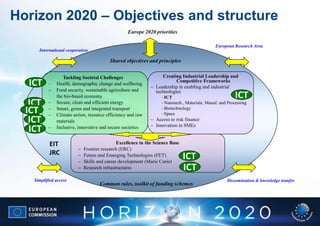
Horizon 2020 – Objectives and structure
                                                  Europe 2020 priorities

                                                                                             European Research Area
      International cooperation

                                         Shared objectives and principles


                  Tackling Societal Challenges                     Creating Industrial Leadership and
  ICT          Health, demographic change and wellbeing
                                                                         Competitive Frameworks
                                                               Leadership in enabling and industrial
               Food security, sustainable agriculture and      technologies
               the bio-based economy                               ICT                                  ICT
   ICT         Secure, clean and efficient energy                  Nanotech., Materials, Manuf. and Processing
  ICT          Smart, green and integrated transport
               Climate action, resource efficiency and raw
                                                                   Biotechnology
                                                                   Space
   ICT         materials                                       Access to risk finance
                                                               Innovation in SMEs
   ICT         Inclusive, innovative and secure societies


            EIT                              Excellence in the Science Base
                            Frontier research (ERC)
            JRC             Future and Emerging Technologies (FET)
                            Skills and career development (Marie Curie)
                                                                              ICT
                            Research infrastructures                          ICT
    Simplified access                                                                              Dissemination & knowledge tranfer
                                    Common rules, toolkit of funding schemes
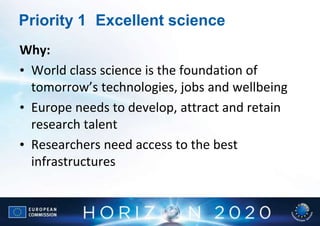
Priority 1 Excellent science
Why:
• World class science is the foundation of
  tomorrow’s technologies, jobs and wellbeing
• Europe needs to develop, attract and retain
  research talent
• Researchers need access to the best
  infrastructures
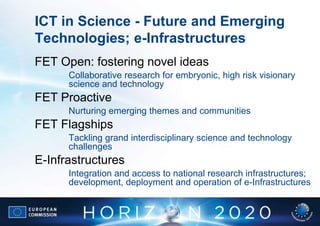
ICT in Science - Future and Emerging
Technologies; e-Infrastructures
FET Open: fostering novel ideas
      Collaborative research for embryonic, high risk visionary
      science and technology
FET Proactive
      Nurturing emerging themes and communities
FET Flagships
      Tackling grand interdisciplinary science and technology
      challenges
E-Infrastructures
      Integration and access to national research infrastructures;
      development, deployment and operation of e-Infrastructures
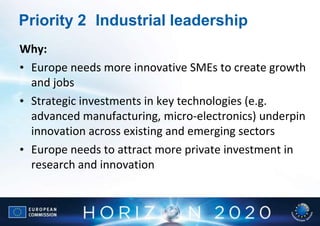
Priority 2 Industrial leadership
Why:
• Europe needs more innovative SMEs to create growth
  and jobs
• Strategic investments in key technologies (e.g.
  advanced manufacturing, micro-electronics) underpin
  innovation across existing and emerging sectors
• Europe needs to attract more private investment in
  research and innovation
ICT in Industrial Leadership (I)
1.   Components and systems
       Smart embedded components and systems, micro-nano-bio systems,
       organic electronics, large area integration, technologies for IoT, smart
       integrated systems, systems of systems and complex system engineering
2.   Next generation computing
       Processor and system architecture, interconnect and data localisation
       technologies, cloud computing, parallel computing and simulation
       software
3.   Future Internet
       Networks, software and services, cyber security, privacy and trust,
       wireless communication and all optical networks, immersive interactive
       multimedia and connected enterprise
ICT in Leadership (II)
4.   Content technologies and information management
       Technologies for language, learning, interaction, digital preservation,
       content access and analytics; advanced data mining, machine learning,
       statistical analysis and visual computing
5.   Advanced interfaces and robots
       Service robotics, cognitive systems, advanced interfaces, smart spaces
       and sentient machines
6.   Key Enabling Technologies: Micro- nano-electronics
     and photonics
       Design, advanced processes, pilot lines for fabrication, related production
       technologies and demonstration actions to validate technology
       developments and innovative business models
Innovation in SMEs
– Dedicated SME instrument
   • SME-led projects
   • Targeted at all types of innovative SMEs with ambition to grow and
     internationalise
   • Includes all types of innovation (non-technological, service..)
   • Supported across societal challenges and enabling technologies areas
       – Phase 1: Proof of concept
       – Phase 2: R&D, demonstration, market replication
       – Phase 3: Commercialisation (only support activities, e.g. facilitate access to
         private capital..)

– Support for research-intensive SMEs
   • Promote market-oriented innovation through Art. 185 JP (Eurostars)

– Accompanying measures
   • Awareness raising, info and dissemination, training…
   • Improving framework conditions
Access to risk finance
 – Debt instrument
    •   Loans to single beneficiaries
    •   Guarantees to financial intermediaries
    •   Combinations of loans and guarantees
    •   Linked to the SME instrument

 – Equity instrument
    • Start-up facility
    • Growth facility

 – Accompanying measures
    •   Technical assistance
    •   Investment readiness schemes
    •   Schemes to attract private investors
    •   Encouragement for philantropic foundations

                          -> Implementation delegated to the EIB and EIF
Priority 3 Societal challenges
Why:
• EU policy objectives (climate, environment, energy,
  transport etc) cannot be achieved without innovation
• Breakthrough solutions come from multi-disciplinary
  collaborations, including social sciences & humanities
• Promising solutions need to be tested, demonstrated
  and scaled up
ICT in societal challenges (I)

 –   Health, demographic change & wellbeing;
     •   e-health, self management of health, improved diagnostics,
         improved surveillance, health data collection, active ageing,
         assisted living;
 –   Secure, clean and efficient energy;
     •   Smart cities; Energy efficient buildings; smart electricity grids;
         smart metering;
 –   Smart, green and integrated transport;
     •   Smart transport equipment, infrastructures and services;
         innovative transport management systems; safety aspects
ICT in societal challenges (II)

 –   Climate action, resource efficiency and raw materials
     •   ICT for increased resource efficiency; earth observation and
         monitoring
 –   Inclusive, innovative and secure societies
     •   Digital inclusion; social innovation platforms; e-government
         services; e-skills and e-learning; e-culture; cyber security;
         ensuring privacy and protection of human rights on-line
Next steps
Ongoing:  Parliament and Council negotiations on the basis of
          the Commission proposals
          Parliament and Council negotiations on EU budget
          2014-20 (including overall budget for Horizon 2020)
Mid 2012: Final calls under 7th Framework Programme for
          Research to bridge gap towards Horizon 2020
End 2013: Adoption of legislative acts by Parliament and Council
          on Horizon 2020
1/1/2014: Horizon 2020 starts; launch of first calls
Thank you for your attention!

             Find out more:

www.ec.europa.eu/research/horizon2020

Europe 2014-2020: programme de recherche & innovation Horizon 2020

  • 1.
    the EU frameworkprogramme for research and innovation Eric Badiqué DG INFSO
  • 2.
    Horizon 2020 • Commissionproposal for a 80 billion euro research and innovation funding programme (2014-20) • Part of proposals for next EU budget, complementing Structural Funds, education, etc. • A core part of Europe 2020, Innovation Union & European Research Area: – Responding to the economic crisis to invest in future jobs and growth – Addressing peoples’ concerns about their livelihoods, safety and environment. – Strengthening the EU’s global position in research, innovation and technology
  • 3.
    What’s new? • Asingle programme bringing together three separate programmes/initiatives (FP7, CIP, EIT) • More innovation, from research to retail, all forms of innovation • Focus on societal challenges facing EU society, e.g. health, clean energy and transport • Simplified access, for all companies, universities, institutes in all EU countries and beyond.
  • 4.
    Horizon 2020 –Objectives and structure Europe 2020 priorities European Research Area International cooperation Shared objectives and principles Tackling Societal Challenges Creating Industrial Leadership and ICT Health, demographic change and wellbeing Competitive Frameworks Leadership in enabling and industrial Food security, sustainable agriculture and technologies the bio-based economy ICT ICT ICT Secure, clean and efficient energy Nanotech., Materials, Manuf. and Processing ICT Smart, green and integrated transport Climate action, resource efficiency and raw Biotechnology Space ICT materials Access to risk finance Innovation in SMEs ICT Inclusive, innovative and secure societies EIT Excellence in the Science Base Frontier research (ERC) JRC Future and Emerging Technologies (FET) Skills and career development (Marie Curie) ICT Research infrastructures ICT Simplified access Dissemination & knowledge tranfer Common rules, toolkit of funding schemes
  • 5.
    Priority 1 Excellentscience Why: • World class science is the foundation of tomorrow’s technologies, jobs and wellbeing • Europe needs to develop, attract and retain research talent • Researchers need access to the best infrastructures
  • 6.
    ICT in Science- Future and Emerging Technologies; e-Infrastructures FET Open: fostering novel ideas Collaborative research for embryonic, high risk visionary science and technology FET Proactive Nurturing emerging themes and communities FET Flagships Tackling grand interdisciplinary science and technology challenges E-Infrastructures Integration and access to national research infrastructures; development, deployment and operation of e-Infrastructures
  • 7.
    Priority 2 Industrialleadership Why: • Europe needs more innovative SMEs to create growth and jobs • Strategic investments in key technologies (e.g. advanced manufacturing, micro-electronics) underpin innovation across existing and emerging sectors • Europe needs to attract more private investment in research and innovation
  • 8.
    ICT in IndustrialLeadership (I) 1. Components and systems Smart embedded components and systems, micro-nano-bio systems, organic electronics, large area integration, technologies for IoT, smart integrated systems, systems of systems and complex system engineering 2. Next generation computing Processor and system architecture, interconnect and data localisation technologies, cloud computing, parallel computing and simulation software 3. Future Internet Networks, software and services, cyber security, privacy and trust, wireless communication and all optical networks, immersive interactive multimedia and connected enterprise
  • 9.
    ICT in Leadership(II) 4. Content technologies and information management Technologies for language, learning, interaction, digital preservation, content access and analytics; advanced data mining, machine learning, statistical analysis and visual computing 5. Advanced interfaces and robots Service robotics, cognitive systems, advanced interfaces, smart spaces and sentient machines 6. Key Enabling Technologies: Micro- nano-electronics and photonics Design, advanced processes, pilot lines for fabrication, related production technologies and demonstration actions to validate technology developments and innovative business models
  • 10.
    Innovation in SMEs –Dedicated SME instrument • SME-led projects • Targeted at all types of innovative SMEs with ambition to grow and internationalise • Includes all types of innovation (non-technological, service..) • Supported across societal challenges and enabling technologies areas – Phase 1: Proof of concept – Phase 2: R&D, demonstration, market replication – Phase 3: Commercialisation (only support activities, e.g. facilitate access to private capital..) – Support for research-intensive SMEs • Promote market-oriented innovation through Art. 185 JP (Eurostars) – Accompanying measures • Awareness raising, info and dissemination, training… • Improving framework conditions
  • 11.
    Access to riskfinance – Debt instrument • Loans to single beneficiaries • Guarantees to financial intermediaries • Combinations of loans and guarantees • Linked to the SME instrument – Equity instrument • Start-up facility • Growth facility – Accompanying measures • Technical assistance • Investment readiness schemes • Schemes to attract private investors • Encouragement for philantropic foundations -> Implementation delegated to the EIB and EIF
  • 12.
    Priority 3 Societalchallenges Why: • EU policy objectives (climate, environment, energy, transport etc) cannot be achieved without innovation • Breakthrough solutions come from multi-disciplinary collaborations, including social sciences & humanities • Promising solutions need to be tested, demonstrated and scaled up
  • 13.
    ICT in societalchallenges (I) – Health, demographic change & wellbeing; • e-health, self management of health, improved diagnostics, improved surveillance, health data collection, active ageing, assisted living; – Secure, clean and efficient energy; • Smart cities; Energy efficient buildings; smart electricity grids; smart metering; – Smart, green and integrated transport; • Smart transport equipment, infrastructures and services; innovative transport management systems; safety aspects
  • 14.
    ICT in societalchallenges (II) – Climate action, resource efficiency and raw materials • ICT for increased resource efficiency; earth observation and monitoring – Inclusive, innovative and secure societies • Digital inclusion; social innovation platforms; e-government services; e-skills and e-learning; e-culture; cyber security; ensuring privacy and protection of human rights on-line
  • 15.
    Next steps Ongoing: Parliament and Council negotiations on the basis of the Commission proposals Parliament and Council negotiations on EU budget 2014-20 (including overall budget for Horizon 2020) Mid 2012: Final calls under 7th Framework Programme for Research to bridge gap towards Horizon 2020 End 2013: Adoption of legislative acts by Parliament and Council on Horizon 2020 1/1/2014: Horizon 2020 starts; launch of first calls
  • 16.
    Thank you foryour attention! Find out more: www.ec.europa.eu/research/horizon2020