I Year B.Ed - CORE 3
LEARNING AND TEACHING
Ms R SRIDEVI
Assistant Professor, Pedagogy of Mathematics,
Loyola College of Education
Chennai 34
UNIT VI
LEARNER CENTRED TEACHING
Need for LEARNER CENTERED
teaching / LEARNING
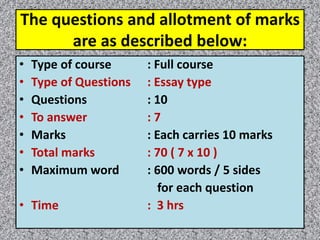
The questions and allotment of marks
are as described below:
• Type of course : Full course
• Type of Questions : Essay type
• Questions : 10
• To answer : 7
• Marks : Each carries 10 marks
• Total marks : 70 ( 7 x 10 )
• Maximum word : 600 words / 5 sides
for each question
• Time : 3 hrs
LEARNER- CENTERED TEACHING
UNIT VI
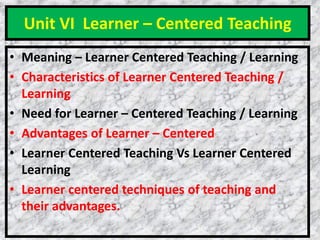
Unit VI Learner – Centered Teaching
• Meaning – Learner Centered Teaching / Learning
• Characteristics of Learner Centered Teaching /
Learning
• Need for Learner – Centered Teaching / Learning
• Advantages of Learner – Centered
• Learner Centered Teaching Vs Learner Centered
Learning
• Learner centered techniques of teaching and
their advantages.
NEED FOR LEARNER
CENTERED TEACHING /
LEARNING
Need for learner centered teaching
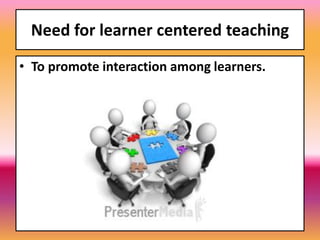
• To promote interaction among learners.
Need for learner centered teaching
• Reliance on active rather than passive
learning.
Need for learner centered teaching
• An emphasis on deep learning and
understanding.
Need for learner centered teaching
• Increased responsibility and accountability
on the part of the student.
Need for learner centered teaching
• An increased sense of autonomy in the
learner.
Need for learner centered teaching
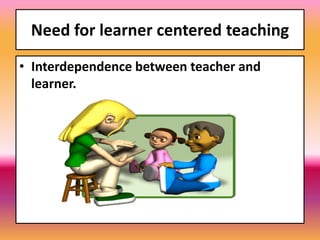
• Interdependence between teacher and
learner.
Helping students adjust to a new and
different learning environment
Giving students the chance to express
their ideas in their terms
Helping to set the goals of student-
centered classes
Helping students learn how to set and
achieve their personal, educational
goals
Giving students enough room to fail
and learn from their missteps
Helping students develop their
critical-thinking and self-reflection
skills
Giving students the space to act as
their advocates in the learning
process
Showing students specific techniques
for accessing the information they’re
interested in
EDUCATIONAL IMPLICATIONS
21
THANK YOU

2. unit vi need for learner centered teaching or learning

  • 1.
    I Year B.Ed- CORE 3 LEARNING AND TEACHING Ms R SRIDEVI Assistant Professor, Pedagogy of Mathematics, Loyola College of Education Chennai 34 UNIT VI LEARNER CENTRED TEACHING Need for LEARNER CENTERED teaching / LEARNING
  • 2.
    The questions andallotment of marks are as described below: • Type of course : Full course • Type of Questions : Essay type • Questions : 10 • To answer : 7 • Marks : Each carries 10 marks • Total marks : 70 ( 7 x 10 ) • Maximum word : 600 words / 5 sides for each question • Time : 3 hrs
  • 3.
  • 4.
    Unit VI Learner– Centered Teaching • Meaning – Learner Centered Teaching / Learning • Characteristics of Learner Centered Teaching / Learning • Need for Learner – Centered Teaching / Learning • Advantages of Learner – Centered • Learner Centered Teaching Vs Learner Centered Learning • Learner centered techniques of teaching and their advantages.
  • 5.
    NEED FOR LEARNER CENTEREDTEACHING / LEARNING
  • 6.
    Need for learnercentered teaching
  • 7.
    Need for learnercentered teaching • To promote interaction among learners.
  • 8.
    Need for learnercentered teaching • Reliance on active rather than passive learning.
  • 9.
    Need for learnercentered teaching • An emphasis on deep learning and understanding.
  • 10.
    Need for learnercentered teaching • Increased responsibility and accountability on the part of the student.
  • 11.
    Need for learnercentered teaching • An increased sense of autonomy in the learner.
  • 12.
    Need for learnercentered teaching • Interdependence between teacher and learner.
  • 13.
    Helping students adjustto a new and different learning environment
  • 14.
    Giving students thechance to express their ideas in their terms
  • 15.
    Helping to setthe goals of student- centered classes
  • 16.
    Helping students learnhow to set and achieve their personal, educational goals
  • 17.
    Giving students enoughroom to fail and learn from their missteps
  • 18.
    Helping students developtheir critical-thinking and self-reflection skills
  • 19.
    Giving students thespace to act as their advocates in the learning process
  • 20.
    Showing students specifictechniques for accessing the information they’re interested in
  • 21.
  • 22.